HYDROGELS & SILICONE HYDROGELS
WHEN AND WHY??
Churawan Lal Sahu
M Optom
1Churwan Lal Sahu M Optom
HYDROGELS & SILICONE
HYDROGELS
Hydrogels-Advantages
 Offers good initial comfort
 Less Prone to displacement
 Offers Good Centration
 Stabilize promptly after insertion
Churwan Lal Sahu M Optom 2
HYDROGELS & SILICONE
HYDROGELS
Hydrogels-Disadvantages
 Poor oxygen transmission
 More dryness
 Greater care and maintenance
 Limited parameters available
Churwan Lal Sahu M Optom 3
HYDROGELS & SILICONE
HYDROGELS
Hydrogels-Disadvantages
 Lens handling can be difficult
 Uptake of preservatives
 May discolour with topical medications
Churwan Lal Sahu M Optom 4
HYDROGELS & SILICONE
HYDROGELS
Hydrogels-Indications
 Who rarely uses CL
 Who uses CL only for 6-8hours
 Who are concerned about Money
Churwan Lal Sahu M Optom 5
HYDROGELS & SILICONE
HYDROGELS
How does the cornea get its O2 if it doesn’t have blood vessels?
 Cornea – Avascular Structure
 O2 required – Principally from the atmosphere
 Reduced oxygen supply can result in changes to the
epithelium, stroma and endothelium
Churwan Lal Sahu M Optom 6
HYDROGELS & SILICONE
HYDROGELS
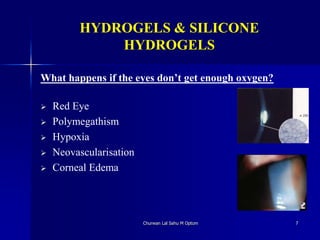
What happens if the eyes don’t get enough oxygen?
 Red Eye
 Polymegathism
 Hypoxia
 Neovascularisation
 Corneal Edema
Churwan Lal Sahu M Optom 7
HYDROGELS & SILICONE
HYDROGELS
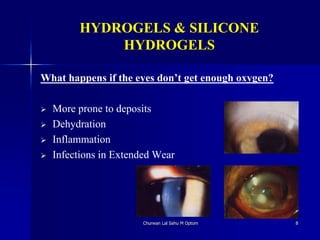
What happens if the eyes don’t get enough oxygen?
 More prone to deposits
 Dehydration
 Inflammation
 Infections in Extended Wear
Churwan Lal Sahu M Optom 8
HYDROGELS & SILICONE
HYDROGELS
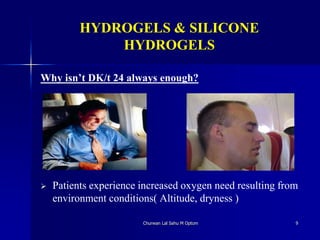
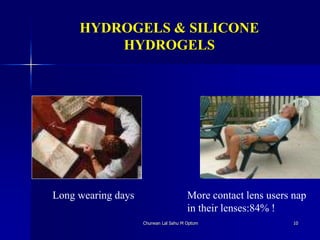
Why isn’t DK/t 24 always enough?
 Patients experience increased oxygen need resulting from
environment conditions( Altitude, dryness )
Churwan Lal Sahu M Optom 9
HYDROGELS & SILICONE
HYDROGELS
Churwan Lal Sahu M Optom 10
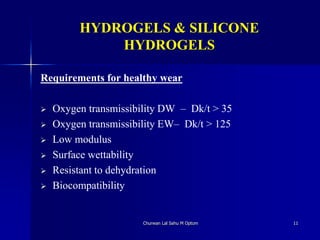
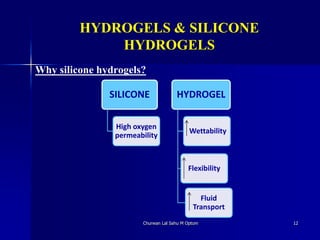
Long wearing days More contact lens users nap
in their lenses:84% !
HYDROGELS & SILICONE
HYDROGELS
Requirements for healthy wear
 Oxygen transmissibility DW – Dk/t > 35
 Oxygen transmissibility EW– Dk/t > 125
 Low modulus
 Surface wettability
 Resistant to dehydration
 Biocompatibility
Churwan Lal Sahu M Optom 11
HYDROGELS & SILICONE
HYDROGELS
Why silicone hydrogels?
Churwan Lal Sahu M Optom 12
SILICONE
High oxygen
permeability
HYDROGEL
Wettability
Flexibility
Fluid
Transport
HYDROGELS & SILICONE
HYDROGELS
Churwan Lal Sahu M Optom 13
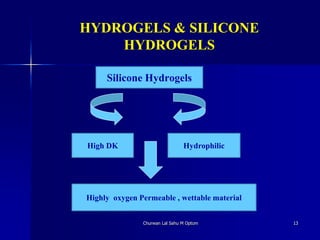
Silicone Hydrogels
High DK Hydrophilic
Highly oxygen Permeable , wettable material
HYDROGELS & SILICONE
HYDROGELS
Silicone hydrogels: Advantages
 More healthier than conventional SCL
 Increased oxygen transmission
 More resistance to protein deposits
 Less dehydration
 Lower risk of infection
 Lower incidence of complication with EW
Churwan Lal Sahu M Optom 14
HYDROGELS & SILICONE
HYDROGELS
Silicone hydrogels: Indications
 High prescriptions
 Wearers who experience end of day discomfort/dryness/redness
 Wearing hours>12-14hrs
 Whose eye requires more oxygen
 Who work long hours in low humidity/air conditioning
Churwan Lal Sahu M Optom 15
HYDROGELS & SILICONE
HYDROGELS
Silicone Hydrogels:Properties
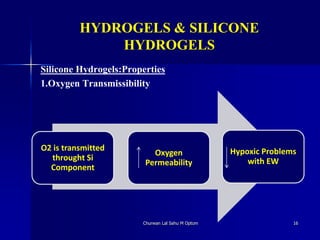
1.Oxygen Transmissibility
Churwan Lal Sahu M Optom 16
O2 is transmitted
throught Si
Component
Oxygen
Permeability
Hypoxic Problems
with EW
HYDROGELS & SILICONE
HYDROGELS
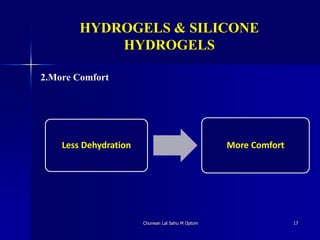
2.More Comfort
Churwan Lal Sahu M Optom 17
Less Dehydration More Comfort
HYDROGELS & SILICONE
HYDROGELS
3.Increased rigidity
 Easily handle
 Corneal astigmatism is masked
Churwan Lal Sahu M Optom 18
HYDROGELS & SILICONE
HYDROGELS
4.Surface wettability
 Contact Angle (CA) -Ability of a fluid to spread over a
contact lens surface
 CA more wettable the surface
 Higher Wettability More comfort
Churwan Lal Sahu M Optom 19
HYDROGELS & SILICONE
HYDROGELS
Silicone Hydrogels:Disadvantages
 More expensive
 Attract lipid deposits Blurred vision/Discomfort
 Rigid material Adaptation Issues
Churwan Lal Sahu M Optom 20
HYDROGELS & SILICONE
HYDROGELS
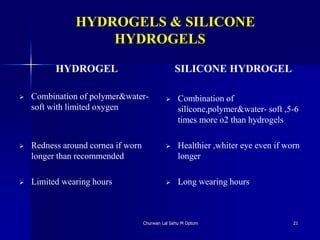
HYDROGEL
 Combination of polymer&water-
soft with limited oxygen
 Redness around cornea if worn
longer than recommended
 Limited wearing hours
SILICONE HYDROGEL
 Combination of
silicone,polymer&water- soft ,5-6
times more o2 than hydrogels
 Healthier ,whiter eye even if worn
longer
 Long wearing hours
Churwan Lal Sahu M Optom 21
HYDROGELS & SILICONE
HYDROGELS
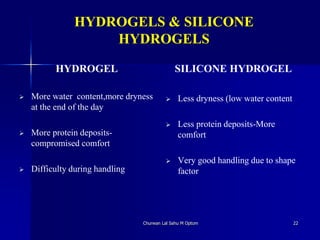
 More water content,more dryness
at the end of the day
 More protein deposits-
compromised comfort
 Difficulty during handling
 Less dryness (low water content
 Less protein deposits-More
comfort
 Very good handling due to shape
factor
Churwan Lal Sahu M Optom 22
HYDROGEL SILICONE HYDROGEL
THANK YOU
23Churwan Lal Sahu M Optom

Hydrogels and silicone hydrogels

  • 1.
    HYDROGELS & SILICONEHYDROGELS WHEN AND WHY?? Churawan Lal Sahu M Optom 1Churwan Lal Sahu M Optom
  • 2.
    HYDROGELS & SILICONE HYDROGELS Hydrogels-Advantages Offers good initial comfort  Less Prone to displacement  Offers Good Centration  Stabilize promptly after insertion Churwan Lal Sahu M Optom 2
  • 3.
    HYDROGELS & SILICONE HYDROGELS Hydrogels-Disadvantages Poor oxygen transmission  More dryness  Greater care and maintenance  Limited parameters available Churwan Lal Sahu M Optom 3
  • 4.
    HYDROGELS & SILICONE HYDROGELS Hydrogels-Disadvantages Lens handling can be difficult  Uptake of preservatives  May discolour with topical medications Churwan Lal Sahu M Optom 4
  • 5.
    HYDROGELS & SILICONE HYDROGELS Hydrogels-Indications Who rarely uses CL  Who uses CL only for 6-8hours  Who are concerned about Money Churwan Lal Sahu M Optom 5
  • 6.
    HYDROGELS & SILICONE HYDROGELS Howdoes the cornea get its O2 if it doesn’t have blood vessels?  Cornea – Avascular Structure  O2 required – Principally from the atmosphere  Reduced oxygen supply can result in changes to the epithelium, stroma and endothelium Churwan Lal Sahu M Optom 6
  • 7.
    HYDROGELS & SILICONE HYDROGELS Whathappens if the eyes don’t get enough oxygen?  Red Eye  Polymegathism  Hypoxia  Neovascularisation  Corneal Edema Churwan Lal Sahu M Optom 7
  • 8.
    HYDROGELS & SILICONE HYDROGELS Whathappens if the eyes don’t get enough oxygen?  More prone to deposits  Dehydration  Inflammation  Infections in Extended Wear Churwan Lal Sahu M Optom 8
  • 9.
    HYDROGELS & SILICONE HYDROGELS Whyisn’t DK/t 24 always enough?  Patients experience increased oxygen need resulting from environment conditions( Altitude, dryness ) Churwan Lal Sahu M Optom 9
  • 10.
    HYDROGELS & SILICONE HYDROGELS ChurwanLal Sahu M Optom 10 Long wearing days More contact lens users nap in their lenses:84% !
  • 11.
    HYDROGELS & SILICONE HYDROGELS Requirementsfor healthy wear  Oxygen transmissibility DW – Dk/t > 35  Oxygen transmissibility EW– Dk/t > 125  Low modulus  Surface wettability  Resistant to dehydration  Biocompatibility Churwan Lal Sahu M Optom 11
  • 12.
    HYDROGELS & SILICONE HYDROGELS Whysilicone hydrogels? Churwan Lal Sahu M Optom 12 SILICONE High oxygen permeability HYDROGEL Wettability Flexibility Fluid Transport
  • 13.
    HYDROGELS & SILICONE HYDROGELS ChurwanLal Sahu M Optom 13 Silicone Hydrogels High DK Hydrophilic Highly oxygen Permeable , wettable material
  • 14.
    HYDROGELS & SILICONE HYDROGELS Siliconehydrogels: Advantages  More healthier than conventional SCL  Increased oxygen transmission  More resistance to protein deposits  Less dehydration  Lower risk of infection  Lower incidence of complication with EW Churwan Lal Sahu M Optom 14
  • 15.
    HYDROGELS & SILICONE HYDROGELS Siliconehydrogels: Indications  High prescriptions  Wearers who experience end of day discomfort/dryness/redness  Wearing hours>12-14hrs  Whose eye requires more oxygen  Who work long hours in low humidity/air conditioning Churwan Lal Sahu M Optom 15
  • 16.
    HYDROGELS & SILICONE HYDROGELS SiliconeHydrogels:Properties 1.Oxygen Transmissibility Churwan Lal Sahu M Optom 16 O2 is transmitted throught Si Component Oxygen Permeability Hypoxic Problems with EW
  • 17.
    HYDROGELS & SILICONE HYDROGELS 2.MoreComfort Churwan Lal Sahu M Optom 17 Less Dehydration More Comfort
  • 18.
    HYDROGELS & SILICONE HYDROGELS 3.Increasedrigidity  Easily handle  Corneal astigmatism is masked Churwan Lal Sahu M Optom 18
  • 19.
    HYDROGELS & SILICONE HYDROGELS 4.Surfacewettability  Contact Angle (CA) -Ability of a fluid to spread over a contact lens surface  CA more wettable the surface  Higher Wettability More comfort Churwan Lal Sahu M Optom 19
  • 20.
    HYDROGELS & SILICONE HYDROGELS SiliconeHydrogels:Disadvantages  More expensive  Attract lipid deposits Blurred vision/Discomfort  Rigid material Adaptation Issues Churwan Lal Sahu M Optom 20
  • 21.
    HYDROGELS & SILICONE HYDROGELS HYDROGEL Combination of polymer&water- soft with limited oxygen  Redness around cornea if worn longer than recommended  Limited wearing hours SILICONE HYDROGEL  Combination of silicone,polymer&water- soft ,5-6 times more o2 than hydrogels  Healthier ,whiter eye even if worn longer  Long wearing hours Churwan Lal Sahu M Optom 21
  • 22.
    HYDROGELS & SILICONE HYDROGELS More water content,more dryness at the end of the day  More protein deposits- compromised comfort  Difficulty during handling  Less dryness (low water content  Less protein deposits-More comfort  Very good handling due to shape factor Churwan Lal Sahu M Optom 22 HYDROGEL SILICONE HYDROGEL
  • 23.