Java Networking


                  1
Topics
●   Basic Concepts on Networking
    –   IP Address
    –   Protocol
    –   Ports
    –   The Client/Server Paradigm
    –   Sockets


●   The Java Networking Package
    –   The ServerSocket and the Socket Class
    –   The MulticastSocket and the DatagramPacket Class
                                                           2
Basic Concepts on Networking
●   The Internet
    –   A global network of computers connected together in
        various ways
    –   Remains functional despite of diversity of hardware
        and software connected together
         ●   Possible through communication standards defined
             and conformed to
         ●   Guarantee compatibility and reliability of
             communication


                                                                3
Basic Concepts on Networking: IP
               Address
●   Logically similar to the traditional mailing address
     –   An address uniquely identifies a particular object


●   Each computer connected to the Internet has a
    unique IP address

●   A 32-bit number used to uniquely identify each
    computer connected to the Internet
     –   192.1.1.1
     –   docs.rinet.ru
                                                              4
Basic Concepts on Networking:
               Protocol
●   Why protocols?
    –   Different types of communication occurring over the
        Internet
    –   Each type of communication requires a specific and
        unique protocol


●   Definition
    –   Set of rules and standards that define a certain type
        of Internet communication
    –   Describes the following information:
         ●   Format of data being sent over the Internet        5
Basic Concepts on Networking:
              Protocol
●   Not entirely new to us. Consider this type of
    conversation:
         "Hello."
         "Hello. Good afternoon. May I please speak at Joan?"
         "Okay, please wait for a while."
         "Thanks."
         ...
    –   Social protocol used in a telephone conversation
    –   Gives us confidence and familiarity of knowing what
        to do

                                                                6
Basic Concepts on Networking:
              Protocol
●   Some important protocols used over the Internet
    –   Hypertext Transfer Protocol (HTTP)
         ●   Used to transfer HTML documents on the Web
    –   File Transfer Protocol (FTP)
         ●   More general compared to HTTP
         ●   Allows you to transfer binary files over the Internet
    –   Both protocols have their own set of rules and
        standards on how data is transferred
    –   Java provides support for both protocols


                                                                     7
Basic Concepts on Networking: Ports
●   Protocols only make sense when used in the
    context of a service
    –   HTTP protocol is used when you are providing Web
        content through an HTTP service
    –   Each computer on the Internet can provide a variety
        of services


●   Why Ports?
    –   The type of service must be known before
        information can be transferred

                                                              8
Basic Concepts on Networking: Ports
●   Definition:
    –   A 16-bit number that identifies each service offered
        by a network server

●   Using a particular service to establish a line of
    communication through a specific protocol
    –   Need to connect to the appropriate port


                                                               9
Basic Concepts on Networking: Ports
●   Standard ports
    –   Numbers specifically associated with a particular
        type of service
    –   Examples:
         ●   The FTP service is located on port 21
         ●   The HTTP service is located on port 80
    –   Given port values below 1024


●   Port values above 1024
    –   Available for custom communication
                                                            10
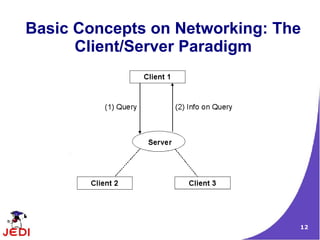
Basic Concepts on Networking: The
      Client/Server Paradigm
●   Basis for Java networking framework

●   Involves two major elements:
    –   Client
         ●   Machine in need of some type of information
    –   Server
         ●   Machine storing information and waiting to give it out


●   Scenario:
    –   Client connects to a server and queries for certain
                                                                      11
Basic Concepts on Networking: The
      Client/Server Paradigm


                                12
Basic Concepts on Networking:
               Sockets
●   Definitions:
    –   Software abstraction for an input or output medium
        of communication
    –   Communication channels that enable you to transfer
        data through a particular port
    –   An endpoint for communication between two
        machines
    –   A particular type of network communication used in
        most Java network programming
    –   Java performs all of its low-level network
        communication through sockets
                                                             13
The Java Networking Package
●   The java.net package

●   Provides classes useful for developing networking
    applications

●   Some classes in the package:
    –   ServerSocket
    –   Socket
    –   MulticastSocket
    –   DatagramPacket
                                                        14
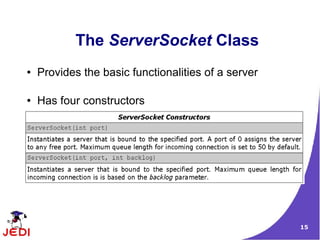
The ServerSocket Class
●   Provides the basic functionalities of a server

●   Has four constructors


                                                     15
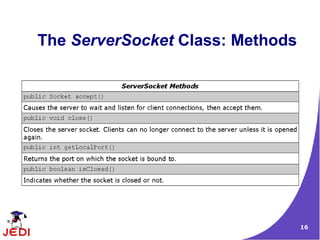
The ServerSocket Class: Methods


                                  16
The ServerSocket Class: Example
1    import java.net.*;
2    import java.io.*;
3    public class EchoingServer {
4       public static void main(String [] args) {
5          ServerSocket server = null;
6          Socket client;
7          try {
8              server = new ServerSocket(1234);
9              //1234 is an unused port number
10         } catch (IOException ie) {
11             System.out.println("Cannot open socket.");
12             System.exit(1);
13         }
14   //continued...
                                                            17
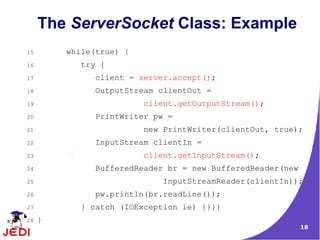
The ServerSocket Class: Example
15       while(true) {
16         try {
17            client = server.accept();
18            OutputStream clientOut =
19                       client.getOutputStream();
20            PrintWriter pw =
21                       new PrintWriter(clientOut, true);
22            InputStream clientIn =
23                       client.getInputStream();
24            BufferedReader br = new BufferedReader(new
25                           InputStreamReader(clientIn));
26            pw.println(br.readLine());
27         } catch (IOException ie) {}}}
28   }
                                                           18
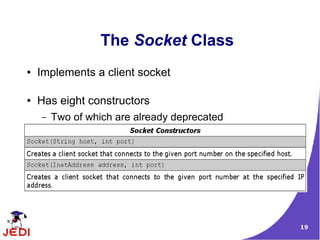
The Socket Class
●   Implements a client socket

●   Has eight constructors
    –   Two of which are already deprecated


                                              19
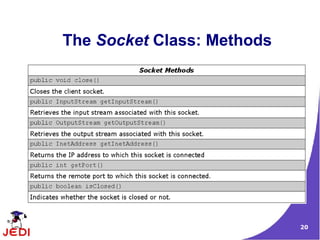
The Socket Class: Methods


                            20
The Socket Class: Example
1    import java.io.*;
2    import java.net.*;
3

4    public class MyClient {
5       public static void main(String args[]) {
6         try {
7            /* Socket client = new Socket("133.0.0.1",
8                                              1234); */
9            Socket client =
10                    new Socket(InetAddress.getLocalHost(),
11                              1234);
12   //continued...


                                                               21
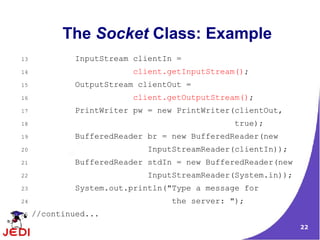
The Socket Class: Example
13           InputStream clientIn =
14                       client.getInputStream();
15           OutputStream clientOut =
16                       client.getOutputStream();
17           PrintWriter pw = new PrintWriter(clientOut,
18                                            true);
19           BufferedReader br = new BufferedReader(new
20                          InputStreamReader(clientIn));
21           BufferedReader stdIn = new BufferedReader(new
22                          InputStreamReader(System.in));
23           System.out.println("Type a message for
24                               the server: ");
25   //continued...
                                                             22
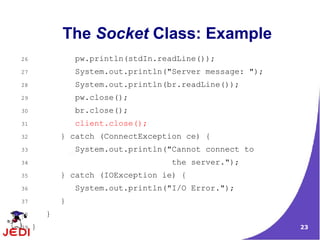
The Socket Class: Example
26               pw.println(stdIn.readLine());
27               System.out.println("Server message: ");
28               System.out.println(br.readLine());
29               pw.close();
30               br.close();
31               client.close();
32           } catch (ConnectException ce) {
33               System.out.println("Cannot connect to
34                                  the server.");
35           } catch (IOException ie) {
36               System.out.println("I/O Error.");
37           }
38       }
39   }                                                     23
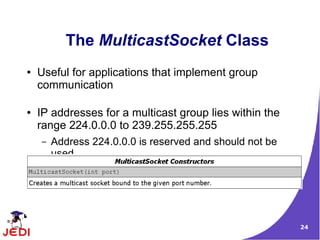
The MulticastSocket Class
●   Useful for applications that implement group
    communication

●   IP addresses for a multicast group lies within the
    range 224.0.0.0 to 239.255.255.255
    –   Address 224.0.0.0 is reserved and should not be
        used

●   Has three constructors


                                                          24
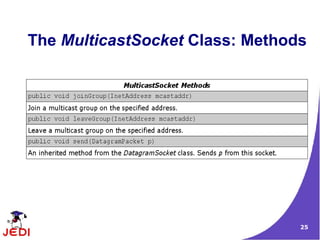
The MulticastSocket Class: Methods


                                 25
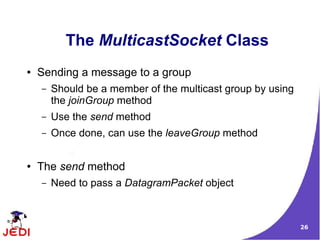
The MulticastSocket Class
●   Sending a message to a group
    –   Should be a member of the multicast group by using
        the joinGroup method
    –   Use the send method
    –   Once done, can use the leaveGroup method


●   The send method
    –   Need to pass a DatagramPacket object


                                                             26
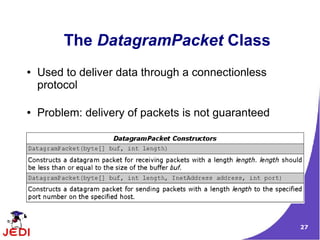
The DatagramPacket Class
●   Used to deliver data through a connectionless
    protocol

●   Problem: delivery of packets is not guaranteed

●   Has six constructors


                                                     27
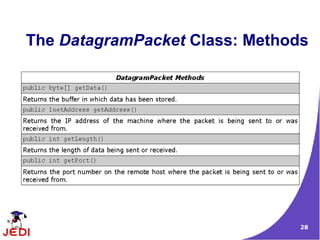
The DatagramPacket Class: Methods


                                28
The MulticastSocket Class: Server
                 Example
1    import java.net.*;
2    public class ChatServer {
3       public static void main(String args[])
4                                throws Exception {
5          MulticastSocket server =
6                      new MulticastSocket(1234);
7          InetAddress group =
8                      InetAddress.getByName("234.5.6.7");
9          //getByName- returns IP address of given host
10         server.joinGroup(group);
11         boolean infinite = true;
12   //continued
                                                             29
The MulticastSocket Class: Server
                 Example
13           /* Continually receives data and prints them */
14           while(infinite) {
15               byte buf[] = new byte[1024];
16               DatagramPacket data =
17                      new DatagramPacket(buf, buf.length);
18               server.receive(data);
19               String msg =
20                      new String(data.getData()).trim();
21               System.out.println(msg);
22           }
23           server.close();
24       }
25   }                                                         30
The MulticastSocket Class: Client
                 Example
1    import java.net.*;
2    import java.io.*;
3    public class ChatClient {
4       public static void main(String args[])
5                                throws Exception {
6          MulticastSocket chat = new MulticastSocket(1234);
7          InetAddress group =
8                         InetAddress.getByName("234.5.6.7");
9          chat.joinGroup(group);
10         String msg = "";
11   //continued...


                                                            31
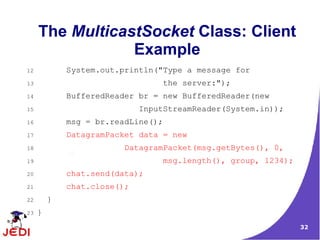
The MulticastSocket Class: Client
                 Example
12           System.out.println("Type a message for
13                                  the server:");
14           BufferedReader br = new BufferedReader(new
15                           InputStreamReader(System.in));
16           msg = br.readLine();
17           DatagramPacket data = new
18                       DatagramPacket(msg.getBytes(), 0,
19                                  msg.length(), group, 1234);
20           chat.send(data);
21           chat.close();
22       }
23   }
                                                                  32
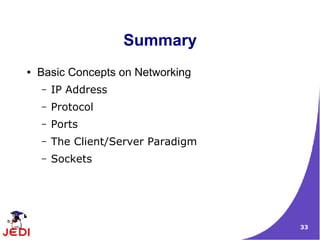
Summary
●   Basic Concepts on Networking
    –   IP Address
    –   Protocol
    –   Ports
    –   The Client/Server Paradigm
    –   Sockets


                                     33
Summary
●   The Java Networking Package
    –   ServerSocket
    –   Socket
    –   MulticastSocket
    –   DatagramPacket


                                  34

javanetworking

  • 1.
  • 2.
    Topics ● Basic Concepts on Networking – IP Address – Protocol – Ports – The Client/Server Paradigm – Sockets ● The Java Networking Package – The ServerSocket and the Socket Class – The MulticastSocket and the DatagramPacket Class 2
  • 3.
    Basic Concepts onNetworking ● The Internet – A global network of computers connected together in various ways – Remains functional despite of diversity of hardware and software connected together ● Possible through communication standards defined and conformed to ● Guarantee compatibility and reliability of communication 3
  • 4.
    Basic Concepts onNetworking: IP Address ● Logically similar to the traditional mailing address – An address uniquely identifies a particular object ● Each computer connected to the Internet has a unique IP address ● A 32-bit number used to uniquely identify each computer connected to the Internet – 192.1.1.1 – docs.rinet.ru 4
  • 5.
    Basic Concepts onNetworking: Protocol ● Why protocols? – Different types of communication occurring over the Internet – Each type of communication requires a specific and unique protocol ● Definition – Set of rules and standards that define a certain type of Internet communication – Describes the following information: ● Format of data being sent over the Internet 5
  • 6.
    Basic Concepts onNetworking: Protocol ● Not entirely new to us. Consider this type of conversation: "Hello." "Hello. Good afternoon. May I please speak at Joan?" "Okay, please wait for a while." "Thanks." ... – Social protocol used in a telephone conversation – Gives us confidence and familiarity of knowing what to do 6
  • 7.
    Basic Concepts onNetworking: Protocol ● Some important protocols used over the Internet – Hypertext Transfer Protocol (HTTP) ● Used to transfer HTML documents on the Web – File Transfer Protocol (FTP) ● More general compared to HTTP ● Allows you to transfer binary files over the Internet – Both protocols have their own set of rules and standards on how data is transferred – Java provides support for both protocols 7
  • 8.
    Basic Concepts onNetworking: Ports ● Protocols only make sense when used in the context of a service – HTTP protocol is used when you are providing Web content through an HTTP service – Each computer on the Internet can provide a variety of services ● Why Ports? – The type of service must be known before information can be transferred 8
  • 9.
    Basic Concepts onNetworking: Ports ● Definition: – A 16-bit number that identifies each service offered by a network server ● Using a particular service to establish a line of communication through a specific protocol – Need to connect to the appropriate port 9
  • 10.
    Basic Concepts onNetworking: Ports ● Standard ports – Numbers specifically associated with a particular type of service – Examples: ● The FTP service is located on port 21 ● The HTTP service is located on port 80 – Given port values below 1024 ● Port values above 1024 – Available for custom communication 10
  • 11.
    Basic Concepts onNetworking: The Client/Server Paradigm ● Basis for Java networking framework ● Involves two major elements: – Client ● Machine in need of some type of information – Server ● Machine storing information and waiting to give it out ● Scenario: – Client connects to a server and queries for certain 11
  • 12.
    Basic Concepts onNetworking: The Client/Server Paradigm 12
  • 13.
    Basic Concepts onNetworking: Sockets ● Definitions: – Software abstraction for an input or output medium of communication – Communication channels that enable you to transfer data through a particular port – An endpoint for communication between two machines – A particular type of network communication used in most Java network programming – Java performs all of its low-level network communication through sockets 13
  • 14.
    The Java NetworkingPackage ● The java.net package ● Provides classes useful for developing networking applications ● Some classes in the package: – ServerSocket – Socket – MulticastSocket – DatagramPacket 14
  • 15.
    The ServerSocket Class ● Provides the basic functionalities of a server ● Has four constructors 15
  • 16.
  • 17.
    The ServerSocket Class:Example 1 import java.net.*; 2 import java.io.*; 3 public class EchoingServer { 4 public static void main(String [] args) { 5 ServerSocket server = null; 6 Socket client; 7 try { 8 server = new ServerSocket(1234); 9 //1234 is an unused port number 10 } catch (IOException ie) { 11 System.out.println("Cannot open socket."); 12 System.exit(1); 13 } 14 //continued... 17
  • 18.
    The ServerSocket Class:Example 15 while(true) { 16 try { 17 client = server.accept(); 18 OutputStream clientOut = 19 client.getOutputStream(); 20 PrintWriter pw = 21 new PrintWriter(clientOut, true); 22 InputStream clientIn = 23 client.getInputStream(); 24 BufferedReader br = new BufferedReader(new 25 InputStreamReader(clientIn)); 26 pw.println(br.readLine()); 27 } catch (IOException ie) {}}} 28 } 18
  • 19.
    The Socket Class ● Implements a client socket ● Has eight constructors – Two of which are already deprecated 19
  • 20.
  • 21.
    The Socket Class:Example 1 import java.io.*; 2 import java.net.*; 3 4 public class MyClient { 5 public static void main(String args[]) { 6 try { 7 /* Socket client = new Socket("133.0.0.1", 8 1234); */ 9 Socket client = 10 new Socket(InetAddress.getLocalHost(), 11 1234); 12 //continued... 21
  • 22.
    The Socket Class:Example 13 InputStream clientIn = 14 client.getInputStream(); 15 OutputStream clientOut = 16 client.getOutputStream(); 17 PrintWriter pw = new PrintWriter(clientOut, 18 true); 19 BufferedReader br = new BufferedReader(new 20 InputStreamReader(clientIn)); 21 BufferedReader stdIn = new BufferedReader(new 22 InputStreamReader(System.in)); 23 System.out.println("Type a message for 24 the server: "); 25 //continued... 22
  • 23.
    The Socket Class:Example 26 pw.println(stdIn.readLine()); 27 System.out.println("Server message: "); 28 System.out.println(br.readLine()); 29 pw.close(); 30 br.close(); 31 client.close(); 32 } catch (ConnectException ce) { 33 System.out.println("Cannot connect to 34 the server."); 35 } catch (IOException ie) { 36 System.out.println("I/O Error."); 37 } 38 } 39 } 23
  • 24.
    The MulticastSocket Class ● Useful for applications that implement group communication ● IP addresses for a multicast group lies within the range 224.0.0.0 to 239.255.255.255 – Address 224.0.0.0 is reserved and should not be used ● Has three constructors 24
  • 25.
  • 26.
    The MulticastSocket Class ● Sending a message to a group – Should be a member of the multicast group by using the joinGroup method – Use the send method – Once done, can use the leaveGroup method ● The send method – Need to pass a DatagramPacket object 26
  • 27.
    The DatagramPacket Class ● Used to deliver data through a connectionless protocol ● Problem: delivery of packets is not guaranteed ● Has six constructors 27
  • 28.
  • 29.
    The MulticastSocket Class:Server Example 1 import java.net.*; 2 public class ChatServer { 3 public static void main(String args[]) 4 throws Exception { 5 MulticastSocket server = 6 new MulticastSocket(1234); 7 InetAddress group = 8 InetAddress.getByName("234.5.6.7"); 9 //getByName- returns IP address of given host 10 server.joinGroup(group); 11 boolean infinite = true; 12 //continued 29
  • 30.
    The MulticastSocket Class:Server Example 13 /* Continually receives data and prints them */ 14 while(infinite) { 15 byte buf[] = new byte[1024]; 16 DatagramPacket data = 17 new DatagramPacket(buf, buf.length); 18 server.receive(data); 19 String msg = 20 new String(data.getData()).trim(); 21 System.out.println(msg); 22 } 23 server.close(); 24 } 25 } 30
  • 31.
    The MulticastSocket Class:Client Example 1 import java.net.*; 2 import java.io.*; 3 public class ChatClient { 4 public static void main(String args[]) 5 throws Exception { 6 MulticastSocket chat = new MulticastSocket(1234); 7 InetAddress group = 8 InetAddress.getByName("234.5.6.7"); 9 chat.joinGroup(group); 10 String msg = ""; 11 //continued... 31
  • 32.
    The MulticastSocket Class:Client Example 12 System.out.println("Type a message for 13 the server:"); 14 BufferedReader br = new BufferedReader(new 15 InputStreamReader(System.in)); 16 msg = br.readLine(); 17 DatagramPacket data = new 18 DatagramPacket(msg.getBytes(), 0, 19 msg.length(), group, 1234); 20 chat.send(data); 21 chat.close(); 22 } 23 } 32
  • 33.
    Summary ● Basic Concepts on Networking – IP Address – Protocol – Ports – The Client/Server Paradigm – Sockets 33
  • 34.
    Summary ● The Java Networking Package – ServerSocket – Socket – MulticastSocket – DatagramPacket 34