2015 - Component Soft Ltd 1
Openstack Networking and ML2
Attila Szlovencsák
Component Soft Ltd.
attila@componentsoft.eu
Openstack Hungary Meetup Group
26 February , 2015
2015 - Component Soft Ltd 2
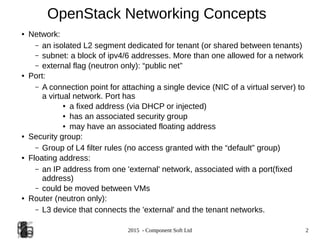
OpenStack Networking Concepts
● Network:
– an isolated L2 segment dedicated for tenant (or shared between tenants)
– subnet: a block of ipv4/6 addresses. More than one allowed for a network
– external flag (neutron only): “public net”
● Port:
– A connection point for attaching a single device (NIC of a virtual server) to
a virtual network. Port has
● a fixed address (via DHCP or injected)
● has an associated security group
● may have an associated floating address
● Security group:
– Group of L4 filter rules (no access granted with the “default” group)
● Floating address:
– an IP address from one 'external' network, associated with a port(fixed
address)
– could be moved between VMs
● Router (neutron only):
– L3 device that connects the 'external' and the tenant networks.
2015 - Component Soft Ltd 3
Nova-network types (pre-grizzly)
br0 br0 br0
VM1 VM2 VM3 VM4
fixed network
(10.0.0.0/8)
nova-compute nova-computenova-network
dnsmasq
controller compute1 compute2
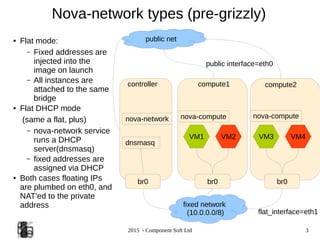
● Flat mode:
– Fixed addresses are
injected into the
image on launch
– All instances are
attached to the same
bridge
● Flat DHCP mode
(same a flat, plus)
– nova-network service
runs a DHCP
server(dnsmasq)
– fixed addresses are
assigned via DHCP
● Both cases floating IPs
are plumbed on eth0, and
NAT'ed to the private
address
public net
flat_interface=eth1
public interface=eth0
2015 - Component Soft Ltd 4
Nova-network types (pre-grizzly)
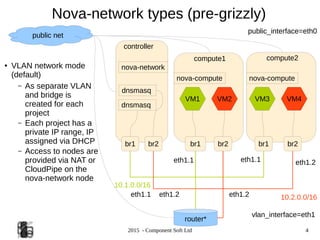
● VLAN network mode
(default)
– As separate VLAN
and bridge is
created for each
project
– Each project has a
private IP range, IP
assigned via DHCP
– Access to nodes are
provided via NAT or
CloudPipe on the
nova-network node
br1 br1 br1
VM1 VM2 VM3 VM4
nova-compute nova-compute
nova-network
dnsmasq
controller
compute1 compute2
br2 br2br2
dnsmasq
eth1.1 eth1.2
eth1.1eth1.1
eth1.2
eth1.2
public net
10.1.0.0/16
10.2.0.0/16
router*
vlan_interface=eth1
public_interface=eth0
2015 - Component Soft Ltd 5
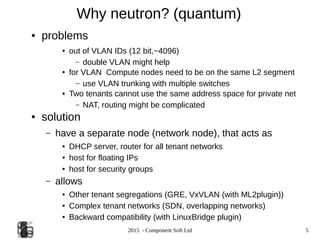
Why neutron? (quantum)
● problems
● out of VLAN IDs (12 bit,~4096)
– double VLAN might help
● for VLAN Compute nodes need to be on the same L2 segment
– use VLAN trunking with multiple switches
● Two tenants cannot use the same address space for private net
– NAT, routing might be complicated
● solution
– have a separate node (network node), that acts as
● DHCP server, router for all tenant networks
● host for floating IPs
● host for security groups
– allows
● Other tenant segregations (GRE, VxVLAN (with ML2plugin))
● Complex tenant networks (SDN, overlapping networks)
● Backward compatibility (with LinuxBridge plugin)
2015 - Component Soft Ltd 6
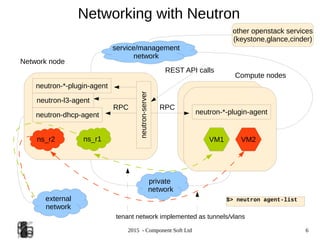
Networking with Neutron
Compute nodes
Network node
private
network
external
network
other openstack services
(keystone,glance,cinder)
neutron-*-plugin-agent
neutron-l3-agent
neutron-dhcp-agent
VM1 VM2ns_r1ns_r2
service/management
network
neutron-server
REST API calls
$> neutron agent-list
tenant network implemented as tunnels/vlans
RPCRPC
2015 - Component Soft Ltd 7
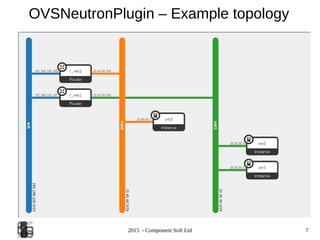
OVSNeutronPlugin – Example topology
2015 - Component Soft Ltd 8
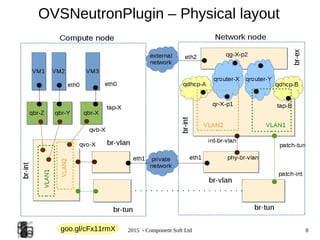
OVSNeutronPlugin – Physical layout
goo.gl/cFx11rmX
2015 - Component Soft Ltd 9
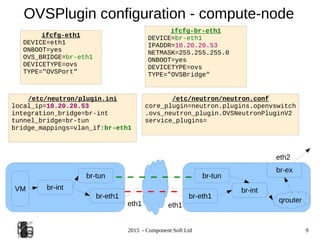
OVSPlugin configuration - compute-node
ifcfg-br-eth1
DEVICE=br-eth1
IPADDR=10.20.20.53
NETMASK=255.255.255.0
ONBOOT=yes
DEVICETYPE=ovs
TYPE="OVSBridge"
ifcfg-eth1
DEVICE=eth1
ONBOOT=yes
OVS_BRIDGE=br-eth1
DEVICETYPE=ovs
TYPE="OVSPort"
/etc/neutron/neutron.conf
core_plugin=neutron.plugins.openvswitch
.ovs_neutron_plugin.OVSNeutronPluginV2
service_plugins=
eth2
eth1
br-tun
br-eth1
br-intVM
br-eth1
br-tun
qrouter
br-ex
br-int
eth1
/etc/neutron/plugin.ini
local_ip=10.20.20.53
integration_bridge=br-int
tunnel_bridge=br-tun
bridge_mappings=vlan_if:br-eth1
2015 - Component Soft Ltd 10
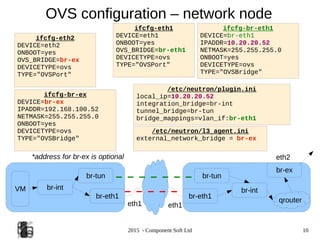
OVS configuration – network node
ifcfg-br-ex
DEVICE=br-ex
IPADDR=192.168.100.52
NETMASK=255.255.255.0
ONBOOT=yes
DEVICETYPE=ovs
TYPE="OVSBridge"
ifcfg-eth2
DEVICE=eth2
ONBOOT=yes
OVS_BRIDGE=br-ex
DEVICETYPE=ovs
TYPE="OVSPort"
eth2
eth1
br-tun
br-eth1
br-intVM
br-eth1
br-tun
qrouter
br-ex
br-int
eth1
/etc/neutron/plugin.ini
local_ip=10.20.20.52
integration_bridge=br-int
tunnel_bridge=br-tun
bridge_mappings=vlan_if:br-eth1
ifcfg-br-eth1
DEVICE=br-eth1
IPADDR=10.20.20.52
NETMASK=255.255.255.0
ONBOOT=yes
DEVICETYPE=ovs
TYPE="OVSBridge"
ifcfg-eth1
DEVICE=eth1
ONBOOT=yes
OVS_BRIDGE=br-eth1
DEVICETYPE=ovs
TYPE="OVSPort"
/etc/neutron/l3_agent.ini
external_network_bridge = br-ex
*address for br-ex is optional
2015 - Component Soft Ltd 11
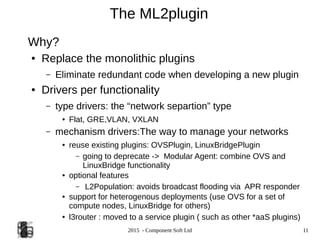
The ML2plugin
Why?
● Replace the monolithic plugins
– Eliminate redundant code when developing a new plugin
● Drivers per functionality
– type drivers: the “network separtion” type
● Flat, GRE,VLAN, VXLAN
– mechanism drivers:The way to manage your networks
● reuse existing plugins: OVSPlugin, LinuxBridgePlugin
– going to deprecate -> Modular Agent: combine OVS and
LinuxBridge functionality
● optional features
– L2Population: avoids broadcast flooding via APR responder
● support for heterogenous deployments (use OVS for a set of
compute nodes, LinuxBridge for others)
● l3router : moved to a service plugin ( such as other *aaS plugins)
2015 - Component Soft Ltd 12
Configuration – OVS+ ML2 (Icehouse)
/etc/neutron/neutron.conf
core_plugin =neutron.plugins.ml2.plugin.Ml2Plugin
service_plugins =neutron.services.l3_router.l3_router_plugin.L3RouterPlugin
/etc/neutron//etc/neutron/plugins/openvswitch/ovs_neutron_plugin.ini
[ovs]
enable_tunneling=True
local_ip=10.20.20.53
integration_bridge=br-int
tunnel_bridge=br-tun
bridge_mappings=vlan_if:br-eth1
[agent]
tunnel_type=gre
l2_population=True
/etc/neutron/plugins/ml2/ml2_conf.ini
[ml2]
type_drivers = gre,vlan,vxlan
tenant_network_types = gre,vlan,vxlan
mechanism_drivers =openvswitch
[ml2_type_flat]
#flat_networks = physnet1,physnet2
[ml2_type_vlan]
network_vlan_ranges =vlan_if:100:200
[ml2_type_gre]
tunnel_id_ranges =100:200
[ml2_type_vxlan]
# vni_ranges =
[securitygroup]
enable_security_group = True
2015 - Component Soft Ltd 13
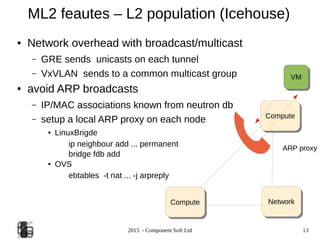
ML2 feautes – L2 population (Icehouse)
● Network overhead with broadcast/multicast
– GRE sends unicasts on each tunnel
– VxVLAN sends to a common multicast group
● avoid ARP broadcasts
– IP/MAC associations known from neutron db
– setup a local ARP proxy on each node
● LinuxBrigde
ip neighbour add ... permanent
bridge fdb add
● OVS
ebtables -t nat ... -j arpreply
ComputeCompute
NetworkNetworkComputeCompute
VMVM
ARP proxy
2015 - Component Soft Ltd 14
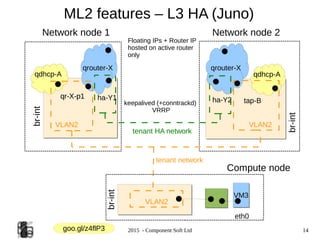
ML2 features – L3 HA (Juno)
qrouter-X qrouter-X
qdhcp-A qdhcp-A
br-int
VLAN2
tap-B
qr-X-p1
VLAN2
br-int
Network node 1 Network node 2
ha-Y2keepalived (+conntrackd)
VRRP
qr-X-p1
goo.gl/z4flP3
tenant network
tenant HA network
ha-Y1
VM3VM3
eth0
VLAN2
VLAN2
Compute node
br-int
Floating IPs + Router IP
hosted on active router
only
2015 - Component Soft Ltd 15
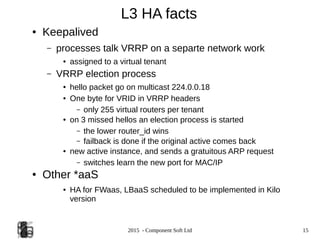
L3 HA facts
● Keepalived
– processes talk VRRP on a separte network work
● assigned to a virtual tenant
– VRRP election process
● hello packet go on multicast 224.0.0.18
● One byte for VRID in VRRP headers
– only 255 virtual routers per tenant
● on 3 missed hellos an election process is started
– the lower router_id wins
– failback is done if the original active comes back
● new active instance, and sends a gratuitous ARP request
– switches learn the new port for MAC/IP
● Other *aaS
● HA for FWaas, LBaaS scheduled to be implemented in Kilo
version

Openstack Networking and ML2

  • 1.
    2015 - ComponentSoft Ltd 1 Openstack Networking and ML2 Attila Szlovencsák Component Soft Ltd. attila@componentsoft.eu Openstack Hungary Meetup Group 26 February , 2015
  • 2.
    2015 - ComponentSoft Ltd 2 OpenStack Networking Concepts ● Network: – an isolated L2 segment dedicated for tenant (or shared between tenants) – subnet: a block of ipv4/6 addresses. More than one allowed for a network – external flag (neutron only): “public net” ● Port: – A connection point for attaching a single device (NIC of a virtual server) to a virtual network. Port has ● a fixed address (via DHCP or injected) ● has an associated security group ● may have an associated floating address ● Security group: – Group of L4 filter rules (no access granted with the “default” group) ● Floating address: – an IP address from one 'external' network, associated with a port(fixed address) – could be moved between VMs ● Router (neutron only): – L3 device that connects the 'external' and the tenant networks.
  • 3.
    2015 - ComponentSoft Ltd 3 Nova-network types (pre-grizzly) br0 br0 br0 VM1 VM2 VM3 VM4 fixed network (10.0.0.0/8) nova-compute nova-computenova-network dnsmasq controller compute1 compute2 ● Flat mode: – Fixed addresses are injected into the image on launch – All instances are attached to the same bridge ● Flat DHCP mode (same a flat, plus) – nova-network service runs a DHCP server(dnsmasq) – fixed addresses are assigned via DHCP ● Both cases floating IPs are plumbed on eth0, and NAT'ed to the private address public net flat_interface=eth1 public interface=eth0
  • 4.
    2015 - ComponentSoft Ltd 4 Nova-network types (pre-grizzly) ● VLAN network mode (default) – As separate VLAN and bridge is created for each project – Each project has a private IP range, IP assigned via DHCP – Access to nodes are provided via NAT or CloudPipe on the nova-network node br1 br1 br1 VM1 VM2 VM3 VM4 nova-compute nova-compute nova-network dnsmasq controller compute1 compute2 br2 br2br2 dnsmasq eth1.1 eth1.2 eth1.1eth1.1 eth1.2 eth1.2 public net 10.1.0.0/16 10.2.0.0/16 router* vlan_interface=eth1 public_interface=eth0
  • 5.
    2015 - ComponentSoft Ltd 5 Why neutron? (quantum) ● problems ● out of VLAN IDs (12 bit,~4096) – double VLAN might help ● for VLAN Compute nodes need to be on the same L2 segment – use VLAN trunking with multiple switches ● Two tenants cannot use the same address space for private net – NAT, routing might be complicated ● solution – have a separate node (network node), that acts as ● DHCP server, router for all tenant networks ● host for floating IPs ● host for security groups – allows ● Other tenant segregations (GRE, VxVLAN (with ML2plugin)) ● Complex tenant networks (SDN, overlapping networks) ● Backward compatibility (with LinuxBridge plugin)
  • 6.
    2015 - ComponentSoft Ltd 6 Networking with Neutron Compute nodes Network node private network external network other openstack services (keystone,glance,cinder) neutron-*-plugin-agent neutron-*-plugin-agent neutron-l3-agent neutron-dhcp-agent VM1 VM2ns_r1ns_r2 service/management network neutron-server REST API calls $> neutron agent-list tenant network implemented as tunnels/vlans RPCRPC
  • 7.
    2015 - ComponentSoft Ltd 7 OVSNeutronPlugin – Example topology
  • 8.
    2015 - ComponentSoft Ltd 8 OVSNeutronPlugin – Physical layout goo.gl/cFx11rmX
  • 9.
    2015 - ComponentSoft Ltd 9 OVSPlugin configuration - compute-node ifcfg-br-eth1 DEVICE=br-eth1 IPADDR=10.20.20.53 NETMASK=255.255.255.0 ONBOOT=yes DEVICETYPE=ovs TYPE="OVSBridge" ifcfg-eth1 DEVICE=eth1 ONBOOT=yes OVS_BRIDGE=br-eth1 DEVICETYPE=ovs TYPE="OVSPort" /etc/neutron/neutron.conf core_plugin=neutron.plugins.openvswitch .ovs_neutron_plugin.OVSNeutronPluginV2 service_plugins= eth2 eth1 br-tun br-eth1 br-intVM br-eth1 br-tun qrouter br-ex br-int eth1 /etc/neutron/plugin.ini local_ip=10.20.20.53 integration_bridge=br-int tunnel_bridge=br-tun bridge_mappings=vlan_if:br-eth1
  • 10.
    2015 - ComponentSoft Ltd 10 OVS configuration – network node ifcfg-br-ex DEVICE=br-ex IPADDR=192.168.100.52 NETMASK=255.255.255.0 ONBOOT=yes DEVICETYPE=ovs TYPE="OVSBridge" ifcfg-eth2 DEVICE=eth2 ONBOOT=yes OVS_BRIDGE=br-ex DEVICETYPE=ovs TYPE="OVSPort" eth2 eth1 br-tun br-eth1 br-intVM br-eth1 br-tun qrouter br-ex br-int eth1 /etc/neutron/plugin.ini local_ip=10.20.20.52 integration_bridge=br-int tunnel_bridge=br-tun bridge_mappings=vlan_if:br-eth1 ifcfg-br-eth1 DEVICE=br-eth1 IPADDR=10.20.20.52 NETMASK=255.255.255.0 ONBOOT=yes DEVICETYPE=ovs TYPE="OVSBridge" ifcfg-eth1 DEVICE=eth1 ONBOOT=yes OVS_BRIDGE=br-eth1 DEVICETYPE=ovs TYPE="OVSPort" /etc/neutron/l3_agent.ini external_network_bridge = br-ex *address for br-ex is optional
  • 11.
    2015 - ComponentSoft Ltd 11 The ML2plugin Why? ● Replace the monolithic plugins – Eliminate redundant code when developing a new plugin ● Drivers per functionality – type drivers: the “network separtion” type ● Flat, GRE,VLAN, VXLAN – mechanism drivers:The way to manage your networks ● reuse existing plugins: OVSPlugin, LinuxBridgePlugin – going to deprecate -> Modular Agent: combine OVS and LinuxBridge functionality ● optional features – L2Population: avoids broadcast flooding via APR responder ● support for heterogenous deployments (use OVS for a set of compute nodes, LinuxBridge for others) ● l3router : moved to a service plugin ( such as other *aaS plugins)
  • 12.
    2015 - ComponentSoft Ltd 12 Configuration – OVS+ ML2 (Icehouse) /etc/neutron/neutron.conf core_plugin =neutron.plugins.ml2.plugin.Ml2Plugin service_plugins =neutron.services.l3_router.l3_router_plugin.L3RouterPlugin /etc/neutron//etc/neutron/plugins/openvswitch/ovs_neutron_plugin.ini [ovs] enable_tunneling=True local_ip=10.20.20.53 integration_bridge=br-int tunnel_bridge=br-tun bridge_mappings=vlan_if:br-eth1 [agent] tunnel_type=gre l2_population=True /etc/neutron/plugins/ml2/ml2_conf.ini [ml2] type_drivers = gre,vlan,vxlan tenant_network_types = gre,vlan,vxlan mechanism_drivers =openvswitch [ml2_type_flat] #flat_networks = physnet1,physnet2 [ml2_type_vlan] network_vlan_ranges =vlan_if:100:200 [ml2_type_gre] tunnel_id_ranges =100:200 [ml2_type_vxlan] # vni_ranges = [securitygroup] enable_security_group = True
  • 13.
    2015 - ComponentSoft Ltd 13 ML2 feautes – L2 population (Icehouse) ● Network overhead with broadcast/multicast – GRE sends unicasts on each tunnel – VxVLAN sends to a common multicast group ● avoid ARP broadcasts – IP/MAC associations known from neutron db – setup a local ARP proxy on each node ● LinuxBrigde ip neighbour add ... permanent bridge fdb add ● OVS ebtables -t nat ... -j arpreply ComputeCompute NetworkNetworkComputeCompute VMVM ARP proxy
  • 14.
    2015 - ComponentSoft Ltd 14 ML2 features – L3 HA (Juno) qrouter-X qrouter-X qdhcp-A qdhcp-A br-int VLAN2 tap-B qr-X-p1 VLAN2 br-int Network node 1 Network node 2 ha-Y2keepalived (+conntrackd) VRRP qr-X-p1 goo.gl/z4flP3 tenant network tenant HA network ha-Y1 VM3VM3 eth0 VLAN2 VLAN2 Compute node br-int Floating IPs + Router IP hosted on active router only
  • 15.
    2015 - ComponentSoft Ltd 15 L3 HA facts ● Keepalived – processes talk VRRP on a separte network work ● assigned to a virtual tenant – VRRP election process ● hello packet go on multicast 224.0.0.18 ● One byte for VRID in VRRP headers – only 255 virtual routers per tenant ● on 3 missed hellos an election process is started – the lower router_id wins – failback is done if the original active comes back ● new active instance, and sends a gratuitous ARP request – switches learn the new port for MAC/IP ● Other *aaS ● HA for FWaas, LBaaS scheduled to be implemented in Kilo version