Open Distributed Networking 
Intelligence: A New Java Paradigm 
Tal Lavian
O p e n Arc hite c ture 2 
Agenda 
 Openness - Virtual community development, Domain experts 
 Architecture and technology concepts 
 Intelligent distributed applications 
 Demos: 
— JEND’s JVM’s, ORE 
— Java Oplet 
— XML on router 
 Summary
Vision 
 Transfer Intelligence to network devices 
 Programmable network devices 
 Virtual community of developers 
 Domain experts bundle Intelligent network devices as part of 
their solutions 
 New era of innovation for startups 
O p e n Arc hite c ture 3
Change the Name of the Game 
 Openness 
 In the current routing market we have to change the name of the 
game 
 It will enable technology leapfrog 
 Programmable devices creates a Paradigm shift 
 Open Architecture is an excellent technology and direction 
 Request: Open Architecture 
 Java appeals to the market & customers 
O p e n Arc hite c ture
Openness
Why an Open Architecture? 
 Unparalleled customization capabilities 
 Dynamic delivery of new services 
 The network adapts itself to users needs, not the other way 
around 
 3rd party developers - create innovative services and 
applications 
 HW & OS independent. can migrate to new HW and SW => 
Investment protection 
O p e n Arc hite c ture
Benefits 
 Network PC-ification 
 Intelligent vs Dumb Devices 
 Open vs Proprietary 
 1,000,000 Java programmers 
 Revolutionize the network 
 IEEE 1520 - programmable networks: Service Providers, 
Enterprises, request programmability 
O p e n Arc hite c ture
O p e n Arc hite c ture 
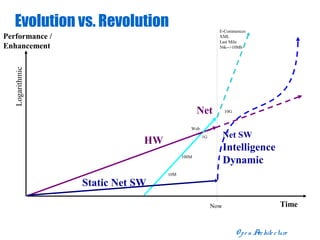
Evolution vs. Revolution 
HW 
Net 
Static Net SW 
Net SW 
Intelligence 
Dynamic 
Time 
Performance / 
Enhancement 
Logarithmic 
Now 
10M 
100M 
1G 
10G 
Web 
E-Commences 
XML 
Last Mile 
56k-->10Mb
O p e n Arc hite c ture 9 
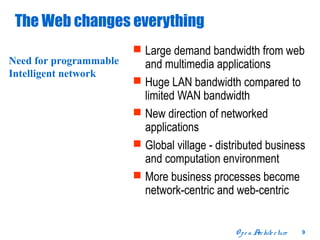
The Web changes everything 
 Large demand bandwidth from web 
and multimedia applications 
 Huge LAN bandwidth compared to 
limited WAN bandwidth 
 New direction of networked 
applications 
 Global village - distributed business 
and computation environment 
 More business processes become 
network-centric and web-centric 
Need for programmable 
Intelligent network
More Users 
Network 
Computers 
Supply chain 
management 
Multicast 
O p e n Arc hite c ture 10 
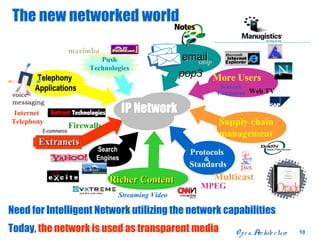
The new networked world 
TTeelleepphhoonnyy 
AApppplliiccaattiioonnss 
Internet 
Telephony Firewalls 
Push 
Technologies 
Protocols 
& 
Standards 
MPEG 
Web TV 
Search 
Engines 
RRiicchheerr CCoonntteenntt 
Streaming Video 
EExxttrraanneettss 
IP Network 
eemmaaiill 
pop3smtp 
voice 
messaging 
E-commerce 
Need for Intelligent Network utilizing the network capabilities 
Today, the network is used as transparent media
New net 
O p e n Arc hite c ture 11 
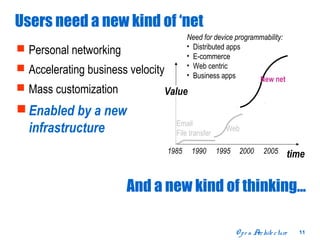
Users need a new kind of ‘net 
Need for device programmability: 
• Distributed apps 
• E-commerce 
• Web centric 
• Business apps 
 Personal networking 
 Accelerating business velocity 
 Mass customization 
 Enabled by a new 
infrastructure 
Value 
1985 1990 1995 2000 2005 
time 
Email Web 
File transfer 
And a new kind of thinking...
Benefits 
 Breakaway business strategy for creation of value over network 
elements 
 Positioning of open standards versus proprietary designs - 
market acceptance 
 Faster TTM for software development 
 Unparalleled support and maintenance capabilities 
 PC-ification - broad adoption 
O p e n Arc hite c ture 12
Community Openness 
 Success stories by large community of developers 
 Net-Based developers’ communities 
— Linux, GNU, Apache, BSD, X-Windows, Perl, Tk/Tcl 
— Netscape browser, NFS, JDK, JVM 
O p e n Arc hite c ture 13 
 Linux success: 
— Compaq, HP, IBM, SUN and SGI 
— Intel, Sparc64, Alpha, PowerPC 
 The Web Changes everything 
— Java, XML, E-Business
Technology
O p e n Arc hite c ture 15 
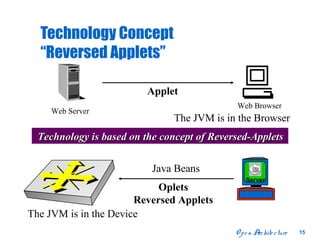
Technology Concept 
“Reversed Applets” 
Java Beans 
Oplets 
Reversed Applets 
Server 
Web Server 
The JVM is in the Device 
Web Browser 
Applet 
The JVM is in the Browser 
Technology is based on tthhee ccoonncceepptt ooff RReevveerrsseedd--AApppplleettss
O p e n Arc hite c ture 16 
Why Aren’t The Current Interfaces 
Sufficient? 
 There are two main management interfaces to most devices: 
— SNMP 
— CLI 
 Web/HTTP is typically just a MIB viewer/manipulator 
— “Collapsed SNMP”
O p e n Arc hite c ture 17 
SNMP Is Data Driven 
 SNMP = MIB + side effects + get/set protocol 
 SNMP is not executable 
— As defined, you can’t really script it 
— You can script things like Perl and have them do SNMP for you 
 You can only manipulate MIB objects that are supported 
 SNMP apps can’t run on the device itself 
— Requires separate server 
 SNMP requires polling 
— Eats up net bandwidth 
 Example: You can’t write a custom CLI login authentication module easily using 
SNMP 
— Perhaps you could with a bunch of traps and such but it would be really ugly
SNMP and CLI Summary 
 SNMP is not a Turing Machine 
 CLI could be made into a Turing Machine, but the 
implementation is ugly and you still couldn’t implement all that 
you wanted very easily 
O p e n Arc hite c ture 18
O p e n Arc hite c ture 19 
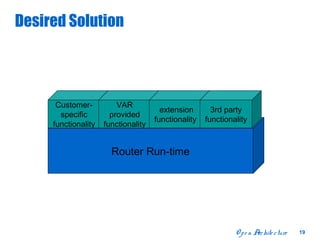
Desired Solution 
Router Run-time 
Customer-specific 
functionality 
VAR 
provided 
functionality 
extension 
functionality 
3rd party 
functionality
Possible Customer/VAR Applications 
 Advanced SNMP monitoring and trap generation 
— Eliminate polling, generate custom traps or system log messages 
O p e n Arc hite c ture 20 
 “Pluggable” remote authentication systems 
— People want different things: LDAP (who’s schema), Security Dynamics, TACACS, etc. 
 Custom CLI commands or web management screens 
 Custom accounting interface 
 Custom asset management 
 Generated MIB extensions for SNMP 
 Runtime image file distribution for upgrades 
 VARs can add a lot of system value tying things together
Possible Applications 
 INM can download advanced network management functions 
dynamically 
— Might download a diagnosis module after determining a fault 
O p e n Arc hite c ture 21 
 In-field upgrades 
— New algorithms 
— Dynamic downloads via the Internet 
 Custom “glue” written by different divisions to create a more 
cohesive solution
O p e n Arc hite c ture 22 
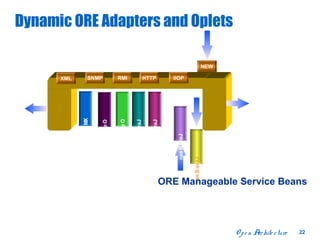
Dynamic ORE Adapters and Oplets 
NEW 
XML RMI IIOP 
naeB t el pO 
naeB avaJ 
naeB avaJ 
naeB avaJ 
naeB avaJ 
ORE Manageable Service Beans 
SNMP HTTP 
naeB t el pO 
naeB L MX
Enabling New Concepts
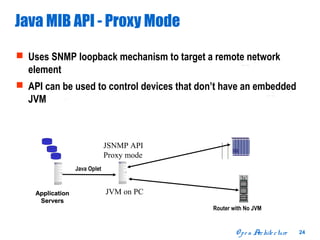
 Uses SNMP loopback mechanism to target a remote network 
element 
 API can be used to control devices that don’t have an embedded 
JVM 
O p e n Arc hite c ture 24 
Java MIB API - Proxy Mode 
AApppplliiccaattiioonn 
SSeerrvveerrss 
Router with No JVM 
JSNMP API 
Proxy mode 
JVM on PC 
Java Oplet
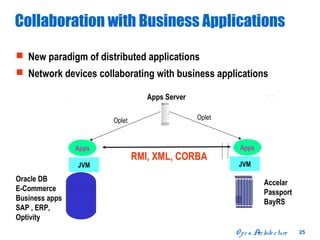
Collaboration with Business Applications 
 New paradigm of distributed applications 
 Network devices collaborating with business applications 
Apps 
O p e n Arc hite c ture 25 
JVM 
Oracle DB 
E-Commerce 
Business apps 
SAP , ERP, 
Optivity 
RMI, XML, CORBA 
Apps 
Accelar 
Passport 
BayRS 
JVM 
Apps Server 
Oplet Oplet
O p e n Arc hite c ture 26 
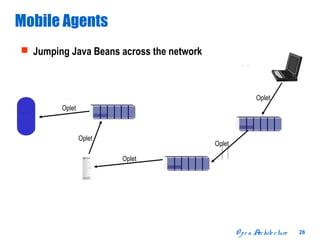
Mobile Agents 
 Jumping Java Beans across the network 
Oplet 
Oplet 
Oplet 
Oplet 
Oplet
O p e n Arc hite c ture 27 
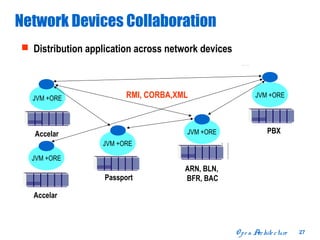
Network Devices Collaboration 
 Distribution application across network devices 
JVM +ORE RMI, CORBA,XML 
JVM +ORE 
JVM +ORE 
JVM +ORE 
Accelar 
Accelar 
Passport 
ARN, BLN, 
BFR, BAC 
PBX 
JVM +ORE
Summary 
 Openness - successfully proven paradigm 
 Domain experts - virtual developers community 
 Allows innovations and added value 
 Dynamic Loading 
 Dynamic agents vs static agents 
 Strong Security 
 New capabilities - XML example 
 An enabling-technology 
O p e n Arc hite c ture 28
O p e n Arc hite c ture 29 
Appendix A: 
Strong Security in the New Model 
 The new concept is secure to add 3rd party code to 
network devices 
— Digital Signature 
— “Certified Oplet” 
— No access out of the JVM space 
— No pointers to damage the work 
— Access only to the published API 
— Verifier - only correct code can be loaded 
— Class loader access list 
– Different Oplets with different access levels 
— JVM has run time bounds, type, and executing checking
O p e n Arc hite c ture 30 
Old model Security (C/C++) 
 Old model - Not secure to add 3rd party code 
— Not recommended to add 3rd party code to network devices 
— Dangerous, C/C++ Pointers 
– Can touch sensitive memory location 
— Risk: Memory allocations and free 
– Allocation without freeing 
– Free without allocation (core dump !!!! ) 
 Limited security in SNMP
O p e n Arc hite c ture 31 
Appendix B: 
Java SNMP MIB API 
 Portable across a range of network devices 
 Extendible 
 Simple and convenient for client use 
 Consistent with SNMP model 
 Hides unnecessary SNMP details 
 Permits optimized access 
 Re-use MIB documentation
MIB API Generation 
 Most of the Java code is generated automatically 
 ASN.1 MIB definitions are converted into Java classes 
 Documentation and commentary in the MIB definitions is placed 
as Javadoc formal comments 
 HTML documentation generated from Javadoc 
O p e n Arc hite c ture 32
MIB Objects 
 The MIB data model is structured as a tree 
 API represents MIB groups with Java classes 
 MIB variables are represented with accessor methods 
 Conceptual tables are represented with iterators 
 API converts SNMP data values into standard Java types 
O p e n Arc hite c ture 33
O p e n Arc hite c ture 34 
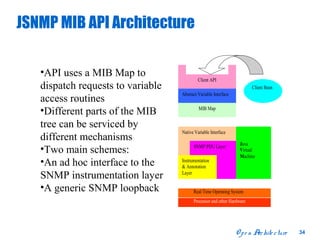
JSNMP MIB API Architecture 
Java 
Virtual 
Machine 
Client API 
Abstract Variable Interface 
MIB Map 
Native Variable Interface 
SNMP PDU Layer 
Instrumentation 
& Annotation 
Layer 
Real Time Operating System 
Processor and other Hardware 
Client Bean 
•API uses a MIB Map to 
dispatch requests to variable 
access routines 
•Different parts of the MIB 
tree can be serviced by 
different mechanisms 
•Two main schemes: 
•An ad hoc interface to the 
SNMP instrumentation layer 
•A generic SNMP loopback
Advantages of MIB map 
 Allows immediate generic implementation of the entire MIB via 
the loopback scheme 
 Enables optimized native implementation of key MIB variables 
for maximum efficiency 
 Permits definition of pseudo-MIB variables for extending MIB 
dynamically 
 Provides site for centralized access management 
O p e n Arc hite c ture 35

Open Distributed Networking Intelligence: A New Java Paradigm

  • 1.
    Open Distributed Networking Intelligence: A New Java Paradigm Tal Lavian
  • 2.
    O p en Arc hite c ture 2 Agenda  Openness - Virtual community development, Domain experts  Architecture and technology concepts  Intelligent distributed applications  Demos: — JEND’s JVM’s, ORE — Java Oplet — XML on router  Summary
  • 3.
    Vision  TransferIntelligence to network devices  Programmable network devices  Virtual community of developers  Domain experts bundle Intelligent network devices as part of their solutions  New era of innovation for startups O p e n Arc hite c ture 3
  • 4.
    Change the Nameof the Game  Openness  In the current routing market we have to change the name of the game  It will enable technology leapfrog  Programmable devices creates a Paradigm shift  Open Architecture is an excellent technology and direction  Request: Open Architecture  Java appeals to the market & customers O p e n Arc hite c ture
  • 5.
  • 6.
    Why an OpenArchitecture?  Unparalleled customization capabilities  Dynamic delivery of new services  The network adapts itself to users needs, not the other way around  3rd party developers - create innovative services and applications  HW & OS independent. can migrate to new HW and SW => Investment protection O p e n Arc hite c ture
  • 7.
    Benefits  NetworkPC-ification  Intelligent vs Dumb Devices  Open vs Proprietary  1,000,000 Java programmers  Revolutionize the network  IEEE 1520 - programmable networks: Service Providers, Enterprises, request programmability O p e n Arc hite c ture
  • 8.
    O p en Arc hite c ture Evolution vs. Revolution HW Net Static Net SW Net SW Intelligence Dynamic Time Performance / Enhancement Logarithmic Now 10M 100M 1G 10G Web E-Commences XML Last Mile 56k-->10Mb
  • 9.
    O p en Arc hite c ture 9 The Web changes everything  Large demand bandwidth from web and multimedia applications  Huge LAN bandwidth compared to limited WAN bandwidth  New direction of networked applications  Global village - distributed business and computation environment  More business processes become network-centric and web-centric Need for programmable Intelligent network
  • 10.
    More Users Network Computers Supply chain management Multicast O p e n Arc hite c ture 10 The new networked world TTeelleepphhoonnyy AApppplliiccaattiioonnss Internet Telephony Firewalls Push Technologies Protocols & Standards MPEG Web TV Search Engines RRiicchheerr CCoonntteenntt Streaming Video EExxttrraanneettss IP Network eemmaaiill pop3smtp voice messaging E-commerce Need for Intelligent Network utilizing the network capabilities Today, the network is used as transparent media
  • 11.
    New net Op e n Arc hite c ture 11 Users need a new kind of ‘net Need for device programmability: • Distributed apps • E-commerce • Web centric • Business apps  Personal networking  Accelerating business velocity  Mass customization  Enabled by a new infrastructure Value 1985 1990 1995 2000 2005 time Email Web File transfer And a new kind of thinking...
  • 12.
    Benefits  Breakawaybusiness strategy for creation of value over network elements  Positioning of open standards versus proprietary designs - market acceptance  Faster TTM for software development  Unparalleled support and maintenance capabilities  PC-ification - broad adoption O p e n Arc hite c ture 12
  • 13.
    Community Openness Success stories by large community of developers  Net-Based developers’ communities — Linux, GNU, Apache, BSD, X-Windows, Perl, Tk/Tcl — Netscape browser, NFS, JDK, JVM O p e n Arc hite c ture 13  Linux success: — Compaq, HP, IBM, SUN and SGI — Intel, Sparc64, Alpha, PowerPC  The Web Changes everything — Java, XML, E-Business
  • 14.
  • 15.
    O p en Arc hite c ture 15 Technology Concept “Reversed Applets” Java Beans Oplets Reversed Applets Server Web Server The JVM is in the Device Web Browser Applet The JVM is in the Browser Technology is based on tthhee ccoonncceepptt ooff RReevveerrsseedd--AApppplleettss
  • 16.
    O p en Arc hite c ture 16 Why Aren’t The Current Interfaces Sufficient?  There are two main management interfaces to most devices: — SNMP — CLI  Web/HTTP is typically just a MIB viewer/manipulator — “Collapsed SNMP”
  • 17.
    O p en Arc hite c ture 17 SNMP Is Data Driven  SNMP = MIB + side effects + get/set protocol  SNMP is not executable — As defined, you can’t really script it — You can script things like Perl and have them do SNMP for you  You can only manipulate MIB objects that are supported  SNMP apps can’t run on the device itself — Requires separate server  SNMP requires polling — Eats up net bandwidth  Example: You can’t write a custom CLI login authentication module easily using SNMP — Perhaps you could with a bunch of traps and such but it would be really ugly
  • 18.
    SNMP and CLISummary  SNMP is not a Turing Machine  CLI could be made into a Turing Machine, but the implementation is ugly and you still couldn’t implement all that you wanted very easily O p e n Arc hite c ture 18
  • 19.
    O p en Arc hite c ture 19 Desired Solution Router Run-time Customer-specific functionality VAR provided functionality extension functionality 3rd party functionality
  • 20.
    Possible Customer/VAR Applications  Advanced SNMP monitoring and trap generation — Eliminate polling, generate custom traps or system log messages O p e n Arc hite c ture 20  “Pluggable” remote authentication systems — People want different things: LDAP (who’s schema), Security Dynamics, TACACS, etc.  Custom CLI commands or web management screens  Custom accounting interface  Custom asset management  Generated MIB extensions for SNMP  Runtime image file distribution for upgrades  VARs can add a lot of system value tying things together
  • 21.
    Possible Applications INM can download advanced network management functions dynamically — Might download a diagnosis module after determining a fault O p e n Arc hite c ture 21  In-field upgrades — New algorithms — Dynamic downloads via the Internet  Custom “glue” written by different divisions to create a more cohesive solution
  • 22.
    O p en Arc hite c ture 22 Dynamic ORE Adapters and Oplets NEW XML RMI IIOP naeB t el pO naeB avaJ naeB avaJ naeB avaJ naeB avaJ ORE Manageable Service Beans SNMP HTTP naeB t el pO naeB L MX
  • 23.
  • 24.
     Uses SNMPloopback mechanism to target a remote network element  API can be used to control devices that don’t have an embedded JVM O p e n Arc hite c ture 24 Java MIB API - Proxy Mode AApppplliiccaattiioonn SSeerrvveerrss Router with No JVM JSNMP API Proxy mode JVM on PC Java Oplet
  • 25.
    Collaboration with BusinessApplications  New paradigm of distributed applications  Network devices collaborating with business applications Apps O p e n Arc hite c ture 25 JVM Oracle DB E-Commerce Business apps SAP , ERP, Optivity RMI, XML, CORBA Apps Accelar Passport BayRS JVM Apps Server Oplet Oplet
  • 26.
    O p en Arc hite c ture 26 Mobile Agents  Jumping Java Beans across the network Oplet Oplet Oplet Oplet Oplet
  • 27.
    O p en Arc hite c ture 27 Network Devices Collaboration  Distribution application across network devices JVM +ORE RMI, CORBA,XML JVM +ORE JVM +ORE JVM +ORE Accelar Accelar Passport ARN, BLN, BFR, BAC PBX JVM +ORE
  • 28.
    Summary  Openness- successfully proven paradigm  Domain experts - virtual developers community  Allows innovations and added value  Dynamic Loading  Dynamic agents vs static agents  Strong Security  New capabilities - XML example  An enabling-technology O p e n Arc hite c ture 28
  • 29.
    O p en Arc hite c ture 29 Appendix A: Strong Security in the New Model  The new concept is secure to add 3rd party code to network devices — Digital Signature — “Certified Oplet” — No access out of the JVM space — No pointers to damage the work — Access only to the published API — Verifier - only correct code can be loaded — Class loader access list – Different Oplets with different access levels — JVM has run time bounds, type, and executing checking
  • 30.
    O p en Arc hite c ture 30 Old model Security (C/C++)  Old model - Not secure to add 3rd party code — Not recommended to add 3rd party code to network devices — Dangerous, C/C++ Pointers – Can touch sensitive memory location — Risk: Memory allocations and free – Allocation without freeing – Free without allocation (core dump !!!! )  Limited security in SNMP
  • 31.
    O p en Arc hite c ture 31 Appendix B: Java SNMP MIB API  Portable across a range of network devices  Extendible  Simple and convenient for client use  Consistent with SNMP model  Hides unnecessary SNMP details  Permits optimized access  Re-use MIB documentation
  • 32.
    MIB API Generation  Most of the Java code is generated automatically  ASN.1 MIB definitions are converted into Java classes  Documentation and commentary in the MIB definitions is placed as Javadoc formal comments  HTML documentation generated from Javadoc O p e n Arc hite c ture 32
  • 33.
    MIB Objects The MIB data model is structured as a tree  API represents MIB groups with Java classes  MIB variables are represented with accessor methods  Conceptual tables are represented with iterators  API converts SNMP data values into standard Java types O p e n Arc hite c ture 33
  • 34.
    O p en Arc hite c ture 34 JSNMP MIB API Architecture Java Virtual Machine Client API Abstract Variable Interface MIB Map Native Variable Interface SNMP PDU Layer Instrumentation & Annotation Layer Real Time Operating System Processor and other Hardware Client Bean •API uses a MIB Map to dispatch requests to variable access routines •Different parts of the MIB tree can be serviced by different mechanisms •Two main schemes: •An ad hoc interface to the SNMP instrumentation layer •A generic SNMP loopback
  • 35.
    Advantages of MIBmap  Allows immediate generic implementation of the entire MIB via the loopback scheme  Enables optimized native implementation of key MIB variables for maximum efficiency  Permits definition of pseudo-MIB variables for extending MIB dynamically  Provides site for centralized access management O p e n Arc hite c ture 35

Editor's Notes

  • #10 The Internet is changing the world in ways we never imagined, yet it’s full potential is far from being realized. Today if you do not have a presence on the Web you become virtually invisible. Imagine not having a web site! The web is changing the way people entertain themselves, the way we learn and the way we do business. It’s affecting everything!
  • #11 A: NO WAY! Service providers care about apps users consider valuable IS cares about ensuring bandwidth for apps that impact profits pace of change. Today, there are literally ‘000s of companies developing products and services that are converging on a single protocol, IP. Waterfall (Tsunami) of new applications rich with content containing data, voice and video. This whole mix will only be exacerbated by adding telephony and video applications….. It should be obvious that new thinking is needed - QUICK!
  • #12 Users - enterprise and consumers need something more! New categories of applications centered around: Interpersonal communications accelerating business velocity Tailoring content to suit individuals These types of applications require a new infrastructure and a new kind of thinking….