HINDU SCHOOL OF ARCHITECTURE
HISTORY OF ARCHITECTURE - ILECTURE - 4
JAIN ARCHITECTURE
HISTORY OF ARCHITECTURE - I
( 3rd century B.C – Seventeenth century A.D)
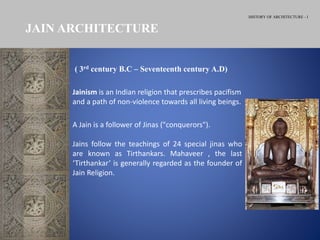
Jainism is an Indian religion that prescribes pacifism
and a path of non-violence towards all living beings.
A Jain is a follower of Jinas ("conquerors").
Jains follow the teachings of 24 special jinas who
are known as Tirthankars. Mahaveer , the last
‘Tirthankar’ is generally regarded as the founder of
Jain Religion.
JAIN ARCHITECTURE
HISTORY OF ARCHITECTURE - I
JAIN ARCHITECTURE
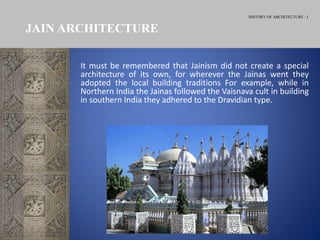
It must be remembered that Jainism did not create a special
architecture of its own, for wherever the Jainas went they
adopted the local building traditions For example, while in
Northern India the Jainas followed the Vaisnava cult in building
in southern India they adhered to the Dravidian type.
HISTORY OF ARCHITECTURE - I
JAIN ARCHITECTURE
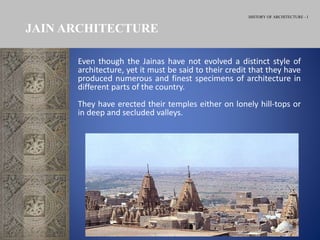
Even though the Jainas have not evolved a distinct style of
architecture, yet it must be said to their credit that they have
produced numerous and finest specimens of architecture in
different parts of the country.
They have erected their temples either on lonely hill-tops or
in deep and secluded valleys.
HISTORY OF ARCHITECTURE - I
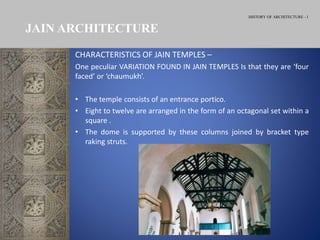
CHARACTERISTICS OF JAIN TEMPLES –
One peculiar VARIATION FOUND IN JAIN TEMPLES Is that they are ‘four
faced’ or ‘chaumukh’.
• The temple consists of an entrance portico.
• Eight to twelve are arranged in the form of an octagonal set within a
square .
• The dome is supported by these columns joined by bracket type
raking struts.
JAIN ARCHITECTURE
HISTORY OF ARCHITECTURE - I
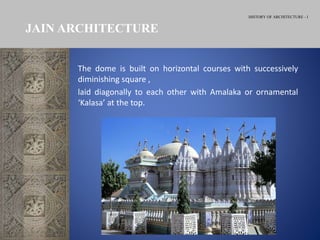
The dome is built on horizontal courses with successively
diminishing square ,
laid diagonally to each other with Amalaka or ornamental
‘Kalasa’ at the top.
JAIN ARCHITECTURE
HISTORY OF ARCHITECTURE - I
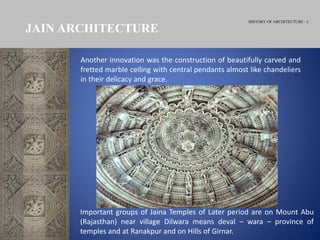
Another innovation was the construction of beautifully carved and
fretted marble ceiling with central pendants almost like chandeliers
in their delicacy and grace.
JAIN ARCHITECTURE
Important groups of Jaina Temples of Later period are on Mount Abu
(Rajasthan) near village Dilwara means deval – wara – province of
temples and at Ranakpur and on Hills of Girnar.
HISTORY OF ARCHITECTURE - I
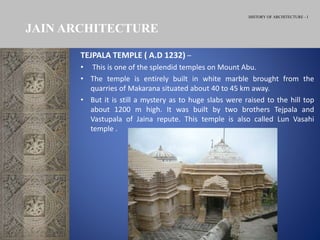
TEJPALA TEMPLE ( A.D 1232) –
• This is one of the splendid temples on Mount Abu.
• The temple is entirely built in white marble brought from the
quarries of Makarana situated about 40 to 45 km away.
• But it is still a mystery as to huge slabs were raised to the hill top
about 1200 m high. It was built by two brothers Tejpala and
Vastupala of Jaina repute. This temple is also called Lun Vasahi
temple .
JAIN ARCHITECTURE
HISTORY OF ARCHITECTURE - I
JAIN ARCHITECTURE
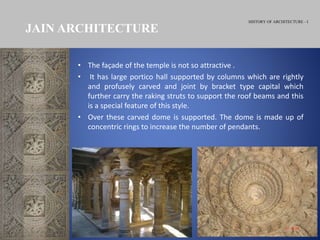
• The façade of the temple is not so attractive .
• It has large portico hall supported by columns which are rightly
and profusely carved and joint by bracket type capital which
further carry the raking struts to support the roof beams and this
is a special feature of this style.
• Over these carved dome is supported. The dome is made up of
concentric rings to increase the number of pendants.
HISTORY OF ARCHITECTURE - I
JAIN ARCHITECTURE
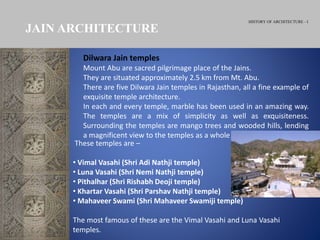
Dilwara Jain temples
Mount Abu are sacred pilgrimage place of the Jains.
They are situated approximately 2.5 km from Mt. Abu.
There are five Dilwara Jain temples in Rajasthan, all a fine example of
exquisite temple architecture.
In each and every temple, marble has been used in an amazing way.
The temples are a mix of simplicity as well as exquisiteness.
Surrounding the temples are mango trees and wooded hills, lending
a magnificent view to the temples as a whole
These temples are –
• Vimal Vasahi (Shri Adi Nathji temple)
• Luna Vasahi (Shri Nemi Nathji temple)
• Pithalhar (Shri Rishabh Deoji temple)
• Khartar Vasahi (Shri Parshav Nathji temple)
• Mahaveer Swami (Shri Mahaveer Swamiji temple)
The most famous of these are the Vimal Vasahi and Luna Vasahi
temples.
HISTORY OF ARCHITECTURE - I
LECTURE - 4
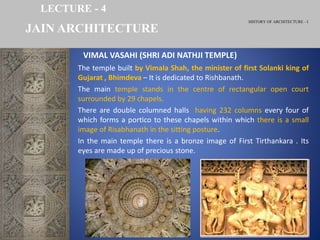
The temple built by Vimala Shah, the minister of first Solanki king of
Gujarat , Bhimdeva – It is dedicated to Rishbanath.
The main temple stands in the centre of rectangular open court
surrounded by 29 chapels.
There are double columned halls having 232 columns every four of
which forms a portico to these chapels within which there is a small
image of Risabhanath in the sitting posture.
In the main temple there is a bronze image of First Tirthankara . Its
eyes are made up of precious stone.
JAIN ARCHITECTURE
VIMAL VASAHI (SHRI ADI NATHJI TEMPLE)
HISTORY OF ARCHITECTURE - I
JAIN ARCHITECTURE
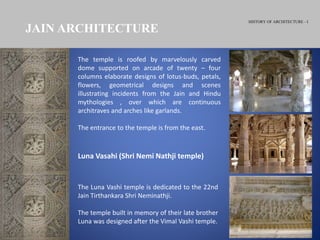
The temple is roofed by marvelously carved
dome supported on arcade of twenty – four
columns elaborate designs of lotus-buds, petals,
flowers, geometrical designs and scenes
illustrating incidents from the Jain and Hindu
mythologies , over which are continuous
architraves and arches like garlands.
The entrance to the temple is from the east.
Luna Vasahi (Shri Nemi Nathji temple)
The Luna Vashi temple is dedicated to the 22nd
Jain Tirthankara Shri Neminathji.
The temple built in memory of their late brother
Luna was designed after the Vimal Vashi temple.
HISTORY OF ARCHITECTURE - I
JAIN ARCHITECTURE
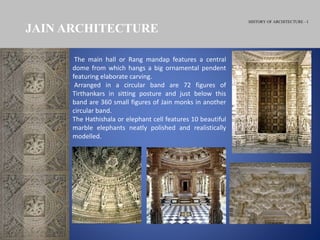
The main hall or Rang mandap features a central
dome from which hangs a big ornamental pendent
featuring elaborate carving.
Arranged in a circular band are 72 figures of
Tirthankars in sitting posture and just below this
band are 360 small figures of Jain monks in another
circular band.
The Hathishala or elephant cell features 10 beautiful
marble elephants neatly polished and realistically
modelled.
HISTORY OF ARCHITECTURE - I
JAIN ARCHITECTURE
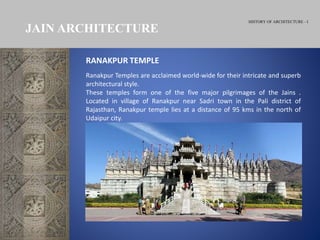
Ranakpur Temples are acclaimed world-wide for their intricate and superb
architectural style.
These temples form one of the five major pilgrimages of the Jains .
Located in village of Ranakpur near Sadri town in the Pali district of
Rajasthan, Ranakpur temple lies at a distance of 95 kms in the north of
Udaipur city.
RANAKPUR TEMPLE
HISTORY OF ARCHITECTURE - I
JAIN ARCHITECTURE
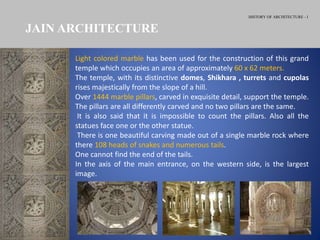
Light colored marble has been used for the construction of this grand
temple which occupies an area of approximately 60 x 62 meters.
The temple, with its distinctive domes, Shikhara , turrets and cupolas
rises majestically from the slope of a hill.
Over 1444 marble pillars, carved in exquisite detail, support the temple.
The pillars are all differently carved and no two pillars are the same.
It is also said that it is impossible to count the pillars. Also all the
statues face one or the other statue.
There is one beautiful carving made out of a single marble rock where
there 108 heads of snakes and numerous tails.
One cannot find the end of the tails.
In the axis of the main entrance, on the western side, is the largest
image.
HISTORY OF ARCHITECTURE - I
JAIN ARCHITECTURE
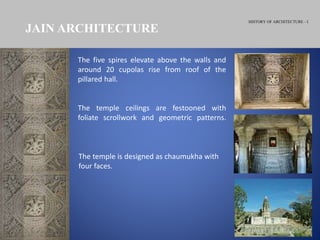
The temple is designed as chaumukha with
four faces.
The five spires elevate above the walls and
around 20 cupolas rise from roof of the
pillared hall.
The temple ceilings are festooned with
foliate scrollwork and geometric patterns.
HISTORY OF ARCHITECTURE - I
JAIN ARCHITECTURE
• GOMATESHWARA according to Jain Scriptures was
the second of the one hundred sons of the first
Tirthankara, Lord Rishabha and king of Podanpur.
• It is situated at Gomateshwara, Shravanabelagola,
Karnataka, India.
• It is 60 feet (18 m) above a hill in a place called
Shravanabelagola in the Hassan district of Karnataka
state, India.
This gigantic statue of lord Bahubali, the Jain saint, is
carved out of a single block of granite and stands
majestically on top of a hill.
It is visible from a distance of 30 km.
At Shravanabelagola the Mahamastakabhisheka
festival is held once in 12 years, when the image of
Gomateshwara is bathed in milk, curds, ghee, saffron
and gold coins.
• What is jain architecture? Main Features of
Jain architecture?

Jain and buddhist

  • 1.
    HINDU SCHOOL OFARCHITECTURE HISTORY OF ARCHITECTURE - ILECTURE - 4 JAIN ARCHITECTURE
  • 2.
    HISTORY OF ARCHITECTURE- I ( 3rd century B.C – Seventeenth century A.D) Jainism is an Indian religion that prescribes pacifism and a path of non-violence towards all living beings. A Jain is a follower of Jinas ("conquerors"). Jains follow the teachings of 24 special jinas who are known as Tirthankars. Mahaveer , the last ‘Tirthankar’ is generally regarded as the founder of Jain Religion. JAIN ARCHITECTURE
  • 3.
    HISTORY OF ARCHITECTURE- I JAIN ARCHITECTURE It must be remembered that Jainism did not create a special architecture of its own, for wherever the Jainas went they adopted the local building traditions For example, while in Northern India the Jainas followed the Vaisnava cult in building in southern India they adhered to the Dravidian type.
  • 4.
    HISTORY OF ARCHITECTURE- I JAIN ARCHITECTURE Even though the Jainas have not evolved a distinct style of architecture, yet it must be said to their credit that they have produced numerous and finest specimens of architecture in different parts of the country. They have erected their temples either on lonely hill-tops or in deep and secluded valleys.
  • 5.
    HISTORY OF ARCHITECTURE- I CHARACTERISTICS OF JAIN TEMPLES – One peculiar VARIATION FOUND IN JAIN TEMPLES Is that they are ‘four faced’ or ‘chaumukh’. • The temple consists of an entrance portico. • Eight to twelve are arranged in the form of an octagonal set within a square . • The dome is supported by these columns joined by bracket type raking struts. JAIN ARCHITECTURE
  • 6.
    HISTORY OF ARCHITECTURE- I The dome is built on horizontal courses with successively diminishing square , laid diagonally to each other with Amalaka or ornamental ‘Kalasa’ at the top. JAIN ARCHITECTURE
  • 7.
    HISTORY OF ARCHITECTURE- I Another innovation was the construction of beautifully carved and fretted marble ceiling with central pendants almost like chandeliers in their delicacy and grace. JAIN ARCHITECTURE Important groups of Jaina Temples of Later period are on Mount Abu (Rajasthan) near village Dilwara means deval – wara – province of temples and at Ranakpur and on Hills of Girnar.
  • 8.
    HISTORY OF ARCHITECTURE- I TEJPALA TEMPLE ( A.D 1232) – • This is one of the splendid temples on Mount Abu. • The temple is entirely built in white marble brought from the quarries of Makarana situated about 40 to 45 km away. • But it is still a mystery as to huge slabs were raised to the hill top about 1200 m high. It was built by two brothers Tejpala and Vastupala of Jaina repute. This temple is also called Lun Vasahi temple . JAIN ARCHITECTURE
  • 9.
    HISTORY OF ARCHITECTURE- I JAIN ARCHITECTURE • The façade of the temple is not so attractive . • It has large portico hall supported by columns which are rightly and profusely carved and joint by bracket type capital which further carry the raking struts to support the roof beams and this is a special feature of this style. • Over these carved dome is supported. The dome is made up of concentric rings to increase the number of pendants.
  • 10.
    HISTORY OF ARCHITECTURE- I JAIN ARCHITECTURE Dilwara Jain temples Mount Abu are sacred pilgrimage place of the Jains. They are situated approximately 2.5 km from Mt. Abu. There are five Dilwara Jain temples in Rajasthan, all a fine example of exquisite temple architecture. In each and every temple, marble has been used in an amazing way. The temples are a mix of simplicity as well as exquisiteness. Surrounding the temples are mango trees and wooded hills, lending a magnificent view to the temples as a whole These temples are – • Vimal Vasahi (Shri Adi Nathji temple) • Luna Vasahi (Shri Nemi Nathji temple) • Pithalhar (Shri Rishabh Deoji temple) • Khartar Vasahi (Shri Parshav Nathji temple) • Mahaveer Swami (Shri Mahaveer Swamiji temple) The most famous of these are the Vimal Vasahi and Luna Vasahi temples.
  • 11.
    HISTORY OF ARCHITECTURE- I LECTURE - 4 The temple built by Vimala Shah, the minister of first Solanki king of Gujarat , Bhimdeva – It is dedicated to Rishbanath. The main temple stands in the centre of rectangular open court surrounded by 29 chapels. There are double columned halls having 232 columns every four of which forms a portico to these chapels within which there is a small image of Risabhanath in the sitting posture. In the main temple there is a bronze image of First Tirthankara . Its eyes are made up of precious stone. JAIN ARCHITECTURE VIMAL VASAHI (SHRI ADI NATHJI TEMPLE)
  • 12.
    HISTORY OF ARCHITECTURE- I JAIN ARCHITECTURE The temple is roofed by marvelously carved dome supported on arcade of twenty – four columns elaborate designs of lotus-buds, petals, flowers, geometrical designs and scenes illustrating incidents from the Jain and Hindu mythologies , over which are continuous architraves and arches like garlands. The entrance to the temple is from the east. Luna Vasahi (Shri Nemi Nathji temple) The Luna Vashi temple is dedicated to the 22nd Jain Tirthankara Shri Neminathji. The temple built in memory of their late brother Luna was designed after the Vimal Vashi temple.
  • 13.
    HISTORY OF ARCHITECTURE- I JAIN ARCHITECTURE The main hall or Rang mandap features a central dome from which hangs a big ornamental pendent featuring elaborate carving. Arranged in a circular band are 72 figures of Tirthankars in sitting posture and just below this band are 360 small figures of Jain monks in another circular band. The Hathishala or elephant cell features 10 beautiful marble elephants neatly polished and realistically modelled.
  • 14.
    HISTORY OF ARCHITECTURE- I JAIN ARCHITECTURE Ranakpur Temples are acclaimed world-wide for their intricate and superb architectural style. These temples form one of the five major pilgrimages of the Jains . Located in village of Ranakpur near Sadri town in the Pali district of Rajasthan, Ranakpur temple lies at a distance of 95 kms in the north of Udaipur city. RANAKPUR TEMPLE
  • 15.
    HISTORY OF ARCHITECTURE- I JAIN ARCHITECTURE Light colored marble has been used for the construction of this grand temple which occupies an area of approximately 60 x 62 meters. The temple, with its distinctive domes, Shikhara , turrets and cupolas rises majestically from the slope of a hill. Over 1444 marble pillars, carved in exquisite detail, support the temple. The pillars are all differently carved and no two pillars are the same. It is also said that it is impossible to count the pillars. Also all the statues face one or the other statue. There is one beautiful carving made out of a single marble rock where there 108 heads of snakes and numerous tails. One cannot find the end of the tails. In the axis of the main entrance, on the western side, is the largest image.
  • 16.
    HISTORY OF ARCHITECTURE- I JAIN ARCHITECTURE The temple is designed as chaumukha with four faces. The five spires elevate above the walls and around 20 cupolas rise from roof of the pillared hall. The temple ceilings are festooned with foliate scrollwork and geometric patterns.
  • 17.
    HISTORY OF ARCHITECTURE- I JAIN ARCHITECTURE • GOMATESHWARA according to Jain Scriptures was the second of the one hundred sons of the first Tirthankara, Lord Rishabha and king of Podanpur. • It is situated at Gomateshwara, Shravanabelagola, Karnataka, India. • It is 60 feet (18 m) above a hill in a place called Shravanabelagola in the Hassan district of Karnataka state, India. This gigantic statue of lord Bahubali, the Jain saint, is carved out of a single block of granite and stands majestically on top of a hill. It is visible from a distance of 30 km. At Shravanabelagola the Mahamastakabhisheka festival is held once in 12 years, when the image of Gomateshwara is bathed in milk, curds, ghee, saffron and gold coins.
  • 18.
    • What isjain architecture? Main Features of Jain architecture?