ISLAMIC ARCHITECTURE
STRUCTURES:
HUMAYUN’S TOMB
RED FORT, DELHI
RED FORT, AGRA
HUMAYUNS
TOMB
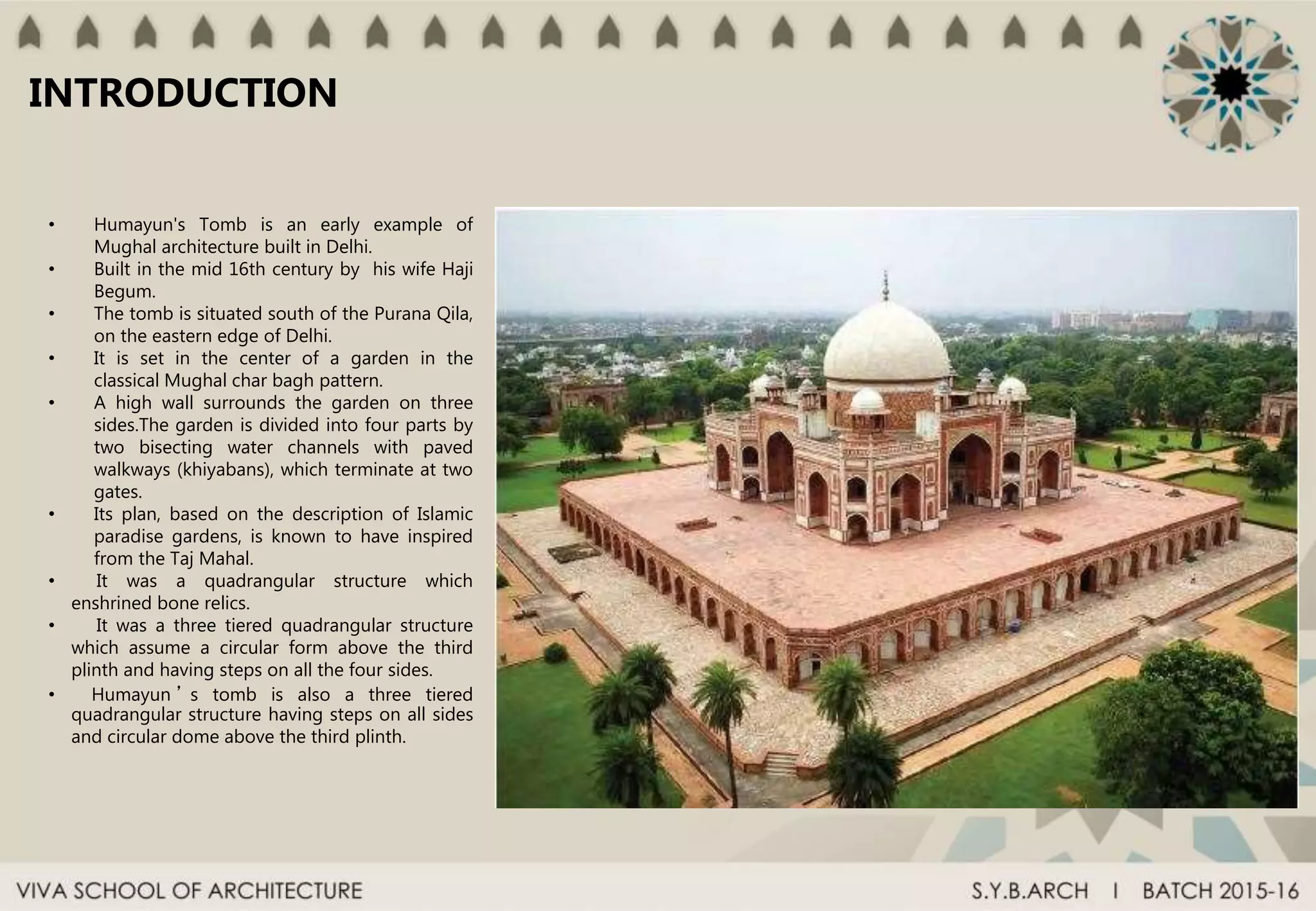
• Humayun's Tomb is an early example of
Mughal architecture built in Delhi.
• Built in the mid 16th century by his wife Haji
Begum.
• The tomb is situated south of the Purana Qila,
on the eastern edge of Delhi.
• It is set in the center of a garden in the
classical Mughal char bagh pattern.
• A high wall surrounds the garden on three
sides.The garden is divided into four parts by
two bisecting water channels with paved
walkways (khiyabans), which terminate at two
gates.
• Its plan, based on the description of Islamic
paradise gardens, is known to have inspired
from the Taj Mahal.
• It was a quadrangular structure which
enshrined bone relics.
• It was a three tiered quadrangular structure
which assume a circular form above the third
plinth and having steps on all the four sides.
• Humayun ’ s tomb is also a three tiered
quadrangular structure having steps on all sides
and circular dome above the third plinth.
INTRODUCTION
SITE PLAN
1
2
3
4
5
6
7
8
15
9
16
14
13
11
12
10
HUMAYUNS TOMB
STYLE: MUGHAL ARCHITECTURE
ARCHITECT: MIRAK MIRZA GHIYATH
LOCATION: MATHURA ROAD, NIZAMUDDIN EAST, DELHI, INDIA
• It was the first garden-tomb on the Indian
subcontinent.
• It was also the first structure to use red sandstone
at such a scale.
• The pathways connect the tomb and the main
entrance gate.
• There are two gateways situated at the west and
the south side.
• Both the gates are 16m in height and have rooms at
the side of the pathway.
• The tomb is built of rubble masonry and red
sandstone, uses white marble as a cladding
material and also for the
flooring, lattice screens (jaalis), door frames,
eaves (chhajja) and for the main dome.
• The plinth made with rubble core has fifty-six cells
all around, and houses over 100 gravestones.
PLAN
• It is a square ninefold plan.
• Eight two-storey vaulted chambers radiate from the central, double-
height domed chamber.
• The chambers of each level are interconnected by straight and diagonal
passages.
• Each of the main chambers has in turn eight more, smaller chambers
radiating from it.
• The symmetrical ground plan contains 124 vaulted chambers in all.
• The central octagonal chamber has the cenotaph of Humayun, which is
encompassed by octagonal chambers at the diagonals
• It also has arched lobbies on the sides and their openings are closed with
perforated screens.
• Central octagonal hall has eight alcoves, one on either side, divided into
a double-storey elevation.
• The third storey above them has jail openings.
• Above them is the stalactite which takes the double-dome.
• Three emphatic arches dominate on each side, of which the central one
is the highest
• The second storey also has a similar design
• Roof surmounted by a 42.5 meters high double dome with marble and
pillared kiosks or chhatris placed around it, which occurs here for the first
time in India.
• This architectural design is known as hasht bihisht (Eight Paradise) and
is typical of Iranian buildings from the time of Timur the Lame. 91M
91M
ELEVATION
SECTION
7M47M42.5M
• Tomb’s Height -47 meters, Width- 91 meters.
• Dome’s Height - 42.5 meters, Brass Finial – 6 meters.
CHARBAGH
Charbagh or Chahar Bagh) is a Persian-style garden layout. The
quadrilateral garden is divided by walkways or flowing water into four smaller
parts. In Persian, "Chār" means 'four' and "bāgh" means 'garden'.
• It is divided in four Quarters by water channels running in four directions
(north, South, east and west)
.
• The four main sections are separated by two water channels which
bisect at right angles.
• The water channels meet at a central reference point mostly a Tomb
• The symbolism behind it very strong and relates to the life after death.
• The Quran describes paradise as a garden of eternity with four rivers: of
water, milk, wine and honey.
• Gardens had been built as earthly representations of the lush and
splendid gardens of paradise described in the holy book .
• The dome is double-layered
• The outer layer supports the white marble exterior facing.
• The inner one defines the cavernous interior volume.
• The most striking visual feature of the tomb is its size and
its garden setting. In terms of both these features, the
tomb established an unprecedented example in Indian
Islamic architecture.
• One of the eye-catching features of the tomb is its raised
plinth that is the cause of its visibility on the city skyline
today. But historically its importance lay in the 56 cells
housed within that raised plinth and that were used as the
burial place of almost 100 royal descendants and relatives.
Red box showing the plinth
ARCHITECTURAL FEATURES
RED FORT , DELHI
Shahjahan (1628-1658) shifted his capital from Agra to Delhi in 1638.
• Laid the foundation of the fort on 16th April 1639, which was completed on 16th April on 1648.
• One crore of rupees was spent on its construction and half of this amount spent only on the palaces (an inscription over the
southern arch of khwabagh).
• It is roughly octagonal on plan, with two longer sides on the east and west.
• It measures about 900 m (n-s) by 550 m (e -w).
• Rampart is constructed in lakhauri brick masonry in lime mortar with red sand stone veneering.
• Its rampart have a perimeter of 2.41 km and rises to a height of 33.5 m on the town side (western side) and 18 m along the river
side (eastern side).
RED FORT, DELHI
MAIN COMPONENT IN RED FORT
• Ramparts and gateways
• Naubat or Naqqar khana- drum house
• Diwan –i- am– hall of public audience
• Mumtaz mahal (chhoti baithak)
• Nahar-i- bihisht – stream of paradise
• Rang mahal – palace of colors
• Shish mahal - house of mirrors
• Khas mahal – private palace
– Tasbih-khana (chamber for telling beads)
– khwabgh bagh (sleeping chamber)
– Tosh khana (robe chamber)
– Beautiful marble screen (carved with ‘scale of justice suspended over a crescent
Surrounded with stars and clouds)
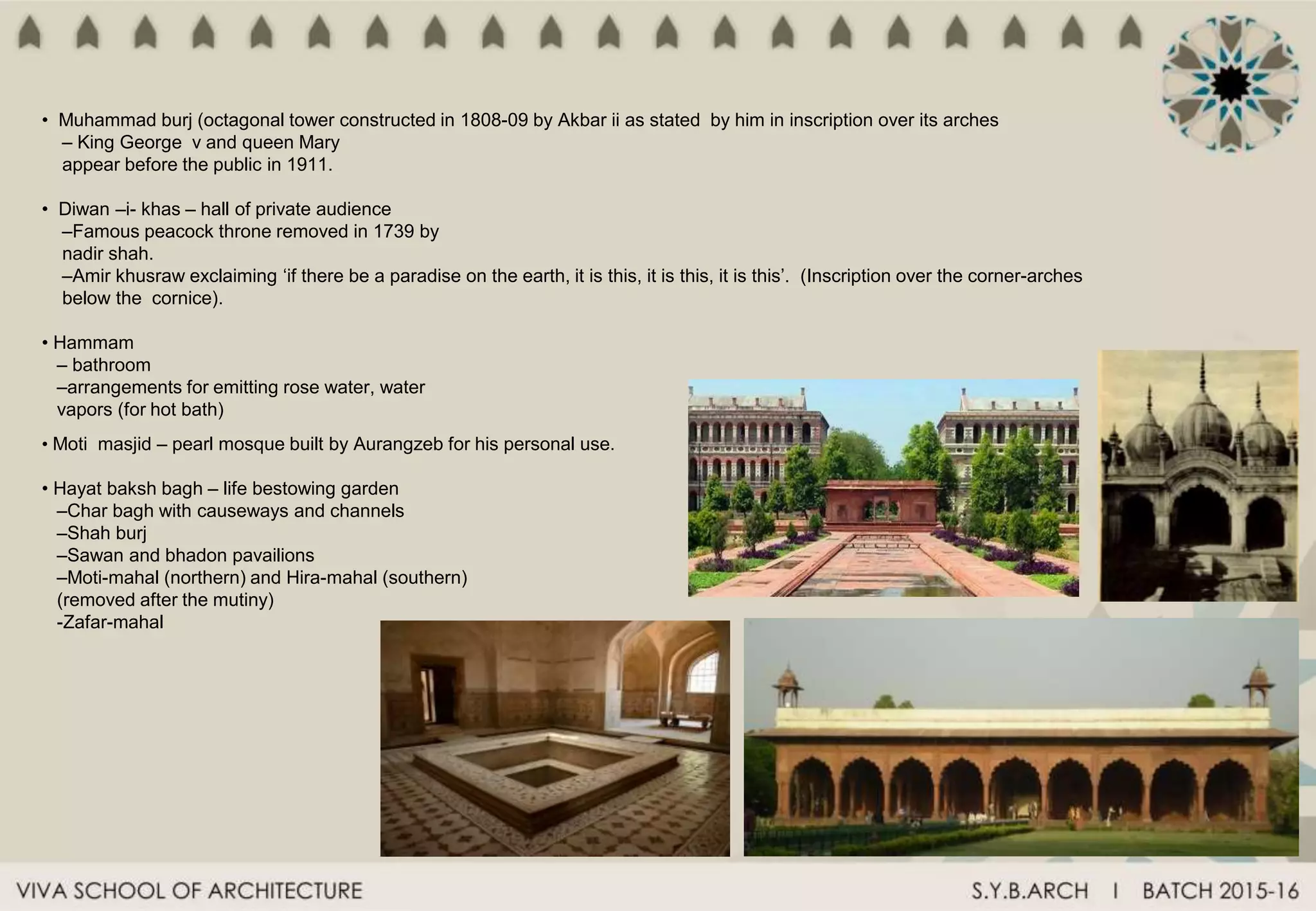
• Muhammad burj (octagonal tower constructed in 1808-09 by Akbar ii as stated by him in inscription over its arches
– King George v and queen Mary
appear before the public in 1911.
• Diwan –i- khas – hall of private audience
–Famous peacock throne removed in 1739 by
nadir shah.
–Amir khusraw exclaiming ‘if there be a paradise on the earth, it is this, it is this, it is this’. (Inscription over the corner-arches
below the cornice).
• Hammam
– bathroom
–arrangements for emitting rose water, water
vapors (for hot bath)
• Moti masjid – pearl mosque built by Aurangzeb for his personal use.
• Hayat baksh bagh – life bestowing garden
–Char bagh with causeways and channels
–Shah burj
–Sawan and bhadon pavailions
–Moti-mahal (northern) and Hira-mahal (southern)
(removed after the mutiny)
-Zafar-mahal
RED FORT , AGRA
• Agra Fort is a UNESCO World Heritage site located in Agra, India.
• The fort is also known as Lal Qila, Fort Rouge and Red Fort of Agra. It is about 2.5 km northwest of its much more famous sister
monument, the Taj Mahal. The fort can be more accurately described as a walled palatial city.
• Agra Fort built by Akbar in Red Sandstone when he was through with the consolidation of his power after accession to power in 1654,
Agra Fort worked both as a military strategic point as well as the royal residence.
• Ever since Babur defeated and killed Ibrahim Lodi at Panipat in 1526, Agra played an important center of Mughal Empire it was in a
ruined condition and Akbar decided to make it his capital and arrived in Agra in 1558 .
• Architects laid the foundation and it was built with bricks in the inner core with sandstone on external surfaces. Some 1,444,000
builders worked on it for eight years, completing it in 1573.
• Akbar had it rebuilt with red sandstone
• At the end of his life, his son, Aurangzeb, in the fort, a punishment that
might not seem so harsh, considering the luxury of the fort, imprisoned
Shah Jahan.
• It is rumored that Shah Jahan died in Musamman Burj, a tower with a
marble balcony with an excellent view of the Taj Mahal.
• The fort contains splendid palaces both in red sandstone and white
marble built by two generations of prolific builders.
1
2
34
5
6
7
Amar Singh gate
Jahangir Palace
Delhi Gate
N
1
2
34
5
6
7
Pavilions for relaxation
Diwan-i-khaas
Diwan-i-aamMoti Masjid
N
MAIN COMPONENT IN RED FORT
Sheesh mahal
Diwan-i-AmDiwan-i-Khas
• Sheesh Mahal - Literally meaning 'Glass Palace' it was the
royal dressing room adorned by tiny mirror-like glass-mosaic
decorations on the walls.
• The Diwan-i-Am - Which was used as a communications
ground between the public and the aristocracy and once
housed the Peacock Throne.
• Diwan-i-Khas - A hall of private audience, it was used to
welcome kings and dignitaries.
• Khas Mahal - An immaculate white marble palace.
• Mina Masjid - Literally meaning 'Heavenly Mosque' it is a tiny
mosque closed to the public.
Nagina Masjid
• The Anguri Bagh - It houses 85 square, geometrically arranged lush
gardens.
• Nagina Masjid - Literally meaning 'Gem Mosque' it was designed
exclusively for the ladies of the court.
• Musamman Burj - A large, octagonal tower with a balcony facing the Taj
Mahal.
Musamman Burj
Anguri Bagh and Khas Mahal
JAHANGIRI MAHAL
• The design of the jahangiri Mahal is formed from a symmetrical, co-
ordinated system of open and closed space which revolves around the
simple, centralized scheme established by court A.
• In plan, it is regular rectangular area defined by cross-axial ratio of
5:4(east-west/north-south).
• The front portal to the river wall measures approximately 77.5m.
• The lateral north-south axis bisecting court A through rooms 3 and 4
measures about 62.5m
• The spatial module is defined by the central bay of the entrance
hall(room 1) which measures approximately 5.6msq.
islamic architecture ,Humayuns tomb

islamic architecture ,Humayuns tomb

  • 1.
  • 2.
  • 3.
    • Humayun's Tombis an early example of Mughal architecture built in Delhi. • Built in the mid 16th century by his wife Haji Begum. • The tomb is situated south of the Purana Qila, on the eastern edge of Delhi. • It is set in the center of a garden in the classical Mughal char bagh pattern. • A high wall surrounds the garden on three sides.The garden is divided into four parts by two bisecting water channels with paved walkways (khiyabans), which terminate at two gates. • Its plan, based on the description of Islamic paradise gardens, is known to have inspired from the Taj Mahal. • It was a quadrangular structure which enshrined bone relics. • It was a three tiered quadrangular structure which assume a circular form above the third plinth and having steps on all the four sides. • Humayun ’ s tomb is also a three tiered quadrangular structure having steps on all sides and circular dome above the third plinth. INTRODUCTION
  • 4.
  • 5.
  • 6.
    HUMAYUNS TOMB STYLE: MUGHALARCHITECTURE ARCHITECT: MIRAK MIRZA GHIYATH LOCATION: MATHURA ROAD, NIZAMUDDIN EAST, DELHI, INDIA • It was the first garden-tomb on the Indian subcontinent. • It was also the first structure to use red sandstone at such a scale. • The pathways connect the tomb and the main entrance gate. • There are two gateways situated at the west and the south side. • Both the gates are 16m in height and have rooms at the side of the pathway. • The tomb is built of rubble masonry and red sandstone, uses white marble as a cladding material and also for the flooring, lattice screens (jaalis), door frames, eaves (chhajja) and for the main dome. • The plinth made with rubble core has fifty-six cells all around, and houses over 100 gravestones.
  • 7.
    PLAN • It isa square ninefold plan. • Eight two-storey vaulted chambers radiate from the central, double- height domed chamber. • The chambers of each level are interconnected by straight and diagonal passages. • Each of the main chambers has in turn eight more, smaller chambers radiating from it. • The symmetrical ground plan contains 124 vaulted chambers in all. • The central octagonal chamber has the cenotaph of Humayun, which is encompassed by octagonal chambers at the diagonals • It also has arched lobbies on the sides and their openings are closed with perforated screens. • Central octagonal hall has eight alcoves, one on either side, divided into a double-storey elevation. • The third storey above them has jail openings. • Above them is the stalactite which takes the double-dome. • Three emphatic arches dominate on each side, of which the central one is the highest • The second storey also has a similar design • Roof surmounted by a 42.5 meters high double dome with marble and pillared kiosks or chhatris placed around it, which occurs here for the first time in India. • This architectural design is known as hasht bihisht (Eight Paradise) and is typical of Iranian buildings from the time of Timur the Lame. 91M 91M
  • 8.
    ELEVATION SECTION 7M47M42.5M • Tomb’s Height-47 meters, Width- 91 meters. • Dome’s Height - 42.5 meters, Brass Finial – 6 meters.
  • 9.
    CHARBAGH Charbagh or ChaharBagh) is a Persian-style garden layout. The quadrilateral garden is divided by walkways or flowing water into four smaller parts. In Persian, "Chār" means 'four' and "bāgh" means 'garden'. • It is divided in four Quarters by water channels running in four directions (north, South, east and west) . • The four main sections are separated by two water channels which bisect at right angles. • The water channels meet at a central reference point mostly a Tomb • The symbolism behind it very strong and relates to the life after death. • The Quran describes paradise as a garden of eternity with four rivers: of water, milk, wine and honey. • Gardens had been built as earthly representations of the lush and splendid gardens of paradise described in the holy book .
  • 10.
    • The domeis double-layered • The outer layer supports the white marble exterior facing. • The inner one defines the cavernous interior volume. • The most striking visual feature of the tomb is its size and its garden setting. In terms of both these features, the tomb established an unprecedented example in Indian Islamic architecture. • One of the eye-catching features of the tomb is its raised plinth that is the cause of its visibility on the city skyline today. But historically its importance lay in the 56 cells housed within that raised plinth and that were used as the burial place of almost 100 royal descendants and relatives. Red box showing the plinth ARCHITECTURAL FEATURES
  • 11.
  • 12.
    Shahjahan (1628-1658) shiftedhis capital from Agra to Delhi in 1638. • Laid the foundation of the fort on 16th April 1639, which was completed on 16th April on 1648. • One crore of rupees was spent on its construction and half of this amount spent only on the palaces (an inscription over the southern arch of khwabagh). • It is roughly octagonal on plan, with two longer sides on the east and west. • It measures about 900 m (n-s) by 550 m (e -w). • Rampart is constructed in lakhauri brick masonry in lime mortar with red sand stone veneering. • Its rampart have a perimeter of 2.41 km and rises to a height of 33.5 m on the town side (western side) and 18 m along the river side (eastern side). RED FORT, DELHI
  • 14.
    MAIN COMPONENT INRED FORT • Ramparts and gateways • Naubat or Naqqar khana- drum house • Diwan –i- am– hall of public audience • Mumtaz mahal (chhoti baithak) • Nahar-i- bihisht – stream of paradise • Rang mahal – palace of colors • Shish mahal - house of mirrors • Khas mahal – private palace – Tasbih-khana (chamber for telling beads) – khwabgh bagh (sleeping chamber) – Tosh khana (robe chamber) – Beautiful marble screen (carved with ‘scale of justice suspended over a crescent Surrounded with stars and clouds)
  • 16.
    • Muhammad burj(octagonal tower constructed in 1808-09 by Akbar ii as stated by him in inscription over its arches – King George v and queen Mary appear before the public in 1911. • Diwan –i- khas – hall of private audience –Famous peacock throne removed in 1739 by nadir shah. –Amir khusraw exclaiming ‘if there be a paradise on the earth, it is this, it is this, it is this’. (Inscription over the corner-arches below the cornice). • Hammam – bathroom –arrangements for emitting rose water, water vapors (for hot bath) • Moti masjid – pearl mosque built by Aurangzeb for his personal use. • Hayat baksh bagh – life bestowing garden –Char bagh with causeways and channels –Shah burj –Sawan and bhadon pavailions –Moti-mahal (northern) and Hira-mahal (southern) (removed after the mutiny) -Zafar-mahal
  • 17.
    RED FORT ,AGRA • Agra Fort is a UNESCO World Heritage site located in Agra, India. • The fort is also known as Lal Qila, Fort Rouge and Red Fort of Agra. It is about 2.5 km northwest of its much more famous sister monument, the Taj Mahal. The fort can be more accurately described as a walled palatial city. • Agra Fort built by Akbar in Red Sandstone when he was through with the consolidation of his power after accession to power in 1654, Agra Fort worked both as a military strategic point as well as the royal residence. • Ever since Babur defeated and killed Ibrahim Lodi at Panipat in 1526, Agra played an important center of Mughal Empire it was in a ruined condition and Akbar decided to make it his capital and arrived in Agra in 1558 . • Architects laid the foundation and it was built with bricks in the inner core with sandstone on external surfaces. Some 1,444,000 builders worked on it for eight years, completing it in 1573. • Akbar had it rebuilt with red sandstone • At the end of his life, his son, Aurangzeb, in the fort, a punishment that might not seem so harsh, considering the luxury of the fort, imprisoned Shah Jahan. • It is rumored that Shah Jahan died in Musamman Burj, a tower with a marble balcony with an excellent view of the Taj Mahal. • The fort contains splendid palaces both in red sandstone and white marble built by two generations of prolific builders.
  • 18.
  • 19.
  • 20.
    MAIN COMPONENT INRED FORT Sheesh mahal Diwan-i-AmDiwan-i-Khas • Sheesh Mahal - Literally meaning 'Glass Palace' it was the royal dressing room adorned by tiny mirror-like glass-mosaic decorations on the walls. • The Diwan-i-Am - Which was used as a communications ground between the public and the aristocracy and once housed the Peacock Throne. • Diwan-i-Khas - A hall of private audience, it was used to welcome kings and dignitaries. • Khas Mahal - An immaculate white marble palace. • Mina Masjid - Literally meaning 'Heavenly Mosque' it is a tiny mosque closed to the public.
  • 21.
    Nagina Masjid • TheAnguri Bagh - It houses 85 square, geometrically arranged lush gardens. • Nagina Masjid - Literally meaning 'Gem Mosque' it was designed exclusively for the ladies of the court. • Musamman Burj - A large, octagonal tower with a balcony facing the Taj Mahal. Musamman Burj Anguri Bagh and Khas Mahal
  • 22.
    JAHANGIRI MAHAL • Thedesign of the jahangiri Mahal is formed from a symmetrical, co- ordinated system of open and closed space which revolves around the simple, centralized scheme established by court A. • In plan, it is regular rectangular area defined by cross-axial ratio of 5:4(east-west/north-south). • The front portal to the river wall measures approximately 77.5m. • The lateral north-south axis bisecting court A through rooms 3 and 4 measures about 62.5m • The spatial module is defined by the central bay of the entrance hall(room 1) which measures approximately 5.6msq.