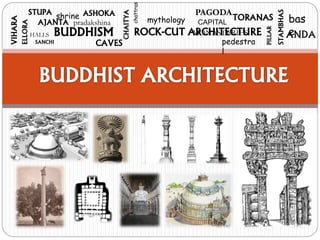
BUDDHISM
VIHARA
CHAITYA
SANCHI
TORANAS
STAMBHAS
ASHOKA
PILLAR
AJANTAELLORA
ROCK-CUT ARCHITECTURE
CAVES
MONASTERIESHALLS
pradakshina
shrine
chattras
PAGODA
mythology CAPITAL bas
e
pedestra
l
ANDA
STUPA
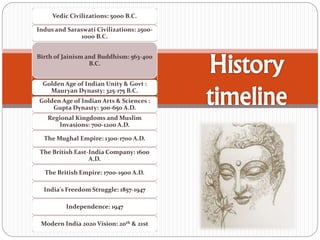
Vedic Civilizations: 5000 B.C.
Indus and Saraswati Civilizations: 2500-
1000 B.C.
Birth of Jainism and Buddhism: 563-400
B.C.
Golden Age of Indian Unity & Govt :
Mauryan Dynasty: 325-175 B.C.
Golden Age of Indian Arts & Sciences :
Gupta Dynasty: 300-650 A.D.
Regional Kingdoms and Muslim
Invasions: 700-1200 A.D.
The Mughal Empire: 1300-1700 A.D.
The British East-India Company: 1600
A.D.
The British Empire: 1700-1900 A.D.
India's Freedom Struggle: 1857-1947
Independence: 1947
Modern India 2020 Vision: 20th & 21st
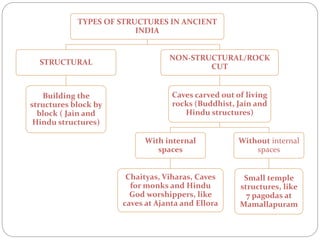
TYPES OF STRUCTURES IN ANCIENT
INDIA
STRUCTURAL
Building the
structures block by
block ( Jain and
Hindu structures)
NON-STRUCTURAL/ROCK
CUT
Caves carved out of living
rocks (Buddhist, Jain and
Hindu structures)
With internal
spaces
Chaityas, Viharas, Caves
for monks and Hindu
God worshippers, like
caves at Ajanta and Ellora
Without internal
spaces
Small temple
structures, like
7 pagodas at
Mamallapuram
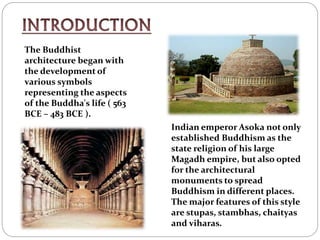
The Buddhist
architecture began with
the development of
various symbols
representing the aspects
of the Buddha's life ( 563
BCE – 483 BCE ).
Indian emperor Asoka not only
established Buddhism as the
state religion of his large
Magadh empire, but also opted
for the architectural
monuments to spread
Buddhism in different places.
The major features of this style
are stupas, stambhas, chaityas
and viharas.
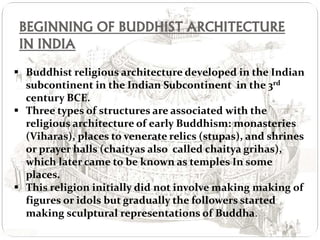
BEGINNING OF BUDDHIST ARCHITECTURE
IN INDIA
 Buddhist religious architecture developed in the Indian
subcontinent in the Indian Subcontinent in the 3rd
century BCE.
 Three types of structures are associated with the
religious architecture of early Buddhism: monasteries
(Viharas), places to venerate relics (stupas), and shrines
or prayer halls (chaityas also called chaitya grihas),
which later came to be known as temples In some
places.
 This religion initially did not involve making making of
figures or idols but gradually the followers started
making sculptural representations of Buddha.
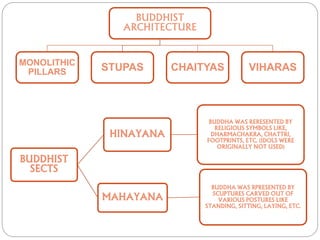
BUDDHIST
ARCHITECTURE
MONOLITHIC
PILLARS STUPAS CHAITYAS VIHARAS
BUDDHIST
SECTS
HINAYANA
BUDDHA WAS RERESENTED BY
RELIGIOUS SYMBOLS LIKE,
DHARMACHAKRA, CHATTRI,
FOOTPRINTS, ETC. (IDOLS WERE
ORIGINALLY NOT USED)
MAHAYANA
BUDDHA WAS RPRESENTED BY
SCUPTURES CARVED OUT OF
VARIOUS POSTURES LIKE
STANDING, SITTING, LAYING, ETC.
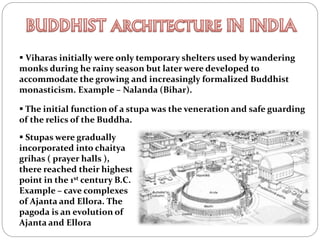
 Viharas initially were only temporary shelters used by wandering
monks during he rainy season but later were developed to
accommodate the growing and increasingly formalized Buddhist
monasticism. Example – Nalanda (Bihar).
 The initial function of a stupa was the veneration and safe guarding
of the relics of the Buddha.
 Stupas were gradually
incorporated into chaitya
grihas ( prayer halls ),
there reached their highest
point in the 1st century B.C.
Example – cave complexes
of Ajanta and Ellora. The
pagoda is an evolution of
Ajanta and Ellora
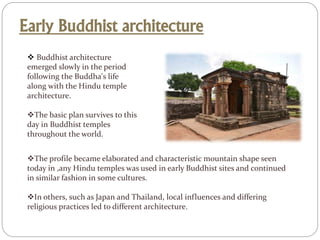
Early Buddhist architecture
 Buddhist architecture
emerged slowly in the period
following the Buddha's life
along with the Hindu temple
architecture.
The basic plan survives to this
day in Buddhist temples
throughout the world.
The profile became elaborated and characteristic mountain shape seen
today in ,any Hindu temples was used in early Buddhist sites and continued
in similar fashion in some cultures.
In others, such as Japan and Thailand, local influences and differing
religious practices led to different architecture.
Evolution
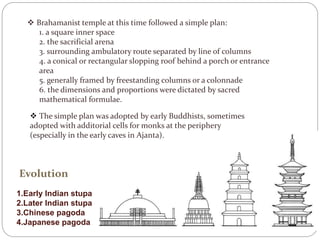
 Brahamanist temple at this time followed a simple plan:
1. a square inner space
2. the sacrificial arena
3. surrounding ambulatory route separated by line of columns
4. a conical or rectangular slopping roof behind a porch or entrance
area
5. generally framed by freestanding columns or a colonnade
6. the dimensions and proportions were dictated by sacred
mathematical formulae.
 The simple plan was adopted by early Buddhists, sometimes
adopted with additorial cells for monks at the periphery
(especially in the early caves in Ajanta).
1.Early Indian stupa
2.Later Indian stupa
3.Chinese pagoda
4.Japanese pagoda
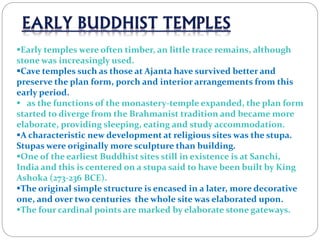
Early temples were often timber, an little trace remains, although
stone was increasingly used.
Cave temples such as those at Ajanta have survived better and
preserve the plan form, porch and interior arrangements from this
early period.
 as the functions of the monastery-temple expanded, the plan form
started to diverge from the Brahmanist tradition and became more
elaborate, providing sleeping, eating and study accommodation.
A characteristic new development at religious sites was the stupa.
Stupas were originally more sculpture than building.
One of the earliest Buddhist sites still in existence is at Sanchi,
India and this is centered on a stupa said to have been built by King
Ashoka (273-236 BCE).
The original simple structure is encased in a later, more decorative
one, and over two centuries the whole site was elaborated upon.
The four cardinal points are marked by elaborate stone gateways.
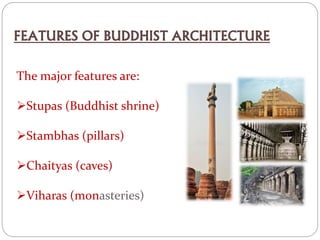
FEATURES OF BUDDHIST ARCHITECTURE
The major features are:
Stupas (Buddhist shrine)
Stambhas (pillars)
Chaityas (caves)
Viharas (monasteries)
Definition: domed-shaped structures used to house sacred relics of
the monks and hence also called “Relic-shrines”.
Construction: Earth materials covered with stones or bricks. The plan,
elevation and the basic structure all derived from the circle.
Stupa is mound of the earth
enclosing a relic can be
compared with the massive form
of the great pyramids of Egypt.
They also called as Thuppa in
Pali, Dagaba in Simbali, tope in
English and Dhatugrabh in
Sanskrit ( Dhatugrabh – relics
preserved in vessel).
Stupas are classified into three types:
1. Sarika Stupa – raised over body relics
2. Paribhojika Stupa – erected over the articles, like the bowl, the
sanghati
3. Uddeshika Stupa – stupas built as commemorative monuments
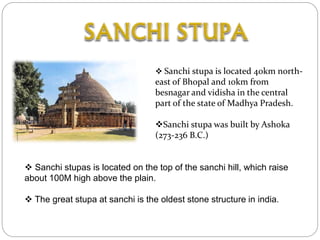
 Sanchi stupa is located 40km north-
east of Bhopal and 10km from
besnagar and vidisha in the central
part of the state of Madhya Pradesh.
Sanchi stupa was built by Ashoka
(273-236 B.C.)
 Sanchi stupas is located on the top of the sanchi hill, which raise
about 100M high above the plain.
 The great stupa at sanchi is the oldest stone structure in india.
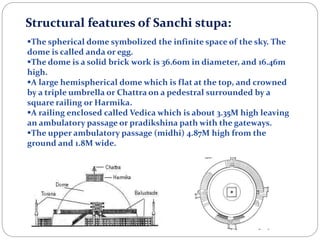
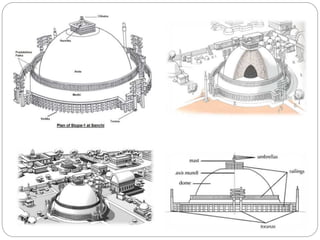
The spherical dome symbolized the infinite space of the sky. The
dome is called anda or egg.
The dome is a solid brick work is 36.60m in diameter, and 16.46m
high.
A large hemispherical dome which is flat at the top, and crowned
by a triple umbrella or Chattra on a pedestral surrounded by a
square railing or Harmika.
A railing enclosed called Vedica which is about 3.35M high leaving
an ambulatory passage or pradikshina path with the gateways.
The upper ambulatory passage (midhi) 4.87M high from the
ground and 1.8M wide.
Structural features of Sanchi stupa:
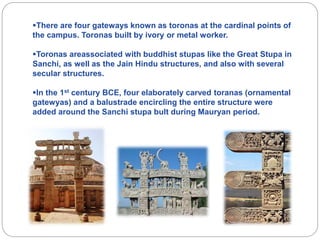
There are four gateways known as toronas at the cardinal points of
the campus. Toronas built by ivory or metal worker.
Toronas areassociated with buddhist stupas like the Great Stupa in
Sanchi, as well as the Jain Hindu structures, and also with several
secular structures.
In the 1st century BCE, four elaborately carved toranas (ornamental
gatewyas) and a balustrade encircling the entire structure were
added around the Sanchi stupa bult during Mauryan period.
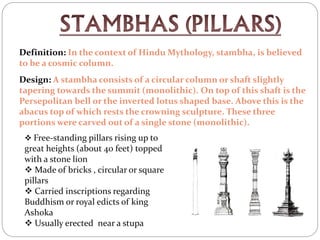
Definition: In the context of Hindu Mythology, stambha, is believed
to be a cosmic column.
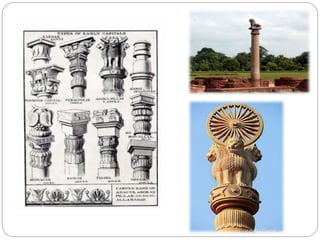
Design: A stambha consists of a circular column or shaft slightly
tapering towards the summit (monolithic). On top of this shaft is the
Persepolitan bell or the inverted lotus shaped base. Above this is the
abacus top of which rests the crowning sculpture. These three
portions were carved out of a single stone (monolithic).
 Free-standing pillars rising up to
great heights (about 40 feet) topped
with a stone lion
 Made of bricks , circular or square
pillars
 Carried inscriptions regarding
Buddhism or royal edicts of king
Ashoka
 Usually erected near a stupa
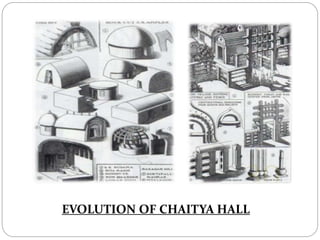
CHAITYA HALLS
Chaityas are Buddhist shrine or
prayer hall with stupa at one
end. They were made for large
gatherings of devotees and made
in rock cut due to permanency of
structure. They were influenced
by aesthetic lifestyle of vedic
period.
Characteristics:
 Accommodates stupa
 Apsidal-ended hall with closely
spaced pillars at each side
Vaulted hall
Aisles and ambulatory
Roofs semicircular in section
CHAITYAS (CAVES)
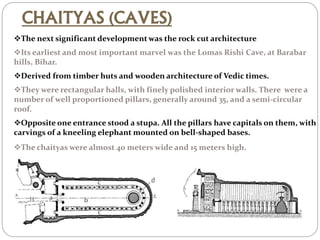
The next significant development was the rock cut architecture
Its earliest and most important marvel was the Lomas Rishi Cave, at Barabar
hills, Bihar.
Derived from timber huts and wooden architecture of Vedic times.
They were rectangular halls, with finely polished interior walls. There were a
number of well proportioned pillars, generally around 35, and a semi-circular
roof.
Opposite one entrance stood a stupa. All the pillars have capitals on them, with
carvings of a kneeling elephant mounted on bell-shaped bases.
The chaityas were almost 40 meters wide and 15 meters high.
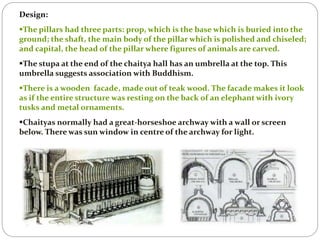
Design:
The pillars had three parts: prop, which is the base which is buried into the
ground; the shaft, the main body of the pillar which is polished and chiseled;
and capital, the head of the pillar where figures of animals are carved.
The stupa at the end of the chaitya hall has an umbrella at the top. This
umbrella suggests association with Buddhism.
There is a wooden facade, made out of teak wood. The facade makes it look
as if the entire structure was resting on the back of an elephant with ivory
tusks and metal ornaments.
Chaityas normally had a great-horseshoe archway with a wall or screen
below. There was sun window in centre of the archway for light.
EVOLUTION OF CHAITYA HALL
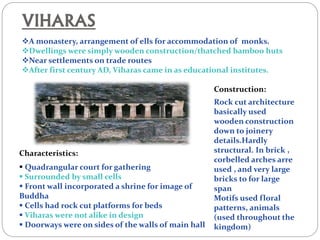
VIHARAS
A monastery, arrangement of ells for accommodation of monks.
Dwellings were simply wooden construction/thatched bamboo huts
Near settlements on trade routes
After first century AD, Viharas came in as educational institutes.
Characteristics:
 Quadrangular court for gathering
 Surrounded by small cells
 Front wall incorporated a shrine for image of
Buddha
 Cells had rock cut platforms for beds
 Viharas were not alike in design
 Doorways were on sides of the walls of main hall
Construction:
Rock cut architecture
basically used
wooden construction
down to joinery
details.Hardly
structural. In brick ,
corbelled arches arre
used , and very large
bricks to for large
span
Motifs used floral
patterns, animals
(used throughout the
kingdom)
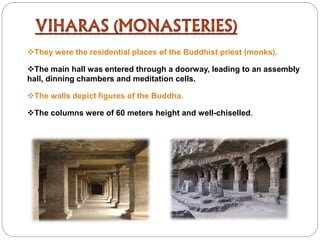
They were the residential places of the Buddhist priest (monks).
The main hall was entered through a doorway, leading to an assembly
hall, dinning chambers and meditation cells.
The walls depict figures of the Buddha.
The columns were of 60 meters height and well-chiselled.
Buddhist architectrure

Buddhist architectrure

  • 1.
  • 2.
    Vedic Civilizations: 5000B.C. Indus and Saraswati Civilizations: 2500- 1000 B.C. Birth of Jainism and Buddhism: 563-400 B.C. Golden Age of Indian Unity & Govt : Mauryan Dynasty: 325-175 B.C. Golden Age of Indian Arts & Sciences : Gupta Dynasty: 300-650 A.D. Regional Kingdoms and Muslim Invasions: 700-1200 A.D. The Mughal Empire: 1300-1700 A.D. The British East-India Company: 1600 A.D. The British Empire: 1700-1900 A.D. India's Freedom Struggle: 1857-1947 Independence: 1947 Modern India 2020 Vision: 20th & 21st
  • 3.
    TYPES OF STRUCTURESIN ANCIENT INDIA STRUCTURAL Building the structures block by block ( Jain and Hindu structures) NON-STRUCTURAL/ROCK CUT Caves carved out of living rocks (Buddhist, Jain and Hindu structures) With internal spaces Chaityas, Viharas, Caves for monks and Hindu God worshippers, like caves at Ajanta and Ellora Without internal spaces Small temple structures, like 7 pagodas at Mamallapuram
  • 4.
    The Buddhist architecture beganwith the development of various symbols representing the aspects of the Buddha's life ( 563 BCE – 483 BCE ). Indian emperor Asoka not only established Buddhism as the state religion of his large Magadh empire, but also opted for the architectural monuments to spread Buddhism in different places. The major features of this style are stupas, stambhas, chaityas and viharas.
  • 5.
    BEGINNING OF BUDDHISTARCHITECTURE IN INDIA  Buddhist religious architecture developed in the Indian subcontinent in the Indian Subcontinent in the 3rd century BCE.  Three types of structures are associated with the religious architecture of early Buddhism: monasteries (Viharas), places to venerate relics (stupas), and shrines or prayer halls (chaityas also called chaitya grihas), which later came to be known as temples In some places.  This religion initially did not involve making making of figures or idols but gradually the followers started making sculptural representations of Buddha.
  • 6.
    BUDDHIST ARCHITECTURE MONOLITHIC PILLARS STUPAS CHAITYASVIHARAS BUDDHIST SECTS HINAYANA BUDDHA WAS RERESENTED BY RELIGIOUS SYMBOLS LIKE, DHARMACHAKRA, CHATTRI, FOOTPRINTS, ETC. (IDOLS WERE ORIGINALLY NOT USED) MAHAYANA BUDDHA WAS RPRESENTED BY SCUPTURES CARVED OUT OF VARIOUS POSTURES LIKE STANDING, SITTING, LAYING, ETC.
  • 7.
     Viharas initiallywere only temporary shelters used by wandering monks during he rainy season but later were developed to accommodate the growing and increasingly formalized Buddhist monasticism. Example – Nalanda (Bihar).  The initial function of a stupa was the veneration and safe guarding of the relics of the Buddha.  Stupas were gradually incorporated into chaitya grihas ( prayer halls ), there reached their highest point in the 1st century B.C. Example – cave complexes of Ajanta and Ellora. The pagoda is an evolution of Ajanta and Ellora
  • 8.
    Early Buddhist architecture Buddhist architecture emerged slowly in the period following the Buddha's life along with the Hindu temple architecture. The basic plan survives to this day in Buddhist temples throughout the world. The profile became elaborated and characteristic mountain shape seen today in ,any Hindu temples was used in early Buddhist sites and continued in similar fashion in some cultures. In others, such as Japan and Thailand, local influences and differing religious practices led to different architecture.
  • 9.
    Evolution  Brahamanist templeat this time followed a simple plan: 1. a square inner space 2. the sacrificial arena 3. surrounding ambulatory route separated by line of columns 4. a conical or rectangular slopping roof behind a porch or entrance area 5. generally framed by freestanding columns or a colonnade 6. the dimensions and proportions were dictated by sacred mathematical formulae.  The simple plan was adopted by early Buddhists, sometimes adopted with additorial cells for monks at the periphery (especially in the early caves in Ajanta). 1.Early Indian stupa 2.Later Indian stupa 3.Chinese pagoda 4.Japanese pagoda
  • 10.
    Early temples wereoften timber, an little trace remains, although stone was increasingly used. Cave temples such as those at Ajanta have survived better and preserve the plan form, porch and interior arrangements from this early period.  as the functions of the monastery-temple expanded, the plan form started to diverge from the Brahmanist tradition and became more elaborate, providing sleeping, eating and study accommodation. A characteristic new development at religious sites was the stupa. Stupas were originally more sculpture than building. One of the earliest Buddhist sites still in existence is at Sanchi, India and this is centered on a stupa said to have been built by King Ashoka (273-236 BCE). The original simple structure is encased in a later, more decorative one, and over two centuries the whole site was elaborated upon. The four cardinal points are marked by elaborate stone gateways.
  • 11.
    FEATURES OF BUDDHISTARCHITECTURE The major features are: Stupas (Buddhist shrine) Stambhas (pillars) Chaityas (caves) Viharas (monasteries)
  • 12.
    Definition: domed-shaped structuresused to house sacred relics of the monks and hence also called “Relic-shrines”. Construction: Earth materials covered with stones or bricks. The plan, elevation and the basic structure all derived from the circle. Stupa is mound of the earth enclosing a relic can be compared with the massive form of the great pyramids of Egypt. They also called as Thuppa in Pali, Dagaba in Simbali, tope in English and Dhatugrabh in Sanskrit ( Dhatugrabh – relics preserved in vessel). Stupas are classified into three types: 1. Sarika Stupa – raised over body relics 2. Paribhojika Stupa – erected over the articles, like the bowl, the sanghati 3. Uddeshika Stupa – stupas built as commemorative monuments
  • 13.
     Sanchi stupais located 40km north- east of Bhopal and 10km from besnagar and vidisha in the central part of the state of Madhya Pradesh. Sanchi stupa was built by Ashoka (273-236 B.C.)  Sanchi stupas is located on the top of the sanchi hill, which raise about 100M high above the plain.  The great stupa at sanchi is the oldest stone structure in india.
  • 14.
    The spherical domesymbolized the infinite space of the sky. The dome is called anda or egg. The dome is a solid brick work is 36.60m in diameter, and 16.46m high. A large hemispherical dome which is flat at the top, and crowned by a triple umbrella or Chattra on a pedestral surrounded by a square railing or Harmika. A railing enclosed called Vedica which is about 3.35M high leaving an ambulatory passage or pradikshina path with the gateways. The upper ambulatory passage (midhi) 4.87M high from the ground and 1.8M wide. Structural features of Sanchi stupa:
  • 15.
    There are fourgateways known as toronas at the cardinal points of the campus. Toronas built by ivory or metal worker. Toronas areassociated with buddhist stupas like the Great Stupa in Sanchi, as well as the Jain Hindu structures, and also with several secular structures. In the 1st century BCE, four elaborately carved toranas (ornamental gatewyas) and a balustrade encircling the entire structure were added around the Sanchi stupa bult during Mauryan period.
  • 17.
    Definition: In thecontext of Hindu Mythology, stambha, is believed to be a cosmic column. Design: A stambha consists of a circular column or shaft slightly tapering towards the summit (monolithic). On top of this shaft is the Persepolitan bell or the inverted lotus shaped base. Above this is the abacus top of which rests the crowning sculpture. These three portions were carved out of a single stone (monolithic).  Free-standing pillars rising up to great heights (about 40 feet) topped with a stone lion  Made of bricks , circular or square pillars  Carried inscriptions regarding Buddhism or royal edicts of king Ashoka  Usually erected near a stupa
  • 19.
    CHAITYA HALLS Chaityas areBuddhist shrine or prayer hall with stupa at one end. They were made for large gatherings of devotees and made in rock cut due to permanency of structure. They were influenced by aesthetic lifestyle of vedic period. Characteristics:  Accommodates stupa  Apsidal-ended hall with closely spaced pillars at each side Vaulted hall Aisles and ambulatory Roofs semicircular in section
  • 20.
    CHAITYAS (CAVES) The nextsignificant development was the rock cut architecture Its earliest and most important marvel was the Lomas Rishi Cave, at Barabar hills, Bihar. Derived from timber huts and wooden architecture of Vedic times. They were rectangular halls, with finely polished interior walls. There were a number of well proportioned pillars, generally around 35, and a semi-circular roof. Opposite one entrance stood a stupa. All the pillars have capitals on them, with carvings of a kneeling elephant mounted on bell-shaped bases. The chaityas were almost 40 meters wide and 15 meters high.
  • 21.
    Design: The pillars hadthree parts: prop, which is the base which is buried into the ground; the shaft, the main body of the pillar which is polished and chiseled; and capital, the head of the pillar where figures of animals are carved. The stupa at the end of the chaitya hall has an umbrella at the top. This umbrella suggests association with Buddhism. There is a wooden facade, made out of teak wood. The facade makes it look as if the entire structure was resting on the back of an elephant with ivory tusks and metal ornaments. Chaityas normally had a great-horseshoe archway with a wall or screen below. There was sun window in centre of the archway for light.
  • 22.
  • 23.
    VIHARAS A monastery, arrangementof ells for accommodation of monks. Dwellings were simply wooden construction/thatched bamboo huts Near settlements on trade routes After first century AD, Viharas came in as educational institutes. Characteristics:  Quadrangular court for gathering  Surrounded by small cells  Front wall incorporated a shrine for image of Buddha  Cells had rock cut platforms for beds  Viharas were not alike in design  Doorways were on sides of the walls of main hall Construction: Rock cut architecture basically used wooden construction down to joinery details.Hardly structural. In brick , corbelled arches arre used , and very large bricks to for large span Motifs used floral patterns, animals (used throughout the kingdom)
  • 24.
    They were theresidential places of the Buddhist priest (monks). The main hall was entered through a doorway, leading to an assembly hall, dinning chambers and meditation cells. The walls depict figures of the Buddha. The columns were of 60 meters height and well-chiselled.