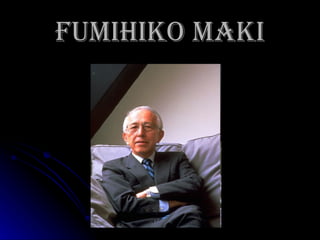
FUMIHIKO MAKI
BIOgrApHy
 Fumihiko Maki was born in Tokyo in 1928.
 He studied at the University of Tokyo, at the
  Cranbrook Academy of Art in Bloomfield Hills,
  and at the Harvard Graduate School of Design.
 He worked for Skidmore, Owings, and Merrill in
  New York and for Sert Jackson and Associates in
  Cambridge he spent several years teaching and
  working independently.
 In 1965 he established Maki and Associates in
  Tokyo.
MAKI’s prOFessIOnAl
         AFFIlIAtIOns
   Registered Architect, Japan
   Registered Architect, Germany
   Member, Japan Institute of Architects
   Honorary Fellow, American Institute of Architects
   Honorary Fellow, Royal Institute of British Architects
   Honorary Fellow, Czech Institute of Architects
   Honorary Fellow, Mexican Institute of Architects
   Honorary Fellow, Bund Deutscher Architekten
   Honorary Fellow, American Academy of Arts & Sciences
   Honorary Fellow, Academia Scientiarum et Artium Europaea
   Honorary Fellow, French Academy of Architecture
Maki’s Teaching and
              Research
   1956-58 Assistant Professor, Washington University.
   1958-60 Graham Foundation Fellow
   1960-62 Associate Professor, Washington University
   1962-65 Associate Professor, GSD Harvard University
   1965-85 Visiting Critic, Universities in United States and
    Europe.
   1979-89 Professor, Department of Architecture, University of
    Tokyo.
MAKI’S PHILOSOPHY
   Maki chooses to work on public buildings that are on at large
    scale, because of this his structures seem to be complicating
    only for the fact that he add so many things.
   He plays off of this idea of space and people and
    incorporates into his design.
   He examines carefully how people interact in spaces and
    works with the site to produce buildings that seem to either
    use curvilinear forms to spread across the land or use
    modules of cubes to build up.
   He also uses dynamic roofs that project in different directions
    to contrast his simplistic facades.
   A recurring aspect in Fumihiko Maki's designs is his
    masterful use of light
Maki’s Major Projects
   1985 - SPIRAL , Tokyo
   1986 - National Museum of Modern Art, Kyoto
   1989 - TEPIA Science Pavilion, Tokyo
   1989 - Makuhari Messe, Chiba
   1990 - Tokyo Metropolitan Gymnasium, Tokyo
   1991 - 94 Keio University, Shonan Fujisawa Campus, Kanagawa
   1993 - Yerba Buena Center for the Arts, USA
   1994 - Isar Buro Park, Germany
   1996 - Kirishima International Concert Hall, Kagoshima
   1996 –Kaze -no-Oka Crematorium, Oita
   1996 - Fukuoka University Helios Plaza, Fukuoka
   1997 - Natori Performing Arts Center, Miyagi
   1997 - Makuhari Messe II North Hall, Chiba
   1998 - Hillside West, Tokyo.
   1999 - Toyama International Conference Center, Toyama.
   2000 - Fukushima Gender Equality Center, Fukushima.
   2003 - Fukui Prefectural Library and Archives, Fukui.
   2003 - Toki Messe / Niigata Convention Center, Niigata.
   2003 - TV Asahi Headquarters, Tokyo.
   2003 - Yokohama I Land Tower, Kanagawa.
   2004 - Tokyo University Law / Political Science Learning
    Center, Tokyo.
   2004 - National Language Research Institute, Tokyo.
   2005 - Shimane Prefectural Museum of History and Folklore,
    Shimane.
   2006 - Washington University in St. Louis Sam Fox School of
    Design and Visual Arts.
   2007 - Republic Polytechnic, Singapore.
1985 - SPIRAL , Tokyo    1986 - National Museum of      1989 - TEPIA Science Pavilion,
                         Modern Art, Kyoto              Tokyo


1989 - Makuhari Messe,      1990 - Tokyo Metropolitan   94 Keio University,
Chiba                       Gymnasium, Tokyo            Shonan Fujisawa Campus,
                                                        Kanagawa
Yerba Buena Center for the 1994 - Isar BOro Park, Germany 1996 - Kirishima International
Arts, USA                                                 Concert Hall, Kagoshima


                            1996 - Fukuoka University       1997 - Natori Performing Arts
 1993 YKK R&D Center        Helios Plaza, Fukuoka           Center, Miyagi
 Sumida, Tokyo
1997 - Makuhari Messe II North     1998 - Hillside West,    1999 - Toyama International
Hall, Chiba                        Tokyo                    Conference Center, Toyama.


 2000 - Fukushima Gender         2003 - Fukui Prefectural      2003 - Toki Messe / Niigata
 Equality Center, Fukushima.     Library and Archives,         Convention Center, Niigata.
                                 Fukui.
1969
  2003 - TV Asahi Headquarters,
 -hillside Terrace in TokyO

  Tokyo.                                                •2002 Rolex Toyocho Building
                                                        Kouto, Tokyo
                                    2003 - Yokohama I
                                    Land Tower,
                                    Kanagawa.


                                                           2004 The National
                                                          Institute for Japanese
1995 Tokyo Church of Chirst         1969- HILLSIDE               Language
                                       1969
Shibuya, Tokyo                    TERRACE IN TOKYO         Tachikawa,Tokyo
2006 Shimane Museum of         2006 Washington University in   2007 - Republic Polytechnic,
Ancient Izumo Izumoshi , Shimne       St. Louis                Singapore
                                     Missouri, U.S.A.


2007 Toyoda Memorial Hall      2007 Mihara Performing Arts
 Renovation Nagoya, Aichi           enter Hiroshima
WORKS UNDER CONSTUCTION


2008 The Delegation of The Ismaili Imamat         2008 The University of Pennsylvania
        Ottawa, Ontario Canada                      Annenberg Public Policy Center


               2009 Massachusetts Institute of Technology, Media Arts and
                               Sciences Building, USA
MAKI’S UPCOMING PROJECTS


2012- Redevelopment of Taipei Main
Station Area Taipei, Taiwan          2012 World Trade Center Tower 4 - 150
                                     Greenwich Street New York, U.S.A
Tokyo Metropolitan Gymnasium


   Tokyo Metropolitan Gymnasium is compound
    institution which consists of a main arena with
    a diameter of 120m, a sub arena, a pool, etc
   Tokyo Metropolitan Gymnasium was
    completed in the year 1990.
   The site area was around 45,800 sq.m
   The construction area of the structure is
    24,100 sq.m
   The total floor area is 43,971 sq.m.
Tokyo Metropolitan Gymnasium

    The Tokyo Metropolitan Gymnasium,
located across from Sendagaya Station
in Tokyo's Shibuya ward,
 It is a futuristic complex bound to
irritate devotees of urban contextual
architecture.
 It is one of several public projects that
architect Fumihiko Maki has completed in
various locations across Japan.
 The sports center consists of three buildings;
a large arena, a smaller sub-arena and a swimming pool, all of which
are joined by a large stone-paved plaza on two levels.
Tokyo Metropolitan Gymnasium

   The large arena is the dominant structure in the
    complex as well as the dominant structure in
    the immediate neighborhood .
   The building appears to be almost all roof since
                    the walls of the structure rise only a few stories
                            above the height of the plaza. When viewed from
                                   above, the roof turns out to be composed of two
                                    symmetrical leaf-like shapes leaning against each
                                              other within a circle.
   The intersecting curving surfaces seem to form a
                    surface of unfathomable geometric complexities.
   The entire surface of the 150-meter-diameter roof
                   is covered with narrow aluminum strips which
                          ensures that some part of the roof will be reflecting
                                           the sun's rays at almost any time during a sunny
    day.
Tokyo Metropolitan Gymnasium

   The sub-arena lies to the southwest of the stadium. The main part of its interior lies
    below ground but its stepped roof protrudes above the plaza.


The ziggurat-like structure is covered with blue tiles. Its simple cube-like shapes provide a
contrast to the flowing curves of the main arena
Tokyo Metropolitan Gymnasium
   The indoor pool is housed in a building at the southwest corner of the site.
   This building is the most conventional looking of the three structures, being
    a rectangular form capped by a gently curving arch-shaped roof.


   Its most notable feature is a teflon roof perched atop walls that are concrete
    below and glass block above, allowing generous amounts of sunlight to
    flood the interiors.
   In contrast to the two arenas, where heavy roofs block the entrance of
    natural light and close-off the interiors from the sky above, the translucent
    roof of the pool structure seems to open its interior to the heavens above.
Fumihiko maki.pps

Fumihiko maki.pps

  • 1.
  • 2.
    BIOgrApHy  Fumihiko Makiwas born in Tokyo in 1928.  He studied at the University of Tokyo, at the Cranbrook Academy of Art in Bloomfield Hills, and at the Harvard Graduate School of Design.  He worked for Skidmore, Owings, and Merrill in New York and for Sert Jackson and Associates in Cambridge he spent several years teaching and working independently.  In 1965 he established Maki and Associates in Tokyo.
  • 3.
    MAKI’s prOFessIOnAl AFFIlIAtIOns  Registered Architect, Japan  Registered Architect, Germany  Member, Japan Institute of Architects  Honorary Fellow, American Institute of Architects  Honorary Fellow, Royal Institute of British Architects  Honorary Fellow, Czech Institute of Architects  Honorary Fellow, Mexican Institute of Architects  Honorary Fellow, Bund Deutscher Architekten  Honorary Fellow, American Academy of Arts & Sciences  Honorary Fellow, Academia Scientiarum et Artium Europaea  Honorary Fellow, French Academy of Architecture
  • 4.
    Maki’s Teaching and Research  1956-58 Assistant Professor, Washington University.  1958-60 Graham Foundation Fellow  1960-62 Associate Professor, Washington University  1962-65 Associate Professor, GSD Harvard University  1965-85 Visiting Critic, Universities in United States and Europe.  1979-89 Professor, Department of Architecture, University of Tokyo.
  • 5.
    MAKI’S PHILOSOPHY  Maki chooses to work on public buildings that are on at large scale, because of this his structures seem to be complicating only for the fact that he add so many things.  He plays off of this idea of space and people and incorporates into his design.  He examines carefully how people interact in spaces and works with the site to produce buildings that seem to either use curvilinear forms to spread across the land or use modules of cubes to build up.  He also uses dynamic roofs that project in different directions to contrast his simplistic facades.  A recurring aspect in Fumihiko Maki's designs is his masterful use of light
  • 6.
    Maki’s Major Projects  1985 - SPIRAL , Tokyo  1986 - National Museum of Modern Art, Kyoto  1989 - TEPIA Science Pavilion, Tokyo  1989 - Makuhari Messe, Chiba  1990 - Tokyo Metropolitan Gymnasium, Tokyo  1991 - 94 Keio University, Shonan Fujisawa Campus, Kanagawa  1993 - Yerba Buena Center for the Arts, USA  1994 - Isar Buro Park, Germany  1996 - Kirishima International Concert Hall, Kagoshima  1996 –Kaze -no-Oka Crematorium, Oita  1996 - Fukuoka University Helios Plaza, Fukuoka  1997 - Natori Performing Arts Center, Miyagi  1997 - Makuhari Messe II North Hall, Chiba
  • 7.
    1998 - Hillside West, Tokyo.  1999 - Toyama International Conference Center, Toyama.  2000 - Fukushima Gender Equality Center, Fukushima.  2003 - Fukui Prefectural Library and Archives, Fukui.  2003 - Toki Messe / Niigata Convention Center, Niigata.  2003 - TV Asahi Headquarters, Tokyo.  2003 - Yokohama I Land Tower, Kanagawa.  2004 - Tokyo University Law / Political Science Learning Center, Tokyo.  2004 - National Language Research Institute, Tokyo.  2005 - Shimane Prefectural Museum of History and Folklore, Shimane.  2006 - Washington University in St. Louis Sam Fox School of Design and Visual Arts.  2007 - Republic Polytechnic, Singapore.
  • 8.
    1985 - SPIRAL, Tokyo 1986 - National Museum of 1989 - TEPIA Science Pavilion, Modern Art, Kyoto Tokyo 1989 - Makuhari Messe, 1990 - Tokyo Metropolitan 94 Keio University, Chiba Gymnasium, Tokyo Shonan Fujisawa Campus, Kanagawa
  • 9.
    Yerba Buena Centerfor the 1994 - Isar BOro Park, Germany 1996 - Kirishima International Arts, USA Concert Hall, Kagoshima 1996 - Fukuoka University 1997 - Natori Performing Arts 1993 YKK R&D Center Helios Plaza, Fukuoka Center, Miyagi Sumida, Tokyo
  • 10.
    1997 - MakuhariMesse II North 1998 - Hillside West, 1999 - Toyama International Hall, Chiba Tokyo Conference Center, Toyama. 2000 - Fukushima Gender 2003 - Fukui Prefectural 2003 - Toki Messe / Niigata Equality Center, Fukushima. Library and Archives, Convention Center, Niigata. Fukui.
  • 11.
    1969 2003- TV Asahi Headquarters, -hillside Terrace in TokyO Tokyo. •2002 Rolex Toyocho Building Kouto, Tokyo 2003 - Yokohama I Land Tower, Kanagawa. 2004 The National Institute for Japanese 1995 Tokyo Church of Chirst 1969- HILLSIDE Language 1969 Shibuya, Tokyo TERRACE IN TOKYO Tachikawa,Tokyo
  • 12.
    2006 Shimane Museumof 2006 Washington University in 2007 - Republic Polytechnic, Ancient Izumo Izumoshi , Shimne St. Louis   Singapore Missouri, U.S.A. 2007 Toyoda Memorial Hall 2007 Mihara Performing Arts Renovation Nagoya, Aichi enter Hiroshima
  • 13.
    WORKS UNDER CONSTUCTION 2008The Delegation of The Ismaili Imamat 2008 The University of Pennsylvania Ottawa, Ontario Canada Annenberg Public Policy Center 2009 Massachusetts Institute of Technology, Media Arts and Sciences Building, USA
  • 14.
    MAKI’S UPCOMING PROJECTS 2012-Redevelopment of Taipei Main Station Area Taipei, Taiwan 2012 World Trade Center Tower 4 - 150 Greenwich Street New York, U.S.A
  • 15.
  • 16.
    Tokyo Metropolitan Gymnasium  Tokyo Metropolitan Gymnasium is compound institution which consists of a main arena with a diameter of 120m, a sub arena, a pool, etc  Tokyo Metropolitan Gymnasium was completed in the year 1990.  The site area was around 45,800 sq.m  The construction area of the structure is 24,100 sq.m  The total floor area is 43,971 sq.m.
  • 17.
    Tokyo Metropolitan Gymnasium  The Tokyo Metropolitan Gymnasium, located across from Sendagaya Station in Tokyo's Shibuya ward,  It is a futuristic complex bound to irritate devotees of urban contextual architecture.  It is one of several public projects that architect Fumihiko Maki has completed in various locations across Japan.  The sports center consists of three buildings; a large arena, a smaller sub-arena and a swimming pool, all of which are joined by a large stone-paved plaza on two levels.
  • 18.
    Tokyo Metropolitan Gymnasium  The large arena is the dominant structure in the complex as well as the dominant structure in the immediate neighborhood .  The building appears to be almost all roof since the walls of the structure rise only a few stories above the height of the plaza. When viewed from above, the roof turns out to be composed of two symmetrical leaf-like shapes leaning against each other within a circle.  The intersecting curving surfaces seem to form a surface of unfathomable geometric complexities.  The entire surface of the 150-meter-diameter roof is covered with narrow aluminum strips which ensures that some part of the roof will be reflecting the sun's rays at almost any time during a sunny day.
  • 19.
    Tokyo Metropolitan Gymnasium  The sub-arena lies to the southwest of the stadium. The main part of its interior lies below ground but its stepped roof protrudes above the plaza. The ziggurat-like structure is covered with blue tiles. Its simple cube-like shapes provide a contrast to the flowing curves of the main arena
  • 20.
    Tokyo Metropolitan Gymnasium  The indoor pool is housed in a building at the southwest corner of the site.  This building is the most conventional looking of the three structures, being a rectangular form capped by a gently curving arch-shaped roof.  Its most notable feature is a teflon roof perched atop walls that are concrete below and glass block above, allowing generous amounts of sunlight to flood the interiors.  In contrast to the two arenas, where heavy roofs block the entrance of natural light and close-off the interiors from the sky above, the translucent roof of the pool structure seems to open its interior to the heavens above.