Alberta Education
ECS-Gr4 Technology
Research Community of
Practice
St. Paul Education Region – language
acquisition & early literacy
Rocky View Schools – enrich &
accessibility
Edmonton Catholic (17 sites)
- assistive technologies
Calgary Catholic - engagement
Designing Digitally Rich,
Knowledge Building,
Inclusive Learning Environments
for the Early Grades
RCOP Overall Goals
 To cultivate, document and assess
engaged teaching, learning and
assessment practices with technology
 To collaborate on research that
contributes new understandings and
empirical evidence of effective
implementation of emerging
technologies with elementary students
Research That Informs
Action
 The Learning Sciences
◦ Bransford, Brown & Cocking, Schank
 The Challenge for Teaching
◦ Davidson, Exley,
 Teaching for Today’s Learners
◦ Friesen, Darling-Hammond et al, Wiske et al Collective Act
of Knowledge Building
 Collective Act of Knowledge Building
◦ Thomas et al, Wenger
 Young Students and Technology Use
◦ Barron et al, Resnick, Bers, Wang et al, Clements
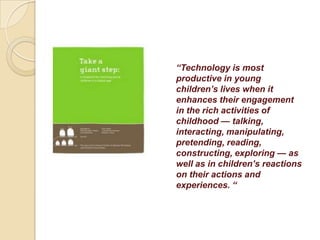
“Technology is most
productive in young
children’s lives when it
enhances their engagement
in the rich activities of
childhood — talking,
interacting, manipulating,
pretending, reading,
constructing, exploring — as
well as in children’s reactions
on their actions and
experiences. “
Take a Giant Step: A Blueprint for Teaching
Young Children in a Digital Age.
Barron, B., Bofferding, L., Cayton-Hodges, G., Copple, C., Darling-Hammond, L.,
Levine, M. (2011). Stanford Educational Leadership Institute
An extensive report that examines current preschool and
primary grade teaching practices, detailing an action plan to
improve teaching young students using digital technologies.
Technology is viewed as most productive in young children’s
lives where it is used to:
• Thoughtfully and strategically enhance children’s social
interactions with peers and adults
• Foster exploration, the manipulation of objects and the
social construction of knowledge.
• Create representations, listen to and read books, engage in
play, conversation, form relationships, and reflect upon their
experiences.
• Enable and enhance vital childhood experiences rather than
attempt to replace them.
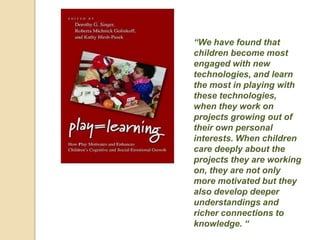
“We have found that
children become most
engaged with new
technologies, and learn
the most in playing with
these technologies,
when they work on
projects growing out of
their own personal
interests. When children
care deeply about the
projects they are working
on, they are not only
more motivated but they
also develop deeper
understandings and
richer connections to
knowledge. “
Computer as Paint Brush: Technology, Play, and
the Creative Society
Resnick, M., in Singer, D., Golinkoff, R. M., & Hirsh-Pasek, K. (Eds.) Play=Learning: How
play motivates and enhances children’s cognitive and social-emotional growth. New York,
NY: Oxford University Press(2009).
MIT Media Lab researcher Mitchel Resnick proposes that:
 The learning potential of personal computers for young
students will not be realized until they are utilized more for
creative than informational purposes.
 Powerful learning experiences for children can be realized
when they move beyond simply interacting with
informational materials to using them to design, create,
and invent (Papert, 1980; Resnick, 2002).
 Similar to a paint brush, digital technologies can be
employed as tools for creative design and expression,
offering a clear alternative to the passive consumption of
digital information
 Young students can use technology to engage in playful
exploration, experimentation, design, invention and robust
learning.
“Little
children
have big
ideas.”
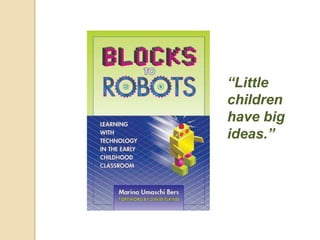
Blocks to Robots; Learning with Technology in the Early
Childhood Classroom. Bers, M., New York: Teachers College Press, 2008
• Young learners require frequent and sustained opportunities to
develop their ideas and to develop foundational understandings
in science, technology, engineering, and mathematics
• Robotic digital manipulatives enable young children to
concretely explore complex concepts, while also fostering the
development of sensorimotor and social/emotional skills.
• Digital technologies can be successfully integrated into the early
childhood classroom and promote positive attitudes toward the
study of science and mathematics.
• Robotics provides young students with physical and creative
opportunities to build and manipulate objects, as well as to
engage in problem-solving and collaborative learning.
Technology-Enhanced, Problem-Based Inquiry Learning in
Early Childhood Education: A Theoretical Basis. Wang, F.,
Kinzie, M., McGuire, P. & Pan, E. In K. McFerrin et al. (Eds.),
Proceedings of Society for Information Technology & Teacher
Education International Conference 2008 (pp. 2266-2271).
Curry School of Education University of Virginia, Chesapeake,
VA: AACE.
• Digital technology is increasingly accessible in early
childhood classrooms and is an effective medium to foster
early childhood learning (Clements & Sarama, 2007; Li &
Atkins, 2004).
• Young children are naturally inquisitive about their
environment and can effectively use technology to anchor an
inquiry to authentic problems.
• Technology can be strategically deployed in support of early
childhood inquiry learning to enable:
a) enriched problem contexts
b) structuring of complex problems, and
c) support of cognitive and metacognitive processes.
“The bottom line
regarding computers
in education is this:
We know materials
and media are
frequently misused or
used ineffectively in
education. Let us not
call for a technological
prohibition, especially
one built on a
specious foundation
that ignores the
hundreds of studies
and reviews that
contradict such a
position. Instead, let
us work together to
use technology well.”
Strip Mining for Gold: Research and Policy in
Educational Technology - A Response to "Fool's
Gold.", Clements, D., Sarama, J., Educational Technology
Review, v11 n1 2003
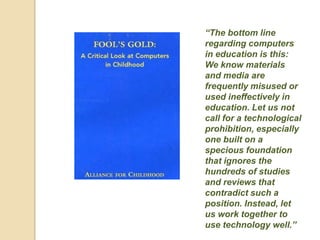
Fool’s Gold (Cordes & Miller, 2000), argued that computers are
detrimental to young children physically, emotionally, intellectually,
and developmentally. It stated that computers interfere with young
children’s needs for exercise, personal interaction with the natural
world, and developing personal bonds with caring adults.
• Technology can be both misused by some and overzealously
promoted by others
• Fools’ Gold ignores and/or misrepresents a large body of
research as well as the work of expert practitioners who
employ computers and technology in ways that are
developmentally appropriate and beneficial to young
students.
• 259 research references are provided that counter with social and
emotional development; types of software; motivation; social and
cognitive interactions; cognitive development; creativity; language
and literacy; writing and word processing; mathematics and
reasoning; and science and simulations
Characteristics of Engaging
Tasks
 Authentic
 Fosters Deep Understanding
 Builds and/or Requires Multiple Forms
of Communication and Expression
 Builds and/or Requires Real-World
competencies
 Appropriate use of Technology
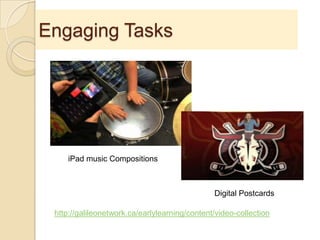
Engaging Tasks
iPad music Compositions
Digital Postcards
http://galileonetwork.ca/earlylearning/content/video-collection
Engaging Tasks – First Year
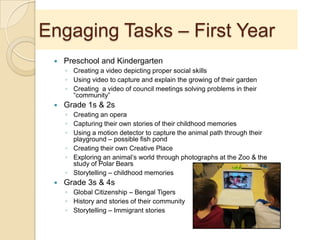
 Preschool and Kindergarten
◦ Creating a video depicting proper social skills
◦ Using video to capture and explain the growing of their garden
◦ Creating a video of council meetings solving problems in their
“community”
 Grade 1s & 2s
◦ Creating an opera
◦ Capturing their own stories of their childhood memories
◦ Using a motion detector to capture the animal path through their
playground – possible fish pond
◦ Creating their own Creative Place
◦ Exploring an animal’s world through photographs at the Zoo & the
study of Polar Bears
◦ Storytelling – childhood memories
 Grade 3s & 4s
◦ Global Citizenship – Bengal Tigers
◦ History and stories of their community
◦ Storytelling – Immigrant stories
Purpose of the Research
 Identify and Share Promising Practices
 Capture Student Learning and Engagement
 Capture Teacher Learning and Engagement
 Document Appropriate Use of Technology for
Learning
 Identify & Address System Affordances and
constraints for using technology with Young
Learners
 Ongoing, Continuous Improvement
Primary Research Questions
 What is the appropriate role for
technology in teaching and
learning for young learners?
 In what ways can schools best
support engaged teaching and
engaged learning with technology
in pre-Kindergarten to Grade 4?
1. Secondary Research
Questions
 How can technology be used to
demonstrate and amplify student
understanding?
◦ Impact of technology on:
 Student Learning & Understanding
 Student Engagement & Agency
 Student Competencies
2. Secondary Research
Questions
 What is the appropriate role of
technology in the assessment of
learning by the very young?
◦ Use of technology
 To document students’ learning
 By students to demonstrate mastery or
understanding
 To make learning & teaching visible
3. Secondary Research
Questions
 In what ways does technology support
a shift from teacher-centered to
student-centered practice?
◦ Impact of technology
 On the design of learning environments
 On enabling student learning, especially
those with complex needs
 On teacher engagement
 On changed teaching practices
4. Secondary Research
Questions
 What are the affordances, barriers /
challenges to technology use with the
very young?
◦ What affordances need to be in place to
support technology use?
◦ What barriers or obstacles need to be
overcome?
◦ What are the challenges to engaged
teaching and learning with technology?
5. Secondary Research
Questions
 What innovations in teaching and
learning were made possible with
technology?
◦ What were the innovative studies
(learning experiences) that were carried
out with young learners that would not
have been possible without the
technology?
◦ What new ways of engaging learners
and assessments of learning were made
possible by access to technology?
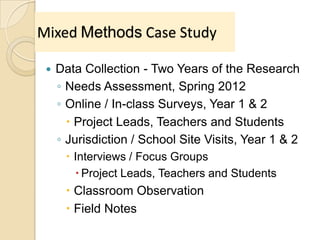
Mixed Methods Case Study
 Data Collection - Two Years of the Research
◦ Needs Assessment, Spring 2012
◦ Online / In-class Surveys, Year 1 & 2
 Project Leads, Teachers and Students
◦ Jurisdiction / School Site Visits, Year 1 & 2
 Interviews / Focus Groups
 Project Leads, Teachers and Students
 Classroom Observation
 Field Notes
Impact of Learning with
Technology
Observations and Conversations from our first year
Student Engagement
Intellectual, Academic, Social, FLOW ZONE
Student Agency
Choice, Empowerment, Worthwhile work
Student Competencies
Problem solving, creativity, collaboration,
constructing meaning, problem posing etc
Research Plan
 Research Questions
 Mixed methods case study
◦ Different Forms of Data Collection
◦ Who is involved
◦ Timeline
 Purpose of Research
Student Engagement
Intellectual, Academic, Social, FLOW ZONE
◦ Self-starters
◦ Collaboration
◦ On task, engrossed in their work, motivated to do
their work,
◦ Fierce conversations
◦ Maybe very quiet, or very loud
◦ Excited to share with each other, with home, others
◦ Exploration, not just following information from the
teacher
◦ Investigating personal interests
◦ Intellectual curiosity, is alive and encouraged
◦ Can’t get enough, time flies by, want to share what
you know
◦ Don’t want to leave
Student Agency
Choice, Empowerment, Worthwhile work
◦ Empowering students, having choice/ownership
◦ Self-directed learning
◦ Authentic tasks, their work has somewhere to go
where others will see it
◦ Elements of negotiation and teamwork, building
on each other’s knowledge
◦ Brain storming in groups
◦ Self-confidence
◦ Student leadership, helping others
◦ Students speaking to their own learning
◦ Making decisions, defending their own decisions
◦ Students accountable for their own work quality
Student Competencies
Problem solving, creativity, collaboration, constructing meaning,
problem posing etc
◦ Teacher co-learner with the students, students
teaching others
◦ Open endedness, more than one answer to a
problem
◦ Student voice in developing the study as it
progresses
◦ Questions that do not have answers on google, multi-
faceted, complex issues and problems
◦ Cite your sources, and explain how that changed your
understanding of the content/issue or problem
◦ Students are required to do something with the
information they gather
◦ It is OK that teachers do not know the answers, or
have the information
◦ Open up learning to the world, collaborate, seek
Year One 2011-2012
 Onsite PD 3 days
 St Paul
 Edmonton Catholic
 Calgary/RVSD
 RCOP May 6th
 Research visits
 Needs assessment
Learning from today
 What have you learned today?
 What questions do you still have?
 What supports do you need to foster
this work in your context?
http://tinyurl.com/bmzs5bw
 http://www.galileonetwork.ca/earlylearning/
 Or www.galileo.org

JTC May 2013 - K-4 Technology Project

  • 1.
    Alberta Education ECS-Gr4 Technology ResearchCommunity of Practice St. Paul Education Region – language acquisition & early literacy Rocky View Schools – enrich & accessibility Edmonton Catholic (17 sites) - assistive technologies Calgary Catholic - engagement
  • 2.
    Designing Digitally Rich, KnowledgeBuilding, Inclusive Learning Environments for the Early Grades
  • 3.
    RCOP Overall Goals To cultivate, document and assess engaged teaching, learning and assessment practices with technology  To collaborate on research that contributes new understandings and empirical evidence of effective implementation of emerging technologies with elementary students
  • 4.
    Research That Informs Action The Learning Sciences ◦ Bransford, Brown & Cocking, Schank  The Challenge for Teaching ◦ Davidson, Exley,  Teaching for Today’s Learners ◦ Friesen, Darling-Hammond et al, Wiske et al Collective Act of Knowledge Building  Collective Act of Knowledge Building ◦ Thomas et al, Wenger  Young Students and Technology Use ◦ Barron et al, Resnick, Bers, Wang et al, Clements
  • 5.
    “Technology is most productivein young children’s lives when it enhances their engagement in the rich activities of childhood — talking, interacting, manipulating, pretending, reading, constructing, exploring — as well as in children’s reactions on their actions and experiences. “
  • 6.
    Take a GiantStep: A Blueprint for Teaching Young Children in a Digital Age. Barron, B., Bofferding, L., Cayton-Hodges, G., Copple, C., Darling-Hammond, L., Levine, M. (2011). Stanford Educational Leadership Institute An extensive report that examines current preschool and primary grade teaching practices, detailing an action plan to improve teaching young students using digital technologies. Technology is viewed as most productive in young children’s lives where it is used to: • Thoughtfully and strategically enhance children’s social interactions with peers and adults • Foster exploration, the manipulation of objects and the social construction of knowledge. • Create representations, listen to and read books, engage in play, conversation, form relationships, and reflect upon their experiences. • Enable and enhance vital childhood experiences rather than attempt to replace them.
  • 7.
    “We have foundthat children become most engaged with new technologies, and learn the most in playing with these technologies, when they work on projects growing out of their own personal interests. When children care deeply about the projects they are working on, they are not only more motivated but they also develop deeper understandings and richer connections to knowledge. “
  • 8.
    Computer as PaintBrush: Technology, Play, and the Creative Society Resnick, M., in Singer, D., Golinkoff, R. M., & Hirsh-Pasek, K. (Eds.) Play=Learning: How play motivates and enhances children’s cognitive and social-emotional growth. New York, NY: Oxford University Press(2009). MIT Media Lab researcher Mitchel Resnick proposes that:  The learning potential of personal computers for young students will not be realized until they are utilized more for creative than informational purposes.  Powerful learning experiences for children can be realized when they move beyond simply interacting with informational materials to using them to design, create, and invent (Papert, 1980; Resnick, 2002).  Similar to a paint brush, digital technologies can be employed as tools for creative design and expression, offering a clear alternative to the passive consumption of digital information  Young students can use technology to engage in playful exploration, experimentation, design, invention and robust learning.
  • 9.
  • 10.
    Blocks to Robots;Learning with Technology in the Early Childhood Classroom. Bers, M., New York: Teachers College Press, 2008 • Young learners require frequent and sustained opportunities to develop their ideas and to develop foundational understandings in science, technology, engineering, and mathematics • Robotic digital manipulatives enable young children to concretely explore complex concepts, while also fostering the development of sensorimotor and social/emotional skills. • Digital technologies can be successfully integrated into the early childhood classroom and promote positive attitudes toward the study of science and mathematics. • Robotics provides young students with physical and creative opportunities to build and manipulate objects, as well as to engage in problem-solving and collaborative learning.
  • 11.
    Technology-Enhanced, Problem-Based InquiryLearning in Early Childhood Education: A Theoretical Basis. Wang, F., Kinzie, M., McGuire, P. & Pan, E. In K. McFerrin et al. (Eds.), Proceedings of Society for Information Technology & Teacher Education International Conference 2008 (pp. 2266-2271). Curry School of Education University of Virginia, Chesapeake, VA: AACE. • Digital technology is increasingly accessible in early childhood classrooms and is an effective medium to foster early childhood learning (Clements & Sarama, 2007; Li & Atkins, 2004). • Young children are naturally inquisitive about their environment and can effectively use technology to anchor an inquiry to authentic problems. • Technology can be strategically deployed in support of early childhood inquiry learning to enable: a) enriched problem contexts b) structuring of complex problems, and c) support of cognitive and metacognitive processes.
  • 12.
    “The bottom line regardingcomputers in education is this: We know materials and media are frequently misused or used ineffectively in education. Let us not call for a technological prohibition, especially one built on a specious foundation that ignores the hundreds of studies and reviews that contradict such a position. Instead, let us work together to use technology well.”
  • 13.
    Strip Mining forGold: Research and Policy in Educational Technology - A Response to "Fool's Gold.", Clements, D., Sarama, J., Educational Technology Review, v11 n1 2003 Fool’s Gold (Cordes & Miller, 2000), argued that computers are detrimental to young children physically, emotionally, intellectually, and developmentally. It stated that computers interfere with young children’s needs for exercise, personal interaction with the natural world, and developing personal bonds with caring adults. • Technology can be both misused by some and overzealously promoted by others • Fools’ Gold ignores and/or misrepresents a large body of research as well as the work of expert practitioners who employ computers and technology in ways that are developmentally appropriate and beneficial to young students. • 259 research references are provided that counter with social and emotional development; types of software; motivation; social and cognitive interactions; cognitive development; creativity; language and literacy; writing and word processing; mathematics and reasoning; and science and simulations
  • 14.
    Characteristics of Engaging Tasks Authentic  Fosters Deep Understanding  Builds and/or Requires Multiple Forms of Communication and Expression  Builds and/or Requires Real-World competencies  Appropriate use of Technology
  • 15.
    Engaging Tasks iPad musicCompositions Digital Postcards http://galileonetwork.ca/earlylearning/content/video-collection
  • 16.
    Engaging Tasks –First Year  Preschool and Kindergarten ◦ Creating a video depicting proper social skills ◦ Using video to capture and explain the growing of their garden ◦ Creating a video of council meetings solving problems in their “community”  Grade 1s & 2s ◦ Creating an opera ◦ Capturing their own stories of their childhood memories ◦ Using a motion detector to capture the animal path through their playground – possible fish pond ◦ Creating their own Creative Place ◦ Exploring an animal’s world through photographs at the Zoo & the study of Polar Bears ◦ Storytelling – childhood memories  Grade 3s & 4s ◦ Global Citizenship – Bengal Tigers ◦ History and stories of their community ◦ Storytelling – Immigrant stories
  • 17.
    Purpose of theResearch  Identify and Share Promising Practices  Capture Student Learning and Engagement  Capture Teacher Learning and Engagement  Document Appropriate Use of Technology for Learning  Identify & Address System Affordances and constraints for using technology with Young Learners  Ongoing, Continuous Improvement
  • 18.
    Primary Research Questions What is the appropriate role for technology in teaching and learning for young learners?  In what ways can schools best support engaged teaching and engaged learning with technology in pre-Kindergarten to Grade 4?
  • 19.
    1. Secondary Research Questions How can technology be used to demonstrate and amplify student understanding? ◦ Impact of technology on:  Student Learning & Understanding  Student Engagement & Agency  Student Competencies
  • 20.
    2. Secondary Research Questions What is the appropriate role of technology in the assessment of learning by the very young? ◦ Use of technology  To document students’ learning  By students to demonstrate mastery or understanding  To make learning & teaching visible
  • 21.
    3. Secondary Research Questions In what ways does technology support a shift from teacher-centered to student-centered practice? ◦ Impact of technology  On the design of learning environments  On enabling student learning, especially those with complex needs  On teacher engagement  On changed teaching practices
  • 22.
    4. Secondary Research Questions What are the affordances, barriers / challenges to technology use with the very young? ◦ What affordances need to be in place to support technology use? ◦ What barriers or obstacles need to be overcome? ◦ What are the challenges to engaged teaching and learning with technology?
  • 23.
    5. Secondary Research Questions What innovations in teaching and learning were made possible with technology? ◦ What were the innovative studies (learning experiences) that were carried out with young learners that would not have been possible without the technology? ◦ What new ways of engaging learners and assessments of learning were made possible by access to technology?
  • 24.
    Mixed Methods CaseStudy  Data Collection - Two Years of the Research ◦ Needs Assessment, Spring 2012 ◦ Online / In-class Surveys, Year 1 & 2  Project Leads, Teachers and Students ◦ Jurisdiction / School Site Visits, Year 1 & 2  Interviews / Focus Groups  Project Leads, Teachers and Students  Classroom Observation  Field Notes
  • 25.
    Impact of Learningwith Technology Observations and Conversations from our first year Student Engagement Intellectual, Academic, Social, FLOW ZONE Student Agency Choice, Empowerment, Worthwhile work Student Competencies Problem solving, creativity, collaboration, constructing meaning, problem posing etc
  • 26.
    Research Plan  ResearchQuestions  Mixed methods case study ◦ Different Forms of Data Collection ◦ Who is involved ◦ Timeline  Purpose of Research
  • 27.
    Student Engagement Intellectual, Academic,Social, FLOW ZONE ◦ Self-starters ◦ Collaboration ◦ On task, engrossed in their work, motivated to do their work, ◦ Fierce conversations ◦ Maybe very quiet, or very loud ◦ Excited to share with each other, with home, others ◦ Exploration, not just following information from the teacher ◦ Investigating personal interests ◦ Intellectual curiosity, is alive and encouraged ◦ Can’t get enough, time flies by, want to share what you know ◦ Don’t want to leave
  • 28.
    Student Agency Choice, Empowerment,Worthwhile work ◦ Empowering students, having choice/ownership ◦ Self-directed learning ◦ Authentic tasks, their work has somewhere to go where others will see it ◦ Elements of negotiation and teamwork, building on each other’s knowledge ◦ Brain storming in groups ◦ Self-confidence ◦ Student leadership, helping others ◦ Students speaking to their own learning ◦ Making decisions, defending their own decisions ◦ Students accountable for their own work quality
  • 29.
    Student Competencies Problem solving,creativity, collaboration, constructing meaning, problem posing etc ◦ Teacher co-learner with the students, students teaching others ◦ Open endedness, more than one answer to a problem ◦ Student voice in developing the study as it progresses ◦ Questions that do not have answers on google, multi- faceted, complex issues and problems ◦ Cite your sources, and explain how that changed your understanding of the content/issue or problem ◦ Students are required to do something with the information they gather ◦ It is OK that teachers do not know the answers, or have the information ◦ Open up learning to the world, collaborate, seek
  • 30.
    Year One 2011-2012 Onsite PD 3 days  St Paul  Edmonton Catholic  Calgary/RVSD  RCOP May 6th  Research visits  Needs assessment
  • 31.
    Learning from today What have you learned today?  What questions do you still have?  What supports do you need to foster this work in your context? http://tinyurl.com/bmzs5bw  http://www.galileonetwork.ca/earlylearning/  Or www.galileo.org

Editor's Notes

  • #5 1 – Schools and classrooms are learner centred, knowledge centred, assessment centered, and community centered – learning does not occur in subject-based silos2 – Challenge -- In today’s world literacy means being able to critically analyze a wide range of texts and contexts in order to take informed action.Pring alone is not sufficient3 – Tocay’s learners, - WDYDIST? Teaching effectiveness, Teaching for DEEP understanding – as a flexible performance capacity4 – socially contructed knowledge and collective act of knowledge building -
  • #6 READ quote
  • #13 Fools Gold is a reference used to argue against technology use in early grades or early childhood
  • #14 Strip Mining for Gold: A responds to Fools Gold – with ananalyses the research – which Fool’s Gold ignores or misrepresents.Clements and Samara counter with a review of an extensive body of research concerning computers and children including; social and emotional development; types of software; motivation; social and cognitive interactions; cognitive development; creativity; language and literacy; writing and word processing; mathematics and reasoning; and science and simulations