Introduction to Mental Health
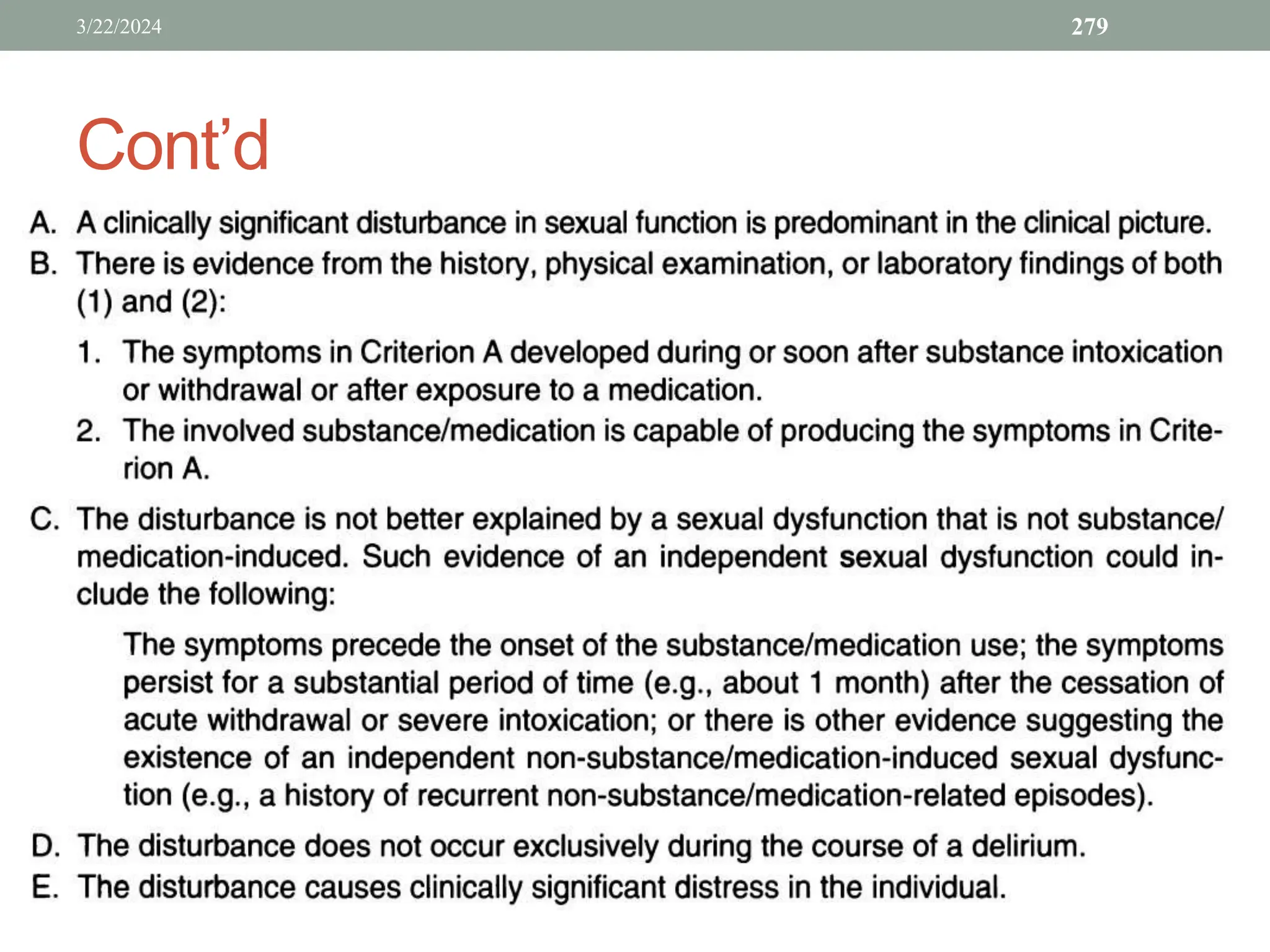
What is Psychiatry?
• Psychiatry: a medical discipline that deals
with mental and behavioral disorders.
• Normality and mental health are central
issues in psychiatry, but there are no clear-cut
definitions of these terms.
Normality and mental health
Normality:
• state of complete physical ,social, and mental well-being (WHO).
• patterns of behavior or personality traits that are typical or that
conform to some standard of proper and acceptable ways of
behaving and being.
Mental Health
• the successful performance of mental functions, in terms of thought,
mood, and behavior that results in productive activities, fulfilling
relationships with others, and the ability to adapt to change and to
cope with adversity.
Mental Disorder
• A behavioral or psychological syndrome or
pattern that is associated with distress (eg.
painful symptom) or disability (Impairment in
one or more areas of functioning) (DSM-IV)
Disablement
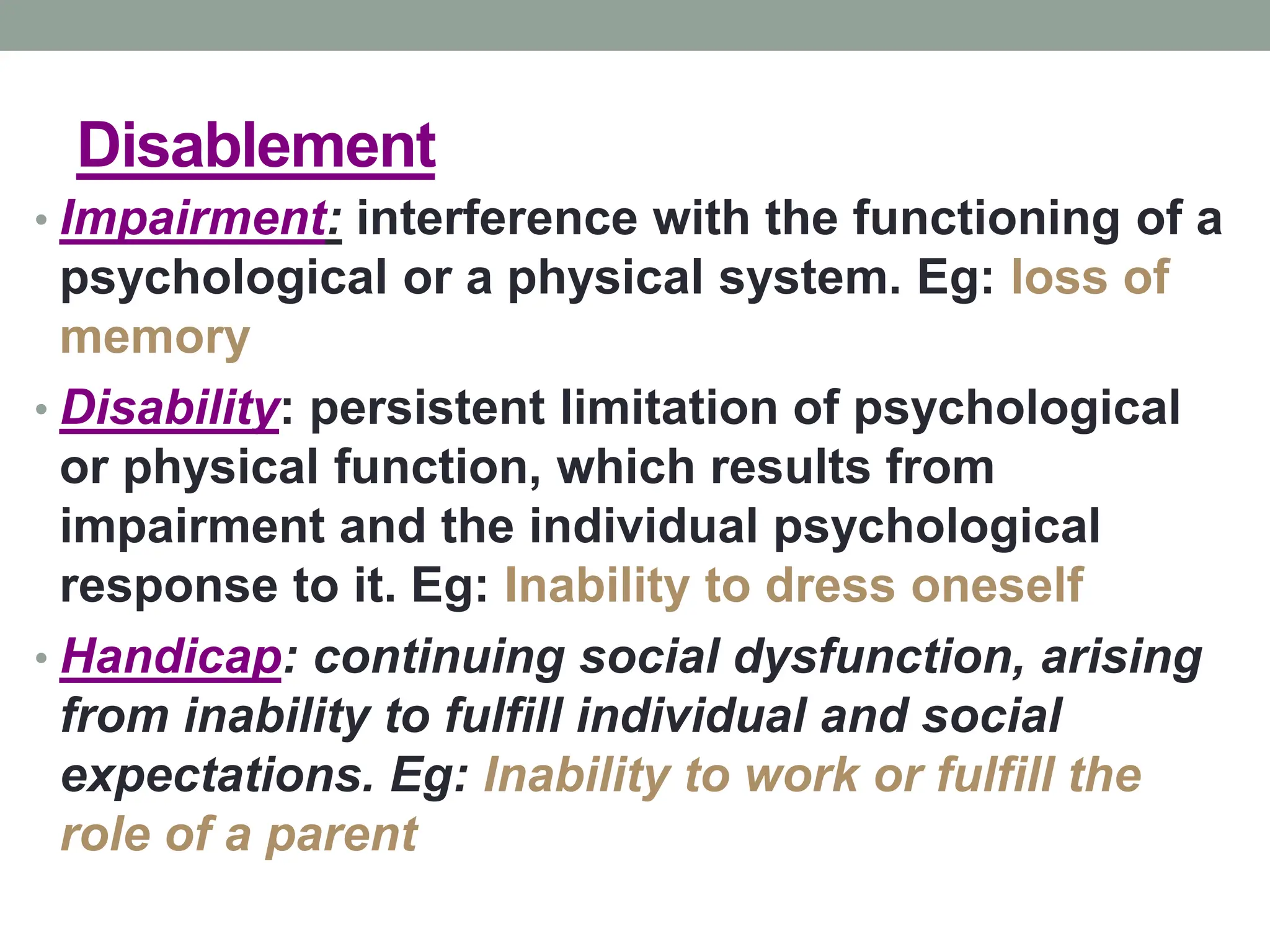
• Impairment: interference with the functioning of a
psychological or a physical system. Eg: loss of
memory
• Disability: persistent limitation of psychological
or physical function, which results from
impairment and the individual psychological
response to it. Eg: Inability to dress oneself
• Handicap: continuing social dysfunction, arising
from inability to fulfill individual and social
expectations. Eg: Inability to work or fulfill the
role of a parent
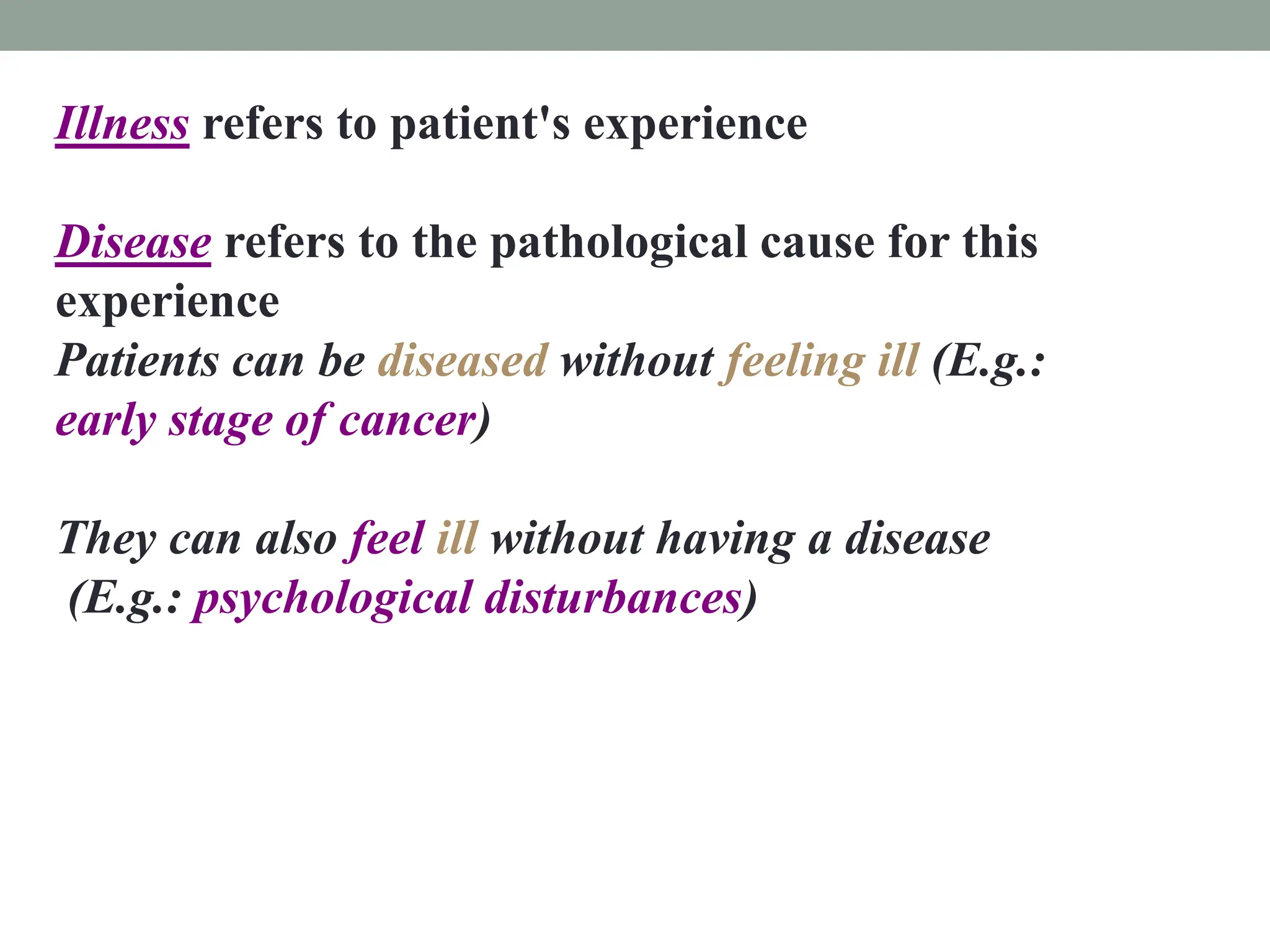
Illness refers to patient's experience
Disease refers to the pathological cause for this
experience
Patients can be diseased without feeling ill (E.g.:
early stage of cancer)
They can also feel ill without having a disease
(E.g.: psychological disturbances)
MENTAL HEALTH
ASSESIGMENT
7
purpose
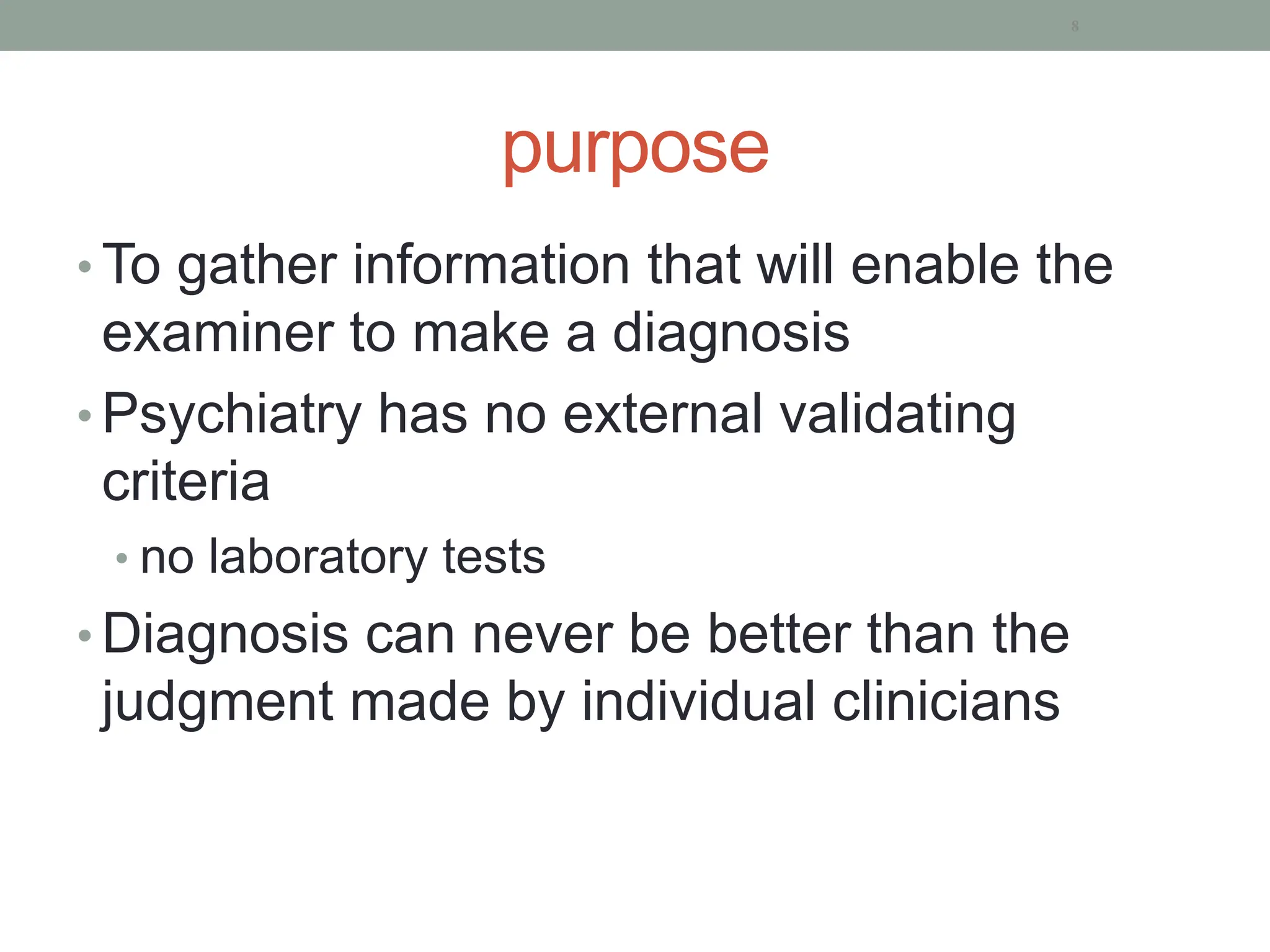
• To gather information that will enable the
examiner to make a diagnosis
• Psychiatry has no external validating
criteria
• no laboratory tests
• Diagnosis can never be better than the
judgment made by individual clinicians
8
Psychiatric evaluation
• History
• MSE
9
Communicating with a person
• Greet the person warmly and with respect
• Introduce yourself by name and position
• Maintain confidentiality and privacy
• Take time for the interview
• Show interest
• Explain you actions when examining a
person
• Be honest - keep promises
10
cont’
• Attitude
• Show respect
• Try not judge
• Be genuine
• Listening and observing
• Listen carefully
• Notice non-verbal communication
• Communicating
• Summarize what the person says
• Show understanding of how the person feels and thinks
• Use simple and clear language
11
cont’
12
cont’
• Active listening
• Establish Rapport
• understanding and trust between the
doctor and the patient
• Empathy
• understanding of what other people are
feeling
13
cont’
• Transference
• set of expectations, beliefs, and emotional
responses that a patient brings to the patient -
doctor relationship
• Counter transference
14
Identification
• Establishes the basic demographics of the
patient
• Components
• Name, Age, DOB, Sex, Address, Occupation,
Marital Status, Religion, Ethnicity
15
CHIEF COMPLAINT
why patient sick health instituation
16
History of the Present Illness (HPI)
• What are the main problems?
• Which of these are the worst?
• When did you first notice that?
• How did it start and progressed?
• What makes it better/worse?
• What have other people said?
• How has that affected you?
• When did you last feel well?
17
HPI cont’
• Record the exact words of the first five or
six sentences
• Obtain a clear chronological account of
symptoms and the effects of these
symptoms on behavior
• Positive and Negative
• Depression, bipolar, anxiety, Psychosis,
Substance, Physical
18
Past Psychiatric History
• In the past have you ever had problems
with your mental health/nerves/depression
• Have you ever seen a psychiatrist before?
• Have you ever been admitted to a
psychiatric hospital?
• What treatments have you had?
• Has there ever been a time that you felt
completely well?
19
Past medical history
• Do you have any problems with your
physical health?
• What about in the past?
• Have you ever had any operations or been
in hospital?
• What medications do you take regularly?
• What medications have you had in the
past?
20
Family history
• Are your parents still living? Are they well?
• Do you mind me asking how they died?
• What did your parents work at?
• Do you have any brothers or sisters?
• As far as you know, has anyone in your
family ever had problems with their mental
health?
21
Personal history-Infancy and early
childhood
• Where were you born?
• Where did you grow up?
• As far as you know was your mother’s pregnancy
normal?
• Was it a normal delivery?
• Were there any problems around the time of your
birth?
• Did you have any serious illnesses as a young
child?
• Were you walking and talking at the correct
times?
22
Personal history-Adolescence and
education
• Which schools did you go to?
• Did you enjoy school?
• What are your lasting memories of school?
• Did you have many friends at school?
• Do you keep in contact with those friends today?
• Did you gain any qualifications at school?
• Were you ever in trouble at school?
• Did you play truant, or were you ever expelled or
suspended?
23
Personal history- Occupational record
• When did you leave school?
• What did you work at? For how long? Then
what happened?
24
Personal history- Sexual
development, relationships and
marriage
• Are you married at present? How would
you describe your marriage?
• Have you had many relationships?
• Tell me more about them?
• Were they successful?
• Do you have any children? How old are
they?
25
Personal history- Present social
circumstances
• Who lives at home with you at the
moment?
• Do you have any worries about debt or
money in general?
• Do you have friends or family who live
nearby?
26
Premorbid personality
• When you are feeling well, how would you
describe yourself?
• How would other people describe you?
• When you find yourself in difficult
situations, what do you do to cope?
• What sort of things do you like to do to
relax?
27
Premorbid personality- cont’
• Do you have any hobbies?
• Do you like to be around other people or do
you prefer your own company?
• Are you religious?
• Do you have any ambitions or plans?
28
Personal history- Alcohol, Drug
and forensic
• Do you smoke?
• Do you take a drink?
• How much do you drink?
• Have you been drinking any more or less
than normal recently?
• Have you ever taken drugs? Tell me more
about that.
• Have you ever been in trouble with the
police, or been convicted of anything?
29
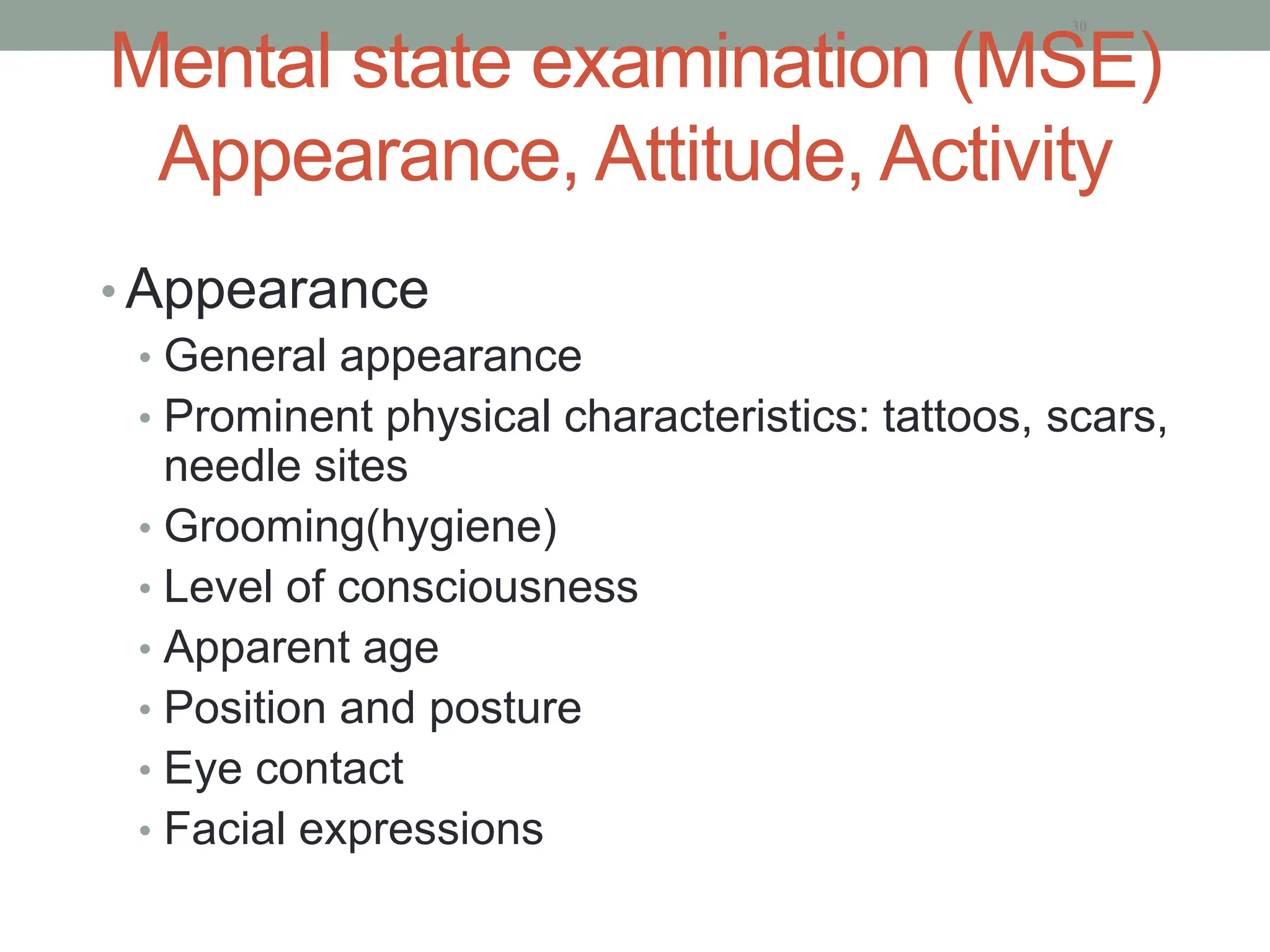
Mental state examination (MSE)
Appearance, Attitude, Activity
• Appearance
• General appearance
• Prominent physical characteristics: tattoos, scars,
needle sites
• Grooming(hygiene)
• Level of consciousness
• Apparent age
• Position and posture
• Eye contact
• Facial expressions
30
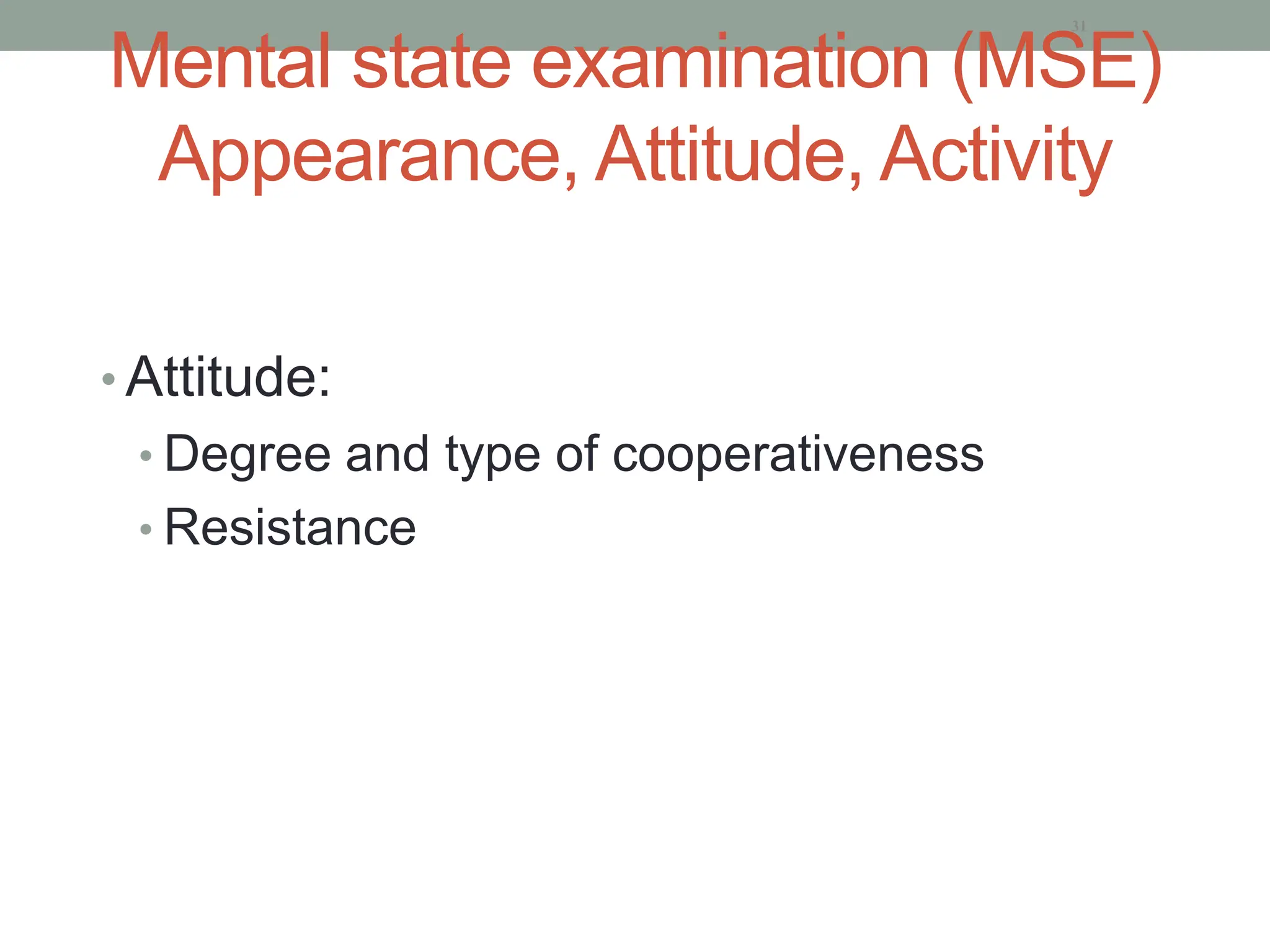
Mental state examination (MSE)
Appearance, Attitude, Activity
• Attitude:
• Degree and type of cooperativeness
• Resistance
31
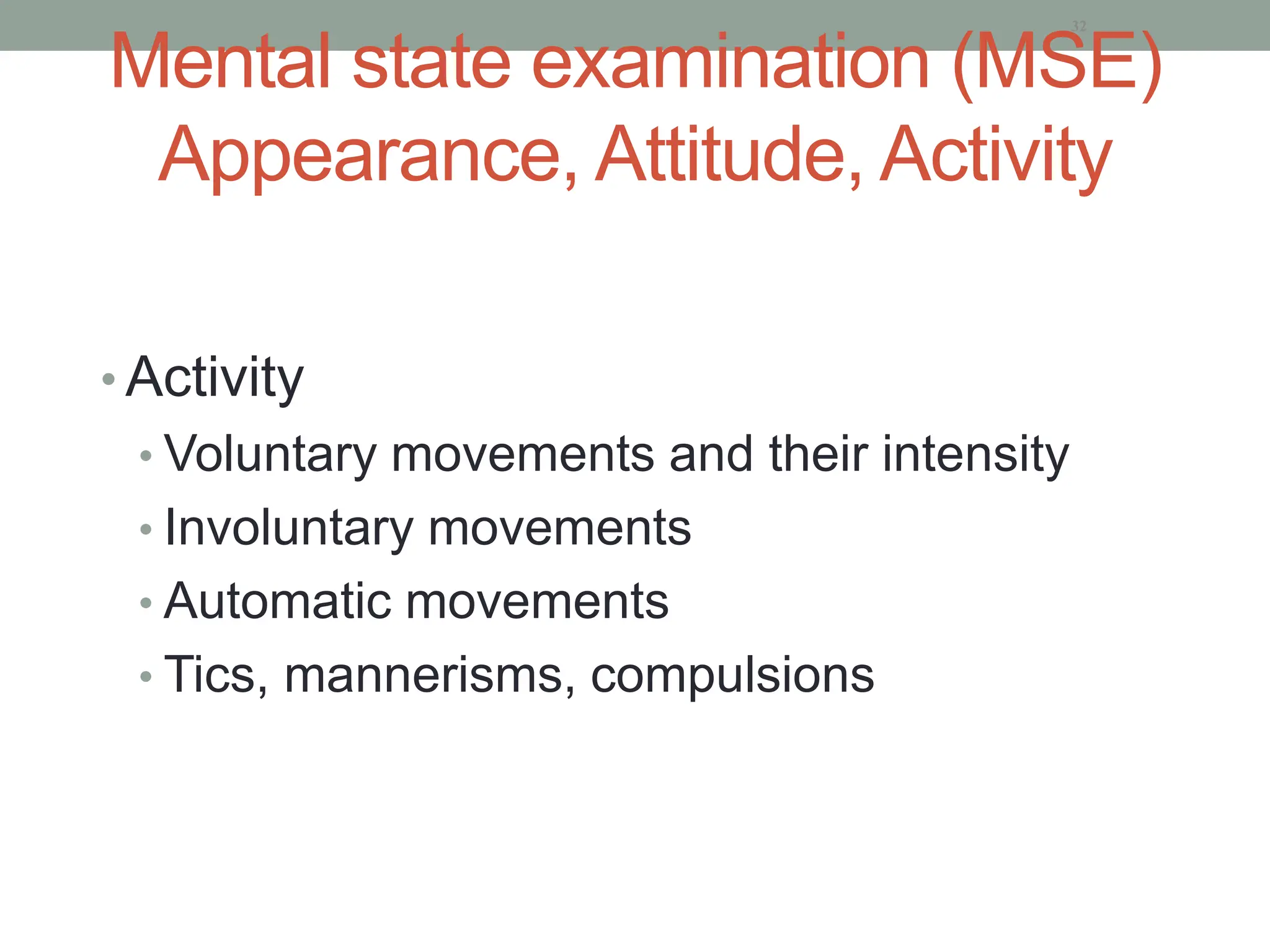
Mental state examination (MSE)
Appearance, Attitude, Activity
• Activity
• Voluntary movements and their intensity
• Involuntary movements
• Automatic movements
• Tics, mannerisms, compulsions
32
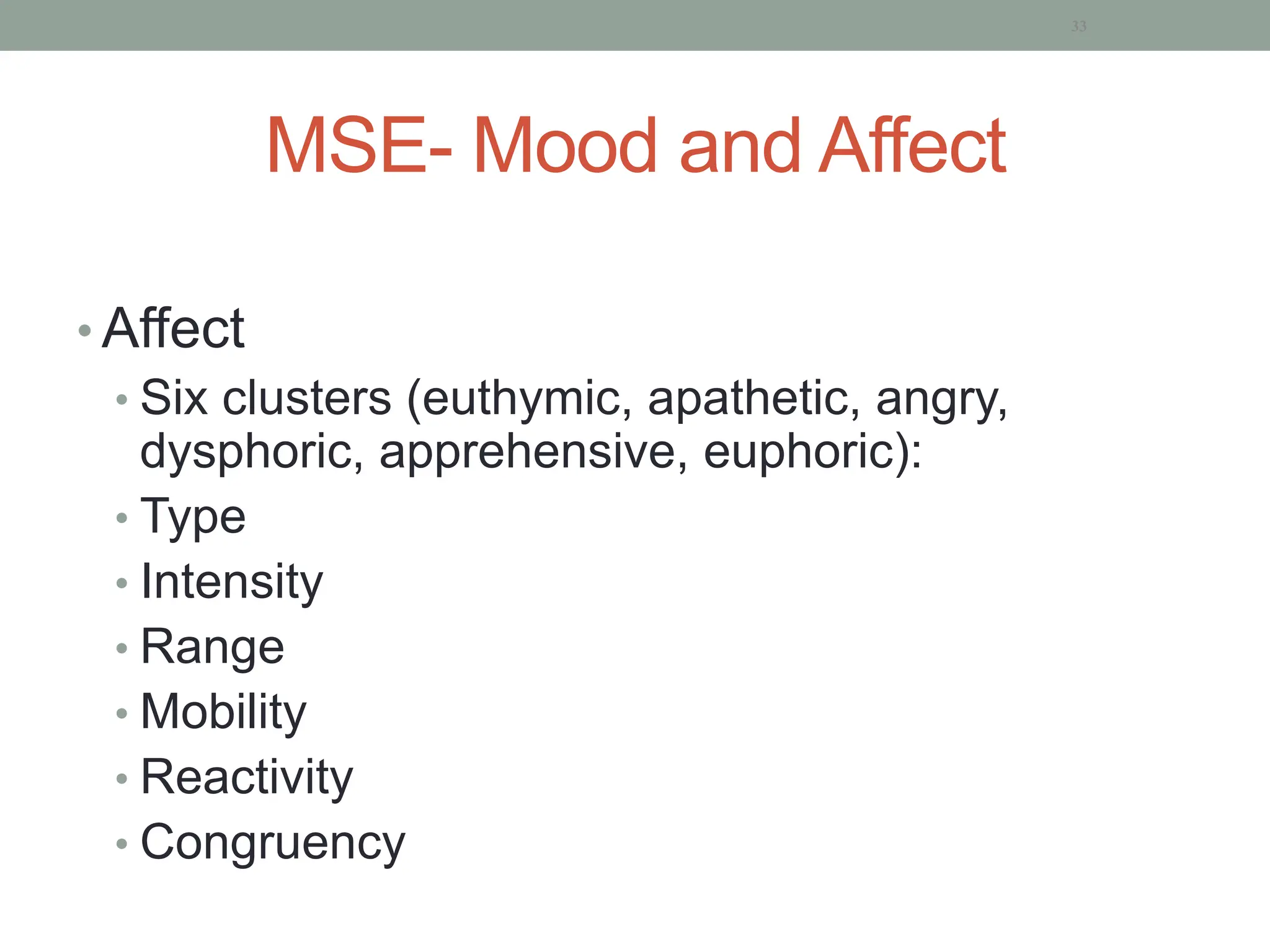
MSE- Mood and Affect
• Affect
• Six clusters (euthymic, apathetic, angry,
dysphoric, apprehensive, euphoric):
• Type
• Intensity
• Range
• Mobility
• Reactivity
• Congruency
33
MSE- Speech and language
• Fluency of speech (rate and volume)
• Repetition
• Comprehension
• Naming
• Reading and writing
• Quality of speech
34
MSE-Thought process
• Describe thought processes:
• Degree of connectedness (loose
associations, tangentiality, etc., )
• Presence of peculiarites (clang
associations, blocking, neologisms, etc., )
35
MSE-Thought content
• Predominant topic or issues
• Preoccupations, ruminations, obsessions
• Suicidal or homicidal ideation
• Phobias
• Delusion
36
MSE- Perceptual abnormalities
• Illusions
• Hallucinations
37
MSE- Cognition
• Consciousness
• Orientation
• Memory
• Attention
• Language
• Calculation
• Judgment and insight
38
Physical examination
• General observations
• Vital signs : HR, BP, RR, Temp
• Autonomic arousal, tremor, sweating etc.,
• Important features: scars, tattoos, signs of
liver disease, signs of thyroid or Cushing's
disease, etc.,
• Specific CVS, RS, GI, and CNS
examination findings and important
negative findings
39
PSYCHOTIC DISORDERS
Psychosis
• “delusions and prominent hallucinations, with the
hallucinations occurring in the absence of insight into their
pathological nature.”
• “a loss of ego boundaries or a gross impairment of reality
testing”
SCHIZOPHRENIA
Functional Psychiatric Disorder
Schizophrenia
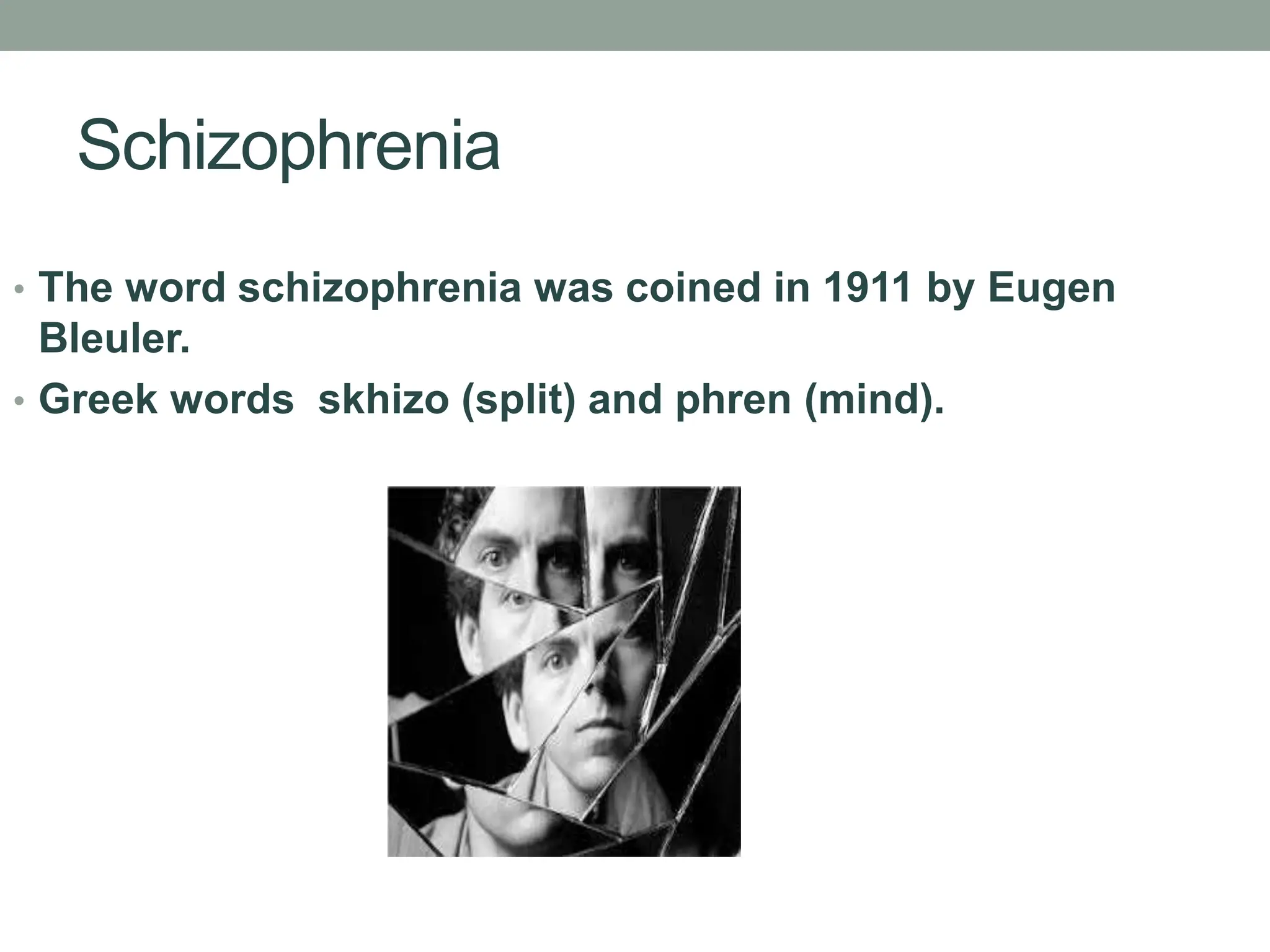
• The word schizophrenia was coined in 1911 by Eugen
Bleuler.
• Greek words skhizo (split) and phren (mind).
Definition
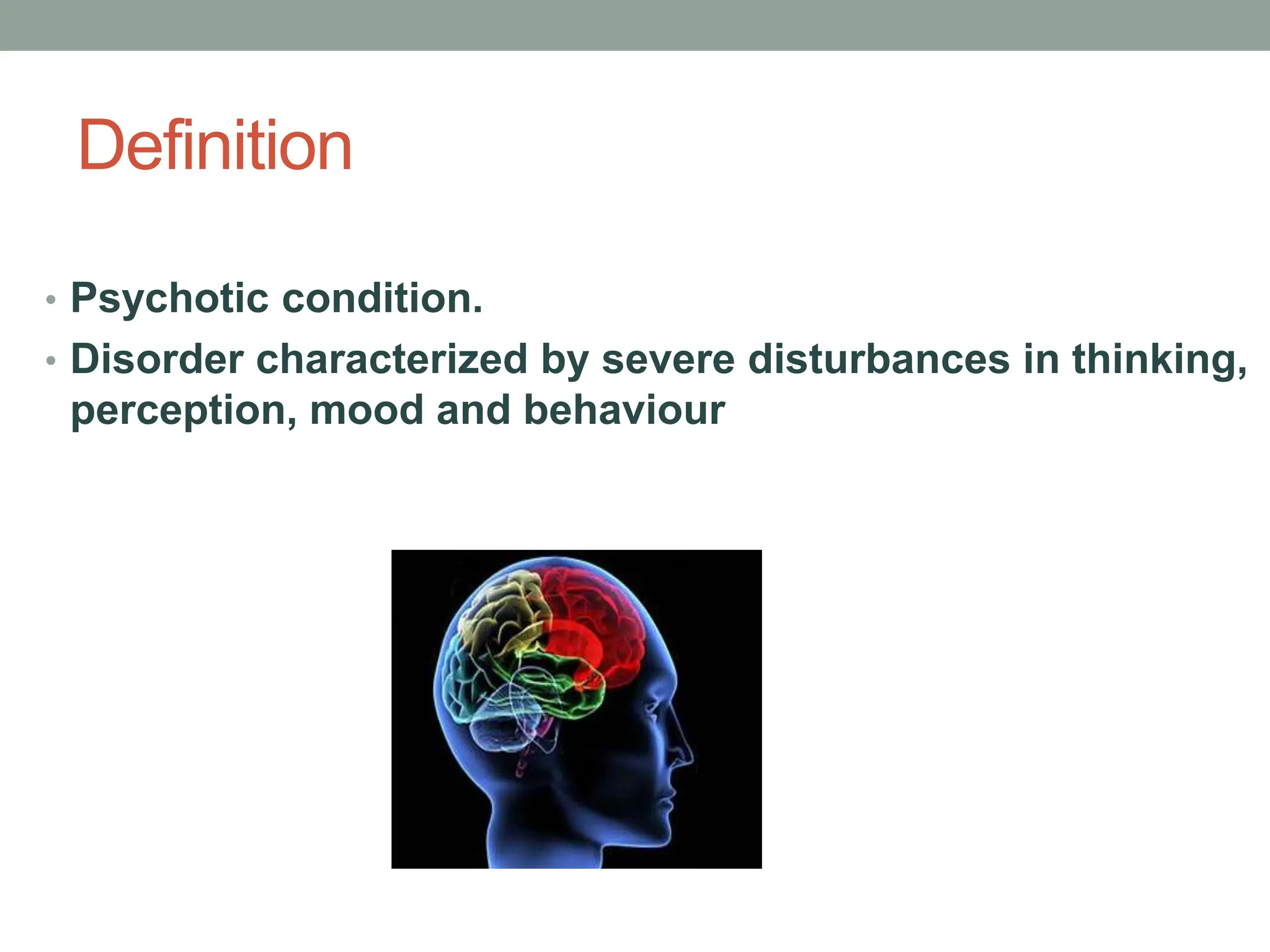
• Psychotic condition.
• Disorder characterized by severe disturbances in thinking,
perception, mood and behaviour
Epidemiology
• Most common of all psychiatric disorders
• Prevalent in all cultures and in all parts of the world.
• About 15% of new admission in mental hospital are
schizophrenic patients.
• According to the world mental health Report 2001. 24
million people world wide suffer from this.
• Prevalent in both men and women.
• The peak ages of onset are 15-25 yrs. for men and 25-
35 yrs. for woman.
• More common in Lower socio economic groups.
Etiology
• The exact cause is still not known.
• Theories support the following factors.
• Genetic Factors
• Biochemical Factors
• Psychological Factors
• Social Factors
• Precipitating Factors
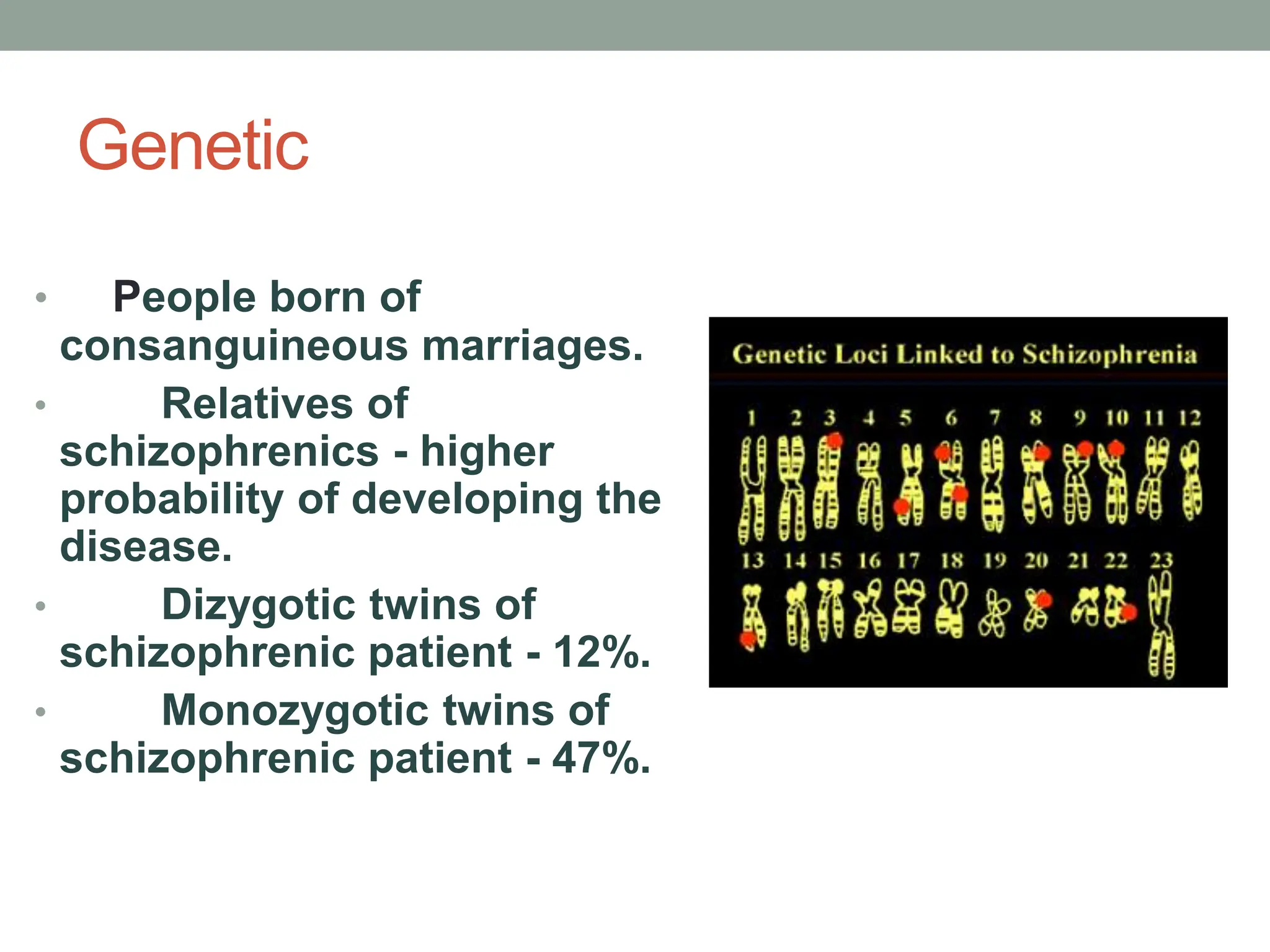
Genetic
• People born of
consanguineous marriages.
• Relatives of
schizophrenics - higher
probability of developing the
disease.
• Dizygotic twins of
schizophrenic patient - 12%.
• Monozygotic twins of
schizophrenic patient - 47%.
Biochemical factors
• Dopamine studies - strange thoughts, bizarre
behaviour, delusion, hallucination
• Various other biochemicals like
• Norepinephrine
• Serotonin
• Acetylcholine
• Gamma-aminobutyric acid and
• Neuro regulators such as
• Prostaglandins and
• Endrophins
• Implicated in the predisposition to
schizophrenia.
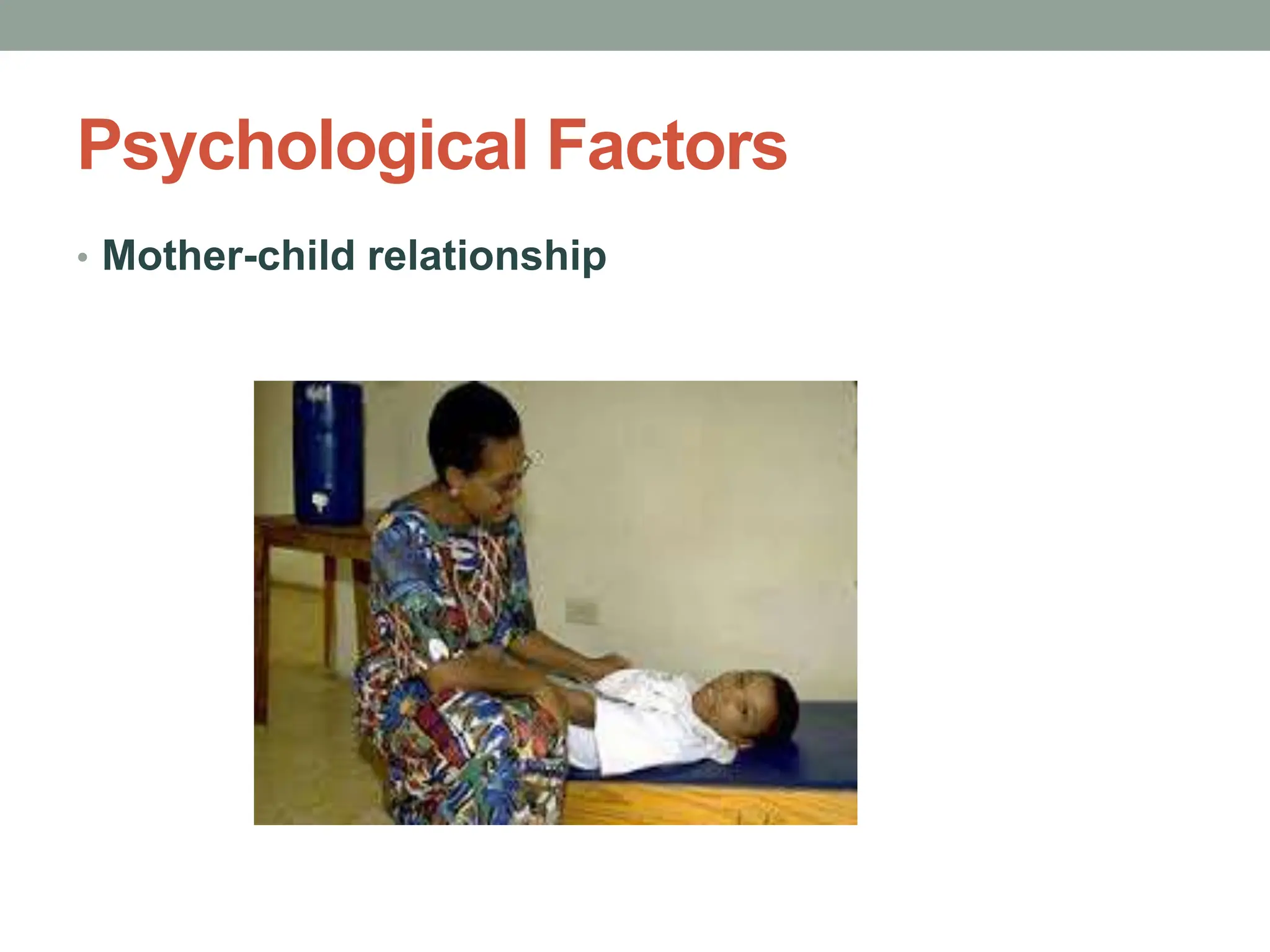
Psychological Factors
• Mother-child relationship
Social Factors
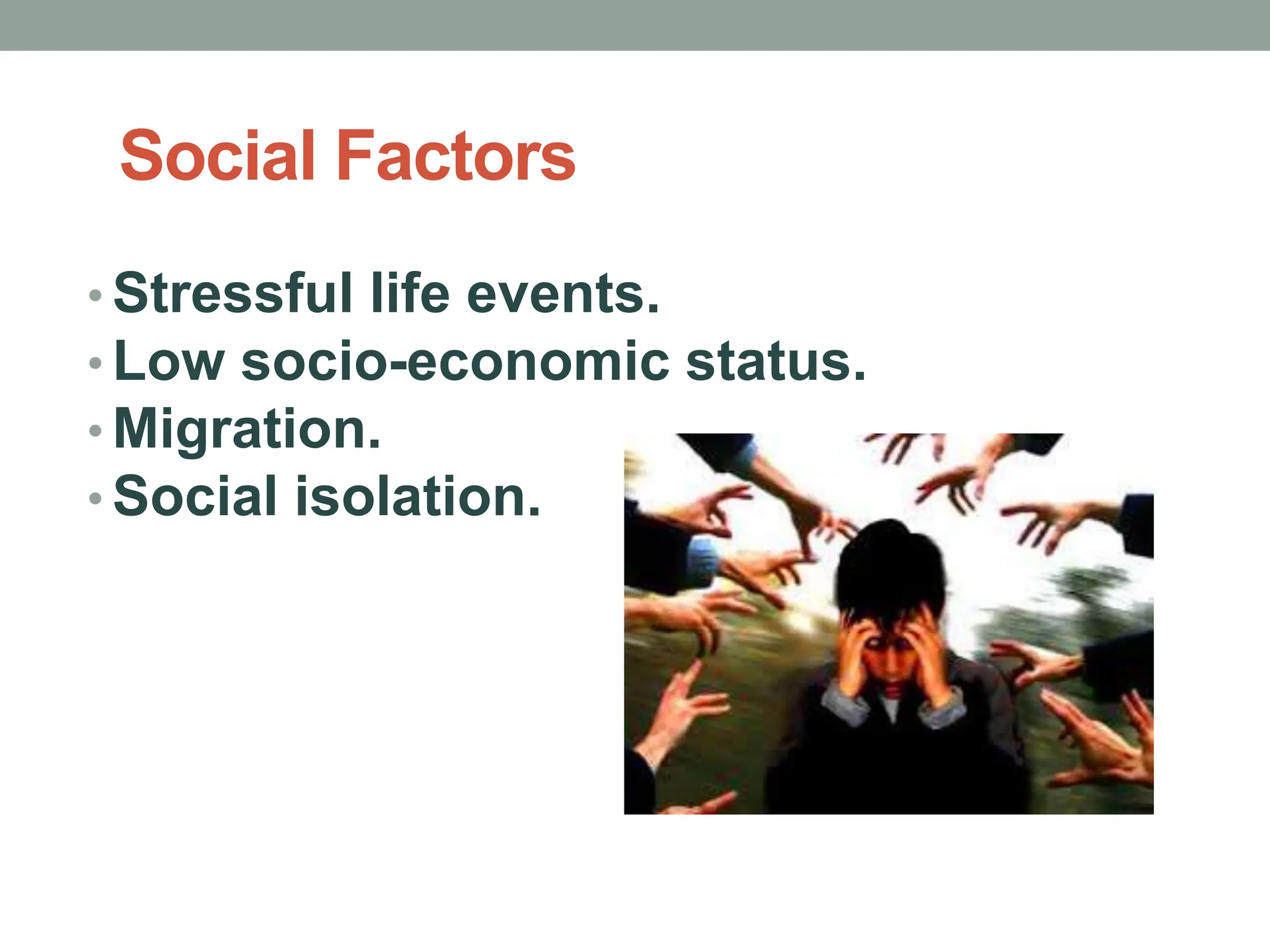
• Stressful life events.
• Low socio-economic status.
• Migration.
• Social isolation.
Precipitating Factors
• Physical illness and child
bearing
• Psychosocial stress.
• Loss of job.
• Loss of dear ones.
• Unexpected financial
loss.
Types of schizophrenia
• F20 - Schizophrenia
• F20.0 - Paranoid schizophrenia
• F20.1 - Hebephrenic schizophrenia
• F20.2 - Catatonic schizophrenia
• F20.3 - Undifferentiated schizophrenia
• F20.4 - Post-schizophrenic depression
• F20.5 - Residual schizophrenia
• F20.6 – Simple Schizophrenia
Simple schizophrenia
• Early onset (in Younger age).
• Symptoms
• Social withdrawal
• Wandering tendency
• Aimless activity.
• Prognosis very poor.
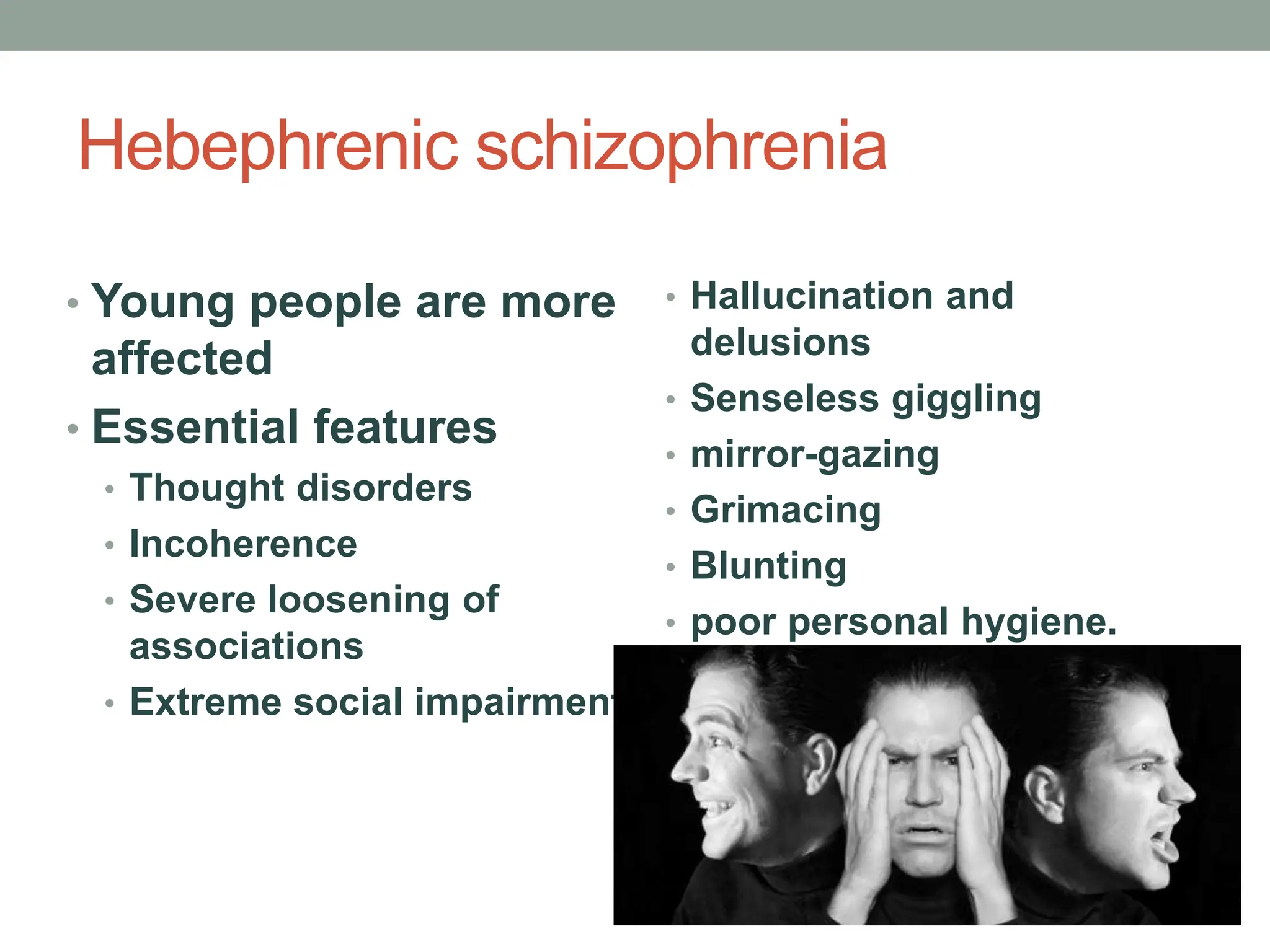
Hebephrenic schizophrenia
• Young people are more
affected
• Essential features
• Thought disorders
• Incoherence
• Severe loosening of
associations
• Extreme social impairment.
• Hallucination and
delusions
• Senseless giggling
• mirror-gazing
• Grimacing
• Blunting
• poor personal hygiene.
Paranoid schizophrenia
• Paranoid means “delusional” .
• Features include
• Delusion of persecution.
• Delusion of jealousy.
• Delusion of grandiosity.
• Disturbances in speech.
• Prognosis is good if treated early.
Catatonic schizophrenia
• Marked disturbances in motor behaviour.
• Two forms :
• Catatonic stupor
• Catatonic excitement
Excited Catatonia
• Increased motor activity – restlessness,
agitation, excitement and aggression.
• Increase in speech production (pressure
of speech)
• Loosening of association & incoherence.
• Severe Excitement
• Do not eat
• Severe dehydration and
• malnutrition.
• If not treated - leads to death.
Stupor
• Extreme retardation of psychomotor activity.
• Symptoms
• Mutism – (Absence of speech)
• Rigidity – Maintenance of rigid posture against efforts to
be mored.
• Negativist
• Echolalia
• Echopraxia
• waxy flexibility
• soiling the cloth with motion and Urine
• Ambitendency – A conflict to do or not to do.
Residual schizophrenia
• Active symptoms reduced but not completely free.
Undifferentiated schizophrenia
• Symptoms of all types present.
• Cannot differentiate the type of schizophrenia.
Post-schizophrenic depression
• Depressive features develop from residual or active
features of schizophrenia.
• Increased risk of suicide.
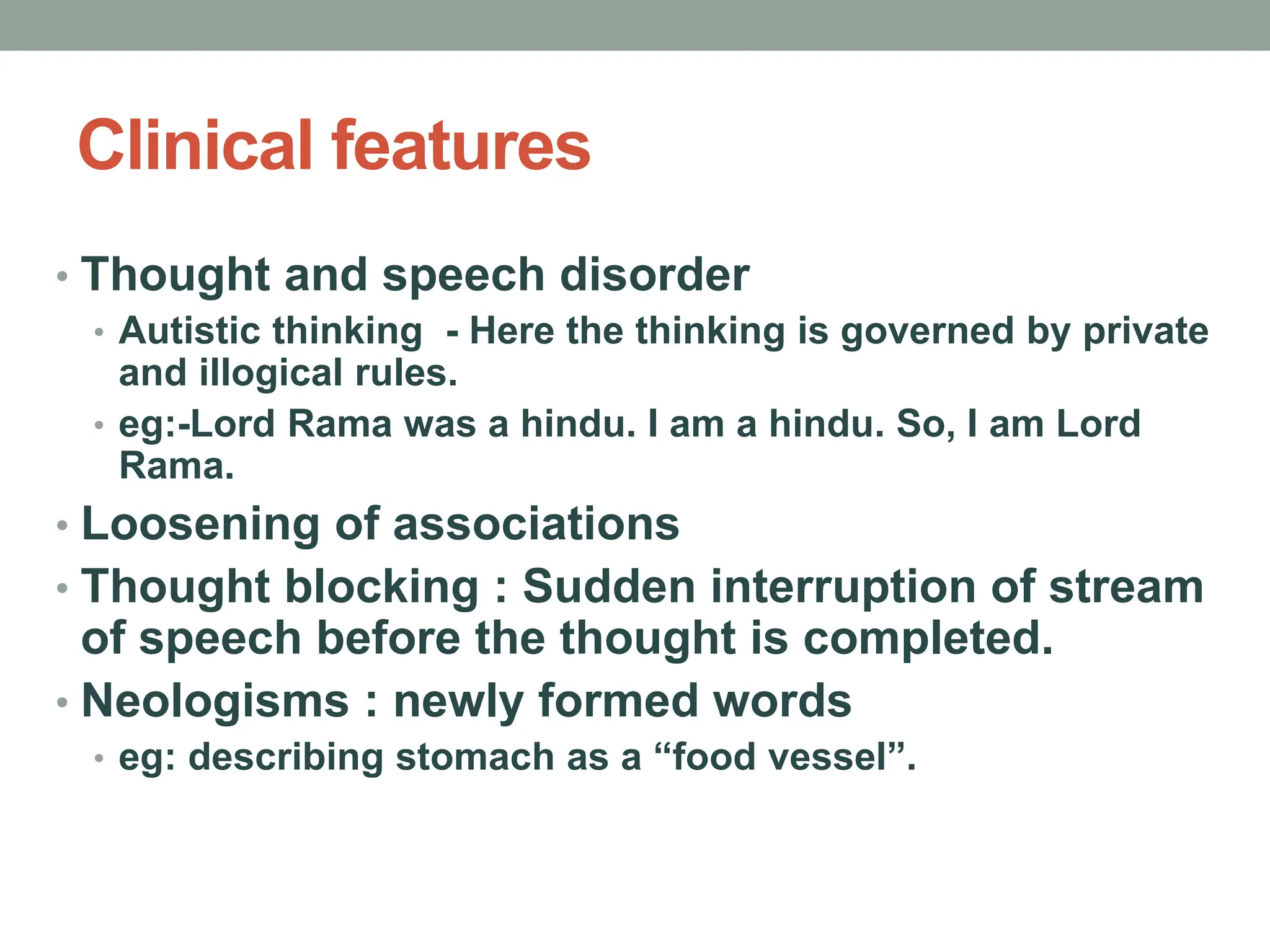
Clinical features
• Thought and speech disorder
• Autistic thinking - Here the thinking is governed by private
and illogical rules.
• eg:-Lord Rama was a hindu. I am a hindu. So, I am Lord
Rama.
• Loosening of associations
• Thought blocking : Sudden interruption of stream
of speech before the thought is completed.
• Neologisms : newly formed words
• eg: describing stomach as a “food vessel”.
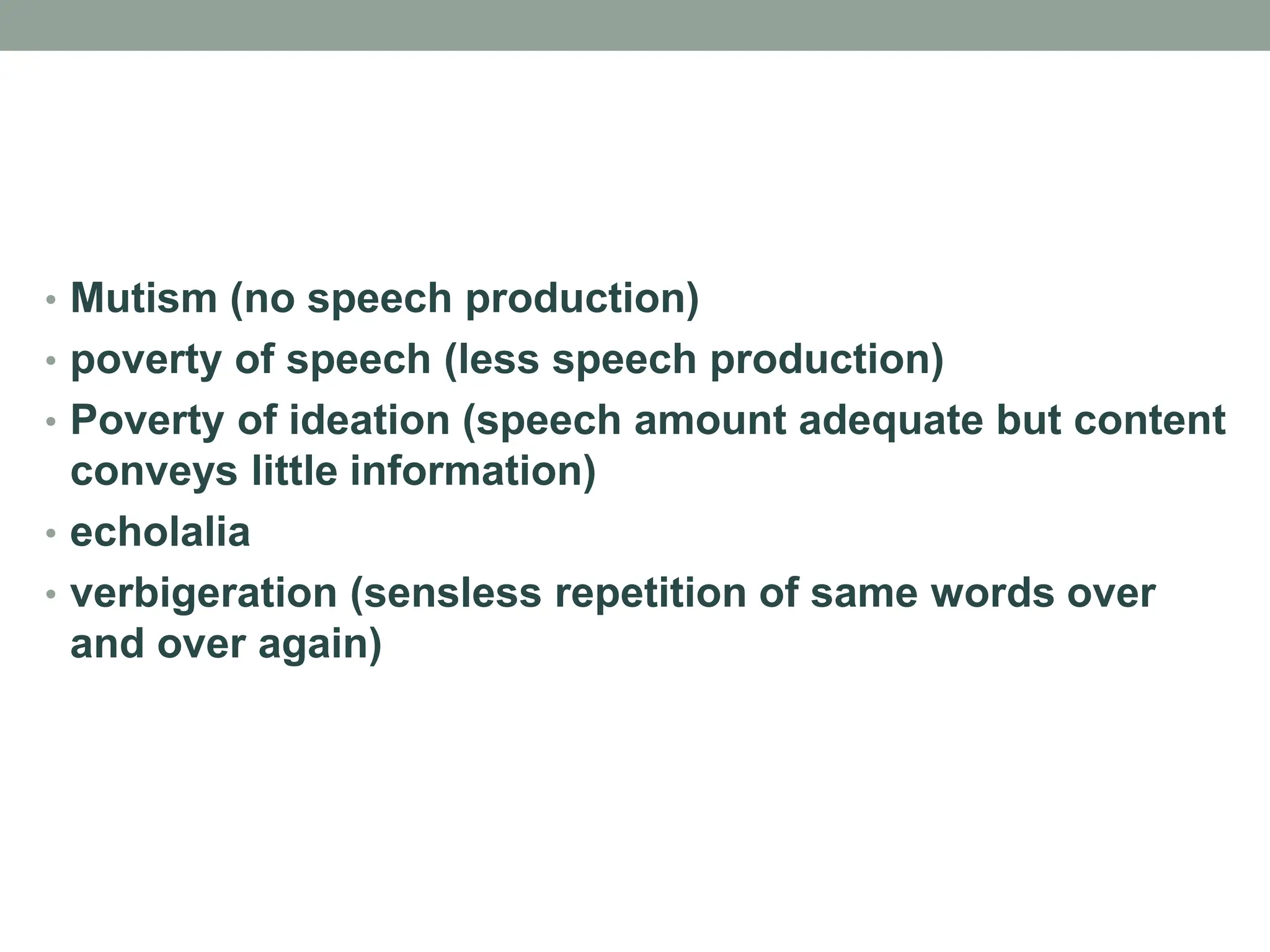
• Mutism (no speech production)
• poverty of speech (less speech production)
• Poverty of ideation (speech amount adequate but content
conveys little information)
• echolalia
• verbigeration (sensless repetition of same words over
and over again)
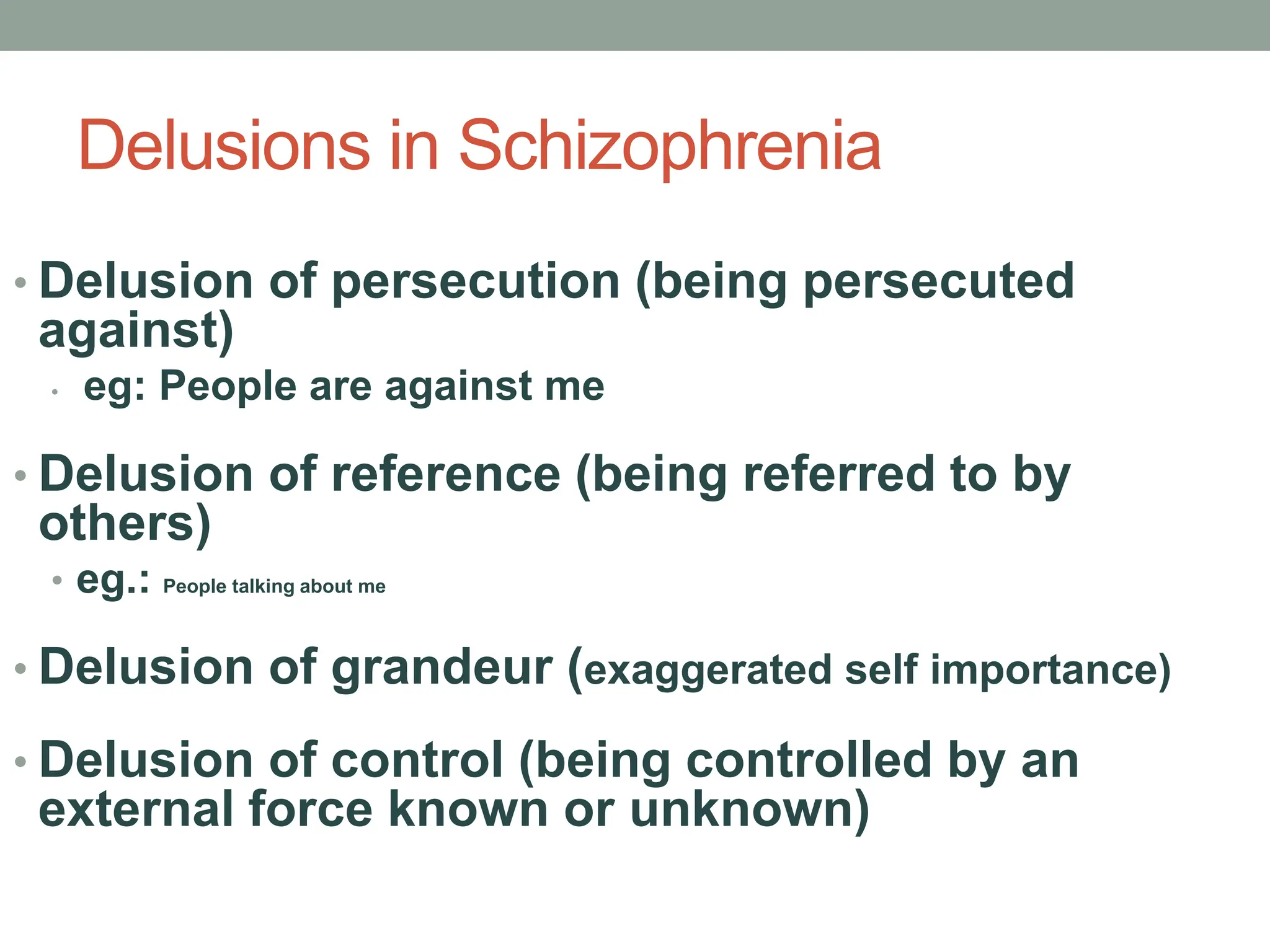
Delusions in Schizophrenia
• Delusion of persecution (being persecuted
against)
• eg: People are against me
• Delusion of reference (being referred to by
others)
• eg.: People talking about me
• Delusion of grandeur (exaggerated self importance)
• Delusion of control (being controlled by an
external force known or unknown)
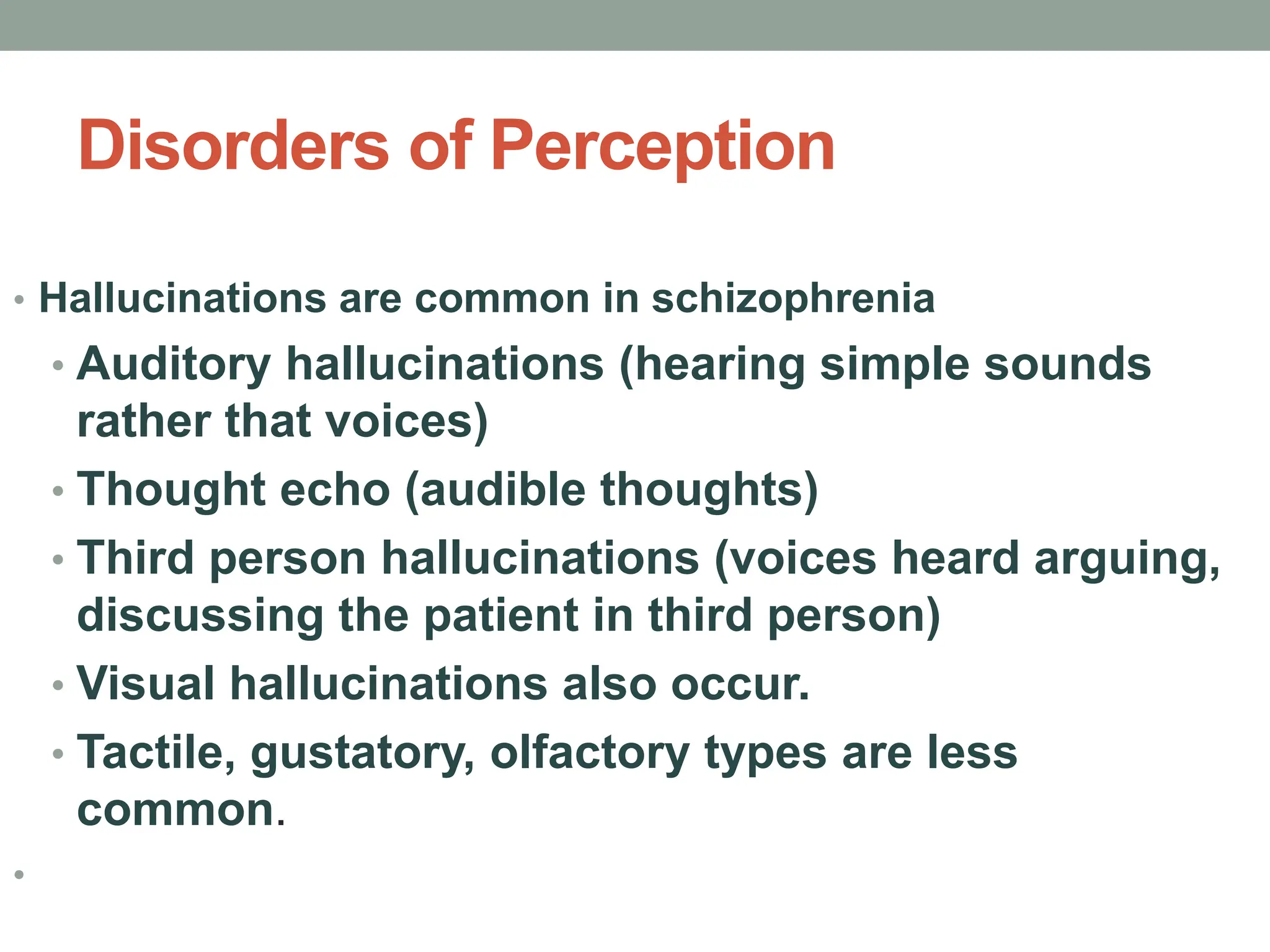
Disorders of Perception
• Hallucinations are common in schizophrenia
• Auditory hallucinations (hearing simple sounds
rather that voices)
• Thought echo (audible thoughts)
• Third person hallucinations (voices heard arguing,
discussing the patient in third person)
• Visual hallucinations also occur.
• Tactile, gustatory, olfactory types are less
common.
•
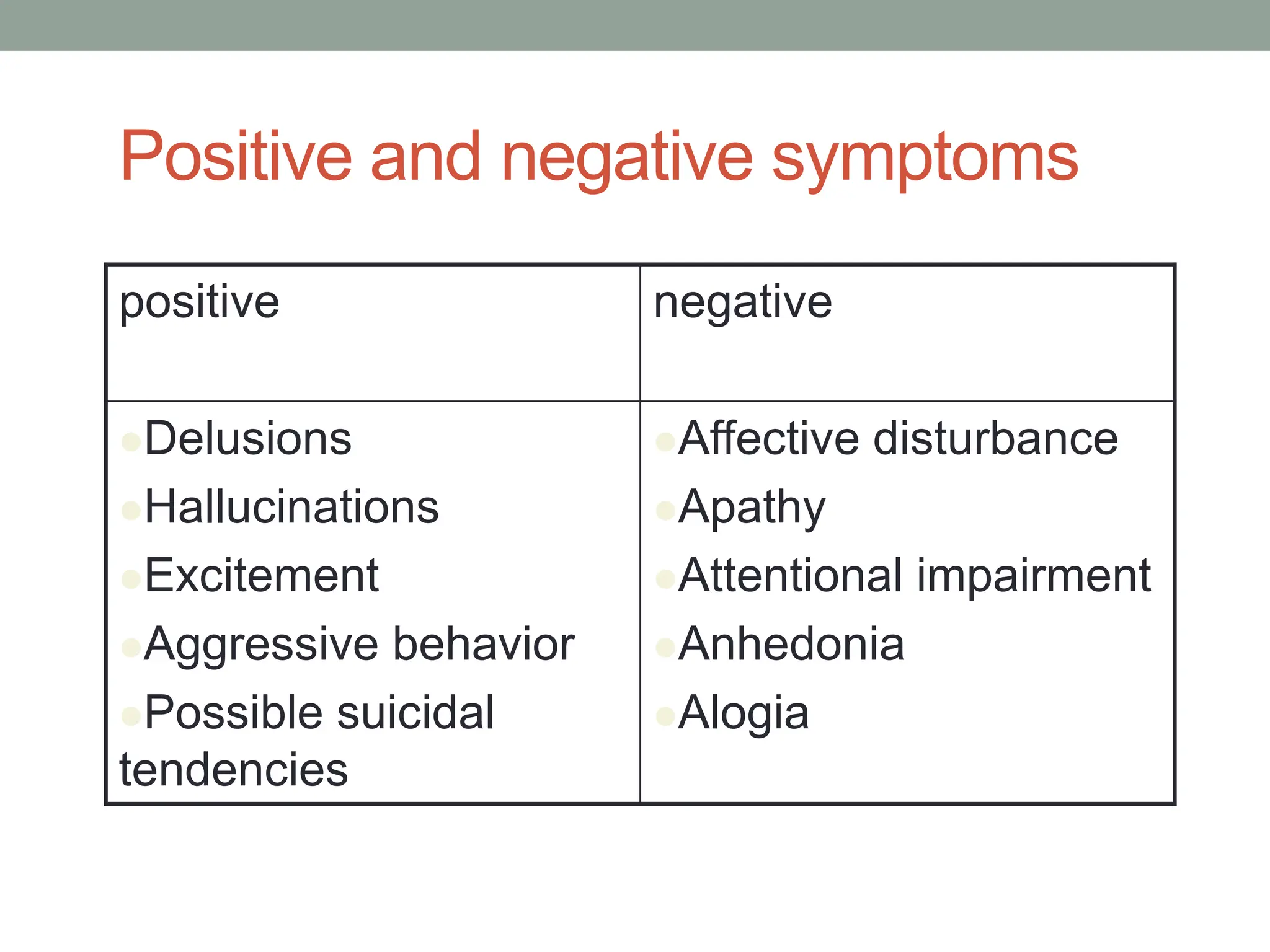
Positive and negative symptoms
positive negative
Delusions
Hallucinations
Excitement
Aggressive behavior
Possible suicidal
tendencies
Affective disturbance
Apathy
Attentional impairment
Anhedonia
Alogia
Schneider’s first rank symptoms of
schizophernia [SFRS]
• He proposed the first rank symptoms of schizophernia in
1959.
• The presence of even one of these symptoms is
considered to be strongly suggestive of schizophernia.
SFRS
• Hearing one’s thought spoken aloud [audible
thoughts or thought echo ]
• Hallucinatory voices in the form of statement and
reply[the patient hears voices discussing him in the
third person]
• Hallucinatory voices in the form of a running
commentary[voices commenting on one’s action]
• Thought withdrawal
• Made volition or acts [the subject being like a robot]
• Made impulse [experiences impulses imposed by some
external force]
• Made feelings [experiences feelings imposed by some
external force]
Course and prognosis
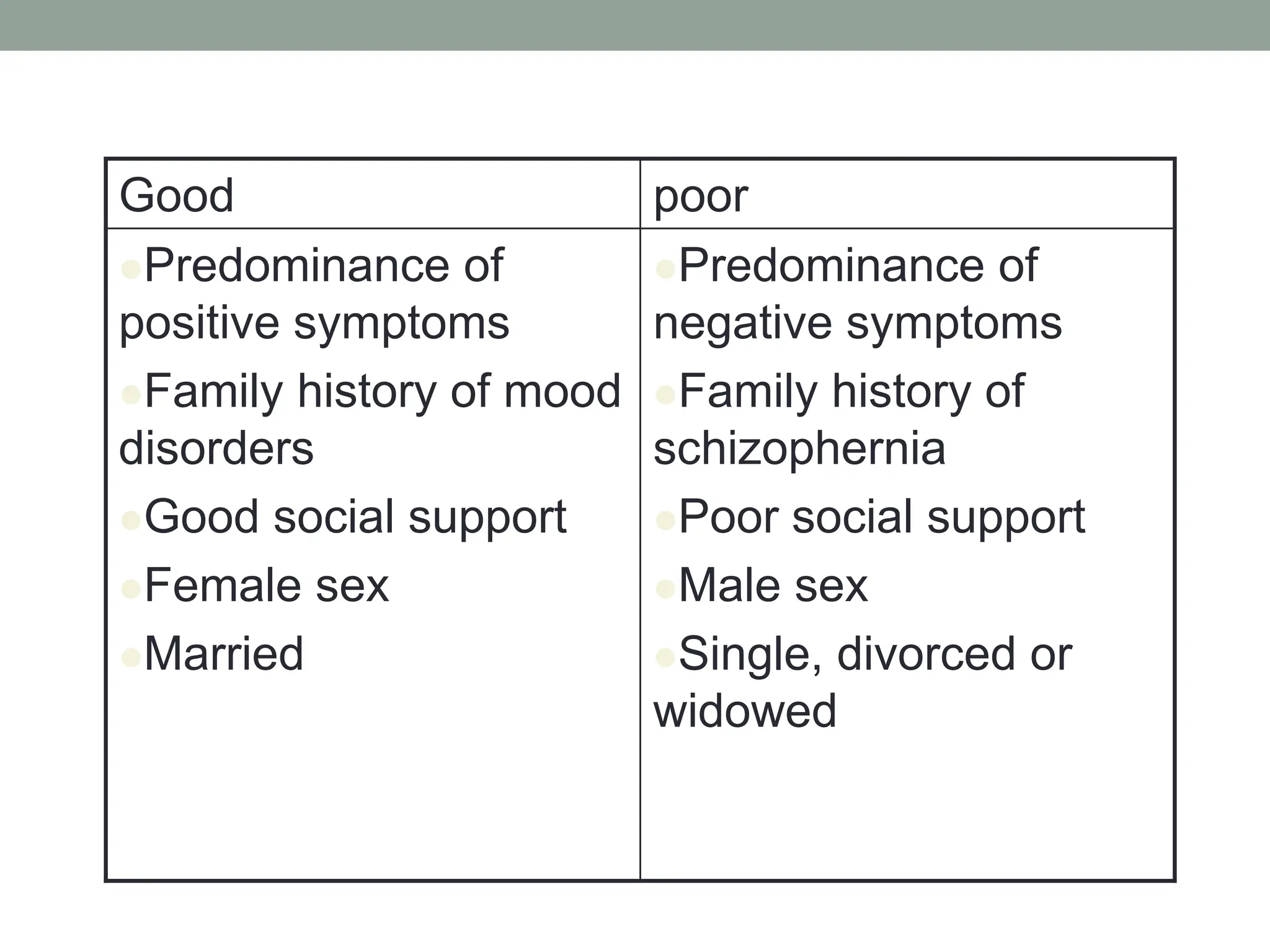
Good prognostic factors Poor prognostic factors
Acute onset
Later onset
Presence of precipitating
factors
Good premorbid
personality
Paranoid, catatonic
Short duration [<6mths]
Chronic
Younger onset
Absence of precipitating
factors
Poor premorbid
personality
Simple, undifferntiated
Long duration[>2yrs]
Good poor
Predominance of
positive symptoms
Family history of mood
disorders
Good social support
Female sex
Married
Predominance of
negative symptoms
Family history of
schizophernia
Poor social support
Male sex
Single, divorced or
widowed
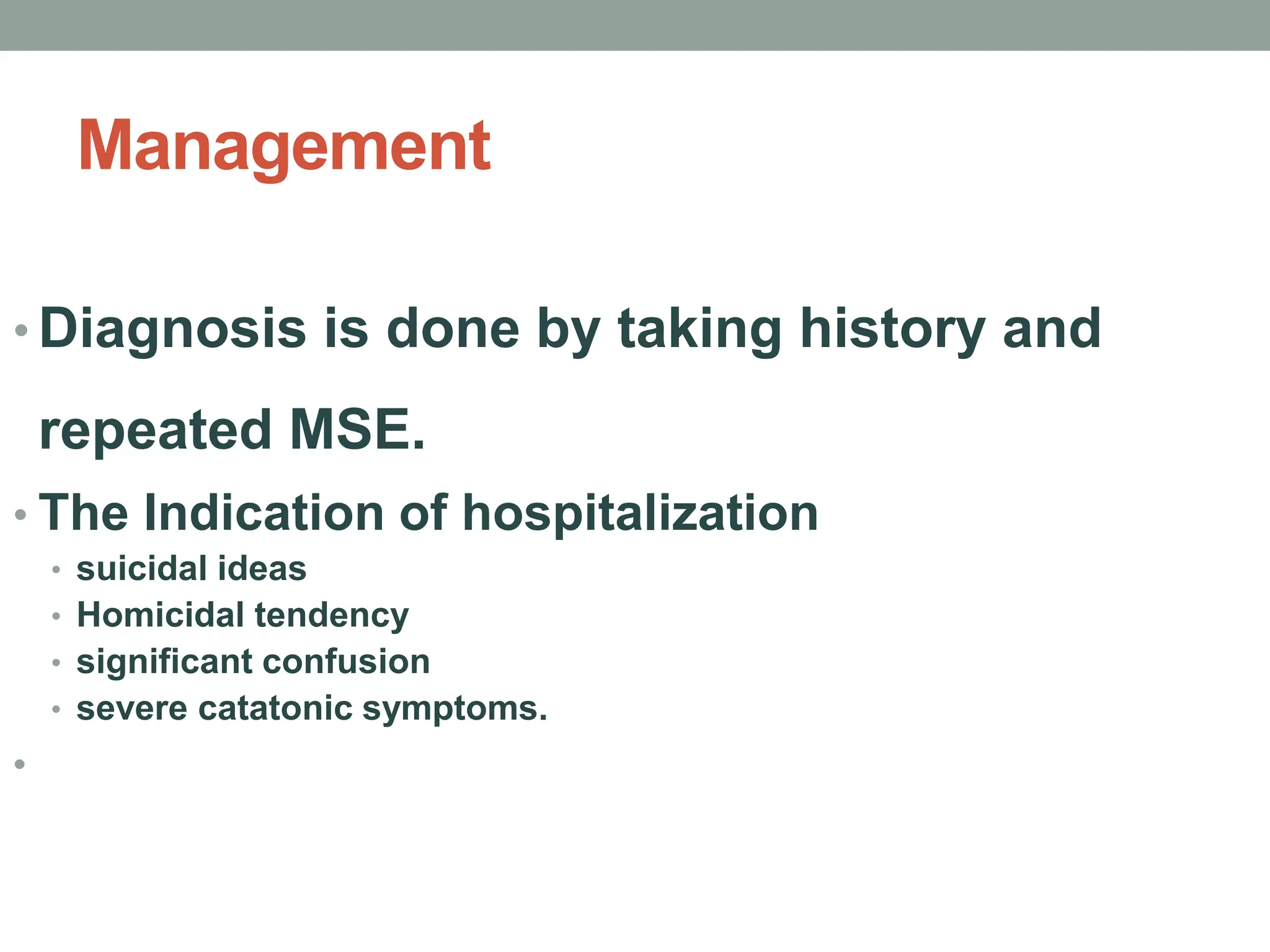
Management
• Diagnosis is done by taking history and
repeated MSE.
• The Indication of hospitalization
• suicidal ideas
• Homicidal tendency
• significant confusion
• severe catatonic symptoms.
•
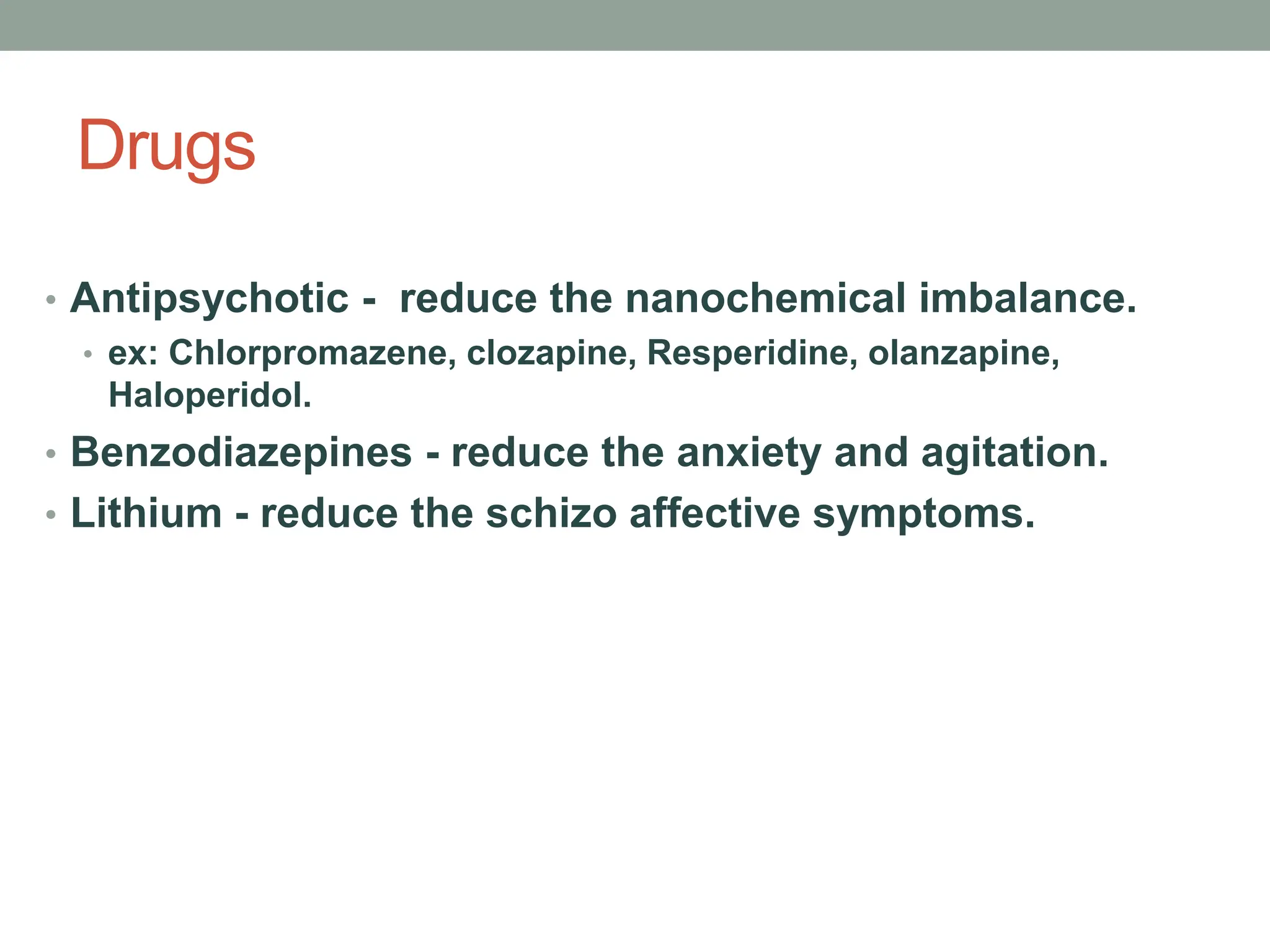
Drugs
• Antipsychotic - reduce the nanochemical imbalance.
• ex: Chlorpromazene, clozapine, Resperidine, olanzapine,
Haloperidol.
• Benzodiazepines - reduce the anxiety and agitation.
• Lithium - reduce the schizo affective symptoms.
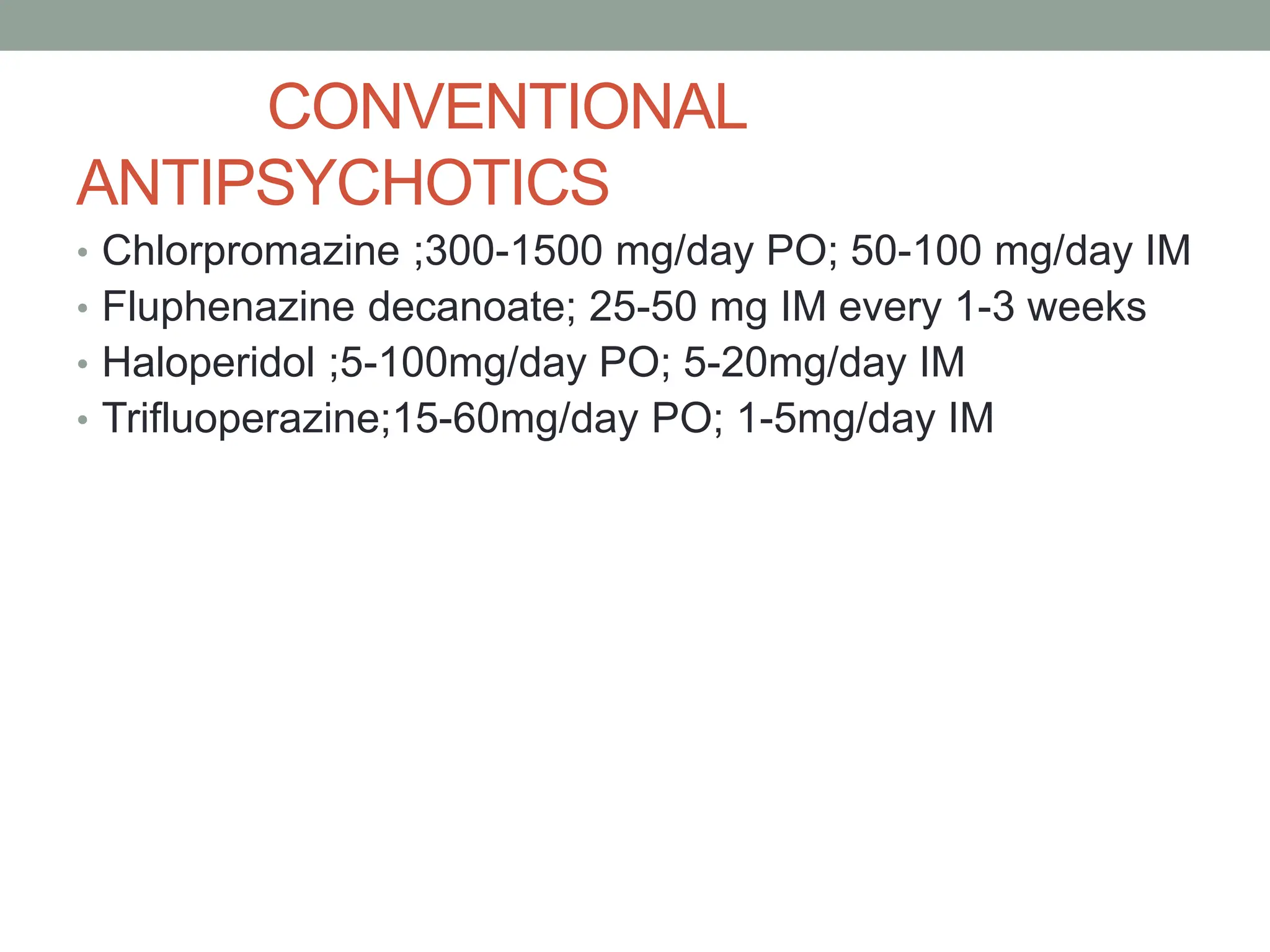
CONVENTIONAL
ANTIPSYCHOTICS
• Chlorpromazine ;300-1500 mg/day PO; 50-100 mg/day IM
• Fluphenazine decanoate; 25-50 mg IM every 1-3 weeks
• Haloperidol ;5-100mg/day PO; 5-20mg/day IM
• Trifluoperazine;15-60mg/day PO; 1-5mg/day IM
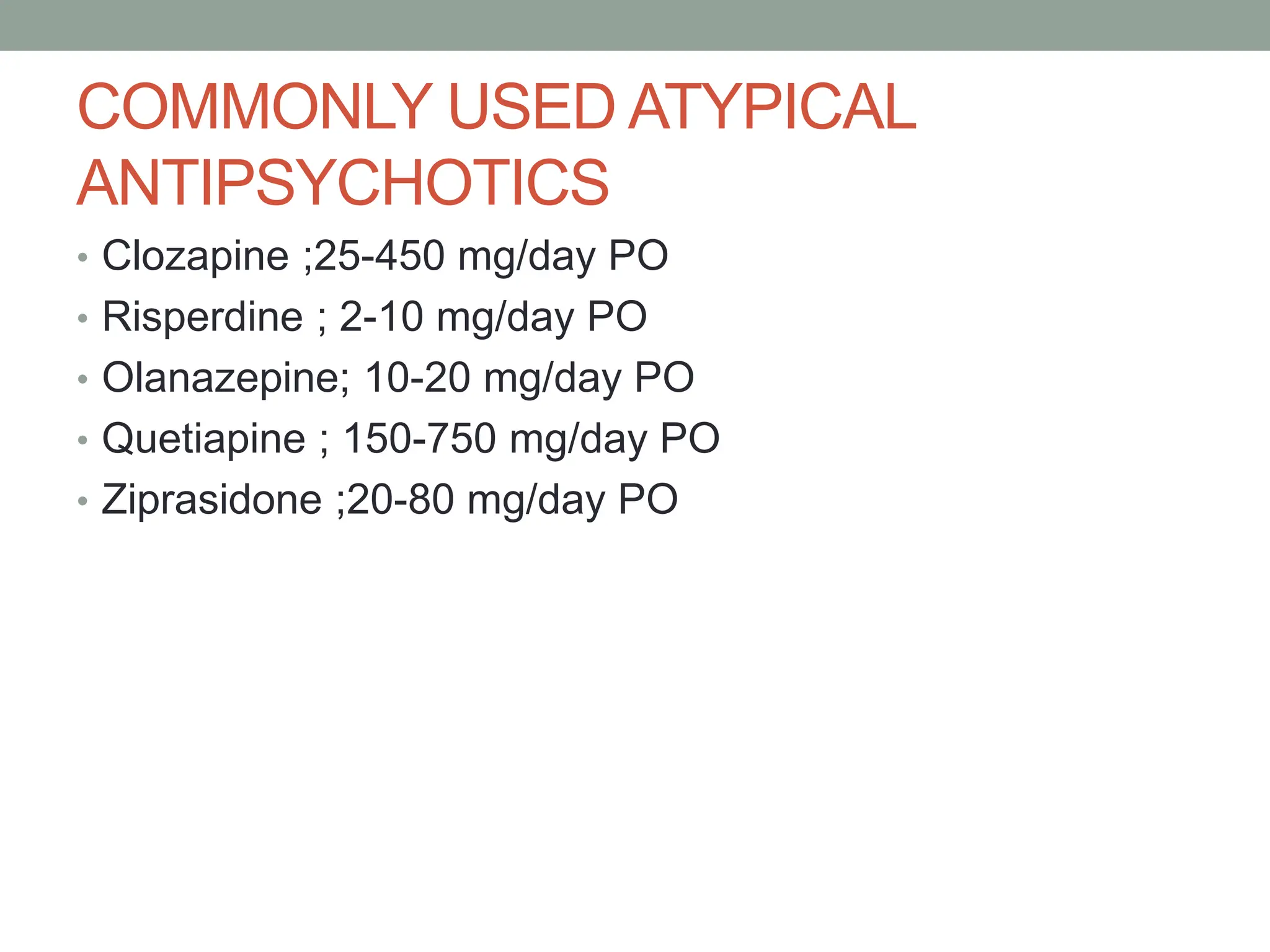
COMMONLY USED ATYPICAL
ANTIPSYCHOTICS
• Clozapine ;25-450 mg/day PO
• Risperdine ; 2-10 mg/day PO
• Olanazepine; 10-20 mg/day PO
• Quetiapine ; 150-750 mg/day PO
• Ziprasidone ;20-80 mg/day PO
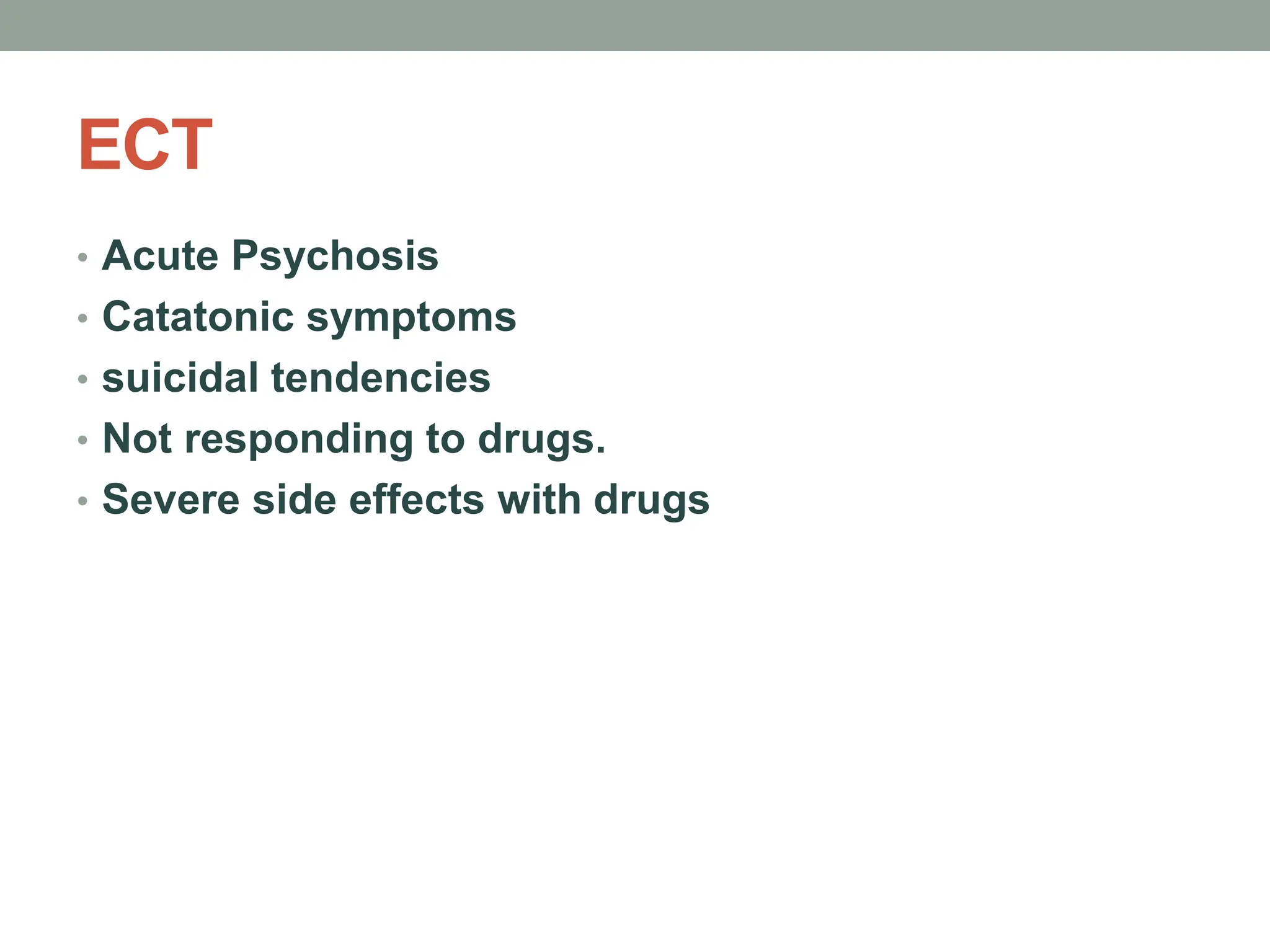
ECT
• Acute Psychosis
• Catatonic symptoms
• suicidal tendencies
• Not responding to drugs.
• Severe side effects with drugs
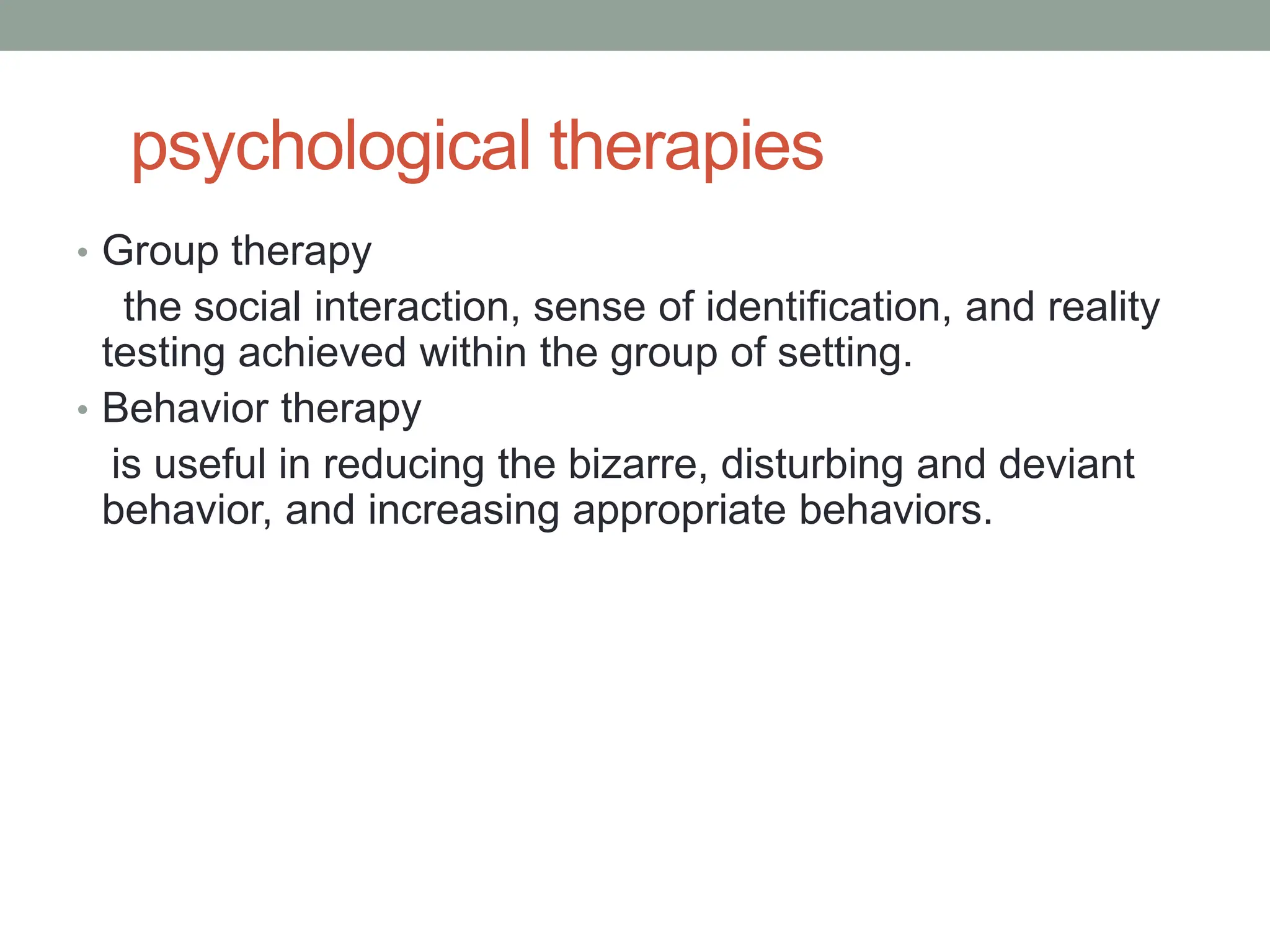
psychological therapies
• Group therapy
the social interaction, sense of identification, and reality
testing achieved within the group of setting.
• Behavior therapy
is useful in reducing the bizarre, disturbing and deviant
behavior, and increasing appropriate behaviors.
• Social skill training
it will improve good eye contact eg.. Role play and
home work assignment.
• Cognitive therapy
to improve cognitive distortions like reducing
distractibility and correcting judgement.
• Family therapy
it consists family education about schizophernia
ANXIETY & STRESS DISORDERS
Learning objectives
Be able to
• Distinguish normal from pathological worry
• Recognise features of different anxiety disorders
• Detect pathological responses to stressors
• Initiate simple interventions and know when to refer
Anxiety
• Normal
• Transient disagreeable emotion state, often with adaptive function
(signals anticipated or impending threat and motivates necessary
action)
• Symptom
• Seen in wide variety of mental disorders
(e.g. depression, psychosis, substance misuse)
• Disorder
• Syndromes where anxiety forms dominant element
Anxiety disorders
• Generalised anxiety disorder
• Agoraphobia (with or without panic disorder)
• Social phobia
• Specific phobia
• Obsessive compulsive disorder
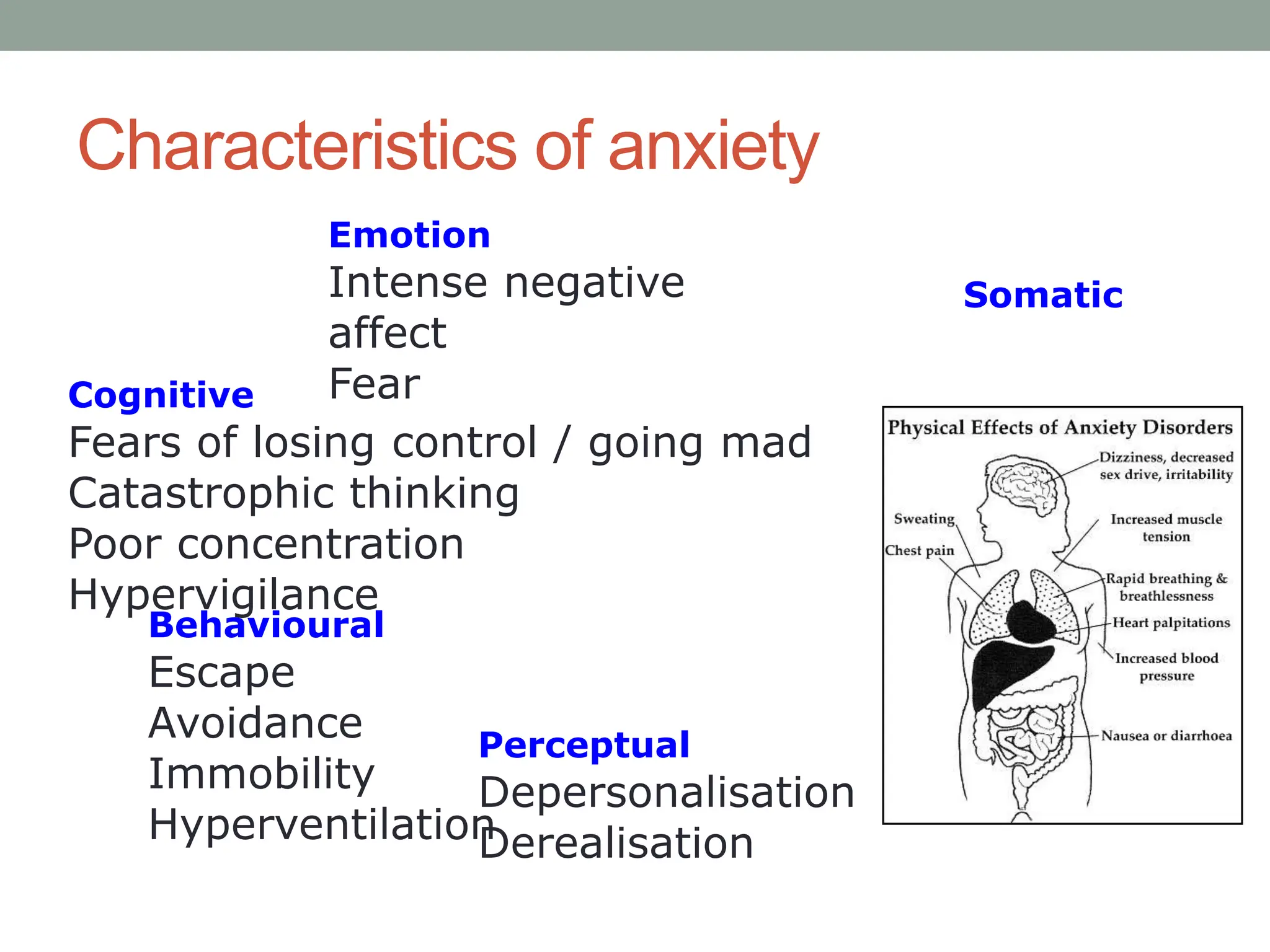
Characteristics of anxiety
Cognitive
Fears of losing control / going mad
Catastrophic thinking
Poor concentration
Hypervigilance
Somatic
Perceptual
Depersonalisation
Derealisation
Behavioural
Escape
Avoidance
Immobility
Hyperventilation
Emotion
Intense negative
affect
Fear
Psychosocial mechanisms
• Stressful life events, especially those involving threat
• Parenting
• Insecure attachment
• Child who lacks early experiences of self-efficacy (control)
• Overprotective parenting
• Lack of responsiveness
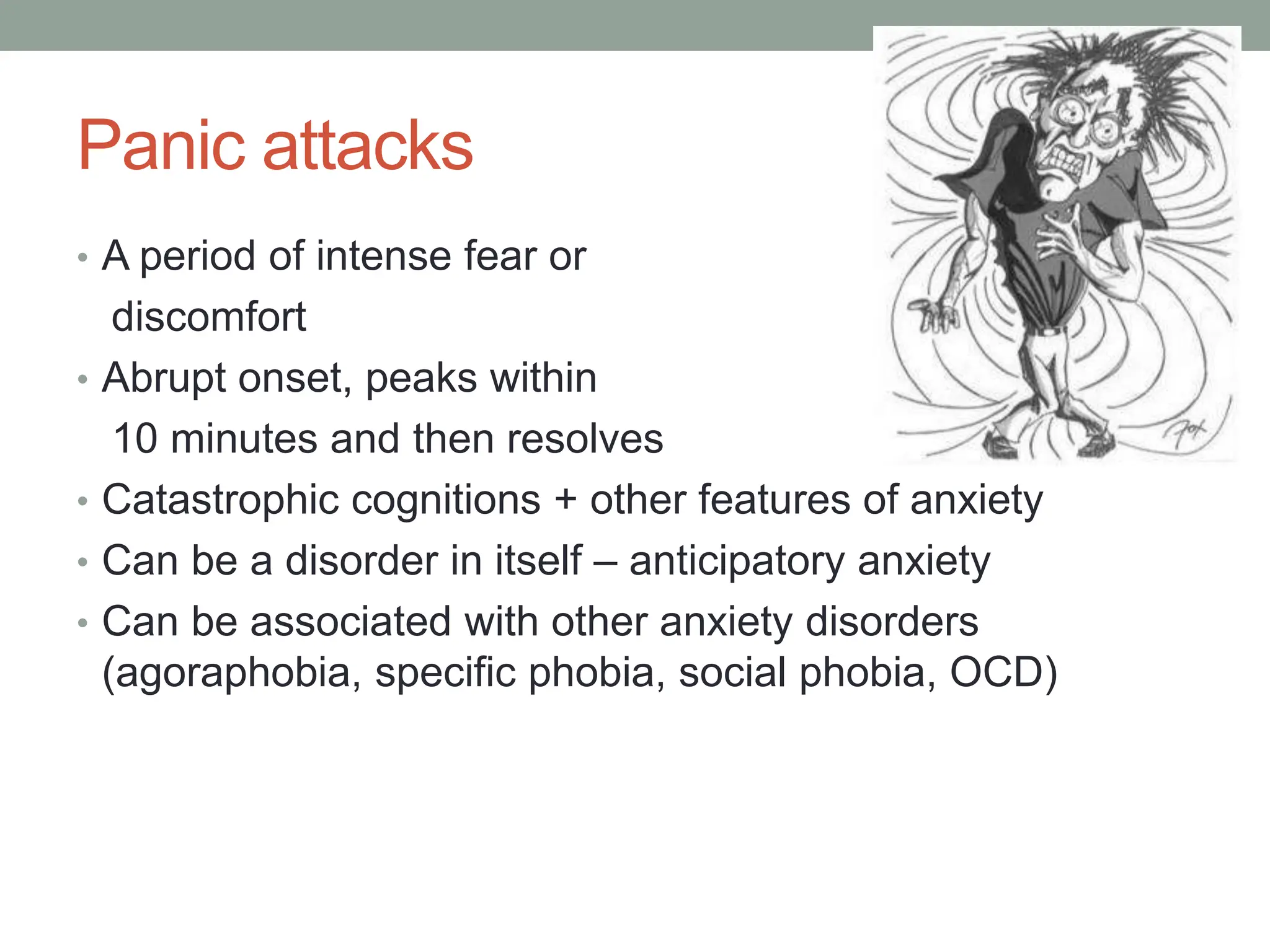
Panic attacks
• A period of intense fear or
discomfort
• Abrupt onset, peaks within
10 minutes and then resolves
• Catastrophic cognitions + other features of anxiety
• Can be a disorder in itself – anticipatory anxiety
• Can be associated with other anxiety disorders
(agoraphobia, specific phobia, social phobia, OCD)
Panic attacks - importance
• May present to emergency department
• Going to die, having a heart attack, can’t breathe
• Management
• Ensure no medical cause present
• Reassure that anxiety cannot stay at that level – maximum 30
minutes
Agoraphobia
• “Fear of the market”
• Anxiety about being in places or situations from which
escape might be difficult (or embarrassing) or in which
help may not be available
• E.g. crowds, waiting in line, on a minibus, being outside
the home alone
• Leads to avoidance (or high levels of distress)
• Very disabling
Social phobia
• A marked or persistent fear of social / performance
situations in which the person is exposed to unfamiliar
persons or to possible scrutiny
• Fear of humiliation / embarrassment
• Leads to avoidance or high level of anxiety / panic attack
or escape
Social phobia
• Aetiology
• 16% prevalence in first degree relatives
• Some genetic contribution e.g. vulnerability to interpreting
situations as dangerous
• Course
• Persistent
• Links to childhood shyness and behavioural inhibition
Specific phobias
• Marked and persistent fear that is excessive /
unreasonable, triggered by a specific object / situation (or
anticipation of the object / situation)
• Animals
• Aspects of natural environment
• Blood, injection, injury** (vasovagal syncope)
• Situational
• Other (dental / medical procedures, choking etc)
Specific phobias
• Try to avoid the exposure
• May not interfere with life
• Few seek help
Generalised anxiety disorder (GAD)
• Persistent anxiety and worry that is out of proportion to
actual events or circumstances. Can be ‘free-floating’.
Can feel difficult to control.
• Present for minimum of six months
• Syndrome loosely defined / catch-all
• High co-morbidity with depression
GAD
• Aetiology
• Modest genetic component
• Familial aggregation
Obsessive compulsive disorder
• A 22 year old man comes to clinic in distress. He is very
worried that something will happen to his family if he
doesn’t count up to 7 over and over again. He spends at
least 2 hours per day counting. He thinks this is silly but
gets even more worried if he doesn’t do the counting. He
has had to stop working.
OCD - symptoms
Obsessions
• Persistent / recurrent ideas, thoughts, impulses or images
that are experienced as
• inappropriate, distressing (ego dystonic),
• and anxiety-provoking
• leading to efforts to suppress or ignore them
OCD - symptoms
Compulsions
• Repetitive acts, behaviours or thoughts that are designed
to counteract the anxiety associated with an obsession
Impact
• At least an hour per day
OCD - examples
Obsessions
• Blasphemous thoughts
• My hands are dirty
• I didn’t lock the door
Compulsions
• Repeated prayers
• Hand-washing
• Checking
OCD - epidemiology
• Course
• Relapsing and remitting
• Co-morbidity
• Depression
• Psychosis
OCD – clues to aetiology
• Paediatric Autoimmune Neuropyshciatric Disorder
Associated with Streptococcus (post streptococ)
• Related to Sydenham’s chorea and Huntington’s disease
• Post-encephalitis
• Trauma
• Temporal lobe epilepsy
• (Disorder of basal ganglia)
Anxiety disorders
management principles
– Detect, reassure
– SSRIs can be helpful (high dose for OCD)
– Beta-blockers can help symptomatically
– Benzodiazepines produce short-term relief but easily lead to
addiction
– Graded exposure
– Systematic desensitisation
– Response prevention (OCD)
Stress disorders
• Acute stress disorder
• Post-traumatic stress disorder
• Adjustment disorder
Extreme stress
• Exposed to an exceptionally stressful life event
• actual or threatened death / serious injury (includes accidental)
• OR threat to personal integrity of self or others (e.g. sexual assault,
)
• Acute stress reaction
• Onset within 4 weeks, lasts at least 2 days
• PTSD
• Persists more than one month after exposure
PTSD
• Life-threatening experience
• Re-experiencing
• Hyperarousal
• Avoidance
Risk factors for PTSD
• Female gender
• 8% of men and 20% of women develop PTSD after traumatic event
• Previous psychiatric disorder
• Previous traumatic experiences, especially in childhood
(abuse, separation, family instability)
• Personality variables: low intelligence, low self-esteem,
external locus of control
Management of PTSD
• Recognition and reassurance
• Advise on self-help strategies:
• Establish routine for daily life
• Seek support from others
• Treat yourself with kindness / compassion
• Accept feelings instead of fighting them
• Face what you are ready to face
• Make time to relax / do enjoyable things
• Consider SSRIs
• Tackle associated alcohol / drug misuse
SUBSTANCE RELATED DISORDERS
Learning Objectives
• At the end of the lecture, students will be able to
– Define different terms encountered in Addiction Psychiatry
– List different substances that are potentially misused
– Discuss different forms of substance use disorders
– Discuss substance induced disorders
– Etiology and Neurobiology of Addiction
– Principles of Management
3/22/2024 107
Addiction: American Society of Addiction Medicine,
2011
• Addiction is a primary, chronic disease of brain reward,
motivation, memory and related circuitry.
• Dysfunction in these circuits leads to characteristic
biological, psychological, social and spiritual
manifestations.
• This is reflected in an individual pathologically pursuing
reward and/or relief by substance use and other
behaviors.
3/22/2024 108
DSM-5 AND Addiction (Published May, 2013)
• DSM-5 uses Substance Use Disorders (SUD)
instead of Addiction because the word Addiction
has uncertain definition and negative connotation.
• But, it acknowledges it is in common usage in
many countries to describe severe problems
related to compulsive and habitual use of
substances.
• The word Addiction is widely used by specialists
who deal with the problem of Substance Related
and Addictive Disorders. Societies, journals use
the name, E.g. Journal Addiction.
• The field has evolved into what is known as
109
Types of addictions
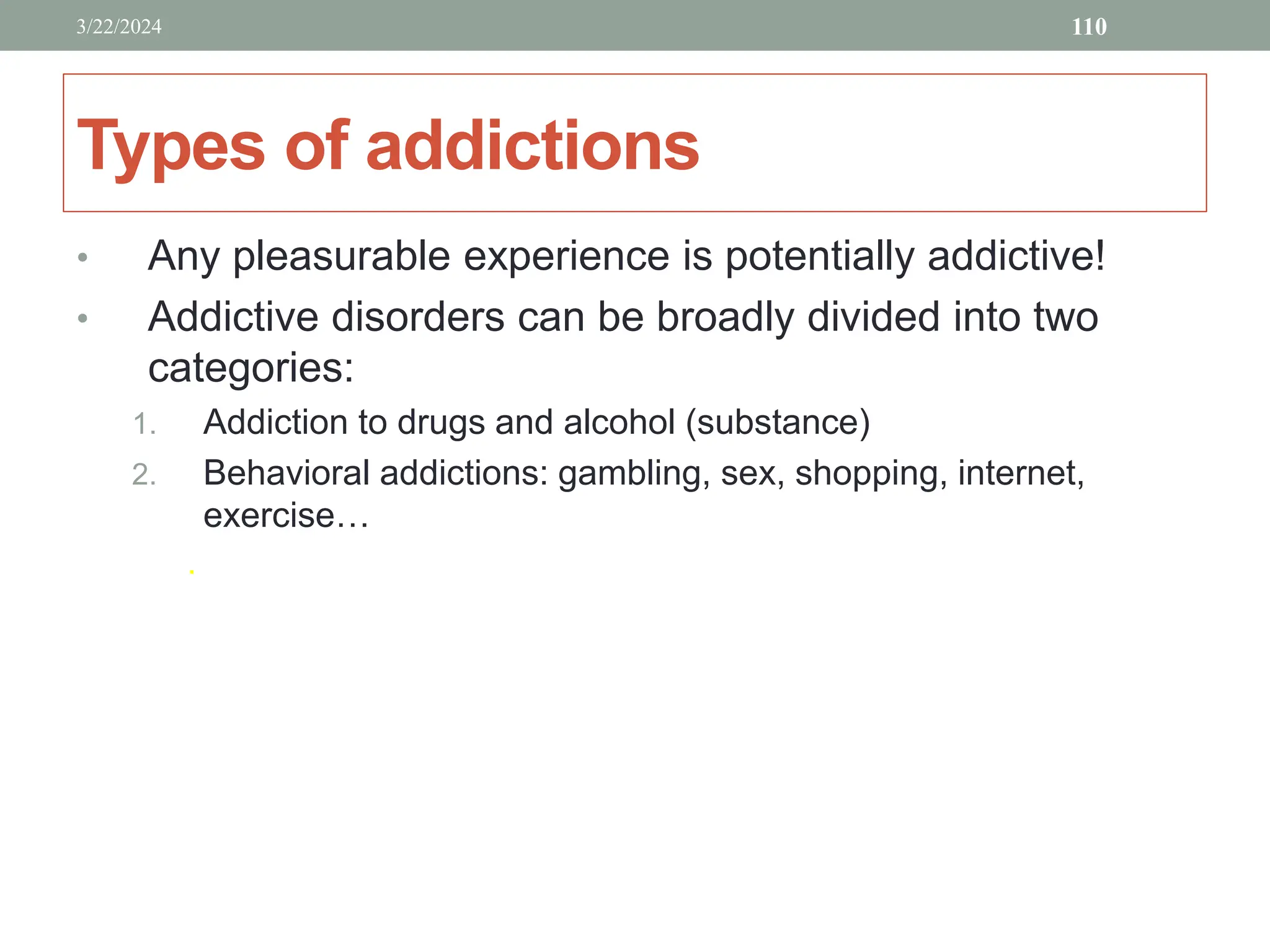
• Any pleasurable experience is potentially addictive!
• Addictive disorders can be broadly divided into two
categories:
1. Addiction to drugs and alcohol (substance)
2. Behavioral addictions: gambling, sex, shopping, internet,
exercise…
.
3/22/2024 110
DSM -5 Classification of SRD
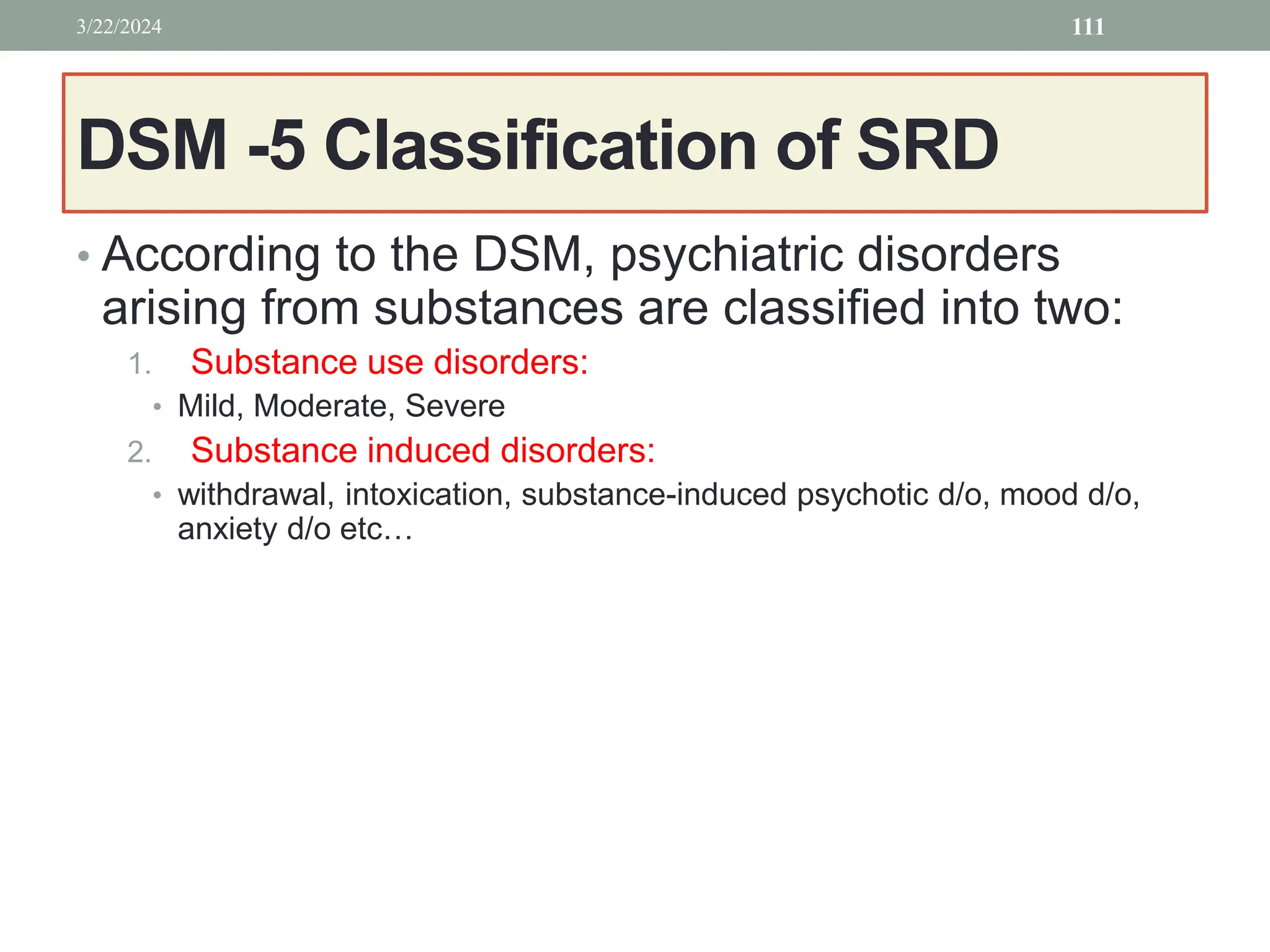
• According to the DSM, psychiatric disorders
arising from substances are classified into two:
1. Substance use disorders:
• Mild, Moderate, Severe
2. Substance induced disorders:
• withdrawal, intoxication, substance-induced psychotic d/o, mood d/o,
anxiety d/o etc…
3/22/2024 111
Views on Addiction
• Medical View
• Addiction is a disease and should be treated as such.
• Moral View
• Addiction is a moral decay and weak personality and should be
handled accordingly.
3/22/2024 112
Drug vs. Substance
• Drug refers to manufactured psychoactive chemicals(in
illicit or licit pharmaceutical plants)
• Substance refers to both manufactured and naturally
occurring psychoactive chemicals (thus it is preferred over
drugs).
• Psychoactive chemicals alter the function of the brain
when taken.
3/22/2024 113
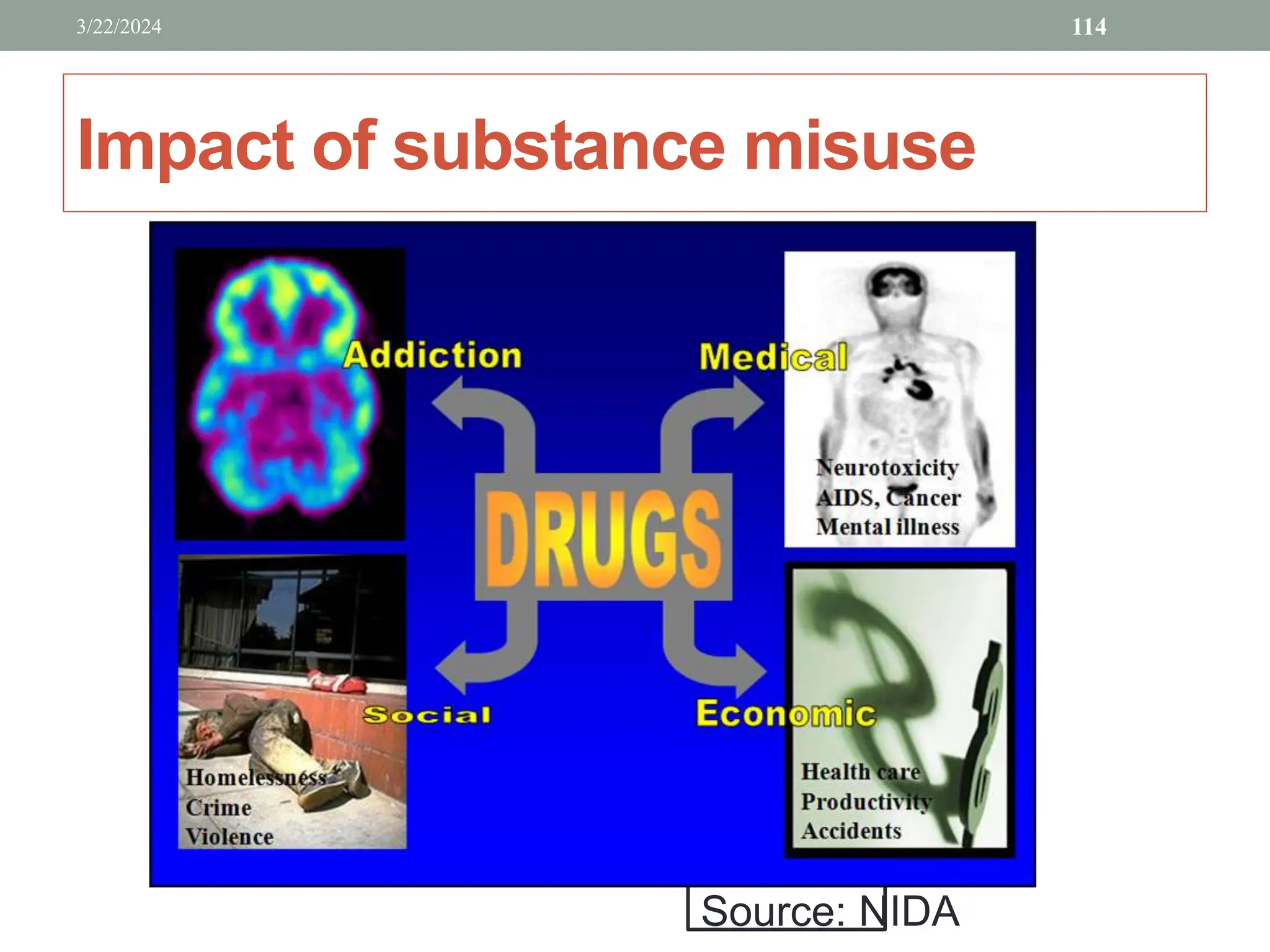
Impact of substance misuse
3/22/2024 114
Source: NIDA
• The substance with the highest intoxicating capacity is
alcohol
• The substance best known for its reinforcing capacity is
cocaine
• The substance best known for its dependence
producing effect is nicotine
• Tolerance easily develops for heroin
• With drawl effect is worst in alcohol
3/22/2024 115
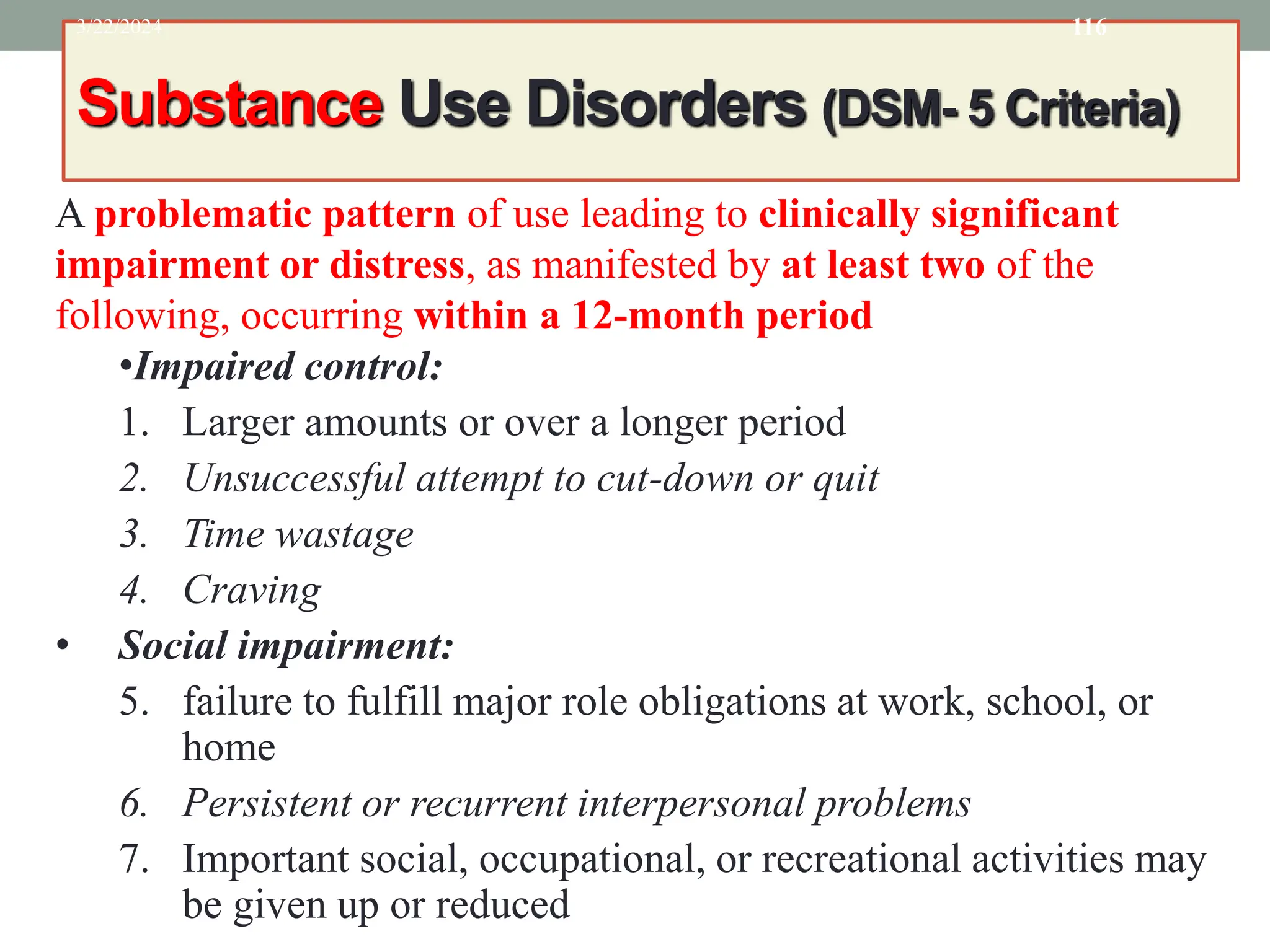
Substance Use Disorders (DSM- 5 Criteria)
3/22/2024 116
A problematic pattern of use leading to clinically significant
impairment or distress, as manifested by at least two of the
following, occurring within a 12-month period
•Impaired control:
1. Larger amounts or over a longer period
2. Unsuccessful attempt to cut-down or quit
3. Time wastage
4. Craving
• Social impairment:
5. failure to fulfill major role obligations at work, school, or
home
6. Persistent or recurrent interpersonal problems
7. Important social, occupational, or recreational activities may
be given up or reduced
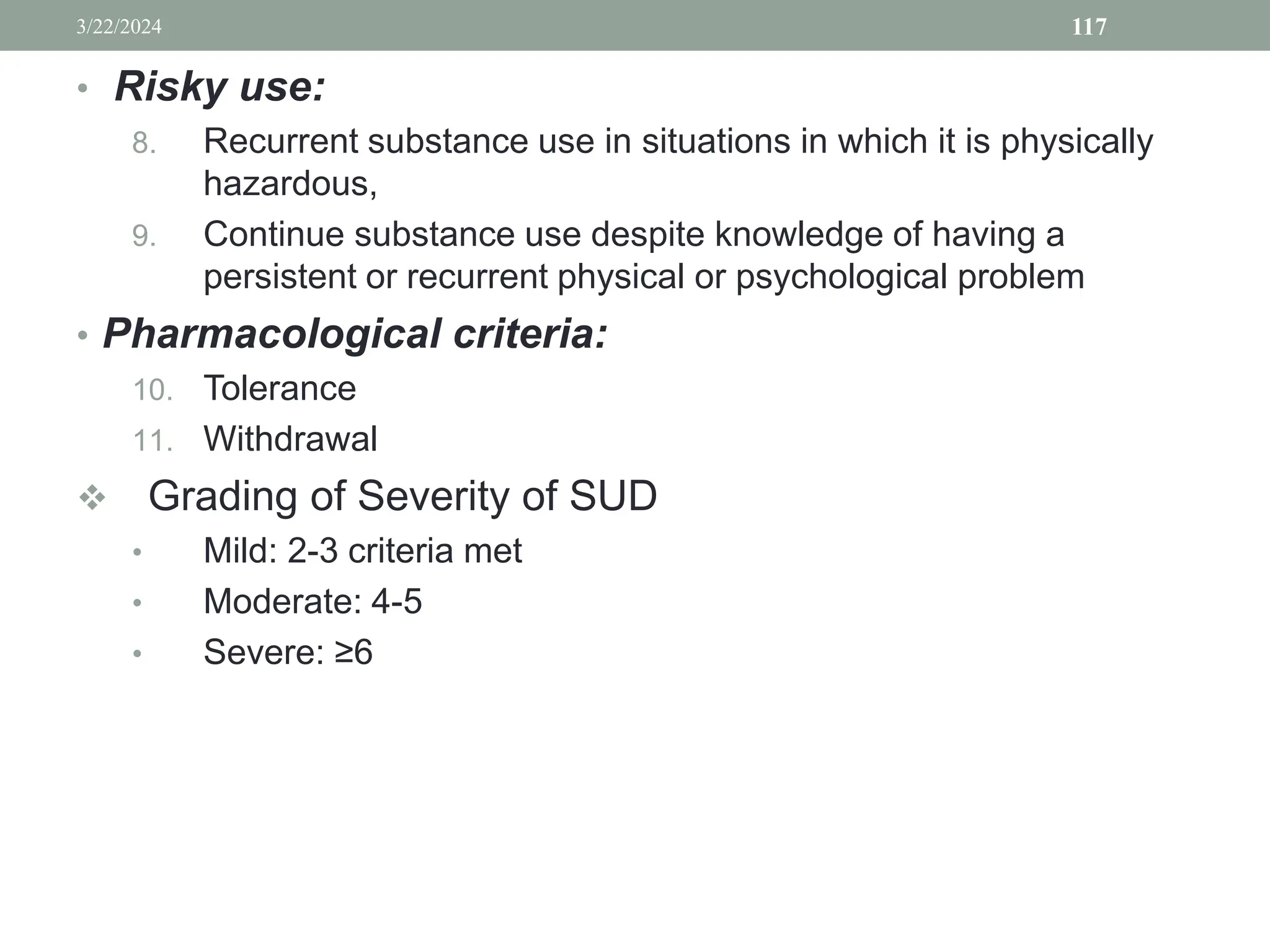
• Risky use:
8. Recurrent substance use in situations in which it is physically
hazardous,
9. Continue substance use despite knowledge of having a
persistent or recurrent physical or psychological problem
• Pharmacological criteria:
10. Tolerance
11. Withdrawal
 Grading of Severity of SUD
• Mild: 2-3 criteria met
• Moderate: 4-5
• Severe: ≥6
3/22/2024 117
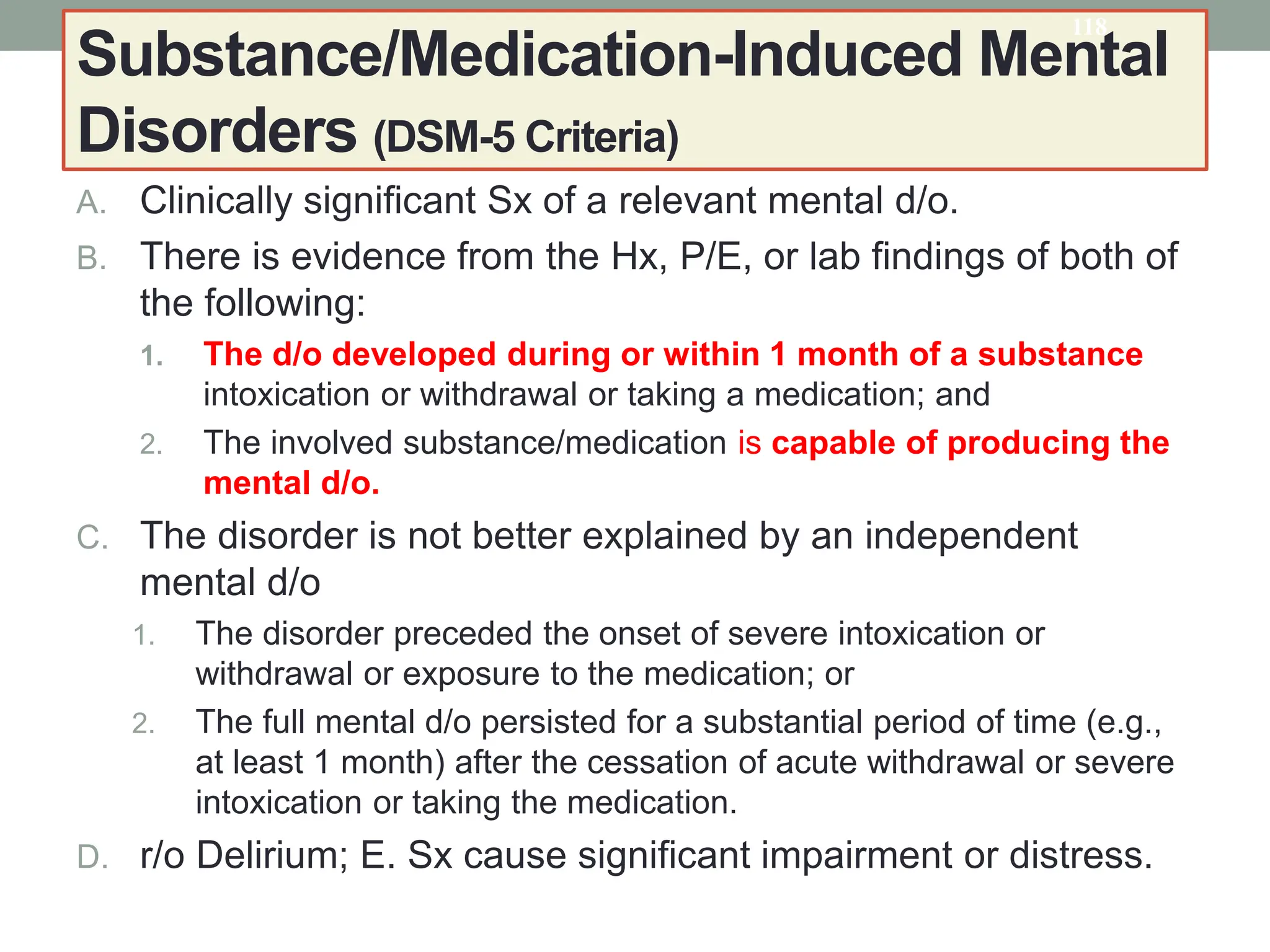
Substance/Medication-Induced Mental
Disorders (DSM-5 Criteria)
A. Clinically significant Sx of a relevant mental d/o.
B. There is evidence from the Hx, P/E, or lab findings of both of
the following:
1. The d/o developed during or within 1 month of a substance
intoxication or withdrawal or taking a medication; and
2. The involved substance/medication is capable of producing the
mental d/o.
C. The disorder is not better explained by an independent
mental d/o
1. The disorder preceded the onset of severe intoxication or
withdrawal or exposure to the medication; or
2. The full mental d/o persisted for a substantial period of time (e.g.,
at least 1 month) after the cessation of acute withdrawal or severe
intoxication or taking the medication.
D. r/o Delirium; E. Sx cause significant impairment or distress.
118
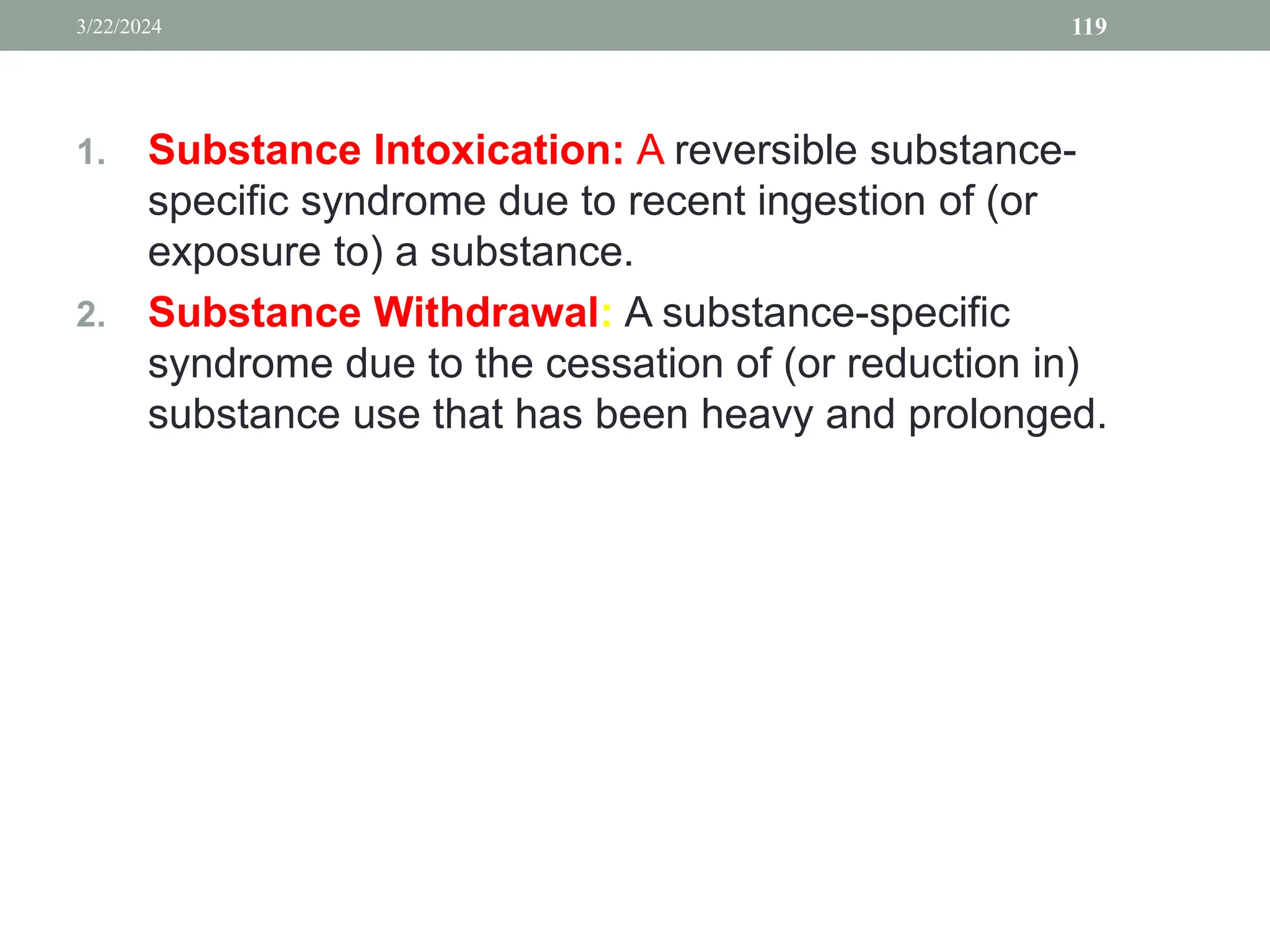
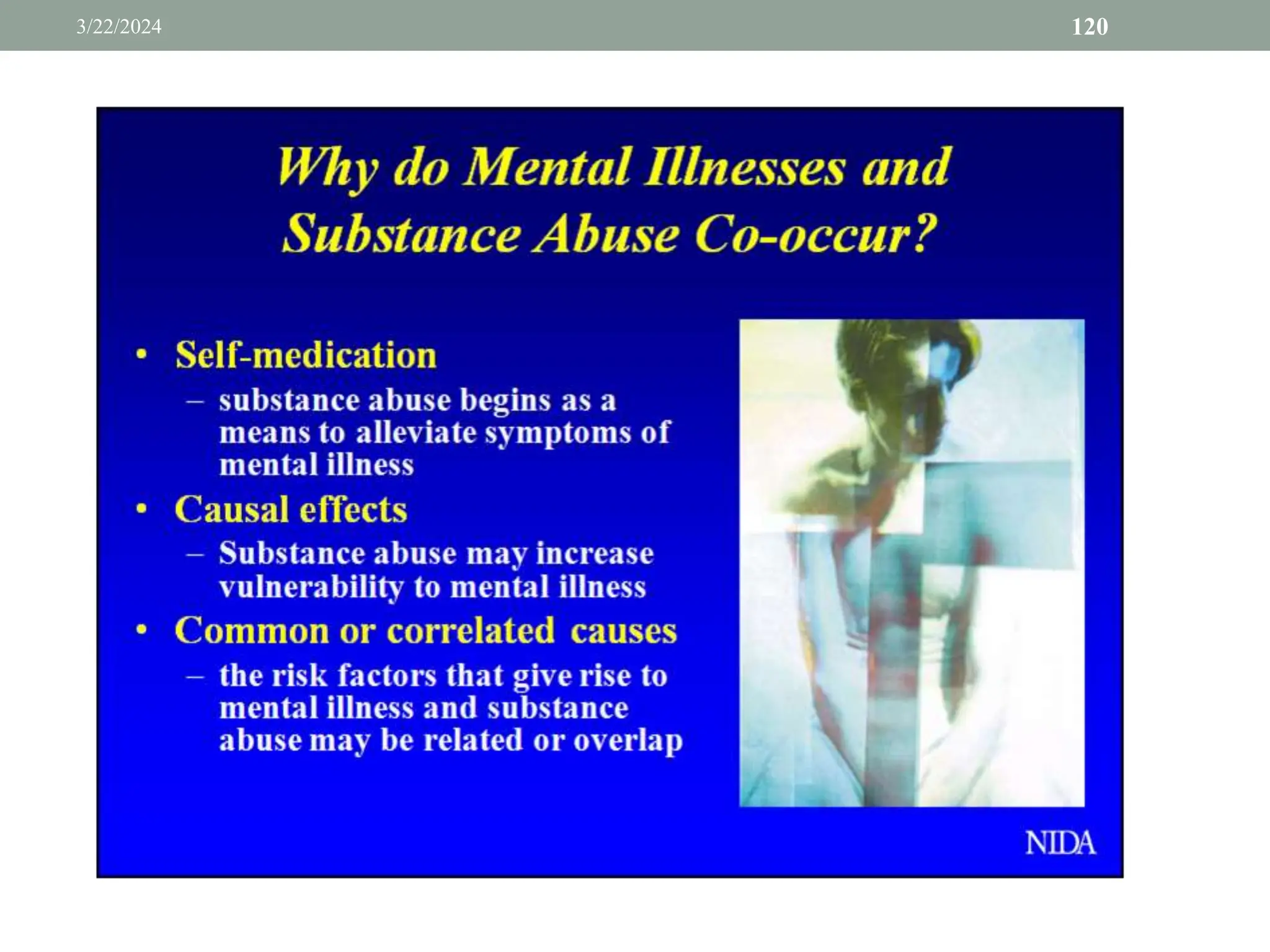
1. Substance Intoxication: A reversible substance-
specific syndrome due to recent ingestion of (or
exposure to) a substance.
2. Substance Withdrawal: A substance-specific
syndrome due to the cessation of (or reduction in)
substance use that has been heavy and prolonged.
3/22/2024 119
3/22/2024 120
Craving
• “The most persistent and insidious clinical component of
addictive illness.”
• Dackis and O’Brien, 2005
3/22/2024 121
Management Principles
• Prevention of harmful use is very important-
public health activity!
• Demand Reduction, Supply Reduction
• Management of clinical cases: two phases
1. Acute management- intoxication and withdrawal
• Medication assisted withdrawal E.g.. Use of
benzodiazepines or anticonvulsants to prevent
withdrawal seizure in Alcohol dependent pts,
analgesics in Opioid dependent patients
• Nutritional support: E.g.. Thiamine injection for alcohol
dependent patients
3/22/2024 122
2. Maintaining Abstinence
• Anticraving medications: e.g Naltrexone (for alcohol)
• Psychotherapy: the mainstay of treatment
• Brief intervention for harmful drinking
• Motivational interviewing
• Group therapy
• Self-help groups: Alcoholic Anonymous (AA), Narcotics Anonymous
(NA) etc…
3/22/2024 123
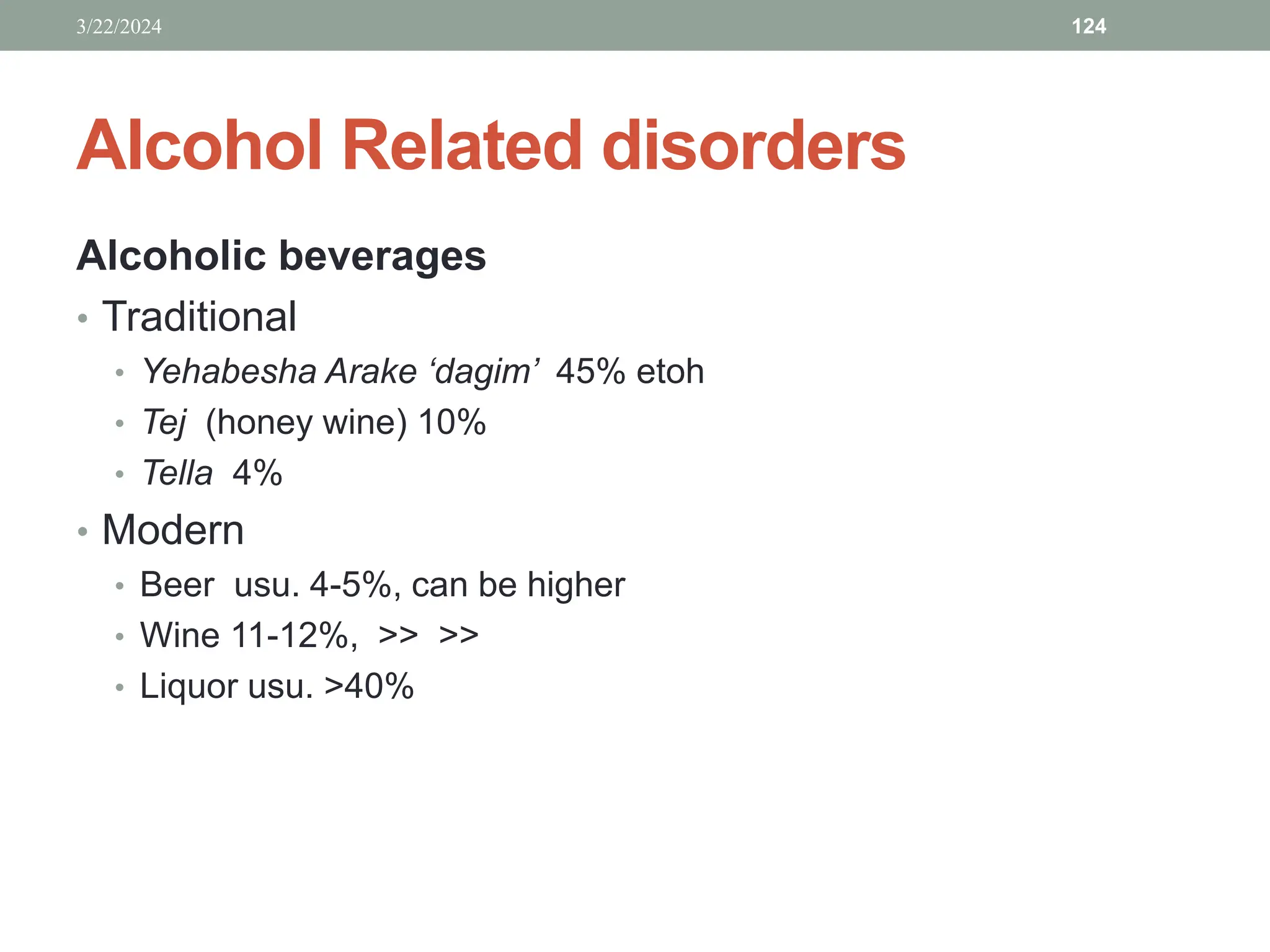
Alcohol Related disorders
Alcoholic beverages
• Traditional
• Yehabesha Arake ‘dagim’ 45% etoh
• Tej (honey wine) 10%
• Tella 4%
• Modern
• Beer usu. 4-5%, can be higher
• Wine 11-12%, >> >>
• Liquor usu. >40%
3/22/2024 124
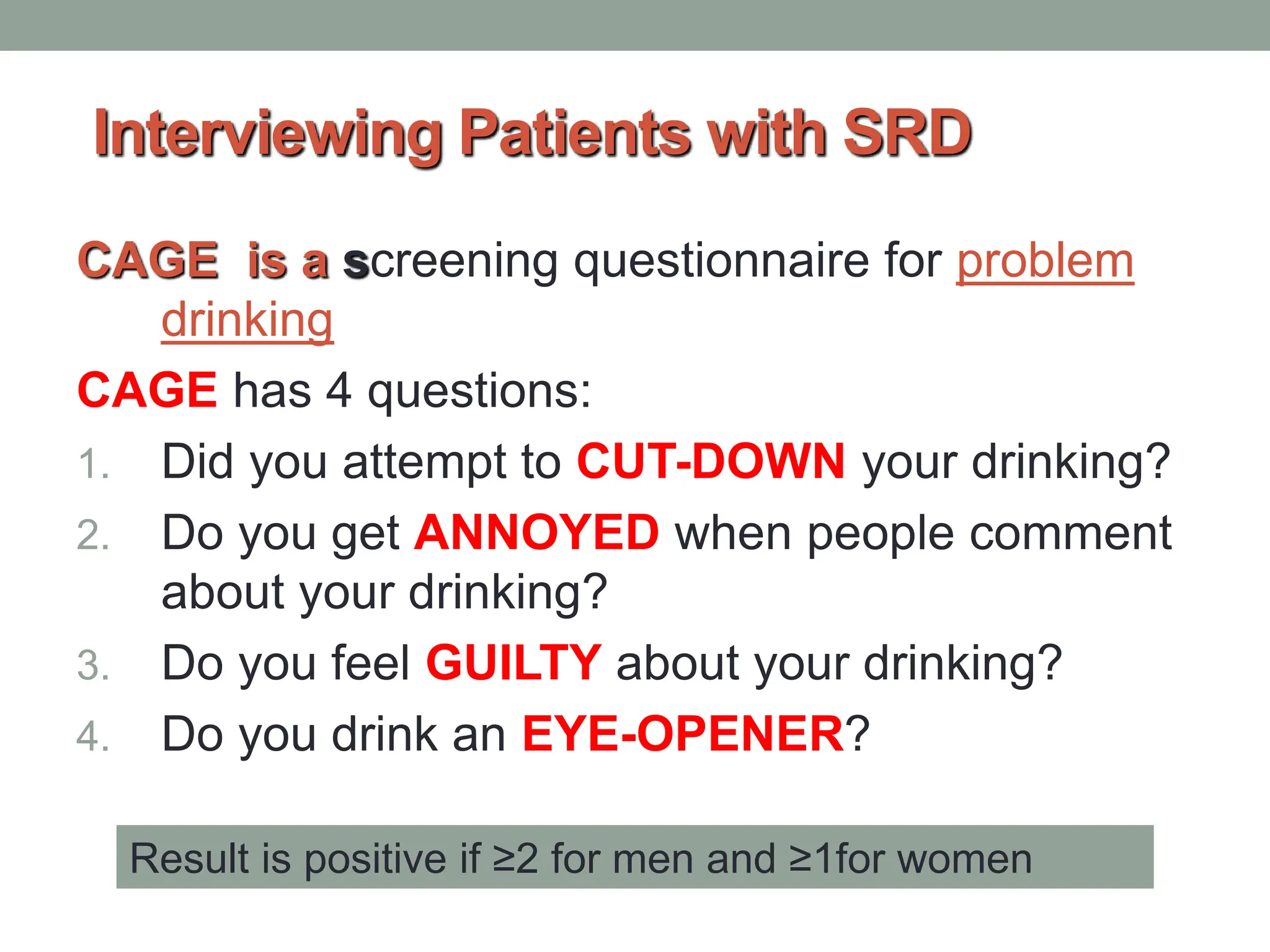
Interviewing Patients with SRD
CAGE is a screening questionnaire for problem
drinking
CAGE has 4 questions:
1. Did you attempt to CUT-DOWN your drinking?
2. Do you get ANNOYED when people comment
about your drinking?
3. Do you feel GUILTY about your drinking?
4. Do you drink an EYE-OPENER?
Result is positive if ≥2 for men and ≥1for women
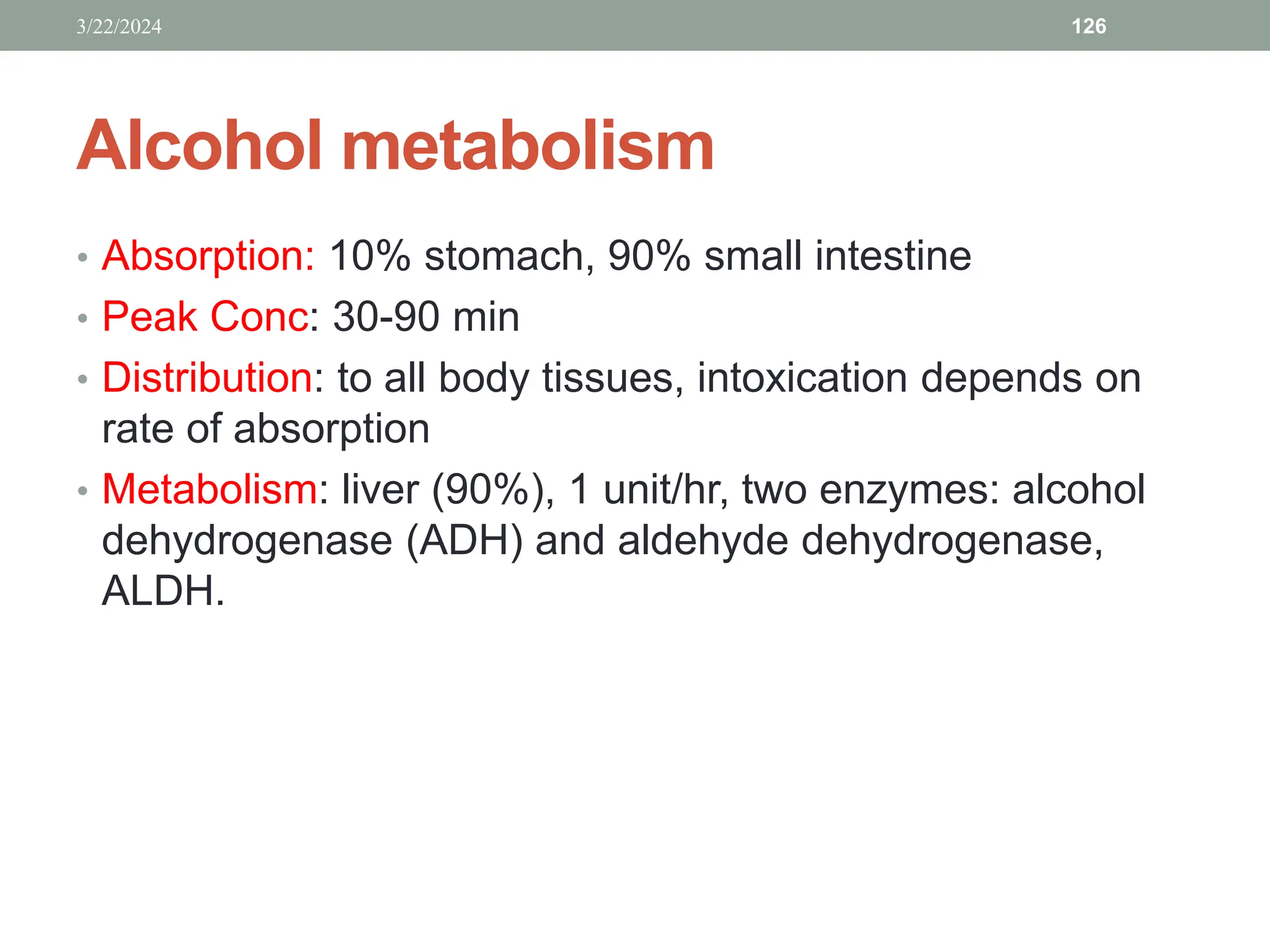
Alcohol metabolism
• Absorption: 10% stomach, 90% small intestine
• Peak Conc: 30-90 min
• Distribution: to all body tissues, intoxication depends on
rate of absorption
• Metabolism: liver (90%), 1 unit/hr, two enzymes: alcohol
dehydrogenase (ADH) and aldehyde dehydrogenase,
ALDH.
3/22/2024 126
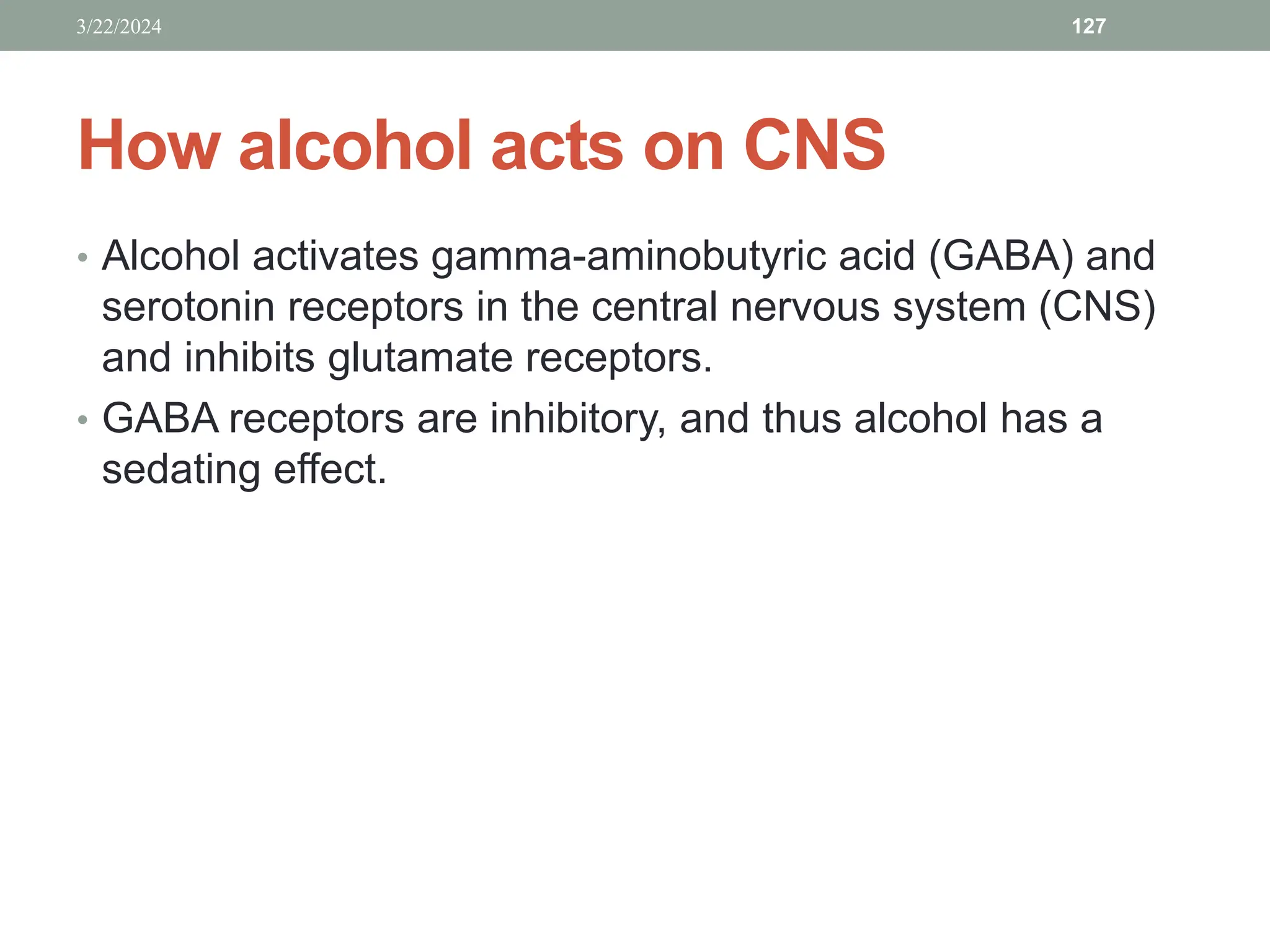
How alcohol acts on CNS
• Alcohol activates gamma-aminobutyric acid (GABA) and
serotonin receptors in the central nervous system (CNS)
and inhibits glutamate receptors.
• GABA receptors are inhibitory, and thus alcohol has a
sedating effect.
3/22/2024 127
• The way alcohol affects people depends on many factors
including:
• age, sex and body weight
• how sensitive one is to alcohol
• the type and amount of food in the stomach
• how much and how often one drinks
• how long one have been drinking
• the environment one is in
• how one expects the alcohol to make one feel and
• whether one has taken any other drug
3/22/2024 128
Alcohol related disorders
• Alcohol Abuse
• Alcohol Dependence
• Alcohol intoxication
• Alcohol withdrawal
• Alcohol intoxication delirium
• Alcohol withdrawal delirium
• Alcohol-induced persisting
dementia
• Alcohol-induced persisting
amnestic disorder
• Alcohol-induced psychotic
disorder, with delusions
• Alcohol-induced psychotic
disorder, with hallucinations
• Alcohol-induced mood
disorder
• Alcohol-induced anxiety
disorder
• Alcohol-induced sexual
dysfunction
• Alcohol-induced sleep
disorder
3/22/2024 129
Alcohol intoxication
≥1 of the following signs, developing during, or shortly
after, alcohol use:
1. slurred speech
2. Incoordination
3. unsteady gait
4. Nystagmus
5. impairment in attention or memory
6. stupor or coma
3/22/2024 130
Relation of blood alcohol level and its
effects (non-alcohol dependent
person)
 0.05% = thought, judgment, and restraint are loosened
and sometimes disrupted
 0.1% =voluntary motor actions usually become
perceptibly clumsy.
 0.2%=the function of the entire motor area of the brain is
measurably depressed, and the parts of the brain that
control emotional behavior are also affected.
 0.3%=a person is commonly confused or may become
stuporous
 0.4 to 0.5% =the person falls into a coma.
3/22/2024 131
Alcohol withdrawal
≥2 of the following, developing within several hrs to a few
days after cessation of (or reduction in) alcohol use
that has been heavy and prolonged :
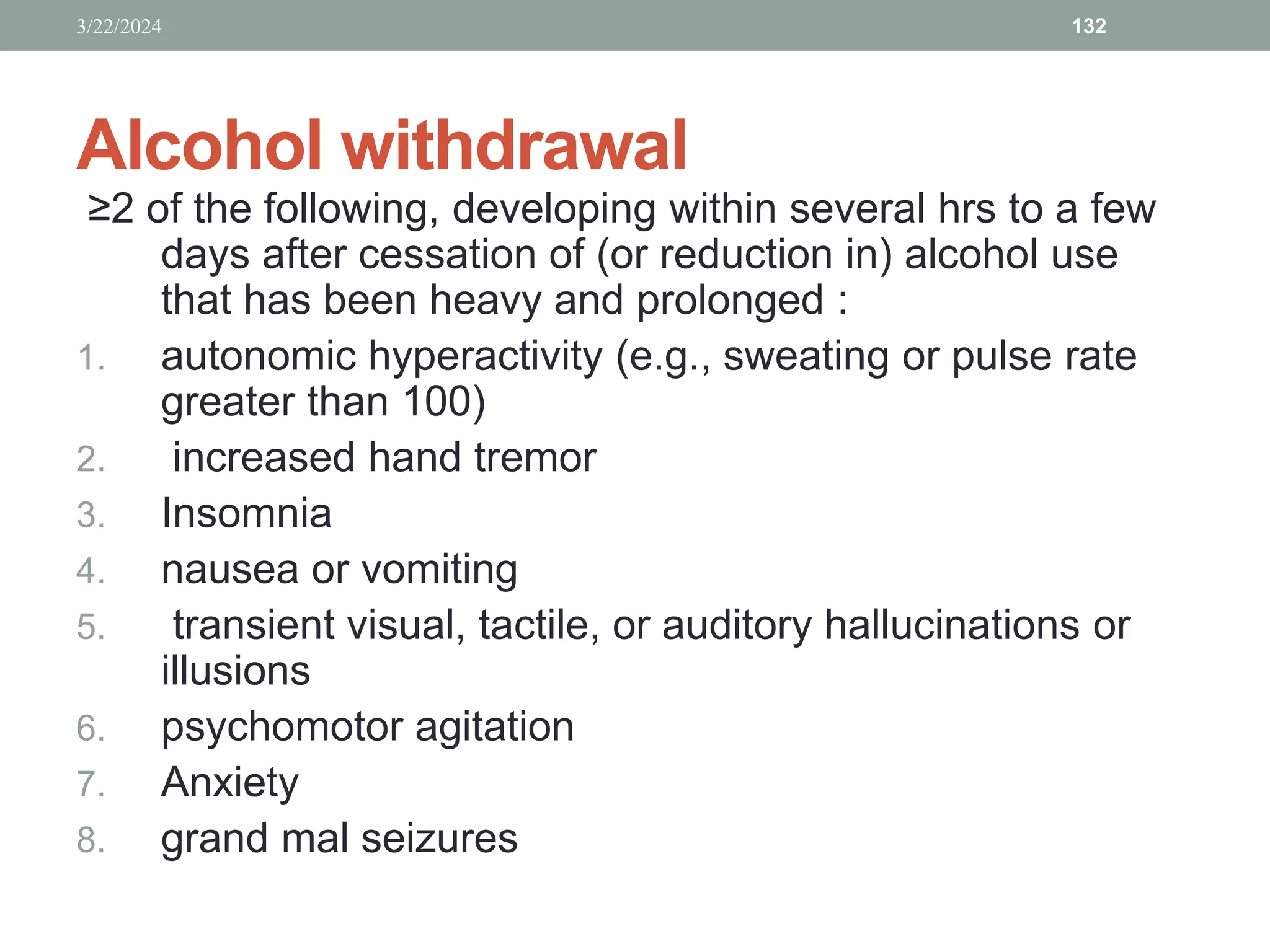
1. autonomic hyperactivity (e.g., sweating or pulse rate
greater than 100)
2. increased hand tremor
3. Insomnia
4. nausea or vomiting
5. transient visual, tactile, or auditory hallucinations or
illusions
6. psychomotor agitation
7. Anxiety
8. grand mal seizures
3/22/2024 132
Alcohol induced delirium
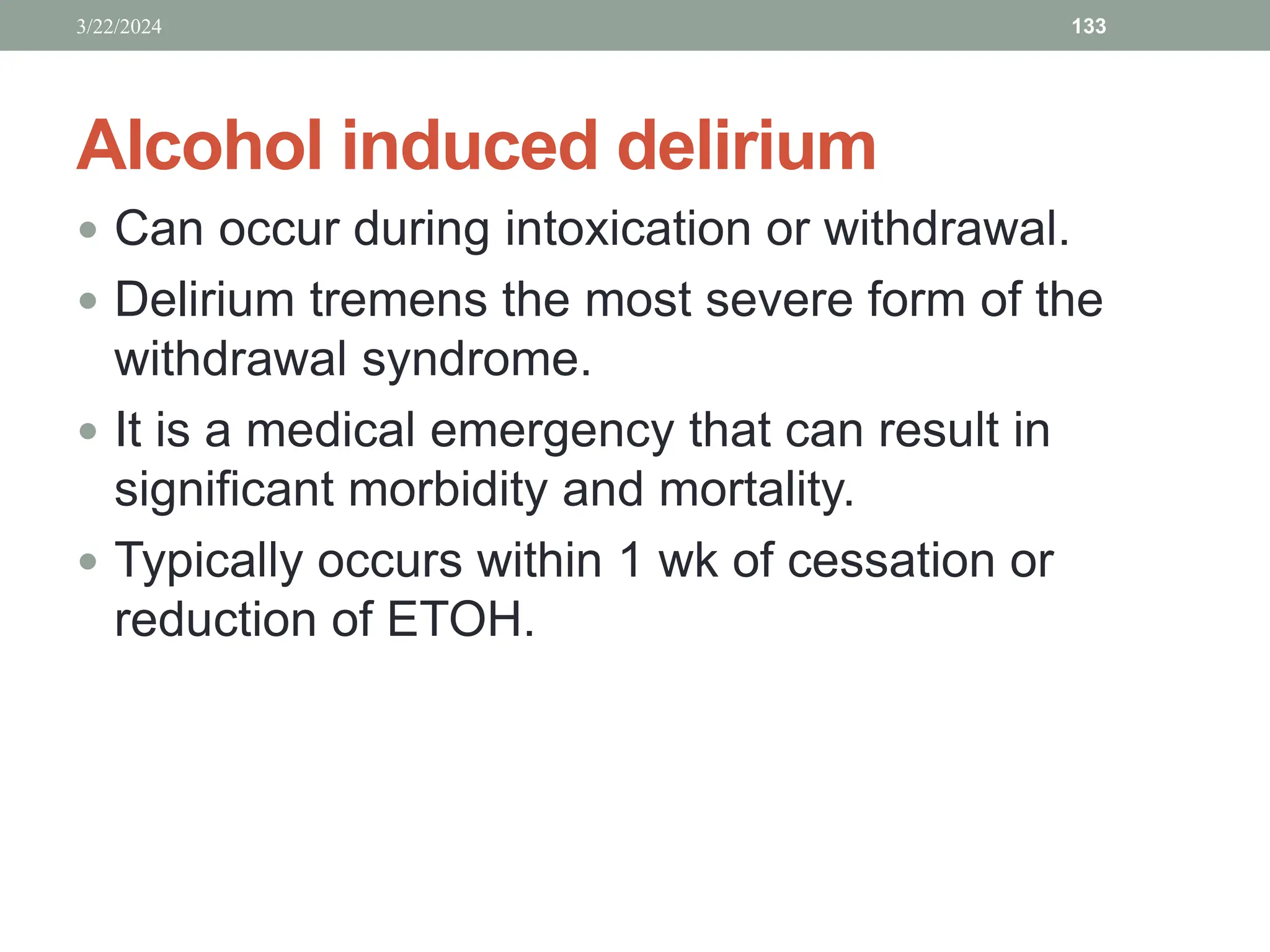
 Can occur during intoxication or withdrawal.
 Delirium tremens the most severe form of the
withdrawal syndrome.
 It is a medical emergency that can result in
significant morbidity and mortality.
 Typically occurs within 1 wk of cessation or
reduction of ETOH.
3/22/2024 133
Diagnostic and lab tests
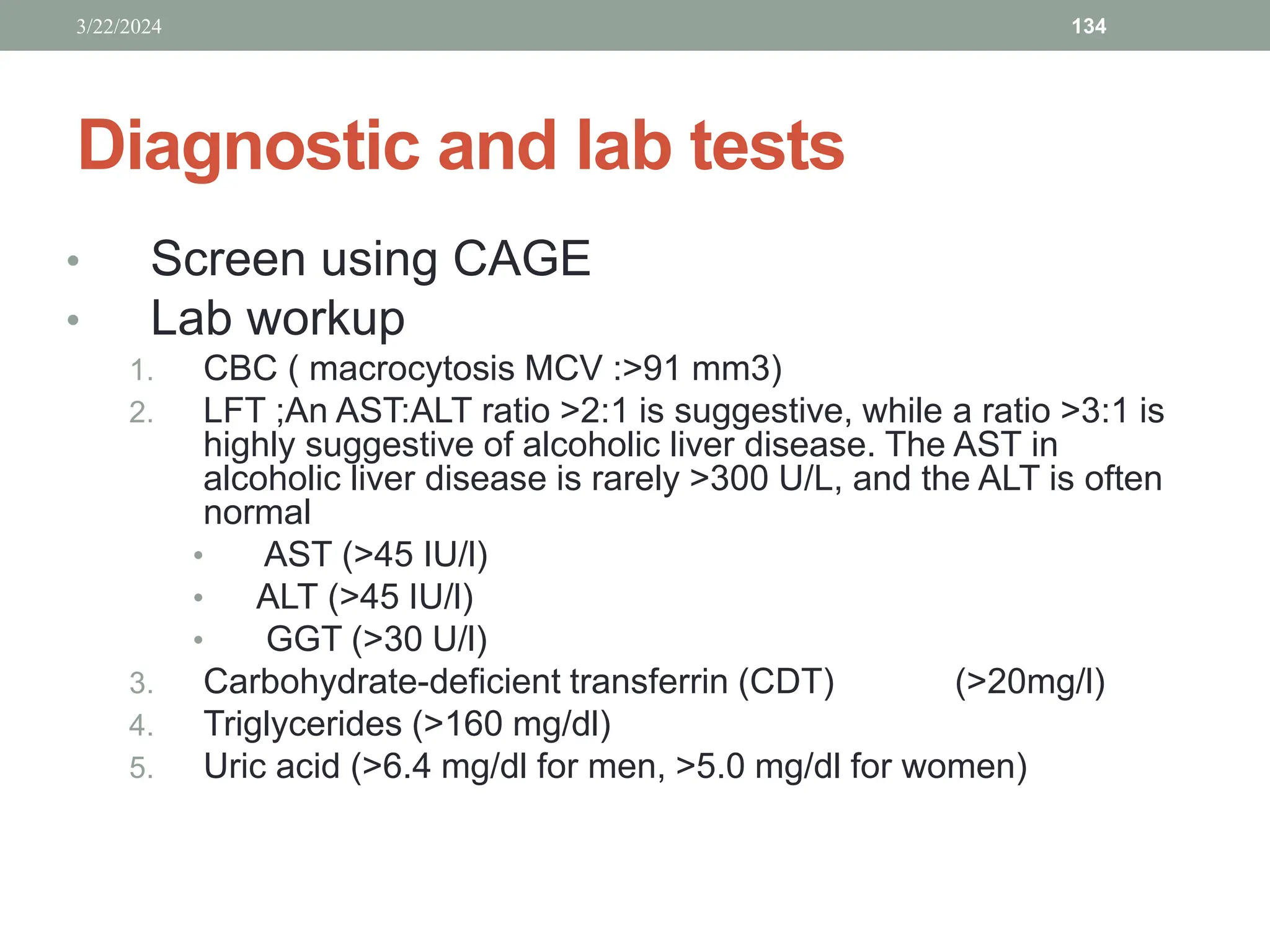
• Screen using CAGE
• Lab workup
1. CBC ( macrocytosis MCV :>91 mm3)
2. LFT ;An AST:ALT ratio >2:1 is suggestive, while a ratio >3:1 is
highly suggestive of alcoholic liver disease. The AST in
alcoholic liver disease is rarely >300 U/L, and the ALT is often
normal
• AST (>45 IU/l)
• ALT (>45 IU/l)
• GGT (>30 U/l)
3. Carbohydrate-deficient transferrin (CDT) (>20mg/l)
4. Triglycerides (>160 mg/dl)
5. Uric acid (>6.4 mg/dl for men, >5.0 mg/dl for women)
3/22/2024 134
Management of alcohol dependence
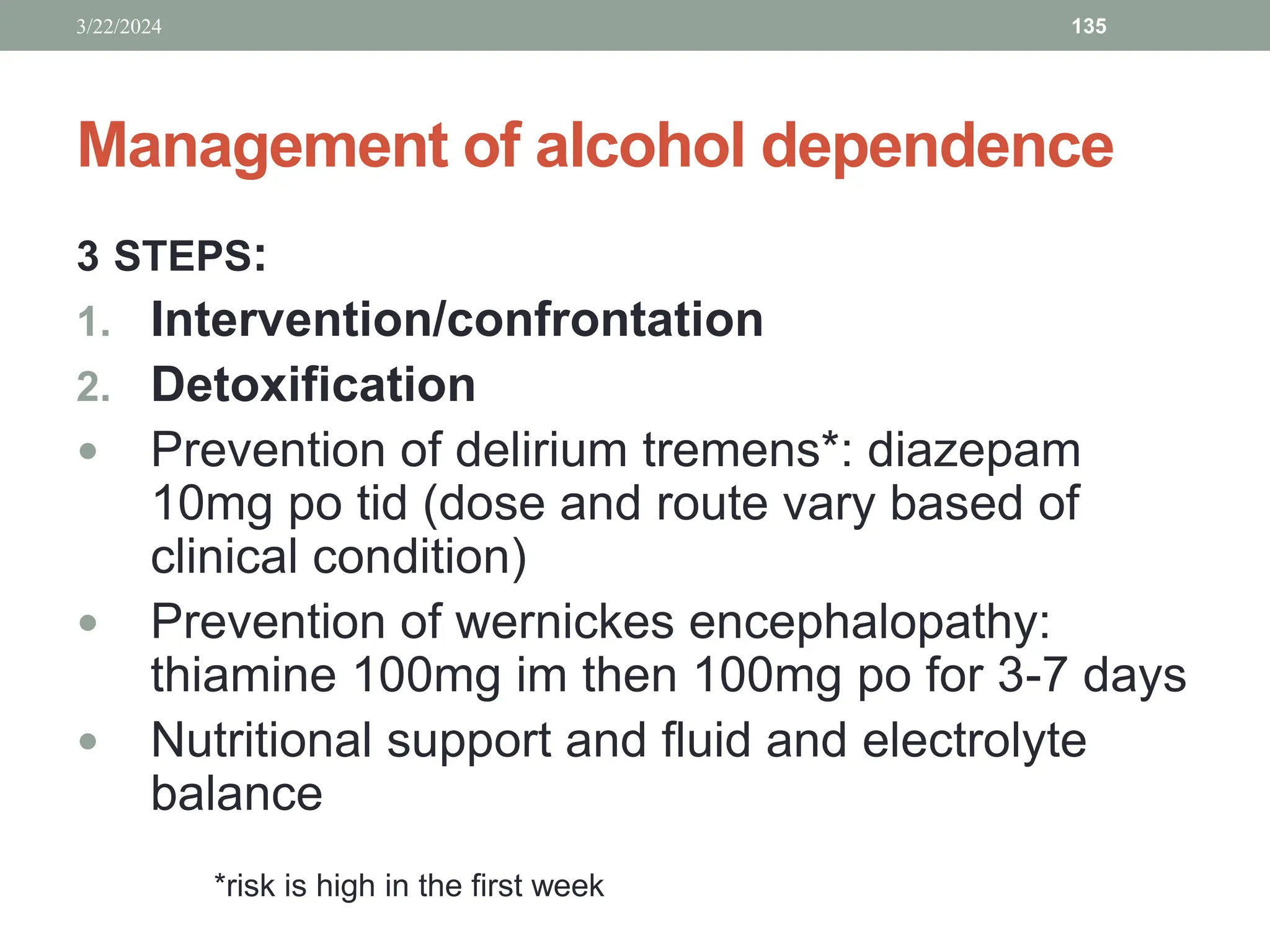
3 STEPS:
1. Intervention/confrontation
2. Detoxification
 Prevention of delirium tremens*: diazepam
10mg po tid (dose and route vary based of
clinical condition)
 Prevention of wernickes encephalopathy:
thiamine 100mg im then 100mg po for 3-7 days
 Nutritional support and fluid and electrolyte
balance
3/22/2024 135
*risk is high in the first week
3. Long term treatment: Rehabilitation
 Aim: abstinence
 Psychotherapy: Motivational Interviewing, Group
therapy, Family Therapy,
 Medication :
 Disulfiram: 250-500mg/d (to be taken 24-48 hrs after the last
drink)
 Naltrexone and acamprosate can also be used.
 ‘Recovery’ is life long!!
3/22/2024 136
Khat
• Khat is the name generally used for Catha edulis.
• The first scientific description of khat as Catha edulis was
in Flora-Aegyptiaco-Arabia by the Swedish botanist Peter
Forskal, who died in Arabia in 1768.
• Grows in Ethiopia, Yemen, Kenya, Tanzania, Uganda and
other countries
3/22/2024 137
Two psychoactive chemicals identified:
1. Cathinone (the most potent found in fresh leaves,
unstable) and
2. Cathine (10 times less potent than cathinone, stable)
• Potency of khat varies with content of cathinone!
3/22/2024 138
Mechanism of Action
• NE-releasing properties
• Inhibit neural uptake of NE
• Decreased DA uptake by nerve terminals
• Increased dopamine efflux
3/22/2024 139
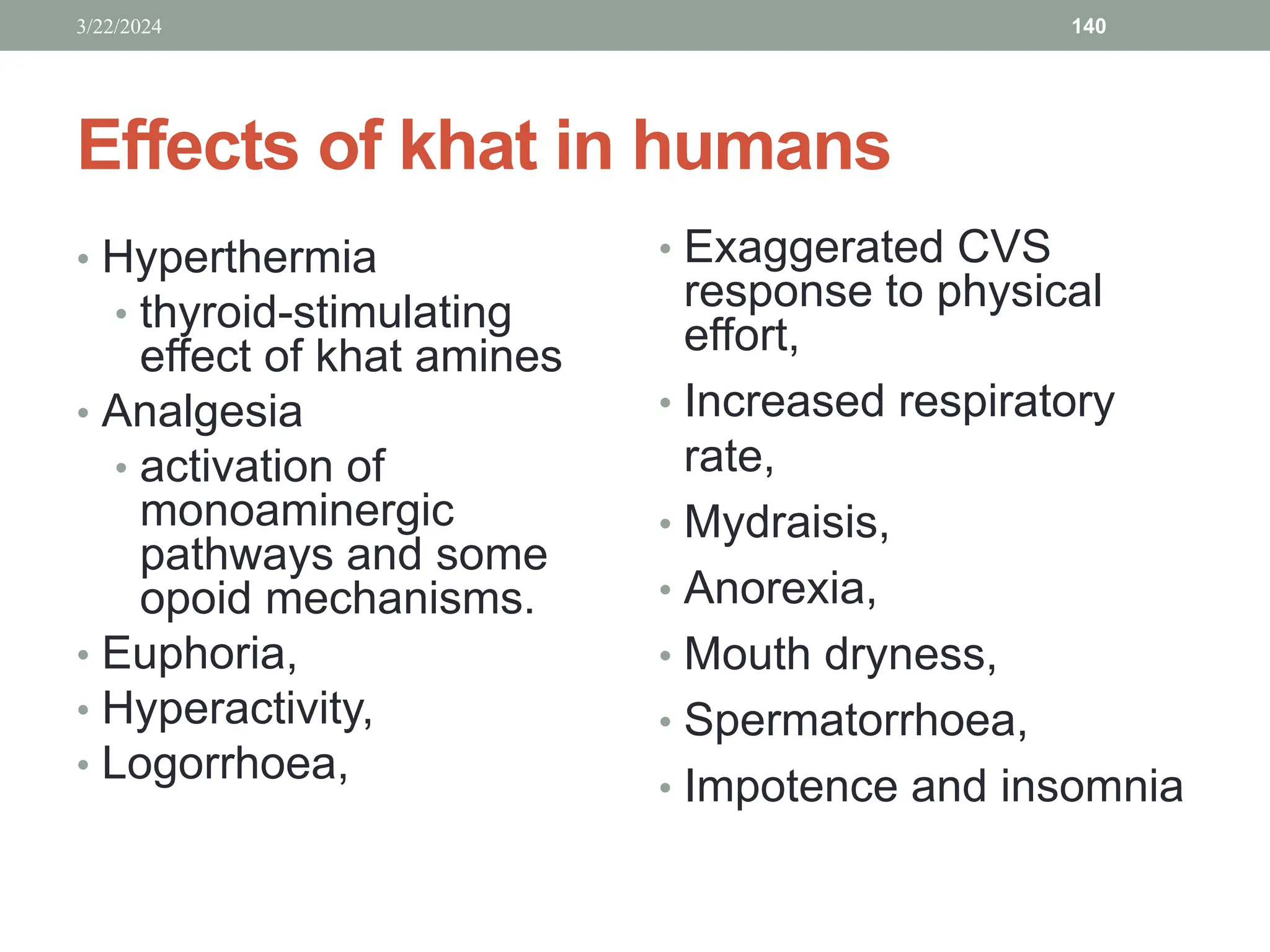
Effects of khat in humans
• Hyperthermia
• thyroid-stimulating
effect of khat amines
• Analgesia
• activation of
monoaminergic
pathways and some
opoid mechanisms.
• Euphoria,
• Hyperactivity,
• Logorrhoea,
• Exaggerated CVS
response to physical
effort,
• Increased respiratory
rate,
• Mydraisis,
• Anorexia,
• Mouth dryness,
• Spermatorrhoea,
• Impotence and insomnia
3/22/2024 140
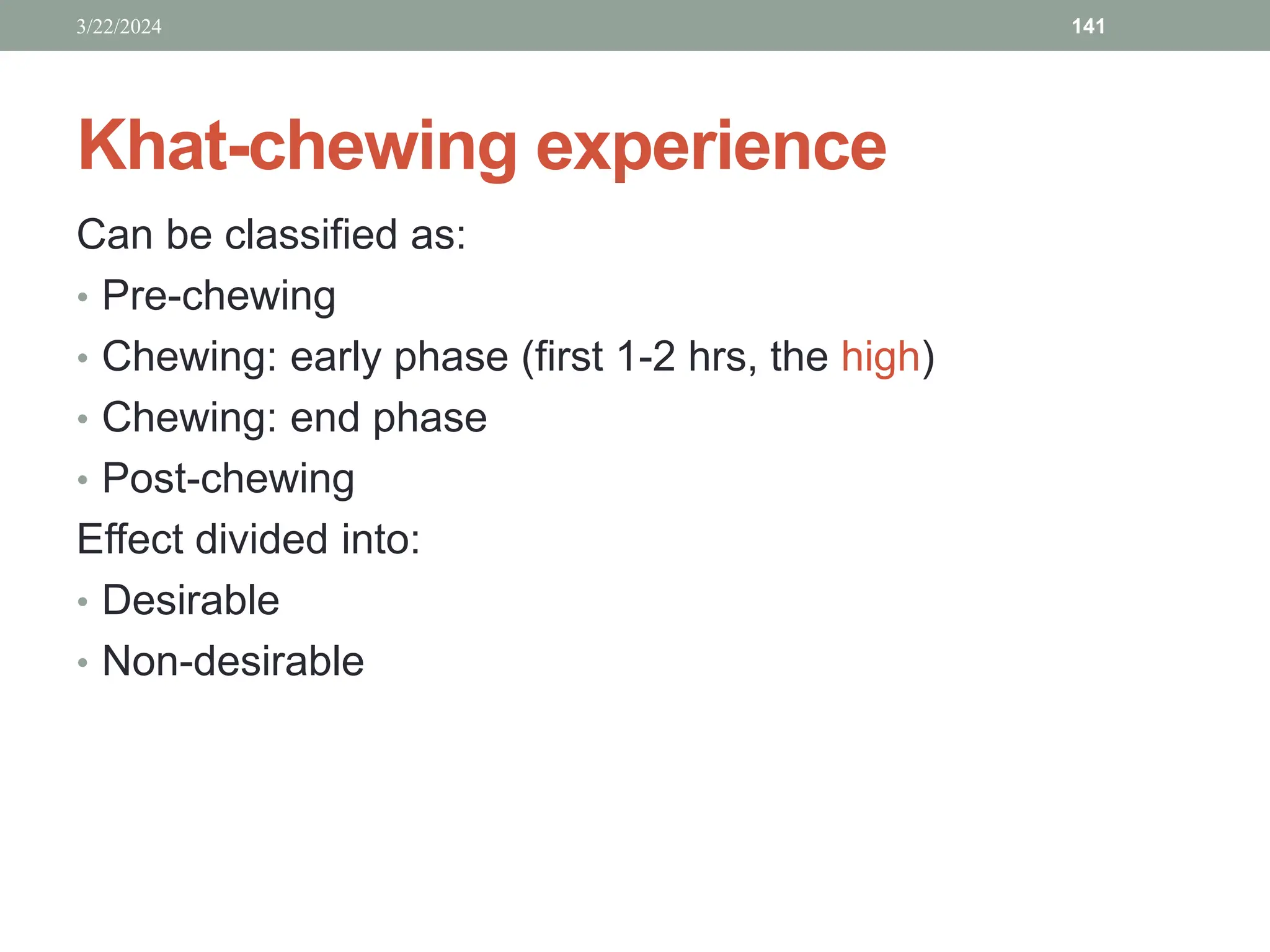
Khat-chewing experience
Can be classified as:
• Pre-chewing
• Chewing: early phase (first 1-2 hrs, the high)
• Chewing: end phase
• Post-chewing
Effect divided into:
• Desirable
• Non-desirable
3/22/2024 141
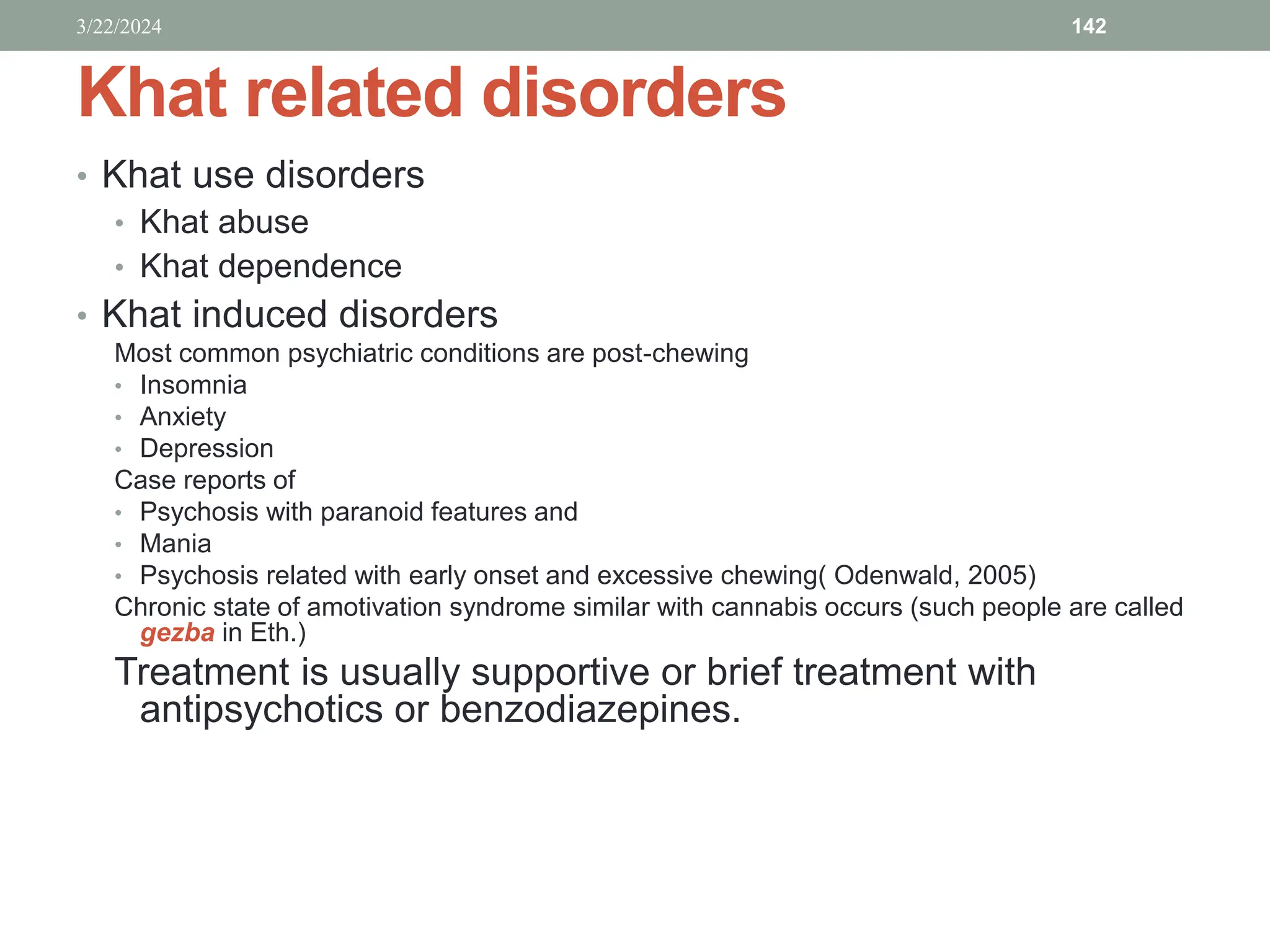
Khat related disorders
• Khat use disorders
• Khat abuse
• Khat dependence
• Khat induced disorders
Most common psychiatric conditions are post-chewing
• Insomnia
• Anxiety
• Depression
Case reports of
• Psychosis with paranoid features and
• Mania
• Psychosis related with early onset and excessive chewing( Odenwald, 2005)
Chronic state of amotivation syndrome similar with cannabis occurs (such people are called
gezba in Eth.)
Treatment is usually supportive or brief treatment with
antipsychotics or benzodiazepines.
3/22/2024 142
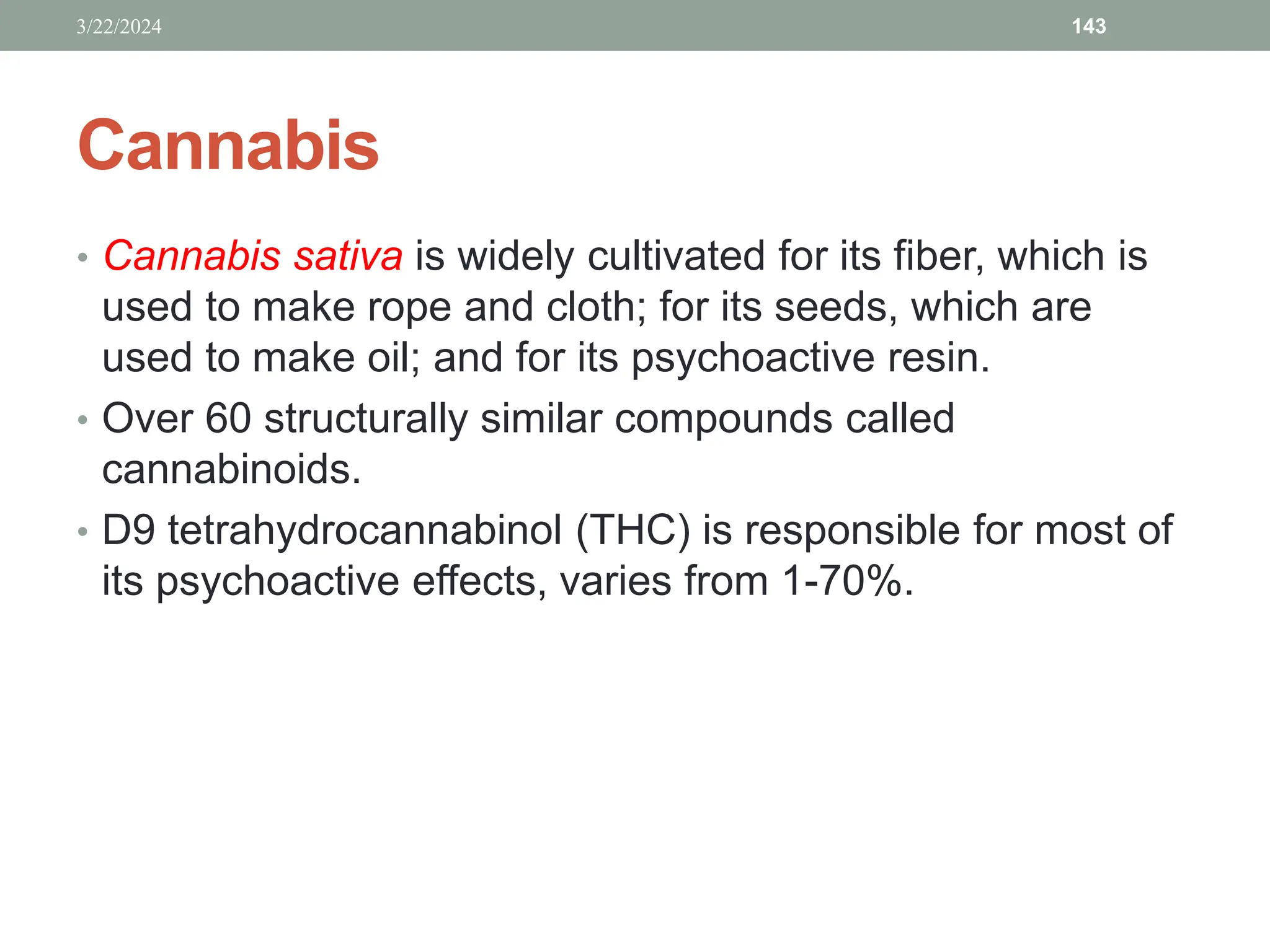
Cannabis
• Cannabis sativa is widely cultivated for its fiber, which is
used to make rope and cloth; for its seeds, which are
used to make oil; and for its psychoactive resin.
• Over 60 structurally similar compounds called
cannabinoids.
• D9 tetrahydrocannabinol (THC) is responsible for most of
its psychoactive effects, varies from 1-70%.
3/22/2024 143
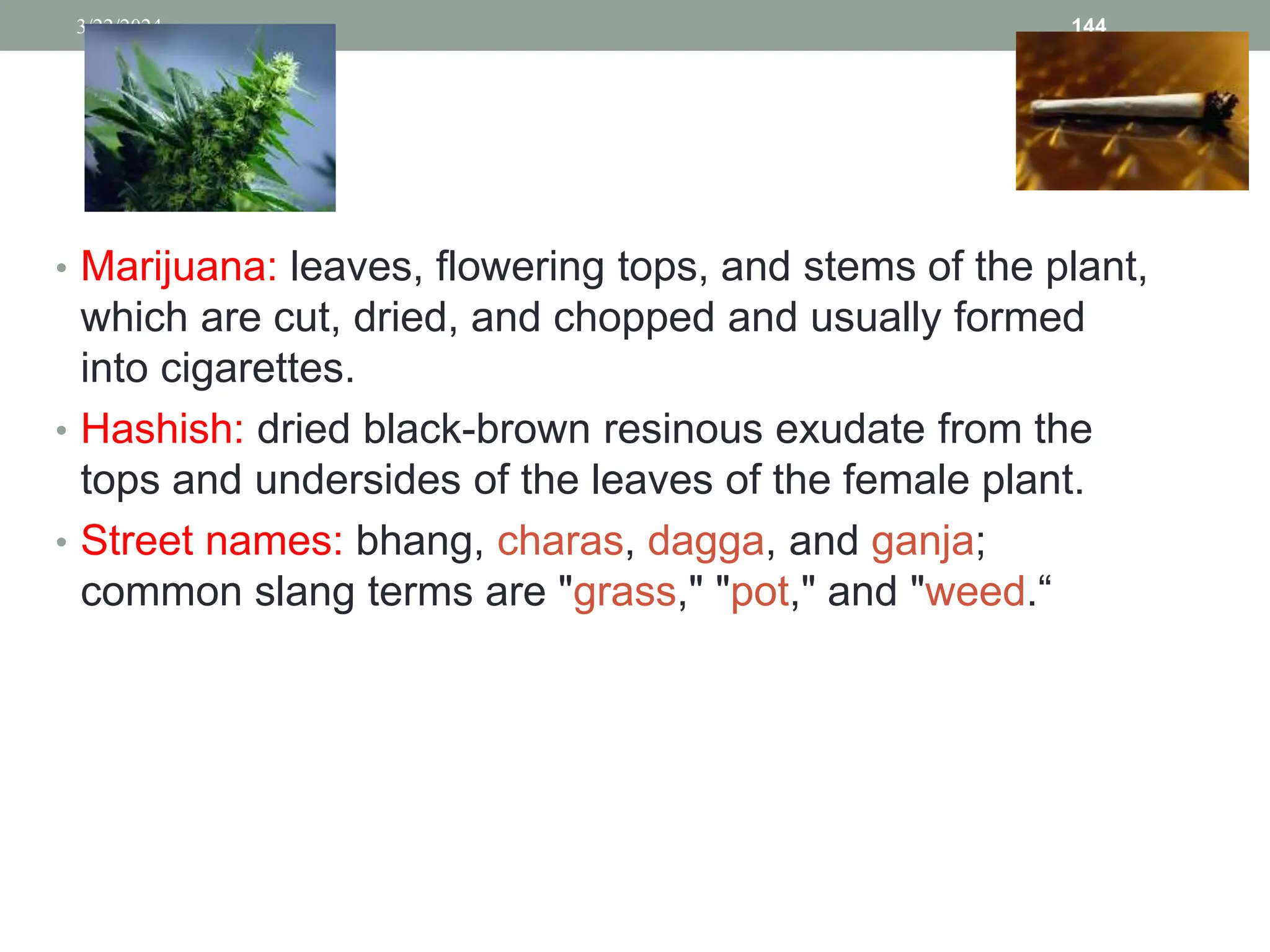
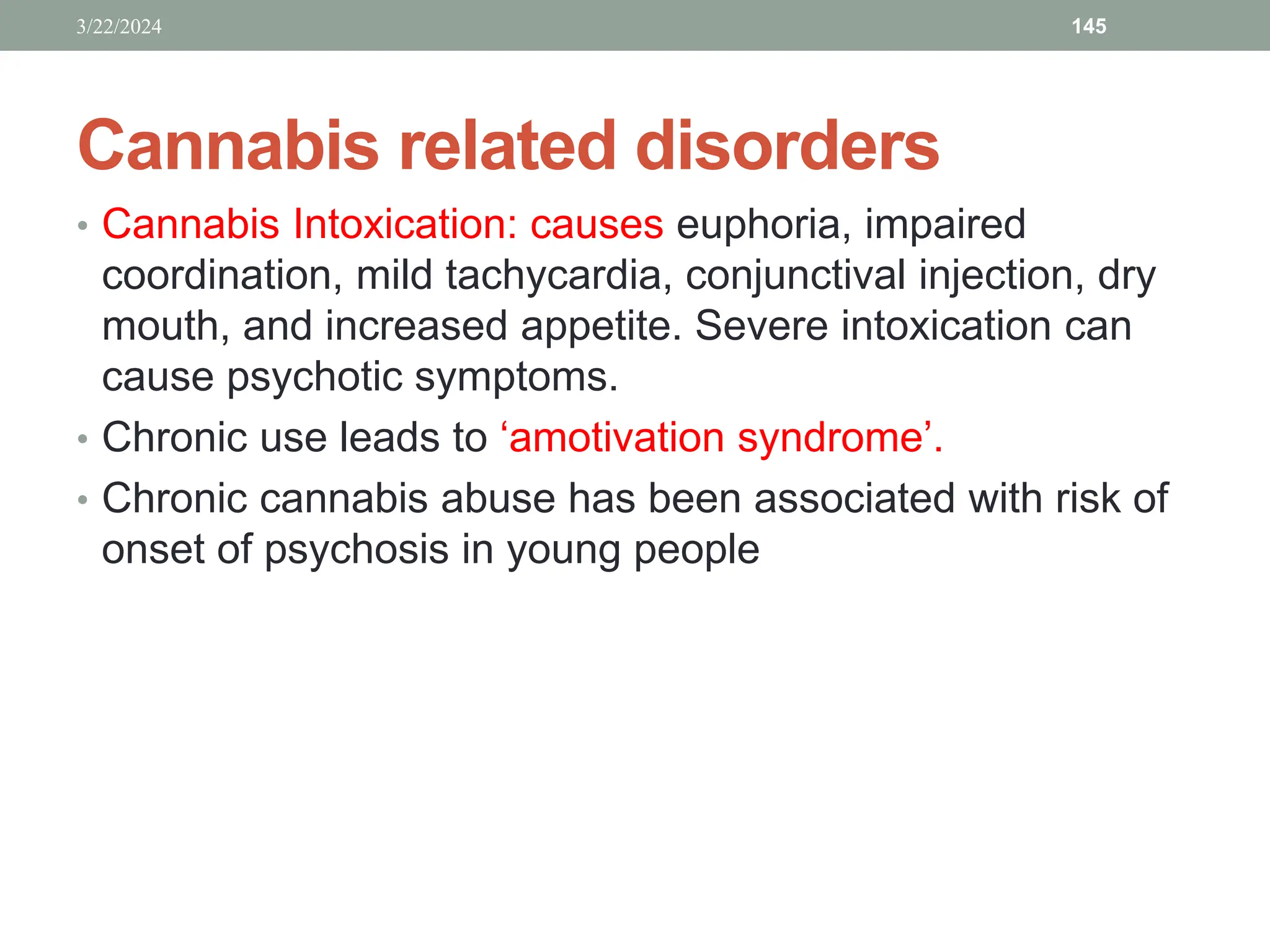
• Marijuana: leaves, flowering tops, and stems of the plant,
which are cut, dried, and chopped and usually formed
into cigarettes.
• Hashish: dried black-brown resinous exudate from the
tops and undersides of the leaves of the female plant.
• Street names: bhang, charas, dagga, and ganja;
common slang terms are "grass," "pot," and "weed.“
3/22/2024 144
Cannabis related disorders
• Cannabis Intoxication: causes euphoria, impaired
coordination, mild tachycardia, conjunctival injection, dry
mouth, and increased appetite. Severe intoxication can
cause psychotic symptoms.
• Chronic use leads to ‘amotivation syndrome’.
• Chronic cannabis abuse has been associated with risk of
onset of psychosis in young people
3/22/2024 145
Management
• Urine drug screen is positive for up to 4 weeks in heavy
users (released from adipose stores).
• Treatment of cannabis intoxication is supportive i.e.
• Antianxiety medications can be used in certain cases where short
term relief of withdrawal symptoms.
• Treatment of intoxication involves additional treatment with
benzodiazepine ( e.g. diazepam 10mg) may be helpful.
3/22/2024 146
Opiates
• The word “opiate” and “opioid” came from the word
“opium,” the juice of the opium poppy, papaver
somniferum, contains 20 opium alkaloids including
morphine.
• Opiates are grown in the middle east and far east.
• Some of the opiates which are synthesized from natural
opiates are heroin, codeine, and hydromorphone.
3/22/2024 147
Opiates and the brain
• Opiates act on a variety of receptors and the three
subtypes are: mu, delta, and kappa receptors.
• The brain has its own endogenous opiates:
• They are peptides derived from precursor
proteins called pro-opiomelanocortin
(POMC), Proenkephalin, and
prodynorphin.
• Exogenous opiates (heroin, morphine, codeine) act as
agonists at opiate receptors.
3/22/2024 148
Opioid intoxication
• At and above pain reliving doses, the opiate induce:
• euphoria “rush” (main reinforcing property)
• followed by a profound sense of disterbance,
• followed in turn by drowsiness (“nodding”), mood swings, mental
clouding, apathy, and slowed motor movements.
• In overdose, it can induce:
• respiratory depression,
• coma,
• hypothermia,
• hypotension & bradycardia.
• Always recognize the clinical triad: coma, pinpoint pupils (pethidine
causes dilation) and respiratory depression in order to diagnose opiate
overdose.
• Also look for needle tracks in the arms, legs, ankles, groin, and
even the dorsal vein of the penis.
3/22/2024 149
Heroin, Pethidine and Morphine:
commonly abused injectable opioids
3/22/2024 150
3/22/2024 151
Opioid dependence
• When given chronically, opiates cause both
tolerance and dependence.
• The withdrawal syndrome is characterized by
• a feeling of dysphoria,
• craving,
• irritability,
• signs of autonomic hyperactivity (tachycardia, tremor
and sweating). Piloerection (“goose bumps”) is often
associated when it is stopped suddenly (“cold turkey”).
• The major risk in heroin abuse is HIV and other
blood-borne infections!!!
3/22/2024 152
Comorbidity with other psychiatric
disorders
• About 90% have additional psychiatric problem
• MDD,
• Alcohol related disorder,
• Anxiety disorder and
• Anti-social personality disorder.
3/22/2024 153
Treatment of opioid dependence
• The core treatment of opioid use is the encouragement of
abstinence.
• Opiate antagonist (naloxone & naltrexone) can be used
for acute intoxication.
• Methadone treatment is used in the developed countries.
It is a synthetic opioid which is taken orally in place of
heroin or other opioids.
3/22/2024 154
Sedative Hypnotic Anxiolytic-Related
Disorders
Agents classified in this section are the following:
1. Benzodiazepines
2. Barbiturates
3. Miscellaneous sedative-hypnotic drugs with limited
clinical use ( such as chloral hydrate, propophol…).
3/22/2024 155
• In the practice of both psychiatry and addiction
medicine, the drugs that are most important
clinically are the benzodiazepines causing
dependence.
• They are abused quite often by health
professionals and the community at large
• Benzodiazepines include:
• Diazepam,
• Bromazepam,
• Clonezepam…
3/22/2024 156
Benzodiazepine and barbiturate
intoxication
• BZ intoxication can lead to behavioral disinhibition →
hostile and aggressive behavior.
• Effect enhanced by concomitant alcohol intake.
• Barbiturate intoxication resembles alcohol intoxication,
can be lethal
• BZ have wider safety margin than barbiturates.
3/22/2024 157
Ttreatment of Sedative Hypnotic and
Anxiolytic Related Disorders
Withdrawal:
• Aim is to prevent withdrawal seizure
• Taper gradually
• Replacement with other anticonvulsant such as
Carbamazepine
Overdose:
• Gastric lavage
• Activated charcoal
• Monitor V/S
• Establish IV line
3/22/2024 158
PERSONALITY DISORDERS
Personality: definitions
“…a relatively enduring pattern of thinking or behaviour
exhibited in a wide range of social and personal contexts.”
(Andreasen 1991)
“the manner of thinking, behaving or reacting that is
characteristic of the individual” (Morris 1976)
General Characteristics of Personality Disorders
• Personality traits consist of enduring patterns of
perceiving, relating to, and thinking about the
environment, other people and oneself.
• A personality disorder is diagnosed when
personality traits become inflexible, pervasive and
maladaptive to the point where they cause
significant social or occupational dysfunction or
subjective distress.
• Patients usually have little or no insight into their
disorder.
• Personality patterns must be stable and date back
to adolescence or early adulthood.
• Therefore, personality disorders are not generally
diagnosed in children.
• Patterns of behavior and perception cannot be
caused by stress, another mental disorder, drug or
medication effect, or a medical condition.
DSM-IV General criteria for personality
disorder
A. Enduring pattern of inner experience and behavior that
deviates markedly from cultural expectations.
Manifested in two or more of the following areas:
1) Cognition
2) Affectivity
3) Interpersonal functioning
4) Impulse control
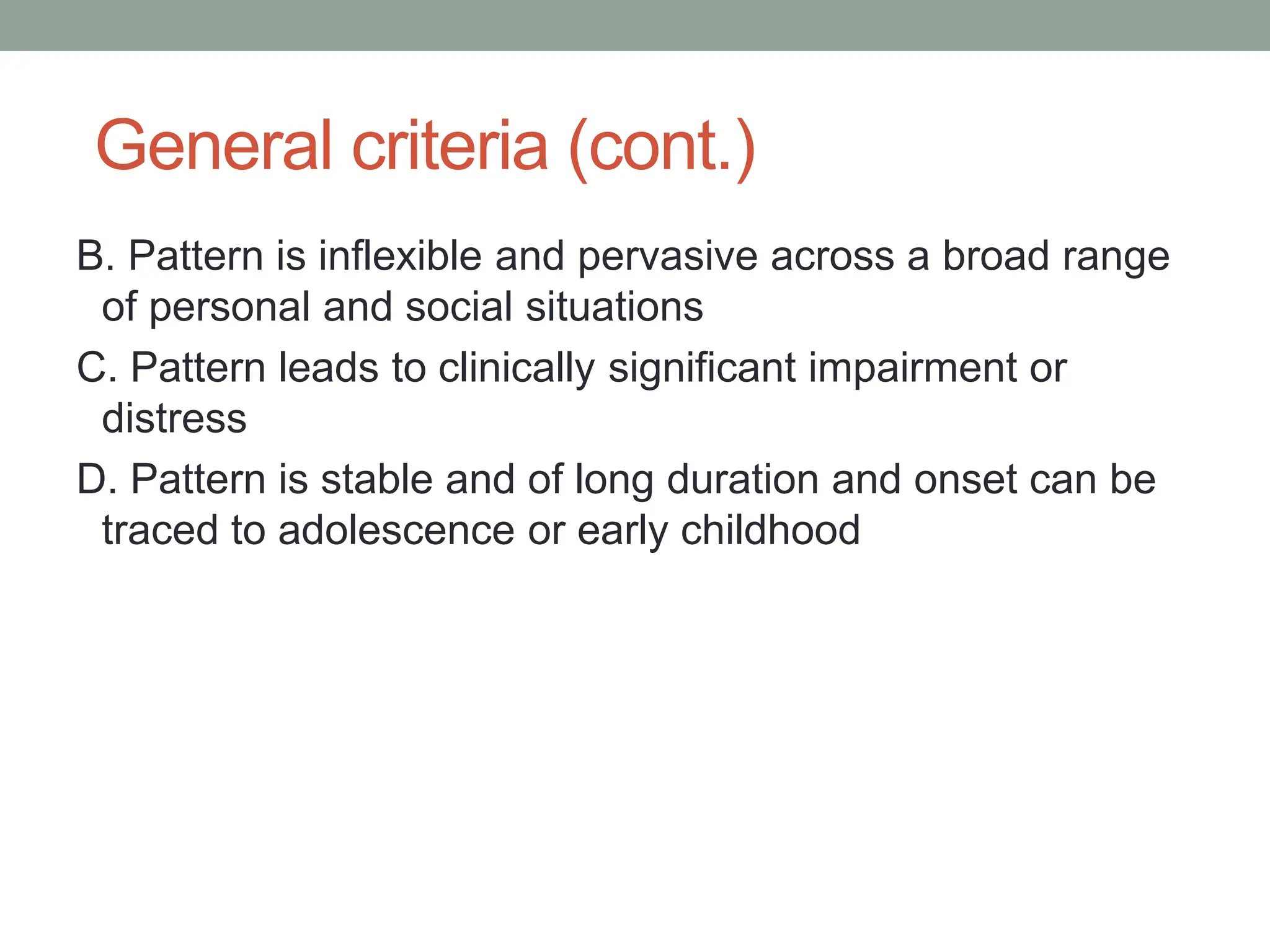
General criteria (cont.)
B. Pattern is inflexible and pervasive across a broad range
of personal and social situations
C. Pattern leads to clinically significant impairment or
distress
D. Pattern is stable and of long duration and onset can be
traced to adolescence or early childhood
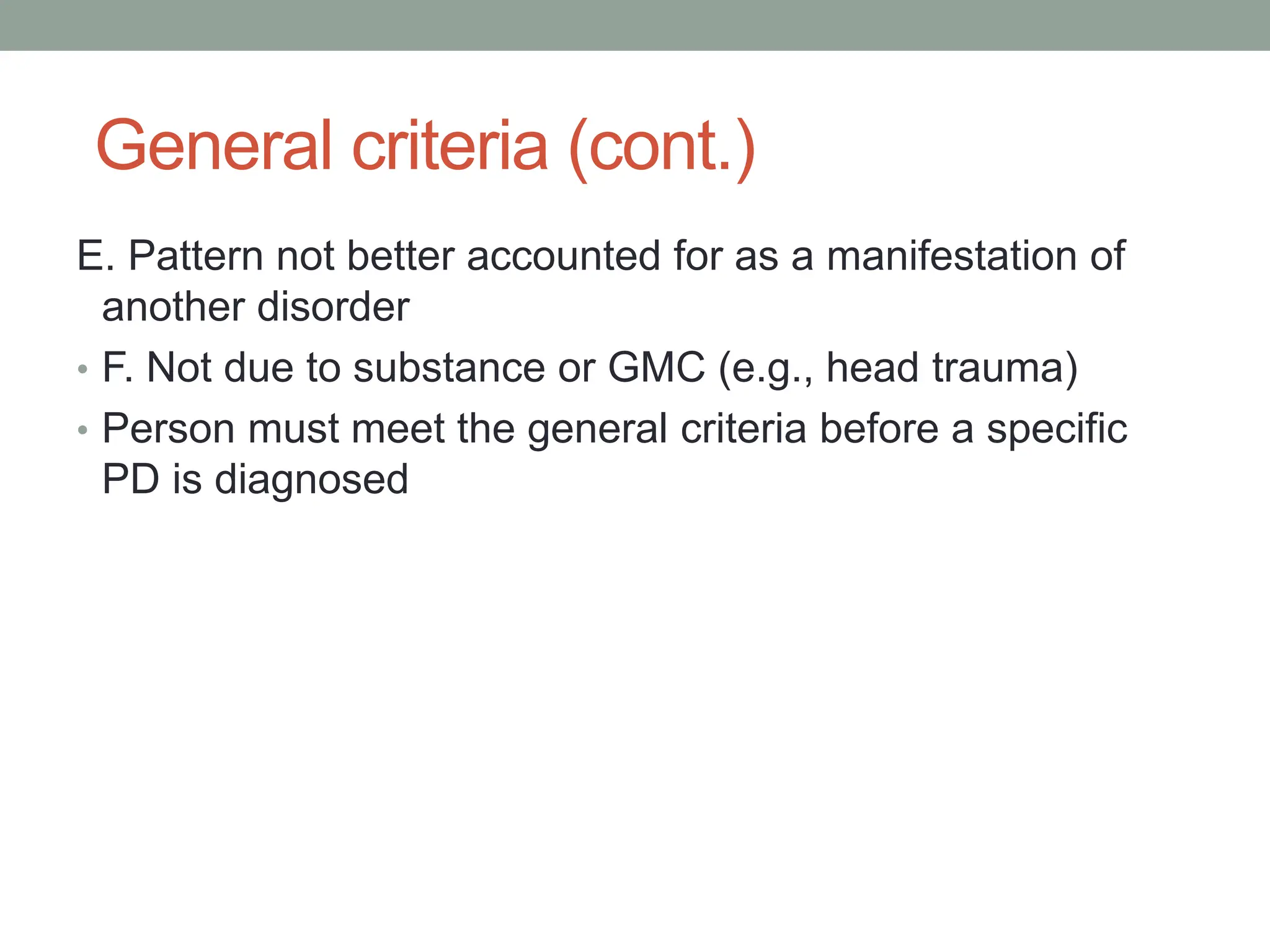
General criteria (cont.)
E. Pattern not better accounted for as a manifestation of
another disorder
• F. Not due to substance or GMC (e.g., head trauma)
• Person must meet the general criteria before a specific
PD is diagnosed
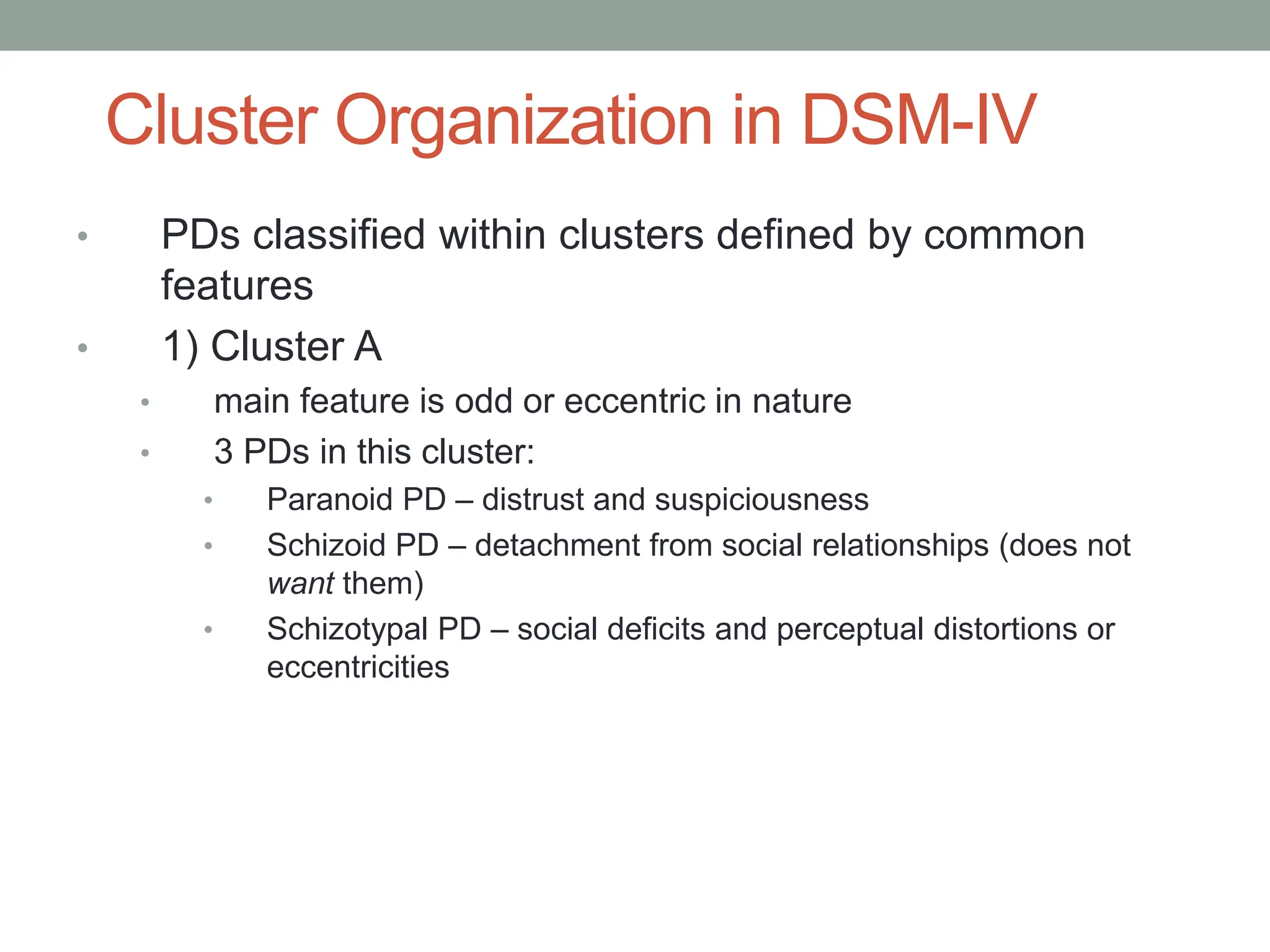
Cluster Organization in DSM-IV
• PDs classified within clusters defined by common
features
• 1) Cluster A
• main feature is odd or eccentric in nature
• 3 PDs in this cluster:
• Paranoid PD – distrust and suspiciousness
• Schizoid PD – detachment from social relationships (does not
want them)
• Schizotypal PD – social deficits and perceptual distortions or
eccentricities
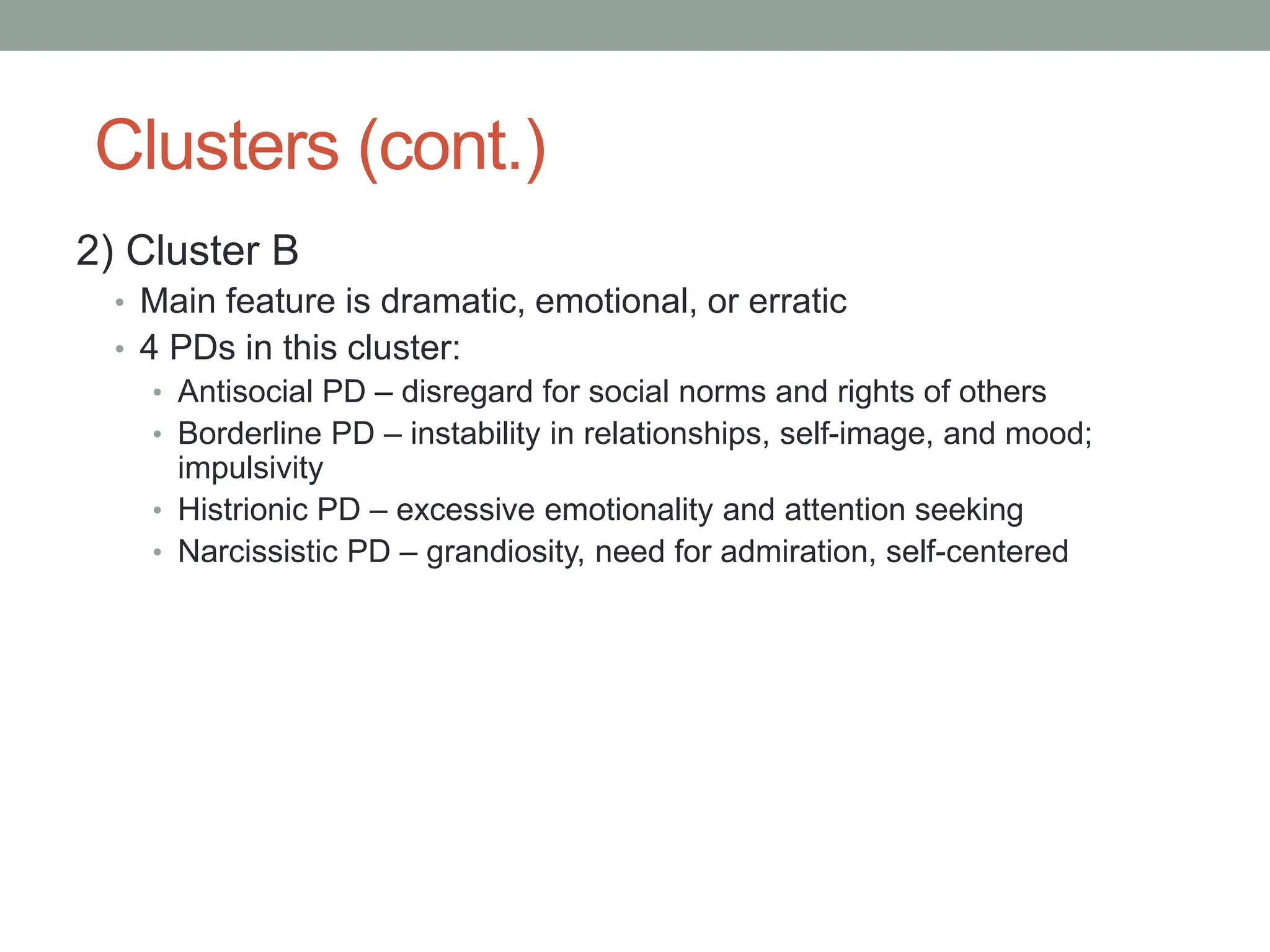
Clusters (cont.)
2) Cluster B
• Main feature is dramatic, emotional, or erratic
• 4 PDs in this cluster:
• Antisocial PD – disregard for social norms and rights of others
• Borderline PD – instability in relationships, self-image, and mood;
impulsivity
• Histrionic PD – excessive emotionality and attention seeking
• Narcissistic PD – grandiosity, need for admiration, self-centered
Clusters (cont.)
3) Cluster C
• Main feature involves anxiety or fearfulness
• 3 PDs in this cluster:
• Dependent PD – submissive, need to be taken care of
• Avoidant PD – social inhibition and inadequacy
• Obssessive-compulsive PD – orderliness, perfectionism, need to control
things
1. Paranoid Personality Disorder
DSM-IV Diagnostic Criteria of Paranoid
Personality Disorder
A. A pervasive distrust and suspiciousness of others
is present without justification, beginning by early
adulthood, and is manifested by at least four of the
following:
1. The patient suspects others are exploiting,
harming, or deceiving him.
2. The patient doubts the loyalty or trustworthiness of
others.
3. The patient fears that information given to others will
be used maliciously against him.
4. Benign remarks by others or benign events are
interpreted as having demeaning or threatening
meanings.
5. The patient persistently bears grudges.
6. The patient perceives attacks that are not apparent
to others, and is quick to react angrily or to
counterattack.
7. The patient repeatedly questions the fidelity of his
spouse or sexual partner.
Treatment of Paranoid Personality
Disorder
• Psychotherapy is the treatment of choice for PPD,
but establishing and maintaining the trust of
patients may be difficult because these patients
have great difficulty tolerating intimacy.
• Symptoms of anxiety and agitation may be severe
enough to warrant treatment with antianxiety
agents.
• Low doses of antipsychotics are useful for
delusional accusations and agitation.
2. Schizoid Personality Disorder
DSM-IV Diagnostic Criteria for Schizoid Personality Disorder
A. A pervasive pattern of social detachment with restricted affect,
beginning by early adulthood and indicated by at least four of the
following:
1. The patient neither desires nor enjoys close relationships, including
family relationships.
2. The patient chooses solitary activities.
3. The patient has little interest in having sexual experiences.
4. The patient takes pleasure in few activities.
5. The patient has no close friends or confidants except first-degree
relatives.
6. The patient is indifferent to the praise or criticism of others.
7. The patient displays emotional detachment or diminished affective
responsiveness.
Treatment of Schizoid Personality Disorder
• Individual psychotherapy is the treatment of choice.
Group therapy is not recommended because other
patients will find the patient's silence difficult to
tolerate.
• The use of antidepressants, antipsychotics and
psychostimulants has been described without
consistent results.
3. Schizotypal Personality Disorder
DSM-IV Diagnostic Criteria
A. A pervasive pattern of discomfort with and reduced capacity
for close relationships as well as perceptual distortions and
eccentricities of behavior, beginning by early adulthood.
At least five of the following should be present:
1. Ideas of reference: interpreting unrelated events as having
direct reference to the patient (e.g., belief that a television
program is really about him).
2. Odd beliefs or magical thinking inconsistent with cultural
norms.( telepathy or a “sixth sense”).
3. Unusual perceptual experiences, including bodily illusions.
4. Odd thinking and speech (e.g., circumstantial, metaphorical,
or stereotyped thinking).
5. Suspiciousness or paranoid ideation.
6. Inappropriate or constricted affect.
7. Behavior or appearance that is odd, eccentric or peculiar.
8. Lack of close friends other than first-degree relatives.
9. Excessive social anxiety that does not diminish with familiarity.
Treatment of Schizotypal Personality
Disorder
• Psychotherapy is the treatment of choice for
schizotypal personality disorder.
• Antipsychotics may be helpful in dealing with low-
grade psychotic symptoms or paranoid delusions.
• Antidepressants may be useful if the patient also
meets criteria for a mood disorder.
Cluster B Personality
Disorders
• Antisocial, borderline, histrionic and narcissistic
personality disorders are referred to as cluster B
personality disorders.
• These disorders are characterized by dramatic or
irrational behavior.
• These patients tend to be very disruptive in clinical
settings.
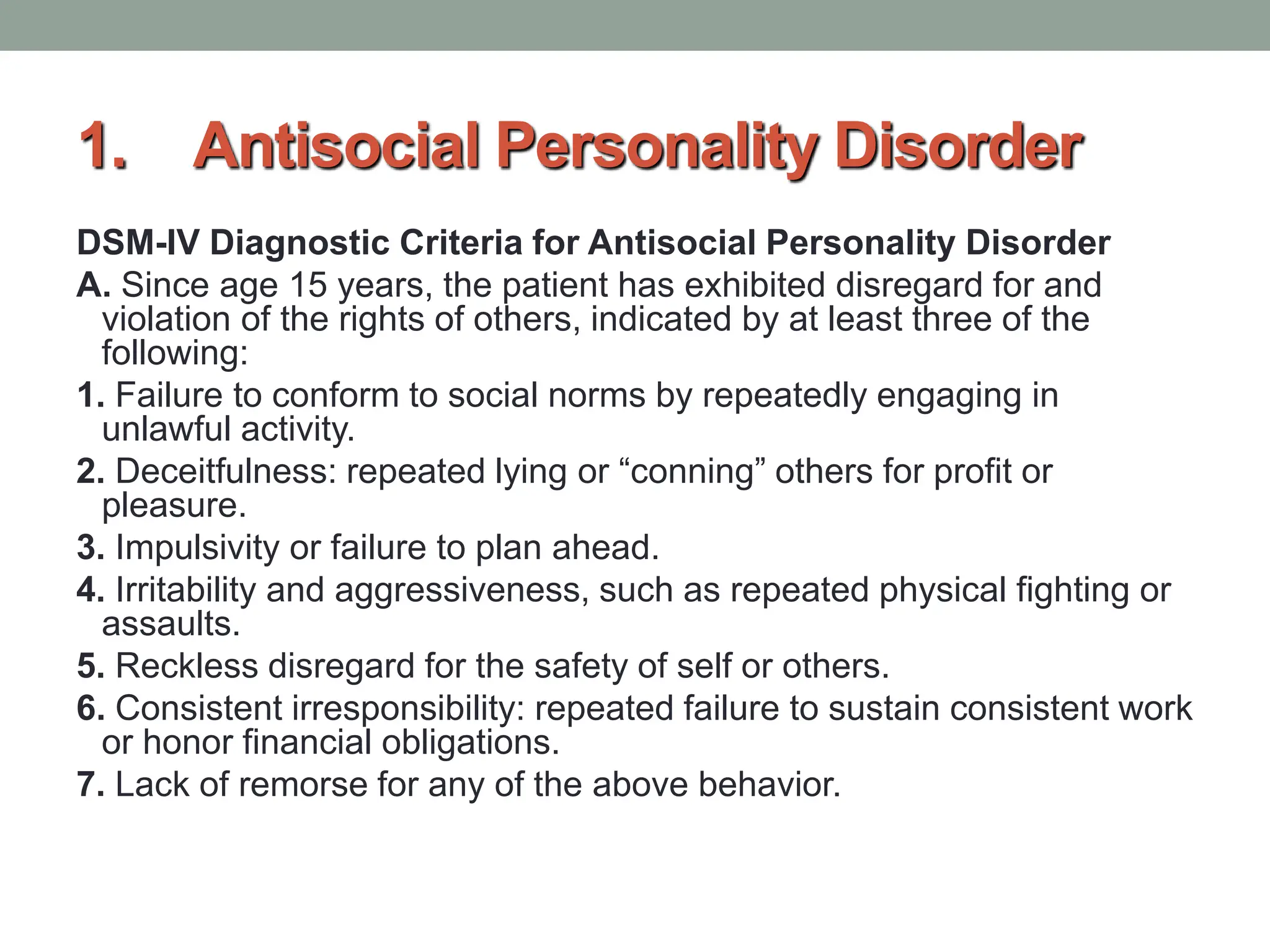
1. Antisocial Personality Disorder
DSM-IV Diagnostic Criteria for Antisocial Personality Disorder
A. Since age 15 years, the patient has exhibited disregard for and
violation of the rights of others, indicated by at least three of the
following:
1. Failure to conform to social norms by repeatedly engaging in
unlawful activity.
2. Deceitfulness: repeated lying or “conning” others for profit or
pleasure.
3. Impulsivity or failure to plan ahead.
4. Irritability and aggressiveness, such as repeated physical fighting or
assaults.
5. Reckless disregard for the safety of self or others.
6. Consistent irresponsibility: repeated failure to sustain consistent work
or honor financial obligations.
7. Lack of remorse for any of the above behavior.
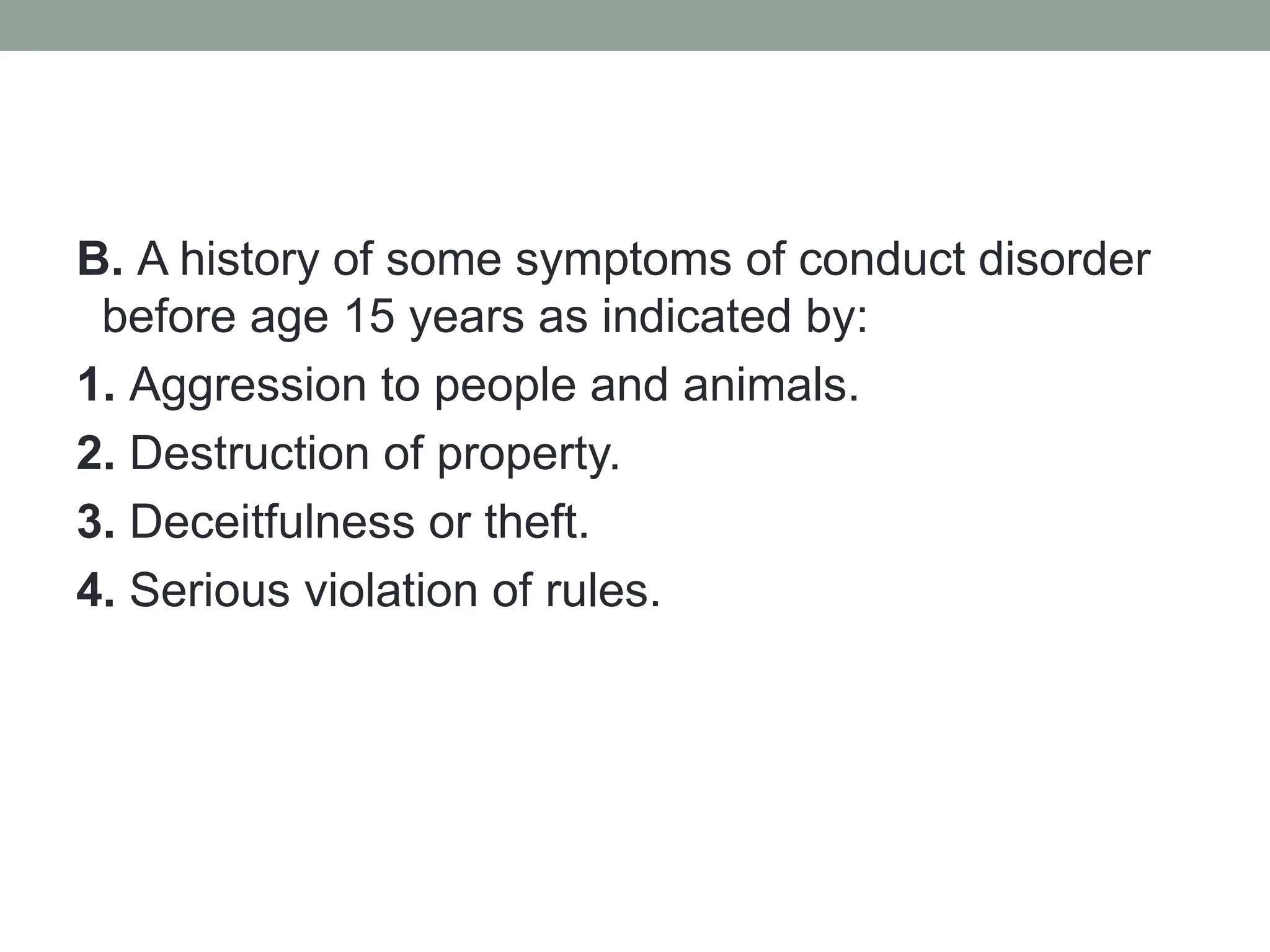
B. A history of some symptoms of conduct disorder
before age 15 years as indicated by:
1. Aggression to people and animals.
2. Destruction of property.
3. Deceitfulness or theft.
4. Serious violation of rules.
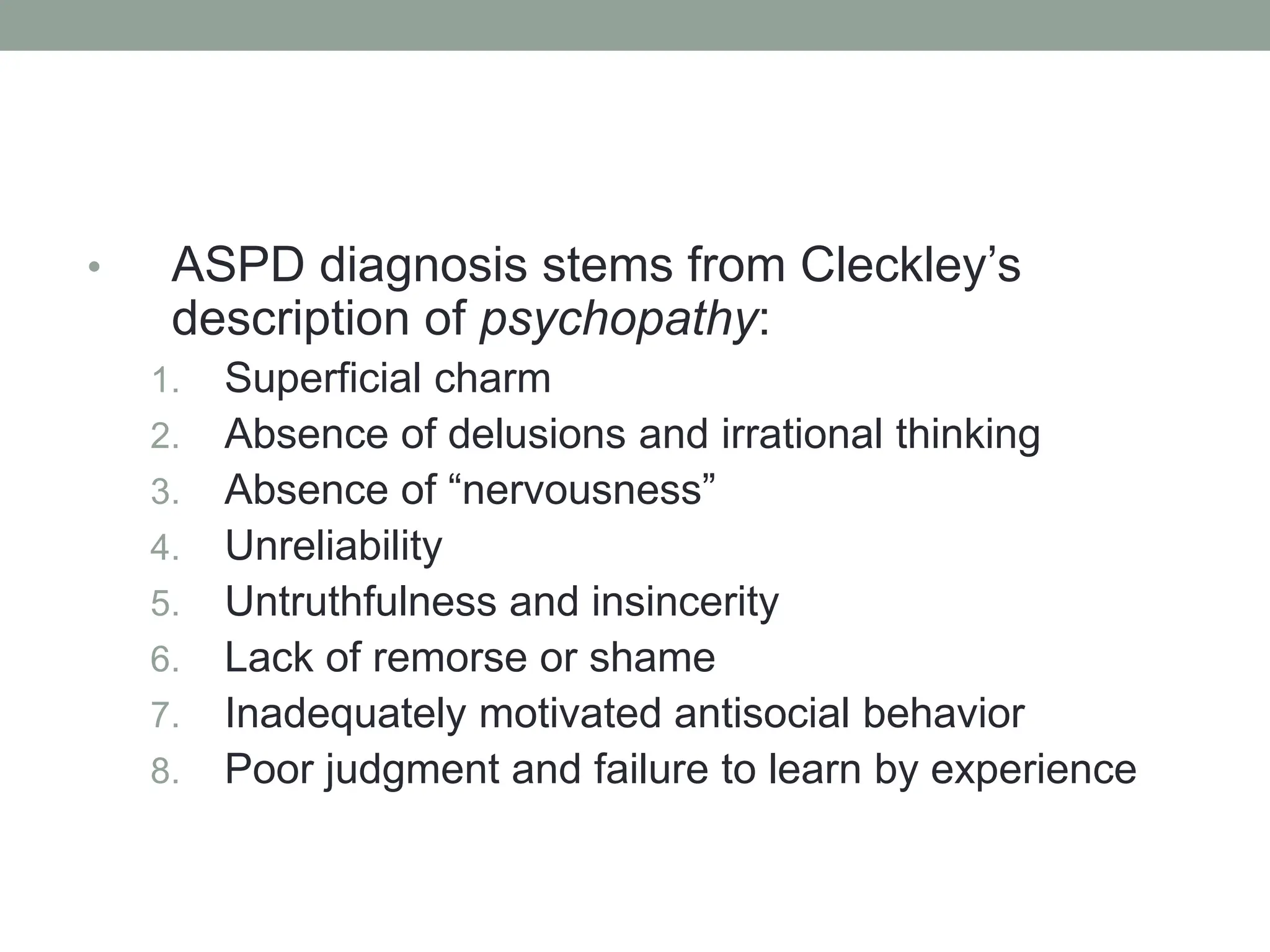
• ASPD diagnosis stems from Cleckley’s
description of psychopathy:
1. Superficial charm
2. Absence of delusions and irrational thinking
3. Absence of “nervousness”
4. Unreliability
5. Untruthfulness and insincerity
6. Lack of remorse or shame
7. Inadequately motivated antisocial behavior
8. Poor judgment and failure to learn by experience
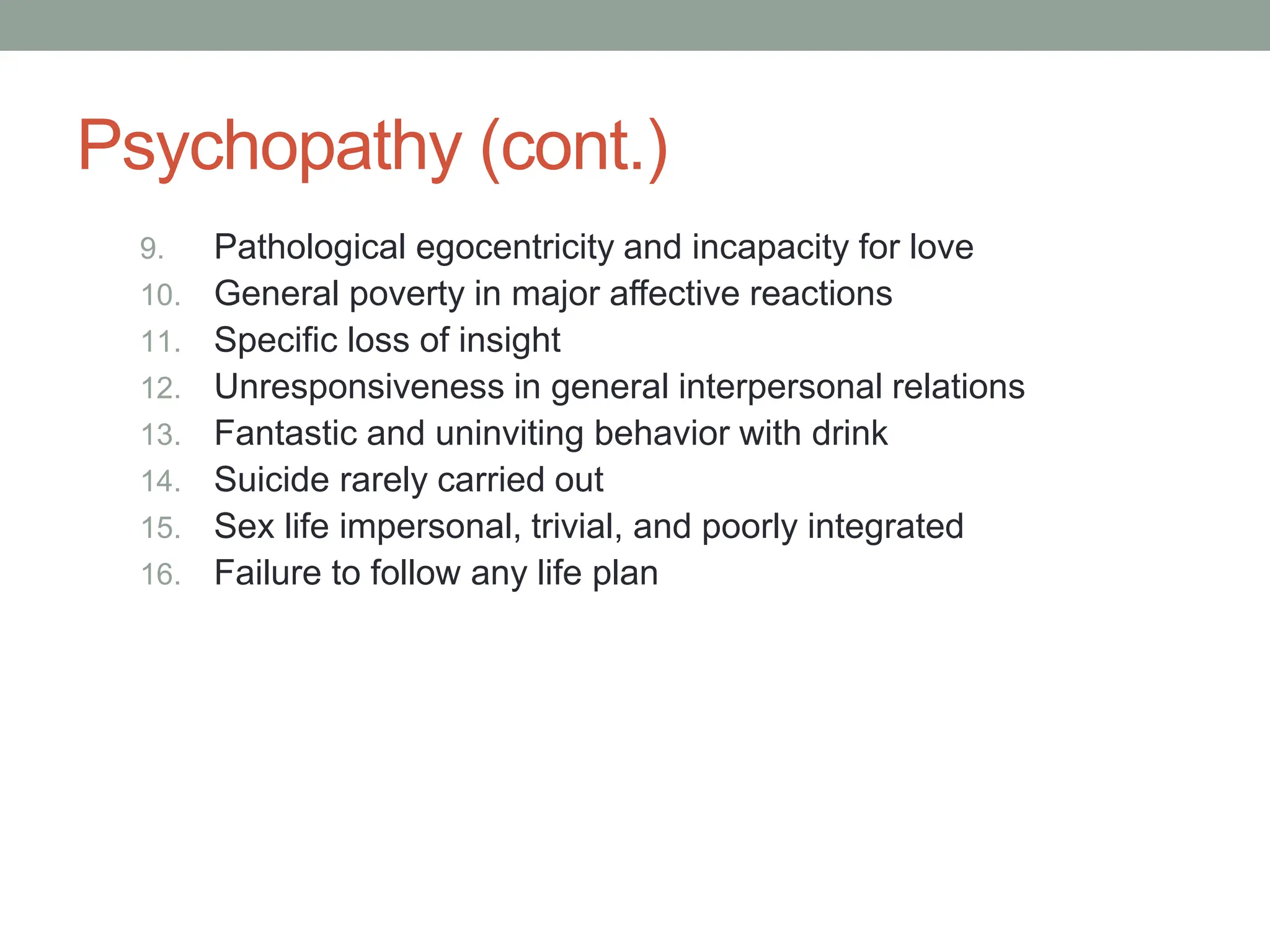
Psychopathy (cont.)
9. Pathological egocentricity and incapacity for love
10. General poverty in major affective reactions
11. Specific loss of insight
12. Unresponsiveness in general interpersonal relations
13. Fantastic and uninviting behavior with drink
14. Suicide rarely carried out
15. Sex life impersonal, trivial, and poorly integrated
16. Failure to follow any life plan
• ASPD definition based on Cleckley’s view
appeared in DSM-II
• Psychopathy is now a separate construct with an
antisocial (ASPD-like) component
• Lee Robins’ work in mid-1960’s formed basis of
current ASPD criteria
• Found that most antisocial adults were antisocial in
childhood
• Most antisocial children are not antisocial as adults
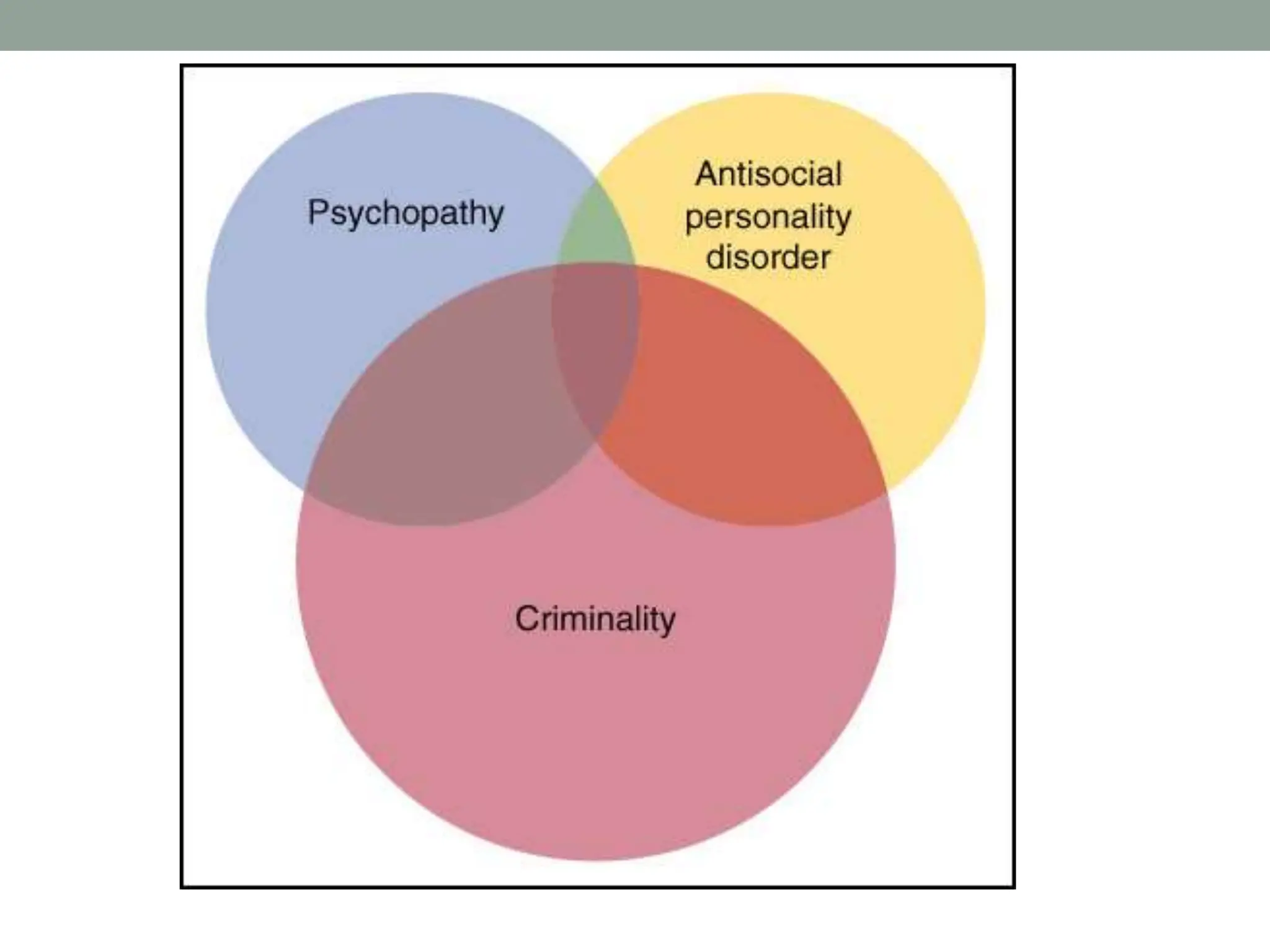
• ASPD vs. criminality
• “criminal” is a legal term denoting conviction for breaking a law:
• Not all people with ASPD are criminals (or in jails)
• Not all people in jail or considered criminal have ASPD
• Not all people with ASPD are psychopaths
Treatment of Antisocial Personality Disorder
• These patients will try to destroy or avoid the therapeutic
relationship.
• Inpatient self-help groups are the most useful treatment
because the patient is not allowed to leave, and because
enhanced peer interaction minimizes authority issues.
• Psychotropic medication is used in patients whose symptoms
interfere with functioning or who meet criteria for another
psychiatric disorder.
• Anticonvulsants, lithium, and beta-blockers have been used for
impulse control problems, including rage reactions.
Antidepressants can be helpful if depression or an anxiety
disorder is present.
2. Borderline Personality Disorder
DSM-IV Diagnostic Criteria for Borderline Personality
Disorder
A pervasive pattern of unstable interpersonal relationships,
unstable self-image, unstable affects, and poor impulse control,
beginning by early adulthood, and indicated by at least five of
the following:
1. Frantic efforts to avoid real or imagined abandonment.
2. Unstable and intense interpersonal relationships, alternating
between extremes of idealization and devaluation.
3. Identity disturbance: unstable self-image or sense of self.
4. Impulsivity in at least two areas that are potentially self-
damaging (e.g., spending, promiscuity, substance abuse,
reckless driving, binge eating).
5. Recurrent suicidal behavior, gestures or threats; or self-
mutilating behavior.
6. Affective instability (e.g., sudden intense dysphoria, irritability
or anxiety of short duration).
7. Chronic feelings of emptiness.
8. Inappropriate, intense anger or difficulty controlling anger.
9. Transient, stress-related paranoid ideation, or severe
dissociative symptoms.
Treatment of Borderline Personality
Disorder
• Psychotherapy is the treatment of choice. Patients
frequently try to recreate their personal chaos in
treatment by displaying acting-out behavior,
resistance to treatment, lability of mood and affect,
and regression.
• Suicide threats and attempts are common.
• Pharmacotherapy is frequently used for coexisting
mood disorders, eating disorders, and anxiety
disorders. Valproate (Depakote) or SSRIs may be
helpful for impulsive-aggressive behavior.
3. Histrionic Personality Disorder
DSM-IV Diagnostic Criteria
A. A pervasive pattern of excessive emotionality and attention seeking,
beginning by early adulthood, as indicated by five or more of the following:
1. The patient is not comfortable unless he is the center of attention.
2. The patient is often inappropriately sexually seductive or provocative with
others.
3. Rapidly shifting and shallow expression of emotions are present.
4. The patient consistently uses physical appearance to attract attention.
5. Speech is excessively impressionistic and lacking in detail.
6. Dramatic, theatrical, and exaggerated expression of emotion is used.
7. The patient is easily influenced by others or by circumstances.
8. Relationships are considered to be more intimate than they are in reality.
Treatment of Histrionic Personality Disorder
• Insight-oriented psychotherapy is the treatment of
choice.
• Keeping patients in therapy can be challenging
since these patients dislike routine.
• Antidepressants are used if depression is also
present.
4. Narcissistic Personality Disorder
DSM-IV Diagnostic Criteria
A. A pervasive pattern of grandiosity (in fantasy or behavior), need for admiration, and
lack of empathy. The disorder begins by early adulthood and is indicated by at least five
of the following:
1. An exaggerated sense of self-importance.
2. Preoccupation with fantasies of unlimited success, power, brilliance, beauty, or ideal
love.
3. Believes he is “special” and can only be understood by, or should associate with, other
special or high-status people (or institutions).
4. Requires excessive admiration.
5. Has a sense of entitlement.
6. Takes advantage of others to achieve his own ends.
7. Lacks empathy.
8. The patient is often envious of others or believes that others are envious of him.
9. Shows arrogant, haughty behavior or attitudes.
Treatment of Narcissistic Personality
Disorder
• Psychotherapy is the treatment of choice, but the
therapeutic relationship can be difficult since envy
often becomes an issue.
• Coexisting substance abuse may complicate
treatment. Depression frequently coexists with
NPD; therefore, antidepressants are useful for
adjunctive therapy.
Cluster C Personality
Disorders
• Avoidant, dependent and obsessive-compulsive
personality disorders are referred to as cluster C
personality disorders.
• These patients tend to be anxious and their
personality pathology is a maladaptive attempt to
control anxiety.
1. Avoidant Personality Disorder
DSM-IV Diagnostic Criteria
A. A pervasive pattern of social inhibition, feelings
of inadequacy and hypersensitivity, beginning by
early adulthood, and indicated by at least four of
the following:
1. The patient avoids occupational activities with
significant interpersonal contact due to fear of
criticism, disapproval or rejection.
2. Unwilling to get involved with people unless
certain of being liked.
3. Restrained in intimate relationships due to fear
of being shamed or ridiculed.
4. Preoccupied with being criticized or rejected in
social situations.
5. Inhibited in new interpersonal situations due to
feelings of inadequacy.
6. The patient views himself as socially inept,
unappealing or inferior to others.
7. Reluctance to take personal risks or to engage in
new activities because they may be embarrassing.
Treatment of Avoidant Personality Disorder
• Individual psychotherapy, group psychotherapy and behavioral
techniques may all be useful. Group therapy may assist in
dealing with social anxiety. Behavioral techniques, such as
assertiveness training and systematic desensitization, may
help the patient to overcome anxiety and shyness.
• Beta-blockers can be useful for situational anxiety.
• Since many of these patients will meet criteria for Social
Phobia (generalized), a trial of SSRI medication may prove
beneficial.
• Patients are prone to other mood and anxiety disorders, and
these disorders should be treated with antidepressants or
anxiolytics.
2. Dependent Personality Disorder
DSM-IV Diagnostic Criteria
A. A pervasive and excessive need to be cared for. This
need leads to submissive, clinging behavior, and fears of
separation beginning by early adulthood and indicated by
at least five of the following:
1. Difficulty making everyday decisions without excessive
advice and reassurance.
2. Needs others to assume responsibility for major areas of
his life.
3. Difficulty expressing disagreement with others and
unrealistically fears loss of support or approval if he
disagrees.
4. Difficulty initiating projects or doing things on his or her
own because of a lack of self confidence in judgment or
abilities.
5. Goes to excessive lengths to obtain nurturance
and support, to the point of volunteering to do
things that are unpleasant.
6. Uncomfortable or helpless when alone due to
exaggerated fears of being unable to care for
himself.
7. Urgently seeks another source of care and
support when a close relationship ends.
8. Unrealistically preoccupied with fears of being
left to take care of himself.
Treatment of Dependent Personality
Disorders
• Insight-oriented psychotherapy, group, and
behavioral therapies, such as assertiveness and
social skills training, have all been used with
success. Family therapy may also be helpful in
supporting new needs of the dependent patient in
treatment.
• Dependent patients are at increased risk for mood
disorders and anxiety disorders. Appropriate
pharmacological interventions may be used if the
patient has these disorders.
3. Obsessive-Compulsive Personality
Disorder
DSM-IV Diagnostic Criteria
A. A pervasive pattern of preoccupation with orderliness,
perfectionism and control, at the expense of flexibility,
openness, and efficiency, beginning by early adulthood and
indicated by at least four of the following:
1. Preoccupied with details, rules, lists, organization or
schedules, to the extent that the major point of the activity is
lost.
2. Perfectionism interferes with task completion.
3. Excessively devoted to work and productivity to the exclusion
of leisure activities and friendships.
4. Overconscientiousness, scrupulousness and
inflexibility about morality, ethics, or values (not
accounted for by culture or religion).
5. Unable to discard worn-out or worthless objects,
even if they have no sentimental value.
6. Reluctant to delegate tasks to others.
7. Miserly spending style toward both self and
others.
8. Rigidity .
Treatment of OCPD
• Long-term, individual therapy is usually helpful.
• Therapy can be difficult due to the patient’s limited
insight and rigidity.
SOMATOFORM DISORDERS
 In patients with somatoform disorders, emotional distress
or difficult life situations are experienced as physical
symptoms.
 Viewed from an individual perspective, the somatizing
patient seems to seek the sick role, which affords relief
from stressful or impossible interpersonal expectations
("primary gain") and, in most societies, provides attention,
caring and sometimes even monetary reward ("secondary
gain").
 This is not malingering (consciously "faking" the
symptoms), because the patient is not aware of the
process through which the symptoms arise, cannot will
them away and genuinely suffers from the symptoms.
Somatization disorder
• People have many physical symptoms from
different parts of the body.
• For example, headaches, feeling sick, abdominal
pain, bowel problems, period problems, tiredness,
sexual problems.
• The main symptoms may vary at different times.
• Affected people tend to be emotional about their
symptoms.
• So they may describe their symptoms as 'terrible',
'unbearable' etc, and symptoms can greatly affect
day-to-day life.
• The disorder persists long-term although the
symptoms may 'wax and wane' in severity.
Hypochondriasis
• This is a disorder where people fear that minor
symptoms may be due to a serious disease.
• People with this disorder have many such fears, and
spend a lot of time thinking about their symptoms.
• Reassurance by a doctor does not usually help as
people with hypochondriasis fear that the doctor has
just not found the ‘serious’ disease.
Conversion disorder
• This disorder is defined by the presence of one or
more neurological symptoms (for example, blindness,
deafness, weakness, paralysis, or numbness of arms
or legs) that cannot be accounted for by a diagnosable
neurological or medical disorder.
• Physical examination may reveal unanatomical
physical signs, and special investigation results are
usually negative.
• The symptoms usually develop quickly in 'response' to
a stressful situation i.e. the patient unconsciously
'convert' his mental stress into a physical symptom.
• The relationship between the physical symptom and
the underlying psychological conflict may be strikingly
clear (e.g. paralysis of the right hand of a girl who is
going to write a final examination)
Body dysmorphic disorder
• A person with body dysmorphic disorder believes that there
is a serious defect in his/her appearance.
• The defect may be real or imagined.
• Symptoms involve preoccupation with a variety of physical
attributes—including facial hair; size of nose, ears, or
breasts.
• The patient may spend hours focusing on a perceived
defect, looking in mirrors (or avoiding them), searching for
ways to hide the problem, or even seeking surgery to
eliminate the problem.
• Because the patient feels self-conscious, he/she may avoid
going out in public and stop going to work or social
activities.
• This disorder differs from normal concerns about one’s
appearance because it causes extreme distress and
interferes with the person’s quality of life and ability to
function.
Treatment of somatoform disorders
• The treatment of somatoform disorders is widely
regarded as complex and challenging.
• people with somatization disorders do not accept
that their symptoms are due to psychosocial
factors. They may become angry or irritated with
their doctors who cannot 'find physical cause' for
their problems.
• Psycho-education for the patient and the family
are therefore very important.
• The goal of treatment is therefore to help the patient
understand his/her symptoms and learn ways to control
them such as stress reduction, improving lifestyle, and
changing the sick role.
• proper evaluation and treatment of other mental health
problems may also help with improving the situation.
MOOD DISORDERS
Course outline
At the end of this lecture, students will be able to
• Define the different terminologies used to describe mood
• Differentiate normal mood changes from disorders
• Describe the epidemiology of mood disorders
• Describe the clinical features and diagnostic criteria of
mood disorders
• Describe the principles of management of different mood
disorders
3/22/2024 213
Definition of Terms
• Mood is a person’s subjective emotional state that
influences a person's behavior and perception of the
world
• Affect is the objective appearance of mood
• Mood disorders (according to DSM-IV TR) involve a
depression or elevation of mood as the primary
disturbance
• Can have other abnormalities (psychosis, anxiety, etc.)
3/22/2024 214
Normal vs pathological mood changes
• Normal individuals experience mood changes all the time
and do have control over their moods and affects
• Patients with mood disorders experience an abnormal
range of moods and lose some level of control over them.
• Distress may be caused by the severity of their moods
and their resulting impairment in social and occupational
functioning.
3/22/2024 215
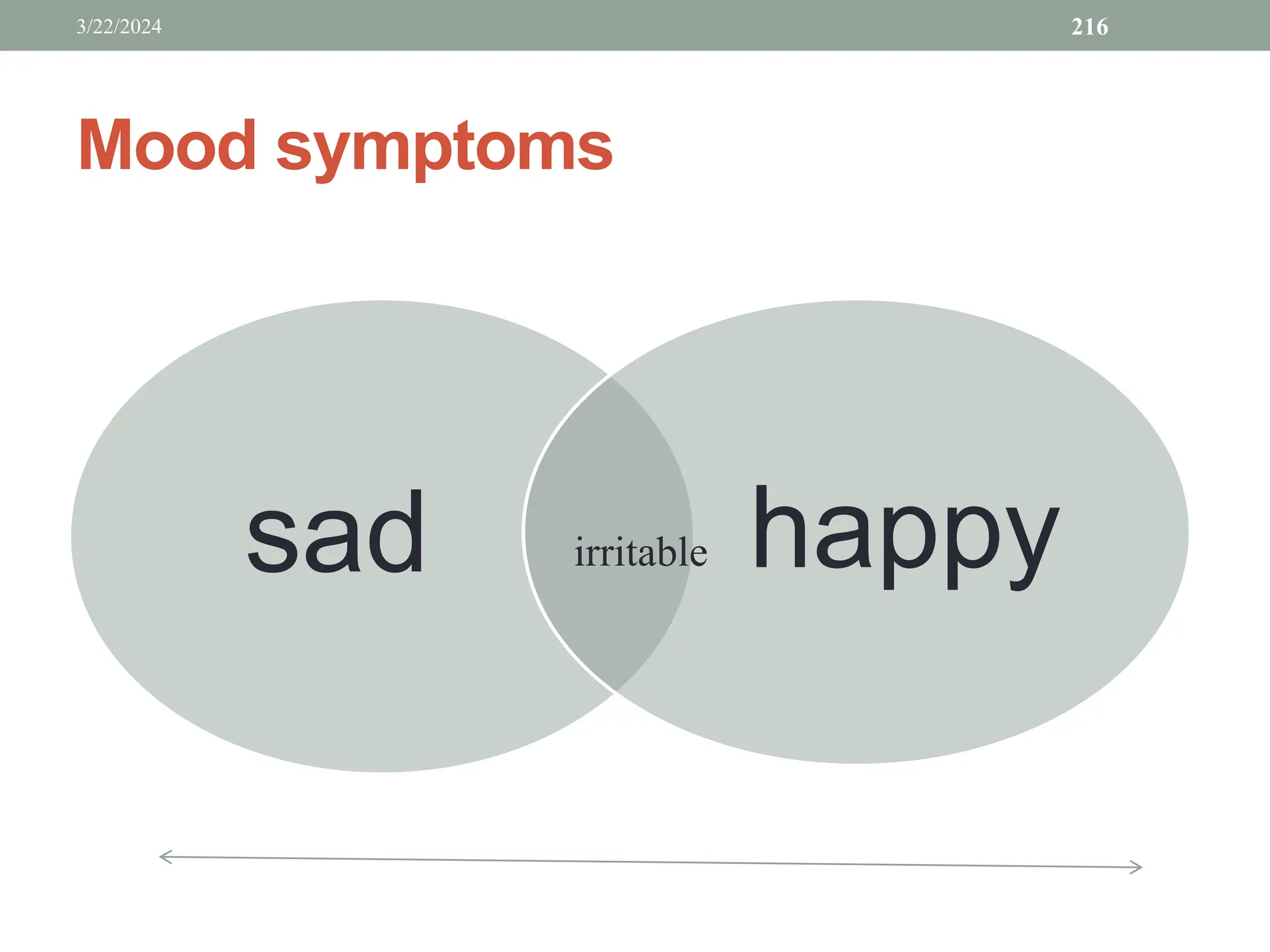
Mood symptoms
sad happy
3/22/2024 216
irritable
Mood Disorders Versus Mood
Episodes
• Mood episodes are distinct periods of time in which some
abnormal mood is present. They are the building blocks of
mood disorders.
• Mood disorders are defined by their patterns of mood
episodes.
3/22/2024 217
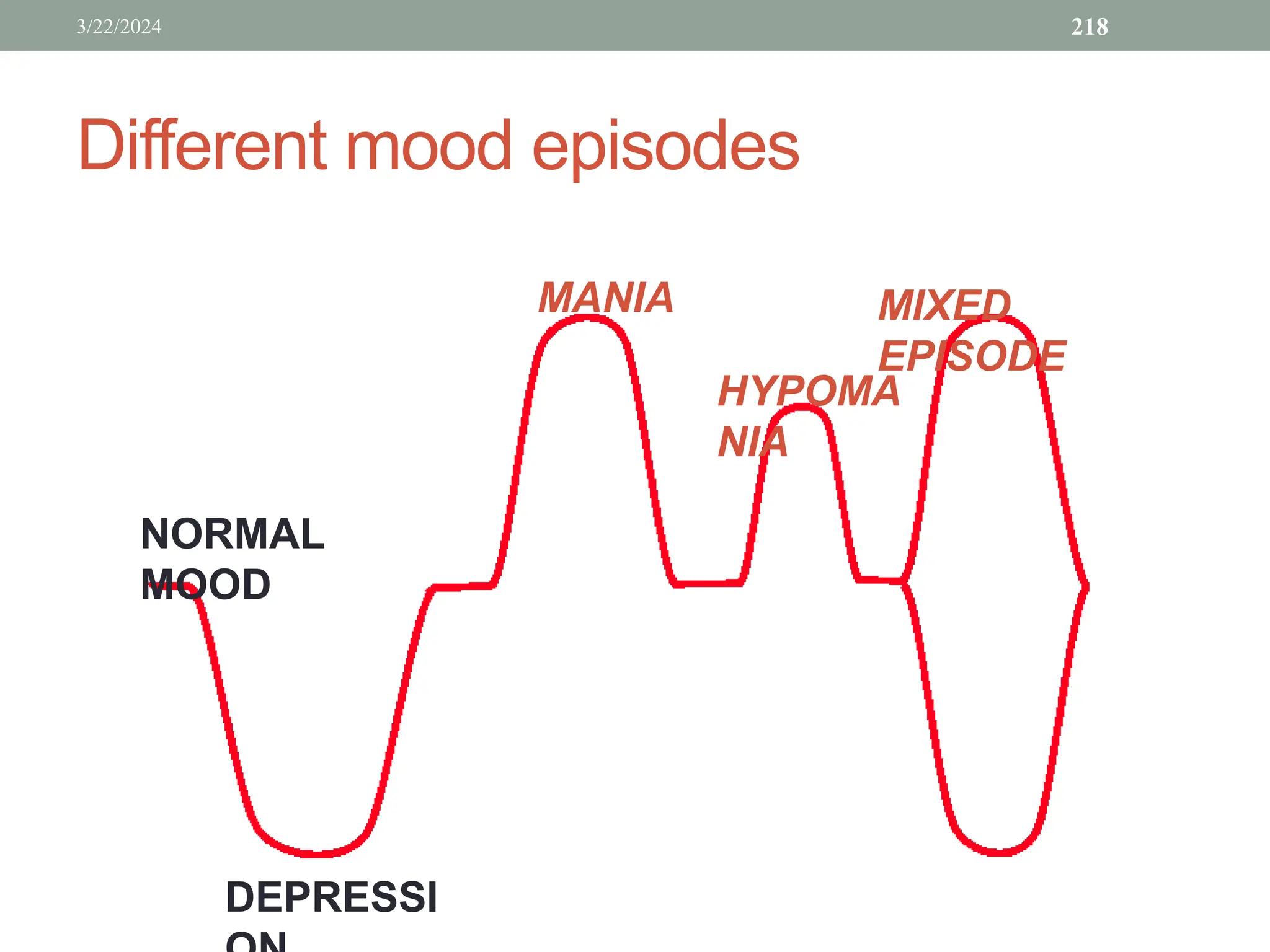
Different mood episodes
3/22/2024 218
DEPRESSI
NORMAL
MOOD
MANIA
HYPOMA
NIA
MIXED
EPISODE
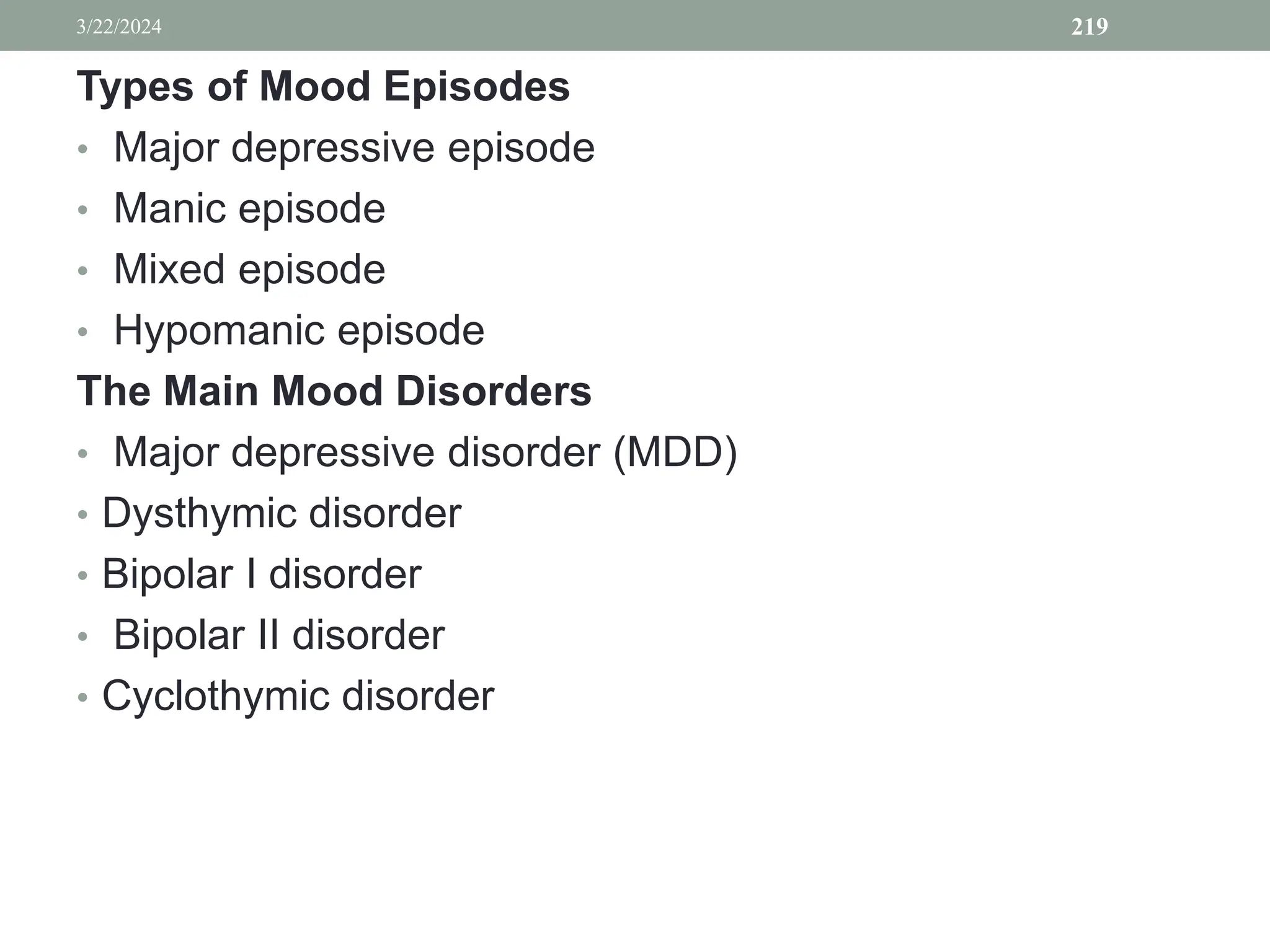
Types of Mood Episodes
• Major depressive episode
• Manic episode
• Mixed episode
• Hypomanic episode
The Main Mood Disorders
• Major depressive disorder (MDD)
• Dysthymic disorder
• Bipolar I disorder
• Bipolar II disorder
• Cyclothymic disorder
3/22/2024 219
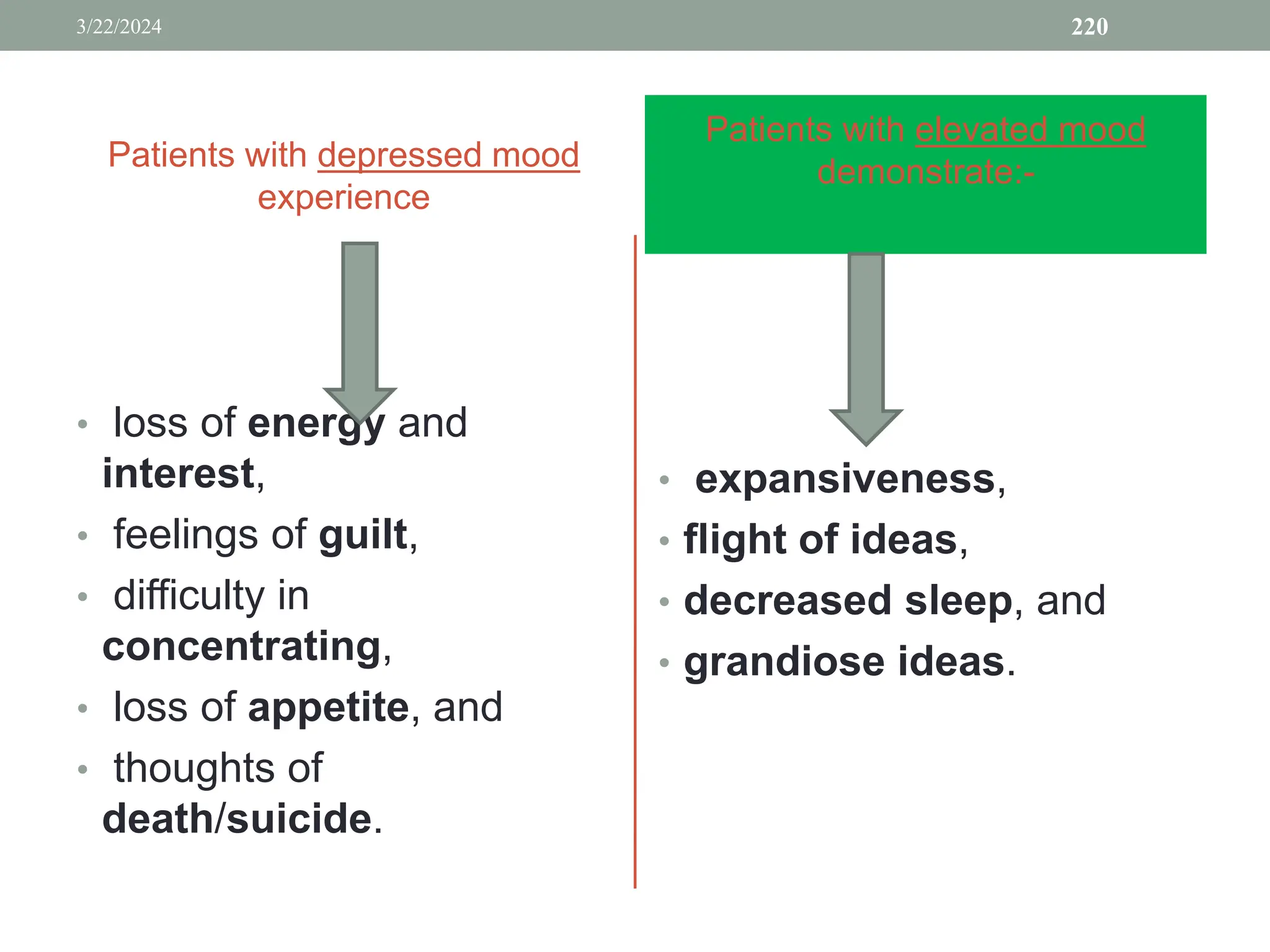
Patients with depressed mood
experience
• loss of energy and
interest,
• feelings of guilt,
• difficulty in
concentrating,
• loss of appetite, and
• thoughts of
death/suicide.
Patients with elevated mood
demonstrate:-
• expansiveness,
• flight of ideas,
• decreased sleep, and
• grandiose ideas.
3/22/2024 220
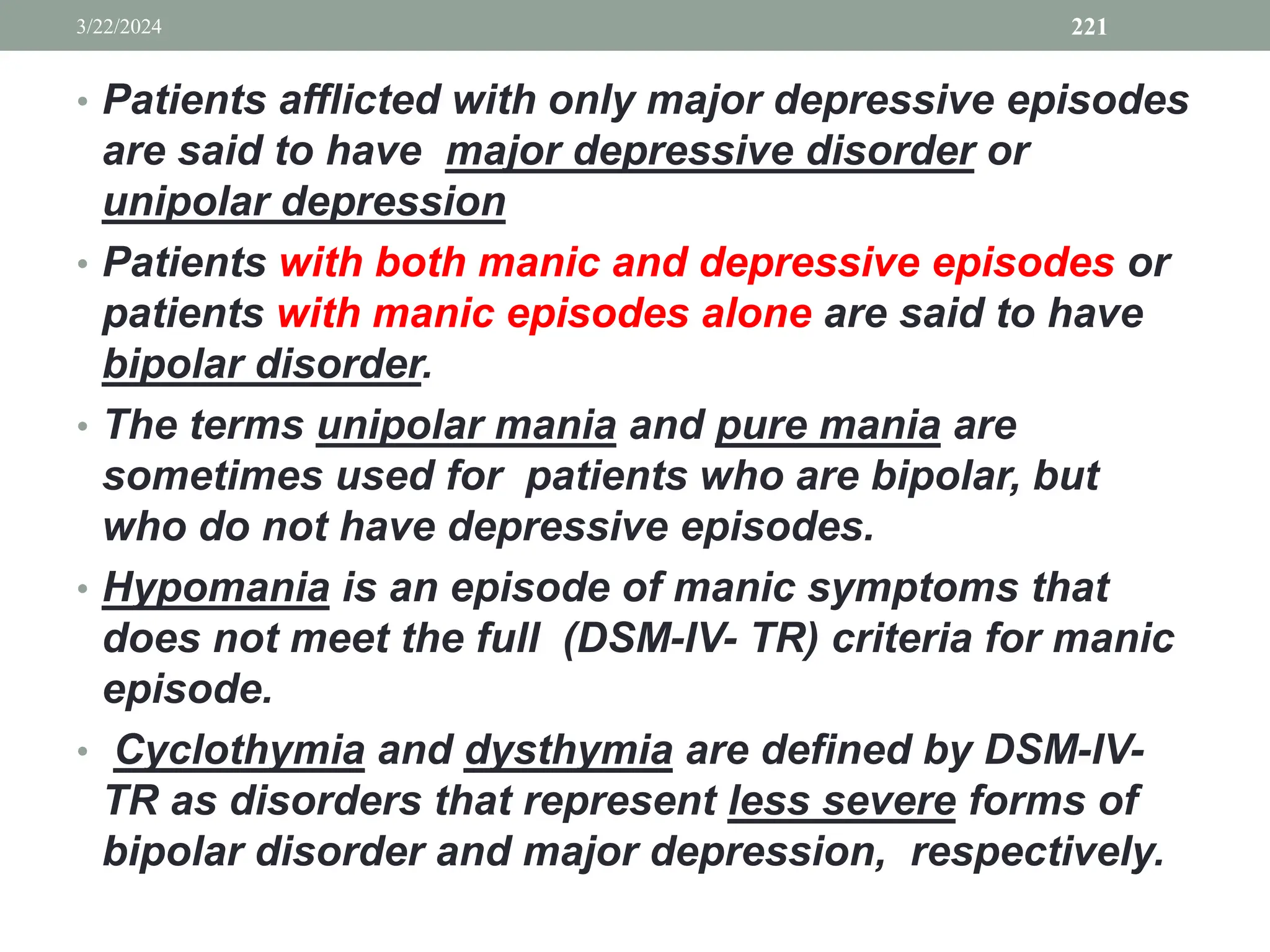
• Patients afflicted with only major depressive episodes
are said to have major depressive disorder or
unipolar depression
• Patients with both manic and depressive episodes or
patients with manic episodes alone are said to have
bipolar disorder.
• The terms unipolar mania and pure mania are
sometimes used for patients who are bipolar, but
who do not have depressive episodes.
• Hypomania is an episode of manic symptoms that
does not meet the full (DSM-IV- TR) criteria for manic
episode.
• Cyclothymia and dysthymia are defined by DSM-IV-
TR as disorders that represent less severe forms of
bipolar disorder and major depression, respectively.
3/22/2024 221
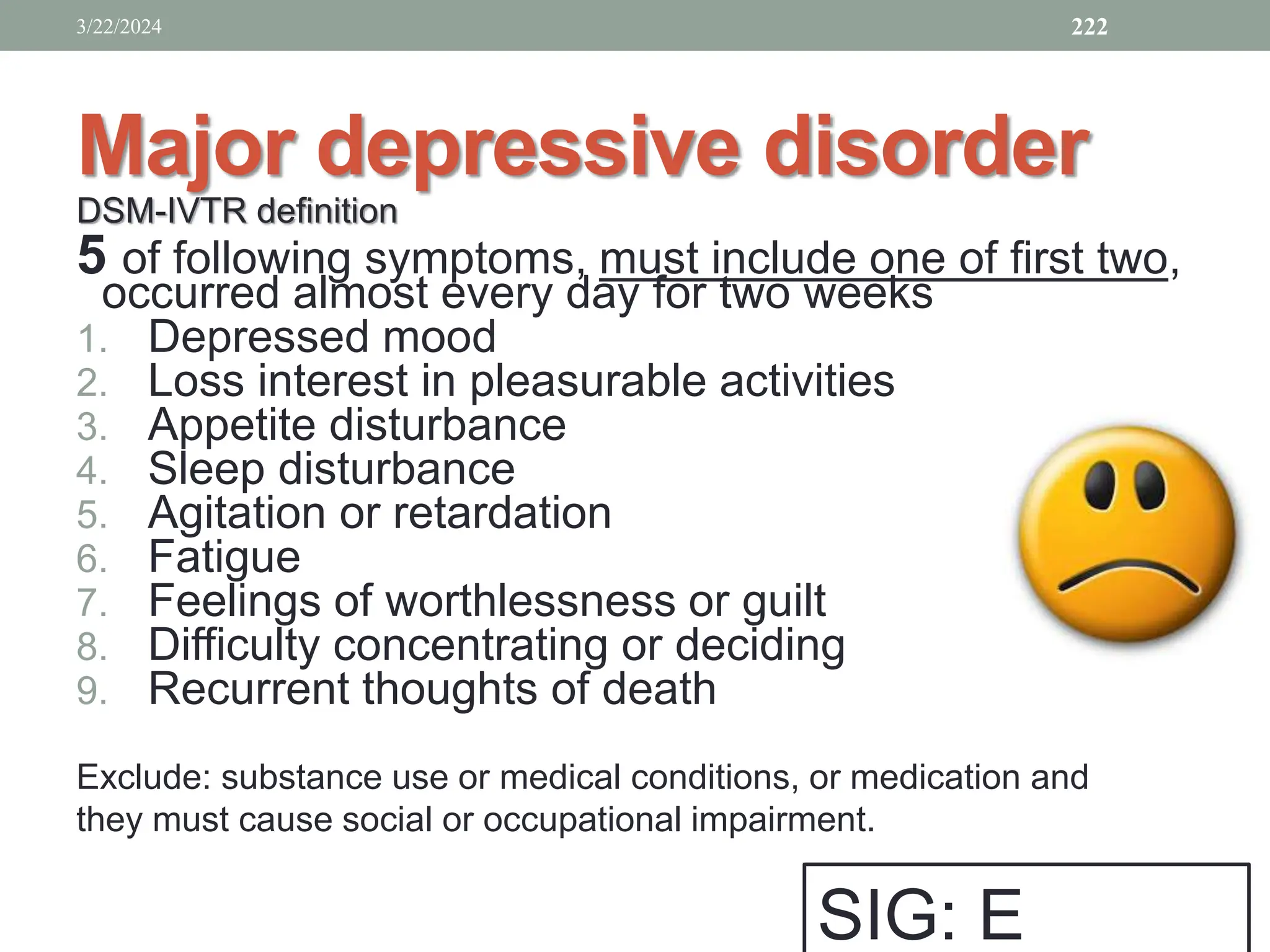
Major depressive disorder
DSM-IVTR definition
5 of following symptoms, must include one of first two,
occurred almost every day for two weeks
1. Depressed mood
2. Loss interest in pleasurable activities
3. Appetite disturbance
4. Sleep disturbance
5. Agitation or retardation
6. Fatigue
7. Feelings of worthlessness or guilt
8. Difficulty concentrating or deciding
9. Recurrent thoughts of death
Exclude: substance use or medical conditions, or medication and
they must cause social or occupational impairment.
3/22/2024 222
SIG: E
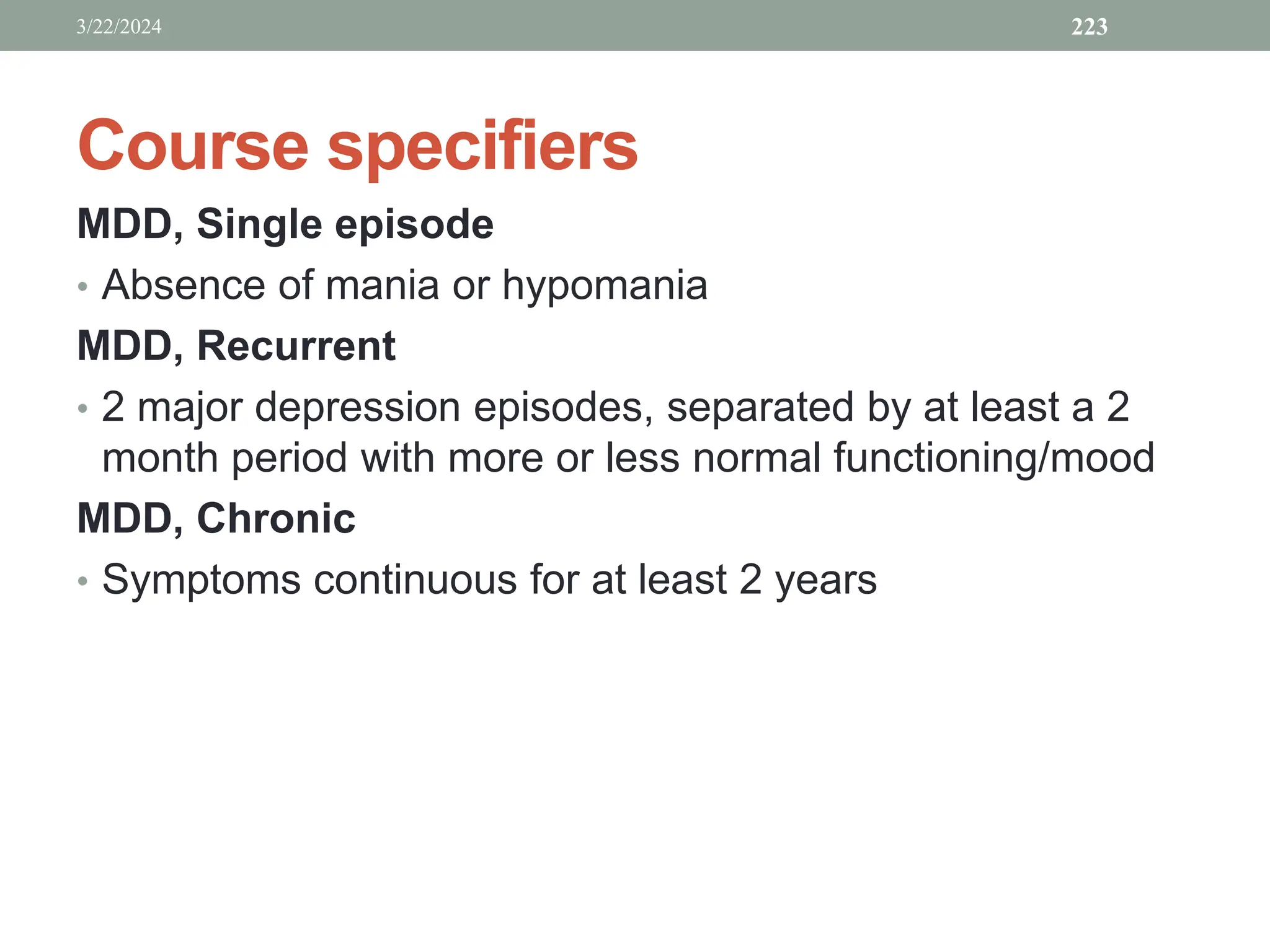
Course specifiers
MDD, Single episode
• Absence of mania or hypomania
MDD, Recurrent
• 2 major depression episodes, separated by at least a 2
month period with more or less normal functioning/mood
MDD, Chronic
• Symptoms continuous for at least 2 years
3/22/2024 223
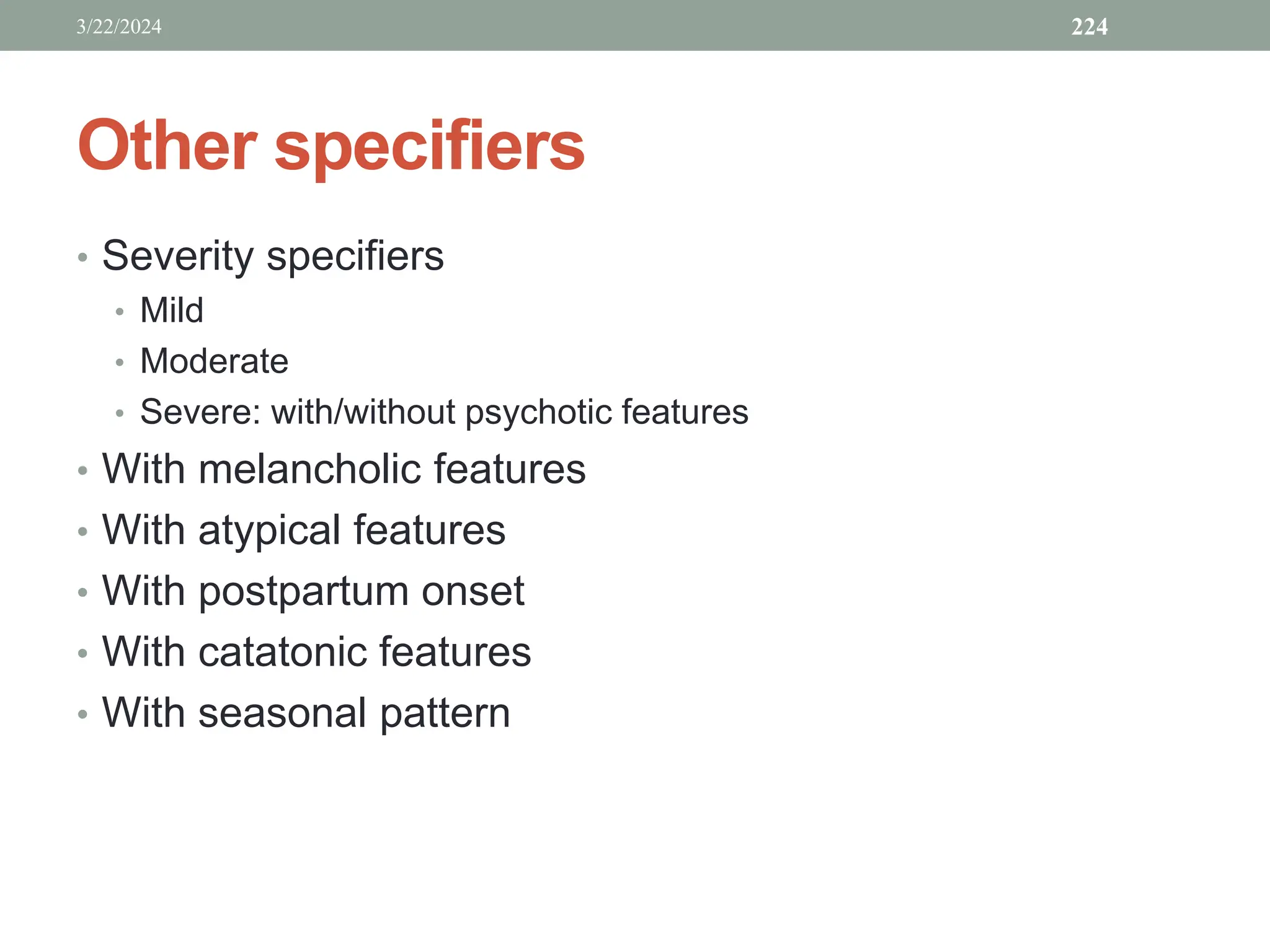
Other specifiers
• Severity specifiers
• Mild
• Moderate
• Severe: with/without psychotic features
• With melancholic features
• With atypical features
• With postpartum onset
• With catatonic features
• With seasonal pattern
3/22/2024 224
Epidemiology
• Most common mood disorder
• Point prevalence: 8%–10% females, 3%–5% males
• Lifetime prevalence: 20%–25% females, 8%–13% males,
• Prevalence in Ethiopia 9.1% (only 22% sought treatment)
[Hailemariam, 2012]
3/22/2024 225
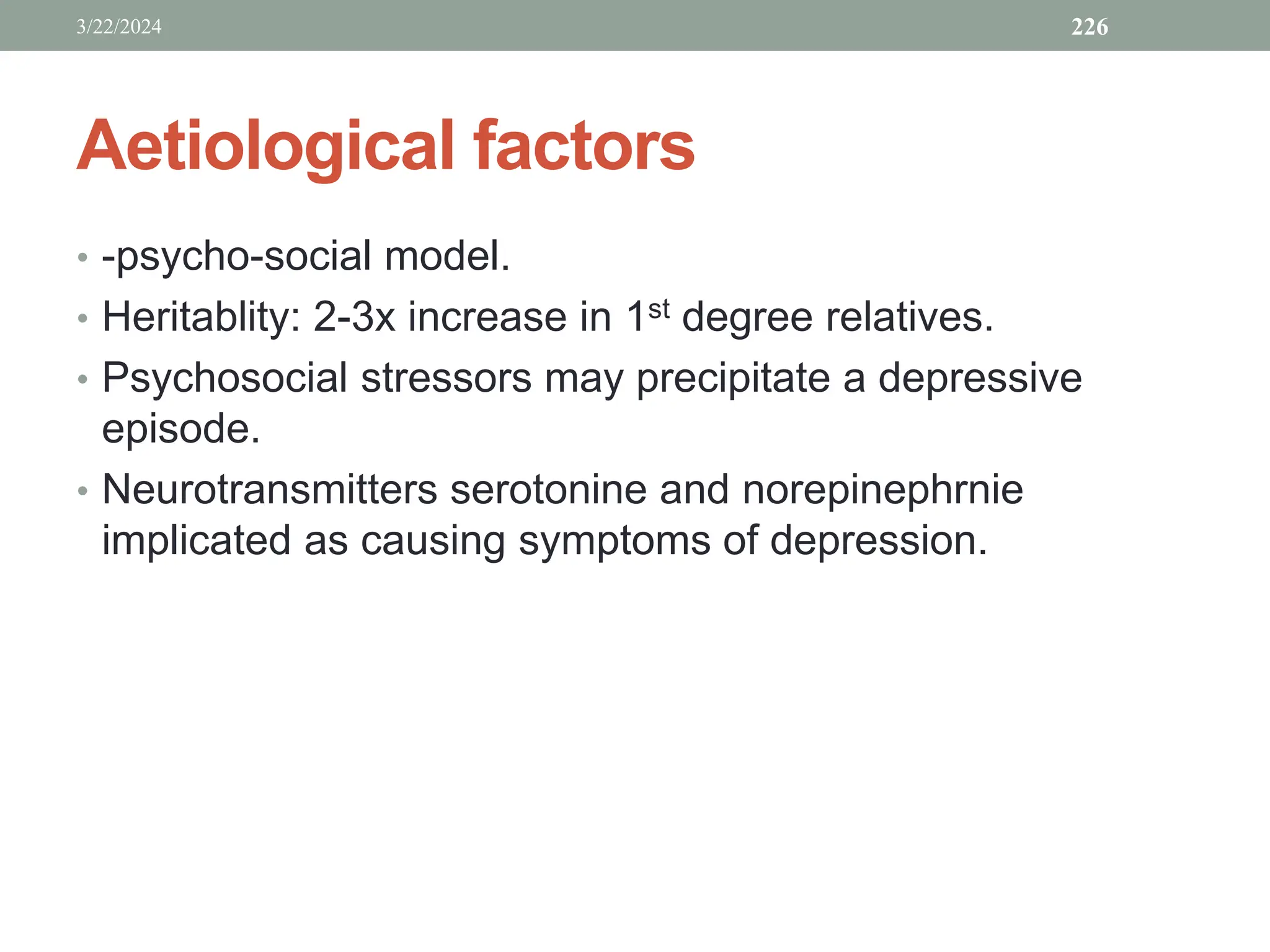
Aetiological factors
• -psycho-social model.
• Heritablity: 2-3x increase in 1st degree relatives.
• Psychosocial stressors may precipitate a depressive
episode.
• Neurotransmitters serotonine and norepinephrnie
implicated as causing symptoms of depression.
3/22/2024 226
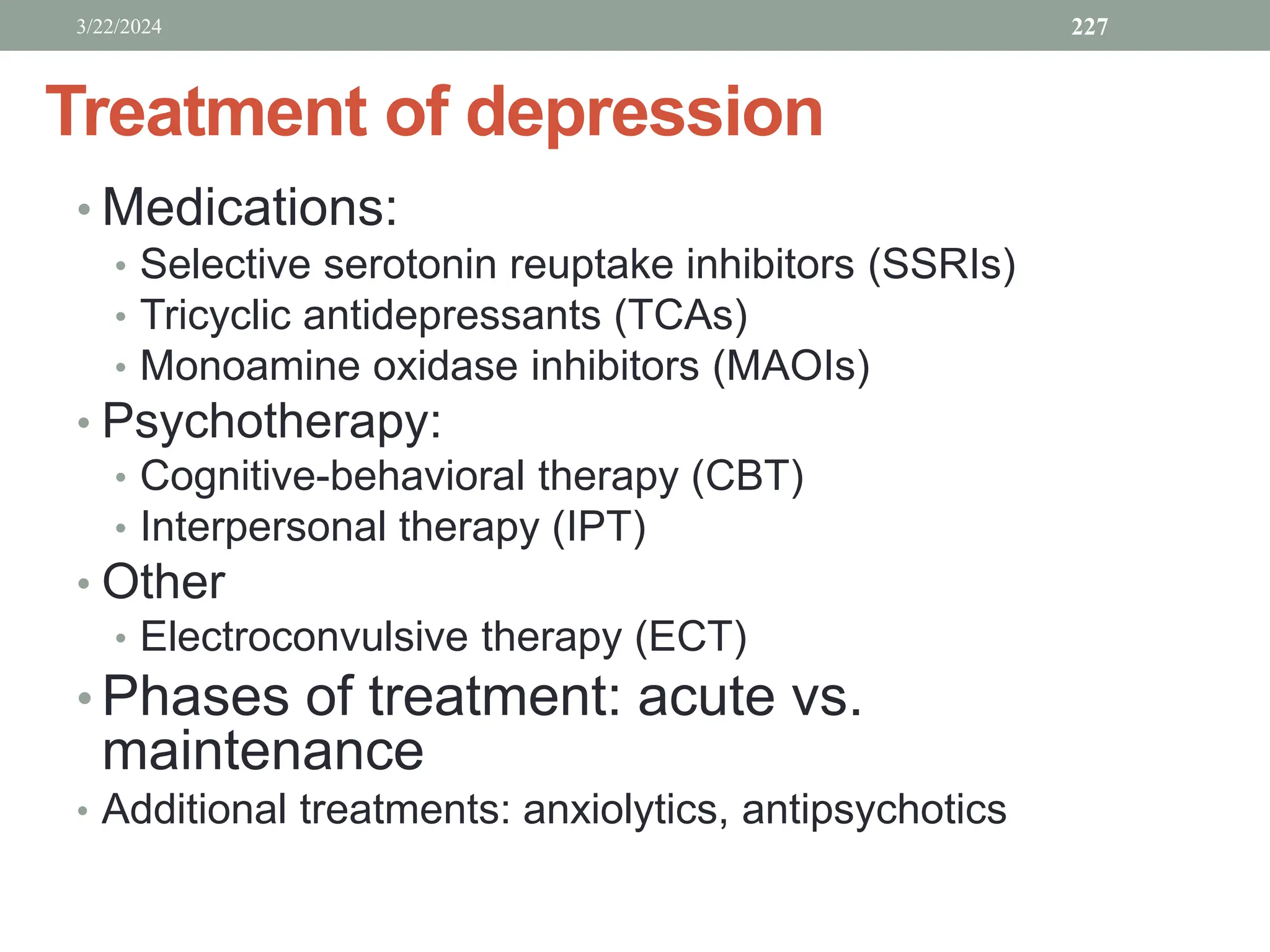
Treatment of depression
• Medications:
• Selective serotonin reuptake inhibitors (SSRIs)
• Tricyclic antidepressants (TCAs)
• Monoamine oxidase inhibitors (MAOIs)
• Psychotherapy:
• Cognitive-behavioral therapy (CBT)
• Interpersonal therapy (IPT)
• Other
• Electroconvulsive therapy (ECT)
• Phases of treatment: acute vs.
maintenance
• Additional treatments: anxiolytics, antipsychotics
3/22/2024 227
Course and Prognosis
• Untreated depressive episodes are self-limiting but
usually last from 6 to 13 months. Generally, episodes
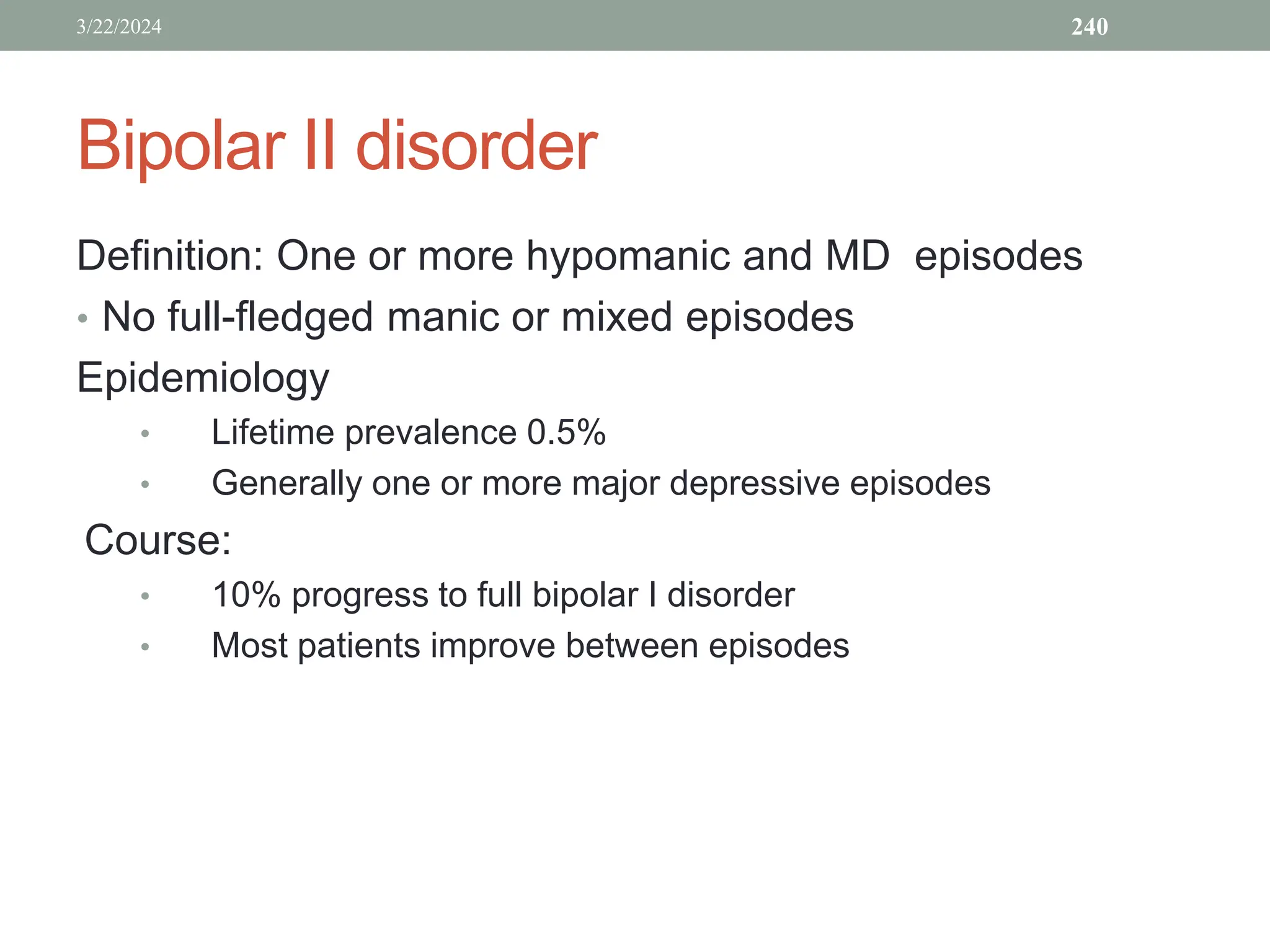
occur more frequently as the disorder progresses.
• Risk of relapse is 50% within the first 2 years after the first
episode.
• About 15% of patients eventually commit suicide.
3/22/2024 228
• Antidepressant medications significantly reduce the length
and severity of symptoms.
• They may be used prophylactically between major
depressive episodes to reduce the risk of subsequent
episodes.
• Approximately 75% of patients are treated successfully
with medical therapy.
3/22/2024 229
Dysthymic disorder: DSM-IVTR Criteria
A. Depressed/irritable mood
B. Presence of two of the following:
• Appetite disturbance
• Sleep disturbance
• Low energy/fatigue
• Poor concentration of difficulties making decision
• Feelings of hopelessness
C. Present for two year period (one year in children and
adolescents)
D. No manic or hypomanic episode
E. No chronic psychotic disorder
F. Not related to organic factors
3/22/2024 230
• Onset: subdivided into early onset (21 years) and late
onset (21 years).
• Point prevalence: 5%
• Lifetime prevalence: 6.4% (8% female, 5% male)
• Course:
• chronic by definition.
• Because chronic, often misdiagnosed as part of patient’s
personality or missed.
3/22/2024 231
Bipolar Disorders
• Bipolar I Disorder
• Bipolar II Disorder
• Cyclothymic Disorder
3/22/2024 232
Manic Episode: DSM-IVTR Diagnostic
Criteria
A. A distinct period of abnormally and persistently
elevated, expansive, or irritable mood
B. Mood disturbance plus three of the following
symptoms (four if the mood is only irritable):
• Inflated self esteem or grandiosity
• Decreased need for sleep
• More talkative than usual or pressure to keep talking
• Flight of ideas, or racing thoughts
• Distractibility
• Increase in goal directed activity
• Excessive involvement in pleasurable activities
C. Marked impairment
D. No psychosis
E. Not organic
3/22/2024 233
DIG-FAST
Mixed episode
• The presence of alternating full blown manic and
depressive episodes within a 24 hr period.
• Also called dysphoric mania
• More common in women.
3/22/2024 234
Hypomania: Diagnostic Criteria
• All the criteria of a Manic episode except criterion C
(marked impairment)
3/22/2024 235
Differences Between Manic and
Hypomanic Episodes
Mania
• Lasts at least 7 days
• Causes severe
impairment in social or
occupational functioning
• May necessitate
hospitalization to prevent
harm to self or others
• May have psychotic
features
Hypomania
• Lasts at least 4 days
• No marked impairment
in social or occupational
functioning
• Does not require
hospitalization
• No psychotic features
3/22/2024 236
Bipolar I disorder
• Definition: Manic or Manic + MD Episodes
• Epidemiology
• Equal gender distribution
• Point prevalence 0.5%–1%
• Lifetime prevalence as high as 1.6%
• Course: recurrence is the rule; usually but not always,
mostly returns to healthy baseline between episodes.
3/22/2024 237
features predictive of bipolar Disorder:-
-early age of onset; before age 25
-psychotic depression;
-PPD esp. one with psychotic features;
-rapid onset and offset of dep.episodes of short
duration (< 3 months);
-recurrent dep.(>5 episodes);
-atypical features;
-seasonality;
-Bipolar family hx.;
-trait mood lability;
-hypomania asso. with Antidepressants;
-repeated loss of efficacy of Antideressants after initial
response;
-Depressive mood state
-sexual arousal (during major depression)
3/22/2024 238
Aetiological factors
• Biological, environmental, psychosocial, and genetic
factors are all important.
• Genetics plays an important role, concordance rate
among monozygotic twins can be as high as 75% and
rates for dizygotic twins are 5 to 25%.
3/22/2024 239
Bipolar II disorder
Definition: One or more hypomanic and MD episodes
• No full-fledged manic or mixed episodes
Epidemiology
• Lifetime prevalence 0.5%
• Generally one or more major depressive episodes
Course:
• 10% progress to full bipolar I disorder
• Most patients improve between episodes
3/22/2024 240
Cyclothymia
• Definition: periods of hypomanic and depressive
symptoms not fulfilling criteria for hypomanic and major
depressive episodes
• Epidemiology: lifetime prevalence 0.4%–1%
3/22/2024 241
Management of bipolar disorder
• Mood-stabilizing agents and antipsychotics
• lithium, divalproex, carbamazepine, lamotrigie, Olanzapine,
risperidone
• In bipolar depression, avoid antidepressants alone, as
they may precipitate a manic episode if prescribed in the
absence of a mood stabilizer
• Antidepressants, antipsychotics, and anxiolytics are
mostly reserved for acute exacerbations, but some
patients require long term use of these agents
3/22/2024 242
Psychotherapy
• Supportive psychotherapy, family therapy, group therapy
(once the acute manic episode has been controlled)
• People with bipolar disorder need to have regular
interpersonal and social rhythm, drastic changes in sleep
pattern can ppt a manic episode!
3/22/2024 243
Other mood disorders
Mood Disorder Due to a General Medical Condition
• Depressive, elated, or irritable mood symptoms or
anhedonia causing significant distress or impairment
• Symptoms physiologically due to a general medical
condition
• Not better accounted for by stress of having the medical
condition
• Not occurring exclusively during delirium
3/22/2024 244
Substance-Induced Mood Disorder
• Depressive, elated, or irritable mood symptoms or
anhedonia causing significant distress or impairment
• Symptoms judged to be due to substance intoxication or
withdrawal
• Symptoms are not better accounted for by non-substance
induced mood disorder
• Not occurring exclusively during delirium
3/22/2024 245
Famous people with mood disorders
3/22/2024 246
How about famous people in Ethiopia?
3/22/2024 247
SEXUAL
DYSFUNCTIONS
Outline
• Definition
• Epidemiology
• Etiology
• Classification and Diagnostic criteria (DSM-5)
• Management
• Prognosis
3/22/2024 249
Definitions
• A clinically significant disturbance in a person’s ability to
respond sexually or to experience sexual pleasure. (DSM
5)
• A person’s inability to participate in a sexual relationship
as he or she would wish.
• RO inadequate sexual stimulation.
3/22/2024 250
Cont’d
 Subtypes
• Lifelong
• Acquired
• Generalized
• Situational
 Specify severity (based on patient’s distress)
 Mild
 Moderate
 Severe
3/22/2024 251
Cont’d
• Other factors
- Partner factors
- Relationship factors
- Individual vulnerability factors
- Cultural or religious factors
- Medical factors
3/22/2024 252
Epidemiology
The rate of sexual dysfunction increases with age:
• 20%–30% of men and
• 40%–45% of women reporting sexual difficulties in
later life.
 One of the causes for divorce (20 – 30% in India)
3/22/2024 253
Etiology
 Multi causal theory
1. Misinformation or ignorance regarding
sexual and social interaction
2. Unconscious guilt and anxiety
concerning sex
3. Performance anxiety, as the most
common cause of erectile and orgasmic
dysfunctions
4. Partners' failure to communicate
3/22/2024 254
Classification (DSM 5)
• Male hypoactive sexual desire disorder,
• Female sexual interest/arousal disorder,
• Erectile disorder,
• Female orgasmic disorder,
• Delayed ejaculation,
• Premature (early) ejaculation,
• Genito-pelvic pain/penetration disorder,
• Substance/medication induced sexual dysfunction,
• dysfunction. Other specified sexual dysfunction, and
• Unspecified sexual
3/22/2024 255
1. Male hypoactive sexual desire disorder
• A deficiency or absence of sexual fantasies and
desire for sexual activity.
• 6 % of younger men (18-24 years) and 41% of older
men (66-74 years) have problems with sexual desire.
3/22/2024 256
Cont’d
Treatment
• Cognitive therapy
• Behavioral treatment (e.g., exercises to
enhance sexual pleasure and communication)
• Marital therapy (e.g., to deal with the
individual's use of sex to control the
relationship)
3/22/2024 257
2. Female sexual interest/arousal disorder
3/22/2024 258
Cont’d
3/22/2024 259
Cont’d
• Treatment
- dual sex therapy
- behavior therapy
- pharmacological
- testosterone
- tamoxifen
- alprostadil cream
- flibanserin
3/22/2024 260
- Is persistent or recurrent inability to attain, or to
maintain an adequate erection until completion of the
sexual activity.
- Used to be called impotence.
- Can be due to organic or
psychological or both causes.
- There is a strong age-related
increase in both prevalence
and incidence of problems
with erection, particularly
after age 50 years.
3. Male Erectile Disorder
Cont’d
• A. At least one of the three following symptoms must be experienced on almost all or all
(approximately 75%-100%) occasions of sexual activity (in identified situational contexts or, if
generalized, in all contexts):
1. Marked difficulty in obtaining an erection during sexual activity.
2. Marked difficulty in maintaining an erection until the completion of sexual activity.
3. Marked decrease in erectile rigidity.
B. The symptoms in Criterion A have persisted for a minimum duration of approximately
6 months.
• C. The symptoms in Criterion A cause clinically significant distress in the individual.
• D. The sexual dysfunction is not better explained by a nonsexual mental disorder or as a
• consequence of severe relationship distress or other significant stressors and is not at
• tributable to the effects of a substance/medication or another medical condition.
• Specifywhether:
• Lifelong: The disturbance has been present since the individual became sexually ac
• tive.
• Acquired: The disturbance began after a period of relatively normal sexual function.
• Specifywhether:
• Generaiized: Not limited to certain types of stimulation, situations, or partners.
• Situationai: Only occurs with certain types of stimulation, situations, or partners.
3/22/2024 262
Cont’d
Treatment
Psychological
• Dual sex therapy
• Behavioral assignments to gradually decrease
performance anxiety.
• Sensate focus exercises
• Group therapy, hypnotherapy, and systematic
desensitization
• Psychodynamic interventions may be helpful in
alleviating intra-psychic conflicts
3/22/2024 263
Cont’d
 Biological
• PDE 5 inhibitors :
- sildenafil citrate, tadalafil,
and vardenafill
• Testosterone – hypogonadism
• Vasoactive injections
• Topical medication :
Nitroglycerin patches
• An external vacuum device.
• Penile prostheses
• Semi – rigid or inflatable
• Vascular surgery
3/22/2024 264
4. Female orgasmic disorder
• Recurrent or persistent delay in, or
absence of, orgasm after a normal
sexual excitement phase.
• Sometimes called inhibited female
orgasm or anorgasmia.
• Overall prevalence - 30%
• 10% of women do not experience or-
gasm throughout their lifetime.
• Twin study suggests a genetic basis
3/22/2024 265
Cont’d
3/22/2024 266
Cont’d
Treatment
• Dual sex therapy
• A program of directed masturbation - vibrator
• Communication and relationship skills
• Any religious concerns or personal beliefs
• Not to expect to have an orgasm every
time she has intercourse
• Medications - Sildenafil
3/22/2024 267
5. Delayed ejaculation
- Difficulty or inability to ejaculate despite the
presence of adequate sexual stimulation and the
desire to ejaculate.
- More common among men with OCD
- It is the least common male sexual complaint.
(<1% of men)
3/22/2024 268
Cont’d
3/22/2024 269
Cont’d
Treatment
• Depends on severity of the disorder and its causes
• A condition with no ejaculation at all may require urologic
intervention
• Dual sex therapy
3/22/2024 270
6. Premature( early) Ejaculation
- Persistent or recurrent achievement of orgasm and
ejaculation before one wishes to.
- With minimal sexual stimulation before or shortly
after penetration.
- The most prevalent of
all male sexual problems.
- Chief complaint of
about 35 to 40 % of men.
3/22/2024 271
Cont’d
• Physiologically predisposed (shorter nerve latency
time) Vs psychogenic or behaviorally conditioned
cause.
• More commonly reported among college-
educated, young, inexperienced men.
• Prevalence may increase with age.
• Mild, moderate, severe
3/22/2024 272
Cont’d
3/22/2024 273
Cont’d
Treatment
Psychological:
• Training the individual to tolerate high levels of
excitement without ejaculating
• Reducing anxiety associated with sexual arousal
• The start–stop technique
Biological:
• Intra-cavernous injection of papaverine and
phentolamine
• Oral medications such as the TCAs and SSRIs
• Oral analgesics such as tramadol
3/22/2024 274
7. Genito-pelvic pain/Penetration disorder
• Refers to four commonly comorbid symptom dimensions:
1) difficulty having intercourse,
2) genito-pelvic pain,
3) fear of pain or vaginal penetration, and
4) tension of the pelvic floor muscles
• The disorder is frequently associated with other sexual
dysfunctions: particularly reduced sexual desire and interest
• Dyspareunia - pain
• Vaginismus - spasm
3/22/2024 275
Cont’d
3/22/2024 276
Cont’d
Treatment
• Systematic desensitization
• Physiotherapy
• Therapy related to the individual's or couple's
psychosexual issues
• The systematic insertion of dilators of
graduated sizes
3/22/2024 277
8. Substance/medication induced sexual dysfunction
• Clinically significant sexual dysfunction that occurs only in
the presence of substance or medication use.
• The dysfunction may involve impaired desire, arousal, or
orgasm or sexual pain.
• Mild, moderate, severe
3/22/2024 278
Cont’d
3/22/2024 279
Prognosis
• Desire disorders are particularly difficult to
treat.
• Couples who regularly practice assigned
exercises appear to have a much greater
likelihood of success.
• Attitude flexibility is a positive
prognostic factor.
• Younger couples tend to
complete sex therapy more
often than older couples.
3/22/2024 280
Assignment
1.Write history of psychiatry.
2.What is mood?
3.What is mood disorder?
4.How many types of mood disorder do you know? And
characterize them.
281
References
• Kaplan and Sadock’s synopsis of psychiatry 11th edition.
3/22/2024 282
ሰውረነ!
Thank You!!!
3/22/2024 283

2-Psychiatric course for HO students and other health student

  • 1.
  • 2.
    What is Psychiatry? •Psychiatry: a medical discipline that deals with mental and behavioral disorders. • Normality and mental health are central issues in psychiatry, but there are no clear-cut definitions of these terms.
  • 3.
    Normality and mentalhealth Normality: • state of complete physical ,social, and mental well-being (WHO). • patterns of behavior or personality traits that are typical or that conform to some standard of proper and acceptable ways of behaving and being. Mental Health • the successful performance of mental functions, in terms of thought, mood, and behavior that results in productive activities, fulfilling relationships with others, and the ability to adapt to change and to cope with adversity.
  • 4.
    Mental Disorder • Abehavioral or psychological syndrome or pattern that is associated with distress (eg. painful symptom) or disability (Impairment in one or more areas of functioning) (DSM-IV)
  • 5.
    Disablement • Impairment: interferencewith the functioning of a psychological or a physical system. Eg: loss of memory • Disability: persistent limitation of psychological or physical function, which results from impairment and the individual psychological response to it. Eg: Inability to dress oneself • Handicap: continuing social dysfunction, arising from inability to fulfill individual and social expectations. Eg: Inability to work or fulfill the role of a parent
  • 6.
    Illness refers topatient's experience Disease refers to the pathological cause for this experience Patients can be diseased without feeling ill (E.g.: early stage of cancer) They can also feel ill without having a disease (E.g.: psychological disturbances)
  • 7.
  • 8.
    purpose • To gatherinformation that will enable the examiner to make a diagnosis • Psychiatry has no external validating criteria • no laboratory tests • Diagnosis can never be better than the judgment made by individual clinicians 8
  • 9.
  • 10.
    Communicating with aperson • Greet the person warmly and with respect • Introduce yourself by name and position • Maintain confidentiality and privacy • Take time for the interview • Show interest • Explain you actions when examining a person • Be honest - keep promises 10
  • 11.
    cont’ • Attitude • Showrespect • Try not judge • Be genuine • Listening and observing • Listen carefully • Notice non-verbal communication • Communicating • Summarize what the person says • Show understanding of how the person feels and thinks • Use simple and clear language 11
  • 12.
  • 13.
    cont’ • Active listening •Establish Rapport • understanding and trust between the doctor and the patient • Empathy • understanding of what other people are feeling 13
  • 14.
    cont’ • Transference • setof expectations, beliefs, and emotional responses that a patient brings to the patient - doctor relationship • Counter transference 14
  • 15.
    Identification • Establishes thebasic demographics of the patient • Components • Name, Age, DOB, Sex, Address, Occupation, Marital Status, Religion, Ethnicity 15
  • 16.
    CHIEF COMPLAINT why patientsick health instituation 16
  • 17.
    History of thePresent Illness (HPI) • What are the main problems? • Which of these are the worst? • When did you first notice that? • How did it start and progressed? • What makes it better/worse? • What have other people said? • How has that affected you? • When did you last feel well? 17
  • 18.
    HPI cont’ • Recordthe exact words of the first five or six sentences • Obtain a clear chronological account of symptoms and the effects of these symptoms on behavior • Positive and Negative • Depression, bipolar, anxiety, Psychosis, Substance, Physical 18
  • 19.
    Past Psychiatric History •In the past have you ever had problems with your mental health/nerves/depression • Have you ever seen a psychiatrist before? • Have you ever been admitted to a psychiatric hospital? • What treatments have you had? • Has there ever been a time that you felt completely well? 19
  • 20.
    Past medical history •Do you have any problems with your physical health? • What about in the past? • Have you ever had any operations or been in hospital? • What medications do you take regularly? • What medications have you had in the past? 20
  • 21.
    Family history • Areyour parents still living? Are they well? • Do you mind me asking how they died? • What did your parents work at? • Do you have any brothers or sisters? • As far as you know, has anyone in your family ever had problems with their mental health? 21
  • 22.
    Personal history-Infancy andearly childhood • Where were you born? • Where did you grow up? • As far as you know was your mother’s pregnancy normal? • Was it a normal delivery? • Were there any problems around the time of your birth? • Did you have any serious illnesses as a young child? • Were you walking and talking at the correct times? 22
  • 23.
    Personal history-Adolescence and education •Which schools did you go to? • Did you enjoy school? • What are your lasting memories of school? • Did you have many friends at school? • Do you keep in contact with those friends today? • Did you gain any qualifications at school? • Were you ever in trouble at school? • Did you play truant, or were you ever expelled or suspended? 23
  • 24.
    Personal history- Occupationalrecord • When did you leave school? • What did you work at? For how long? Then what happened? 24
  • 25.
    Personal history- Sexual development,relationships and marriage • Are you married at present? How would you describe your marriage? • Have you had many relationships? • Tell me more about them? • Were they successful? • Do you have any children? How old are they? 25
  • 26.
    Personal history- Presentsocial circumstances • Who lives at home with you at the moment? • Do you have any worries about debt or money in general? • Do you have friends or family who live nearby? 26
  • 27.
    Premorbid personality • Whenyou are feeling well, how would you describe yourself? • How would other people describe you? • When you find yourself in difficult situations, what do you do to cope? • What sort of things do you like to do to relax? 27
  • 28.
    Premorbid personality- cont’ •Do you have any hobbies? • Do you like to be around other people or do you prefer your own company? • Are you religious? • Do you have any ambitions or plans? 28
  • 29.
    Personal history- Alcohol,Drug and forensic • Do you smoke? • Do you take a drink? • How much do you drink? • Have you been drinking any more or less than normal recently? • Have you ever taken drugs? Tell me more about that. • Have you ever been in trouble with the police, or been convicted of anything? 29
  • 30.
    Mental state examination(MSE) Appearance, Attitude, Activity • Appearance • General appearance • Prominent physical characteristics: tattoos, scars, needle sites • Grooming(hygiene) • Level of consciousness • Apparent age • Position and posture • Eye contact • Facial expressions 30
  • 31.
    Mental state examination(MSE) Appearance, Attitude, Activity • Attitude: • Degree and type of cooperativeness • Resistance 31
  • 32.
    Mental state examination(MSE) Appearance, Attitude, Activity • Activity • Voluntary movements and their intensity • Involuntary movements • Automatic movements • Tics, mannerisms, compulsions 32
  • 33.
    MSE- Mood andAffect • Affect • Six clusters (euthymic, apathetic, angry, dysphoric, apprehensive, euphoric): • Type • Intensity • Range • Mobility • Reactivity • Congruency 33
  • 34.
    MSE- Speech andlanguage • Fluency of speech (rate and volume) • Repetition • Comprehension • Naming • Reading and writing • Quality of speech 34
  • 35.
    MSE-Thought process • Describethought processes: • Degree of connectedness (loose associations, tangentiality, etc., ) • Presence of peculiarites (clang associations, blocking, neologisms, etc., ) 35
  • 36.
    MSE-Thought content • Predominanttopic or issues • Preoccupations, ruminations, obsessions • Suicidal or homicidal ideation • Phobias • Delusion 36
  • 37.
    MSE- Perceptual abnormalities •Illusions • Hallucinations 37
  • 38.
    MSE- Cognition • Consciousness •Orientation • Memory • Attention • Language • Calculation • Judgment and insight 38
  • 39.
    Physical examination • Generalobservations • Vital signs : HR, BP, RR, Temp • Autonomic arousal, tremor, sweating etc., • Important features: scars, tattoos, signs of liver disease, signs of thyroid or Cushing's disease, etc., • Specific CVS, RS, GI, and CNS examination findings and important negative findings 39
  • 40.
  • 41.
    Psychosis • “delusions andprominent hallucinations, with the hallucinations occurring in the absence of insight into their pathological nature.” • “a loss of ego boundaries or a gross impairment of reality testing”
  • 42.
  • 43.
    Schizophrenia • The wordschizophrenia was coined in 1911 by Eugen Bleuler. • Greek words skhizo (split) and phren (mind).
  • 44.
    Definition • Psychotic condition. •Disorder characterized by severe disturbances in thinking, perception, mood and behaviour
  • 45.
    Epidemiology • Most commonof all psychiatric disorders • Prevalent in all cultures and in all parts of the world. • About 15% of new admission in mental hospital are schizophrenic patients. • According to the world mental health Report 2001. 24 million people world wide suffer from this. • Prevalent in both men and women. • The peak ages of onset are 15-25 yrs. for men and 25- 35 yrs. for woman. • More common in Lower socio economic groups.
  • 46.
    Etiology • The exactcause is still not known. • Theories support the following factors. • Genetic Factors • Biochemical Factors • Psychological Factors • Social Factors • Precipitating Factors
  • 47.
    Genetic • People bornof consanguineous marriages. • Relatives of schizophrenics - higher probability of developing the disease. • Dizygotic twins of schizophrenic patient - 12%. • Monozygotic twins of schizophrenic patient - 47%.
  • 48.
    Biochemical factors • Dopaminestudies - strange thoughts, bizarre behaviour, delusion, hallucination • Various other biochemicals like • Norepinephrine • Serotonin • Acetylcholine • Gamma-aminobutyric acid and • Neuro regulators such as • Prostaglandins and • Endrophins • Implicated in the predisposition to schizophrenia.
  • 49.
  • 50.
    Social Factors • Stressfullife events. • Low socio-economic status. • Migration. • Social isolation.
  • 51.
    Precipitating Factors • Physicalillness and child bearing • Psychosocial stress. • Loss of job. • Loss of dear ones. • Unexpected financial loss.
  • 52.
    Types of schizophrenia •F20 - Schizophrenia • F20.0 - Paranoid schizophrenia • F20.1 - Hebephrenic schizophrenia • F20.2 - Catatonic schizophrenia • F20.3 - Undifferentiated schizophrenia • F20.4 - Post-schizophrenic depression • F20.5 - Residual schizophrenia • F20.6 – Simple Schizophrenia
  • 53.
    Simple schizophrenia • Earlyonset (in Younger age). • Symptoms • Social withdrawal • Wandering tendency • Aimless activity. • Prognosis very poor.
  • 54.
    Hebephrenic schizophrenia • Youngpeople are more affected • Essential features • Thought disorders • Incoherence • Severe loosening of associations • Extreme social impairment. • Hallucination and delusions • Senseless giggling • mirror-gazing • Grimacing • Blunting • poor personal hygiene.
  • 55.
    Paranoid schizophrenia • Paranoidmeans “delusional” . • Features include • Delusion of persecution. • Delusion of jealousy. • Delusion of grandiosity. • Disturbances in speech. • Prognosis is good if treated early.
  • 56.
    Catatonic schizophrenia • Markeddisturbances in motor behaviour. • Two forms : • Catatonic stupor • Catatonic excitement
  • 57.
    Excited Catatonia • Increasedmotor activity – restlessness, agitation, excitement and aggression. • Increase in speech production (pressure of speech) • Loosening of association & incoherence. • Severe Excitement • Do not eat • Severe dehydration and • malnutrition. • If not treated - leads to death.
  • 58.
    Stupor • Extreme retardationof psychomotor activity. • Symptoms • Mutism – (Absence of speech) • Rigidity – Maintenance of rigid posture against efforts to be mored. • Negativist • Echolalia • Echopraxia • waxy flexibility • soiling the cloth with motion and Urine • Ambitendency – A conflict to do or not to do.
  • 59.
    Residual schizophrenia • Activesymptoms reduced but not completely free.
  • 60.
    Undifferentiated schizophrenia • Symptomsof all types present. • Cannot differentiate the type of schizophrenia.
  • 61.
    Post-schizophrenic depression • Depressivefeatures develop from residual or active features of schizophrenia. • Increased risk of suicide.
  • 62.
    Clinical features • Thoughtand speech disorder • Autistic thinking - Here the thinking is governed by private and illogical rules. • eg:-Lord Rama was a hindu. I am a hindu. So, I am Lord Rama. • Loosening of associations • Thought blocking : Sudden interruption of stream of speech before the thought is completed. • Neologisms : newly formed words • eg: describing stomach as a “food vessel”.
  • 63.
    • Mutism (nospeech production) • poverty of speech (less speech production) • Poverty of ideation (speech amount adequate but content conveys little information) • echolalia • verbigeration (sensless repetition of same words over and over again)
  • 64.
    Delusions in Schizophrenia •Delusion of persecution (being persecuted against) • eg: People are against me • Delusion of reference (being referred to by others) • eg.: People talking about me • Delusion of grandeur (exaggerated self importance) • Delusion of control (being controlled by an external force known or unknown)
  • 65.
    Disorders of Perception •Hallucinations are common in schizophrenia • Auditory hallucinations (hearing simple sounds rather that voices) • Thought echo (audible thoughts) • Third person hallucinations (voices heard arguing, discussing the patient in third person) • Visual hallucinations also occur. • Tactile, gustatory, olfactory types are less common. •
  • 66.
    Positive and negativesymptoms positive negative Delusions Hallucinations Excitement Aggressive behavior Possible suicidal tendencies Affective disturbance Apathy Attentional impairment Anhedonia Alogia
  • 67.
    Schneider’s first ranksymptoms of schizophernia [SFRS] • He proposed the first rank symptoms of schizophernia in 1959. • The presence of even one of these symptoms is considered to be strongly suggestive of schizophernia.
  • 68.
    SFRS • Hearing one’sthought spoken aloud [audible thoughts or thought echo ] • Hallucinatory voices in the form of statement and reply[the patient hears voices discussing him in the third person] • Hallucinatory voices in the form of a running commentary[voices commenting on one’s action]
  • 69.
    • Thought withdrawal •Made volition or acts [the subject being like a robot] • Made impulse [experiences impulses imposed by some external force] • Made feelings [experiences feelings imposed by some external force]
  • 70.
    Course and prognosis Goodprognostic factors Poor prognostic factors Acute onset Later onset Presence of precipitating factors Good premorbid personality Paranoid, catatonic Short duration [<6mths] Chronic Younger onset Absence of precipitating factors Poor premorbid personality Simple, undifferntiated Long duration[>2yrs]
  • 71.
    Good poor Predominance of positivesymptoms Family history of mood disorders Good social support Female sex Married Predominance of negative symptoms Family history of schizophernia Poor social support Male sex Single, divorced or widowed
  • 72.
    Management • Diagnosis isdone by taking history and repeated MSE. • The Indication of hospitalization • suicidal ideas • Homicidal tendency • significant confusion • severe catatonic symptoms. •
  • 73.
    Drugs • Antipsychotic -reduce the nanochemical imbalance. • ex: Chlorpromazene, clozapine, Resperidine, olanzapine, Haloperidol. • Benzodiazepines - reduce the anxiety and agitation. • Lithium - reduce the schizo affective symptoms.
  • 74.
    CONVENTIONAL ANTIPSYCHOTICS • Chlorpromazine ;300-1500mg/day PO; 50-100 mg/day IM • Fluphenazine decanoate; 25-50 mg IM every 1-3 weeks • Haloperidol ;5-100mg/day PO; 5-20mg/day IM • Trifluoperazine;15-60mg/day PO; 1-5mg/day IM
  • 75.
    COMMONLY USED ATYPICAL ANTIPSYCHOTICS •Clozapine ;25-450 mg/day PO • Risperdine ; 2-10 mg/day PO • Olanazepine; 10-20 mg/day PO • Quetiapine ; 150-750 mg/day PO • Ziprasidone ;20-80 mg/day PO
  • 76.
    ECT • Acute Psychosis •Catatonic symptoms • suicidal tendencies • Not responding to drugs. • Severe side effects with drugs
  • 77.
    psychological therapies • Grouptherapy the social interaction, sense of identification, and reality testing achieved within the group of setting. • Behavior therapy is useful in reducing the bizarre, disturbing and deviant behavior, and increasing appropriate behaviors.
  • 78.
    • Social skilltraining it will improve good eye contact eg.. Role play and home work assignment. • Cognitive therapy to improve cognitive distortions like reducing distractibility and correcting judgement. • Family therapy it consists family education about schizophernia
  • 79.
  • 80.
    Learning objectives Be ableto • Distinguish normal from pathological worry • Recognise features of different anxiety disorders • Detect pathological responses to stressors • Initiate simple interventions and know when to refer
  • 81.
    Anxiety • Normal • Transientdisagreeable emotion state, often with adaptive function (signals anticipated or impending threat and motivates necessary action) • Symptom • Seen in wide variety of mental disorders (e.g. depression, psychosis, substance misuse) • Disorder • Syndromes where anxiety forms dominant element
  • 82.
    Anxiety disorders • Generalisedanxiety disorder • Agoraphobia (with or without panic disorder) • Social phobia • Specific phobia • Obsessive compulsive disorder
  • 83.
    Characteristics of anxiety Cognitive Fearsof losing control / going mad Catastrophic thinking Poor concentration Hypervigilance Somatic Perceptual Depersonalisation Derealisation Behavioural Escape Avoidance Immobility Hyperventilation Emotion Intense negative affect Fear
  • 84.
    Psychosocial mechanisms • Stressfullife events, especially those involving threat • Parenting • Insecure attachment • Child who lacks early experiences of self-efficacy (control) • Overprotective parenting • Lack of responsiveness
  • 85.
    Panic attacks • Aperiod of intense fear or discomfort • Abrupt onset, peaks within 10 minutes and then resolves • Catastrophic cognitions + other features of anxiety • Can be a disorder in itself – anticipatory anxiety • Can be associated with other anxiety disorders (agoraphobia, specific phobia, social phobia, OCD)
  • 86.
    Panic attacks -importance • May present to emergency department • Going to die, having a heart attack, can’t breathe • Management • Ensure no medical cause present • Reassure that anxiety cannot stay at that level – maximum 30 minutes
  • 87.
    Agoraphobia • “Fear ofthe market” • Anxiety about being in places or situations from which escape might be difficult (or embarrassing) or in which help may not be available • E.g. crowds, waiting in line, on a minibus, being outside the home alone • Leads to avoidance (or high levels of distress) • Very disabling
  • 88.
    Social phobia • Amarked or persistent fear of social / performance situations in which the person is exposed to unfamiliar persons or to possible scrutiny • Fear of humiliation / embarrassment • Leads to avoidance or high level of anxiety / panic attack or escape
  • 89.
    Social phobia • Aetiology •16% prevalence in first degree relatives • Some genetic contribution e.g. vulnerability to interpreting situations as dangerous • Course • Persistent • Links to childhood shyness and behavioural inhibition
  • 90.
    Specific phobias • Markedand persistent fear that is excessive / unreasonable, triggered by a specific object / situation (or anticipation of the object / situation) • Animals • Aspects of natural environment • Blood, injection, injury** (vasovagal syncope) • Situational • Other (dental / medical procedures, choking etc)
  • 91.
    Specific phobias • Tryto avoid the exposure • May not interfere with life • Few seek help
  • 92.
    Generalised anxiety disorder(GAD) • Persistent anxiety and worry that is out of proportion to actual events or circumstances. Can be ‘free-floating’. Can feel difficult to control. • Present for minimum of six months • Syndrome loosely defined / catch-all • High co-morbidity with depression
  • 93.
    GAD • Aetiology • Modestgenetic component • Familial aggregation
  • 94.
    Obsessive compulsive disorder •A 22 year old man comes to clinic in distress. He is very worried that something will happen to his family if he doesn’t count up to 7 over and over again. He spends at least 2 hours per day counting. He thinks this is silly but gets even more worried if he doesn’t do the counting. He has had to stop working.
  • 95.
    OCD - symptoms Obsessions •Persistent / recurrent ideas, thoughts, impulses or images that are experienced as • inappropriate, distressing (ego dystonic), • and anxiety-provoking • leading to efforts to suppress or ignore them
  • 96.
    OCD - symptoms Compulsions •Repetitive acts, behaviours or thoughts that are designed to counteract the anxiety associated with an obsession Impact • At least an hour per day
  • 97.
    OCD - examples Obsessions •Blasphemous thoughts • My hands are dirty • I didn’t lock the door Compulsions • Repeated prayers • Hand-washing • Checking
  • 98.
    OCD - epidemiology •Course • Relapsing and remitting • Co-morbidity • Depression • Psychosis
  • 99.
    OCD – cluesto aetiology • Paediatric Autoimmune Neuropyshciatric Disorder Associated with Streptococcus (post streptococ) • Related to Sydenham’s chorea and Huntington’s disease • Post-encephalitis • Trauma • Temporal lobe epilepsy • (Disorder of basal ganglia)
  • 100.
    Anxiety disorders management principles –Detect, reassure – SSRIs can be helpful (high dose for OCD) – Beta-blockers can help symptomatically – Benzodiazepines produce short-term relief but easily lead to addiction – Graded exposure – Systematic desensitisation – Response prevention (OCD)
  • 101.
    Stress disorders • Acutestress disorder • Post-traumatic stress disorder • Adjustment disorder
  • 102.
    Extreme stress • Exposedto an exceptionally stressful life event • actual or threatened death / serious injury (includes accidental) • OR threat to personal integrity of self or others (e.g. sexual assault, ) • Acute stress reaction • Onset within 4 weeks, lasts at least 2 days • PTSD • Persists more than one month after exposure
  • 103.
    PTSD • Life-threatening experience •Re-experiencing • Hyperarousal • Avoidance
  • 104.
    Risk factors forPTSD • Female gender • 8% of men and 20% of women develop PTSD after traumatic event • Previous psychiatric disorder • Previous traumatic experiences, especially in childhood (abuse, separation, family instability) • Personality variables: low intelligence, low self-esteem, external locus of control
  • 105.
    Management of PTSD •Recognition and reassurance • Advise on self-help strategies: • Establish routine for daily life • Seek support from others • Treat yourself with kindness / compassion • Accept feelings instead of fighting them • Face what you are ready to face • Make time to relax / do enjoyable things • Consider SSRIs • Tackle associated alcohol / drug misuse
  • 106.
  • 107.
    Learning Objectives • Atthe end of the lecture, students will be able to – Define different terms encountered in Addiction Psychiatry – List different substances that are potentially misused – Discuss different forms of substance use disorders – Discuss substance induced disorders – Etiology and Neurobiology of Addiction – Principles of Management 3/22/2024 107
  • 108.
    Addiction: American Societyof Addiction Medicine, 2011 • Addiction is a primary, chronic disease of brain reward, motivation, memory and related circuitry. • Dysfunction in these circuits leads to characteristic biological, psychological, social and spiritual manifestations. • This is reflected in an individual pathologically pursuing reward and/or relief by substance use and other behaviors. 3/22/2024 108
  • 109.
    DSM-5 AND Addiction(Published May, 2013) • DSM-5 uses Substance Use Disorders (SUD) instead of Addiction because the word Addiction has uncertain definition and negative connotation. • But, it acknowledges it is in common usage in many countries to describe severe problems related to compulsive and habitual use of substances. • The word Addiction is widely used by specialists who deal with the problem of Substance Related and Addictive Disorders. Societies, journals use the name, E.g. Journal Addiction. • The field has evolved into what is known as 109
  • 110.
    Types of addictions •Any pleasurable experience is potentially addictive! • Addictive disorders can be broadly divided into two categories: 1. Addiction to drugs and alcohol (substance) 2. Behavioral addictions: gambling, sex, shopping, internet, exercise… . 3/22/2024 110
  • 111.
    DSM -5 Classificationof SRD • According to the DSM, psychiatric disorders arising from substances are classified into two: 1. Substance use disorders: • Mild, Moderate, Severe 2. Substance induced disorders: • withdrawal, intoxication, substance-induced psychotic d/o, mood d/o, anxiety d/o etc… 3/22/2024 111
  • 112.
    Views on Addiction •Medical View • Addiction is a disease and should be treated as such. • Moral View • Addiction is a moral decay and weak personality and should be handled accordingly. 3/22/2024 112
  • 113.
    Drug vs. Substance •Drug refers to manufactured psychoactive chemicals(in illicit or licit pharmaceutical plants) • Substance refers to both manufactured and naturally occurring psychoactive chemicals (thus it is preferred over drugs). • Psychoactive chemicals alter the function of the brain when taken. 3/22/2024 113
  • 114.
    Impact of substancemisuse 3/22/2024 114 Source: NIDA
  • 115.
    • The substancewith the highest intoxicating capacity is alcohol • The substance best known for its reinforcing capacity is cocaine • The substance best known for its dependence producing effect is nicotine • Tolerance easily develops for heroin • With drawl effect is worst in alcohol 3/22/2024 115
  • 116.
    Substance Use Disorders(DSM- 5 Criteria) 3/22/2024 116 A problematic pattern of use leading to clinically significant impairment or distress, as manifested by at least two of the following, occurring within a 12-month period •Impaired control: 1. Larger amounts or over a longer period 2. Unsuccessful attempt to cut-down or quit 3. Time wastage 4. Craving • Social impairment: 5. failure to fulfill major role obligations at work, school, or home 6. Persistent or recurrent interpersonal problems 7. Important social, occupational, or recreational activities may be given up or reduced
  • 117.
    • Risky use: 8.Recurrent substance use in situations in which it is physically hazardous, 9. Continue substance use despite knowledge of having a persistent or recurrent physical or psychological problem • Pharmacological criteria: 10. Tolerance 11. Withdrawal  Grading of Severity of SUD • Mild: 2-3 criteria met • Moderate: 4-5 • Severe: ≥6 3/22/2024 117
  • 118.
    Substance/Medication-Induced Mental Disorders (DSM-5Criteria) A. Clinically significant Sx of a relevant mental d/o. B. There is evidence from the Hx, P/E, or lab findings of both of the following: 1. The d/o developed during or within 1 month of a substance intoxication or withdrawal or taking a medication; and 2. The involved substance/medication is capable of producing the mental d/o. C. The disorder is not better explained by an independent mental d/o 1. The disorder preceded the onset of severe intoxication or withdrawal or exposure to the medication; or 2. The full mental d/o persisted for a substantial period of time (e.g., at least 1 month) after the cessation of acute withdrawal or severe intoxication or taking the medication. D. r/o Delirium; E. Sx cause significant impairment or distress. 118
  • 119.
    1. Substance Intoxication:A reversible substance- specific syndrome due to recent ingestion of (or exposure to) a substance. 2. Substance Withdrawal: A substance-specific syndrome due to the cessation of (or reduction in) substance use that has been heavy and prolonged. 3/22/2024 119
  • 120.
  • 121.
    Craving • “The mostpersistent and insidious clinical component of addictive illness.” • Dackis and O’Brien, 2005 3/22/2024 121
  • 122.
    Management Principles • Preventionof harmful use is very important- public health activity! • Demand Reduction, Supply Reduction • Management of clinical cases: two phases 1. Acute management- intoxication and withdrawal • Medication assisted withdrawal E.g.. Use of benzodiazepines or anticonvulsants to prevent withdrawal seizure in Alcohol dependent pts, analgesics in Opioid dependent patients • Nutritional support: E.g.. Thiamine injection for alcohol dependent patients 3/22/2024 122
  • 123.
    2. Maintaining Abstinence •Anticraving medications: e.g Naltrexone (for alcohol) • Psychotherapy: the mainstay of treatment • Brief intervention for harmful drinking • Motivational interviewing • Group therapy • Self-help groups: Alcoholic Anonymous (AA), Narcotics Anonymous (NA) etc… 3/22/2024 123
  • 124.
    Alcohol Related disorders Alcoholicbeverages • Traditional • Yehabesha Arake ‘dagim’ 45% etoh • Tej (honey wine) 10% • Tella 4% • Modern • Beer usu. 4-5%, can be higher • Wine 11-12%, >> >> • Liquor usu. >40% 3/22/2024 124
  • 125.
    Interviewing Patients withSRD CAGE is a screening questionnaire for problem drinking CAGE has 4 questions: 1. Did you attempt to CUT-DOWN your drinking? 2. Do you get ANNOYED when people comment about your drinking? 3. Do you feel GUILTY about your drinking? 4. Do you drink an EYE-OPENER? Result is positive if ≥2 for men and ≥1for women
  • 126.
    Alcohol metabolism • Absorption:10% stomach, 90% small intestine • Peak Conc: 30-90 min • Distribution: to all body tissues, intoxication depends on rate of absorption • Metabolism: liver (90%), 1 unit/hr, two enzymes: alcohol dehydrogenase (ADH) and aldehyde dehydrogenase, ALDH. 3/22/2024 126
  • 127.
    How alcohol actson CNS • Alcohol activates gamma-aminobutyric acid (GABA) and serotonin receptors in the central nervous system (CNS) and inhibits glutamate receptors. • GABA receptors are inhibitory, and thus alcohol has a sedating effect. 3/22/2024 127
  • 128.
    • The wayalcohol affects people depends on many factors including: • age, sex and body weight • how sensitive one is to alcohol • the type and amount of food in the stomach • how much and how often one drinks • how long one have been drinking • the environment one is in • how one expects the alcohol to make one feel and • whether one has taken any other drug 3/22/2024 128
  • 129.
    Alcohol related disorders •Alcohol Abuse • Alcohol Dependence • Alcohol intoxication • Alcohol withdrawal • Alcohol intoxication delirium • Alcohol withdrawal delirium • Alcohol-induced persisting dementia • Alcohol-induced persisting amnestic disorder • Alcohol-induced psychotic disorder, with delusions • Alcohol-induced psychotic disorder, with hallucinations • Alcohol-induced mood disorder • Alcohol-induced anxiety disorder • Alcohol-induced sexual dysfunction • Alcohol-induced sleep disorder 3/22/2024 129
  • 130.
    Alcohol intoxication ≥1 ofthe following signs, developing during, or shortly after, alcohol use: 1. slurred speech 2. Incoordination 3. unsteady gait 4. Nystagmus 5. impairment in attention or memory 6. stupor or coma 3/22/2024 130
  • 131.
    Relation of bloodalcohol level and its effects (non-alcohol dependent person)  0.05% = thought, judgment, and restraint are loosened and sometimes disrupted  0.1% =voluntary motor actions usually become perceptibly clumsy.  0.2%=the function of the entire motor area of the brain is measurably depressed, and the parts of the brain that control emotional behavior are also affected.  0.3%=a person is commonly confused or may become stuporous  0.4 to 0.5% =the person falls into a coma. 3/22/2024 131
  • 132.
    Alcohol withdrawal ≥2 ofthe following, developing within several hrs to a few days after cessation of (or reduction in) alcohol use that has been heavy and prolonged : 1. autonomic hyperactivity (e.g., sweating or pulse rate greater than 100) 2. increased hand tremor 3. Insomnia 4. nausea or vomiting 5. transient visual, tactile, or auditory hallucinations or illusions 6. psychomotor agitation 7. Anxiety 8. grand mal seizures 3/22/2024 132
  • 133.
    Alcohol induced delirium Can occur during intoxication or withdrawal.  Delirium tremens the most severe form of the withdrawal syndrome.  It is a medical emergency that can result in significant morbidity and mortality.  Typically occurs within 1 wk of cessation or reduction of ETOH. 3/22/2024 133
  • 134.
    Diagnostic and labtests • Screen using CAGE • Lab workup 1. CBC ( macrocytosis MCV :>91 mm3) 2. LFT ;An AST:ALT ratio >2:1 is suggestive, while a ratio >3:1 is highly suggestive of alcoholic liver disease. The AST in alcoholic liver disease is rarely >300 U/L, and the ALT is often normal • AST (>45 IU/l) • ALT (>45 IU/l) • GGT (>30 U/l) 3. Carbohydrate-deficient transferrin (CDT) (>20mg/l) 4. Triglycerides (>160 mg/dl) 5. Uric acid (>6.4 mg/dl for men, >5.0 mg/dl for women) 3/22/2024 134
  • 135.
    Management of alcoholdependence 3 STEPS: 1. Intervention/confrontation 2. Detoxification  Prevention of delirium tremens*: diazepam 10mg po tid (dose and route vary based of clinical condition)  Prevention of wernickes encephalopathy: thiamine 100mg im then 100mg po for 3-7 days  Nutritional support and fluid and electrolyte balance 3/22/2024 135 *risk is high in the first week
  • 136.
    3. Long termtreatment: Rehabilitation  Aim: abstinence  Psychotherapy: Motivational Interviewing, Group therapy, Family Therapy,  Medication :  Disulfiram: 250-500mg/d (to be taken 24-48 hrs after the last drink)  Naltrexone and acamprosate can also be used.  ‘Recovery’ is life long!! 3/22/2024 136
  • 137.
    Khat • Khat isthe name generally used for Catha edulis. • The first scientific description of khat as Catha edulis was in Flora-Aegyptiaco-Arabia by the Swedish botanist Peter Forskal, who died in Arabia in 1768. • Grows in Ethiopia, Yemen, Kenya, Tanzania, Uganda and other countries 3/22/2024 137
  • 138.
    Two psychoactive chemicalsidentified: 1. Cathinone (the most potent found in fresh leaves, unstable) and 2. Cathine (10 times less potent than cathinone, stable) • Potency of khat varies with content of cathinone! 3/22/2024 138
  • 139.
    Mechanism of Action •NE-releasing properties • Inhibit neural uptake of NE • Decreased DA uptake by nerve terminals • Increased dopamine efflux 3/22/2024 139
  • 140.
    Effects of khatin humans • Hyperthermia • thyroid-stimulating effect of khat amines • Analgesia • activation of monoaminergic pathways and some opoid mechanisms. • Euphoria, • Hyperactivity, • Logorrhoea, • Exaggerated CVS response to physical effort, • Increased respiratory rate, • Mydraisis, • Anorexia, • Mouth dryness, • Spermatorrhoea, • Impotence and insomnia 3/22/2024 140
  • 141.
    Khat-chewing experience Can beclassified as: • Pre-chewing • Chewing: early phase (first 1-2 hrs, the high) • Chewing: end phase • Post-chewing Effect divided into: • Desirable • Non-desirable 3/22/2024 141
  • 142.
    Khat related disorders •Khat use disorders • Khat abuse • Khat dependence • Khat induced disorders Most common psychiatric conditions are post-chewing • Insomnia • Anxiety • Depression Case reports of • Psychosis with paranoid features and • Mania • Psychosis related with early onset and excessive chewing( Odenwald, 2005) Chronic state of amotivation syndrome similar with cannabis occurs (such people are called gezba in Eth.) Treatment is usually supportive or brief treatment with antipsychotics or benzodiazepines. 3/22/2024 142
  • 143.
    Cannabis • Cannabis sativais widely cultivated for its fiber, which is used to make rope and cloth; for its seeds, which are used to make oil; and for its psychoactive resin. • Over 60 structurally similar compounds called cannabinoids. • D9 tetrahydrocannabinol (THC) is responsible for most of its psychoactive effects, varies from 1-70%. 3/22/2024 143
  • 144.
    • Marijuana: leaves,flowering tops, and stems of the plant, which are cut, dried, and chopped and usually formed into cigarettes. • Hashish: dried black-brown resinous exudate from the tops and undersides of the leaves of the female plant. • Street names: bhang, charas, dagga, and ganja; common slang terms are "grass," "pot," and "weed.“ 3/22/2024 144
  • 145.
    Cannabis related disorders •Cannabis Intoxication: causes euphoria, impaired coordination, mild tachycardia, conjunctival injection, dry mouth, and increased appetite. Severe intoxication can cause psychotic symptoms. • Chronic use leads to ‘amotivation syndrome’. • Chronic cannabis abuse has been associated with risk of onset of psychosis in young people 3/22/2024 145
  • 146.
    Management • Urine drugscreen is positive for up to 4 weeks in heavy users (released from adipose stores). • Treatment of cannabis intoxication is supportive i.e. • Antianxiety medications can be used in certain cases where short term relief of withdrawal symptoms. • Treatment of intoxication involves additional treatment with benzodiazepine ( e.g. diazepam 10mg) may be helpful. 3/22/2024 146
  • 147.
    Opiates • The word“opiate” and “opioid” came from the word “opium,” the juice of the opium poppy, papaver somniferum, contains 20 opium alkaloids including morphine. • Opiates are grown in the middle east and far east. • Some of the opiates which are synthesized from natural opiates are heroin, codeine, and hydromorphone. 3/22/2024 147
  • 148.
    Opiates and thebrain • Opiates act on a variety of receptors and the three subtypes are: mu, delta, and kappa receptors. • The brain has its own endogenous opiates: • They are peptides derived from precursor proteins called pro-opiomelanocortin (POMC), Proenkephalin, and prodynorphin. • Exogenous opiates (heroin, morphine, codeine) act as agonists at opiate receptors. 3/22/2024 148
  • 149.
    Opioid intoxication • Atand above pain reliving doses, the opiate induce: • euphoria “rush” (main reinforcing property) • followed by a profound sense of disterbance, • followed in turn by drowsiness (“nodding”), mood swings, mental clouding, apathy, and slowed motor movements. • In overdose, it can induce: • respiratory depression, • coma, • hypothermia, • hypotension & bradycardia. • Always recognize the clinical triad: coma, pinpoint pupils (pethidine causes dilation) and respiratory depression in order to diagnose opiate overdose. • Also look for needle tracks in the arms, legs, ankles, groin, and even the dorsal vein of the penis. 3/22/2024 149
  • 150.
    Heroin, Pethidine andMorphine: commonly abused injectable opioids 3/22/2024 150
  • 151.
  • 152.
    Opioid dependence • Whengiven chronically, opiates cause both tolerance and dependence. • The withdrawal syndrome is characterized by • a feeling of dysphoria, • craving, • irritability, • signs of autonomic hyperactivity (tachycardia, tremor and sweating). Piloerection (“goose bumps”) is often associated when it is stopped suddenly (“cold turkey”). • The major risk in heroin abuse is HIV and other blood-borne infections!!! 3/22/2024 152
  • 153.
    Comorbidity with otherpsychiatric disorders • About 90% have additional psychiatric problem • MDD, • Alcohol related disorder, • Anxiety disorder and • Anti-social personality disorder. 3/22/2024 153
  • 154.
    Treatment of opioiddependence • The core treatment of opioid use is the encouragement of abstinence. • Opiate antagonist (naloxone & naltrexone) can be used for acute intoxication. • Methadone treatment is used in the developed countries. It is a synthetic opioid which is taken orally in place of heroin or other opioids. 3/22/2024 154
  • 155.
    Sedative Hypnotic Anxiolytic-Related Disorders Agentsclassified in this section are the following: 1. Benzodiazepines 2. Barbiturates 3. Miscellaneous sedative-hypnotic drugs with limited clinical use ( such as chloral hydrate, propophol…). 3/22/2024 155
  • 156.
    • In thepractice of both psychiatry and addiction medicine, the drugs that are most important clinically are the benzodiazepines causing dependence. • They are abused quite often by health professionals and the community at large • Benzodiazepines include: • Diazepam, • Bromazepam, • Clonezepam… 3/22/2024 156
  • 157.
    Benzodiazepine and barbiturate intoxication •BZ intoxication can lead to behavioral disinhibition → hostile and aggressive behavior. • Effect enhanced by concomitant alcohol intake. • Barbiturate intoxication resembles alcohol intoxication, can be lethal • BZ have wider safety margin than barbiturates. 3/22/2024 157
  • 158.
    Ttreatment of SedativeHypnotic and Anxiolytic Related Disorders Withdrawal: • Aim is to prevent withdrawal seizure • Taper gradually • Replacement with other anticonvulsant such as Carbamazepine Overdose: • Gastric lavage • Activated charcoal • Monitor V/S • Establish IV line 3/22/2024 158
  • 159.
  • 160.
    Personality: definitions “…a relativelyenduring pattern of thinking or behaviour exhibited in a wide range of social and personal contexts.” (Andreasen 1991) “the manner of thinking, behaving or reacting that is characteristic of the individual” (Morris 1976)
  • 161.
    General Characteristics ofPersonality Disorders • Personality traits consist of enduring patterns of perceiving, relating to, and thinking about the environment, other people and oneself. • A personality disorder is diagnosed when personality traits become inflexible, pervasive and maladaptive to the point where they cause significant social or occupational dysfunction or subjective distress. • Patients usually have little or no insight into their disorder.
  • 162.
    • Personality patternsmust be stable and date back to adolescence or early adulthood. • Therefore, personality disorders are not generally diagnosed in children. • Patterns of behavior and perception cannot be caused by stress, another mental disorder, drug or medication effect, or a medical condition.
  • 163.
    DSM-IV General criteriafor personality disorder A. Enduring pattern of inner experience and behavior that deviates markedly from cultural expectations. Manifested in two or more of the following areas: 1) Cognition 2) Affectivity 3) Interpersonal functioning 4) Impulse control
  • 164.
    General criteria (cont.) B.Pattern is inflexible and pervasive across a broad range of personal and social situations C. Pattern leads to clinically significant impairment or distress D. Pattern is stable and of long duration and onset can be traced to adolescence or early childhood
  • 165.
    General criteria (cont.) E.Pattern not better accounted for as a manifestation of another disorder • F. Not due to substance or GMC (e.g., head trauma) • Person must meet the general criteria before a specific PD is diagnosed
  • 166.
    Cluster Organization inDSM-IV • PDs classified within clusters defined by common features • 1) Cluster A • main feature is odd or eccentric in nature • 3 PDs in this cluster: • Paranoid PD – distrust and suspiciousness • Schizoid PD – detachment from social relationships (does not want them) • Schizotypal PD – social deficits and perceptual distortions or eccentricities
  • 167.
    Clusters (cont.) 2) ClusterB • Main feature is dramatic, emotional, or erratic • 4 PDs in this cluster: • Antisocial PD – disregard for social norms and rights of others • Borderline PD – instability in relationships, self-image, and mood; impulsivity • Histrionic PD – excessive emotionality and attention seeking • Narcissistic PD – grandiosity, need for admiration, self-centered
  • 168.
    Clusters (cont.) 3) ClusterC • Main feature involves anxiety or fearfulness • 3 PDs in this cluster: • Dependent PD – submissive, need to be taken care of • Avoidant PD – social inhibition and inadequacy • Obssessive-compulsive PD – orderliness, perfectionism, need to control things
  • 169.
    1. Paranoid PersonalityDisorder DSM-IV Diagnostic Criteria of Paranoid Personality Disorder A. A pervasive distrust and suspiciousness of others is present without justification, beginning by early adulthood, and is manifested by at least four of the following: 1. The patient suspects others are exploiting, harming, or deceiving him. 2. The patient doubts the loyalty or trustworthiness of others.
  • 170.
    3. The patientfears that information given to others will be used maliciously against him. 4. Benign remarks by others or benign events are interpreted as having demeaning or threatening meanings. 5. The patient persistently bears grudges. 6. The patient perceives attacks that are not apparent to others, and is quick to react angrily or to counterattack. 7. The patient repeatedly questions the fidelity of his spouse or sexual partner.
  • 171.
    Treatment of ParanoidPersonality Disorder • Psychotherapy is the treatment of choice for PPD, but establishing and maintaining the trust of patients may be difficult because these patients have great difficulty tolerating intimacy. • Symptoms of anxiety and agitation may be severe enough to warrant treatment with antianxiety agents. • Low doses of antipsychotics are useful for delusional accusations and agitation.
  • 172.
    2. Schizoid PersonalityDisorder DSM-IV Diagnostic Criteria for Schizoid Personality Disorder A. A pervasive pattern of social detachment with restricted affect, beginning by early adulthood and indicated by at least four of the following: 1. The patient neither desires nor enjoys close relationships, including family relationships. 2. The patient chooses solitary activities. 3. The patient has little interest in having sexual experiences. 4. The patient takes pleasure in few activities. 5. The patient has no close friends or confidants except first-degree relatives. 6. The patient is indifferent to the praise or criticism of others. 7. The patient displays emotional detachment or diminished affective responsiveness.
  • 173.
    Treatment of SchizoidPersonality Disorder • Individual psychotherapy is the treatment of choice. Group therapy is not recommended because other patients will find the patient's silence difficult to tolerate. • The use of antidepressants, antipsychotics and psychostimulants has been described without consistent results.
  • 174.
    3. Schizotypal PersonalityDisorder DSM-IV Diagnostic Criteria A. A pervasive pattern of discomfort with and reduced capacity for close relationships as well as perceptual distortions and eccentricities of behavior, beginning by early adulthood. At least five of the following should be present: 1. Ideas of reference: interpreting unrelated events as having direct reference to the patient (e.g., belief that a television program is really about him). 2. Odd beliefs or magical thinking inconsistent with cultural norms.( telepathy or a “sixth sense”).
  • 175.
    3. Unusual perceptualexperiences, including bodily illusions. 4. Odd thinking and speech (e.g., circumstantial, metaphorical, or stereotyped thinking). 5. Suspiciousness or paranoid ideation. 6. Inappropriate or constricted affect. 7. Behavior or appearance that is odd, eccentric or peculiar. 8. Lack of close friends other than first-degree relatives. 9. Excessive social anxiety that does not diminish with familiarity.
  • 176.
    Treatment of SchizotypalPersonality Disorder • Psychotherapy is the treatment of choice for schizotypal personality disorder. • Antipsychotics may be helpful in dealing with low- grade psychotic symptoms or paranoid delusions. • Antidepressants may be useful if the patient also meets criteria for a mood disorder.
  • 177.
    Cluster B Personality Disorders •Antisocial, borderline, histrionic and narcissistic personality disorders are referred to as cluster B personality disorders. • These disorders are characterized by dramatic or irrational behavior. • These patients tend to be very disruptive in clinical settings.
  • 178.
    1. Antisocial PersonalityDisorder DSM-IV Diagnostic Criteria for Antisocial Personality Disorder A. Since age 15 years, the patient has exhibited disregard for and violation of the rights of others, indicated by at least three of the following: 1. Failure to conform to social norms by repeatedly engaging in unlawful activity. 2. Deceitfulness: repeated lying or “conning” others for profit or pleasure. 3. Impulsivity or failure to plan ahead. 4. Irritability and aggressiveness, such as repeated physical fighting or assaults. 5. Reckless disregard for the safety of self or others. 6. Consistent irresponsibility: repeated failure to sustain consistent work or honor financial obligations. 7. Lack of remorse for any of the above behavior.
  • 179.
    B. A historyof some symptoms of conduct disorder before age 15 years as indicated by: 1. Aggression to people and animals. 2. Destruction of property. 3. Deceitfulness or theft. 4. Serious violation of rules.
  • 180.
    • ASPD diagnosisstems from Cleckley’s description of psychopathy: 1. Superficial charm 2. Absence of delusions and irrational thinking 3. Absence of “nervousness” 4. Unreliability 5. Untruthfulness and insincerity 6. Lack of remorse or shame 7. Inadequately motivated antisocial behavior 8. Poor judgment and failure to learn by experience
  • 181.
    Psychopathy (cont.) 9. Pathologicalegocentricity and incapacity for love 10. General poverty in major affective reactions 11. Specific loss of insight 12. Unresponsiveness in general interpersonal relations 13. Fantastic and uninviting behavior with drink 14. Suicide rarely carried out 15. Sex life impersonal, trivial, and poorly integrated 16. Failure to follow any life plan
  • 182.
    • ASPD definitionbased on Cleckley’s view appeared in DSM-II • Psychopathy is now a separate construct with an antisocial (ASPD-like) component • Lee Robins’ work in mid-1960’s formed basis of current ASPD criteria • Found that most antisocial adults were antisocial in childhood • Most antisocial children are not antisocial as adults
  • 183.
    • ASPD vs.criminality • “criminal” is a legal term denoting conviction for breaking a law: • Not all people with ASPD are criminals (or in jails) • Not all people in jail or considered criminal have ASPD • Not all people with ASPD are psychopaths
  • 185.
    Treatment of AntisocialPersonality Disorder • These patients will try to destroy or avoid the therapeutic relationship. • Inpatient self-help groups are the most useful treatment because the patient is not allowed to leave, and because enhanced peer interaction minimizes authority issues. • Psychotropic medication is used in patients whose symptoms interfere with functioning or who meet criteria for another psychiatric disorder. • Anticonvulsants, lithium, and beta-blockers have been used for impulse control problems, including rage reactions. Antidepressants can be helpful if depression or an anxiety disorder is present.
  • 186.
    2. Borderline PersonalityDisorder DSM-IV Diagnostic Criteria for Borderline Personality Disorder A pervasive pattern of unstable interpersonal relationships, unstable self-image, unstable affects, and poor impulse control, beginning by early adulthood, and indicated by at least five of the following: 1. Frantic efforts to avoid real or imagined abandonment. 2. Unstable and intense interpersonal relationships, alternating between extremes of idealization and devaluation. 3. Identity disturbance: unstable self-image or sense of self.
  • 187.
    4. Impulsivity inat least two areas that are potentially self- damaging (e.g., spending, promiscuity, substance abuse, reckless driving, binge eating). 5. Recurrent suicidal behavior, gestures or threats; or self- mutilating behavior. 6. Affective instability (e.g., sudden intense dysphoria, irritability or anxiety of short duration). 7. Chronic feelings of emptiness. 8. Inappropriate, intense anger or difficulty controlling anger. 9. Transient, stress-related paranoid ideation, or severe dissociative symptoms.
  • 188.
    Treatment of BorderlinePersonality Disorder • Psychotherapy is the treatment of choice. Patients frequently try to recreate their personal chaos in treatment by displaying acting-out behavior, resistance to treatment, lability of mood and affect, and regression. • Suicide threats and attempts are common. • Pharmacotherapy is frequently used for coexisting mood disorders, eating disorders, and anxiety disorders. Valproate (Depakote) or SSRIs may be helpful for impulsive-aggressive behavior.
  • 189.
    3. Histrionic PersonalityDisorder DSM-IV Diagnostic Criteria A. A pervasive pattern of excessive emotionality and attention seeking, beginning by early adulthood, as indicated by five or more of the following: 1. The patient is not comfortable unless he is the center of attention. 2. The patient is often inappropriately sexually seductive or provocative with others. 3. Rapidly shifting and shallow expression of emotions are present. 4. The patient consistently uses physical appearance to attract attention. 5. Speech is excessively impressionistic and lacking in detail. 6. Dramatic, theatrical, and exaggerated expression of emotion is used. 7. The patient is easily influenced by others or by circumstances. 8. Relationships are considered to be more intimate than they are in reality.
  • 190.
    Treatment of HistrionicPersonality Disorder • Insight-oriented psychotherapy is the treatment of choice. • Keeping patients in therapy can be challenging since these patients dislike routine. • Antidepressants are used if depression is also present.
  • 191.
    4. Narcissistic PersonalityDisorder DSM-IV Diagnostic Criteria A. A pervasive pattern of grandiosity (in fantasy or behavior), need for admiration, and lack of empathy. The disorder begins by early adulthood and is indicated by at least five of the following: 1. An exaggerated sense of self-importance. 2. Preoccupation with fantasies of unlimited success, power, brilliance, beauty, or ideal love. 3. Believes he is “special” and can only be understood by, or should associate with, other special or high-status people (or institutions). 4. Requires excessive admiration. 5. Has a sense of entitlement. 6. Takes advantage of others to achieve his own ends. 7. Lacks empathy. 8. The patient is often envious of others or believes that others are envious of him. 9. Shows arrogant, haughty behavior or attitudes.
  • 192.
    Treatment of NarcissisticPersonality Disorder • Psychotherapy is the treatment of choice, but the therapeutic relationship can be difficult since envy often becomes an issue. • Coexisting substance abuse may complicate treatment. Depression frequently coexists with NPD; therefore, antidepressants are useful for adjunctive therapy.
  • 193.
    Cluster C Personality Disorders •Avoidant, dependent and obsessive-compulsive personality disorders are referred to as cluster C personality disorders. • These patients tend to be anxious and their personality pathology is a maladaptive attempt to control anxiety.
  • 194.
    1. Avoidant PersonalityDisorder DSM-IV Diagnostic Criteria A. A pervasive pattern of social inhibition, feelings of inadequacy and hypersensitivity, beginning by early adulthood, and indicated by at least four of the following: 1. The patient avoids occupational activities with significant interpersonal contact due to fear of criticism, disapproval or rejection. 2. Unwilling to get involved with people unless certain of being liked. 3. Restrained in intimate relationships due to fear of being shamed or ridiculed.
  • 195.
    4. Preoccupied withbeing criticized or rejected in social situations. 5. Inhibited in new interpersonal situations due to feelings of inadequacy. 6. The patient views himself as socially inept, unappealing or inferior to others. 7. Reluctance to take personal risks or to engage in new activities because they may be embarrassing.
  • 196.
    Treatment of AvoidantPersonality Disorder • Individual psychotherapy, group psychotherapy and behavioral techniques may all be useful. Group therapy may assist in dealing with social anxiety. Behavioral techniques, such as assertiveness training and systematic desensitization, may help the patient to overcome anxiety and shyness. • Beta-blockers can be useful for situational anxiety. • Since many of these patients will meet criteria for Social Phobia (generalized), a trial of SSRI medication may prove beneficial. • Patients are prone to other mood and anxiety disorders, and these disorders should be treated with antidepressants or anxiolytics.
  • 197.
    2. Dependent PersonalityDisorder DSM-IV Diagnostic Criteria A. A pervasive and excessive need to be cared for. This need leads to submissive, clinging behavior, and fears of separation beginning by early adulthood and indicated by at least five of the following: 1. Difficulty making everyday decisions without excessive advice and reassurance. 2. Needs others to assume responsibility for major areas of his life. 3. Difficulty expressing disagreement with others and unrealistically fears loss of support or approval if he disagrees. 4. Difficulty initiating projects or doing things on his or her own because of a lack of self confidence in judgment or abilities.
  • 198.
    5. Goes toexcessive lengths to obtain nurturance and support, to the point of volunteering to do things that are unpleasant. 6. Uncomfortable or helpless when alone due to exaggerated fears of being unable to care for himself. 7. Urgently seeks another source of care and support when a close relationship ends. 8. Unrealistically preoccupied with fears of being left to take care of himself.
  • 199.
    Treatment of DependentPersonality Disorders • Insight-oriented psychotherapy, group, and behavioral therapies, such as assertiveness and social skills training, have all been used with success. Family therapy may also be helpful in supporting new needs of the dependent patient in treatment. • Dependent patients are at increased risk for mood disorders and anxiety disorders. Appropriate pharmacological interventions may be used if the patient has these disorders.
  • 200.
    3. Obsessive-Compulsive Personality Disorder DSM-IVDiagnostic Criteria A. A pervasive pattern of preoccupation with orderliness, perfectionism and control, at the expense of flexibility, openness, and efficiency, beginning by early adulthood and indicated by at least four of the following: 1. Preoccupied with details, rules, lists, organization or schedules, to the extent that the major point of the activity is lost. 2. Perfectionism interferes with task completion. 3. Excessively devoted to work and productivity to the exclusion of leisure activities and friendships.
  • 201.
    4. Overconscientiousness, scrupulousnessand inflexibility about morality, ethics, or values (not accounted for by culture or religion). 5. Unable to discard worn-out or worthless objects, even if they have no sentimental value. 6. Reluctant to delegate tasks to others. 7. Miserly spending style toward both self and others. 8. Rigidity .
  • 202.
    Treatment of OCPD •Long-term, individual therapy is usually helpful. • Therapy can be difficult due to the patient’s limited insight and rigidity.
  • 204.
  • 205.
     In patientswith somatoform disorders, emotional distress or difficult life situations are experienced as physical symptoms.  Viewed from an individual perspective, the somatizing patient seems to seek the sick role, which affords relief from stressful or impossible interpersonal expectations ("primary gain") and, in most societies, provides attention, caring and sometimes even monetary reward ("secondary gain").  This is not malingering (consciously "faking" the symptoms), because the patient is not aware of the process through which the symptoms arise, cannot will them away and genuinely suffers from the symptoms.
  • 206.
    Somatization disorder • Peoplehave many physical symptoms from different parts of the body. • For example, headaches, feeling sick, abdominal pain, bowel problems, period problems, tiredness, sexual problems. • The main symptoms may vary at different times. • Affected people tend to be emotional about their symptoms. • So they may describe their symptoms as 'terrible', 'unbearable' etc, and symptoms can greatly affect day-to-day life. • The disorder persists long-term although the symptoms may 'wax and wane' in severity.
  • 207.
    Hypochondriasis • This isa disorder where people fear that minor symptoms may be due to a serious disease. • People with this disorder have many such fears, and spend a lot of time thinking about their symptoms. • Reassurance by a doctor does not usually help as people with hypochondriasis fear that the doctor has just not found the ‘serious’ disease.
  • 208.
    Conversion disorder • Thisdisorder is defined by the presence of one or more neurological symptoms (for example, blindness, deafness, weakness, paralysis, or numbness of arms or legs) that cannot be accounted for by a diagnosable neurological or medical disorder. • Physical examination may reveal unanatomical physical signs, and special investigation results are usually negative. • The symptoms usually develop quickly in 'response' to a stressful situation i.e. the patient unconsciously 'convert' his mental stress into a physical symptom. • The relationship between the physical symptom and the underlying psychological conflict may be strikingly clear (e.g. paralysis of the right hand of a girl who is going to write a final examination)
  • 209.
    Body dysmorphic disorder •A person with body dysmorphic disorder believes that there is a serious defect in his/her appearance. • The defect may be real or imagined. • Symptoms involve preoccupation with a variety of physical attributes—including facial hair; size of nose, ears, or breasts. • The patient may spend hours focusing on a perceived defect, looking in mirrors (or avoiding them), searching for ways to hide the problem, or even seeking surgery to eliminate the problem. • Because the patient feels self-conscious, he/she may avoid going out in public and stop going to work or social activities. • This disorder differs from normal concerns about one’s appearance because it causes extreme distress and interferes with the person’s quality of life and ability to function.
  • 210.
    Treatment of somatoformdisorders • The treatment of somatoform disorders is widely regarded as complex and challenging. • people with somatization disorders do not accept that their symptoms are due to psychosocial factors. They may become angry or irritated with their doctors who cannot 'find physical cause' for their problems. • Psycho-education for the patient and the family are therefore very important.
  • 211.
    • The goalof treatment is therefore to help the patient understand his/her symptoms and learn ways to control them such as stress reduction, improving lifestyle, and changing the sick role. • proper evaluation and treatment of other mental health problems may also help with improving the situation.
  • 212.
  • 213.
    Course outline At theend of this lecture, students will be able to • Define the different terminologies used to describe mood • Differentiate normal mood changes from disorders • Describe the epidemiology of mood disorders • Describe the clinical features and diagnostic criteria of mood disorders • Describe the principles of management of different mood disorders 3/22/2024 213
  • 214.
    Definition of Terms •Mood is a person’s subjective emotional state that influences a person's behavior and perception of the world • Affect is the objective appearance of mood • Mood disorders (according to DSM-IV TR) involve a depression or elevation of mood as the primary disturbance • Can have other abnormalities (psychosis, anxiety, etc.) 3/22/2024 214
  • 215.
    Normal vs pathologicalmood changes • Normal individuals experience mood changes all the time and do have control over their moods and affects • Patients with mood disorders experience an abnormal range of moods and lose some level of control over them. • Distress may be caused by the severity of their moods and their resulting impairment in social and occupational functioning. 3/22/2024 215
  • 216.
  • 217.
    Mood Disorders VersusMood Episodes • Mood episodes are distinct periods of time in which some abnormal mood is present. They are the building blocks of mood disorders. • Mood disorders are defined by their patterns of mood episodes. 3/22/2024 217
  • 218.
    Different mood episodes 3/22/2024218 DEPRESSI NORMAL MOOD MANIA HYPOMA NIA MIXED EPISODE
  • 219.
    Types of MoodEpisodes • Major depressive episode • Manic episode • Mixed episode • Hypomanic episode The Main Mood Disorders • Major depressive disorder (MDD) • Dysthymic disorder • Bipolar I disorder • Bipolar II disorder • Cyclothymic disorder 3/22/2024 219
  • 220.
    Patients with depressedmood experience • loss of energy and interest, • feelings of guilt, • difficulty in concentrating, • loss of appetite, and • thoughts of death/suicide. Patients with elevated mood demonstrate:- • expansiveness, • flight of ideas, • decreased sleep, and • grandiose ideas. 3/22/2024 220
  • 221.
    • Patients afflictedwith only major depressive episodes are said to have major depressive disorder or unipolar depression • Patients with both manic and depressive episodes or patients with manic episodes alone are said to have bipolar disorder. • The terms unipolar mania and pure mania are sometimes used for patients who are bipolar, but who do not have depressive episodes. • Hypomania is an episode of manic symptoms that does not meet the full (DSM-IV- TR) criteria for manic episode. • Cyclothymia and dysthymia are defined by DSM-IV- TR as disorders that represent less severe forms of bipolar disorder and major depression, respectively. 3/22/2024 221
  • 222.
    Major depressive disorder DSM-IVTRdefinition 5 of following symptoms, must include one of first two, occurred almost every day for two weeks 1. Depressed mood 2. Loss interest in pleasurable activities 3. Appetite disturbance 4. Sleep disturbance 5. Agitation or retardation 6. Fatigue 7. Feelings of worthlessness or guilt 8. Difficulty concentrating or deciding 9. Recurrent thoughts of death Exclude: substance use or medical conditions, or medication and they must cause social or occupational impairment. 3/22/2024 222 SIG: E
  • 223.
    Course specifiers MDD, Singleepisode • Absence of mania or hypomania MDD, Recurrent • 2 major depression episodes, separated by at least a 2 month period with more or less normal functioning/mood MDD, Chronic • Symptoms continuous for at least 2 years 3/22/2024 223
  • 224.
    Other specifiers • Severityspecifiers • Mild • Moderate • Severe: with/without psychotic features • With melancholic features • With atypical features • With postpartum onset • With catatonic features • With seasonal pattern 3/22/2024 224
  • 225.
    Epidemiology • Most commonmood disorder • Point prevalence: 8%–10% females, 3%–5% males • Lifetime prevalence: 20%–25% females, 8%–13% males, • Prevalence in Ethiopia 9.1% (only 22% sought treatment) [Hailemariam, 2012] 3/22/2024 225
  • 226.
    Aetiological factors • -psycho-socialmodel. • Heritablity: 2-3x increase in 1st degree relatives. • Psychosocial stressors may precipitate a depressive episode. • Neurotransmitters serotonine and norepinephrnie implicated as causing symptoms of depression. 3/22/2024 226
  • 227.
    Treatment of depression •Medications: • Selective serotonin reuptake inhibitors (SSRIs) • Tricyclic antidepressants (TCAs) • Monoamine oxidase inhibitors (MAOIs) • Psychotherapy: • Cognitive-behavioral therapy (CBT) • Interpersonal therapy (IPT) • Other • Electroconvulsive therapy (ECT) • Phases of treatment: acute vs. maintenance • Additional treatments: anxiolytics, antipsychotics 3/22/2024 227
  • 228.
    Course and Prognosis •Untreated depressive episodes are self-limiting but usually last from 6 to 13 months. Generally, episodes occur more frequently as the disorder progresses. • Risk of relapse is 50% within the first 2 years after the first episode. • About 15% of patients eventually commit suicide. 3/22/2024 228
  • 229.
    • Antidepressant medicationssignificantly reduce the length and severity of symptoms. • They may be used prophylactically between major depressive episodes to reduce the risk of subsequent episodes. • Approximately 75% of patients are treated successfully with medical therapy. 3/22/2024 229
  • 230.
    Dysthymic disorder: DSM-IVTRCriteria A. Depressed/irritable mood B. Presence of two of the following: • Appetite disturbance • Sleep disturbance • Low energy/fatigue • Poor concentration of difficulties making decision • Feelings of hopelessness C. Present for two year period (one year in children and adolescents) D. No manic or hypomanic episode E. No chronic psychotic disorder F. Not related to organic factors 3/22/2024 230
  • 231.
    • Onset: subdividedinto early onset (21 years) and late onset (21 years). • Point prevalence: 5% • Lifetime prevalence: 6.4% (8% female, 5% male) • Course: • chronic by definition. • Because chronic, often misdiagnosed as part of patient’s personality or missed. 3/22/2024 231
  • 232.
    Bipolar Disorders • BipolarI Disorder • Bipolar II Disorder • Cyclothymic Disorder 3/22/2024 232
  • 233.
    Manic Episode: DSM-IVTRDiagnostic Criteria A. A distinct period of abnormally and persistently elevated, expansive, or irritable mood B. Mood disturbance plus three of the following symptoms (four if the mood is only irritable): • Inflated self esteem or grandiosity • Decreased need for sleep • More talkative than usual or pressure to keep talking • Flight of ideas, or racing thoughts • Distractibility • Increase in goal directed activity • Excessive involvement in pleasurable activities C. Marked impairment D. No psychosis E. Not organic 3/22/2024 233 DIG-FAST
  • 234.
    Mixed episode • Thepresence of alternating full blown manic and depressive episodes within a 24 hr period. • Also called dysphoric mania • More common in women. 3/22/2024 234
  • 235.
    Hypomania: Diagnostic Criteria •All the criteria of a Manic episode except criterion C (marked impairment) 3/22/2024 235
  • 236.
    Differences Between Manicand Hypomanic Episodes Mania • Lasts at least 7 days • Causes severe impairment in social or occupational functioning • May necessitate hospitalization to prevent harm to self or others • May have psychotic features Hypomania • Lasts at least 4 days • No marked impairment in social or occupational functioning • Does not require hospitalization • No psychotic features 3/22/2024 236
  • 237.
    Bipolar I disorder •Definition: Manic or Manic + MD Episodes • Epidemiology • Equal gender distribution • Point prevalence 0.5%–1% • Lifetime prevalence as high as 1.6% • Course: recurrence is the rule; usually but not always, mostly returns to healthy baseline between episodes. 3/22/2024 237
  • 238.
    features predictive ofbipolar Disorder:- -early age of onset; before age 25 -psychotic depression; -PPD esp. one with psychotic features; -rapid onset and offset of dep.episodes of short duration (< 3 months); -recurrent dep.(>5 episodes); -atypical features; -seasonality; -Bipolar family hx.; -trait mood lability; -hypomania asso. with Antidepressants; -repeated loss of efficacy of Antideressants after initial response; -Depressive mood state -sexual arousal (during major depression) 3/22/2024 238
  • 239.
    Aetiological factors • Biological,environmental, psychosocial, and genetic factors are all important. • Genetics plays an important role, concordance rate among monozygotic twins can be as high as 75% and rates for dizygotic twins are 5 to 25%. 3/22/2024 239
  • 240.
    Bipolar II disorder Definition:One or more hypomanic and MD episodes • No full-fledged manic or mixed episodes Epidemiology • Lifetime prevalence 0.5% • Generally one or more major depressive episodes Course: • 10% progress to full bipolar I disorder • Most patients improve between episodes 3/22/2024 240
  • 241.
    Cyclothymia • Definition: periodsof hypomanic and depressive symptoms not fulfilling criteria for hypomanic and major depressive episodes • Epidemiology: lifetime prevalence 0.4%–1% 3/22/2024 241
  • 242.
    Management of bipolardisorder • Mood-stabilizing agents and antipsychotics • lithium, divalproex, carbamazepine, lamotrigie, Olanzapine, risperidone • In bipolar depression, avoid antidepressants alone, as they may precipitate a manic episode if prescribed in the absence of a mood stabilizer • Antidepressants, antipsychotics, and anxiolytics are mostly reserved for acute exacerbations, but some patients require long term use of these agents 3/22/2024 242
  • 243.
    Psychotherapy • Supportive psychotherapy,family therapy, group therapy (once the acute manic episode has been controlled) • People with bipolar disorder need to have regular interpersonal and social rhythm, drastic changes in sleep pattern can ppt a manic episode! 3/22/2024 243
  • 244.
    Other mood disorders MoodDisorder Due to a General Medical Condition • Depressive, elated, or irritable mood symptoms or anhedonia causing significant distress or impairment • Symptoms physiologically due to a general medical condition • Not better accounted for by stress of having the medical condition • Not occurring exclusively during delirium 3/22/2024 244
  • 245.
    Substance-Induced Mood Disorder •Depressive, elated, or irritable mood symptoms or anhedonia causing significant distress or impairment • Symptoms judged to be due to substance intoxication or withdrawal • Symptoms are not better accounted for by non-substance induced mood disorder • Not occurring exclusively during delirium 3/22/2024 245
  • 246.
    Famous people withmood disorders 3/22/2024 246
  • 247.
    How about famouspeople in Ethiopia? 3/22/2024 247
  • 248.
  • 249.
    Outline • Definition • Epidemiology •Etiology • Classification and Diagnostic criteria (DSM-5) • Management • Prognosis 3/22/2024 249
  • 250.
    Definitions • A clinicallysignificant disturbance in a person’s ability to respond sexually or to experience sexual pleasure. (DSM 5) • A person’s inability to participate in a sexual relationship as he or she would wish. • RO inadequate sexual stimulation. 3/22/2024 250
  • 251.
    Cont’d  Subtypes • Lifelong •Acquired • Generalized • Situational  Specify severity (based on patient’s distress)  Mild  Moderate  Severe 3/22/2024 251
  • 252.
    Cont’d • Other factors -Partner factors - Relationship factors - Individual vulnerability factors - Cultural or religious factors - Medical factors 3/22/2024 252
  • 253.
    Epidemiology The rate ofsexual dysfunction increases with age: • 20%–30% of men and • 40%–45% of women reporting sexual difficulties in later life.  One of the causes for divorce (20 – 30% in India) 3/22/2024 253
  • 254.
    Etiology  Multi causaltheory 1. Misinformation or ignorance regarding sexual and social interaction 2. Unconscious guilt and anxiety concerning sex 3. Performance anxiety, as the most common cause of erectile and orgasmic dysfunctions 4. Partners' failure to communicate 3/22/2024 254
  • 255.
    Classification (DSM 5) •Male hypoactive sexual desire disorder, • Female sexual interest/arousal disorder, • Erectile disorder, • Female orgasmic disorder, • Delayed ejaculation, • Premature (early) ejaculation, • Genito-pelvic pain/penetration disorder, • Substance/medication induced sexual dysfunction, • dysfunction. Other specified sexual dysfunction, and • Unspecified sexual 3/22/2024 255
  • 256.
    1. Male hypoactivesexual desire disorder • A deficiency or absence of sexual fantasies and desire for sexual activity. • 6 % of younger men (18-24 years) and 41% of older men (66-74 years) have problems with sexual desire. 3/22/2024 256
  • 257.
    Cont’d Treatment • Cognitive therapy •Behavioral treatment (e.g., exercises to enhance sexual pleasure and communication) • Marital therapy (e.g., to deal with the individual's use of sex to control the relationship) 3/22/2024 257
  • 258.
    2. Female sexualinterest/arousal disorder 3/22/2024 258
  • 259.
  • 260.
    Cont’d • Treatment - dualsex therapy - behavior therapy - pharmacological - testosterone - tamoxifen - alprostadil cream - flibanserin 3/22/2024 260
  • 261.
    - Is persistentor recurrent inability to attain, or to maintain an adequate erection until completion of the sexual activity. - Used to be called impotence. - Can be due to organic or psychological or both causes. - There is a strong age-related increase in both prevalence and incidence of problems with erection, particularly after age 50 years. 3. Male Erectile Disorder
  • 262.
    Cont’d • A. Atleast one of the three following symptoms must be experienced on almost all or all (approximately 75%-100%) occasions of sexual activity (in identified situational contexts or, if generalized, in all contexts): 1. Marked difficulty in obtaining an erection during sexual activity. 2. Marked difficulty in maintaining an erection until the completion of sexual activity. 3. Marked decrease in erectile rigidity. B. The symptoms in Criterion A have persisted for a minimum duration of approximately 6 months. • C. The symptoms in Criterion A cause clinically significant distress in the individual. • D. The sexual dysfunction is not better explained by a nonsexual mental disorder or as a • consequence of severe relationship distress or other significant stressors and is not at • tributable to the effects of a substance/medication or another medical condition. • Specifywhether: • Lifelong: The disturbance has been present since the individual became sexually ac • tive. • Acquired: The disturbance began after a period of relatively normal sexual function. • Specifywhether: • Generaiized: Not limited to certain types of stimulation, situations, or partners. • Situationai: Only occurs with certain types of stimulation, situations, or partners. 3/22/2024 262
  • 263.
    Cont’d Treatment Psychological • Dual sextherapy • Behavioral assignments to gradually decrease performance anxiety. • Sensate focus exercises • Group therapy, hypnotherapy, and systematic desensitization • Psychodynamic interventions may be helpful in alleviating intra-psychic conflicts 3/22/2024 263
  • 264.
    Cont’d  Biological • PDE5 inhibitors : - sildenafil citrate, tadalafil, and vardenafill • Testosterone – hypogonadism • Vasoactive injections • Topical medication : Nitroglycerin patches • An external vacuum device. • Penile prostheses • Semi – rigid or inflatable • Vascular surgery 3/22/2024 264
  • 265.
    4. Female orgasmicdisorder • Recurrent or persistent delay in, or absence of, orgasm after a normal sexual excitement phase. • Sometimes called inhibited female orgasm or anorgasmia. • Overall prevalence - 30% • 10% of women do not experience or- gasm throughout their lifetime. • Twin study suggests a genetic basis 3/22/2024 265
  • 266.
  • 267.
    Cont’d Treatment • Dual sextherapy • A program of directed masturbation - vibrator • Communication and relationship skills • Any religious concerns or personal beliefs • Not to expect to have an orgasm every time she has intercourse • Medications - Sildenafil 3/22/2024 267
  • 268.
    5. Delayed ejaculation -Difficulty or inability to ejaculate despite the presence of adequate sexual stimulation and the desire to ejaculate. - More common among men with OCD - It is the least common male sexual complaint. (<1% of men) 3/22/2024 268
  • 269.
  • 270.
    Cont’d Treatment • Depends onseverity of the disorder and its causes • A condition with no ejaculation at all may require urologic intervention • Dual sex therapy 3/22/2024 270
  • 271.
    6. Premature( early)Ejaculation - Persistent or recurrent achievement of orgasm and ejaculation before one wishes to. - With minimal sexual stimulation before or shortly after penetration. - The most prevalent of all male sexual problems. - Chief complaint of about 35 to 40 % of men. 3/22/2024 271
  • 272.
    Cont’d • Physiologically predisposed(shorter nerve latency time) Vs psychogenic or behaviorally conditioned cause. • More commonly reported among college- educated, young, inexperienced men. • Prevalence may increase with age. • Mild, moderate, severe 3/22/2024 272
  • 273.
  • 274.
    Cont’d Treatment Psychological: • Training theindividual to tolerate high levels of excitement without ejaculating • Reducing anxiety associated with sexual arousal • The start–stop technique Biological: • Intra-cavernous injection of papaverine and phentolamine • Oral medications such as the TCAs and SSRIs • Oral analgesics such as tramadol 3/22/2024 274
  • 275.
    7. Genito-pelvic pain/Penetrationdisorder • Refers to four commonly comorbid symptom dimensions: 1) difficulty having intercourse, 2) genito-pelvic pain, 3) fear of pain or vaginal penetration, and 4) tension of the pelvic floor muscles • The disorder is frequently associated with other sexual dysfunctions: particularly reduced sexual desire and interest • Dyspareunia - pain • Vaginismus - spasm 3/22/2024 275
  • 276.
  • 277.
    Cont’d Treatment • Systematic desensitization •Physiotherapy • Therapy related to the individual's or couple's psychosexual issues • The systematic insertion of dilators of graduated sizes 3/22/2024 277
  • 278.
    8. Substance/medication inducedsexual dysfunction • Clinically significant sexual dysfunction that occurs only in the presence of substance or medication use. • The dysfunction may involve impaired desire, arousal, or orgasm or sexual pain. • Mild, moderate, severe 3/22/2024 278
  • 279.
  • 280.
    Prognosis • Desire disordersare particularly difficult to treat. • Couples who regularly practice assigned exercises appear to have a much greater likelihood of success. • Attitude flexibility is a positive prognostic factor. • Younger couples tend to complete sex therapy more often than older couples. 3/22/2024 280
  • 281.
    Assignment 1.Write history ofpsychiatry. 2.What is mood? 3.What is mood disorder? 4.How many types of mood disorder do you know? And characterize them. 281
  • 282.
    References • Kaplan andSadock’s synopsis of psychiatry 11th edition. 3/22/2024 282
  • 283.