Child Psychiatry – Part 2
Dr Bhakti Murkey
Assistant Professor, Department of Psychiatry (PMCH Udaipur)
Outline
 Classification (ICD-10)
 History taking in Child Psychiatry
 ADHD
 Autism
 Asperger’s Syndrome
 Intellectual Disability Disorder
 Specific Learning Disorders
 Tic Disorder
 Disruptive Behavior Disorders
 Oppositional Defiant Disorder
 Conduct Disorder
 Anxiety Disorders in children
 Childhood Depression
 Childhood Mania
 Childhood onset Schizophrenia
 Elimination Disorders
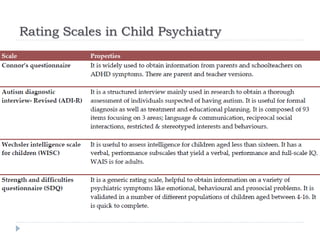
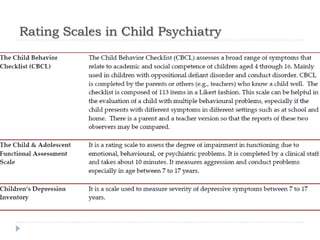
 Rating Scales in children
 References
Anxiety Disorders in children
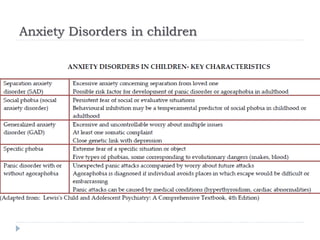
 Prevalence 5 - 15%
 Male: female ratio is equal in childhood, and 1:2 in adolescence
 Separation anxiety disorder - 3.5% in children and 0.8% in adolescents
 Generalized anxiety disorder - approximately 4% of adolescents
 Simple Phobia - 10% in some studies; twice as common in females
 Social phobia - 1% in children and between 5 -15% in adolescents
 Panic disorder - 3-6%, peak onset 15 -19 years
 Tearfulness and clinging in preschool children
 Somatic and hypochondriacal complaints in middle childhood (5-12 years)
 Irritability and aggression in middle childhood
Anxiety Disorders in children
 Co-morbidity:
 Up to 90% of young people have a co-morbid diagnosis
 Commonly mood disorders and depression (8.2 times more likely)
 Separation anxiety disorder:
 Developmentally inappropriate and excessive anxiety concerning
separation from home or from those to whom the individual is attached
 Interfere with normal age appropriate functioning
 Excessive worry about losing or being permanently separated from a
major attachment figure
 Symptoms: anxiety about separation, sleep disturbances, refusal to go to
sleep without attachment figure, school refusal, nausea/ vomiting,
headache, stomach ache, etc
Anxiety Disorders in children
 Different patterns of attachment:
 Secure (about 60%) – child uses carer as secure base but able to explore freely
and go back to caregiver for comfort if necessary
 Insecure, avoidant/anxious type (about 15%) – appears interested in
caregiver, minimal distress at separation, sometimes ignores/avoids caregiver
 Insecure, ambivalent/resistant type (about 10%) – high levels of distress upon
separation, resist comforting and can take a while to settle (often inconsistent care
giving)
 Disorganized/disorientated (about 15%) – child displays contradictory behavior
patterns (arises from either the child experiencing the caregiver as frightening or the
caregiver being frightened themselves)
Anxiety Disorders in children
 Attachment disorders:
 Reactive attachment disorder:
 Persistent abnormalities in the child’s pattern of social relationships,
associated with emotional disturbance and reactive to changes in
environment
 Before the age of 5 years, manifest as inhibited or disinhibited
 More common in poverty stricken and socially disrupted environments
 Causes: direct result of severe parental neglect, abuse and serious
mishandling OR a young, isolated, inexperienced, and/or depressed
caretaker
 Features:
 Fearfulness and hyper-vigilance that do not respond to comforting
 Poor social interaction with peers
 Aggression towards self & others
Anxiety Disorders in children
 Disinhibited attachment disorder:
 Particular pattern of abnormal social functioning in first 5 years of life
 Usually manifest by clinging and diffuse non selectively focused attachment
behavior
 Later, clinging tends to be replaced by attention seeking and
indiscriminately friendly behavior
 Sibling rivalry disorder:
 Within 6 months of the birth of an immediately younger sibling
 Emotional disturbance that is abnormal in degree and/or persistence
 Anxiety, regression, tantrums, sleep difficulties, oppositional behavior or
attention seeking behavior
 Strong reluctance to share and a lack of positive regard to, the sibling
Anxiety Disorders in children
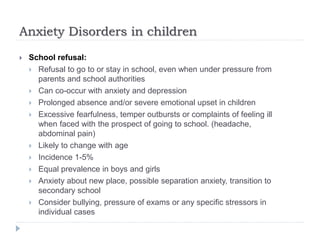
 School refusal:
 Refusal to go to or stay in school, even when under pressure from
parents and school authorities
 Can co-occur with anxiety and depression
 Prolonged absence and/or severe emotional upset in children
 Excessive fearfulness, temper outbursts or complaints of feeling ill
when faced with the prospect of going to school. (headache,
abdominal pain)
 Likely to change with age
 Incidence 1-5%
 Equal prevalence in boys and girls
 Anxiety about new place, possible separation anxiety, transition to
secondary school
 Consider bullying, pressure of exams or any specific stressors in
individual cases
Anxiety Disorders in children
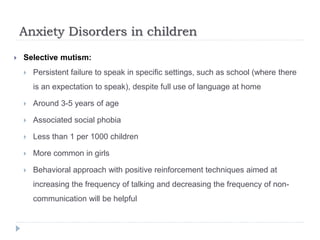
 Selective mutism:
 Persistent failure to speak in specific settings, such as school (where there
is an expectation to speak), despite full use of language at home
 Around 3-5 years of age
 Associated social phobia
 Less than 1 per 1000 children
 More common in girls
 Behavioral approach with positive reinforcement techniques aimed at
increasing the frequency of talking and decreasing the frequency of non-
communication will be helpful
Anxiety Disorders in children
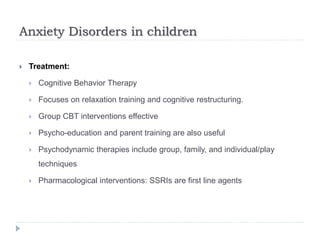
 Treatment:
 Cognitive Behavior Therapy
 Focuses on relaxation training and cognitive restructuring.
 Group CBT interventions effective
 Psycho-education and parent training are also useful
 Psychodynamic therapies include group, family, and individual/play
techniques
 Pharmacological interventions: SSRIs are first line agents
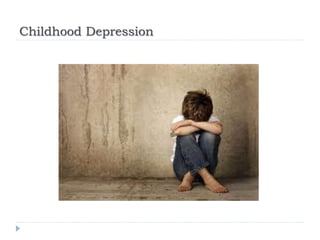
Childhood Depression
 Pure clinical depression very uncommon before puberty
 Prevalence pre-puberty: about 1%, no sex difference and post-puberty: about
3%, commoner in females
 50% remain clinically depressed after 12 months
 Adolescent depression shows significant continuity into adulthood (30% will
have a recurrence within 5 years)
 The single most important distinction between depression and the normal ups
and downs of childhood and adolescence is that depression is associated with
functional impairment, mediated through the intensity, duration and lack of
responsiveness of depressed mood and associated symptoms
Childhood Depression
 Clinical features:
 Young children: Poor feeding, failure to thrive, tantrums, irritability,
separation anxiety, hyperactivity, regressed behavior such as enuresis
 Older children: Somatization like pain in head, abdomen, chest and/or
Hypochondriacal ideas, school refusal, Poor academic achievement at
school, decline in school work, sleep disturbance, antisocial behavior
 Adolescents: Low mood, anhedonia and social withdrawal are powerful
indicators along with low self-esteem, biological symptoms, suicidal acts
or substance abuse
Childhood Depression
 Risk factors:
 Psychosocial difficulties
 Family history of depression
 Early loss of a parent
 Parental separation, divorce and marital conflict
 History of abuse (physical, emotional or sexual)
 Co-morbidity:
 Is the rule (50-80%) rather than the exception
 Anxiety (50 – 80%) is frequently a precursor of depression and mood
disorder
 Conduct disorder – 25%, OCD – 15%, eating disorder – 5%
 ADHD and depression are also often co morbid and may be co-
transmitted in families
 Alcohol, drug and tobacco abuse are also associated
Childhood Depression
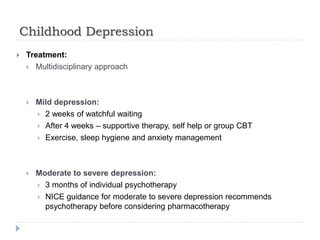
 Treatment:
 Multidisciplinary approach
 Mild depression:
 2 weeks of watchful waiting
 After 4 weeks – supportive therapy, self help or group CBT
 Exercise, sleep hygiene and anxiety management
 Moderate to severe depression:
 3 months of individual psychotherapy
 NICE guidance for moderate to severe depression recommends
psychotherapy before considering pharmacotherapy
Childhood Depression
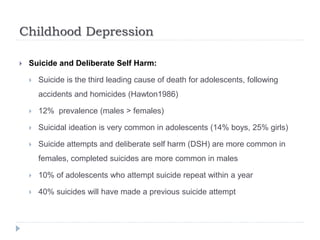
 Suicide and Deliberate Self Harm:
 Suicide is the third leading cause of death for adolescents, following
accidents and homicides (Hawton1986)
 12% prevalence (males > females)
 Suicidal ideation is very common in adolescents (14% boys, 25% girls)
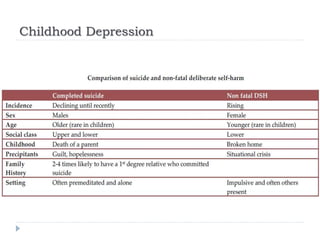
 Suicide attempts and deliberate self harm (DSH) are more common in
females, completed suicides are more common in males
 10% of adolescents who attempt suicide repeat within a year
 40% suicides will have made a previous suicide attempt
Childhood Depression
Childhood Mania
Childhood Mania
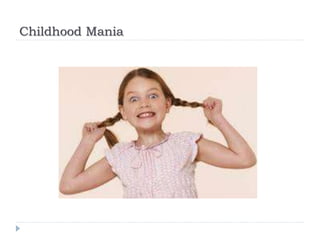
 Commonly reported symptoms: increased energy, distractibility, pressured
speech, irritability, grandiosity, racing thoughts, decreased need for sleep,
euphoria/elation, flight of ideas and poor judgement
 Typically present with atypical or mixed features characterized by irritability,
labile mood and behavioral problems
 Prevalence is approximately 1%
 M>F in childhood cases, M=F in adolescents
 Adults with Bipolar Disorder have consistently reported that up to 60% had the
onset of their mood symptoms before the age of 20 years
Childhood Mania
 Co-morbidity:
 Approximately 70% have ADHD, 40% ODD, 30% anxiety disorder, 40%
have substance misuse problems, 8% Tourette’s syndrome and 3% bulimia
nervosa
 Outcome:
 Early onset BPD has a poor outcome with 50% showing long-term decline
in function
 Suicide risk is approximately 10% completed attempts
 Treatment:
 NICE guidelines on bipolar disorder in children & adolescents recommend
using adult medication guidelines but in lower doses
 Atypical antipsychotics (Olanzapine, Risperidone) are preferred first line for
acute mania followed by valproate/lithium
 For maintenance the same choice of medication preferred
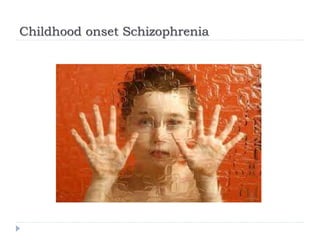
Childhood onset Schizophrenia
 Rare and severe
 Onset of psychotic symptoms by age 12 years
 Early - onset = before age 18
 Very early - onset schizophrenia = before 13 yrs
 Prevalence estimated to be 1 - 2 per 1,000, more in boys
 Characterized by more negative symptoms, disorganized behavior, greater
disorganization both of thought and sense of self and fewer systematized or
persecutory delusions
 More chronic course with less chance of a full recovery
 Children often socially rejected and clingy and have limited social skills
Childhood onset Schizophrenia
 Aetiology:
 Genetic factors: up to eight times more prevalent among first-degree
relatives
 Obstetric complications implicated (maternal infections like rubella,
obstetric complications like hypoxia)
 High expressed emotion, characterized by overly critical responses in
families, has been shown to be correlated with increased relapse
rates among patients with schizophrenia
 Early attentional deficits, deficits in social functioning, deficits in
organizational ability and a lower intellectual ability at age 16 and 17
predict later development of schizophrenia in at - risk individuals
Childhood onset Schizophrenia
 Course and outcome:
 Appears to be more malignant
 It seems to respond less to medication
 Prognosis may be poorer
 Predictors of outcome: child's level of functioning before the onset
of schizophrenia, the age of onset, IQ, duration of first episode,
duration of untreated psychosis, presence of negative symptoms,
response to pharmacological interventions, how much functioning the
child regained after the first episode, and the amount of support
available from the family
 Risk of suicide or accidental death as a result of psychotic symptoms
appears to be about 5% (adult suicide rate for schizophrenia is 10%)
Childhood onset Schizophrenia
 Treatment:
 Algorithms are the same as those for adults
 Atypical antipsychotics favored over typical ones
 Clozapine seems to be effective in treatment resistant psychosis in
adolescents
 Avoid depot and sedating antipsychotics
 Psychosocial treatments should include family work and focus on
psycho-education, social skills, and problem solving strategies and
CBT methods
Elimination Disorders
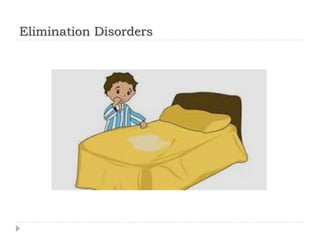
 Enuresis:
 Repeated voiding of urine into a child's clothes or bed
 May be involuntary or intentional
 Age at least 5 years, with duration at least 3 months
 Prevalence: 2-5% (twice as common in boys than girls)
 Can occur as a psychiatric complication of stressful life events or
emotional disturbances
 Primary or secondary
 Nocturnal or diurnal or mixed
 70% have a parent or sibling who was late in becoming dry
Elimination Disorders
 Daytime enuresis - likely to be related to structural abnormalities
 Sexual abuse is associated with secondary wetting
 Rule out organic factors: urinary tract infections, obstructions, genitourinary
pathology, neurological conditions like spina bifida, diabetes mellitus and diabetes
insipidus
 Often self-limiting
 Emotional and social difficulties: poor self image, social embarrassment
 The first step: review appropriate toilet training
 Psycho-education: Child with nocturnal enuresis is not being lazy (avoid
punishments)
 Enuresis alarm and star chart particularly helpful
 Medications: Imipramine/ Desmopressin (intranasal spray)
Elimination Disorders
 Encopresis:
 Voluntary or involuntary soiling of normally formed stools in inappropriate
places in a child of 4 years (mental age) or older, in the absence of a
sufficient organic cause
 At least once a month for 6 months
 Male : Female ratio nearly 6:1
 Up to 70% children may have chronic constipation
 Important to exclude organic cause such as Hirschprung'ʹs disease,
anorectal pathology, neurological problems, nutritional disorders and
medication side effects
 Associated with measures of maternal hostility, and harsh and punitive
parenting
Elimination Disorders
 Treatment:
 Assessment, including imaging of the gut if indicated
 Evacuate any stool
 Use of laxatives
 Operant training with rewards and positive reinforcement
 Family support/therapy: reduce the family tensions establish a non-punitive
atmosphere
 Self-limiting, mostly stops by the age of 16 years
Rating Scales in Child Psychiatry
References
 Kaplan and Sadock’s Synopsis of Psychiatry
 Rutter’s Textbook of Child Psychiatry
 SPMM Clinical Notes in Child Psychiatry
Child Psychiatry - Part 2

Child Psychiatry - Part 2

  • 1.
    Child Psychiatry –Part 2 Dr Bhakti Murkey Assistant Professor, Department of Psychiatry (PMCH Udaipur)
  • 2.
    Outline  Classification (ICD-10) History taking in Child Psychiatry  ADHD  Autism  Asperger’s Syndrome  Intellectual Disability Disorder  Specific Learning Disorders  Tic Disorder  Disruptive Behavior Disorders  Oppositional Defiant Disorder  Conduct Disorder  Anxiety Disorders in children  Childhood Depression  Childhood Mania  Childhood onset Schizophrenia  Elimination Disorders  Rating Scales in children  References
  • 3.
  • 4.
    Anxiety Disorders inchildren  Prevalence 5 - 15%  Male: female ratio is equal in childhood, and 1:2 in adolescence  Separation anxiety disorder - 3.5% in children and 0.8% in adolescents  Generalized anxiety disorder - approximately 4% of adolescents  Simple Phobia - 10% in some studies; twice as common in females  Social phobia - 1% in children and between 5 -15% in adolescents  Panic disorder - 3-6%, peak onset 15 -19 years  Tearfulness and clinging in preschool children  Somatic and hypochondriacal complaints in middle childhood (5-12 years)  Irritability and aggression in middle childhood
  • 5.
    Anxiety Disorders inchildren  Co-morbidity:  Up to 90% of young people have a co-morbid diagnosis  Commonly mood disorders and depression (8.2 times more likely)  Separation anxiety disorder:  Developmentally inappropriate and excessive anxiety concerning separation from home or from those to whom the individual is attached  Interfere with normal age appropriate functioning  Excessive worry about losing or being permanently separated from a major attachment figure  Symptoms: anxiety about separation, sleep disturbances, refusal to go to sleep without attachment figure, school refusal, nausea/ vomiting, headache, stomach ache, etc
  • 6.
    Anxiety Disorders inchildren  Different patterns of attachment:  Secure (about 60%) – child uses carer as secure base but able to explore freely and go back to caregiver for comfort if necessary  Insecure, avoidant/anxious type (about 15%) – appears interested in caregiver, minimal distress at separation, sometimes ignores/avoids caregiver  Insecure, ambivalent/resistant type (about 10%) – high levels of distress upon separation, resist comforting and can take a while to settle (often inconsistent care giving)  Disorganized/disorientated (about 15%) – child displays contradictory behavior patterns (arises from either the child experiencing the caregiver as frightening or the caregiver being frightened themselves)
  • 7.
    Anxiety Disorders inchildren  Attachment disorders:  Reactive attachment disorder:  Persistent abnormalities in the child’s pattern of social relationships, associated with emotional disturbance and reactive to changes in environment  Before the age of 5 years, manifest as inhibited or disinhibited  More common in poverty stricken and socially disrupted environments  Causes: direct result of severe parental neglect, abuse and serious mishandling OR a young, isolated, inexperienced, and/or depressed caretaker  Features:  Fearfulness and hyper-vigilance that do not respond to comforting  Poor social interaction with peers  Aggression towards self & others
  • 8.
    Anxiety Disorders inchildren  Disinhibited attachment disorder:  Particular pattern of abnormal social functioning in first 5 years of life  Usually manifest by clinging and diffuse non selectively focused attachment behavior  Later, clinging tends to be replaced by attention seeking and indiscriminately friendly behavior  Sibling rivalry disorder:  Within 6 months of the birth of an immediately younger sibling  Emotional disturbance that is abnormal in degree and/or persistence  Anxiety, regression, tantrums, sleep difficulties, oppositional behavior or attention seeking behavior  Strong reluctance to share and a lack of positive regard to, the sibling
  • 9.
    Anxiety Disorders inchildren  School refusal:  Refusal to go to or stay in school, even when under pressure from parents and school authorities  Can co-occur with anxiety and depression  Prolonged absence and/or severe emotional upset in children  Excessive fearfulness, temper outbursts or complaints of feeling ill when faced with the prospect of going to school. (headache, abdominal pain)  Likely to change with age  Incidence 1-5%  Equal prevalence in boys and girls  Anxiety about new place, possible separation anxiety, transition to secondary school  Consider bullying, pressure of exams or any specific stressors in individual cases
  • 10.
    Anxiety Disorders inchildren  Selective mutism:  Persistent failure to speak in specific settings, such as school (where there is an expectation to speak), despite full use of language at home  Around 3-5 years of age  Associated social phobia  Less than 1 per 1000 children  More common in girls  Behavioral approach with positive reinforcement techniques aimed at increasing the frequency of talking and decreasing the frequency of non- communication will be helpful
  • 11.
  • 12.
    Anxiety Disorders inchildren  Treatment:  Cognitive Behavior Therapy  Focuses on relaxation training and cognitive restructuring.  Group CBT interventions effective  Psycho-education and parent training are also useful  Psychodynamic therapies include group, family, and individual/play techniques  Pharmacological interventions: SSRIs are first line agents
  • 13.
  • 14.
    Childhood Depression  Pureclinical depression very uncommon before puberty  Prevalence pre-puberty: about 1%, no sex difference and post-puberty: about 3%, commoner in females  50% remain clinically depressed after 12 months  Adolescent depression shows significant continuity into adulthood (30% will have a recurrence within 5 years)  The single most important distinction between depression and the normal ups and downs of childhood and adolescence is that depression is associated with functional impairment, mediated through the intensity, duration and lack of responsiveness of depressed mood and associated symptoms
  • 15.
    Childhood Depression  Clinicalfeatures:  Young children: Poor feeding, failure to thrive, tantrums, irritability, separation anxiety, hyperactivity, regressed behavior such as enuresis  Older children: Somatization like pain in head, abdomen, chest and/or Hypochondriacal ideas, school refusal, Poor academic achievement at school, decline in school work, sleep disturbance, antisocial behavior  Adolescents: Low mood, anhedonia and social withdrawal are powerful indicators along with low self-esteem, biological symptoms, suicidal acts or substance abuse
  • 16.
    Childhood Depression  Riskfactors:  Psychosocial difficulties  Family history of depression  Early loss of a parent  Parental separation, divorce and marital conflict  History of abuse (physical, emotional or sexual)  Co-morbidity:  Is the rule (50-80%) rather than the exception  Anxiety (50 – 80%) is frequently a precursor of depression and mood disorder  Conduct disorder – 25%, OCD – 15%, eating disorder – 5%  ADHD and depression are also often co morbid and may be co- transmitted in families  Alcohol, drug and tobacco abuse are also associated
  • 17.
    Childhood Depression  Treatment: Multidisciplinary approach  Mild depression:  2 weeks of watchful waiting  After 4 weeks – supportive therapy, self help or group CBT  Exercise, sleep hygiene and anxiety management  Moderate to severe depression:  3 months of individual psychotherapy  NICE guidance for moderate to severe depression recommends psychotherapy before considering pharmacotherapy
  • 18.
    Childhood Depression  Suicideand Deliberate Self Harm:  Suicide is the third leading cause of death for adolescents, following accidents and homicides (Hawton1986)  12% prevalence (males > females)  Suicidal ideation is very common in adolescents (14% boys, 25% girls)  Suicide attempts and deliberate self harm (DSH) are more common in females, completed suicides are more common in males  10% of adolescents who attempt suicide repeat within a year  40% suicides will have made a previous suicide attempt
  • 19.
  • 20.
  • 21.
    Childhood Mania  Commonlyreported symptoms: increased energy, distractibility, pressured speech, irritability, grandiosity, racing thoughts, decreased need for sleep, euphoria/elation, flight of ideas and poor judgement  Typically present with atypical or mixed features characterized by irritability, labile mood and behavioral problems  Prevalence is approximately 1%  M>F in childhood cases, M=F in adolescents  Adults with Bipolar Disorder have consistently reported that up to 60% had the onset of their mood symptoms before the age of 20 years
  • 22.
    Childhood Mania  Co-morbidity: Approximately 70% have ADHD, 40% ODD, 30% anxiety disorder, 40% have substance misuse problems, 8% Tourette’s syndrome and 3% bulimia nervosa  Outcome:  Early onset BPD has a poor outcome with 50% showing long-term decline in function  Suicide risk is approximately 10% completed attempts  Treatment:  NICE guidelines on bipolar disorder in children & adolescents recommend using adult medication guidelines but in lower doses  Atypical antipsychotics (Olanzapine, Risperidone) are preferred first line for acute mania followed by valproate/lithium  For maintenance the same choice of medication preferred
  • 23.
  • 24.
    Childhood onset Schizophrenia Rare and severe  Onset of psychotic symptoms by age 12 years  Early - onset = before age 18  Very early - onset schizophrenia = before 13 yrs  Prevalence estimated to be 1 - 2 per 1,000, more in boys  Characterized by more negative symptoms, disorganized behavior, greater disorganization both of thought and sense of self and fewer systematized or persecutory delusions  More chronic course with less chance of a full recovery  Children often socially rejected and clingy and have limited social skills
  • 25.
    Childhood onset Schizophrenia Aetiology:  Genetic factors: up to eight times more prevalent among first-degree relatives  Obstetric complications implicated (maternal infections like rubella, obstetric complications like hypoxia)  High expressed emotion, characterized by overly critical responses in families, has been shown to be correlated with increased relapse rates among patients with schizophrenia  Early attentional deficits, deficits in social functioning, deficits in organizational ability and a lower intellectual ability at age 16 and 17 predict later development of schizophrenia in at - risk individuals
  • 26.
    Childhood onset Schizophrenia Course and outcome:  Appears to be more malignant  It seems to respond less to medication  Prognosis may be poorer  Predictors of outcome: child's level of functioning before the onset of schizophrenia, the age of onset, IQ, duration of first episode, duration of untreated psychosis, presence of negative symptoms, response to pharmacological interventions, how much functioning the child regained after the first episode, and the amount of support available from the family  Risk of suicide or accidental death as a result of psychotic symptoms appears to be about 5% (adult suicide rate for schizophrenia is 10%)
  • 27.
    Childhood onset Schizophrenia Treatment:  Algorithms are the same as those for adults  Atypical antipsychotics favored over typical ones  Clozapine seems to be effective in treatment resistant psychosis in adolescents  Avoid depot and sedating antipsychotics  Psychosocial treatments should include family work and focus on psycho-education, social skills, and problem solving strategies and CBT methods
  • 28.
  • 29.
    Elimination Disorders  Enuresis: Repeated voiding of urine into a child's clothes or bed  May be involuntary or intentional  Age at least 5 years, with duration at least 3 months  Prevalence: 2-5% (twice as common in boys than girls)  Can occur as a psychiatric complication of stressful life events or emotional disturbances  Primary or secondary  Nocturnal or diurnal or mixed  70% have a parent or sibling who was late in becoming dry
  • 30.
    Elimination Disorders  Daytimeenuresis - likely to be related to structural abnormalities  Sexual abuse is associated with secondary wetting  Rule out organic factors: urinary tract infections, obstructions, genitourinary pathology, neurological conditions like spina bifida, diabetes mellitus and diabetes insipidus  Often self-limiting  Emotional and social difficulties: poor self image, social embarrassment  The first step: review appropriate toilet training  Psycho-education: Child with nocturnal enuresis is not being lazy (avoid punishments)  Enuresis alarm and star chart particularly helpful  Medications: Imipramine/ Desmopressin (intranasal spray)
  • 31.
    Elimination Disorders  Encopresis: Voluntary or involuntary soiling of normally formed stools in inappropriate places in a child of 4 years (mental age) or older, in the absence of a sufficient organic cause  At least once a month for 6 months  Male : Female ratio nearly 6:1  Up to 70% children may have chronic constipation  Important to exclude organic cause such as Hirschprung'ʹs disease, anorectal pathology, neurological problems, nutritional disorders and medication side effects  Associated with measures of maternal hostility, and harsh and punitive parenting
  • 32.
    Elimination Disorders  Treatment: Assessment, including imaging of the gut if indicated  Evacuate any stool  Use of laxatives  Operant training with rewards and positive reinforcement  Family support/therapy: reduce the family tensions establish a non-punitive atmosphere  Self-limiting, mostly stops by the age of 16 years
  • 33.
    Rating Scales inChild Psychiatry
  • 34.
    Rating Scales inChild Psychiatry
  • 35.
    References  Kaplan andSadock’s Synopsis of Psychiatry  Rutter’s Textbook of Child Psychiatry  SPMM Clinical Notes in Child Psychiatry