Ivan Illich and me
Topics
Brand new world
Deschooling
Learning is the work
Resources


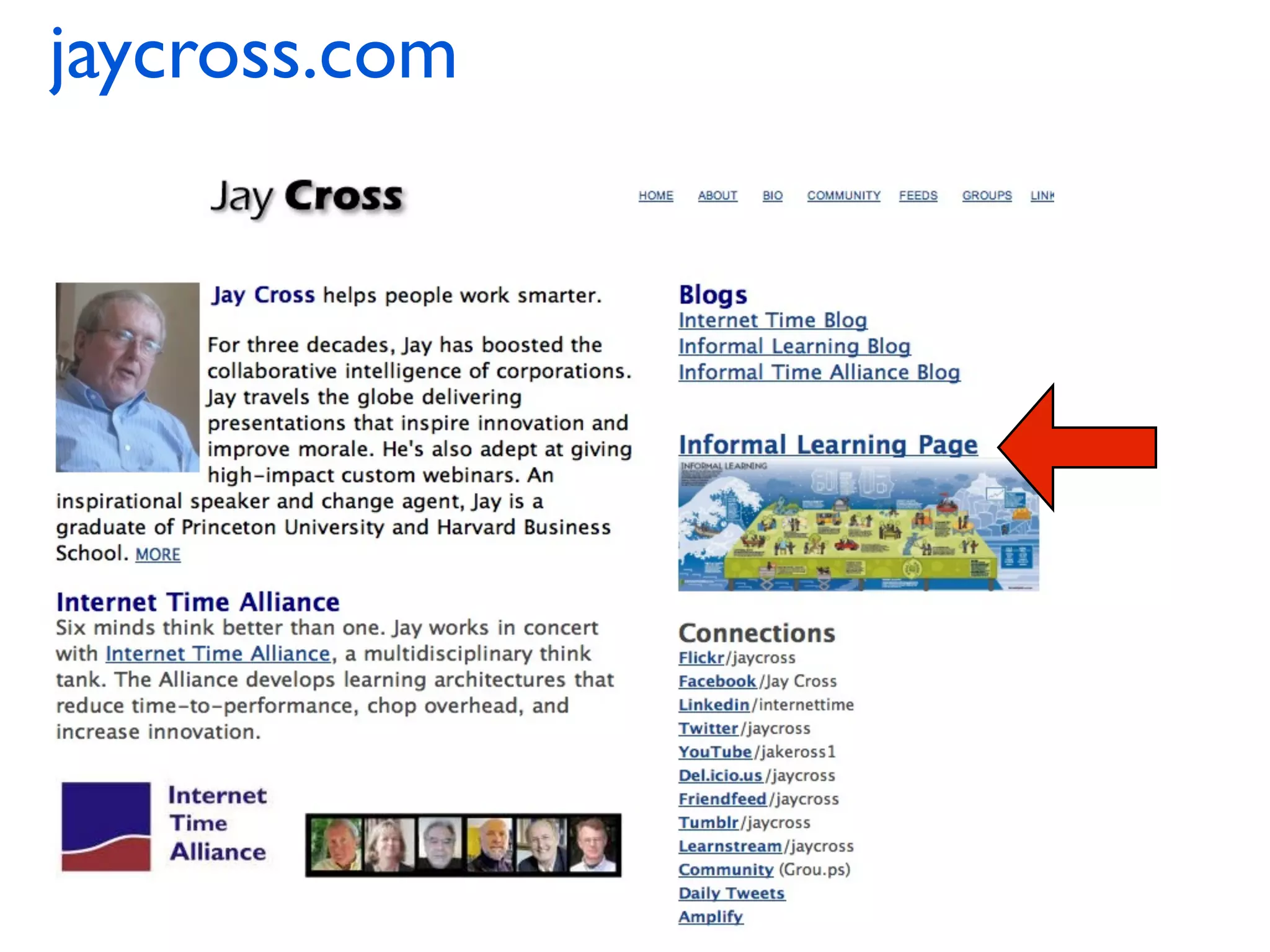
Jay Cross
jaycross.com
Deschooling
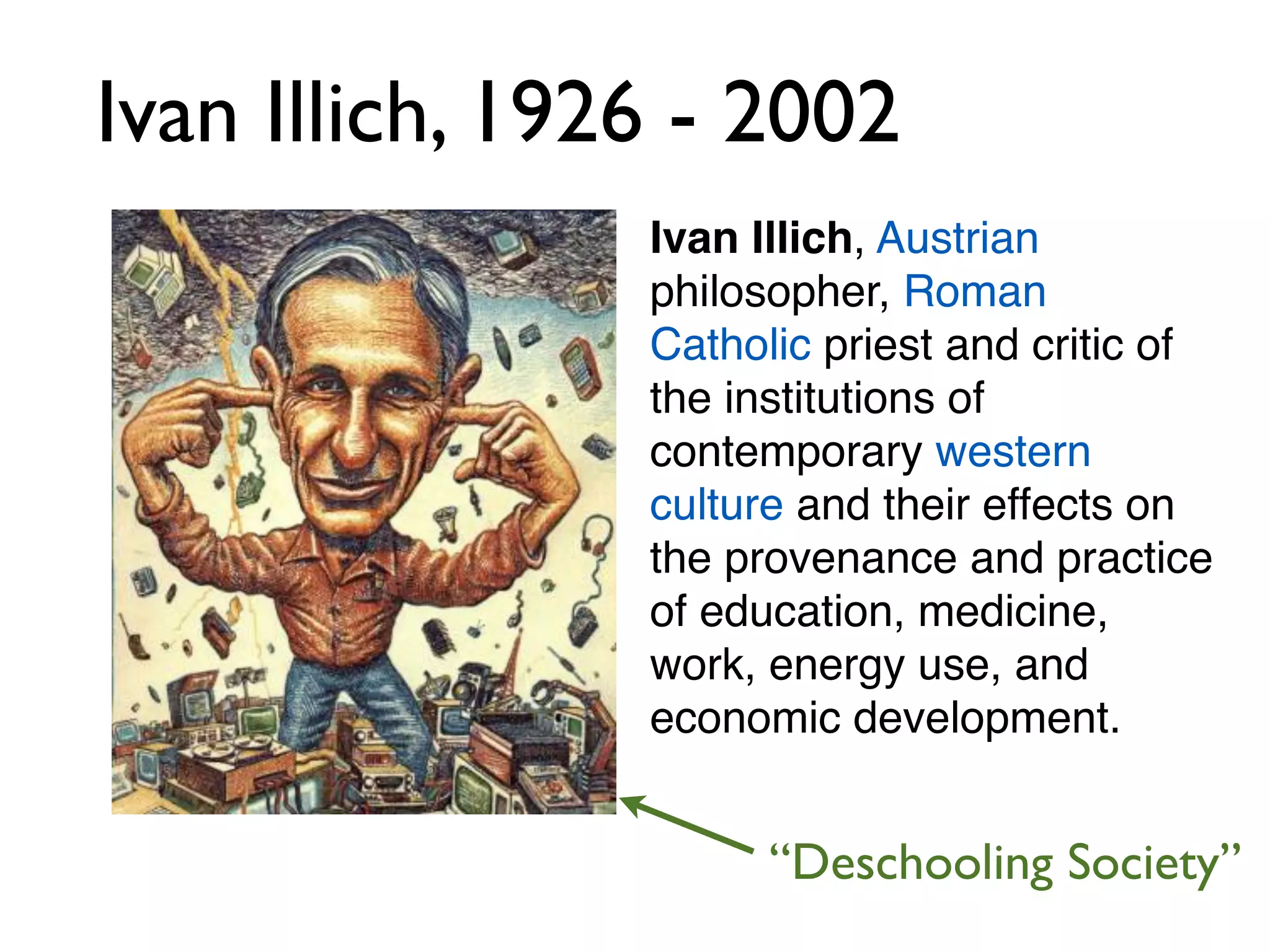
Ivan Illich, 1926 - 2002
                Ivan Illich, Austrian
                philosopher, Roman
                Catholic priest and critic of
                the institutions of
                contemporary western
                culture and their effects on
                the provenance and practice
                of education, medicine,
                work, energy use, and
                economic development.


                      “Deschooling Society”
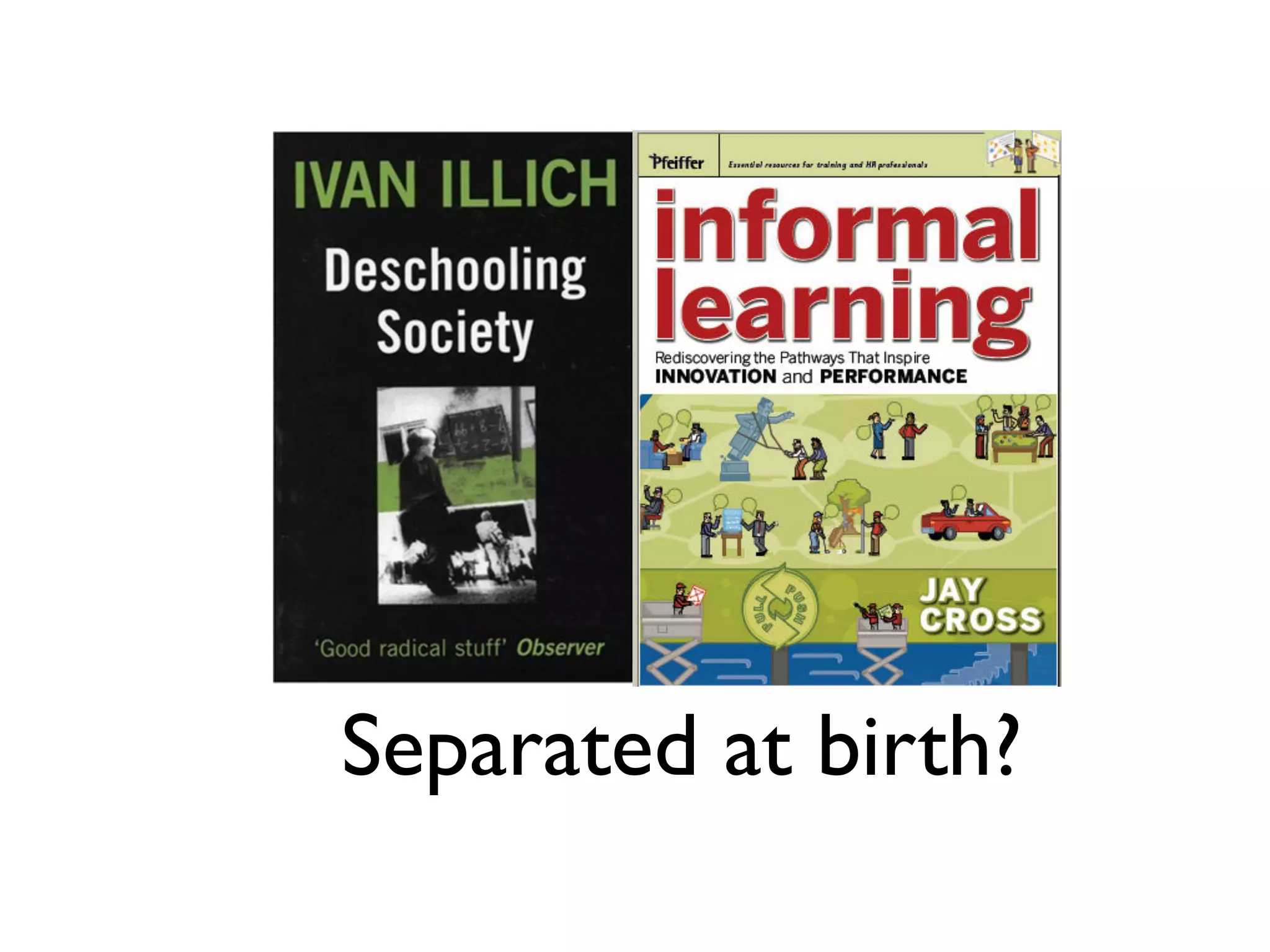
Separated at birth?
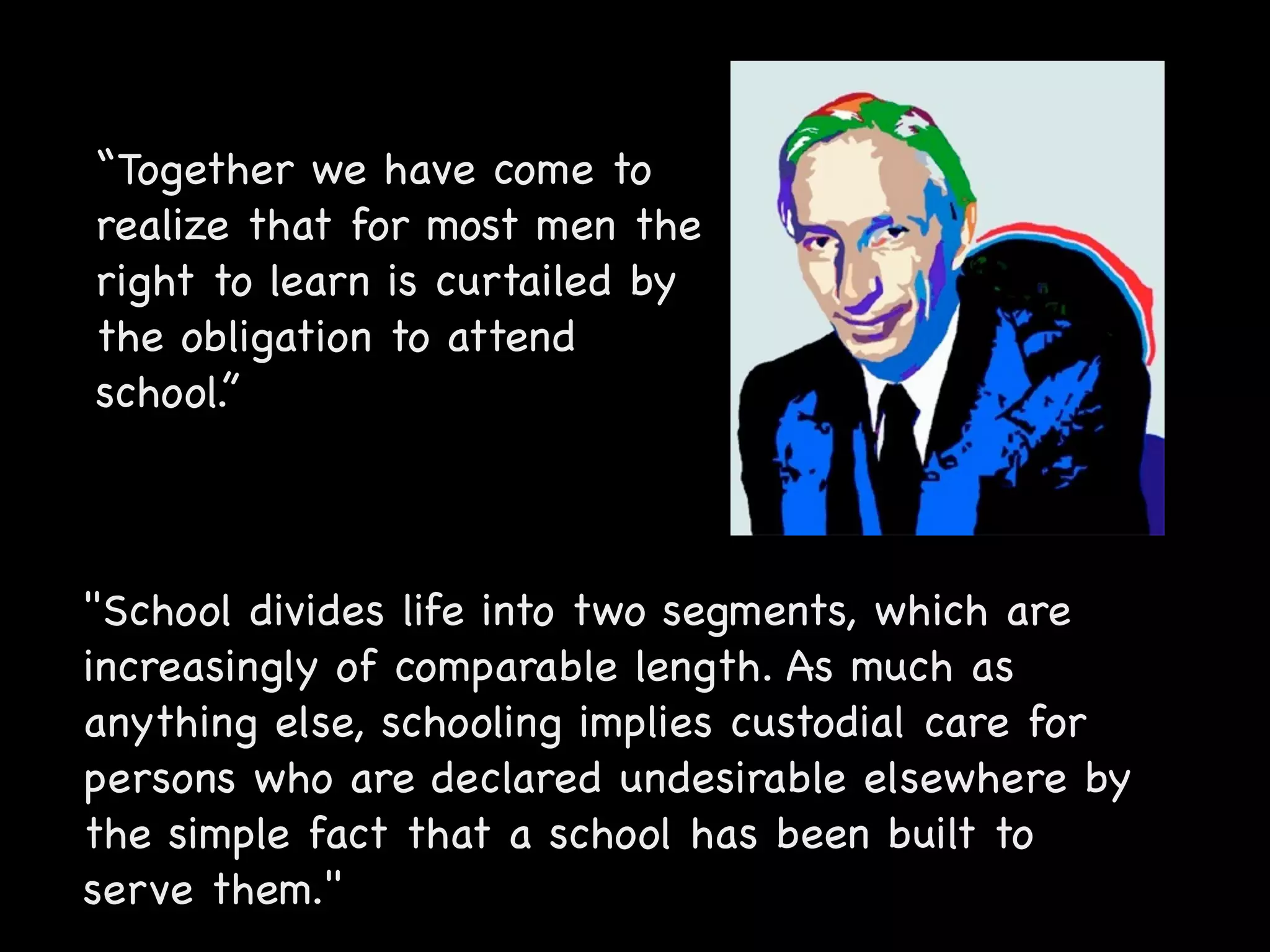
“Together we have come to
realize that for most men the
right to learn is curtailed by
the obligation to attend
school.”


"School divides life into two segments, which are
increasingly of comparable length. As much as
anything else, schooling implies custodial care for
persons who are declared undesirable elsewhere by
the simple fact that a school has been built to
serve them."
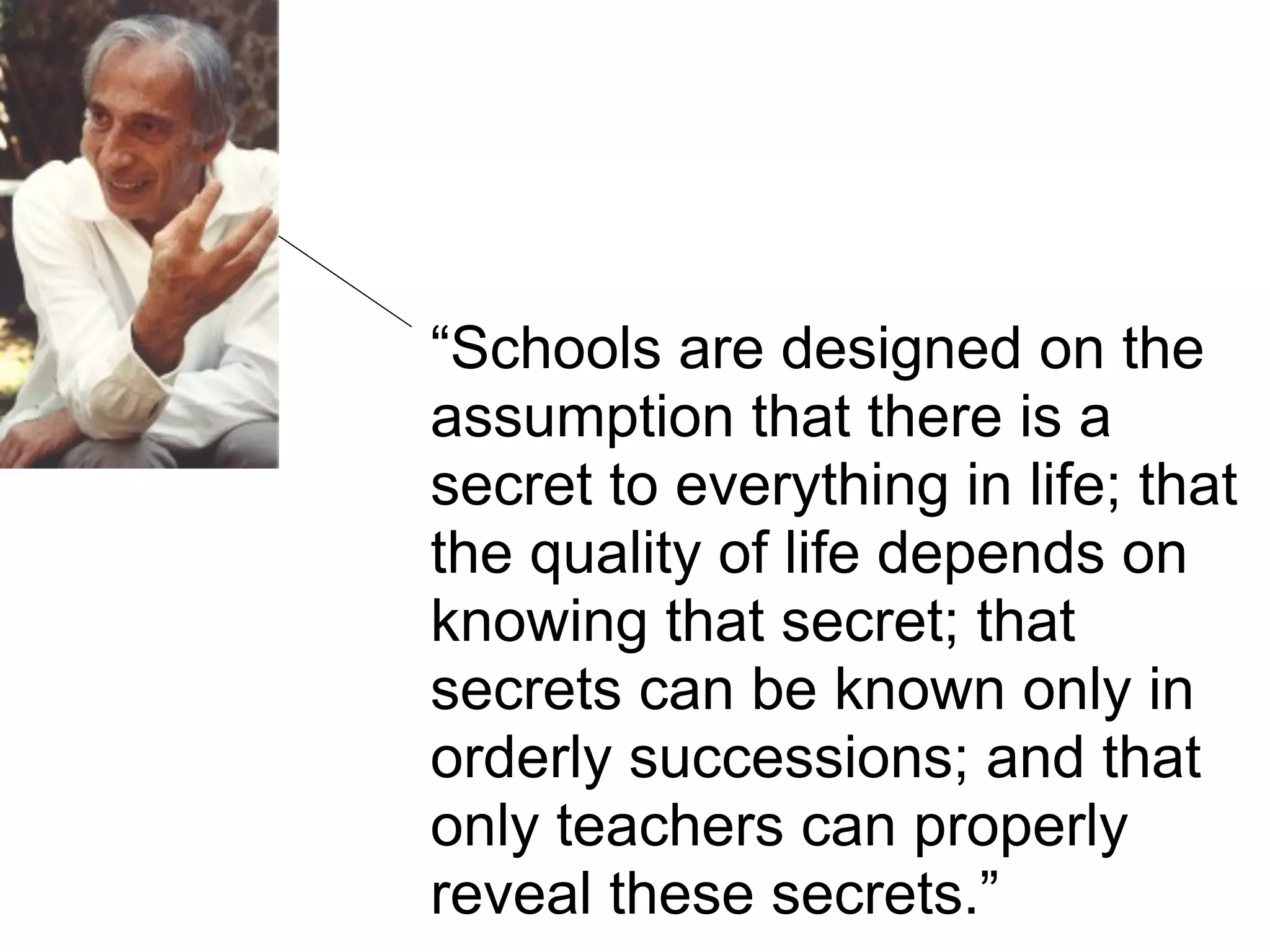
“Schools are designed on the
assumption that there is a
secret to everything in life; that
the quality of life depends on
knowing that secret; that
secrets can be known only in
orderly successions; and that
only teachers can properly
reveal these secrets.”
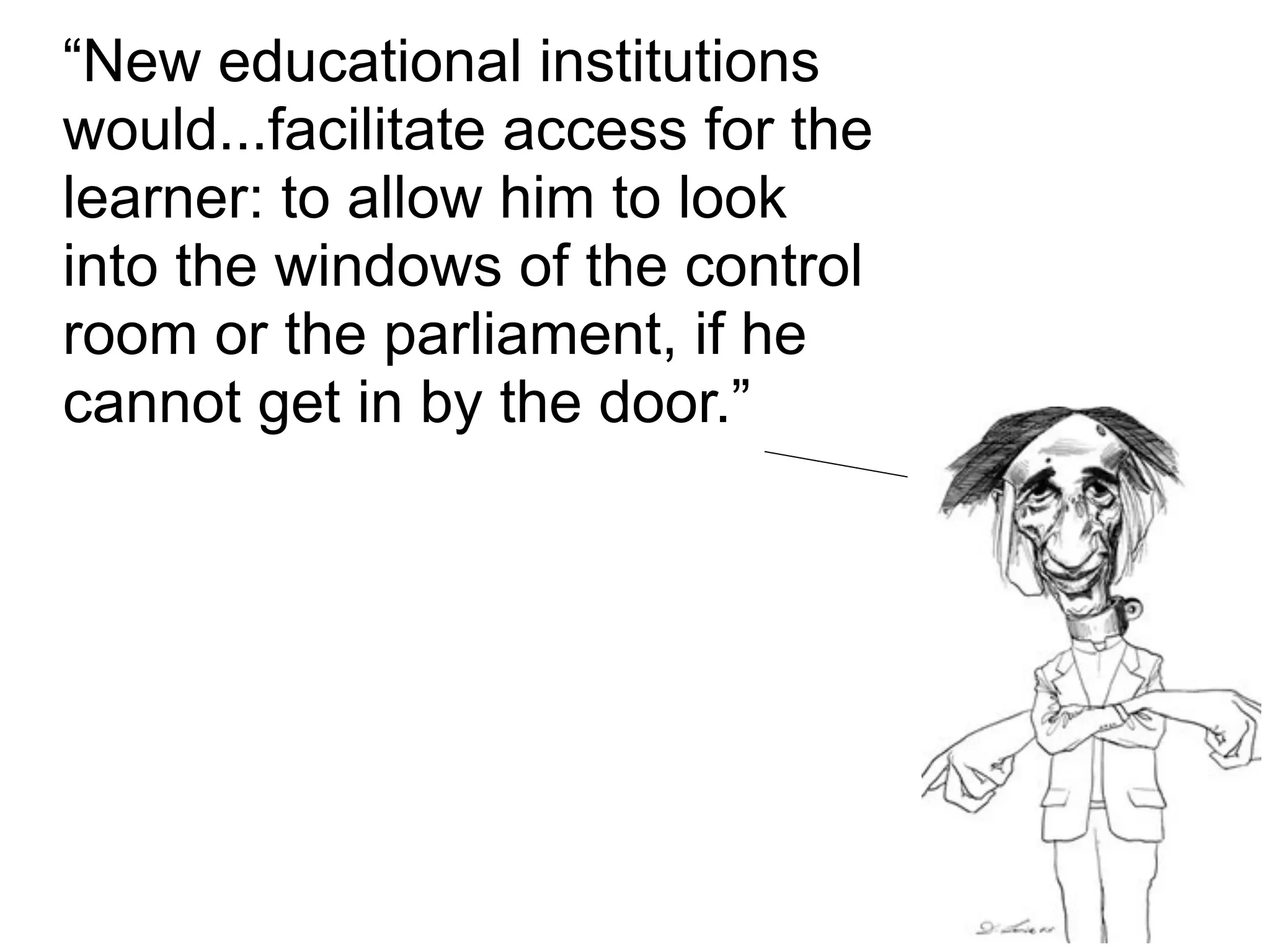
“New educational institutions
would...facilitate access for the
learner: to allow him to look
into the windows of the control
room or the parliament, if he
cannot get in by the door.”
“When pressed to specify how they acquired
what they know and value, will readily admit
that they learned it more often outside than
inside school. Their knowledge of facts, their
understanding of life and work came to them
from friendship or love, while viewing TV, or
while reading, from examples of peers or the
challenge of a street encounter. Or they may
have learned what they know through the
apprenticeship ritual for admission to a street
gang or the initiation to a hospital, newspaper
city room, plumber's shop, or insurance
office.”
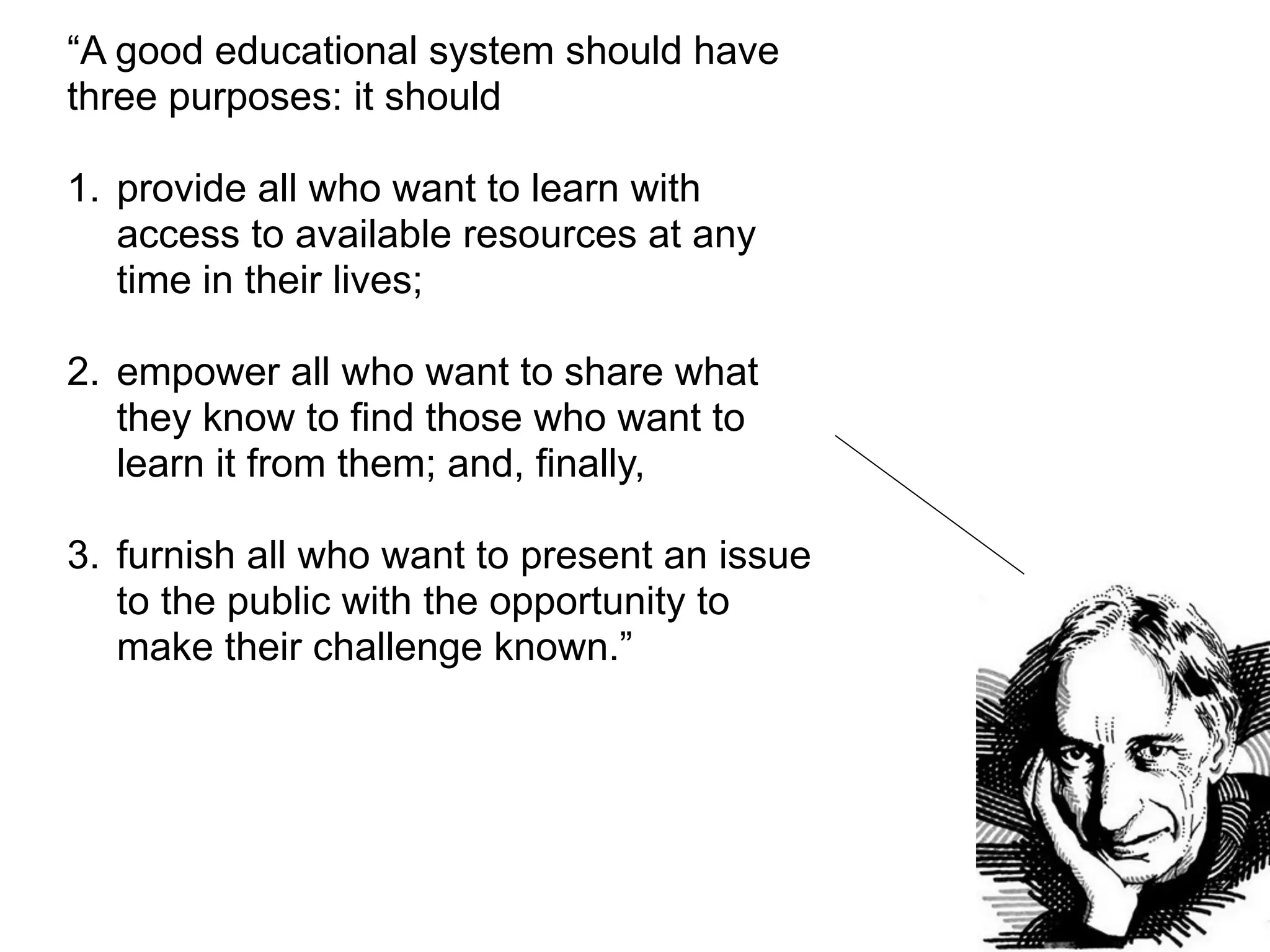
“A good educational system should have
three purposes: it should

1. provide all who want to learn with
   access to available resources at any
   time in their lives;

2. empower all who want to share what
   they know to find those who want to
   learn it from them; and, finally,

3. furnish all who want to present an issue
   to the public with the opportunity to
   make their challenge known.”
Why School is the Wrong Model for Learning


Irrelevant content
Not real world
Forgetting curve
Students seen as deficient
Taught by authority figure
Focus on individuals, not groups
Stifles creativity
Give answers rather than action
Assembly-line approach
“Ends” with graduation
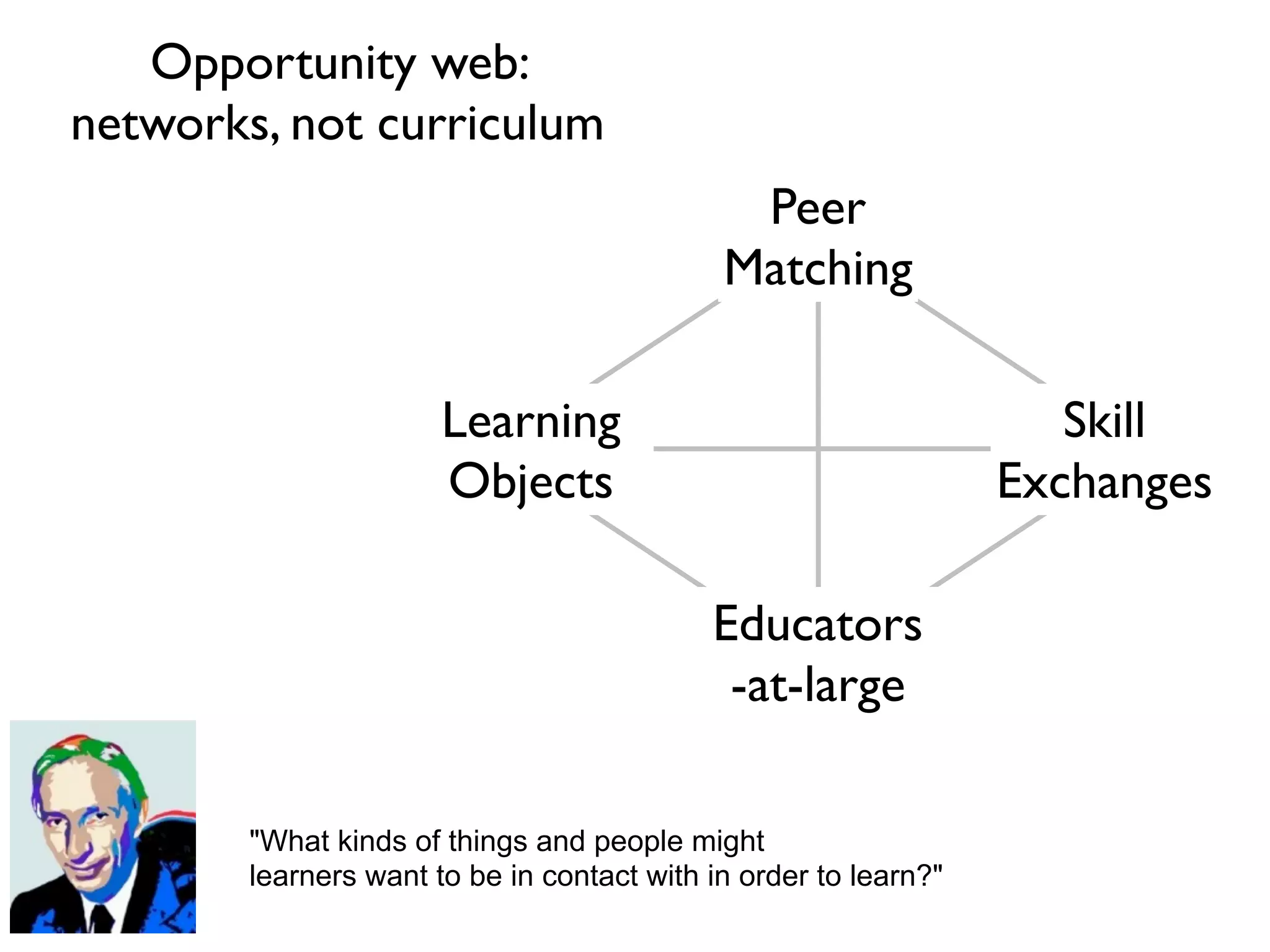
Opportunity web:
networks, not curriculum
                                              Peer
                                             Matching

                       Learning                                      Skill
                       Objects                                    Exchanges

                                            Educators
                                             -at-large

        "What kinds of things and people might
        learners want to be in contact with in order to learn?"
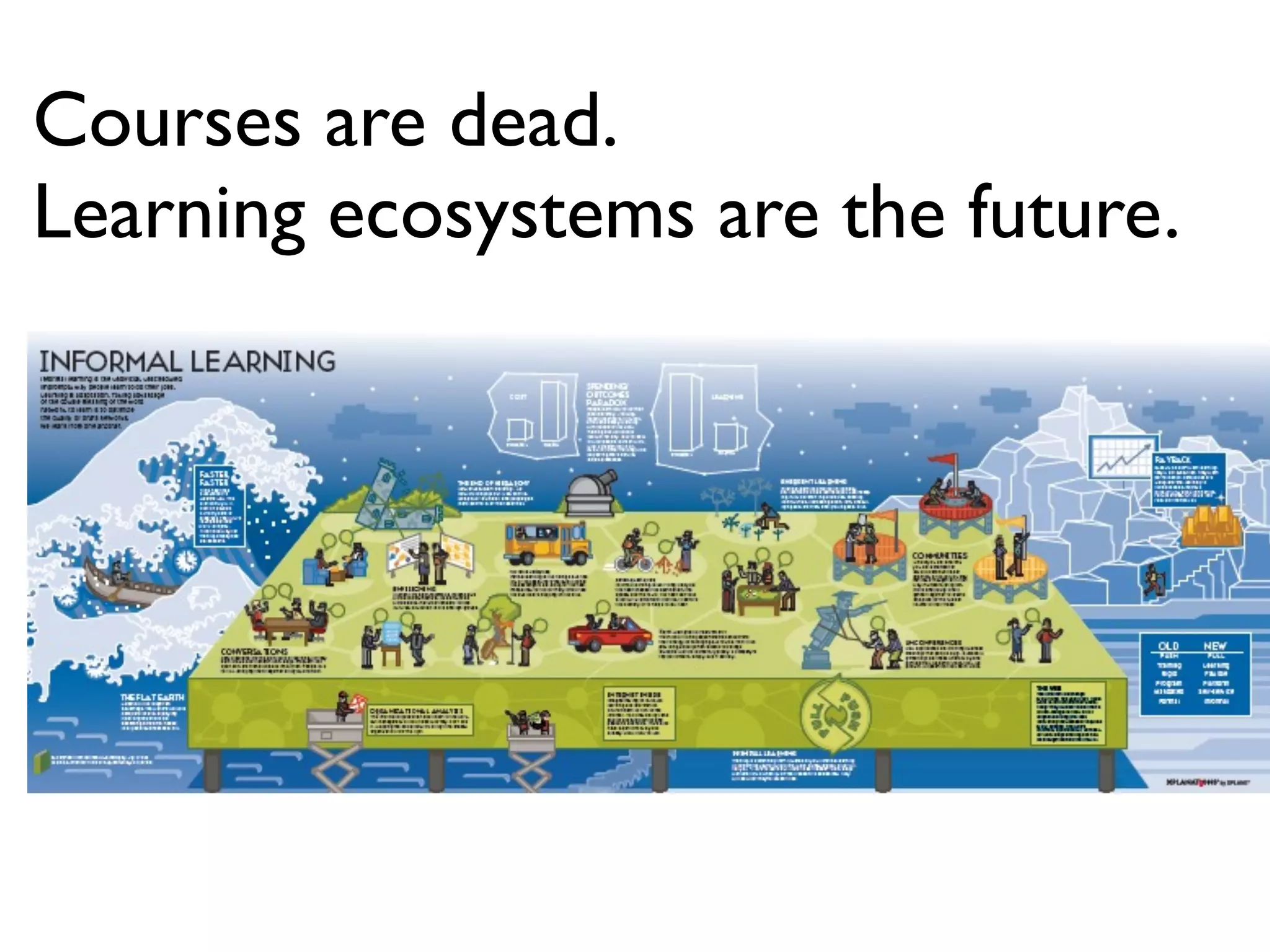
Courses are dead.
Learning ecosystems are the future.
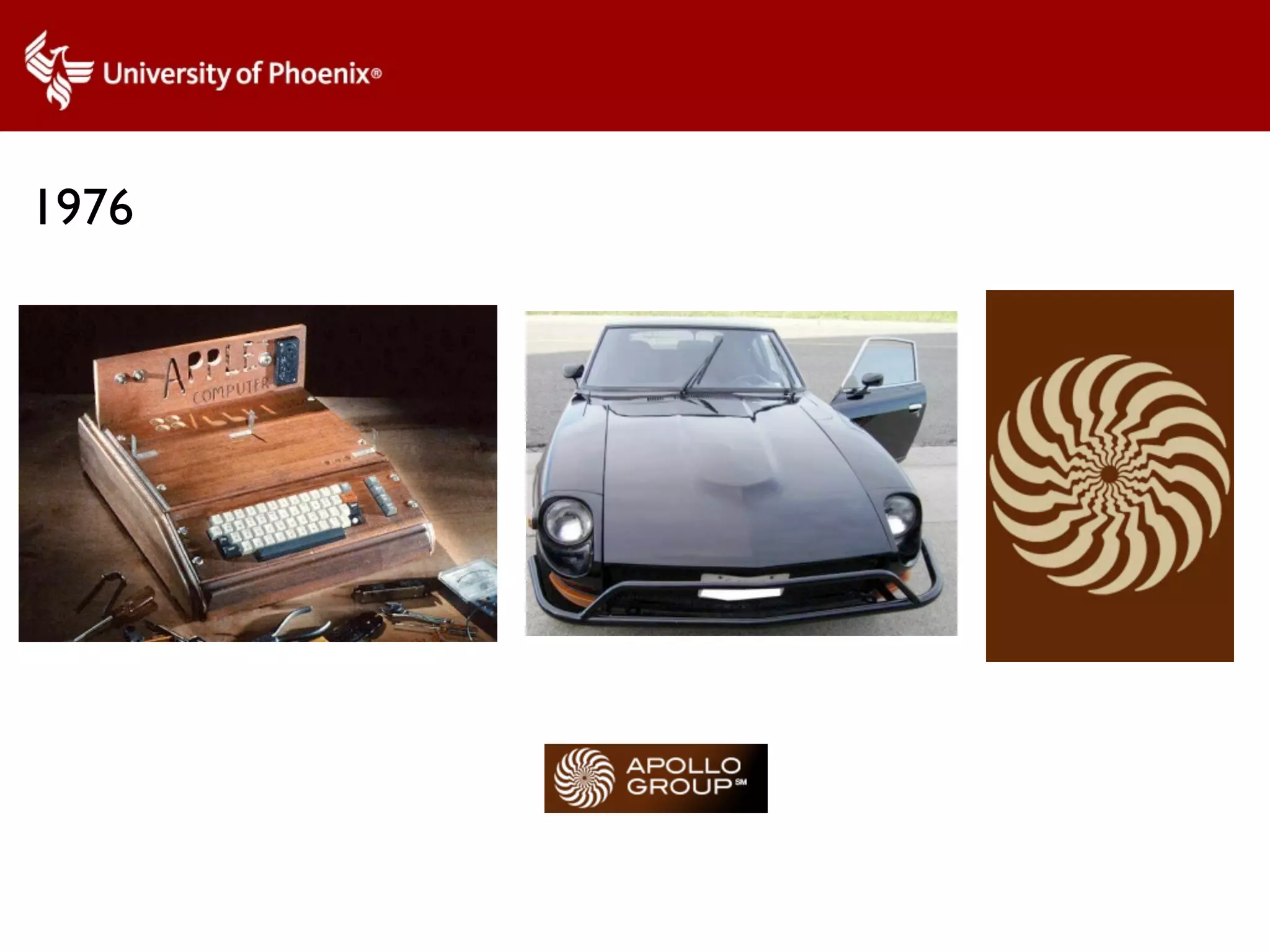
1976
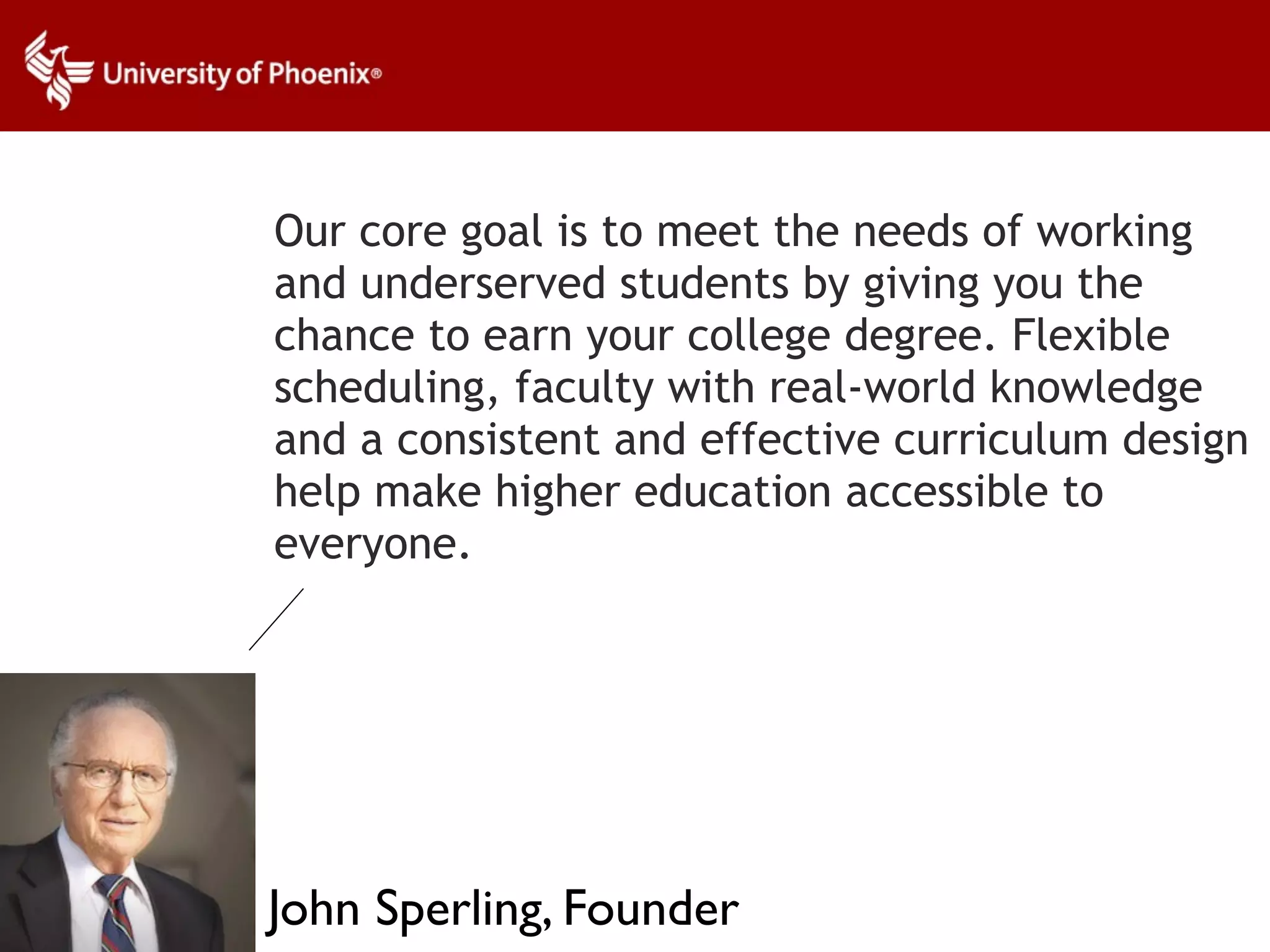
Our core goal is to meet the needs of working
and underserved students by giving you the
chance to earn your college degree. Flexible
scheduling, faculty with real-world knowledge
and a consistent and effective curriculum design
help make higher education accessible to
everyone.


John Sperling, Founder
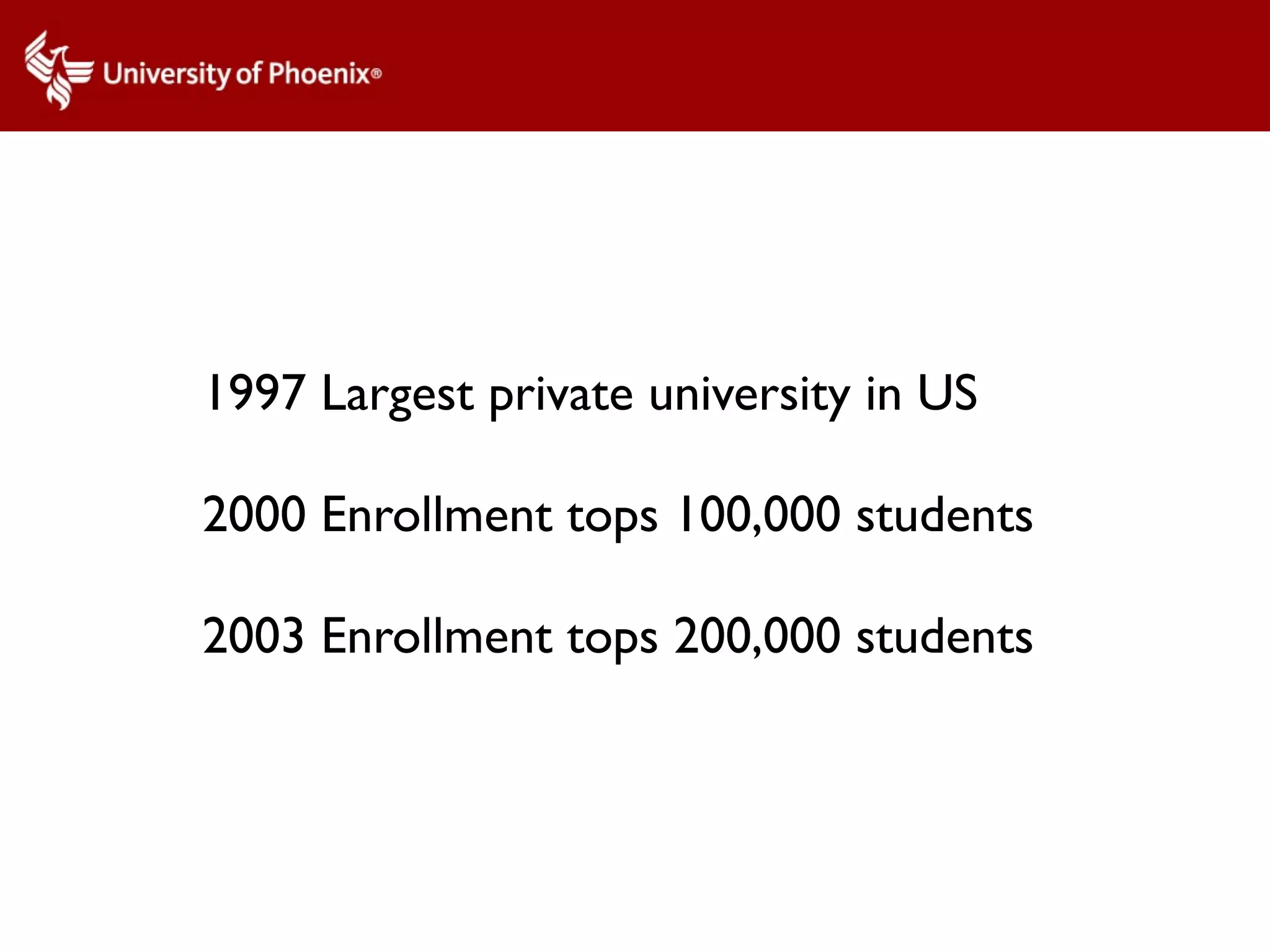
1997 Largest private university in US

2000 Enrollment tops 100,000 students

2003 Enrollment tops 200,000 students
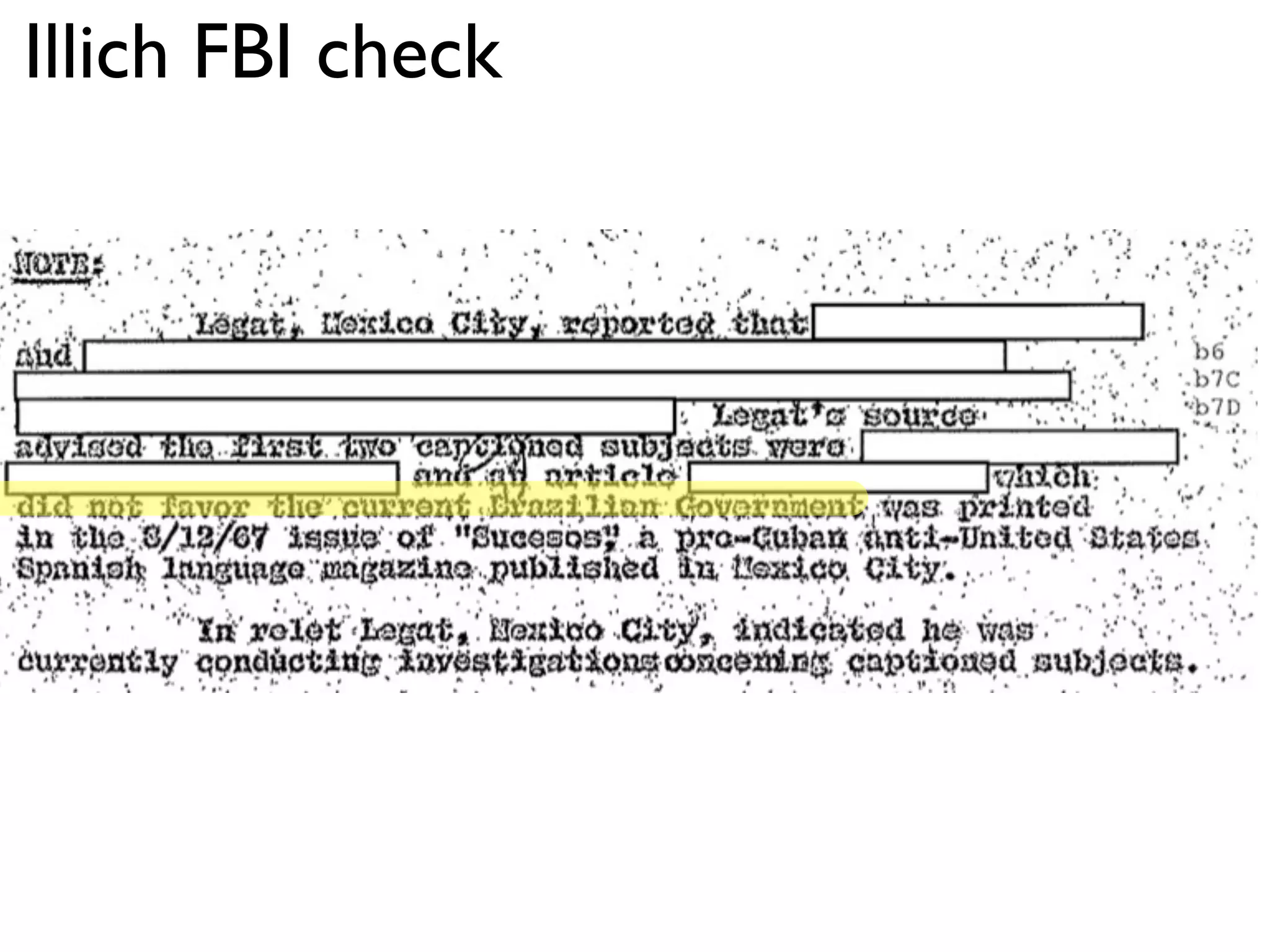
Illich FBI check
Illich FBI check
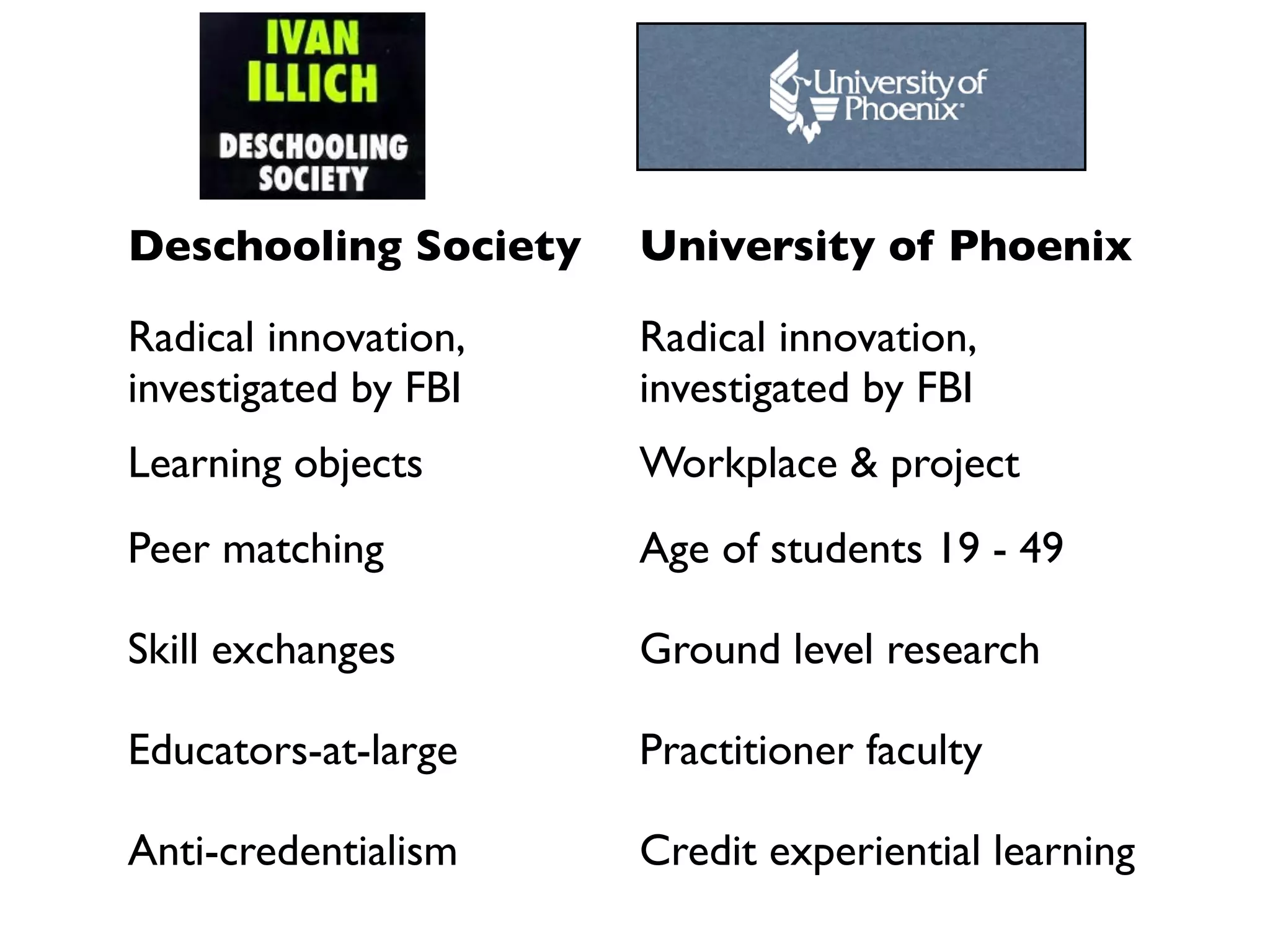
Deschooling Society   University of Phoenix

Radical innovation,   Radical innovation,
investigated by FBI   investigated by FBI
Learning objects      Workplace & project
Peer matching         Age of students 19 - 49

Skill exchanges       Ground level research

Educators-at-large    Practitioner faculty

Anti-credentialism    Credit experiential learning
Resources
jaycross.com
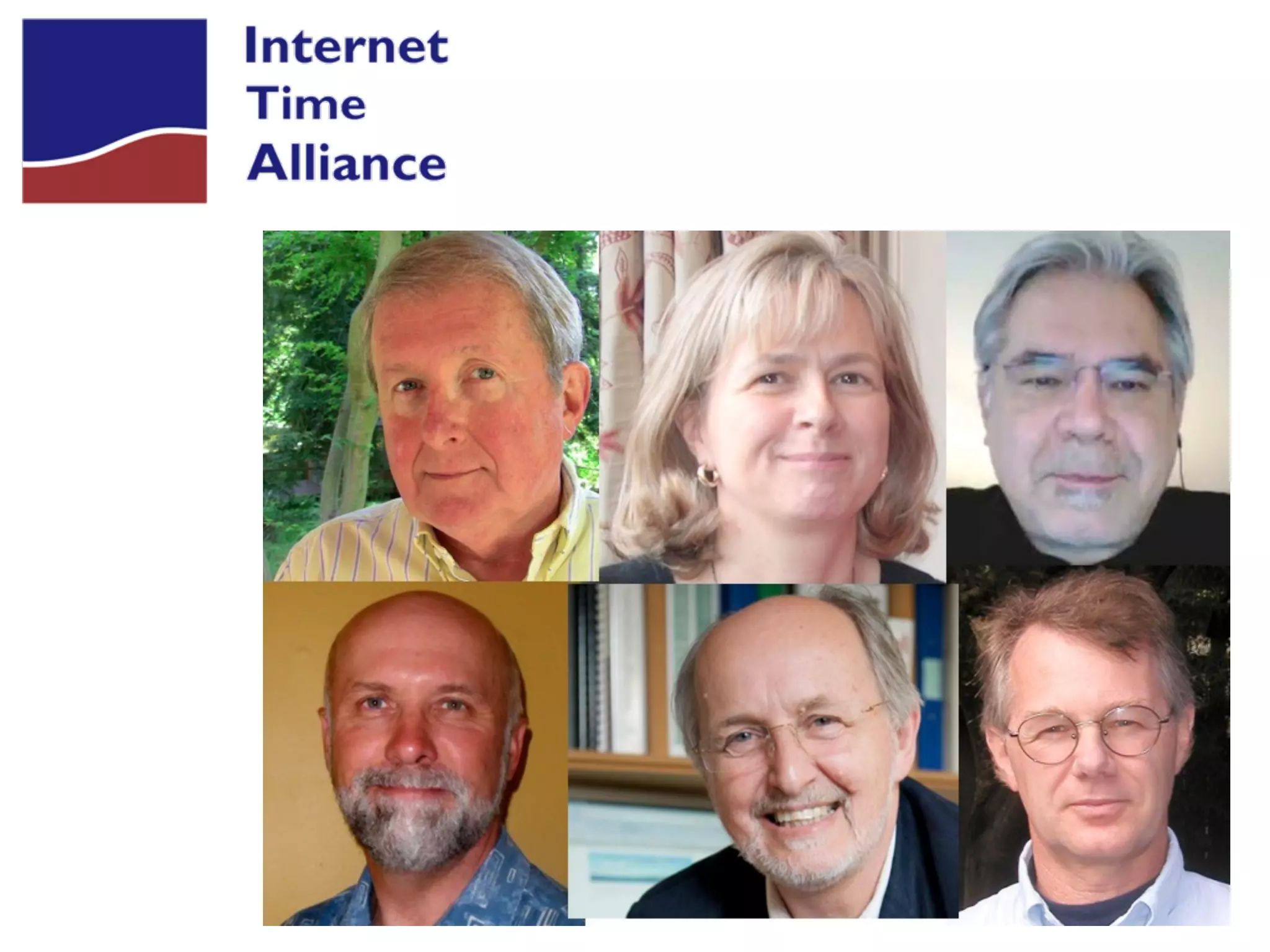
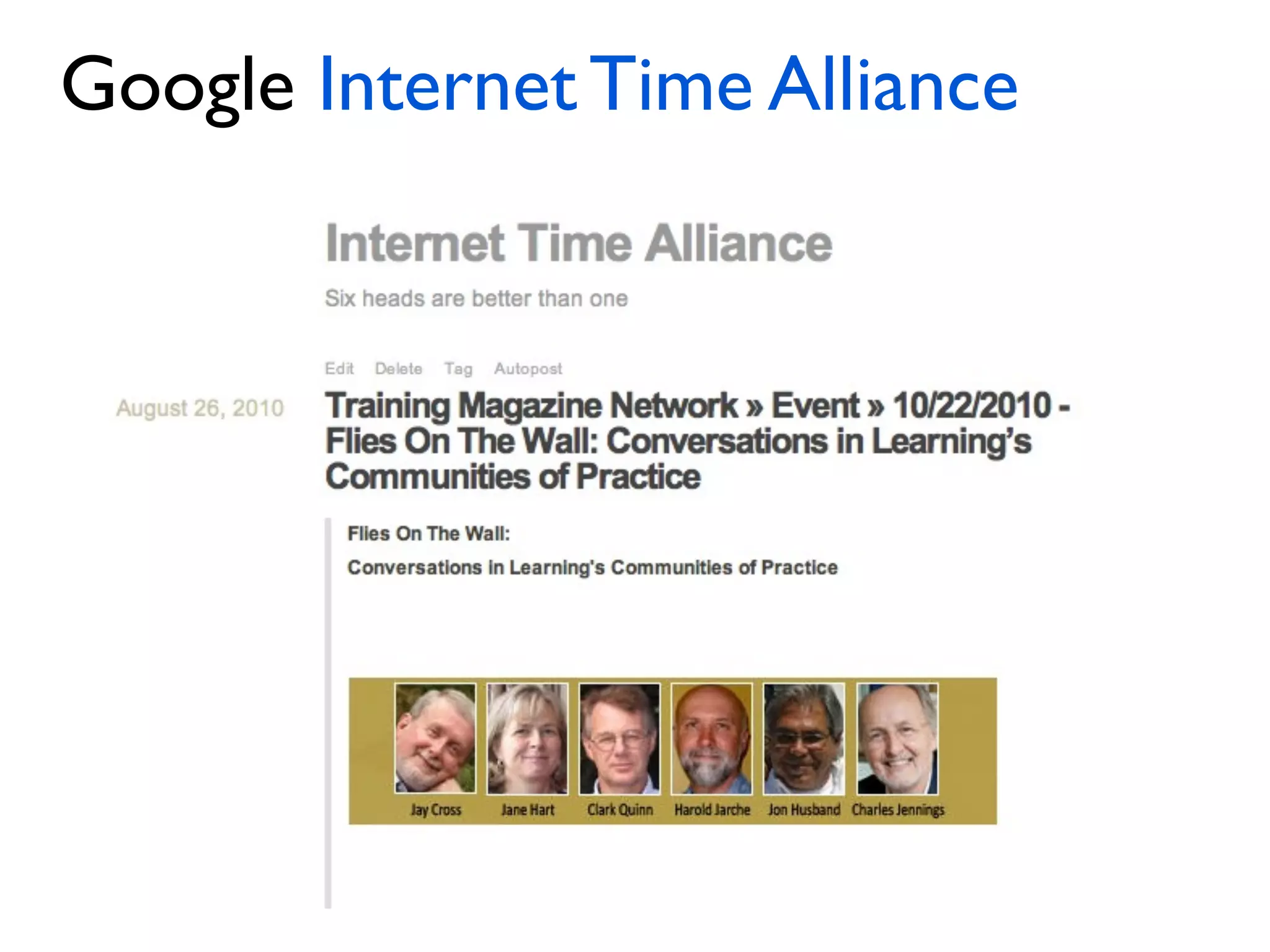
Google Internet Time Alliance
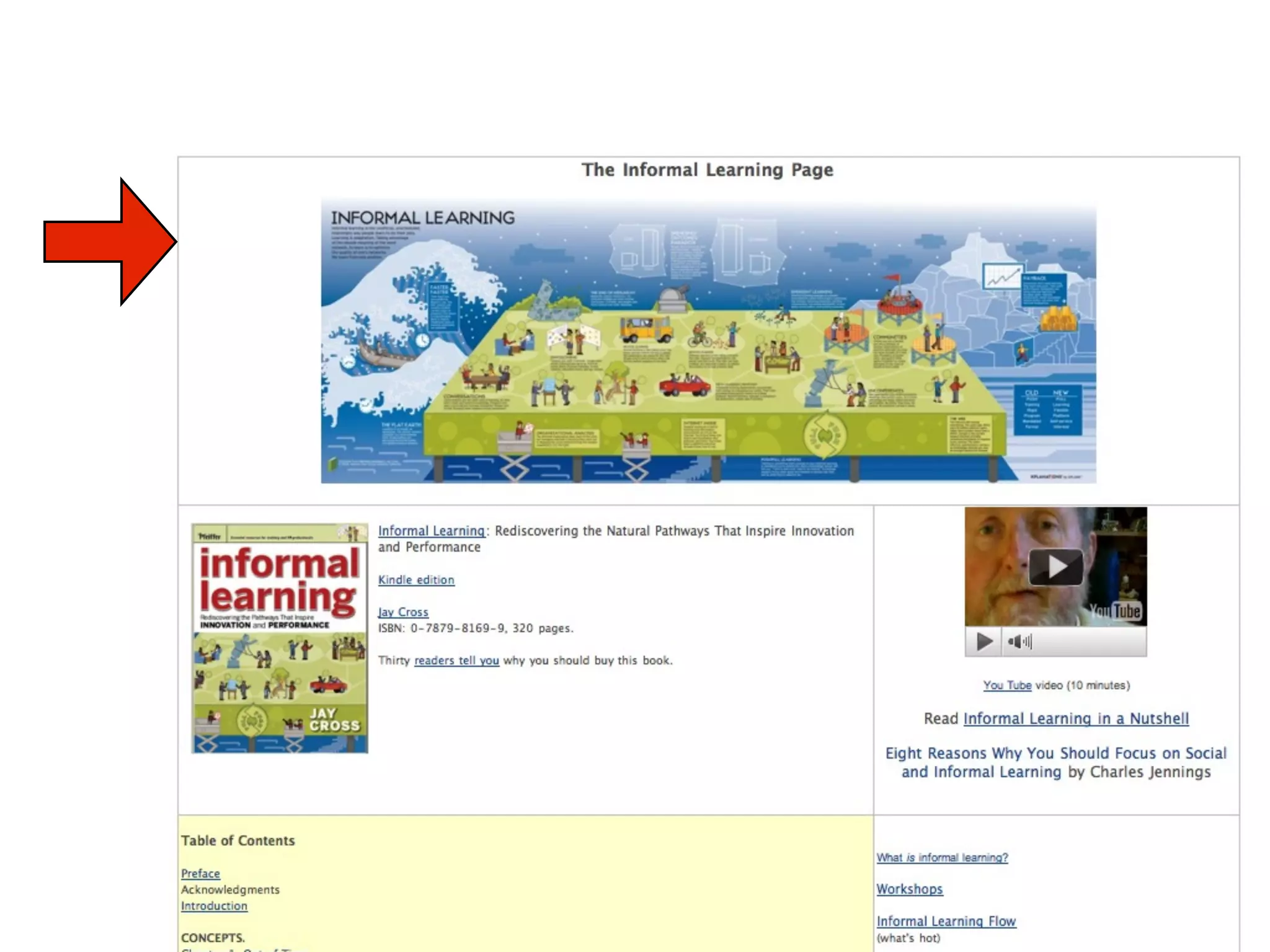
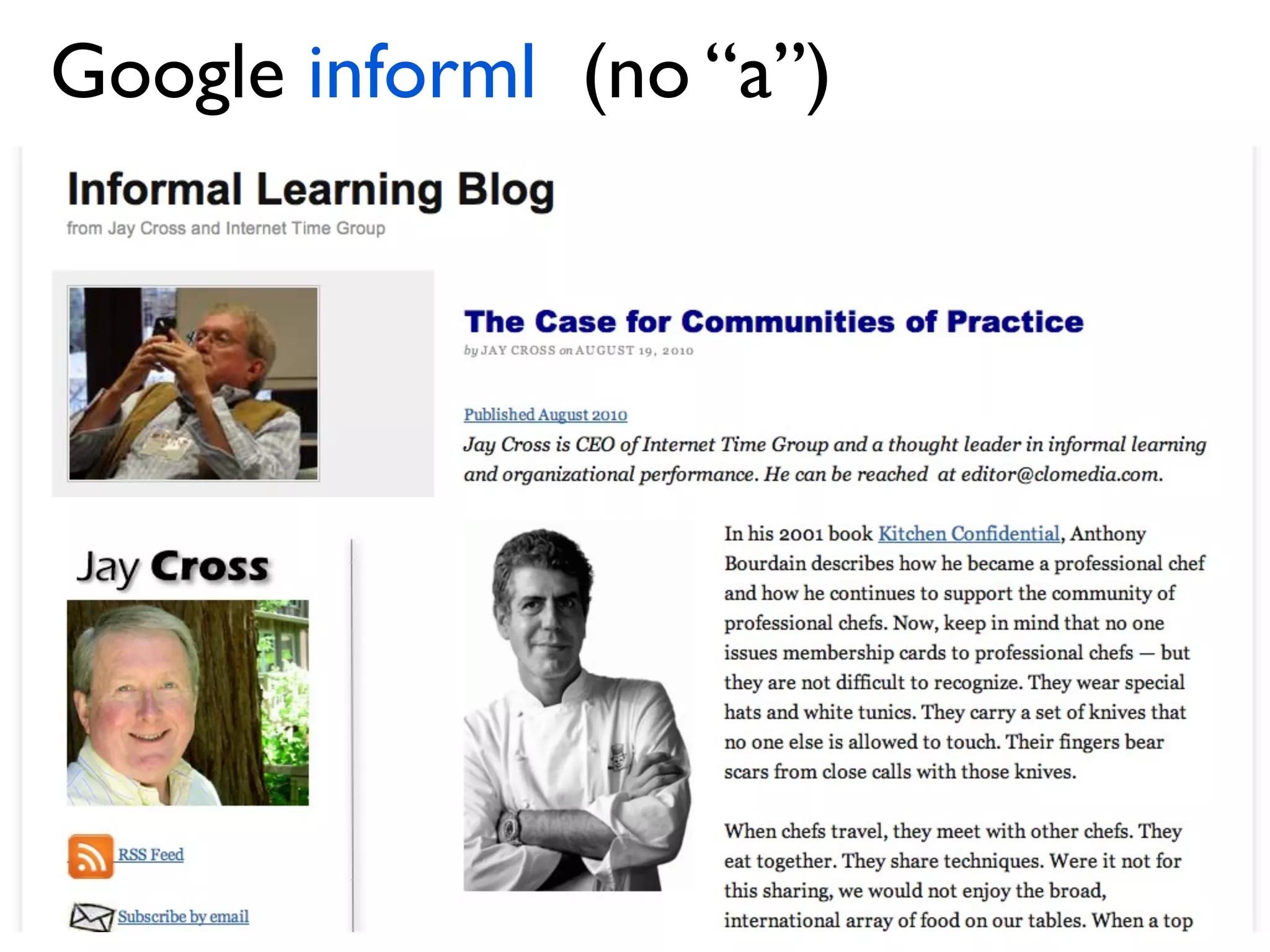
Google informl (no “a”)
Ivan illich and_me

Ivan illich and_me

  • 1.
  • 2.
    Topics Brand new world Deschooling Learningis the work Resources Jay Cross jaycross.com
  • 5.
  • 6.
    Ivan Illich, 1926- 2002 Ivan Illich, Austrian philosopher, Roman Catholic priest and critic of the institutions of contemporary western culture and their effects on the provenance and practice of education, medicine, work, energy use, and economic development. “Deschooling Society”
  • 7.
  • 8.
    “Together we havecome to realize that for most men the right to learn is curtailed by the obligation to attend school.” "School divides life into two segments, which are increasingly of comparable length. As much as anything else, schooling implies custodial care for persons who are declared undesirable elsewhere by the simple fact that a school has been built to serve them."
  • 9.
    “Schools are designedon the assumption that there is a secret to everything in life; that the quality of life depends on knowing that secret; that secrets can be known only in orderly successions; and that only teachers can properly reveal these secrets.”
  • 10.
    “New educational institutions would...facilitateaccess for the learner: to allow him to look into the windows of the control room or the parliament, if he cannot get in by the door.”
  • 11.
    “When pressed tospecify how they acquired what they know and value, will readily admit that they learned it more often outside than inside school. Their knowledge of facts, their understanding of life and work came to them from friendship or love, while viewing TV, or while reading, from examples of peers or the challenge of a street encounter. Or they may have learned what they know through the apprenticeship ritual for admission to a street gang or the initiation to a hospital, newspaper city room, plumber's shop, or insurance office.”
  • 12.
    “A good educationalsystem should have three purposes: it should 1. provide all who want to learn with access to available resources at any time in their lives; 2. empower all who want to share what they know to find those who want to learn it from them; and, finally, 3. furnish all who want to present an issue to the public with the opportunity to make their challenge known.”
  • 13.
    Why School isthe Wrong Model for Learning Irrelevant content Not real world Forgetting curve Students seen as deficient Taught by authority figure Focus on individuals, not groups Stifles creativity Give answers rather than action Assembly-line approach “Ends” with graduation
  • 14.
    Opportunity web: networks, notcurriculum Peer Matching Learning Skill Objects Exchanges Educators -at-large "What kinds of things and people might learners want to be in contact with in order to learn?"
  • 15.
    Courses are dead. Learningecosystems are the future.
  • 17.
  • 18.
    Our core goalis to meet the needs of working and underserved students by giving you the chance to earn your college degree. Flexible scheduling, faculty with real-world knowledge and a consistent and effective curriculum design help make higher education accessible to everyone. John Sperling, Founder
  • 19.
    1997 Largest privateuniversity in US 2000 Enrollment tops 100,000 students 2003 Enrollment tops 200,000 students
  • 20.
  • 21.
  • 22.
    Deschooling Society University of Phoenix Radical innovation, Radical innovation, investigated by FBI investigated by FBI Learning objects Workplace & project Peer matching Age of students 19 - 49 Skill exchanges Ground level research Educators-at-large Practitioner faculty Anti-credentialism Credit experiential learning
  • 24.
  • 25.
  • 27.
  • 28.

Editor's Notes

  • #5 Most important meme of the day is Change
  • #15 Illich: To liberate access to things by abolishing the control which persons and institutions now exercise over their educational values. To liberate the sharing of skills by guaranteeing freedom to teach or exercise them on request. To liberate the critical and creative resources of people by returning to individual persons the ability to call and hold meetings — an ability now increasingly monopolized by institutions which claim to speak for the people. To liberate the individual from the obligation to shape his expectations to the services offered by any established profession — by providing him with the opportunity to draw on the experience of his peers and to entrust himself to the teacher, guide, adviser, or healer of his choice. Inevitably the deschooling of society will blur the distinctions between economics, education, and politics on which the stability of the present world order and the stability of nations now rest.
  • #26 For more information