Changing the perception of ICT in Education (53 schools at a time)
Glenn McMahon Education Officer: Curriculum and Learning Technologies
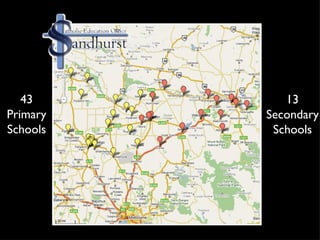
43 Primary Schools 13 Secondary Schools
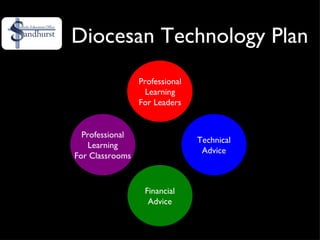
Diocesan Technology Plan Professional Learning For Leaders Professional Learning For Classrooms Financial Advice Technical Advice
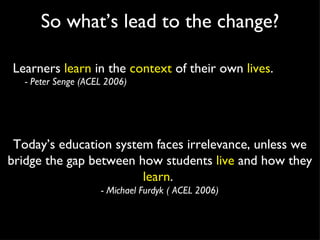
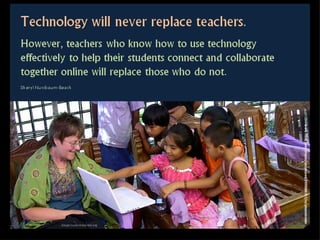
So what’s lead to the change? Learners  learn  in the  context  of their own  lives . - Peter Senge (ACEL 2006) Today’s education system faces irrelevance, unless we bridge the gap between how students  live  and how they  learn .  - Michael Furdyk ( ACEL 2006)
Start the Conversation
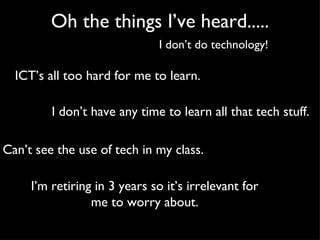
Oh the things I’ve heard..... I don’t do technology! ICT’s all too hard for me to learn. I don’t have any time to learn all that tech stuff. Can’t see the use of tech in my class. I’m retiring in 3 years so it’s irrelevant for me to worry about.
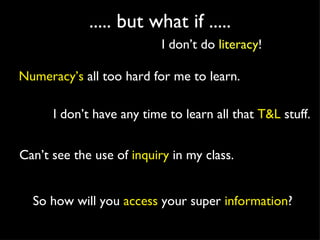
..... but what if ..... I don’t do  literacy ! Numeracy’s  all too hard for me to learn. I don’t have any time to learn all that  T&L  stuff. Can’t see the use of  inquiry  in my class. So how will you  access  your super  information ?
 
Leadership
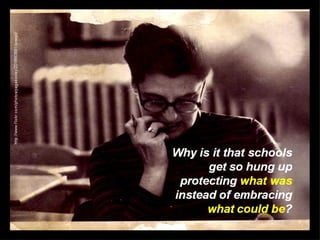
Images from Flickr.com & dangerouslyirrelevant.org
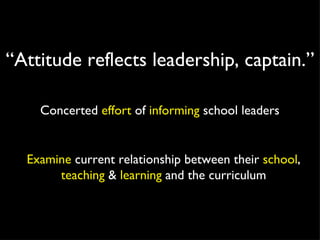
Concerted  effort  of  informing  school leaders Examine  current relationship between their  school ,  teaching  &  learning  and the curriculum “ Attitude reflects leadership, captain.”
 
Present the facts
 
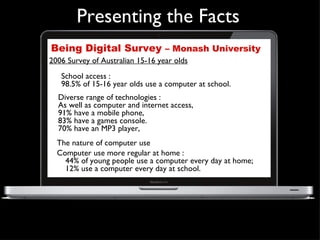
Being Digital Survey  – Monash University Presenting the Facts The nature of computer use  Computer use more regular at home :  44% of young people use a computer every day at home;  12% use a computer every day at school. Diverse range of technologies :  As well as computer and internet access,  91% have a mobile phone,  83% have a games console.  70% have an MP3 player,  2006 Survey of Australian 15-16 year olds School access :  98.5% of 15-16 year olds use a computer at school.
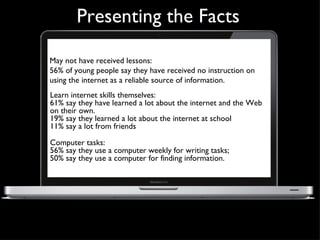
Presenting the Facts May not have received lessons:  56% of young people say they have received no instruction on using the internet as a reliable source of information. Learning and literacy  Learn internet skills themselves:  61% say they have learned a lot about the internet and the Web on their own. 19% say they learned a lot about the internet at school  11% say a lot from friends  Computer tasks:  56% say they use a computer weekly for writing tasks;  50% say they use a computer for finding information.
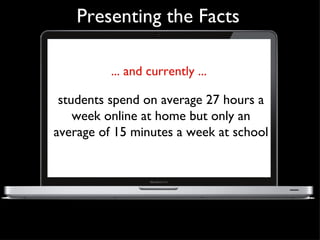
Presenting the Facts ... and currently ... students spend on average 27 hours a week online at home but only an average of 15 minutes a week at school
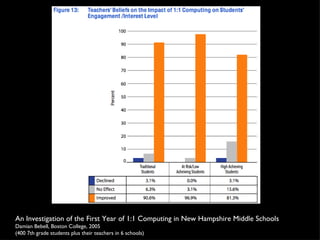
An Investigation of the First Year of 1:1 Computing in New Hampshire Middle Schools Damian Bebell, Boston College, 2005 (400 7th grade students plus their teachers in 6 schools)
Make ‘IT’ Relevant
 
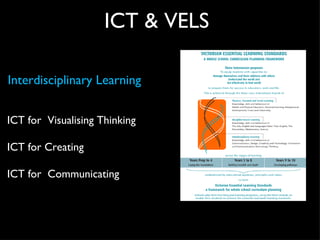
ICT & VELS Interdisciplinary Learning ICT for  Visualising Thinking ICT for Creating ICT for  Communicating
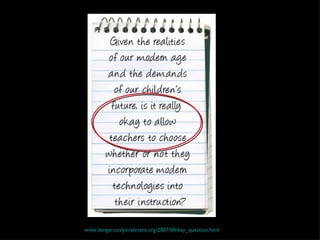
www.dangerouslyirrelevant.org/2007/04/key_question.html
Normalise the New
 
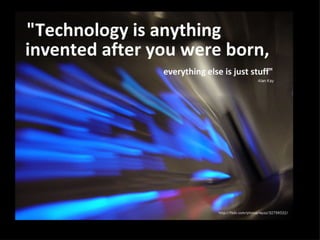
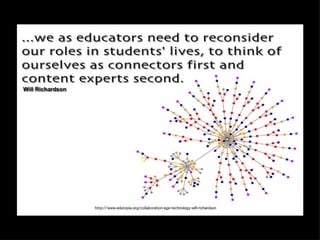
Normalising the new (Bringing the big picture closer to reality) Digital Natives v Digital Immigrants 21st Century Learning Students know technology Students & Teachers Contemporary learning Students are fearless users/adapters of technology who still need guidance
Change the perspective
 
The fear factor
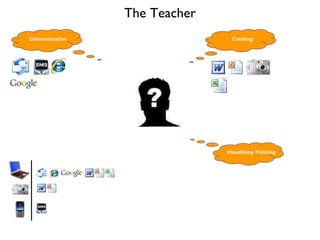
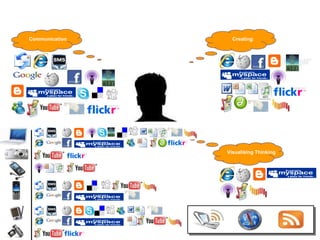
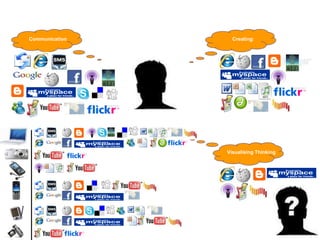
The Teacher Uses: Communication Creating: Visualising Thinking
Uses: Communication Creating: Visualising Thinking
Uses: Communication Creating: Visualising Thinking   Classroom teacher Student
Teachers & The Fear Factor You don’t have to know everything about it (ICT) but you do have to  know  what it can do. If you don’t have an awareness of what you can do with ICT, you’ll never  plan  for your  students  to  use  it. You don’t know what you don’t know.
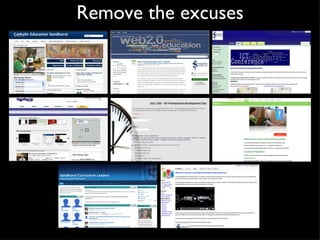
Remove the excuses
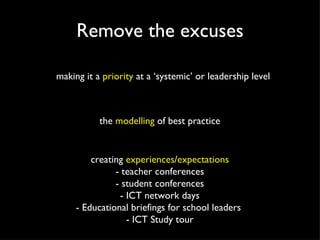
Remove the excuses making it a  priority  at a ‘systemic’ or leadership level the   modelling  of best practice creating  experiences / expectations - teacher conferences - student conferences - ICT network days - Educational briefings for school leaders  - ICT Study tour
Remove the excuses
Make ICT PD personal
 
Strategies that have influenced 1. Start the conversation 2. Present the facts 3. Make it relevant/relate it to the curriculum and pedagogy 4. Normalise the new 5. Change the perspective 6. Alleviate the fear factor 7. Remove the excuses 8. Make PD/ICT personal INVOLVE LEADERSHIP
 
my details e: gmcmahon@ceosand.catholic.edu.au b: sandhurstictnetwork.globalteacher.org.au t: ceosandhurst d: mackas s: gmac74 i: mcmahong@mac.com

Ittakesavillage

  • 1.
    Changing the perceptionof ICT in Education (53 schools at a time)
  • 2.
    Glenn McMahon EducationOfficer: Curriculum and Learning Technologies
  • 3.
    43 Primary Schools13 Secondary Schools
  • 4.
    Diocesan Technology PlanProfessional Learning For Leaders Professional Learning For Classrooms Financial Advice Technical Advice
  • 5.
    So what’s leadto the change? Learners learn in the context of their own lives . - Peter Senge (ACEL 2006) Today’s education system faces irrelevance, unless we bridge the gap between how students live and how they learn . - Michael Furdyk ( ACEL 2006)
  • 6.
  • 7.
    Oh the thingsI’ve heard..... I don’t do technology! ICT’s all too hard for me to learn. I don’t have any time to learn all that tech stuff. Can’t see the use of tech in my class. I’m retiring in 3 years so it’s irrelevant for me to worry about.
  • 8.
    ..... but whatif ..... I don’t do literacy ! Numeracy’s all too hard for me to learn. I don’t have any time to learn all that T&L stuff. Can’t see the use of inquiry in my class. So how will you access your super information ?
  • 9.
  • 10.
  • 11.
    Images from Flickr.com& dangerouslyirrelevant.org
  • 12.
    Concerted effort of informing school leaders Examine current relationship between their school , teaching & learning and the curriculum “ Attitude reflects leadership, captain.”
  • 13.
  • 14.
  • 15.
  • 16.
    Being Digital Survey – Monash University Presenting the Facts The nature of computer use Computer use more regular at home : 44% of young people use a computer every day at home; 12% use a computer every day at school. Diverse range of technologies : As well as computer and internet access, 91% have a mobile phone, 83% have a games console. 70% have an MP3 player, 2006 Survey of Australian 15-16 year olds School access : 98.5% of 15-16 year olds use a computer at school.
  • 17.
    Presenting the FactsMay not have received lessons: 56% of young people say they have received no instruction on using the internet as a reliable source of information. Learning and literacy Learn internet skills themselves: 61% say they have learned a lot about the internet and the Web on their own. 19% say they learned a lot about the internet at school 11% say a lot from friends Computer tasks: 56% say they use a computer weekly for writing tasks; 50% say they use a computer for finding information.
  • 18.
    Presenting the Facts... and currently ... students spend on average 27 hours a week online at home but only an average of 15 minutes a week at school

  • 19.
    An Investigation ofthe First Year of 1:1 Computing in New Hampshire Middle Schools Damian Bebell, Boston College, 2005 (400 7th grade students plus their teachers in 6 schools)
  • 20.
  • 21.
  • 22.
    ICT & VELSInterdisciplinary Learning ICT for Visualising Thinking ICT for Creating ICT for Communicating
  • 23.
  • 24.
  • 25.
  • 26.
    Normalising the new(Bringing the big picture closer to reality) Digital Natives v Digital Immigrants 21st Century Learning Students know technology Students & Teachers Contemporary learning Students are fearless users/adapters of technology who still need guidance
  • 27.
  • 28.
  • 29.
  • 30.
    The Teacher Uses:Communication Creating: Visualising Thinking
  • 31.
    Uses: Communication Creating:Visualising Thinking
  • 32.
    Uses: Communication Creating:Visualising Thinking Classroom teacher Student
  • 33.
    Teachers & TheFear Factor You don’t have to know everything about it (ICT) but you do have to know what it can do. If you don’t have an awareness of what you can do with ICT, you’ll never plan for your students to use it. You don’t know what you don’t know.
  • 34.
  • 35.
    Remove the excusesmaking it a priority at a ‘systemic’ or leadership level the modelling of best practice creating experiences / expectations - teacher conferences - student conferences - ICT network days - Educational briefings for school leaders - ICT Study tour
  • 36.
  • 37.
    Make ICT PDpersonal
  • 38.
  • 39.
    Strategies that haveinfluenced 1. Start the conversation 2. Present the facts 3. Make it relevant/relate it to the curriculum and pedagogy 4. Normalise the new 5. Change the perspective 6. Alleviate the fear factor 7. Remove the excuses 8. Make PD/ICT personal INVOLVE LEADERSHIP
  • 40.
  • 41.
    my details e:gmcmahon@ceosand.catholic.edu.au b: sandhurstictnetwork.globalteacher.org.au t: ceosandhurst d: mackas s: gmac74 i: mcmahong@mac.com