
Gender and technology Phil Bannister Head of Policy Advice and Departmental Liaison Di Levine Head of Educational Research and Analysis
Gender and ICT in school
Learners are using technology in a range of ways for learning in primary schools… Cranmer et al, 2008
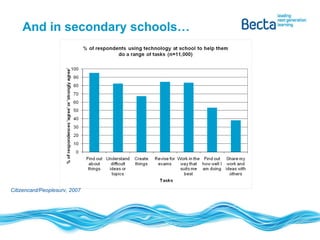
And in secondary schools… Citizencard/Peoplesurv, 2007
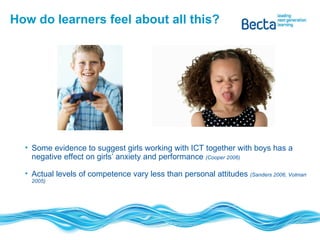
How do learners feel about all this? Some evidence to suggest girls working with ICT together with boys has a negative effect on girls’ anxiety and performance  (Cooper 2006) Actual levels of competence vary less than personal attitudes  (Sanders 2006, Volman 2005)
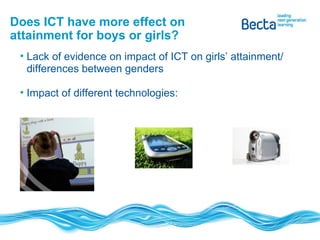
Does ICT have more effect on attainment for boys or girls? Lack of evidence on impact of ICT on girls’ attainment/ differences between genders Impact of different technologies:
Gender and ICT outside of school
How do boys and girls differ in their use outside schools? Girls significantly more likely than boys to have no/limited access to a computer at home  (Valentine et al 2005) Boys have more experience of using ICT out of school, use it more intensively, and consider themselves more capable at advanced ICT activities  (Eurydice 2005)  The uses girls tend to favour are:  writing developing artwork and photographs creating music producing invitations, booklets, and diaries  (Valentine et al 2005)
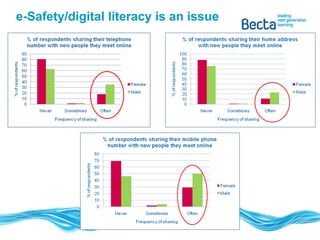
e-Safety/digital literacy is an issue
Using ICT for learning outside school? Girls are much more likely than boys to use computers outside of school for schoolwork – 50% of girls compared with 15% of boys (Valentine et al 2005) Girls are slightly less trusting than boys, and slightly more likely to make checks on what they find online. They are also less likely to visit new websites (a change from 2006) (Ofcom 2008) Home use of ICT is modelled on in-school use – school has an important role in enabling both boys and girls to make best use of technology for learning Home ICT use for educational purposes is positively associated with attainment – possibility of the gender gap being widened?
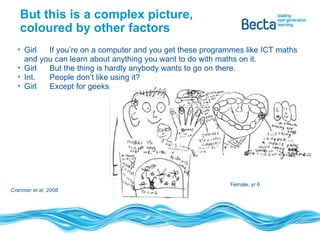
But this is a complex picture, coloured by other factors Girl If you’re on a computer and you get these programmes like ICT maths and you can learn about anything you want to do with maths on it. Girl But the thing is hardly anybody wants to go on there. Int. People don’t like using it? Girl Except for geeks. Cranmer et al, 2008 Female, yr 6
Why do boys and girls differ in their attitudes? Socialisation is the key factor affecting girls’ confidence and attitudes towards ICT Pupil age is important: General consensus that boys and girls start off liking ICT the same Parental attitudes and actions can have a significant impact In KS3 & 4 girls may lose enthusiasm for technology use
Classroom practices may also have an impact Some evidence that where teachers believe girls dislike ICT, they direct more attention towards boys when using technology in the classroom Design of software and digital content used in schools may be geared to appeal more to boys  Cooper 2006
Implications for practice Practitioners need to consider gender as one of a number of factors that influence technology for learning This involves: Not assuming they know what technologies learners are using in informal learning settings, and for what sort of activity Encouraging enquiry-led and learner voice approaches to challenge their own assumptions and preconceptions
Contact... Becta Millburn Hill Road Science Park Coventry CV4 7JJ T +44 (0)24 7679 7094 F +44 (0)24 7641 1418 E  diane.levine@becta.org.uk E  phil.bannister@becta.org.uk www.becta.org.uk

Gender And Technology Becta

  • 1.
    Gender and technologyPhil Bannister Head of Policy Advice and Departmental Liaison Di Levine Head of Educational Research and Analysis
  • 2.
    Gender and ICTin school
  • 3.
    Learners are usingtechnology in a range of ways for learning in primary schools… Cranmer et al, 2008
  • 4.
    And in secondaryschools… Citizencard/Peoplesurv, 2007
  • 5.
    How do learnersfeel about all this? Some evidence to suggest girls working with ICT together with boys has a negative effect on girls’ anxiety and performance (Cooper 2006) Actual levels of competence vary less than personal attitudes (Sanders 2006, Volman 2005)
  • 6.
    Does ICT havemore effect on attainment for boys or girls? Lack of evidence on impact of ICT on girls’ attainment/ differences between genders Impact of different technologies:
  • 7.
    Gender and ICToutside of school
  • 8.
    How do boysand girls differ in their use outside schools? Girls significantly more likely than boys to have no/limited access to a computer at home (Valentine et al 2005) Boys have more experience of using ICT out of school, use it more intensively, and consider themselves more capable at advanced ICT activities (Eurydice 2005) The uses girls tend to favour are: writing developing artwork and photographs creating music producing invitations, booklets, and diaries (Valentine et al 2005)
  • 9.
  • 10.
    Using ICT forlearning outside school? Girls are much more likely than boys to use computers outside of school for schoolwork – 50% of girls compared with 15% of boys (Valentine et al 2005) Girls are slightly less trusting than boys, and slightly more likely to make checks on what they find online. They are also less likely to visit new websites (a change from 2006) (Ofcom 2008) Home use of ICT is modelled on in-school use – school has an important role in enabling both boys and girls to make best use of technology for learning Home ICT use for educational purposes is positively associated with attainment – possibility of the gender gap being widened?
  • 11.
    But this isa complex picture, coloured by other factors Girl If you’re on a computer and you get these programmes like ICT maths and you can learn about anything you want to do with maths on it. Girl But the thing is hardly anybody wants to go on there. Int. People don’t like using it? Girl Except for geeks. Cranmer et al, 2008 Female, yr 6
  • 12.
    Why do boysand girls differ in their attitudes? Socialisation is the key factor affecting girls’ confidence and attitudes towards ICT Pupil age is important: General consensus that boys and girls start off liking ICT the same Parental attitudes and actions can have a significant impact In KS3 & 4 girls may lose enthusiasm for technology use
  • 13.
    Classroom practices mayalso have an impact Some evidence that where teachers believe girls dislike ICT, they direct more attention towards boys when using technology in the classroom Design of software and digital content used in schools may be geared to appeal more to boys Cooper 2006
  • 14.
    Implications for practicePractitioners need to consider gender as one of a number of factors that influence technology for learning This involves: Not assuming they know what technologies learners are using in informal learning settings, and for what sort of activity Encouraging enquiry-led and learner voice approaches to challenge their own assumptions and preconceptions
  • 15.
    Contact... Becta MillburnHill Road Science Park Coventry CV4 7JJ T +44 (0)24 7679 7094 F +44 (0)24 7641 1418 E diane.levine@becta.org.uk E phil.bannister@becta.org.uk www.becta.org.uk