07/06/10 1
By :
Prof. Amit Kumar
07/06/10 2
“Logistics has advanced from warehousing and
transportation to boardrooms of the successful leading
companies across the world. Due to increasing
importance of business logistics, it becomes necessary
for the student pursuing management education from
IILM- Graduate School of Management, to understand
logistics, its basic framework and practical utility.”
IILM-GSM
Importance of this course
International Trade Logistics
07/06/10 3
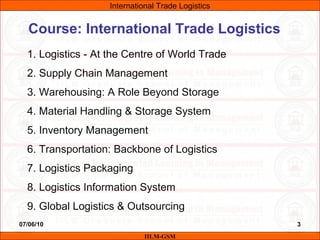
Course: International Trade Logistics
1. Logistics - At the Centre of World Trade
2. Supply Chain Management
3. Warehousing: A Role Beyond Storage
4. Material Handling & Storage System
5. Inventory Management
6. Transportation: Backbone of Logistics
7. Logistics Packaging
8. Logistics Information System
9. Global Logistics & Outsourcing
IILM-GSM
International Trade Logistics
07/06/10 4
IILM-GSM
International Trade Logistics Global Logistics & Outsourcing
07/05/10f4t 5
Contents
• Catalysts for Outsourcing Trends
• Benefits of Logistics Outsourcing
• Evolution of Logistics
• Third Party & Fourth Party Logistics
• Selection of Service Provider
• Value Added Services
• Indian 3PL Service Providers
• Why Global Logistics?
• Global Logistics Challenges
• Strategic Issues & Managing Global Logistics
• Case Study: A Draft Agreement Between the 3PL Service
Provider and the Manufacturing Firm Outsourcing the
Logistics Services
IILM-GSM
International Trade Logistics Global Logistics & Outsourcing
07/05/10 6
• To survive in today’s competitive markets, companies
are focusing on their core competencies and adopting
outsourcing as a strategic solution to improve quality of
service and reduce cost of important as well as non-core
processes.
• Today, it is an accepted trend in industry to form a
collaborative relationship with the logistics service
provider for knowledge-based supply chain integration
that rests on IT as the backbone.
“Logistics outsourcing is an important driver of
top-line growth and corporate strategy.”
Introduction: Logistics Outsourcing
IILM-GSM
International Trade Logistics Global Logistics & Outsourcing
07/05/10 7
• Today, business organizations across the world are
struggling not only for the growth but mere survival. The
factors responsible for this are:
 The liberalized economies of the countries across the
world
 Globalization of businesses
 Recessionary trends in the markets
• Moreover, customer has become more demanding and
looking more for value-added services from suppliers.
Catalysts for Outsourcing Trends
IILM-GSM
International Trade Logistics Global Logistics & Outsourcing
07/05/10 8
• In such situation, organizations are realizing that cost
cutting and differentiation in value delivery system are
solutions to the current problem.
• This can be achieved through outsourcing the non-core
operations to experts in the field and concentrating on
core business areas.
A growing trend observable in the industry today
is a ‘hollowing out’ of corporations.
Catalysts for Outsourcing Trends
IILM-GSM
International Trade Logistics Global Logistics & Outsourcing
07/05/10 9
• Logistics is one of the operations in which the majority of
Indian business corporations do not have expertise.
• In the developed countries, LO is treated as a strategic
solution to improve quality of service and reduce the cost of
important non-core processes.
• The critical reasons are:
 To focus on core competencies
 Resource constraints
 Cost saving resulting from better management of the
supply chain
 Cross-pollination of better available practices
 Wider geographical coverage
Reasons for Outsourcing Logistics
Activities
IILM-GSM
International Trade Logistics Global Logistics & Outsourcing
07/05/10 10
1. In highly competitive markets, Logistics Outsourcing
provides the operational flexibility to meet the
changing needs of the customers.
2. Logistics services can also be customized for major
markets or key accounts.
3. The requirement of funds for investment in
transportation fleet, warehouses, handling equipment
and storage arrangement is absolutely eliminated and
the responsibility falls on the service provider.
4. The human resource requirement is minimized and
is limited only to coordinating and monitoring the service
provider’s activities.
Benefits of Logistics Outsourcing (LO)
IILM-GSM
International Trade Logistics Global Logistics & Outsourcing
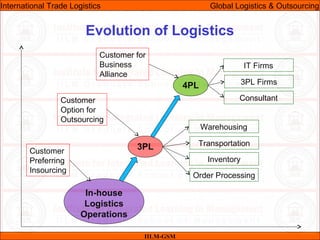
Evolution of Logistics
IILM-GSM
International Trade Logistics Global Logistics & Outsourcing
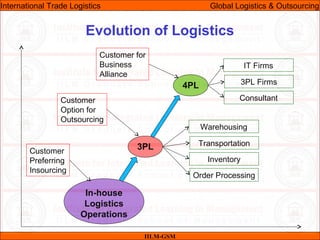
In-house
Logistics
Operations
3PL
4PL
Customer
Preferring
Insourcing
Customer
Option for
Outsourcing
Customer for
Business
Alliance
Warehousing
Transportation
Inventory
Order Processing
IT Firms
3PL Firms
Consultant
07/05/10 12
• These firms are external to the company and provide on
stand-alone or an integrated basis.
 The stand-alone operator is called a ‘wholesaler’,
who extends only one type of service in which it has
expertise. It may be any of such services as
warehousing, transportation, inventory management,
packaging or so forth.
 But one who provides the total logistic service and
offers entire logistic solutions to customer problems is
called the ‘integrator’.
• The 1990s witnessed the growth of 3PL firms, when
companies around the world realized that logistics is the
key to the success of supply chain.
Third Party Logistics
IILM-GSM
International Trade Logistics Global Logistics & Outsourcing
07/05/10 13
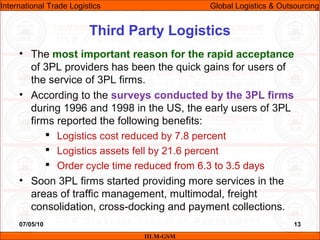
• The most important reason for the rapid acceptance
of 3PL providers has been the quick gains for users of
the service of 3PL firms.
• According to the surveys conducted by the 3PL firms
during 1996 and 1998 in the US, the early users of 3PL
firms reported the following benefits:
 Logistics cost reduced by 7.8 percent
 Logistics assets fell by 21.6 percent
 Order cycle time reduced from 6.3 to 3.5 days
• Soon 3PL firms started providing more services in the
areas of traffic management, multimodal, freight
consolidation, cross-docking and payment collections.
Third Party Logistics
IILM-GSM
International Trade Logistics Global Logistics & Outsourcing
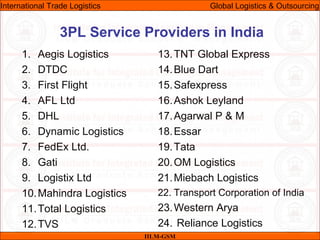
1. Aegis Logistics
2. DTDC
3. First Flight
4. AFL Ltd
5. DHL
6. Dynamic Logistics
7. FedEx Ltd.
8. Gati
9. Logistix Ltd
10.Mahindra Logistics
11.Total Logistics
12.TVS
3PL Service Providers in India
IILM-GSM
International Trade Logistics Global Logistics & Outsourcing
13.TNT Global Express
14.Blue Dart
15.Safexpress
16.Ashok Leyland
17.Agarwal P & M
18.Essar
19.Tata
20.OM Logistics
21.Miebach Logistics
22. Transport Corporation of India
23.Western Arya
24. Reliance Logistics
Evolution of Logistics
IILM-GSM
International Trade Logistics Global Logistics & Outsourcing
In-house
Logistics
Operations
3PL
4PL
Customer
Preferring
Insourcing
Customer
Option for
Outsourcing
Customer for
Business
Alliance
Warehousing
Transportation
Inventory
Order Processing
IT Firms
3PL Firms
Consultant
07/05/10 16
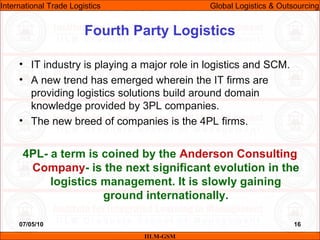
• IT industry is playing a major role in logistics and SCM.
• A new trend has emerged wherein the IT firms are
providing logistics solutions build around domain
knowledge provided by 3PL companies.
• The new breed of companies is the 4PL firms.
4PL- a term is coined by the Anderson Consulting
Company- is the next significant evolution in the
logistics management. It is slowly gaining
ground internationally.
Fourth Party Logistics
IILM-GSM
International Trade Logistics Global Logistics & Outsourcing
07/05/10 17
According to the Anderson Consultants,
“4PL assembles and manages the resources, capabilities
and technology of its own organization with those of
complementary service providers to deliver a
comprehensive supply chain solution”.
Fourth Party Logistics
IILM-GSM
International Trade Logistics Global Logistics & Outsourcing
07/05/10 18
For example, A 4PL company of FMCG Indian manufacturer
operating in the Indian and overseas markets, which need
to integrate its entire logistics operations handled by
different 3PL firms in different geographical areas assigned
to them, shall design and operate one single central
information system instead of the different systems in
different areas by each 3PL firms.
A 4PL firm fulfils all the different needs of the client
from a single source instead of getting into
multiple 3PL alliances to achieve through multiple
sources objectives.
Fourth Party Logistics
IILM-GSM
International Trade Logistics Global Logistics & Outsourcing
07/05/10 19
Recently, Hewlett Packard (HP) has appointed Circle
International (CI) as their 4PL partner in the Asia
Pacific region. CI operates from the central hub
located in Singapore, where it buys and stocks HP’s
inventory requirement in the region.
The network of warehouse hubs, spread across the countries
in the region, takes care of the distribution. The local HP
office in the country draws its inventory requirements by
buying from the CI local hub.
HP does not block its funds in inventory. Thus 4PL provides
logistic services by blocking its own money in someone
else’s products and components.
Fourth Party Logistics
IILM-GSM
International Trade Logistics Global Logistics & Outsourcing
07/05/10 20
Selection of Service Provider
IILM-GSM
International Trade Logistics Global Logistics & Outsourcing
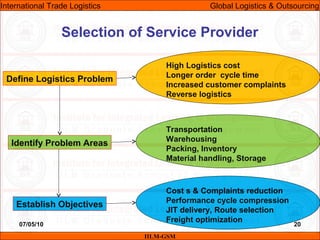
High Logistics cost
Longer order cycle time
Increased customer complaints
Reverse logistics
Define Logistics Problem
Transportation
Warehousing
Packing, Inventory
Material handling, Storage
Identify Problem Areas
Cost s & Complaints reduction
Performance cycle compression
JIT delivery, Route selection
Freight optimization
Establish Objectives
07/05/10 21
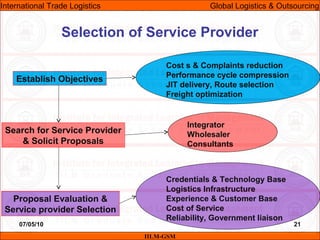
Selection of Service Provider
IILM-GSM
International Trade Logistics Global Logistics & Outsourcing
Establish Objectives
Integrator
Wholesaler
Consultants
Search for Service Provider
& Solicit Proposals
Credentials & Technology Base
Logistics Infrastructure
Experience & Customer Base
Cost of Service
Reliability, Government liaison
Proposal Evaluation &
Service provider Selection
Cost s & Complaints reduction
Performance cycle compression
JIT delivery, Route selection
Freight optimization
07/05/10 22
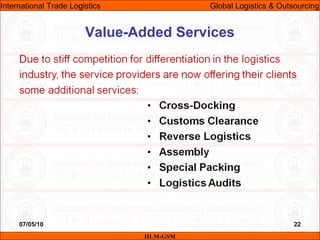
Value-Added Services
IILM-GSM
International Trade Logistics Global Logistics & Outsourcing
07/05/10 23
Cross-Docking:
• It means elimination of storage time in the logistics process.
• The material that arrives at the warehouse hub from various
vendors is break-bulk, assorted, consolidated and repacked to
dispatch to the customers.
• The storage time is less than 48 hours.
Customs Clearance:
• This involves the responsibility of complete documentation and
customs clearance for imports and exports of goods.
Reverse Logistics:
• It covers the re-transportation (to the manufacturer) and
documentation of rejected or damaged goods at customer end.
Value-Added Services
IILM-GSM
International Trade Logistics Global Logistics & Outsourcing
07/05/10 24
Assembly:
• The manufacturers want service providers to prepare a kit
consisting of the manufactured and bought out items which
will go directly to point of sale or use.
• This is required at the time of joint product offerings by two
companies at the time of promotional campaign.
Special Packing:
• It includes seaworthy packing for sea transportation,
shrinkage packaging or packing for specific markets.
Logistics Audits:
• To conduct regular audits or audits-on-demand by the
customer to identify problems or deficiencies in the logistics
supply chain and suggest logistic solutions.
Value-Added Services
IILM-GSM
International Trade Logistics Global Logistics & Outsourcing
07/05/10 25
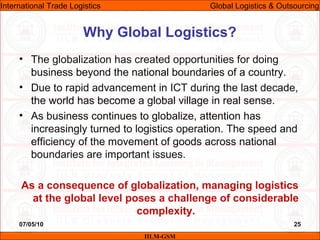
• The globalization has created opportunities for doing
business beyond the national boundaries of a country.
• Due to rapid advancement in ICT during the last decade,
the world has become a global village in real sense.
• As business continues to globalize, attention has
increasingly turned to logistics operation. The speed and
efficiency of the movement of goods across national
boundaries are important issues.
As a consequence of globalization, managing logistics
at the global level poses a challenge of considerable
complexity.
Why Global Logistics?
IILM-GSM
International Trade Logistics Global Logistics & Outsourcing
07/05/10 26
Global Logistics Challenges
IILM-GSM
International Trade Logistics Global Logistics & Outsourcing
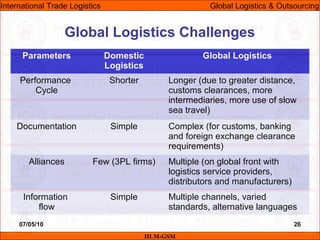
Parameters Domestic
Logistics
Global Logistics
Performance
Cycle
Shorter Longer (due to greater distance,
customs clearances, more
intermediaries, more use of slow
sea travel)
Documentation Simple Complex (for customs, banking
and foreign exchange clearance
requirements)
Alliances Few (3PL firms) Multiple (on global front with
logistics service providers,
distributors and manufacturers)
Information
flow
Simple Multiple channels, varied
standards, alternative languages
07/05/10 27
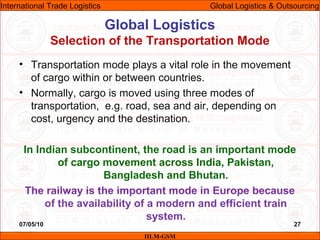
• Transportation mode plays a vital role in the movement
of cargo within or between countries.
• Normally, cargo is moved using three modes of
transportation, e.g. road, sea and air, depending on
cost, urgency and the destination.
In Indian subcontinent, the road is an important mode
of cargo movement across India, Pakistan,
Bangladesh and Bhutan.
The railway is the important mode in Europe because
of the availability of a modern and efficient train
system.
Global Logistics
Selection of the Transportation Mode
IILM-GSM
International Trade Logistics Global Logistics & Outsourcing
07/05/10 28
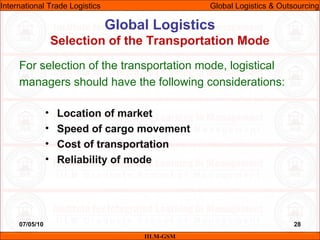
For selection of the transportation mode, logistical
managers should have the following considerations:
• Location of market
• Speed of cargo movement
• Cost of transportation
• Reliability of mode
Global Logistics
Selection of the Transportation Mode
IILM-GSM
International Trade Logistics Global Logistics & Outsourcing
07/05/10 29
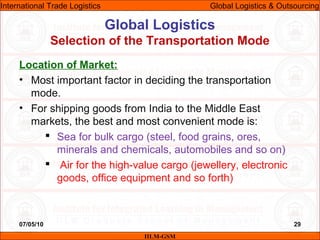
Location of Market:
• Most important factor in deciding the transportation
mode.
• For shipping goods from India to the Middle East
markets, the best and most convenient mode is:
 Sea for bulk cargo (steel, food grains, ores,
minerals and chemicals, automobiles and so on)
 Air for the high-value cargo (jewellery, electronic
goods, office equipment and so forth)
Global Logistics
Selection of the Transportation Mode
IILM-GSM
International Trade Logistics Global Logistics & Outsourcing
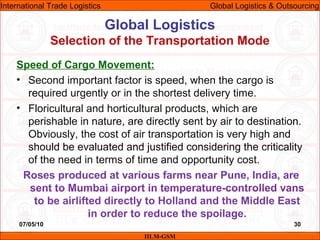
07/05/10 30
Speed of Cargo Movement:
• Second important factor is speed, when the cargo is
required urgently or in the shortest delivery time.
• Floricultural and horticultural products, which are
perishable in nature, are directly sent by air to destination.
Obviously, the cost of air transportation is very high and
should be evaluated and justified considering the criticality
of the need in terms of time and opportunity cost.
Roses produced at various farms near Pune, India, are
sent to Mumbai airport in temperature-controlled vans
to be airlifted directly to Holland and the Middle East
in order to reduce the spoilage.
Global Logistics
Selection of the Transportation Mode
IILM-GSM
International Trade Logistics Global Logistics & Outsourcing
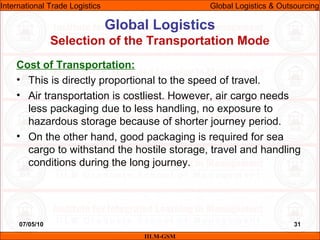
07/05/10 31
Cost of Transportation:
• This is directly proportional to the speed of travel.
• Air transportation is costliest. However, air cargo needs
less packaging due to less handling, no exposure to
hazardous storage because of shorter journey period.
• On the other hand, good packaging is required for sea
cargo to withstand the hostile storage, travel and handling
conditions during the long journey.
Global Logistics
Selection of the Transportation Mode
IILM-GSM
International Trade Logistics Global Logistics & Outsourcing
07/05/10 32
Reliability of Mode:
• In India, air accounts for less than 1% of the total cargo
movement, while rail 35%, road 39% and sea 24%.
• Each of the modes is associated with some hazards and
so there is no ideal mode of transportation.
Global Logistics
Selection of the Transportation Mode
IILM-GSM
International Trade Logistics Global Logistics & Outsourcing
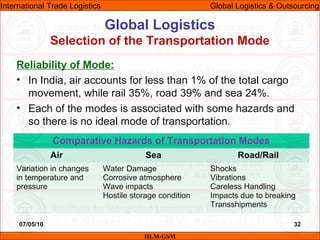
Comparative Hazards of Transportation Modes
Air Sea Road/Rail
Variation in changes
in temperature and
pressure
Water Damage
Corrosive atmosphere
Wave impacts
Hostile storage condition
Shocks
Vibrations
Careless Handling
Impacts due to breaking
Transshipments
07/05/10 33
Following are some options for firms to plan their logistics
for truly global operation:
1. The firm may concentrate their manufacturing and
sourcing at a few locations, despite selling their products
across global markets,
For example, BMW and Thomson. The major focus of
these companies is on outbound logistics for
distribution of finished products in global markets.
Global Logistics: Strategic Issues
IILM-GSM
International Trade Logistics Global Logistics & Outsourcing
07/05/10 34
Following are some options for firms to plan their logistics
for truly global operation:
2. The next category of firms includes those that
manufacture at one place and sell their products in the
global markets.
These are the companies manufacturing very high
value products such as aircrafts and defence
products. They source their raw material and
components from all over the world. The major focus
is on outbound logistics.
Global Logistics: Strategic Issues
IILM-GSM
International Trade Logistics Global Logistics & Outsourcing
07/05/10 35
Following are some options for firms to plan their logistics
for truly global operation:
3. Companies in this category manufacture mass-
consumed low-value product such as soft drinks.
Firms like McDonalds, Coca Cola and Pepsi adopt this
strategy of supplying to the market from local
manufacturing plants.
The products are sold within 200 kilometers of the
plants. Beyond a particular distance the logistical
cost makes the finished product uncompetitive.
Global Logistics: Strategic Issues
IILM-GSM
International Trade Logistics Global Logistics & Outsourcing
07/05/10 36
Following are some options for firms to plan their logistics
for truly global operation:
4. The fourth category includes companies that source from
and distribute to many locations. They focus on both
inbound and outbound logistics.
Some examples are the Japanese car and consumer
electronics manufacturing companies such as
Honda, Toyota and Sony, and so on.
Global Logistics: Strategic Issues
IILM-GSM
International Trade Logistics Global Logistics & Outsourcing

Itl lecture-23 & 24 (global logistics & outsourcing)

  • 1.
  • 2.
    07/06/10 2 “Logistics hasadvanced from warehousing and transportation to boardrooms of the successful leading companies across the world. Due to increasing importance of business logistics, it becomes necessary for the student pursuing management education from IILM- Graduate School of Management, to understand logistics, its basic framework and practical utility.” IILM-GSM Importance of this course International Trade Logistics
  • 3.
    07/06/10 3 Course: InternationalTrade Logistics 1. Logistics - At the Centre of World Trade 2. Supply Chain Management 3. Warehousing: A Role Beyond Storage 4. Material Handling & Storage System 5. Inventory Management 6. Transportation: Backbone of Logistics 7. Logistics Packaging 8. Logistics Information System 9. Global Logistics & Outsourcing IILM-GSM International Trade Logistics
  • 4.
    07/06/10 4 IILM-GSM International TradeLogistics Global Logistics & Outsourcing
  • 5.
    07/05/10f4t 5 Contents • Catalystsfor Outsourcing Trends • Benefits of Logistics Outsourcing • Evolution of Logistics • Third Party & Fourth Party Logistics • Selection of Service Provider • Value Added Services • Indian 3PL Service Providers • Why Global Logistics? • Global Logistics Challenges • Strategic Issues & Managing Global Logistics • Case Study: A Draft Agreement Between the 3PL Service Provider and the Manufacturing Firm Outsourcing the Logistics Services IILM-GSM International Trade Logistics Global Logistics & Outsourcing
  • 6.
    07/05/10 6 • Tosurvive in today’s competitive markets, companies are focusing on their core competencies and adopting outsourcing as a strategic solution to improve quality of service and reduce cost of important as well as non-core processes. • Today, it is an accepted trend in industry to form a collaborative relationship with the logistics service provider for knowledge-based supply chain integration that rests on IT as the backbone. “Logistics outsourcing is an important driver of top-line growth and corporate strategy.” Introduction: Logistics Outsourcing IILM-GSM International Trade Logistics Global Logistics & Outsourcing
  • 7.
    07/05/10 7 • Today,business organizations across the world are struggling not only for the growth but mere survival. The factors responsible for this are:  The liberalized economies of the countries across the world  Globalization of businesses  Recessionary trends in the markets • Moreover, customer has become more demanding and looking more for value-added services from suppliers. Catalysts for Outsourcing Trends IILM-GSM International Trade Logistics Global Logistics & Outsourcing
  • 8.
    07/05/10 8 • Insuch situation, organizations are realizing that cost cutting and differentiation in value delivery system are solutions to the current problem. • This can be achieved through outsourcing the non-core operations to experts in the field and concentrating on core business areas. A growing trend observable in the industry today is a ‘hollowing out’ of corporations. Catalysts for Outsourcing Trends IILM-GSM International Trade Logistics Global Logistics & Outsourcing
  • 9.
    07/05/10 9 • Logisticsis one of the operations in which the majority of Indian business corporations do not have expertise. • In the developed countries, LO is treated as a strategic solution to improve quality of service and reduce the cost of important non-core processes. • The critical reasons are:  To focus on core competencies  Resource constraints  Cost saving resulting from better management of the supply chain  Cross-pollination of better available practices  Wider geographical coverage Reasons for Outsourcing Logistics Activities IILM-GSM International Trade Logistics Global Logistics & Outsourcing
  • 10.
    07/05/10 10 1. Inhighly competitive markets, Logistics Outsourcing provides the operational flexibility to meet the changing needs of the customers. 2. Logistics services can also be customized for major markets or key accounts. 3. The requirement of funds for investment in transportation fleet, warehouses, handling equipment and storage arrangement is absolutely eliminated and the responsibility falls on the service provider. 4. The human resource requirement is minimized and is limited only to coordinating and monitoring the service provider’s activities. Benefits of Logistics Outsourcing (LO) IILM-GSM International Trade Logistics Global Logistics & Outsourcing
  • 11.
    Evolution of Logistics IILM-GSM InternationalTrade Logistics Global Logistics & Outsourcing In-house Logistics Operations 3PL 4PL Customer Preferring Insourcing Customer Option for Outsourcing Customer for Business Alliance Warehousing Transportation Inventory Order Processing IT Firms 3PL Firms Consultant
  • 12.
    07/05/10 12 • Thesefirms are external to the company and provide on stand-alone or an integrated basis.  The stand-alone operator is called a ‘wholesaler’, who extends only one type of service in which it has expertise. It may be any of such services as warehousing, transportation, inventory management, packaging or so forth.  But one who provides the total logistic service and offers entire logistic solutions to customer problems is called the ‘integrator’. • The 1990s witnessed the growth of 3PL firms, when companies around the world realized that logistics is the key to the success of supply chain. Third Party Logistics IILM-GSM International Trade Logistics Global Logistics & Outsourcing
  • 13.
    07/05/10 13 • Themost important reason for the rapid acceptance of 3PL providers has been the quick gains for users of the service of 3PL firms. • According to the surveys conducted by the 3PL firms during 1996 and 1998 in the US, the early users of 3PL firms reported the following benefits:  Logistics cost reduced by 7.8 percent  Logistics assets fell by 21.6 percent  Order cycle time reduced from 6.3 to 3.5 days • Soon 3PL firms started providing more services in the areas of traffic management, multimodal, freight consolidation, cross-docking and payment collections. Third Party Logistics IILM-GSM International Trade Logistics Global Logistics & Outsourcing
  • 14.
    1. Aegis Logistics 2.DTDC 3. First Flight 4. AFL Ltd 5. DHL 6. Dynamic Logistics 7. FedEx Ltd. 8. Gati 9. Logistix Ltd 10.Mahindra Logistics 11.Total Logistics 12.TVS 3PL Service Providers in India IILM-GSM International Trade Logistics Global Logistics & Outsourcing 13.TNT Global Express 14.Blue Dart 15.Safexpress 16.Ashok Leyland 17.Agarwal P & M 18.Essar 19.Tata 20.OM Logistics 21.Miebach Logistics 22. Transport Corporation of India 23.Western Arya 24. Reliance Logistics
  • 15.
    Evolution of Logistics IILM-GSM InternationalTrade Logistics Global Logistics & Outsourcing In-house Logistics Operations 3PL 4PL Customer Preferring Insourcing Customer Option for Outsourcing Customer for Business Alliance Warehousing Transportation Inventory Order Processing IT Firms 3PL Firms Consultant
  • 16.
    07/05/10 16 • ITindustry is playing a major role in logistics and SCM. • A new trend has emerged wherein the IT firms are providing logistics solutions build around domain knowledge provided by 3PL companies. • The new breed of companies is the 4PL firms. 4PL- a term is coined by the Anderson Consulting Company- is the next significant evolution in the logistics management. It is slowly gaining ground internationally. Fourth Party Logistics IILM-GSM International Trade Logistics Global Logistics & Outsourcing
  • 17.
    07/05/10 17 According tothe Anderson Consultants, “4PL assembles and manages the resources, capabilities and technology of its own organization with those of complementary service providers to deliver a comprehensive supply chain solution”. Fourth Party Logistics IILM-GSM International Trade Logistics Global Logistics & Outsourcing
  • 18.
    07/05/10 18 For example,A 4PL company of FMCG Indian manufacturer operating in the Indian and overseas markets, which need to integrate its entire logistics operations handled by different 3PL firms in different geographical areas assigned to them, shall design and operate one single central information system instead of the different systems in different areas by each 3PL firms. A 4PL firm fulfils all the different needs of the client from a single source instead of getting into multiple 3PL alliances to achieve through multiple sources objectives. Fourth Party Logistics IILM-GSM International Trade Logistics Global Logistics & Outsourcing
  • 19.
    07/05/10 19 Recently, HewlettPackard (HP) has appointed Circle International (CI) as their 4PL partner in the Asia Pacific region. CI operates from the central hub located in Singapore, where it buys and stocks HP’s inventory requirement in the region. The network of warehouse hubs, spread across the countries in the region, takes care of the distribution. The local HP office in the country draws its inventory requirements by buying from the CI local hub. HP does not block its funds in inventory. Thus 4PL provides logistic services by blocking its own money in someone else’s products and components. Fourth Party Logistics IILM-GSM International Trade Logistics Global Logistics & Outsourcing
  • 20.
    07/05/10 20 Selection ofService Provider IILM-GSM International Trade Logistics Global Logistics & Outsourcing High Logistics cost Longer order cycle time Increased customer complaints Reverse logistics Define Logistics Problem Transportation Warehousing Packing, Inventory Material handling, Storage Identify Problem Areas Cost s & Complaints reduction Performance cycle compression JIT delivery, Route selection Freight optimization Establish Objectives
  • 21.
    07/05/10 21 Selection ofService Provider IILM-GSM International Trade Logistics Global Logistics & Outsourcing Establish Objectives Integrator Wholesaler Consultants Search for Service Provider & Solicit Proposals Credentials & Technology Base Logistics Infrastructure Experience & Customer Base Cost of Service Reliability, Government liaison Proposal Evaluation & Service provider Selection Cost s & Complaints reduction Performance cycle compression JIT delivery, Route selection Freight optimization
  • 22.
    07/05/10 22 Value-Added Services IILM-GSM InternationalTrade Logistics Global Logistics & Outsourcing
  • 23.
    07/05/10 23 Cross-Docking: • Itmeans elimination of storage time in the logistics process. • The material that arrives at the warehouse hub from various vendors is break-bulk, assorted, consolidated and repacked to dispatch to the customers. • The storage time is less than 48 hours. Customs Clearance: • This involves the responsibility of complete documentation and customs clearance for imports and exports of goods. Reverse Logistics: • It covers the re-transportation (to the manufacturer) and documentation of rejected or damaged goods at customer end. Value-Added Services IILM-GSM International Trade Logistics Global Logistics & Outsourcing
  • 24.
    07/05/10 24 Assembly: • Themanufacturers want service providers to prepare a kit consisting of the manufactured and bought out items which will go directly to point of sale or use. • This is required at the time of joint product offerings by two companies at the time of promotional campaign. Special Packing: • It includes seaworthy packing for sea transportation, shrinkage packaging or packing for specific markets. Logistics Audits: • To conduct regular audits or audits-on-demand by the customer to identify problems or deficiencies in the logistics supply chain and suggest logistic solutions. Value-Added Services IILM-GSM International Trade Logistics Global Logistics & Outsourcing
  • 25.
    07/05/10 25 • Theglobalization has created opportunities for doing business beyond the national boundaries of a country. • Due to rapid advancement in ICT during the last decade, the world has become a global village in real sense. • As business continues to globalize, attention has increasingly turned to logistics operation. The speed and efficiency of the movement of goods across national boundaries are important issues. As a consequence of globalization, managing logistics at the global level poses a challenge of considerable complexity. Why Global Logistics? IILM-GSM International Trade Logistics Global Logistics & Outsourcing
  • 26.
    07/05/10 26 Global LogisticsChallenges IILM-GSM International Trade Logistics Global Logistics & Outsourcing Parameters Domestic Logistics Global Logistics Performance Cycle Shorter Longer (due to greater distance, customs clearances, more intermediaries, more use of slow sea travel) Documentation Simple Complex (for customs, banking and foreign exchange clearance requirements) Alliances Few (3PL firms) Multiple (on global front with logistics service providers, distributors and manufacturers) Information flow Simple Multiple channels, varied standards, alternative languages
  • 27.
    07/05/10 27 • Transportationmode plays a vital role in the movement of cargo within or between countries. • Normally, cargo is moved using three modes of transportation, e.g. road, sea and air, depending on cost, urgency and the destination. In Indian subcontinent, the road is an important mode of cargo movement across India, Pakistan, Bangladesh and Bhutan. The railway is the important mode in Europe because of the availability of a modern and efficient train system. Global Logistics Selection of the Transportation Mode IILM-GSM International Trade Logistics Global Logistics & Outsourcing
  • 28.
    07/05/10 28 For selectionof the transportation mode, logistical managers should have the following considerations: • Location of market • Speed of cargo movement • Cost of transportation • Reliability of mode Global Logistics Selection of the Transportation Mode IILM-GSM International Trade Logistics Global Logistics & Outsourcing
  • 29.
    07/05/10 29 Location ofMarket: • Most important factor in deciding the transportation mode. • For shipping goods from India to the Middle East markets, the best and most convenient mode is:  Sea for bulk cargo (steel, food grains, ores, minerals and chemicals, automobiles and so on)  Air for the high-value cargo (jewellery, electronic goods, office equipment and so forth) Global Logistics Selection of the Transportation Mode IILM-GSM International Trade Logistics Global Logistics & Outsourcing
  • 30.
    07/05/10 30 Speed ofCargo Movement: • Second important factor is speed, when the cargo is required urgently or in the shortest delivery time. • Floricultural and horticultural products, which are perishable in nature, are directly sent by air to destination. Obviously, the cost of air transportation is very high and should be evaluated and justified considering the criticality of the need in terms of time and opportunity cost. Roses produced at various farms near Pune, India, are sent to Mumbai airport in temperature-controlled vans to be airlifted directly to Holland and the Middle East in order to reduce the spoilage. Global Logistics Selection of the Transportation Mode IILM-GSM International Trade Logistics Global Logistics & Outsourcing
  • 31.
    07/05/10 31 Cost ofTransportation: • This is directly proportional to the speed of travel. • Air transportation is costliest. However, air cargo needs less packaging due to less handling, no exposure to hazardous storage because of shorter journey period. • On the other hand, good packaging is required for sea cargo to withstand the hostile storage, travel and handling conditions during the long journey. Global Logistics Selection of the Transportation Mode IILM-GSM International Trade Logistics Global Logistics & Outsourcing
  • 32.
    07/05/10 32 Reliability ofMode: • In India, air accounts for less than 1% of the total cargo movement, while rail 35%, road 39% and sea 24%. • Each of the modes is associated with some hazards and so there is no ideal mode of transportation. Global Logistics Selection of the Transportation Mode IILM-GSM International Trade Logistics Global Logistics & Outsourcing Comparative Hazards of Transportation Modes Air Sea Road/Rail Variation in changes in temperature and pressure Water Damage Corrosive atmosphere Wave impacts Hostile storage condition Shocks Vibrations Careless Handling Impacts due to breaking Transshipments
  • 33.
    07/05/10 33 Following aresome options for firms to plan their logistics for truly global operation: 1. The firm may concentrate their manufacturing and sourcing at a few locations, despite selling their products across global markets, For example, BMW and Thomson. The major focus of these companies is on outbound logistics for distribution of finished products in global markets. Global Logistics: Strategic Issues IILM-GSM International Trade Logistics Global Logistics & Outsourcing
  • 34.
    07/05/10 34 Following aresome options for firms to plan their logistics for truly global operation: 2. The next category of firms includes those that manufacture at one place and sell their products in the global markets. These are the companies manufacturing very high value products such as aircrafts and defence products. They source their raw material and components from all over the world. The major focus is on outbound logistics. Global Logistics: Strategic Issues IILM-GSM International Trade Logistics Global Logistics & Outsourcing
  • 35.
    07/05/10 35 Following aresome options for firms to plan their logistics for truly global operation: 3. Companies in this category manufacture mass- consumed low-value product such as soft drinks. Firms like McDonalds, Coca Cola and Pepsi adopt this strategy of supplying to the market from local manufacturing plants. The products are sold within 200 kilometers of the plants. Beyond a particular distance the logistical cost makes the finished product uncompetitive. Global Logistics: Strategic Issues IILM-GSM International Trade Logistics Global Logistics & Outsourcing
  • 36.
    07/05/10 36 Following aresome options for firms to plan their logistics for truly global operation: 4. The fourth category includes companies that source from and distribute to many locations. They focus on both inbound and outbound logistics. Some examples are the Japanese car and consumer electronics manufacturing companies such as Honda, Toyota and Sony, and so on. Global Logistics: Strategic Issues IILM-GSM International Trade Logistics Global Logistics & Outsourcing

Editor's Notes

  • #8 This is the analysis of the present problem for the business organizration today For the soloution..see the next slide
  • #9 hollowing out’ of corporations..in order words… a large companies are increasingly outsourcing non core business porocesses and gaining operating efficiencies and effectiveness by emngaging the services of experts in that particluar field.
  • #10 Pollination..meaning check it…..
  • #11 .. responsibility falls on the service provider…to craete infrasturcture.
  • #13 General trand in the present industry..is lot of players who act as an integrator…sourcing all the activities from a single source…less risk
  • #14 Apart from basic..serviicves like warehousing, transportaion, order processing ..they stared providing advance servieces in order to attract more customer… “If an organization is a Third Party Logistics provider, who is the First and Second party?” 1st Party: The Supplier …of cargo…containers…2nd Party: The Company buying the product that is being stored or shipped…generally transporation company like rail, airlines, sea 3rd Party Logistics Provider (3PL): The company that provides warehousing and transportation outsourcing.4th Party Logistics Provider (4PL): The majority of people would agree that 4PL is little more than logistics consultant speak, but nevertheless here is the official definition courtesy of Accenture:“A 4PL is an integrator that assembles the resources, capabilities, and technology of its own organization and other organizations to design, build and run comprehensive supply chain solutions.” Source: http://www.logisticslist.com/first-second-third-party-logistics.html#ixzz1ELAmqorf
  • #17 Sap provides modiules on logistics…HRM..SOD ..FICO etc…. 4Pl..is just an advancement of 3PL concept…a level ahead..of 3PL Even..infosuys they are working on SCM and logistics moduled and acting as 4PL only to the very few key clients…just a guess
  • #20 4PL is an emerging trend and there are very few 4PL firms operating across the world… Another company provides 4PL is accenture
  • #22 Wholesaler may provide stand alone..warehousing facility
  • #25 Specfic markets or customer groups
  • #26 ICT..information and communication technologies
  • #27 90 % world export import activities takes place by sea route..