

LOGISTICS
MANAGEMENT
UNIT-1
PRESENTED BY
K.BALASRI PRASAD
B.Sc(KU), M.B.A(OU), NET(UGC), (Ph.D)(MGU)
UNIT – I :
INTRODUCTION :
Logistics Management, Inbound, Internal
and Outbound Logistics in SCM,
Developing the Logistics organization for
effective Supply Chain Management,
development of Integrated Logistics
Strategy, Logistics in Maximizing
profitability and cash flow, 3PL, 4PL,
International Logistics, Reverse Logistics.
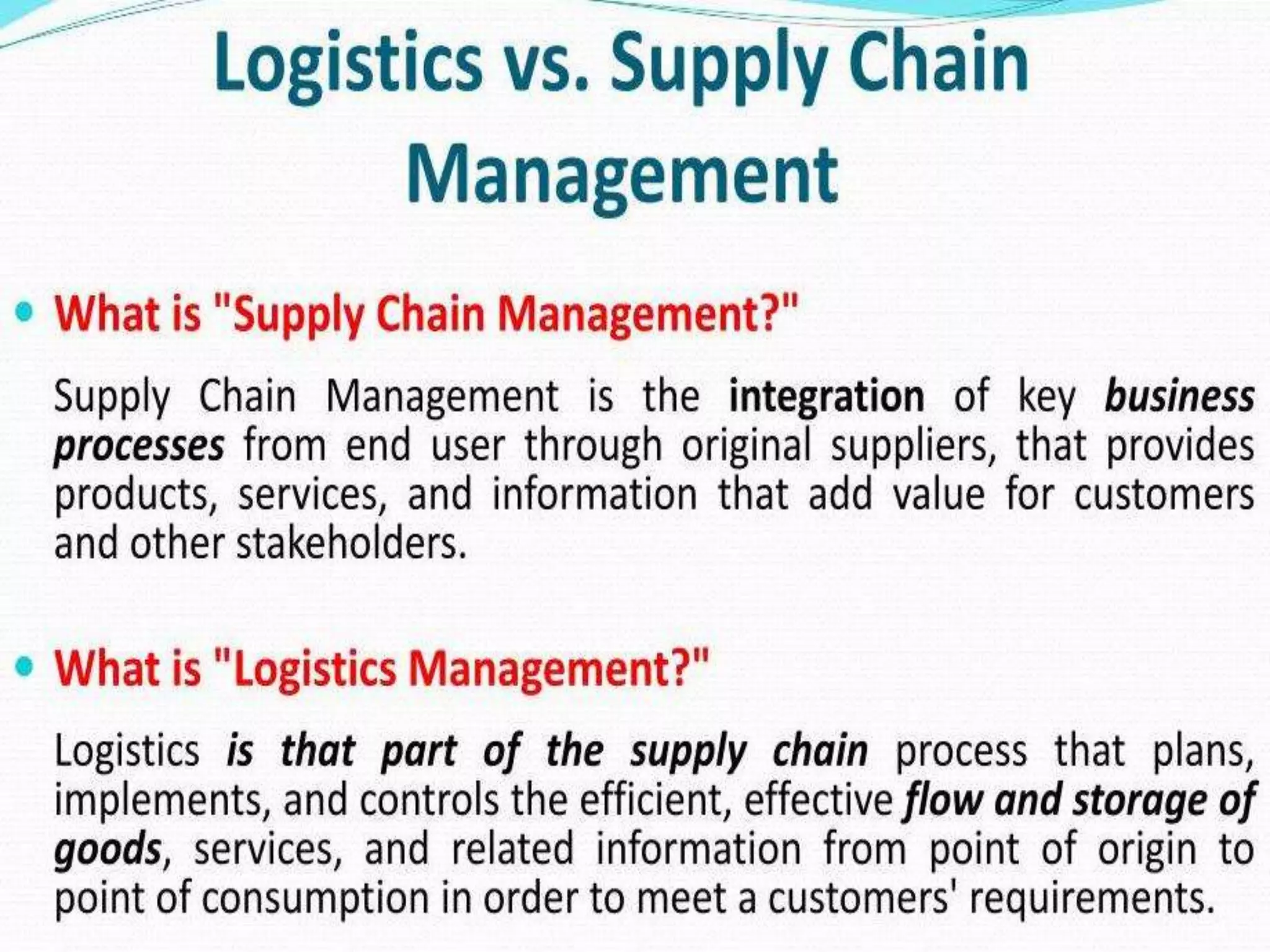
Logistics Management:
Logistics management is a supply
chain management component that is used to meet
customer demands through the planning, control
and implementation of the effective movement and
storage of related information, goods and services
from origin to destination.
Inbound logistics:
 The process of bringing in purchased goods into the
company is known as inbound logistics.
 Inbound logistics refers to the transportation, the storage
and the receiving of goods into a business.
 It relates to goods procurement for office use or for the
production unit. In a manufacturing company, the
production unit purchases raw materials or components
from its suppliers for the production of other goods.
 Inbound logistics look at the supply chain and specifically
transportation as goods come into a company.
 Inbound logistics, therefore, focuses on the incoming
goods i.e. the inflow of goods from suppliers into the
warehouse.
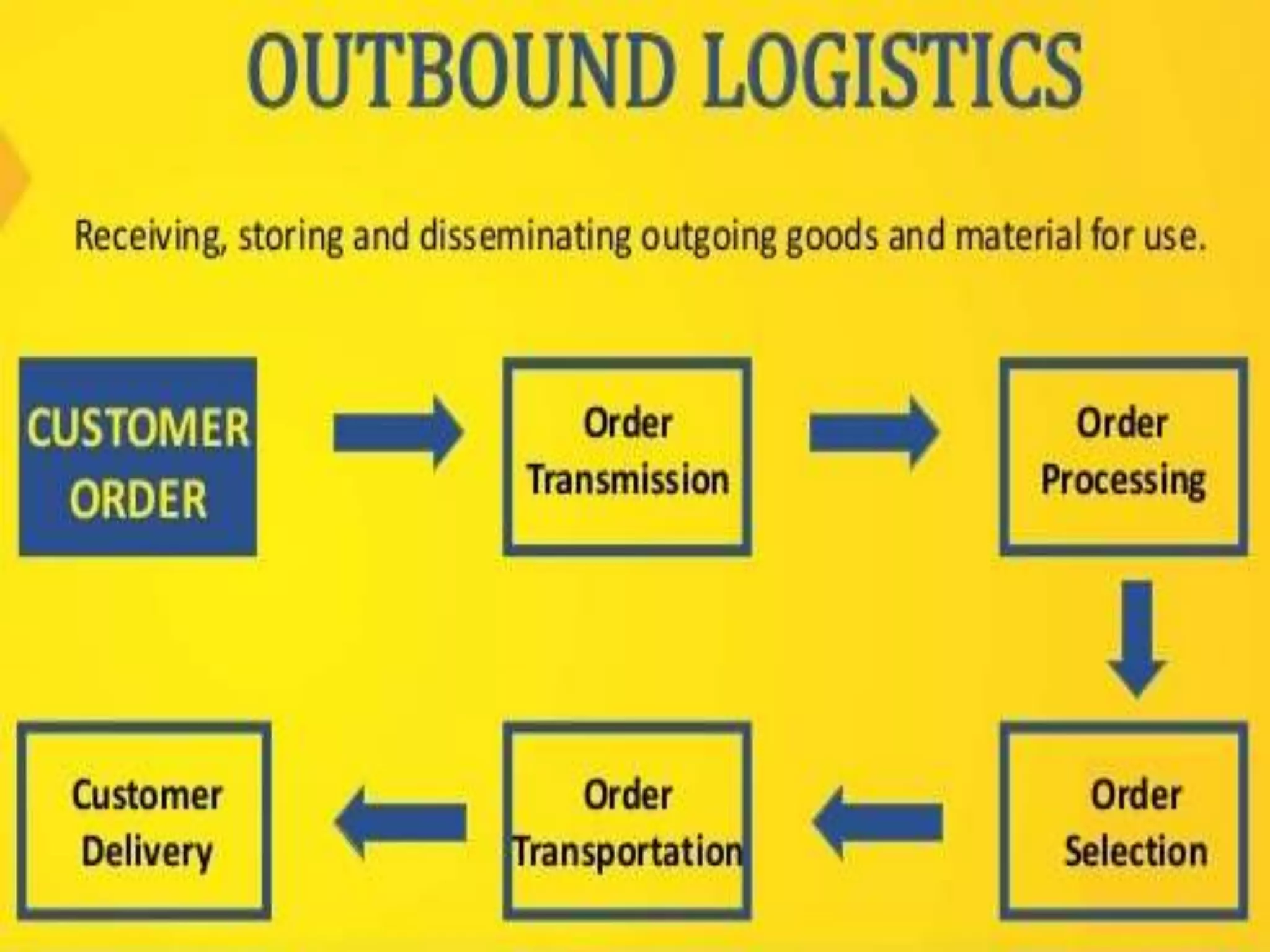
 Outbound Logistics:
The process related to the movement and storage of
products from the end of the production line to the end
user.
It plays a critical role in a supplier's overall customer
relationship management process.
Outbound logistics refers to the processes involved in
the movement and storage of products and how
related information flows from the end of the
production line to the firm’s customer.
Outbound logistics relies profoundly on transportation
and storage of finished goods.
The process of packaging and distributing customer
orders using specific transportation is known as
outbound logistics.
Internal logistics:
 The area that covers the movement of materials and the
support operations that occur within a company.
 It comprises several processes, such as warehousing,
stock control, automation and storage systems, material
handling, equipment and information technology.
 It aids in regulating material flows within the institution,
ensuring that the right items are in the right place, in the
right quantity and at the right time.
Developing the Logistics organization for
effective Supply Chain Management:
 When a company creates a logistics strategy it is defining
the service levels at which its logistics organization is at its
most cost-effective.
The ultimate goal of any logistics strategy is to deliver what
your customers want and when they want it.
There are different component areas for each company but
the list should at least include the following:
Transportation: Does the current transportation strategies
help service levels?
Outsourcing: What outsourcing is used in the logistics
function? Would a partnership with a third party logistics
company improve service levels?
Logistics Systems: Do the current logistics systems provide
the level of data that is required to successfully implement a
logistics strategy or are new systems required?
Competitors: Review what the competitors offer. Can changes
to the company’s customer service improve service levels?
Information: Is the information that drives the logistics
organization real-time and accurate? If the data is inaccurate
then the decisions that are made will be in error.
Strategy Review: Are the objectives of the logistics
organization in line with company objectives and strategies?
A successfully implemented logistics strategy is important for
companies who are dedicated to keeping service levels at the
highest levels possible despite changes that occur in the supply
chain.
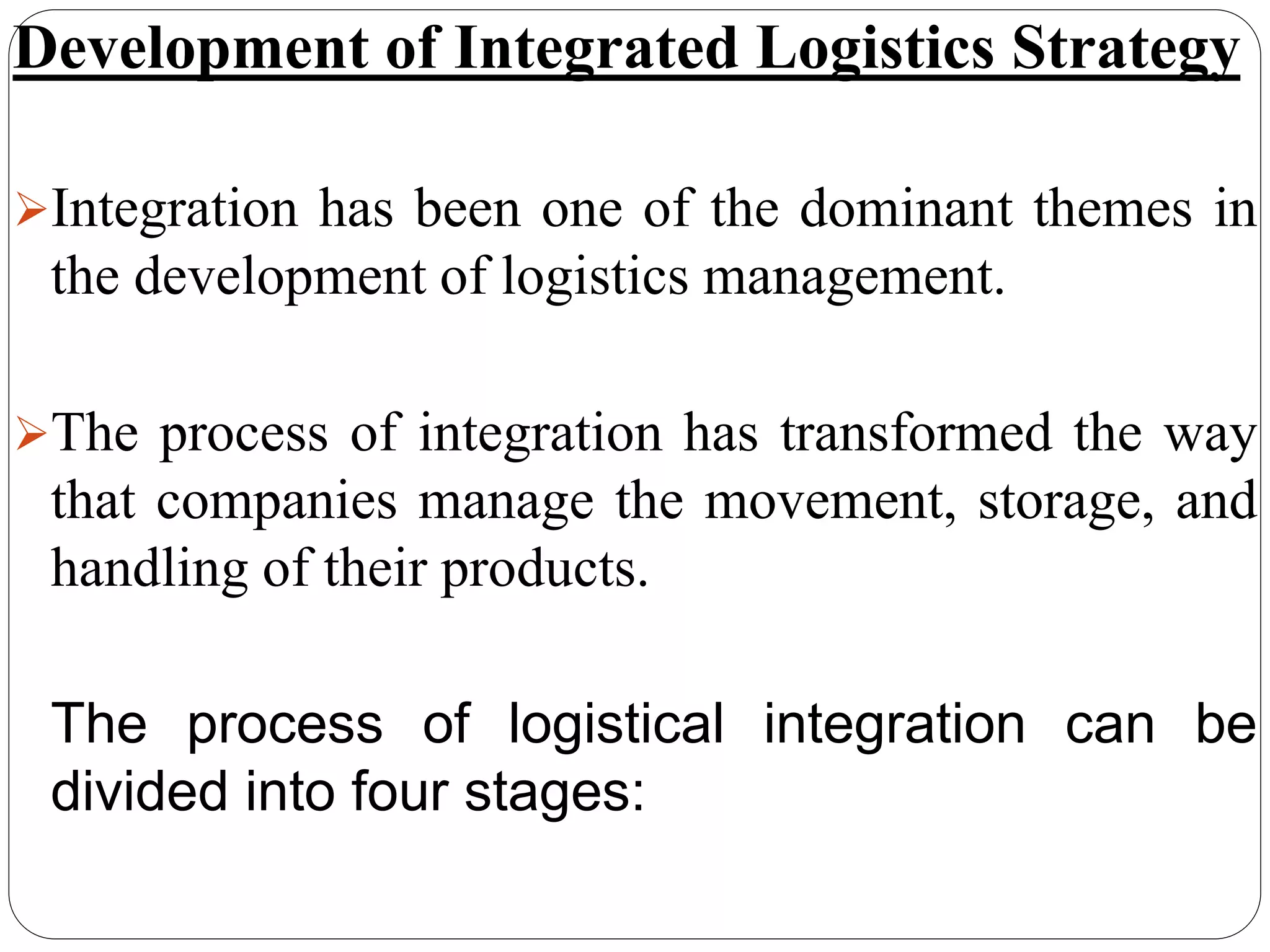
Development of Integrated Logistics Strategy
Integration has been one of the dominant themes in
the development of logistics management.
The process of integration has transformed the way
that companies manage the movement, storage, and
handling of their products.
The process of logistical integration can be
divided into four stages:
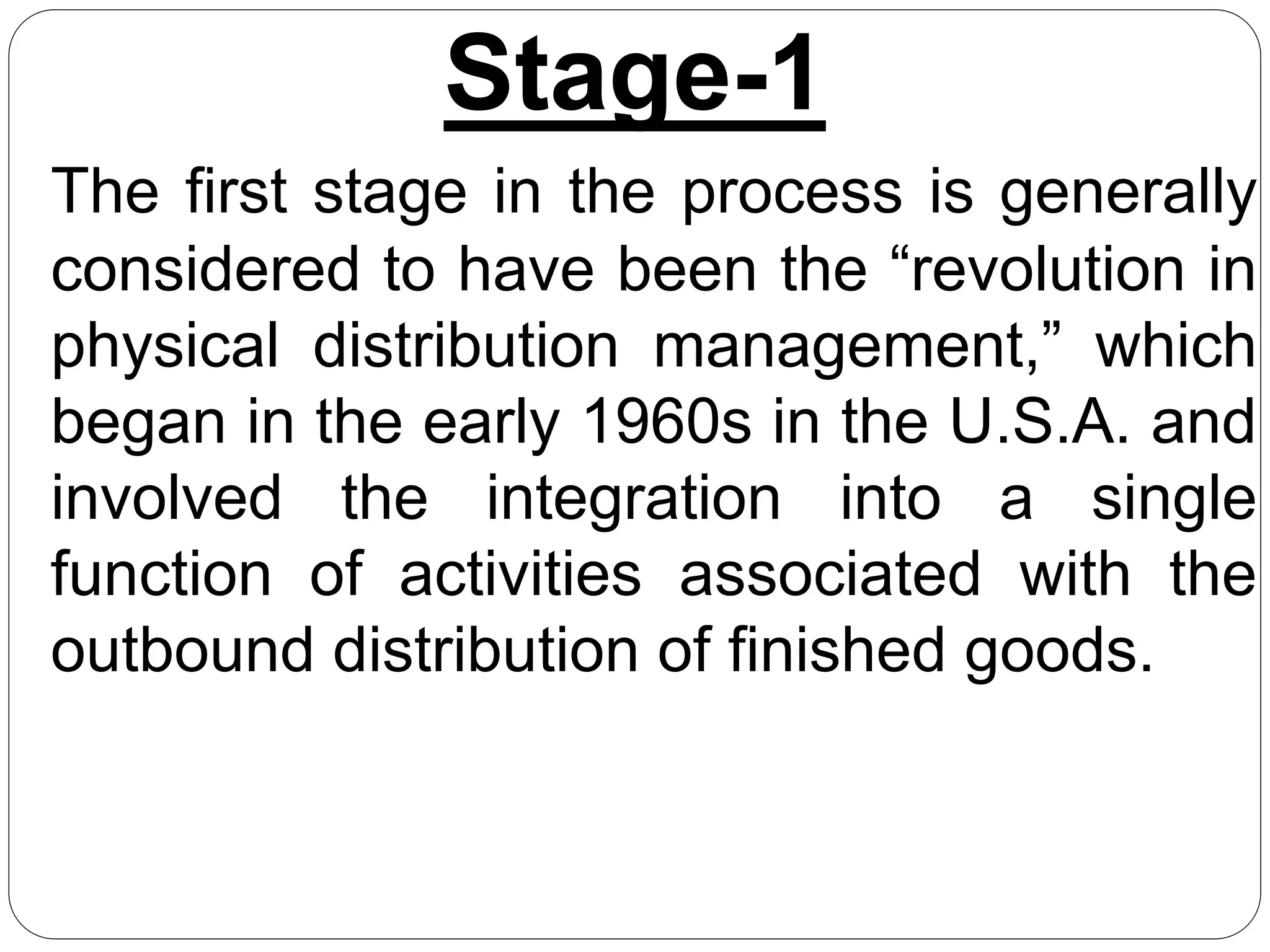
Stage-1
The first stage in the process is generally
considered to have been the “revolution in
physical distribution management,” which
began in the early 1960s in the U.S.A. and
involved the integration into a single
function of activities associated with the
outbound distribution of finished goods.
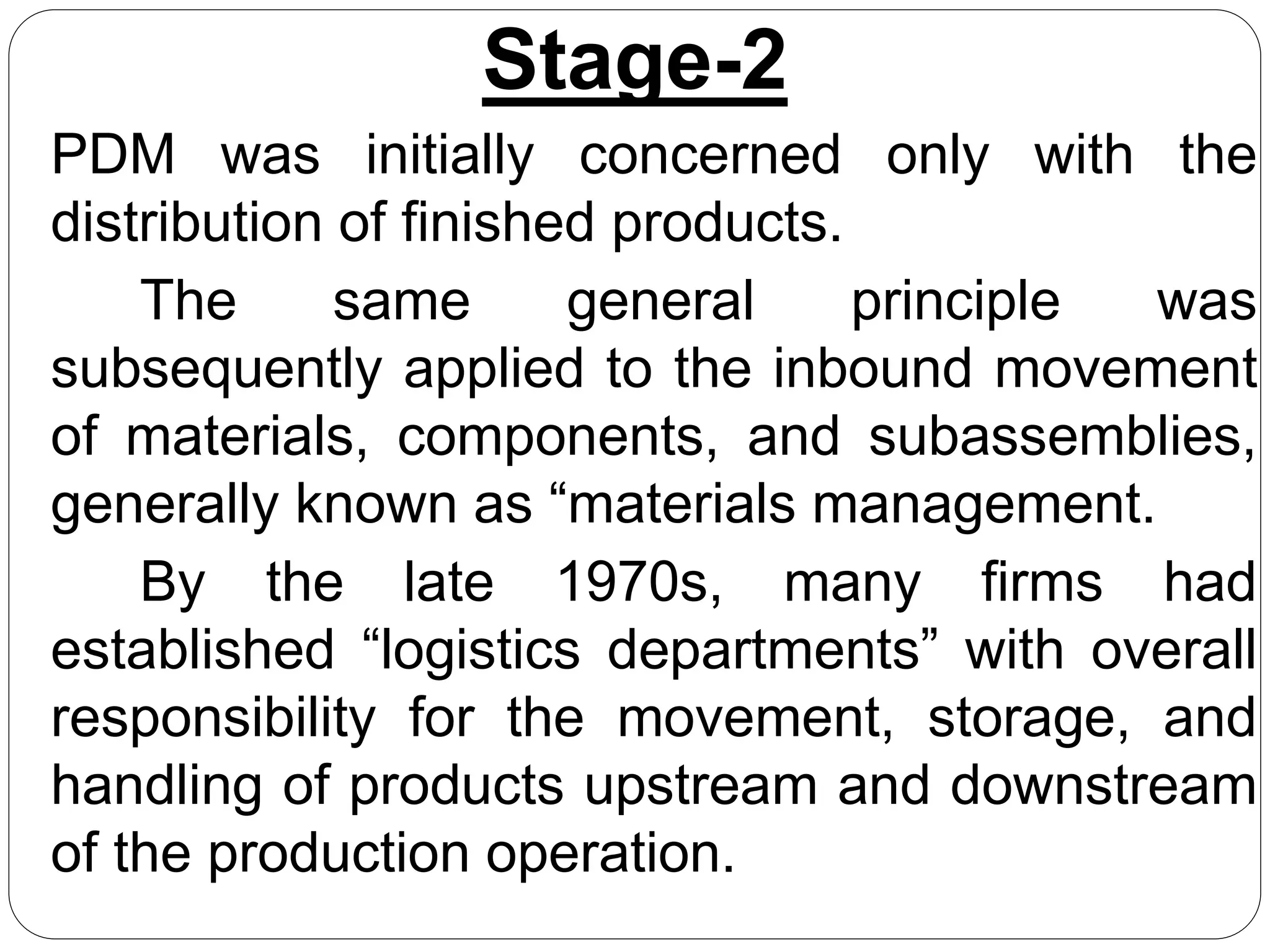
Stage-2
PDM was initially concerned only with the
distribution of finished products.
The same general principle was
subsequently applied to the inbound movement
of materials, components, and subassemblies,
generally known as “materials management.
By the late 1970s, many firms had
established “logistics departments” with overall
responsibility for the movement, storage, and
handling of products upstream and downstream
of the production operation.
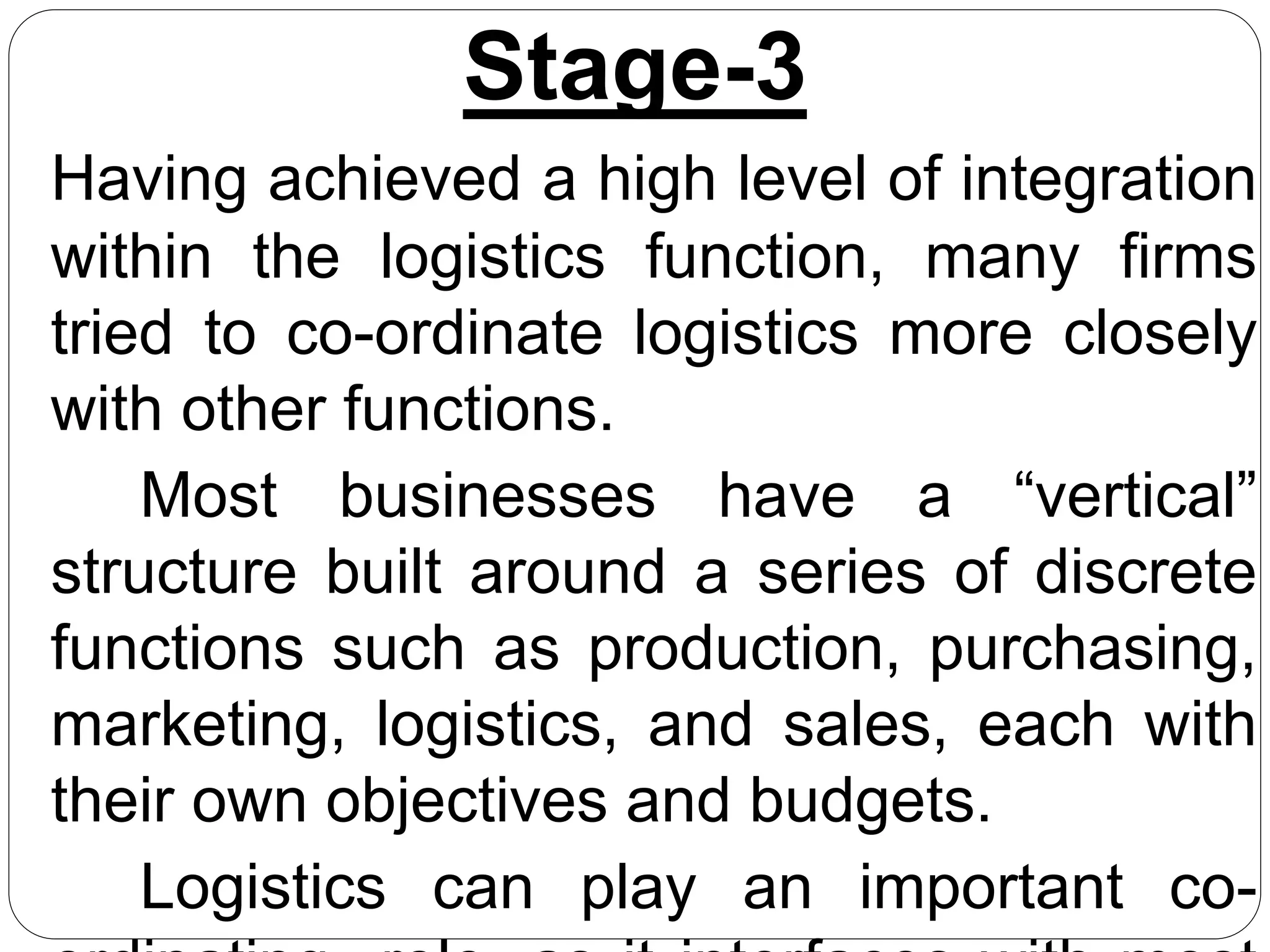
Stage-3
Having achieved a high level of integration
within the logistics function, many firms
tried to co-ordinate logistics more closely
with other functions.
Most businesses have a “vertical”
structure built around a series of discrete
functions such as production, purchasing,
marketing, logistics, and sales, each with
their own objectives and budgets.
Logistics can play an important co-
Stage-4
To achieve wider, supply chain optimization it is
necessary for companies at different levels in
the chain to co-ordinate their operations. This is
the essence of supply chain management
(SCM).
The main driver of SCM over the past 20
years has unquestionably been the desire to
minimize inventory.
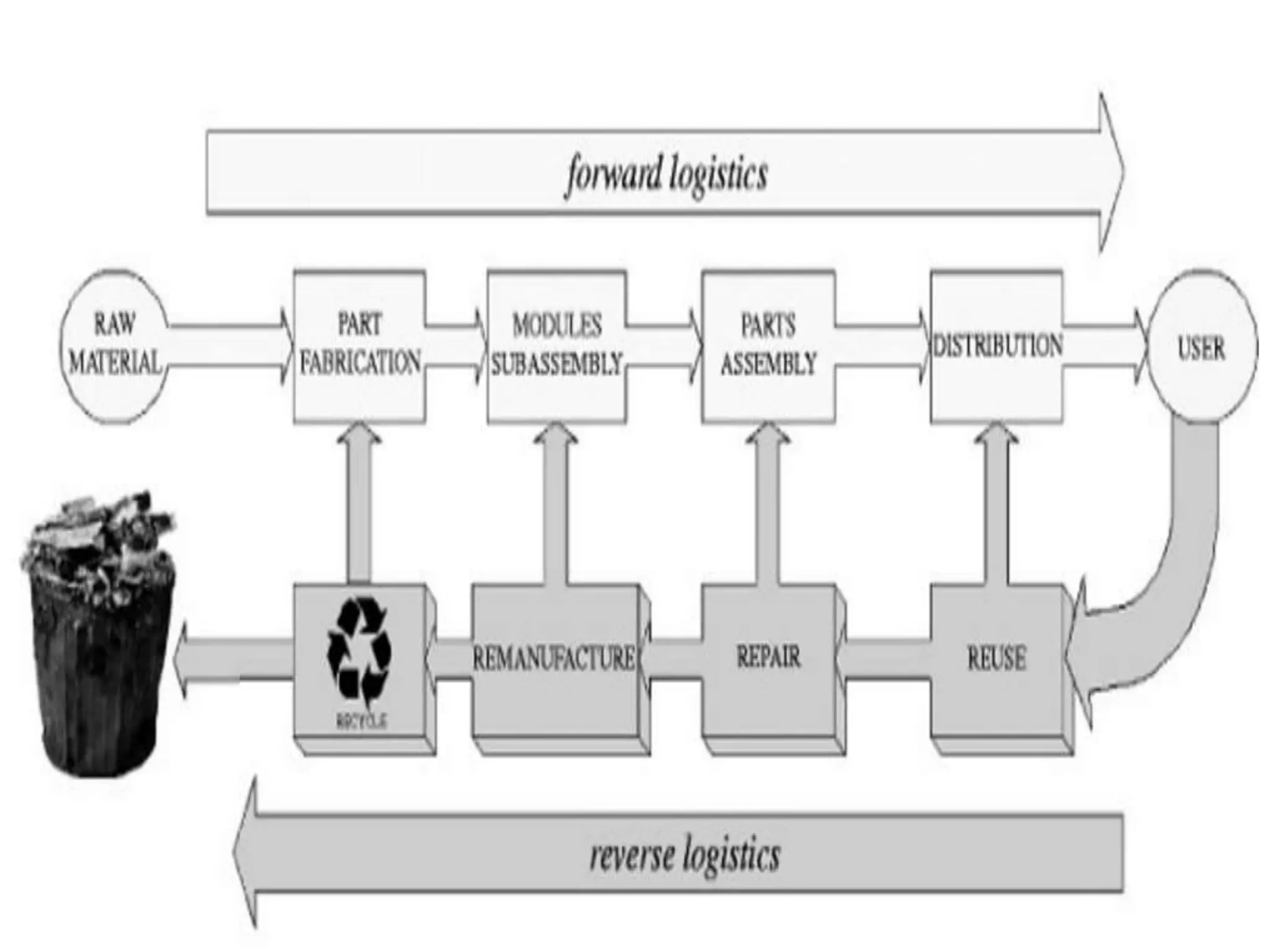
Reverse logistics:
“The process of
moving goods from their typical
final destination for the purpose
of capturing value, or proper
disposal. Remanufacturing and
refurbishing activities also may
be included in the definition of
reverse logistics."
Any process or management after the
delivery of the product involves reverse
logistics.
If the product is defective, the customer
would return the product.
The manufacturing firm would then
have to organize shipping of the defective
product, testing the product, dismantling,
repairing, recycling or disposing the
product.
The product would travel in reverse
through the supply chain network in order
Logistics in Maximizing profitability and cash flow:
When you think about Supply Chain
optimization you typically think of improving
delivery times, delivery accuracy and customer
service.
Here are four suggestions for how organization can
improve profitability by making quick and simple
savings:
1. Inventory Management:
Organizations must find the right balance between
minimizing their stocks and being able to meet order
demands. The threat of a stock shortage must be
visible before it actually arises.
2. Supplier Cash Control:
A great deal of insight can be found in the supply and
payment agreements with suppliers.
There are a number of elements to consider:
 how you can avoid purchasing unnecessary stock
(through automated order placement),
 avoidance of costs for corrections in orders and supplies
 the optimization of the payment behaviour of suppliers.
3. Operating Expenses Control:
There can be reasons for incorrect supplies
occurring, and instead of simply correcting the
relevant order, it’s important to search for the
point in the process where the error arose in
order to prevent the same mistake from
happening again.
4. Customer Cash Control:
By continually measuring whether the right
product in the right quantity is delivered to the
right place at the time required by the client,
supply processes can be further optimized and
costly errors avoided.
Reducing the term between ordering and
payment, solving late payments, making
missing payments visible and invoicing for them
can save a great deal.
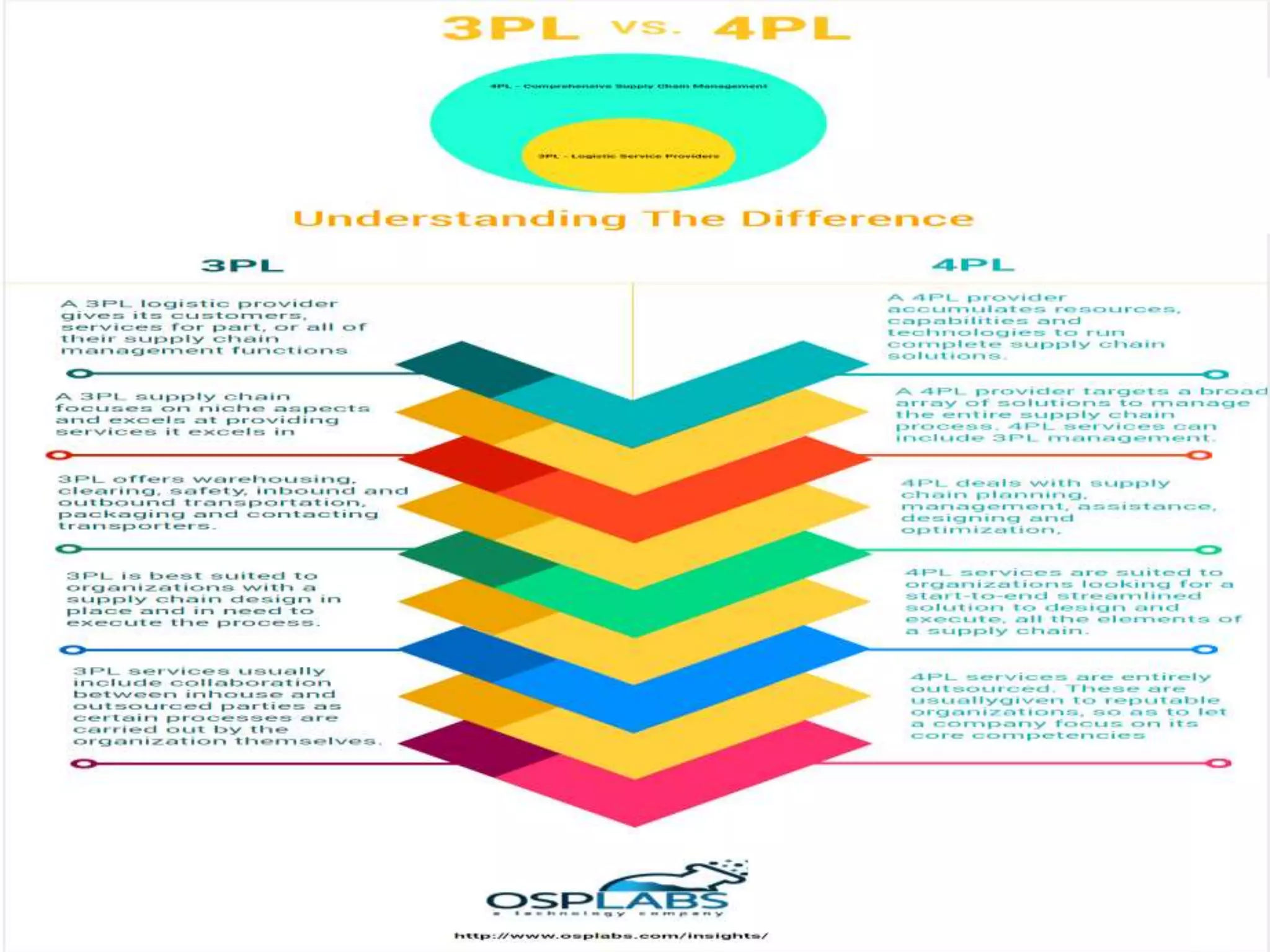
Third-party Logistics (3PL):
 Third-party logistics companies handle
physical distribution and logistics.
 3PL companies can do this by using their
own resources, such as warehouse
facilities, and their network of freight
transportation providers to help clients ship
or store their products appropriately.
 Whether in transit or in storage, 3PL
companies leverage their experience to
ensure that all steps are taken to keep the
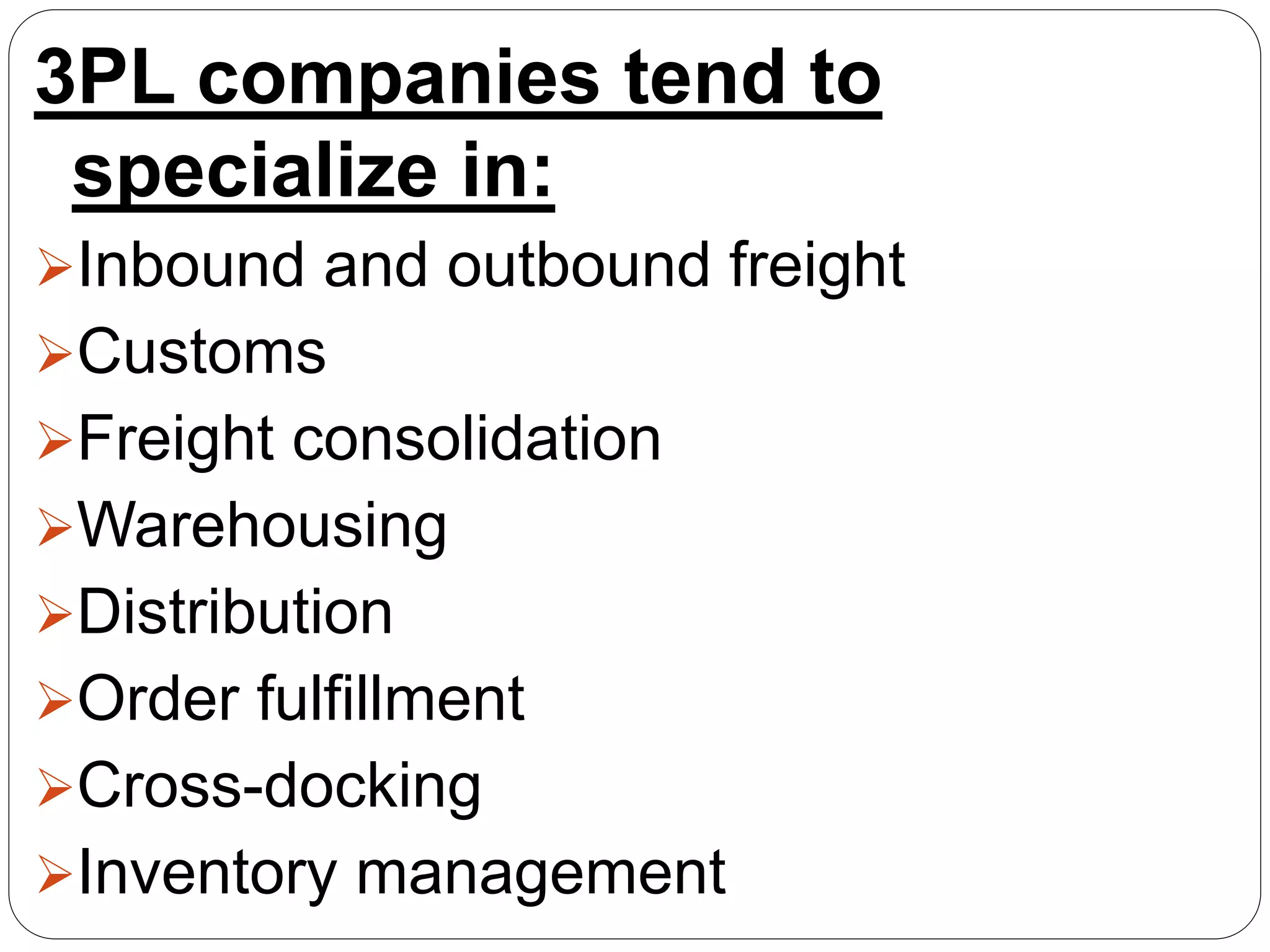
3PL companies tend to
specialize in:
Inbound and outbound freight
Customs
Freight consolidation
Warehousing
Distribution
Order fulfillment
Cross-docking
Inventory management
Fourth-party Logistics (4PL)
A 4PL company does not stop at
outsourcing logistics services but also
outsources the management of said
services.
Generally, 4PL companies have no way
of transportation or warehousing, but
rather use the transportation and
warehousing services of a 3PL
company.
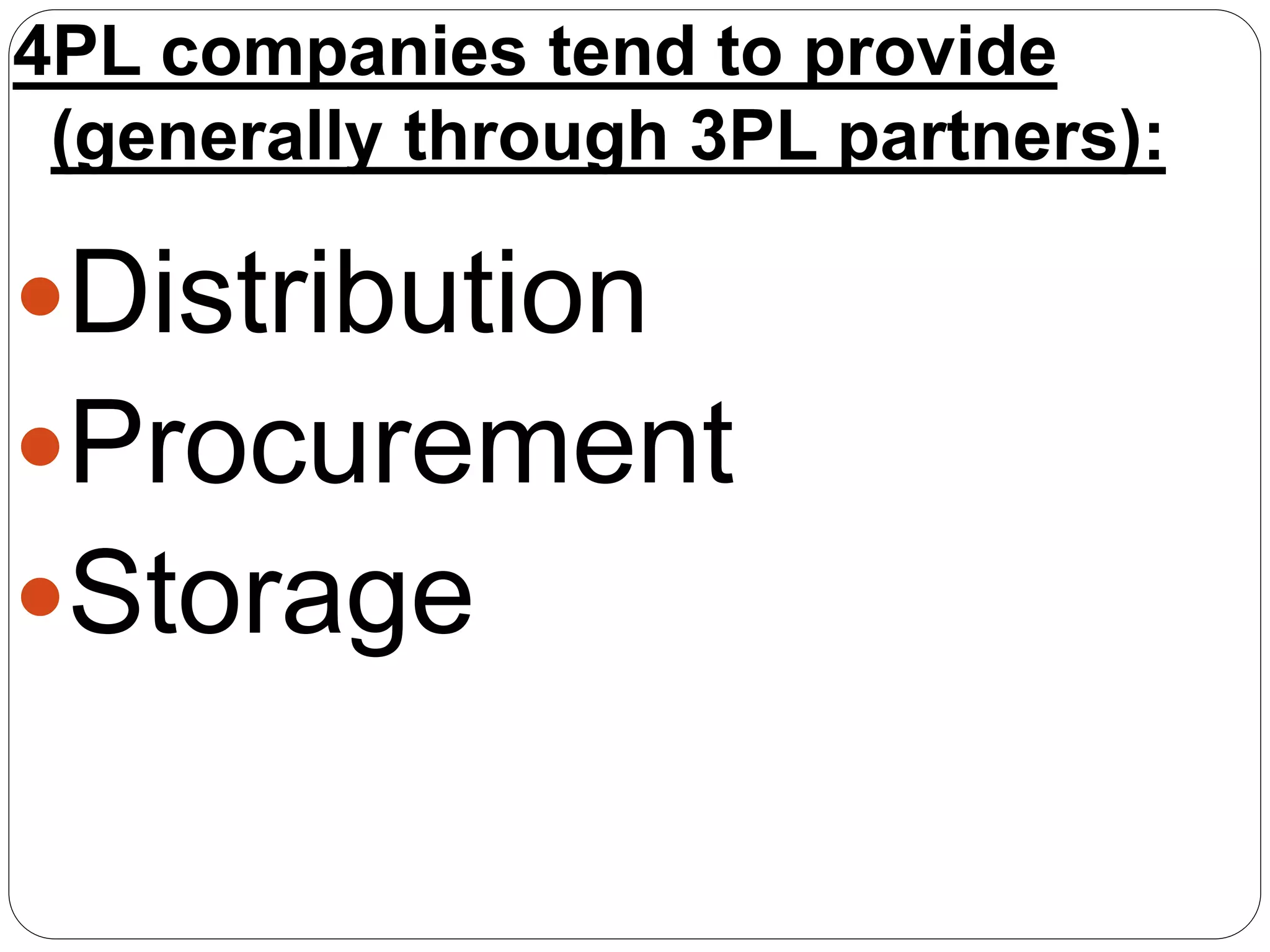
4PL companies tend to provide
(generally through 3PL partners):
Distribution
Procurement
Storage
LOGISTICS MANAGEMENT- UNIT-1 (2020)- BBA- V- Sem- Osmania University

LOGISTICS MANAGEMENT- UNIT-1 (2020)- BBA- V- Sem- Osmania University

  • 1.
  • 3.
    UNIT – I: INTRODUCTION : Logistics Management, Inbound, Internal and Outbound Logistics in SCM, Developing the Logistics organization for effective Supply Chain Management, development of Integrated Logistics Strategy, Logistics in Maximizing profitability and cash flow, 3PL, 4PL, International Logistics, Reverse Logistics.
  • 4.
    Logistics Management: Logistics managementis a supply chain management component that is used to meet customer demands through the planning, control and implementation of the effective movement and storage of related information, goods and services from origin to destination.
  • 6.
    Inbound logistics:  Theprocess of bringing in purchased goods into the company is known as inbound logistics.  Inbound logistics refers to the transportation, the storage and the receiving of goods into a business.  It relates to goods procurement for office use or for the production unit. In a manufacturing company, the production unit purchases raw materials or components from its suppliers for the production of other goods.  Inbound logistics look at the supply chain and specifically transportation as goods come into a company.  Inbound logistics, therefore, focuses on the incoming goods i.e. the inflow of goods from suppliers into the warehouse.
  • 8.
     Outbound Logistics: Theprocess related to the movement and storage of products from the end of the production line to the end user. It plays a critical role in a supplier's overall customer relationship management process. Outbound logistics refers to the processes involved in the movement and storage of products and how related information flows from the end of the production line to the firm’s customer. Outbound logistics relies profoundly on transportation and storage of finished goods. The process of packaging and distributing customer orders using specific transportation is known as outbound logistics.
  • 10.
    Internal logistics:  Thearea that covers the movement of materials and the support operations that occur within a company.  It comprises several processes, such as warehousing, stock control, automation and storage systems, material handling, equipment and information technology.  It aids in regulating material flows within the institution, ensuring that the right items are in the right place, in the right quantity and at the right time.
  • 11.
    Developing the Logisticsorganization for effective Supply Chain Management:  When a company creates a logistics strategy it is defining the service levels at which its logistics organization is at its most cost-effective. The ultimate goal of any logistics strategy is to deliver what your customers want and when they want it. There are different component areas for each company but the list should at least include the following: Transportation: Does the current transportation strategies help service levels? Outsourcing: What outsourcing is used in the logistics function? Would a partnership with a third party logistics company improve service levels?
  • 12.
    Logistics Systems: Dothe current logistics systems provide the level of data that is required to successfully implement a logistics strategy or are new systems required? Competitors: Review what the competitors offer. Can changes to the company’s customer service improve service levels? Information: Is the information that drives the logistics organization real-time and accurate? If the data is inaccurate then the decisions that are made will be in error. Strategy Review: Are the objectives of the logistics organization in line with company objectives and strategies? A successfully implemented logistics strategy is important for companies who are dedicated to keeping service levels at the highest levels possible despite changes that occur in the supply chain.
  • 13.
    Development of IntegratedLogistics Strategy Integration has been one of the dominant themes in the development of logistics management. The process of integration has transformed the way that companies manage the movement, storage, and handling of their products. The process of logistical integration can be divided into four stages:
  • 14.
    Stage-1 The first stagein the process is generally considered to have been the “revolution in physical distribution management,” which began in the early 1960s in the U.S.A. and involved the integration into a single function of activities associated with the outbound distribution of finished goods.
  • 15.
    Stage-2 PDM was initiallyconcerned only with the distribution of finished products. The same general principle was subsequently applied to the inbound movement of materials, components, and subassemblies, generally known as “materials management. By the late 1970s, many firms had established “logistics departments” with overall responsibility for the movement, storage, and handling of products upstream and downstream of the production operation.
  • 16.
    Stage-3 Having achieved ahigh level of integration within the logistics function, many firms tried to co-ordinate logistics more closely with other functions. Most businesses have a “vertical” structure built around a series of discrete functions such as production, purchasing, marketing, logistics, and sales, each with their own objectives and budgets. Logistics can play an important co-
  • 17.
    Stage-4 To achieve wider,supply chain optimization it is necessary for companies at different levels in the chain to co-ordinate their operations. This is the essence of supply chain management (SCM). The main driver of SCM over the past 20 years has unquestionably been the desire to minimize inventory.
  • 18.
    Reverse logistics: “The processof moving goods from their typical final destination for the purpose of capturing value, or proper disposal. Remanufacturing and refurbishing activities also may be included in the definition of reverse logistics."
  • 19.
    Any process ormanagement after the delivery of the product involves reverse logistics. If the product is defective, the customer would return the product. The manufacturing firm would then have to organize shipping of the defective product, testing the product, dismantling, repairing, recycling or disposing the product. The product would travel in reverse through the supply chain network in order
  • 21.
    Logistics in Maximizingprofitability and cash flow: When you think about Supply Chain optimization you typically think of improving delivery times, delivery accuracy and customer service. Here are four suggestions for how organization can improve profitability by making quick and simple savings: 1. Inventory Management: Organizations must find the right balance between minimizing their stocks and being able to meet order demands. The threat of a stock shortage must be visible before it actually arises.
  • 22.
    2. Supplier CashControl: A great deal of insight can be found in the supply and payment agreements with suppliers. There are a number of elements to consider:  how you can avoid purchasing unnecessary stock (through automated order placement),  avoidance of costs for corrections in orders and supplies  the optimization of the payment behaviour of suppliers.
  • 23.
    3. Operating ExpensesControl: There can be reasons for incorrect supplies occurring, and instead of simply correcting the relevant order, it’s important to search for the point in the process where the error arose in order to prevent the same mistake from happening again.
  • 24.
    4. Customer CashControl: By continually measuring whether the right product in the right quantity is delivered to the right place at the time required by the client, supply processes can be further optimized and costly errors avoided. Reducing the term between ordering and payment, solving late payments, making missing payments visible and invoicing for them can save a great deal.
  • 25.
    Third-party Logistics (3PL): Third-party logistics companies handle physical distribution and logistics.  3PL companies can do this by using their own resources, such as warehouse facilities, and their network of freight transportation providers to help clients ship or store their products appropriately.  Whether in transit or in storage, 3PL companies leverage their experience to ensure that all steps are taken to keep the
  • 26.
    3PL companies tendto specialize in: Inbound and outbound freight Customs Freight consolidation Warehousing Distribution Order fulfillment Cross-docking Inventory management
  • 27.
    Fourth-party Logistics (4PL) A4PL company does not stop at outsourcing logistics services but also outsources the management of said services. Generally, 4PL companies have no way of transportation or warehousing, but rather use the transportation and warehousing services of a 3PL company.
  • 28.
    4PL companies tendto provide (generally through 3PL partners): Distribution Procurement Storage