07/05/15 1
By :
Prof. Amit Kumar
07/05/15 2
Course: Consumer Behavior
Unit-1 Consumer in the Marketplace
Unit-2 Models of Consumer Behavior
Unit-3 Cultural Influences on Consumer Decision making
Unit-4 Sociological Influences on Consumer Decision making
Unit-5 Personal / Individual Influences on Decision making
Unit-6 Psychological Influences on Decision making
Unit-7 Consumer Decision Making Process
Unit-8 Consumer Influence & Diffusion of Innovation
Consumer Behavior
IILM-Graduate School of Management
07/05/15 3
Consumer Behavior Consumer Influence & Diffusion of Innovation
IILM-Graduate School of Management
07/05/15 4
Consumer Behavior Consumer Influence & Diffusion of Innovation
IILM-Graduate School of Management
07/05/15 5
Consumer Behavior Consumer Influence & Diffusion of Innovation
IILM-Graduate School of Management
• Think of an innovation in your field.
• Describe different groups of employees in your
organization who would respond early and
favorably, as well as later and unfavorably.
• What are the differences between these groups?
• How could you use this information to market the
innovation to them more effectively?
07/05/15 6
In today’s competitive context, markers
are not only concerned with launching
brands but also with how consumer
accept them in the marketplace.
Consumer Behavior Consumer Influence & Diffusion of Innovation
IILM-Graduate School of Management
07/05/15 7
Consumer Behavior Consumer Influence & Diffusion of Innovation
IILM-Graduate School of Management
07/05/15 8
1. How consumers accept new products and
brands (specially the target segment of
consumers) and
2. How they accept a set of marketing mix elements
formulated for a brand over a period of time.
Traditionally diffusion of innovation has been concerned
only with new products, the concept can be applied to
existing products and brands.
Consumer Behavior Consumer Influence & Diffusion of Innovation
IILM-Graduate School of Management
Diffusion of Innovation is Associated With:
07/05/15 9
New products can be divided into:
1. Continuous innovation;
2. Dynamically continuous innovation;
3. Discontinuous innovation;
Consumer Behavior Consumer Influence & Diffusion of Innovation
IILM-Graduate School of Management
Defining “New” Products
The division of ‘new’ among products launched in
market is based on two aspects:
1. The changes required in consumer behavior
to use the innovation;
2. Degree of innovation;
07/05/15 10
1. Discontinuous Innovation
• Aero planes, computers and telephones were
discontinuous innovations at the period of time
when they were invented,
• As both the degree of innovation as well as the
degree of changes required in consumer behavior
in adapting to these innovations was high.
Consumer Behavior Consumer Influence & Diffusion of Innovation
IILM-Graduate School of Management
Defining “New” Products
07/05/15 11
2. Dynamically Continuous Innovation
• When buying a digital camera or considering
Internet shopping, the change in behavior on the
part of the consumers is moderate as is the
degree of innovation.
Consumer Behavior Consumer Influence & Diffusion of Innovation
IILM-Graduate School of Management
Defining “New” Products
07/05/15 12
3. Continuous Innovation
• When the remote switch of a TV is considered,
consumers have to make only a small change
with regard to their behavior (or practice) to use
the remote along with their TV.
• Hence, this is a continuous innovation.
Consumer Behavior Consumer Influence & Diffusion of Innovation
IILM-Graduate School of Management
Defining “New” Products
07/05/15 13
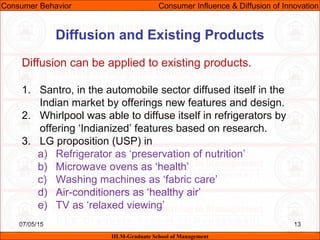
Diffusion can be applied to existing products.
1. Santro, in the automobile sector diffused itself in the
Indian market by offerings new features and design.
2. Whirlpool was able to diffuse itself in refrigerators by
offering ‘Indianized’ features based on research.
3. LG proposition (USP) in
a) Refrigerator as ‘preservation of nutrition’
b) Microwave ovens as ‘health’
c) Washing machines as ‘fabric care’
d) Air-conditioners as ‘healthy air’
e) TV as ‘relaxed viewing’
Consumer Behavior Consumer Influence & Diffusion of Innovation
IILM-Graduate School of Management
Diffusion and Existing Products
07/05/15 14
Consumer Behavior Consumer Influence & Diffusion of Innovation
IILM-Graduate School of Management
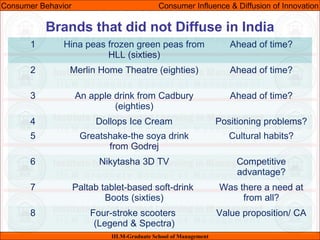
Brands that did not Diffuse in India
1 Hina peas frozen green peas from
HLL (sixties)
Ahead of time?
2 Merlin Home Theatre (eighties) Ahead of time?
3 An apple drink from Cadbury
(eighties)
Ahead of time?
4 Dollops Ice Cream Positioning problems?
5 Greatshake-the soya drink
from Godrej
Cultural habits?
6 Nikytasha 3D TV Competitive
advantage?
7 Paltab tablet-based soft-drink
Boots (sixties)
Was there a need at
from all?
8 Four-stroke scooters
(Legend & Spectra)
Value proposition/ CA
07/05/15 15
Consumer Behavior Consumer Influence & Diffusion of Innovation
IILM-Graduate School of Management
07/05/15 16
Consumer Behavior Consumer Influence & Diffusion of Innovation
IILM-Graduate School of Management

Cb unit-viii (consumer influence & diffusion of innovation)

  • 1.
  • 2.
    07/05/15 2 Course: ConsumerBehavior Unit-1 Consumer in the Marketplace Unit-2 Models of Consumer Behavior Unit-3 Cultural Influences on Consumer Decision making Unit-4 Sociological Influences on Consumer Decision making Unit-5 Personal / Individual Influences on Decision making Unit-6 Psychological Influences on Decision making Unit-7 Consumer Decision Making Process Unit-8 Consumer Influence & Diffusion of Innovation Consumer Behavior IILM-Graduate School of Management
  • 3.
    07/05/15 3 Consumer BehaviorConsumer Influence & Diffusion of Innovation IILM-Graduate School of Management
  • 4.
    07/05/15 4 Consumer BehaviorConsumer Influence & Diffusion of Innovation IILM-Graduate School of Management
  • 5.
    07/05/15 5 Consumer BehaviorConsumer Influence & Diffusion of Innovation IILM-Graduate School of Management • Think of an innovation in your field. • Describe different groups of employees in your organization who would respond early and favorably, as well as later and unfavorably. • What are the differences between these groups? • How could you use this information to market the innovation to them more effectively?
  • 6.
    07/05/15 6 In today’scompetitive context, markers are not only concerned with launching brands but also with how consumer accept them in the marketplace. Consumer Behavior Consumer Influence & Diffusion of Innovation IILM-Graduate School of Management
  • 7.
    07/05/15 7 Consumer BehaviorConsumer Influence & Diffusion of Innovation IILM-Graduate School of Management
  • 8.
    07/05/15 8 1. Howconsumers accept new products and brands (specially the target segment of consumers) and 2. How they accept a set of marketing mix elements formulated for a brand over a period of time. Traditionally diffusion of innovation has been concerned only with new products, the concept can be applied to existing products and brands. Consumer Behavior Consumer Influence & Diffusion of Innovation IILM-Graduate School of Management Diffusion of Innovation is Associated With:
  • 9.
    07/05/15 9 New productscan be divided into: 1. Continuous innovation; 2. Dynamically continuous innovation; 3. Discontinuous innovation; Consumer Behavior Consumer Influence & Diffusion of Innovation IILM-Graduate School of Management Defining “New” Products The division of ‘new’ among products launched in market is based on two aspects: 1. The changes required in consumer behavior to use the innovation; 2. Degree of innovation;
  • 10.
    07/05/15 10 1. DiscontinuousInnovation • Aero planes, computers and telephones were discontinuous innovations at the period of time when they were invented, • As both the degree of innovation as well as the degree of changes required in consumer behavior in adapting to these innovations was high. Consumer Behavior Consumer Influence & Diffusion of Innovation IILM-Graduate School of Management Defining “New” Products
  • 11.
    07/05/15 11 2. DynamicallyContinuous Innovation • When buying a digital camera or considering Internet shopping, the change in behavior on the part of the consumers is moderate as is the degree of innovation. Consumer Behavior Consumer Influence & Diffusion of Innovation IILM-Graduate School of Management Defining “New” Products
  • 12.
    07/05/15 12 3. ContinuousInnovation • When the remote switch of a TV is considered, consumers have to make only a small change with regard to their behavior (or practice) to use the remote along with their TV. • Hence, this is a continuous innovation. Consumer Behavior Consumer Influence & Diffusion of Innovation IILM-Graduate School of Management Defining “New” Products
  • 13.
    07/05/15 13 Diffusion canbe applied to existing products. 1. Santro, in the automobile sector diffused itself in the Indian market by offerings new features and design. 2. Whirlpool was able to diffuse itself in refrigerators by offering ‘Indianized’ features based on research. 3. LG proposition (USP) in a) Refrigerator as ‘preservation of nutrition’ b) Microwave ovens as ‘health’ c) Washing machines as ‘fabric care’ d) Air-conditioners as ‘healthy air’ e) TV as ‘relaxed viewing’ Consumer Behavior Consumer Influence & Diffusion of Innovation IILM-Graduate School of Management Diffusion and Existing Products
  • 14.
    07/05/15 14 Consumer BehaviorConsumer Influence & Diffusion of Innovation IILM-Graduate School of Management Brands that did not Diffuse in India 1 Hina peas frozen green peas from HLL (sixties) Ahead of time? 2 Merlin Home Theatre (eighties) Ahead of time? 3 An apple drink from Cadbury (eighties) Ahead of time? 4 Dollops Ice Cream Positioning problems? 5 Greatshake-the soya drink from Godrej Cultural habits? 6 Nikytasha 3D TV Competitive advantage? 7 Paltab tablet-based soft-drink Boots (sixties) Was there a need at from all? 8 Four-stroke scooters (Legend & Spectra) Value proposition/ CA
  • 15.
    07/05/15 15 Consumer BehaviorConsumer Influence & Diffusion of Innovation IILM-Graduate School of Management
  • 16.
    07/05/15 16 Consumer BehaviorConsumer Influence & Diffusion of Innovation IILM-Graduate School of Management

Editor's Notes

  • #4 Consumer acceptance todays using the innovative products
  • #5 What is ur opinion on this topic..ask to few students for their attentions
  • #6 Like a software engineer…whenever new operating systems comes in the market..how long it takes to u to adopt or buy that O/S U all r manageet students..suppose a new sony or apple comes with a new brand of laptop ..which is highly innovative in nature..when u will think to purchase that? Show a video of a innovative technology?
  • #8 http://www.consumerpsychologist.com/cb_Diffusion_of_Innovation.html
  • #9 Like a software engineer…whenever new operating systems comes in the market..how long it takes to u to adopt or buy that O/S U all r manageet students..suppose a new sony or apple comes with a new brand of laptop ..which is highly innovative in nature..when u will think to purchase that?..recently netbook..came in the market and ur jouniors got that products… Show a video of a innovative technology? Apple ipod G5…. http://www.youtube.com/watch?v=zV8iC7Nqqlg&feature=related Existing product like laptop…
  • #10 Give emphasis of learning in all three innovation.. Innovations come in different degrees.  A continuous innovation includes slight improvements over time.  Very little usually changes from year to year in automobiles, and even automobiles of the 1990s are driven much the same way that automobiles of the 1950 were driven.  A dynamically continuous innovation involves some change in technology, although the product is used much the same way that its predecessors were used—e.g., jet vs. propeller aircraft.  A discontinous innovation involves a product that fundamentally changes the way that things are done—e.g., the fax and photocopiers.  In general, discontinuous innovations are more difficult to market since greater changes are required in the way things are done, but the rewards are also often significant.
  • #11 It’s a case of completely new learning…microwave..computer..very difficult to do innovation and market,..a complete set of features has to innovate in this case
  • #12 Like electric tooth brush Vs tooth brush, laptop vs netbook.. dynamically continuous innovation. Back (Answer). disrupts consumer's normal routine but does not require totally new learning (ex: electric tooth brush)
  • #13 Very little learning cases…slight improvement over time…before it was pressing the TV buttons but now remote ..buying flavoured soft drinks…or buying light bulbs (100 hrs)
  • #14 TV as relax viewing..remember golden eye features
  • #15 Tang orange jouce (positioned as breakfast jouce)---cultural habits
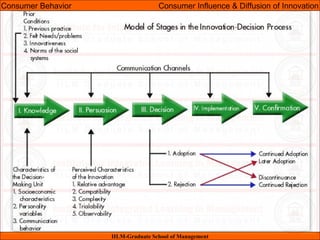
  • #16 Five stages of the adoption process KnowledgeIn this stage the individual is first exposed to an innovation but lacks information about the innovation. It should be noted that during this stage of the process the individual has not been inspired to find more information about the innovation. Persuasion (means might be innovation as a complex products…) In this stage the individual is interested in the innovation and actively seeks information/detail about the innovation. Decision In this stage the individual takes the concept of the innovation and weighs the advantages/disadvantages of using the innovation and decides whether to adopt or reject the innovation. Due to the individualistic nature of this stage Rogers notes that it is the most difficult stage to acquire empirical evidence (Rogers, 1964, p. 83). ImplementationIn this stage the individual employs the innovation to a varying degree depending on the situation. During this stage the individual determines the usefulness of the innovation and may search for further information about it. Confirmation Although the name of this stage may be misleading, in this stage the individual finalizes their decision to continue using the innovation and may use the innovation to its fullest potential.
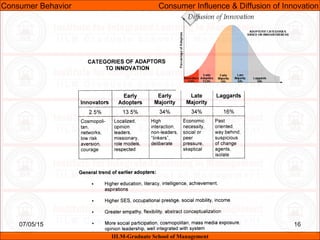
  • #17 Cosmopolitan may refer to: Internationalism. A city/place or person that embraces its multicultural demographics; they know Know more about Lifestyle trends, Relationships, Love & Lust, Love tips and tricks, Fashion trends, Beauty tips, Hot Picture gallery of sexy ... Adopter categories Rogers defines an adopter category as a classification of individuals within a social system on the basis of innovativeness. In the book Diffusion of Innovations, Rogers suggests a total of five categories of adopters in order to standardize the usage of adopter categories in diffusion research. It should be noted that the adoption of an innovation follows an S curve when plotted over a length of time.[citation needed] The categories of adopters are: innovators, early adopters, early majority, late majority, and laggards [7] Innovators Innovators are the first individuals to adopt an innovation. Innovators are willing to take risks, youngest in age, have the highest social class, have great financial lucidity, very social and have closest contact to scientific sources and interaction with other innovators. Early Adopters This is second fastest category of individuals who adopt an innovation. These individuals have the highest degree of opinion leadership among the other adopter categories. Early adopters are typically younger in age, have a higher social status, have more financial lucidity, advanced education, and are more socially forward than late adopters (Rogers, 1964, p. 185). Early MajorityIndividuals in this category adopt an innovation after a varying degree of time. This time of adoption is significantly longer than the innovators and early adopters. Early Majority tend to be slower in the adoption process, have above average social status, contact with early adopters, and show some opinion leadership Late MajorityIndividuals in this category will adopt an innovation after the average member of the society. These individuals approach an innovation with a high degree of skepticism and after the majority of society has adopted the innovation. Late Majority are typically skeptical about an innovation, have below average social status, very little financial lucidity, in contact with others in late majority and early majority, very little opinion leadership. LaggardsIndividuals in this category are the last to adopt an innovation. Unlike some of the previous categories, individuals in this category show little to no opinion leadership. These individuals typically have an aversion to change-agents and tend to be advanced in age. Laggards typically tend to be focused on “traditions”, have lowest social status, lowest financial fluidity, oldest of all other adopters, in contact with only family and close friends, very little to no opinion leadership.