07/04/15 1
By :
Prof. Amit Kumar
07/04/15 2
Course: Consumer Behavior
Unit-1 Consumer in the Marketplace
Unit-2 Models of Consumer Behavior
Unit-3 Cultural Influences on Consumer Decision making
Unit-4 Sociological Influences on Consumer Decision making
Unit-5 Personal / Individual Influences on Decision making
Unit-6 Psychological Influences on Decision making
Unit-7 Consumer Decision Making Process
Unit-8 Consumer Influence & Diffusion of Innovation
Consumer Behavior
IILM-Graduate School of Management
07/04/15 3
Consumer Behavior Consumer Decision Making Process
IILM-Graduate School of Management
07/04/15 4
• Think of a recent important purchase– briefly draw a
flowchart of the steps you recall moving through from
the awareness of need to post purchase
• What influenced you at each step?
Consumer Behavior Consumer Decision Making Process
IILM-Graduate School of Management
07/04/15 5
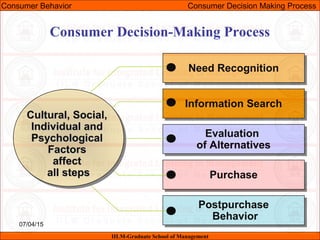
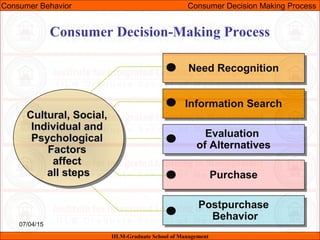
Consumer Decision-Making Process
Postpurchase
Behavior
Postpurchase
Behavior
PurchasePurchase
Evaluation
of Alternatives
Evaluation
of Alternatives
Information SearchInformation Search
Need RecognitionNeed Recognition
Cultural, Social,Cultural, Social,
Individual andIndividual and
PsychologicalPsychological
FactorsFactors
affectaffect
all stepsall steps
Cultural, Social,Cultural, Social,
Individual andIndividual and
PsychologicalPsychological
FactorsFactors
affectaffect
all stepsall steps
Consumer Behavior Consumer Decision Making Process
IILM-Graduate School of Management
07/04/15 6
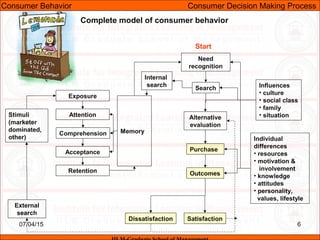
Complete model of consumer behavior
Stimuli
(marketer
dominated,
other)
External
search
Memory
Internal
search
Exposure
Attention
Comprehension
Acceptance
Retention
Search
Need
recognition
Alternative
evaluation
Purchase
Outcomes
Dissatisfaction Satisfaction
Individual
differences
• resources
• motivation &
involvement
• knowledge
• attitudes
• personality,
values, lifestyle
Influences
• culture
• social class
• family
• situation
Start
Consumer Behavior Consumer Decision Making Process
07/04/15 7
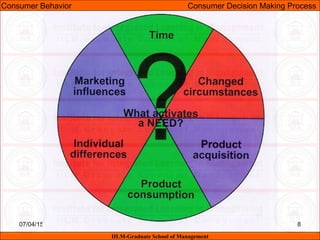
• How do you know when to shop? What are the
triggers that initiate an awareness & search?
• What are the internal & external sources of these
triggers?
Consumer Behavior Consumer Decision Making Process
IILM-Graduate School of Management
07/04/15 8
Consumer Behavior Consumer Decision Making Process
IILM-Graduate School of Management
07/04/15 9
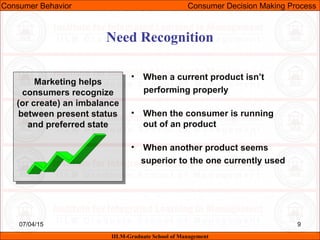
Need Recognition
Preferred State
Marketing helps
consumers recognize
(or create) an imbalance
between present status
and preferred state
• When a current product isn’t
performing properly
• When the consumer is running
out of an product
• When another product seems
superior to the one currently used
Consumer Behavior Consumer Decision Making Process
IILM-Graduate School of Management
07/04/15 10
Information Search
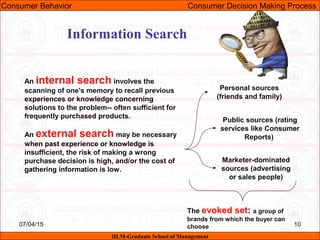
An internal search involves the
scanning of one's memory to recall previous
experiences or knowledge concerning
solutions to the problem-- often sufficient for
frequently purchased products.
An external search may be necessary
when past experience or knowledge is
insufficient, the risk of making a wrong
purchase decision is high, and/or the cost of
gathering information is low.
Personal sources
(friends and family)
Public sources (rating
services like Consumer
Reports)
Marketer-dominated
sources (advertising
or sales people)
The evoked set: a group of
brands from which the buyer can
choose
Consumer Behavior Consumer Decision Making Process
IILM-Graduate School of Management
07/04/15 11
Information Search
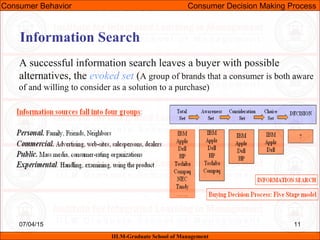
A successful information search leaves a buyer with possible
alternatives, the evoked set (A group of brands that a consumer is both aware
of and willing to consider as a solution to a purchase)
Consumer Behavior Consumer Decision Making Process
IILM-Graduate School of Management
07/04/15 12
• go back to your past purchase– what were the
specific internal and external sources of
information that influenced your decision?
• how do you determine (and rate) the credibility of
these sources?
• what specific information influenced you?
Consumer Behavior Consumer Decision Making Process
IILM-Graduate School of Management
07/04/15 13
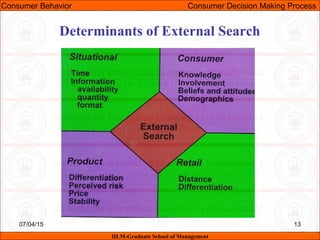
Determinants of External Search
Consumer Behavior Consumer Decision Making Process
IILM-Graduate School of Management
07/04/15 14
Consumer Decision-Making Process
Postpurchase
Behavior
Postpurchase
Behavior
PurchasePurchase
Evaluation
of Alternatives
Evaluation
of Alternatives
Information SearchInformation Search
Need RecognitionNeed Recognition
Cultural, Social,Cultural, Social,
Individual andIndividual and
PsychologicalPsychological
FactorsFactors
affectaffect
all stepsall steps
Cultural, Social,Cultural, Social,
Individual andIndividual and
PsychologicalPsychological
FactorsFactors
affectaffect
all stepsall steps
Consumer Behavior Consumer Decision Making Process
IILM-Graduate School of Management
07/04/15 15
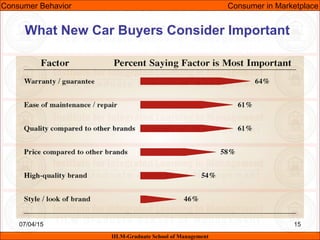
What New Car Buyers Consider Important
Consumer Behavior Consumer in Marketplace
IILM-Graduate School of Management
07/04/15 16
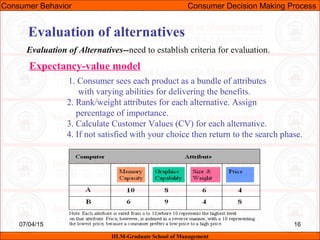
Evaluation of alternatives
1. Consumer sees each product as a bundle of attributes
with varying abilities for delivering the benefits.
2. Rank/weight attributes for each alternative. Assign
percentage of importance.
3. Calculate Customer Values (CV) for each alternative.
4. If not satisfied with your choice then return to the search phase.
Evaluation of Alternatives--need to establish criteria for evaluation.
Expectancy-value model
Consumer Behavior Consumer Decision Making Process
IILM-Graduate School of Management
07/04/15 17
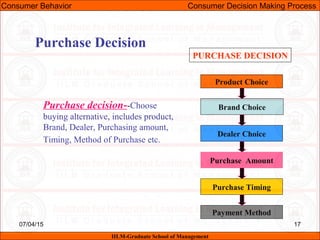
Purchase Decision
Purchase decision--Choose
buying alternative, includes product,
Brand, Dealer, Purchasing amount,
Timing, Method of Purchase etc.
Product Choice
Brand Choice
Dealer Choice
Purchase Amount
Purchase Timing
PURCHASE DECISION
Payment Method
Consumer Behavior Consumer Decision Making Process
IILM-Graduate School of Management
07/04/15 18
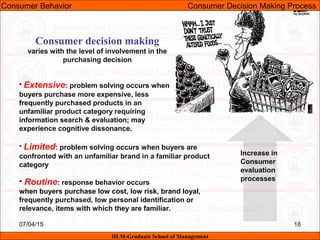
Consumer decision making
varies with the level of involvement in the
purchasing decision
• Extensive: problem solving occurs when
buyers purchase more expensive, less
frequently purchased products in an
unfamiliar product category requiring
information search & evaluation; may
experience cognitive dissonance.
• Limited: problem solving occurs when buyers are
confronted with an unfamiliar brand in a familiar product
category
• Routine: response behavior occurs
when buyers purchase low cost, low risk, brand loyal,
frequently purchased, low personal identification or
relevance, items with which they are familiar.
Increase in
Consumer
evaluation
processes
Consumer Behavior Consumer Decision Making Process
IILM-Graduate School of Management
07/04/15 19
• quickly list 10 items you have purchased in the past
month
• reexamine how long it took you to make a decision
on each
• why did such a difference in decision occur?
Consumer Behavior Consumer Decision Making Process
IILM-Graduate School of Management
07/04/15 20
Factors affecting
Consumer involvement
• Previous experience: low level involvement
• Interest: high involvement
• Perceived risk of negative consequences: high involvement
• Situation: low to high due to risk
• Social visibility: involvement increases with product visibility
• Offer extensive information on high involvement products
• In-store promotion & placement is important for low involvement products
• Linking low-involvement product to high-involvement issue can increase sales
So…
Consumer Behavior Consumer Decision Making Process
IILM-Graduate School of Management
07/04/15 21
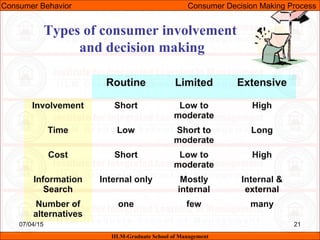
Types of consumer involvement
and decision making
Routine Limited Extensive
Involvement Short Low to
moderate
High
Time Low Short to
moderate
Long
Cost Short Low to
moderate
High
Information
Search
Internal only Mostly
internal
Internal &
external
Number of
alternatives
one few many
Consumer Behavior Consumer Decision Making Process
IILM-Graduate School of Management
07/04/15 22
• think of an important purchasing decision
you have made
• what are some of the thoughts you have had
following your purchase? Any regrets?
• what has influenced those thoughts?
• how have you dealt with the discomfort?
• how has the company anticipated or dealt with
your discomfort?
Consumer Behavior Consumer Decision Making Process
IILM-Graduate School of Management
07/04/15 23
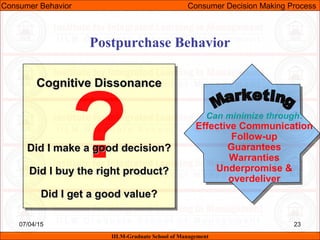
Postpurchase Behavior
Can minimize through:
Effective Communication
Follow-up
Guarantees
Warranties
Underpromise &
overdeliver
Cognitive DissonanceCognitive Dissonance
?Did I make a good decision?Did I make a good decision?
Did I buy the right product?Did I buy the right product?
Did I get a good value?Did I get a good value?
Consumer Behavior Consumer Decision Making Process
IILM-Graduate School of Management
07/04/15 24
Post purchase Behavior
Post-Purchase Evaluation
Post purchase: Satisfaction or Dissatisfaction
Post purchase Action: CRM programs designed to build long-
term brand loyalty.
Post purchase use & disposal: Marketer should also monitor how buyers
use and dispose of the product.
Cognitive Dissonance Is the anxiety that occurs when a customer has
second
thoughts immediately following a purchase.
􀂾 Can lead to customer complaints, brand switching, or discontinuing
􀂾 Can reduced by: Guarantees and trial, Customer follow-ups,
Confirming information from other users.
Consumer Behavior Consumer Decision Making Process
IILM-Graduate School of Management
07/04/15 25
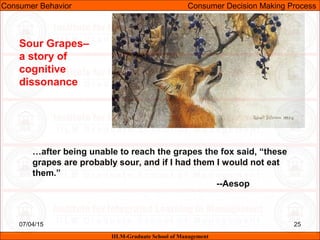
Sour Grapes–
a story of
cognitive
dissonance
…after being unable to reach the grapes the fox said, “these
grapes are probably sour, and if I had them I would not eat
them.”
--Aesop
Consumer Behavior Consumer Decision Making Process
IILM-Graduate School of Management
07/04/15 26
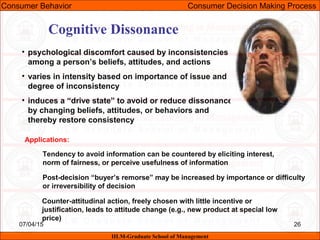
Cognitive Dissonance
• psychological discomfort caused by inconsistencies
among a person’s beliefs, attitudes, and actions
• varies in intensity based on importance of issue and
degree of inconsistency
• induces a “drive state” to avoid or reduce dissonance
by changing beliefs, attitudes, or behaviors and
thereby restore consistency
Tendency to avoid information can be countered by eliciting interest,
norm of fairness, or perceive usefulness of information
Post-decision “buyer’s remorse” may be increased by importance or difficulty
or irreversibility of decision
Counter-attitudinal action, freely chosen with little incentive or
justification, leads to attitude change (e.g., new product at special low
price)
Applications:
Consumer Behavior Consumer Decision Making Process
IILM-Graduate School of Management
07/04/15 27
• think of an innovation in your field
• describe different groups of employees in your
organization who would respond early and
favorably, as well as later and unfavorably
• what are the differences between these groups?
• how could you use this information to market the
innovation to them more effectively?
Consumer Behavior Consumer Decision Making Process
IILM-Graduate School of Management

Cb unit-vii (consumer decision making process)

  • 1.
  • 2.
    07/04/15 2 Course: ConsumerBehavior Unit-1 Consumer in the Marketplace Unit-2 Models of Consumer Behavior Unit-3 Cultural Influences on Consumer Decision making Unit-4 Sociological Influences on Consumer Decision making Unit-5 Personal / Individual Influences on Decision making Unit-6 Psychological Influences on Decision making Unit-7 Consumer Decision Making Process Unit-8 Consumer Influence & Diffusion of Innovation Consumer Behavior IILM-Graduate School of Management
  • 3.
    07/04/15 3 Consumer BehaviorConsumer Decision Making Process IILM-Graduate School of Management
  • 4.
    07/04/15 4 • Thinkof a recent important purchase– briefly draw a flowchart of the steps you recall moving through from the awareness of need to post purchase • What influenced you at each step? Consumer Behavior Consumer Decision Making Process IILM-Graduate School of Management
  • 5.
    07/04/15 5 Consumer Decision-MakingProcess Postpurchase Behavior Postpurchase Behavior PurchasePurchase Evaluation of Alternatives Evaluation of Alternatives Information SearchInformation Search Need RecognitionNeed Recognition Cultural, Social,Cultural, Social, Individual andIndividual and PsychologicalPsychological FactorsFactors affectaffect all stepsall steps Cultural, Social,Cultural, Social, Individual andIndividual and PsychologicalPsychological FactorsFactors affectaffect all stepsall steps Consumer Behavior Consumer Decision Making Process IILM-Graduate School of Management
  • 6.
    07/04/15 6 Complete modelof consumer behavior Stimuli (marketer dominated, other) External search Memory Internal search Exposure Attention Comprehension Acceptance Retention Search Need recognition Alternative evaluation Purchase Outcomes Dissatisfaction Satisfaction Individual differences • resources • motivation & involvement • knowledge • attitudes • personality, values, lifestyle Influences • culture • social class • family • situation Start Consumer Behavior Consumer Decision Making Process
  • 7.
    07/04/15 7 • Howdo you know when to shop? What are the triggers that initiate an awareness & search? • What are the internal & external sources of these triggers? Consumer Behavior Consumer Decision Making Process IILM-Graduate School of Management
  • 8.
    07/04/15 8 Consumer BehaviorConsumer Decision Making Process IILM-Graduate School of Management
  • 9.
    07/04/15 9 Need Recognition PreferredState Marketing helps consumers recognize (or create) an imbalance between present status and preferred state • When a current product isn’t performing properly • When the consumer is running out of an product • When another product seems superior to the one currently used Consumer Behavior Consumer Decision Making Process IILM-Graduate School of Management
  • 10.
    07/04/15 10 Information Search Aninternal search involves the scanning of one's memory to recall previous experiences or knowledge concerning solutions to the problem-- often sufficient for frequently purchased products. An external search may be necessary when past experience or knowledge is insufficient, the risk of making a wrong purchase decision is high, and/or the cost of gathering information is low. Personal sources (friends and family) Public sources (rating services like Consumer Reports) Marketer-dominated sources (advertising or sales people) The evoked set: a group of brands from which the buyer can choose Consumer Behavior Consumer Decision Making Process IILM-Graduate School of Management
  • 11.
    07/04/15 11 Information Search Asuccessful information search leaves a buyer with possible alternatives, the evoked set (A group of brands that a consumer is both aware of and willing to consider as a solution to a purchase) Consumer Behavior Consumer Decision Making Process IILM-Graduate School of Management
  • 12.
    07/04/15 12 • goback to your past purchase– what were the specific internal and external sources of information that influenced your decision? • how do you determine (and rate) the credibility of these sources? • what specific information influenced you? Consumer Behavior Consumer Decision Making Process IILM-Graduate School of Management
  • 13.
    07/04/15 13 Determinants ofExternal Search Consumer Behavior Consumer Decision Making Process IILM-Graduate School of Management
  • 14.
    07/04/15 14 Consumer Decision-MakingProcess Postpurchase Behavior Postpurchase Behavior PurchasePurchase Evaluation of Alternatives Evaluation of Alternatives Information SearchInformation Search Need RecognitionNeed Recognition Cultural, Social,Cultural, Social, Individual andIndividual and PsychologicalPsychological FactorsFactors affectaffect all stepsall steps Cultural, Social,Cultural, Social, Individual andIndividual and PsychologicalPsychological FactorsFactors affectaffect all stepsall steps Consumer Behavior Consumer Decision Making Process IILM-Graduate School of Management
  • 15.
    07/04/15 15 What NewCar Buyers Consider Important Consumer Behavior Consumer in Marketplace IILM-Graduate School of Management
  • 16.
    07/04/15 16 Evaluation ofalternatives 1. Consumer sees each product as a bundle of attributes with varying abilities for delivering the benefits. 2. Rank/weight attributes for each alternative. Assign percentage of importance. 3. Calculate Customer Values (CV) for each alternative. 4. If not satisfied with your choice then return to the search phase. Evaluation of Alternatives--need to establish criteria for evaluation. Expectancy-value model Consumer Behavior Consumer Decision Making Process IILM-Graduate School of Management
  • 17.
    07/04/15 17 Purchase Decision Purchasedecision--Choose buying alternative, includes product, Brand, Dealer, Purchasing amount, Timing, Method of Purchase etc. Product Choice Brand Choice Dealer Choice Purchase Amount Purchase Timing PURCHASE DECISION Payment Method Consumer Behavior Consumer Decision Making Process IILM-Graduate School of Management
  • 18.
    07/04/15 18 Consumer decisionmaking varies with the level of involvement in the purchasing decision • Extensive: problem solving occurs when buyers purchase more expensive, less frequently purchased products in an unfamiliar product category requiring information search & evaluation; may experience cognitive dissonance. • Limited: problem solving occurs when buyers are confronted with an unfamiliar brand in a familiar product category • Routine: response behavior occurs when buyers purchase low cost, low risk, brand loyal, frequently purchased, low personal identification or relevance, items with which they are familiar. Increase in Consumer evaluation processes Consumer Behavior Consumer Decision Making Process IILM-Graduate School of Management
  • 19.
    07/04/15 19 • quicklylist 10 items you have purchased in the past month • reexamine how long it took you to make a decision on each • why did such a difference in decision occur? Consumer Behavior Consumer Decision Making Process IILM-Graduate School of Management
  • 20.
    07/04/15 20 Factors affecting Consumerinvolvement • Previous experience: low level involvement • Interest: high involvement • Perceived risk of negative consequences: high involvement • Situation: low to high due to risk • Social visibility: involvement increases with product visibility • Offer extensive information on high involvement products • In-store promotion & placement is important for low involvement products • Linking low-involvement product to high-involvement issue can increase sales So… Consumer Behavior Consumer Decision Making Process IILM-Graduate School of Management
  • 21.
    07/04/15 21 Types ofconsumer involvement and decision making Routine Limited Extensive Involvement Short Low to moderate High Time Low Short to moderate Long Cost Short Low to moderate High Information Search Internal only Mostly internal Internal & external Number of alternatives one few many Consumer Behavior Consumer Decision Making Process IILM-Graduate School of Management
  • 22.
    07/04/15 22 • thinkof an important purchasing decision you have made • what are some of the thoughts you have had following your purchase? Any regrets? • what has influenced those thoughts? • how have you dealt with the discomfort? • how has the company anticipated or dealt with your discomfort? Consumer Behavior Consumer Decision Making Process IILM-Graduate School of Management
  • 23.
    07/04/15 23 Postpurchase Behavior Canminimize through: Effective Communication Follow-up Guarantees Warranties Underpromise & overdeliver Cognitive DissonanceCognitive Dissonance ?Did I make a good decision?Did I make a good decision? Did I buy the right product?Did I buy the right product? Did I get a good value?Did I get a good value? Consumer Behavior Consumer Decision Making Process IILM-Graduate School of Management
  • 24.
    07/04/15 24 Post purchaseBehavior Post-Purchase Evaluation Post purchase: Satisfaction or Dissatisfaction Post purchase Action: CRM programs designed to build long- term brand loyalty. Post purchase use & disposal: Marketer should also monitor how buyers use and dispose of the product. Cognitive Dissonance Is the anxiety that occurs when a customer has second thoughts immediately following a purchase. 􀂾 Can lead to customer complaints, brand switching, or discontinuing 􀂾 Can reduced by: Guarantees and trial, Customer follow-ups, Confirming information from other users. Consumer Behavior Consumer Decision Making Process IILM-Graduate School of Management
  • 25.
    07/04/15 25 Sour Grapes– astory of cognitive dissonance …after being unable to reach the grapes the fox said, “these grapes are probably sour, and if I had them I would not eat them.” --Aesop Consumer Behavior Consumer Decision Making Process IILM-Graduate School of Management
  • 26.
    07/04/15 26 Cognitive Dissonance •psychological discomfort caused by inconsistencies among a person’s beliefs, attitudes, and actions • varies in intensity based on importance of issue and degree of inconsistency • induces a “drive state” to avoid or reduce dissonance by changing beliefs, attitudes, or behaviors and thereby restore consistency Tendency to avoid information can be countered by eliciting interest, norm of fairness, or perceive usefulness of information Post-decision “buyer’s remorse” may be increased by importance or difficulty or irreversibility of decision Counter-attitudinal action, freely chosen with little incentive or justification, leads to attitude change (e.g., new product at special low price) Applications: Consumer Behavior Consumer Decision Making Process IILM-Graduate School of Management
  • 27.
    07/04/15 27 • thinkof an innovation in your field • describe different groups of employees in your organization who would respond early and favorably, as well as later and unfavorably • what are the differences between these groups? • how could you use this information to market the innovation to them more effectively? Consumer Behavior Consumer Decision Making Process IILM-Graduate School of Management

Editor's Notes

  • #10 1st point..like I have inject printer…slow speed..lower quality..look for laser printer 2nd …like remote slide mover..as a lecturer..i found difficulty many of times while delivering lectures in the class.. 3rd… air conditioners gives better cooling than the cooler than the fans
  • #12 Consumer rating org or similarly marketing research firm… Evoked set and considerations sets are same.. Consumer rating org..are the org which prevent custiomer from the fraud..they will rate the consumer electonices product, insurance product, helath care product and provide ranking. http://www.nfrc.org/ The largest consumer rating organization is the National Fenestration Rating Council (NFRC). fen·es·tra·tion (f n -str sh n). n. 1. The design and placement of windows in a building. 2. An opening in the surface of a structure, as in a membrane. ... Its aim is to protect consumers from fraud in window claims by the numerous different brands around. They do so by doing their own ratings on stuff such as the energy performance of the window and the solar heat gain co-efficient. Through this council, architects, builders and home consumers alike can compare between windows fairly. Mass media denotes a section of the media specifically designed to reach a large audience. The term was coined in the 1920s with the advent of nationwide radio networks, mass-circulation newspapers and magazines. However, some forms of mass media such as books and manuscripts had already been in use for centuries. Commercial software, a software that is licensed for a fee Commercial vehicle, a type of vehicle used for carrying goods or passengers Advertising is the act of delivering message for profit Advertising is a form of communication intended to persuade an audience (viewers, readers or listeners) to take some action. It includes the name of a product or service and how that product or service could benefit the consumer, to persuade potential customers to purchase or to consume that particular brand. Modern advertising developed with the rise of mass production in the late 19th and early 20th centuries
  • #16 This survey done in indian market by McKinsely in 2007-08.. Just a guess…suppose
  • #17 Find the attributes for the different products and services..in 4 member in a group…laptop..moblie…Ac cooler…house like duplex…credit cards…insurance product….holidays package….motor bike….water purifier…microwave……….