Adopting ITIL Framework
             By: Vinayak Ghadi
Do we know about ITIL framework?

• Information Technology Infrastructure Library (ITIL) is
  most popular framework for IT service management

• Its a set of practices for IT service management
  (ITSM) that focuses on aligning IT services with the
  needs of business

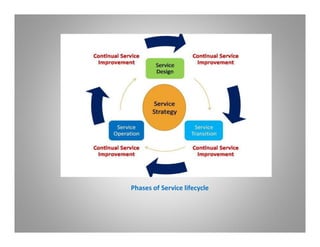
• The core of ITIL The core of ITIL is structured around
  a Service Lifecycle which consists of the five phases
Phases of Service lifecycle
Service Strategy: The Service strategy helps understand and
provides guidance on how to design, develop and implement
service management which would help define policies,
guidelines and processes across the entire lifecycle.

Processes involved :
• Service Strategy
• Service Portfolio Management
• Demand Management
• Financial Management
Service Design: Guidance on design and development of
services and interrelated service management processes
are defined under this publication. This helps mapping
strategic objectives into portfolios of service.

Processes involved :
• Service Catalogue Management
• Service Level Management
• Availability Management
• Capacity Management
• Service Continuity Management
• IT Security Management
• Supplier Management
Service Transition: Guidance on development and improvement
for capabilities and processes for transitioning new and changed
services into operation is covered under this publication,
Realization of service strategies being mapped into service design
with control over risks of failure and service disruption is achieved.

Processes involved :
• Change Management
• Service Asset and Configuration Management
• Release and Deployment Management
• Transition Planning and Support
• Service Validation and Testing
• Evaluation
• Knowledge Management
Service Operation: Effectiveness and efficiency of the
service delivered and support to ensure the value to the
stakeholder depends upon the practices in the
management of service operations.

Processes involved :
• Incident Management
• Problem Management
• Event Management
• Service Request Fulfilment
• Access Management
Continual Service Improvement: This publication
emphasizes on improvement of processes in order to deliver
value to the customers with better design and transition and
measuring scope for continuous improvement.

Steps Involved :
• What should we measure
• What can be measured
• Gather related data
• Process data
• Analyse data
• Making it usable and Present data
• Implement the corrective action
Key Adoption Challenges

Question to be answered
• Do we really need ITIL? If yes how it is going to help us?
• What impact it will have on our in-house processes which are
  in practice?
• Are we going to achieve detailed and measurable outcome?
• Can we map our enterprise vision into procedural roadmap to
  achieve it?
• Will that guarantee us ROI(Return on Investment)?
• Are we prepared to put RACI model in practice which
  emphasizes on Responsibility, Accountability, Consulting and
  Transparency in every function?
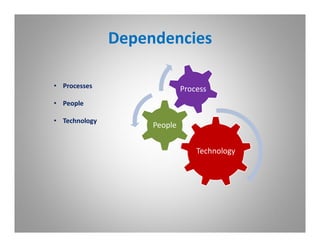
Dependencies

• Processes                  Process
• People

• Technology
                    People


                                 Technology
How do we prepare ourselves?

• Business Support: Top management approval
• Training and Building Knowledge Base: Defined
  processes and Documentation
• Process Implementation & Technology: Prioritized
  Implementation managing technical dependencies
• Change Management: Framework adoption resulting in
  changes across enterprise
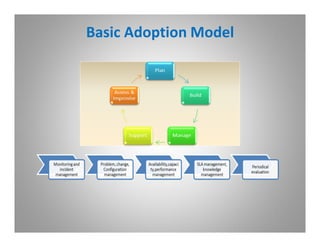
Basic Adoption Model
Benefits of Framework Adoption
• Improved resource utilization
• Infrastructure management becomes smooth
• Providing services meeting business, customer and user
  demands
• Unified management tools, technology and people
• Best practices for Project and vendor management
• Ownership and Increased accountability on assets and
  documented processes
• Operational visibility and proactive control can be enforced
• Business continuity management becomes easier
• Improved control and transparency
• Increased alignment between business and IT
• Measuring performance and efficiency improvises
• Better understanding and improved ability to manage change
References

1. ITIL Adoption Model based on TAM : http://www.ipedr.com/vol5/no1/8-
   H00038.pdf
2. ITIL Adoption: 5 Steps That Can Help With Success
   http://blogs.forrester.com/stephen_mann/12-02-01-
   itil_adoption_5_steps_that_can_help_with_success
3. ITIL® Adoption –the Challenges by Markus Bause, Director SERVIEW GmbH
   Written by Kate Winter
4. ITIL Benefits and Barriers to Success
   http://www.computereconomics.com/article.cfm?id=1433
5. Top 20 (OK, 50) ITIL Adoption Mistakes by Stephen Mann
   http://blogs.forrester.com/stephen_mann/11-08-26-
   top_20_ok_50_itil_adoption_mistakes

Adopting ITIL framework

  • 1.
    Adopting ITIL Framework By: Vinayak Ghadi
  • 2.
    Do we knowabout ITIL framework? • Information Technology Infrastructure Library (ITIL) is most popular framework for IT service management • Its a set of practices for IT service management (ITSM) that focuses on aligning IT services with the needs of business • The core of ITIL The core of ITIL is structured around a Service Lifecycle which consists of the five phases
  • 3.
  • 4.
    Service Strategy: TheService strategy helps understand and provides guidance on how to design, develop and implement service management which would help define policies, guidelines and processes across the entire lifecycle. Processes involved : • Service Strategy • Service Portfolio Management • Demand Management • Financial Management
  • 5.
    Service Design: Guidanceon design and development of services and interrelated service management processes are defined under this publication. This helps mapping strategic objectives into portfolios of service. Processes involved : • Service Catalogue Management • Service Level Management • Availability Management • Capacity Management • Service Continuity Management • IT Security Management • Supplier Management
  • 6.
    Service Transition: Guidanceon development and improvement for capabilities and processes for transitioning new and changed services into operation is covered under this publication, Realization of service strategies being mapped into service design with control over risks of failure and service disruption is achieved. Processes involved : • Change Management • Service Asset and Configuration Management • Release and Deployment Management • Transition Planning and Support • Service Validation and Testing • Evaluation • Knowledge Management
  • 7.
    Service Operation: Effectivenessand efficiency of the service delivered and support to ensure the value to the stakeholder depends upon the practices in the management of service operations. Processes involved : • Incident Management • Problem Management • Event Management • Service Request Fulfilment • Access Management
  • 8.
    Continual Service Improvement:This publication emphasizes on improvement of processes in order to deliver value to the customers with better design and transition and measuring scope for continuous improvement. Steps Involved : • What should we measure • What can be measured • Gather related data • Process data • Analyse data • Making it usable and Present data • Implement the corrective action
  • 9.
    Key Adoption Challenges Questionto be answered • Do we really need ITIL? If yes how it is going to help us? • What impact it will have on our in-house processes which are in practice? • Are we going to achieve detailed and measurable outcome? • Can we map our enterprise vision into procedural roadmap to achieve it? • Will that guarantee us ROI(Return on Investment)? • Are we prepared to put RACI model in practice which emphasizes on Responsibility, Accountability, Consulting and Transparency in every function?
  • 10.
    Dependencies • Processes Process • People • Technology People Technology
  • 11.
    How do weprepare ourselves? • Business Support: Top management approval • Training and Building Knowledge Base: Defined processes and Documentation • Process Implementation & Technology: Prioritized Implementation managing technical dependencies • Change Management: Framework adoption resulting in changes across enterprise
  • 12.
  • 13.
    Benefits of FrameworkAdoption • Improved resource utilization • Infrastructure management becomes smooth • Providing services meeting business, customer and user demands • Unified management tools, technology and people • Best practices for Project and vendor management • Ownership and Increased accountability on assets and documented processes • Operational visibility and proactive control can be enforced • Business continuity management becomes easier • Improved control and transparency • Increased alignment between business and IT • Measuring performance and efficiency improvises • Better understanding and improved ability to manage change
  • 14.
    References 1. ITIL AdoptionModel based on TAM : http://www.ipedr.com/vol5/no1/8- H00038.pdf 2. ITIL Adoption: 5 Steps That Can Help With Success http://blogs.forrester.com/stephen_mann/12-02-01- itil_adoption_5_steps_that_can_help_with_success 3. ITIL® Adoption –the Challenges by Markus Bause, Director SERVIEW GmbH Written by Kate Winter 4. ITIL Benefits and Barriers to Success http://www.computereconomics.com/article.cfm?id=1433 5. Top 20 (OK, 50) ITIL Adoption Mistakes by Stephen Mann http://blogs.forrester.com/stephen_mann/11-08-26- top_20_ok_50_itil_adoption_mistakes