ITILv3
Information Technology
Infrastructure Library
Faisal Iqbal
Head of IT Support Staff Services
Moon International Pak Pvt Limited
Definition
“ITIL provides a comprehensive, consistent
and coherent set of best practices for IT
Service Management Processes, promoting a
quality approach to achieving business
effectiveness and efficiency in the use of
information systems.”
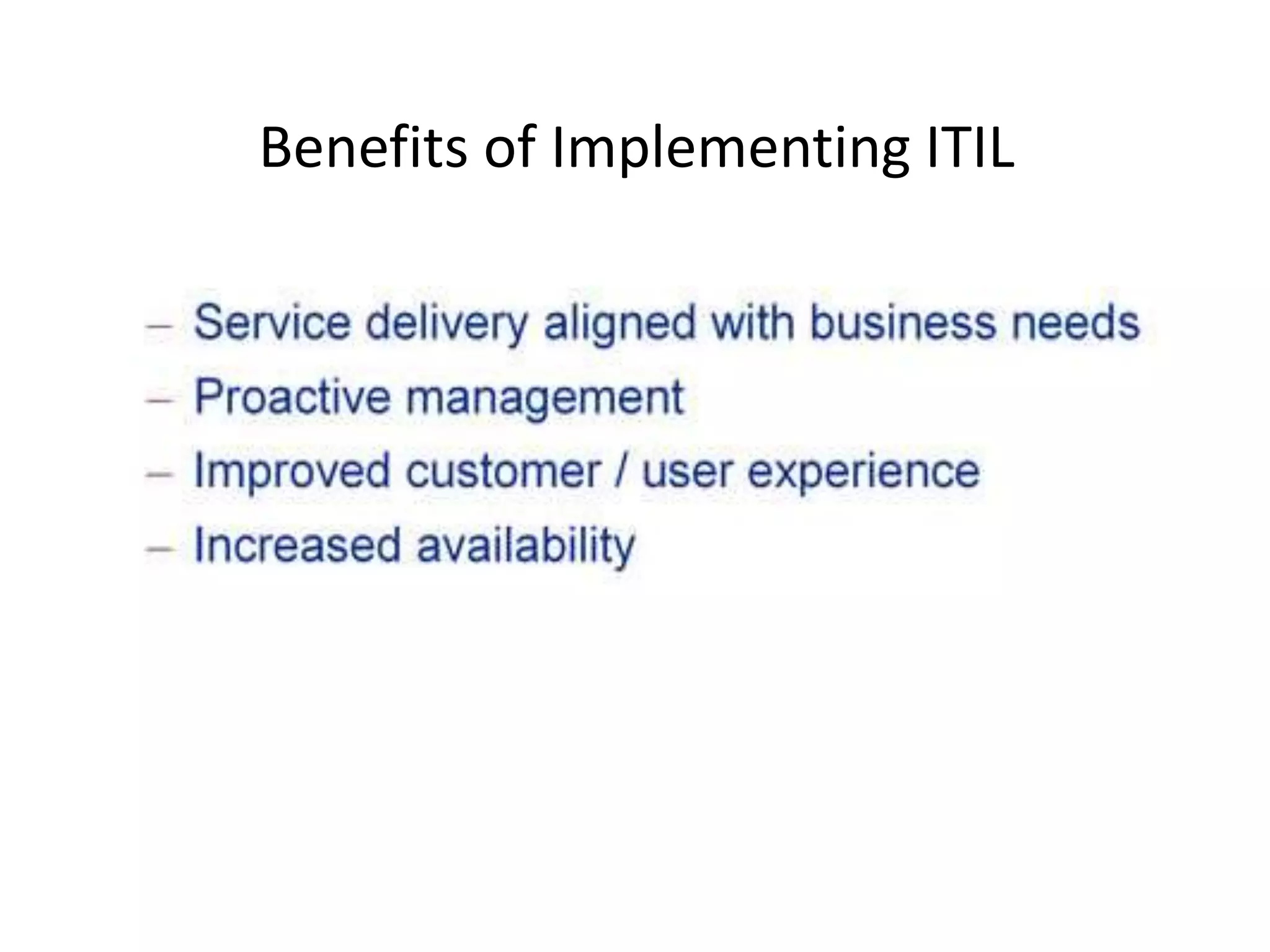
Benefits of Implementing ITIL
Agenda for the Session
• What is ITIL?
• What about v3?
• Key Concepts
• Service Management & Delivery
• The Service Lifecycle
• The Five Stages of the lifecycle
• ITIL Roles
• Functions and Processes
• Further Learning
• Accreditation
What is ITIL?
• Systematic approach to high quality IT service
delivery
• Documented best practice for IT Service
Management
• Provides common language with well-defined
terms
• Developed in 1980s by what is now The Office of
Government Commerce
What about v3?
• ITIL started in 80s.
– 40 publications!
• v2 came along in 2000-2002
– Still Large and complex
– 8 Books
– Talks about what you should do
• v3 in 2007
– Much simplified and rationalised to 5 books
– Much clearer guidance on how to provide service
– Easier, more modular accreditation paths
– Keeps tactical and operational guidance
– Gives more prominence to strategic ITIL guidance relevant to senior
staff
– Aligned with ISO20000 standard for service management
Key Concepts
• Service
– Delivers value to customer by facilitating
outcomes customers want to achieve without
ownership of the specific costs and risks
– e.g. The MI backup service means that you as Unit
ITSS don’t have to care about how much tapes,
disks or robots cost and you don’t have to worry if
one of the MI staff is off sick or on leaves
Key Concepts
• Service Level
– Measured and reported achievement against one or
more service level targets
– E.g.
• Red = 1 hour response 24/7
• Amber = 4 hour response 8/5
• Green = Next business day
• Service Level Agreement
– Written and negotiated agreement between Service
Provider and Customer documenting agreed service
levels and costs
Key Concepts
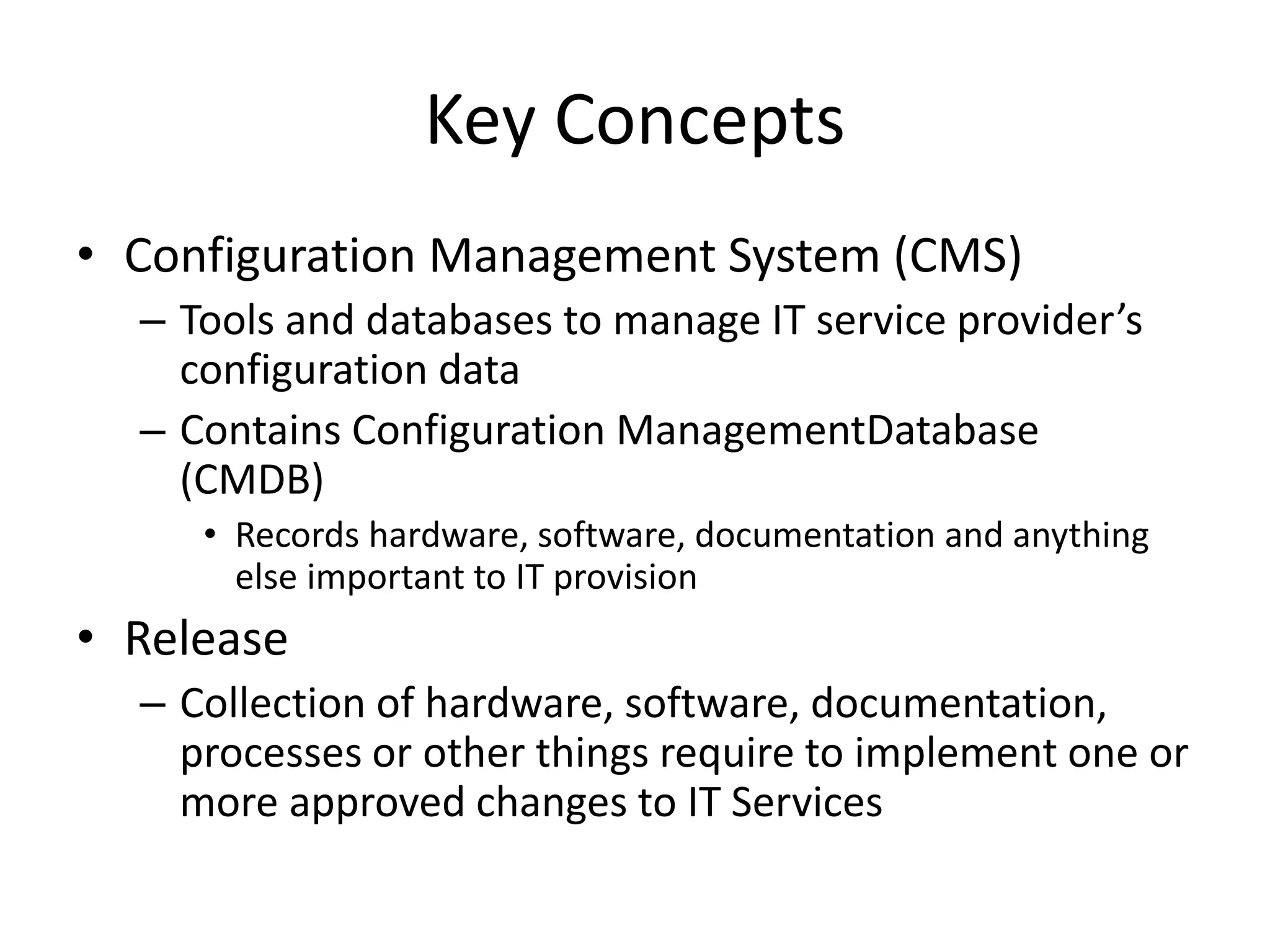
• Configuration Management System (CMS)
– Tools and databases to manage IT service provider’s
configuration data
– Contains Configuration ManagementDatabase
(CMDB)
• Records hardware, software, documentation and anything
else important to IT provision
• Release
– Collection of hardware, software, documentation,
processes or other things require to implement one or
more approved changes to IT Services
Key Concepts
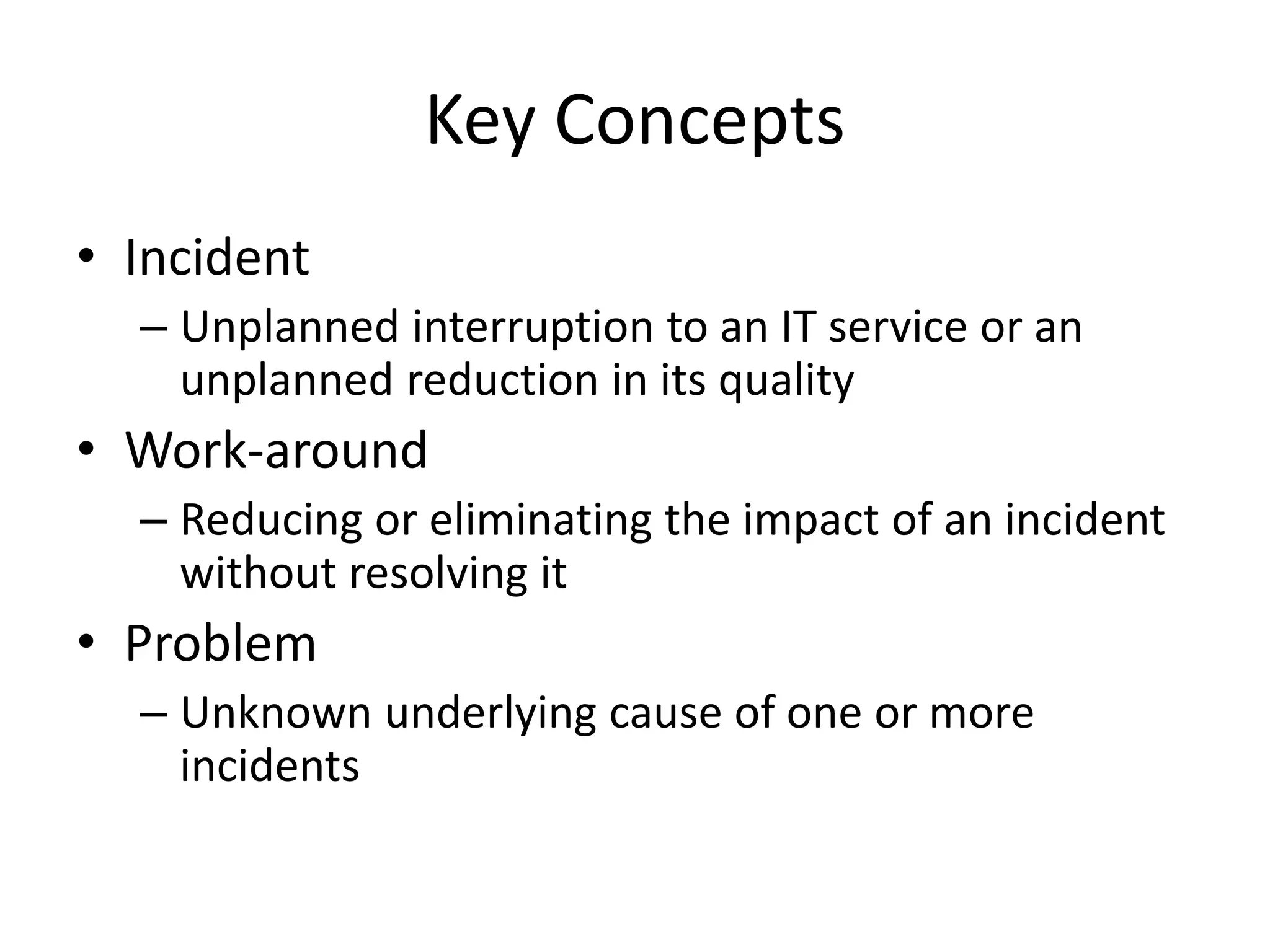
• Incident
– Unplanned interruption to an IT service or an
unplanned reduction in its quality
• Work-around
– Reducing or eliminating the impact of an incident
without resolving it
• Problem
– Unknown underlying cause of one or more
incidents
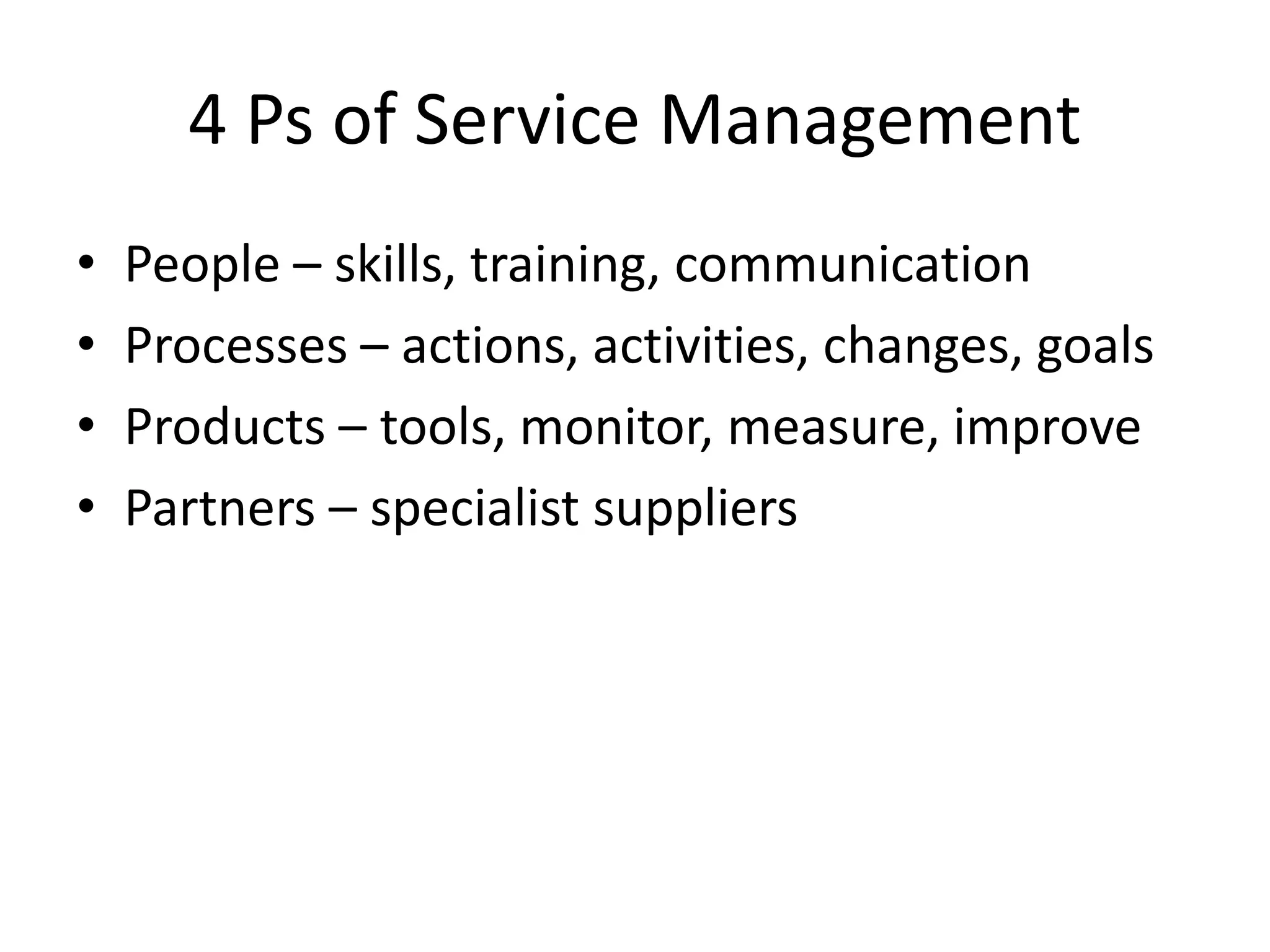
4 Ps of Service Management
• People – skills, training, communication
• Processes – actions, activities, changes, goals
• Products – tools, monitor, measure, improve
• Partners – specialist suppliers
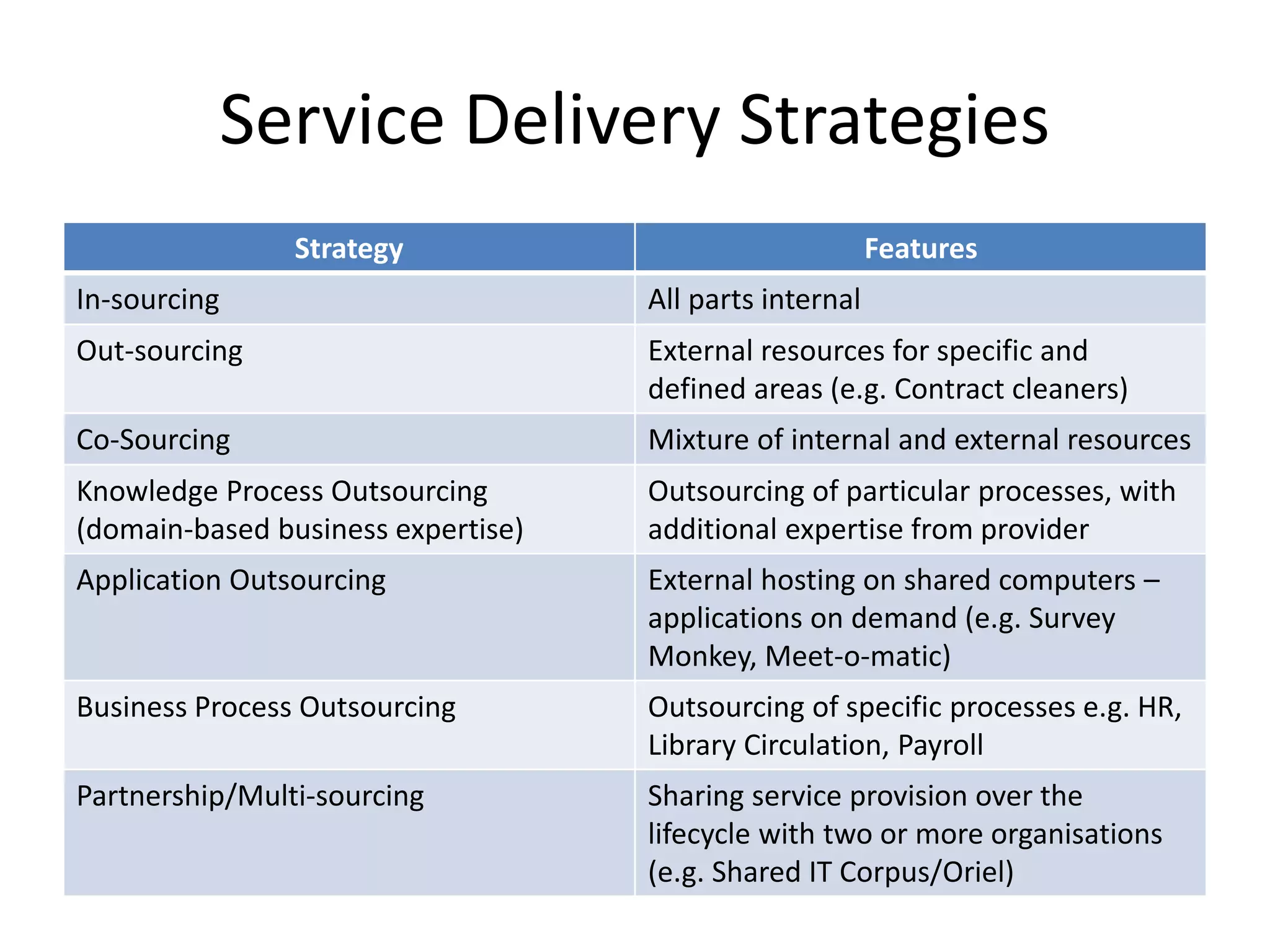
Service Delivery Strategies
Strategy Features
In-sourcing All parts internal
Out-sourcing External resources for specific and
defined areas (e.g. Contract cleaners)
Co-Sourcing Mixture of internal and external resources
Knowledge Process Outsourcing
(domain-based business expertise)
Outsourcing of particular processes, with
additional expertise from provider
Application Outsourcing External hosting on shared computers –
applications on demand (e.g. Survey
Monkey, Meet-o-matic)
Business Process Outsourcing Outsourcing of specific processes e.g. HR,
Library Circulation, Payroll
Partnership/Multi-sourcing Sharing service provision over the
lifecycle with two or more organisations
(e.g. Shared IT Corpus/Oriel)
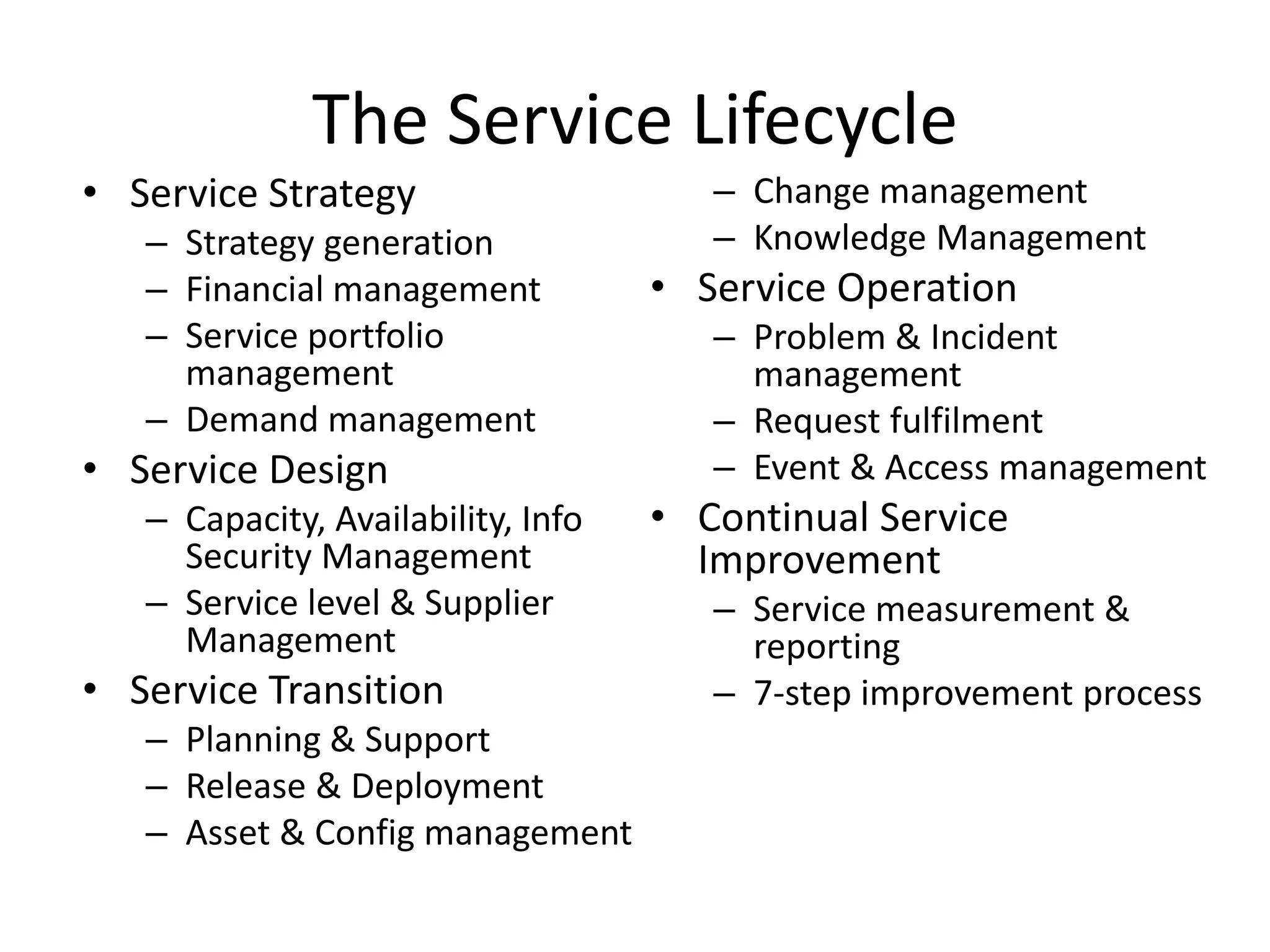
The Service Lifecycle
• Service Strategy
– Strategy generation
– Financial management
– Service portfolio
management
– Demand management
• Service Design
– Capacity, Availability, Info
Security Management
– Service level & Supplier
Management
• Service Transition
– Planning & Support
– Release & Deployment
– Asset & Config management
– Change management
– Knowledge Management
• Service Operation
– Problem & Incident
management
– Request fulfilment
– Event & Access management
• Continual Service
Improvement
– Service measurement &
reporting
– 7-step improvement process
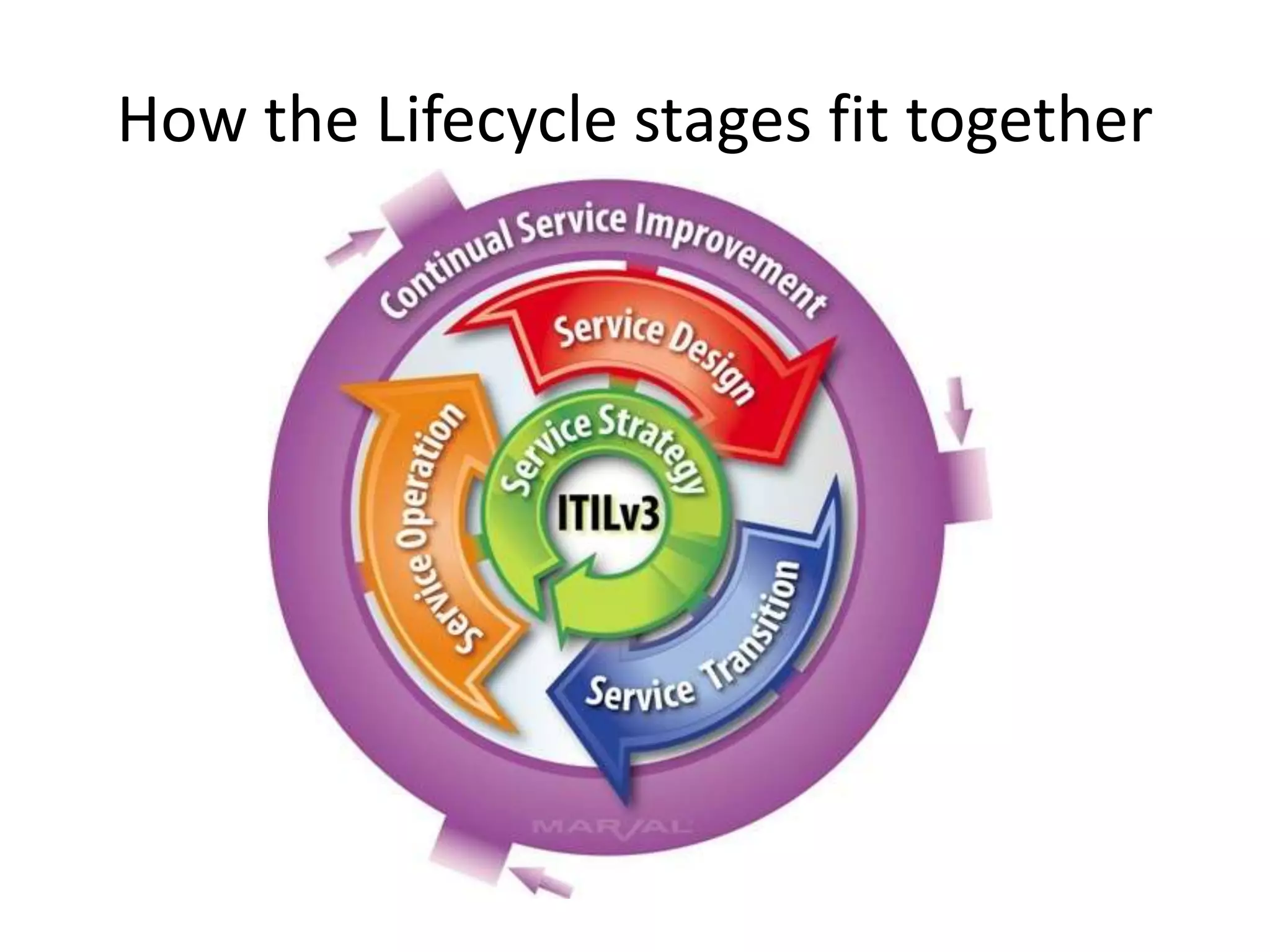
How the Lifecycle stages fit together
Service Strategy
• What are we going to provide?
• Can we afford it?
• Can we provide enough of it?
• How do we gain competitive advantage?
• Perspective
– Vision, mission and strategic goals
• Position
• Plan
• Pattern
– Must fit organisational culture
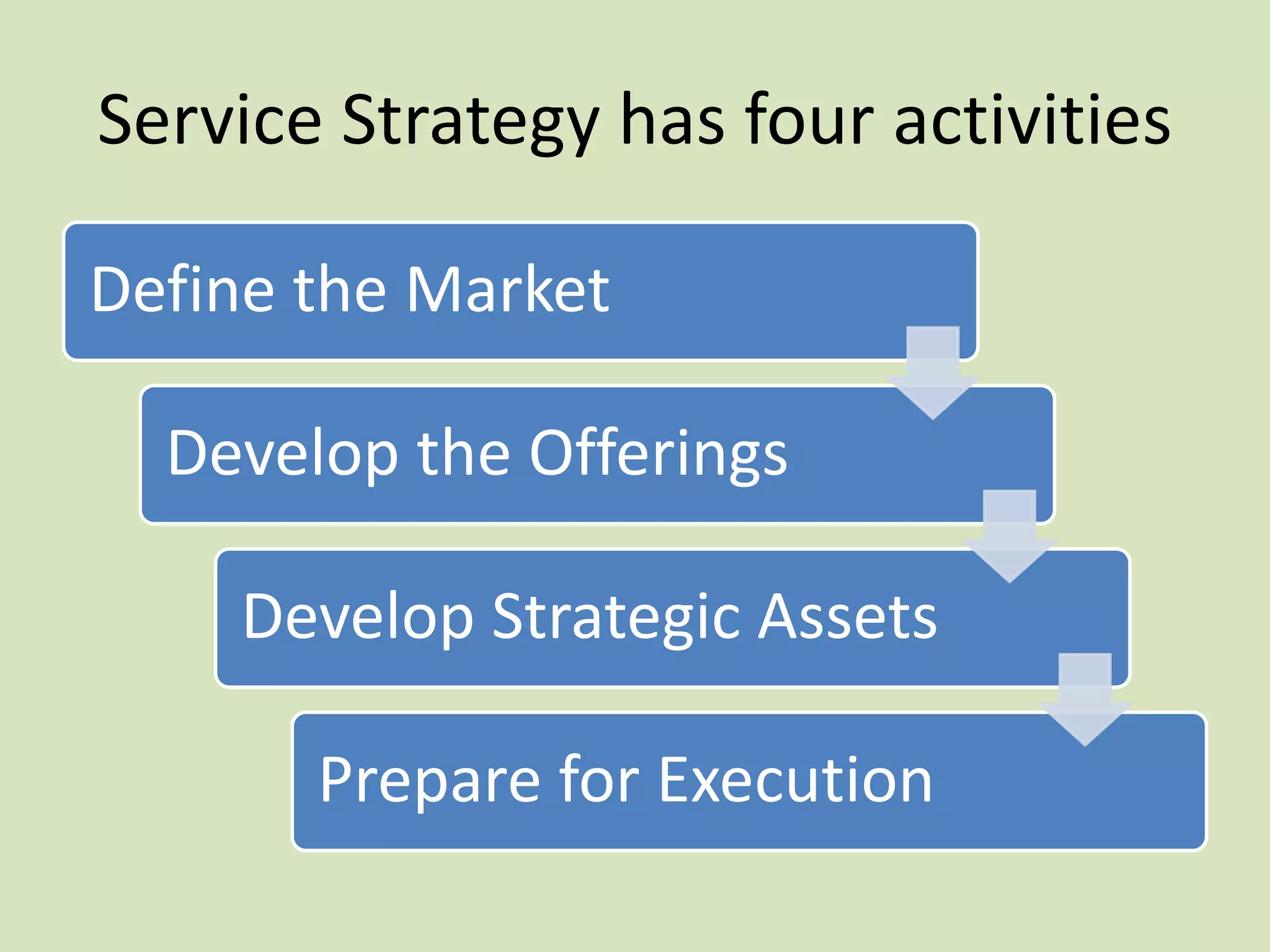
Service Strategy has four activities
Define the Market
Develop the Offerings
Develop Strategic Assets
Prepare for Execution
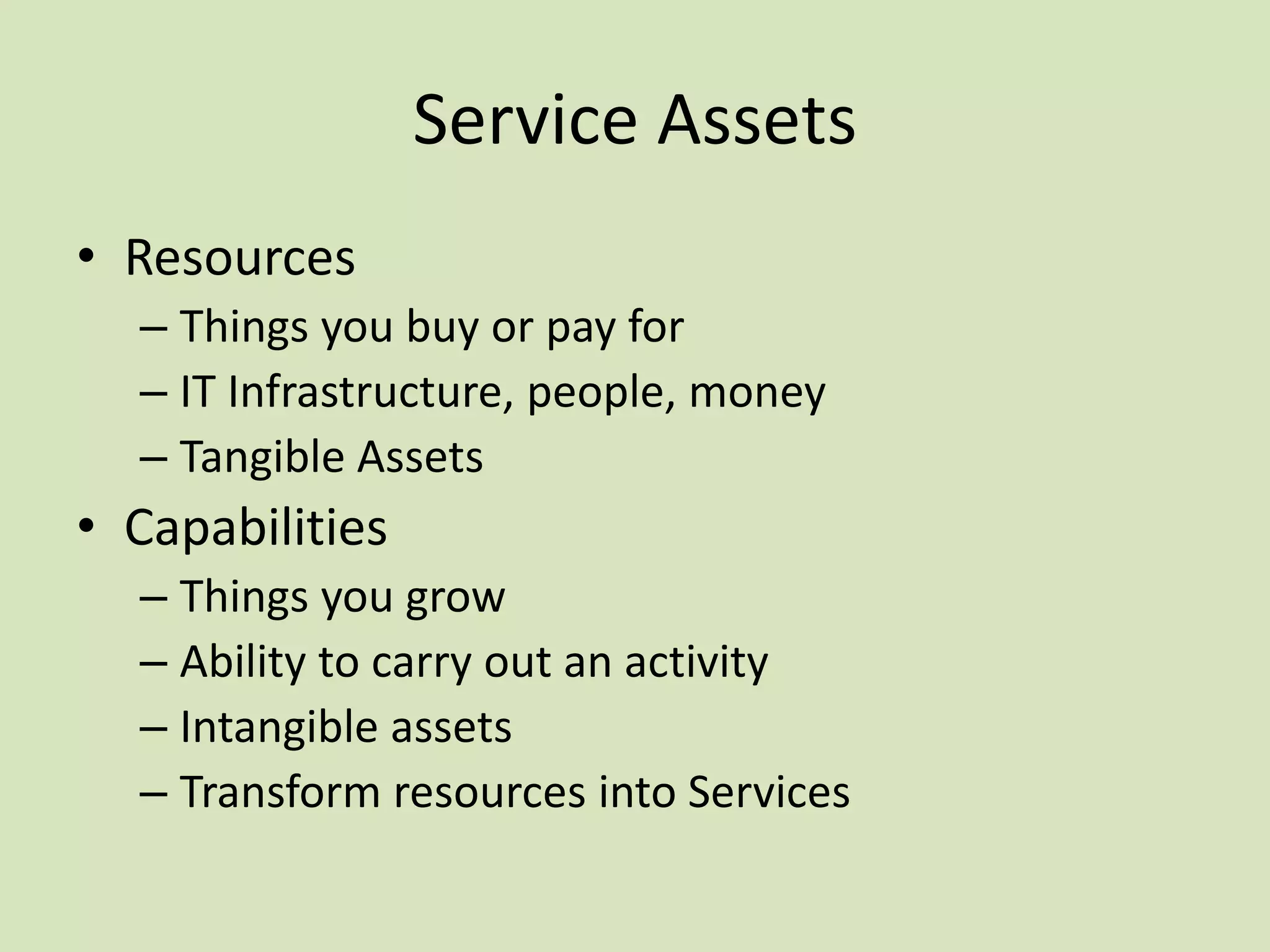
Service Assets
• Resources
– Things you buy or pay for
– IT Infrastructure, people, money
– Tangible Assets
• Capabilities
– Things you grow
– Ability to carry out an activity
– Intangible assets
– Transform resources into Services
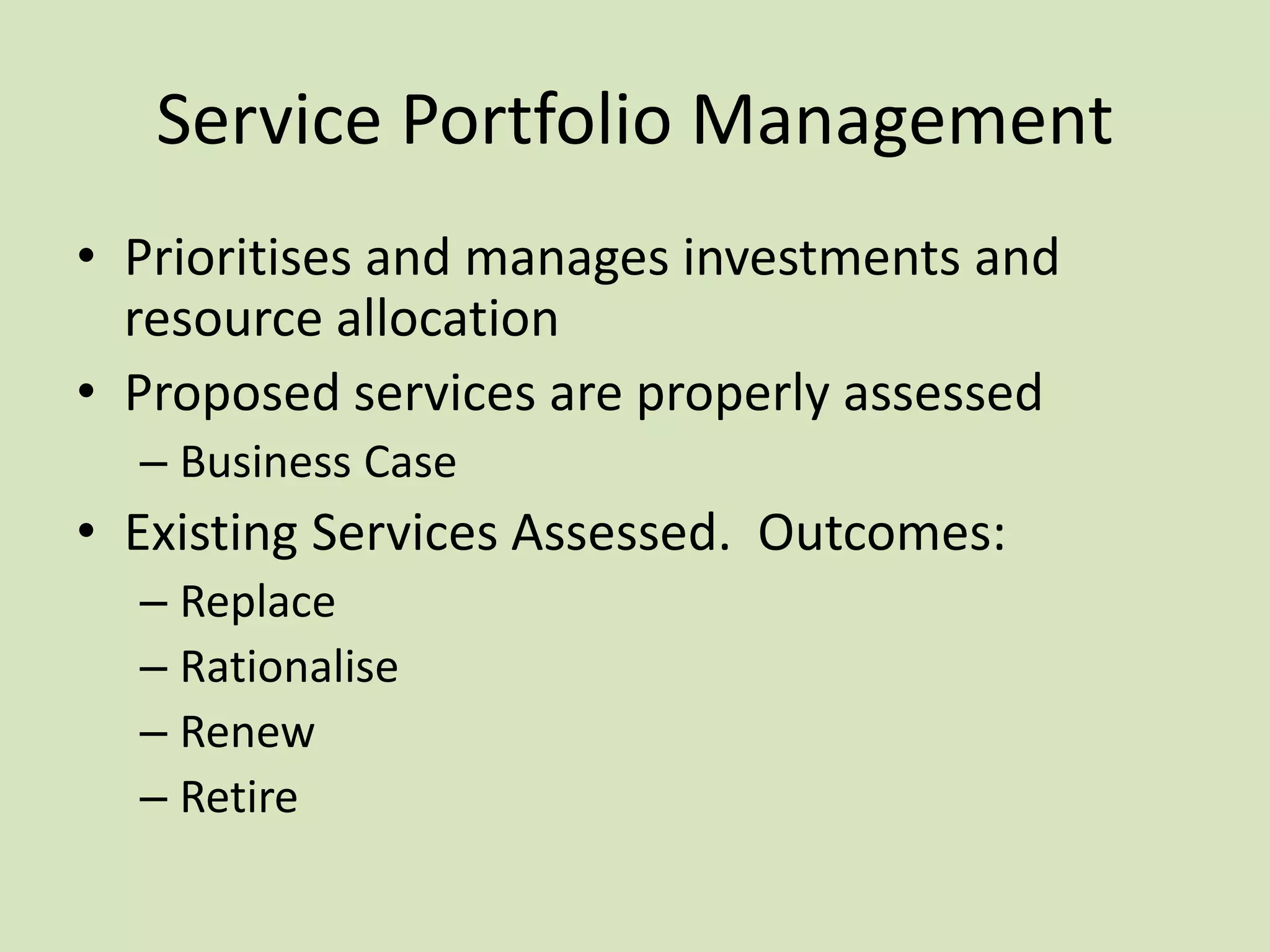
Service Portfolio Management
• Prioritises and manages investments and
resource allocation
• Proposed services are properly assessed
– Business Case
• Existing Services Assessed. Outcomes:
– Replace
– Rationalise
– Renew
– Retire
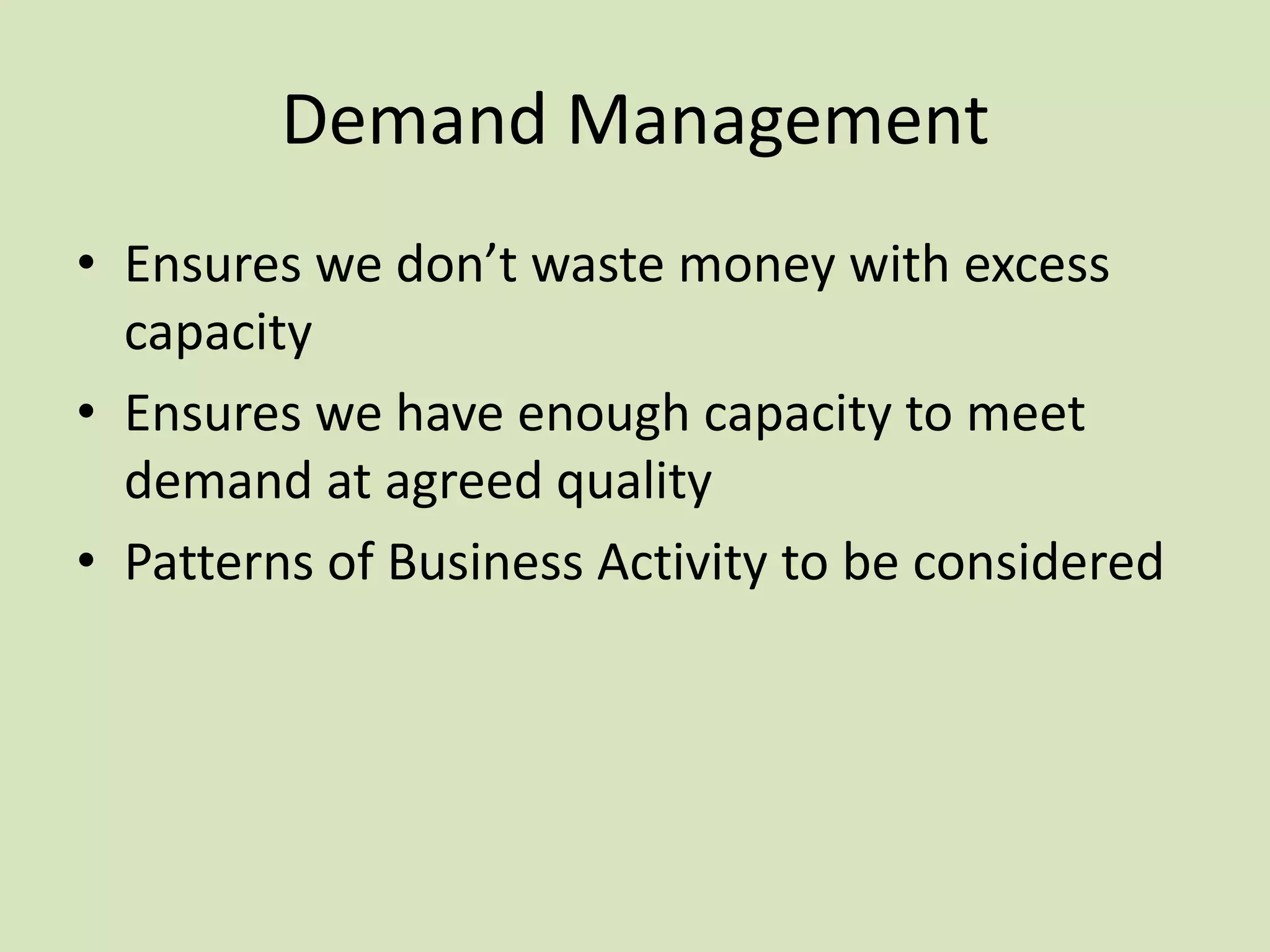
Demand Management
• Ensures we don’t waste money with excess
capacity
• Ensures we have enough capacity to meet
demand at agreed quality
• Patterns of Business Activity to be considered
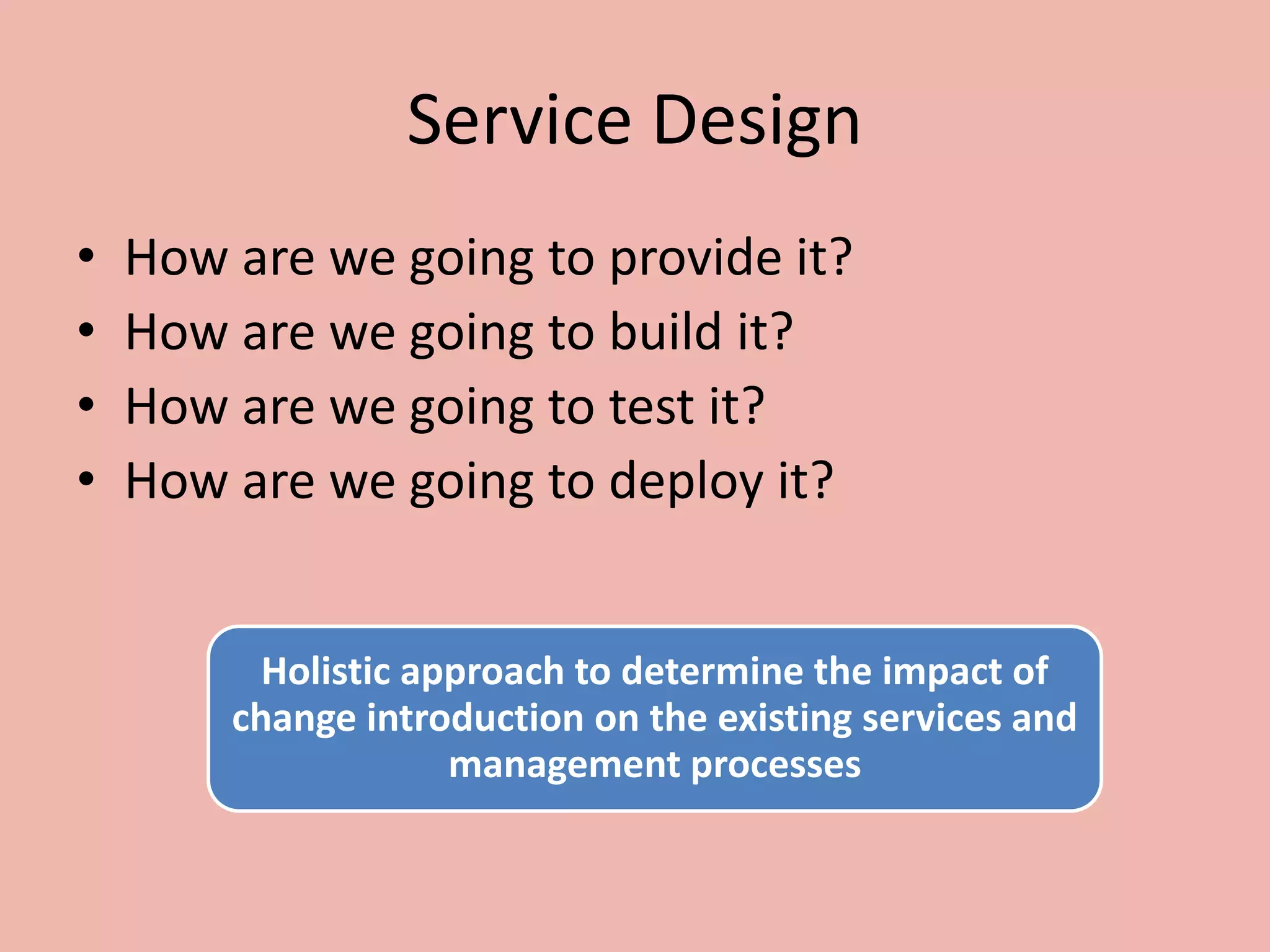
Service Design
• How are we going to provide it?
• How are we going to build it?
• How are we going to test it?
• How are we going to deploy it?
Holistic approach to determine the impact of
change introduction on the existing services and
management processes
Processes in Service Design
• Availability Management
• Capacity Management
• ITSCM (disaster recovery)
• Supplier Management
• Service Level Management
• Information Security Management
• Service Catalogue Management
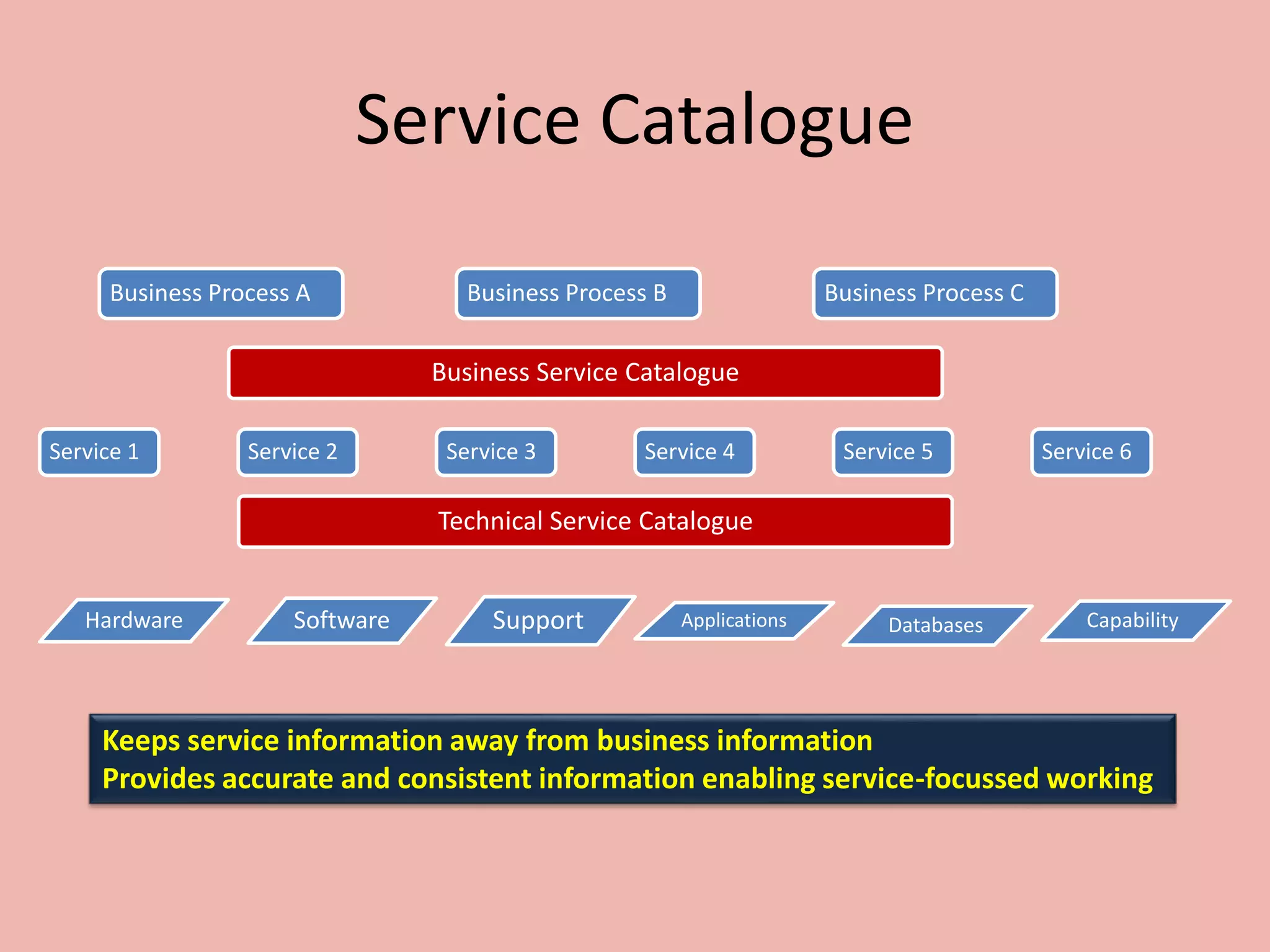
Service Catalogue
Business Process A Business Process B Business Process C
Business Service Catalogue
Service 1 Service 2 Service 3 Service 4 Service 5 Service 6
Technical Service Catalogue
Software Support Applications CapabilityDatabasesHardware
Keeps service information away from business information
Provides accurate and consistent information enabling service-focussed working
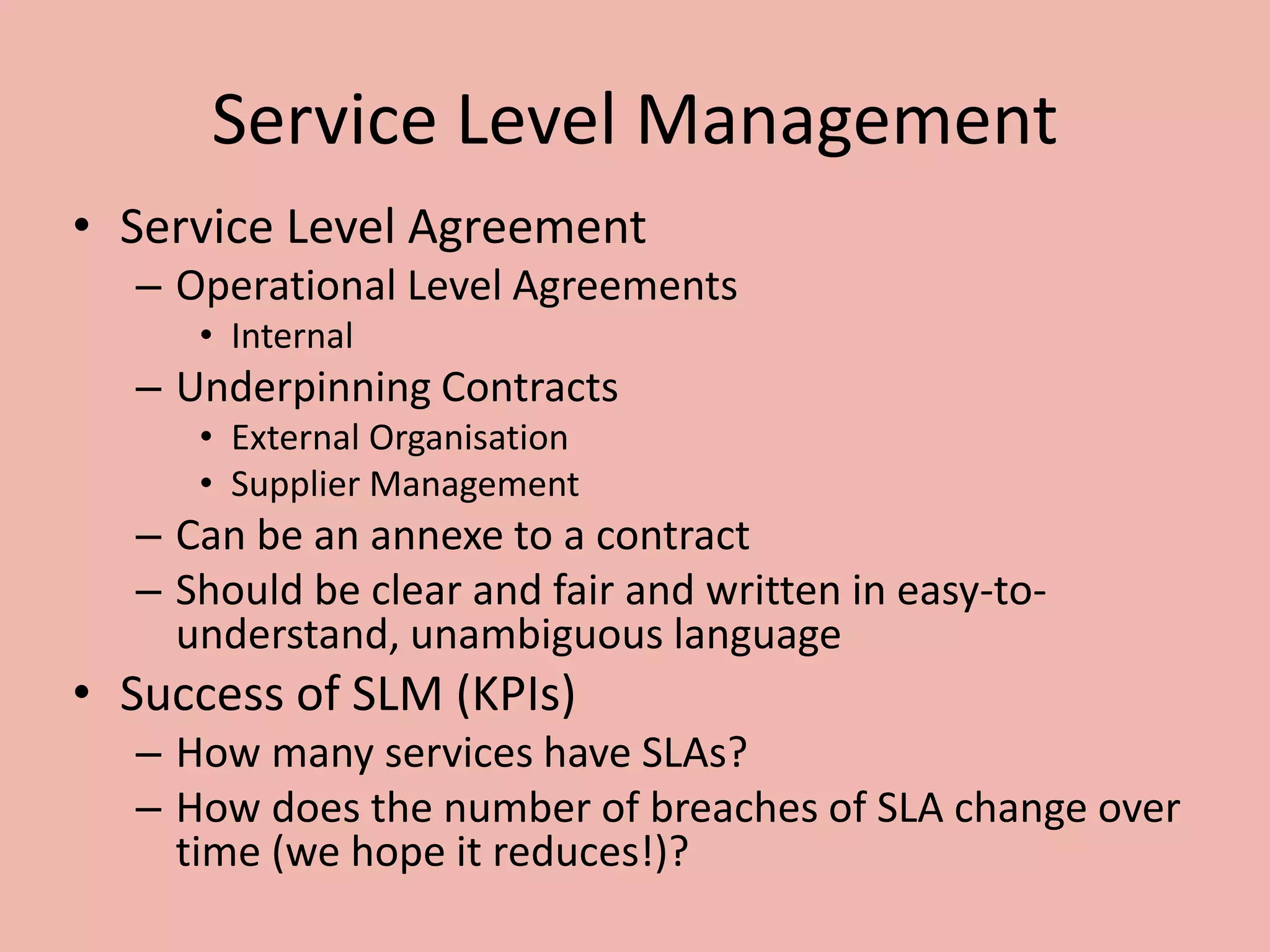
Service Level Management
• Service Level Agreement
– Operational Level Agreements
• Internal
– Underpinning Contracts
• External Organisation
• Supplier Management
– Can be an annexe to a contract
– Should be clear and fair and written in easy-to-
understand, unambiguous language
• Success of SLM (KPIs)
– How many services have SLAs?
– How does the number of breaches of SLA change over
time (we hope it reduces!)?
Things you might find in an SLA
Service
Description
Hours of
operation
User Response
times
Incident
Response
times
Resolution
times
Availability &
Continuity
targets
Customer
Responsibilities
Critical
operational
periods
Change
Response
Times
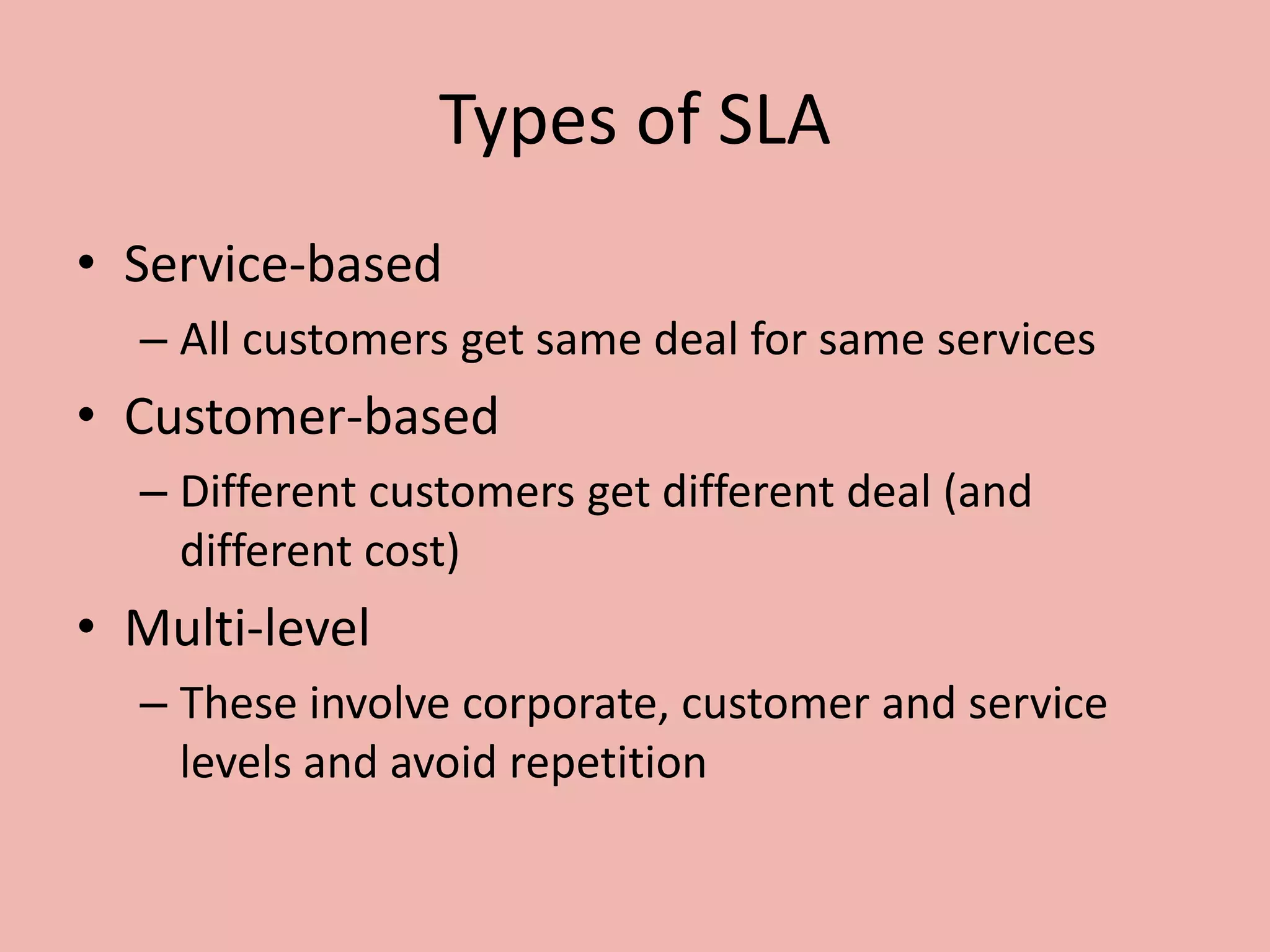
Types of SLA
• Service-based
– All customers get same deal for same services
• Customer-based
– Different customers get different deal (and
different cost)
• Multi-level
– These involve corporate, customer and service
levels and avoid repetition
Right Capacity, Right Time, Right Cost!
• This is capacity management
• Balances Cost against Capacity so minimises
costs while maintaining quality of service
Is it available?
• Ensure that IT services matches or exceeds
agreed targets
• Lots of Acronyms
– Mean Time Between Service Incidents
– Mean Time Between Failures
– Mean Time to Restore Service
• Resilience increases availability
– Service can remain functional even though one or
more of its components have failed
ITSCM – what?
• IT Service Continuity Management
• Ensures resumption of services within agreed
timescale
• Business Impact Analysis informs decisions
about resources
– E.g. Stock Exchange can’t afford 5 minutes
downtime but 2 hours downtime probably wont
badly affect a departmental accounts office or a
college bursary
Standby for liftoff...
• Cold
– Accommodation and environment ready but no IT
equipment
• Warm
– As cold plus backup IT equipment to receive data
• Hot
– Full duplexing, redundancy and failover
Information Security Management
• Confidentiality
– Making sure only those authorised can see data
• Integrity
– Making sure the data is accurate and not
corrupted
• Availability
– Making sure data is supplied when it is requested
Service Transition
• Build
• Deployment
• Testing
• User acceptance
• Bed-in
Good service transition
• Set customer expectations
• Enable release integration
• Reduce performance variation
• Document and reduce known errors
• Minimise risk
• Ensure proper use of services
• Some things excluded
– Swapping failed device
– Adding new user
– Installing standard software
Knowledge management
• Vital to enabling the right information to be
provided at the right place and the right time
to the right person to enable informed
decision
• Stops data being locked away with individuals
• Obvious organisational advantage
Data-Information-Knowledge-Wisdom
Data Information
- who, what , where?
Knowledge
- How?
Wisdom
- Why?
Wisdom cannot be assisted by technology
– it only comes with experience!
Service Knowledge Information
Management System is crucial to retaining
this extremely valuable information
Service Asset and Configuration
• Managing these properly is key
• Provides Logical Model of Infrastructure and
Accurate Configuration information
• Controls assets
• Minimised costs
• Enables proper change and release
management
• Speeds incident and problem resolution
Configuration Management System
Service
Management
KB
Asset and
Configuration
Info
Change Data
Release Data
Application
Data
Document
Definitive
Media Library
Configuration
Management
DB
Painting the Forth Bridge...
• A Baseline is a “last known good
configuration”
• But the CMS will always be a “work in
progress” and probably always out of date.
But still worth having
• Current configuration will always be the most
recent baseline plus any implemented
approved changes
Change Management – or what we all
get wrong!
• Respond to customers changing business
requirements
• Respond to business and IT requests for change
that will align the services with the business
needs
• Roles
– Change Manager
– Change Authority
• Change Advisory Board (CAB)
• Emergency CAB (ECAB)
• 80% of service interruption is caused by operator
error or poor change control (Gartner)
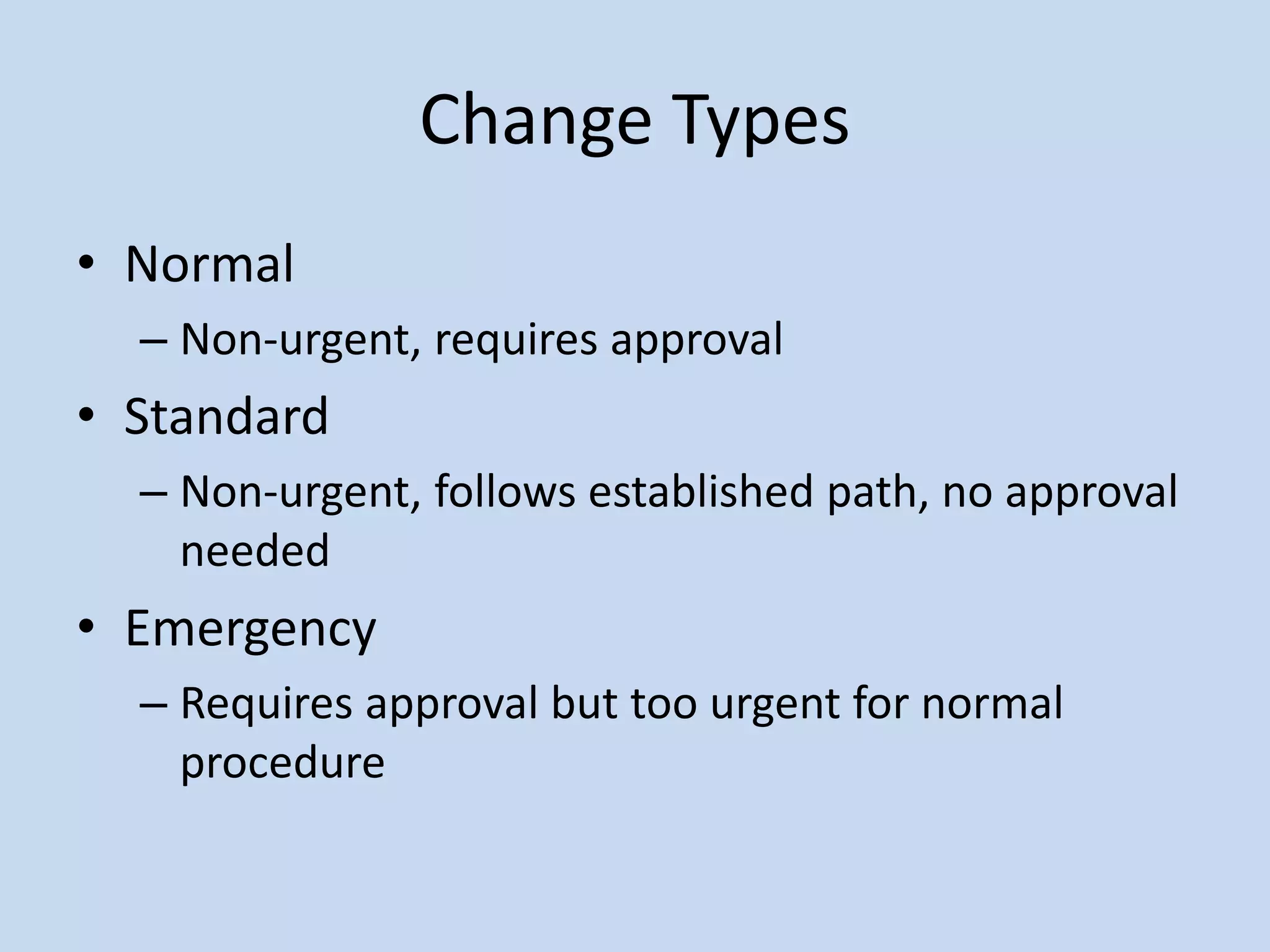
Change Types
• Normal
– Non-urgent, requires approval
• Standard
– Non-urgent, follows established path, no approval
needed
• Emergency
– Requires approval but too urgent for normal
procedure
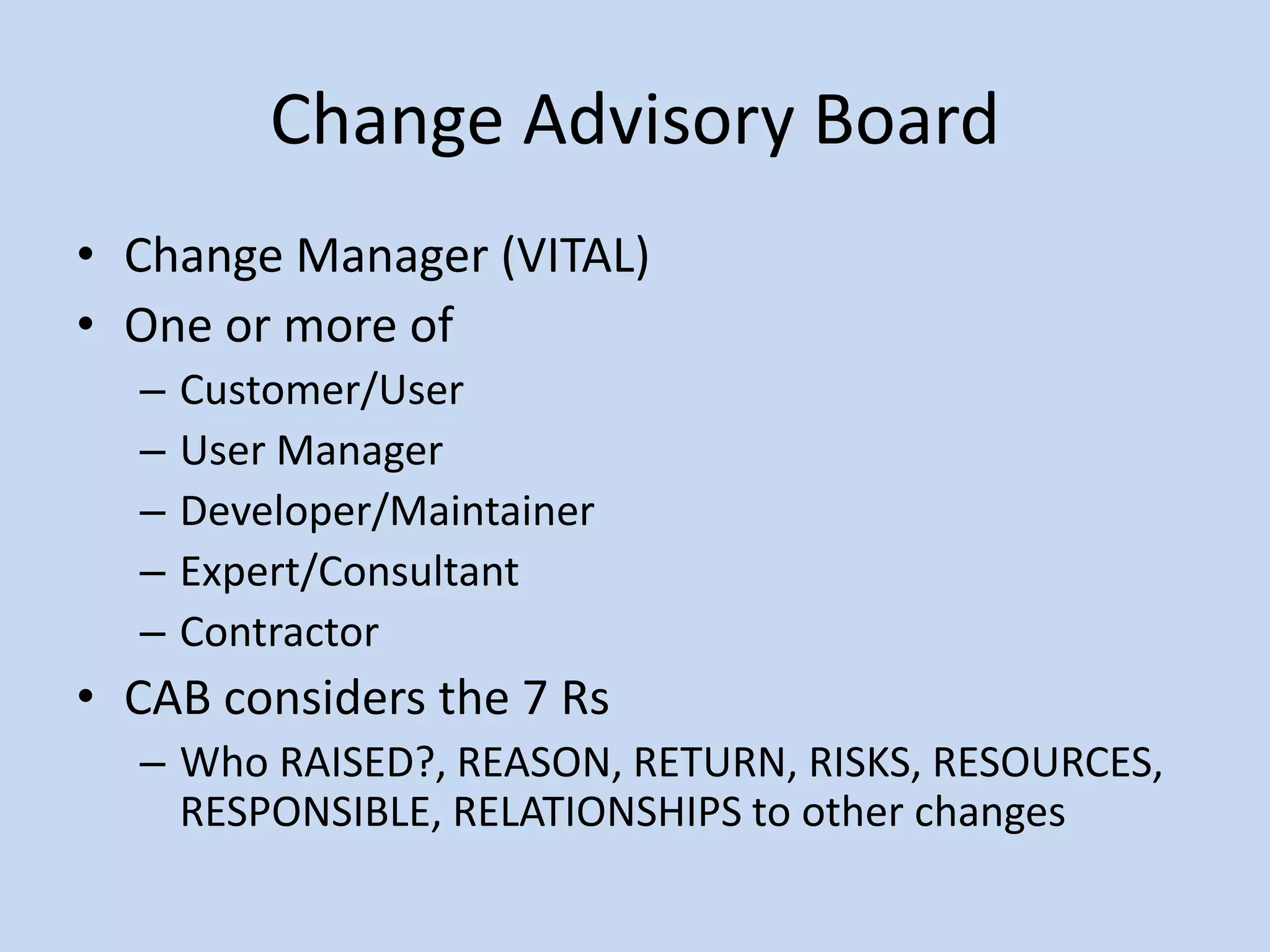
Change Advisory Board
• Change Manager (VITAL)
• One or more of
– Customer/User
– User Manager
– Developer/Maintainer
– Expert/Consultant
– Contractor
• CAB considers the 7 Rs
– Who RAISED?, REASON, RETURN, RISKS, RESOURCES,
RESPONSIBLE, RELATIONSHIPS to other changes
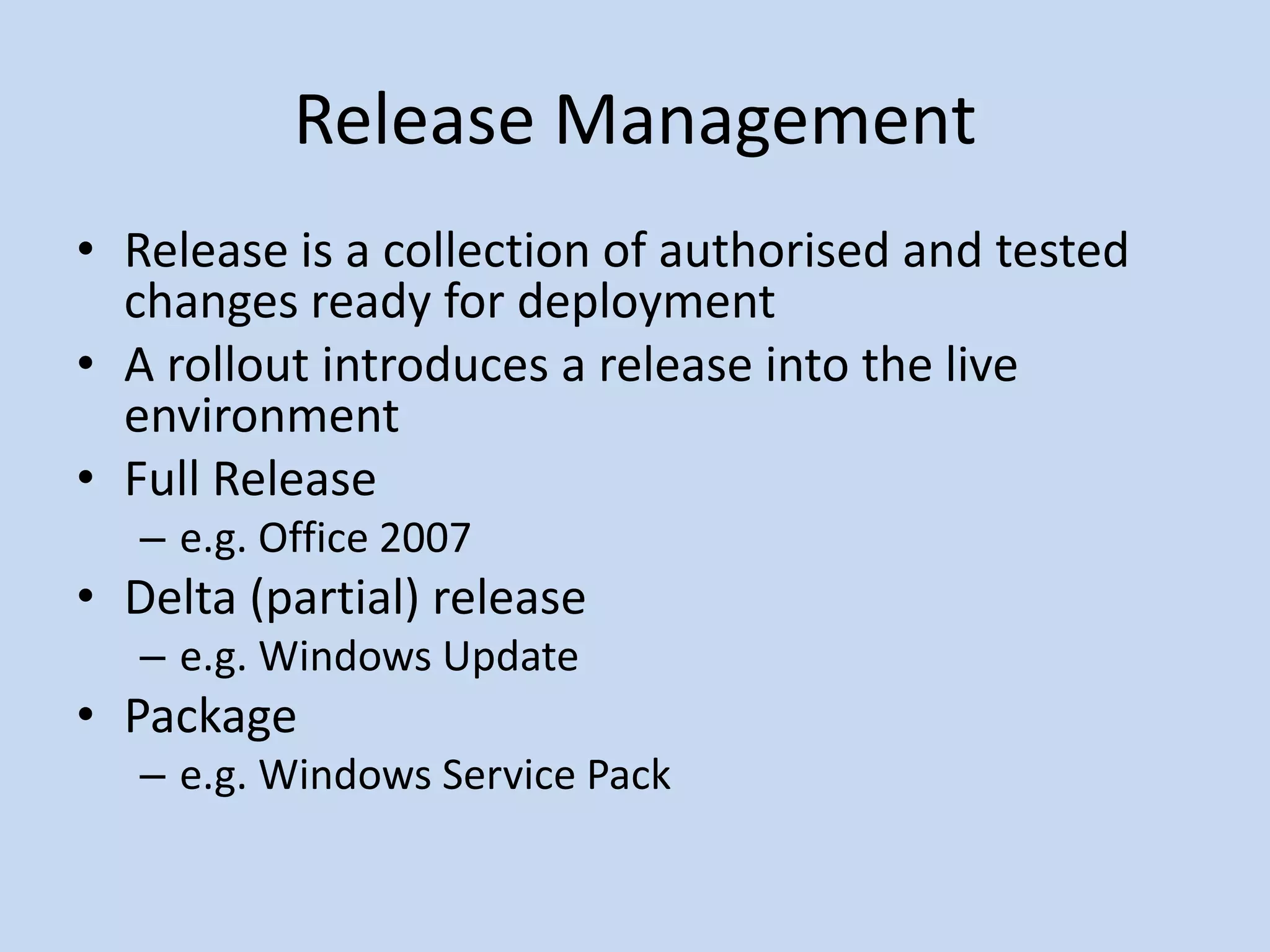
Release Management
• Release is a collection of authorised and tested
changes ready for deployment
• A rollout introduces a release into the live
environment
• Full Release
– e.g. Office 2007
• Delta (partial) release
– e.g. Windows Update
• Package
– e.g. Windows Service Pack
Phased or Big Bang?
• Phased release is less painful but more work
• Deploy can be manual or automatic
• Automatic can be push or pull
• Release Manager will produce a release policy
• Release MUST be tested and NOT by the
developer or the change instigator
Service Operation
• Maintenance
• Management
• Realises Strategic Objectives and is where the
Value is seen
Processes in Service Operation
• Incident Management
• Problem Management
• Event Management
• Request Fulfilment
• Access Management
Functions in Service Operation
• Service Desk
• Technical Management
• IT Operations Management
• Applications Management
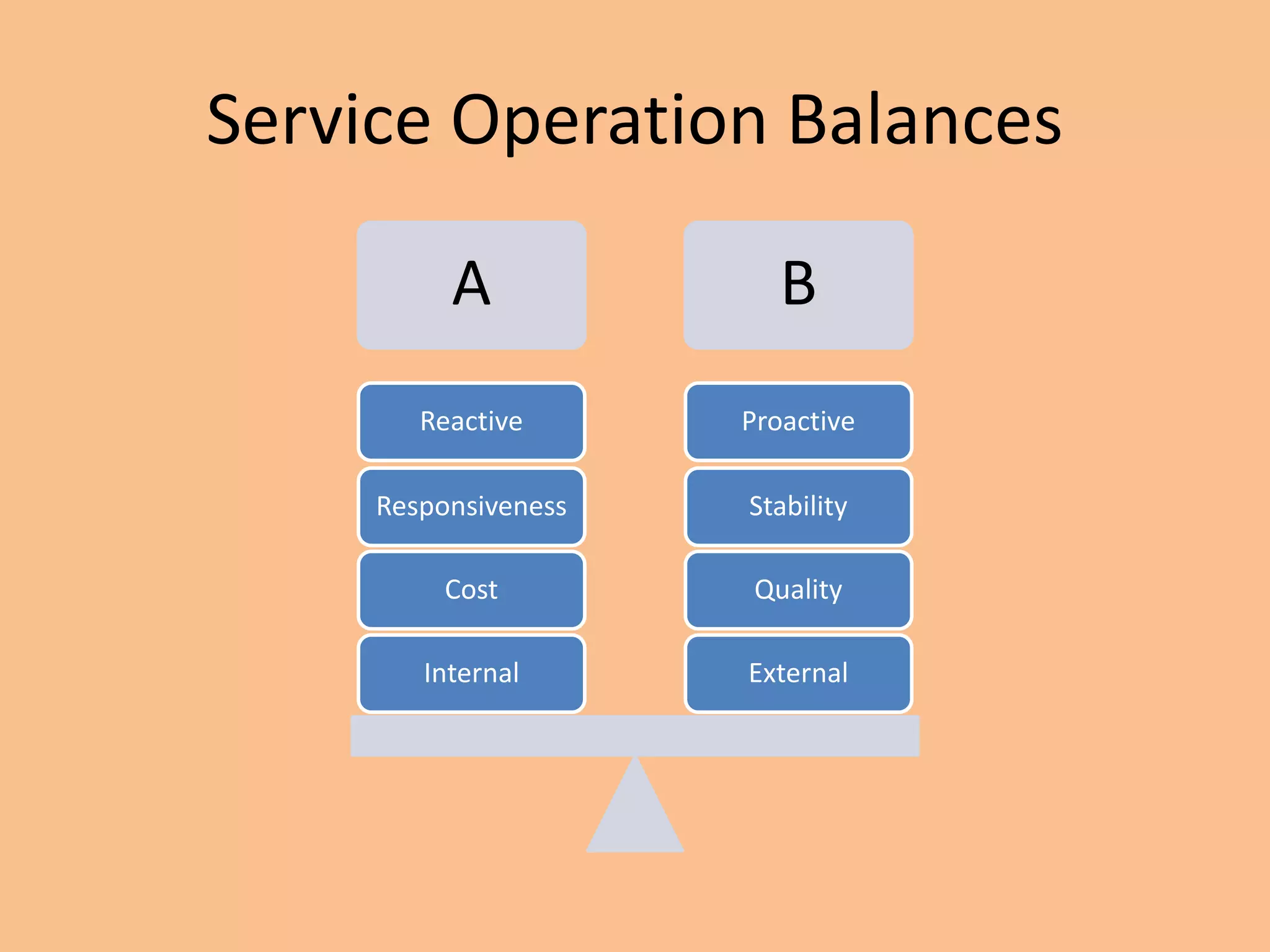
Service Operation Balances
A B
External
Quality
Stability
Proactive
Internal
Cost
Responsiveness
Reactive
Incident Management
• Deals with unplanned interruptions to IT
Services or reductions in their quality
• Failure of a configuration item that has not
impacted a service is also an incident (e.g.
Disk in RAID failure)
• Reported by:
– Users
– Technical Staff
– Monitoring Tools
Event Management
• 3 Types of events
– Information
– Warning
– Exception
• Can we give examples?
• Need to make sense of events and have
appropriate control actions planned and
documented
Request Fulfilment
• Information, advice or a standard change
• Should not be classed as Incidents or Changes
• Can we give more examples?
Problem Management
• Aims to prevent problems and resulting incidents
• Minimises impact of unavoidable incidents
• Eliminates recurring incidents
• Proactive Problem Management
– Identifies areas of potential weakness
– Identifies workarounds
• Reactive Problem Management
– Indentifies underlying causes of incidents
– Identifies changes to prevent recurrence
Access Management
• Right things for right users at right time
• Concepts
– Access
– Identity (Authentication, AuthN)
– Rights (Authorisation, AuthZ)
– Service Group
– Directory
Service Desk
• Local, Central or Virtual
• Examples?
• Single point of contact
• Skills for operators
– Customer Focus
– Articulate
– Interpersonal Skills (patient!)
– Understand Business
– Methodical/Analytical
– Technical knowledge
– Multi-lingual
• Service desk often seen as the bottom of the pile
– Bust most visible to customers so important to get right!
Continual Service Improvement
• Focus on Process owners and Service Owners
• Ensures that service management processes
continue to support the business
• Monitor and enhance Service Level
Achievements
• Plan – do –check – act (Deming)
Service Measurement
• Technology (components, MTBF etc)
• Process (KPIs - Critical Success Factors)
• Service (End-to end, e.g. Customer Satisfaction)
• Why?
– Validation – Soundness of decisions
– Direction – of future activities
– Justify – provide factual evidence
– Intervene – when changes or corrections are needed
7 Steps to Improvement
What should
we measure?
What can we
measure?
Gather data
Process dataAnalyse data
Present and
use info
Corrective
action
ITIL Roles
• Process Owner
– Ensures Fit for Purpose
• Process Manager
– Monitors and Reports on Process
• Service Owner
– Accountable for Delivery
• Service Manager
– Responsible for initiation, transition and
maintenance. Lifecycle!
More Roles
• Business Relationship Manager
• Service Asset & Configuration
– Service Asset Manager
– Service Knowledge Manager
– Configuration Manager
– Configuration Analyst
– Configuration Librarian
– CMS tools administrator
Functions and Processes
• Process
– Structured set of activities designed to accomplish a
defined objective
– Inputs & Outputs
– Measurable
– e.g. ??
• Function
– Team or group of people and tools they use to carry
out one or more processes or activities
– Own practices and knowledge body
– e.g. ??

Itilv3

  • 1.
    ITILv3 Information Technology Infrastructure Library FaisalIqbal Head of IT Support Staff Services Moon International Pak Pvt Limited
  • 2.
    Definition “ITIL provides acomprehensive, consistent and coherent set of best practices for IT Service Management Processes, promoting a quality approach to achieving business effectiveness and efficiency in the use of information systems.”
  • 3.
  • 4.
    Agenda for theSession • What is ITIL? • What about v3? • Key Concepts • Service Management & Delivery • The Service Lifecycle • The Five Stages of the lifecycle • ITIL Roles • Functions and Processes • Further Learning • Accreditation
  • 5.
    What is ITIL? •Systematic approach to high quality IT service delivery • Documented best practice for IT Service Management • Provides common language with well-defined terms • Developed in 1980s by what is now The Office of Government Commerce
  • 6.
    What about v3? •ITIL started in 80s. – 40 publications! • v2 came along in 2000-2002 – Still Large and complex – 8 Books – Talks about what you should do • v3 in 2007 – Much simplified and rationalised to 5 books – Much clearer guidance on how to provide service – Easier, more modular accreditation paths – Keeps tactical and operational guidance – Gives more prominence to strategic ITIL guidance relevant to senior staff – Aligned with ISO20000 standard for service management
  • 7.
    Key Concepts • Service –Delivers value to customer by facilitating outcomes customers want to achieve without ownership of the specific costs and risks – e.g. The MI backup service means that you as Unit ITSS don’t have to care about how much tapes, disks or robots cost and you don’t have to worry if one of the MI staff is off sick or on leaves
  • 8.
    Key Concepts • ServiceLevel – Measured and reported achievement against one or more service level targets – E.g. • Red = 1 hour response 24/7 • Amber = 4 hour response 8/5 • Green = Next business day • Service Level Agreement – Written and negotiated agreement between Service Provider and Customer documenting agreed service levels and costs
  • 9.
    Key Concepts • ConfigurationManagement System (CMS) – Tools and databases to manage IT service provider’s configuration data – Contains Configuration ManagementDatabase (CMDB) • Records hardware, software, documentation and anything else important to IT provision • Release – Collection of hardware, software, documentation, processes or other things require to implement one or more approved changes to IT Services
  • 10.
    Key Concepts • Incident –Unplanned interruption to an IT service or an unplanned reduction in its quality • Work-around – Reducing or eliminating the impact of an incident without resolving it • Problem – Unknown underlying cause of one or more incidents
  • 11.
    4 Ps ofService Management • People – skills, training, communication • Processes – actions, activities, changes, goals • Products – tools, monitor, measure, improve • Partners – specialist suppliers
  • 12.
    Service Delivery Strategies StrategyFeatures In-sourcing All parts internal Out-sourcing External resources for specific and defined areas (e.g. Contract cleaners) Co-Sourcing Mixture of internal and external resources Knowledge Process Outsourcing (domain-based business expertise) Outsourcing of particular processes, with additional expertise from provider Application Outsourcing External hosting on shared computers – applications on demand (e.g. Survey Monkey, Meet-o-matic) Business Process Outsourcing Outsourcing of specific processes e.g. HR, Library Circulation, Payroll Partnership/Multi-sourcing Sharing service provision over the lifecycle with two or more organisations (e.g. Shared IT Corpus/Oriel)
  • 14.
    The Service Lifecycle •Service Strategy – Strategy generation – Financial management – Service portfolio management – Demand management • Service Design – Capacity, Availability, Info Security Management – Service level & Supplier Management • Service Transition – Planning & Support – Release & Deployment – Asset & Config management – Change management – Knowledge Management • Service Operation – Problem & Incident management – Request fulfilment – Event & Access management • Continual Service Improvement – Service measurement & reporting – 7-step improvement process
  • 15.
    How the Lifecyclestages fit together
  • 16.
    Service Strategy • Whatare we going to provide? • Can we afford it? • Can we provide enough of it? • How do we gain competitive advantage? • Perspective – Vision, mission and strategic goals • Position • Plan • Pattern – Must fit organisational culture
  • 17.
    Service Strategy hasfour activities Define the Market Develop the Offerings Develop Strategic Assets Prepare for Execution
  • 18.
    Service Assets • Resources –Things you buy or pay for – IT Infrastructure, people, money – Tangible Assets • Capabilities – Things you grow – Ability to carry out an activity – Intangible assets – Transform resources into Services
  • 19.
    Service Portfolio Management •Prioritises and manages investments and resource allocation • Proposed services are properly assessed – Business Case • Existing Services Assessed. Outcomes: – Replace – Rationalise – Renew – Retire
  • 20.
    Demand Management • Ensureswe don’t waste money with excess capacity • Ensures we have enough capacity to meet demand at agreed quality • Patterns of Business Activity to be considered
  • 21.
    Service Design • Howare we going to provide it? • How are we going to build it? • How are we going to test it? • How are we going to deploy it? Holistic approach to determine the impact of change introduction on the existing services and management processes
  • 22.
    Processes in ServiceDesign • Availability Management • Capacity Management • ITSCM (disaster recovery) • Supplier Management • Service Level Management • Information Security Management • Service Catalogue Management
  • 23.
    Service Catalogue Business ProcessA Business Process B Business Process C Business Service Catalogue Service 1 Service 2 Service 3 Service 4 Service 5 Service 6 Technical Service Catalogue Software Support Applications CapabilityDatabasesHardware Keeps service information away from business information Provides accurate and consistent information enabling service-focussed working
  • 24.
    Service Level Management •Service Level Agreement – Operational Level Agreements • Internal – Underpinning Contracts • External Organisation • Supplier Management – Can be an annexe to a contract – Should be clear and fair and written in easy-to- understand, unambiguous language • Success of SLM (KPIs) – How many services have SLAs? – How does the number of breaches of SLA change over time (we hope it reduces!)?
  • 25.
    Things you mightfind in an SLA Service Description Hours of operation User Response times Incident Response times Resolution times Availability & Continuity targets Customer Responsibilities Critical operational periods Change Response Times
  • 26.
    Types of SLA •Service-based – All customers get same deal for same services • Customer-based – Different customers get different deal (and different cost) • Multi-level – These involve corporate, customer and service levels and avoid repetition
  • 27.
    Right Capacity, RightTime, Right Cost! • This is capacity management • Balances Cost against Capacity so minimises costs while maintaining quality of service
  • 28.
    Is it available? •Ensure that IT services matches or exceeds agreed targets • Lots of Acronyms – Mean Time Between Service Incidents – Mean Time Between Failures – Mean Time to Restore Service • Resilience increases availability – Service can remain functional even though one or more of its components have failed
  • 29.
    ITSCM – what? •IT Service Continuity Management • Ensures resumption of services within agreed timescale • Business Impact Analysis informs decisions about resources – E.g. Stock Exchange can’t afford 5 minutes downtime but 2 hours downtime probably wont badly affect a departmental accounts office or a college bursary
  • 30.
    Standby for liftoff... •Cold – Accommodation and environment ready but no IT equipment • Warm – As cold plus backup IT equipment to receive data • Hot – Full duplexing, redundancy and failover
  • 31.
    Information Security Management •Confidentiality – Making sure only those authorised can see data • Integrity – Making sure the data is accurate and not corrupted • Availability – Making sure data is supplied when it is requested
  • 32.
    Service Transition • Build •Deployment • Testing • User acceptance • Bed-in
  • 33.
    Good service transition •Set customer expectations • Enable release integration • Reduce performance variation • Document and reduce known errors • Minimise risk • Ensure proper use of services • Some things excluded – Swapping failed device – Adding new user – Installing standard software
  • 34.
    Knowledge management • Vitalto enabling the right information to be provided at the right place and the right time to the right person to enable informed decision • Stops data being locked away with individuals • Obvious organisational advantage
  • 35.
    Data-Information-Knowledge-Wisdom Data Information - who,what , where? Knowledge - How? Wisdom - Why? Wisdom cannot be assisted by technology – it only comes with experience! Service Knowledge Information Management System is crucial to retaining this extremely valuable information
  • 36.
    Service Asset andConfiguration • Managing these properly is key • Provides Logical Model of Infrastructure and Accurate Configuration information • Controls assets • Minimised costs • Enables proper change and release management • Speeds incident and problem resolution
  • 37.
    Configuration Management System Service Management KB Assetand Configuration Info Change Data Release Data Application Data Document Definitive Media Library Configuration Management DB
  • 38.
    Painting the ForthBridge... • A Baseline is a “last known good configuration” • But the CMS will always be a “work in progress” and probably always out of date. But still worth having • Current configuration will always be the most recent baseline plus any implemented approved changes
  • 39.
    Change Management –or what we all get wrong! • Respond to customers changing business requirements • Respond to business and IT requests for change that will align the services with the business needs • Roles – Change Manager – Change Authority • Change Advisory Board (CAB) • Emergency CAB (ECAB) • 80% of service interruption is caused by operator error or poor change control (Gartner)
  • 40.
    Change Types • Normal –Non-urgent, requires approval • Standard – Non-urgent, follows established path, no approval needed • Emergency – Requires approval but too urgent for normal procedure
  • 41.
    Change Advisory Board •Change Manager (VITAL) • One or more of – Customer/User – User Manager – Developer/Maintainer – Expert/Consultant – Contractor • CAB considers the 7 Rs – Who RAISED?, REASON, RETURN, RISKS, RESOURCES, RESPONSIBLE, RELATIONSHIPS to other changes
  • 42.
    Release Management • Releaseis a collection of authorised and tested changes ready for deployment • A rollout introduces a release into the live environment • Full Release – e.g. Office 2007 • Delta (partial) release – e.g. Windows Update • Package – e.g. Windows Service Pack
  • 43.
    Phased or BigBang? • Phased release is less painful but more work • Deploy can be manual or automatic • Automatic can be push or pull • Release Manager will produce a release policy • Release MUST be tested and NOT by the developer or the change instigator
  • 44.
    Service Operation • Maintenance •Management • Realises Strategic Objectives and is where the Value is seen
  • 45.
    Processes in ServiceOperation • Incident Management • Problem Management • Event Management • Request Fulfilment • Access Management
  • 46.
    Functions in ServiceOperation • Service Desk • Technical Management • IT Operations Management • Applications Management
  • 47.
    Service Operation Balances AB External Quality Stability Proactive Internal Cost Responsiveness Reactive
  • 48.
    Incident Management • Dealswith unplanned interruptions to IT Services or reductions in their quality • Failure of a configuration item that has not impacted a service is also an incident (e.g. Disk in RAID failure) • Reported by: – Users – Technical Staff – Monitoring Tools
  • 49.
    Event Management • 3Types of events – Information – Warning – Exception • Can we give examples? • Need to make sense of events and have appropriate control actions planned and documented
  • 50.
    Request Fulfilment • Information,advice or a standard change • Should not be classed as Incidents or Changes • Can we give more examples?
  • 51.
    Problem Management • Aimsto prevent problems and resulting incidents • Minimises impact of unavoidable incidents • Eliminates recurring incidents • Proactive Problem Management – Identifies areas of potential weakness – Identifies workarounds • Reactive Problem Management – Indentifies underlying causes of incidents – Identifies changes to prevent recurrence
  • 52.
    Access Management • Rightthings for right users at right time • Concepts – Access – Identity (Authentication, AuthN) – Rights (Authorisation, AuthZ) – Service Group – Directory
  • 53.
    Service Desk • Local,Central or Virtual • Examples? • Single point of contact • Skills for operators – Customer Focus – Articulate – Interpersonal Skills (patient!) – Understand Business – Methodical/Analytical – Technical knowledge – Multi-lingual • Service desk often seen as the bottom of the pile – Bust most visible to customers so important to get right!
  • 54.
    Continual Service Improvement •Focus on Process owners and Service Owners • Ensures that service management processes continue to support the business • Monitor and enhance Service Level Achievements • Plan – do –check – act (Deming)
  • 55.
    Service Measurement • Technology(components, MTBF etc) • Process (KPIs - Critical Success Factors) • Service (End-to end, e.g. Customer Satisfaction) • Why? – Validation – Soundness of decisions – Direction – of future activities – Justify – provide factual evidence – Intervene – when changes or corrections are needed
  • 56.
    7 Steps toImprovement What should we measure? What can we measure? Gather data Process dataAnalyse data Present and use info Corrective action
  • 57.
    ITIL Roles • ProcessOwner – Ensures Fit for Purpose • Process Manager – Monitors and Reports on Process • Service Owner – Accountable for Delivery • Service Manager – Responsible for initiation, transition and maintenance. Lifecycle!
  • 58.
    More Roles • BusinessRelationship Manager • Service Asset & Configuration – Service Asset Manager – Service Knowledge Manager – Configuration Manager – Configuration Analyst – Configuration Librarian – CMS tools administrator
  • 59.
    Functions and Processes •Process – Structured set of activities designed to accomplish a defined objective – Inputs & Outputs – Measurable – e.g. ?? • Function – Team or group of people and tools they use to carry out one or more processes or activities – Own practices and knowledge body – e.g. ??