Chapter 7
  Accounting Periods and
Methods and Depreciation


    Income Tax Fundamentals 2012

            Gerald E. Whittenburg &
                 Martha Altus-Buller

                    2012 Cengage Learning
Learning Objectives
 Determine different accounting periods and methods
  for tax periods
 Understand concept of depreciation
 Calculate depreciation using MACRS tables and
  identify when §179 election to expense may be
  applied
 Apply listed property and luxury automobile
  limitations
 Understand tax treatment of intangibles
 Determine whether parties are considered related
  and how to treat related party transactions

                                    2012 Cengage Learning
Accounting Periods
 Rarely, a taxpayer’s tax year will differ from the calendar
  year
 In a partnership
   The tax year must be the same tax year as 50% of partners’
   If majority of partners’ tax years are different, must use tax
    year of ‘principal partners’
      Principal partner defined as partner with at least 5% share in
      profits or capital
   If principal partners have different tax years, partnership
    generally required to use least aggregate deferral method

                Note: Partnerships don’t pay tax as an entity


                                                    2012 Cengage Learning
Accounting Periods
Partnerships/S-Corporations may elect to
 adopt a different fiscal tax year from the
 one prescribed on previous slide, but only
 o       If entity can demonstrate that natural
         business cycle easily conforms to fiscal year
         other than calendar year
     •     Such as a golf course in Denver, CO (natural
           business cycle ends in October)


            Note: S-Corporations don’t pay tax as an entity


                                                 2012 Cengage Learning
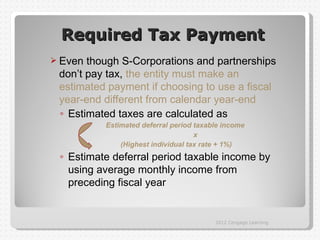
Required Tax Payment
 Even though S-Corporations and partnerships
 don’t pay tax, the entity must make an
 estimated payment if choosing to use a fiscal
 year-end different from calendar year-end
 ◦ Estimated taxes are calculated as
          Estimated deferral period taxable income
                                    x
              (Highest individual tax rate + 1%)
 ◦ Estimate deferral period taxable income by
   using average monthly income from
   preceding fiscal year


                                         2012 Cengage Learning
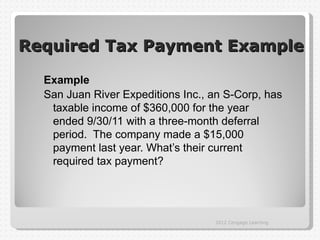
Required Tax Payment Example

  Example
  San Juan River Expeditions Inc., an S-Corp, has
   taxable income of $360,000 for the year
   ended 9/30/11 with a three-month deferral
   period. The company made a $15,000
   payment last year. What’s their current
   required tax payment?


                                   2012 Cengage Learning
Solution
Example
San Juan River Expeditions Inc., an S-Corp, has taxable income of
  $360,000 for the year ended 9/30/11 with a three-month deferral period.
  The company made a $15,000 payment last year. What’s their current
  required tax payment?

Solution
  The required tax payment =
  (Estimated taxable income in deferral period x 36%) - prior year’s tax payment


  Deferral period is 3 months (October – December)
       [($360,000/12) x 3 months] = $90,000 ($90,000 x 36%) = $32,400
       ($32,400 - 15,000) = $17,400 estimated tax payment due in current year


                                                         2012 Cengage Learning
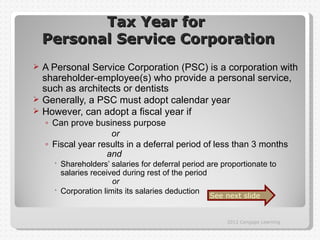
Tax Year for
    Personal Service Corporation
 A Personal Service Corporation (PSC) is a corporation with
  shareholder-employee(s) who provide a personal service,
  such as architects or dentists
 Generally, a PSC must adopt calendar year
 However, can adopt a fiscal year if
    ◦ Can prove business purpose
                     or
    ◦ Fiscal year results in a deferral period of less than 3 months
                    and
       Shareholders’ salaries for deferral period are proportionate to
        salaries received during rest of the period
                       or
       Corporation limits its salaries deduction
                                                   See next slide


                                                        2012 Cengage Learning
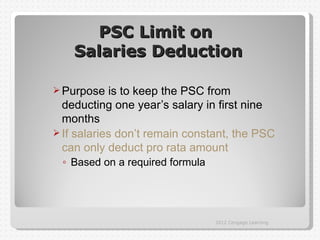
PSC Limit on
    Salaries Deduction

 Purpose   is to keep the PSC from
  deducting one year’s salary in first nine
  months
 If salaries don’t remain constant, the PSC
  can only deduct pro rata amount
 ◦ Based on a required formula


                                 2012 Cengage Learning
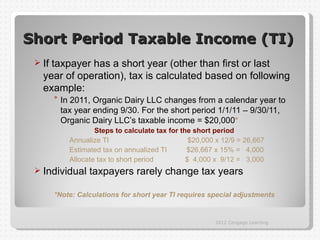
Short Period Taxable Income (TI)
  Iftaxpayer has a short year (other than first or last
   year of operation), tax is calculated based on following
   example:
        ° In 2011, Organic Dairy LLC changes from a calendar year to
          tax year ending 9/30. For the short period 1/1/11 – 9/30/11,
          Organic Dairy LLC’s taxable income = $20,000*
                    Steps to calculate tax for the short period
            Annualize TI                          $20,000 x 12/9 = 26,667
            Estimated tax on annualized TI       $26,667 x 15% = 4,000
            Allocate tax to short period         $ 4,000 x 9/12 = 3,000
  Individual     taxpayers rarely change tax years

        *Note: Calculations for short year TI requires special adjustments


                                                         2012 Cengage Learning
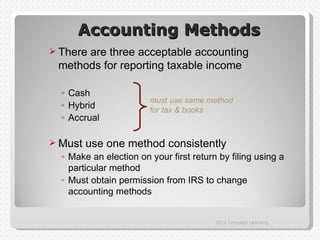
Accounting Methods
 There
      are three acceptable accounting
 methods for reporting taxable income

  ◦ Cash
                        must use same method
  ◦ Hybrid              for tax & books
  ◦ Accrual

 Must   use one method consistently
  ◦ Make an election on your first return by filing using a
    particular method
  ◦ Must obtain permission from IRS to change
    accounting methods


                                         2012 Cengage Learning
Accounting Methods
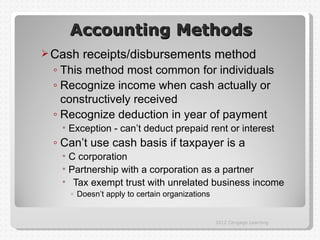
 Cash   receipts/disbursements method
 ◦ This method most common for individuals
 ◦ Recognize income when cash actually or
   constructively received
 ◦ Recognize deduction in year of payment
   • Exception - can’t deduct prepaid rent or interest
 ◦ Can’t use cash basis if taxpayer is a
   • C corporation
   • Partnership with a corporation as a partner
   • Tax exempt trust with unrelated business income
     ◦ Doesn’t apply to certain organizations


                                                2012 Cengage Learning
Accounting Methods
         (continued)
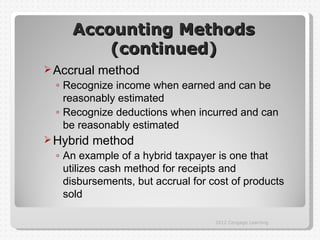
 Accrual   method
  ◦ Recognize income when earned and can be
    reasonably estimated
  ◦ Recognize deductions when incurred and can
    be reasonably estimated
 Hybrid   method
  ◦ An example of a hybrid taxpayer is one that
    utilizes cash method for receipts and
    disbursements, but accrual for cost of products
    sold

                                    2012 Cengage Learning
Depreciation
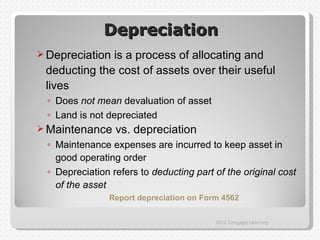
 Depreciationis a process of allocating and
 deducting the cost of assets over their useful
 lives
 ◦ Does not mean devaluation of asset
 ◦ Land is not depreciated
 Maintenance    vs. depreciation
 ◦ Maintenance expenses are incurred to keep asset in
   good operating order
 ◦ Depreciation refers to deducting part of the original cost
   of the asset
               Report depreciation on Form 4562

                                         2012 Cengage Learning
Depreciation Methods

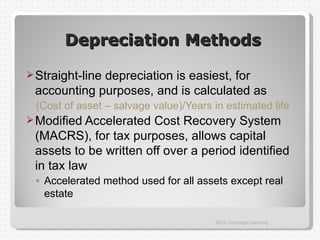
 Straight-line
             depreciation is easiest, for
 accounting purposes, and is calculated as
 (Cost of asset – salvage value)/Years in estimated life
 Modified Accelerated Cost Recovery System
 (MACRS), for tax purposes, allows capital
 assets to be written off over a period identified
 in tax law
 ◦ Accelerated method used for all assets except real
   estate

                                       2012 Cengage Learning
Personal Property
             Recovery Periods
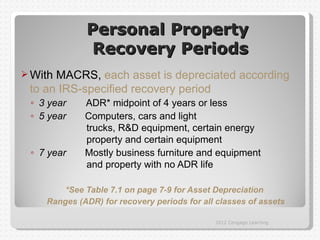
 WithMACRS, each asset is depreciated according
 to an IRS-specified recovery period
 ◦ 3 year    ADR* midpoint of 4 years or less
 ◦ 5 year    Computers, cars and light
             trucks, R&D equipment, certain energy
             property and certain equipment
 ◦ 7 year    Mostly business furniture and equipment
             and property with no ADR life

        *See Table 7.1 on page 7-9 for Asset Depreciation
    Ranges (ADR) for recovery periods for all classes of assets

                                             2012 Cengage Learning
Calculating Depreciation
         for Personal Property
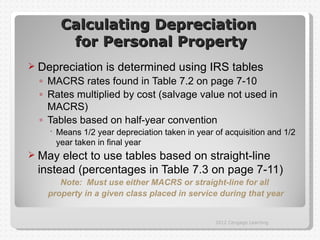
 Depreciation     is determined using IRS tables
  ◦ MACRS rates found in Table 7.2 on page 7-10
  ◦ Rates multiplied by cost (salvage value not used in
    MACRS)
  ◦ Tables based on half-year convention
     Means 1/2 year depreciation taken in year of acquisition and 1/2
      year taken in final year
 May elect to use tables based on straight-line
 instead (percentages in Table 7.3 on page 7-11)
      Note: Must use either MACRS or straight-line for all
   property in a given class placed in service during that year


                                                2012 Cengage Learning
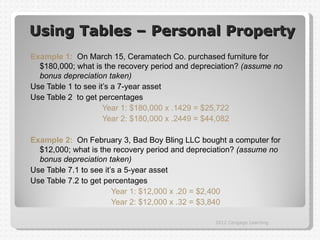
Using Tables – Personal Property
Example 1: On March 15, Ceramatech Co. purchased furniture for
  $180,000; what is the recovery period and depreciation? (assume no
  bonus depreciation taken)
Use Table 1 to see it’s a 7-year asset
Use Table 2 to get percentages
                     Year 1: $180,000 x .1429 = $25,722
                     Year 2: $180,000 x .2449 = $44,082

Example 2: On February 3, Bad Boy Bling LLC bought a computer for
  $12,000; what is the recovery period and depreciation? (assume no
  bonus depreciation taken)
Use Table 7.1 to see it’s a 5-year asset
Use Table 7.2 to get percentages
                        Year 1: $12,000 x .20 = $2,400
                        Year 2: $12,000 x .32 = $3,840

                                                 2012 Cengage Learning
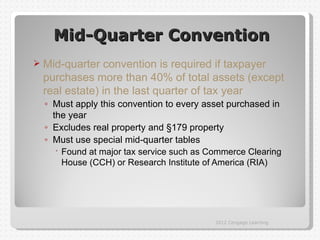
Mid-Quarter Convention
   Mid-quarter convention is required if taxpayer
    purchases more than 40% of total assets (except
    real estate) in the last quarter of tax year
    ◦ Must apply this convention to every asset purchased in
      the year
    ◦ Excludes real property and §179 property
    ◦ Must use special mid-quarter tables
        Found at major tax service such as Commerce Clearing
         House (CCH) or Research Institute of America (RIA)


                                             2012 Cengage Learning
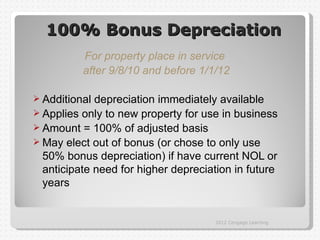
100% Bonus Depreciation
          For property place in service
          after 9/8/10 and before 1/1/12

 Additional depreciation immediately available
 Applies only to new property for use in business
 Amount = 100% of adjusted basis
 May elect out of bonus (or chose to only use
  50% bonus depreciation) if have current NOL or
  anticipate need for higher depreciation in future
  years


                                      2012 Cengage Learning
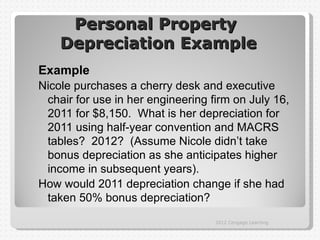
Personal Property
    Depreciation Example
Example
Nicole purchases a cherry desk and executive
 chair for use in her engineering firm on July 16,
 2011 for $8,150. What is her depreciation for
 2011 using half-year convention and MACRS
 tables? 2012? (Assume Nicole didn’t take
 bonus depreciation as she anticipates higher
 income in subsequent years).
How would 2011 depreciation change if she had
 taken 50% bonus depreciation?
                                   2012 Cengage Learning
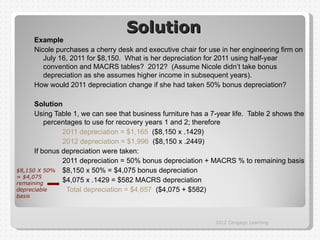
Solution
        Example
        Nicole purchases a cherry desk and executive chair for use in her engineering firm on
           July 16, 2011 for $8,150. What is her depreciation for 2011 using half-year
           convention and MACRS tables? 2012? (Assume Nicole didn’t take bonus
           depreciation as she assumes higher income in subsequent years).
        How would 2011 depreciation change if she had taken 50% bonus depreciation?

      Solution
      Using Table 1, we can see that business furniture has a 7-year life. Table 2 shows the
          percentages to use for recovery years 1 and 2; therefore
               2011 depreciation = $1,165 ($8,150 x .1429)
               2012 depreciation = $1,996 ($8,150 x .2449)
      If bonus depreciation were taken:
               2011 depreciation = 50% bonus depreciation + MACRS % to remaining basis
$8,150 X 50% $8,150 x 50% = $4,075 bonus depreciation
= $4,075
remaining
               $4,075 x .1429 = $582 MACRS depreciation
depreciable      Total depreciation = $4,657 ($4,075 + $582)
basis


                                                                 2012 Cengage Learning
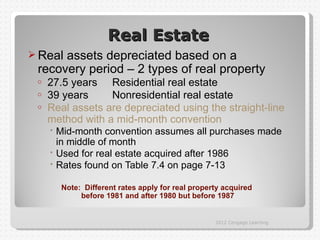
Real Estate
 Realassets depreciated based on a
 recovery period – 2 types of real property
 o   27.5 years Residential real estate
 o   39 years     Nonresidential real estate
 o   Real assets are depreciated using the straight-line
     method with a mid-month convention
      Mid-month convention assumes all purchases made
       in middle of month
      Used for real estate acquired after 1986
      Rates found on Table 7.4 on page 7-13

       Note: Different rates apply for real property acquired
            before 1981 and after 1980 but before 1987


                                                  2012 Cengage Learning
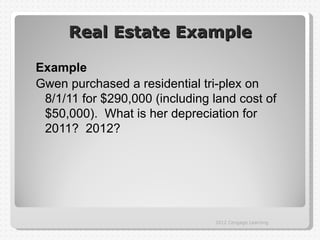
Real Estate Example

Example
Gwen purchased a residential tri-plex on
 8/1/11 for $290,000 (including land cost of
 $50,000). What is her depreciation for
 2011? 2012?


                                2012 Cengage Learning
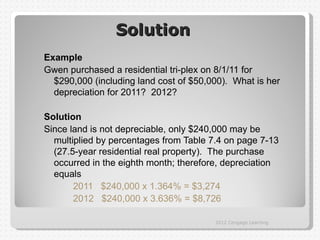
Solution
Example
Gwen purchased a residential tri-plex on 8/1/11 for
  $290,000 (including land cost of $50,000). What is her
  depreciation for 2011? 2012?

Solution
Since land is not depreciable, only $240,000 may be
  multiplied by percentages from Table 7.4 on page 7-13
  (27.5-year residential real property). The purchase
  occurred in the eighth month; therefore, depreciation
  equals
       2011 $240,000 x 1.364% = $3,274
       2012 $240,000 x 3.636% = $8,726

                                        2012 Cengage Learning
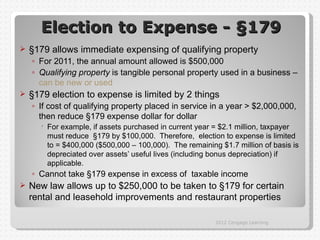
Election to Expense - §179
   §179 allows immediate expensing of qualifying property
    ◦ For 2011, the annual amount allowed is $500,000
    ◦ Qualifying property is tangible personal property used in a business –
      can be new or used
   §179 election to expense is limited by 2 things
    ◦ If cost of qualifying property placed in service in a year > $2,000,000,
      then reduce §179 expense dollar for dollar
       For example, if assets purchased in current year = $2.1 million, taxpayer
        must reduce §179 by $100,000. Therefore, election to expense is limited
        to = $400,000 ($500,000 – 100,000). The remaining $1.7 million of basis is
        depreciated over assets’ useful lives (including bonus depreciation) if
        applicable.
    ◦ Cannot take §179 expense in excess of taxable income
   New law allows up to $250,000 to be taken to §179 for certain
    rental and leasehold improvements and restaurant properties

                                                         2012 Cengage Learning
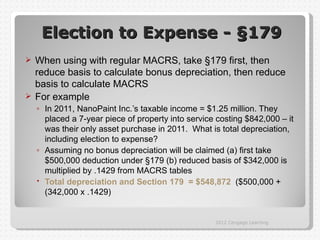
Election to Expense - §179
 When using with regular MACRS, take §179 first, then
  reduce basis to calculate bonus depreciation, then reduce
  basis to calculate MACRS
 For example
    ◦ In 2011, NanoPaint Inc.’s taxable income = $1.25 million. They
      placed a 7-year piece of property into service costing $842,000 – it
      was their only asset purchase in 2011. What is total depreciation,
      including election to expense?
    ◦ Assuming no bonus depreciation will be claimed (a) first take
      $500,000 deduction under §179 (b) reduced basis of $342,000 is
      multiplied by .1429 from MACRS tables
     Total depreciation and Section 179 = $548,872 ($500,000 +
      (342,000 x .1429)


                                                    2012 Cengage Learning
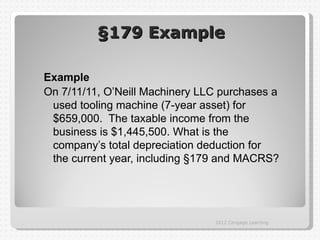
§179 Example

Example
On 7/11/11, O’Neill Machinery LLC purchases a
 used tooling machine (7-year asset) for
 $659,000. The taxable income from the
 business is $1,445,500. What is the
 company’s total depreciation deduction for
 the current year, including §179 and MACRS?


                                2012 Cengage Learning
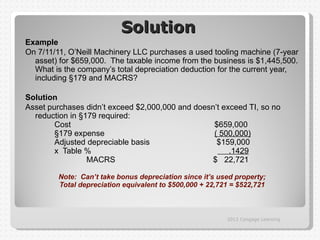
Solution
Example
On 7/11/11, O’Neill Machinery LLC purchases a used tooling machine (7-year
  asset) for $659,000. The taxable income from the business is $1,445,500.
  What is the company’s total depreciation deduction for the current year,
  including §179 and MACRS?

Solution
Asset purchases didn’t exceed $2,000,000 and doesn’t exceed TI, so no
  reduction in §179 required:
        Cost                                      $659,000
        §179 expense                              ( 500,000)
        Adjusted depreciable basis                 $159,000
        x Table %                                      .1429
                 MACRS                            $ 22,721

        Note: Can’t take bonus depreciation since it’s used property;
        Total depreciation equivalent to $500,000 + 22,721 = $522,721


                                                         2012 Cengage Learning
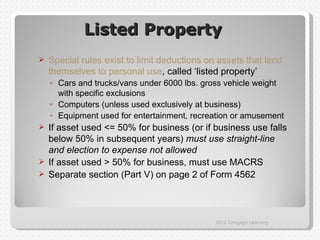
Listed Property
   Special rules exist to limit deductions on assets that lend
    themselves to personal use, called ‘listed property’
    ◦ Cars and trucks/vans under 6000 lbs. gross vehicle weight
      with specific exclusions
    ◦ Computers (unless used exclusively at business)
    ◦ Equipment used for entertainment, recreation or amusement
 If asset used <= 50% for business (or if business use falls
  below 50% in subsequent years) must use straight-line
  and election to expense not allowed
 If asset used > 50% for business, must use MACRS
 Separate section (Part V) on page 2 of Form 4562


                                              2012 Cengage Learning
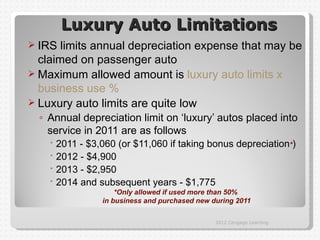
Luxury Auto Limitations
 IRS  limits annual depreciation expense that may be
  claimed on passenger auto
 Maximum allowed amount is luxury auto limits x
  business use %
 Luxury auto limits are quite low
  ◦ Annual depreciation limit on ‘luxury’ autos placed into
    service in 2011 are as follows
     2011 - $3,060 (or $11,060 if taking bonus depreciation*)
     2012 - $4,900
     2013 - $2,950
     2014 and subsequent years - $1,775
                    *Only allowed if used more than 50%
                in business and purchased new during 2011

                                               2012 Cengage Learning
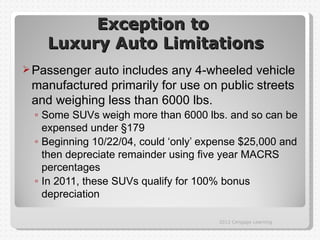
Exception to
    Luxury Auto Limitations
 Passenger auto includes any 4-wheeled vehicle
 manufactured primarily for use on public streets
 and weighing less than 6000 lbs.
 ◦ Some SUVs weigh more than 6000 lbs. and so can be
   expensed under §179
 ◦ Beginning 10/22/04, could ‘only’ expense $25,000 and
   then depreciate remainder using five year MACRS
   percentages
 ◦ In 2011, these SUVs qualify for 100% bonus
   depreciation

                                      2012 Cengage Learning
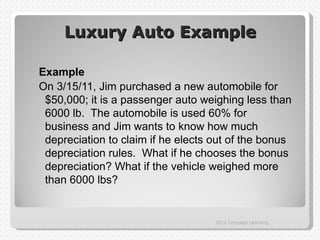
Luxury Auto Example

Example
On 3/15/11, Jim purchased a new automobile for
 $50,000; it is a passenger auto weighing less than
 6000 lb. The automobile is used 60% for
 business and Jim wants to know how much
 depreciation to claim if he elects out of the bonus
 depreciation rules. What if he chooses the bonus
 depreciation? What if the vehicle weighed more
 than 6000 lbs?


                                    2012 Cengage Learning
Solution
Example
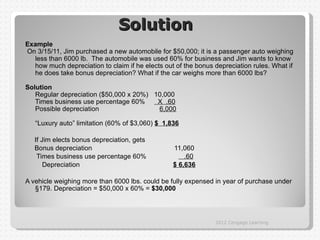
On 3/15/11, Jim purchased a new automobile for $50,000; it is a passenger auto weighing
  less than 6000 lb. The automobile was used 60% for business and Jim wants to know
  how much depreciation to claim if he elects out of the bonus depreciation rules. What if
  he does take bonus depreciation? What if the car weighs more than 6000 lbs?

Solution
   Regular depreciation ($50,000 x 20%) 10,000
   Times business use percentage 60%     X .60
   Possible depreciation                 6,000

   “Luxury auto” limitation (60% of $3,060) $ 1,836

   If Jim elects bonus depreciation, gets
   Bonus depreciation                            11,060
    Times business use percentage 60%                .60
       Depreciation                              $ 6,636

A vehicle weighing more than 6000 lbs. could be fully expensed in year of purchase under
   §179. Depreciation = $50,000 x 60% = $30,000


                                                               2012 Cengage Learning
Intangible Assets
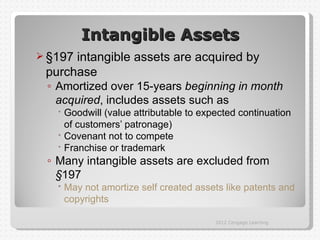
 §197intangible assets are acquired by
 purchase
 ◦ Amortized over 15-years beginning in month
   acquired, includes assets such as
    Goodwill (value attributable to expected continuation
     of customers’ patronage)
    Covenant not to compete
    Franchise or trademark
 ◦ Many intangible assets are excluded from
   §197
    May not amortize self created assets like patents and
     copyrights

                                        2012 Cengage Learning
Amortization Example


Example
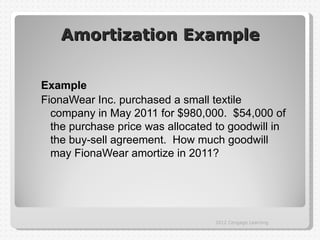
FionaWear Inc. purchased a small textile
  company in May 2011 for $980,000. $54,000 of
  the purchase price was allocated to goodwill in
  the buy-sell agreement. How much goodwill
  may FionaWear amortize in 2011?


                                  2012 Cengage Learning
Solution

Example
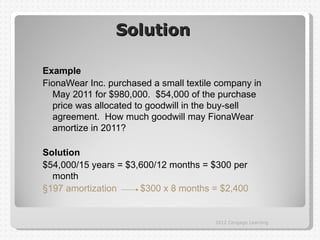
FionaWear Inc. purchased a small textile company in
  May 2011 for $980,000. $54,000 of the purchase
  price was allocated to goodwill in the buy-sell
  agreement. How much goodwill may FionaWear
  amortize in 2011?

Solution
$54,000/15 years = $3,600/12 months = $300 per
  month
§197 amortization     $300 x 8 months = $2,400


                                        2012 Cengage Learning
Related Party Transactions §267
    Restricted transaction between related parties include
     ◦ Recognizing losses on sales between related parties
     ◦ One accrual basis and one cash basis taxpayer as pertains to
       expensing unpaid expenses and interest
    Related parties are:
     ◦ Family members such as spouses, lineal descendants,
       siblings
     ◦ A corporation and more than 50% owner
     ◦ Brother/sister corporations
     ◦ Parent/subsidiary corporations
     ◦ Complex ‘constructive ownership’ rules


                                               2012 Cengage Learning
Related Party Transactions §267

 Losses   disallowed between related parties
  ◦ When property sold later to an unrelated party, all
    previously disallowed losses may be taken against gain
 Maynot avoid tax when one taxpayer uses cash
 method for expenses and interest and the other
 taxpayer uses accrual method


                                         2012 Cengage Learning
My head hurts!


The End!
            2012 Cengage Learning

Itf ipp ch07_2012_final

  • 1.
    Chapter 7 Accounting Periods and Methods and Depreciation Income Tax Fundamentals 2012 Gerald E. Whittenburg & Martha Altus-Buller 2012 Cengage Learning
  • 2.
    Learning Objectives  Determinedifferent accounting periods and methods for tax periods  Understand concept of depreciation  Calculate depreciation using MACRS tables and identify when §179 election to expense may be applied  Apply listed property and luxury automobile limitations  Understand tax treatment of intangibles  Determine whether parties are considered related and how to treat related party transactions 2012 Cengage Learning
  • 3.
    Accounting Periods  Rarely,a taxpayer’s tax year will differ from the calendar year  In a partnership  The tax year must be the same tax year as 50% of partners’  If majority of partners’ tax years are different, must use tax year of ‘principal partners’  Principal partner defined as partner with at least 5% share in profits or capital  If principal partners have different tax years, partnership generally required to use least aggregate deferral method Note: Partnerships don’t pay tax as an entity 2012 Cengage Learning
  • 4.
    Accounting Periods Partnerships/S-Corporations mayelect to adopt a different fiscal tax year from the one prescribed on previous slide, but only o If entity can demonstrate that natural business cycle easily conforms to fiscal year other than calendar year • Such as a golf course in Denver, CO (natural business cycle ends in October) Note: S-Corporations don’t pay tax as an entity 2012 Cengage Learning
  • 5.
    Required Tax Payment Even though S-Corporations and partnerships don’t pay tax, the entity must make an estimated payment if choosing to use a fiscal year-end different from calendar year-end ◦ Estimated taxes are calculated as Estimated deferral period taxable income x (Highest individual tax rate + 1%) ◦ Estimate deferral period taxable income by using average monthly income from preceding fiscal year 2012 Cengage Learning
  • 6.
    Required Tax PaymentExample Example San Juan River Expeditions Inc., an S-Corp, has taxable income of $360,000 for the year ended 9/30/11 with a three-month deferral period. The company made a $15,000 payment last year. What’s their current required tax payment? 2012 Cengage Learning
  • 7.
    Solution Example San Juan RiverExpeditions Inc., an S-Corp, has taxable income of $360,000 for the year ended 9/30/11 with a three-month deferral period. The company made a $15,000 payment last year. What’s their current required tax payment? Solution The required tax payment = (Estimated taxable income in deferral period x 36%) - prior year’s tax payment Deferral period is 3 months (October – December) [($360,000/12) x 3 months] = $90,000 ($90,000 x 36%) = $32,400 ($32,400 - 15,000) = $17,400 estimated tax payment due in current year 2012 Cengage Learning
  • 8.
    Tax Year for Personal Service Corporation  A Personal Service Corporation (PSC) is a corporation with shareholder-employee(s) who provide a personal service, such as architects or dentists  Generally, a PSC must adopt calendar year  However, can adopt a fiscal year if ◦ Can prove business purpose or ◦ Fiscal year results in a deferral period of less than 3 months and  Shareholders’ salaries for deferral period are proportionate to salaries received during rest of the period or  Corporation limits its salaries deduction See next slide 2012 Cengage Learning
  • 9.
    PSC Limit on Salaries Deduction  Purpose is to keep the PSC from deducting one year’s salary in first nine months  If salaries don’t remain constant, the PSC can only deduct pro rata amount ◦ Based on a required formula 2012 Cengage Learning
  • 10.
    Short Period TaxableIncome (TI)  Iftaxpayer has a short year (other than first or last year of operation), tax is calculated based on following example: ° In 2011, Organic Dairy LLC changes from a calendar year to tax year ending 9/30. For the short period 1/1/11 – 9/30/11, Organic Dairy LLC’s taxable income = $20,000* Steps to calculate tax for the short period Annualize TI $20,000 x 12/9 = 26,667 Estimated tax on annualized TI $26,667 x 15% = 4,000 Allocate tax to short period $ 4,000 x 9/12 = 3,000  Individual taxpayers rarely change tax years *Note: Calculations for short year TI requires special adjustments 2012 Cengage Learning
  • 11.
    Accounting Methods  There are three acceptable accounting methods for reporting taxable income ◦ Cash must use same method ◦ Hybrid for tax & books ◦ Accrual  Must use one method consistently ◦ Make an election on your first return by filing using a particular method ◦ Must obtain permission from IRS to change accounting methods 2012 Cengage Learning
  • 12.
    Accounting Methods  Cash receipts/disbursements method ◦ This method most common for individuals ◦ Recognize income when cash actually or constructively received ◦ Recognize deduction in year of payment • Exception - can’t deduct prepaid rent or interest ◦ Can’t use cash basis if taxpayer is a • C corporation • Partnership with a corporation as a partner • Tax exempt trust with unrelated business income ◦ Doesn’t apply to certain organizations 2012 Cengage Learning
  • 13.
    Accounting Methods (continued)  Accrual method ◦ Recognize income when earned and can be reasonably estimated ◦ Recognize deductions when incurred and can be reasonably estimated  Hybrid method ◦ An example of a hybrid taxpayer is one that utilizes cash method for receipts and disbursements, but accrual for cost of products sold 2012 Cengage Learning
  • 14.
    Depreciation  Depreciationis aprocess of allocating and deducting the cost of assets over their useful lives ◦ Does not mean devaluation of asset ◦ Land is not depreciated  Maintenance vs. depreciation ◦ Maintenance expenses are incurred to keep asset in good operating order ◦ Depreciation refers to deducting part of the original cost of the asset Report depreciation on Form 4562 2012 Cengage Learning
  • 15.
    Depreciation Methods  Straight-line depreciation is easiest, for accounting purposes, and is calculated as (Cost of asset – salvage value)/Years in estimated life  Modified Accelerated Cost Recovery System (MACRS), for tax purposes, allows capital assets to be written off over a period identified in tax law ◦ Accelerated method used for all assets except real estate 2012 Cengage Learning
  • 16.
    Personal Property Recovery Periods  WithMACRS, each asset is depreciated according to an IRS-specified recovery period ◦ 3 year ADR* midpoint of 4 years or less ◦ 5 year Computers, cars and light trucks, R&D equipment, certain energy property and certain equipment ◦ 7 year Mostly business furniture and equipment and property with no ADR life *See Table 7.1 on page 7-9 for Asset Depreciation Ranges (ADR) for recovery periods for all classes of assets 2012 Cengage Learning
  • 17.
    Calculating Depreciation for Personal Property  Depreciation is determined using IRS tables ◦ MACRS rates found in Table 7.2 on page 7-10 ◦ Rates multiplied by cost (salvage value not used in MACRS) ◦ Tables based on half-year convention  Means 1/2 year depreciation taken in year of acquisition and 1/2 year taken in final year  May elect to use tables based on straight-line instead (percentages in Table 7.3 on page 7-11) Note: Must use either MACRS or straight-line for all property in a given class placed in service during that year 2012 Cengage Learning
  • 18.
    Using Tables –Personal Property Example 1: On March 15, Ceramatech Co. purchased furniture for $180,000; what is the recovery period and depreciation? (assume no bonus depreciation taken) Use Table 1 to see it’s a 7-year asset Use Table 2 to get percentages Year 1: $180,000 x .1429 = $25,722 Year 2: $180,000 x .2449 = $44,082 Example 2: On February 3, Bad Boy Bling LLC bought a computer for $12,000; what is the recovery period and depreciation? (assume no bonus depreciation taken) Use Table 7.1 to see it’s a 5-year asset Use Table 7.2 to get percentages Year 1: $12,000 x .20 = $2,400 Year 2: $12,000 x .32 = $3,840 2012 Cengage Learning
  • 19.
    Mid-Quarter Convention  Mid-quarter convention is required if taxpayer purchases more than 40% of total assets (except real estate) in the last quarter of tax year ◦ Must apply this convention to every asset purchased in the year ◦ Excludes real property and §179 property ◦ Must use special mid-quarter tables  Found at major tax service such as Commerce Clearing House (CCH) or Research Institute of America (RIA) 2012 Cengage Learning
  • 20.
    100% Bonus Depreciation For property place in service after 9/8/10 and before 1/1/12  Additional depreciation immediately available  Applies only to new property for use in business  Amount = 100% of adjusted basis  May elect out of bonus (or chose to only use 50% bonus depreciation) if have current NOL or anticipate need for higher depreciation in future years 2012 Cengage Learning
  • 21.
    Personal Property Depreciation Example Example Nicole purchases a cherry desk and executive chair for use in her engineering firm on July 16, 2011 for $8,150. What is her depreciation for 2011 using half-year convention and MACRS tables? 2012? (Assume Nicole didn’t take bonus depreciation as she anticipates higher income in subsequent years). How would 2011 depreciation change if she had taken 50% bonus depreciation? 2012 Cengage Learning
  • 22.
    Solution Example Nicole purchases a cherry desk and executive chair for use in her engineering firm on July 16, 2011 for $8,150. What is her depreciation for 2011 using half-year convention and MACRS tables? 2012? (Assume Nicole didn’t take bonus depreciation as she assumes higher income in subsequent years). How would 2011 depreciation change if she had taken 50% bonus depreciation? Solution Using Table 1, we can see that business furniture has a 7-year life. Table 2 shows the percentages to use for recovery years 1 and 2; therefore 2011 depreciation = $1,165 ($8,150 x .1429) 2012 depreciation = $1,996 ($8,150 x .2449) If bonus depreciation were taken: 2011 depreciation = 50% bonus depreciation + MACRS % to remaining basis $8,150 X 50% $8,150 x 50% = $4,075 bonus depreciation = $4,075 remaining $4,075 x .1429 = $582 MACRS depreciation depreciable Total depreciation = $4,657 ($4,075 + $582) basis 2012 Cengage Learning
  • 23.
    Real Estate  Realassetsdepreciated based on a recovery period – 2 types of real property o 27.5 years Residential real estate o 39 years Nonresidential real estate o Real assets are depreciated using the straight-line method with a mid-month convention  Mid-month convention assumes all purchases made in middle of month  Used for real estate acquired after 1986  Rates found on Table 7.4 on page 7-13 Note: Different rates apply for real property acquired before 1981 and after 1980 but before 1987 2012 Cengage Learning
  • 24.
    Real Estate Example Example Gwenpurchased a residential tri-plex on 8/1/11 for $290,000 (including land cost of $50,000). What is her depreciation for 2011? 2012? 2012 Cengage Learning
  • 25.
    Solution Example Gwen purchased aresidential tri-plex on 8/1/11 for $290,000 (including land cost of $50,000). What is her depreciation for 2011? 2012? Solution Since land is not depreciable, only $240,000 may be multiplied by percentages from Table 7.4 on page 7-13 (27.5-year residential real property). The purchase occurred in the eighth month; therefore, depreciation equals 2011 $240,000 x 1.364% = $3,274 2012 $240,000 x 3.636% = $8,726 2012 Cengage Learning
  • 26.
    Election to Expense- §179  §179 allows immediate expensing of qualifying property ◦ For 2011, the annual amount allowed is $500,000 ◦ Qualifying property is tangible personal property used in a business – can be new or used  §179 election to expense is limited by 2 things ◦ If cost of qualifying property placed in service in a year > $2,000,000, then reduce §179 expense dollar for dollar  For example, if assets purchased in current year = $2.1 million, taxpayer must reduce §179 by $100,000. Therefore, election to expense is limited to = $400,000 ($500,000 – 100,000). The remaining $1.7 million of basis is depreciated over assets’ useful lives (including bonus depreciation) if applicable. ◦ Cannot take §179 expense in excess of taxable income  New law allows up to $250,000 to be taken to §179 for certain rental and leasehold improvements and restaurant properties 2012 Cengage Learning
  • 27.
    Election to Expense- §179  When using with regular MACRS, take §179 first, then reduce basis to calculate bonus depreciation, then reduce basis to calculate MACRS  For example ◦ In 2011, NanoPaint Inc.’s taxable income = $1.25 million. They placed a 7-year piece of property into service costing $842,000 – it was their only asset purchase in 2011. What is total depreciation, including election to expense? ◦ Assuming no bonus depreciation will be claimed (a) first take $500,000 deduction under §179 (b) reduced basis of $342,000 is multiplied by .1429 from MACRS tables  Total depreciation and Section 179 = $548,872 ($500,000 + (342,000 x .1429) 2012 Cengage Learning
  • 28.
    §179 Example Example On 7/11/11,O’Neill Machinery LLC purchases a used tooling machine (7-year asset) for $659,000. The taxable income from the business is $1,445,500. What is the company’s total depreciation deduction for the current year, including §179 and MACRS? 2012 Cengage Learning
  • 29.
    Solution Example On 7/11/11, O’NeillMachinery LLC purchases a used tooling machine (7-year asset) for $659,000. The taxable income from the business is $1,445,500. What is the company’s total depreciation deduction for the current year, including §179 and MACRS? Solution Asset purchases didn’t exceed $2,000,000 and doesn’t exceed TI, so no reduction in §179 required: Cost $659,000 §179 expense ( 500,000) Adjusted depreciable basis $159,000 x Table % .1429 MACRS $ 22,721 Note: Can’t take bonus depreciation since it’s used property; Total depreciation equivalent to $500,000 + 22,721 = $522,721 2012 Cengage Learning
  • 30.
    Listed Property  Special rules exist to limit deductions on assets that lend themselves to personal use, called ‘listed property’ ◦ Cars and trucks/vans under 6000 lbs. gross vehicle weight with specific exclusions ◦ Computers (unless used exclusively at business) ◦ Equipment used for entertainment, recreation or amusement  If asset used <= 50% for business (or if business use falls below 50% in subsequent years) must use straight-line and election to expense not allowed  If asset used > 50% for business, must use MACRS  Separate section (Part V) on page 2 of Form 4562 2012 Cengage Learning
  • 31.
    Luxury Auto Limitations IRS limits annual depreciation expense that may be claimed on passenger auto  Maximum allowed amount is luxury auto limits x business use %  Luxury auto limits are quite low ◦ Annual depreciation limit on ‘luxury’ autos placed into service in 2011 are as follows  2011 - $3,060 (or $11,060 if taking bonus depreciation*)  2012 - $4,900  2013 - $2,950  2014 and subsequent years - $1,775 *Only allowed if used more than 50% in business and purchased new during 2011 2012 Cengage Learning
  • 32.
    Exception to Luxury Auto Limitations  Passenger auto includes any 4-wheeled vehicle manufactured primarily for use on public streets and weighing less than 6000 lbs. ◦ Some SUVs weigh more than 6000 lbs. and so can be expensed under §179 ◦ Beginning 10/22/04, could ‘only’ expense $25,000 and then depreciate remainder using five year MACRS percentages ◦ In 2011, these SUVs qualify for 100% bonus depreciation 2012 Cengage Learning
  • 33.
    Luxury Auto Example Example On3/15/11, Jim purchased a new automobile for $50,000; it is a passenger auto weighing less than 6000 lb. The automobile is used 60% for business and Jim wants to know how much depreciation to claim if he elects out of the bonus depreciation rules. What if he chooses the bonus depreciation? What if the vehicle weighed more than 6000 lbs? 2012 Cengage Learning
  • 34.
    Solution Example On 3/15/11, Jimpurchased a new automobile for $50,000; it is a passenger auto weighing less than 6000 lb. The automobile was used 60% for business and Jim wants to know how much depreciation to claim if he elects out of the bonus depreciation rules. What if he does take bonus depreciation? What if the car weighs more than 6000 lbs? Solution Regular depreciation ($50,000 x 20%) 10,000 Times business use percentage 60% X .60 Possible depreciation 6,000 “Luxury auto” limitation (60% of $3,060) $ 1,836 If Jim elects bonus depreciation, gets Bonus depreciation 11,060 Times business use percentage 60% .60 Depreciation $ 6,636 A vehicle weighing more than 6000 lbs. could be fully expensed in year of purchase under §179. Depreciation = $50,000 x 60% = $30,000 2012 Cengage Learning
  • 35.
    Intangible Assets  §197intangibleassets are acquired by purchase ◦ Amortized over 15-years beginning in month acquired, includes assets such as  Goodwill (value attributable to expected continuation of customers’ patronage)  Covenant not to compete  Franchise or trademark ◦ Many intangible assets are excluded from §197  May not amortize self created assets like patents and copyrights 2012 Cengage Learning
  • 36.
    Amortization Example Example FionaWear Inc.purchased a small textile company in May 2011 for $980,000. $54,000 of the purchase price was allocated to goodwill in the buy-sell agreement. How much goodwill may FionaWear amortize in 2011? 2012 Cengage Learning
  • 37.
    Solution Example FionaWear Inc. purchaseda small textile company in May 2011 for $980,000. $54,000 of the purchase price was allocated to goodwill in the buy-sell agreement. How much goodwill may FionaWear amortize in 2011? Solution $54,000/15 years = $3,600/12 months = $300 per month §197 amortization $300 x 8 months = $2,400 2012 Cengage Learning
  • 38.
    Related Party Transactions§267  Restricted transaction between related parties include ◦ Recognizing losses on sales between related parties ◦ One accrual basis and one cash basis taxpayer as pertains to expensing unpaid expenses and interest  Related parties are: ◦ Family members such as spouses, lineal descendants, siblings ◦ A corporation and more than 50% owner ◦ Brother/sister corporations ◦ Parent/subsidiary corporations ◦ Complex ‘constructive ownership’ rules 2012 Cengage Learning
  • 39.
    Related Party Transactions§267  Losses disallowed between related parties ◦ When property sold later to an unrelated party, all previously disallowed losses may be taken against gain  Maynot avoid tax when one taxpayer uses cash method for expenses and interest and the other taxpayer uses accrual method 2012 Cengage Learning
  • 40.
    My head hurts! TheEnd! 2012 Cengage Learning