CHAPTER 8
PARTNERSHIPS
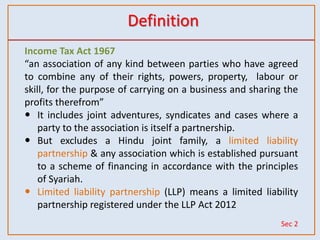
Definition
Income Tax Act 1967
“an association of any kind between parties who have agreed
to combine any of their rights, powers, property, labour or
skill, for the purpose of carrying on a business and sharing the
profits therefrom”
 It includes joint adventures, syndicates and cases where a
party to the association is itself a partnership.
 But excludes a Hindu joint family, a limited liability
partnership & any association which is established pursuant
to a scheme of financing in accordance with the principles
of Syariah.
 Limited liability partnership (LLP) means a limited liability
partnership registered under the LLP Act 2012
Sec 2
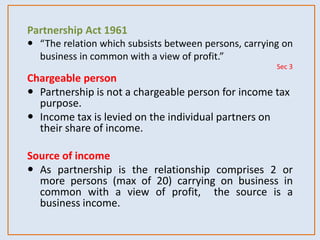
Partnership Act 1961
 “The relation which subsists between persons, carrying on
business in common with a view of profit.”
Sec 3
Chargeable person
 Partnership is not a chargeable person for income tax
purpose.
 Income tax is levied on the individual partners on
their share of income.
Source of income
 As partnership is the relationship comprises 2 or
more persons (max of 20) carrying on business in
common with a view of profit, the source is a
business income.
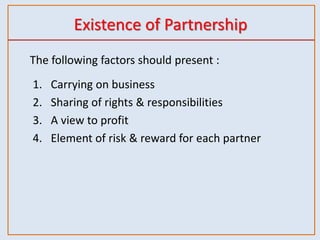
Existence of Partnership
The following factors should present :
1. Carrying on business
2. Sharing of rights & responsibilities
3. A view to profit
4. Element of risk & reward for each partner
Basis Period (BP)
• BP for a partnership = BP for business
• Where there is a change in the partnership
[admission of new partner(s) / withdrawal of
existing partner(s)], the BP will be divided into
two period:
1. old partnership (before change in the partnership)
2. new partnership (after change in the partnership)
In this case, the partnership’s income also need to
be distributed into those two periods
Return form by Partnership
The return (Form P) must declare:
• The divisible income or divisible loss
[sec.86(2)(a)]
• All information to determine the statutory income from
all sources
[(sec.86(2)(b)]
• Other information as required
[(sec.86(2)(c)]
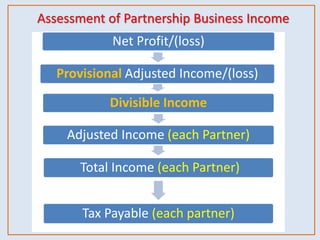
Assessment of Partnership Business Income
Net Profit/(loss)
Provisional Adjusted Income/(loss)
Divisible Income
Adjusted Income (each Partner)
Total Income (each Partner)
Tax Payable (each partner)
Provisional Adjusted Income [Sec.55(2)]
• A partnership is postulated as a sole proprietorship
for the purposes of computing partnership adjusted
income
• For partnership, this adjusted income is known as
provisional adjusted income
• The normal rules of allowable, non-allowable,
double deduction are employed to determine the
gross income & deductions
» See chapter 7 on business Income
Example 1
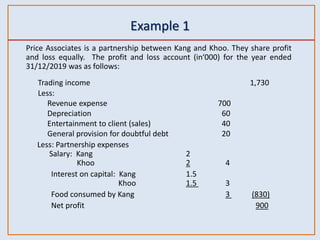
Price Associates is a partnership between Kang and Khoo. They share profit
and loss equally. The profit and loss account (in‘000) for the year ended
31/12/2019 was as follows:
Trading income 1,730
Less:
Revenue expense 700
Depreciation 60
Entertainment to client (sales) 40
General provision for doubtful debt 20
Less: Partnership expenses
Salary: Kang 2
Khoo 2 4
Interest on capital: Kang 1.5
Khoo 1.5 3
Food consumed by Kang 3 (830)
Net profit 900
The computation of provisional adjusted income
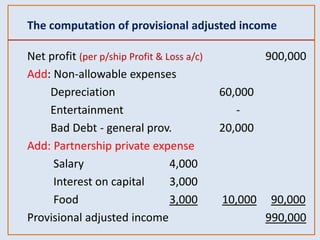
Net profit (per p/ship Profit & Loss a/c) 900,000
Add: Non-allowable expenses
Depreciation 60,000
Entertainment -
Bad Debt - general prov. 20,000
Add: Partnership private expense
Salary 4,000
Interest on capital 3,000
Food 3,000 10,000 90,000
Provisional adjusted income 990,000
Divisible Income [Sec.55(3)]
From the provisional adjusted income the following are
deducted to arrive at the divisible income:
• Remuneration of partners
• Interest to any partner on capital paid or advanced
• Private and domestic expenses, if any, of a partner
(including reimbursement by the partner)
The basis to allocate the partnership income to
individual partners is based on the ratio as stipulated
in a partnership agreement
Example 1 - cont’d
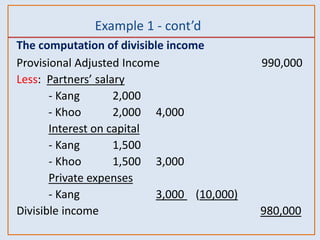
The computation of divisible income
Provisional Adjusted Income 990,000
Less: Partners’ salary
- Kang 2,000
- Khoo 2,000 4,000
Interest on capital
- Kang 1,500
- Khoo 1,500 3,000
Private expenses
- Kang 3,000 (10,000)
Divisible income 980,000
Change of profit-sharing ratio
• Divisible income is presumed accrued evenly over
the basis period. If there is a change of profit-sharing
ratio during the basis period, an apportion on time
basis based on the old and new ratio will be done.
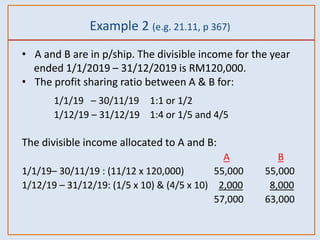
Example 2 (e.g. 21.11, p 367)
• A and B are in p/ship. The divisible income for the year
ended 1/1/2019 – 31/12/2019 is RM120,000.
• The profit sharing ratio between A & B for:
1/1/19 – 30/11/19 1:1 or 1/2
1/12/19 – 31/12/19 1:4 or 1/5 and 4/5
The divisible income allocated to A and B:
A B
1/1/19– 30/11/19 : (11/12 x 120,000) 55,000 55,000
1/12/19 – 31/12/19: (1/5 x 10) & (4/5 x 10) 2,000 8,000
57,000 63,000
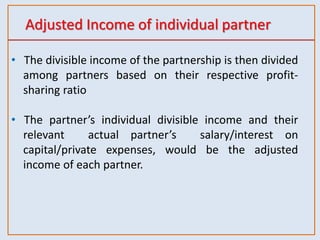
Adjusted Income of individual partner
• The divisible income of the partnership is then divided
among partners based on their respective profit-
sharing ratio
• The partner’s individual divisible income and their
relevant actual partner’s salary/interest on
capital/private expenses, would be the adjusted
income of each partner.
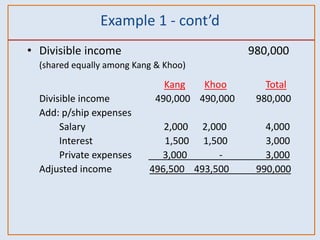
Example 1 - cont’d
• Divisible income 980,000
(shared equally among Kang & Khoo)
Kang Khoo Total
Divisible income 490,000 490,000 980,000
Add: p/ship expenses
Salary 2,000 2,000 4,000
Interest 1,500 1,500 3,000
Private expenses 3,000 - 3,000
Adjusted income 496,500 493,500 990,000
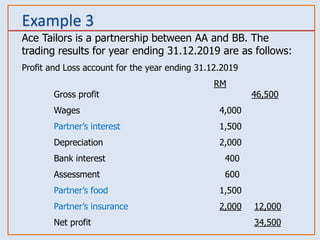
Ace Tailors is a partnership between AA and BB. The
trading results for year ending 31.12.2019 are as follows:
Profit and Loss account for the year ending 31.12.2019
RM
Gross profit 46,500
Wages 4,000
Partner’s interest 1,500
Depreciation 2,000
Bank interest 400
Assessment 600
Partner’s food 1,500
Partner’s insurance 2,000 12,000
Net profit 34,500
Example 3
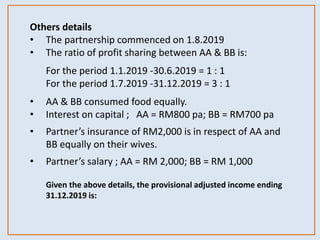
Others details
• The partnership commenced on 1.8.2019
• The ratio of profit sharing between AA & BB is:
For the period 1.1.2019 -30.6.2019 = 1 : 1
For the period 1.7.2019 -31.12.2019 = 3 : 1
• AA & BB consumed food equally.
• Interest on capital ; AA = RM800 pa; BB = RM700 pa
• Partner’s insurance of RM2,000 is in respect of AA and
BB equally on their wives.
• Partner’s salary ; AA = RM 2,000; BB = RM 1,000
Given the above details, the provisional adjusted income ending
31.12.2019 is:
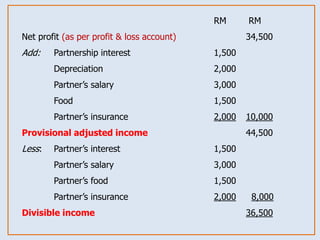
RM RM
Net profit (as per profit & loss account) 34,500
Add: Partnership interest 1,500
Depreciation 2,000
Partner’s salary 3,000
Food 1,500
Partner’s insurance 2,000 10,000
Provisional adjusted income 44,500
Less: Partner’s interest 1,500
Partner’s salary 3,000
Partner’s food 1,500
Partner’s insurance 2,000 8,000
Divisible income 36,500
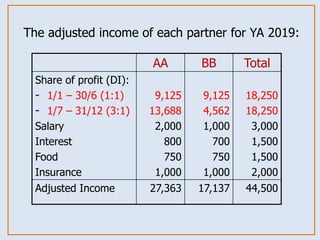
AA BB Total
Share of profit (DI):
- 1/1 – 30/6 (1:1)
- 1/7 – 31/12 (3:1)
Salary
Interest
Food
Insurance
9,125
13,688
2,000
800
750
1,000
9,125
4,562
1,000
700
750
1,000
18,250
18,250
3,000
1,500
1,500
2,000
Adjusted Income 27,363 17,137 44,500
The adjusted income of each partner for YA 2019:
Provisional Adjusted Loss
• Computed along the same line as provisional adjusted
income
• Where a divisible loss arises, the loss is allocated to
individual partners according to the relevant profit
sharing ratio at the material time.
Changes in Partnership
• When a partner withdrew from the partnership or a
new person is admitted as partner into the existing
partnership, this would resulted in a cessation of old
partnership and commencement of new p/ship
• See earlier slide on Basis Period
Continuing Partnership
• If the p/ship change & at least one existing
partner in the old p/ship continues to be a
partner in the new p/ship,
– the p/ship is treated as continuing even though the
change takes place half way through the basis year.
• There is no revision of basis periods & that
partner’s share of adjusted income is calculated in
the normal way.
• This applicable if the partnership businesses (old
& new) are substantially the same.
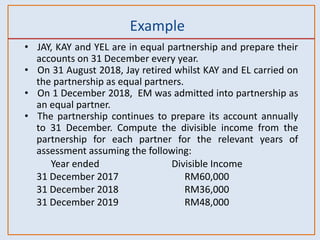
Example
• JAY, KAY and YEL are in equal partnership and prepare their
accounts on 31 December every year.
• On 31 August 2018, Jay retired whilst KAY and EL carried on
the partnership as equal partners.
• On 1 December 2018, EM was admitted into partnership as
an equal partner.
• The partnership continues to prepare its account annually
to 31 December. Compute the divisible income from the
partnership for each partner for the relevant years of
assessment assuming the following:
Year ended Divisible Income
31 December 2017 RM60,000
31 December 2018 RM36,000
31 December 2019 RM48,000
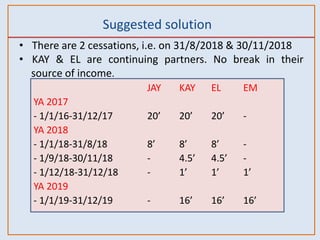
Suggested solution
• There are 2 cessations, i.e. on 31/8/2018 & 30/11/2018
• KAY & EL are continuing partners. No break in their
source of income.
JAY KAY EL EM
YA 2017
- 1/1/16-31/12/17 20’ 20’ 20’ -
YA 2018
- 1/1/18-31/8/18 8’ 8’ 8’ -
- 1/9/18-30/11/18 - 4.5’ 4.5’ -
- 1/12/18-31/12/18 - 1’ 1’ 1’
YA 2019
- 1/1/19-31/12/19 - 16’ 16’ 16’
Admitting a new partner
• In the case of a new partner admitted into an existing
partnership which continues to prepare its accounts
to its usual year end, the basis period will start on the
day one becomes a partner to the end of the
accounting period [S21(5)]
• Example:
If C is admitted on 1 October 2018 as a partner in the firm
of EBICO, which continues to prepare its accounts to 31
Dec annually, the basis period for C would be as follows:
Y/A Basis period
2018 1/10/2018 – 31/12/2018
2019 1/ 1/2019 – 31/12/2019
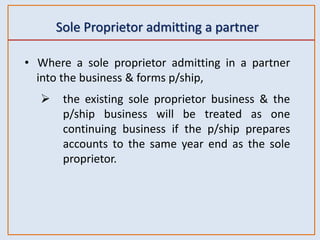
Sole Proprietor admitting a partner
• Where a sole proprietor admitting in a partner
into the business & forms p/ship,
 the existing sole proprietor business & the
p/ship business will be treated as one
continuing business if the p/ship prepares
accounts to the same year end as the sole
proprietor.
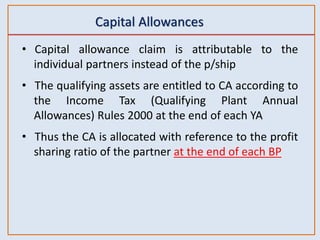
Capital Allowances
• Capital allowance claim is attributable to the
individual partners instead of the p/ship
• The qualifying assets are entitled to CA according to
the Income Tax (Qualifying Plant Annual
Allowances) Rules 2000 at the end of each YA
• Thus the CA is allocated with reference to the profit
sharing ratio of the partner at the end of each BP
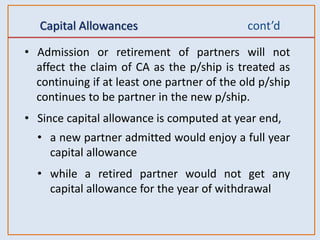
Capital Allowances cont’d
• Admission or retirement of partners will not
affect the claim of CA as the p/ship is treated as
continuing if at least one partner of the old p/ship
continues to be partner in the new p/ship.
• Since capital allowance is computed at year end,
• a new partner admitted would enjoy a full year
capital allowance
• while a retired partner would not get any
capital allowance for the year of withdrawal
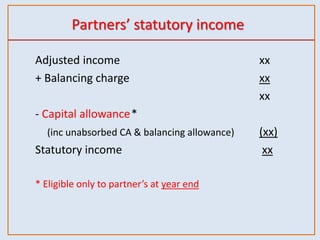
Partners’ statutory income
Adjusted income xx
+ Balancing charge xx
xx
- Capital allowance*
(inc unabsorbed CA & balancing allowance) (xx)
Statutory income xx
* Eligible only to partner’s at year end
Partnership Losses
• When p/ship suffers losses, the provisional adjusted
loss will result in divisible loss which will be shared by
individual partners according to their profit sharing
ratio per p/ship deed
• As business loss can be set off against all other
income in the current year, the individual partner may
be able to lower his tax liability if he also derives
employment income and investment income. Any
unabsorbed losses can be carried forward indefinitely
to be set off against future business income (statutory
income).
Non-business Income from partnership
• The adjusted income from the relevant sources
(i.e. dividend, rental) are to be apportioned
among partners according to their applicable
profit sharing ratio
Approved Donations
• Approved donations are also to be divided among
partners following their profit sharing ratio at the
time of payments

Chapter 8 Partnership.ppt

  • 1.
  • 2.
    Definition Income Tax Act1967 “an association of any kind between parties who have agreed to combine any of their rights, powers, property, labour or skill, for the purpose of carrying on a business and sharing the profits therefrom”  It includes joint adventures, syndicates and cases where a party to the association is itself a partnership.  But excludes a Hindu joint family, a limited liability partnership & any association which is established pursuant to a scheme of financing in accordance with the principles of Syariah.  Limited liability partnership (LLP) means a limited liability partnership registered under the LLP Act 2012 Sec 2
  • 3.
    Partnership Act 1961 “The relation which subsists between persons, carrying on business in common with a view of profit.” Sec 3 Chargeable person  Partnership is not a chargeable person for income tax purpose.  Income tax is levied on the individual partners on their share of income. Source of income  As partnership is the relationship comprises 2 or more persons (max of 20) carrying on business in common with a view of profit, the source is a business income.
  • 4.
    Existence of Partnership Thefollowing factors should present : 1. Carrying on business 2. Sharing of rights & responsibilities 3. A view to profit 4. Element of risk & reward for each partner
  • 5.
    Basis Period (BP) •BP for a partnership = BP for business • Where there is a change in the partnership [admission of new partner(s) / withdrawal of existing partner(s)], the BP will be divided into two period: 1. old partnership (before change in the partnership) 2. new partnership (after change in the partnership) In this case, the partnership’s income also need to be distributed into those two periods
  • 6.
    Return form byPartnership The return (Form P) must declare: • The divisible income or divisible loss [sec.86(2)(a)] • All information to determine the statutory income from all sources [(sec.86(2)(b)] • Other information as required [(sec.86(2)(c)]
  • 7.
    Assessment of PartnershipBusiness Income Net Profit/(loss) Provisional Adjusted Income/(loss) Divisible Income Adjusted Income (each Partner) Total Income (each Partner) Tax Payable (each partner)
  • 8.
    Provisional Adjusted Income[Sec.55(2)] • A partnership is postulated as a sole proprietorship for the purposes of computing partnership adjusted income • For partnership, this adjusted income is known as provisional adjusted income • The normal rules of allowable, non-allowable, double deduction are employed to determine the gross income & deductions » See chapter 7 on business Income
  • 9.
    Example 1 Price Associatesis a partnership between Kang and Khoo. They share profit and loss equally. The profit and loss account (in‘000) for the year ended 31/12/2019 was as follows: Trading income 1,730 Less: Revenue expense 700 Depreciation 60 Entertainment to client (sales) 40 General provision for doubtful debt 20 Less: Partnership expenses Salary: Kang 2 Khoo 2 4 Interest on capital: Kang 1.5 Khoo 1.5 3 Food consumed by Kang 3 (830) Net profit 900
  • 10.
    The computation ofprovisional adjusted income Net profit (per p/ship Profit & Loss a/c) 900,000 Add: Non-allowable expenses Depreciation 60,000 Entertainment - Bad Debt - general prov. 20,000 Add: Partnership private expense Salary 4,000 Interest on capital 3,000 Food 3,000 10,000 90,000 Provisional adjusted income 990,000
  • 11.
    Divisible Income [Sec.55(3)] Fromthe provisional adjusted income the following are deducted to arrive at the divisible income: • Remuneration of partners • Interest to any partner on capital paid or advanced • Private and domestic expenses, if any, of a partner (including reimbursement by the partner) The basis to allocate the partnership income to individual partners is based on the ratio as stipulated in a partnership agreement
  • 12.
    Example 1 -cont’d The computation of divisible income Provisional Adjusted Income 990,000 Less: Partners’ salary - Kang 2,000 - Khoo 2,000 4,000 Interest on capital - Kang 1,500 - Khoo 1,500 3,000 Private expenses - Kang 3,000 (10,000) Divisible income 980,000
  • 13.
    Change of profit-sharingratio • Divisible income is presumed accrued evenly over the basis period. If there is a change of profit-sharing ratio during the basis period, an apportion on time basis based on the old and new ratio will be done.
  • 14.
    Example 2 (e.g.21.11, p 367) • A and B are in p/ship. The divisible income for the year ended 1/1/2019 – 31/12/2019 is RM120,000. • The profit sharing ratio between A & B for: 1/1/19 – 30/11/19 1:1 or 1/2 1/12/19 – 31/12/19 1:4 or 1/5 and 4/5 The divisible income allocated to A and B: A B 1/1/19– 30/11/19 : (11/12 x 120,000) 55,000 55,000 1/12/19 – 31/12/19: (1/5 x 10) & (4/5 x 10) 2,000 8,000 57,000 63,000
  • 15.
    Adjusted Income ofindividual partner • The divisible income of the partnership is then divided among partners based on their respective profit- sharing ratio • The partner’s individual divisible income and their relevant actual partner’s salary/interest on capital/private expenses, would be the adjusted income of each partner.
  • 16.
    Example 1 -cont’d • Divisible income 980,000 (shared equally among Kang & Khoo) Kang Khoo Total Divisible income 490,000 490,000 980,000 Add: p/ship expenses Salary 2,000 2,000 4,000 Interest 1,500 1,500 3,000 Private expenses 3,000 - 3,000 Adjusted income 496,500 493,500 990,000
  • 17.
    Ace Tailors isa partnership between AA and BB. The trading results for year ending 31.12.2019 are as follows: Profit and Loss account for the year ending 31.12.2019 RM Gross profit 46,500 Wages 4,000 Partner’s interest 1,500 Depreciation 2,000 Bank interest 400 Assessment 600 Partner’s food 1,500 Partner’s insurance 2,000 12,000 Net profit 34,500 Example 3
  • 18.
    Others details • Thepartnership commenced on 1.8.2019 • The ratio of profit sharing between AA & BB is: For the period 1.1.2019 -30.6.2019 = 1 : 1 For the period 1.7.2019 -31.12.2019 = 3 : 1 • AA & BB consumed food equally. • Interest on capital ; AA = RM800 pa; BB = RM700 pa • Partner’s insurance of RM2,000 is in respect of AA and BB equally on their wives. • Partner’s salary ; AA = RM 2,000; BB = RM 1,000 Given the above details, the provisional adjusted income ending 31.12.2019 is:
  • 19.
    RM RM Net profit(as per profit & loss account) 34,500 Add: Partnership interest 1,500 Depreciation 2,000 Partner’s salary 3,000 Food 1,500 Partner’s insurance 2,000 10,000 Provisional adjusted income 44,500 Less: Partner’s interest 1,500 Partner’s salary 3,000 Partner’s food 1,500 Partner’s insurance 2,000 8,000 Divisible income 36,500
  • 20.
    AA BB Total Shareof profit (DI): - 1/1 – 30/6 (1:1) - 1/7 – 31/12 (3:1) Salary Interest Food Insurance 9,125 13,688 2,000 800 750 1,000 9,125 4,562 1,000 700 750 1,000 18,250 18,250 3,000 1,500 1,500 2,000 Adjusted Income 27,363 17,137 44,500 The adjusted income of each partner for YA 2019:
  • 21.
    Provisional Adjusted Loss •Computed along the same line as provisional adjusted income • Where a divisible loss arises, the loss is allocated to individual partners according to the relevant profit sharing ratio at the material time.
  • 22.
    Changes in Partnership •When a partner withdrew from the partnership or a new person is admitted as partner into the existing partnership, this would resulted in a cessation of old partnership and commencement of new p/ship • See earlier slide on Basis Period
  • 23.
    Continuing Partnership • Ifthe p/ship change & at least one existing partner in the old p/ship continues to be a partner in the new p/ship, – the p/ship is treated as continuing even though the change takes place half way through the basis year. • There is no revision of basis periods & that partner’s share of adjusted income is calculated in the normal way. • This applicable if the partnership businesses (old & new) are substantially the same.
  • 24.
    Example • JAY, KAYand YEL are in equal partnership and prepare their accounts on 31 December every year. • On 31 August 2018, Jay retired whilst KAY and EL carried on the partnership as equal partners. • On 1 December 2018, EM was admitted into partnership as an equal partner. • The partnership continues to prepare its account annually to 31 December. Compute the divisible income from the partnership for each partner for the relevant years of assessment assuming the following: Year ended Divisible Income 31 December 2017 RM60,000 31 December 2018 RM36,000 31 December 2019 RM48,000
  • 25.
    Suggested solution • Thereare 2 cessations, i.e. on 31/8/2018 & 30/11/2018 • KAY & EL are continuing partners. No break in their source of income. JAY KAY EL EM YA 2017 - 1/1/16-31/12/17 20’ 20’ 20’ - YA 2018 - 1/1/18-31/8/18 8’ 8’ 8’ - - 1/9/18-30/11/18 - 4.5’ 4.5’ - - 1/12/18-31/12/18 - 1’ 1’ 1’ YA 2019 - 1/1/19-31/12/19 - 16’ 16’ 16’
  • 26.
    Admitting a newpartner • In the case of a new partner admitted into an existing partnership which continues to prepare its accounts to its usual year end, the basis period will start on the day one becomes a partner to the end of the accounting period [S21(5)] • Example: If C is admitted on 1 October 2018 as a partner in the firm of EBICO, which continues to prepare its accounts to 31 Dec annually, the basis period for C would be as follows: Y/A Basis period 2018 1/10/2018 – 31/12/2018 2019 1/ 1/2019 – 31/12/2019
  • 27.
    Sole Proprietor admittinga partner • Where a sole proprietor admitting in a partner into the business & forms p/ship,  the existing sole proprietor business & the p/ship business will be treated as one continuing business if the p/ship prepares accounts to the same year end as the sole proprietor.
  • 28.
    Capital Allowances • Capitalallowance claim is attributable to the individual partners instead of the p/ship • The qualifying assets are entitled to CA according to the Income Tax (Qualifying Plant Annual Allowances) Rules 2000 at the end of each YA • Thus the CA is allocated with reference to the profit sharing ratio of the partner at the end of each BP
  • 29.
    Capital Allowances cont’d •Admission or retirement of partners will not affect the claim of CA as the p/ship is treated as continuing if at least one partner of the old p/ship continues to be partner in the new p/ship. • Since capital allowance is computed at year end, • a new partner admitted would enjoy a full year capital allowance • while a retired partner would not get any capital allowance for the year of withdrawal
  • 30.
    Partners’ statutory income Adjustedincome xx + Balancing charge xx xx - Capital allowance* (inc unabsorbed CA & balancing allowance) (xx) Statutory income xx * Eligible only to partner’s at year end
  • 31.
    Partnership Losses • Whenp/ship suffers losses, the provisional adjusted loss will result in divisible loss which will be shared by individual partners according to their profit sharing ratio per p/ship deed • As business loss can be set off against all other income in the current year, the individual partner may be able to lower his tax liability if he also derives employment income and investment income. Any unabsorbed losses can be carried forward indefinitely to be set off against future business income (statutory income).
  • 32.
    Non-business Income frompartnership • The adjusted income from the relevant sources (i.e. dividend, rental) are to be apportioned among partners according to their applicable profit sharing ratio Approved Donations • Approved donations are also to be divided among partners following their profit sharing ratio at the time of payments

Editor's Notes

  • #5 Contoh 1-sorg bwak keluar modal, sorg manage-hat manage dpt gaji, hat kluaq modai dpt profit=bukan partnership Contoh 2-xregister business, xdak agreement-tp sorg bwak kuaq modai 10k.=partnership Key=master&servant relationship