Depreciation Accounting Periods & Methods and Depreciation Copyright ©2005 by South-Western, a division of Thomson Learning.  All rights reserved.
Objective Identify different accounting periods and methods allowed
Tax Year for Individuals Individuals must use a calendar year as their tax year Businesses must use a calendar year as their tax year  unless they can show a different “natural business year”
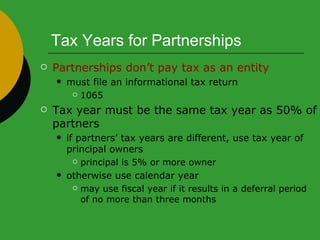
Tax Years for Partnerships Partnerships don’t pay tax as an entity  must file an informational tax return  1065 Tax year must be the same tax year as 50% of partners if partners’ tax years are different, use tax year of principal owners  principal is 5% or more owner otherwise use calendar year may use fiscal year if it results in a deferral period of no more than three months
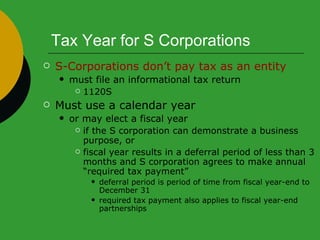
Tax Year for S Corporations S-Corporations don’t pay tax as an entity must file an informational tax return  1120S Must use a calendar year  or may elect a fiscal year  if the S corporation can demonstrate a business purpose, or fiscal year results in a deferral period of less than 3 months and S corporation agrees to make annual “required tax payment” deferral period is period of time from fiscal year-end to December 31 required tax payment also applies to fiscal year-end partnerships
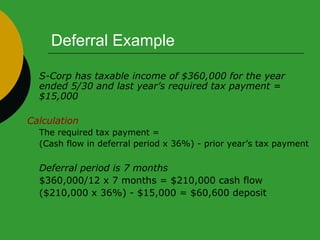
Deferral Example S-Corp has taxable income of $360,000 for the year ended 5/30 and last year’s required tax payment = $15,000 Calculation The required tax payment =  (Cash flow in deferral period x 36%) - prior year’s tax payment Deferral period is 7 months   $360,000/12 x 7 months = $210,000 cash flow  ($210,000 x 36%) - $15,000 = $60,600 deposit
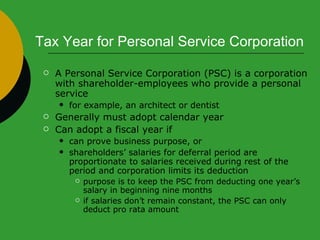
Tax Year for Personal Service Corporation A Personal Service Corporation (PSC) is a corporation with shareholder-employees who provide a personal service for example, an architect or dentist Generally must adopt calendar year  Can adopt a fiscal year if can prove business purpose, or shareholders’ salaries for deferral period are proportionate to salaries received during rest of the period and corporation limits its deduction  purpose is to keep the PSC from deducting one year’s salary in beginning nine months if salaries don’t remain constant, the PSC can only deduct pro rata amount
Short Tax Periods Occur when taxpayer changes from fiscal year-end to calendar year-end or visa versa Taxpayer must annualize income see example on p. 7-4,  calculate tax, then  allocate it to the short period At top of tax return must complete:  “For Short Tax Year from _____ to _____”
Accounting Methods There are three acceptable  accounting methods Cash Hybrid Accrual  Must use one method consistently make an election on your first return by filing using a particular method file Form 3115 within first 6 months after initial election  this requests permission from IRS to change accounting methods must use same method  for tax & books
Accounting Methods (continued) Cash basis taxpayers can’t deduct prepaid rent or interest can’t use cash basis if taxpayer is a  trust with UBI (unrelated business income), or partnership with a corporation as a partner, or C corporation  PSCs and farms may use cash basis, and entities with gross receipts $5,000,000 or less Accrual basis taxpayers must report prepaid interest or rent as income when received Hybrid basis taxpayers cash method but must use accrual for COGS
Objective Describe the concept of depreciation and be able to calculate depreciation expense using MACRS tables
Depreciation (Form 4562) Depreciation is a process of  allocating the cost of assets to expense over their useful lives land is not depreciated Rules for depreciation have changed over the years pre-1980: straight line (SL) method 1980-1986: use ACRS tables  Post-1986: use MACRS tables
Personal Property Each asset is depreciated according to an  IRS-specified recovery period 3 year   Race horses, tractors units 5 year   Computer, cars and light    trucks, R&D equipment 7 year   Office furniture, machinery,    property with no life 10 year   Barges, vessels 15 year   Land Improvements 20 year   Utility plants, sewers
Personal Property (continued) Depreciation is determined using IRS tables (Table 2 in text) percentages from tables are based on double-declining balance  salvage value  not  used in MACRS  tables based on  half year convention 1/2 year depreciation taken in year of acquisition  1/2 year depreciation taken in final year  May elect to use tables based on straight line instead
Personal Property (continued) Always use the half-year convention unless  mid-quarter convention applies Mid-quarter convention  is required if taxpayer purchases 40% or more of total assets (except real estate) in last quarter of tax year applies to every asset purchased in the year excluding real property and §179 property must use special mid-quarter tables
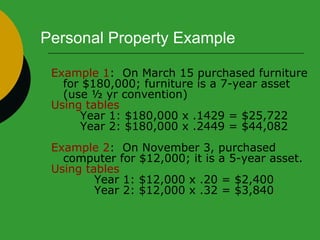
Example 1 :  On March 15 purchased furniture for $180,000; furniture is a 7-year asset (use ½ yr convention)  Using tables   Year 1: $180,000 x .1429 = $25,722 Year 2: $180,000 x .2449 = $44,082 Example 2 :  On November 3, purchased computer for $12,000; it is a 5-year asset.  Using tables Year 1: $12,000 x .20 = $2,400 Year 2: $12,000 x .32 = $3,840 Personal Property Example
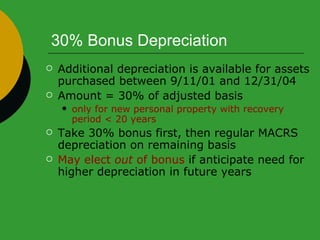
30% Bonus Depreciation Additional depreciation is available for assets purchased between 9/11/01 and 12/31/04 Amount = 30% of adjusted basis only for new personal property with recovery period < 20 years Take 30% bonus first, then regular MACRS depreciation on remaining basis May   elect  out  of bonus  if anticipate need for higher depreciation in future years
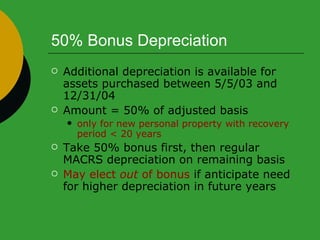
50% Bonus Depreciation  Additional depreciation is available for assets purchased between 5/5/03 and 12/31/04 Amount = 50% of adjusted basis only for new personal property with recovery period < 20 years Take 50% bonus first, then regular MACRS depreciation on remaining basis May elect  out  of bonus  if anticipate need for higher depreciation in future years
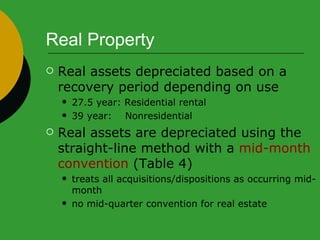
Real Property Real assets depreciated based on a recovery period depending on use 27.5 year: Residential rental 39 year:  Nonresidential Real assets are depreciated using the straight-line method with a  mid-month convention  (Table 4) treats all acquisitions/dispositions as occurring mid-month no mid-quarter convention for real estate
Objective Identify when an election to expense the cost of an asset may be used and calculate amount
Election to Expense - Section 179 §179 allows immediate expensing of qualifying property in 2004, the  annual amount allowed is $102,000   qualifying property  is tangible personal property used in a business §179 limited: if cost of qualifying property placed in service in a year > $410,000, reduce §179 expense $ for $ cannot take §179 expense in excess of  taxable income may carry forward any unused amount If using bonus depreciation, take §179 first then 30% or 50% bonus depreciation then MACRS depreciation
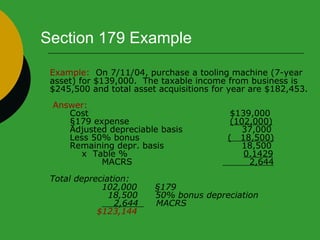
Example:  On 7/11/04, purchase a tooling machine (7-year asset) for $139,000.  The taxable income from business is $245,500 and total asset acquisitions for year are $182,453.   Answer:  Cost $139,000 §179 expense   (102,000) Adjusted depreciable basis      37,000 Less 50% bonus   (  18,500) Remaining depr. basis      18,500   x  Table %    0.1429 MACRS     2,644 Total depreciation:  102,000  §179   18,500  50% bonus depreciation   2,644  MACRS   $123,144 Section 179 Example
Objective Define listed property and luxury automobiles ;  describe the limitations placed on depreciation of these items
Listed Property Special rules exist to limit deductions on assets used  both in a business and personally cars cell phones  computers (unless used exclusively at business) entertainment equipment Limitation depends on amount of business use if asset  used  >  50% for business , can use MACRS if asset  used < 50% for business , must use straight line Separate section on page 2 of Form 4562
Luxury Autos Limits Maximum allowed amount is  luxury auto limits x business use % depreciation on automobiles is also limited based on business use (5-year MACRS amount x business use %) Luxury auto limits are quite low:  depreciation on autos  placed into service  in 2004 is:  2004 - $2,960  2005 - $4,800 2006 - $2,850 2007 and subsequent years - $1,675
Special First-Year Depreciation for Automobiles Extra depreciation is allowed on autos used more than  50% business maximum of 50% up to $7,650  then multiply by business use % new autos purchased before 12/31/04 may elect ‘out of’ special first year depreciation
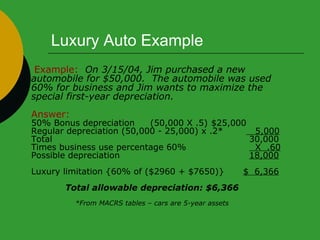
Luxury Auto Example   Example:  On 3/15/04, Jim purchased a new automobile for $50,000.  The automobile was used 60% for business and Jim wants to maximize the special first-year depreciation. Answer: 50% Bonus depreciation  (50,000 X .5) $25,000 Regular depreciation (50,000 - 25,000) x .2*   5,000 Total   30,000 Times business use percentage 60%   X  .60 Possible depreciation   18,000 Luxury limitation {60% of ($2960 + $7650)} $  6,366 Total allowable depreciation: $6,366 *From MACRS tables – cars are 5-year assets
Hybrid/Electric Cars May qualify for up to $2000 deduction for AGI if purchase hybrid vehicle Such as the Toyota Prius/Honda Insight vehicle may be used 100% personal
Objective Describe the tax treatment for goodwill and certain other intangible assets
Intangible Assets §197 intangible assets  are acquired by purchase  amortized over 15-years beginning in month acquired goodwill going-concern covenant not to compete see complete list in text, p. 7-21 Many intangible assets are excluded from Section 197 provisions may not amortize internally-generated assets  like patents and copyrights Report in separate section of Form 4562
Objective Determine whether parties are classified as ‘related’ for tax purposes and identify tax treatment of related party transactions
Related Party Transactions Related parties are: a corporation and  >  50% owner brother/sister corporations parent/subsidiary corporations family members  spouses, lineal descendants, siblings also used for purposes of calculating ownership in corporations §267 disallows losses on sales between related parties   when property sold later to an unrelated party, all previously disallowed losses may be taken against gain
The End! My head hurts!

Depreciation Study Gudide

  • 1.
    Depreciation Accounting Periods& Methods and Depreciation Copyright ©2005 by South-Western, a division of Thomson Learning. All rights reserved.
  • 2.
    Objective Identify differentaccounting periods and methods allowed
  • 3.
    Tax Year forIndividuals Individuals must use a calendar year as their tax year Businesses must use a calendar year as their tax year unless they can show a different “natural business year”
  • 4.
    Tax Years forPartnerships Partnerships don’t pay tax as an entity must file an informational tax return 1065 Tax year must be the same tax year as 50% of partners if partners’ tax years are different, use tax year of principal owners principal is 5% or more owner otherwise use calendar year may use fiscal year if it results in a deferral period of no more than three months
  • 5.
    Tax Year forS Corporations S-Corporations don’t pay tax as an entity must file an informational tax return 1120S Must use a calendar year or may elect a fiscal year if the S corporation can demonstrate a business purpose, or fiscal year results in a deferral period of less than 3 months and S corporation agrees to make annual “required tax payment” deferral period is period of time from fiscal year-end to December 31 required tax payment also applies to fiscal year-end partnerships
  • 6.
    Deferral Example S-Corphas taxable income of $360,000 for the year ended 5/30 and last year’s required tax payment = $15,000 Calculation The required tax payment = (Cash flow in deferral period x 36%) - prior year’s tax payment Deferral period is 7 months $360,000/12 x 7 months = $210,000 cash flow ($210,000 x 36%) - $15,000 = $60,600 deposit
  • 7.
    Tax Year forPersonal Service Corporation A Personal Service Corporation (PSC) is a corporation with shareholder-employees who provide a personal service for example, an architect or dentist Generally must adopt calendar year Can adopt a fiscal year if can prove business purpose, or shareholders’ salaries for deferral period are proportionate to salaries received during rest of the period and corporation limits its deduction purpose is to keep the PSC from deducting one year’s salary in beginning nine months if salaries don’t remain constant, the PSC can only deduct pro rata amount
  • 8.
    Short Tax PeriodsOccur when taxpayer changes from fiscal year-end to calendar year-end or visa versa Taxpayer must annualize income see example on p. 7-4, calculate tax, then allocate it to the short period At top of tax return must complete: “For Short Tax Year from _____ to _____”
  • 9.
    Accounting Methods Thereare three acceptable accounting methods Cash Hybrid Accrual Must use one method consistently make an election on your first return by filing using a particular method file Form 3115 within first 6 months after initial election this requests permission from IRS to change accounting methods must use same method for tax & books
  • 10.
    Accounting Methods (continued)Cash basis taxpayers can’t deduct prepaid rent or interest can’t use cash basis if taxpayer is a trust with UBI (unrelated business income), or partnership with a corporation as a partner, or C corporation PSCs and farms may use cash basis, and entities with gross receipts $5,000,000 or less Accrual basis taxpayers must report prepaid interest or rent as income when received Hybrid basis taxpayers cash method but must use accrual for COGS
  • 11.
    Objective Describe theconcept of depreciation and be able to calculate depreciation expense using MACRS tables
  • 12.
    Depreciation (Form 4562)Depreciation is a process of allocating the cost of assets to expense over their useful lives land is not depreciated Rules for depreciation have changed over the years pre-1980: straight line (SL) method 1980-1986: use ACRS tables Post-1986: use MACRS tables
  • 13.
    Personal Property Eachasset is depreciated according to an IRS-specified recovery period 3 year Race horses, tractors units 5 year Computer, cars and light trucks, R&D equipment 7 year Office furniture, machinery, property with no life 10 year Barges, vessels 15 year Land Improvements 20 year Utility plants, sewers
  • 14.
    Personal Property (continued)Depreciation is determined using IRS tables (Table 2 in text) percentages from tables are based on double-declining balance salvage value not used in MACRS tables based on half year convention 1/2 year depreciation taken in year of acquisition 1/2 year depreciation taken in final year May elect to use tables based on straight line instead
  • 15.
    Personal Property (continued)Always use the half-year convention unless mid-quarter convention applies Mid-quarter convention is required if taxpayer purchases 40% or more of total assets (except real estate) in last quarter of tax year applies to every asset purchased in the year excluding real property and §179 property must use special mid-quarter tables
  • 16.
    Example 1 : On March 15 purchased furniture for $180,000; furniture is a 7-year asset (use ½ yr convention) Using tables Year 1: $180,000 x .1429 = $25,722 Year 2: $180,000 x .2449 = $44,082 Example 2 : On November 3, purchased computer for $12,000; it is a 5-year asset. Using tables Year 1: $12,000 x .20 = $2,400 Year 2: $12,000 x .32 = $3,840 Personal Property Example
  • 17.
    30% Bonus DepreciationAdditional depreciation is available for assets purchased between 9/11/01 and 12/31/04 Amount = 30% of adjusted basis only for new personal property with recovery period < 20 years Take 30% bonus first, then regular MACRS depreciation on remaining basis May elect out of bonus if anticipate need for higher depreciation in future years
  • 18.
    50% Bonus Depreciation Additional depreciation is available for assets purchased between 5/5/03 and 12/31/04 Amount = 50% of adjusted basis only for new personal property with recovery period < 20 years Take 50% bonus first, then regular MACRS depreciation on remaining basis May elect out of bonus if anticipate need for higher depreciation in future years
  • 19.
    Real Property Realassets depreciated based on a recovery period depending on use 27.5 year: Residential rental 39 year: Nonresidential Real assets are depreciated using the straight-line method with a mid-month convention (Table 4) treats all acquisitions/dispositions as occurring mid-month no mid-quarter convention for real estate
  • 20.
    Objective Identify whenan election to expense the cost of an asset may be used and calculate amount
  • 21.
    Election to Expense- Section 179 §179 allows immediate expensing of qualifying property in 2004, the annual amount allowed is $102,000 qualifying property is tangible personal property used in a business §179 limited: if cost of qualifying property placed in service in a year > $410,000, reduce §179 expense $ for $ cannot take §179 expense in excess of taxable income may carry forward any unused amount If using bonus depreciation, take §179 first then 30% or 50% bonus depreciation then MACRS depreciation
  • 22.
    Example: On7/11/04, purchase a tooling machine (7-year asset) for $139,000. The taxable income from business is $245,500 and total asset acquisitions for year are $182,453. Answer: Cost $139,000 §179 expense (102,000) Adjusted depreciable basis 37,000 Less 50% bonus ( 18,500) Remaining depr. basis 18,500 x Table % 0.1429 MACRS 2,644 Total depreciation: 102,000 §179 18,500 50% bonus depreciation 2,644 MACRS $123,144 Section 179 Example
  • 23.
    Objective Define listedproperty and luxury automobiles ; describe the limitations placed on depreciation of these items
  • 24.
    Listed Property Specialrules exist to limit deductions on assets used both in a business and personally cars cell phones computers (unless used exclusively at business) entertainment equipment Limitation depends on amount of business use if asset used > 50% for business , can use MACRS if asset used < 50% for business , must use straight line Separate section on page 2 of Form 4562
  • 25.
    Luxury Autos LimitsMaximum allowed amount is luxury auto limits x business use % depreciation on automobiles is also limited based on business use (5-year MACRS amount x business use %) Luxury auto limits are quite low: depreciation on autos placed into service in 2004 is: 2004 - $2,960 2005 - $4,800 2006 - $2,850 2007 and subsequent years - $1,675
  • 26.
    Special First-Year Depreciationfor Automobiles Extra depreciation is allowed on autos used more than 50% business maximum of 50% up to $7,650 then multiply by business use % new autos purchased before 12/31/04 may elect ‘out of’ special first year depreciation
  • 27.
    Luxury Auto Example Example: On 3/15/04, Jim purchased a new automobile for $50,000. The automobile was used 60% for business and Jim wants to maximize the special first-year depreciation. Answer: 50% Bonus depreciation (50,000 X .5) $25,000 Regular depreciation (50,000 - 25,000) x .2* 5,000 Total 30,000 Times business use percentage 60% X .60 Possible depreciation 18,000 Luxury limitation {60% of ($2960 + $7650)} $ 6,366 Total allowable depreciation: $6,366 *From MACRS tables – cars are 5-year assets
  • 28.
    Hybrid/Electric Cars Mayqualify for up to $2000 deduction for AGI if purchase hybrid vehicle Such as the Toyota Prius/Honda Insight vehicle may be used 100% personal
  • 29.
    Objective Describe thetax treatment for goodwill and certain other intangible assets
  • 30.
    Intangible Assets §197intangible assets are acquired by purchase amortized over 15-years beginning in month acquired goodwill going-concern covenant not to compete see complete list in text, p. 7-21 Many intangible assets are excluded from Section 197 provisions may not amortize internally-generated assets like patents and copyrights Report in separate section of Form 4562
  • 31.
    Objective Determine whetherparties are classified as ‘related’ for tax purposes and identify tax treatment of related party transactions
  • 32.
    Related Party TransactionsRelated parties are: a corporation and > 50% owner brother/sister corporations parent/subsidiary corporations family members spouses, lineal descendants, siblings also used for purposes of calculating ownership in corporations §267 disallows losses on sales between related parties when property sold later to an unrelated party, all previously disallowed losses may be taken against gain
  • 33.
    The End! Myhead hurts!

Editor's Notes

  • #8 Changed “provides” to provide in second line
  • #9 Changed “see example in text” to “see example on p. 7-4”
  • #11 Changed “&lt; $5,000,000” to $5,000,000 or less
  • #14 Changed for 3 year property “tractors” to “tractor units”
  • #17 Example 2 is a bit confusing as; 1) if assume only asset placed in service during the year would have to use the mid-quarter convention and students aren’t provided that table in the textbook or, 2) if assume additional information pertaining to example 1 (i.e., had purchased the furniture in March and now a computer – the example would be correct as would use the Table 2 on p. 7-9. If #2 then need additional information to say in addition to the purchase on March 15….
  • #29 Added “such as the” to Toyota Prius/Honda Insight as more than just the two hybrids available
  • #31 Added p. 7-21 to bullet “see complete list in text”