1
Presentation By:-
o Lubna Shehzadi (S2F13MCOM0031)
o Humaira Shamshad (S2F13MCOM0006)
o Saira Azam (S2F13MCOM0034)
o Asma Tahir (S2F13MCOM0064)
University of Central Punjab
2
Introduction
Mission Statement
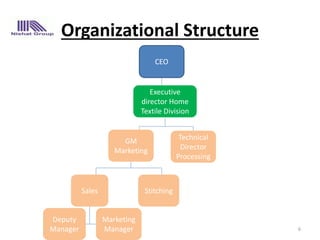
Organizational Structure
Product Line
Time Series Analysis
Liquidity Ratios
Profitability Ratios
Turnover Efficiency Ratios
Debt Management Ratios
Conclusion &
Recommendations
References
Contents
3
Managerial Accounting
Ratio Analysis
Introduction
 Nishat Mills Limited is the flagship company of Nishat Group.
It was established in 1951.
 It is one of the most modern, largest vertically integrated
textile company in Pakistan with annual turnover of $575
million.
 Due to the application of prudent management policies,
consolidation of operations, a strong balance sheet and an
effective marketing strategy, the growth trend is expected to
continue in the years to come.
4
Managerial Accounting
Ratio Analysis
Mission Statement
To provide quality products to customers and explore new
markets to promote/expand sales of the Company through good
governance and foster a sound and dynamic team, so as to
achieve optimum prices of products of the Company for
sustainable and equitable growth and prosperity of the Company.
Managerial Accounting
Ratio Analysis
5
Organizational Structure
6
CEO
Executive
director Home
Textile Division
Marketing
Manager
GM
Marketing
Technical
Director
Processing
Sales
Deputy
Manager
Stitching
Board of Directors
1 Mian Umer Mansha
Chief
Executive
Officer
2 Mian Hassan Mansha Chairmn
3 Mr. Khalid Qadeer Qureshi Director
4 Mr. Saeed Ahmed Alvi Director
5 Syed Zahid Hussain
Director
(Nomine
e NIT)
6 Ms. Nabiha Shahnawaz Cheema Director
7 Mr. Maqsood Ahmad Director
7
Product Line
8
The Company also has the most modern textile dyeing and processing units, 2
stitching units for home textile, one stitching unit for garments and Power
Generation facilities.
The Company's production facilities comprise of :
• Spinning
• Weaving
• Processing
• Stitching and
• Power generation.
Product Line
Managerial Accounting
Ratio Analysis
9
Weavin
g
Stitching
Power generation
Spinning & Processing
Presented by:
Humaira Shamshad (S2F13MCOM0006)
10
Managerial Accounting
Ratio Analysis
Ratio analysis is used to evaluate
relationships among financial
statement items. The ratios are
used to identify trends over time
for one company or to compare
two or more companies at one
point in time. Financial
statement ratio analysis focuses
on four key aspects of a
business:
• Liquidity Ratios
• Profitability Ratios
• Debt Management Ratios
• Activity Ratios
11
Managerial Accounting
Ratio Analysis
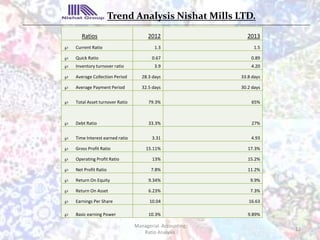
Ratios 2012 2013
 Current Ratio 1.3 1.5
 Quick Ratio 0.67 0.89
 Inventory turnover ratio 3.9 4.20
 Average Collection Period 28.3 days 33.8 days
 Average Payment Period 32.5 days 30.2 days
 Total Asset turnover Ratio 79.3% 65%
 Debt Ratio 33.3% 27%
 Time Interest earned ratio 3.31 4.93
 Gross Profit Ratio 15.11% 17.3%
 Operating Profit Ratio 13% 15.2%
 Net Profit Ratio 7.8% 11.2%
 Return On Equity 9.34% 9.9%
 Return On Asset 6.23% 7.3%
 Earnings Per Share 10.04 16.63
 Basic earning Power 10.3% 9.89%
Trend Analysis Nishat Mills LTD.
12
Managerial Accounting
Ratio Analysis
Current Ratio Current Ratio = Current Assets/
Current Liabilities
It measures whether or not a company has enough
cash or liquid assets to pay its current liability over the
next fiscal year.
Nishat mills Ltd.’s current ratio has slightly improved in
2013 as compared to 2012 .
2012= 1.3:1 , 2013=1.5 :1
Liquid Ratio Liquid Ratio = Quick Assets/
Current Liabilities
The true liquidity refers to the ability of a firm to pay its
short term obligations as and when they become due.
A standard of 1:1 absolute liquidity ratio is considered an
acceptable norm.
Nishat Mills Ltd.’s liquid ratio has slightly improved in
2013 as compared to 2012.
2012= 0.67:1 , 2013=0.89 :1
Liquidity Ratios
13
Managerial Accounting
Ratio Analysis
G.P Ratio Gross profit ratio= Gross Profit/
sales×100
Operating Profit Ratio
Gross profit margin indicates the percentage of revenue
available to cover operating and other expenditures.
Nishat Mills Ltd.’s gross profit margin has significantly
improved from 2012 in 2013.
2012= 15.11% , 2013=17.3%
. Operating profit ratio=
Operating Profit/ sales×100
The a higher value of operating margin ratio is favourable
which indicates that more proportion of revenue is
converted to operating income.
Nishat Mills Ltd.’s operating profit margin has significantly
improved from 2012 in 2013. It shows that company’s
revenues are significantly converted into operating
income.
2012= 13 % , 2013=15.2%
Profitability Ratios
14
Managerial Accounting
Ratio Analysis
Net profit Ratio Net profit Ratio= Net Income /
sales×100
An indicator of profitability, calculated as net
income divided by revenue. Company’s net profit
improved from 2012. It shows that company has
generated more profit as compare to previous year.
2012= 7.8% , 2013=11.2%
Return on Assets ROA= Net Income / Total Assets×100
ROE indicates the profit generated by the total assets
employed. A higher ratio reflects a more effective
employment of company assets.
Nishat Mills Ltd.’s return on Asset has improved from
2012 in 2013. Company’s assets are more efficient in
generating profits.
2012= 6.23% , 2013=7.3%
15
Managerial Accounting
Ratio Analysis
Presented by:
Saira Azam (S2F13MCOM0034)
16
Business Finance
Ratio Analysis
Return on Equity Return on Equity = Net Income /
Shareholder's Equity
Return on equity reveals how much profit a company earned in
comparison to the total amount of shareholder equity found on
the balance sheet.
The normal benchmark for ROE figure is 12% and above.
Companies that could generate ROE of 15% or more are
considered as very good investment. Nishat Mills Ltd.’s return on
equity has improved from 2012 in 2013. But it is not so good
because it is below 12%.
2012= 9.34% , 2013=9.9%
Earning Per Share Return on Equity = E.A.C.S / No.of
outstanding shares
Earnings per share calculate that how much a share
earns. It is calculated by dividing E.A.C.S to No. of
outstanding shares.
Company’s shares are generating more profit than they
were in 2012. So earnings per share have improved in
2013.
2012= 10.04 , 2013=16.63
17
Business Finance
Ratio Analysis
Basic Earning Power BEP = EBIT/ Total Assets×100
BEP is calculated by dividing EBIT to Total Assets.
This Ratio shows the raw earning power of the firm’s
assets, before the influence of taxes and leverage, and it is
useful when comparing firms with different degree of
financial leverage and tax situations.
Company’s BEP has deteriorated in 2013 than it was in
2012.
2012= 10.3% , 2013=9.89%
18
Managerial accounting
Ratio Analysis
Debt Ratio
Debt Ratio = Total Debts/
Total Assets×100
Debt Management Ratios
The debt ratio calculates the percent of assets provided
by creditors. It is calculated by dividing total debt by total
assets. Total debt is the same as total liabilities. Nishat
mills Ltd.'s debt ratio is better in 2013. Now outside
claims over equity are less than in 2012.
2012= 33.3% , 2013=27%
Time Interest Earned Ratio
TIE= EBIT/ Interest Expense
The TIE is an indicator of the company's ability to pay
interest as it comes due. It is calculated by dividing
earnings before interest and taxes (EBIT) by interest
expense.
In 2013 company’s ability to pay interest has improved
than it was in 2012.
2012= 3.31 times , 2013=4.93 times
19
Managerial Accounting
Ratio Analysis
Presented by
Asma Tahir (S2F13MCOM0064)
20
Business Finance
Ratio Analysis
Inventory Turnover Ratio
=CGS/Avg.Inventory
Activity Ratios
Avg. Collection Period
Avg. Collection period=
avg. Acc. Receviables/ Sales
per day
An activity ratio calculated as cost of goods sold divided by
inventory. Nishat mills Ltd.'s inventory turnover ratio has
significantly improved in 2013 as compared to 2012.
2012= 3.9 times , 2013=4.20 times
An activity ratio equal to the number of days in the
period divided by receivables turnover. Nishat mills Ltd.'s
average collection period was better in 2012 than in
2013.
2012= 28.3 days , 2013= 33.8 days
21
Managerial Accounting
Ratio Analysis
Avg.Collection Period
Avg. Payment Period
Total Asset Turnover Ratio
Total Asset Turnover Ratio=
sales/ Total Assets×100
Avg. payment period= avg.Acc.payables/
purchases per day
An estimate of the average number of days it takes a
company to pay its suppliers; equal to the number of days
in the period divided by payables turnover ratio for the
period. Nishat mills Ltd.'s average payment period is
better in 2013 than in 2012. Now company is in a strong
position to pay off its debt in minimum time period.
2012= 32.5 days , 2013=30.2 days
The asset turnover ratio measures how efficiently a
company is using its assets. The turnover value varies by
industry. It is calculated by dividing net sales by total
assets. Nishat mills Ltd.'s assets were generating more
sales in 2012 than 2013. So efficiency has deteriorated in
2013.
2012= 79.3% , 2013= 65%
22Managerial Accounting
Ratio Analysis
23
Managerial Accounting
Ratio Analysis
Conclusion & Recommendations
From above discussion, we may conclude that liquidity ratios are improved in 2013 as
compared
to 2012.Activity ratios has also been improved in 2013 except avg. collection period
and total
asset turnover. And if we talk about debt management ratios, these are also improved in
2013.Profitibility ratios are better in 2013 as compared to 2012 except basic earning
power.
Here are some recommendations which company may follow to improve its current
situation:
• Company needs to improve its avg. collection period and it can be done by changing
its credit terms and policies to collect money.
• Company can improve its asset-turnover ratio by increasing sales and by finding
ways to use its assets more efficiently.
• It needs to improve its BEP.
22
References
Annual Report Of
Nishat Mills Ltd.
24
Managerial Accounting
Ratio Analysis
Thanks
For
LISTENING
US
25
Managerial accounting
Ratio Analysis
26
Managerial Accounting
Ratio Analysis

Nishat Mills Ltd

  • 1.
  • 2.
    Presentation By:- o LubnaShehzadi (S2F13MCOM0031) o Humaira Shamshad (S2F13MCOM0006) o Saira Azam (S2F13MCOM0034) o Asma Tahir (S2F13MCOM0064) University of Central Punjab 2
  • 3.
    Introduction Mission Statement Organizational Structure ProductLine Time Series Analysis Liquidity Ratios Profitability Ratios Turnover Efficiency Ratios Debt Management Ratios Conclusion & Recommendations References Contents 3 Managerial Accounting Ratio Analysis
  • 4.
    Introduction  Nishat MillsLimited is the flagship company of Nishat Group. It was established in 1951.  It is one of the most modern, largest vertically integrated textile company in Pakistan with annual turnover of $575 million.  Due to the application of prudent management policies, consolidation of operations, a strong balance sheet and an effective marketing strategy, the growth trend is expected to continue in the years to come. 4 Managerial Accounting Ratio Analysis
  • 5.
    Mission Statement To providequality products to customers and explore new markets to promote/expand sales of the Company through good governance and foster a sound and dynamic team, so as to achieve optimum prices of products of the Company for sustainable and equitable growth and prosperity of the Company. Managerial Accounting Ratio Analysis 5
  • 6.
    Organizational Structure 6 CEO Executive director Home TextileDivision Marketing Manager GM Marketing Technical Director Processing Sales Deputy Manager Stitching
  • 7.
    Board of Directors 1Mian Umer Mansha Chief Executive Officer 2 Mian Hassan Mansha Chairmn 3 Mr. Khalid Qadeer Qureshi Director 4 Mr. Saeed Ahmed Alvi Director 5 Syed Zahid Hussain Director (Nomine e NIT) 6 Ms. Nabiha Shahnawaz Cheema Director 7 Mr. Maqsood Ahmad Director 7
  • 8.
    Product Line 8 The Companyalso has the most modern textile dyeing and processing units, 2 stitching units for home textile, one stitching unit for garments and Power Generation facilities. The Company's production facilities comprise of : • Spinning • Weaving • Processing • Stitching and • Power generation.
  • 9.
    Product Line Managerial Accounting RatioAnalysis 9 Weavin g Stitching Power generation Spinning & Processing
  • 10.
    Presented by: Humaira Shamshad(S2F13MCOM0006) 10 Managerial Accounting Ratio Analysis
  • 11.
    Ratio analysis isused to evaluate relationships among financial statement items. The ratios are used to identify trends over time for one company or to compare two or more companies at one point in time. Financial statement ratio analysis focuses on four key aspects of a business: • Liquidity Ratios • Profitability Ratios • Debt Management Ratios • Activity Ratios 11 Managerial Accounting Ratio Analysis
  • 12.
    Ratios 2012 2013 Current Ratio 1.3 1.5  Quick Ratio 0.67 0.89  Inventory turnover ratio 3.9 4.20  Average Collection Period 28.3 days 33.8 days  Average Payment Period 32.5 days 30.2 days  Total Asset turnover Ratio 79.3% 65%  Debt Ratio 33.3% 27%  Time Interest earned ratio 3.31 4.93  Gross Profit Ratio 15.11% 17.3%  Operating Profit Ratio 13% 15.2%  Net Profit Ratio 7.8% 11.2%  Return On Equity 9.34% 9.9%  Return On Asset 6.23% 7.3%  Earnings Per Share 10.04 16.63  Basic earning Power 10.3% 9.89% Trend Analysis Nishat Mills LTD. 12 Managerial Accounting Ratio Analysis
  • 13.
    Current Ratio CurrentRatio = Current Assets/ Current Liabilities It measures whether or not a company has enough cash or liquid assets to pay its current liability over the next fiscal year. Nishat mills Ltd.’s current ratio has slightly improved in 2013 as compared to 2012 . 2012= 1.3:1 , 2013=1.5 :1 Liquid Ratio Liquid Ratio = Quick Assets/ Current Liabilities The true liquidity refers to the ability of a firm to pay its short term obligations as and when they become due. A standard of 1:1 absolute liquidity ratio is considered an acceptable norm. Nishat Mills Ltd.’s liquid ratio has slightly improved in 2013 as compared to 2012. 2012= 0.67:1 , 2013=0.89 :1 Liquidity Ratios 13 Managerial Accounting Ratio Analysis
  • 14.
    G.P Ratio Grossprofit ratio= Gross Profit/ sales×100 Operating Profit Ratio Gross profit margin indicates the percentage of revenue available to cover operating and other expenditures. Nishat Mills Ltd.’s gross profit margin has significantly improved from 2012 in 2013. 2012= 15.11% , 2013=17.3% . Operating profit ratio= Operating Profit/ sales×100 The a higher value of operating margin ratio is favourable which indicates that more proportion of revenue is converted to operating income. Nishat Mills Ltd.’s operating profit margin has significantly improved from 2012 in 2013. It shows that company’s revenues are significantly converted into operating income. 2012= 13 % , 2013=15.2% Profitability Ratios 14 Managerial Accounting Ratio Analysis
  • 15.
    Net profit RatioNet profit Ratio= Net Income / sales×100 An indicator of profitability, calculated as net income divided by revenue. Company’s net profit improved from 2012. It shows that company has generated more profit as compare to previous year. 2012= 7.8% , 2013=11.2% Return on Assets ROA= Net Income / Total Assets×100 ROE indicates the profit generated by the total assets employed. A higher ratio reflects a more effective employment of company assets. Nishat Mills Ltd.’s return on Asset has improved from 2012 in 2013. Company’s assets are more efficient in generating profits. 2012= 6.23% , 2013=7.3% 15 Managerial Accounting Ratio Analysis
  • 16.
    Presented by: Saira Azam(S2F13MCOM0034) 16 Business Finance Ratio Analysis
  • 17.
    Return on EquityReturn on Equity = Net Income / Shareholder's Equity Return on equity reveals how much profit a company earned in comparison to the total amount of shareholder equity found on the balance sheet. The normal benchmark for ROE figure is 12% and above. Companies that could generate ROE of 15% or more are considered as very good investment. Nishat Mills Ltd.’s return on equity has improved from 2012 in 2013. But it is not so good because it is below 12%. 2012= 9.34% , 2013=9.9% Earning Per Share Return on Equity = E.A.C.S / No.of outstanding shares Earnings per share calculate that how much a share earns. It is calculated by dividing E.A.C.S to No. of outstanding shares. Company’s shares are generating more profit than they were in 2012. So earnings per share have improved in 2013. 2012= 10.04 , 2013=16.63 17 Business Finance Ratio Analysis
  • 18.
    Basic Earning PowerBEP = EBIT/ Total Assets×100 BEP is calculated by dividing EBIT to Total Assets. This Ratio shows the raw earning power of the firm’s assets, before the influence of taxes and leverage, and it is useful when comparing firms with different degree of financial leverage and tax situations. Company’s BEP has deteriorated in 2013 than it was in 2012. 2012= 10.3% , 2013=9.89% 18 Managerial accounting Ratio Analysis
  • 19.
    Debt Ratio Debt Ratio= Total Debts/ Total Assets×100 Debt Management Ratios The debt ratio calculates the percent of assets provided by creditors. It is calculated by dividing total debt by total assets. Total debt is the same as total liabilities. Nishat mills Ltd.'s debt ratio is better in 2013. Now outside claims over equity are less than in 2012. 2012= 33.3% , 2013=27% Time Interest Earned Ratio TIE= EBIT/ Interest Expense The TIE is an indicator of the company's ability to pay interest as it comes due. It is calculated by dividing earnings before interest and taxes (EBIT) by interest expense. In 2013 company’s ability to pay interest has improved than it was in 2012. 2012= 3.31 times , 2013=4.93 times 19 Managerial Accounting Ratio Analysis
  • 20.
    Presented by Asma Tahir(S2F13MCOM0064) 20 Business Finance Ratio Analysis
  • 21.
    Inventory Turnover Ratio InventoryTurnover Ratio =CGS/Avg.Inventory Activity Ratios Avg. Collection Period Avg. Collection period= avg. Acc. Receviables/ Sales per day An activity ratio calculated as cost of goods sold divided by inventory. Nishat mills Ltd.'s inventory turnover ratio has significantly improved in 2013 as compared to 2012. 2012= 3.9 times , 2013=4.20 times An activity ratio equal to the number of days in the period divided by receivables turnover. Nishat mills Ltd.'s average collection period was better in 2012 than in 2013. 2012= 28.3 days , 2013= 33.8 days 21 Managerial Accounting Ratio Analysis Avg.Collection Period
  • 22.
    Avg. Payment Period TotalAsset Turnover Ratio Total Asset Turnover Ratio= sales/ Total Assets×100 Avg. payment period= avg.Acc.payables/ purchases per day An estimate of the average number of days it takes a company to pay its suppliers; equal to the number of days in the period divided by payables turnover ratio for the period. Nishat mills Ltd.'s average payment period is better in 2013 than in 2012. Now company is in a strong position to pay off its debt in minimum time period. 2012= 32.5 days , 2013=30.2 days The asset turnover ratio measures how efficiently a company is using its assets. The turnover value varies by industry. It is calculated by dividing net sales by total assets. Nishat mills Ltd.'s assets were generating more sales in 2012 than 2013. So efficiency has deteriorated in 2013. 2012= 79.3% , 2013= 65% 22Managerial Accounting Ratio Analysis
  • 23.
    23 Managerial Accounting Ratio Analysis Conclusion& Recommendations From above discussion, we may conclude that liquidity ratios are improved in 2013 as compared to 2012.Activity ratios has also been improved in 2013 except avg. collection period and total asset turnover. And if we talk about debt management ratios, these are also improved in 2013.Profitibility ratios are better in 2013 as compared to 2012 except basic earning power. Here are some recommendations which company may follow to improve its current situation: • Company needs to improve its avg. collection period and it can be done by changing its credit terms and policies to collect money. • Company can improve its asset-turnover ratio by increasing sales and by finding ways to use its assets more efficiently. • It needs to improve its BEP.
  • 24.
    22 References Annual Report Of NishatMills Ltd. 24 Managerial Accounting Ratio Analysis
  • 25.
  • 26.