Library Sources for ITCT Melanie Parlette, BA, MLIS Engineering and IT Liaison Library Resource Centre Conestoga College May 2011
Today we will cover . . . Why you should use different types of sources (Scholarly Journals, Trade Journals etc.) to get different types of information What Peer Review is and why it’s important How you can find articles in an academic database Different ways you can research after you graduate . . .
Types of Sources Scholarly Journals Popular Magazines Trade Journals Conference Papers Technical Reports What’s the Difference?
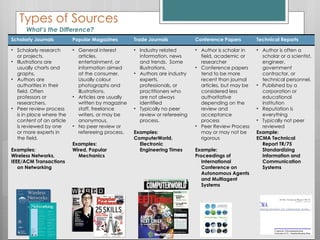
Types of Sources What’s the Difference? Scholarly Journals Popular Magazines Trade Journals Conference Papers Technical Reports Scholarly research or projects.   Illustrations are usually charts and graphs.  Authors are authorities in their field. Often professors or researchers.  Peer review process is in place where the content of an article is reviewed by one or more experts in the field.  Examples: Wireless Networks,  IEEE/ACM Transactions on Networking General interest articles, entertainment, or information aimed at the consumer.  Usually colour photographs and illustrations.  Articles are usually written by magazine staff, freelance writers, or may be anonymous.  No peer review or refereeing process.  Examples: Wired, Popular Mechanics Industry related information, news and trends.  Some illustrations.  Authors are industry experts, professionals, or practitioners who are not always identified Typically no peer review or refereeing process.  Examples: ComputerWorld, Electronic Engineering Times Author is scholar in field, academic or researcher Conference papers tend to be more recent than journal articles, but may be considered less authoritative depending on the review and acceptance process Peer Review Process may or may not be rigorous Example: Proceedings of International Conference on Autonomous Agents and Multiagent Systems  Author is often a scholar or a scientist, engineer, government contractor, or technical personnel. Published by a corporation or educational institution Reputation is everything  Typically not peer reviewed Example: ECMA Technical Report TR/75 Standardizing Information and Communication Systems
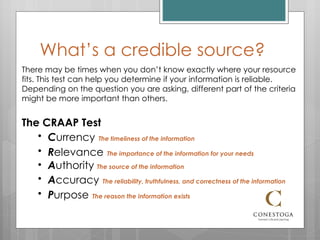
What’s a credible source? There may be times when you don’t know exactly where your resource fits. This test can help you determine if your information is reliable. Depending on the question you are asking, different part of the criteria might be more important than others. The CRAAP Test C urrency   The timeliness of the information R elevance   The importance of the information for your needs A uthority  The source of the information A ccuracy   The reliability, truthfulness, and correctness of the information P urpose   The reason the information exists
CRAAP TEST Activity The CRAAP Evaluation Tool
What is Peer Review? When an author submits his or her research article to a scholarly journal, an editor will review it to see if it meets the criteria of that journal. If it does, the editor will send the article out for  Peer Review . [Peer Review is the process where other experts in the field will thoroughly review and evaluate the article and the research that was done. They check for accuracy of the information presented, validity and repeatability of the research, quality and appropriateness for the journal.] Based on the feedback from the experts (i.e. “peers”), the author’s submission will be accepted, rejected or accepted with revisions. It is uncommon to accept a paper with no revisions. In most cases an author will need to make some changes before final publication. Source:  Simon Fraser University
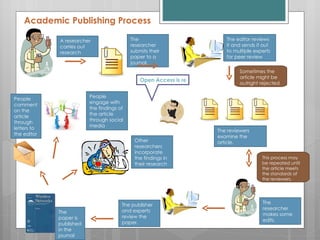
Academic Publishing Process A researcher carries out research The researcher submits their paper to a journal. The editor reviews it and sends it out to multiple experts for peer review The reviewers examine the article. Sometimes the article might be outright rejected The researcher makes some edits. This process may be repeated until the article meets the standards of the reviewers. The publisher and experts review the paper. The paper is published in the journal Other researchers incorporate the findings in their research People engage with the findings of the article through social media People comment on the article through letters to the editor Open Access is revolutionizing this process.
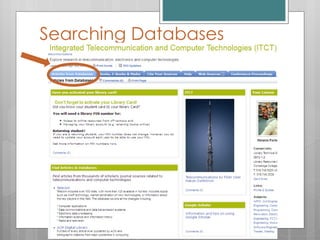
Searching Databases
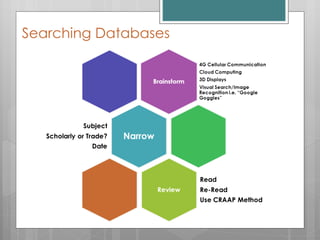
Searching Databases
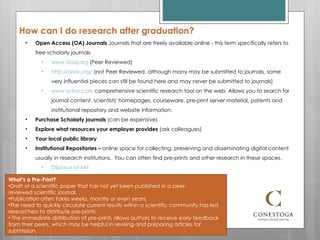
How can I do research after graduation? Open Access (OA) Journals  Journals that are freely available online - this term specifically refers to free scholarly journals www.doaj.org  (Peer Reviewed) http://arxiv.org/  (not Peer Reviewed, although many may be submitted to journals, some very influential pieces can still be found here and may never be submitted to journals) www.scirus.com  comprehensive scientific research tool on the web. Allows you to search for journal content, scientists' homepages, courseware, pre-print server material, patents and institutional repository and website information.  Purchase Scholarly journals  (can be expensive) Explore what resources your employer provides  (ask colleagues) Your local public library Institutional Repositories –  online space for collecting, preserving and disseminating digital content usually in research institutions.  You can often find pre-prints and other research in these spaces.  DSpace at MIT What’s a Pre-Print? Draft of a scientific paper that has not yet been published in a peer-reviewed scientific journal.  Publication often takes weeks, months or even years.  The need to quickly circulate current results within a scientific community has led researchers to distribute pre-prints. The immediate distribution of pre-prints allows authors to receive early feedback from their peers, which may be helpful in revising and preparing articles for submission.
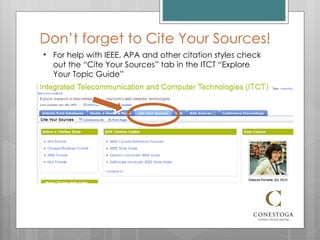
Don’t forget to Cite Your Sources! For help with IEEE, APA and other citation styles check out the “Cite Your Sources” tab in the ITCT “Explore Your Topic Guide”
Get Help! By Email [email_address] [email_address]   Online IM Chat on the LRC Contact Us Page Or  in the ITCT “Explore Your Topic Guide” In Person Visit the LRC Monday – Friday 7:30 AM – 5:00 PM By Phone Information Desk @ 519-748-5220 x3361

ITCT - Library Resources

  • 1.
    Library Sources forITCT Melanie Parlette, BA, MLIS Engineering and IT Liaison Library Resource Centre Conestoga College May 2011
  • 2.
    Today we willcover . . . Why you should use different types of sources (Scholarly Journals, Trade Journals etc.) to get different types of information What Peer Review is and why it’s important How you can find articles in an academic database Different ways you can research after you graduate . . .
  • 3.
    Types of SourcesScholarly Journals Popular Magazines Trade Journals Conference Papers Technical Reports What’s the Difference?
  • 4.
    Types of SourcesWhat’s the Difference? Scholarly Journals Popular Magazines Trade Journals Conference Papers Technical Reports Scholarly research or projects.  Illustrations are usually charts and graphs. Authors are authorities in their field. Often professors or researchers. Peer review process is in place where the content of an article is reviewed by one or more experts in the field. Examples: Wireless Networks, IEEE/ACM Transactions on Networking General interest articles, entertainment, or information aimed at the consumer.  Usually colour photographs and illustrations. Articles are usually written by magazine staff, freelance writers, or may be anonymous. No peer review or refereeing process. Examples: Wired, Popular Mechanics Industry related information, news and trends.  Some illustrations. Authors are industry experts, professionals, or practitioners who are not always identified Typically no peer review or refereeing process. Examples: ComputerWorld, Electronic Engineering Times Author is scholar in field, academic or researcher Conference papers tend to be more recent than journal articles, but may be considered less authoritative depending on the review and acceptance process Peer Review Process may or may not be rigorous Example: Proceedings of International Conference on Autonomous Agents and Multiagent Systems Author is often a scholar or a scientist, engineer, government contractor, or technical personnel. Published by a corporation or educational institution Reputation is everything Typically not peer reviewed Example: ECMA Technical Report TR/75 Standardizing Information and Communication Systems
  • 5.
    What’s a crediblesource? There may be times when you don’t know exactly where your resource fits. This test can help you determine if your information is reliable. Depending on the question you are asking, different part of the criteria might be more important than others. The CRAAP Test C urrency The timeliness of the information R elevance The importance of the information for your needs A uthority The source of the information A ccuracy The reliability, truthfulness, and correctness of the information P urpose The reason the information exists
  • 6.
    CRAAP TEST ActivityThe CRAAP Evaluation Tool
  • 7.
    What is PeerReview? When an author submits his or her research article to a scholarly journal, an editor will review it to see if it meets the criteria of that journal. If it does, the editor will send the article out for Peer Review . [Peer Review is the process where other experts in the field will thoroughly review and evaluate the article and the research that was done. They check for accuracy of the information presented, validity and repeatability of the research, quality and appropriateness for the journal.] Based on the feedback from the experts (i.e. “peers”), the author’s submission will be accepted, rejected or accepted with revisions. It is uncommon to accept a paper with no revisions. In most cases an author will need to make some changes before final publication. Source: Simon Fraser University
  • 8.
    Academic Publishing ProcessA researcher carries out research The researcher submits their paper to a journal. The editor reviews it and sends it out to multiple experts for peer review The reviewers examine the article. Sometimes the article might be outright rejected The researcher makes some edits. This process may be repeated until the article meets the standards of the reviewers. The publisher and experts review the paper. The paper is published in the journal Other researchers incorporate the findings in their research People engage with the findings of the article through social media People comment on the article through letters to the editor Open Access is revolutionizing this process.
  • 9.
  • 10.
  • 11.
    How can Ido research after graduation? Open Access (OA) Journals Journals that are freely available online - this term specifically refers to free scholarly journals www.doaj.org (Peer Reviewed) http://arxiv.org/ (not Peer Reviewed, although many may be submitted to journals, some very influential pieces can still be found here and may never be submitted to journals) www.scirus.com comprehensive scientific research tool on the web. Allows you to search for journal content, scientists' homepages, courseware, pre-print server material, patents and institutional repository and website information. Purchase Scholarly journals (can be expensive) Explore what resources your employer provides (ask colleagues) Your local public library Institutional Repositories – online space for collecting, preserving and disseminating digital content usually in research institutions. You can often find pre-prints and other research in these spaces. DSpace at MIT What’s a Pre-Print? Draft of a scientific paper that has not yet been published in a peer-reviewed scientific journal. Publication often takes weeks, months or even years. The need to quickly circulate current results within a scientific community has led researchers to distribute pre-prints. The immediate distribution of pre-prints allows authors to receive early feedback from their peers, which may be helpful in revising and preparing articles for submission.
  • 12.
    Don’t forget toCite Your Sources! For help with IEEE, APA and other citation styles check out the “Cite Your Sources” tab in the ITCT “Explore Your Topic Guide”
  • 13.
    Get Help! ByEmail [email_address] [email_address] Online IM Chat on the LRC Contact Us Page Or in the ITCT “Explore Your Topic Guide” In Person Visit the LRC Monday – Friday 7:30 AM – 5:00 PM By Phone Information Desk @ 519-748-5220 x3361

Editor's Notes

  • #10 Telecom wireless network capacity Narrow Source Type Date
  • #11 ABI Trade and Industry Image Recognition Narrow Source Type - Scholarly Date – 2009 - PResent Subject – Visualization Also – Full Text?