Peer Review
                                   Early History
SOURCES:
http://webspace.ship.edu/cgboer/platoscave.html
http://teachingcommons.cdl.edu/cdip/facultyresearch/PeerReview.html
http://mediacommons.futureofthebook.org/mcpress/plannedobsolescence/one/t
http://www.elsevier.com/wps/find/reviewershome.reviewers/peerreview
http://www.quora.com/What-is-the-history-of-peer-review-in-academia
   Think of Plato’s Allegory of the Cave
    ◦ Search for knowledge
    ◦ Questions of validity of truth
      “…and then conceive some one saying to him,
       that what he saw before was an illusion, but that
       now, when he is approaching nearer to being and
       his eye is turned towards more real
       existence, he has a clearer vision…
      “And suppose once more, that he is reluctantly
       dragged up a steep and rugged ascent, and
       held fast until he is forced into the presence of the
       sun himself”


Peer Review Contemplation
   Thought that review by peers has been a method
    of evaluation since ancient Greece
   Only recent history provides firm evidence
   854-931 Syrian physician Ishaq bin Ali al-Rahwi
    first described a peer review process
    ◦ Physician must make notes of a patient's condition on
      every visit. When the patient was cured or had died, the
      notes were examined by a local medical council to decide
      whether the physician had met the required standards of
      medical care. If their reviews were negative, the
      physician could face a lawsuit from a maltreated patient.


History of Peer Review
   Very little research done and seems to quote
    David Kronick’s Peer Review in 18th-Century
    Scientific Journalism
    ◦ Most texts focus on natural and social sciences, not publishing
    • Society membership “required scientists to
      demonstrate their bona fides in the form of
      publication, experimentation, or invention in
      order to be eligible for election” creating
    ◦ Circulation of letters among peers
    ◦ Reading of papers in society meetings


Royal Societies & Academies
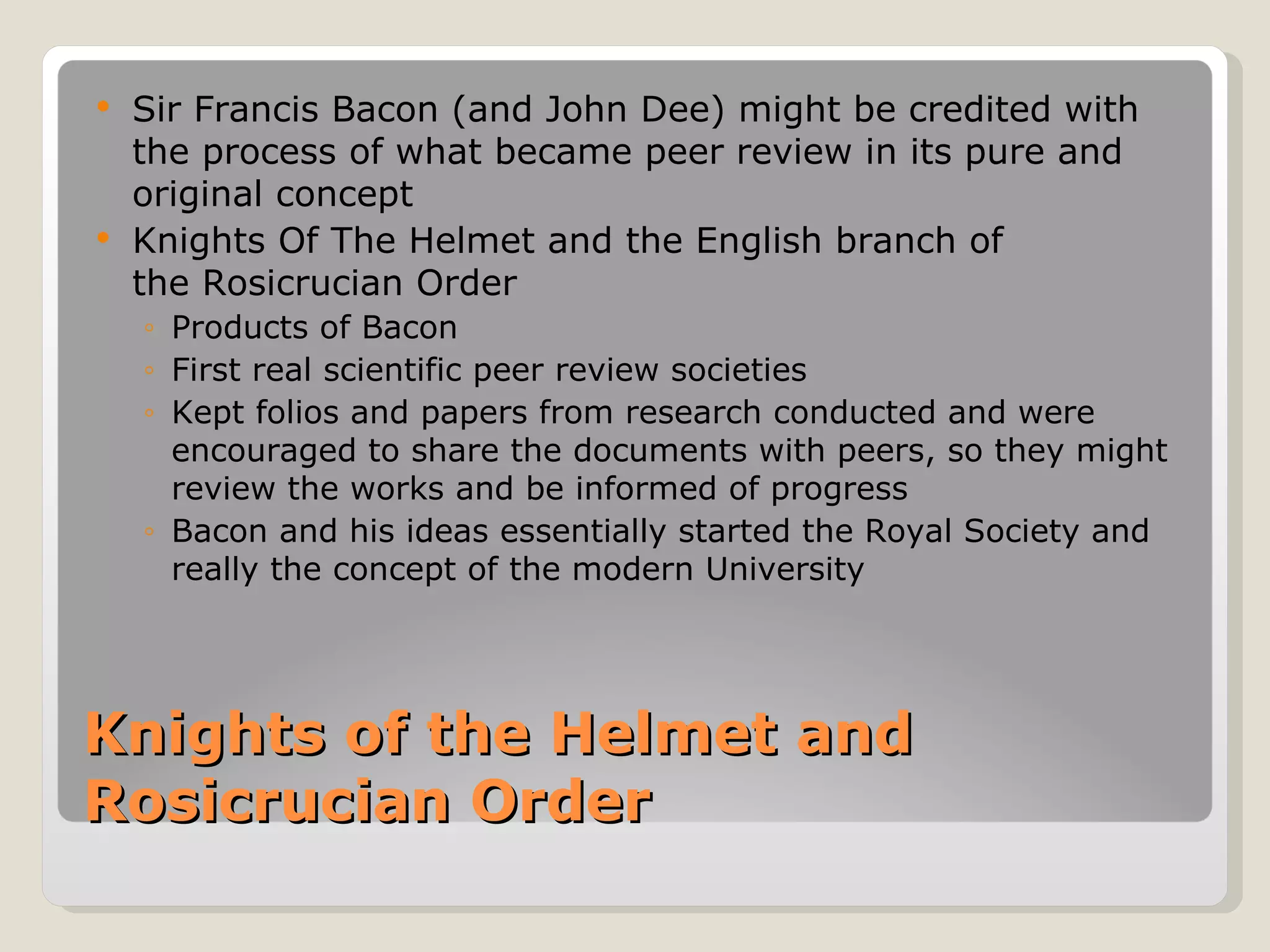
 Sir Francis Bacon (and John Dee) might be credited with
  the process of what became peer review in its pure and
  original concept
 Knights Of The Helmet and the English branch of
  the Rosicrucian Order
    ◦ Products of Bacon
    ◦ First real scientific peer review societies
    ◦ Kept folios and papers from research conducted and were
      encouraged to share the documents with peers, so they might
      review the works and be informed of progress
    ◦ Bacon and his ideas essentially started the Royal Society and
      really the concept of the modern University


Knights of the Helmet and
Rosicrucian Order
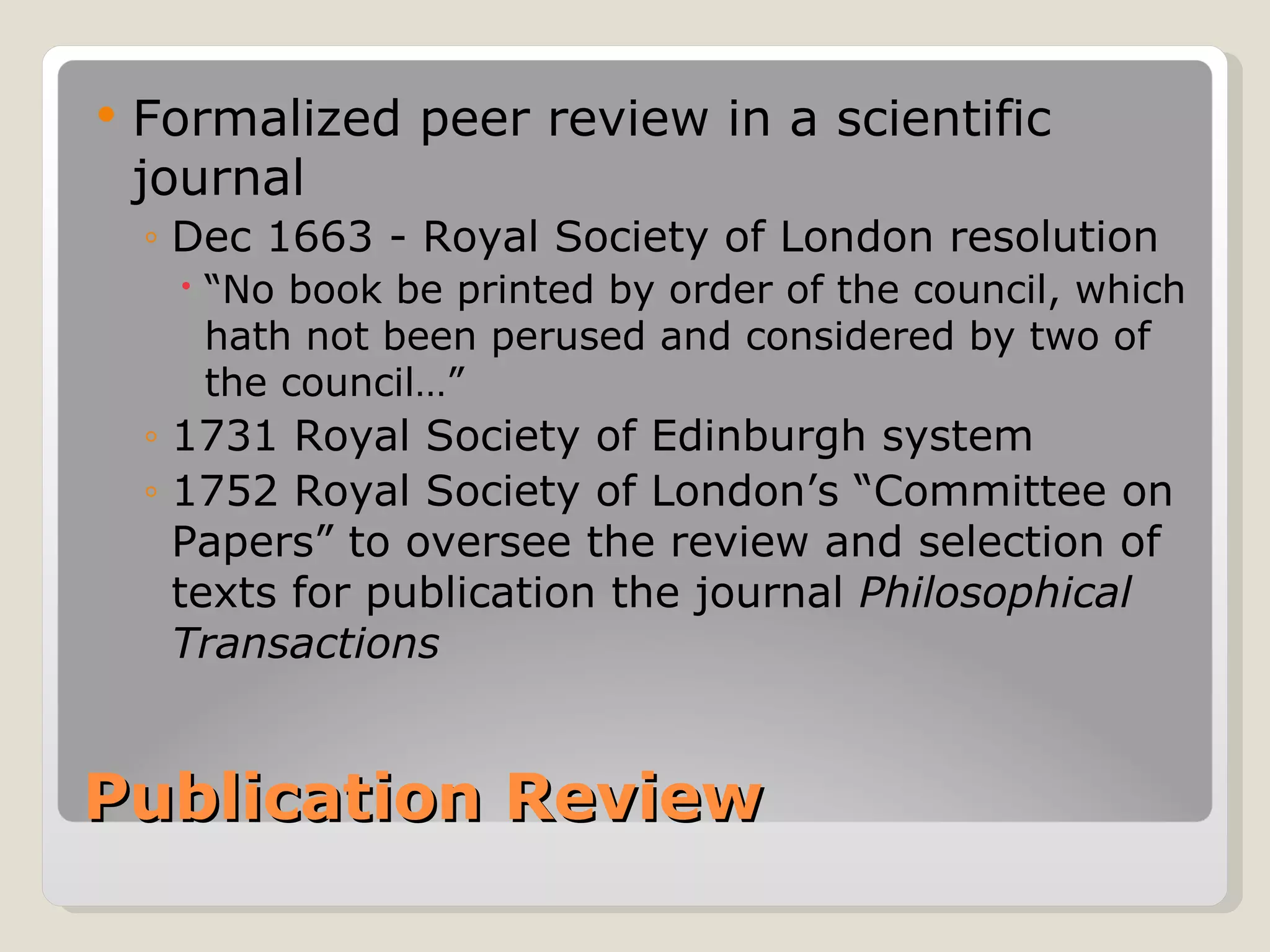
   Formalized peer review in a scientific
    journal
    ◦ Dec 1663 - Royal Society of London resolution
      “No book be printed by order of the council, which
       hath not been perused and considered by two of
       the council…”
    ◦ 1731 Royal Society of Edinburgh system
    ◦ 1752 Royal Society of London’s “Committee on
      Papers” to oversee the review and selection of
      texts for publication the journal Philosophical
      Transactions


Publication Review
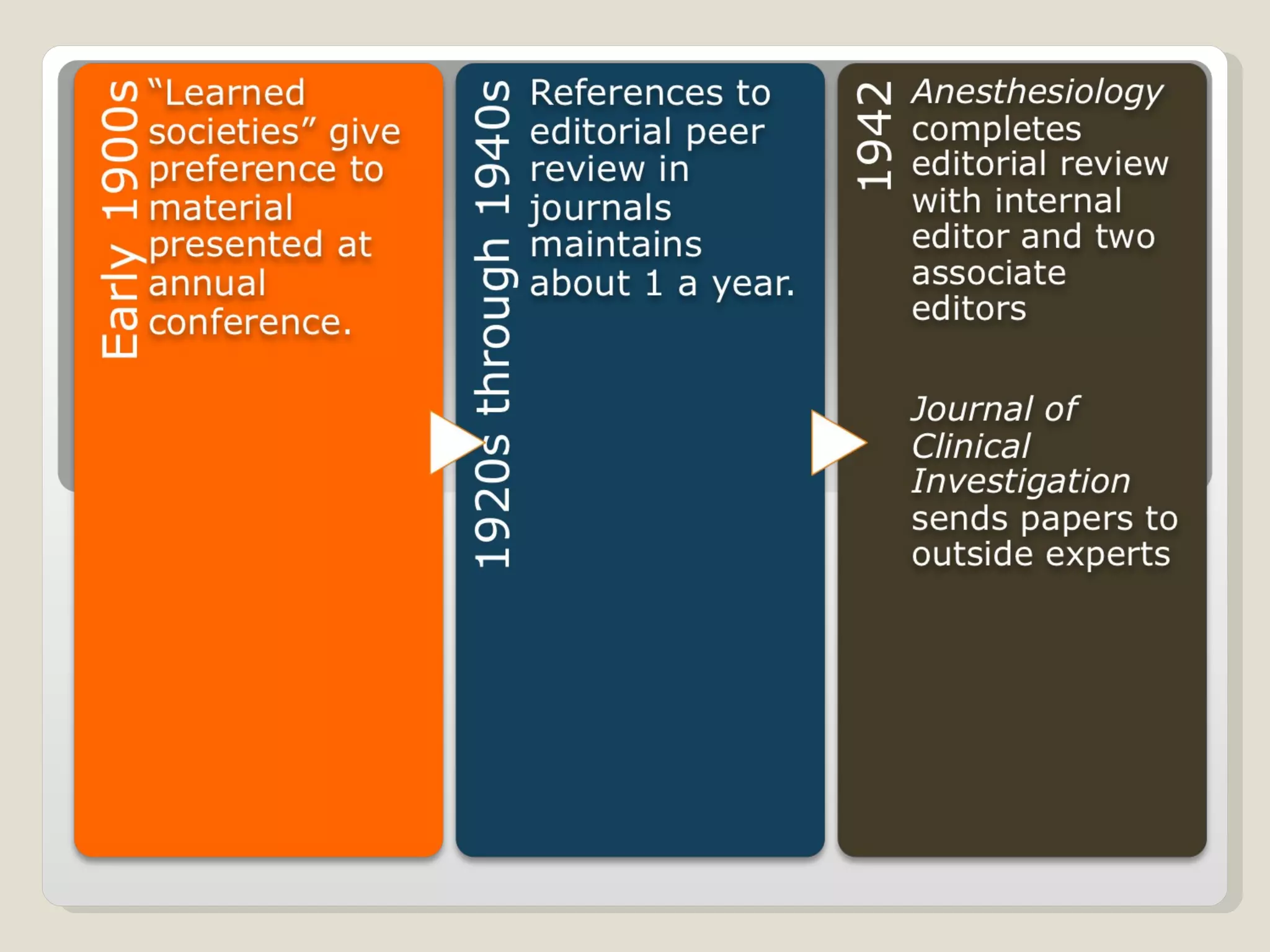
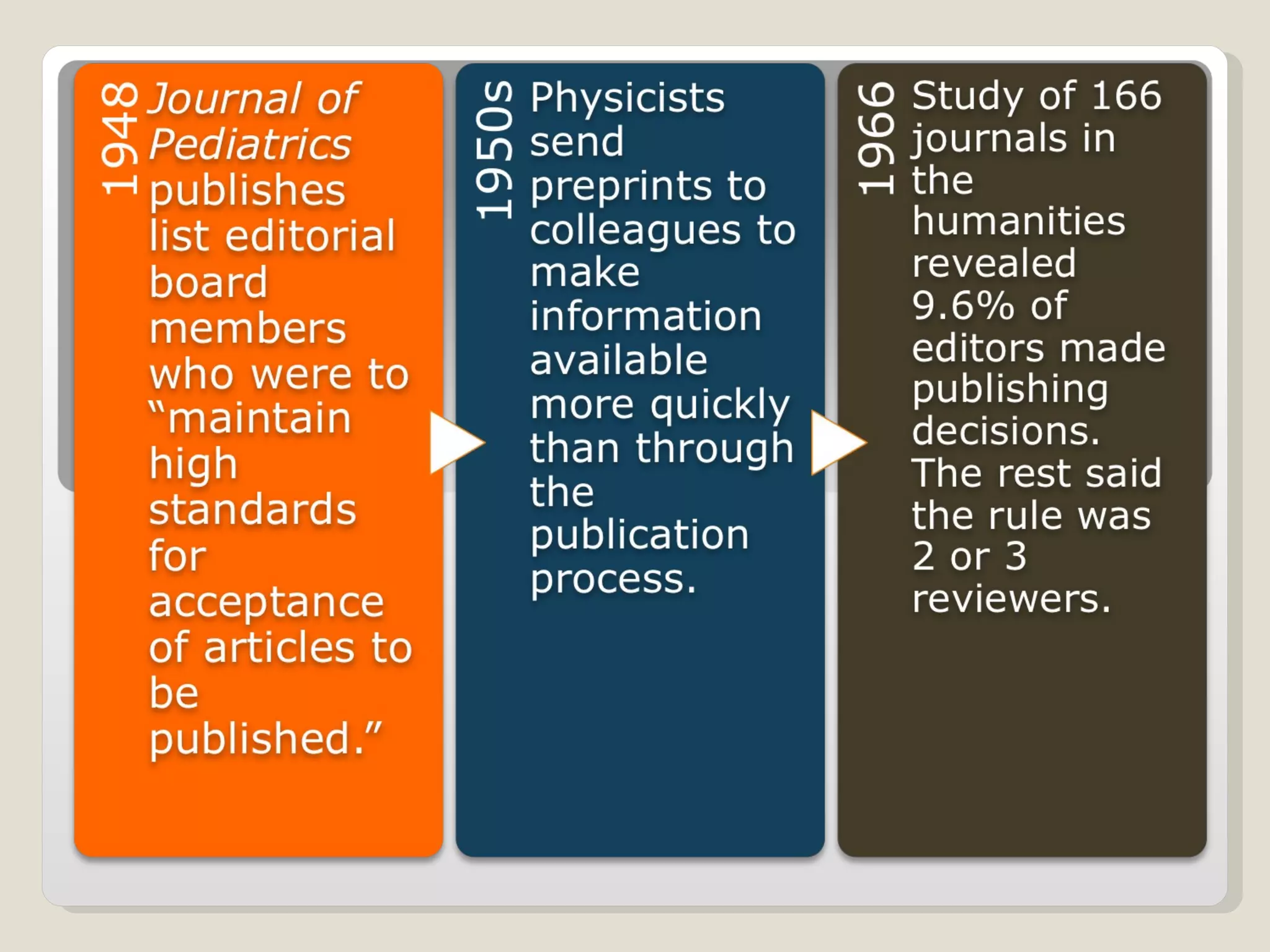
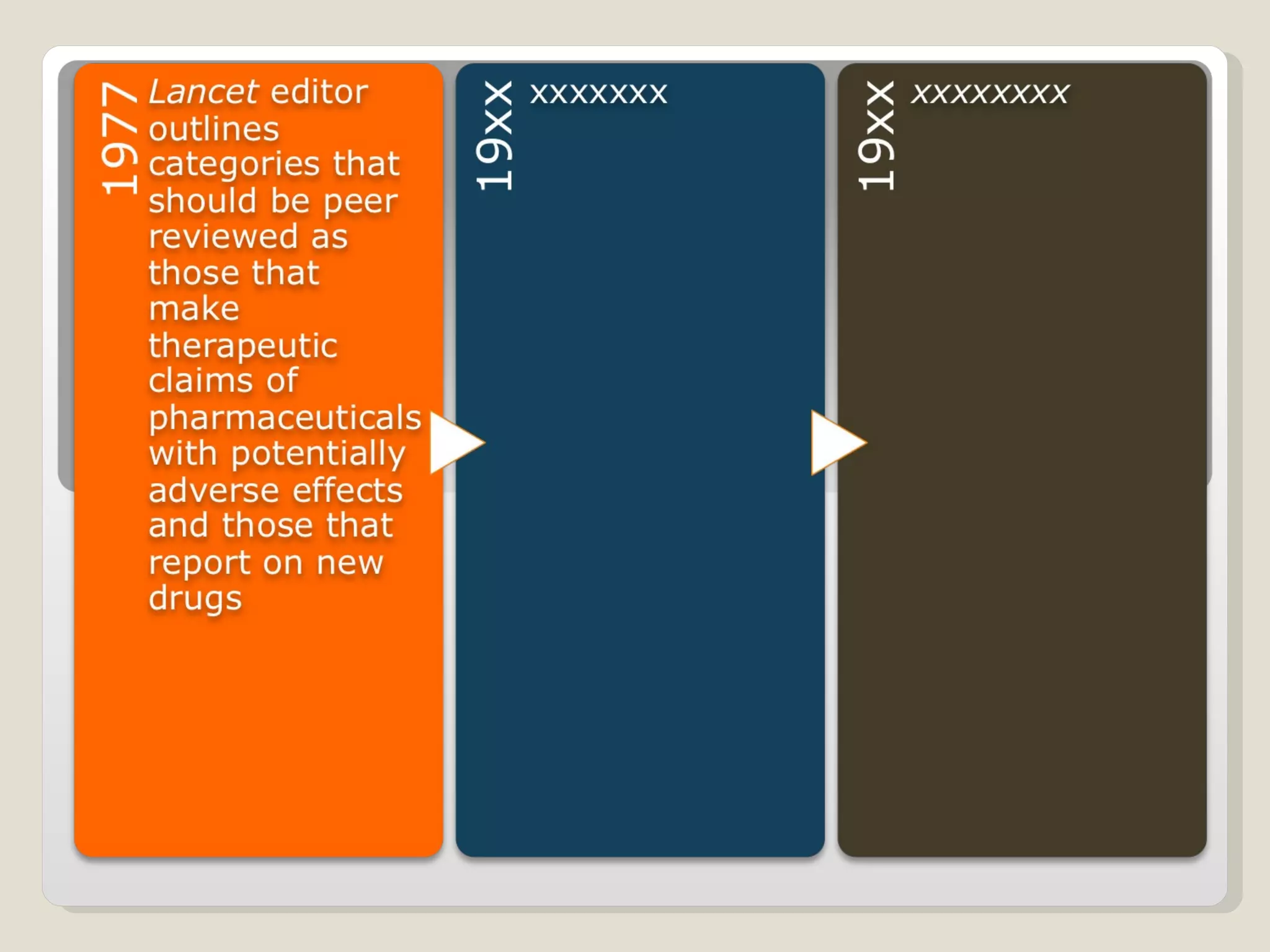
Timeline of changes
adopted by journals
Highlights from the book Editorial Peer Review: Its
                    Strengths and Weaknesses by
                               Ann C. Weller, 2001
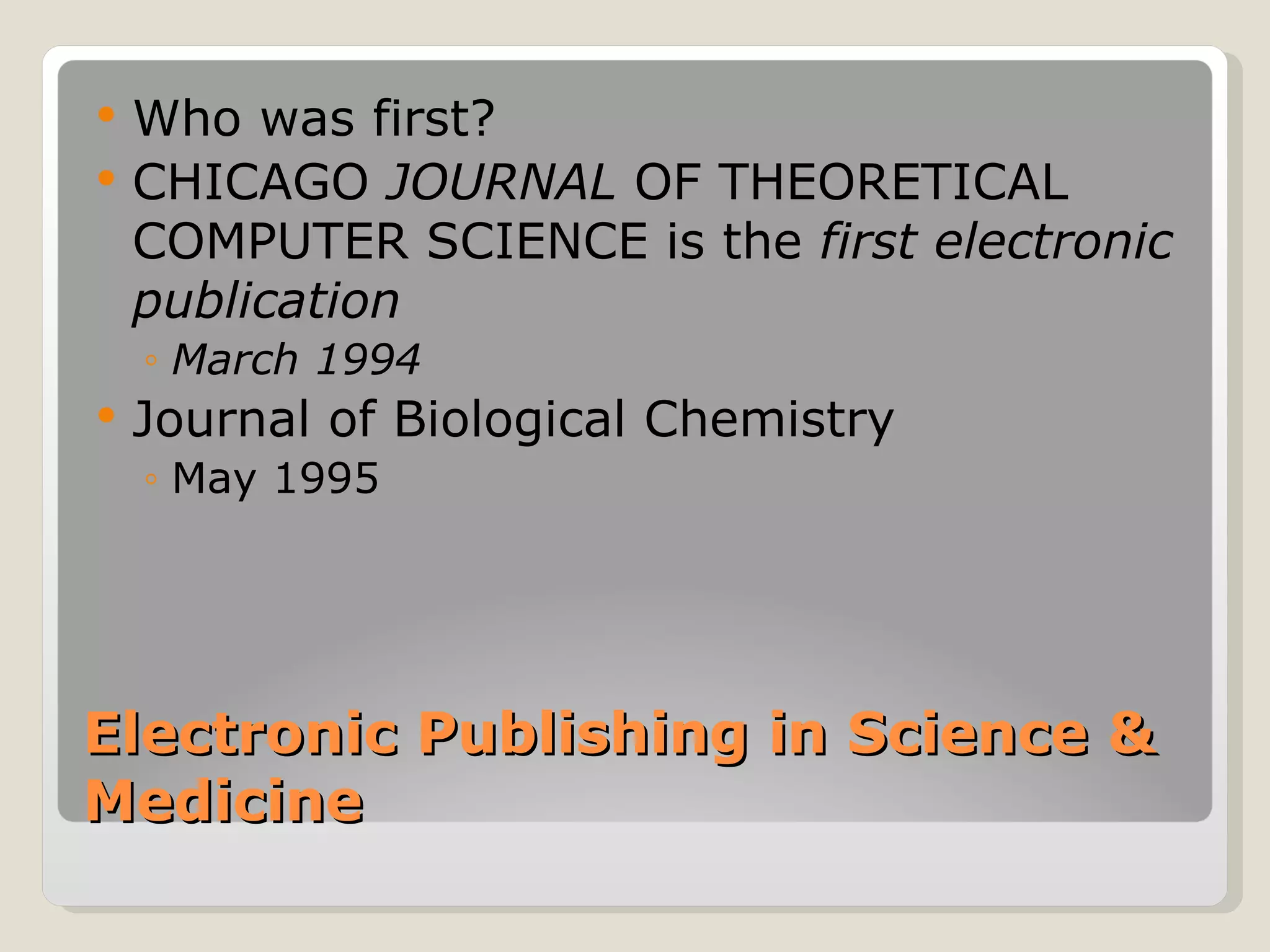
   Who was first?
   CHICAGO JOURNAL OF THEORETICAL
    COMPUTER SCIENCE is the first electronic
    publication
    ◦ March 1994
   Journal of Biological Chemistry
    ◦ May 1995


Electronic Publishing in Science &
Medicine
   Molecules are three-dimensional objects which are difficult to represent in two-dimensions.
   Publication costs of color images are quite staggering and usually discouraged, and certainly
    discouraged in large numbers. Color is often useful in representing a third (or fourth) dimension,
    such as in electron density maps, multi-dimensional NMR, protein structures, and so forth.
   Dynamical processes are impossible to represent in print. The solution is the publication of video
    and/or movies.
   With the increased cost of publication and demands to restrict article length, spectra, spectral data,
    and large data files are, at best, placed in supplementary material, are presented in a highly
    abbreviated form, or are deleted outright. Related to this is the ability to store online numerical
    results, input data, computer output, and so forth, ready for the reuse without retyping for further
    processing.
   5. With publications not limited by space, electronic journals can include comments, criticisms, and
    author replies to all published manuscripts. This interactive communication between authors and
    readership allows for points to be clarified, extensions to be drawn, and collaborations to be born.
    Electronic journals will be able to facilitate these exchanges, thereby enhancing the impact of these
    new publications.


Why?
Open Access publication
   Open Access stands for unrestricted access and unrestricted reuse. Here’s why that
    matters.
   Most publishers own the rights to the articles in their journals. Anyone who wants to
    read the articles must pay to access them. Anyone who wants to use the articles in
    any way must obtain permission from the publisher and is often required to pay an
    additional fee.
   Although many researchers can access the journals they need via their institution
    and think that their access in free, in reality it is not. The institution has often been
    involved in lengthy negotiations around the price of their site license, and re-use of
    this content is limited.
   Paying for access to content makes sense in the world of print publishing, where
    providing content to each new reader requires the production of an additional copy,
    but online it makes much less sense to charge for content when it is possible to
    provide access to all readers anywhere in the world.

   All PLoS content is published under the Creative Commons Attribution License (CC-
    BY), which was developed to facilitate open access – namely, free immediate access
    to, and unrestricted reuse of, original works of all types. Under this license, authors
    agree to make articles legally available for reuse, without permission or fees, for
    virtually any purpose. Anyone may copy, distribute, or reuse these articles, as long
    as the author and original source are properly cited. Additionally, the journal
    platform that PLoS uses to publish research articles is Open Source.
http://www.plos.org/about/open-access/
   Accelerated discovery. With open access,
    researchers can read and build on the findings of
    others without restriction.
   Public enrichment. Much scientific and medical
    research is paid for with public funds. Open
    access allows taxpayers to see the results of
    their investment.
   Improved education. Open access means that
    teachers and their students have access to the
    latest research findings throughout the world.


Benefits of OA Research
Examples
   HighWire Press is the largest archive
    of free full-text science on Earth! As of
    2/29/12, we are assisting in the online
    publication of 2,127,016 free full-text
    articles and 6,910,018 total articles.
    There are 36 sites with free trial periods,
    and 51 completely free sites. 273 sites
    have free back issues, and 1320 sites
    have pay per view!


Hirewire
   PubMed Central® (PMC) is a free archive of
    biomedical and life sciences journal literature
    at the U.S. National Institutes of Health's
    National Library of Medicine (NIH/NLM). In
    keeping with NLM’s legislative mandate to
    collect and preserve the biomedical
    literature, PMC serves as a digital
    counterpart to NLM’s extensive print journal
    collection. Launched in February 2000, PMC
    was developed and is managed by NLM’s
    National Center for Biotechnology
    Information (NCBI).
PubMed Central
 Ensures high visibility and maximum exposure for your
  work - anyone with online access can read your article.
 The Open Access in the developing world micro site
  provides a news platform for all open access developments
  in lower-income countries.
 The site also details BioMed Central's developing world
  initiatives which look to increase the visibility and output of
  scientific research from across Africa and the wider
  developing world such as our waiver fund and Foundation
  Membership.


BioMed Central
Evolution of peer_review2

Evolution of peer_review2

  • 1.
    Peer Review Early History SOURCES: http://webspace.ship.edu/cgboer/platoscave.html http://teachingcommons.cdl.edu/cdip/facultyresearch/PeerReview.html http://mediacommons.futureofthebook.org/mcpress/plannedobsolescence/one/t http://www.elsevier.com/wps/find/reviewershome.reviewers/peerreview http://www.quora.com/What-is-the-history-of-peer-review-in-academia
  • 2.
    Think of Plato’s Allegory of the Cave ◦ Search for knowledge ◦ Questions of validity of truth  “…and then conceive some one saying to him, that what he saw before was an illusion, but that now, when he is approaching nearer to being and his eye is turned towards more real existence, he has a clearer vision…  “And suppose once more, that he is reluctantly dragged up a steep and rugged ascent, and held fast until he is forced into the presence of the sun himself” Peer Review Contemplation
  • 3.
    Thought that review by peers has been a method of evaluation since ancient Greece  Only recent history provides firm evidence  854-931 Syrian physician Ishaq bin Ali al-Rahwi first described a peer review process ◦ Physician must make notes of a patient's condition on every visit. When the patient was cured or had died, the notes were examined by a local medical council to decide whether the physician had met the required standards of medical care. If their reviews were negative, the physician could face a lawsuit from a maltreated patient. History of Peer Review
  • 4.
    Very little research done and seems to quote David Kronick’s Peer Review in 18th-Century Scientific Journalism ◦ Most texts focus on natural and social sciences, not publishing • Society membership “required scientists to demonstrate their bona fides in the form of publication, experimentation, or invention in order to be eligible for election” creating ◦ Circulation of letters among peers ◦ Reading of papers in society meetings Royal Societies & Academies
  • 5.
     Sir FrancisBacon (and John Dee) might be credited with the process of what became peer review in its pure and original concept  Knights Of The Helmet and the English branch of the Rosicrucian Order ◦ Products of Bacon ◦ First real scientific peer review societies ◦ Kept folios and papers from research conducted and were encouraged to share the documents with peers, so they might review the works and be informed of progress ◦ Bacon and his ideas essentially started the Royal Society and really the concept of the modern University Knights of the Helmet and Rosicrucian Order
  • 6.
    Formalized peer review in a scientific journal ◦ Dec 1663 - Royal Society of London resolution  “No book be printed by order of the council, which hath not been perused and considered by two of the council…” ◦ 1731 Royal Society of Edinburgh system ◦ 1752 Royal Society of London’s “Committee on Papers” to oversee the review and selection of texts for publication the journal Philosophical Transactions Publication Review
  • 7.
    Timeline of changes adoptedby journals Highlights from the book Editorial Peer Review: Its Strengths and Weaknesses by Ann C. Weller, 2001
  • 12.
    Who was first?  CHICAGO JOURNAL OF THEORETICAL COMPUTER SCIENCE is the first electronic publication ◦ March 1994  Journal of Biological Chemistry ◦ May 1995 Electronic Publishing in Science & Medicine
  • 13.
    Molecules are three-dimensional objects which are difficult to represent in two-dimensions.  Publication costs of color images are quite staggering and usually discouraged, and certainly discouraged in large numbers. Color is often useful in representing a third (or fourth) dimension, such as in electron density maps, multi-dimensional NMR, protein structures, and so forth.  Dynamical processes are impossible to represent in print. The solution is the publication of video and/or movies.  With the increased cost of publication and demands to restrict article length, spectra, spectral data, and large data files are, at best, placed in supplementary material, are presented in a highly abbreviated form, or are deleted outright. Related to this is the ability to store online numerical results, input data, computer output, and so forth, ready for the reuse without retyping for further processing.  5. With publications not limited by space, electronic journals can include comments, criticisms, and author replies to all published manuscripts. This interactive communication between authors and readership allows for points to be clarified, extensions to be drawn, and collaborations to be born. Electronic journals will be able to facilitate these exchanges, thereby enhancing the impact of these new publications. Why?
  • 14.
  • 15.
    Open Access stands for unrestricted access and unrestricted reuse. Here’s why that matters.  Most publishers own the rights to the articles in their journals. Anyone who wants to read the articles must pay to access them. Anyone who wants to use the articles in any way must obtain permission from the publisher and is often required to pay an additional fee.  Although many researchers can access the journals they need via their institution and think that their access in free, in reality it is not. The institution has often been involved in lengthy negotiations around the price of their site license, and re-use of this content is limited.  Paying for access to content makes sense in the world of print publishing, where providing content to each new reader requires the production of an additional copy, but online it makes much less sense to charge for content when it is possible to provide access to all readers anywhere in the world.  All PLoS content is published under the Creative Commons Attribution License (CC- BY), which was developed to facilitate open access – namely, free immediate access to, and unrestricted reuse of, original works of all types. Under this license, authors agree to make articles legally available for reuse, without permission or fees, for virtually any purpose. Anyone may copy, distribute, or reuse these articles, as long as the author and original source are properly cited. Additionally, the journal platform that PLoS uses to publish research articles is Open Source. http://www.plos.org/about/open-access/
  • 16.
    Accelerated discovery. With open access, researchers can read and build on the findings of others without restriction.  Public enrichment. Much scientific and medical research is paid for with public funds. Open access allows taxpayers to see the results of their investment.  Improved education. Open access means that teachers and their students have access to the latest research findings throughout the world. Benefits of OA Research
  • 17.
  • 18.
    HighWire Press is the largest archive of free full-text science on Earth! As of 2/29/12, we are assisting in the online publication of 2,127,016 free full-text articles and 6,910,018 total articles. There are 36 sites with free trial periods, and 51 completely free sites. 273 sites have free back issues, and 1320 sites have pay per view! Hirewire
  • 19.
    PubMed Central® (PMC) is a free archive of biomedical and life sciences journal literature at the U.S. National Institutes of Health's National Library of Medicine (NIH/NLM). In keeping with NLM’s legislative mandate to collect and preserve the biomedical literature, PMC serves as a digital counterpart to NLM’s extensive print journal collection. Launched in February 2000, PMC was developed and is managed by NLM’s National Center for Biotechnology Information (NCBI). PubMed Central
  • 20.
     Ensures highvisibility and maximum exposure for your work - anyone with online access can read your article.  The Open Access in the developing world micro site provides a news platform for all open access developments in lower-income countries.  The site also details BioMed Central's developing world initiatives which look to increase the visibility and output of scientific research from across Africa and the wider developing world such as our waiver fund and Foundation Membership. BioMed Central