LIBRARY
RESOURCES
COMM 1130
MELANIE PARLETTE, ENGINEERING & IT LIAISON
LIBRARY RESOURCE CENTRE
TODAY YOU’LL LEARN . . .
  • How to identify different types of sources based on
    distinguishing features.
  • How to evaluate information sources using the CRAAP test to
    determine the quality and whether it is appropriate for your
    assignment.
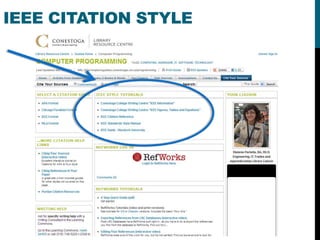
  • Where you can find tools to assist you with creating IEEE
    citations.
  • That you have a Research Guide on the Library website and
    that you can access many relevant resources from here.
TYPES OF RESOURCES
 • ACTIVITY
  •   Scholarly Journals
  •   Popular Magazines
  •   Trade Journals
  •   Conference Papers
  •   Technical Reports
  •   Blogs
  •   Commercial Websites
  •   Educational Websites
  •   News Websites
  •   Forum Website

                  … and more!
TYPES OF SOURCES
      What’s the Difference?
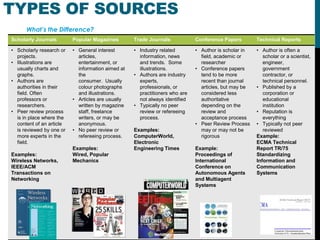
Scholarly Journals        Popular Magazines        Trade Journals            Conference Papers        Technical Reports

• Scholarly research or   • General interest       • Industry related        • Author is scholar in   • Author is often a
  projects.                 articles,                information, news         field, academic or        scholar or a scientist,
• Illustrations are         entertainment, or        and trends. Some          researcher                engineer,
  usually charts and        information aimed at     illustrations.          • Conference papers         government
  graphs.                   the                    • Authors are industry      tend to be more           contractor, or
• Authors are               consumer. Usually        experts,                  recent than journal       technical personnel.
  authorities in their      colour photographs       professionals, or         articles, but may be   • Published by a
  field. Often              and illustrations.       practitioners who are     considered less           corporation or
  professors or           • Articles are usually     not always identified     authoritative             educational
  researchers.              written by magazine    • Typically no peer         depending on the          institution
• Peer review process       staff, freelance         review or refereeing      review and             • Reputation is
  is in place where the     writers, or may be       process.                  acceptance process        everything
  content of an article     anonymous.                                       • Peer Review Process    • Typically not peer
  is reviewed by one or   • No peer review or      Examples:                   may or may not be         reviewed
  more experts in the       refereeing process.    ComputerWorld,              rigorous               Example:
  field.                                           Electronic                                         ECMA Technical
                          Examples:                Engineering Times         Example:                 Report TR/75
Examples:                 Wired, Popular                                     Proceedings of           Standardizing
Wireless Networks,        Mechanics                                          International            Information and
IEEE/ACM                                                                     Conference on            Communication
Transactions on                                                              Autonomous Agents        Systems
Networking                                                                   and Multiagent
                                                                             Systems
TYPES OF WEBSITES
  •Blogs

  •Commercial Websites

  •Educational Websites

  •News Websites

  •Forum Website

  •Content Website

   Social Networks, Government, Advocacy, Counterfeit . . .
WHAT’S A CREDIBLE SOURCE?

There may be times when you don’t know exactly where your resource fits.
This test can help you determine if your information is reliable. Depending on
the question you are asking, different part of the criteria might be more
important than others.


The CRAAP Test
  • Currency The timeliness of the information
  • Relevance The importance of the information for your needs
  • Authority The source of the information
  • Accuracy The reliability, truthfulness, and correctness of the information
  • Purpose The reason the information exists
PROBLEM
 I’m on a committee in the LRC to assist in choosing a new
    Content Management System for the library’s website.
 There are many different types of programs out there so I’ve
   decided to begin by doing some research to discover what
   types of systems exist.


 I’ve gathered the following information sources (see handouts).
 Do you think I should use these when presenting to
   my colleagues?
CRAAP TEST
 • Activity
 • The CRAAP Evaluation Tool
DATABASES
 What is an electronic article database?
  • Online / web-based collection of:
       • Magazines
       • Newspapers
       • Journals
           • Includes professional journal articles
  • Databases are usually organized by major subject i.e.
    nursing, business, science, etc.
  • You choose a database based on your topic
  • Each database contains millions of articles, searchable by keyword
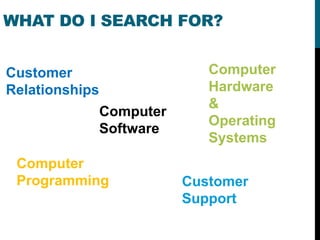
WHAT DO I SEARCH FOR?


Customer                      Computer
Relationships                 Hardware
                              &
                Computer
                              Operating
                Software
                              Systems
 Computer
 Programming               Customer
                           Support
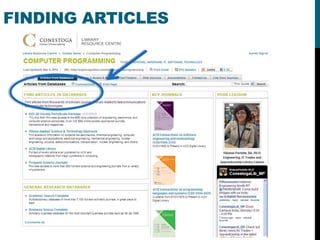
FINDING ARTICLES
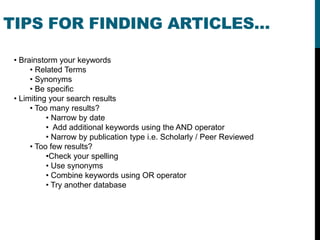
TIPS FOR FINDING ARTICLES…

 • Brainstorm your keywords
      • Related Terms
      • Synonyms
      • Be specific
 • Limiting your search results
      • Too many results?
           • Narrow by date
           • Add additional keywords using the AND operator
           • Narrow by publication type i.e. Scholarly / Peer Reviewed
      • Too few results?
           •Check your spelling
           • Use synonyms
           • Combine keywords using OR operator
           • Try another database
IEEE CITATION STYLE
GET HELP AT THE LIBRARY
 Email                              Online

           Melanie Parlette:
                                    • IM Chat on the LRC Contact Us
     mparlette@conestogac.on.ca
                                                   Page
      LRC Information Desk:         • Or in the Computer Programming
         lrcinfo@conestogac.on.ca              Research Guide


                In Person                        By Phone

 Visit the LRC
 • Monday – Thursday
    7:30 AM – 9:00 PM                        Information Desk @
 • Friday 7:30 AM – 5:00 PM                  519-748-5220 x3361
 • Saturday 9 AM – 4:00 PM
 • Sunday Noon – 4:00 PM
HOW DID WE DO?
http://svy.mk/March5Alcock

Comm 1130 technical_communication_march2012-alcock

  • 1.
    LIBRARY RESOURCES COMM 1130 MELANIE PARLETTE,ENGINEERING & IT LIAISON LIBRARY RESOURCE CENTRE
  • 2.
    TODAY YOU’LL LEARN. . . • How to identify different types of sources based on distinguishing features. • How to evaluate information sources using the CRAAP test to determine the quality and whether it is appropriate for your assignment. • Where you can find tools to assist you with creating IEEE citations. • That you have a Research Guide on the Library website and that you can access many relevant resources from here.
  • 3.
    TYPES OF RESOURCES • ACTIVITY • Scholarly Journals • Popular Magazines • Trade Journals • Conference Papers • Technical Reports • Blogs • Commercial Websites • Educational Websites • News Websites • Forum Website … and more!
  • 4.
    TYPES OF SOURCES What’s the Difference? Scholarly Journals Popular Magazines Trade Journals Conference Papers Technical Reports • Scholarly research or • General interest • Industry related • Author is scholar in • Author is often a projects. articles, information, news field, academic or scholar or a scientist, • Illustrations are entertainment, or and trends. Some researcher engineer, usually charts and information aimed at illustrations. • Conference papers government graphs. the • Authors are industry tend to be more contractor, or • Authors are consumer. Usually experts, recent than journal technical personnel. authorities in their colour photographs professionals, or articles, but may be • Published by a field. Often and illustrations. practitioners who are considered less corporation or professors or • Articles are usually not always identified authoritative educational researchers. written by magazine • Typically no peer depending on the institution • Peer review process staff, freelance review or refereeing review and • Reputation is is in place where the writers, or may be process. acceptance process everything content of an article anonymous. • Peer Review Process • Typically not peer is reviewed by one or • No peer review or Examples: may or may not be reviewed more experts in the refereeing process. ComputerWorld, rigorous Example: field. Electronic ECMA Technical Examples: Engineering Times Example: Report TR/75 Examples: Wired, Popular Proceedings of Standardizing Wireless Networks, Mechanics International Information and IEEE/ACM Conference on Communication Transactions on Autonomous Agents Systems Networking and Multiagent Systems
  • 5.
    TYPES OF WEBSITES •Blogs •Commercial Websites •Educational Websites •News Websites •Forum Website •Content Website Social Networks, Government, Advocacy, Counterfeit . . .
  • 6.
    WHAT’S A CREDIBLESOURCE? There may be times when you don’t know exactly where your resource fits. This test can help you determine if your information is reliable. Depending on the question you are asking, different part of the criteria might be more important than others. The CRAAP Test • Currency The timeliness of the information • Relevance The importance of the information for your needs • Authority The source of the information • Accuracy The reliability, truthfulness, and correctness of the information • Purpose The reason the information exists
  • 7.
    PROBLEM I’m ona committee in the LRC to assist in choosing a new Content Management System for the library’s website. There are many different types of programs out there so I’ve decided to begin by doing some research to discover what types of systems exist. I’ve gathered the following information sources (see handouts). Do you think I should use these when presenting to my colleagues?
  • 8.
    CRAAP TEST •Activity • The CRAAP Evaluation Tool
  • 9.
    DATABASES What isan electronic article database? • Online / web-based collection of: • Magazines • Newspapers • Journals • Includes professional journal articles • Databases are usually organized by major subject i.e. nursing, business, science, etc. • You choose a database based on your topic • Each database contains millions of articles, searchable by keyword
  • 10.
    WHAT DO ISEARCH FOR? Customer Computer Relationships Hardware & Computer Operating Software Systems Computer Programming Customer Support
  • 11.
  • 12.
    TIPS FOR FINDINGARTICLES… • Brainstorm your keywords • Related Terms • Synonyms • Be specific • Limiting your search results • Too many results? • Narrow by date • Add additional keywords using the AND operator • Narrow by publication type i.e. Scholarly / Peer Reviewed • Too few results? •Check your spelling • Use synonyms • Combine keywords using OR operator • Try another database
  • 13.
  • 14.
    GET HELP ATTHE LIBRARY Email Online Melanie Parlette: • IM Chat on the LRC Contact Us mparlette@conestogac.on.ca Page LRC Information Desk: • Or in the Computer Programming lrcinfo@conestogac.on.ca Research Guide In Person By Phone Visit the LRC • Monday – Thursday 7:30 AM – 9:00 PM Information Desk @ • Friday 7:30 AM – 5:00 PM 519-748-5220 x3361 • Saturday 9 AM – 4:00 PM • Sunday Noon – 4:00 PM
  • 15.
    HOW DID WEDO? http://svy.mk/March5Alcock

Editor's Notes

  • #3 ISSUE: Everywhere we go there is information. Some people talk about experiencing information overload. We are consistently bombarded with facts, figures, and stories. Through taking the time to understand what types of information are out their and the different purposes they serve we can better understand how to use them as we go about our assignments and later our careers My name is Melanie Parlette and I am the Engineering and IT Liaison for the library. I have training and experience in assisting students in finding the resources they need and better understanding the library and the services that we offer. Our session today is going to allow us to better understand information sources so that we can apply this knowledge when we are completing assignments and later as we much wade through the information we encounter in our workplaces. So let’s move forward with our agenda for today.
  • #6 Blogs:Commercial:Educational:News:Forum:Online forums or message boards are websites where like-minded people come together and discuss everything related to their industry, or any other topic like sports, music, or politics.Content:
  • #10 Use the print examples you brought to explain what a student can find in a database. Emphasize variety of information, ease of use, scholarly holdings, quality of information and tools provided for organizing results
  • #11 Use the print examples you brought to explain what a student can find in a database. Emphasize variety of information, ease of use, scholarly holdings, quality of information and tools provided for organizing results