what is your impact factor? 
April Aultman Becker 
Manager, Education, Reference, Outreach 
Research Medical Library
What is the difference between an Impact Factor and the 
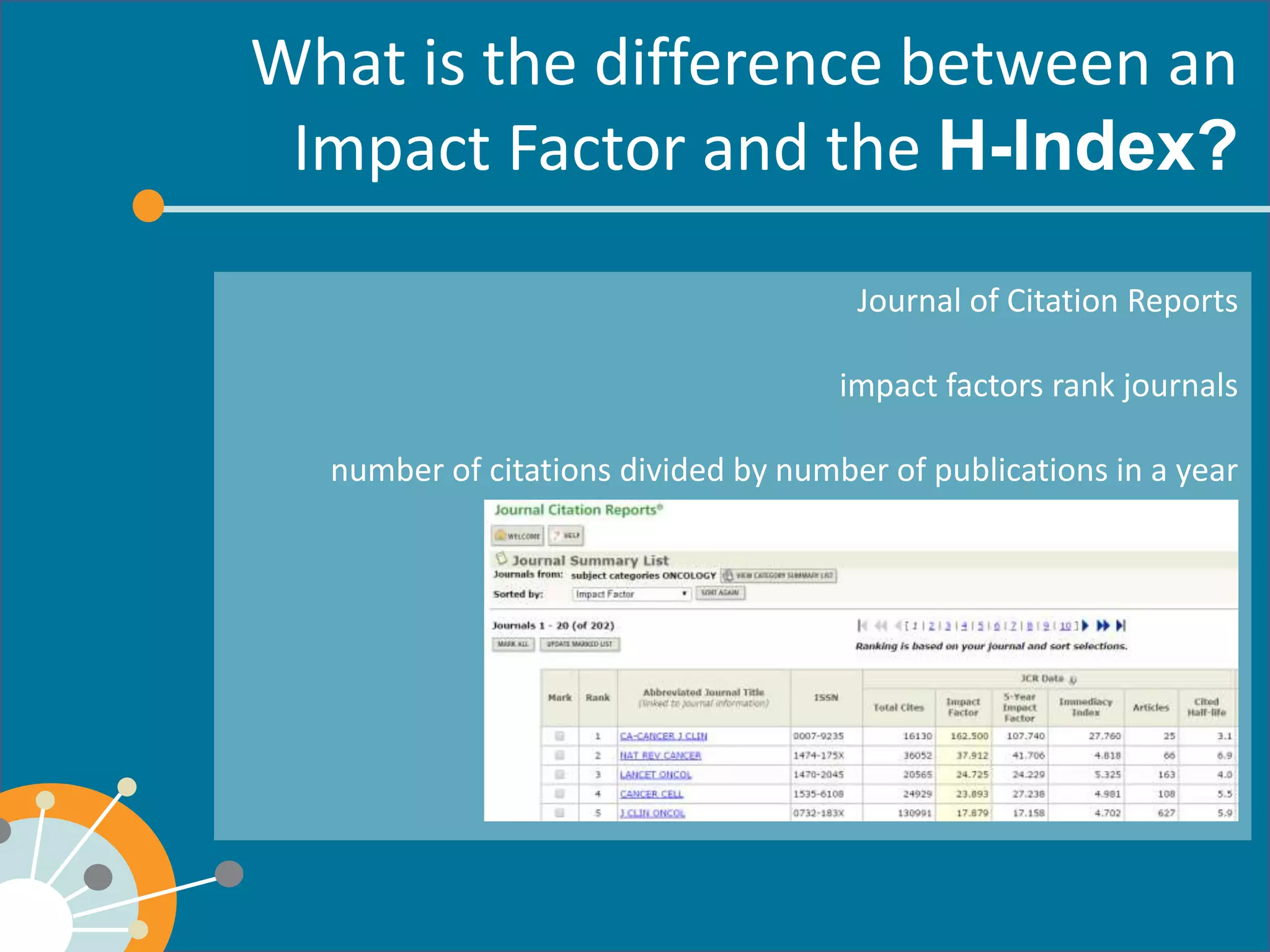
Journal of Citation Reports 
impact factors rank journals 
number of citations divided by number of publications in a year
What is the 
suggested in 2005 by Jorge E. Hirsch 
measures productivity and impact of the published work of a scholar 
based on the set of the scientist's most cited papers and the number of citations that they have received in other publications
How does the work? 
ever-changing 
not just the first author 
the total number of published papers and the number of citations for each paper 
how many of the researcher’s papers have been cited at least once
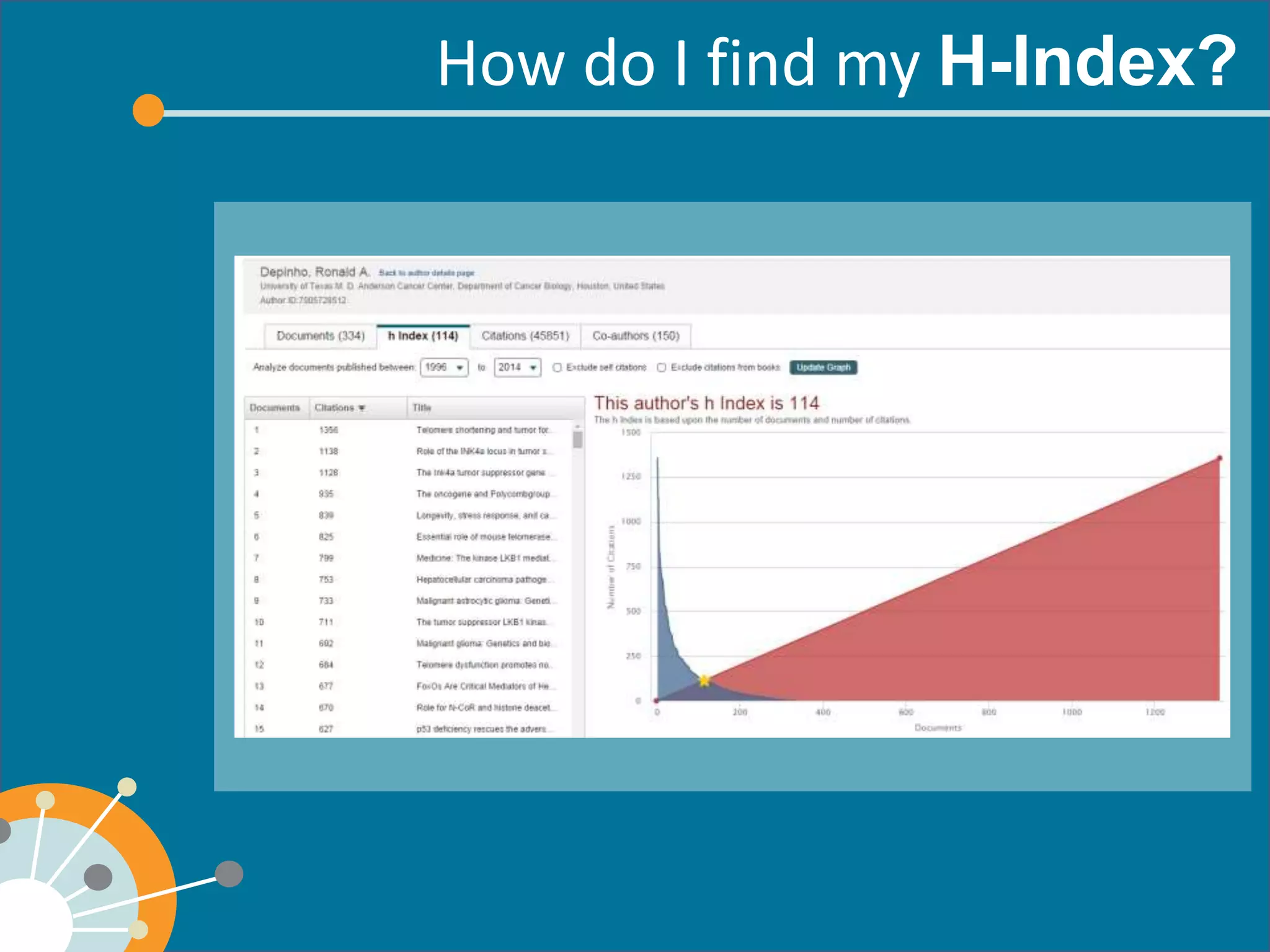
How do I find my
How do I find my
How do I find my
How do I find my
How do I find my
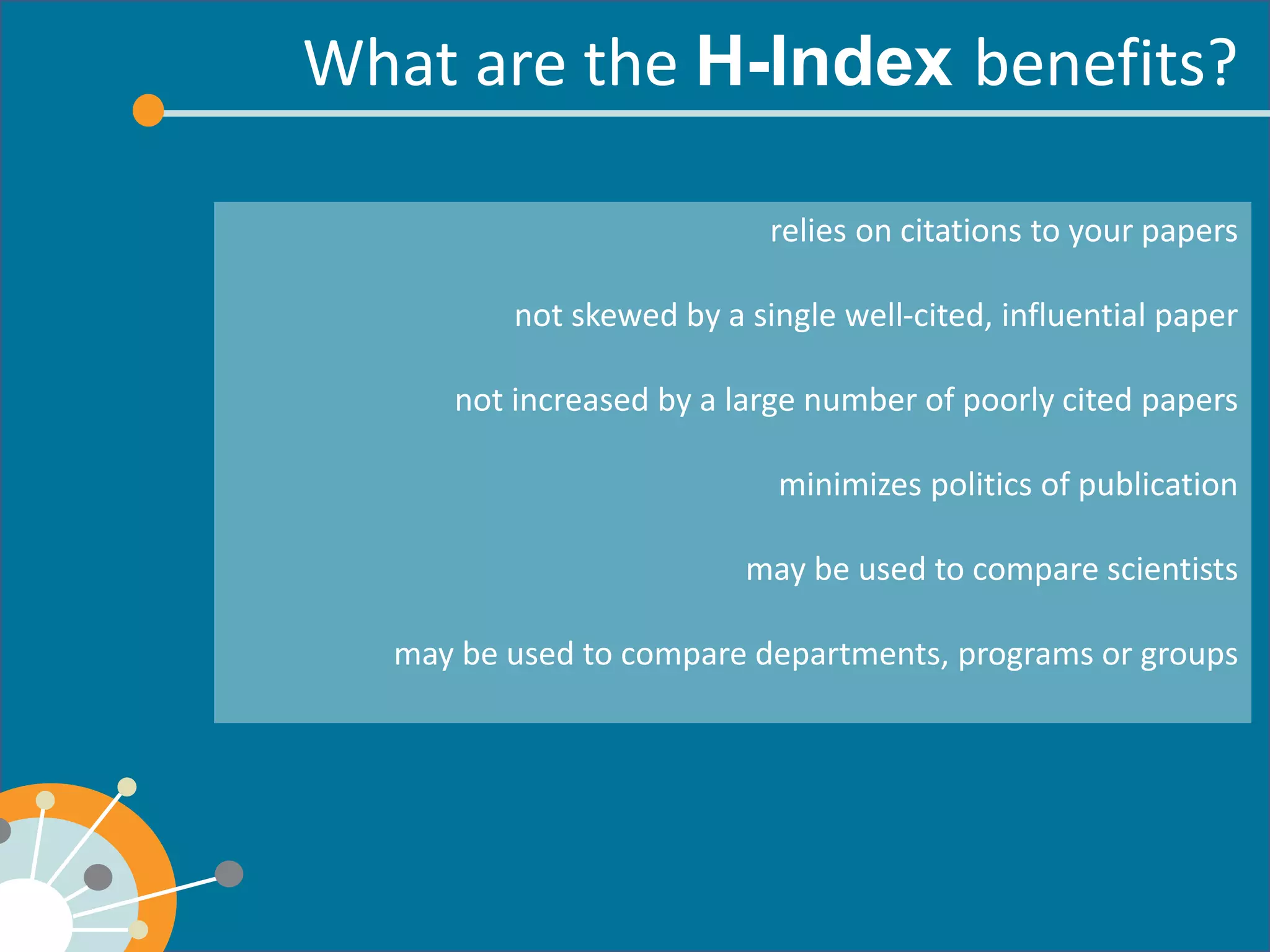
What are the benefits? 
relies on citations to your papers 
not skewed by a single well-cited, influential paper 
not increased by a large number of poorly cited papers 
minimizes politics of publication 
may be used to compare scientists 
may be used to compare departments, programs or groups
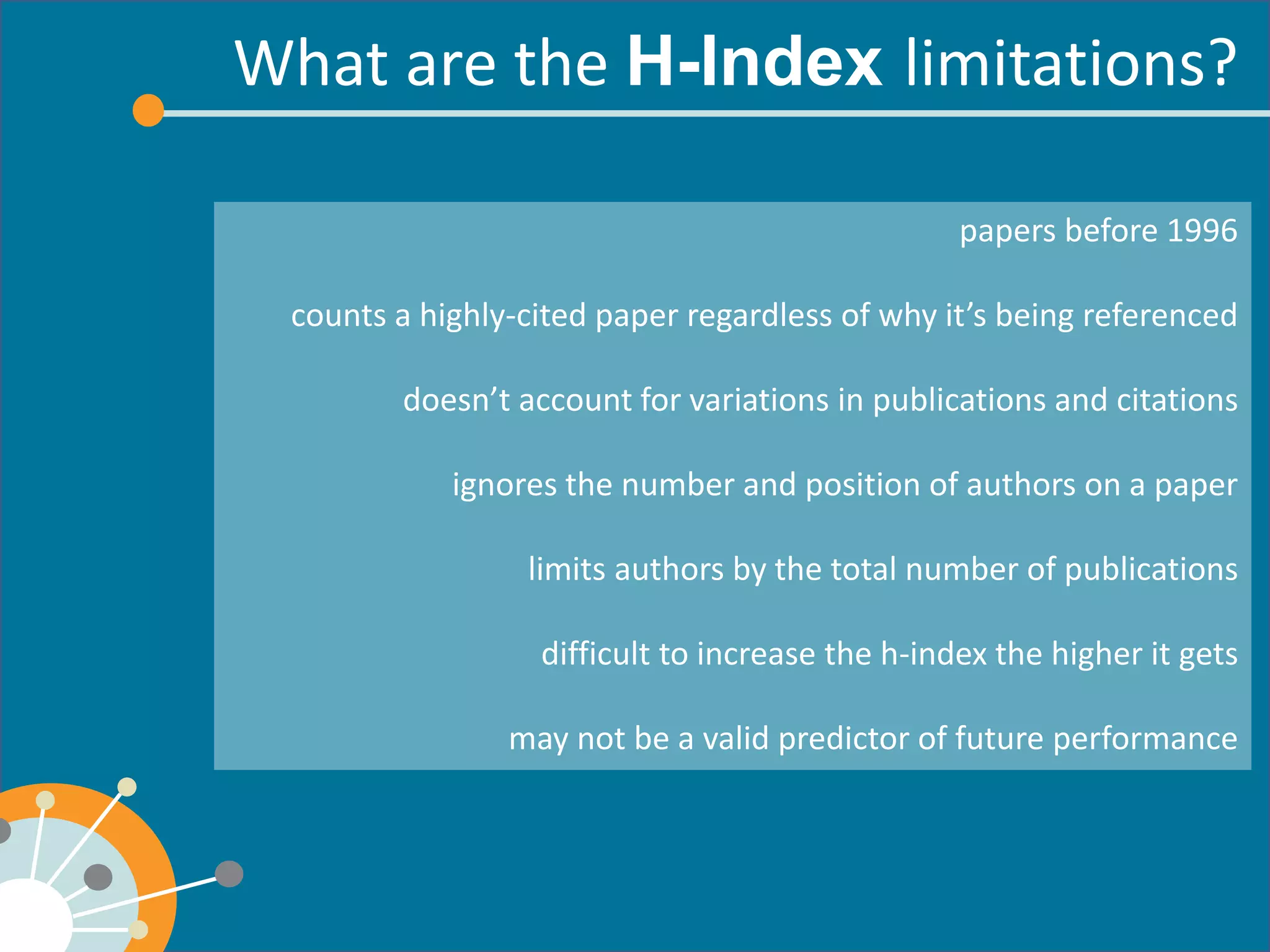
What are the limitations? 
papers before 1996 
counts a highly-cited paper regardless of why it’s being referenced 
doesn’t account for variations in publications and citations 
ignores the number and position of authors on a paper 
limits authors by the total number of publications 
difficult to increase the h-index the higher it gets 
may not be a valid predictor of future performance
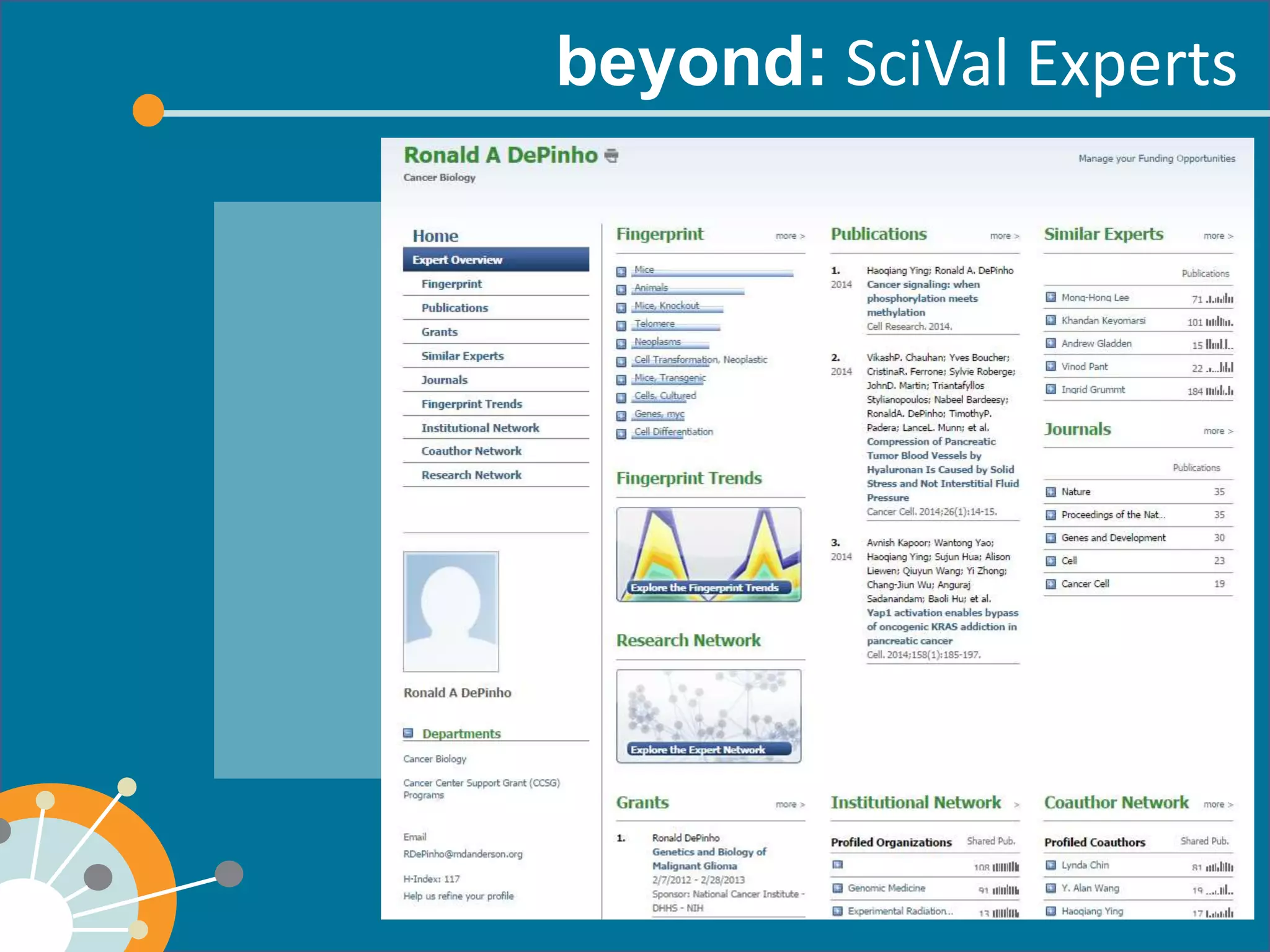
SciVal Experts 
MD Anderson specific 
search by last name, department, concept
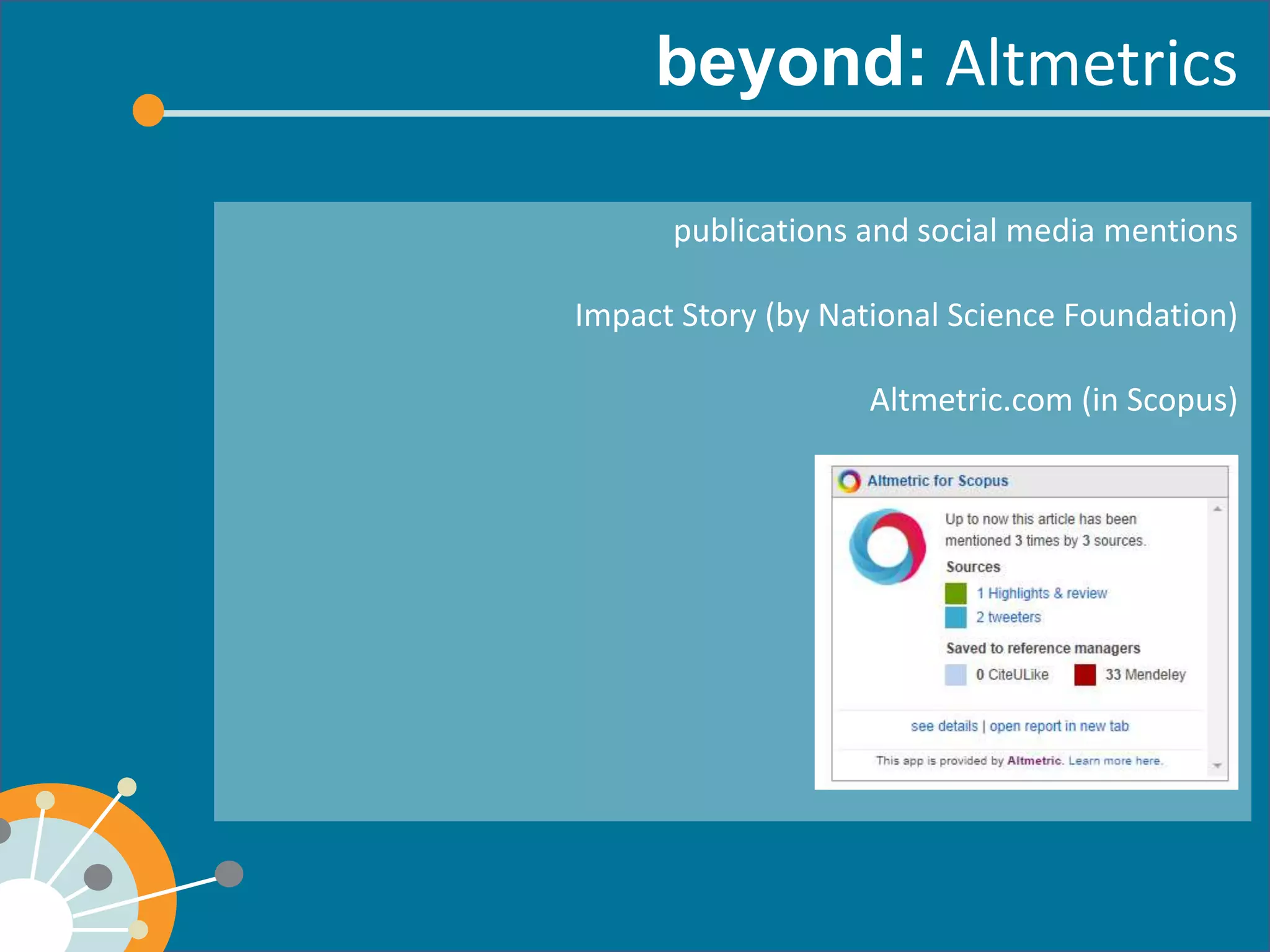
Altmetrics 
publications and social media mentions 
Impact Story (by National Science Foundation) 
Altmetric.com (in Scopus)
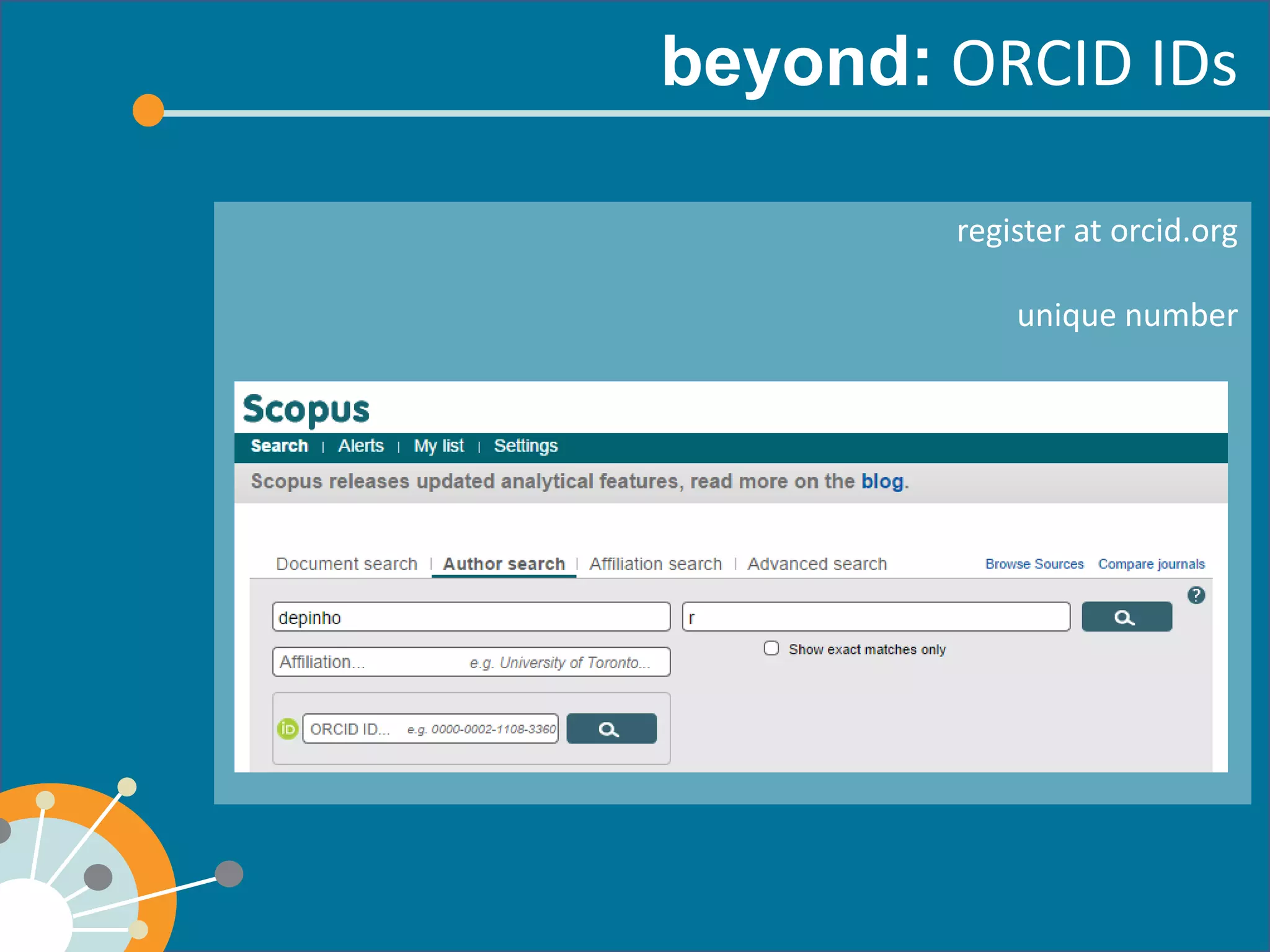
ORCID IDs 
register at orcid.org 
unique number
avaultman@mdanderson.org 
rml-help@mdanderson.org 
www.mdanderson.org/library
H index and beyond

H index and beyond

  • 1.
    what is yourimpact factor? April Aultman Becker Manager, Education, Reference, Outreach Research Medical Library
  • 2.
    What is thedifference between an Impact Factor and the Journal of Citation Reports impact factors rank journals number of citations divided by number of publications in a year
  • 3.
    What is the suggested in 2005 by Jorge E. Hirsch measures productivity and impact of the published work of a scholar based on the set of the scientist's most cited papers and the number of citations that they have received in other publications
  • 4.
    How does thework? ever-changing not just the first author the total number of published papers and the number of citations for each paper how many of the researcher’s papers have been cited at least once
  • 5.
    How do Ifind my
  • 6.
    How do Ifind my
  • 7.
    How do Ifind my
  • 8.
    How do Ifind my
  • 9.
    How do Ifind my
  • 10.
    What are thebenefits? relies on citations to your papers not skewed by a single well-cited, influential paper not increased by a large number of poorly cited papers minimizes politics of publication may be used to compare scientists may be used to compare departments, programs or groups
  • 11.
    What are thelimitations? papers before 1996 counts a highly-cited paper regardless of why it’s being referenced doesn’t account for variations in publications and citations ignores the number and position of authors on a paper limits authors by the total number of publications difficult to increase the h-index the higher it gets may not be a valid predictor of future performance
  • 12.
    SciVal Experts MDAnderson specific search by last name, department, concept
  • 13.
    Altmetrics publications andsocial media mentions Impact Story (by National Science Foundation) Altmetric.com (in Scopus)
  • 14.
    ORCID IDs registerat orcid.org unique number
  • 15.

Editor's Notes

  • #2 Welcome Chat One webinar a month 11:30-12 Request for webinar topics Upcoming education events at end of webinar Record
  • #3 Journals have long been ranked in order of relative “importance” by their journal impact factor through the database Journal of Citation Reports. JCR calculates the impact factors with the number of publications and the number of citations. JCR through RML Ranks alphabetically or by subject category Looking at top 5 in Oncology – why is CA high? Average IF number is below 6, more like 2.
  • #4 While most of us would agree that it’s nearly impossible to accurately describe a scientist’s career with a single number, that doesn’t mean metrics that attempt to do so are useless.  The h-index, originally described in 2005 by Jorge Hirsch, a physicist at UCSD, as a tool for determining theoretical physicists' relative quality and is sometimes called the Hirsch index or Hirsch number, is a measurement that aims to describe the scientific productivity and impact of a researcher.  Like all metrics, the h-index is not perfect; however, it addresses many of the problems associated with the publication process in general and enables some very interesting analyses. The h-index attempts to measure both the productivity and impact of the published work of a scientist or scholar. The index is based on the set of the scientist's most cited papers and the number of citations that they have received in other publications.
  • #5 In Scopus the h-index is not a static value; it is calculated live on a set of results each time you look it up.  it does not have to be papers belonging to just one author. To calculate it, only two pieces of information are required: the total number of papers published (Np) and the number of citations (Nc) for each paper. So we can ask ourselves, “Have I published one paper that’s been cited at least once?”  If so, we’ve got an H-index of one and we can move on to the next question, “Have I published two papers that have each been cited at least twice?”  If so, our score is 2 and we can continue to repeat this line of questioning until we can’t answer ‘yes’ anymore.  What if I’ve published 84 documents that have been cited 82 times each? What if they’ve only been cited 5 times each?
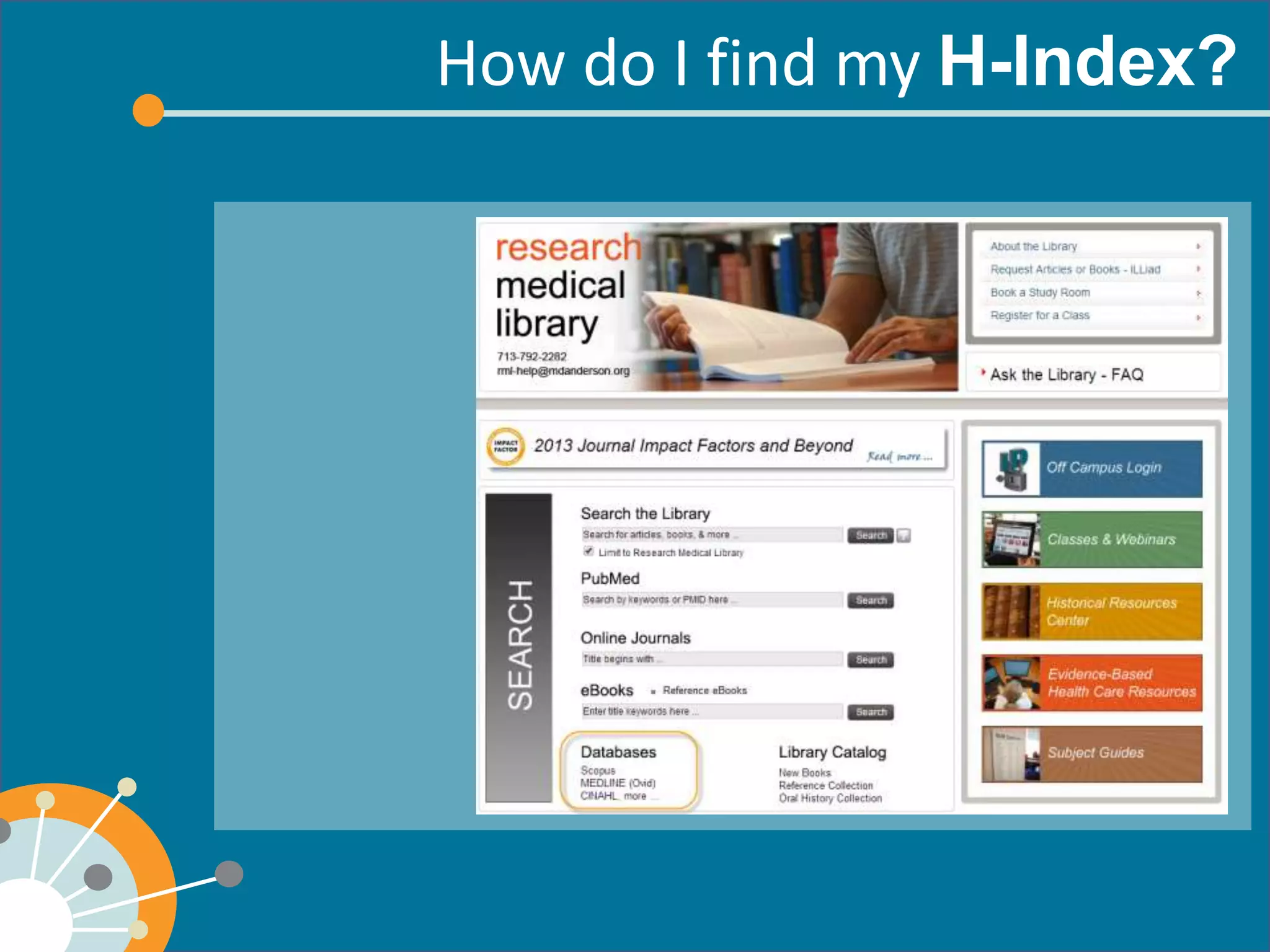
  • #6 Inside From home (remote) Databases
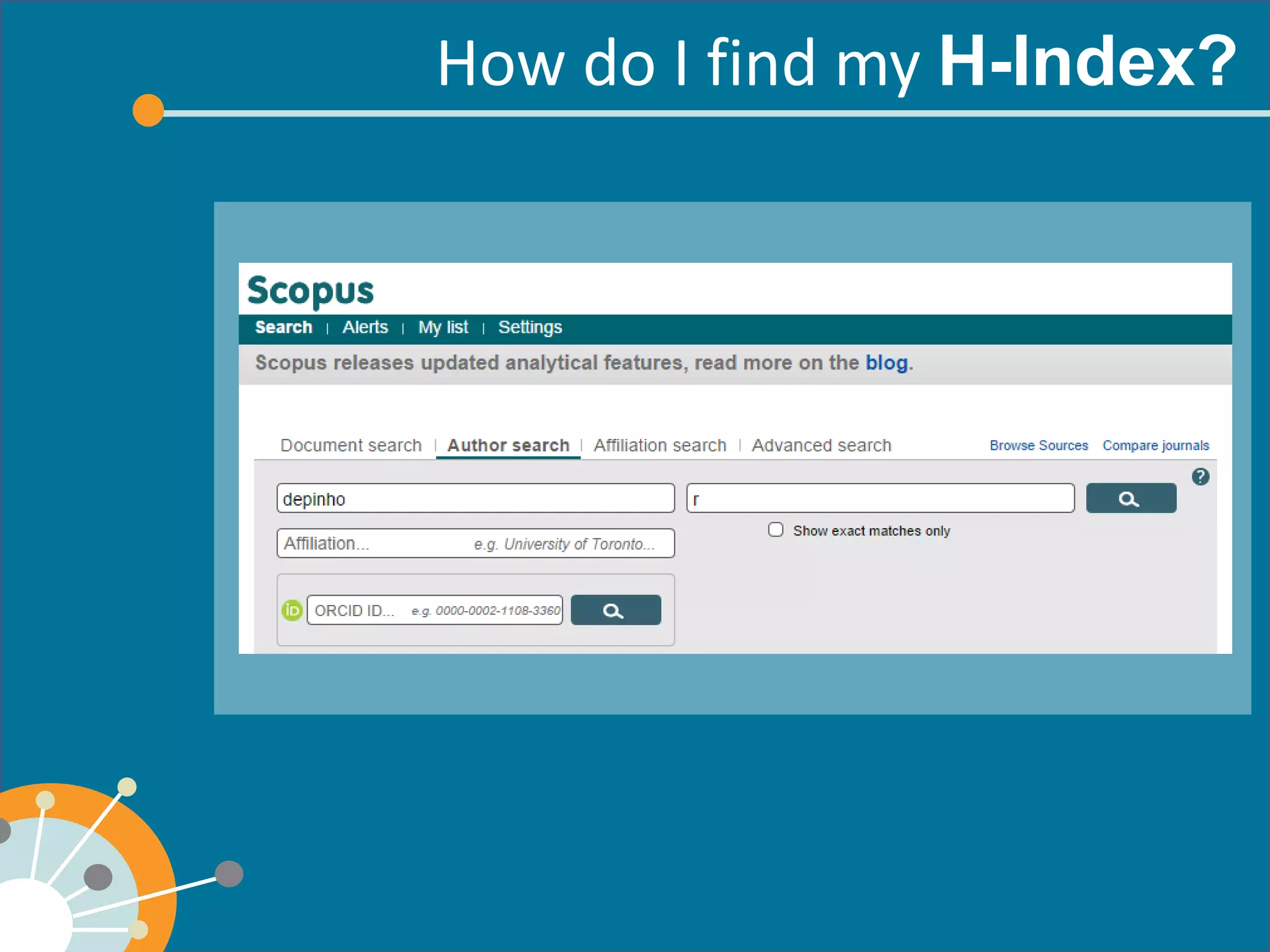
  • #7 Who’s used scopus? Scopus similar to PubMed, author metrics Why Depinho’s a good example
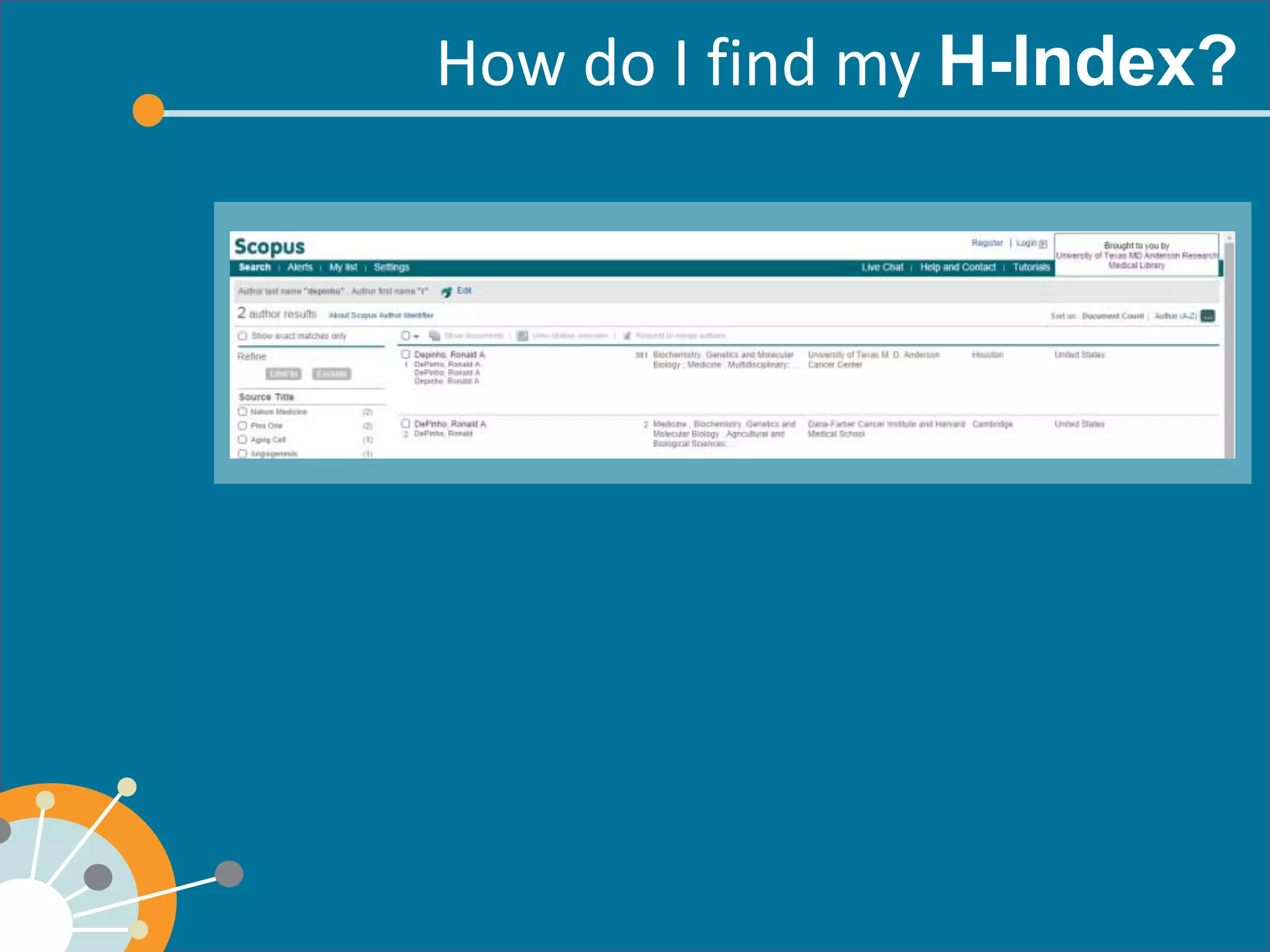
  • #8 Why are there two results here? What to do if you see this
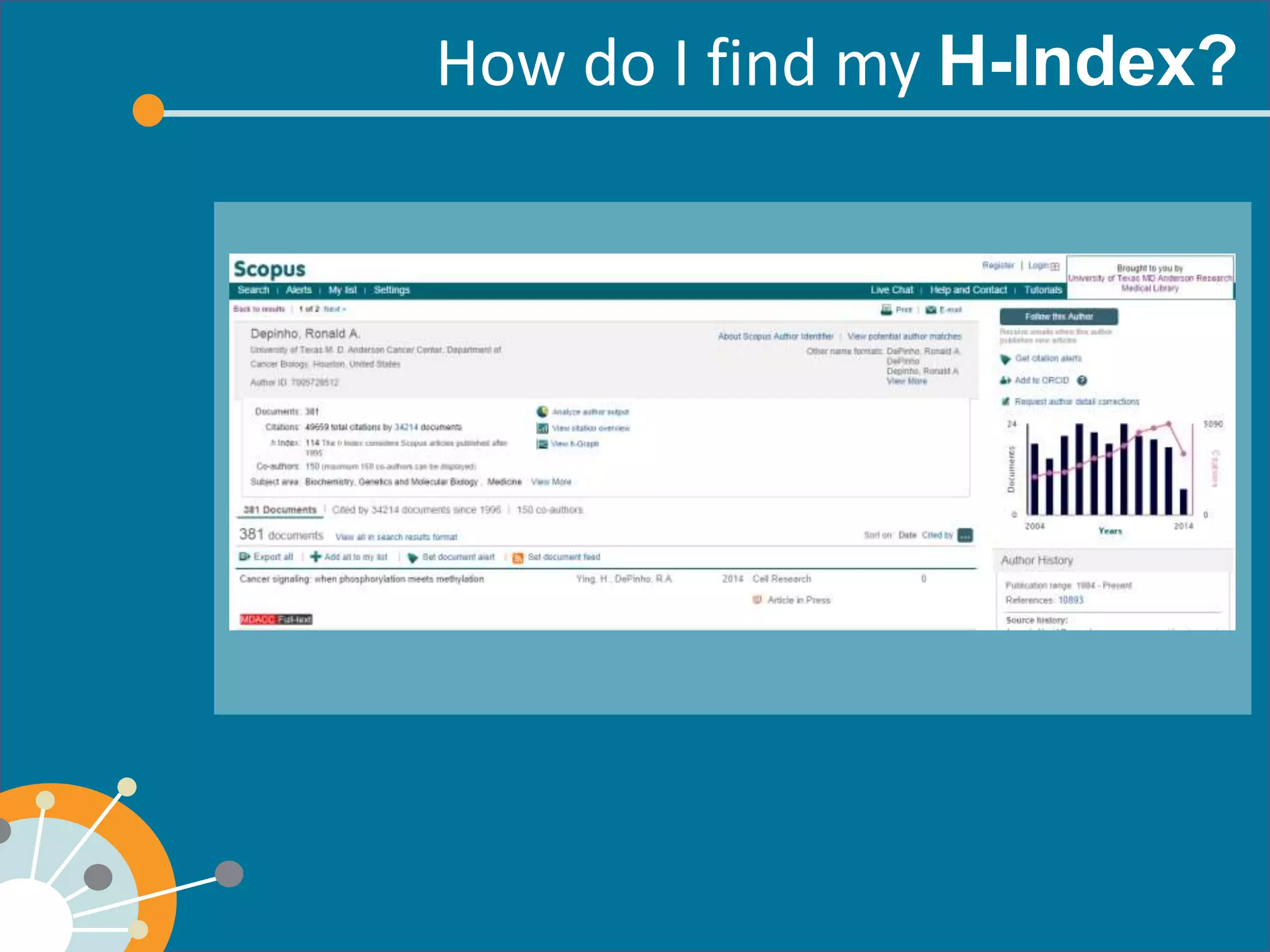
  • #9 Author info page 381 docs – can get full text Cited almost 50k times (so why is his h-index only 114?) Point out the report corrections features
  • #10 H-index graph
  • #11 The index has several advantages over other metrics: It relies on citations to your papers, not the journals, which is a truer measure of quality It is not dramatically skewed by a single well-cited, influential paper (unlike total number of citations would be) It is not increased by a large number of poorly cited papers (unlike total number of papers would be) It minimizes the politics of publication.  A high-impact paper counts regardless of whether or not it’s a top-tier journal It’s good for comparing scientists within a field at similar stages in their careers It may be used to compare not just individuals, but also departments, programs or any other group of scientists.
  • #12 Critics of the metric suggest it is limited in the following ways: Scopus does not have complete citation information for articles published before 1996. The references are needed to calculate citations; if my article A cites your article B, but Scopus doesn't have references of my article A, well, your B won't show as being cited. There's no danger if you published in 1996 or later because you couldn't have been cited before that time, but if you published in 1982 we may be showing a lower citation count for that article. It counts a highly-cited paper regardless of why it’s being referenced- eg, for negative reasons It doesn’t account for variations in average number of publications and citations in various fields (some traditionally publish and cite less than others) It ignores the number and position of authors on a paper It limits authors by the total number of publications, so shorter careers are at a disadvantage It has relatively low resolution in that many scientists end up in the same range since it gets increasingly difficult to increase the h-index the higher it gets (an h-index of 100 corresponds to a minimum of 10,000 citations) It, like all metrics, is based on data from the past and may not be a valid predictor of future performance. However, in a follow-up publication Jorge Hirsch demonstrated that the h-index is better than other indicators (total papers, total citations, citations per paper) at predicting future scientific achievement.
  • #13 Another place to find h index and author metrics Provided by RML MDA specific, but there are links to sister/partnering institutions/authors Why does it say h-index of 117 here? Which would an author choose to report out?
  • #14 Researchers care about what people are saying about their work. Increasingly they need to show the impact of their papers, books and datasets are having beyond just citations. Alternative metrics are web-based metrics that measure the impact of scholarly material. Web-based metrics typically include both publications and data from social media sources. Some examples of altmetrics tools are: Impact Story is a free tool supported by the National Science Foundation which allows you to upload articles, datasets, software and other products using Google Scholar, ORCID or PMID’s. Impact Story reports altmetrics and traditional citation counts for each item. Altmetric.com can be used through the Scopus database. Look for the Altmetric widget in Scopus on the right hand side of each individual search result. This tool watches social media sites, newspapers, government policy documents and other sources for mentions of scholarly articles and brings all the attention together to compile article level metrics.
  • #15 Tracking an author’s individual publication impact can be challenging. If you have a common name, multiple names or have changed your name during the course of your career, an ORCID ID helps that distinguish you from every other researcher and track publications across databases. ORCID provides a persistent digital identifier that distinguishes you from every other researcher. Include your ORCID identifier on your Webpage, when you submit publications, apply for grants, and in any research workflow to ensure you get credit for your work.