Introduction to research article
Barsha Roy
Lecturer, CSE
barsharoy@uits.edu.bd
Roadmap
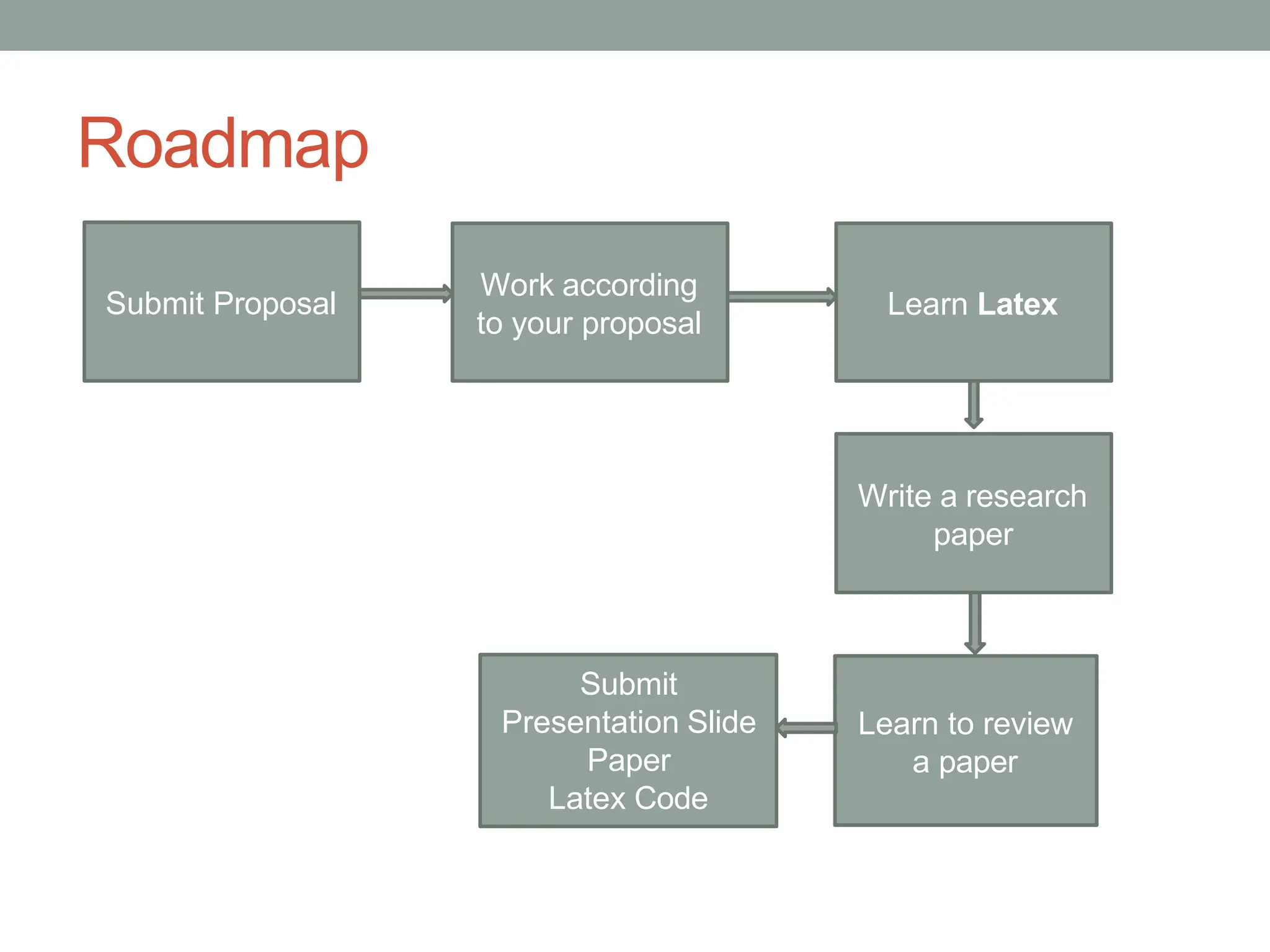
Submit Proposal
Write a research
paper
Work according
to your proposal
Learn to review
a paper
Learn Latex
Submit
Presentation Slide
Paper
Latex Code
Major Article Type
• Research Article
• A research article describes a study that was performed by the article’s author(s). It explains the
methodology of the study, such as how data was collected and analyzed, and clarifies what the
results mean. Each step of the study is reported in detail so that other researchers can repeat the
experiment. Research papers are divided into sections that occur in a particular order: abstract,
introduction, methods, results, discussion, and references.
• Review Article
• Review articles do not describe original research conducted by the author(s). Instead, they give an
overview of a specific subject by examining previously published studies on the topic. The author
searches for and selects studies on the subject and then tries to make sense of their findings. In
particular, review articles look at whether the outcomes of the chosen studies are similar, and if they
are not, attempt to explain the conflicting results. By interpreting the findings of previous studies,
review articles are able to present the current knowledge and understanding of a specific topic.
Since review articles summarize the research on a particular topic, students should read them for
background information before consulting detailed, technical research articles. Furthermore, review
articles are a useful starting point for a research project because their reference lists can be used to
find additional articles on the subject.
• What are differences between a research paper and review paper?
• Task: Read some research paper and a review paper that is relevant to your work.
Publication
 Where to you find/publish research article?
 Journal
 Conference
 Book
 Google Scholar (Search Engine)
 Journal Ranking:
https://www.scimagojr.com/journalrank.php
Quartiles: Q1, Q2, Q3, Q4
 Some Reputed Publishers
 https://www.nature.com/
 https://www.springer.com/gp/
 https://dl.acm.org/journals
 https://ieeexplore.ieee.org/Xplore/home.jsp
 https://www.sciencedirect.com/browse/journals-and-books
Indexing and Impact Factor
Scientific and scholarly authors normally
cite other publications. If Paper R
contains a bibliographic footnote using
and describing Paper C, then
– R contains a reference to C,
– C has a citation from R.
• The number of references a paper has
is measured by the number of items in
its bibliography as endnotes, footnotes,
etc.,
• The number of citations a paper has is
found by looking it up [in a] citation
index and seeing how many others
papers mention it.“
Source: Price D. J. D. Little science, big science. and beyond. New York: Columbia University Press, 1986.
Indexing and Impact Factor
• Citation indexing makes links between books and articles that were written
in the past and articles that make reference to ("cite") these older
publications. In other words, it is a technique that allows us to trace the use of
an idea (an earlier document) forward to others who have used ("cited") it.
The citation indexes were originally designed primarily for information
retrieval. Helps for identifying the relevant research papers independent of
language, title words, or author keywords.
• A citation index is a paper-based or electronic database that provides
citation links between documents.
• Common citation index databases (indexing):
 Science Citation Index Expanded(SCI)
 Social Science Citation Index (SSCI)
 Scopus
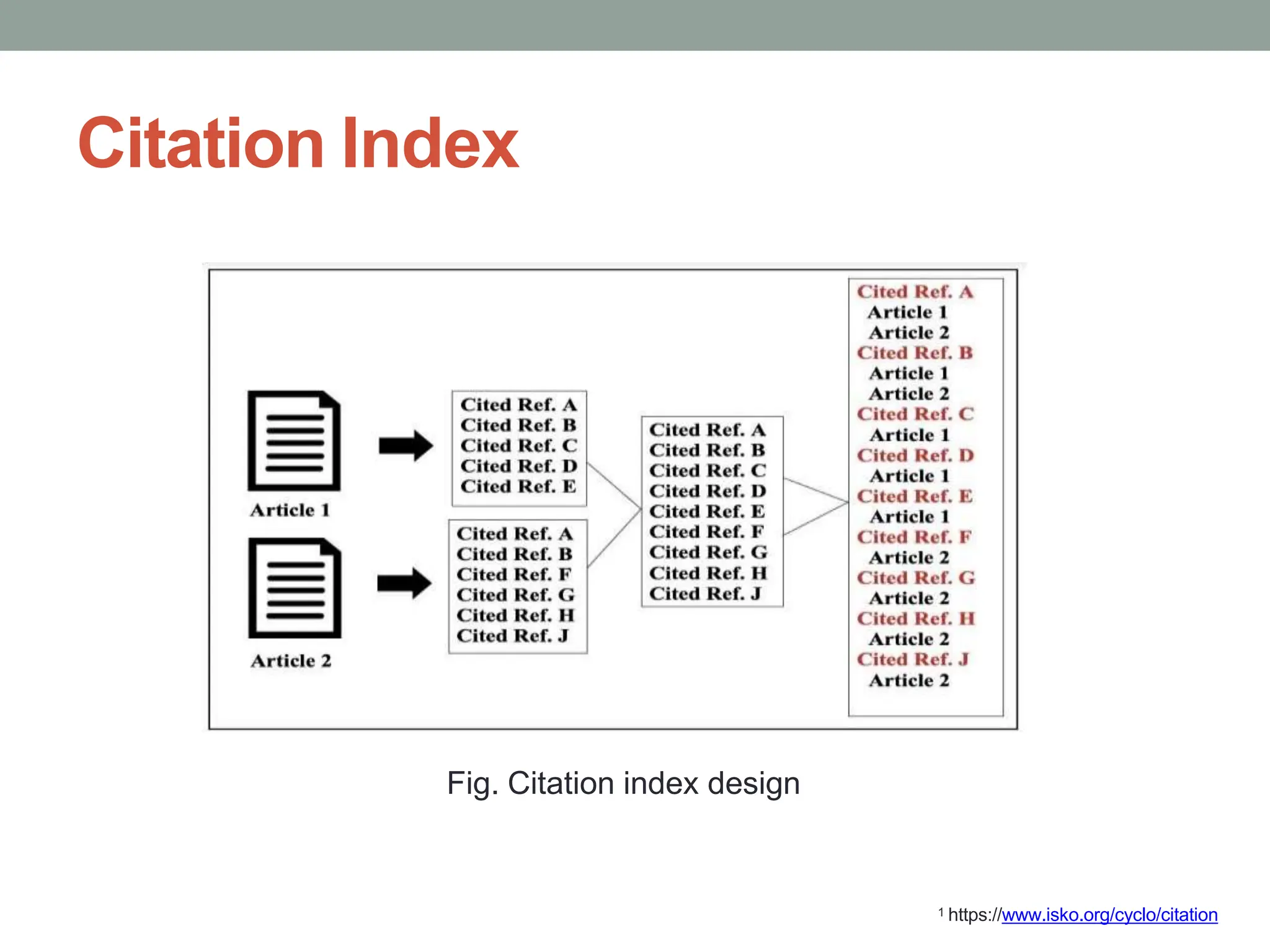
Citation Index
Fig. Citation index design
1 https://www.isko.org/cyclo/citation
Indexing and Impact Factor
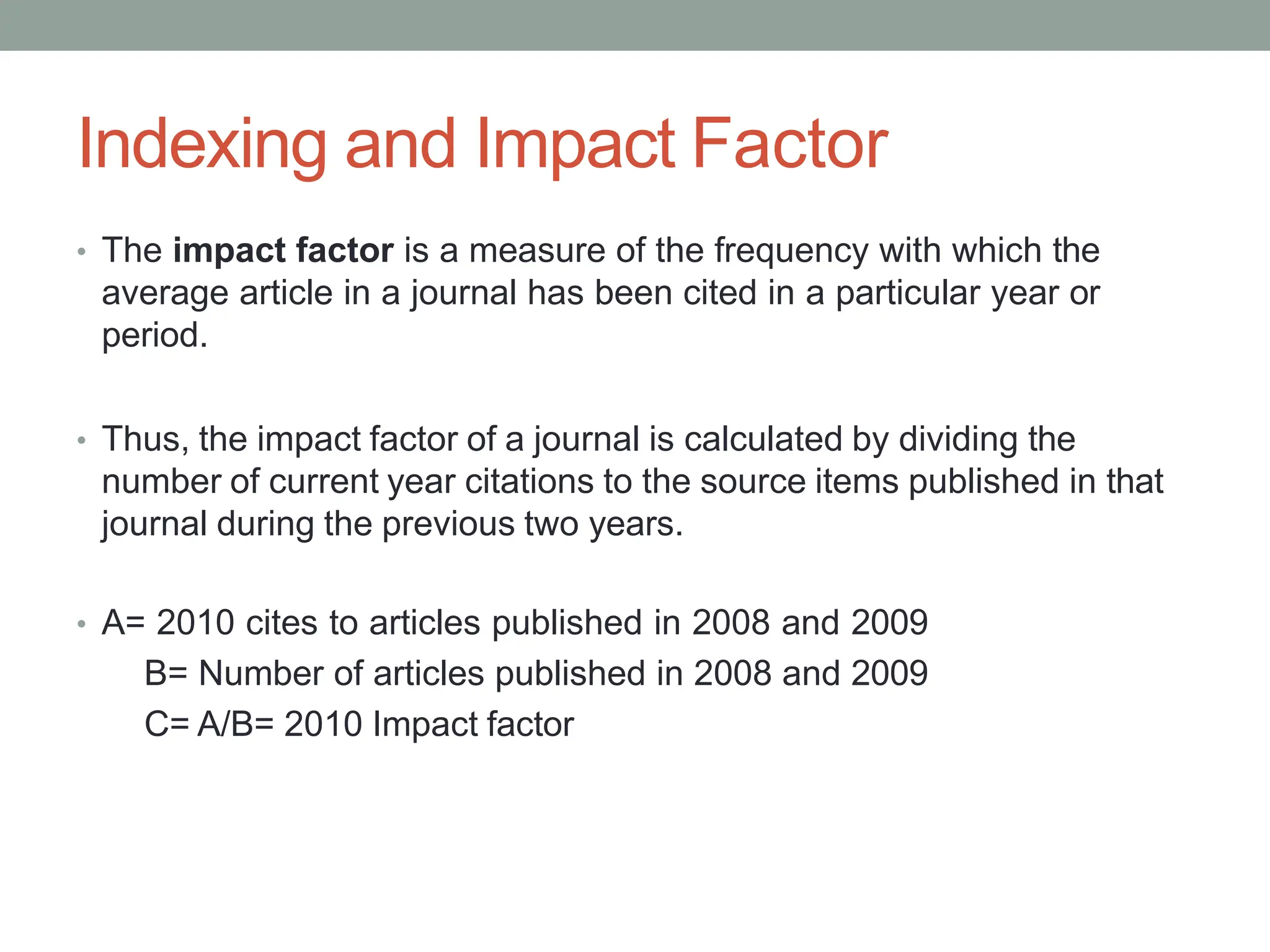
• The impact factor is a measure of the frequency with which the
average article in a journal has been cited in a particular year or
period.
• Thus, the impact factor of a journal is calculated by dividing the
number of current year citations to the source items published in that
journal during the previous two years.
• A= 2010 cites to articles published in 2008 and 2009
B= Number of articles published in 2008 and 2009
C= A/B= 2010 Impact factor
Indexing and Impact Factor
• Task 1: Find out 1 paper from a journal form each of the above publishers
that you are interested to work on.
• Task 2: Find the citation index databases (indexing) in which corresponding
journals are included.
• Task 3: List is the impact factor of your journal.
Peer Review Process
• What is double blind peer review?
• How the journals of your selected papers are reviewed?
Reasons to accept your paper
• It provides insight into an important issue and useful to people who make
decisions.
• The insight is used to develop a framework or theory and stimulates new,
important questions.
• The methods used to explore the issue are appropriate (for example, data
collection and analysis of data).
• The methods used are applied rigorously and explain why and how the data
support the conclusions.
Reasons to accept your paper
• Connections to prior work in the field or from other fields are made and serve
to make the article's arguments clear.
• The article tells a good story, meaning it is well written and easy to
understand, the arguments are logical and not internally contradictory.
Why Reject
• It fails the technical screening.
• It does not fall within the Aims and Scope.
• It's incomplete.
• The procedures and/or analysis of the data is seen to be defective.
• The conclusions cannot be justified on the basis of the rest of the paper.
• It's is simply a small extension of a different paper, often from the same
authors.
• It's incomprehensible.
Thank You

Introduction to research and its different aspects

  • 1.
    Introduction to researcharticle Barsha Roy Lecturer, CSE barsharoy@uits.edu.bd
  • 2.
    Roadmap Submit Proposal Write aresearch paper Work according to your proposal Learn to review a paper Learn Latex Submit Presentation Slide Paper Latex Code
  • 3.
    Major Article Type •Research Article • A research article describes a study that was performed by the article’s author(s). It explains the methodology of the study, such as how data was collected and analyzed, and clarifies what the results mean. Each step of the study is reported in detail so that other researchers can repeat the experiment. Research papers are divided into sections that occur in a particular order: abstract, introduction, methods, results, discussion, and references. • Review Article • Review articles do not describe original research conducted by the author(s). Instead, they give an overview of a specific subject by examining previously published studies on the topic. The author searches for and selects studies on the subject and then tries to make sense of their findings. In particular, review articles look at whether the outcomes of the chosen studies are similar, and if they are not, attempt to explain the conflicting results. By interpreting the findings of previous studies, review articles are able to present the current knowledge and understanding of a specific topic. Since review articles summarize the research on a particular topic, students should read them for background information before consulting detailed, technical research articles. Furthermore, review articles are a useful starting point for a research project because their reference lists can be used to find additional articles on the subject. • What are differences between a research paper and review paper? • Task: Read some research paper and a review paper that is relevant to your work.
  • 4.
    Publication  Where toyou find/publish research article?  Journal  Conference  Book  Google Scholar (Search Engine)  Journal Ranking: https://www.scimagojr.com/journalrank.php Quartiles: Q1, Q2, Q3, Q4  Some Reputed Publishers  https://www.nature.com/  https://www.springer.com/gp/  https://dl.acm.org/journals  https://ieeexplore.ieee.org/Xplore/home.jsp  https://www.sciencedirect.com/browse/journals-and-books
  • 5.
    Indexing and ImpactFactor Scientific and scholarly authors normally cite other publications. If Paper R contains a bibliographic footnote using and describing Paper C, then – R contains a reference to C, – C has a citation from R. • The number of references a paper has is measured by the number of items in its bibliography as endnotes, footnotes, etc., • The number of citations a paper has is found by looking it up [in a] citation index and seeing how many others papers mention it.“ Source: Price D. J. D. Little science, big science. and beyond. New York: Columbia University Press, 1986.
  • 6.
    Indexing and ImpactFactor • Citation indexing makes links between books and articles that were written in the past and articles that make reference to ("cite") these older publications. In other words, it is a technique that allows us to trace the use of an idea (an earlier document) forward to others who have used ("cited") it. The citation indexes were originally designed primarily for information retrieval. Helps for identifying the relevant research papers independent of language, title words, or author keywords. • A citation index is a paper-based or electronic database that provides citation links between documents. • Common citation index databases (indexing):  Science Citation Index Expanded(SCI)  Social Science Citation Index (SSCI)  Scopus
  • 7.
    Citation Index Fig. Citationindex design 1 https://www.isko.org/cyclo/citation
  • 8.
    Indexing and ImpactFactor • The impact factor is a measure of the frequency with which the average article in a journal has been cited in a particular year or period. • Thus, the impact factor of a journal is calculated by dividing the number of current year citations to the source items published in that journal during the previous two years. • A= 2010 cites to articles published in 2008 and 2009 B= Number of articles published in 2008 and 2009 C= A/B= 2010 Impact factor
  • 9.
    Indexing and ImpactFactor • Task 1: Find out 1 paper from a journal form each of the above publishers that you are interested to work on. • Task 2: Find the citation index databases (indexing) in which corresponding journals are included. • Task 3: List is the impact factor of your journal.
  • 10.
    Peer Review Process •What is double blind peer review? • How the journals of your selected papers are reviewed?
  • 11.
    Reasons to acceptyour paper • It provides insight into an important issue and useful to people who make decisions. • The insight is used to develop a framework or theory and stimulates new, important questions. • The methods used to explore the issue are appropriate (for example, data collection and analysis of data). • The methods used are applied rigorously and explain why and how the data support the conclusions.
  • 12.
    Reasons to acceptyour paper • Connections to prior work in the field or from other fields are made and serve to make the article's arguments clear. • The article tells a good story, meaning it is well written and easy to understand, the arguments are logical and not internally contradictory.
  • 13.
    Why Reject • Itfails the technical screening. • It does not fall within the Aims and Scope. • It's incomplete. • The procedures and/or analysis of the data is seen to be defective. • The conclusions cannot be justified on the basis of the rest of the paper. • It's is simply a small extension of a different paper, often from the same authors. • It's incomprehensible.
  • 14.