Measuring Scholarly
and Public Impact:
Let’s Talk Metrics
RACHEL BORCHARDT MONDAY, MAY 16TH, 2017
BORCHARD@AMERICAN.EDU CONFERENCE FOR HIGH-IMPACT RESEARCH
Why metrics?
 Quantifiable measures of research impact
 Differentiate articles, journals, authors, institutions
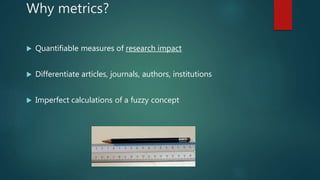
 Imperfect calculations of a fuzzy concept
How are metrics used?
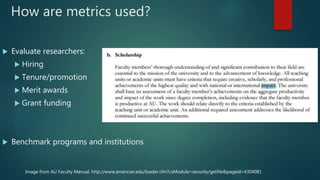
 Evaluate researchers:
 Hiring
 Tenure/promotion
 Merit awards
 Grant funding
 Benchmark programs and institutions
Image from AU Faculty Manual, http://www.american.edu/loader.cfm?csModule=security/getfile&pageid=4304081
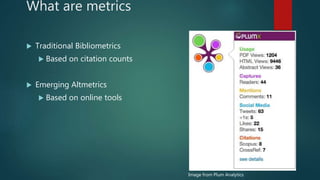
What are metrics
 Traditional Bibliometrics
 Based on citation counts
 Emerging Altmetrics
 Based on online tools
Image from Plum Analytics
Categories of bibliometrics
 Article-level
 Journal-level
 Author-level
 Institutional-level
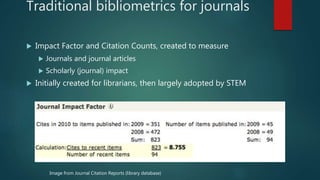
Traditional bibliometrics for journals
 Impact Factor and Citation Counts, created to measure
 Journals and journal articles
 Scholarly (journal) impact
 Initially created for librarians, then largely adopted by STEM
Image from Journal Citation Reports (library database)
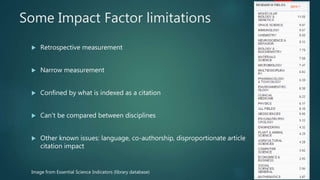
Some Impact Factor limitations
 Retrospective measurement
 Narrow measurement
 Confined by what is indexed as a citation
 Can’t be compared between disciplines
 Other known issues: language, co-authorship, disproportionate article
citation impact
Image from Essential Science Indicators (library database)
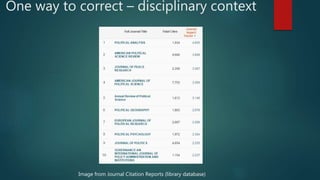
One way to correct – disciplinary context
Image from Journal Citation Reports (library database)
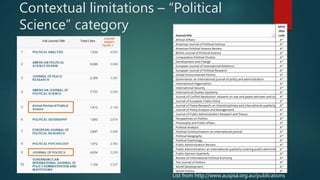
Contextual limitations – “Political
Science” category
List from http://www.auspsa.org.au/publications
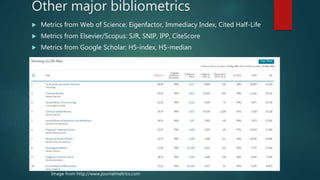
Other major bibliometrics
 Metrics from Web of Science: Eigenfactor, Immediacy Index, Cited Half-Life
 Metrics from Elsevier/Scopus: SJR, SNIP, IPP, CiteScore
 Metrics from Google Scholar: H5-index, H5-median
Image from http://www.journalmetrics.com
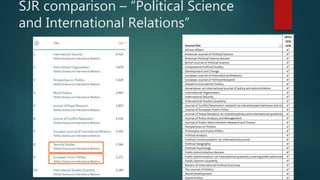
SJR comparison – “Political Science
and International Relations”
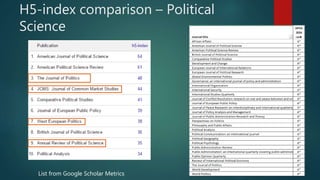
H5-index comparison – Political
Science
List from Google Scholar Metrics
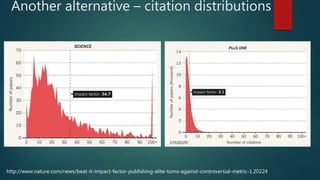
Another alternative – citation distributions
http://www.nature.com/news/beat-it-impact-factor-publishing-elite-turns-against-controversial-metric-1.20224
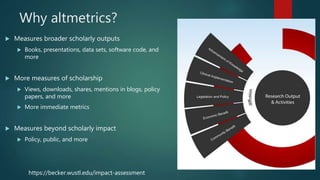
Why altmetrics?
 Measures broader scholarly outputs
 Books, presentations, data sets, software code, and
more
 More measures of scholarship
 Views, downloads, shares, mentions in blogs, policy
papers, and more
 More immediate metrics
 Measures beyond scholarly impact
 Policy, public, and more
https://becker.wustl.edu/impact-assessment
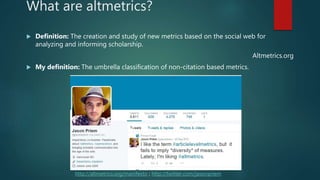
What are altmetrics?
 Definition: The creation and study of new metrics based on the social web for
analyzing and informing scholarship.
Altmetrics.org
 My definition: The umbrella classification of non-citation based metrics.
http://altmetrics.org/manifesto ; http://twitter.com/jasonpriem
Categories of altmetrics
Article-level [individual work]
 Journal-level
 Author-level
 Institutional-level
Where do altmetrics come from?
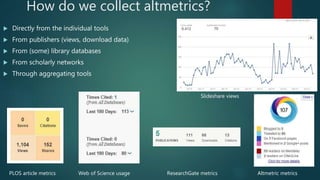
How do we collect altmetrics?
 Directly from the individual tools
 From publishers (views, download data)
 From (some) library databases
 From scholarly networks
 Through aggregating tools
Slideshare views
PLOS article metrics Web of Science usage ResearchGate metrics Altmetric metrics
“Impact” and metrics
 Inherently fuzzy and subjective
 Attention
 Engagement
 Some correlate to bibliometrics; some don’t
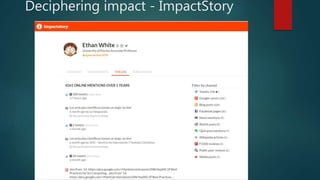
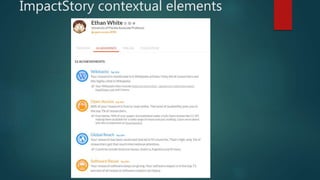
Deciphering impact - ImpactStory
ImpactStory contextual elements
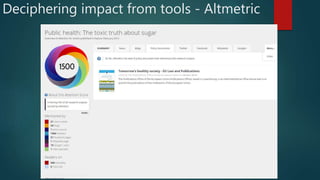
Deciphering impact from tools - Altmetric
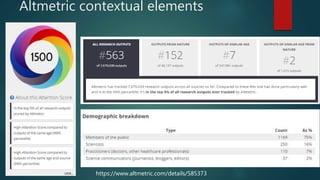
Altmetric contextual elements
https://www.altmetric.com/details/585373
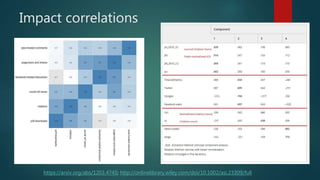
Impact correlations
https://arxiv.org/abs/1203.4745; http://onlinelibrary.wiley.com/doi/10.1002/asi.23309/full
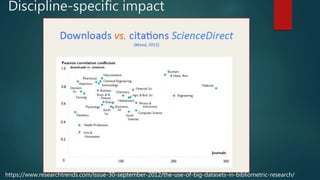
Discipline-specific impact
https://www.researchtrends.com/issue-30-september-2012/the-use-of-big-datasets-in-bibliometric-research/
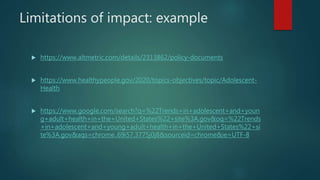
Limitations of impact: example
 https://www.altmetric.com/details/2313862/policy-documents
 https://www.healthypeople.gov/2020/topics-objectives/topic/Adolescent-
Health
 https://www.google.com/search?q=%22Trends+in+adolescent+and+youn
g+adult+health+in+the+United+States%22+site%3A.gov&oq=%22Trends
+in+adolescent+and+young+adult+health+in+the+United+States%22+si
te%3A.gov&aqs=chrome..69i57.3775j0j8&sourceid=chrome&ie=UTF-8
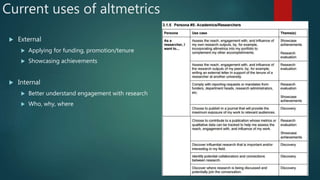
Current uses of altmetrics
 External
 Applying for funding, promotion/tenure
 Showcasing achievements
 Internal
 Better understand engagement with research
 Who, why, where
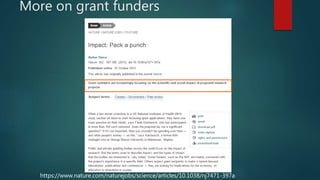
More on grant funders
https://www.nature.com/naturejobs/science/articles/10.1038/nj7471-397a
Grant funders: NSF
 Broader Impacts
 https://www.nsf.gov/od/oia/special/broaderimpacts/
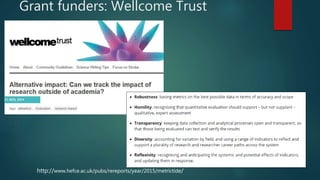
Grant funders: Wellcome Trust
http://www.hefce.ac.uk/pubs/rereports/year/2015/metrictide/
Putting it all together - suggestions
 Develop personal impact goals
 Discipline-specific, research-specific, university-specific, etc.
 Demonstrate achievement of those goals
 Tell your story
 Bibliometrics, altmetrics, and qualitative measures
 Complementary roles
 Track early and often!
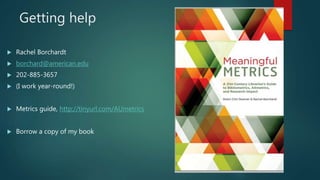
Getting help
 Rachel Borchardt
 borchard@american.edu
 202-885-3657
 (I work year-round!)
 Metrics guide, http://tinyurl.com/AUmetrics
 Borrow a copy of my book
Questions?

CHiR presentation measuring scholarly and public impact

  • 1.
    Measuring Scholarly and PublicImpact: Let’s Talk Metrics RACHEL BORCHARDT MONDAY, MAY 16TH, 2017 BORCHARD@AMERICAN.EDU CONFERENCE FOR HIGH-IMPACT RESEARCH
  • 2.
    Why metrics?  Quantifiablemeasures of research impact  Differentiate articles, journals, authors, institutions  Imperfect calculations of a fuzzy concept
  • 3.
    How are metricsused?  Evaluate researchers:  Hiring  Tenure/promotion  Merit awards  Grant funding  Benchmark programs and institutions Image from AU Faculty Manual, http://www.american.edu/loader.cfm?csModule=security/getfile&pageid=4304081
  • 4.
    What are metrics Traditional Bibliometrics  Based on citation counts  Emerging Altmetrics  Based on online tools Image from Plum Analytics
  • 5.
    Categories of bibliometrics Article-level  Journal-level  Author-level  Institutional-level
  • 6.
    Traditional bibliometrics forjournals  Impact Factor and Citation Counts, created to measure  Journals and journal articles  Scholarly (journal) impact  Initially created for librarians, then largely adopted by STEM Image from Journal Citation Reports (library database)
  • 7.
    Some Impact Factorlimitations  Retrospective measurement  Narrow measurement  Confined by what is indexed as a citation  Can’t be compared between disciplines  Other known issues: language, co-authorship, disproportionate article citation impact Image from Essential Science Indicators (library database)
  • 8.
    One way tocorrect – disciplinary context Image from Journal Citation Reports (library database)
  • 9.
    Contextual limitations –“Political Science” category List from http://www.auspsa.org.au/publications
  • 10.
    Other major bibliometrics Metrics from Web of Science: Eigenfactor, Immediacy Index, Cited Half-Life  Metrics from Elsevier/Scopus: SJR, SNIP, IPP, CiteScore  Metrics from Google Scholar: H5-index, H5-median Image from http://www.journalmetrics.com
  • 11.
    SJR comparison –“Political Science and International Relations”
  • 12.
    H5-index comparison –Political Science List from Google Scholar Metrics
  • 13.
    Another alternative –citation distributions http://www.nature.com/news/beat-it-impact-factor-publishing-elite-turns-against-controversial-metric-1.20224
  • 14.
    Why altmetrics?  Measuresbroader scholarly outputs  Books, presentations, data sets, software code, and more  More measures of scholarship  Views, downloads, shares, mentions in blogs, policy papers, and more  More immediate metrics  Measures beyond scholarly impact  Policy, public, and more https://becker.wustl.edu/impact-assessment
  • 15.
    What are altmetrics? Definition: The creation and study of new metrics based on the social web for analyzing and informing scholarship. Altmetrics.org  My definition: The umbrella classification of non-citation based metrics. http://altmetrics.org/manifesto ; http://twitter.com/jasonpriem
  • 16.
    Categories of altmetrics Article-level[individual work]  Journal-level  Author-level  Institutional-level
  • 17.
  • 18.
    How do wecollect altmetrics?  Directly from the individual tools  From publishers (views, download data)  From (some) library databases  From scholarly networks  Through aggregating tools Slideshare views PLOS article metrics Web of Science usage ResearchGate metrics Altmetric metrics
  • 19.
    “Impact” and metrics Inherently fuzzy and subjective  Attention  Engagement  Some correlate to bibliometrics; some don’t
  • 20.
  • 21.
  • 22.
    Deciphering impact fromtools - Altmetric
  • 23.
  • 24.
  • 25.
  • 26.
    Limitations of impact:example  https://www.altmetric.com/details/2313862/policy-documents  https://www.healthypeople.gov/2020/topics-objectives/topic/Adolescent- Health  https://www.google.com/search?q=%22Trends+in+adolescent+and+youn g+adult+health+in+the+United+States%22+site%3A.gov&oq=%22Trends +in+adolescent+and+young+adult+health+in+the+United+States%22+si te%3A.gov&aqs=chrome..69i57.3775j0j8&sourceid=chrome&ie=UTF-8
  • 27.
    Current uses ofaltmetrics  External  Applying for funding, promotion/tenure  Showcasing achievements  Internal  Better understand engagement with research  Who, why, where
  • 28.
    More on grantfunders https://www.nature.com/naturejobs/science/articles/10.1038/nj7471-397a
  • 29.
    Grant funders: NSF Broader Impacts  https://www.nsf.gov/od/oia/special/broaderimpacts/
  • 30.
    Grant funders: WellcomeTrust http://www.hefce.ac.uk/pubs/rereports/year/2015/metrictide/
  • 31.
    Putting it alltogether - suggestions  Develop personal impact goals  Discipline-specific, research-specific, university-specific, etc.  Demonstrate achievement of those goals  Tell your story  Bibliometrics, altmetrics, and qualitative measures  Complementary roles  Track early and often!
  • 32.
    Getting help  RachelBorchardt  borchard@american.edu  202-885-3657  (I work year-round!)  Metrics guide, http://tinyurl.com/AUmetrics  Borrow a copy of my book
  • 33.