THE INTERSECTION
BET WEEN PROFESSOR
EXPECTATIONS AND STUDENT
INTERPRETATIONS OF
ACADEMIC SKILLS :
A M U L T I - D I S C I P L I N A R Y A P P R O A C H
Melanie Parlette-Stewart | Laura Schnablegger (absent) | Shannon Rushe
INTRODUCTION
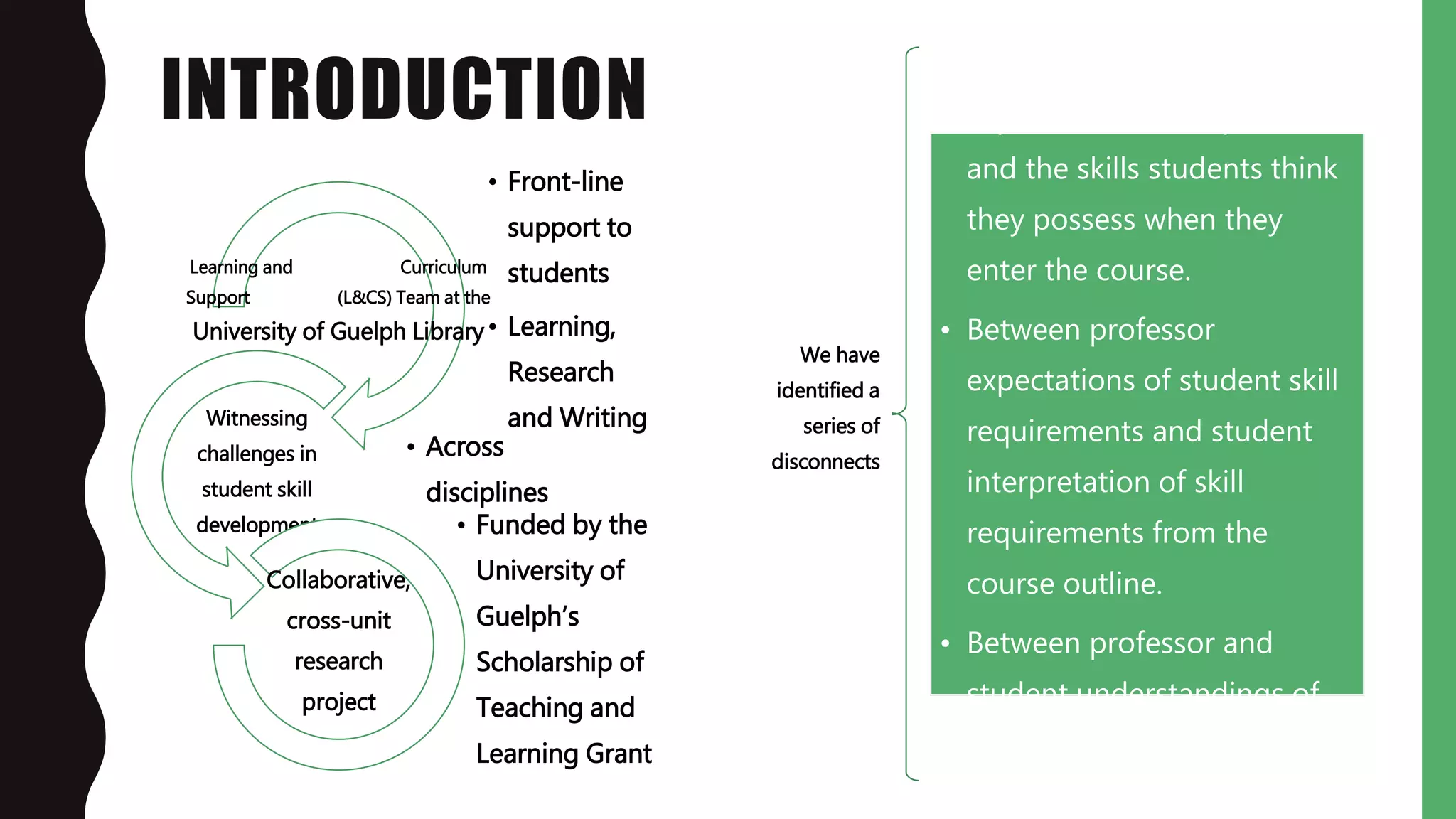
• Front-line
support to
students
• Learning,
Research
and Writing
Learning and Curriculum
Support (L&CS) Team at the
University of Guelph Library
• Across
disciplines
Witnessing
challenges in
student skill
development • Funded by the
University of
Guelph’s
Scholarship of
Teaching and
Learning Grant
Collaborative,
cross-unit
research
project
We have
identified a
series of
disconnects
writing and information
literacy skills professors
expect students to possess
and the skills students think
they possess when they
enter the course.
• Between professor
expectations of student skill
requirements and student
interpretation of skill
requirements from the
course outline.
• Between professor and
student understandings of
where students should
develop these skills (i.e. in
OBJECTIVES
To identify the gap between the
learning, writing and information
literacy skills professors expect
students to possess before a
course and which of these skills
students think that they have
when they enter the course
To identify which skills professors
explicitly articulate to their
students and indicate they expect
in their courses, and which skills
professors expect students to
develop outside of the course
To identify which skills students
seek to develop based on their
interpretations of professor
expectations
To evaluate, across multiple
disciplines, students’ ability to
articulate and identify the skills
necessary for particular third-year
courses before and after taking
these courses
To recommend curriculum
support and academic service
delivery based on these findings.
To inform the content strategy of
the Virtual Learning Commons
LITERATURE REVIEW
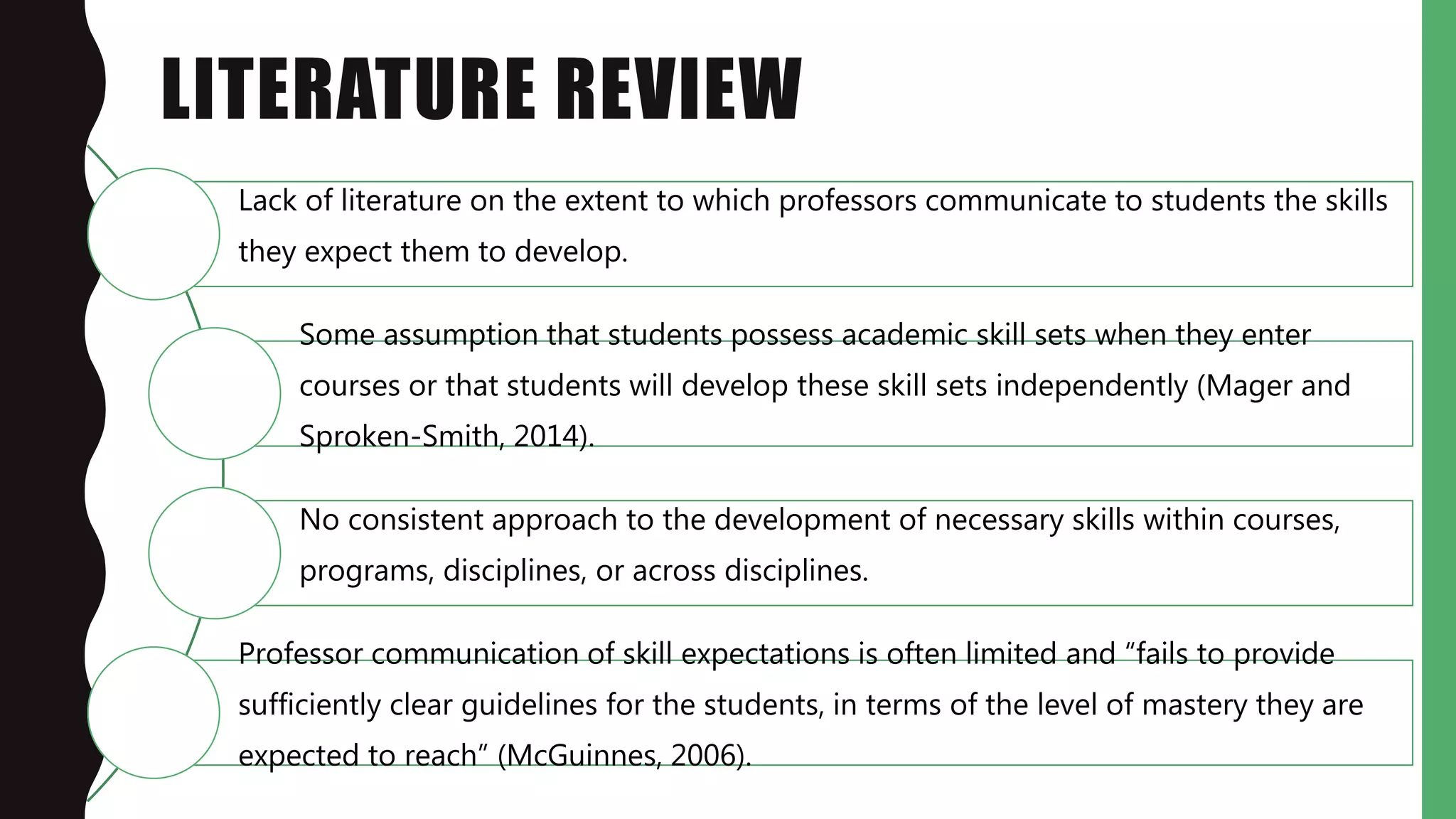
Lack of literature on the extent to which professors communicate to students the skills
they expect them to develop.
Some assumption that students possess academic skill sets when they enter
courses or that students will develop these skill sets independently (Mager and
Sproken-Smith, 2014).
No consistent approach to the development of necessary skills within courses,
programs, disciplines, or across disciplines.
Professor communication of skill expectations is often limited and “fails to provide
sufficiently clear guidelines for the students, in terms of the level of mastery they are
expected to reach” (McGuinnes, 2006).
DATA COLLECTION
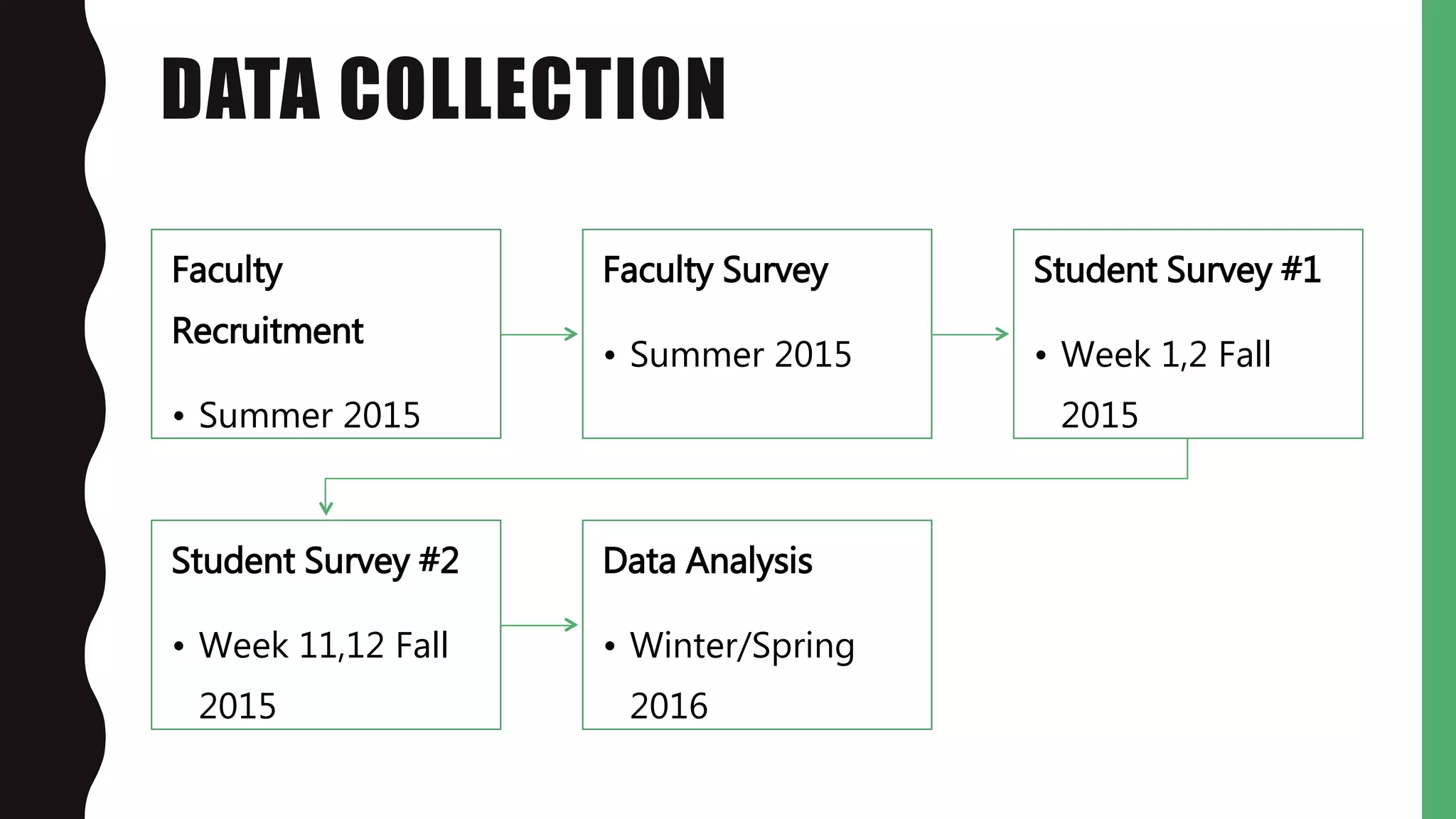
Faculty
Recruitment
• Summer 2015
Faculty Survey
• Summer 2015
Student Survey #1
• Week 1,2 Fall
2015
Student Survey #2
• Week 11,12 Fall
2015
Data Analysis
• Winter/Spring
2016
DATA OVERVIEW
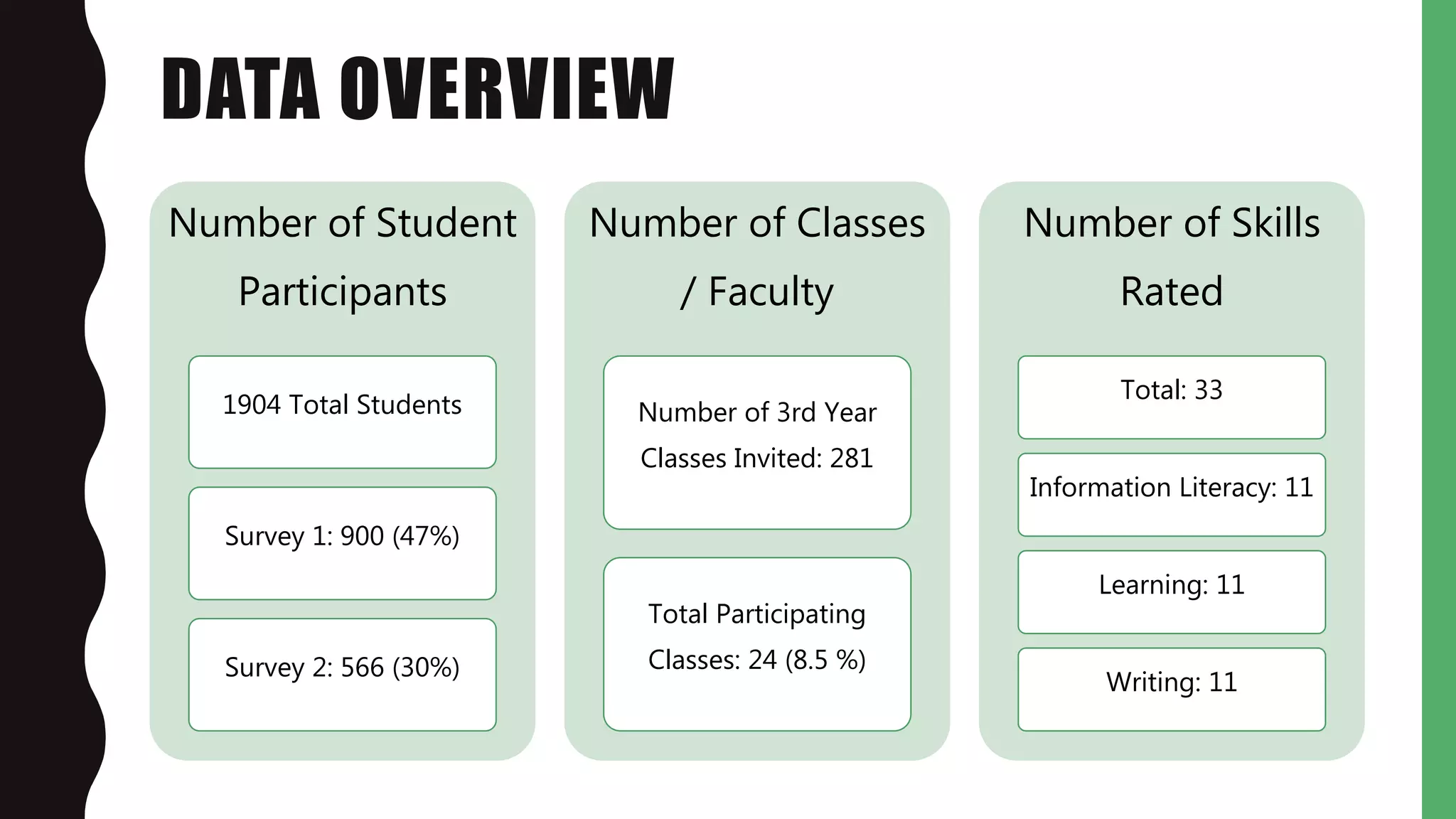
Number of Student
Participants
1904 Total Students
Survey 1: 900 (47%)
Survey 2: 566 (30%)
Number of Classes
/ Faculty
Number of 3rd Year
Classes Invited: 281
Total Participating
Classes: 24 (8.5 %)
Number of Skills
Rated
Total: 33
Information Literacy: 11
Learning: 11
Writing: 11
DATA OVERVIEW
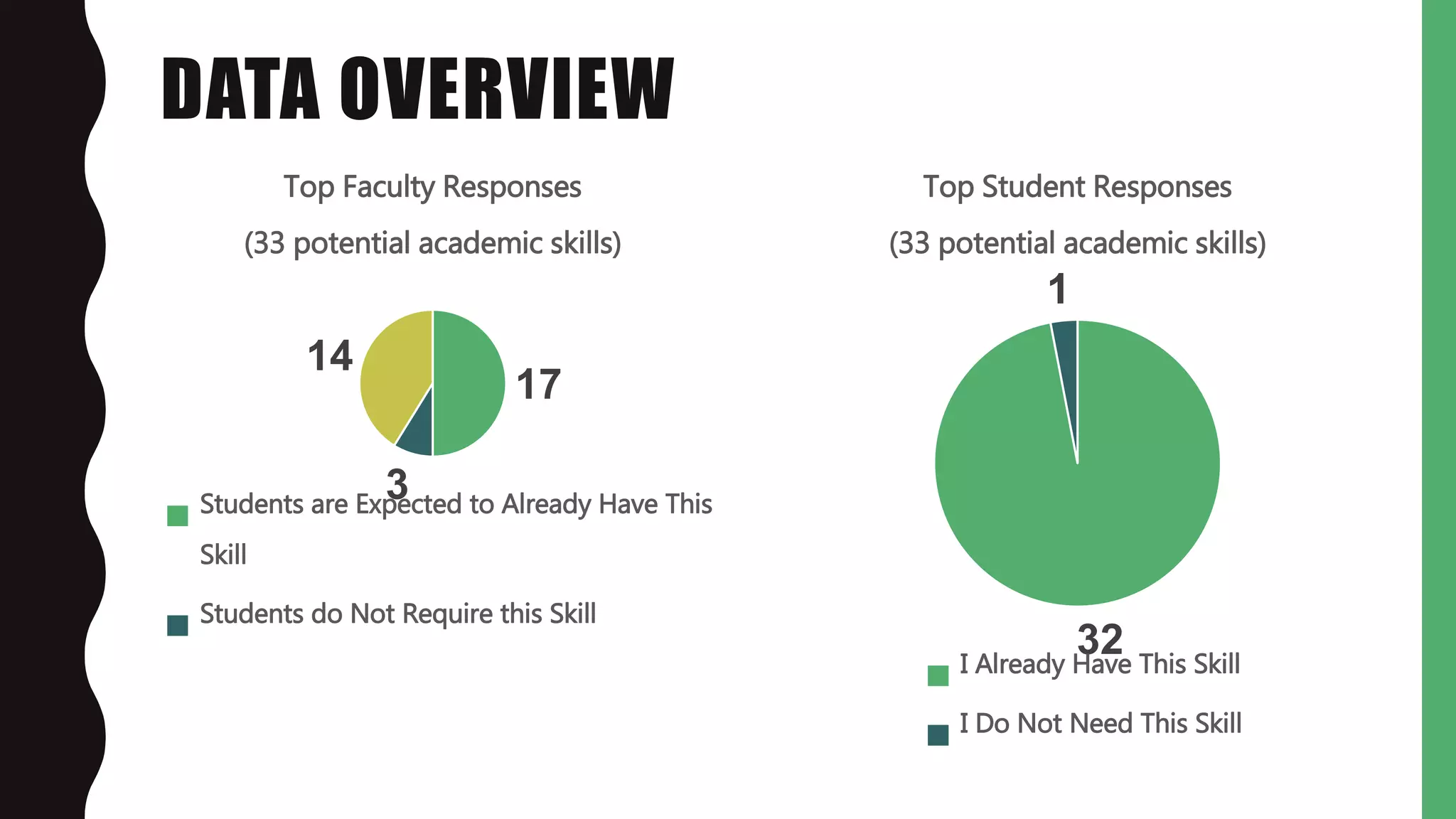
32
1
Top Student Responses
(33 potential academic skills)
I Already Have This Skill
I Do Not Need This Skill
17
3
14
Top Faculty Responses
(33 potential academic skills)
Students are Expected to Already Have This
Skill
Students do Not Require this Skill
DATA OVERVIEW
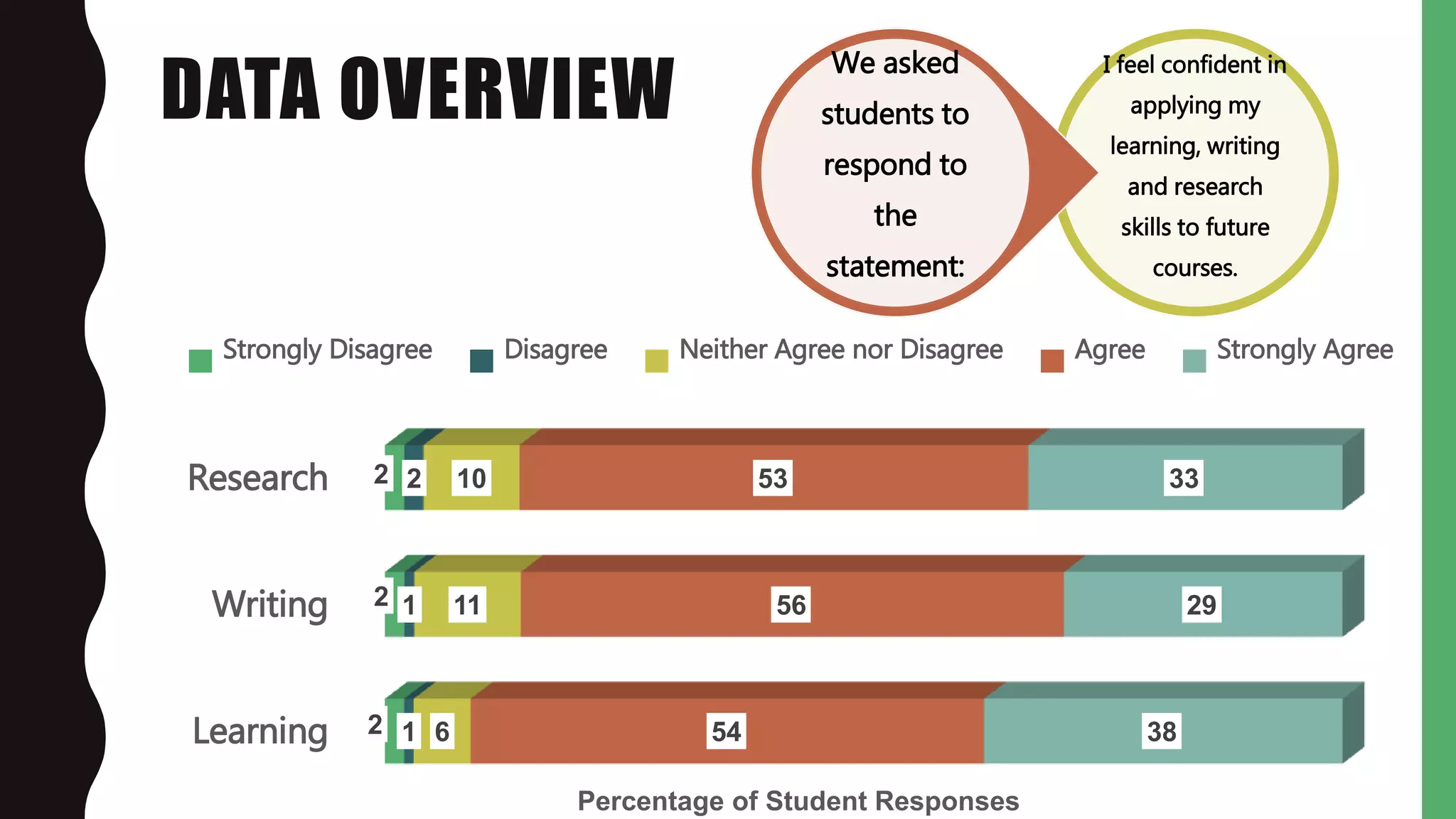
Learning
Writing
Research
2
2
2
1
1
2
6
11
10
54
56
53
38
29
33
Percentage of Student Responses
Strongly Disagree Disagree Neither Agree nor Disagree Agree Strongly Agree
I feel confident in
applying my
learning, writing
and research
skills to future
courses.
We asked
students to
respond to
the
statement:
DISCOVERING THE DISCREPANCIES
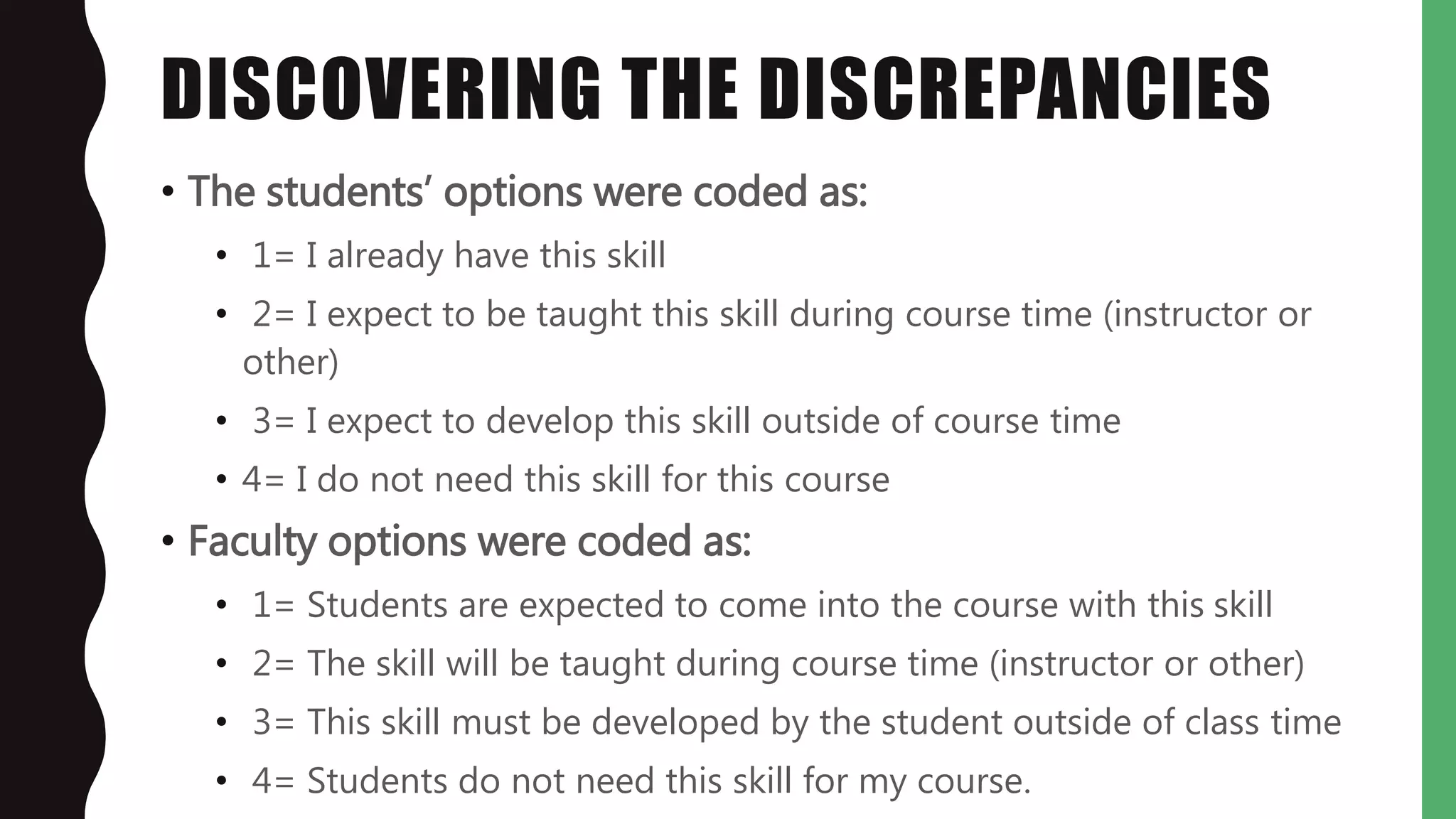
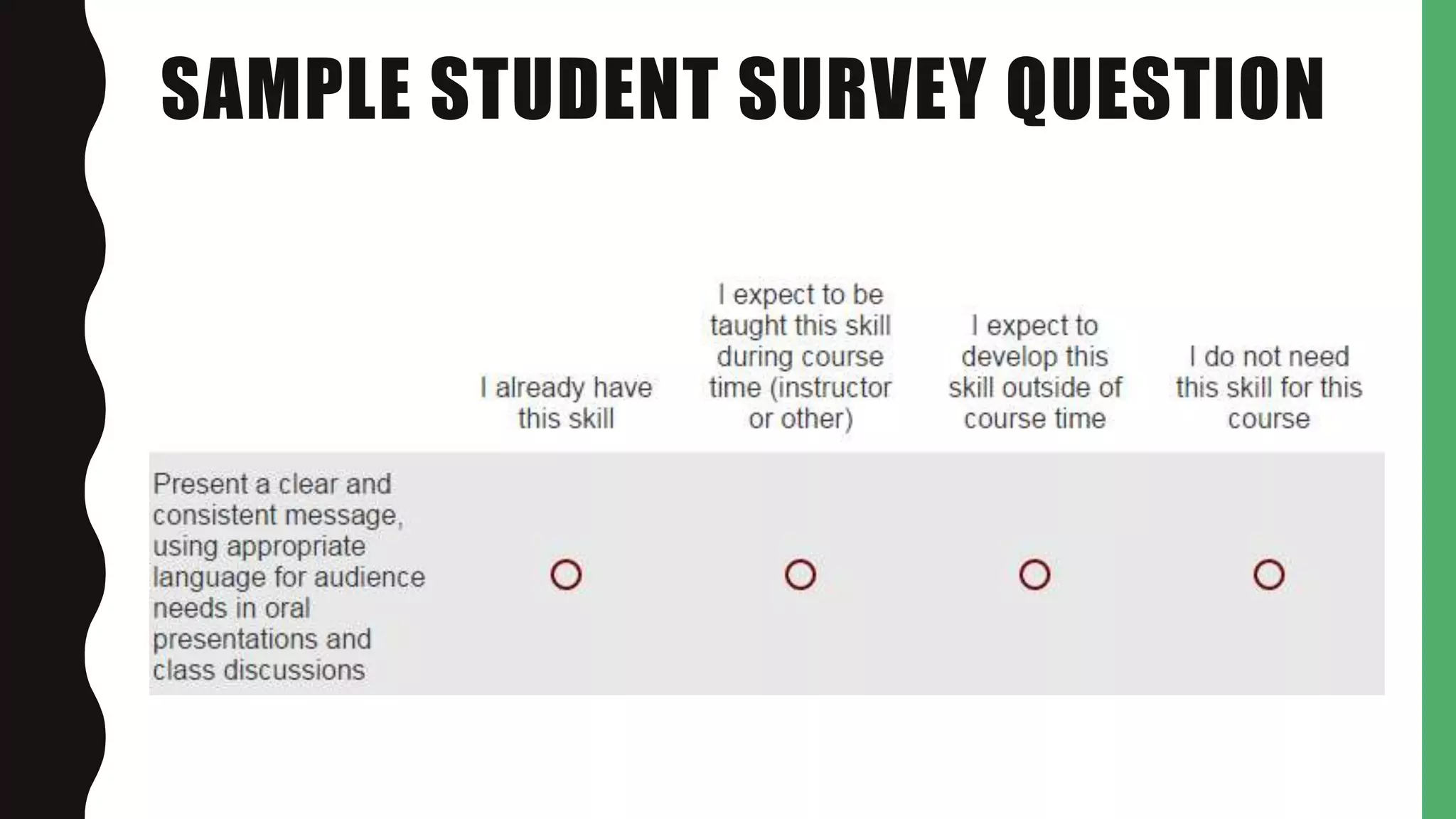
• The students’ options were coded as:
• 1= I already have this skill
• 2= I expect to be taught this skill during course time (instructor or
other)
• 3= I expect to develop this skill outside of course time
• 4= I do not need this skill for this course
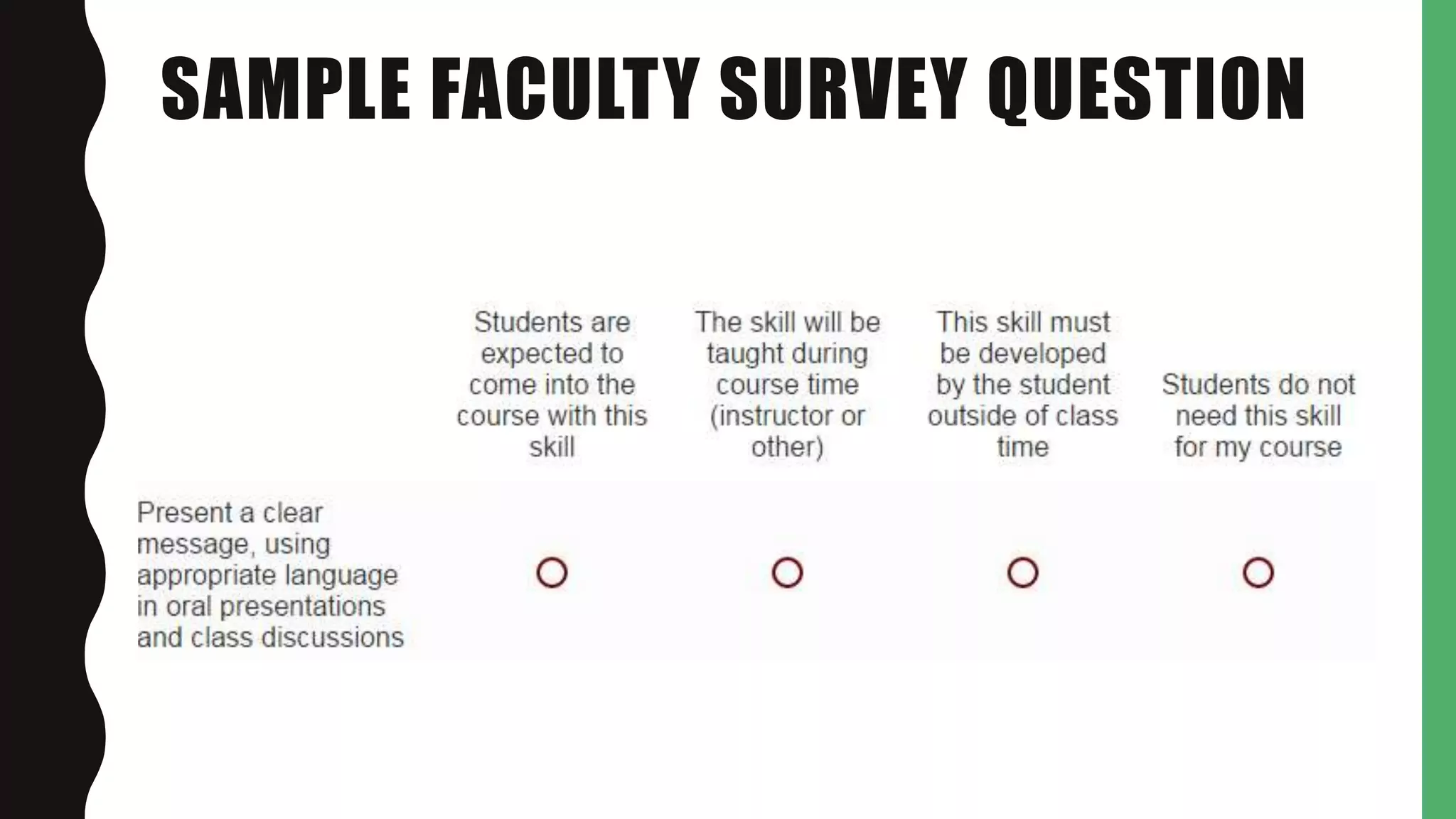
• Faculty options were coded as:
• 1= Students are expected to come into the course with this skill
• 2= The skill will be taught during course time (instructor or other)
• 3= This skill must be developed by the student outside of class time
• 4= Students do not need this skill for my course.
SAMPLE STUDENT SURVEY QUESTION
SAMPLE FACULTY SURVEY QUESTION
DISCOVERING THE DISCREPANCIES
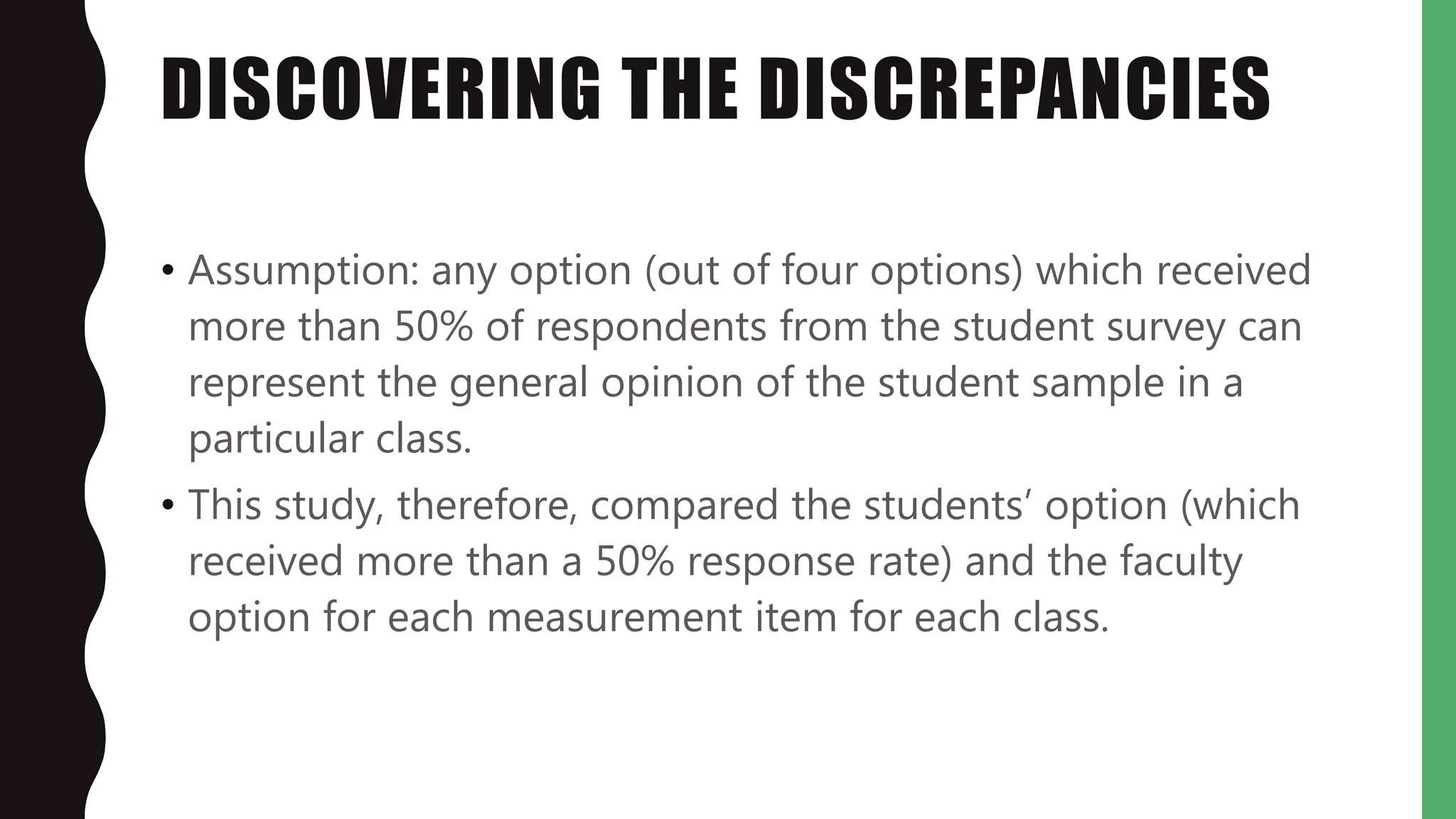
• Assumption: any option (out of four options) which received
more than 50% of respondents from the student survey can
represent the general opinion of the student sample in a
particular class.
• This study, therefore, compared the students’ option (which
received more than a 50% response rate) and the faculty
option for each measurement item for each class.
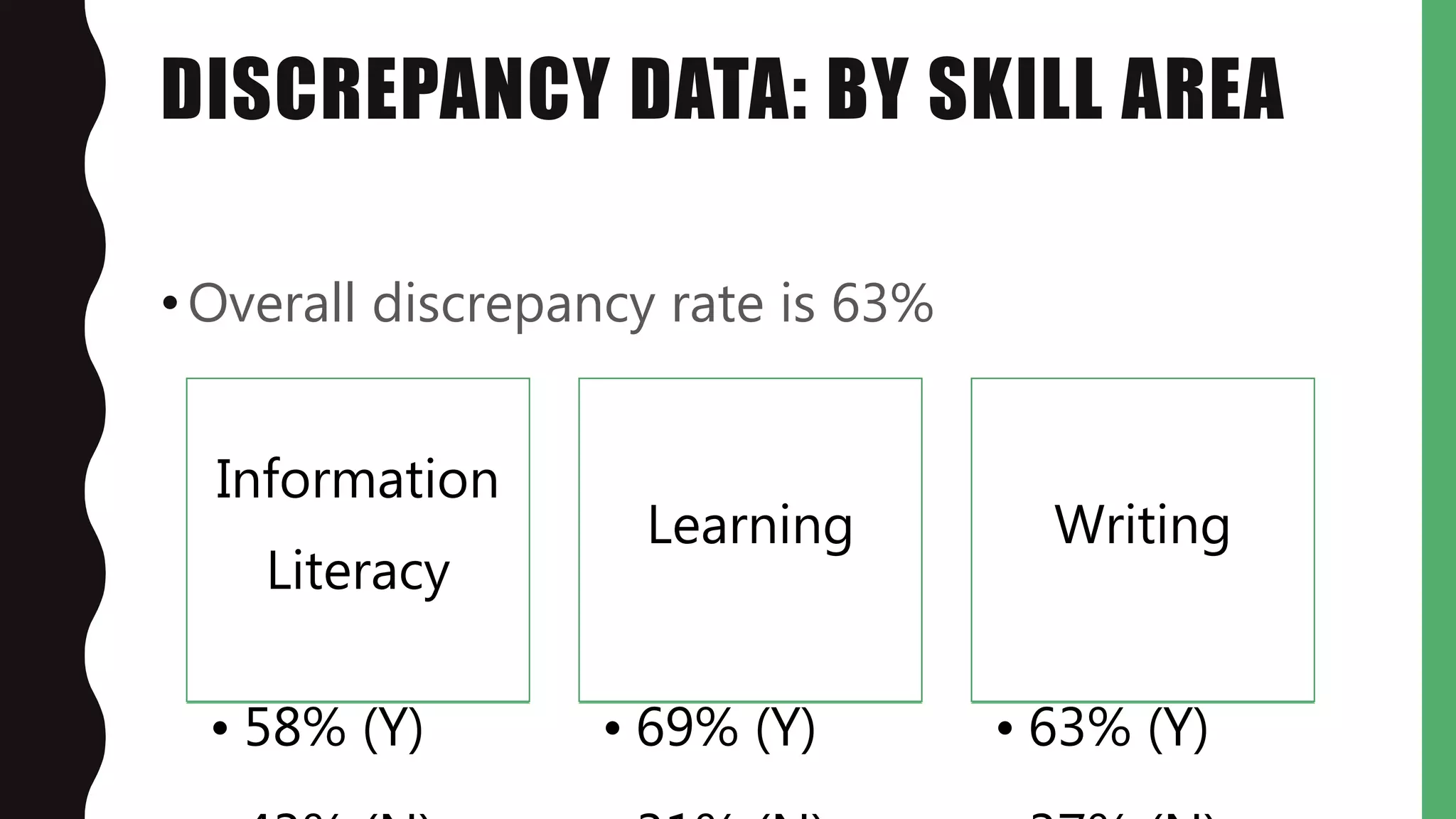
DISCREPANCY DATA: BY SKILL AREA
•Overall discrepancy rate is 63%
Information
Literacy
• 58% (Y)
Learning
• 69% (Y)
Writing
• 63% (Y)
SAMPLE DISCREPANCY FINDINGS:
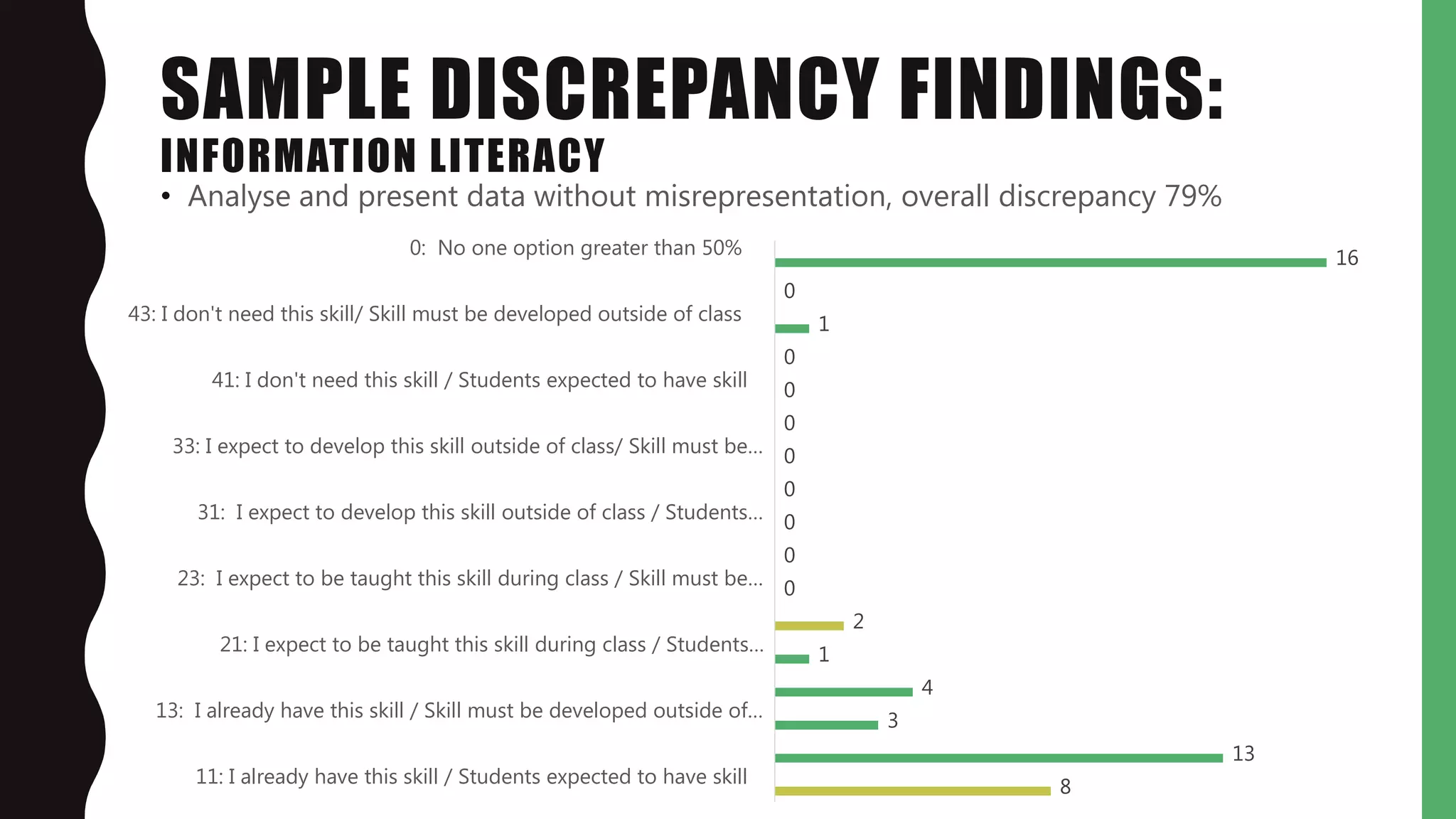
INFORMATION LITERACY
• Analyse and present data without misrepresentation, overall discrepancy 79%
8
13
3
4
1
2
0
0
0
0
0
0
0
0
1
0
16
11: I already have this skill / Students expected to have skill
13: I already have this skill / Skill must be developed outside of…
21: I expect to be taught this skill during class / Students…
23: I expect to be taught this skill during class / Skill must be…
31: I expect to develop this skill outside of class / Students…
33: I expect to develop this skill outside of class/ Skill must be…
41: I don't need this skill / Students expected to have skill
43: I don't need this skill/ Skill must be developed outside of class
0: No one option greater than 50%
SAMPLE DISCREPANCY FINDINGS:
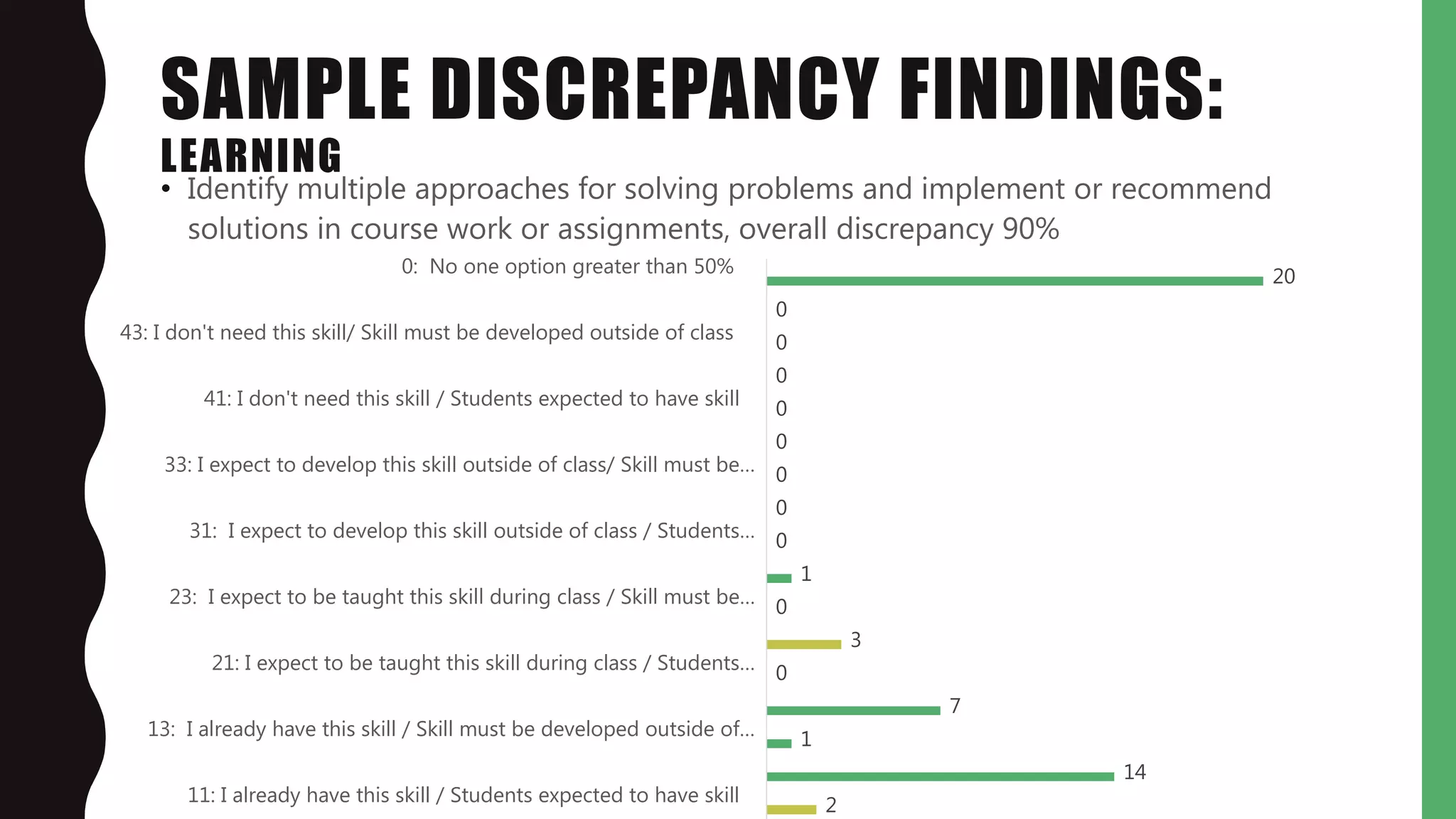
LEARNING
• Identify multiple approaches for solving problems and implement or recommend
solutions in course work or assignments, overall discrepancy 90%
2
14
1
7
0
3
0
1
0
0
0
0
0
0
0
0
20
11: I already have this skill / Students expected to have skill
13: I already have this skill / Skill must be developed outside of…
21: I expect to be taught this skill during class / Students…
23: I expect to be taught this skill during class / Skill must be…
31: I expect to develop this skill outside of class / Students…
33: I expect to develop this skill outside of class/ Skill must be…
41: I don't need this skill / Students expected to have skill
43: I don't need this skill/ Skill must be developed outside of class
0: No one option greater than 50%
SAMPLE DISCREPANCY FINDINGS:
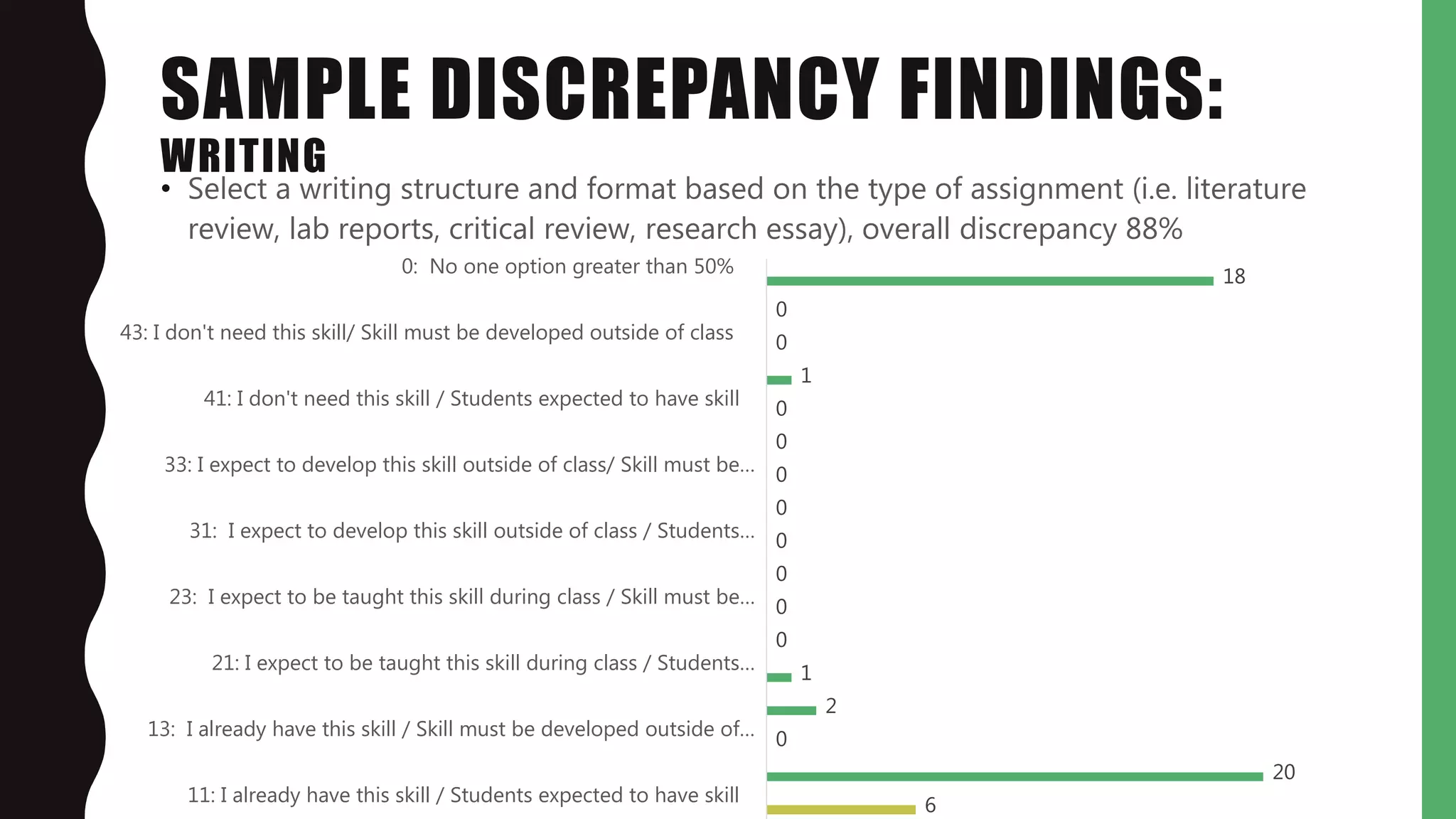
WRITING
• Select a writing structure and format based on the type of assignment (i.e. literature
review, lab reports, critical review, research essay), overall discrepancy 88%
6
20
0
2
1
0
0
0
0
0
0
0
0
1
0
0
18
11: I already have this skill / Students expected to have skill
13: I already have this skill / Skill must be developed outside of…
21: I expect to be taught this skill during class / Students…
23: I expect to be taught this skill during class / Skill must be…
31: I expect to develop this skill outside of class / Students…
33: I expect to develop this skill outside of class/ Skill must be…
41: I don't need this skill / Students expected to have skill
43: I don't need this skill/ Skill must be developed outside of class
0: No one option greater than 50%
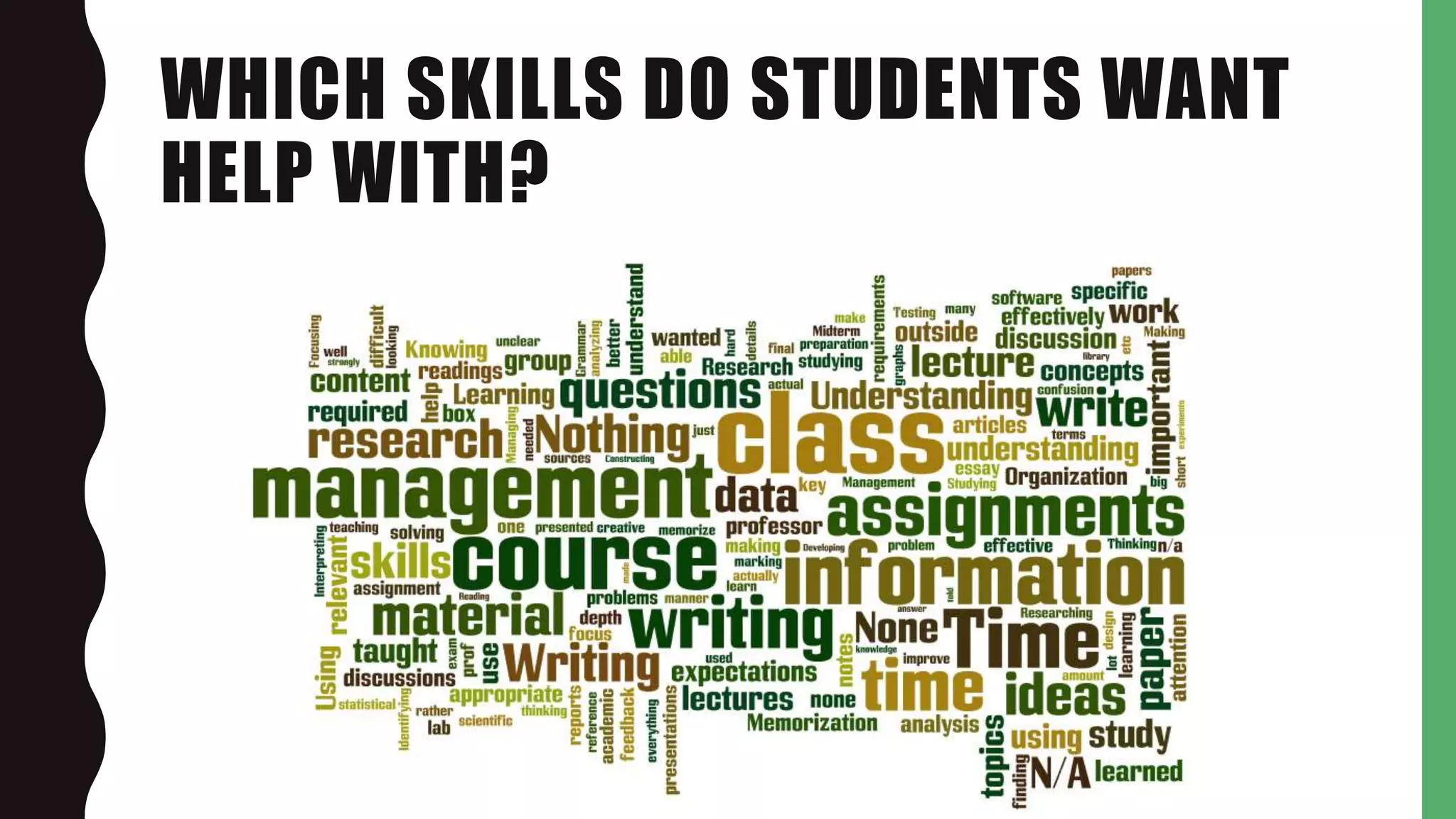
WHICH SKILLS DO STUDENTS WANT
HELP WITH?
WHICH SKILLS DO STUDENTS WANT HELP WITH?
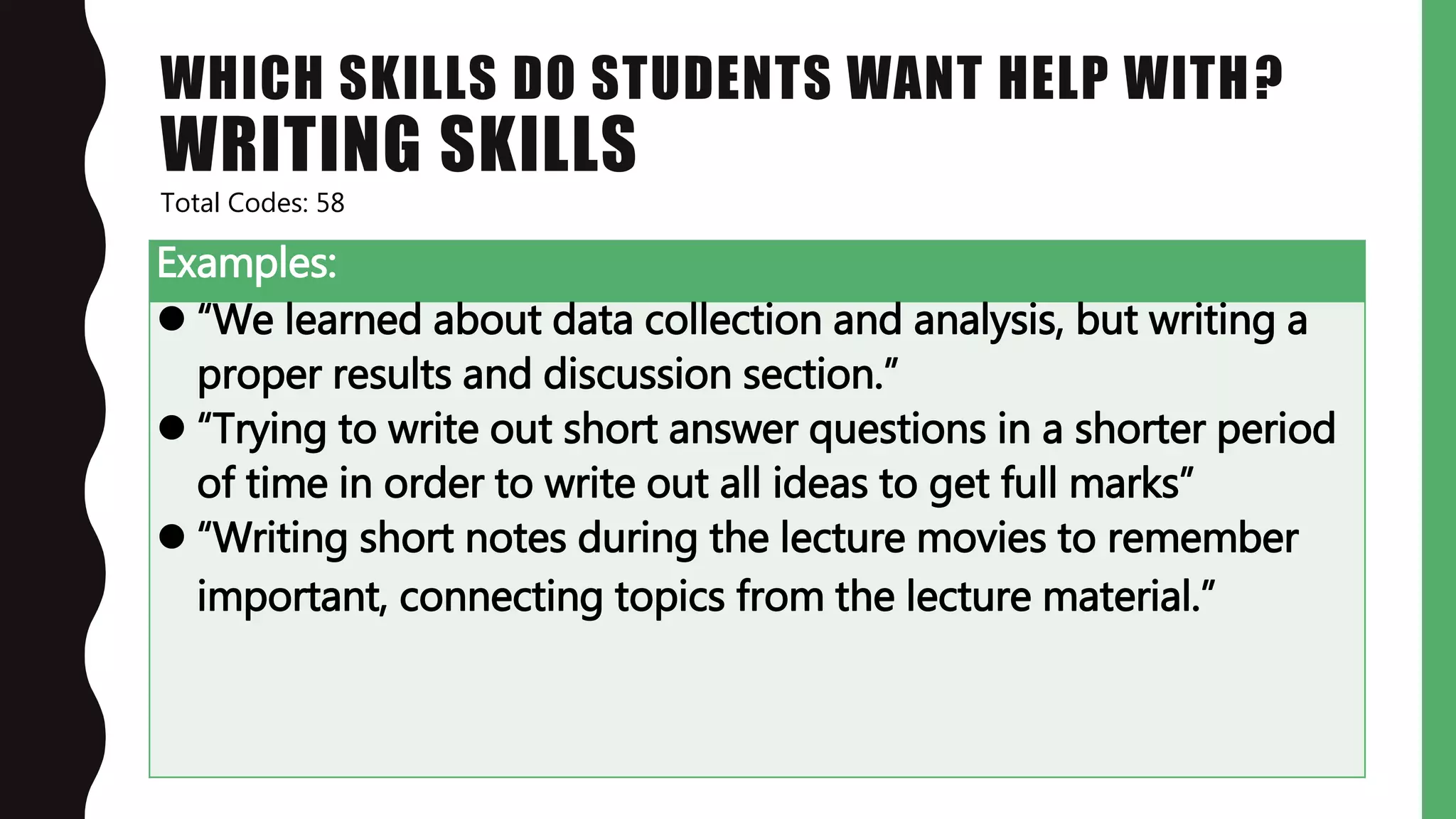
WRITING SKILLS
Examples:
 “We learned about data collection and analysis, but writing a
proper results and discussion section.”
 “Trying to write out short answer questions in a shorter period
of time in order to write out all ideas to get full marks”
 “Writing short notes during the lecture movies to remember
important, connecting topics from the lecture material.”
Total Codes: 58
WHICH SKILLS DO STUDENTS WANT HELP WITH?
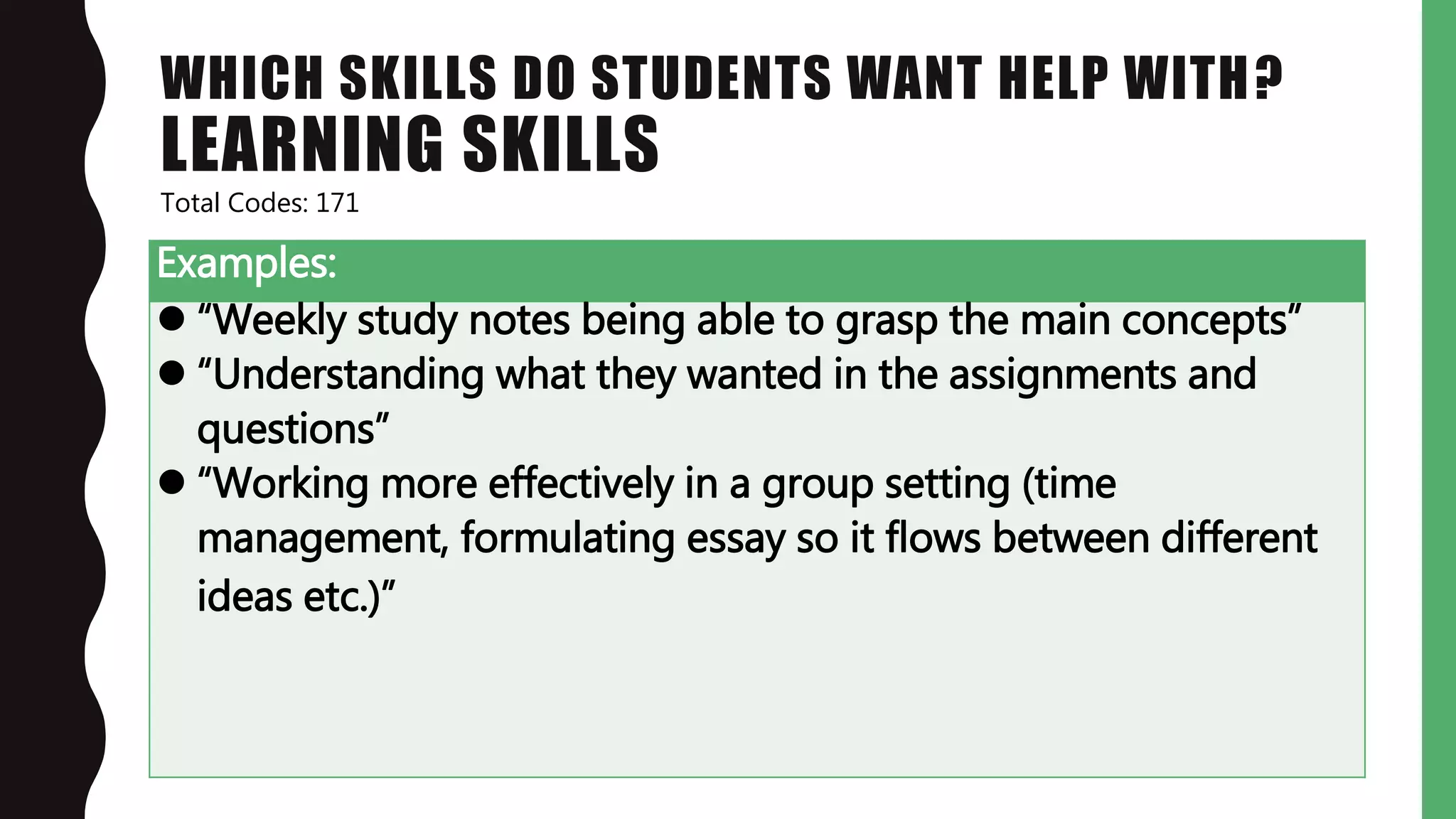
LEARNING SKILLS
Examples:
 “Weekly study notes being able to grasp the main concepts”
 “Understanding what they wanted in the assignments and
questions”
 “Working more effectively in a group setting (time
management, formulating essay so it flows between different
ideas etc.)”
Total Codes: 171
WHICH SKILLS DO STUDENTS WANT HELP WITH?
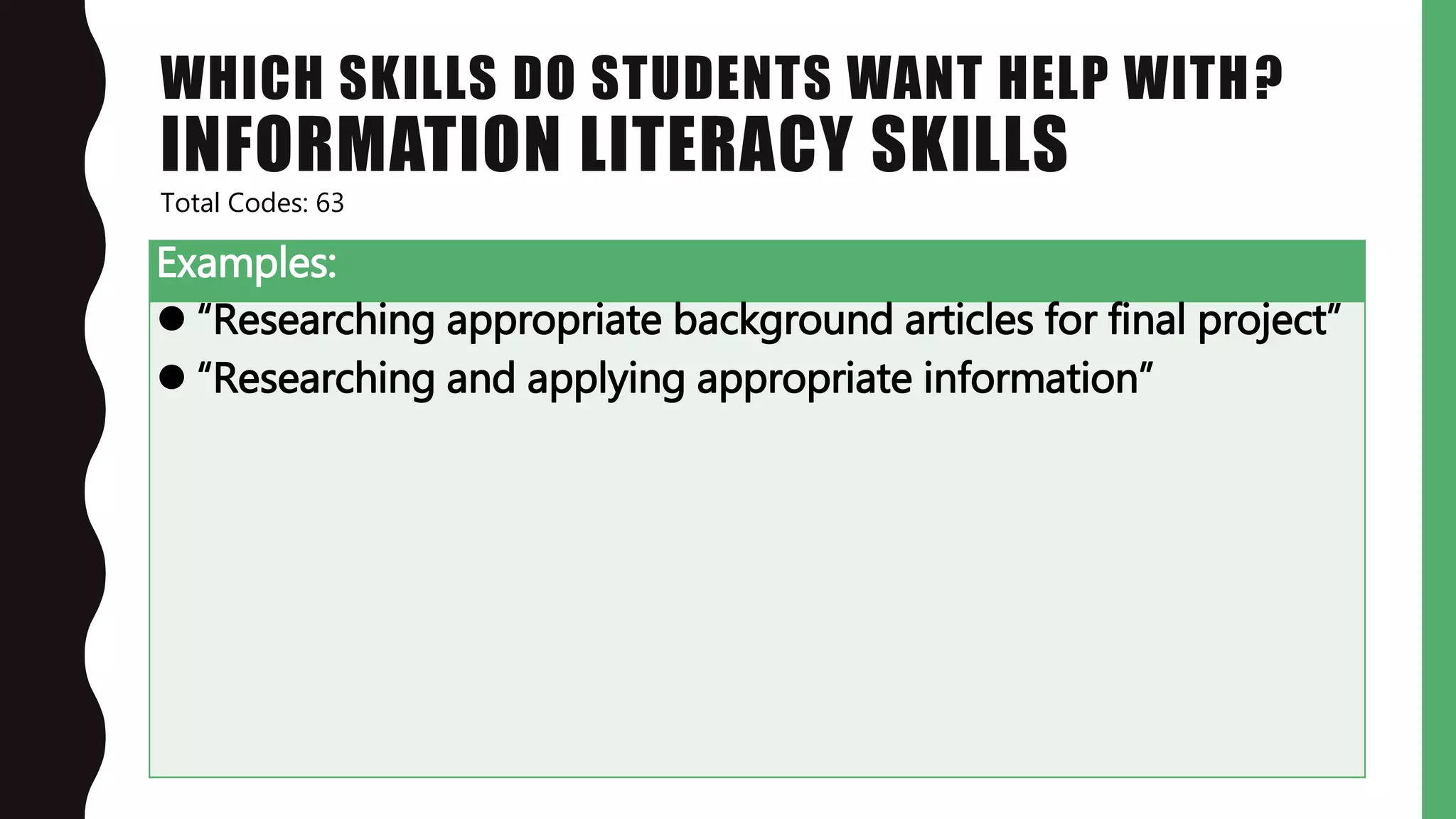
INFORMATION LITERACY SKILLS
Examples:
 “Researching appropriate background articles for final project”
 “Researching and applying appropriate information”
Total Codes: 63
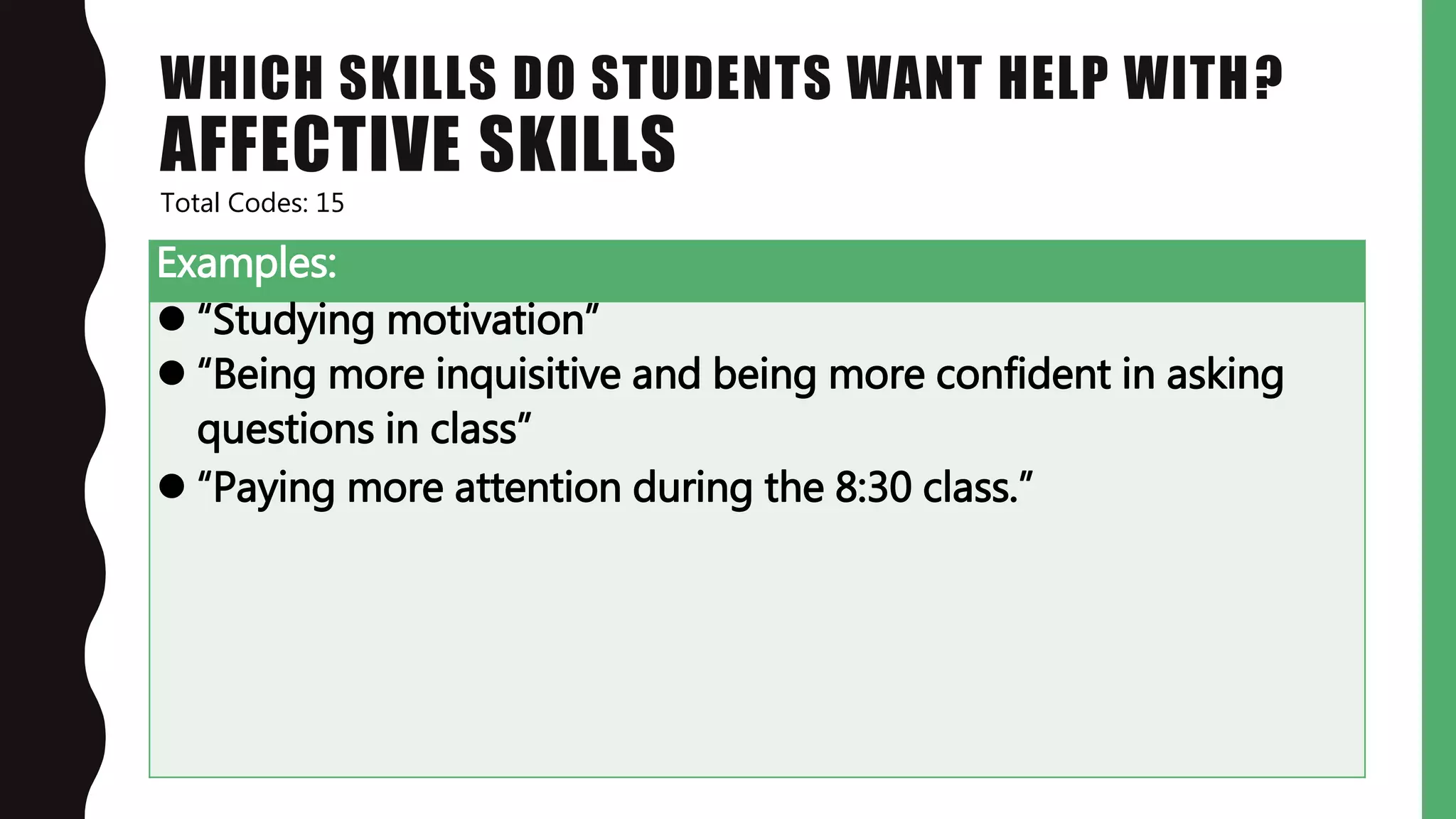
WHICH SKILLS DO STUDENTS WANT HELP WITH?
AFFECTIVE SKILLS
Examples:
 “Studying motivation”
 “Being more inquisitive and being more confident in asking
questions in class”
 “Paying more attention during the 8:30 class.”
Total Codes: 15
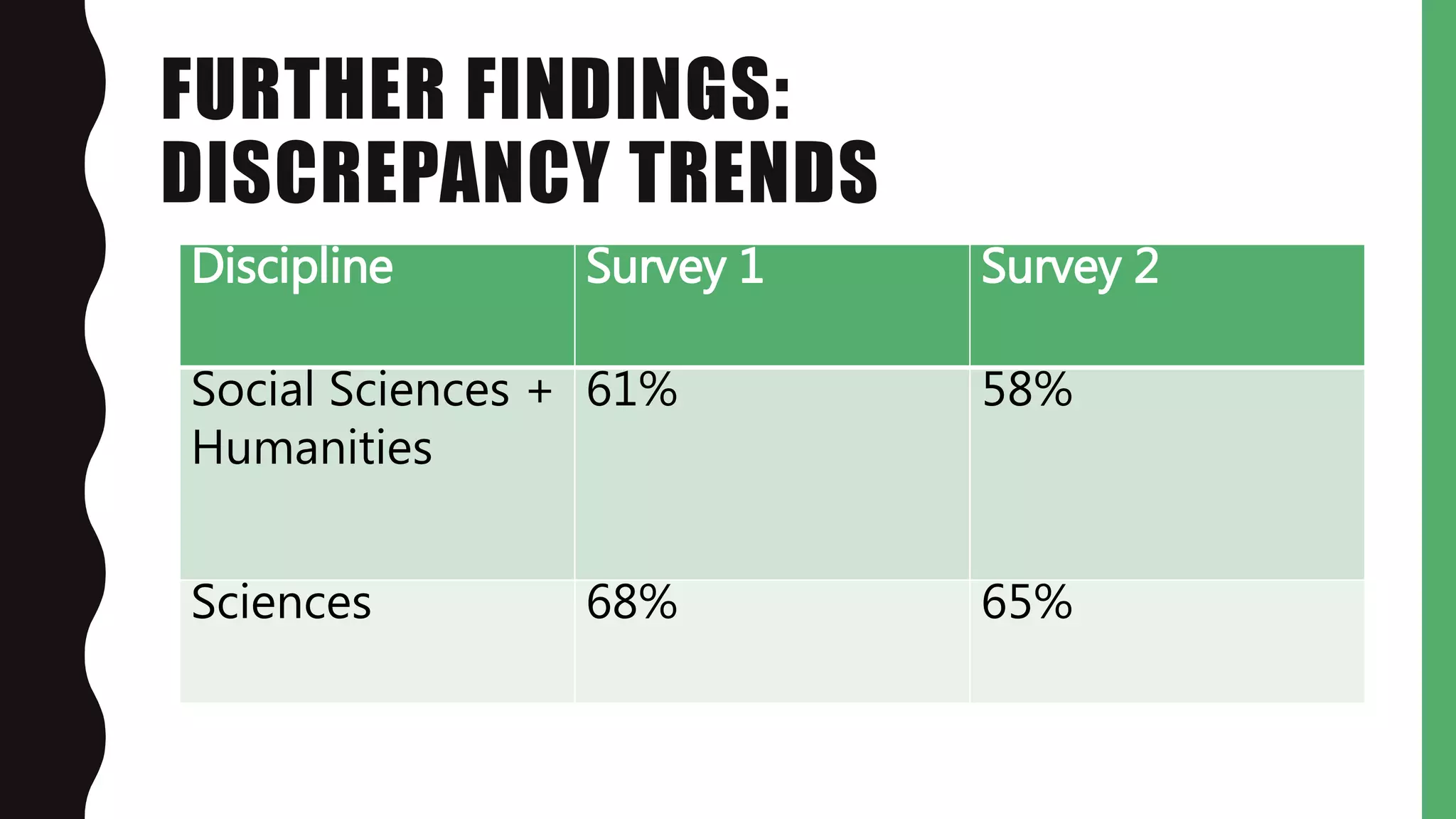
FURTHER FINDINGS:
DISCREPANCY TRENDS
Discipline Survey 1 Survey 2
Social Sciences +
Humanities
61% 58%
Sciences 68% 65%
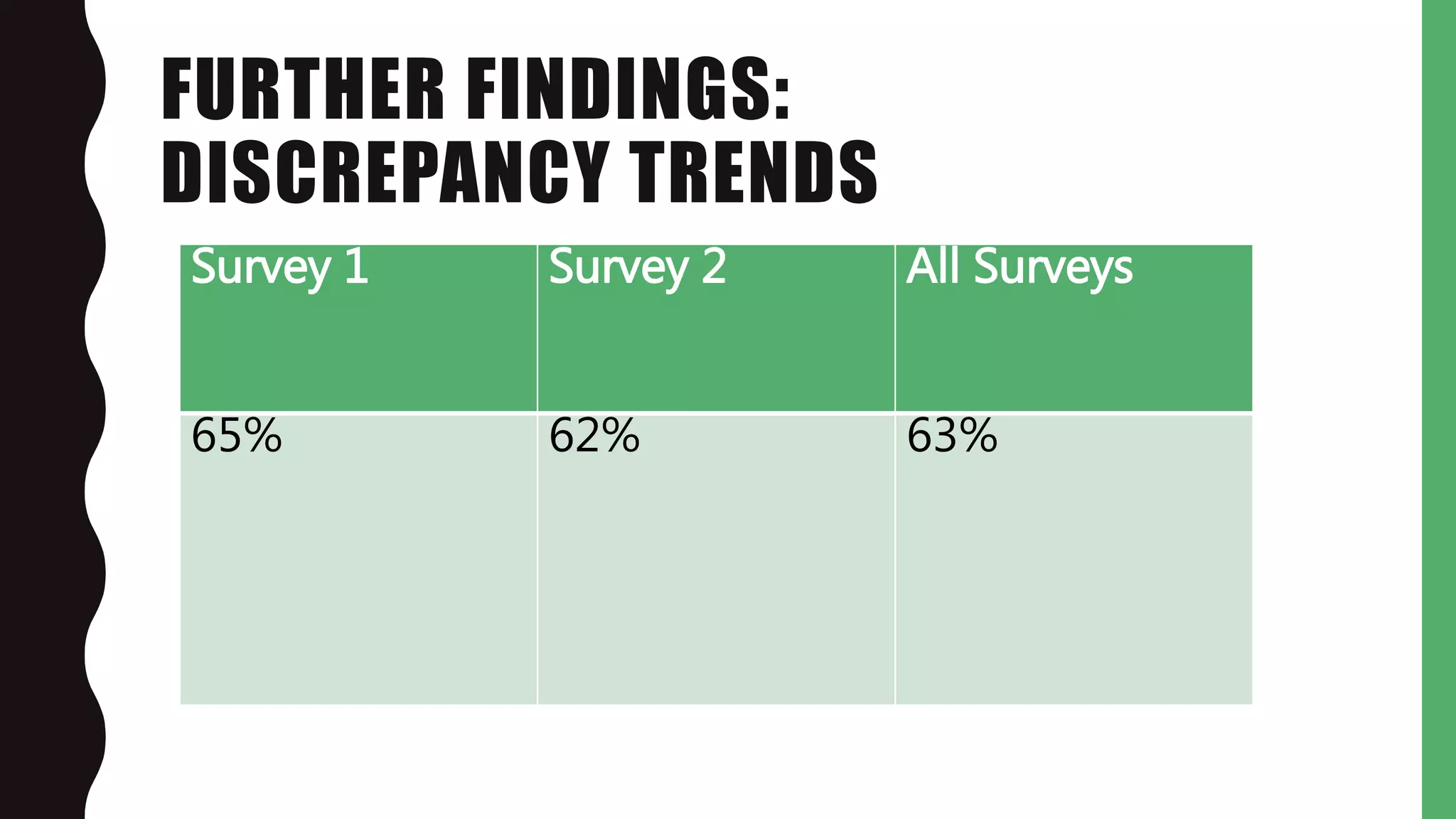
FURTHER FINDINGS:
DISCREPANCY TRENDS
Survey 1 Survey 2 All Surveys
65% 62% 63%
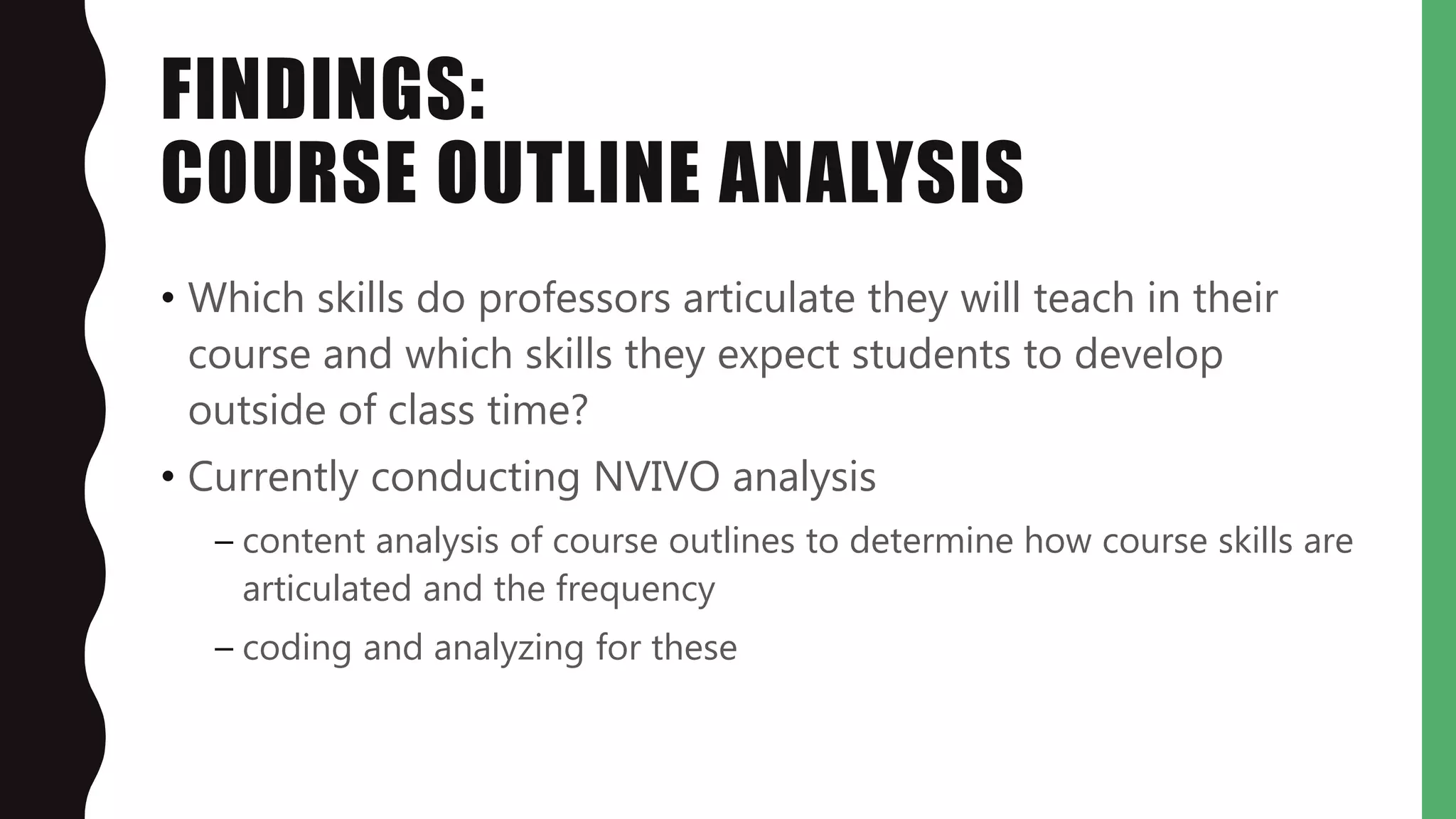
FINDINGS:
COURSE OUTLINE ANALYSIS
• Which skills do professors articulate they will teach in their
course and which skills they expect students to develop
outside of class time?
• Currently conducting NVIVO analysis
– content analysis of course outlines to determine how course skills are
articulated and the frequency
– coding and analyzing for these
IMPLICATIONS
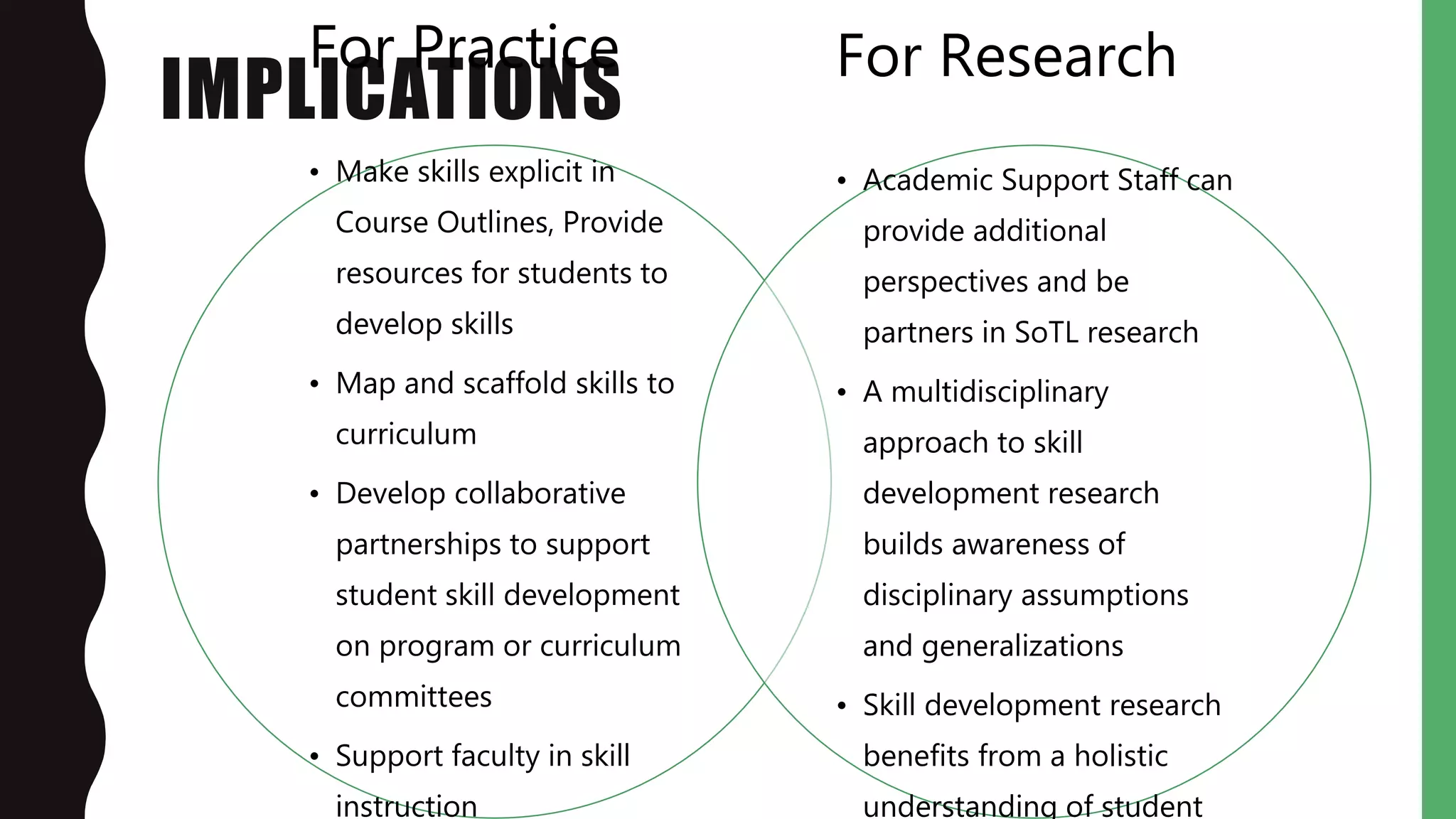
For Practice
• Make skills explicit in
Course Outlines, Provide
resources for students to
develop skills
• Map and scaffold skills to
curriculum
• Develop collaborative
partnerships to support
student skill development
on program or curriculum
committees
• Support faculty in skill
instruction
For Research
• Academic Support Staff can
provide additional
perspectives and be
partners in SoTL research
• A multidisciplinary
approach to skill
development research
builds awareness of
disciplinary assumptions
and generalizations
• Skill development research
benefits from a holistic
understanding of student
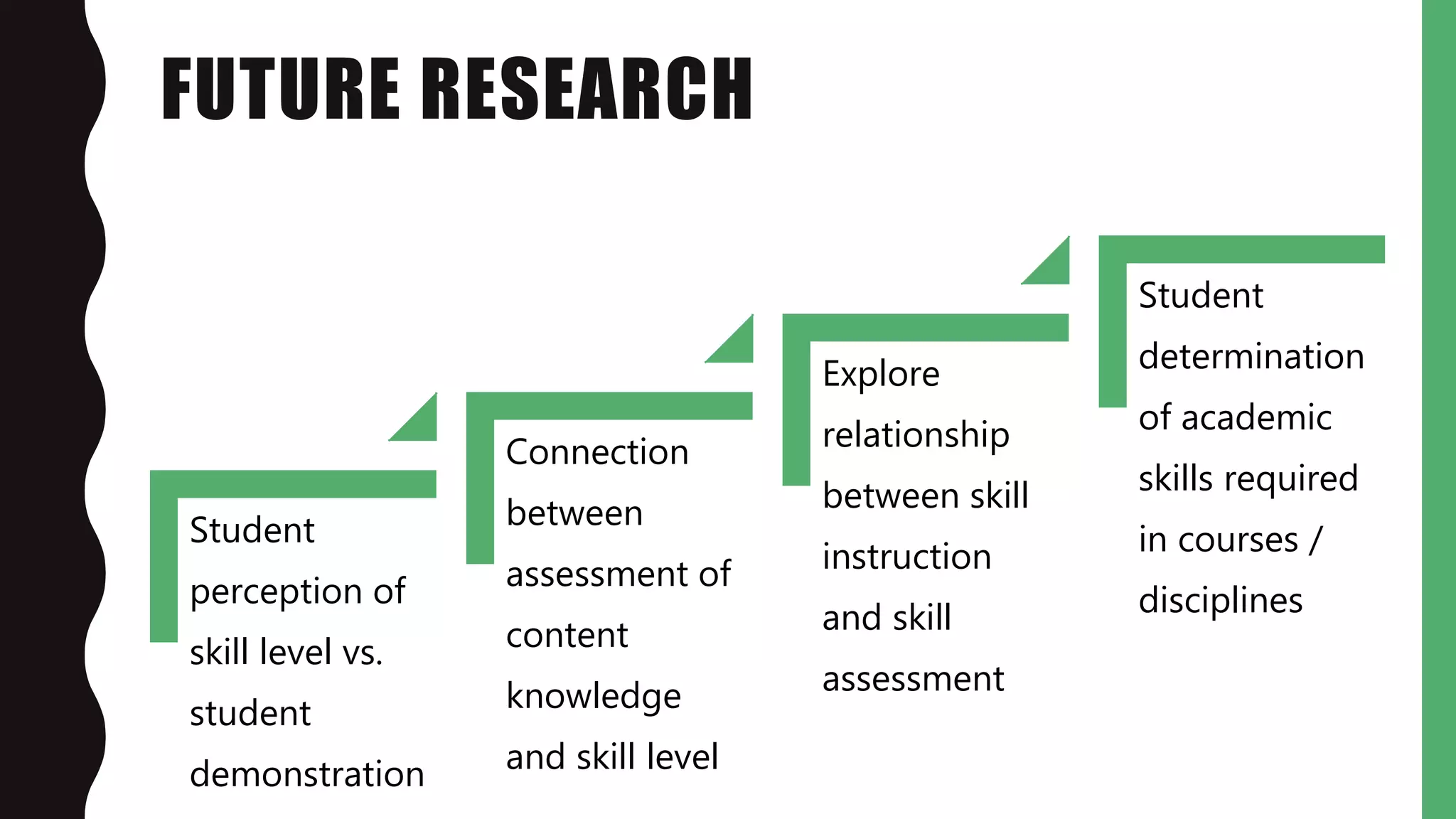
FUTURE RESEARCH
Student
perception of
skill level vs.
student
demonstration
Connection
between
assessment of
content
knowledge
and skill level
Explore
relationship
between skill
instruction
and skill
assessment
Student
determination
of academic
skills required
in courses /
disciplines
Questions?
CONTACT US
• Melanie Parlette-Stewart, Blended Learning Librarian
mparlett@uoguelph.ca
• Laura Schnablegger, English-as-an-Additional Language
Specialist schnable@uoguelph.ca
• Shannon Rushe, Program Counsellor - Bachelor of Arts &
Sciences srushe@uoguelph.ca
REFERENCES
Charmain, C. (2011). Student perception of academic writing skills activities in a traditional programming course. Computers &
Education, 58:1028-1041. Retrieved from http://www.lib.uoguelph.ca/
Crosthwaite, I. et al. (2006). Balancing curriculum processes and content in a project centred curriculum: In pursuit of graduate
attributes. Chemical Engineering Research and Design, 84(A7): 619-628. Retrieved from http://www.lib.uoguelph.ca/
Fraser, K. and Thomas, T. (2013). Challenges of assuring the development of graduate attributes in a Bachelor of Arts. Higher
Education Research & Development, 32(4):545-560. Retrieved from http://www.lib.uoguelph.ca/
Haigh, A. (2012). You can lead students to the Library, but can you make them do research? The effect of syllabus design and
content on undergraduates’ perceptions and use of the academic library. Journal of Business & Finance Librarianship, 18 (1):
33-48). Retrieved from http://www.lib.uoguelph.ca/
Mager, S. and Spronken-Smith, R. (2014). Graduate attribute attainment in a multi-level undergraduate geography
course.Journal of Geography in Higher Education, 38(2): 238-250. Retrieved from http://www.lib.uoguelph.ca/
McGuinness, C. (2006). What faculty think - Exploring the barriers to information literacy development in undergraduate
education. The Journal of Academic Librarianship, 12(6): 573-582. Retrieved from http://www.lib.uoguelph.ca/
Mounce, M. (2010). Working together: Academic librarians and faculty collaborating to improve students’ information literacy
skills: A literature review 2000-2009. The Reference Librarian, 51(4): 300-320. Retrieved from http://www.lib.uoguelph.ca/
Raven, M. (2012). Bridging the gap: Understanding the differing research expectations of first-year students and professors.
Evidence Based Library and Information Practice, 7(3). Retrieved from http://www.lib.uoguelph.ca/
Walter, S. and Eodice, M. (2007). Meeting the student learning imperative: Supporting and sustaining collaboration between
academic libraries and student services programs. Research Strategies, 20: 219-225. Retrieved from http://www.lib.uoguelph.ca/

The Intersection between Professor  Expectations and Student Interpretations of Academic Skills:A Multi-Disciplinary Approach

  • 1.
    THE INTERSECTION BET WEENPROFESSOR EXPECTATIONS AND STUDENT INTERPRETATIONS OF ACADEMIC SKILLS : A M U L T I - D I S C I P L I N A R Y A P P R O A C H Melanie Parlette-Stewart | Laura Schnablegger (absent) | Shannon Rushe
  • 2.
    INTRODUCTION • Front-line support to students •Learning, Research and Writing Learning and Curriculum Support (L&CS) Team at the University of Guelph Library • Across disciplines Witnessing challenges in student skill development • Funded by the University of Guelph’s Scholarship of Teaching and Learning Grant Collaborative, cross-unit research project We have identified a series of disconnects writing and information literacy skills professors expect students to possess and the skills students think they possess when they enter the course. • Between professor expectations of student skill requirements and student interpretation of skill requirements from the course outline. • Between professor and student understandings of where students should develop these skills (i.e. in
  • 3.
    OBJECTIVES To identify thegap between the learning, writing and information literacy skills professors expect students to possess before a course and which of these skills students think that they have when they enter the course To identify which skills professors explicitly articulate to their students and indicate they expect in their courses, and which skills professors expect students to develop outside of the course To identify which skills students seek to develop based on their interpretations of professor expectations To evaluate, across multiple disciplines, students’ ability to articulate and identify the skills necessary for particular third-year courses before and after taking these courses To recommend curriculum support and academic service delivery based on these findings. To inform the content strategy of the Virtual Learning Commons
  • 4.
    LITERATURE REVIEW Lack ofliterature on the extent to which professors communicate to students the skills they expect them to develop. Some assumption that students possess academic skill sets when they enter courses or that students will develop these skill sets independently (Mager and Sproken-Smith, 2014). No consistent approach to the development of necessary skills within courses, programs, disciplines, or across disciplines. Professor communication of skill expectations is often limited and “fails to provide sufficiently clear guidelines for the students, in terms of the level of mastery they are expected to reach” (McGuinnes, 2006).
  • 5.
    DATA COLLECTION Faculty Recruitment • Summer2015 Faculty Survey • Summer 2015 Student Survey #1 • Week 1,2 Fall 2015 Student Survey #2 • Week 11,12 Fall 2015 Data Analysis • Winter/Spring 2016
  • 6.
    DATA OVERVIEW Number ofStudent Participants 1904 Total Students Survey 1: 900 (47%) Survey 2: 566 (30%) Number of Classes / Faculty Number of 3rd Year Classes Invited: 281 Total Participating Classes: 24 (8.5 %) Number of Skills Rated Total: 33 Information Literacy: 11 Learning: 11 Writing: 11
  • 7.
    DATA OVERVIEW 32 1 Top StudentResponses (33 potential academic skills) I Already Have This Skill I Do Not Need This Skill 17 3 14 Top Faculty Responses (33 potential academic skills) Students are Expected to Already Have This Skill Students do Not Require this Skill
  • 8.
    DATA OVERVIEW Learning Writing Research 2 2 2 1 1 2 6 11 10 54 56 53 38 29 33 Percentage ofStudent Responses Strongly Disagree Disagree Neither Agree nor Disagree Agree Strongly Agree I feel confident in applying my learning, writing and research skills to future courses. We asked students to respond to the statement:
  • 9.
    DISCOVERING THE DISCREPANCIES •The students’ options were coded as: • 1= I already have this skill • 2= I expect to be taught this skill during course time (instructor or other) • 3= I expect to develop this skill outside of course time • 4= I do not need this skill for this course • Faculty options were coded as: • 1= Students are expected to come into the course with this skill • 2= The skill will be taught during course time (instructor or other) • 3= This skill must be developed by the student outside of class time • 4= Students do not need this skill for my course.
  • 10.
  • 11.
  • 12.
    DISCOVERING THE DISCREPANCIES •Assumption: any option (out of four options) which received more than 50% of respondents from the student survey can represent the general opinion of the student sample in a particular class. • This study, therefore, compared the students’ option (which received more than a 50% response rate) and the faculty option for each measurement item for each class.
  • 13.
    DISCREPANCY DATA: BYSKILL AREA •Overall discrepancy rate is 63% Information Literacy • 58% (Y) Learning • 69% (Y) Writing • 63% (Y)
  • 14.
    SAMPLE DISCREPANCY FINDINGS: INFORMATIONLITERACY • Analyse and present data without misrepresentation, overall discrepancy 79% 8 13 3 4 1 2 0 0 0 0 0 0 0 0 1 0 16 11: I already have this skill / Students expected to have skill 13: I already have this skill / Skill must be developed outside of… 21: I expect to be taught this skill during class / Students… 23: I expect to be taught this skill during class / Skill must be… 31: I expect to develop this skill outside of class / Students… 33: I expect to develop this skill outside of class/ Skill must be… 41: I don't need this skill / Students expected to have skill 43: I don't need this skill/ Skill must be developed outside of class 0: No one option greater than 50%
  • 15.
    SAMPLE DISCREPANCY FINDINGS: LEARNING •Identify multiple approaches for solving problems and implement or recommend solutions in course work or assignments, overall discrepancy 90% 2 14 1 7 0 3 0 1 0 0 0 0 0 0 0 0 20 11: I already have this skill / Students expected to have skill 13: I already have this skill / Skill must be developed outside of… 21: I expect to be taught this skill during class / Students… 23: I expect to be taught this skill during class / Skill must be… 31: I expect to develop this skill outside of class / Students… 33: I expect to develop this skill outside of class/ Skill must be… 41: I don't need this skill / Students expected to have skill 43: I don't need this skill/ Skill must be developed outside of class 0: No one option greater than 50%
  • 16.
    SAMPLE DISCREPANCY FINDINGS: WRITING •Select a writing structure and format based on the type of assignment (i.e. literature review, lab reports, critical review, research essay), overall discrepancy 88% 6 20 0 2 1 0 0 0 0 0 0 0 0 1 0 0 18 11: I already have this skill / Students expected to have skill 13: I already have this skill / Skill must be developed outside of… 21: I expect to be taught this skill during class / Students… 23: I expect to be taught this skill during class / Skill must be… 31: I expect to develop this skill outside of class / Students… 33: I expect to develop this skill outside of class/ Skill must be… 41: I don't need this skill / Students expected to have skill 43: I don't need this skill/ Skill must be developed outside of class 0: No one option greater than 50%
  • 17.
    WHICH SKILLS DOSTUDENTS WANT HELP WITH?
  • 18.
    WHICH SKILLS DOSTUDENTS WANT HELP WITH? WRITING SKILLS Examples:  “We learned about data collection and analysis, but writing a proper results and discussion section.”  “Trying to write out short answer questions in a shorter period of time in order to write out all ideas to get full marks”  “Writing short notes during the lecture movies to remember important, connecting topics from the lecture material.” Total Codes: 58
  • 19.
    WHICH SKILLS DOSTUDENTS WANT HELP WITH? LEARNING SKILLS Examples:  “Weekly study notes being able to grasp the main concepts”  “Understanding what they wanted in the assignments and questions”  “Working more effectively in a group setting (time management, formulating essay so it flows between different ideas etc.)” Total Codes: 171
  • 20.
    WHICH SKILLS DOSTUDENTS WANT HELP WITH? INFORMATION LITERACY SKILLS Examples:  “Researching appropriate background articles for final project”  “Researching and applying appropriate information” Total Codes: 63
  • 21.
    WHICH SKILLS DOSTUDENTS WANT HELP WITH? AFFECTIVE SKILLS Examples:  “Studying motivation”  “Being more inquisitive and being more confident in asking questions in class”  “Paying more attention during the 8:30 class.” Total Codes: 15
  • 22.
    FURTHER FINDINGS: DISCREPANCY TRENDS DisciplineSurvey 1 Survey 2 Social Sciences + Humanities 61% 58% Sciences 68% 65%
  • 23.
    FURTHER FINDINGS: DISCREPANCY TRENDS Survey1 Survey 2 All Surveys 65% 62% 63%
  • 24.
    FINDINGS: COURSE OUTLINE ANALYSIS •Which skills do professors articulate they will teach in their course and which skills they expect students to develop outside of class time? • Currently conducting NVIVO analysis – content analysis of course outlines to determine how course skills are articulated and the frequency – coding and analyzing for these
  • 25.
    IMPLICATIONS For Practice • Makeskills explicit in Course Outlines, Provide resources for students to develop skills • Map and scaffold skills to curriculum • Develop collaborative partnerships to support student skill development on program or curriculum committees • Support faculty in skill instruction For Research • Academic Support Staff can provide additional perspectives and be partners in SoTL research • A multidisciplinary approach to skill development research builds awareness of disciplinary assumptions and generalizations • Skill development research benefits from a holistic understanding of student
  • 26.
    FUTURE RESEARCH Student perception of skilllevel vs. student demonstration Connection between assessment of content knowledge and skill level Explore relationship between skill instruction and skill assessment Student determination of academic skills required in courses / disciplines
  • 27.
  • 28.
    CONTACT US • MelanieParlette-Stewart, Blended Learning Librarian mparlett@uoguelph.ca • Laura Schnablegger, English-as-an-Additional Language Specialist schnable@uoguelph.ca • Shannon Rushe, Program Counsellor - Bachelor of Arts & Sciences srushe@uoguelph.ca
  • 29.
    REFERENCES Charmain, C. (2011).Student perception of academic writing skills activities in a traditional programming course. Computers & Education, 58:1028-1041. Retrieved from http://www.lib.uoguelph.ca/ Crosthwaite, I. et al. (2006). Balancing curriculum processes and content in a project centred curriculum: In pursuit of graduate attributes. Chemical Engineering Research and Design, 84(A7): 619-628. Retrieved from http://www.lib.uoguelph.ca/ Fraser, K. and Thomas, T. (2013). Challenges of assuring the development of graduate attributes in a Bachelor of Arts. Higher Education Research & Development, 32(4):545-560. Retrieved from http://www.lib.uoguelph.ca/ Haigh, A. (2012). You can lead students to the Library, but can you make them do research? The effect of syllabus design and content on undergraduates’ perceptions and use of the academic library. Journal of Business & Finance Librarianship, 18 (1): 33-48). Retrieved from http://www.lib.uoguelph.ca/ Mager, S. and Spronken-Smith, R. (2014). Graduate attribute attainment in a multi-level undergraduate geography course.Journal of Geography in Higher Education, 38(2): 238-250. Retrieved from http://www.lib.uoguelph.ca/ McGuinness, C. (2006). What faculty think - Exploring the barriers to information literacy development in undergraduate education. The Journal of Academic Librarianship, 12(6): 573-582. Retrieved from http://www.lib.uoguelph.ca/ Mounce, M. (2010). Working together: Academic librarians and faculty collaborating to improve students’ information literacy skills: A literature review 2000-2009. The Reference Librarian, 51(4): 300-320. Retrieved from http://www.lib.uoguelph.ca/ Raven, M. (2012). Bridging the gap: Understanding the differing research expectations of first-year students and professors. Evidence Based Library and Information Practice, 7(3). Retrieved from http://www.lib.uoguelph.ca/ Walter, S. and Eodice, M. (2007). Meeting the student learning imperative: Supporting and sustaining collaboration between academic libraries and student services programs. Research Strategies, 20: 219-225. Retrieved from http://www.lib.uoguelph.ca/

Editor's Notes

  • #2 SR
  • #3 SR
  • #4 SR
  • #5 SR Numerous studies exist on how and to what extent course instructors in higher education are embedding or directly teaching writing, learning and research skills in their courses (Cilliers, 2011; Crosthwaite et al., 2006; Mager and Sproken-Smith, 2014). Preliminary research has also revealed that professor communication of expected or required student skills is often limited or unclear (McGuinnes, 2006).
  • #6 SR
  • #7 SR
  • #8 SR
  • #9 SR
  • #10 MPS
  • #11 MPS
  • #12 MPS
  • #13 MPS If there is no one option that had greater than 50% respondents, that option was coded as 0=Students' opinion are more evenly distributed (there is no one option that had greater than 50% response rate).
  • #14 MPS
  • #15 MPS
  • #16 MPS
  • #17 MPS
  • #18 SR
  • #19 SR
  • #20 SR
  • #21 SR
  • #22 SR
  • #23 MPS
  • #24 MPS
  • #25 MPS
  • #26 MPS * Could mention toolkit?
  • #27 MPS
  • #28 Course evaluations Toolkits for faculty + staff