Methodology and Tools for Research:
Scientific publishing
Yannick Prié
Polytech Nantes, University of Nantes
Master DMKM, 2015-2016
CC	BY-SA	4.0
Attribution-ShareAlike 4.0
International (CC BY-SA 4.0)
•  This course "Methodology and Tools for Research: Scientific
Publishing" by Yannick Prié is licensed CC BY-SA 4.0
•  This license covers the general organization of the material, the
textual content, the figures, etc. except where indicated.
•  This license means that you can share and adapt this course,
provided you give appropriate credit to the author and distribute your
contributions under the same license as the original
◦  for more information about this license, see
http://creativecommons.org/licenses/by-sa/4.0/
•  For any comment on this course, do not hesitate to contact me:
yannick.prie@univ-nantes.fr or @yprie
Objectives of this course
•  Understand the many facets of publishing:
◦  Journals, conferences, books
◦  Types of publications
◦  Publication workflows
◦  Economy of publication
•  Get an idea on “publication-based” evaluation
◦  Impact factor
◦  H-index
•  Ressources for the course
http://www.scoop.it/t/toolsandmethodologyforresearch
Historical introduction (1)
•  (in the west)
•  Since the greeks
◦  circulation of knowledge works
•  books, horses, libraries, manual copies (after print,1456, mechanical
copies), only few specific “scientific works”
•  Turn of the 16th-17th centuries
◦  notions of author, anteriority of discovery
•  e.g. Galileo sends Kepler his encrypted discovery of Jupiter’s
satellites
◦  organisation of scientific communication
•  1635: Academia Parisiensis
◦  Marin Mersenne (1588-1648, monk, philosopher, mathematician):
communication with scholars, collect and diffusion of discoveries using
postal services
•  1662: Royal Society of London
•  1666: Académie des Sciences
Historical
introduction (2)
•  Academy of Sciences
◦  scientific communication
are read during meetings
◦  articles/minutes are then
published by academies
•  Scholarly societies
◦  idem
•  Professional publishers for scientific
and medical material
◦  because institutions were not that
good at publishing
•  Periodical journals (19th)
•  Exponential growth of scientific material
◦  need for means of finding scientific
information: databases, abstracting, etc.
•  Here: focus on computer science
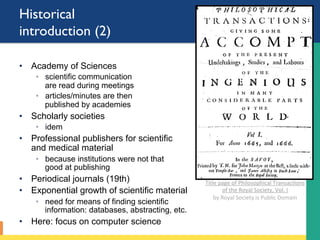
Title	page	of	Philosophical	Transac;ons	
of	the	Royal	Society,	Vol.	I			
by	Royal	Society	is	Public	Domain
Outline
•  Different types of scientific documents
•  Principles of publication
•  Economics of publishing
•  Bibliometrics
Outline
•  Different types of scientific documents
•  Principles of publication
•  Economics of publishing
•  Bibliometrics
Journal articles
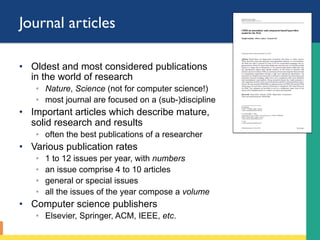
•  Oldest and most considered publications
in the world of research
◦  Nature, Science (not for computer science!)
◦  most journal are focused on a (sub-)discipline
•  Important articles which describe mature,
solid research and results
◦  often the best publications of a researcher
•  Various publication rates
◦  1 to 12 issues per year, with numbers
◦  an issue comprise 4 to 10 articles
◦  general or special issues
◦  all the issues of the year compose a volume
•  Computer science publishers
◦  Elsevier, Springer, ACM, IEEE, etc.
Conference articles
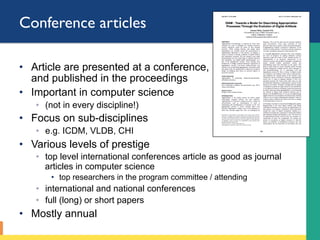
•  Article are presented at a conference,
and published in the proceedings
•  Important in computer science
◦  (not in every discipline!)
•  Focus on sub-disciplines
◦  e.g. ICDM, VLDB, CHI
•  Various levels of prestige
◦  top level international conferences article as good as journal
articles in computer science
•  top researchers in the program committee / attending
◦  international and national conferences
◦  full (long) or short papers
•  Mostly annual
Posters
•  Posters are presented in
dedicated sessions of
conferences
◦  several stand-up presentations
•  Research result that were not
sufficient for publication in the main
program
◦  not finished
◦  only preliminary ideas
◦  can be associated to a short paper or abstract in the
proceedings
◦  (the occasion to attend important conferences
without a paper)
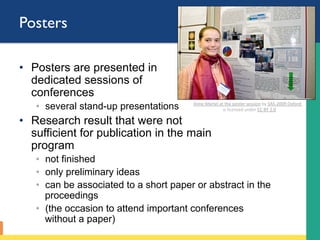
Anne	Martel	at	the	poster	session	by	SAS-2009	Oxford		
is	licensed	under	CC	BY	2.0
Workshop articles
•  Workshops are small conferences focused on dedicated
topics
◦  aimed at discussing hot subjects in a more informal atmosphere
◦  position papers, on-going work
◦  key researchers participate to workshops
•  Various kinds of workshops
◦  10 to 100 participants
◦  with or without proceedings
◦  recurring or one-shot
◦  open or invitation-only
◦  independent or associated to a conference (shared
accommodation)
•  Workshops can lead to special issues of journals
Books and book chapters
•  Book: the most ancient mode of
disseminating knowledge
◦  e.g. dialogues of Plato
•  Academic books
◦  classical: one or several authors
◦  “chapter-based”: one or several editor
•  one or several authors for each chapter
•  Various quality
◦  various publishers, various book series
◦  books or book chapter are generally written
upon request
•  not the same evaluation processes as journals
◦  books must be sold
•  editorial policy, marketing effect, etc.
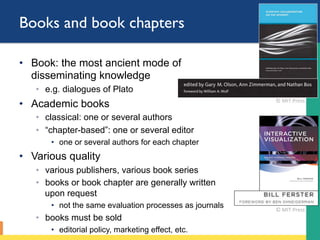
©	MIT	Press	
©	MIT	Press
Research reports
•  Articles under submission
•  Preprints
•  Technical report from which articles can be
extracted
•  A means to declare anteriority: a report has a
number and a date, is published by an institution
Data, additional material
•  Generally associated with articles
◦  full results
◦  code
◦  experimental protocol
◦  …
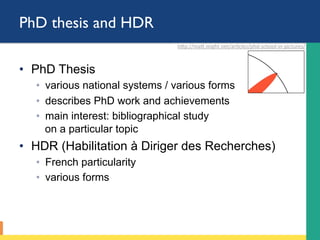
PhD thesis (and HDR)
•  PhD Thesis
◦  various national systems / various forms
◦  describes PhD work and achievements
◦  main interest: bibliographical study
on a particular topic
•  HDR (Habilitation à Diriger des Recherches)
◦  French particularity
◦  various forms
hLp://maL.might.net/ar;cles/phd-school-in-pictures/
Scientific popularisation material
•  Books
•  Articles in journals targeted towards the general
public
◦  Scientific journal
◦  Institutional journals (eg. CNRS)
◦  Classical journals
•  Videos
•  Websites
•  …
Outline
•  Different types of scientific documents
•  Principles of publication
•  Economics of publishing
•  Bibliometrics
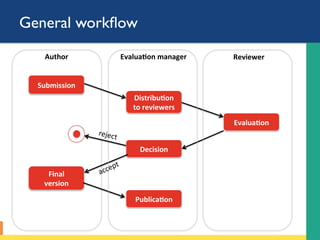
General workflow
Submission	
Distribu-on	
to	reviewers	
Decision	
Final		
version	
Publica-on	
Author	 Evalua-on	manager	 Reviewer	
reject	
Evalua-on
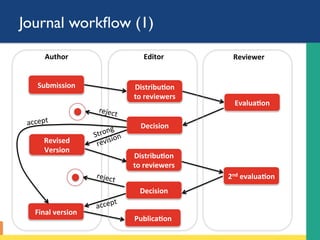
Journal workflow (1)
Submission	 Distribu-on	
to	reviewers	
Evalua-on	
Decision	
Final	version	
Publica-on	
Author	 Editor	 Reviewer	
accept	
reject	
2nd	evalua-on	
Revised	
Version	
Distribu-on	
to	reviewers	
Decision	
reject	
accept
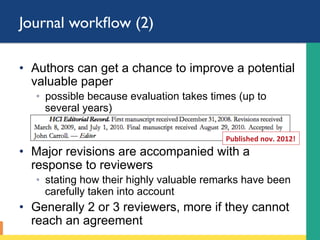
Journal workflow (2)
•  Authors can get a chance to improve a potential
valuable paper
◦  possible because evaluation takes times (up to
several years)
•  Major revisions are accompanied with a
response to reviewers
◦  stating how their highly valuable remarks have been
carefully taken into account
•  Generally 2 or 3 reviewers, more if they cannot
reach an agreement
Published	nov.	2012!
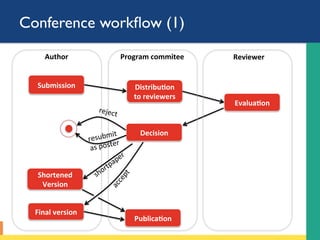
Conference workflow (1)
Submission	 Distribu-on	
to	reviewers	
Evalua-on	
Decision	
Final	version	
Publica-on	
Author	 Program	commitee	 Reviewer	
reject	
Shortened	
Version	
resubmit		
as	poster
Conference workflow (2)
•  Full evaluation process takes 4-7 months
•  Up to 4 reviewers for highly disputed papers
•  Variants
◦  poster can be accepted automatically
◦  rebuttal: a few days to respond to reviewers before final decision
◦  meta-reviewers: members of CP, choose reviewers, write a
meta-review
•  Abstract-only conferences:
◦  acceptance is based on a 1-2 pages abstract, paper is written if
accepted
◦  in many disciplines (hard science or social science)
◦  but NOT in computer science
Getting one’s work from one publication
to another
•  Getting more chance to have one’s work read
◦  workshop paper à special issue journal paper
◦  conference paper à journal paper
◦  national conference à international conference
•  This is why you could read several time the
same paper
•  Depend on the sub-discipline’s stance on
republishing
◦  may need serious extension
•  e.g. at least 40%-50% of new material
Reviewing = evaluating a paper
•  Giving one’s opinion on the value of an article
◦  originality (regarding the state of the art)
◦  technical quality (soundness, precision)
◦  presentation quality (language, clarity, figures)
◦  appropriateness to the journal/conference
◦  confidence of the reviewer
◦  general evaluation, recommandation
•  Giving comments on how to improve it
◦  Very important!
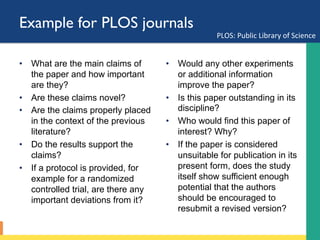
Example for PLOS journals
•  What are the main claims of
the paper and how important
are they?
•  Are these claims novel?
•  Are the claims properly placed
in the context of the previous
literature?
•  Do the results support the
claims?
•  If a protocol is provided, for
example for a randomized
controlled trial, are there any
important deviations from it?
•  Would any other experiments
or additional information
improve the paper?
•  Is this paper outstanding in its
discipline?
•  Who would find this paper of
interest? Why?
•  If the paper is considered
unsuitable for publication in its
present form, does the study
itself show sufficient enough
potential that the authors
should be encouraged to
resubmit a revised version?
PLOS:	Public	Library	of	Science
Outline
•  Different types of scientific documents
•  Publishing principles
•  Economics of publishing
•  Bibliometrics
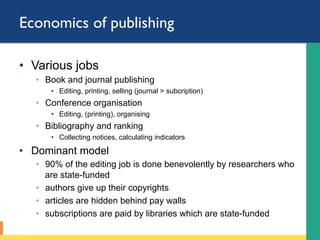
Economics of publishing
•  Various jobs
◦  Book and journal publishing
•  Editing, printing, selling (journal > subcription)
◦  Conference organisation
•  Editing, (printing), organising
◦  Bibliography and ranking
•  Collecting notices, calculating indicators
•  Dominant model
◦  90% of the editing job is done benevolently by researchers who
are state-funded
◦  authors give up their copyrights
◦  articles are hidden behind pay walls
◦  subscriptions are paid by libraries which are state-funded
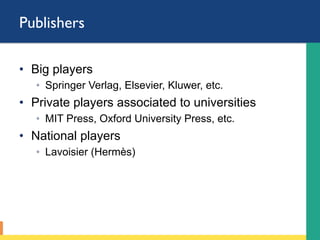
Publishers
•  Big players
◦  Springer Verlag, Elsevier, Kluwer, etc.
•  Private players associated to universities
◦  MIT Press, Oxford University Press, etc.
•  National players
◦  Lavoisier (Hermès)
Scholarly organisations
•  More or less thematic
◦  Have members that pay a fee
◦  Edit journals
◦  Sponsor workgroups (eg. Special Interest Group)
◦  Sponsor conferences
◦  Give awards
•  Big international players in computer science
◦  ACM: Association for Computing Machinery
•  good label for conference
◦  IEEE: Institute of Electrical and Electronics Engineers
•  careful with IEEE sponsored conferences
Citations indexes
•  A necessity with the increase in the number of
articles published, even in a sub-discipline
◦  ISI – Web of Knowledge (since 1960)
•  Source of the impact factor indicator
•  Owned by Thomson/Reuters
◦  Scopus
•  Owned by Elsevier
◦  Publishers indexes / digital libraries
•  IEEE Xplore, ACM DL, etc.
◦  Recent players
•  Google Scholar, Microsoft Academic Search, CiteSeerX
Spreading one’s work anyway
•  Publish on the web a quite final version of the
work
◦  version n-1, preprint
•  Get authorization from the publisher
•  Use open access (see later)
Outline
•  Different types of scientific documents
•  Publishing principles
•  Economics of publishing
•  Bibliometrics: evaluating the impact of
research work
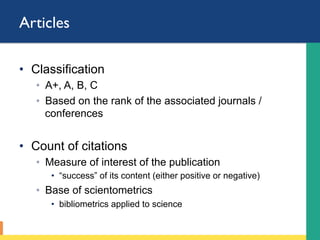
Articles
•  Classification
◦  A+, A, B, C
◦  Based on the rank of the associated journals /
conferences
•  Count of citations
◦  Measure of interest of the publication
•  “success” of its content (either positive or negative)
◦  Base of scientometrics
•  bibliometrics applied to science
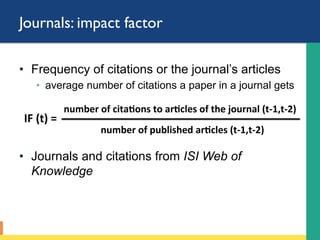
Journals: impact factor
•  Frequency of citations or the journal’s articles
◦  average number of citations a paper in a journal gets
•  Journals and citations from ISI Web of
Knowledge
number	of	cita-ons	to	ar-cles	of	the	journal	(t-1,t-2)	
IF	(t)	=			
number	of	published	ar-cles	(t-1,t-2)
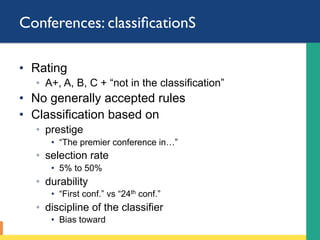
Conferences: classificationS
•  Rating
◦  A+, A, B, C + “not in the classification”
•  No generally accepted rules
•  Classification based on
◦  prestige
•  “The premier conference in…”
◦  selection rate
•  5% to 50%
◦  durability
•  “First conf.” vs “24th conf.”
◦  discipline of the classifier
•  Bias toward
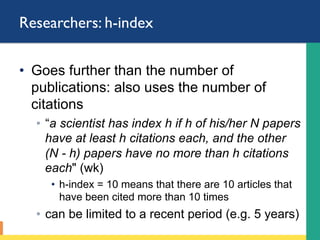
Researchers: h-index
•  Goes further than the number of
publications: also uses the number of
citations
◦  “a scientist has index h if h of his/her N papers
have at least h citations each, and the other
(N - h) papers have no more than h citations
each" (wk)
•  “h-index = 10” means that there are 10 articles that
have been cited more than 10 times
◦  can be limited to a recent period (e.g. 5 years)
Bias (1)
Indicators are just… indicators
•  Indicators are easy to design and calculate
◦  it depends on the aims
◦  e.g. h-index not adapted to short careers
•  Citation number does not directly measure quality
•  Impact factor is related to journal, not to article
•  H-index is not suited to short careers
•  Differences between disciplines
◦  ways of citing
◦  number of authors
◦  journals alone or journals + conferences
Bias (2)
Careful with that h-index, Eugen
•  Indicators can be manipulated
◦  h-index: auto-citations
◦  impact-factor: e.g. an editorial that cites the best recent papers
of the review itself
•  Indicators depend upon the organisation that makes the
calculation
◦  various h-indexes, depending on what articles are counted
•  auto-citations or not
•  only peer-reviewer article vs any pdf on the web
◦  but if a student’s work cites an article, it is indeed a measure of its
influence! (cf. pagerank)
◦  IF depends on ISI
•  not all journals are taken into account
ummagumma	-	pink	floyd	1969		
by	Ian	Burt	is	licensed	CC	BY	2.0
Outline
•  Different types of scientific documents
•  Publishing principles
•  Economics of publishing
•  Bibliometrics
•  Conclusion
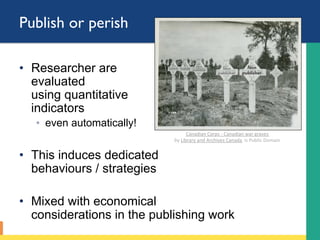
Publish or perish
•  Researcher are
evaluated
using quantitative
indicators
◦  even automatically!
•  This induces dedicated
behaviours / strategies
•  Mixed with economical
considerations in the publishing work
Modified	from	Canadian	Corps	-	Canadian	war	graves		
by	Library	and	Archives	Canada		is	Public	Domain	
Non
publisher
Non
publisher
Non
publisher
Non
publisher
Non
publisher
Good strategies
•  Target appropriated conferences / journals
•  Try to have your papers read
◦  disseminate (pdf on the web)
◦  do good research
•  Help indexing robots
◦  good name of organisation
Bad strategies
•  Do auto-plagiarism
•  Cheat indicators
•  Go over conflict of interest
◦  e.g. review your friend’s papers
•  Knowingly publish in “false conferences” or “false
journals”
◦  http://www.qualityofconferences.com/
•  Declare false results
◦  “There is increasing concern,” declared epidemiologist John
Ioannidis in a highly cited 2005 paper in PLoS Medicine, “that in
modern research, false findings may be the majority or even the
vast majority of published research claims.”
http://www.sciencenews.org/view/feature /id/57091/title/Odds_Are,_Its_Wrong
◦  See http://retractionwatch.wordpress.com/
Why is it bad?
•  Because the world of research functions with
peer reviewing evaluation
•  If the system is cheated, the huge amount of
time spend in reviewing is lost
•  Trust is a vital necessity
Resistance
•  Slow science movement
•  San Francisco Declaration
on Research Assessment
◦  Putting science into the
assessment of research
•  Open science
hLp://en.wikipedia.org/wiki/File:Fist.svg		
Fist	is	Public		Domain
Annex: PLOS evaluation sheet
•  What are the main claims of the paper
and how important are they?
•  Are these claims novel?
◦  If not, please specify papers that
weaken the claims to the
originality of this one.
•  Are the claims properly placed in the
context of the previous literature?
•  Do the results support the claims?
◦  If not, what other evidence is
required?
•  If a protocol is provided, for example
for a randomized controlled trial, are
there any important deviations from it?
◦  If so, have the authors explained
adequately why the deviations
occurred?
•  Would any other experiments or
additional information improve the
paper?
◦  How much better would the paper
be if this extra work was done,
and how difficult would such work
be to do, or to provide?
•  Is this paper outstanding in its
discipline?
◦  If yes, what makes it outstanding?
If not, why not?
•  Who would find this paper of interest?
Why?
•  If the paper is considered unsuitable
for publication in its present form,
◦  does the study itself show
sufficient enough potential that the
authors should be encouraged to
resubmit a revised version?

Tools and Methodology for Research: Scientific Publishing

  • 1.
    Methodology and Toolsfor Research: Scientific publishing Yannick Prié Polytech Nantes, University of Nantes Master DMKM, 2015-2016 CC BY-SA 4.0
  • 2.
    Attribution-ShareAlike 4.0 International (CCBY-SA 4.0) •  This course "Methodology and Tools for Research: Scientific Publishing" by Yannick Prié is licensed CC BY-SA 4.0 •  This license covers the general organization of the material, the textual content, the figures, etc. except where indicated. •  This license means that you can share and adapt this course, provided you give appropriate credit to the author and distribute your contributions under the same license as the original ◦  for more information about this license, see http://creativecommons.org/licenses/by-sa/4.0/ •  For any comment on this course, do not hesitate to contact me: yannick.prie@univ-nantes.fr or @yprie
  • 3.
    Objectives of thiscourse •  Understand the many facets of publishing: ◦  Journals, conferences, books ◦  Types of publications ◦  Publication workflows ◦  Economy of publication •  Get an idea on “publication-based” evaluation ◦  Impact factor ◦  H-index •  Ressources for the course http://www.scoop.it/t/toolsandmethodologyforresearch
  • 4.
    Historical introduction (1) • (in the west) •  Since the greeks ◦  circulation of knowledge works •  books, horses, libraries, manual copies (after print,1456, mechanical copies), only few specific “scientific works” •  Turn of the 16th-17th centuries ◦  notions of author, anteriority of discovery •  e.g. Galileo sends Kepler his encrypted discovery of Jupiter’s satellites ◦  organisation of scientific communication •  1635: Academia Parisiensis ◦  Marin Mersenne (1588-1648, monk, philosopher, mathematician): communication with scholars, collect and diffusion of discoveries using postal services •  1662: Royal Society of London •  1666: Académie des Sciences
  • 5.
    Historical introduction (2) •  Academyof Sciences ◦  scientific communication are read during meetings ◦  articles/minutes are then published by academies •  Scholarly societies ◦  idem •  Professional publishers for scientific and medical material ◦  because institutions were not that good at publishing •  Periodical journals (19th) •  Exponential growth of scientific material ◦  need for means of finding scientific information: databases, abstracting, etc. •  Here: focus on computer science Title page of Philosophical Transac;ons of the Royal Society, Vol. I by Royal Society is Public Domain
  • 6.
    Outline •  Different typesof scientific documents •  Principles of publication •  Economics of publishing •  Bibliometrics
  • 7.
    Outline •  Different typesof scientific documents •  Principles of publication •  Economics of publishing •  Bibliometrics
  • 8.
    Journal articles •  Oldestand most considered publications in the world of research ◦  Nature, Science (not for computer science!) ◦  most journal are focused on a (sub-)discipline •  Important articles which describe mature, solid research and results ◦  often the best publications of a researcher •  Various publication rates ◦  1 to 12 issues per year, with numbers ◦  an issue comprise 4 to 10 articles ◦  general or special issues ◦  all the issues of the year compose a volume •  Computer science publishers ◦  Elsevier, Springer, ACM, IEEE, etc.
  • 9.
    Conference articles •  Articleare presented at a conference, and published in the proceedings •  Important in computer science ◦  (not in every discipline!) •  Focus on sub-disciplines ◦  e.g. ICDM, VLDB, CHI •  Various levels of prestige ◦  top level international conferences article as good as journal articles in computer science •  top researchers in the program committee / attending ◦  international and national conferences ◦  full (long) or short papers •  Mostly annual
  • 10.
    Posters •  Posters arepresented in dedicated sessions of conferences ◦  several stand-up presentations •  Research result that were not sufficient for publication in the main program ◦  not finished ◦  only preliminary ideas ◦  can be associated to a short paper or abstract in the proceedings ◦  (the occasion to attend important conferences without a paper) Anne Martel at the poster session by SAS-2009 Oxford is licensed under CC BY 2.0
  • 11.
    Workshop articles •  Workshopsare small conferences focused on dedicated topics ◦  aimed at discussing hot subjects in a more informal atmosphere ◦  position papers, on-going work ◦  key researchers participate to workshops •  Various kinds of workshops ◦  10 to 100 participants ◦  with or without proceedings ◦  recurring or one-shot ◦  open or invitation-only ◦  independent or associated to a conference (shared accommodation) •  Workshops can lead to special issues of journals
  • 12.
    Books and bookchapters •  Book: the most ancient mode of disseminating knowledge ◦  e.g. dialogues of Plato •  Academic books ◦  classical: one or several authors ◦  “chapter-based”: one or several editor •  one or several authors for each chapter •  Various quality ◦  various publishers, various book series ◦  books or book chapter are generally written upon request •  not the same evaluation processes as journals ◦  books must be sold •  editorial policy, marketing effect, etc. © MIT Press © MIT Press
  • 13.
    Research reports •  Articlesunder submission •  Preprints •  Technical report from which articles can be extracted •  A means to declare anteriority: a report has a number and a date, is published by an institution
  • 14.
    Data, additional material • Generally associated with articles ◦  full results ◦  code ◦  experimental protocol ◦  …
  • 15.
    PhD thesis (andHDR) •  PhD Thesis ◦  various national systems / various forms ◦  describes PhD work and achievements ◦  main interest: bibliographical study on a particular topic •  HDR (Habilitation à Diriger des Recherches) ◦  French particularity ◦  various forms hLp://maL.might.net/ar;cles/phd-school-in-pictures/
  • 16.
    Scientific popularisation material • Books •  Articles in journals targeted towards the general public ◦  Scientific journal ◦  Institutional journals (eg. CNRS) ◦  Classical journals •  Videos •  Websites •  …
  • 17.
    Outline •  Different typesof scientific documents •  Principles of publication •  Economics of publishing •  Bibliometrics
  • 18.
  • 19.
    Journal workflow (1) Submission Distribu-on to reviewers Evalua-on Decision Final version Publica-on Author Editor Reviewer accept reject 2nd evalua-on Revised Version Distribu-on to reviewers Decision reject accept
  • 20.
    Journal workflow (2) • Authors can get a chance to improve a potential valuable paper ◦  possible because evaluation takes times (up to several years) •  Major revisions are accompanied with a response to reviewers ◦  stating how their highly valuable remarks have been carefully taken into account •  Generally 2 or 3 reviewers, more if they cannot reach an agreement Published nov. 2012!
  • 21.
    Conference workflow (1) Submission Distribu-on to reviewers Evalua-on Decision Final version Publica-on Author Program commitee Reviewer reject Shortened Version resubmit as poster
  • 22.
    Conference workflow (2) • Full evaluation process takes 4-7 months •  Up to 4 reviewers for highly disputed papers •  Variants ◦  poster can be accepted automatically ◦  rebuttal: a few days to respond to reviewers before final decision ◦  meta-reviewers: members of CP, choose reviewers, write a meta-review •  Abstract-only conferences: ◦  acceptance is based on a 1-2 pages abstract, paper is written if accepted ◦  in many disciplines (hard science or social science) ◦  but NOT in computer science
  • 23.
    Getting one’s workfrom one publication to another •  Getting more chance to have one’s work read ◦  workshop paper à special issue journal paper ◦  conference paper à journal paper ◦  national conference à international conference •  This is why you could read several time the same paper •  Depend on the sub-discipline’s stance on republishing ◦  may need serious extension •  e.g. at least 40%-50% of new material
  • 24.
    Reviewing = evaluatinga paper •  Giving one’s opinion on the value of an article ◦  originality (regarding the state of the art) ◦  technical quality (soundness, precision) ◦  presentation quality (language, clarity, figures) ◦  appropriateness to the journal/conference ◦  confidence of the reviewer ◦  general evaluation, recommandation •  Giving comments on how to improve it ◦  Very important!
  • 25.
    Example for PLOSjournals •  What are the main claims of the paper and how important are they? •  Are these claims novel? •  Are the claims properly placed in the context of the previous literature? •  Do the results support the claims? •  If a protocol is provided, for example for a randomized controlled trial, are there any important deviations from it? •  Would any other experiments or additional information improve the paper? •  Is this paper outstanding in its discipline? •  Who would find this paper of interest? Why? •  If the paper is considered unsuitable for publication in its present form, does the study itself show sufficient enough potential that the authors should be encouraged to resubmit a revised version? PLOS: Public Library of Science
  • 26.
    Outline •  Different typesof scientific documents •  Publishing principles •  Economics of publishing •  Bibliometrics
  • 27.
    Economics of publishing • Various jobs ◦  Book and journal publishing •  Editing, printing, selling (journal > subcription) ◦  Conference organisation •  Editing, (printing), organising ◦  Bibliography and ranking •  Collecting notices, calculating indicators •  Dominant model ◦  90% of the editing job is done benevolently by researchers who are state-funded ◦  authors give up their copyrights ◦  articles are hidden behind pay walls ◦  subscriptions are paid by libraries which are state-funded
  • 28.
    Publishers •  Big players ◦ Springer Verlag, Elsevier, Kluwer, etc. •  Private players associated to universities ◦  MIT Press, Oxford University Press, etc. •  National players ◦  Lavoisier (Hermès)
  • 29.
    Scholarly organisations •  Moreor less thematic ◦  Have members that pay a fee ◦  Edit journals ◦  Sponsor workgroups (eg. Special Interest Group) ◦  Sponsor conferences ◦  Give awards •  Big international players in computer science ◦  ACM: Association for Computing Machinery •  good label for conference ◦  IEEE: Institute of Electrical and Electronics Engineers •  careful with IEEE sponsored conferences
  • 30.
    Citations indexes •  Anecessity with the increase in the number of articles published, even in a sub-discipline ◦  ISI – Web of Knowledge (since 1960) •  Source of the impact factor indicator •  Owned by Thomson/Reuters ◦  Scopus •  Owned by Elsevier ◦  Publishers indexes / digital libraries •  IEEE Xplore, ACM DL, etc. ◦  Recent players •  Google Scholar, Microsoft Academic Search, CiteSeerX
  • 31.
    Spreading one’s workanyway •  Publish on the web a quite final version of the work ◦  version n-1, preprint •  Get authorization from the publisher •  Use open access (see later)
  • 32.
    Outline •  Different typesof scientific documents •  Publishing principles •  Economics of publishing •  Bibliometrics: evaluating the impact of research work
  • 33.
    Articles •  Classification ◦  A+,A, B, C ◦  Based on the rank of the associated journals / conferences •  Count of citations ◦  Measure of interest of the publication •  “success” of its content (either positive or negative) ◦  Base of scientometrics •  bibliometrics applied to science
  • 34.
    Journals: impact factor • Frequency of citations or the journal’s articles ◦  average number of citations a paper in a journal gets •  Journals and citations from ISI Web of Knowledge number of cita-ons to ar-cles of the journal (t-1,t-2) IF (t) = number of published ar-cles (t-1,t-2)
  • 35.
    Conferences: classificationS •  Rating ◦ A+, A, B, C + “not in the classification” •  No generally accepted rules •  Classification based on ◦  prestige •  “The premier conference in…” ◦  selection rate •  5% to 50% ◦  durability •  “First conf.” vs “24th conf.” ◦  discipline of the classifier •  Bias toward
  • 36.
    Researchers: h-index •  Goesfurther than the number of publications: also uses the number of citations ◦  “a scientist has index h if h of his/her N papers have at least h citations each, and the other (N - h) papers have no more than h citations each" (wk) •  “h-index = 10” means that there are 10 articles that have been cited more than 10 times ◦  can be limited to a recent period (e.g. 5 years)
  • 37.
    Bias (1) Indicators arejust… indicators •  Indicators are easy to design and calculate ◦  it depends on the aims ◦  e.g. h-index not adapted to short careers •  Citation number does not directly measure quality •  Impact factor is related to journal, not to article •  H-index is not suited to short careers •  Differences between disciplines ◦  ways of citing ◦  number of authors ◦  journals alone or journals + conferences
  • 38.
    Bias (2) Careful withthat h-index, Eugen •  Indicators can be manipulated ◦  h-index: auto-citations ◦  impact-factor: e.g. an editorial that cites the best recent papers of the review itself •  Indicators depend upon the organisation that makes the calculation ◦  various h-indexes, depending on what articles are counted •  auto-citations or not •  only peer-reviewer article vs any pdf on the web ◦  but if a student’s work cites an article, it is indeed a measure of its influence! (cf. pagerank) ◦  IF depends on ISI •  not all journals are taken into account ummagumma - pink floyd 1969 by Ian Burt is licensed CC BY 2.0
  • 39.
    Outline •  Different typesof scientific documents •  Publishing principles •  Economics of publishing •  Bibliometrics •  Conclusion
  • 40.
    Publish or perish • Researcher are evaluated using quantitative indicators ◦  even automatically! •  This induces dedicated behaviours / strategies •  Mixed with economical considerations in the publishing work Modified from Canadian Corps - Canadian war graves by Library and Archives Canada is Public Domain Non publisher Non publisher Non publisher Non publisher Non publisher
  • 41.
    Good strategies •  Targetappropriated conferences / journals •  Try to have your papers read ◦  disseminate (pdf on the web) ◦  do good research •  Help indexing robots ◦  good name of organisation
  • 42.
    Bad strategies •  Doauto-plagiarism •  Cheat indicators •  Go over conflict of interest ◦  e.g. review your friend’s papers •  Knowingly publish in “false conferences” or “false journals” ◦  http://www.qualityofconferences.com/ •  Declare false results ◦  “There is increasing concern,” declared epidemiologist John Ioannidis in a highly cited 2005 paper in PLoS Medicine, “that in modern research, false findings may be the majority or even the vast majority of published research claims.” http://www.sciencenews.org/view/feature /id/57091/title/Odds_Are,_Its_Wrong ◦  See http://retractionwatch.wordpress.com/
  • 43.
    Why is itbad? •  Because the world of research functions with peer reviewing evaluation •  If the system is cheated, the huge amount of time spend in reviewing is lost •  Trust is a vital necessity
  • 44.
    Resistance •  Slow sciencemovement •  San Francisco Declaration on Research Assessment ◦  Putting science into the assessment of research •  Open science hLp://en.wikipedia.org/wiki/File:Fist.svg Fist is Public Domain
  • 45.
    Annex: PLOS evaluationsheet •  What are the main claims of the paper and how important are they? •  Are these claims novel? ◦  If not, please specify papers that weaken the claims to the originality of this one. •  Are the claims properly placed in the context of the previous literature? •  Do the results support the claims? ◦  If not, what other evidence is required? •  If a protocol is provided, for example for a randomized controlled trial, are there any important deviations from it? ◦  If so, have the authors explained adequately why the deviations occurred? •  Would any other experiments or additional information improve the paper? ◦  How much better would the paper be if this extra work was done, and how difficult would such work be to do, or to provide? •  Is this paper outstanding in its discipline? ◦  If yes, what makes it outstanding? If not, why not? •  Who would find this paper of interest? Why? •  If the paper is considered unsuitable for publication in its present form, ◦  does the study itself show sufficient enough potential that the authors should be encouraged to resubmit a revised version?