Basic of Computers and
Information Technology
Topics
• What is Information Technology
• Basic use of computers and Information Technology
• Basic terms (Hardware, Software, Networking, Internet, Cloud)
• Carriers in Information Technology
• What needs to become an IT professional
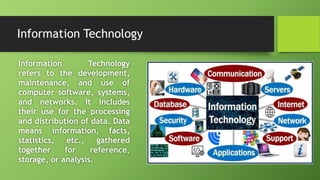
Information Technology
refers to the development,
maintenance, and use of
computer software, systems,
and networks. It includes
their use for the processing
and distribution of data. Data
means information, facts,
statistics, etc., gathered
together for reference,
storage, or analysis.
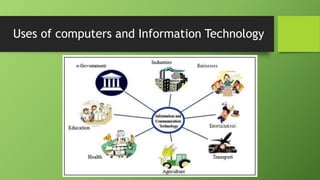
Uses of computers and Information Technology
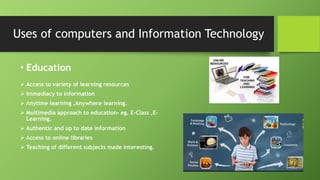
• Education
 Access to variety of learning resources
 Immediacy to information
 Anytime learning ,Anywhere learning.
 Multimedia approach to education- eg. E-Class ,E-
Learning.
 Authentic and up to date information
 Access to online libraries
 Teaching of different subjects made interesting.
Uses of computers and Information Technology
• Business
 IT plays an important role in business
environment as every organization adopts it in
some form or the other to perform the tasks in
effective manner.
 E-Commerce includes buying & selling products
and services over the internet, electronic fund
transfers, smart cards, digital cash & all other
ways of doing business over digital networks.eg-
daraz.com , Amazon.com are examples of
ECommerce.
 IT HAS EFFECTED BUSINESS IN FOLLOWING WAYS:
• COMPETITIVENESS SECURITY
• COST BENEFITS
• MARKETING
• E-RECRUITMENT.
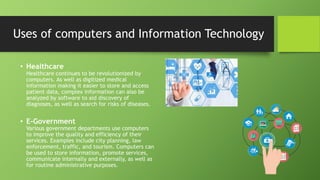
• Healthcare
Healthcare continues to be revolutionized by
computers. As well as digitized medical
information making it easier to store and access
patient data, complex information can also be
analyzed by software to aid discovery of
diagnoses, as well as search for risks of diseases.
• E-Government
Various government departments use computers
to improve the quality and efficiency of their
services. Examples include city planning, law
enforcement, traffic, and tourism. Computers can
be used to store information, promote services,
communicate internally and externally, as well as
for routine administrative purposes.
Uses of computers and Information Technology
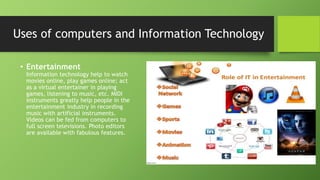
• Entertainment
Information technology help to watch
movies online, play games online; act
as a virtual entertainer in playing
games, listening to music, etc. MIDI
instruments greatly help people in the
entertainment industry in recording
music with artificial instruments.
Videos can be fed from computers to
full screen televisions. Photo editors
are available with fabulous features.
Uses of computers and Information Technology
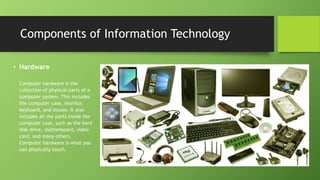
• Hardware
Computer hardware is the
collection of physical parts of a
computer system. This includes
the computer case, monitor,
keyboard, and mouse. It also
includes all the parts inside the
computer case, such as the hard
disk drive, motherboard, video
card, and many others.
Computer hardware is what you
can physically touch.
Components of Information Technology
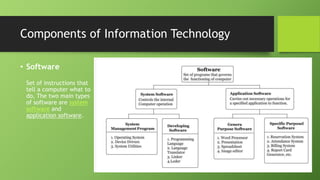
• Software
Set of instructions that
tell a computer what to
do, The two main types
of software are system
software and
application software.
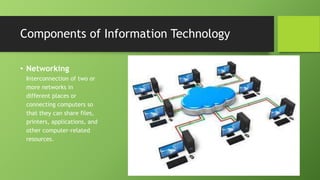
• Networking
Interconnection of two or
more networks in
different places or
connecting computers so
that they can share files,
printers, applications, and
other computer-related
resources.
Components of Information Technology
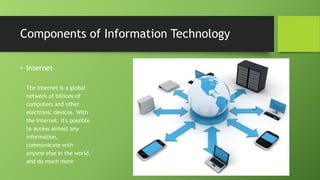
• Internet
The Internet is a global
network of billions of
computers and other
electronic devices. With
the Internet, it's possible
to access almost any
information,
communicate with
anyone else in the world,
and do much more
Components of Information Technology
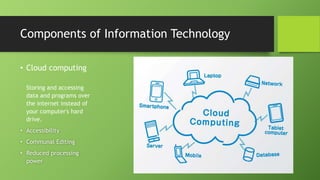
• Cloud computing
Storing and accessing
data and programs over
the internet instead of
your computer's hard
drive.
• Accessibility
• Communal Editing
• Reduced processing
power
Carriers in Information Technology
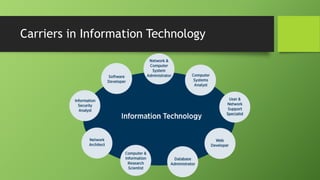
• Web developer. Web developers are responsible for creating the look and technical aspects of a
website.
• Network administrator. In charge of making sure the computer network for an organization is secure,
and runs smoothly.
• Data analyst. Data analysts take big data and find patterns to help business leaders make decisions.
• IT manager. Oversee all the hardware and software that an organization uses to run.
• Information security expert. Making sure data and information stay safe from attacks and threats.
• Cloud administration. Cloud administration is involved with ensuring that an organization’s cloud
software is working correctly and securely.
Carriers in Information Technology
• Computer systems analyst. Responsible for determining how a computer system is working, and what
can be done to make the processes more effective.
• Computer and information research scientist. Responsible for inventing and designing new approaches
for tech.
• Computer hardware engineer. In charge of researching, designing, and testing new computer
hardware.
• Computer network architect. In charge of building data communication systems for an organization.
• Software developer. Software developers are the ones who create the ideas and models for computer
programs. They are sometimes called software engineers.
Carriers in Information Technology
Thank you

Information Technology

  • 1.
    Basic of Computersand Information Technology
  • 2.
    Topics • What isInformation Technology • Basic use of computers and Information Technology • Basic terms (Hardware, Software, Networking, Internet, Cloud) • Carriers in Information Technology • What needs to become an IT professional
  • 3.
    Information Technology Information Technology refersto the development, maintenance, and use of computer software, systems, and networks. It includes their use for the processing and distribution of data. Data means information, facts, statistics, etc., gathered together for reference, storage, or analysis.
  • 4.
    Uses of computersand Information Technology
  • 5.
    Uses of computersand Information Technology • Education  Access to variety of learning resources  Immediacy to information  Anytime learning ,Anywhere learning.  Multimedia approach to education- eg. E-Class ,E- Learning.  Authentic and up to date information  Access to online libraries  Teaching of different subjects made interesting.
  • 6.
    Uses of computersand Information Technology • Business  IT plays an important role in business environment as every organization adopts it in some form or the other to perform the tasks in effective manner.  E-Commerce includes buying & selling products and services over the internet, electronic fund transfers, smart cards, digital cash & all other ways of doing business over digital networks.eg- daraz.com , Amazon.com are examples of ECommerce.  IT HAS EFFECTED BUSINESS IN FOLLOWING WAYS: • COMPETITIVENESS SECURITY • COST BENEFITS • MARKETING • E-RECRUITMENT.
  • 7.
    • Healthcare Healthcare continuesto be revolutionized by computers. As well as digitized medical information making it easier to store and access patient data, complex information can also be analyzed by software to aid discovery of diagnoses, as well as search for risks of diseases. • E-Government Various government departments use computers to improve the quality and efficiency of their services. Examples include city planning, law enforcement, traffic, and tourism. Computers can be used to store information, promote services, communicate internally and externally, as well as for routine administrative purposes. Uses of computers and Information Technology
  • 8.
    • Entertainment Information technologyhelp to watch movies online, play games online; act as a virtual entertainer in playing games, listening to music, etc. MIDI instruments greatly help people in the entertainment industry in recording music with artificial instruments. Videos can be fed from computers to full screen televisions. Photo editors are available with fabulous features. Uses of computers and Information Technology
  • 9.
    • Hardware Computer hardwareis the collection of physical parts of a computer system. This includes the computer case, monitor, keyboard, and mouse. It also includes all the parts inside the computer case, such as the hard disk drive, motherboard, video card, and many others. Computer hardware is what you can physically touch. Components of Information Technology
  • 10.
    Components of InformationTechnology • Software Set of instructions that tell a computer what to do, The two main types of software are system software and application software.
  • 11.
    • Networking Interconnection oftwo or more networks in different places or connecting computers so that they can share files, printers, applications, and other computer-related resources. Components of Information Technology
  • 12.
    • Internet The Internetis a global network of billions of computers and other electronic devices. With the Internet, it's possible to access almost any information, communicate with anyone else in the world, and do much more Components of Information Technology
  • 13.
    Components of InformationTechnology • Cloud computing Storing and accessing data and programs over the internet instead of your computer's hard drive. • Accessibility • Communal Editing • Reduced processing power
  • 14.
  • 15.
    • Web developer.Web developers are responsible for creating the look and technical aspects of a website. • Network administrator. In charge of making sure the computer network for an organization is secure, and runs smoothly. • Data analyst. Data analysts take big data and find patterns to help business leaders make decisions. • IT manager. Oversee all the hardware and software that an organization uses to run. • Information security expert. Making sure data and information stay safe from attacks and threats. • Cloud administration. Cloud administration is involved with ensuring that an organization’s cloud software is working correctly and securely. Carriers in Information Technology
  • 16.
    • Computer systemsanalyst. Responsible for determining how a computer system is working, and what can be done to make the processes more effective. • Computer and information research scientist. Responsible for inventing and designing new approaches for tech. • Computer hardware engineer. In charge of researching, designing, and testing new computer hardware. • Computer network architect. In charge of building data communication systems for an organization. • Software developer. Software developers are the ones who create the ideas and models for computer programs. They are sometimes called software engineers. Carriers in Information Technology
  • 17.

Editor's Notes