2D Plane Elasticity – Isoparametric Bilinear Quadrilateral
Lagrange type Element
Filipe Giesteira Master student
Faculty of Engineering of University of Porto (FEUP)
Mechanical Engineering Department (DEMec)
Finite Element Method (MEF, Método dos Elementos Finitos)
Supervisor: Prof. Francisco Andrade Pires
Supervisor: Prof. José Dias Rodrigues
Finite Element Method (FEM) - Final Presentation
Faculty of Engineering of University of Porto
Building L / Room L317
Porto, 24th January 2019
Work Assignment No. 2.3
2
Contents
➢ Introduction – Plane Elasticity Background Theory
➢ Weak & Strong Form – FEM Mathematical Formulation
➢ Finite Element Library – Isoparametric Bilinear Quadrilateral Element
➢ FEM Equations – Element Mechanical Properties
➢ BaPMEF FEM Tool – Script Capabilities and Limitations
➢ Validation Examples – Solutions of the Biharmonic Equation / Airy Functions
➢ Practical Applications
24-01-2019
3
1. Introduction
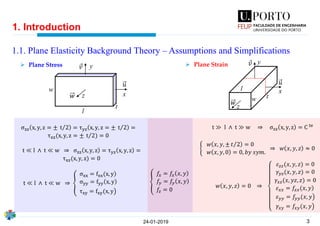
1.1. Plane Elasticity Background Theory – Assumptions and Simplifications
24-01-2019
y
x
l
t
w
z
𝑢
Ԧ𝑣
𝑤
σzz x, y, z = ± Τt 2 = τyz x, y, z = ± Τt 2 =
τxz(x, y, z = ± Τt 2) = 0
t ≪ l ∧ t ≪ w ⇒ σzz x, y, z = τyz x, y, z =
τxz(x, y, z) = 0
t ≪ l ∧ t ≪ w ⇒ ൞
)σxx = fxx(x, y
σyy = fyy x, y
൯τxy = fxy(x, y
y
xl
tw
z
Ԧ𝑣
𝑢
𝑤
t ≫ l ∧ t ≫ w ⇒ σzz x, y, z = C te
ቊ
𝑤 𝑥, 𝑦, ± Τ𝑡 2 = 0
𝑤 𝑥, 𝑦, 0 = 0, 𝑏𝑦 𝑠𝑦𝑚.
⇒ 𝑤 𝑥, 𝑦, 𝑧 ≈ 0
𝑤 𝑥, 𝑦, 𝑧 = 0 ⇒
𝜀 𝑧𝑧(𝑥, 𝑦, 𝑧) = 0
𝛾𝑦𝑧(𝑥, 𝑦, 𝑧) = 0
𝛾𝑥𝑧(𝑥, 𝑦𝑧, 𝑧) = 0
)𝜀 𝑥𝑥 = 𝑓𝑥𝑥(𝑥, 𝑦
൯𝜀 𝑦𝑦 = 𝑓𝑦𝑦(𝑥, 𝑦
൯𝛾𝑥𝑦 = 𝑓𝑥𝑦(𝑥, 𝑦
൞
𝑓𝑥 = 𝑓𝑥 𝑥, 𝑦
𝑓𝑦 = 𝑓𝑦 𝑥, 𝑦
𝑓𝑧 = 0
➢ Plane Stress ➢ Plane Strain
4
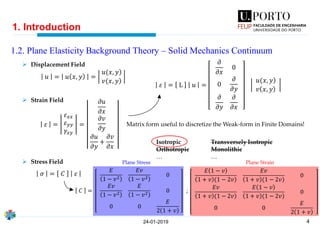
➢ Displacement Field
➢ Strain Field
➢ Stress Field
1. Introduction
1.2. Plane Elasticity Background Theory – Solid Mechanics Continuum
24-01-2019
𝑢 = 𝑢 𝑥, 𝑦 =
)𝑢(𝑥, 𝑦
)𝑣(𝑥, 𝑦
𝜀 =
𝜀 𝑥𝑥
𝜀 𝑦𝑦
𝛾𝑥𝑦
=
𝜕𝑢
𝜕𝑥
𝜕𝑣
𝜕𝑦
𝜕𝑢
𝜕𝑦
+
𝜕𝑣
𝜕𝑥
𝜀 = L 𝑢 =
𝜕
𝜕𝑥
0
0
𝜕
𝜕𝑦
𝜕
𝜕𝑦
𝜕
𝜕𝑥
)𝑢(𝑥, 𝑦
𝑣 𝑥, 𝑦
𝜎 = 𝐶 𝜀
𝐶 =
𝐸
1 − 𝑣2
𝐸𝑣
1 − 𝑣2
0
𝐸𝑣
1 − 𝑣2
𝐸
1 − 𝑣2
0
0 0
𝐸
2 1 + 𝑣
;
𝐸 1 − 𝑣
)1 + 𝑣 (1 − 2𝑣
𝐸𝑣
)1 + 𝑣 (1 − 2𝑣
0
𝐸𝑣
)1 + 𝑣 (1 − 2𝑣
𝐸 1 − 𝑣
)1 + 𝑣 (1 − 2𝑣
0
0 0
𝐸
2 1 + 𝑣
Plane Stress Plane Strain
Matrix form useful to discretize the Weak-form in Finite Domains!
Isotropic Transversely Isotropic
Orthotropic Monolithic
… …
5
2. Weak & Strong Form
24-01-2019
2.1. Development of the Weak Form
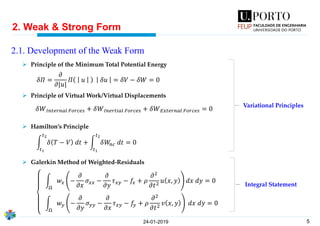
➢ Principle of the Minimum Total Potential Energy
➢ Principle of Virtual Work/Virtual Displacements
➢ Hamilton’s Principle
➢ Galerkin Method of Weighted-Residuals
𝛿𝛱 =
𝜕
𝜕|𝑢|
𝛱 𝑢 𝛿𝑢 = 𝛿𝑉 − 𝛿𝑊 = 0
𝛿𝑊 𝐼𝑛𝑡𝑒𝑟𝑛𝑎𝑙 𝐹𝑜𝑟𝑐𝑒𝑠 + 𝛿𝑊 𝐼𝑛𝑒𝑟𝑡𝑖𝑎𝑙 𝐹𝑜𝑟𝑐𝑒𝑠 + 𝛿𝑊 𝐸𝑥𝑡𝑒𝑟𝑛𝑎𝑙 𝐹𝑜𝑟𝑐𝑒𝑠 = 0
න
𝑡1
𝑡2
𝛿 𝑇 − 𝑉 𝑑𝑡 + න
𝑡1
𝑡2
𝛿𝑊𝑛𝑐 𝑑𝑡 = 0
න
Ω
𝑤𝑥 −
𝜕
𝜕𝑥
𝜎 𝑥𝑥 −
𝜕
𝜕𝑦
𝜏 𝑥𝑦 − 𝑓𝑥 + 𝜌
𝜕2
𝜕𝑡2 𝑢 𝑥, 𝑦 𝑑𝑥 𝑑𝑦 = 0
න
Ω
𝑤 𝑦 −
𝜕
𝜕𝑦
𝜎 𝑦𝑦 −
𝜕
𝜕𝑥
𝜏 𝑥𝑦 − 𝑓𝑦 + 𝜌
𝜕2
𝜕𝑡2 𝑣 𝑥, 𝑦 𝑑𝑥 𝑑𝑦 = 0
Variational Principles
Integral Statement
6
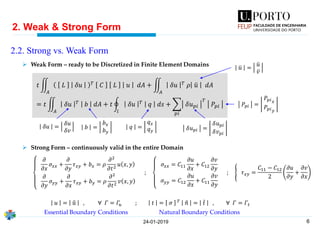
➢ Weak Form – ready to be Discretized in Finite Element Domains
➢ Strong Form – continuously valid in the entire Domain
2. Weak & Strong Form
24-01-2019
2.2. Strong vs. Weak Form
𝑡 ඵ
𝐴
𝐿 𝛿𝑢 𝑇 𝐶 𝐿 𝑢 𝑑𝐴 + ඵ
𝐴
𝛿𝑢 𝑇 𝜌 ሷ𝑢 𝑑𝐴
= 𝑡 ඵ
𝐴
𝛿𝑢 𝑇 𝑏 𝑑𝐴 + 𝑡 ර
𝑙
𝛿𝑢 𝑇 𝑞 𝑑𝑠 + ෍
𝑝𝑖
𝛿𝑢 𝑝𝑖
𝑇
𝑃𝑝𝑖
𝜕
𝜕𝑥
𝜎𝑥𝑥 +
𝜕
𝜕𝑦
𝜏 𝑥𝑦 + 𝑏 𝑥 = 𝜌
𝜕2
𝜕𝑡2
𝑢 𝑥, 𝑦
𝜕
𝜕𝑦
𝜎 𝑦𝑦 +
𝜕
𝜕𝑥
𝜏 𝑥𝑦 + 𝑏 𝑦 = 𝜌
𝜕2
𝜕𝑡2
𝑣 𝑥, 𝑦
;
𝜎𝑥𝑥 = 𝐶11
𝜕𝑢
𝜕𝑥
+ 𝐶12
𝜕𝑣
𝜕𝑦
𝜎 𝑦𝑦 = 𝐶12
𝜕𝑢
𝜕𝑥
+ 𝐶11
𝜕𝑣
𝜕𝑦
; ൝ 𝜏 𝑥𝑦 =
𝐶11 − 𝐶12
2
𝜕𝑢
𝜕𝑦
+
𝜕𝑣
𝜕𝑥
𝑢 = ො𝑢 , ∀ 𝛤 = 𝛤𝑢 ; 𝑡 = 𝜎 𝑇
ො𝑛 = Ƹ𝑡 , ∀ 𝛤 = 𝛤𝑡
Natural Boundary ConditionsEssential Boundary Conditions
𝛿𝑢 =
𝛿𝑢
𝛿𝑣 𝛿𝑢 𝑝𝑖 =
𝛿𝑢 𝑝𝑖
𝛿𝑣 𝑝𝑖
𝑃𝑝𝑖 =
𝑃𝑝𝑖 𝑥
𝑃𝑝𝑖 𝑦
𝑏 =
𝑏 𝑥
𝑏 𝑦
𝑞 =
𝑞 𝑥
𝑞 𝑦
ሷ𝑢 =
ሷ𝑢
ሷ𝑣
7
3. Finite Element Library
24-01-2019
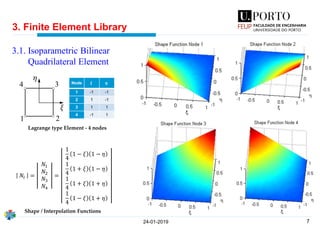
3.1. Isoparametric Bilinear
Quadrilateral Element
𝑁𝑖 =
𝑁1
𝑁2
𝑁3
𝑁4
=
1
4
1 − 𝜉 1 − 𝜂
1
4
1 + 𝜉 1 − 𝜂
1
4
1 + 𝜉 1 + 𝜂
1
4
1 − 𝜉 1 + 𝜂
Node 𝝃 𝜼
1 -1 -1
2 1 -1
3 1 1
4 -1 1
𝜂
𝜉
1
4 3
2
Lagrange type Element - 4 nodes
Shape / Interpolation Functions
8
3. Finite Element Library
24-01-2019
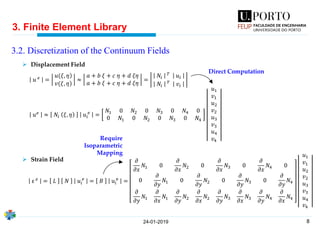
3.2. Discretization of the Continuum Fields
𝑢 𝑒
≈ 𝑁𝑖 𝜉, 𝜂 𝑢𝑖
𝑒
=
𝑁1 0 𝑁2 0 𝑁3 0 𝑁4 0
0 𝑁1 0 𝑁2 0 𝑁3 0 𝑁4
𝑢1
𝑣1
𝑢2
𝑣2
𝑢3
𝑣3
𝑢4
𝑣4
𝑢 𝑒
=
)𝑢(𝜉, 𝜂
)𝑣(𝜉, 𝜂
≈
𝑎 + 𝑏 𝜉 + 𝑐 𝜂 + 𝑑 𝜉𝜂
=
𝑁𝑖
𝑇
𝑢𝑖
𝑁𝑖
𝑇
𝑣𝑖
ε 𝑒
= 𝐿 𝑁 𝑢𝑖
𝑒
= 𝐵 ui
e
=
𝜕
𝜕𝑥
𝑁1 0
𝜕
𝜕𝑥
𝑁2 0
𝜕
𝜕𝑥
𝑁3 0
𝜕
𝜕𝑥
𝑁4 0
0
𝜕
𝜕𝑦
𝑁1 0
𝜕
𝜕𝑦
𝑁2 0
𝜕
𝜕𝑦
𝑁3 0
𝜕
𝜕𝑦
𝑁4
𝜕
𝜕𝑦
𝑁1
𝜕
𝜕𝑥
𝑁1
𝜕
𝜕𝑦
𝑁2
𝜕
𝜕𝑥
𝑁2
𝜕
𝜕𝑦
𝑁3
𝜕
𝜕𝑥
𝑁3
𝜕
𝜕𝑦
𝑁4
𝜕
𝜕𝑥
𝑁4
𝑢1
𝑣1
𝑢2
𝑣2
𝑢3
𝑣3
𝑢4
𝑣4
➢ Displacement Field
➢ Strain Field
Direct Computation
Require
Isoparametric
Mapping
9
3. Finite Element Library
24-01-2019
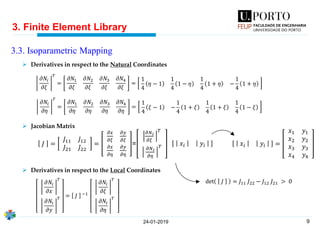
3.3. Isoparametric Mapping
𝐽 =
𝐽11 𝐽12
𝐽21 𝐽22
=
𝜕𝑥
𝜕𝜉
𝜕𝑦
𝜕𝜉
𝜕𝑥
𝜕𝜂
𝜕𝑦
𝜕𝜂
=
𝜕𝑁 𝑖
𝜕𝜉
𝑇
𝜕𝑁 𝑖
𝜕𝜂
𝑇 𝑥𝑖 𝑦𝑖 𝑥𝑖 𝑦𝑖 =
𝑥1 𝑦1
𝑥2 𝑦2
𝑥3 𝑦3
𝑥4 𝑦4
𝜕𝑁𝑖
𝜕𝜉
𝑇
=
𝜕𝑁1
𝜕𝜉
𝜕𝑁2
𝜕𝜉
𝜕𝑁3
𝜕𝜉
𝜕𝑁4
𝜕𝜉
=
1
4
𝜂 − 1
1
4
1 − 𝜂
1
4
1 + 𝜂 −
1
4
1 + 𝜂
𝜕𝑁𝑖
𝜕𝜂
𝑇
=
𝜕𝑁1
𝜕𝜂
𝜕𝑁2
𝜕𝜂
𝜕𝑁3
𝜕𝜂
𝜕𝑁4
𝜕𝜂
=
1
4
𝜉 − 1 −
1
4
1 + 𝜉
1
4
1 + 𝜉
1
4
1 − 𝜉
𝜕𝑁𝑖
𝜕𝑥
𝑇
𝜕𝑁𝑖
𝜕𝑦
𝑇 = 𝐽 −1
𝜕𝑁𝑖
𝜕𝜉
𝑇
𝜕𝑁𝑖
𝜕𝜂
𝑇
➢ Derivatives in respect to the Natural Coordinates
➢ Jacobian Matrix
➢ Derivatives in respect to the Local Coordinates
det 𝐽 = 𝐽11 𝐽22 − 𝐽12 𝐽21 > 0
10
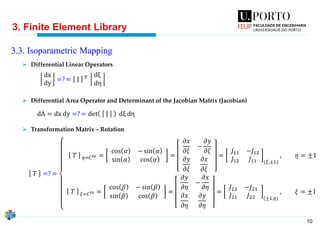
3. Finite Element Library
3.3. Isoparametric Mapping
➢ Differential Linear Operators
➢ Differential Area Operator and Determinant of the Jacobian Matrix (Jacobian)
➢ Transformation Matrix – Rotation
dA = dx dy =? = det J dξ dη
𝑇 =? =
𝑇 𝜂=𝐶 𝑡𝑒 =
cos 𝛼 − sin 𝛼
sin 𝛼 cos 𝛼
=
𝜕𝑥
𝜕𝜉
−
𝜕𝑦
𝜕𝜉
𝜕𝑦
𝜕𝜉
𝜕𝑥
𝜕𝜉
=
𝐽11 −𝐽12
𝐽12 𝐽11 (𝜉,±1)
, 𝜂 = ±1
𝑇 𝜉=𝐶 𝑡𝑒 =
cos 𝛽 − sin 𝛽
sin 𝛽 cos 𝛽
=
𝜕𝑦
𝜕𝜂
−
𝜕𝑥
𝜕𝜂
𝜕𝑥
𝜕𝜂
𝜕𝑦
𝜕𝜂
=
𝐽22 −𝐽21
𝐽21 𝐽22 (±1,𝜂)
, 𝜉 = ±1
dx
dy
=? = J T dξ
dη
11
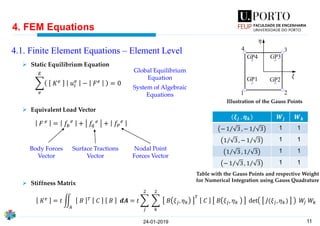
4. FEM Equations
24-01-2019
4.1. Finite Element Equations – Element Level
➢ Static Equilibrium Equation
➢ Equivalent Load Vector
➢ Stiffness Matrix
𝐾 𝑒
= 𝑡 ඵ
𝐴
𝐵 𝑇
𝐶 𝐵 𝒅𝑨 = 𝑡 ෍
𝑗
2
෍
𝑘
2
𝐵 𝜉𝑗, 𝜂 𝑘
𝑇
𝐶 𝐵 𝜉𝑗, 𝜂 𝑘 det 𝐽(𝜉𝑗, 𝜂 𝑘) 𝑊𝑗 𝑊𝑘
(𝝃𝒋 , 𝜼 𝒌) 𝑾𝒋 𝑾 𝒌
− Τ1 3 , − Τ1 3 1 1
Τ1 3, − Τ1 3 1 1
Τ1 3 , Τ1 3 1 1
− Τ1 3, Τ1 3 1 1
𝐹 𝑒 = 𝑓𝑏
𝑒
+ 𝑓𝑞
𝑒 + 𝑓𝑃
𝑒
෍
𝑒
𝐸
𝐾 𝑒 𝑢𝑖
𝑒
− 𝐹 𝑒 = 0
Body Forces
Vector
Surface Tractions
Vector
Nodal Point
Forces Vector
Global Equilibrium
Equation
System of Algebraic
Equations 2
𝜂
𝜉
1
4 3
GP2
GP4 GP3
GP1
Illustration of the Gauss Points
Table with the Gauss Points and respective Weight
for Numerical Integration using Gauss Quadrature
12
4. FEM Equations
24-01-2019
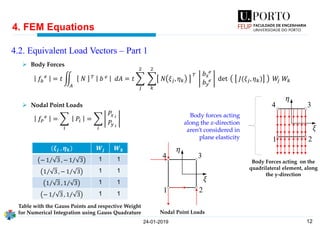
4.2. Equivalent Load Vectors – Part 1
➢ Body Forces
➢ Nodal Point Loads
𝑓𝑏
𝑒
= 𝑡 ඵ
𝐴
𝑁 𝑇 𝑏 𝑒 𝑑𝐴 = 𝑡 ෍
𝑗
2
෍
𝑘
2
𝑁 𝜉𝑗, 𝜂 𝑘
𝑇 𝑏 𝑥
𝑒
𝑏 𝑦
𝑒 det 𝐽(𝜉𝑗, 𝜂 𝑘) 𝑊𝑗 𝑊𝑘
𝑓𝑃
𝑒
= ෍
𝑖
𝑃𝑖 = ෍
𝑖
𝑃𝑥 𝑖
𝑃𝑦 𝑖
𝜂
𝜉
1
4 3
2
𝜂
𝜉
1
4 3
2
Body Forces acting on the
quadrilateral element, along
the y-direction
Nodal Point Loads
Body forces acting
along the z-direction
aren’t considered in
plane elasticity
(𝝃𝒋 , 𝜼 𝒌) 𝑾𝒋 𝑾 𝒌
− Τ1 3 , − Τ1 3 1 1
Τ1 3, − Τ1 3 1 1
Τ1 3 , Τ1 3 1 1
− Τ1 3, Τ1 3 1 1
Table with the Gauss Points and respective Weight
for Numerical Integration using Gauss Quadrature
13
4. FEM Equations
24-01-2019
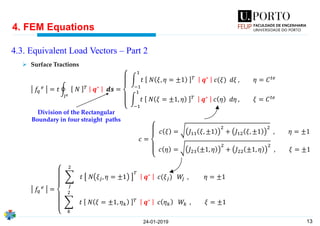
4.3. Equivalent Load Vectors – Part 2
➢ Surface Tractions
𝑓𝑞
𝑒 = 𝑡 ර
𝑙 𝑒
𝑁 𝑇 𝒒∗ 𝒅𝒔 =
න
−1
1
𝑡 𝑁 𝜉, 𝜂 = ±1 𝑇 𝒒∗ 𝑐(𝜉) 𝑑𝜉 , 𝜂 = 𝐶 𝑡𝑒
න
−1
1
𝑡 𝑁 𝜉 = ±1, 𝜂 𝑇 𝒒∗ 𝑐 𝜂 𝑑𝜂 , 𝜉 = 𝐶 𝑡𝑒
𝑓𝑞
𝑒 =
෍
𝑗
2
𝑡 𝑁 𝜉𝑗, 𝜂 = ±1
𝑇
𝒒∗ 𝑐(𝜉𝑗) 𝑊𝑗 , 𝜂 = ±1
෍
𝑘
2
𝑡 𝑁 𝜉 = ±1, 𝜂 𝑘
𝑇 𝒒∗ 𝑐 𝜂 𝑘 𝑊𝑘 , 𝜉 = ±1
𝑐 =
𝑐 𝜉 = 𝐽11 𝜉, ±1
2
+ 𝐽12 𝜉, ±1
2
, 𝜂 = ±1
𝑐 𝜂 = 𝐽21 ±1, 𝜂
2
+ 𝐽22 ±1, 𝜂
2
, 𝜉 = ±1
Division of the Rectangular
Boundary in four straight paths
14
4. FEM Equations
24-01-2019
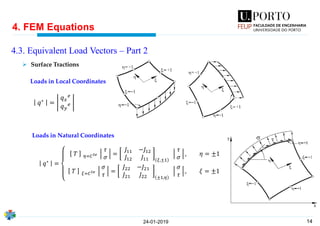
4.3. Equivalent Load Vectors – Part 2
➢ Surface Tractions
Loads in Local Coordinates
Loads in Natural Coordinates
𝑞∗ =
𝑞 𝑥
𝑒
𝑞 𝑦
𝑒
𝑞∗
=
𝑇 𝜂=𝐶 𝑡𝑒
𝜏
𝜎
=
𝐽11 −𝐽12
𝐽12 𝐽11 𝜉,±1
𝜏
𝜎
, 𝜂 = ±1
𝑇 𝜉=𝐶 𝑡𝑒
𝜎
𝜏
=
𝐽22 −𝐽21
𝐽21 𝐽22 ±1,𝜂
𝜎
𝜏
, 𝜉 = ±1
15
5. BapMEF FEM Tool
24-01-2019
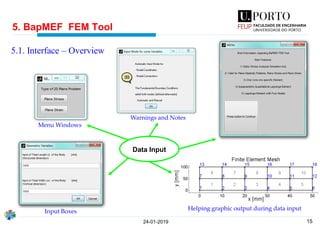
5.1. Interface – Overview
Warnings and Notes
Input Boxes
Menu Windows
Helping graphic output during data input
Data Input
16
5. BapMEF FEM Tool
24-01-2019
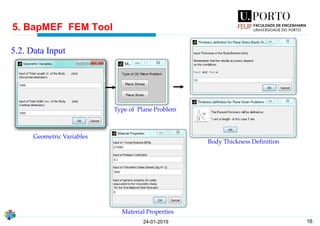
5.2. Data Input
Geometric Variables
Body Thickness Definition
Material Properties
Type of Plane Problem
17
5. BapMEF FEM Tool
24-01-2019
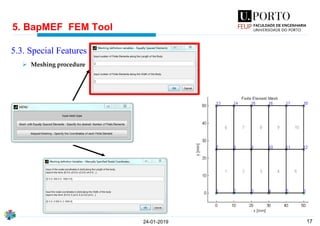
5.3. Special Features
➢ Meshing procedure
18
5. BapMEF FEM Tool
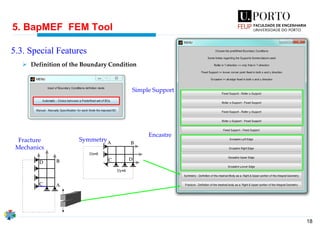
5.3. Special Features
➢ Definition of the Boundary Condition
Simple Support
Encastre
SymmetryFracture
Mechanics
19
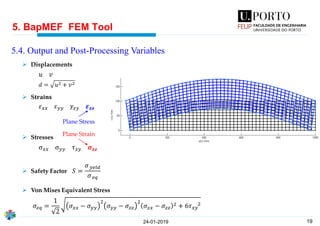
➢ Displacements
➢ S𝐭𝐫𝐚𝐢𝐧𝐬
➢ Stresses
➢ Safety Factor
➢ Von Mises Equivalent Stress
5. BapMEF FEM Tool
24-01-2019
5.4. Output and Post-Processing Variables
𝜀 𝑥𝑥 𝜀 𝑦𝑦 𝛾𝑥𝑦 𝜺 𝒛𝒛
σ 𝑥𝑥 σ 𝑦𝑦 τ 𝑥𝑦 𝝈 𝒛𝒛
𝜎𝑒𝑞 =
1
2
𝜎 𝑥𝑥 − 𝜎 𝑦𝑦
2
𝜎 𝑦𝑦 − 𝜎𝑧𝑧
2
𝜎 𝑥𝑥 − 𝜎𝑧𝑧
2 + 6𝜏 𝑥𝑦
2
𝑆 =
𝜎 𝑦𝑒𝑙𝑑
𝜎 𝑒𝑞
𝑑 = 𝑢2 + 𝑣2
𝑢 𝑣
Plane Stress
Plane Strain
20
6. Validation Examples
24-01-2019
6.1. Constant Rectangular cross-section Beam – Pure Bending
𝑙
𝑙
𝒙 𝒛
𝑢 𝑥, 𝑦 = −
𝑀 𝑜
𝐸𝐼
𝑥𝑦 1 𝑢(𝑥, 𝑦) = −
12𝑀 𝑜
𝐸𝑡𝑤3 𝑥 −
𝑙
2
𝑦 −
𝑤
2
Physical Problem
Equivalent Problem
SimulatedBending Moments ??
Rotation DOF ??
[1] Silva Gomes, Mecânica dos Sólidos e Resistência dos Materiais
Change of Coordinate System
𝑦
𝑥
𝑦
𝑥
𝑤
𝑡
𝑤
𝑀 𝑜 = 𝑃 ∙ 𝑎
Original Coordinate System Coordinate System of the BaPMEF tool
21
6. Validation Examples
24-01-2019
6.1. Constant Rectangular cross-section Beam – Pure Bending
Comparison of
the
displacements in
the x-direction,
determined by
the BaPMEF tool
against the
Analytical
solution
➢ Overall good match
between the Analytical
and Numeric Solution
➢ Null displacements
along the Neutral Axis
➢ Small mismatch near
the plate’s ends:
▪ Analytical
solution badly
behaved in plate’s
boundaries[1]
▪ Boundary
Conditions
difficult to model
in Plane Elasticity
Deformed
shape of
the mesh
22
6. Validation Examples
24-01-2019
𝑡
𝑤
𝑢(𝑥, 𝑦) =
𝑃
6𝐺𝐼
𝑦 −
𝑤
2
3
−
𝑃𝑥2
2𝐸𝐼
𝑦 −
𝑤
2
− 𝑣
𝑃
6𝐸𝐼
𝑦 −
𝑤
2
3
+
𝑃𝑙2
2𝐸𝐼
−
𝑃𝑤2
8𝐺𝐼
𝑦 −
𝑤
2
𝑣(𝑥, 𝑦) = 𝑣
𝑃𝑥
2𝐸𝐼
𝑦 −
𝑤
2
2
+
𝑃𝑥3
6𝐸𝐼
−
𝑃𝑙2 𝑥
2𝐸𝐼
+
𝑃𝑙3
3𝐸𝐼
𝑢(𝑥, 𝑦) =
𝑃
6𝐺𝐼
𝑦 −
𝑤
2
3
−
𝑃𝑥2
2𝐸𝐼
𝑦 −
𝑤
2
− 𝑣
𝑃
6𝐸𝐼
𝑦 −
𝑤
2
3
+
𝑃𝑙2
2𝐸𝐼
𝑦 −
𝑤
2
𝑣(𝑥, 𝑦) = 𝑣
𝑃𝑥
2𝐸𝐼
𝑦 −
𝑤
2
2
+
𝑃𝑥3
6𝐸𝐼
−
𝑃𝑙2
2𝐸𝐼
+
𝑃𝑤2
8𝐺𝐼
𝑥 +
𝑃𝑙3
3𝐸𝐼
+
𝑃𝑤2 𝑙
8𝐺𝐼
𝜕𝑣
𝜕𝑥 𝑥=𝑙 ; 𝑦=0
= 0
𝜕𝑢
𝜕𝑦 𝑥=𝑙 ; 𝑦=0
= 0
Situation (ii) 1
Situation (i) 1
➢ Shear distributed Load
➢ There is no approximation in the definition of the BC
➢ It is also necessary to change the coordinate system
6.2. Constant Rectangular cross-section Beam – Cantilever Beam
under Tangential Traction at the end
[1] Silva Gomes, Mecânica dos Sólidos e Resistência dos Materiais
Problem Simulated
𝑦
𝑥
𝑞
𝑙
𝑤𝑃
𝒒 =
𝑷
𝒘 ∙ 𝒕
23
6. Validation Examples
24-01-2019
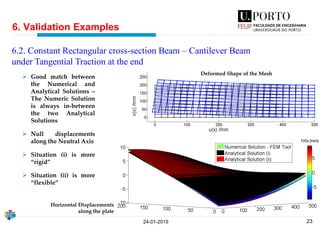
➢ Good match between
the Numerical and
Analytical Solutions –
The Numeric Solution
is always in-between
the two Analytical
Solutions
➢ Null displacements
along the Neutral Axis
➢ Situation (i) is more
“rigid”
➢ Situation (ii) is more
“flexible”
6.2. Constant Rectangular cross-section Beam – Cantilever Beam
under Tangential Traction at the end
Horizontal Displacements
along the plate
Deformed Shape of the Mesh
24
6. Validation Examples
24-01-2019
6.2. Constant Rectangular cross-section Beam – Cantilever Beam
under Tangential Traction at the end
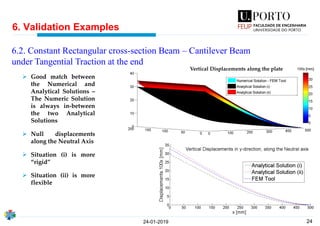
➢ Good match between
the Numerical and
Analytical Solutions –
The Numeric Solution
is always in-between
the two Analytical
Solutions
➢ Null displacements
along the Neutral Axis
➢ Situation (i) is more
“rigid”
➢ Situation (ii) is more
flexible
Vertical Displacements along the plate
25
6. Validation Examples
24-01-2019
6.2. Constant Rectangular cross-section Beam – Cantilever Beam
under Tangential Traction at the end
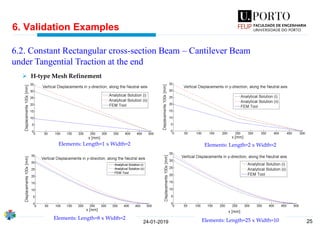
➢ H-type Mesh Refinement
Elements: Length=1 x Width=2 Elements: Length=2 x Width=2
Elements: Length=8 x Width=2 Elements: Length=25 x Width=10
26
𝑣 𝑥, 𝑦 1
=
𝑸
2𝐸𝐼
൮
൲
𝑦 −
𝑤
2
4
12
−
𝑤2
8
𝑦 −
𝑤
2
2
+
𝑤3
12
𝑦 −
𝑤
2
+ 𝑣
𝑙2
4
− 𝑥 −
𝑙
2
2 𝑦 −
𝑤
2
2
+
𝑦 −
𝑤
2
4
6
−
𝑤2
20
𝑦 −
𝑤
2
2
+
𝑙2
8
𝑥 −
𝑙
2
2
−
𝑥 −
𝑙
2
4
12
−
𝑤2
20
𝑥 −
𝑙
2
2
+
1
4
+
𝑣
8
𝑤2 𝑥 −
𝑙
2
2
−
5𝑙4
192
1 +
12𝑤2
5𝑙2
4
5
+
𝑣
2
6. Validation Examples
24-01-2019
6.3. Constant Rectangular cross-section Beam – Simple Supported Beam
under Uniform Surface Traction
𝑙
𝑤
𝑞
𝑦
𝑥 𝑡
𝑤
𝑞
𝑄
➢ There is no approximation in the definition of the BC
[1] Silva Gomes, Mecânica dos Sólidos e Resistência dos Materiais
Problem Simulated
𝑸 = 𝒒 ∙ 𝒕
27
6. Validation Examples
24-01-2019
6.3. Constant Rectangular cross-section Beam – Simple Supported Beam
under Uniform Surface Traction
➢ It is also necessary to change the original Coordinate System of the Analytical Solution
➢ Analytical Solutions for the Stresses
𝜎 𝑥𝑥
1 =
𝑸
2𝐼
2
3
𝑦 −
𝑤
2
3
−
𝑤2
10
𝑦 −
𝑤
2
−
𝑸
2𝐼
𝑥 −
𝑙
2
2
−
𝑙2
4
𝑦 −
𝑤
2
𝜎 𝑦𝑦
1 = −
𝑸
2𝐼
𝑦 −
𝑤
2
3
3
−
𝑤2
4
𝑦 −
𝑤
2
−
𝑤3
12
𝜏 𝑥𝑦
1 =
𝑸
2𝐼
𝑦 −
𝑤
2
2
−
𝑤2
4
𝑥 −
𝑙
2
[1] Silva Gomes, Mecânica dos Sólidos e Resistência dos Materiais
Deformed Shape of the Mesh
28
6. Validation Examples
6.3. Constant Rectangular cross-section Beam – Simple Supported Beam
under Uniform Surface Traction
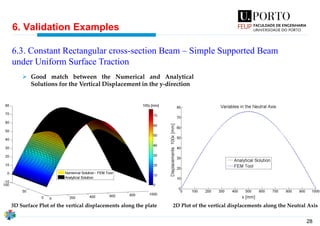
➢ Good match between the Numerical and Analytical
Solutions for the Vertical Displacement in the y-direction
3D Surface Plot of the vertical displacements along the plate 2D Plot of the vertical displacements along the Neutral Axis
29
6. Validation Examples
6.3. Constant Rectangular cross-section Beam – Simple Supported Beam
under Uniform Surface Traction
➢ Overall good match between the Numerical and Analytical
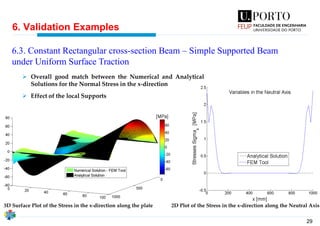
Solutions for the Normal Stress in the x-direction
➢ Effect of the local Supports
3D Surface Plot of the Stress in the x-direction along the plate 2D Plot of the Stress in the x-direction along the Neutral Axis
30
6. Validation Examples
6.3. Constant Rectangular cross-section Beam – Simple Supported Beam
under Uniform Surface Traction
➢ Overall good match between the Numerical and Analytical
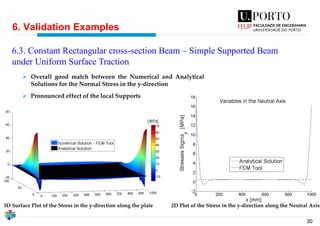
Solutions for the Normal Stress in the y-direction
➢ Pronounced effect of the local Supports
3D Surface Plot of the Stress in the y-direction along the plate 2D Plot of the Stress in the y-direction along the Neutral Axis
31
6. Validation Examples
6.3. Constant Rectangular cross-section Beam – Simple Supported Beam
under Uniform Surface Traction
➢ Overall good match between the Numerical and Analytical
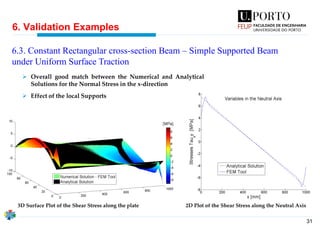
Solutions for the Normal Stress in the x-direction
➢ Effect of the local Supports
3D Surface Plot of the Shear Stress along the plate 2D Plot of the Shear Stress along the Neutral Axis
32
7. Practical Applications
24-01-2019
7.1. Fracture Mechanics – Plate with Centered Crack
2a
𝑊
𝐿
𝑞
𝑞
𝑊
𝑡
a
𝑤 =
𝑊
2
𝑙 =
𝐿
2
Physical Problem
Equivalent Problem Simulated
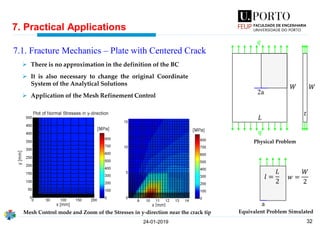
➢ There is no approximation in the definition of the BC
➢ It is also necessary to change the original Coordinate
System of the Analytical Solutions
➢ Application of the Mesh Refinement Control
Mesh Control mode and Zoom of the Stresses in y-direction near the crack tip
33
7. Practical Applications
24-01-2019
7.1. Fracture Mechanics – Plate with Centered Crack
𝜎 𝑦𝑦 =
𝑞 𝑎
)2(𝑥 − 𝑎
𝜎 𝑦𝑦 =
𝑞 𝑎
)2(𝑥 − 𝑎
sec
𝜋𝑎
𝐿
𝜎 𝑦𝑦 =
𝑞 𝑎
)2(𝑥 − 𝑎
𝐿
𝜋𝑎
tan
𝜋𝑎
𝐿
𝜎 𝑦𝑦 =
𝑞
1 −
𝑎
𝑥
2
4
𝐸
𝑞
𝑎2 − 𝑎𝑥
2
;
4
𝐸
𝑞
𝑎2 − 𝑎𝑥
2
sec
𝜋𝑎
𝐿
;
4
𝐸
𝑞
𝑎2 − 𝑎𝑥
2
𝐿
𝜋𝑎
tan
𝜋𝑎
𝐿
;
2
𝐸
𝑞 𝑎2 − 𝑥2 ;
)4(1 − 𝑣2
𝐸
𝑞
𝑎2 − 𝑎𝑥
2
)4(1 − 𝑣2
𝐸
𝑞
𝑎2 − 𝑎𝑥
2
sec
𝜋𝑎
𝐿
)4(1 − 𝑣2
𝐸
𝑞
𝑎2 − 𝑎𝑥
2
𝐿
𝜋𝑎
tan
𝜋𝑎
𝐿
)2(1 − 𝑣2
𝐸
𝑞 𝑎2 − 𝑥2
Plane Stress Plane Strain Solution [2]
(i)
(ii)
(iii)
(iv)
𝑣 𝑥, 𝑦 =
𝑣 𝑥, 𝑦 =
𝑣 𝑥, 𝑦 =
𝑣 𝑥, 𝑦 =
➢ Plane Strain Problem
[2] David Broke, Elementary Engineering Fracture Mechanics
34
7. Practical Applications
24-01-2019
7.1. Fracture Mechanics – Plate with Centered Crack
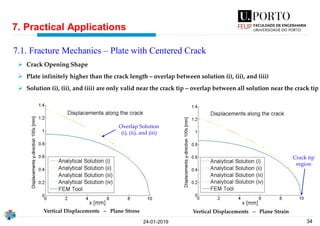
➢ Crack Opening Shape
➢ Plate infinitely higher than the crack length – overlap between solution (i), (ii), and (iii)
➢ Solution (i), (ii), and (iii) are only valid near the crack tip – overlap between all solution near the crack tip
Vertical Displacements – Plane Stress Vertical Displacements – Plane Strain
Overlap Solution
(i), (ii), and (iii)
Crack tip
region
35
7. Practical Applications
24-01-2019
7.1. Fracture Mechanics – Plate with Centered Crack
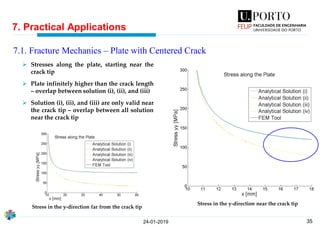
➢ Stresses along the plate, starting near the
crack tip
➢ Plate infinitely higher than the crack length
– overlap between solution (i), (ii), and (iii)
➢ Solution (i), (ii), and (iii) are only valid near
the crack tip – overlap between all solution
near the crack tip
Stress in the y-direction near the crack tip
Stress in the y-direction far from the crack tip
36
7. Practical Applications
24-01-2019
7.2. BaPMEF vs. Abaqus®
15 Τ𝑁 𝑚𝑚2
𝑷
5 Τ𝑁 𝑚𝑚2
150 [𝑁]
500 [𝑁]
50 [𝑁]
100 [𝑚𝑚]
100 [𝑚𝑚]
30 [𝑚𝑚] 30 [𝑚𝑚]
20 [𝑚𝑚] 20 [𝑚𝑚]
10 Τ𝑁 𝑚𝑚2
BaPMEF
➢ Commercially
Available FEA Software
– Abaqus ®
➢ Plane Strain Problem
➢ Generic Loading – No
Analytical Solution
Available
➢ Gravity Body Forces
➢ Surface Tractions acting
along the whole
boundary
➢ Surface Tractions acting
on each Element
Problem
Simulated
in Abaqus
Problem Simulated
in BaPMEF
Gravity Force
37
7. Practical Applications
24-01-2019
7.2. BaPMEF vs. Abaqus®
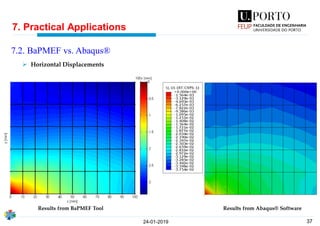
➢ Horizontal Displacements
Results from BaPMEF Tool Results from Abaqus® Software
38
7. Practical Applications
24-01-2019
7.2. BaPMEF vs. Abaqus®
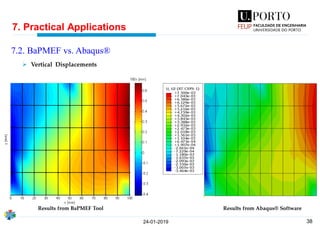
➢ Vertical Displacements
Results from BaPMEF Tool Results from Abaqus® Software
39
7. Practical Applications
24-01-2019
7.2. BaPMEF vs. Abaqus®
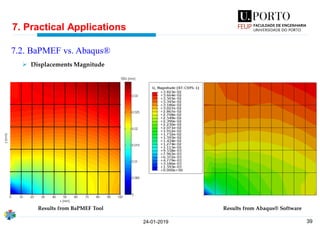
➢ Displacements Magnitude
Results from BaPMEF Tool Results from Abaqus® Software
40
Thank you for your attention!
24-01-2019
Método dos Elementos Finitos
EM065
Theory
FEM Programming
Validation & Practical Applications

Isoparametric bilinear quadrilateral element _ ppt presentation

  • 1.
    2D Plane Elasticity– Isoparametric Bilinear Quadrilateral Lagrange type Element Filipe Giesteira Master student Faculty of Engineering of University of Porto (FEUP) Mechanical Engineering Department (DEMec) Finite Element Method (MEF, Método dos Elementos Finitos) Supervisor: Prof. Francisco Andrade Pires Supervisor: Prof. José Dias Rodrigues Finite Element Method (FEM) - Final Presentation Faculty of Engineering of University of Porto Building L / Room L317 Porto, 24th January 2019 Work Assignment No. 2.3
  • 2.
    2 Contents ➢ Introduction –Plane Elasticity Background Theory ➢ Weak & Strong Form – FEM Mathematical Formulation ➢ Finite Element Library – Isoparametric Bilinear Quadrilateral Element ➢ FEM Equations – Element Mechanical Properties ➢ BaPMEF FEM Tool – Script Capabilities and Limitations ➢ Validation Examples – Solutions of the Biharmonic Equation / Airy Functions ➢ Practical Applications 24-01-2019
  • 3.
    3 1. Introduction 1.1. PlaneElasticity Background Theory – Assumptions and Simplifications 24-01-2019 y x l t w z 𝑢 Ԧ𝑣 𝑤 σzz x, y, z = ± Τt 2 = τyz x, y, z = ± Τt 2 = τxz(x, y, z = ± Τt 2) = 0 t ≪ l ∧ t ≪ w ⇒ σzz x, y, z = τyz x, y, z = τxz(x, y, z) = 0 t ≪ l ∧ t ≪ w ⇒ ൞ )σxx = fxx(x, y σyy = fyy x, y ൯τxy = fxy(x, y y xl tw z Ԧ𝑣 𝑢 𝑤 t ≫ l ∧ t ≫ w ⇒ σzz x, y, z = C te ቊ 𝑤 𝑥, 𝑦, ± Τ𝑡 2 = 0 𝑤 𝑥, 𝑦, 0 = 0, 𝑏𝑦 𝑠𝑦𝑚. ⇒ 𝑤 𝑥, 𝑦, 𝑧 ≈ 0 𝑤 𝑥, 𝑦, 𝑧 = 0 ⇒ 𝜀 𝑧𝑧(𝑥, 𝑦, 𝑧) = 0 𝛾𝑦𝑧(𝑥, 𝑦, 𝑧) = 0 𝛾𝑥𝑧(𝑥, 𝑦𝑧, 𝑧) = 0 )𝜀 𝑥𝑥 = 𝑓𝑥𝑥(𝑥, 𝑦 ൯𝜀 𝑦𝑦 = 𝑓𝑦𝑦(𝑥, 𝑦 ൯𝛾𝑥𝑦 = 𝑓𝑥𝑦(𝑥, 𝑦 ൞ 𝑓𝑥 = 𝑓𝑥 𝑥, 𝑦 𝑓𝑦 = 𝑓𝑦 𝑥, 𝑦 𝑓𝑧 = 0 ➢ Plane Stress ➢ Plane Strain
  • 4.
    4 ➢ Displacement Field ➢Strain Field ➢ Stress Field 1. Introduction 1.2. Plane Elasticity Background Theory – Solid Mechanics Continuum 24-01-2019 𝑢 = 𝑢 𝑥, 𝑦 = )𝑢(𝑥, 𝑦 )𝑣(𝑥, 𝑦 𝜀 = 𝜀 𝑥𝑥 𝜀 𝑦𝑦 𝛾𝑥𝑦 = 𝜕𝑢 𝜕𝑥 𝜕𝑣 𝜕𝑦 𝜕𝑢 𝜕𝑦 + 𝜕𝑣 𝜕𝑥 𝜀 = L 𝑢 = 𝜕 𝜕𝑥 0 0 𝜕 𝜕𝑦 𝜕 𝜕𝑦 𝜕 𝜕𝑥 )𝑢(𝑥, 𝑦 𝑣 𝑥, 𝑦 𝜎 = 𝐶 𝜀 𝐶 = 𝐸 1 − 𝑣2 𝐸𝑣 1 − 𝑣2 0 𝐸𝑣 1 − 𝑣2 𝐸 1 − 𝑣2 0 0 0 𝐸 2 1 + 𝑣 ; 𝐸 1 − 𝑣 )1 + 𝑣 (1 − 2𝑣 𝐸𝑣 )1 + 𝑣 (1 − 2𝑣 0 𝐸𝑣 )1 + 𝑣 (1 − 2𝑣 𝐸 1 − 𝑣 )1 + 𝑣 (1 − 2𝑣 0 0 0 𝐸 2 1 + 𝑣 Plane Stress Plane Strain Matrix form useful to discretize the Weak-form in Finite Domains! Isotropic Transversely Isotropic Orthotropic Monolithic … …
  • 5.
    5 2. Weak &Strong Form 24-01-2019 2.1. Development of the Weak Form ➢ Principle of the Minimum Total Potential Energy ➢ Principle of Virtual Work/Virtual Displacements ➢ Hamilton’s Principle ➢ Galerkin Method of Weighted-Residuals 𝛿𝛱 = 𝜕 𝜕|𝑢| 𝛱 𝑢 𝛿𝑢 = 𝛿𝑉 − 𝛿𝑊 = 0 𝛿𝑊 𝐼𝑛𝑡𝑒𝑟𝑛𝑎𝑙 𝐹𝑜𝑟𝑐𝑒𝑠 + 𝛿𝑊 𝐼𝑛𝑒𝑟𝑡𝑖𝑎𝑙 𝐹𝑜𝑟𝑐𝑒𝑠 + 𝛿𝑊 𝐸𝑥𝑡𝑒𝑟𝑛𝑎𝑙 𝐹𝑜𝑟𝑐𝑒𝑠 = 0 න 𝑡1 𝑡2 𝛿 𝑇 − 𝑉 𝑑𝑡 + න 𝑡1 𝑡2 𝛿𝑊𝑛𝑐 𝑑𝑡 = 0 න Ω 𝑤𝑥 − 𝜕 𝜕𝑥 𝜎 𝑥𝑥 − 𝜕 𝜕𝑦 𝜏 𝑥𝑦 − 𝑓𝑥 + 𝜌 𝜕2 𝜕𝑡2 𝑢 𝑥, 𝑦 𝑑𝑥 𝑑𝑦 = 0 න Ω 𝑤 𝑦 − 𝜕 𝜕𝑦 𝜎 𝑦𝑦 − 𝜕 𝜕𝑥 𝜏 𝑥𝑦 − 𝑓𝑦 + 𝜌 𝜕2 𝜕𝑡2 𝑣 𝑥, 𝑦 𝑑𝑥 𝑑𝑦 = 0 Variational Principles Integral Statement
  • 6.
    6 ➢ Weak Form– ready to be Discretized in Finite Element Domains ➢ Strong Form – continuously valid in the entire Domain 2. Weak & Strong Form 24-01-2019 2.2. Strong vs. Weak Form 𝑡 ඵ 𝐴 𝐿 𝛿𝑢 𝑇 𝐶 𝐿 𝑢 𝑑𝐴 + ඵ 𝐴 𝛿𝑢 𝑇 𝜌 ሷ𝑢 𝑑𝐴 = 𝑡 ඵ 𝐴 𝛿𝑢 𝑇 𝑏 𝑑𝐴 + 𝑡 ර 𝑙 𝛿𝑢 𝑇 𝑞 𝑑𝑠 + ෍ 𝑝𝑖 𝛿𝑢 𝑝𝑖 𝑇 𝑃𝑝𝑖 𝜕 𝜕𝑥 𝜎𝑥𝑥 + 𝜕 𝜕𝑦 𝜏 𝑥𝑦 + 𝑏 𝑥 = 𝜌 𝜕2 𝜕𝑡2 𝑢 𝑥, 𝑦 𝜕 𝜕𝑦 𝜎 𝑦𝑦 + 𝜕 𝜕𝑥 𝜏 𝑥𝑦 + 𝑏 𝑦 = 𝜌 𝜕2 𝜕𝑡2 𝑣 𝑥, 𝑦 ; 𝜎𝑥𝑥 = 𝐶11 𝜕𝑢 𝜕𝑥 + 𝐶12 𝜕𝑣 𝜕𝑦 𝜎 𝑦𝑦 = 𝐶12 𝜕𝑢 𝜕𝑥 + 𝐶11 𝜕𝑣 𝜕𝑦 ; ൝ 𝜏 𝑥𝑦 = 𝐶11 − 𝐶12 2 𝜕𝑢 𝜕𝑦 + 𝜕𝑣 𝜕𝑥 𝑢 = ො𝑢 , ∀ 𝛤 = 𝛤𝑢 ; 𝑡 = 𝜎 𝑇 ො𝑛 = Ƹ𝑡 , ∀ 𝛤 = 𝛤𝑡 Natural Boundary ConditionsEssential Boundary Conditions 𝛿𝑢 = 𝛿𝑢 𝛿𝑣 𝛿𝑢 𝑝𝑖 = 𝛿𝑢 𝑝𝑖 𝛿𝑣 𝑝𝑖 𝑃𝑝𝑖 = 𝑃𝑝𝑖 𝑥 𝑃𝑝𝑖 𝑦 𝑏 = 𝑏 𝑥 𝑏 𝑦 𝑞 = 𝑞 𝑥 𝑞 𝑦 ሷ𝑢 = ሷ𝑢 ሷ𝑣
  • 7.
    7 3. Finite ElementLibrary 24-01-2019 3.1. Isoparametric Bilinear Quadrilateral Element 𝑁𝑖 = 𝑁1 𝑁2 𝑁3 𝑁4 = 1 4 1 − 𝜉 1 − 𝜂 1 4 1 + 𝜉 1 − 𝜂 1 4 1 + 𝜉 1 + 𝜂 1 4 1 − 𝜉 1 + 𝜂 Node 𝝃 𝜼 1 -1 -1 2 1 -1 3 1 1 4 -1 1 𝜂 𝜉 1 4 3 2 Lagrange type Element - 4 nodes Shape / Interpolation Functions
  • 8.
    8 3. Finite ElementLibrary 24-01-2019 3.2. Discretization of the Continuum Fields 𝑢 𝑒 ≈ 𝑁𝑖 𝜉, 𝜂 𝑢𝑖 𝑒 = 𝑁1 0 𝑁2 0 𝑁3 0 𝑁4 0 0 𝑁1 0 𝑁2 0 𝑁3 0 𝑁4 𝑢1 𝑣1 𝑢2 𝑣2 𝑢3 𝑣3 𝑢4 𝑣4 𝑢 𝑒 = )𝑢(𝜉, 𝜂 )𝑣(𝜉, 𝜂 ≈ 𝑎 + 𝑏 𝜉 + 𝑐 𝜂 + 𝑑 𝜉𝜂 𝑎 + 𝑏 𝜉 + 𝑐 𝜂 + 𝑑 𝜉𝜂 = 𝑁𝑖 𝑇 𝑢𝑖 𝑁𝑖 𝑇 𝑣𝑖 ε 𝑒 = 𝐿 𝑁 𝑢𝑖 𝑒 = 𝐵 ui e = 𝜕 𝜕𝑥 𝑁1 0 𝜕 𝜕𝑥 𝑁2 0 𝜕 𝜕𝑥 𝑁3 0 𝜕 𝜕𝑥 𝑁4 0 0 𝜕 𝜕𝑦 𝑁1 0 𝜕 𝜕𝑦 𝑁2 0 𝜕 𝜕𝑦 𝑁3 0 𝜕 𝜕𝑦 𝑁4 𝜕 𝜕𝑦 𝑁1 𝜕 𝜕𝑥 𝑁1 𝜕 𝜕𝑦 𝑁2 𝜕 𝜕𝑥 𝑁2 𝜕 𝜕𝑦 𝑁3 𝜕 𝜕𝑥 𝑁3 𝜕 𝜕𝑦 𝑁4 𝜕 𝜕𝑥 𝑁4 𝑢1 𝑣1 𝑢2 𝑣2 𝑢3 𝑣3 𝑢4 𝑣4 ➢ Displacement Field ➢ Strain Field Direct Computation Require Isoparametric Mapping
  • 9.
    9 3. Finite ElementLibrary 24-01-2019 3.3. Isoparametric Mapping 𝐽 = 𝐽11 𝐽12 𝐽21 𝐽22 = 𝜕𝑥 𝜕𝜉 𝜕𝑦 𝜕𝜉 𝜕𝑥 𝜕𝜂 𝜕𝑦 𝜕𝜂 = 𝜕𝑁 𝑖 𝜕𝜉 𝑇 𝜕𝑁 𝑖 𝜕𝜂 𝑇 𝑥𝑖 𝑦𝑖 𝑥𝑖 𝑦𝑖 = 𝑥1 𝑦1 𝑥2 𝑦2 𝑥3 𝑦3 𝑥4 𝑦4 𝜕𝑁𝑖 𝜕𝜉 𝑇 = 𝜕𝑁1 𝜕𝜉 𝜕𝑁2 𝜕𝜉 𝜕𝑁3 𝜕𝜉 𝜕𝑁4 𝜕𝜉 = 1 4 𝜂 − 1 1 4 1 − 𝜂 1 4 1 + 𝜂 − 1 4 1 + 𝜂 𝜕𝑁𝑖 𝜕𝜂 𝑇 = 𝜕𝑁1 𝜕𝜂 𝜕𝑁2 𝜕𝜂 𝜕𝑁3 𝜕𝜂 𝜕𝑁4 𝜕𝜂 = 1 4 𝜉 − 1 − 1 4 1 + 𝜉 1 4 1 + 𝜉 1 4 1 − 𝜉 𝜕𝑁𝑖 𝜕𝑥 𝑇 𝜕𝑁𝑖 𝜕𝑦 𝑇 = 𝐽 −1 𝜕𝑁𝑖 𝜕𝜉 𝑇 𝜕𝑁𝑖 𝜕𝜂 𝑇 ➢ Derivatives in respect to the Natural Coordinates ➢ Jacobian Matrix ➢ Derivatives in respect to the Local Coordinates det 𝐽 = 𝐽11 𝐽22 − 𝐽12 𝐽21 > 0
  • 10.
    10 3. Finite ElementLibrary 3.3. Isoparametric Mapping ➢ Differential Linear Operators ➢ Differential Area Operator and Determinant of the Jacobian Matrix (Jacobian) ➢ Transformation Matrix – Rotation dA = dx dy =? = det J dξ dη 𝑇 =? = 𝑇 𝜂=𝐶 𝑡𝑒 = cos 𝛼 − sin 𝛼 sin 𝛼 cos 𝛼 = 𝜕𝑥 𝜕𝜉 − 𝜕𝑦 𝜕𝜉 𝜕𝑦 𝜕𝜉 𝜕𝑥 𝜕𝜉 = 𝐽11 −𝐽12 𝐽12 𝐽11 (𝜉,±1) , 𝜂 = ±1 𝑇 𝜉=𝐶 𝑡𝑒 = cos 𝛽 − sin 𝛽 sin 𝛽 cos 𝛽 = 𝜕𝑦 𝜕𝜂 − 𝜕𝑥 𝜕𝜂 𝜕𝑥 𝜕𝜂 𝜕𝑦 𝜕𝜂 = 𝐽22 −𝐽21 𝐽21 𝐽22 (±1,𝜂) , 𝜉 = ±1 dx dy =? = J T dξ dη
  • 11.
    11 4. FEM Equations 24-01-2019 4.1.Finite Element Equations – Element Level ➢ Static Equilibrium Equation ➢ Equivalent Load Vector ➢ Stiffness Matrix 𝐾 𝑒 = 𝑡 ඵ 𝐴 𝐵 𝑇 𝐶 𝐵 𝒅𝑨 = 𝑡 ෍ 𝑗 2 ෍ 𝑘 2 𝐵 𝜉𝑗, 𝜂 𝑘 𝑇 𝐶 𝐵 𝜉𝑗, 𝜂 𝑘 det 𝐽(𝜉𝑗, 𝜂 𝑘) 𝑊𝑗 𝑊𝑘 (𝝃𝒋 , 𝜼 𝒌) 𝑾𝒋 𝑾 𝒌 − Τ1 3 , − Τ1 3 1 1 Τ1 3, − Τ1 3 1 1 Τ1 3 , Τ1 3 1 1 − Τ1 3, Τ1 3 1 1 𝐹 𝑒 = 𝑓𝑏 𝑒 + 𝑓𝑞 𝑒 + 𝑓𝑃 𝑒 ෍ 𝑒 𝐸 𝐾 𝑒 𝑢𝑖 𝑒 − 𝐹 𝑒 = 0 Body Forces Vector Surface Tractions Vector Nodal Point Forces Vector Global Equilibrium Equation System of Algebraic Equations 2 𝜂 𝜉 1 4 3 GP2 GP4 GP3 GP1 Illustration of the Gauss Points Table with the Gauss Points and respective Weight for Numerical Integration using Gauss Quadrature
  • 12.
    12 4. FEM Equations 24-01-2019 4.2.Equivalent Load Vectors – Part 1 ➢ Body Forces ➢ Nodal Point Loads 𝑓𝑏 𝑒 = 𝑡 ඵ 𝐴 𝑁 𝑇 𝑏 𝑒 𝑑𝐴 = 𝑡 ෍ 𝑗 2 ෍ 𝑘 2 𝑁 𝜉𝑗, 𝜂 𝑘 𝑇 𝑏 𝑥 𝑒 𝑏 𝑦 𝑒 det 𝐽(𝜉𝑗, 𝜂 𝑘) 𝑊𝑗 𝑊𝑘 𝑓𝑃 𝑒 = ෍ 𝑖 𝑃𝑖 = ෍ 𝑖 𝑃𝑥 𝑖 𝑃𝑦 𝑖 𝜂 𝜉 1 4 3 2 𝜂 𝜉 1 4 3 2 Body Forces acting on the quadrilateral element, along the y-direction Nodal Point Loads Body forces acting along the z-direction aren’t considered in plane elasticity (𝝃𝒋 , 𝜼 𝒌) 𝑾𝒋 𝑾 𝒌 − Τ1 3 , − Τ1 3 1 1 Τ1 3, − Τ1 3 1 1 Τ1 3 , Τ1 3 1 1 − Τ1 3, Τ1 3 1 1 Table with the Gauss Points and respective Weight for Numerical Integration using Gauss Quadrature
  • 13.
    13 4. FEM Equations 24-01-2019 4.3.Equivalent Load Vectors – Part 2 ➢ Surface Tractions 𝑓𝑞 𝑒 = 𝑡 ර 𝑙 𝑒 𝑁 𝑇 𝒒∗ 𝒅𝒔 = න −1 1 𝑡 𝑁 𝜉, 𝜂 = ±1 𝑇 𝒒∗ 𝑐(𝜉) 𝑑𝜉 , 𝜂 = 𝐶 𝑡𝑒 න −1 1 𝑡 𝑁 𝜉 = ±1, 𝜂 𝑇 𝒒∗ 𝑐 𝜂 𝑑𝜂 , 𝜉 = 𝐶 𝑡𝑒 𝑓𝑞 𝑒 = ෍ 𝑗 2 𝑡 𝑁 𝜉𝑗, 𝜂 = ±1 𝑇 𝒒∗ 𝑐(𝜉𝑗) 𝑊𝑗 , 𝜂 = ±1 ෍ 𝑘 2 𝑡 𝑁 𝜉 = ±1, 𝜂 𝑘 𝑇 𝒒∗ 𝑐 𝜂 𝑘 𝑊𝑘 , 𝜉 = ±1 𝑐 = 𝑐 𝜉 = 𝐽11 𝜉, ±1 2 + 𝐽12 𝜉, ±1 2 , 𝜂 = ±1 𝑐 𝜂 = 𝐽21 ±1, 𝜂 2 + 𝐽22 ±1, 𝜂 2 , 𝜉 = ±1 Division of the Rectangular Boundary in four straight paths
  • 14.
    14 4. FEM Equations 24-01-2019 4.3.Equivalent Load Vectors – Part 2 ➢ Surface Tractions Loads in Local Coordinates Loads in Natural Coordinates 𝑞∗ = 𝑞 𝑥 𝑒 𝑞 𝑦 𝑒 𝑞∗ = 𝑇 𝜂=𝐶 𝑡𝑒 𝜏 𝜎 = 𝐽11 −𝐽12 𝐽12 𝐽11 𝜉,±1 𝜏 𝜎 , 𝜂 = ±1 𝑇 𝜉=𝐶 𝑡𝑒 𝜎 𝜏 = 𝐽22 −𝐽21 𝐽21 𝐽22 ±1,𝜂 𝜎 𝜏 , 𝜉 = ±1
  • 15.
    15 5. BapMEF FEMTool 24-01-2019 5.1. Interface – Overview Warnings and Notes Input Boxes Menu Windows Helping graphic output during data input Data Input
  • 16.
    16 5. BapMEF FEMTool 24-01-2019 5.2. Data Input Geometric Variables Body Thickness Definition Material Properties Type of Plane Problem
  • 17.
    17 5. BapMEF FEMTool 24-01-2019 5.3. Special Features ➢ Meshing procedure
  • 18.
    18 5. BapMEF FEMTool 5.3. Special Features ➢ Definition of the Boundary Condition Simple Support Encastre SymmetryFracture Mechanics
  • 19.
    19 ➢ Displacements ➢ S𝐭𝐫𝐚𝐢𝐧𝐬 ➢Stresses ➢ Safety Factor ➢ Von Mises Equivalent Stress 5. BapMEF FEM Tool 24-01-2019 5.4. Output and Post-Processing Variables 𝜀 𝑥𝑥 𝜀 𝑦𝑦 𝛾𝑥𝑦 𝜺 𝒛𝒛 σ 𝑥𝑥 σ 𝑦𝑦 τ 𝑥𝑦 𝝈 𝒛𝒛 𝜎𝑒𝑞 = 1 2 𝜎 𝑥𝑥 − 𝜎 𝑦𝑦 2 𝜎 𝑦𝑦 − 𝜎𝑧𝑧 2 𝜎 𝑥𝑥 − 𝜎𝑧𝑧 2 + 6𝜏 𝑥𝑦 2 𝑆 = 𝜎 𝑦𝑒𝑙𝑑 𝜎 𝑒𝑞 𝑑 = 𝑢2 + 𝑣2 𝑢 𝑣 Plane Stress Plane Strain
  • 20.
    20 6. Validation Examples 24-01-2019 6.1.Constant Rectangular cross-section Beam – Pure Bending 𝑙 𝑙 𝒙 𝒛 𝑢 𝑥, 𝑦 = − 𝑀 𝑜 𝐸𝐼 𝑥𝑦 1 𝑢(𝑥, 𝑦) = − 12𝑀 𝑜 𝐸𝑡𝑤3 𝑥 − 𝑙 2 𝑦 − 𝑤 2 Physical Problem Equivalent Problem SimulatedBending Moments ?? Rotation DOF ?? [1] Silva Gomes, Mecânica dos Sólidos e Resistência dos Materiais Change of Coordinate System 𝑦 𝑥 𝑦 𝑥 𝑤 𝑡 𝑤 𝑀 𝑜 = 𝑃 ∙ 𝑎 Original Coordinate System Coordinate System of the BaPMEF tool
  • 21.
    21 6. Validation Examples 24-01-2019 6.1.Constant Rectangular cross-section Beam – Pure Bending Comparison of the displacements in the x-direction, determined by the BaPMEF tool against the Analytical solution ➢ Overall good match between the Analytical and Numeric Solution ➢ Null displacements along the Neutral Axis ➢ Small mismatch near the plate’s ends: ▪ Analytical solution badly behaved in plate’s boundaries[1] ▪ Boundary Conditions difficult to model in Plane Elasticity Deformed shape of the mesh
  • 22.
    22 6. Validation Examples 24-01-2019 𝑡 𝑤 𝑢(𝑥,𝑦) = 𝑃 6𝐺𝐼 𝑦 − 𝑤 2 3 − 𝑃𝑥2 2𝐸𝐼 𝑦 − 𝑤 2 − 𝑣 𝑃 6𝐸𝐼 𝑦 − 𝑤 2 3 + 𝑃𝑙2 2𝐸𝐼 − 𝑃𝑤2 8𝐺𝐼 𝑦 − 𝑤 2 𝑣(𝑥, 𝑦) = 𝑣 𝑃𝑥 2𝐸𝐼 𝑦 − 𝑤 2 2 + 𝑃𝑥3 6𝐸𝐼 − 𝑃𝑙2 𝑥 2𝐸𝐼 + 𝑃𝑙3 3𝐸𝐼 𝑢(𝑥, 𝑦) = 𝑃 6𝐺𝐼 𝑦 − 𝑤 2 3 − 𝑃𝑥2 2𝐸𝐼 𝑦 − 𝑤 2 − 𝑣 𝑃 6𝐸𝐼 𝑦 − 𝑤 2 3 + 𝑃𝑙2 2𝐸𝐼 𝑦 − 𝑤 2 𝑣(𝑥, 𝑦) = 𝑣 𝑃𝑥 2𝐸𝐼 𝑦 − 𝑤 2 2 + 𝑃𝑥3 6𝐸𝐼 − 𝑃𝑙2 2𝐸𝐼 + 𝑃𝑤2 8𝐺𝐼 𝑥 + 𝑃𝑙3 3𝐸𝐼 + 𝑃𝑤2 𝑙 8𝐺𝐼 𝜕𝑣 𝜕𝑥 𝑥=𝑙 ; 𝑦=0 = 0 𝜕𝑢 𝜕𝑦 𝑥=𝑙 ; 𝑦=0 = 0 Situation (ii) 1 Situation (i) 1 ➢ Shear distributed Load ➢ There is no approximation in the definition of the BC ➢ It is also necessary to change the coordinate system 6.2. Constant Rectangular cross-section Beam – Cantilever Beam under Tangential Traction at the end [1] Silva Gomes, Mecânica dos Sólidos e Resistência dos Materiais Problem Simulated 𝑦 𝑥 𝑞 𝑙 𝑤𝑃 𝒒 = 𝑷 𝒘 ∙ 𝒕
  • 23.
    23 6. Validation Examples 24-01-2019 ➢Good match between the Numerical and Analytical Solutions – The Numeric Solution is always in-between the two Analytical Solutions ➢ Null displacements along the Neutral Axis ➢ Situation (i) is more “rigid” ➢ Situation (ii) is more “flexible” 6.2. Constant Rectangular cross-section Beam – Cantilever Beam under Tangential Traction at the end Horizontal Displacements along the plate Deformed Shape of the Mesh
  • 24.
    24 6. Validation Examples 24-01-2019 6.2.Constant Rectangular cross-section Beam – Cantilever Beam under Tangential Traction at the end ➢ Good match between the Numerical and Analytical Solutions – The Numeric Solution is always in-between the two Analytical Solutions ➢ Null displacements along the Neutral Axis ➢ Situation (i) is more “rigid” ➢ Situation (ii) is more flexible Vertical Displacements along the plate
  • 25.
    25 6. Validation Examples 24-01-2019 6.2.Constant Rectangular cross-section Beam – Cantilever Beam under Tangential Traction at the end ➢ H-type Mesh Refinement Elements: Length=1 x Width=2 Elements: Length=2 x Width=2 Elements: Length=8 x Width=2 Elements: Length=25 x Width=10
  • 26.
    26 𝑣 𝑥, 𝑦1 = 𝑸 2𝐸𝐼 ൮ ൲ 𝑦 − 𝑤 2 4 12 − 𝑤2 8 𝑦 − 𝑤 2 2 + 𝑤3 12 𝑦 − 𝑤 2 + 𝑣 𝑙2 4 − 𝑥 − 𝑙 2 2 𝑦 − 𝑤 2 2 + 𝑦 − 𝑤 2 4 6 − 𝑤2 20 𝑦 − 𝑤 2 2 + 𝑙2 8 𝑥 − 𝑙 2 2 − 𝑥 − 𝑙 2 4 12 − 𝑤2 20 𝑥 − 𝑙 2 2 + 1 4 + 𝑣 8 𝑤2 𝑥 − 𝑙 2 2 − 5𝑙4 192 1 + 12𝑤2 5𝑙2 4 5 + 𝑣 2 6. Validation Examples 24-01-2019 6.3. Constant Rectangular cross-section Beam – Simple Supported Beam under Uniform Surface Traction 𝑙 𝑤 𝑞 𝑦 𝑥 𝑡 𝑤 𝑞 𝑄 ➢ There is no approximation in the definition of the BC [1] Silva Gomes, Mecânica dos Sólidos e Resistência dos Materiais Problem Simulated 𝑸 = 𝒒 ∙ 𝒕
  • 27.
    27 6. Validation Examples 24-01-2019 6.3.Constant Rectangular cross-section Beam – Simple Supported Beam under Uniform Surface Traction ➢ It is also necessary to change the original Coordinate System of the Analytical Solution ➢ Analytical Solutions for the Stresses 𝜎 𝑥𝑥 1 = 𝑸 2𝐼 2 3 𝑦 − 𝑤 2 3 − 𝑤2 10 𝑦 − 𝑤 2 − 𝑸 2𝐼 𝑥 − 𝑙 2 2 − 𝑙2 4 𝑦 − 𝑤 2 𝜎 𝑦𝑦 1 = − 𝑸 2𝐼 𝑦 − 𝑤 2 3 3 − 𝑤2 4 𝑦 − 𝑤 2 − 𝑤3 12 𝜏 𝑥𝑦 1 = 𝑸 2𝐼 𝑦 − 𝑤 2 2 − 𝑤2 4 𝑥 − 𝑙 2 [1] Silva Gomes, Mecânica dos Sólidos e Resistência dos Materiais Deformed Shape of the Mesh
  • 28.
    28 6. Validation Examples 6.3.Constant Rectangular cross-section Beam – Simple Supported Beam under Uniform Surface Traction ➢ Good match between the Numerical and Analytical Solutions for the Vertical Displacement in the y-direction 3D Surface Plot of the vertical displacements along the plate 2D Plot of the vertical displacements along the Neutral Axis
  • 29.
    29 6. Validation Examples 6.3.Constant Rectangular cross-section Beam – Simple Supported Beam under Uniform Surface Traction ➢ Overall good match between the Numerical and Analytical Solutions for the Normal Stress in the x-direction ➢ Effect of the local Supports 3D Surface Plot of the Stress in the x-direction along the plate 2D Plot of the Stress in the x-direction along the Neutral Axis
  • 30.
    30 6. Validation Examples 6.3.Constant Rectangular cross-section Beam – Simple Supported Beam under Uniform Surface Traction ➢ Overall good match between the Numerical and Analytical Solutions for the Normal Stress in the y-direction ➢ Pronounced effect of the local Supports 3D Surface Plot of the Stress in the y-direction along the plate 2D Plot of the Stress in the y-direction along the Neutral Axis
  • 31.
    31 6. Validation Examples 6.3.Constant Rectangular cross-section Beam – Simple Supported Beam under Uniform Surface Traction ➢ Overall good match between the Numerical and Analytical Solutions for the Normal Stress in the x-direction ➢ Effect of the local Supports 3D Surface Plot of the Shear Stress along the plate 2D Plot of the Shear Stress along the Neutral Axis
  • 32.
    32 7. Practical Applications 24-01-2019 7.1.Fracture Mechanics – Plate with Centered Crack 2a 𝑊 𝐿 𝑞 𝑞 𝑊 𝑡 a 𝑤 = 𝑊 2 𝑙 = 𝐿 2 Physical Problem Equivalent Problem Simulated ➢ There is no approximation in the definition of the BC ➢ It is also necessary to change the original Coordinate System of the Analytical Solutions ➢ Application of the Mesh Refinement Control Mesh Control mode and Zoom of the Stresses in y-direction near the crack tip
  • 33.
    33 7. Practical Applications 24-01-2019 7.1.Fracture Mechanics – Plate with Centered Crack 𝜎 𝑦𝑦 = 𝑞 𝑎 )2(𝑥 − 𝑎 𝜎 𝑦𝑦 = 𝑞 𝑎 )2(𝑥 − 𝑎 sec 𝜋𝑎 𝐿 𝜎 𝑦𝑦 = 𝑞 𝑎 )2(𝑥 − 𝑎 𝐿 𝜋𝑎 tan 𝜋𝑎 𝐿 𝜎 𝑦𝑦 = 𝑞 1 − 𝑎 𝑥 2 4 𝐸 𝑞 𝑎2 − 𝑎𝑥 2 ; 4 𝐸 𝑞 𝑎2 − 𝑎𝑥 2 sec 𝜋𝑎 𝐿 ; 4 𝐸 𝑞 𝑎2 − 𝑎𝑥 2 𝐿 𝜋𝑎 tan 𝜋𝑎 𝐿 ; 2 𝐸 𝑞 𝑎2 − 𝑥2 ; )4(1 − 𝑣2 𝐸 𝑞 𝑎2 − 𝑎𝑥 2 )4(1 − 𝑣2 𝐸 𝑞 𝑎2 − 𝑎𝑥 2 sec 𝜋𝑎 𝐿 )4(1 − 𝑣2 𝐸 𝑞 𝑎2 − 𝑎𝑥 2 𝐿 𝜋𝑎 tan 𝜋𝑎 𝐿 )2(1 − 𝑣2 𝐸 𝑞 𝑎2 − 𝑥2 Plane Stress Plane Strain Solution [2] (i) (ii) (iii) (iv) 𝑣 𝑥, 𝑦 = 𝑣 𝑥, 𝑦 = 𝑣 𝑥, 𝑦 = 𝑣 𝑥, 𝑦 = ➢ Plane Strain Problem [2] David Broke, Elementary Engineering Fracture Mechanics
  • 34.
    34 7. Practical Applications 24-01-2019 7.1.Fracture Mechanics – Plate with Centered Crack ➢ Crack Opening Shape ➢ Plate infinitely higher than the crack length – overlap between solution (i), (ii), and (iii) ➢ Solution (i), (ii), and (iii) are only valid near the crack tip – overlap between all solution near the crack tip Vertical Displacements – Plane Stress Vertical Displacements – Plane Strain Overlap Solution (i), (ii), and (iii) Crack tip region
  • 35.
    35 7. Practical Applications 24-01-2019 7.1.Fracture Mechanics – Plate with Centered Crack ➢ Stresses along the plate, starting near the crack tip ➢ Plate infinitely higher than the crack length – overlap between solution (i), (ii), and (iii) ➢ Solution (i), (ii), and (iii) are only valid near the crack tip – overlap between all solution near the crack tip Stress in the y-direction near the crack tip Stress in the y-direction far from the crack tip
  • 36.
    36 7. Practical Applications 24-01-2019 7.2.BaPMEF vs. Abaqus® 15 Τ𝑁 𝑚𝑚2 𝑷 5 Τ𝑁 𝑚𝑚2 150 [𝑁] 500 [𝑁] 50 [𝑁] 100 [𝑚𝑚] 100 [𝑚𝑚] 30 [𝑚𝑚] 30 [𝑚𝑚] 20 [𝑚𝑚] 20 [𝑚𝑚] 10 Τ𝑁 𝑚𝑚2 BaPMEF ➢ Commercially Available FEA Software – Abaqus ® ➢ Plane Strain Problem ➢ Generic Loading – No Analytical Solution Available ➢ Gravity Body Forces ➢ Surface Tractions acting along the whole boundary ➢ Surface Tractions acting on each Element Problem Simulated in Abaqus Problem Simulated in BaPMEF Gravity Force
  • 37.
    37 7. Practical Applications 24-01-2019 7.2.BaPMEF vs. Abaqus® ➢ Horizontal Displacements Results from BaPMEF Tool Results from Abaqus® Software
  • 38.
    38 7. Practical Applications 24-01-2019 7.2.BaPMEF vs. Abaqus® ➢ Vertical Displacements Results from BaPMEF Tool Results from Abaqus® Software
  • 39.
    39 7. Practical Applications 24-01-2019 7.2.BaPMEF vs. Abaqus® ➢ Displacements Magnitude Results from BaPMEF Tool Results from Abaqus® Software
  • 40.
    40 Thank you foryour attention! 24-01-2019 Método dos Elementos Finitos EM065 Theory FEM Programming Validation & Practical Applications