THEORY OF ELASTICITY
Seminar topic
by
A. Sabiha khathun (16481D1501)
M. Tech (Machine Design)
Subject: Advanced Mechanics Of Solids
Faculty : Dr. P. Ravindra Babu (prof. &vice-principal)
Department of Mechanical Engineering
Gudlavalleru Engineering College
ELASTICITY
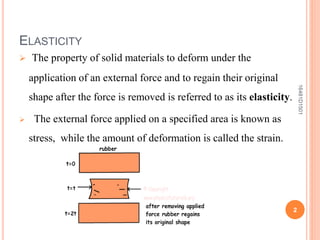
 The property of solid materials to deform under the
application of an external force and to regain their original
shape after the force is removed is referred to as its elasticity.
 The external force applied on a specified area is known as
stress, while the amount of deformation is called the strain.
2
16481D1501
 It is the branch of Solid Mechanics which deals with the
stress and displacements in elastic solids produced by
external forces or changes in temperature.
 The purpose of study is to check the sufficiency of the
strength, stiffness and stability of structural and machine
elements.
3
16481D1501
IMPORTANT CONCEPT IN THEORY OF
ELASTICITY
 External forces
 Stresses - (internal force)
 Deformations-strain and displacements
4
16481D1501
There are two kinds of external forces that act on the
bodies
 Body forces
Gravitational forces
Inertia forces(in motion)
 Surface forces
Pressure(in water, atmosphere)
Contact forces .
5
16481D1501
Internal forces produced by external force
Deformation: By deformation we mean the change of shape of a
body
 Strain components completely define the deformation condition
(or strain condition) at that point
 Displacement
the change of position, the displacement components in the x, y,
z axes are denoted by u, v, w respectively.
6
16481D1501
BASIC ASSUMPTIONS IN THEORY OF
ELASTICITY
 The body is continuous
 The body is perfectly elastic
 The body is homogeneous
 The body is isotropic
example: polycrystalline ceramics and steel
wood and fiber reinforced composite
 The displacements and strains are small
7
16481D1501
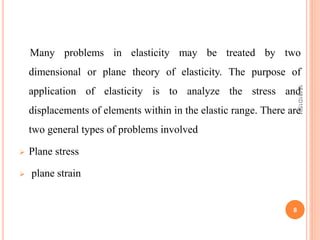
Many problems in elasticity may be treated by two
dimensional or plane theory of elasticity. The purpose of
application of elasticity is to analyze the stress and
displacements of elements within in the elastic range. There are
two general types of problems involved
 Plane stress
 plane strain
8
16481D1501
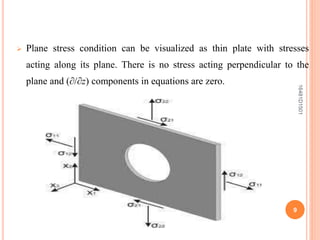
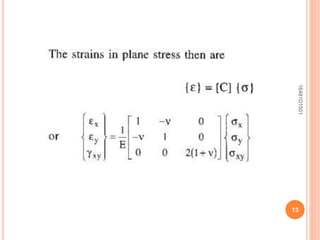
 Plane stress condition can be visualized as thin plate with stresses
acting along its plane. There is no stress acting perpendicular to the
plane and (∂/∂z) components in equations are zero.
9
16481D1501
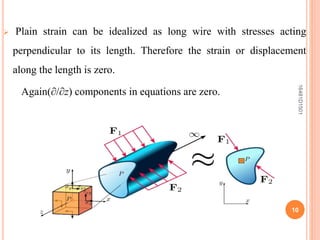
 Plain strain can be idealized as long wire with stresses acting
perpendicular to its length. Therefore the strain or displacement
along the length is zero.
Again(∂/∂z) components in equations are zero.
10
16481D1501
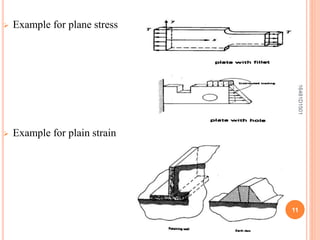
 Example for plane stress
 Example for plain strain
11
16481D1501
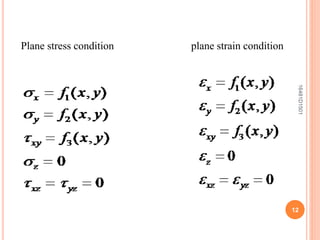
Plane stress condition plane strain condition
12
16481D1501
13
16481D1501
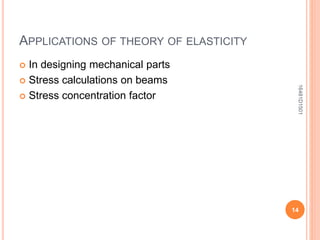
APPLICATIONS OF THEORY OF ELASTICITY
 In designing mechanical parts
 Stress calculations on beams
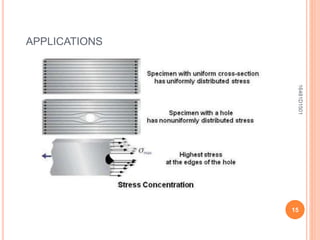
 Stress concentration factor
14
16481D1501
APPLICATIONS
15
16481D1501
 By using strength of materials we cant predict the stress
directly under a load or supports in a simple beam where
theory of elasticity is applied
 Generally factor of safety used for a mechanical members is
3or 4.But in the design of precision parts where strength to
weight ratio is minimum accuracy of stress values is more
important.
16
16481D1501
Thank you
17
16481D1501

theory of elasticity

  • 1.
    THEORY OF ELASTICITY Seminartopic by A. Sabiha khathun (16481D1501) M. Tech (Machine Design) Subject: Advanced Mechanics Of Solids Faculty : Dr. P. Ravindra Babu (prof. &vice-principal) Department of Mechanical Engineering Gudlavalleru Engineering College
  • 2.
    ELASTICITY  The propertyof solid materials to deform under the application of an external force and to regain their original shape after the force is removed is referred to as its elasticity.  The external force applied on a specified area is known as stress, while the amount of deformation is called the strain. 2 16481D1501
  • 3.
     It isthe branch of Solid Mechanics which deals with the stress and displacements in elastic solids produced by external forces or changes in temperature.  The purpose of study is to check the sufficiency of the strength, stiffness and stability of structural and machine elements. 3 16481D1501
  • 4.
    IMPORTANT CONCEPT INTHEORY OF ELASTICITY  External forces  Stresses - (internal force)  Deformations-strain and displacements 4 16481D1501
  • 5.
    There are twokinds of external forces that act on the bodies  Body forces Gravitational forces Inertia forces(in motion)  Surface forces Pressure(in water, atmosphere) Contact forces . 5 16481D1501
  • 6.
    Internal forces producedby external force Deformation: By deformation we mean the change of shape of a body  Strain components completely define the deformation condition (or strain condition) at that point  Displacement the change of position, the displacement components in the x, y, z axes are denoted by u, v, w respectively. 6 16481D1501
  • 7.
    BASIC ASSUMPTIONS INTHEORY OF ELASTICITY  The body is continuous  The body is perfectly elastic  The body is homogeneous  The body is isotropic example: polycrystalline ceramics and steel wood and fiber reinforced composite  The displacements and strains are small 7 16481D1501
  • 8.
    Many problems inelasticity may be treated by two dimensional or plane theory of elasticity. The purpose of application of elasticity is to analyze the stress and displacements of elements within in the elastic range. There are two general types of problems involved  Plane stress  plane strain 8 16481D1501
  • 9.
     Plane stresscondition can be visualized as thin plate with stresses acting along its plane. There is no stress acting perpendicular to the plane and (∂/∂z) components in equations are zero. 9 16481D1501
  • 10.
     Plain straincan be idealized as long wire with stresses acting perpendicular to its length. Therefore the strain or displacement along the length is zero. Again(∂/∂z) components in equations are zero. 10 16481D1501
  • 11.
     Example forplane stress  Example for plain strain 11 16481D1501
  • 12.
    Plane stress conditionplane strain condition 12 16481D1501
  • 13.
  • 14.
    APPLICATIONS OF THEORYOF ELASTICITY  In designing mechanical parts  Stress calculations on beams  Stress concentration factor 14 16481D1501
  • 15.
  • 16.
     By usingstrength of materials we cant predict the stress directly under a load or supports in a simple beam where theory of elasticity is applied  Generally factor of safety used for a mechanical members is 3or 4.But in the design of precision parts where strength to weight ratio is minimum accuracy of stress values is more important. 16 16481D1501
  • 17.