ISOMETRIC AND ISOTONIC EXERCISES
Submitted by
Dr. Jasjyot Kaur Sabharwal (PT)
BASICS
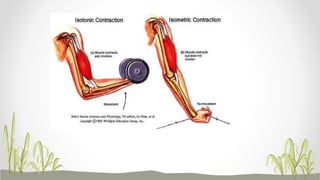
• There are two types of muscle contractions: isometric and isotonic.
• The prefix of both words is “iso” and it means “the same”.
• Different exercises exert different contractions. Isotonic exercises involve
muscle contractions and shortening movement whereas isometric does not
involve muscle shortening movement but deals with muscle contractions.
ISOMETRIC EXERCISES
 An isometric exercise is a type of strength training in which muscle length
and joint angle does not change.
 They are done in static positions rather than being dynamic with a large
range of motion.
 Equipment: Isometric exercise don’t use any equipment apart from your
body. Muscle contractions are completed by tightening and relaxing your
muscles in static positions.
BENEFITS OF ISOMETIC EXERCISES
 In isometric exercises the main benefit is that you can perform them with no
equipment and in relatively short amount of time.
 These exercises also enhance stabilization and boost strength for people with
arthritis or in other people who had injury causing an inhabit range of
motion.
 Improves body posture and spine alignment.
EXAMPLES
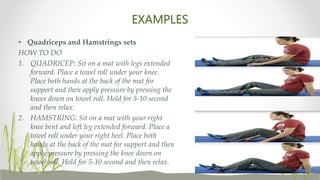
• Quadriceps and Hamstrings sets
HOW TO DO
1. QUADRICEP: Sit on a mat with legs extended
forward. Place a towel roll under your knee.
Place both hands at the back of the mat for
support and then apply pressure by pressing the
knees down on towel roll. Hold for 5-10 second
and then relax.
2. HAMSTRING: Sit on a mat with your right
knee bent and left leg extended forward. Place a
towel roll under your right heel. Place both
hands at the back of the mat for support and then
apply pressure by pressing the knee down on
towel roll. Hold for 5-10 second and then relax.
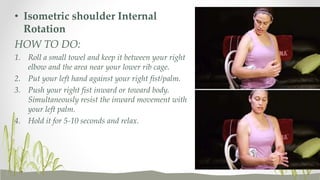
• Isometric shoulder Internal
Rotation
HOW TO DO:
1. Roll a small towel and keep it between your right
elbow and the area near your lower rib cage.
2. Put your left hand against your right fist/palm.
3. Push your right fist inward or toward body.
Simultaneously resist the inward movement with
your left palm.
4. Hold it for 5-10 seconds and relax.
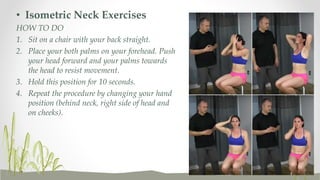
• Isometric Neck Exercises
HOW TO DO
1. Sit on a chair with your back straight.
2. Place your both palms on your forehead. Push
your head forward and your palms towards
the head to resist movement.
3. Hold this position for 10 seconds.
4. Repeat the procedure by changing your hand
position (behind neck, right side of head and
on cheeks).
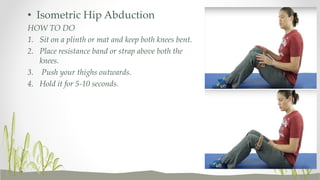
• Isometric Hip Abduction
HOW TO DO
1. Sit on a plinth or mat and keep both knees bent.
2. Place resistance band or strap above both the
knees.
3. Push your thighs outwards.
4. Hold it for 5-10 seconds.
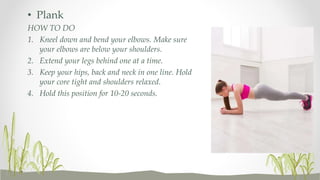
• Plank
HOW TO DO
1. Kneel down and bend your elbows. Make sure
your elbows are below your shoulders.
2. Extend your legs behind one at a time.
3. Keep your hips, back and neck in one line. Hold
your core tight and shoulders relaxed.
4. Hold this position for 10-20 seconds.
ISOTONIC EXERCISES
 An isotonic exercise is a form of exercise in which isotonic muscular
contraction is used to improve joint mobility and strengthen muscle by
continuous and sustained movement of arms and legs.
 Equipments: A variety of weight lifting machines, resistance bands, medicine
ball, free weight, bench press, dumb bells, your body.
BENEFITS
 Boosts cardiovascular health. This increases blood circulation and there by

decreasing risk of stroke, heart attack and other heart diseases.
 Allows muscle to gain strength
 Improves bone density and lowers the risk of osteoporosis.
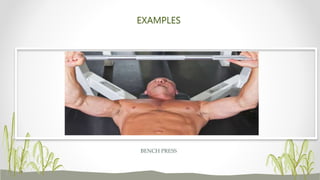
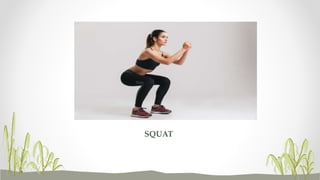
EXAMPLES
BENCH PRESS
Bench Press
SHOULDER- FRONT RAISE
SQUAT
THANKYOU

Isometric and isotonic exercises

  • 1.
    ISOMETRIC AND ISOTONICEXERCISES Submitted by Dr. Jasjyot Kaur Sabharwal (PT)
  • 2.
    BASICS • There aretwo types of muscle contractions: isometric and isotonic. • The prefix of both words is “iso” and it means “the same”. • Different exercises exert different contractions. Isotonic exercises involve muscle contractions and shortening movement whereas isometric does not involve muscle shortening movement but deals with muscle contractions.
  • 4.
    ISOMETRIC EXERCISES  Anisometric exercise is a type of strength training in which muscle length and joint angle does not change.  They are done in static positions rather than being dynamic with a large range of motion.  Equipment: Isometric exercise don’t use any equipment apart from your body. Muscle contractions are completed by tightening and relaxing your muscles in static positions.
  • 5.
    BENEFITS OF ISOMETICEXERCISES  In isometric exercises the main benefit is that you can perform them with no equipment and in relatively short amount of time.  These exercises also enhance stabilization and boost strength for people with arthritis or in other people who had injury causing an inhabit range of motion.  Improves body posture and spine alignment.
  • 6.
    EXAMPLES • Quadriceps andHamstrings sets HOW TO DO 1. QUADRICEP: Sit on a mat with legs extended forward. Place a towel roll under your knee. Place both hands at the back of the mat for support and then apply pressure by pressing the knees down on towel roll. Hold for 5-10 second and then relax. 2. HAMSTRING: Sit on a mat with your right knee bent and left leg extended forward. Place a towel roll under your right heel. Place both hands at the back of the mat for support and then apply pressure by pressing the knee down on towel roll. Hold for 5-10 second and then relax.
  • 7.
    • Isometric shoulderInternal Rotation HOW TO DO: 1. Roll a small towel and keep it between your right elbow and the area near your lower rib cage. 2. Put your left hand against your right fist/palm. 3. Push your right fist inward or toward body. Simultaneously resist the inward movement with your left palm. 4. Hold it for 5-10 seconds and relax.
  • 8.
    • Isometric NeckExercises HOW TO DO 1. Sit on a chair with your back straight. 2. Place your both palms on your forehead. Push your head forward and your palms towards the head to resist movement. 3. Hold this position for 10 seconds. 4. Repeat the procedure by changing your hand position (behind neck, right side of head and on cheeks).
  • 9.
    • Isometric HipAbduction HOW TO DO 1. Sit on a plinth or mat and keep both knees bent. 2. Place resistance band or strap above both the knees. 3. Push your thighs outwards. 4. Hold it for 5-10 seconds.
  • 10.
    • Plank HOW TODO 1. Kneel down and bend your elbows. Make sure your elbows are below your shoulders. 2. Extend your legs behind one at a time. 3. Keep your hips, back and neck in one line. Hold your core tight and shoulders relaxed. 4. Hold this position for 10-20 seconds.
  • 11.
    ISOTONIC EXERCISES  Anisotonic exercise is a form of exercise in which isotonic muscular contraction is used to improve joint mobility and strengthen muscle by continuous and sustained movement of arms and legs.  Equipments: A variety of weight lifting machines, resistance bands, medicine ball, free weight, bench press, dumb bells, your body.
  • 12.
    BENEFITS  Boosts cardiovascularhealth. This increases blood circulation and there by decreasing risk of stroke, heart attack and other heart diseases.  Allows muscle to gain strength  Improves bone density and lowers the risk of osteoporosis.
  • 13.
  • 14.
  • 15.
  • 16.