Dr. Jasjyot Kaur Sabharwal (PT)
 Health care services in general are rendered by the
government through a network of health centers from
the grass root areas to the block level in the rural areas
and through the hospitals, dispensaries, maternal and
child health welfare centers in urban areas.
 Each system in the country has developed its own way
of health care delivery, independent of the central
government. The responsibility consists mainly of
policy making, planning, guiding, assisting, evaluating
band coordinating the work of health ministers.
HEALTH CARE DELIVERY SYSTEM-
It is defined as the aggregate of institutions,
organizations and persons who enter, the health care
system, who has responsibility that include promotion of
health, prevention of illness, detection and treatment of
disease and rehabilitation.
HEALTH CARE SERVICES-
Defined as multiple services rendered to individuals,
families or communities by agents of health services or
professionals for purpose of promoting, maintaining,
monitoring or restoring health.
1. To improve the health status of population
2. To improve the experience of care
3. To reduce the economic burden of illness
4. To improve social justice equity
 Orientation toward health
 Population perspective
 Intensive use of information
 Knowledge of treatment outcome
 Primary health care (PHC) is essential health care
based on practical, scientifically sound and socially
acceptable methods and technology made universally
accessible to individuals and families in the
community through their full participation and at the
cost that community and country can afford to
maintain at every stage of their development in the
spirit of self-reliance and self-determination.
1. Equitable distribution
2. Community participation
3. Inter-sectoral coordination
4. Appropriate technology
1. Medical services including family planning
2. Immunization
3. Provision of essential drugs
4. Prevention and control of local endemic diseases
5. Provision of food supply & nutrition
6. Treatment of common illness and ailments.
7. Health education abut prevailing health problems
and its p Prevention and control
 At least half the people in the world lack full coverage
of essential health services
 Primary health care can cover the majority of person’s
health need throughout their life including
preventive, promotive, curative, rehabilitation
and palliative care.
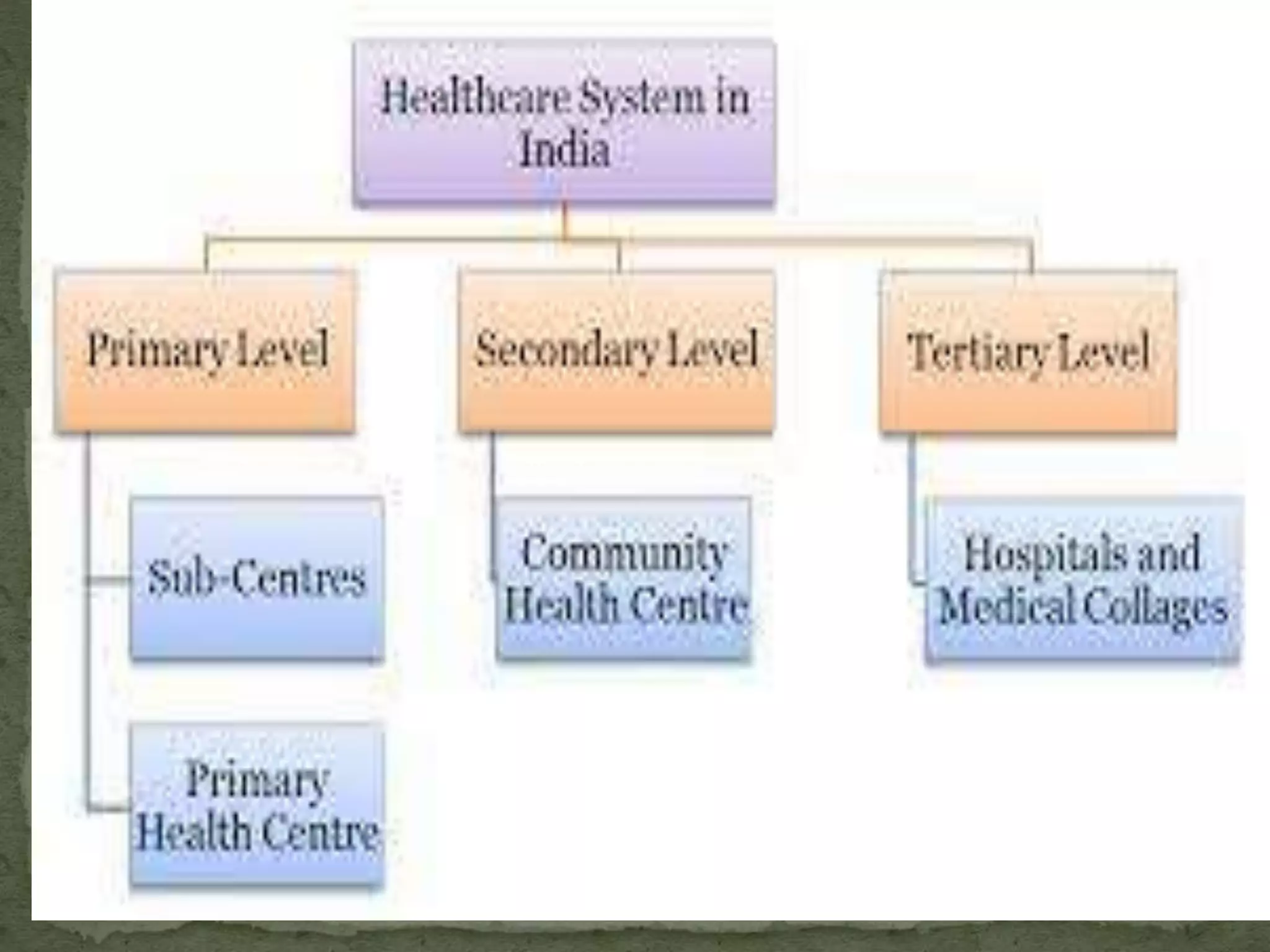
 First level of contact of the individuals and the
community with the health system
 Provided By- Sub-centers, PHCs, ASHA.
 At this level more complex problems are taken care
mostly which requires secondary level of preventive
and curative services.
 These services are provided by district hospitals and
community health centers.
 First referral level
 This level of health care is provided at the
state/regional/central level institutions
 Requires specific facilities and highly specialized
health care professionals.
 These institutions serve as referral units for primary
and secondary level.
 The sub centre is the most peripheral and first contact
point between primary health care and community
 Interpersonal communication in order to bring about
behavioral change and provide services in relation to
maternal and child health, family welfare, nutrition,
immunization, diarrhea control and control of
communicable disease programme
 Each sub centre is required to manned by at least one
auxiliary nurse midwife / female health worker and
male health worker.
 Community Health Centre (CHC) is required to be
manned by four medical specialist i.e. surgeon,
physician, gynecologist and pediatrician supported by
21 paramedical and other staff.
 30 in-doo beds with one OT, X-ray, Labor room and
Laboratory facilities.
Health care delivery system in india

Health care delivery system in india

  • 1.
    Dr. Jasjyot KaurSabharwal (PT)
  • 2.
     Health careservices in general are rendered by the government through a network of health centers from the grass root areas to the block level in the rural areas and through the hospitals, dispensaries, maternal and child health welfare centers in urban areas.  Each system in the country has developed its own way of health care delivery, independent of the central government. The responsibility consists mainly of policy making, planning, guiding, assisting, evaluating band coordinating the work of health ministers.
  • 3.
    HEALTH CARE DELIVERYSYSTEM- It is defined as the aggregate of institutions, organizations and persons who enter, the health care system, who has responsibility that include promotion of health, prevention of illness, detection and treatment of disease and rehabilitation. HEALTH CARE SERVICES- Defined as multiple services rendered to individuals, families or communities by agents of health services or professionals for purpose of promoting, maintaining, monitoring or restoring health.
  • 4.
    1. To improvethe health status of population 2. To improve the experience of care 3. To reduce the economic burden of illness 4. To improve social justice equity
  • 5.
     Orientation towardhealth  Population perspective  Intensive use of information  Knowledge of treatment outcome
  • 7.
     Primary healthcare (PHC) is essential health care based on practical, scientifically sound and socially acceptable methods and technology made universally accessible to individuals and families in the community through their full participation and at the cost that community and country can afford to maintain at every stage of their development in the spirit of self-reliance and self-determination.
  • 8.
    1. Equitable distribution 2.Community participation 3. Inter-sectoral coordination 4. Appropriate technology
  • 9.
    1. Medical servicesincluding family planning 2. Immunization 3. Provision of essential drugs 4. Prevention and control of local endemic diseases 5. Provision of food supply & nutrition 6. Treatment of common illness and ailments. 7. Health education abut prevailing health problems and its p Prevention and control
  • 10.
     At leasthalf the people in the world lack full coverage of essential health services  Primary health care can cover the majority of person’s health need throughout their life including preventive, promotive, curative, rehabilitation and palliative care.  First level of contact of the individuals and the community with the health system  Provided By- Sub-centers, PHCs, ASHA.
  • 11.
     At thislevel more complex problems are taken care mostly which requires secondary level of preventive and curative services.  These services are provided by district hospitals and community health centers.  First referral level
  • 12.
     This levelof health care is provided at the state/regional/central level institutions  Requires specific facilities and highly specialized health care professionals.  These institutions serve as referral units for primary and secondary level.
  • 13.
     The subcentre is the most peripheral and first contact point between primary health care and community  Interpersonal communication in order to bring about behavioral change and provide services in relation to maternal and child health, family welfare, nutrition, immunization, diarrhea control and control of communicable disease programme  Each sub centre is required to manned by at least one auxiliary nurse midwife / female health worker and male health worker.
  • 14.
     Community HealthCentre (CHC) is required to be manned by four medical specialist i.e. surgeon, physician, gynecologist and pediatrician supported by 21 paramedical and other staff.  30 in-doo beds with one OT, X-ray, Labor room and Laboratory facilities.