


STATIC
EXERCISES
Dr Akshay Shetty
Asst.Professor
Dept of Panchakarma
SSRAMCH Inchal
Contents
• Objectives
• Physiology of exercise
• Introduction of Static Exercise
• Definition of Static exercise
• Types of Static exercise
• Importance of Static exercise
• Indications of Static exercise
• Contraindications of Static exercise
• Summary
• References
09-05-2020 STATIC EXERCISE (Dr Akshay Shetty) 2
Objectives
By the end of the presentation the learners must be able
1. To know the physiology of exercise
2. To know Introduction of Static exercise
3. To know the definition of Static exercise
4. To know the types of Static exercise
5. To know the importance of Static exercise
6. To know the Indications of Static exercise
7. To know the Contraindications of Static exercise
09-05-2020 STATIC EXERCISE (Dr Akshay Shetty) 3
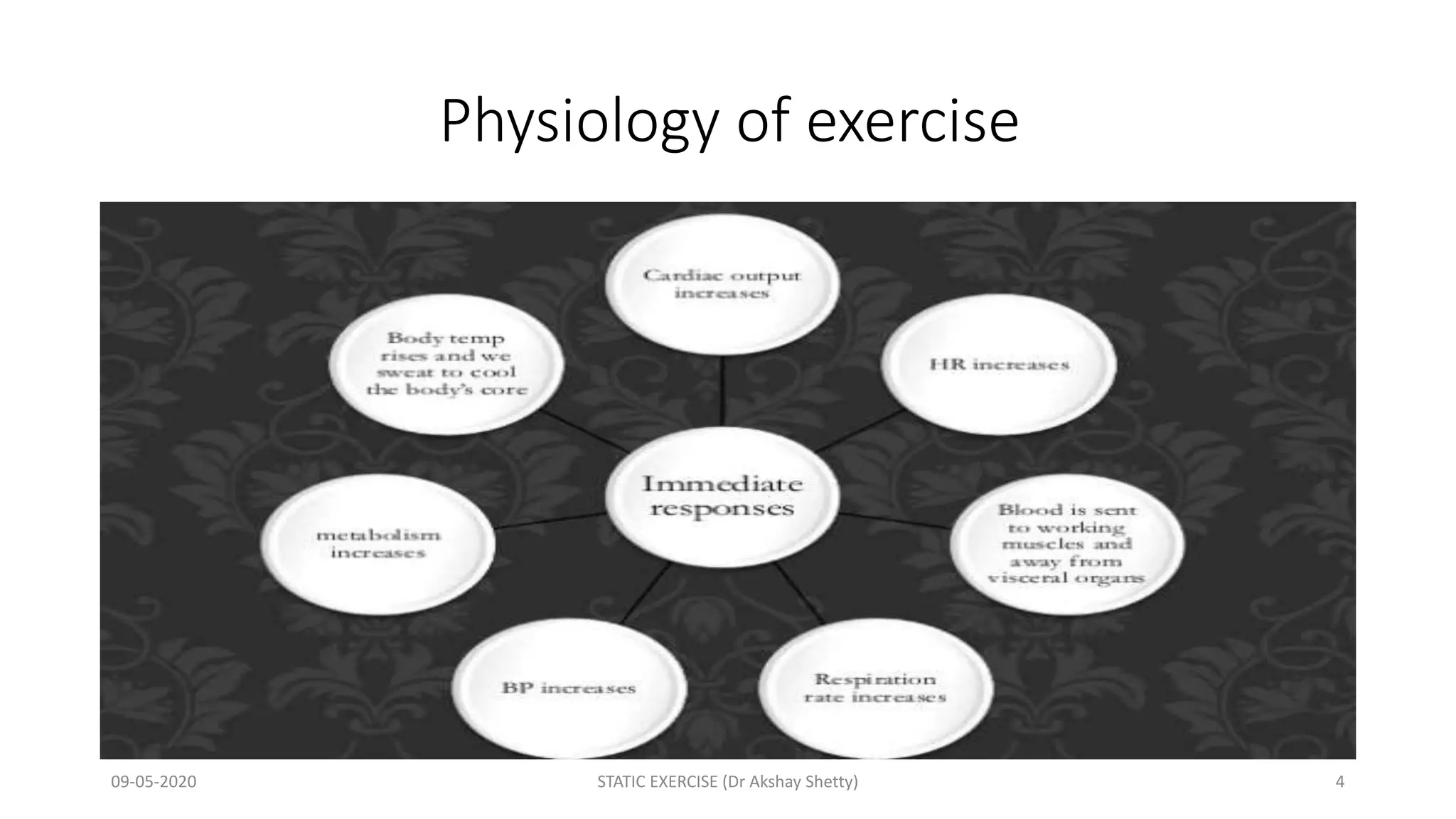
Physiology of exercise
09-05-2020 STATIC EXERCISE (Dr Akshay Shetty) 4
Introduction
• Isometric exercise also known as a form of static exercise. Isometric
comes from the Greek "iso-", equal + "metron", measure =
maintaining the same measure, dimension or length.
• The muscle contract without visible change in Joint motion or muscle
length.
• There is no physical work done (force x distance)
• There is great tension and force output produced by the muscle.
• Tension is directly proportional to resistance.
• Tension is the force output of the muscle.
09-05-2020 STATIC EXERCISE (Dr Akshay Shetty) 5
Cont…
• Sources of resistance:
• Holding against a force applied manually.
• Holding weight in a particular position.
• Maintaining a position against the resistance of the body
weight.
• Pushing or pulling on immovable object.
09-05-2020 STATIC EXERCISE (Dr Akshay Shetty) 6
Definition
Isometric exercise is “exercise in which a muscle contracts and produces
force without an appreciable change in length of the muscle and
without visible joint motion.
Isotonic exercise: Exercise in which a contracting muscle shortens
against a constant load, as when lifting a weight.
09-05-2020 STATIC EXERCISE (Dr Akshay Shetty) 7
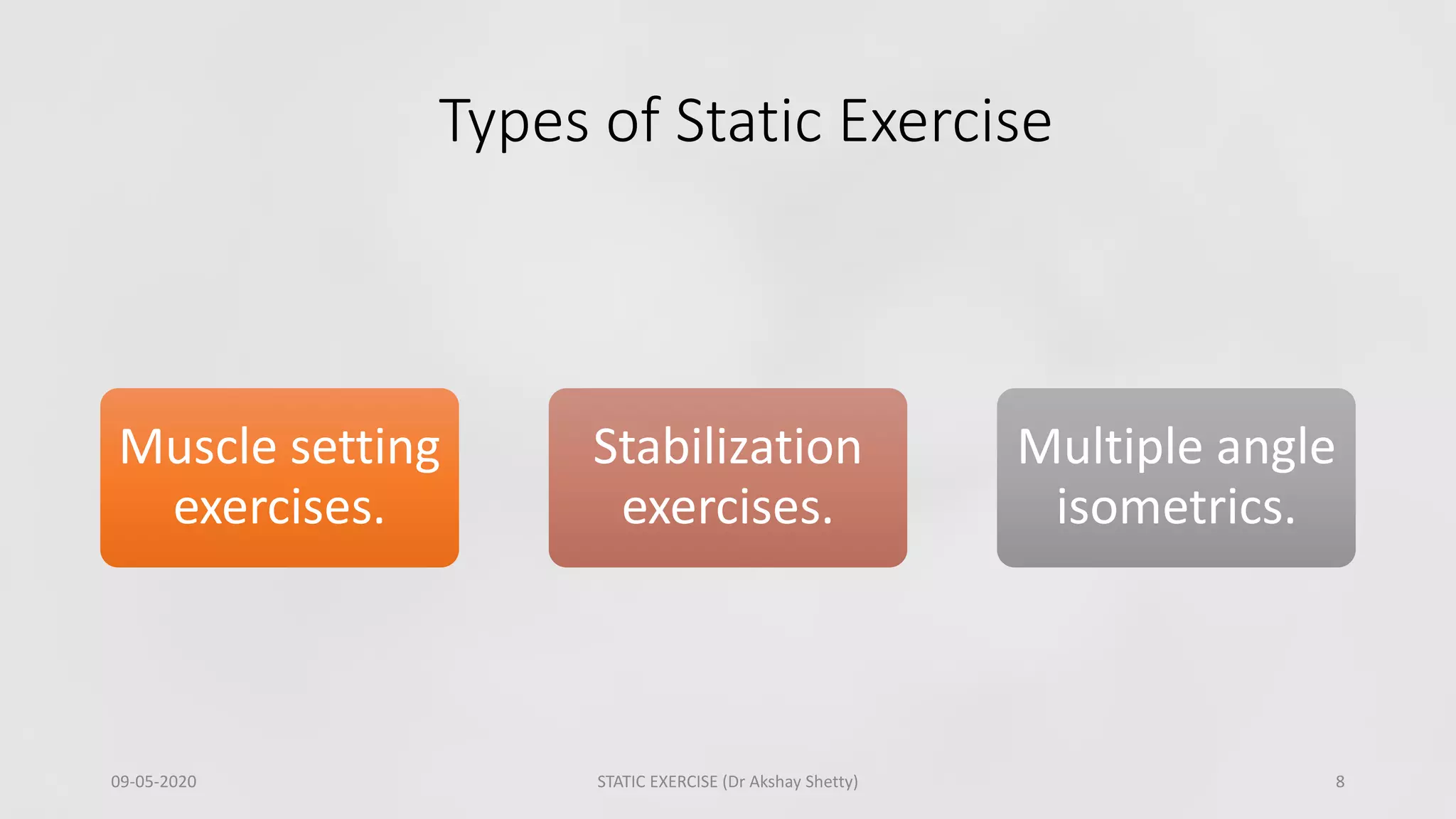
Types of Static Exercise
09-05-2020 STATIC EXERCISE (Dr Akshay Shetty) 8
Muscle setting
exercises.
Stabilization
exercises.
Multiple angle
isometrics.
Contd…
• Definition: is low intensity isometric exercise performed against little
to no resistance.
• As muscle setting is not performed against any appreciable resistance,
it will not improve muscle strength except in very weak muscles
09-05-2020 STATIC EXERCISE (Dr Akshay Shetty) 9
Importance
09-05-2020 STATIC EXERCISE (Dr Akshay Shetty) 10
Muscle setting can retard muscle atrophy in the stage of rehabilitation of a
muscle when immobilization is necessary.
It is used to promote muscle relaxation and circulation and to decrease muscle
pain and spasm after injury to soft tissues during the acute stage of healing.
Muscle setting maintain mobility between muscle fibers as they heal.
Contd…
09-05-2020 STATIC EXERCISE (Dr Akshay Shetty) 11
Prevent or minimize muscle atrophy when joint movement is not possible
Activate muscle and facilitate muscle contraction specially after surgeries or when acute
injury of the joint or the soft tissue surrounding it.
Develop posture or joint stability.
Improve muscle strength when use of dynamic resistance exercises could harm the
condition.
To develop static muscle strength at particular points of the range consistent with specific
task related needs.
09-05-2020 STATIC EXERCISE (Dr Akshay Shetty) 12
09-05-2020 STATIC EXERCISE (Dr Akshay Shetty) 13
09-05-2020 STATIC EXERCISE (Dr Akshay Shetty) 14
09-05-2020 STATIC EXERCISE (Dr Akshay Shetty) 15
09-05-2020 STATIC EXERCISE (Dr Akshay Shetty) 16
Indications of Static exercise
• During immobilization as joint movement is not possible due to
immobilization by casts, splints, braces, or various types of traction
apparatus.
• After joint surgeries or injuries, when movement is too painful, or
when movement may interfere with the healing process.
• When the muscle weakness is confined to a definite angle or part of
the range.
09-05-2020 STATIC EXERCISE (Dr Akshay Shetty) 17
Contraindications of Static exercise
• Isometric exercise can increase blood pressure and heart rate to
levels that would be dangerous for anyone with undiagnosed
cardiac problems.
• Isometric exercise also increases intra abdominal pressure to
dangerously high levels.
• Be wear to instruct the patient not to hold breathing during
isometric exercise to avoid valsalva maneuver
09-05-2020 STATIC EXERCISE (Dr Akshay Shetty) 18
Summary
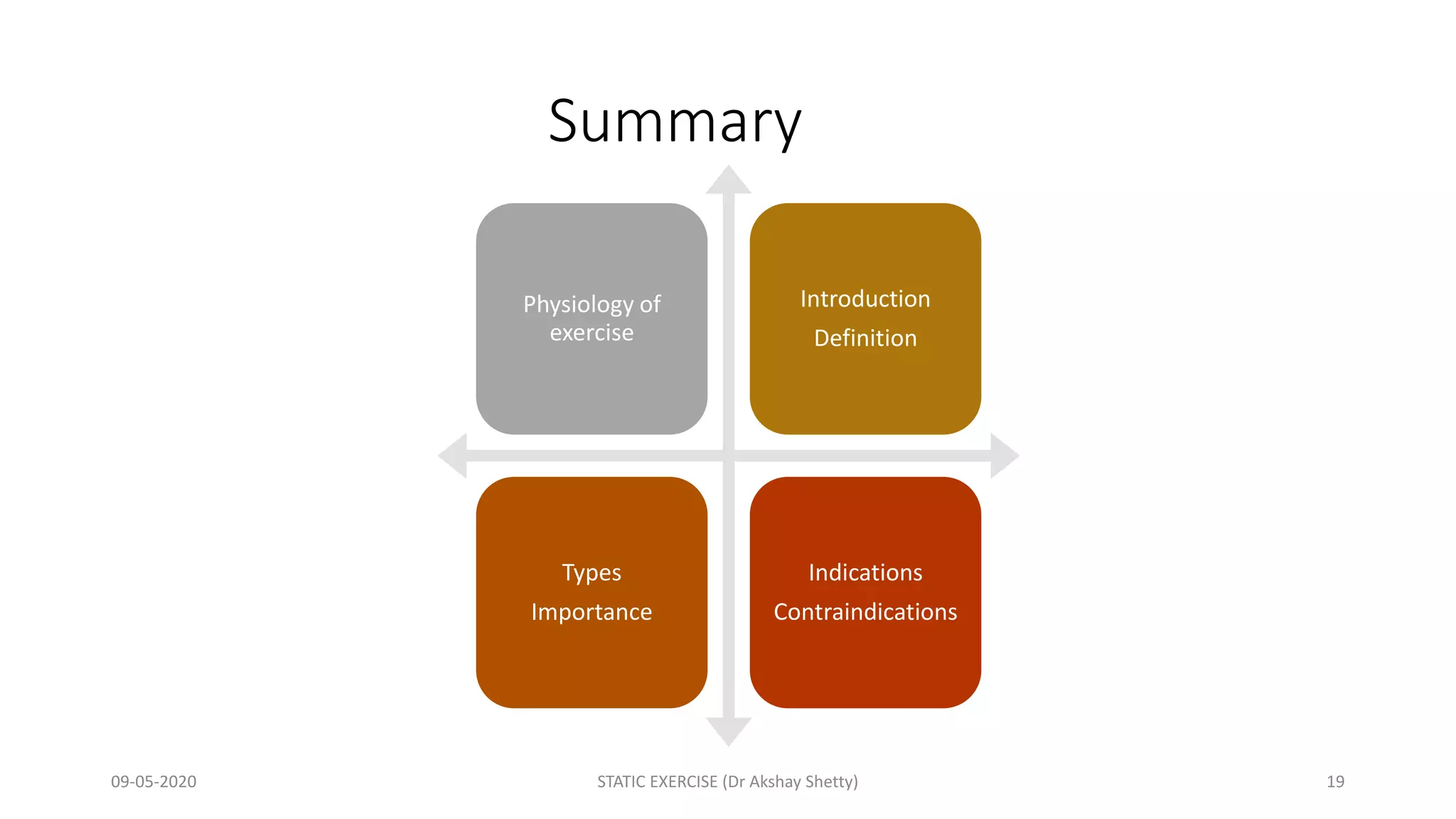
Physiology of
exercise
Introduction
Definition
Types
Importance
Indications
Contraindications
09-05-2020 STATIC EXERCISE (Dr Akshay Shetty) 19
References
09-05-2020 STATIC EXERCISE (Dr Akshay Shetty) 20
www.staticexercise.org
www.isometric.uk/org
09-05-2020 STATIC EXERCISE (Dr Akshay Shetty) 21

Static exercises

  • 1.
  • 2.
    Contents • Objectives • Physiologyof exercise • Introduction of Static Exercise • Definition of Static exercise • Types of Static exercise • Importance of Static exercise • Indications of Static exercise • Contraindications of Static exercise • Summary • References 09-05-2020 STATIC EXERCISE (Dr Akshay Shetty) 2
  • 3.
    Objectives By the endof the presentation the learners must be able 1. To know the physiology of exercise 2. To know Introduction of Static exercise 3. To know the definition of Static exercise 4. To know the types of Static exercise 5. To know the importance of Static exercise 6. To know the Indications of Static exercise 7. To know the Contraindications of Static exercise 09-05-2020 STATIC EXERCISE (Dr Akshay Shetty) 3
  • 4.
    Physiology of exercise 09-05-2020STATIC EXERCISE (Dr Akshay Shetty) 4
  • 5.
    Introduction • Isometric exercisealso known as a form of static exercise. Isometric comes from the Greek "iso-", equal + "metron", measure = maintaining the same measure, dimension or length. • The muscle contract without visible change in Joint motion or muscle length. • There is no physical work done (force x distance) • There is great tension and force output produced by the muscle. • Tension is directly proportional to resistance. • Tension is the force output of the muscle. 09-05-2020 STATIC EXERCISE (Dr Akshay Shetty) 5
  • 6.
    Cont… • Sources ofresistance: • Holding against a force applied manually. • Holding weight in a particular position. • Maintaining a position against the resistance of the body weight. • Pushing or pulling on immovable object. 09-05-2020 STATIC EXERCISE (Dr Akshay Shetty) 6
  • 7.
    Definition Isometric exercise is“exercise in which a muscle contracts and produces force without an appreciable change in length of the muscle and without visible joint motion. Isotonic exercise: Exercise in which a contracting muscle shortens against a constant load, as when lifting a weight. 09-05-2020 STATIC EXERCISE (Dr Akshay Shetty) 7
  • 8.
    Types of StaticExercise 09-05-2020 STATIC EXERCISE (Dr Akshay Shetty) 8 Muscle setting exercises. Stabilization exercises. Multiple angle isometrics.
  • 9.
    Contd… • Definition: islow intensity isometric exercise performed against little to no resistance. • As muscle setting is not performed against any appreciable resistance, it will not improve muscle strength except in very weak muscles 09-05-2020 STATIC EXERCISE (Dr Akshay Shetty) 9
  • 10.
    Importance 09-05-2020 STATIC EXERCISE(Dr Akshay Shetty) 10 Muscle setting can retard muscle atrophy in the stage of rehabilitation of a muscle when immobilization is necessary. It is used to promote muscle relaxation and circulation and to decrease muscle pain and spasm after injury to soft tissues during the acute stage of healing. Muscle setting maintain mobility between muscle fibers as they heal.
  • 11.
    Contd… 09-05-2020 STATIC EXERCISE(Dr Akshay Shetty) 11 Prevent or minimize muscle atrophy when joint movement is not possible Activate muscle and facilitate muscle contraction specially after surgeries or when acute injury of the joint or the soft tissue surrounding it. Develop posture or joint stability. Improve muscle strength when use of dynamic resistance exercises could harm the condition. To develop static muscle strength at particular points of the range consistent with specific task related needs.
  • 12.
    09-05-2020 STATIC EXERCISE(Dr Akshay Shetty) 12
  • 13.
    09-05-2020 STATIC EXERCISE(Dr Akshay Shetty) 13
  • 14.
    09-05-2020 STATIC EXERCISE(Dr Akshay Shetty) 14
  • 15.
    09-05-2020 STATIC EXERCISE(Dr Akshay Shetty) 15
  • 16.
    09-05-2020 STATIC EXERCISE(Dr Akshay Shetty) 16
  • 17.
    Indications of Staticexercise • During immobilization as joint movement is not possible due to immobilization by casts, splints, braces, or various types of traction apparatus. • After joint surgeries or injuries, when movement is too painful, or when movement may interfere with the healing process. • When the muscle weakness is confined to a definite angle or part of the range. 09-05-2020 STATIC EXERCISE (Dr Akshay Shetty) 17
  • 18.
    Contraindications of Staticexercise • Isometric exercise can increase blood pressure and heart rate to levels that would be dangerous for anyone with undiagnosed cardiac problems. • Isometric exercise also increases intra abdominal pressure to dangerously high levels. • Be wear to instruct the patient not to hold breathing during isometric exercise to avoid valsalva maneuver 09-05-2020 STATIC EXERCISE (Dr Akshay Shetty) 18
  • 19.
  • 20.
    References 09-05-2020 STATIC EXERCISE(Dr Akshay Shetty) 20 www.staticexercise.org www.isometric.uk/org
  • 21.
    09-05-2020 STATIC EXERCISE(Dr Akshay Shetty) 21