ISO 9001:2015
Quality Management Systems
1
BY
PARABAKARAN
Learning Objectives
2
Have the skills to
develop documentation
:
• process mapping
•documented information
such as procedure and
supporting document
……QMS shall establishing the
documented information for
the effectiveness (Clause 7.5
9001:2015)
• The history and
development of ISO
9001
• What is a Quality
Management
System (QMS)
• The benefits of a
QMS
KNOWLEDGE
• The terms and
definitions used
• Key concepts, principles
and structure
• The main requirements
of ISO 9001:2015 and
how to implement
SKILLS
Solution &
Result...
3
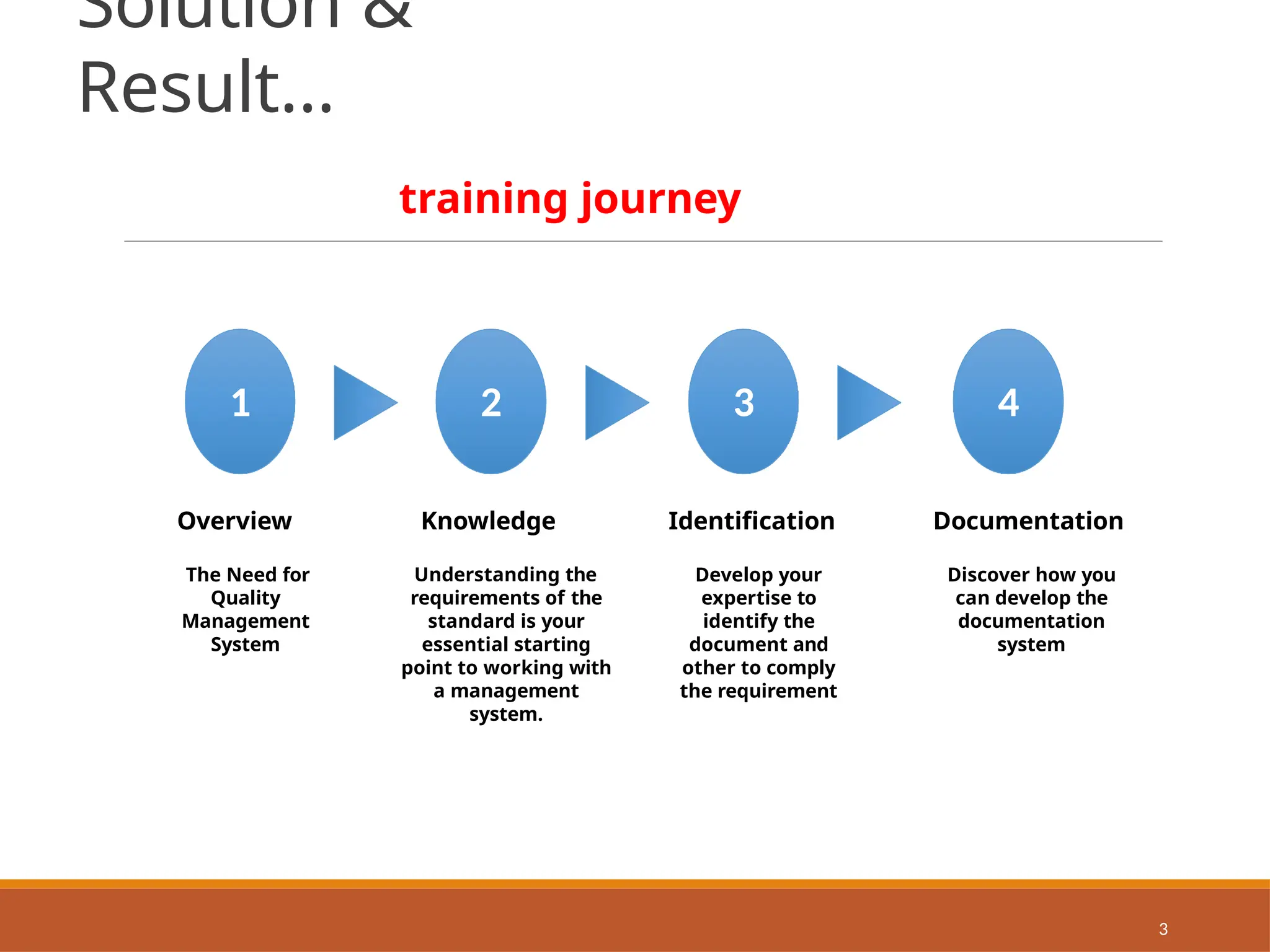
1 2 3 4
Overview Knowledge Identification Documentation
The Need for
Quality
Management
System
Understanding the
requirements of the
standard is your
essential starting
point to working with
a management
system.
Develop your
expertise to
identify the
document and
other to comply
the requirement
Discover how you
can develop the
documentation
system
training journey
5
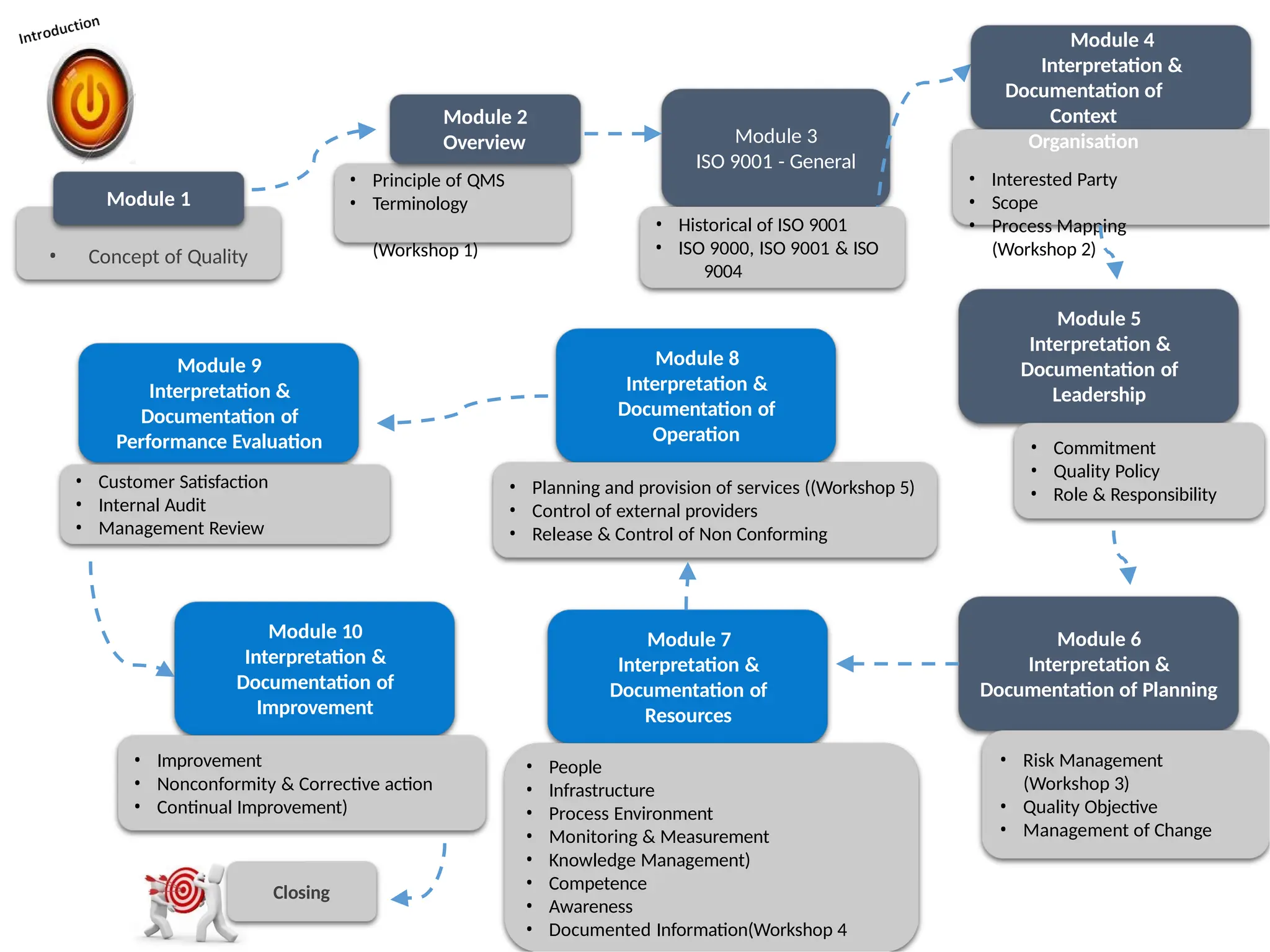
• Concept of Quality
Closing
Module 1
Module 3
ISO 9001 - General
Module 2
Overview
• Principle of QMS
• Terminology
(Workshop 1)
• Historical of ISO 9001
• ISO 9000, ISO 9001 & ISO
9004
Module 4
Interpretation &
Documentation of
Context
Organisation
• Interested Party
• Scope
• Process Mapping
(Workshop 2)
Module 7
Interpretation &
Documentation of
Resources
• People
• Infrastructure
• Process Environment
• Monitoring & Measurement
• Knowledge Management)
• Competence
• Awareness
• Documented Information(Workshop 4
Module 5
Interpretation &
Documentation of
Leadership
• Commitment
• Quality Policy
• Role & Responsibility
Module 8
Interpretation &
Documentation of
Operation
• Planning and provision of services ((Workshop 5)
• Control of external providers
• Release & Control of Non Conforming
Module 9
Interpretation &
Documentation of
Performance Evaluation
• Customer Satisfaction
• Internal Audit
• Management Review
Module 10
Interpretation &
Documentation of
Improvement
• Improvement
• Nonconformity & Corrective action
• Continual Improvement)
Module 6
Interpretation &
Documentation of Planning
• Risk Management
(Workshop 3)
• Quality Objective
• Management of Change
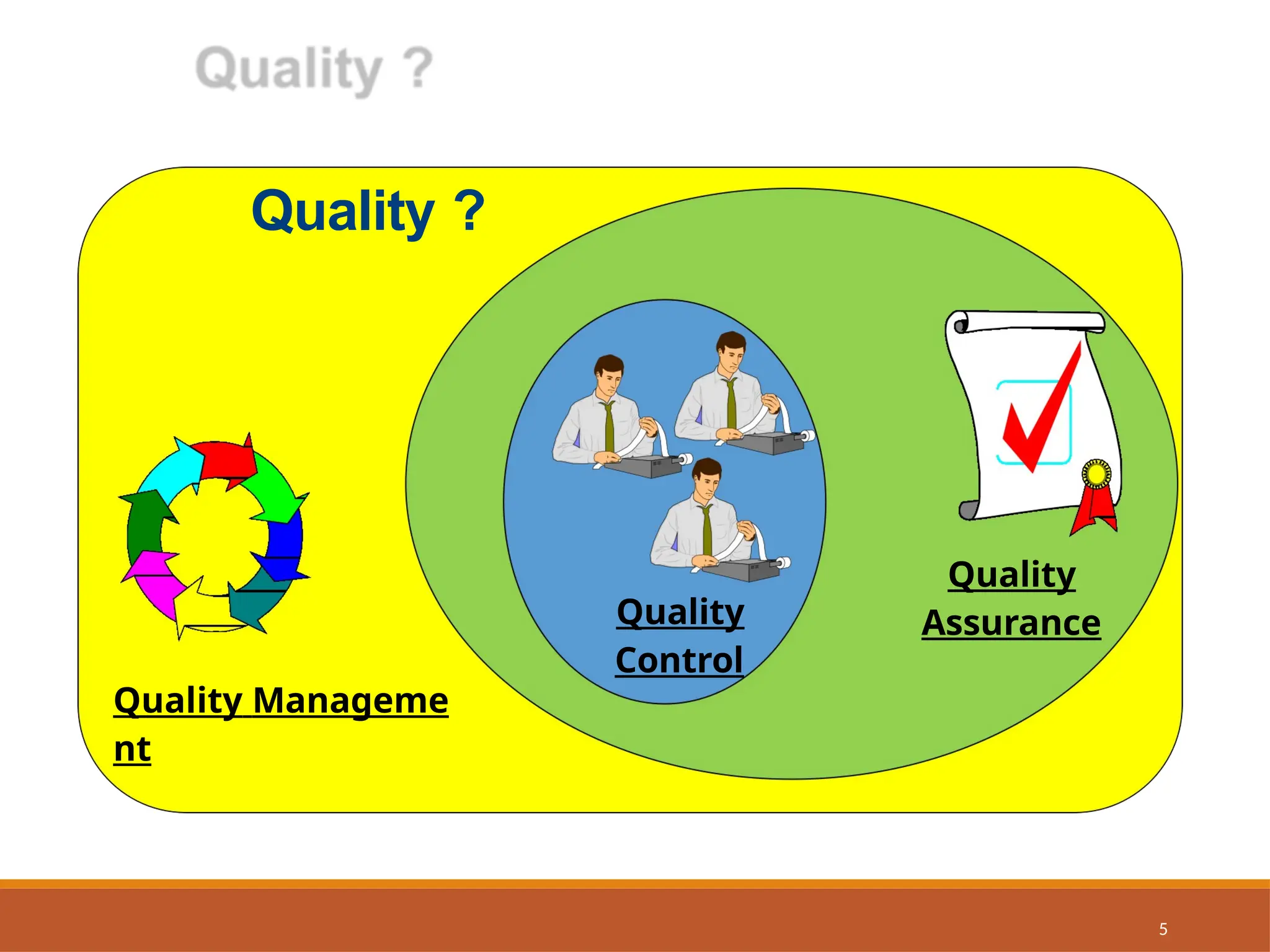
Quality Manageme
nt
Quality
Assurance
Quality
Control
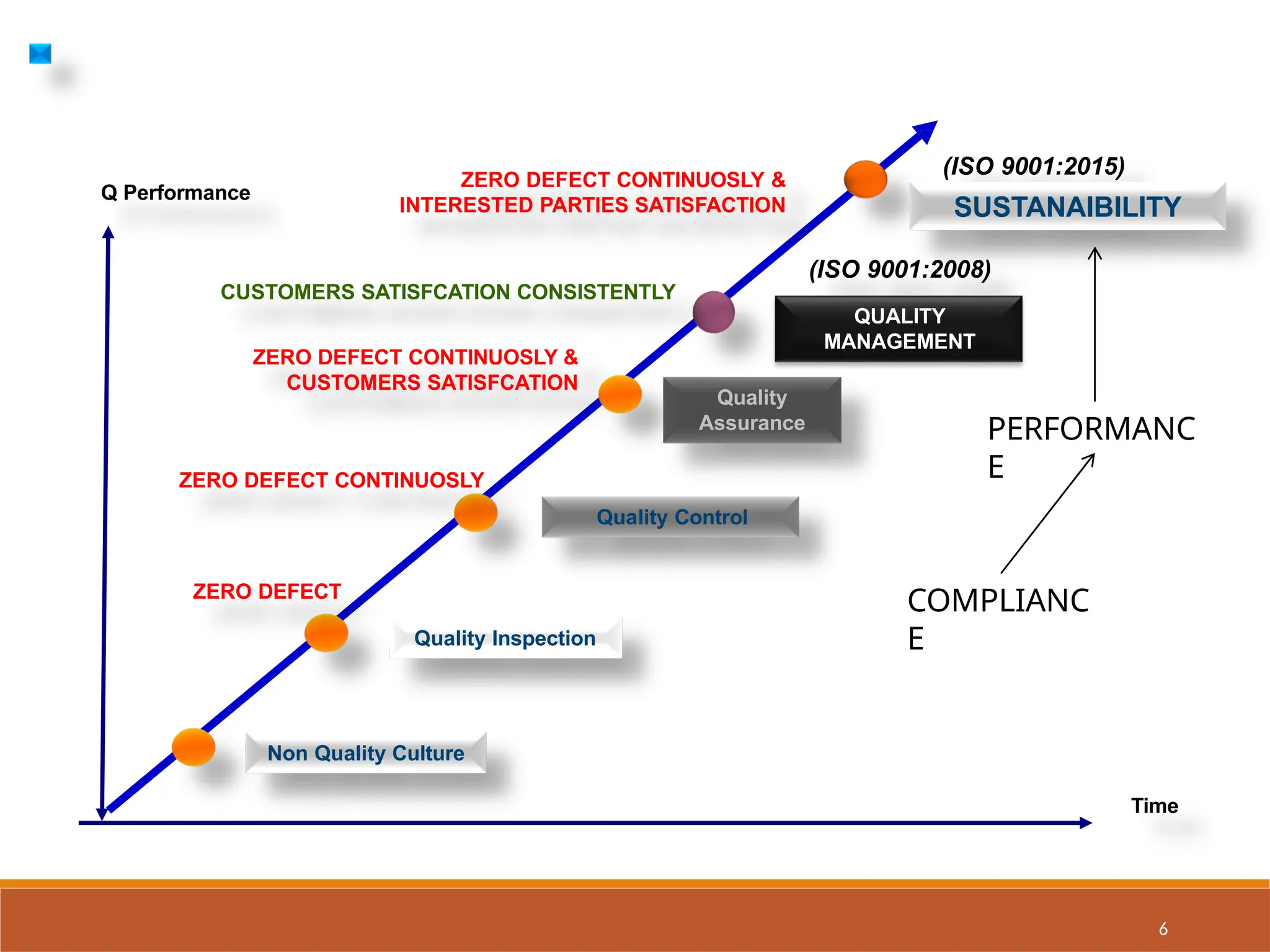
Quality ?
5
Non Quality Culture
Quality Inspection
Time
Q Performance
ZERO DEFECT
ZERO DEFECT CONTINUOSLY
Quality Control
ZERO DEFECT CONTINUOSLY &
CUSTOMERS SATISFCATION
Quality
Assurance
CUSTOMERS SATISFCATION CONSISTENTLY
(ISO 9001:2008)
QUALITY
MANAGEMENT
ZERO DEFECT CONTINUOSLY &
INTERESTED PARTIES SATISFACTION
(ISO 9001:2015)
SUSTANAIBILITY
COMPLIANC
E
PERFORMANC
E
6
comprehensive portfolios ensure your corporate reputation
remains secure
Key terms and
definitions
8
Management ?
“Coordinated activities to direct
and control an organization”
Quality Management ?
“Management with regard to
quality”
Quality Management System ?
“Management system with regard
to quality”
9
Key concepts : 7
Management Principles
10
Customer
Focus
Leadership
Engagement
of People
Process
Approach
Improvemen
t
Evidence-
based
Decision
Making
Relationship
Management
Key concepts : Process
Approach
11
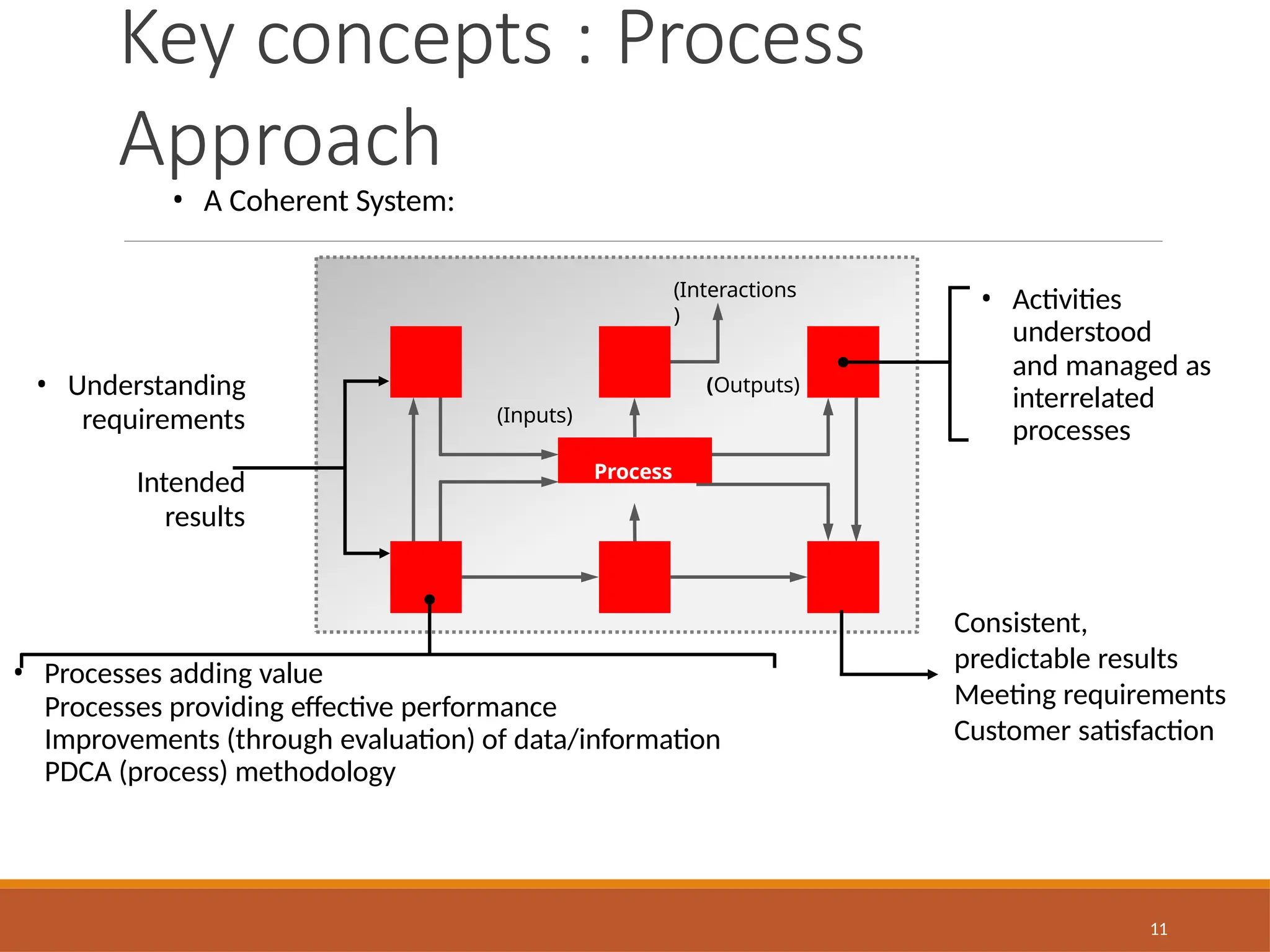
• A Coherent System:
• Understanding
requirements
Intended
results
Consistent,
predictable results
Meeting requirements
Customer satisfaction
• Activities
understood
and managed as
interrelated
processes
• Processes adding value
Processes providing effective performance
Improvements (through evaluation) of data/information
PDCA (process) methodology
(Interactions
)
(Outputs)
(Inputs)
Process
ISO 9001 – History
12
ISO 9001 – 1987
EN 29001 - 1987
Quality systems
Part 1. Specification for
design/development, production,
installation and servicing
ISO 9002 – 1987
EN 29002 - 1987
Quality systems
Part 1. Specification for production
and installation
ISO 9003 – 1987
EN 29003 - 1987
Quality systems
Part 1. Specification for final
inspection and test
Evolution of ISO 9000
13
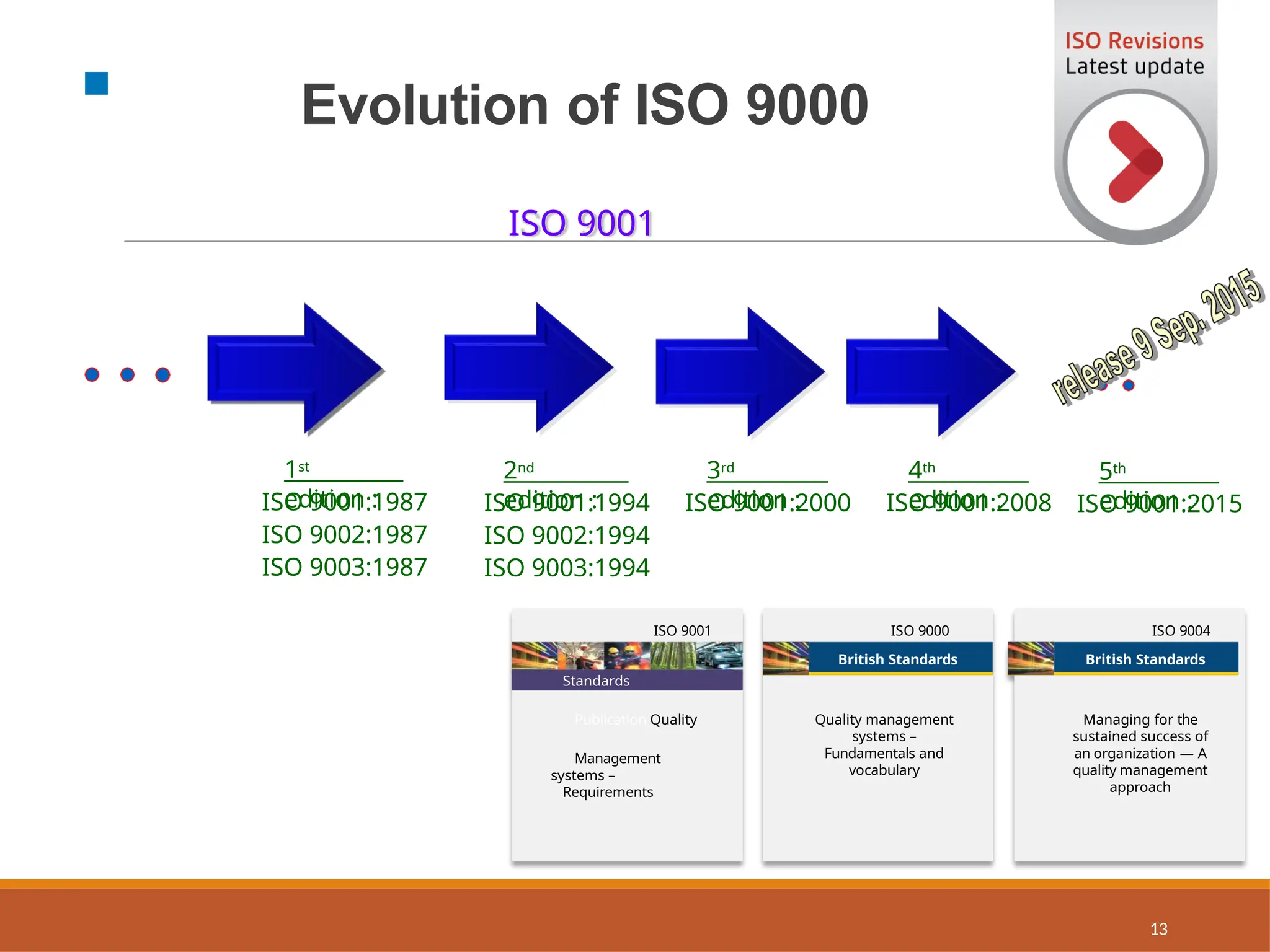
ISO 9001
1st
edition :
ISO 9001:1987
ISO 9002:1987
ISO 9003:1987
2nd
edition :
ISO 9001:1994
ISO 9002:1994
ISO 9003:1994
3rd
edition :
ISO 9001:2000
4th
edition :
ISO 9001:2008
5th
edition :
ISO 9001:2015
ISO 9004
British Standards
Managing for the
sustained success of
an organization — A
quality management
approach
ISO 9000
British Standards
Quality management
systems –
Fundamentals and
vocabulary
ISO 9001
Standards
Publication Quality
Management
systems –
Requirements
Accredited Certification
14
Accreditation Body
Certification
Body
Organization
Accredits
Certification body
local national body
Personnel
Certification Body
eg IRCA
Auditor
User
Audit
s
Certificates
Training Course,
Tutor,
Training Body
Accredits
Trains
International Accreditation Forum
Certified once, accepted everywhere
Establishes
Multilateral Recognition
Arrangements
Mandatory
Documents
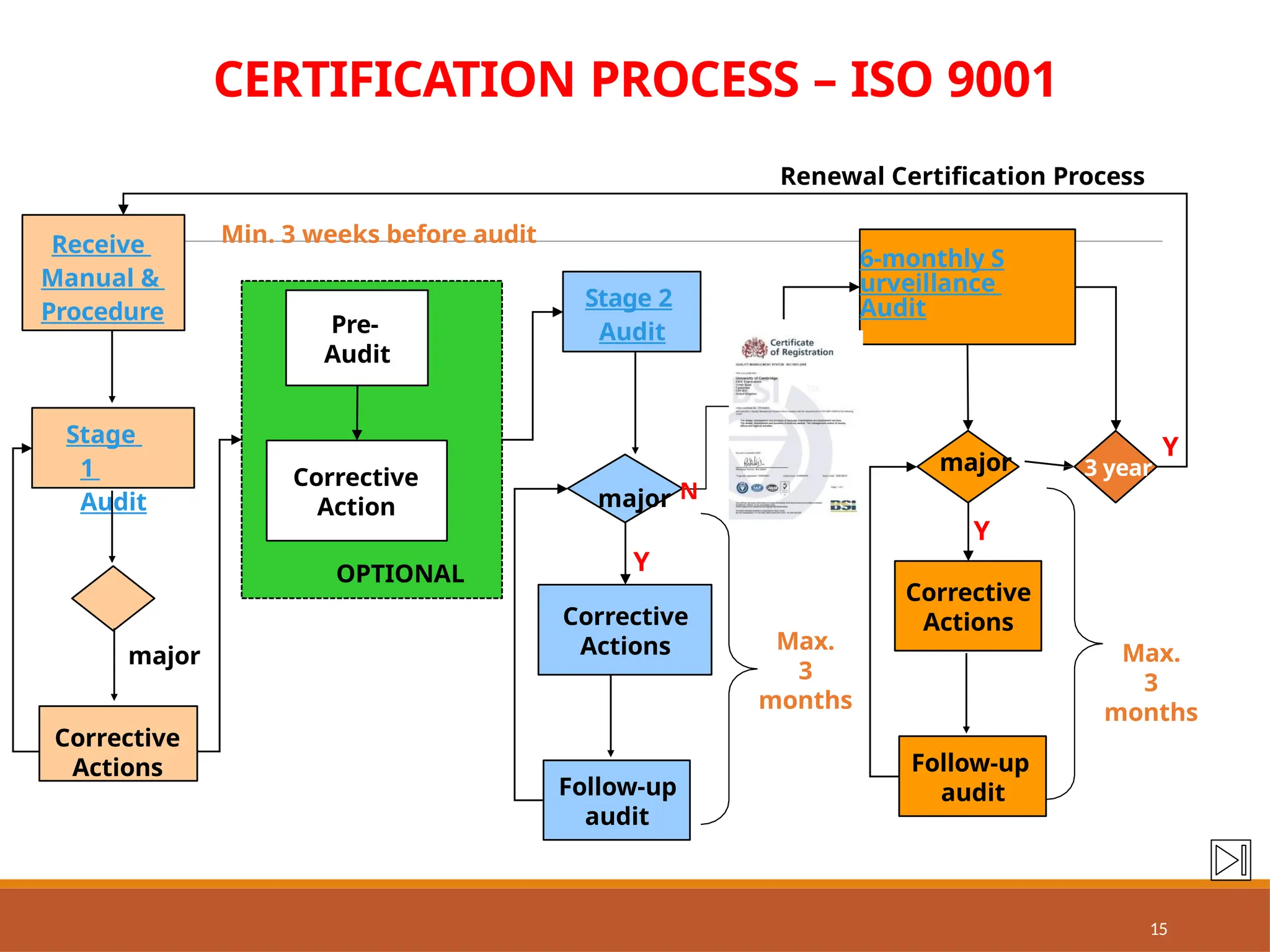
Receive
Manual &
Procedure
Stage
1
Audit
Corrective
Actions
Pre-
Audit
Corrective
Action
Stage 2
Audit
Corrective
Actions
Follow-up
audit
6-monthly S
urveillance
Audit
Corrective
Actions
Follow-up
audit
3 year
major
Y
Renewal Certification Process
CERTIFICATION PROCESS – ISO 9001
15
Min. 3 weeks before audit
OPTIONAL
major
Max.
3
months
major N
Y
Y
Max.
3
months
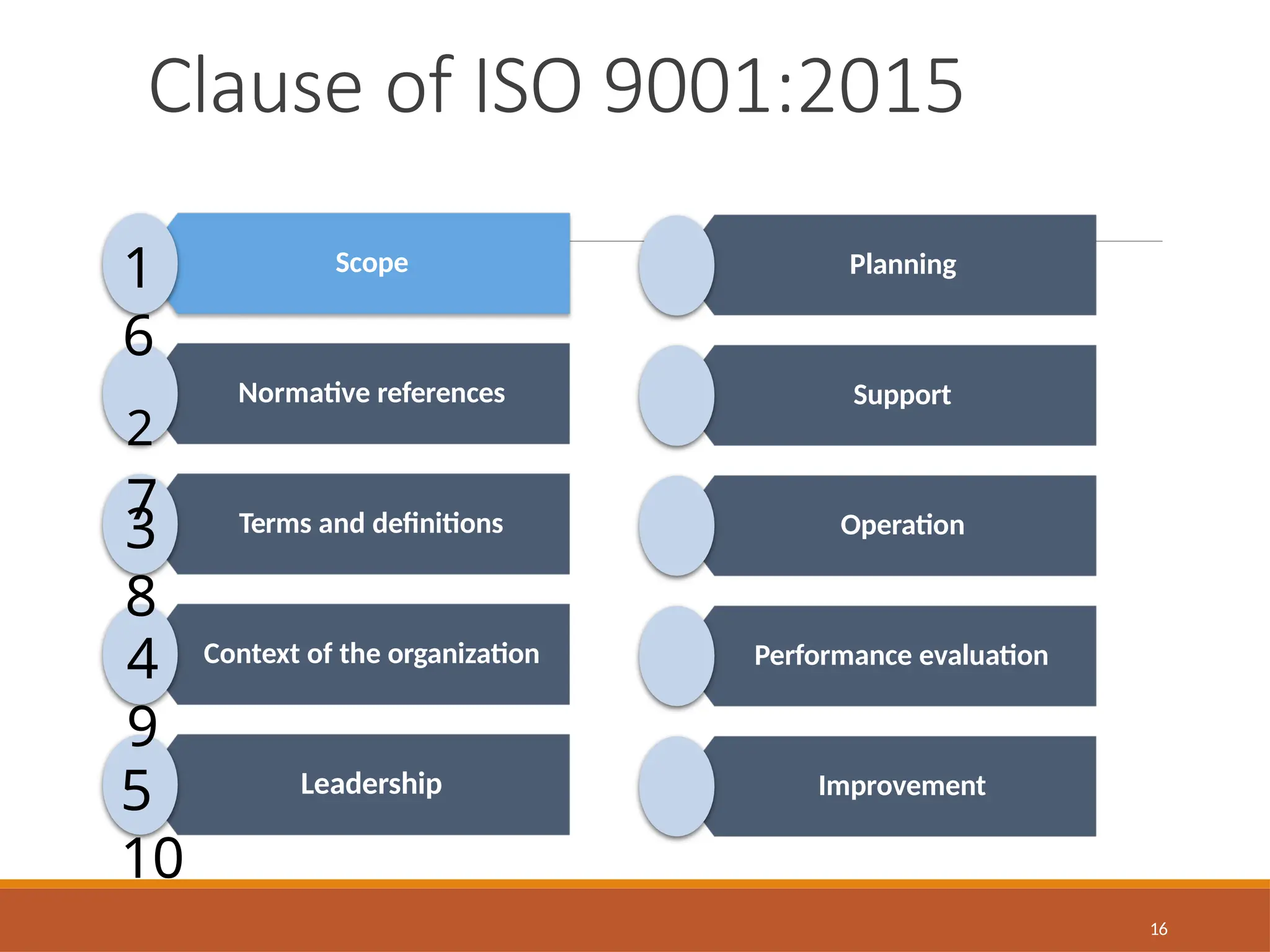
Clause of ISO 9001:2015
16
Scope
Normative references
Terms and definitions
Context of the organization
Leadership
Planning
Support
Operation
Performance evaluation
Improvement
1
6
2
7
3
8
4
9
5
10
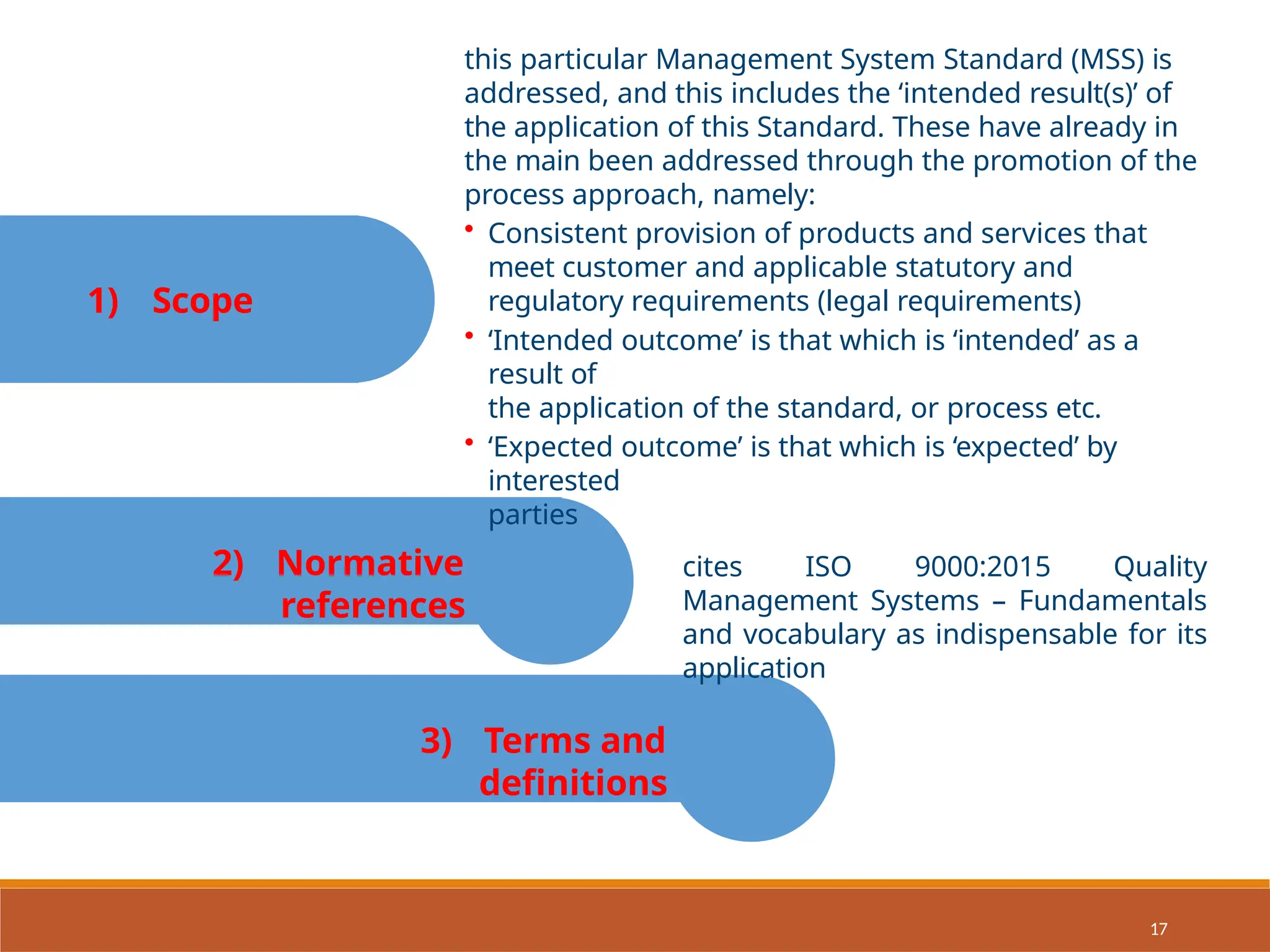
1) Scope
2) Normative
references
3) Terms and
definitions
cites ISO 9000:2015 Quality
Management Systems – Fundamentals
and vocabulary as indispensable for its
application
this particular Management System Standard (MSS) is
addressed, and this includes the ‘intended result(s)’ of
the application of this Standard. These have already in
the main been addressed through the promotion of the
process approach, namely:
• Consistent provision of products and services that
meet customer and applicable statutory and
regulatory requirements (legal requirements)
• ‘Intended outcome’ is that which is ‘intended’ as a
result of
the application of the standard, or process etc.
• ‘Expected outcome’ is that which is ‘expected’ by
interested
parties
17
18
4. Context of the organization
1. Understanding the organization and its context
The organization shall determine external and
internal issues that are relevant to its purpose
and its strategic direction and that affect its ability to
achieve the intended result(s) of its quality
management system.
The organization shall monitor and review information
about these external and internal issues.
19
Understand the ‘Context of your Organization’
20
QMS
Requiremen
ts of these
interested
parties
Purpose
and
strategic
direction
Boundaries
and
applicability
(Scope)
External
and internal
issues
Interested
parties
relevant to
the QMS
Organization
Products and
services
Applicability
Determine:
Intended
result(s) of
4.2. Understanding the needs and expectations of
interested parties
Due to their effect or potential effect on the organization’s
ability to consistently provide products and services that
meet customer and applicable statutory and regulatory
requirements, the organization shall determine:
a)the interested parties that are relevant to the
quality management system;
b)the requirements of these interested parties that
are relevant to the quality management system.
The organization shall monitor and review information
about these interested parties and their relevant
requirements.
21
Clause 4: Context of the Organization (2)
22
4.2. Understanding the needs and expectations of interested
parties Citizens
Customers
Distributors
Shareholders
Investors
Owners
Insurers
Government
Regulators
Recovery
service
suppliers
The Organization
Management
• Top Management
• Those accountable
for Quality policy
and implementation
Those who
implement and
maintain the QMS
• Those who
maintain QMS and
risk procedures
Other
Staff
Contractor
s
Competitors
Media
Commentators
Trade groups
Neighbors
Pressure groups
Emergency
services
Other response agencies
Transport services
Staff dependents
ISO 9001:2015
Risk-based thinking enables an organization to determine
the factors that could cause its processes and its quality
management system to deviate from the planned results,
to put in place preventive controls
to minimize negative effects and to make maximum use
of opportunities as they arise
ISO 9001:2015
REQUIREMENTS
ISO 9001:2015 requires for the
organization to determine the risks and
opportunities based on the knowledge of
the organization’s context (4.1 & 4.2)
25
EXTERNAL ANALYSIS (PESTEL)
(includingissuesfrom interested parties)
NO. ISSUES RISK/OPPORTUNITIES FOR KCDIO
1 POLITICAL
• Trump’s Muslim countries ban • (Opportunities) Increase international students application
2 ECONOMIC
• Reduced operational budget • (Risk) could not renew licenses
3 SOCIAL
• Staffing problem
• ELB implementation • (Risk) Student demonstration
4 TECHNOLOGY
• Outdated equipment • (Risk) MQA accreditation withdrawal
5 ENVIRONMENT
• Raining season • (risk) Flood at certain areas
6 LEGAL
• Intro of ICGPA
• stringent procedure in getting
VAL.
• Not following procedures
• (Risk) Decreasing intake from international students due to
implementation of i-CGPA and VAL procedure
• (Risk) accreditation withdrawal
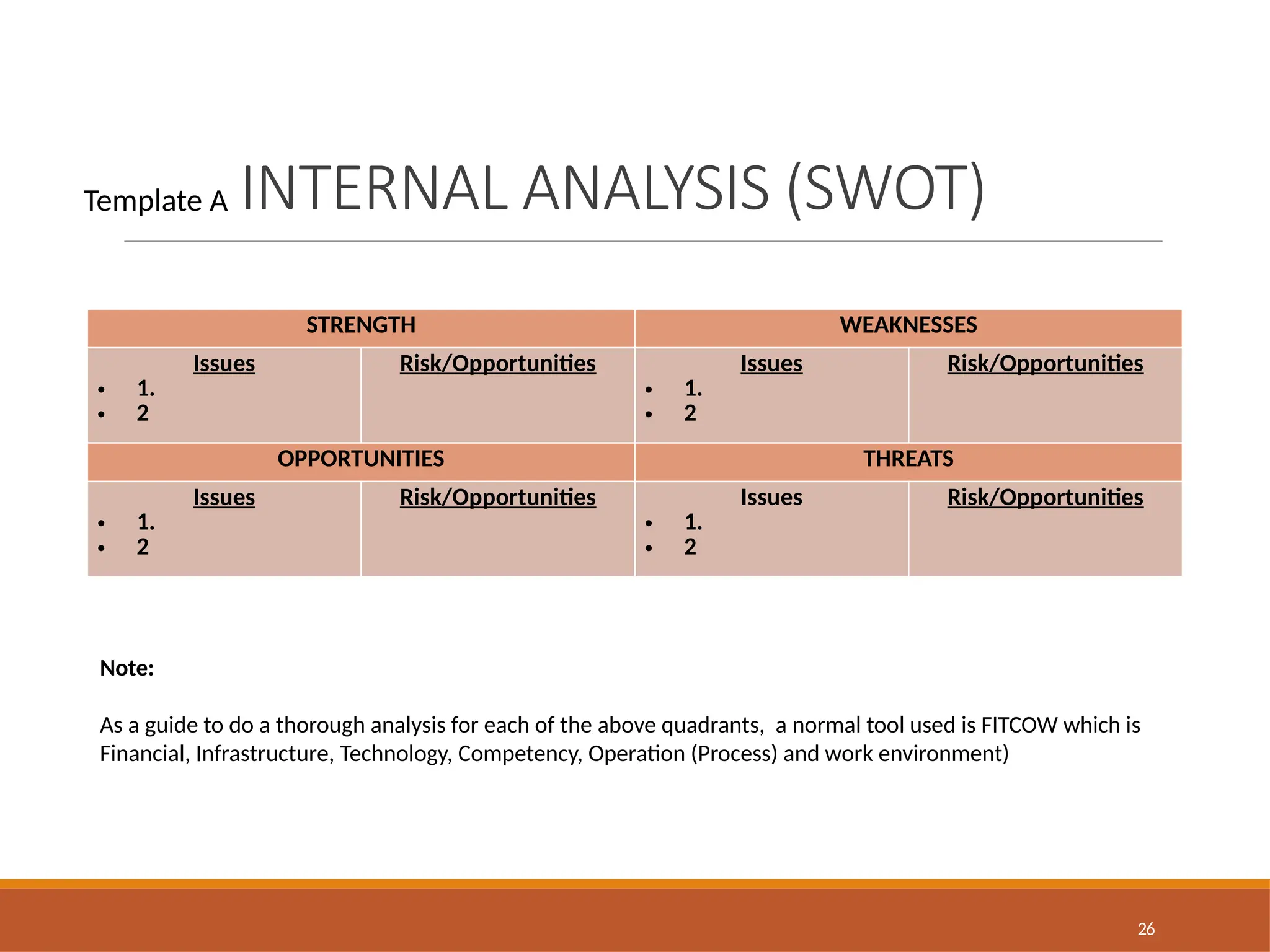
Template A
26
INTERNAL ANALYSIS (SWOT)
STRENGTH WEAKNESSES
Issues
• 1.
• 2
Risk/Opportunities Issues
• 1.
• 2
Risk/Opportunities
OPPORTUNITIES THREATS
Issues
• 1.
• 2
Risk/Opportunities Issues
• 1.
• 2
Risk/Opportunities
Note:
As a guide to do a thorough analysis for each of the above quadrants, a normal tool used is FITCOW which is
Financial, Infrastructure, Technology, Competency, Operation (Process) and work environment)
Template A
6.1.1 When planning for the quality
management system, the organization
shall consider the issues referred to in 4.1
and the requirements referred to in 4.2
and determine the risks and
opportunities that need to be addressed
to:
a) give assurance that the quality
management system can achieve its
intended result(s);
b) enhance desirable effects;
c) prevent, or reduce, undesired
effects;
d) achieve improvement.
ISO 9001:2015
REQUIREMENTS
Identifying Risks
Risks are determined to prevent or reduce undesired effects, and to give
assurance that quality management system can achieve its intended results.
ISO 9001 does not define specific types of risks that need to be determined
and addressed
Types and categories of risks are commonly used:
Processes: risks of nonconforming output, process breakdown, process
inefficiency, excessive variability, etc.
Quality: risk of defects and non-attainment of specified requirements
Suppliers: risk of defects and non-attainment of specified
requirements
Operation: risks to business continuity, data loss, public relations, etc.;
What about Opportunity?
Apart from the risks, the organization has to also identify the
opportunities that may come in its way.
Opportunities can be in form of adoption of new practices, launching of
new products or services, opening new markets, addressing new clients,
building partnerships, using new technology and other desirable and
viable possibilities to address the organization’s or its customers’ needs.
Why Risks are considered?
Risk : Effect of uncertainties
Risk Level: Likelihood x consequences
Risks and opportunities can affect conformity
of products and services and the ability to
enhance customer satisfaction are
determined and addressed
Managing
Risks
Step 1: Identify the Risk. ...
Step 2: Analyze the risk. ...
Step 3: Evaluate or Rank the Risk. ...
Step 4: Treat the Risk. ...
Step 5: Monitor and Review the risk.
Brainstorming
Environmental/Horizon Scanning
Interviews
Past data Analysis
Causes of Risk
Risk
Consequence/Impact
According to a leading global provider of risk
management services AON in their 2011
Global Risk Management Survey (AON,
2013) the top three risks for higher
education are ranked as follows:
1. Regulatory and legislative changes
2. Economic slowdown
3. Damage to brand or reputation
Online Journal of Applied Knowledge
Management, Volume 2, Issue 1, 2014
Samples: Common risks
Food poisoning
Theft
Fire
Flood
Samples: Common risks in
University
Issue Risks Consequence Measure
Student Enrolment • unpopular programs
• bad information about
Kulliyyah
Low enrollment • market research in order to introduce new
and update existing study programs
• Improve quality work of the staff
• additional activities offered to students,
• continuous promotions
Information System • Data Loss due to
Technical breakdown
• Data theft
• student’s
dissatisfaction
• the University’s
reputation issue
• financial loss
• Ensure staff obey the rules on the access to
data
• Acquire appropriate software and hardware
• train staff periodically
• test the equipment periodically
• perform a weekly backup
• Ensure physical protection of workstation
• Ensure saving and frequent changing of
passwords
• Do frequent updating of antivirus software
• avoid using unverified external data media
• Conduct comprehensive testing and fixing of
program flaws
Samples: Common risks in University
Issue Risks Consequence Measure
Teaching low quality of the teaching
because of the teaching staff
• Dissatisfaction
• bad experience of the students
• loss of Kulliyyah reputation
• low enrollment rate
• hiring the highest quality
teaching staff,
• Continuous assessment of the
academic staff’s work
poor teaching quality due to non-
existence or non-use of
contemporary devices and
electronic means
• bad experiences of students
• school reputation
• low enrollment rate
• Acquisition of the equipment
• continuous training of academic
staff
Student practical: Bad choice of
organizations in terms of the
activity and process and poor
support
• bad experience of students
• bad experience of associated
from the situation which
jeopardize Kulliyyah reputation
• students’ awareness about the
significance of the practical work
and the possibilities it offers
(acquiring precious experience,
accumulating data for the
placement)
Financial process Certain programmes could not be
run due to budget issue
• Bad reputation
• Accreditation withdrawal
• finding other sources of finance
by introducing alternative short
programs or courses which are in
demand
Misappropriation of fund • Bad reputation
• Financial loss
• Strengthen work process
• Continuous reminders to staff
Samples: Common risks in
University
Issue Risks Consequence Measure
Management • Bad assessment of the
management in relation
to type and content of
the study programs
• High-quality teaching
staff leave the Kulliyyah
• bad results of scientific
research work because
of the poor quality of
the teaching staff or
bad support due to lack
of funds
• Programmes run not
according to university
or government
requirements due to
bad documentation or
awareness
• impossibility or
withdrawal of
accreditation
• bad experience of
students
• lower financial
income
• jeopardized
University or Kulliyyah
reputation
• lower enrollment rate
• introducing or improving a quality system
(e.g. ISO) in order to improve University
elements in all processes and intensify the
conditions for their successful
implementation
• plan for hiring the teaching staff in
accordance to the need of the Kulliyyah
• motivate staff towards further improvement
by supporting them to visit conferences, write
articles and books, participate in projects, and
by awarding them according to an
assessment of their work
• periodical review and update of documents
for conducting the Kulliyyah programmes in
accordance to practice and update the staff
39
Template C
Risk Category
Type Description
Strategic Losses due to error or misjudgment in the selection of strategy or the execution of the strategy or
exposure to loss resulting from a strategy that turns out to be defective or inappropriate
Operations Risk arising from execution of a company's business function which focuses on the risks arising from the
people, assets, systems and processes through which the University operates
Finance
Risk associated with the finances of the Universityy, including loan interest charges, echange rates,
taxation, borrowings & credit, government grant, error in asset valuation (over or undervaluation),
liabilitiies, spending beyond limit, negative cash flows or any other direct and indirect losses affecting
other elemnets of the University's finances
Reputation
Risk of impact to the business attribute/related to the trustworthiness of the business and/or the
education industry as a whole
Information
Risk arising from the flow of information and availability of new or existing technology to the business
and the impact of it being adopted or not to the business
Regulation
Risk due to non-compliance or failure to adhere to sets of rutles and regulation as set out by the
University, Government or legislation
Qualitative Measure of
Consequences of Likelihood
Level Descriptor Probability Description
5 Almost certain >50%
The event is expected to occur in most
circumstances - will occur on an annual basis
4 Likely 31% - 50%
The event will probably occur in most
circumstances - will occur once in every 3
years
3 Possible 16% - 30%
The event might occur at some time - will occur
once in every 10 years
2 Unlikely 1% - 15%
The event could occur at some time - will occur
in every 20 years
1 Rare <1%
The event may occur only in exceptional
circumstances - will occur once in every 50
years
Qualitative Measure of
Consequences of Impact
Level Description Example detail description
1 Insignificant No injuries, low financial loss, no risk to reputation.
2 Minor
Minor First aid treatment, on-site release
immediately contained, medium financial loss,
some customer dissatisfaction.
3 Moderate
Medical treatment required, on-site release
contained with outside assistance, high financial
loss and public visibility.
4 Major
Major Extensive injuries, loss of production
capability, invocation of disaster recovery with no
detrimental effects, major financial loss.
5 Catastrophic
Death, off-site with detrimental effect, huge
financial loss.
Quantitative Measure of
Consequences of Impact
Level Description Example detail description
1 Insignificant Nil – Negligible
2 Minor Under RM1 mil
3 Moderate Between RM1 mil - RM5 mil
4 Major Between RM5 mil - RM15 mil
5 Catastrophic Above RM15 mil
Qualitative Risk Analysis
Matrix
Likelihood /
Impact
1 2 3 4 5
5 M S H H E
4 L M S H H
3 L M M S H
2 L L M Time Bomb Time Bomb
1 L L L Time Bomb Time Bomb
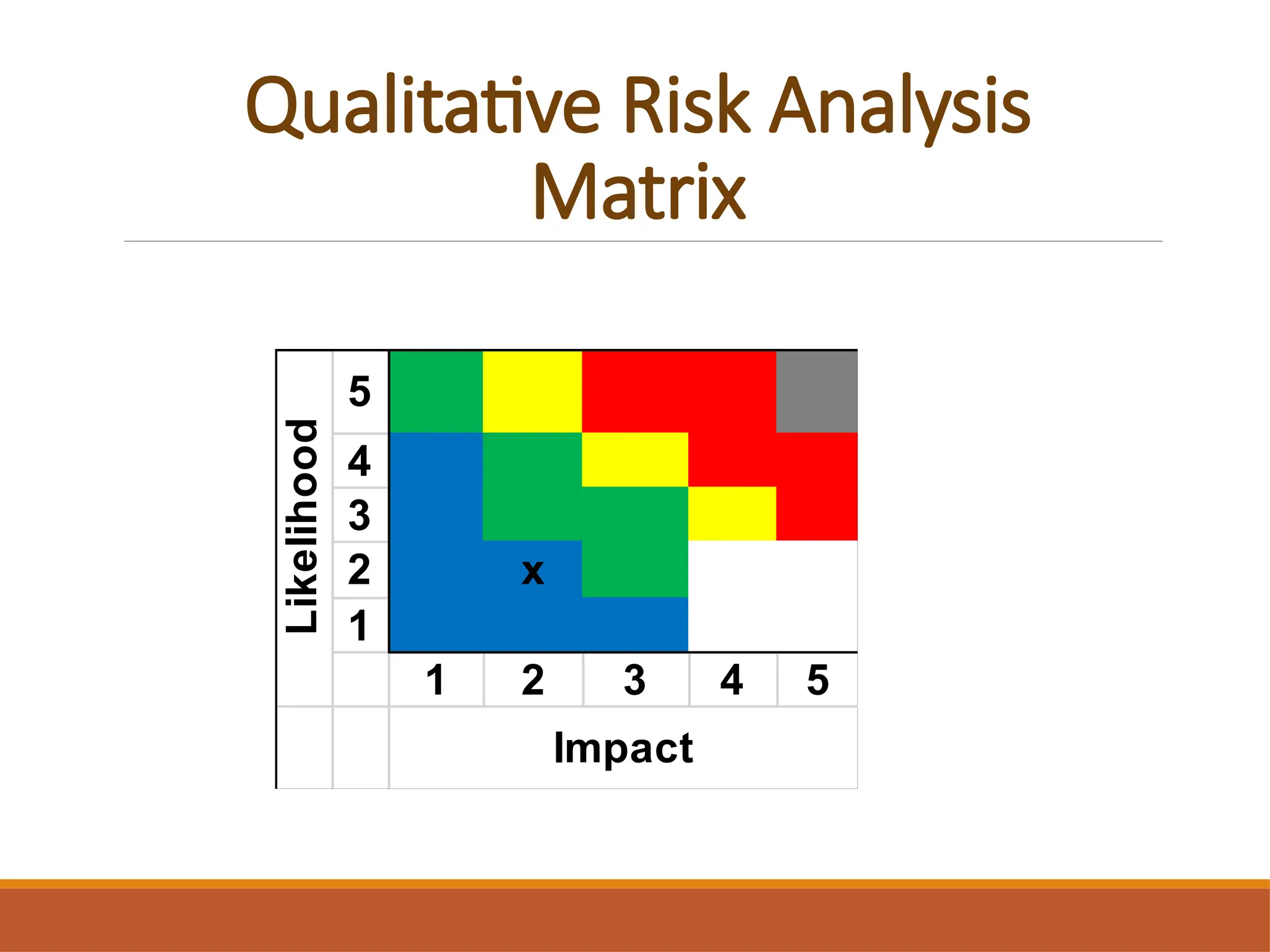
Qualitative Risk Analysis
Matrix
5
4
3
2 x
1
1 2 3 4 5
Impact
Likelihood
Qualitative Risk Analysis
Matrix
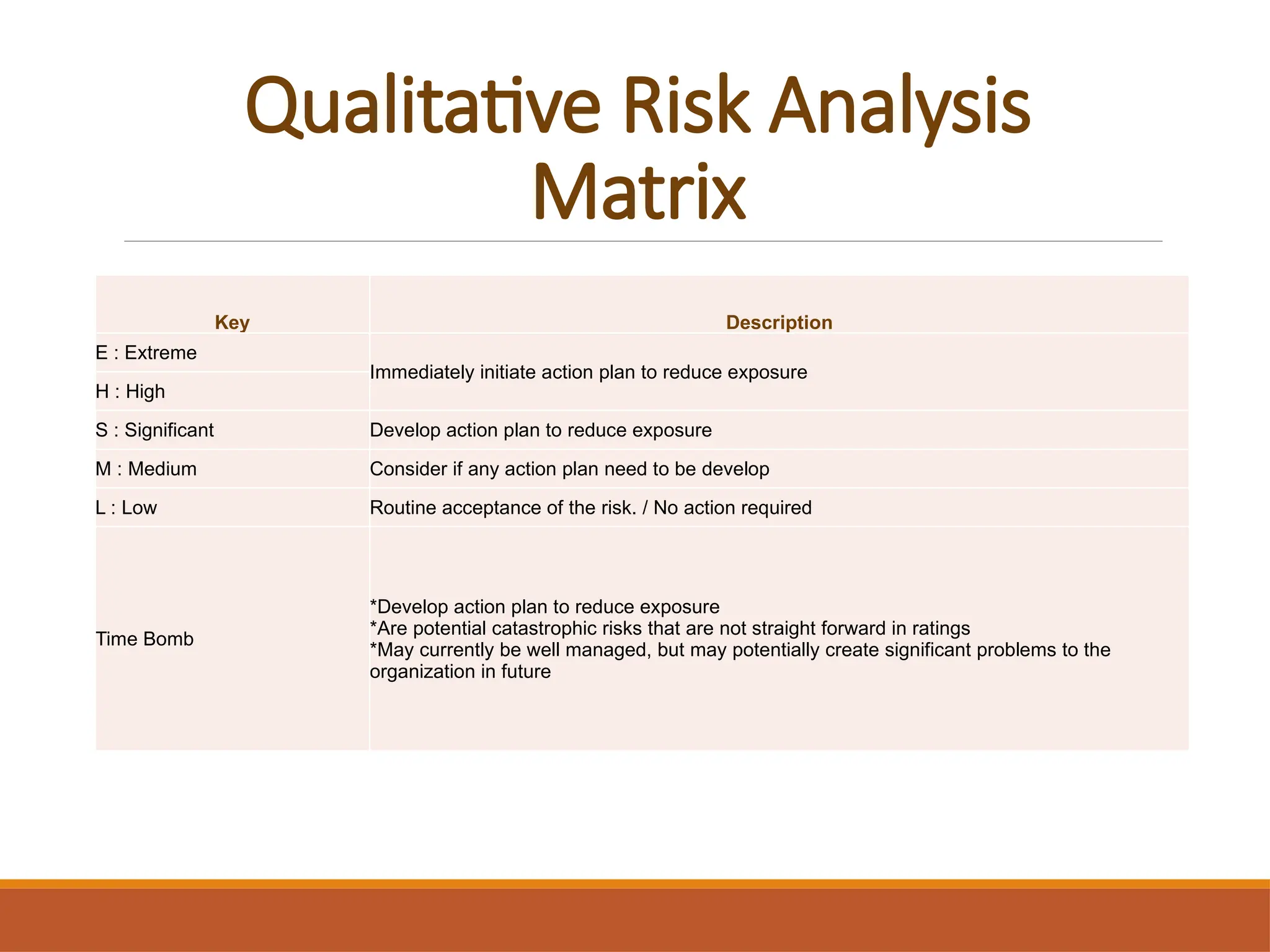
Key Description
E : Extreme
Immediately initiate action plan to reduce exposure
H : High
S : Significant Develop action plan to reduce exposure
M : Medium Consider if any action plan need to be develop
L : Low Routine acceptance of the risk. / No action required
Time Bomb
*Develop action plan to reduce exposure
*Are potential catastrophic risks that are not straight forward in ratings
*May currently be well managed, but may potentially create significant problems to the
organization in future
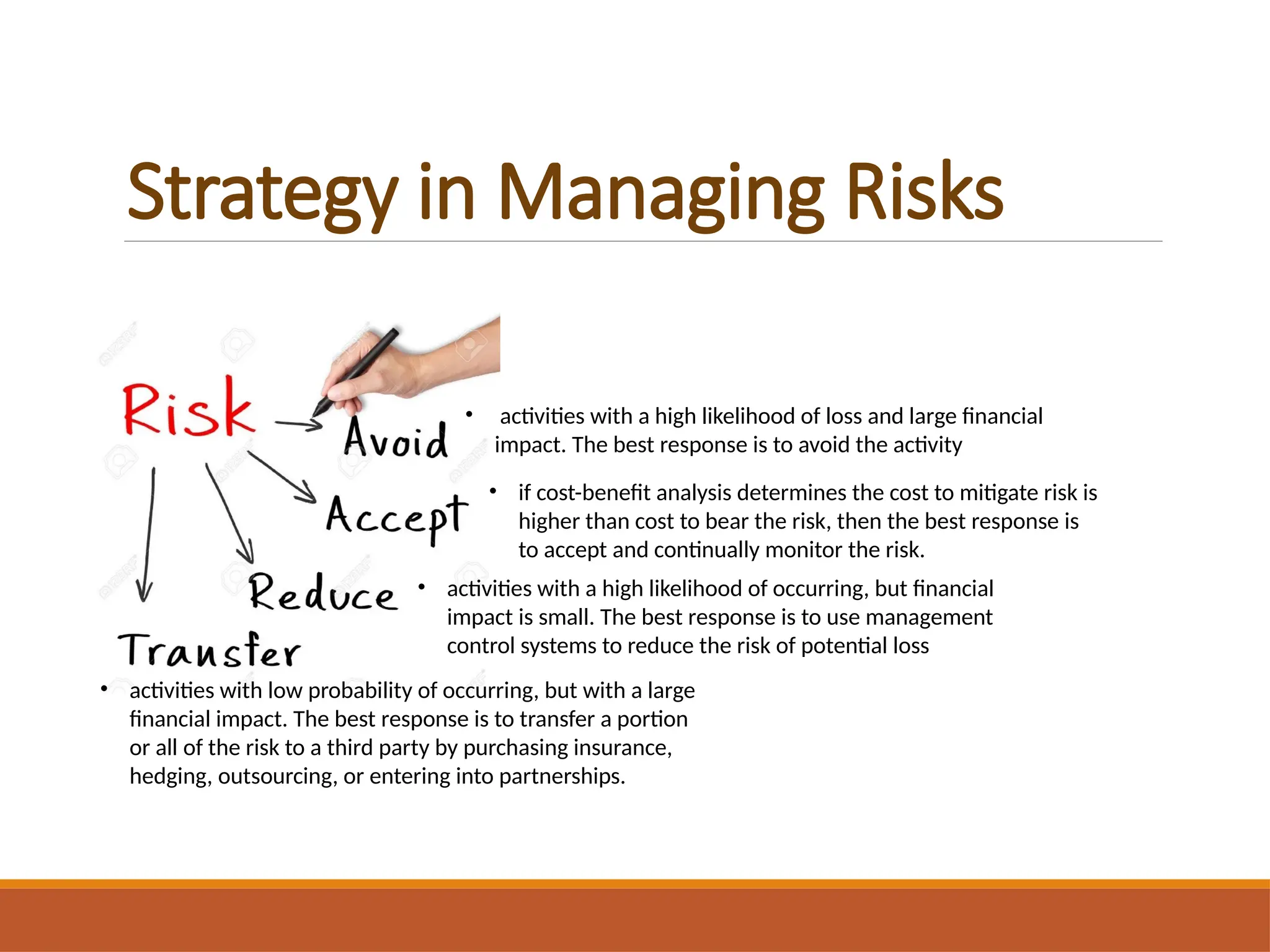
Strategy in Managing Risks
• activities with a high likelihood of loss and large financial
impact. The best response is to avoid the activity
• activities with low probability of occurring, but with a large
financial impact. The best response is to transfer a portion
or all of the risk to a third party by purchasing insurance,
hedging, outsourcing, or entering into partnerships.
• if cost-benefit analysis determines the cost to mitigate risk is
higher than cost to bear the risk, then the best response is
to accept and continually monitor the risk.
• activities with a high likelihood of occurring, but financial
impact is small. The best response is to use management
control systems to reduce the risk of potential loss
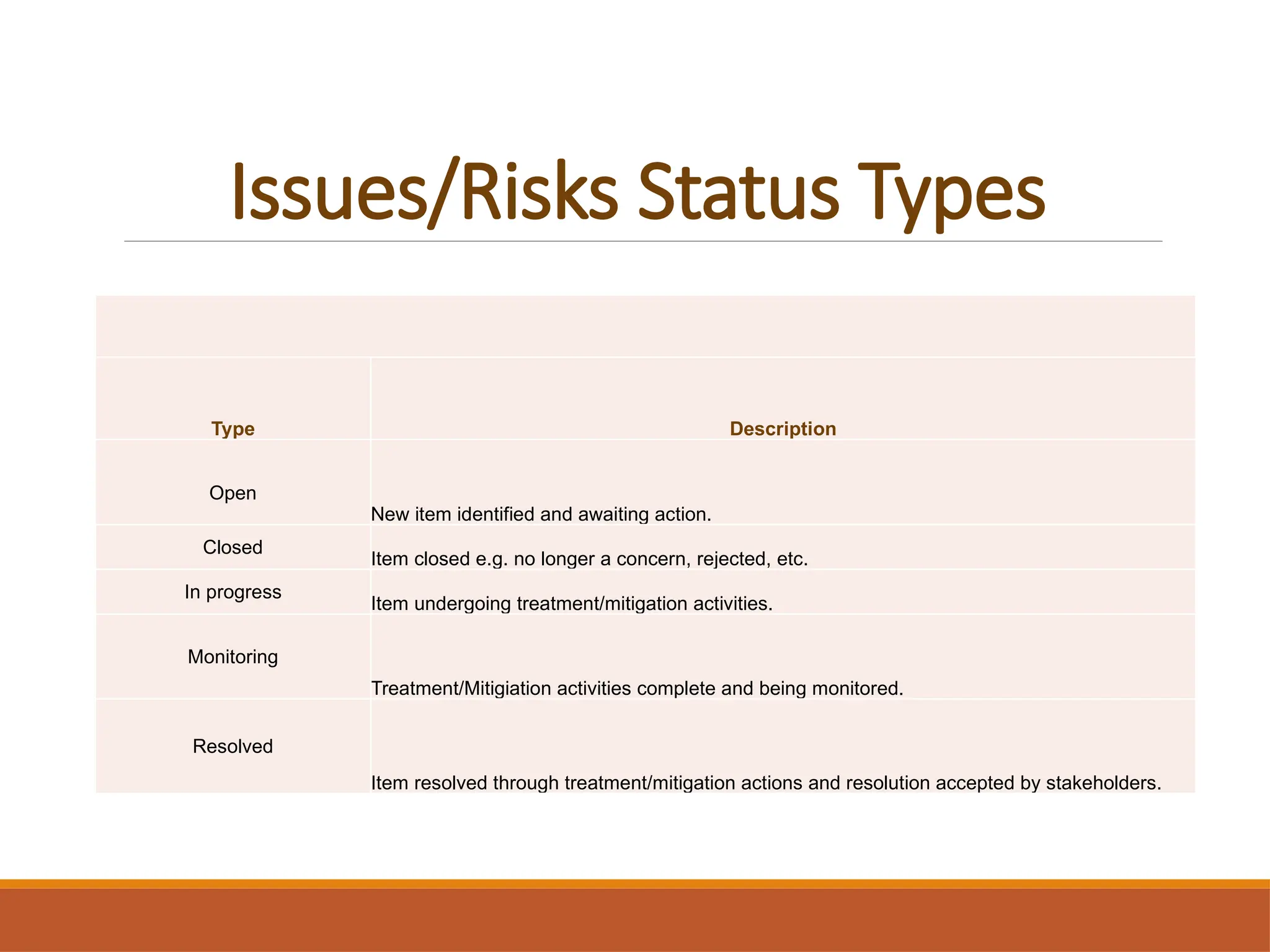
Issues/Risks Status Types
Type Description
Open
New item identified and awaiting action.
Closed
Item closed e.g. no longer a concern, rejected, etc.
In progress
Item undergoing treatment/mitigation activities.
Monitoring
Treatment/Mitigiation activities complete and being monitored.
Resolved
Item resolved through treatment/mitigation actions and resolution accepted by stakeholders.
What’s next? Having the risks and opportunities
identified, a proper plan of actions
need to be laid out in order to
mitigate these risks and grab the
opportunities.
Then, from time to time, the
organization needs to assess the
effectiveness of the actions taken.
50
RISKS SUMMARY
(From Risk Register)
RISK CATEGORY DESCRIPTION OF RISK RISK
REGISTER
NO.
1. External Analysis 1. Could renew licence
2. Decreasing intake from international students due to
implementation of i-CGPA and VAL procedure
3. MQA accreditation withdrawal
R1.1.1
R1.3.3
R1.3.4
2. Internal Analysis 1. Decreasing intake from international students due to
stringent procedure in getting VAL.
R2.1.1
Template C
51
OPPORTUNITY SUMMARY
CATEGORY TYPE DESCRIPTION OF OPPORTUNITIES OPPORTUNITY
REGISTER NO.
1. EXTERNAL ANALYSIS
2. INTERNAL ANALYSIS
Template D
52
Risks No:
(From Risk Register)
Strategy Initiatives Year/
Period
PIC KPI Target Achieve
d
% of
Success
PLANNING TO ADDRESS THE RISKS
Template E
53
Strategy Initiatives Year/
Period
PIC KPI Target Achieved % of
Success
PLANNING TO ADDRESS THE OPPORTUNITIES
Opportunity No:
(From Opportunity Summary)
Template F
Workflow
Identify External & Internal issues, risks and opportunities
(including from interested parties)
Risks Opportuni
ties
List all risks in Risk
Register
Analyze Each Risk
Categorize Risk
Avoi
d
Acce
pt
Trans
fer
Redu
ce
Categorize Risk
(L,M,H,E,TB)
L =
Low
Medium, High, Extreme &
Time Bomb
Prepare &
Execute Action
Plans
Monitor &
Review
List all
opportunities in
summary
List all Risks in
summary
Use
Templa
te B
Use
Templa
te A
Use Template C
Use
Template E
& F
Use
Template D
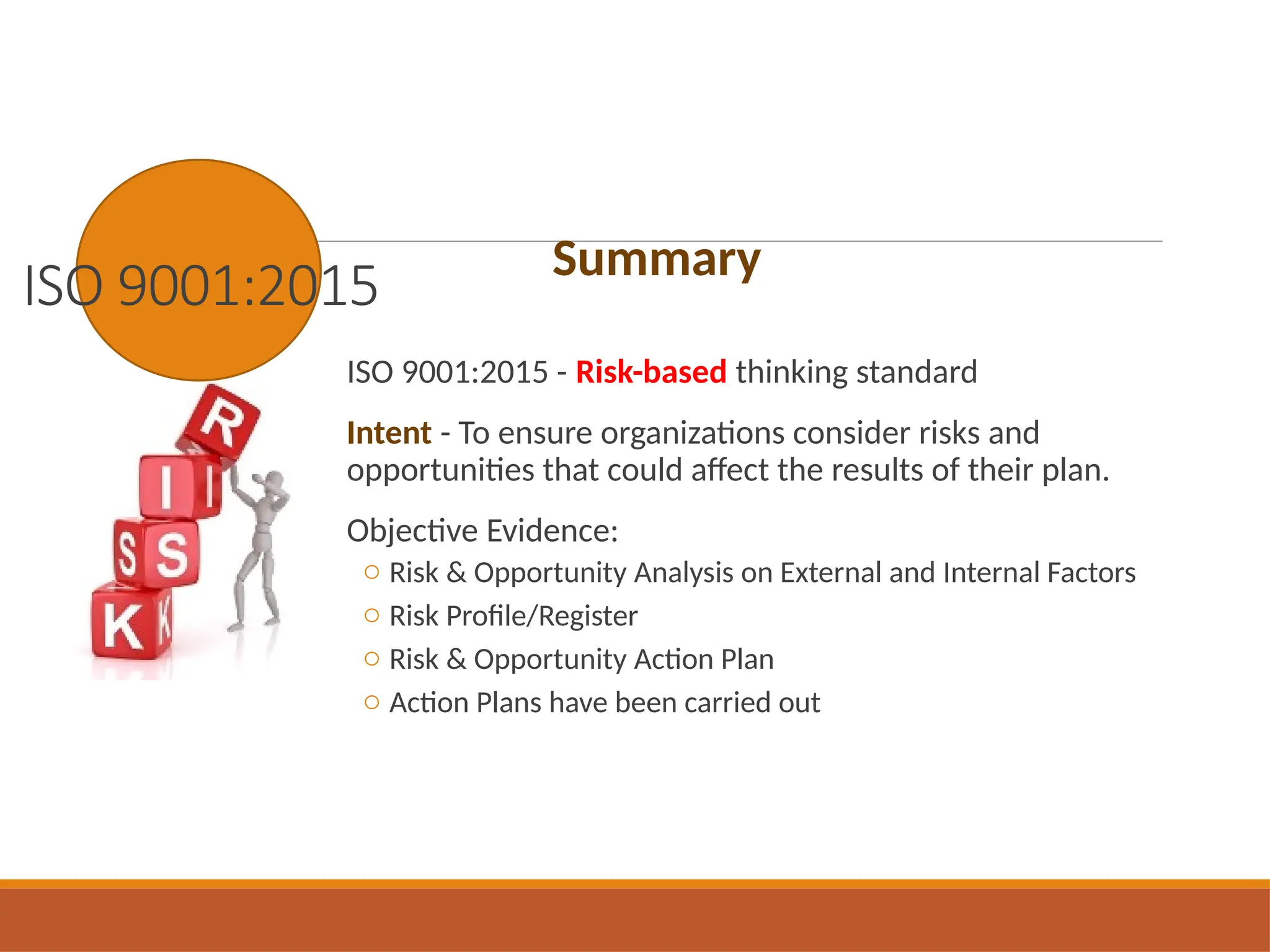
ISO 9001:2015
ISO 9001:2015 - Risk-based thinking standard
Intent - To ensure organizations consider risks and
opportunities that could affect the results of their plan.
Objective Evidence:
o Risk & Opportunity Analysis on External and Internal Factors
o Risk Profile/Register
o Risk & Opportunity Action Plan
o Action Plans have been carried out
Summary
4.3. Determining the scope of the quality management
system
56
The organization shall determine the boundaries and
applicability of the quality management system to
establish its scope.
When determining this scope, the organization shall
consider:
a) the external and internal issues referred to in
4.1;
b) the requirements of relevant interested parties
referred to in 4.2;
c) the products and services of the organization.
The organization shall apply all the requirements of
this International Standard if they are applicable
within the determined scope of its quality
management system.
The scope of the organization’s quality management
system shall be available and be maintained as
documented information. The scope shall state the
types of products and services covered, and provide
justification for any requirement of this International
Standard that the organization determines is not
applicable to the scope of its quality management
system.
57
Conformity to this International Standard may only be
claimed if the requirements determined as not being
applicable do not affect the organization’s ability or
responsibility to ensure the conformity of its products
and services and the enhancement of customer
satisfaction.
58
Clause 4: Context of the
59
Organization (3)
• 4.3. Determining the scope of the
QMS
• 4.4. QMS and its Processes
4. Quality management system and its processes
1.The organization shall establish, implement,
maintain and continually improve a quality
management system, including the processes needed
and their interactions, in accordance with the
requirements of this International Standard.
The organization shall determine the processes
needed for the quality management system and their
application throughout the organization, and shall:
60
a) determine the inputs required and the outputs
expected from these processes;
b) determine the sequence and interaction of these
processes;
c) determine and apply the criteria and methods
(including monitoring, measurements and related
performance indicators) needed to ensure the
effective operation and control of these processes;
d) determine the resources needed for these
processes and ensure their
availability;
61
e)assign the responsibilities and authorities for
these processes;
f)address the risks and opportunities as
determined in accordance with the requirements of
6.1;
g)evaluate these processes and implement
any changes needed to ensure that these
processes achieve their intended results;
h)improve the processes and the quality
management system.
62
4.4.2. To the extent necessary, the organization shall:
a) maintain documented information to support the
operation of its processes;
b) retain documented information to have confidence
that the processes are being carried out as
planned.
63
64
Key concepts : Process
65
With what?
(resources)
Outputs?
(what,
to whom)
What results?
(monitoring, measurements,
performance indicators)
Inputs?
(what,
from
whom)
How done?
(criteria, methods/controls
documentation)
With who?
(responsibilities,
authorities)
PROCESS
Key concepts Process Approach
66
• A Coherent System:
• Understanding
requirements
Intended
results
Consistent,
predictable results
Meeting requirements
Customer satisfaction
• Activities
understood
and managed as
interrelated
processes
• Processes adding value
Processes providing effective performance
Improvements (through evaluation) of data/information
PDCA (process) methodology
(Interactions
)
(Outputs)
(Inputs)
Process
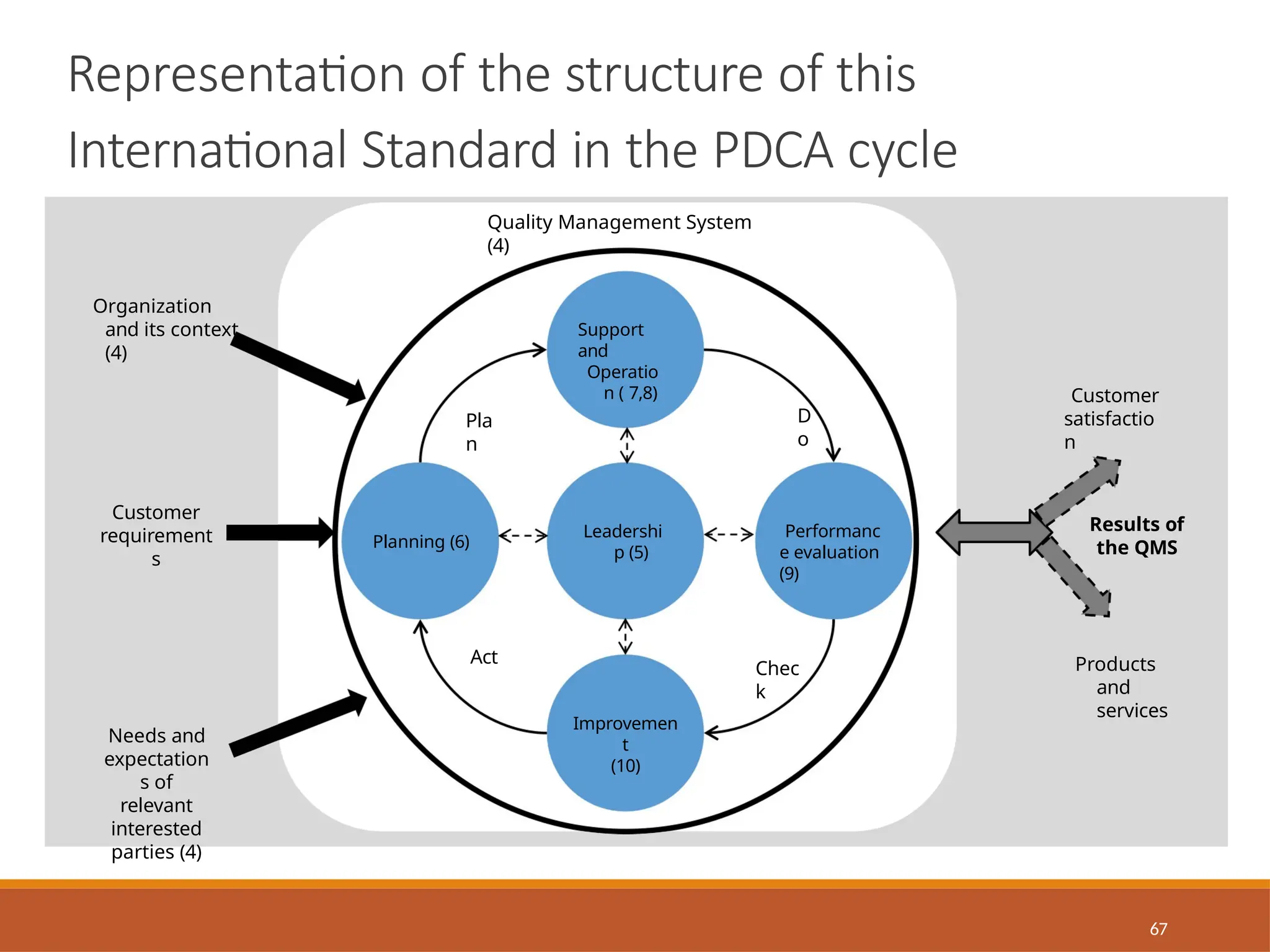
Representation of the structure of this
International Standard in the PDCA cycle
67
Leadershi
p (5)
Support
and
Operatio
n ( 7,8)
Improvemen
t
(10)
Planning (6)
Performanc
e evaluation
(9)
Pla
n
D
o
Chec
k
Act
Quality Management System
(4)
Organization
and its context
(4)
Customer
requirement
s
Needs and
expectation
s of
relevant
interested
parties (4)
Customer
satisfactio
n
Products
and
services
Results of
the QMS
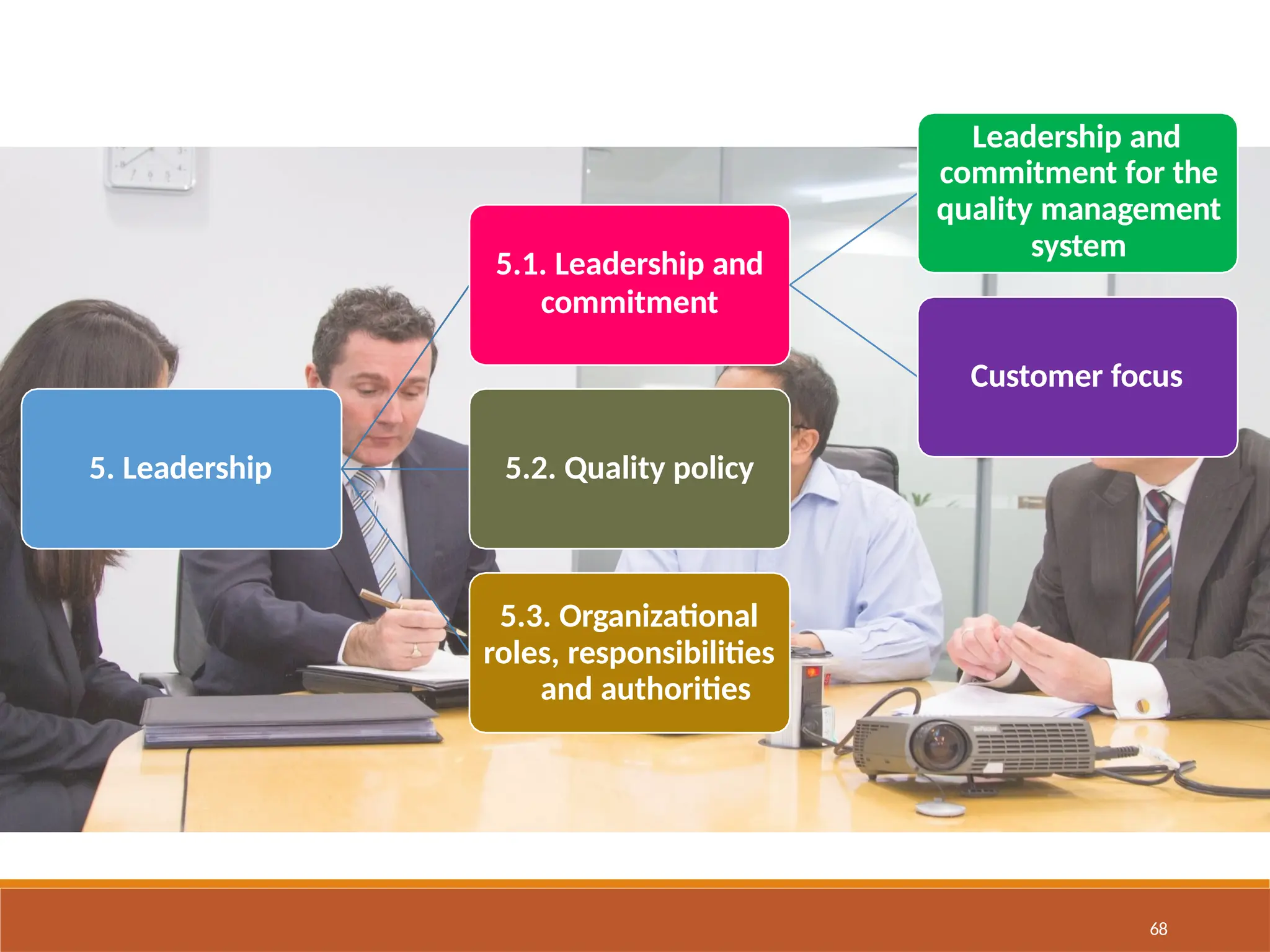
5. Leadership
5.1. Leadership and
commitment
Leadership and
commitment for the
quality management
system
Customer focus
5.2. Quality policy
5.3. Organizational
roles, responsibilities
and authorities
68
5. Leadership
69
5.1. Leadership and commitment
5.5.1. General
Top management shall demonstrate leadership and
commitment with respect to the quality management
system by:
a)taking accountability for the effectiveness of
the quality management system;
b)ensuring that the quality policy and quality
objectives are established for the quality management
system and are compatible with the context and
strategic direction of the organization;
5. LEADERSHIP
c) ensuring the integration of the quality
management system requirements into the
organization’s business processes;
70
d)promoting the use of the process
approach and risk-based thinking;
e)ensuring that the resources needed for
the quality management system are
available;
f)communicating the importance of
effective quality management and of
conforming to the quality management
system requirements;
5. LEADERSHIP
71
g)ensuring that the quality
management system achieves its
intended results;
h)engaging, directing and supporting
persons to contribute to the
effectiveness of the quality management
system;
i) promoting improvement;
j)supporting other relevant
management roles to demonstrate their
leadership as it applies to their areas of
responsibility.
5. LEADERSHIP
5.1.2. Customer focus
72
Top management shall demonstrate leadership and
commitment with respect to customer focus by ensuring
that:
a)customer and applicable statutory and
regulatory requirements are determined,
understood and consistently met;
b)the risks and opportunities that can affect conformity
of products and services and the ability to enhance
customer satisfaction are determined and addressed;
c)the focus on enhancing customer satisfaction
is maintained.
5. LEADERSHIP
73
2. Policy
1. Establishing the quality policy
Top management shall establish, implement and
maintain a quality policy that:
a)is appropriate to the purpose and context of
the organization and supports its strategic
direction;
b) provides a framework for setting quality
objectives;
c)includes a commitment to satisfy
applicable requirements;
d)includes a commitment to continual improvement
of the quality management system.
5. LEADERSHIP
5.2.2. Communicating the quality policy
74
The quality policy shall:
a)be available and be maintained as
documented information;
b)be communicated, understood and applied
within the organization;
c)be available to relevant interested parties,
as appropriate.
5. LEADERSHIP
5.3. Organizational roles, responsibilities and
authorities
75
Top management shall ensure that the responsibilities
and authorities for relevant roles are assigned,
communicated and understood within the
organization.
Top management shall assign the responsibility and
authority for:
a)ensuring that the quality management system
conforms to the requirements of this International
Standard;
b)ensuring that the processes are delivering
their intended outputs;
5. LEADERSHIP
76
c)reporting on the performance of the
quality management system and on
opportunities for improvement (see 10.1), in
particular to top management;
d)ensuring the promotion of customer
focus throughout the organization;
e)ensuring that the integrity of the quality
management system is maintained when changes to
the quality management system are planned and
implemented.
Clause 6: Planning for the QMS
77
4.1
6.1
Determine risks and opportunities
9.2
6.1
Plan actions to address risks and
opportunities
Issues
1. Actions to address risks and opportunities
2. Quality objectives and planning to achieve
them
3. Planning of changes
6. PLANNING
78
1. Actions to address risks and opportunities
1.When planning for the quality management
system, the organization shall consider the issues
referred to in 4.1 and the requirements referred to in
4.2 and determine the risks and opportunities that
need to be addressed to:
a)give assurance that the quality management
system can achieve its intended result(s);
b) enhance desirable effects;
c) prevent, or reduce, undesired effects;
d) achieve improvement.
6. PLANNING
6.1.2. The organization shall plan:
79
a) actions to address these risks and opportunities;
b) how to:
1) integrate and implement the actions into its quality
management system processes (see 4.4);
2) evaluate the effectiveness of these actions.
Actions taken to address risks and opportunities shall
be proportionate to the potential impact on the
conformity of products and services.
One can “slice and dice” these multiple
dimensions of risk
80
Portfolio
Concentration
Risk
Transaction Risk
Counterparty
Risk
Issuer Risk
Trading Risk
Gap Risk
Equity Risk
Interest Rate Risk
Currency Risk
Commodity Risk
Risks
Operational
Risk
Reputational
Risk
Business and
strategic risks
Market Risk
Credit Risk
“Specific
Risk”
General
Market
Risk
Issue Risk
Threat map
81
Business Risk Assessment Process
82
Assessment Assessment
of Controls
Identify
Risk
Understand
and analyse
the business
of Risk
Assess
business
risk
Assess
implemented
risk control
Business
Management
Strategy
Planning
Implementation
Monitoring
Improvement
Focus on
strategic
issues
Prioritising
of critical
risk
Improved
internal
control
Managed
Business
Risk context, assessment and
treatment
83
Relevant
Issues
(from
context)
red = -ve
green = +ve
Risk
Identification
Risk Analysis Risk Evaluation Risk Treatment Residual risk
Neighbourho
o d
disruption
in street
cabling
New fibre
technolog
y available
Workforc
e
retention
Share
holders:
Stock market
crash
Economic –
Significant
effect on profit
objectives and
liquidity if
share price
collapses
Impact
significant but
likelihood
unknown (high
uncertainty)
Unable to
qualify as
likelihood
unknown
Subscribe to Economic
indicators service for
horizon scanning
economic conditions and
global trends
Unknown pending
horizon scan. Re-
evaluate on report
receipt. Tolerate
risk. Transfer
emergency funds
to holding
company
62
SAMPLE - LIST OF RISK ITEMS
Design Engineering Risks Procurement Risks HSE Risks Project Management Risks Organizational
Risks
Terms & Conditions
Contract Risks
FEED Docs in ITB Docs are not detail
and incomplete additional some
procentage for Bill of Quantity
calculation may required.
RFQ & RFP documents are not
clear such as : Scope of Supply,
Data Sheet, Bill of Quantity,
Specification, Test Witness,
Chemical /Oil/Grease Supply,
Spare Part For Commissioning & 2
Years Operations, engineering
document should be supply,
Fabrication Schedule, Packaging
Specification, General Condition,
etc are not clear.
HSE Project Plan
Implementation. High standard
will impact to project cost and
schedule
Project purpose and need is not well-
defined
Inexperienced staff
assigned
Refer To Legal Analysis on
Draft of Contract from
Legal Department or
Refer to Analysis from
Contract Engineer
Plot Plan, P&ID, One Line Diagram &
Hazardous Area Change
Critical Items and Very tight
Schedule that need special
attentions
Risk Register and Risk
Management Execution are not
well done since Engineering
Design Stage.
Project scope, schedule, objectives,
cost, and deliverables are not clearly
defined or understood
Losing critical staff at
crucial time of the
project
Inaccurate assumptions on
technical issues in planning stage
Increase in material cost due to
market forces
Environmental analysis
(AMDAL) incomplete
Unreasonably high expectations from
stakeholders
Insufficient time to
plan
Surveys incomplete Political Situation is unstable, War,
Riot, Embargo
Environmental regulation or
local regulation is not Clear or
Changed
Vendor or contractor delays Unanticipated project
manager workload
Changes to Capacity, Materials or
Specification
Economic is Unstable, Depression,
Inflasion, Currency Rate is
unstable, Oil Price is unstable or
increase.
Construction Waste Treatment
Availability
Estimating and/or scheduling errors Internal “red tape”
causes delay getting
approvals, decisions
SIL, HAZID & HAZOP Study have
potensial to add more materials,
instrument & equipments.
Disaster, Climate, High/Low Tide
and Other Nature Conditions.
Availability of project data and
mapping at the beginning of
the environmental study is
insufficient
Unplanned work that must be
accommodated
Functional units not
available, overloaded
Basic Engineering Design Data &
Detail Engineering Design Data are
wrong.
Massive Development or Massive
Construction in some country or
Province that requires a lot of
Cosntruction materials
New information after
Environmental Document is
completed may require re-
evaluation or a new document
(i.e. utility relocation beyond
document coverage)
Lack of coordination/communication Lack of specialized
staff or Skilled MP
resources are limited.
P&ID and Plot Plan Review Meeting
are not so carefully done so it does
not find a crucial problem
Loading & Unloading and
Transportation Plan which need
special attentions
New alternatives required to
avoid, mitigate or minimize
impact
Underestimated support resources or
overly optimistic delivery schedule
Overlapping of one or
more projects
Don't Consider Operability,
Maintainability & Constructability
Import & Export Regulations are
changed
Design changes require
additional Environmental
analysis
Inaccurate contract time estimates
Approval Procedure for Engineering
Products is very long
Procurement Planning & Control
are wrong
Unanticipated Noise, Air
Quality and Waste impacts
Unresolved project conflicts not
escalated in a timely manner
Project causes an unanticipated
barrier to wildlife
Unanticipated escalation in right of
way values or construction cost
85
86
87
The FMEA
Form
Identify failure modes
and their effects
A Closer Look
88
Identify causes of the
failure modes
and controls
Prioritize
Determine and assess
actions
6. PLANNING
89
2. Quality objectives and planning to achieve them
1.The organization shall establish quality
objectives at relevant functions, levels and processes
needed for the quality management system.
The quality objectives shall:
a) be consistent with the quality policy;
b) be measurable;
c) take into account applicable requirements;
6. PLANNING
90
d)be relevant to conformity of products and
services and to enhancement of customer
satisfaction;
e) be monitored;
f) be communicated;
g) be updated as appropriate.
The organization shall maintain documented
information on the quality objectives.
6. PLANNING
91
6.2.2. When planning how to achieve its quality
objectives, the organization shall determine:
• what will be done;
• what resources will be required;
• who will be responsible;
• when it will be completed;
• how the results will be evaluated.
Institusional
objectives
progressing
Current
Situation
Objective and Effort of the whole institution
92
Future
Situation
Risk Analysis
Vision
Mission
Performance
indicators
Risk A
Objectives
A
Risk B
Objectives B
Risk C
Objectives C
6. PLANNING
93
6.3. Planning of changes
When the organization determines the need for
changes to the quality management system, the
changes shall be carried out in a planned manner (see
4.4).
The organization shall consider:
a)the purpose of the changes and their
potential consequences;
b) the integrity of the quality management
system;
c) he availability of resources;
d)the allocation or reallocation of responsibilities
and authorities.
• Planning/implementing QMS changes (6.3),
• Controlling operational changes, planned and
unintentional (8.1)
• Addressing unplanned changes affecting products
& services (8.5.6)
• See also 7.1.6 Organizational knowledge - for
addressing changing needs and trends,
with respect to knowledge
6.3. ‘Planning of Changes’
94
• 7.1 – Resources
• Determine and provide the necessary resources including people,
infrastructure, operational processes, and knowledge
• 7.2 – Competence
• Identify and maintain competence
• 7.3 – Awareness
• Make objectives known, and ensure awareness of QMS
• 7.4 – Communication
• What, when, how, who, and to whom
• 7.5 – Documented information
• Reflects variety of sources and need to back up information
Clause 7: Support
95
7. Support
1. Resources
1. General
The organization shall determine and provide the
resources needed for the establishment,
implementation, maintenance and continual
improvement of the quality management system.
The organization shall consider:
a)the capabilities of, and constraints on,
existing internal resources;
b)what needs to be obtained from
external providers.
96
7. SUPPORT
97
2. People
The organization shall determine and provide the
persons necessary for the effective implementation
of its quality management system and for the
operation and control of its processes.
3. Infrastructure
The organization shall determine, provide and
maintain the infrastructure necessary for the
operation of its processes and to achieve conformity
of products and services.
7. SUPPORT
7.1.4. Environment for the operation of processes
The organization shall determine, provide and maintain the environment
necessary for the operation of its processes and to achieve conformity of
products and services.
98
7. SUPPORT
5.Monitoring and
measuring resources
1. General
The organization shall determine and
provide the resources needed to ensure
valid and reliable results when
monitoring or measuring is used to verify
the conformity of products and services to
requirements.
The organization shall ensure that the
resources provided:
a) are suitable for the specific type of
monitoring and measurement activities
being undertaken;
99
7. SUPPORT
b) are maintained to ensure their continuing fitness for their
purpose.
The organization shall retain appropriate documented information as
evidence of fitness for purpose of the monitoring and measurement
resources.
100
7. SUPPORT
101
7.1.5.2. Measurement traceability
When measurement traceability is a requirement, or
is considered by the organization to be an essential
part of providing confidence in the validity of
measurement results, measuring equipment shall be:
a) calibrated or verified, or both, at specified intervals,
or prior to use, against measurement standards
traceable to international or national measurement
standards; when no such standards exist, the basis
used for calibration or verification shall be retained as
documented information;
7. SUPPORT
102
b) identified in order to determine their status;
c)safeguarded from adjustments, damage or
deterioration that would invalidate the calibration
status and subsequent measurement results.
The organization shall determine if the validity of
previous measurement results has been adversely
affected when measuring equipment is found to
be unfit for its intended purpose, and shall take
appropriate action as necessary.
•
7. SUPPORT
103
7.1.6. Organizational knowledge
The organization shall determine the knowledge
necessary for the operation of its processes and to
achieve conformity of products and services.
This knowledge shall be maintained and be made
available to the extent necessary.
When addressing changing needs and trends, the
organization shall consider its current knowledge and
determine how to acquire or access any necessary
additional knowledge and required updates.
7. SUPPORT
104
7.2. Competence
The organization shall:
a)determine the necessary competence of person(s)
doing work under its control that affects the performance
and effectiveness of the quality management system;
b)ensure that these persons are competent on the basis
of appropriate education, training, or experience;
c)where applicable, take actions to acquire the
necessary competence, and evaluate the effectiveness of
the actions taken;
d)retain appropriate documented information as
evidence of competence.
7. SUPPORT
105
7.3. Awareness
The organization shall ensure that persons doing work
under the organization’s control are aware of:
a) the quality policy;
b) relevant quality objectives;
c)their contribution to the effectiveness of the
quality management system, including the benefits of
improved performance;
d)the implications of not conforming with the
quality management system requirements.
7. SUPPORT
106
7.4. Communication
The organization shall determine the internal and
external communications relevant to the quality
management system, including:
a) on what it will communicate;
b) when to communicate;
c) with whom to communicate;
d) how to communicate;
e) who communicates.
7. SUPPORT
107
5. Documented information
1. General
The organization’s quality management system shall
include:
a)documented information required by
this International Standard;
b)documented information determined by the
organization as being necessary for the effectiveness
of the quality management system.
7. SUPPORT
7.5.2. Creating and updating
108
When creating and updating documented
information, the organization shall ensure
appropriate:
a)identification and description (e.g. a title,
date, author, or reference number);
b)format (e.g. language, software version,
graphics) and media (e.g. paper, electronic);
c) review and approval for suitability and adequacy.
7. SUPPORT
109
3. Control of documented information
1.Documented information required by the
quality management system and by this International
Standard shall be controlled to ensure:
a)it is available and suitable for use, where and
when it is needed;
b)it is adequately protected (e.g. from loss of
confidentiality, improper use, or loss of integrity).
7. SUPPORT
110
7.5.3.2. For the control of documented information,
the organization shall address the following activities,
as applicable:
a) distribution, access, retrieval and use;
b)storage and preservation, including preservation
of legibility;
c) control of changes (e.g. version control);
d) retention and disposition.
7. SUPPORT
111
Documented information of external origin
determined by the organization to be necessary for
the planning and operation of the quality
management system shall be identified as
appropriate, and be controlled.
Documented information retained as evidence of
conformity shall be protected from unintended
alterations.
Clause 8: Operation
112
Operational planning
and
control
Requirements for products and
services
Design and development of product‘s’ and
services
Control of externally provided products and
services
Production and service
provision, including
release
Co
n
t
r
8. Operation
113
8.1. Operational planning and control
The organization shall plan, implement and control
the processes (see 4.4) needed to meet the
requirements for the provision of products and
services, and to implement the actions determined in
Clause 6, by:
a)determining the requirements for the products
and services;
b) establishing criteria for:
1) the processes;
2) the acceptance of products and services;
8. OPERATION
114
c)determining the resources needed to achieve
conformity to the product and service requirements;
d)implementing control of the processes
in accordance with the criteria;
e)determining, maintaining and retaining
documented information to the extent necessary:
1) to have confidence that the processes have been
carried out as planned;
2) to demonstrate the conformity of products and services
to their requirements. The output of this planning shall
be suitable for the organization’s operations.
8. OPERATION
The organization shall control planned changes and review the
consequences of unintended changes, taking action to mitigate any
adverse effects, as necessary.
The organization shall ensure that outsourced processes are
controlled (see 8.4).
115
8. OPERATION
8.2. Requirements for products and services
116
8.2.1. Customer communication
Communication with customers shall include:
a) providing information relating to products and
services;
b)handling enquiries, contracts or orders,
including changes;
c)obtaining customer feedback relating to products
and services, including customer complaints;
d) handling or controlling customer property;
e)establishing specific requirements for
contingency actions, when relevant.
8. OPERATION
117
8.2.2. Determining the requirements for products
and services
When determining the requirements for the products
and services to be offered to customers, the
organization shall ensure that:
a)the requirements for the products and services
are defined, including:
1) any applicable statutory and regulatory requirements;
2) those considered necessary by the organization;
b)the organization can meet the claims for
the products and services it offers.
8. OPERATION
118
3.Review of the requirements for products
and services
1.The organization shall ensure that it has
the ability to meet the requirements for products
and services to be offered to customers. The
organization shall conduct a review before
committing to supply products and services to a
customer, to include:
a) requirements specified by the customer, including
the requirements for delivery and post- delivery
activities;
8. OPERATION
b)requirements not stated by the customer, but necessary for
the specified or intended use, when known;
c) requirements specified by the organization;
d)statutory and regulatory requirements applicable to the products
and services;
e)contract or order requirements differing from those previously
expressed.
119
8. OPERATION
The organization shall ensure that contract or order requirements
differing from those previously defined are resolved.
The customer’s requirements shall be confirmed by the organization
before acceptance, when the customer does not provide a documented
statement of their requirements.
120
8. OPERATION
121
8.2.3.2. The organization shall retain documented
information, as applicable:
a) on the results of the review;
b)on any new requirements for the products
and services.
8. OPERATION
122
8.2.4. Changes to requirements for products and
services
The organization shall ensure that relevant
documented information is amended, and that
relevant persons are made aware of the changed
requirements, when the requirements for products
and services are changed.
8. OPERATION
123
3.Design and development of products
and services
1. General
The organization shall establish, implement and
maintain a design and development process that is
appropriate to ensure the subsequent provision of
products and services.
8. OPERATION
124
8.3.2. Design and development planning
In determining the stages and controls for design and
development, the organization shall consider:
a)the nature, duration and complexity of the
design and development activities;
b)the required process stages, including
applicable design and development reviews;
c)the required design and development
verification and validation activities;
d)the responsibilities and authorities involved in
the design and development process;
8. OPERATION
125
e)the internal and external resource needs for
the design and development of products and
services;
f)the need to control interfaces between
persons involved in the design and development
process;
g)the need for involvement of customers and users
in the design and development process;
h)the requirements for subsequent provision
of products and services;
8. OPERATION
126
i)the level of control expected for the design and
development process by customers and other relevant
interested parties;
j)the documented information needed
to demonstrate that design and
development requirements have been
met.
8. OPERATION
127
8.3.3. Design and development inputs
The organization shall determine the requirements
essential for the specific types of products and services to
be designed and developed. The organization shall
consider:
a) functional and performance requirements;
b)information derived from previous similar design
and development activities;
c) statutory and regulatory requirements;
d) standards or codes of practice that the organization
has
committed to implement;
e) potential consequences of failure due to the nature
of the
products and services.
8. OPERATION
Inputs shall be adequate for design and development purposes,
complete and unambiguous.
Conflicting design and development inputs shall be resolved.
The organization shall retain documented information on design and
development inputs.
128
8. OPERATION
8.3.4. Design and development controls
The organization shall apply controls to the design and development
process to ensure that:
a) the results to be achieved are defined;
b)reviews are conducted to evaluate the ability of the results of
design and development to meet requirements;
c)verification activities are conducted to ensure that the design and
development outputs meet the input requirements;
129
8. OPERATION
130
d)validation activities are conducted to ensure that
the resulting products and services meet the
requirements for the specified application or intended
use;
e)any necessary actions are taken on problems
determined during the reviews, or verification and
validation activities;
f)documented information of these activities
is retained.
8. OPERATION
131
8.3.5. Design and development outputs
The organization shall ensure that design and
development outputs:
a) meet the input requirements;
b)are adequate for the subsequent processes for the
provision of products and services;
c)include or reference monitoring and measuring
requirements, as appropriate, and acceptance criteria;
d)specify the characteristics of the products and services
that are essential for their intended purpose and their safe
and proper provision.
The organization shall retain documented information
on design and development outputs.
8. OPERATION
132
8.3.6. Design and development changes
The organization shall identify, review and control
changes made during, or subsequent to, the design
and development of products and services, to the
extent necessary to ensure that there is no adverse
impact on conformity to requirements.
The organization shall retain documented information
on:
a) design and development changes;
b) the results of reviews;
c) the authorization of the changes;
d) the actions taken to prevent adverse impacts.
8. OPERATION
133
8.4. Control of externally provided processes, products and
services
• 8.4.1. General
The organization shall ensure that externally provided
processes, products and services conform to
requirements.
The organization shall determine the controls to be
applied to externally provided processes, products
and services when:
a) products and services from external providers are
intended for incorporation into the organization’s own
products and services;
8. OPERATION
134
b)products and services are provided directly to
the customer(s) by external providers on behalf of
the organization;
c)a process, or part of a process, is provided by
an external provider as a result of a decision by
the organization.
8. OPERATION
135
The organization shall determine and apply criteria for
the evaluation, selection, monitoring of performance,
and re-evaluation of external providers, based on their
ability to provide processes or products and services
in accordance with requirements. The organization
shall retain documented information of these
activities and any necessary actions arising from the
evaluations.
8. OPERATION
8.4.2. Type and extent of control
The organization shall ensure that externally provided
processes, products and services do not adversely
affect the organization’s ability to consistently deliver
conforming products and services to its customers.
136
The organization shall:
a) ensure that externally provided processes remain within
the control of its quality management system;
b) define both the controls that it intends to apply to an
external provider and those it intends to apply to
the resulting output;
8. OPERATION
c) take into consideration:
1) the potential impact of the externally provided
processes, products and services on the organization’s
ability to consistently meet customer and applicable
statutory and regulatory requirements;
2)the effectiveness of the controls applied by
the external provider;
d)determine the verification, or other activities,
necessary to ensure that the externally provided
processes, products and services meet requirements.
137
8. OPERATION
138
8.4.3. Information for external providers
The organization shall ensure the adequacy of
requirements prior to their communication to the
external provider.
The organization shall communicate to external
providers its requirements for:
a)the processes, products and services to
be provided;
b) the approval of:
1) products and services;
2) methods, processes and equipment;
3) the release of products and services;
8. OPERATION
139
c)competence, including any required qualification
of persons;
d) the external providers’ interactions with the
organization;
e) control and monitoring of the external providers’
performance to be applied by the organization;
f)verification or validation activities that the
organization, or its customer, intends to perform at
the external providers’ premises.
121
8. OPERATION
8.5. Production and service provision
8.5.1. Control of production and service provision
The organization shall implement production and
service provision under controlled conditions.
Controlled conditions shall include, as applicable:
a)the availability of documented information
that defines:
1) the characteristics of the products to be produced,
the
services to be provided, or the activities to be
performed;
2) the results to be achieved;
8. OPERATION
141
b)the availability and use of suitable monitoring
and measuring resources;
c)the implementation of monitoring and
measurement activities at appropriate stages to verify
that criteria for control of processes or outputs, and
acceptance criteria for products and services, have
been met;
d)the use of suitable infrastructure and
environment for the operation of processes;
e)the appointment of competent persons,
including any required qualification;
8. OPERATION
142
f)the validation, and periodic revalidation, of the
ability to achieve planned results of the processes for
production and service provision, where the resulting
output cannot be verified by subsequent monitoring
or measurement;
g)the implementation of actions to prevent
human error;
h)the implementation of release, delivery and
post- delivery activities.
8. OPERATION
143
8.5.2. Identification and traceability
The organization shall use suitable means to identify
outputs when it is necessary to ensure the conformity
of products and services.
The organization shall identify the status of outputs
with respect to monitoring and measurement
requirements throughout production and service
provision.
The organization shall control the unique
identification of the outputs when traceability is a
requirement, and shall retain the documented
information necessary to enable traceability.
8. OPERATION
144
8.5.3. Property belonging to customers or external
providers
The organization shall exercise care with property belonging to
customers or external providers while it is under the
organization’s control or being used by the organization.
The organization shall identify, verify, protect and safeguard
customers’ or external providers’ property provided for use or
incorporation into the products and services.
When the property of a customer or external provider is lost,
damaged or otherwise found to be unsuitable for use, the
organization shall report this to the customer or external
provider and retain documented information on what has
occurred.
8. OPERATION
145
8.5.4. Preservation
The organization shall preserve the outputs during
production and service provision, to the extent
necessary to ensure conformity to requirements.
8. OPERATION
146
8.5.5. Post-delivery activities
The organization shall meet requirements for post-
delivery activities associated with the products and
services.
8. OPERATION
147
In determining the extent of post-delivery activities
that are required, the organization shall consider:
a) statutory and regulatory requirements;
b)the potential undesired consequences
associated with its products and services;
c)the nature, use and intended lifetime of its
products and services;
d) customer requirements;
e) customer feedback.
8. OPERATION
148
8.5.6. Control of changes
The organization shall review and control changes for
production or service provision, to the extent
necessary to ensure continuing conformity with
requirements.
The organization shall retain documented information
describing the results of the review of changes, the
person(s) authorizing the change, and any necessary
actions arising from the review.
8. OPERATION
149
8.6. Release of products and services
The organization shall implement planned
arrangements, at appropriate stages, to verify that the
product and service requirements have been met.
The release of products and services to the customer
shall not proceed until the planned arrangements
have been satisfactorily completed, unless otherwise
approved by a relevant authority and, as applicable,
by the customer.
8. OPERATION
150
The organization shall retain documented information
on the release of products and services. The
documented information shall include:
a)evidence of conformity with the
acceptance criteria;
b)traceability to the person(s) authorizing
the release.
8. OPERATION
151
7. Control of nonconforming outputs
1.The organization shall ensure that outputs
that do not conform to their requirements are
identified and controlled to prevent their unintended
use or delivery.
The organization shall take appropriate action based
on the nature of the nonconformity and its effect on
the conformity of products and services. This shall
also apply to nonconforming products and services
detected after delivery of products, during or after the
provision of services.
8. OPERATION
152
The organization shall deal with nonconforming
outputs in one or more of the following ways:
a) correction;
b)segregation, containment, return or suspension
of provision of products and services;
c) informing the customer;
d)obtaining authorization for acceptance
under concession.
Conformity to the requirements shall be verified when
nonconforming outputs are corrected.
8. OPERATION
153
8.7.2. The organization shall retain documented
information that:
a) describes the nonconformity;
b) describes the actions taken;
c) describes any concessions obtained;
d)identifies the authority deciding the action
in respect of the nonconformity.
Clause 9 – Performance evaluation
154
• 9.1 – Monitoring, measurement, analysis and evaluation
• What needs to be monitored and measured, how and when
• 9.2 – Internal audit
• To establish whether the QMS conforms to requirements and is
effectively implemented and maintained
• 9.3 – Management review
• Top management must regularly review the QMS
Clause 9 – Performance
155
evaluation
9.1. Monitoring, measurement,
analysis and evaluation
9.1.1
9.1.2
9.1.3
(General
)
(Customer
satisfaction
)
(Analysis
and
evaluation)
• What needs to be monitored and
measured,
how and when
9. PERFORMANCE EVALUATION
156
9. Performance evaluation
1.Monitoring, measurement, analysis
and evaluation
1. General
The organization shall determine:
a) what needs to be monitored and
measured;
b)the methods for monitoring, measurement,
analysis and evaluation needed to ensure valid
results;
c)when the monitoring and measuring shall
be performed;
9. PERFORMANCE EVALUATION
157
d) when the results from monitoring and
measurement shall be analysed and evaluated.
The organization shall evaluate the performance and
the effectiveness of the quality management system.
The organization shall retain appropriate documented
information as evidence of the results.
9. PERFORMANCE EVALUATION
9.1.2. Customer satisfaction
The organization shall monitor customers’ perceptions of the degree to
which their needs and expectations have been fulfilled. The organization
shall determine the methods for obtaining, monitoring and reviewing
this information.
158
9.1.2. Customer Satisfaction
159
Loyalty factors
UNANTICIPATED
DESIRED
EXPECTED
BASIC
Purchasing factors
9. PERFORMANCE EVALUATION
160
9.1.3. Analysis and evaluation
The organization shall analyse and evaluate
appropriate data and information arising from
monitoring and measurement.
The results of analysis shall be used to
evaluate:
a) conformity of products and services;
b) the degree of customer satisfaction;
c)the performance and effectiveness of the
quality management system;
d) if planning has been implemented effectively;
9. PERFORMANCE EVALUATION
161
e)the effectiveness of actions taken to address
risks and opportunities;
f) the performance of external providers;
g)the need for improvements to the
quality management system.
144
Clause 9 – Performance
evaluation
9.2. Internal Audit
To establish whether the QMS conforms to
requirements and is effectively implemented
and maintained
At planned
intervals
(status and
importance)
Ensure
system
conforms to
planned
arrangement
s
Ensure
system
conforms to
ISO 9001
Effectively
implement
ed and
maintained
Follow-up
actions
Audit criteria, scope, frequency, methods defined in documented
information
9. PERFORMANCE EVALUATION
9.2. Internal audit
163
9.2.1. The organization shall conduct internal audits at
planned intervals to provide information on whether
the quality management system:
a) conforms to:
1) the organization’s own requirements for its
quality management system;
2) the requirements of this International Standard;
b) is effectively implemented and maintained.
9. PERFORMANCE EVALUATION
164
9.2.2. The organization shall:
a)plan, establish, implement and maintain an audit
programme(s) including the frequency, methods,
responsibilities, planning requirements and reporting,
which shall take into consideration the importance of
the processes concerned, changes affecting the
organization, and the results of previous audits;
b) define the audit criteria and scope for each audit;
9. PERFORMANCE EVALUATION
165
c)select auditors and conduct audits to ensure
objectivity and the impartiality of the audit process;
d)ensure that the results of the audits are reported
to relevant management;
e)take appropriate correction and corrective
actions without undue delay;
f)retain documented information as evidence of the
implementation of the audit programme and the audit
results.
9. PERFORMANCE EVALUATION
166
3. Management review
1. General
Top management shall review the organization’s
quality management system, at planned intervals, to
ensure its continuing suitability, adequacy,
effectiveness and alignment with the strategic
direction of the organization.
9. PERFORMANCE EVALUATION
9.3.2. Management review inputs
167
The management review shall be planned and carried
out taking into consideration:
a)the status of actions from previous
management reviews;
b)changes in external and internal issues that
are relevant to the quality management system;
c)information on the performance and
effectiveness of the quality management system,
including trends in:
1)customer satisfaction and feedback from
relevant interested parties;
9. PERFORMANCE EVALUATION
168
2) the extent to which quality objectives have been met;
3) process performance and conformity of products and
services;
4) nonconformities and corrective actions;
5) monitoring and measurement results;
6) audit results;
7) the performance of external providers;
d) the adequacy of resources;
e)the effectiveness of actions taken to address
risks and opportunities (see 6.1);
f) opportunities for improvement.
9. PERFORMANCE EVALUATION
169
9.3.3. Management review outputs
The outputs of the management review shall include
decisions and actions related to:
a) opportunities for improvement;
b)any need for changes to the quality
management system;
c) resource needs.
The organization shall retain documented information
as evidence of the results of management reviews.
Previous actions/
status
External/
internal issues
N/C’s,
corrective actions
Monitoring/
Measurement
Audit results
Customer
satisfaction
External providers
Adequacy of
resources
CONSIDER:
REVIEW
Process performance
Risks and
opportunities
Continual
improvement (C.I)
Opportunities (C.I)
Changes to QMS
Resource needs
Doc. Information
WHAT NEEDS
TO CHANGE?
! !
9.3. Management Review
170
Clause 10: Improvement
171
Improvement
Nonconformity and
corrective
action
Continual improvement
10. IMPROVEMENT
10. Improvement
172
10.1. General
The organization shall determine and select
opportunities for improvement and implement any
necessary actions to meet customer requirements and
enhance customer satisfaction.
These shall include:
a)improving products and services to meet requirements
as well as to address future needs and expectations;
b) correcting, preventing or reducing undesired effects;
c) improving the performance and effectiveness of the
quality
management system.
What to
evaluate ?
Action
•Corrective
•Correction
•Improvement
•Policy
•Critical Success
Factor
•Measurement
•Program
•Data collected
•Responsibility
•Frequency
•Method
How to
evaluate ?
Analyze
10. IMPROVEMENT
174
10.2. Nonconformity and corrective action
When a nonconformity occurs, including any arising from
complaints, the organization shall:
a) react to the nonconformity and, as applicable:
1) take action to control and correct it;
2) deal with the consequences;
b)evaluate the need for action to eliminate the
cause(s) of the nonconformity, in order that it does not
recur or occur elsewhere, by:
1) reviewing and analysing the nonconformity;
2) determining the causes of the nonconformity;
3) determining if similar nonconformities exist, or could
potentially occur;
10. IMPROVEMENT
175
c) implement any action needed;
d)review the effectiveness of any corrective
action taken;
e)update risks and opportunities determined
during planning, if necessary;
f)make changes to the quality management system,
if necessary.
Corrective actions shall be appropriate to the effects
of the nonconformities encountered.
10. IMPROVEMENT
176
10.2.2. The organization shall retain documented
information as evidence of:
a)the nature of the nonconformities and
any subsequent actions taken;
b) the results of any corrective action.
10. IMPROVEMENT
10.3. Continual improvement
The organization shall continually improve the suitability, adequacy and
effectiveness of the quality management system.
The organization shall consider the results of analysis and evaluation,
and the outputs from management review, to determine if there are
needs or opportunities that shall be addressed as part of continual
improvement.
177
QUALITY PROBLEM
•Operational Cost
•Customer satisfaction Result
•Non conformity
•Performance
•Health & Safety
CORRECTIVE ACTION
•Coordination between function
•Caused identification
•Analysis & corrective action plan
•Follow up
•Implementation monitoring,
efficiency and evaluation on its
effectiveness
POTENTIAL
PROBLEMS
CONTINUAL
IMPROVEMENT
PREVENTIVE ACTIONS
•Caused identification
•Analysis & preventive action plan
•Implementation
•Implementation monitoring,
efficiency and evaluation on its
effectiveness (Management Review)
Continual improvement
Review and Final Questions

iso 9001 2015 awareness training .pptx

  • 1.
    ISO 9001:2015 Quality ManagementSystems 1 BY PARABAKARAN
  • 2.
    Learning Objectives 2 Have theskills to develop documentation : • process mapping •documented information such as procedure and supporting document ……QMS shall establishing the documented information for the effectiveness (Clause 7.5 9001:2015) • The history and development of ISO 9001 • What is a Quality Management System (QMS) • The benefits of a QMS KNOWLEDGE • The terms and definitions used • Key concepts, principles and structure • The main requirements of ISO 9001:2015 and how to implement SKILLS
  • 3.
    Solution & Result... 3 1 23 4 Overview Knowledge Identification Documentation The Need for Quality Management System Understanding the requirements of the standard is your essential starting point to working with a management system. Develop your expertise to identify the document and other to comply the requirement Discover how you can develop the documentation system training journey
  • 4.
    5 • Concept ofQuality Closing Module 1 Module 3 ISO 9001 - General Module 2 Overview • Principle of QMS • Terminology (Workshop 1) • Historical of ISO 9001 • ISO 9000, ISO 9001 & ISO 9004 Module 4 Interpretation & Documentation of Context Organisation • Interested Party • Scope • Process Mapping (Workshop 2) Module 7 Interpretation & Documentation of Resources • People • Infrastructure • Process Environment • Monitoring & Measurement • Knowledge Management) • Competence • Awareness • Documented Information(Workshop 4 Module 5 Interpretation & Documentation of Leadership • Commitment • Quality Policy • Role & Responsibility Module 8 Interpretation & Documentation of Operation • Planning and provision of services ((Workshop 5) • Control of external providers • Release & Control of Non Conforming Module 9 Interpretation & Documentation of Performance Evaluation • Customer Satisfaction • Internal Audit • Management Review Module 10 Interpretation & Documentation of Improvement • Improvement • Nonconformity & Corrective action • Continual Improvement) Module 6 Interpretation & Documentation of Planning • Risk Management (Workshop 3) • Quality Objective • Management of Change
  • 5.
  • 6.
    Non Quality Culture QualityInspection Time Q Performance ZERO DEFECT ZERO DEFECT CONTINUOSLY Quality Control ZERO DEFECT CONTINUOSLY & CUSTOMERS SATISFCATION Quality Assurance CUSTOMERS SATISFCATION CONSISTENTLY (ISO 9001:2008) QUALITY MANAGEMENT ZERO DEFECT CONTINUOSLY & INTERESTED PARTIES SATISFACTION (ISO 9001:2015) SUSTANAIBILITY COMPLIANC E PERFORMANC E 6
  • 7.
    comprehensive portfolios ensureyour corporate reputation remains secure
  • 8.
    Key terms and definitions 8 Management? “Coordinated activities to direct and control an organization” Quality Management ? “Management with regard to quality” Quality Management System ? “Management system with regard to quality”
  • 9.
  • 10.
    Key concepts :7 Management Principles 10 Customer Focus Leadership Engagement of People Process Approach Improvemen t Evidence- based Decision Making Relationship Management
  • 11.
    Key concepts :Process Approach 11 • A Coherent System: • Understanding requirements Intended results Consistent, predictable results Meeting requirements Customer satisfaction • Activities understood and managed as interrelated processes • Processes adding value Processes providing effective performance Improvements (through evaluation) of data/information PDCA (process) methodology (Interactions ) (Outputs) (Inputs) Process
  • 12.
    ISO 9001 –History 12 ISO 9001 – 1987 EN 29001 - 1987 Quality systems Part 1. Specification for design/development, production, installation and servicing ISO 9002 – 1987 EN 29002 - 1987 Quality systems Part 1. Specification for production and installation ISO 9003 – 1987 EN 29003 - 1987 Quality systems Part 1. Specification for final inspection and test
  • 13.
    Evolution of ISO9000 13 ISO 9001 1st edition : ISO 9001:1987 ISO 9002:1987 ISO 9003:1987 2nd edition : ISO 9001:1994 ISO 9002:1994 ISO 9003:1994 3rd edition : ISO 9001:2000 4th edition : ISO 9001:2008 5th edition : ISO 9001:2015 ISO 9004 British Standards Managing for the sustained success of an organization — A quality management approach ISO 9000 British Standards Quality management systems – Fundamentals and vocabulary ISO 9001 Standards Publication Quality Management systems – Requirements
  • 14.
    Accredited Certification 14 Accreditation Body Certification Body Organization Accredits Certificationbody local national body Personnel Certification Body eg IRCA Auditor User Audit s Certificates Training Course, Tutor, Training Body Accredits Trains International Accreditation Forum Certified once, accepted everywhere Establishes Multilateral Recognition Arrangements Mandatory Documents
  • 15.
    Receive Manual & Procedure Stage 1 Audit Corrective Actions Pre- Audit Corrective Action Stage 2 Audit Corrective Actions Follow-up audit 6-monthlyS urveillance Audit Corrective Actions Follow-up audit 3 year major Y Renewal Certification Process CERTIFICATION PROCESS – ISO 9001 15 Min. 3 weeks before audit OPTIONAL major Max. 3 months major N Y Y Max. 3 months
  • 16.
    Clause of ISO9001:2015 16 Scope Normative references Terms and definitions Context of the organization Leadership Planning Support Operation Performance evaluation Improvement 1 6 2 7 3 8 4 9 5 10
  • 17.
    1) Scope 2) Normative references 3)Terms and definitions cites ISO 9000:2015 Quality Management Systems – Fundamentals and vocabulary as indispensable for its application this particular Management System Standard (MSS) is addressed, and this includes the ‘intended result(s)’ of the application of this Standard. These have already in the main been addressed through the promotion of the process approach, namely: • Consistent provision of products and services that meet customer and applicable statutory and regulatory requirements (legal requirements) • ‘Intended outcome’ is that which is ‘intended’ as a result of the application of the standard, or process etc. • ‘Expected outcome’ is that which is ‘expected’ by interested parties 17
  • 18.
  • 19.
    4. Context ofthe organization 1. Understanding the organization and its context The organization shall determine external and internal issues that are relevant to its purpose and its strategic direction and that affect its ability to achieve the intended result(s) of its quality management system. The organization shall monitor and review information about these external and internal issues. 19
  • 20.
    Understand the ‘Contextof your Organization’ 20 QMS Requiremen ts of these interested parties Purpose and strategic direction Boundaries and applicability (Scope) External and internal issues Interested parties relevant to the QMS Organization Products and services Applicability Determine: Intended result(s) of
  • 21.
    4.2. Understanding theneeds and expectations of interested parties Due to their effect or potential effect on the organization’s ability to consistently provide products and services that meet customer and applicable statutory and regulatory requirements, the organization shall determine: a)the interested parties that are relevant to the quality management system; b)the requirements of these interested parties that are relevant to the quality management system. The organization shall monitor and review information about these interested parties and their relevant requirements. 21
  • 22.
    Clause 4: Contextof the Organization (2) 22 4.2. Understanding the needs and expectations of interested parties Citizens Customers Distributors Shareholders Investors Owners Insurers Government Regulators Recovery service suppliers The Organization Management • Top Management • Those accountable for Quality policy and implementation Those who implement and maintain the QMS • Those who maintain QMS and risk procedures Other Staff Contractor s Competitors Media Commentators Trade groups Neighbors Pressure groups Emergency services Other response agencies Transport services Staff dependents
  • 23.
    ISO 9001:2015 Risk-based thinkingenables an organization to determine the factors that could cause its processes and its quality management system to deviate from the planned results, to put in place preventive controls to minimize negative effects and to make maximum use of opportunities as they arise
  • 24.
    ISO 9001:2015 REQUIREMENTS ISO 9001:2015requires for the organization to determine the risks and opportunities based on the knowledge of the organization’s context (4.1 & 4.2)
  • 25.
    25 EXTERNAL ANALYSIS (PESTEL) (includingissuesfrominterested parties) NO. ISSUES RISK/OPPORTUNITIES FOR KCDIO 1 POLITICAL • Trump’s Muslim countries ban • (Opportunities) Increase international students application 2 ECONOMIC • Reduced operational budget • (Risk) could not renew licenses 3 SOCIAL • Staffing problem • ELB implementation • (Risk) Student demonstration 4 TECHNOLOGY • Outdated equipment • (Risk) MQA accreditation withdrawal 5 ENVIRONMENT • Raining season • (risk) Flood at certain areas 6 LEGAL • Intro of ICGPA • stringent procedure in getting VAL. • Not following procedures • (Risk) Decreasing intake from international students due to implementation of i-CGPA and VAL procedure • (Risk) accreditation withdrawal Template A
  • 26.
    26 INTERNAL ANALYSIS (SWOT) STRENGTHWEAKNESSES Issues • 1. • 2 Risk/Opportunities Issues • 1. • 2 Risk/Opportunities OPPORTUNITIES THREATS Issues • 1. • 2 Risk/Opportunities Issues • 1. • 2 Risk/Opportunities Note: As a guide to do a thorough analysis for each of the above quadrants, a normal tool used is FITCOW which is Financial, Infrastructure, Technology, Competency, Operation (Process) and work environment) Template A
  • 27.
    6.1.1 When planningfor the quality management system, the organization shall consider the issues referred to in 4.1 and the requirements referred to in 4.2 and determine the risks and opportunities that need to be addressed to: a) give assurance that the quality management system can achieve its intended result(s); b) enhance desirable effects; c) prevent, or reduce, undesired effects; d) achieve improvement. ISO 9001:2015 REQUIREMENTS
  • 28.
    Identifying Risks Risks aredetermined to prevent or reduce undesired effects, and to give assurance that quality management system can achieve its intended results. ISO 9001 does not define specific types of risks that need to be determined and addressed Types and categories of risks are commonly used: Processes: risks of nonconforming output, process breakdown, process inefficiency, excessive variability, etc. Quality: risk of defects and non-attainment of specified requirements Suppliers: risk of defects and non-attainment of specified requirements Operation: risks to business continuity, data loss, public relations, etc.;
  • 29.
    What about Opportunity? Apartfrom the risks, the organization has to also identify the opportunities that may come in its way. Opportunities can be in form of adoption of new practices, launching of new products or services, opening new markets, addressing new clients, building partnerships, using new technology and other desirable and viable possibilities to address the organization’s or its customers’ needs.
  • 30.
    Why Risks areconsidered? Risk : Effect of uncertainties Risk Level: Likelihood x consequences Risks and opportunities can affect conformity of products and services and the ability to enhance customer satisfaction are determined and addressed
  • 31.
    Managing Risks Step 1: Identifythe Risk. ... Step 2: Analyze the risk. ... Step 3: Evaluate or Rank the Risk. ... Step 4: Treat the Risk. ... Step 5: Monitor and Review the risk.
  • 32.
  • 33.
  • 34.
    According to aleading global provider of risk management services AON in their 2011 Global Risk Management Survey (AON, 2013) the top three risks for higher education are ranked as follows: 1. Regulatory and legislative changes 2. Economic slowdown 3. Damage to brand or reputation Online Journal of Applied Knowledge Management, Volume 2, Issue 1, 2014
  • 35.
    Samples: Common risks Foodpoisoning Theft Fire Flood
  • 36.
    Samples: Common risksin University Issue Risks Consequence Measure Student Enrolment • unpopular programs • bad information about Kulliyyah Low enrollment • market research in order to introduce new and update existing study programs • Improve quality work of the staff • additional activities offered to students, • continuous promotions Information System • Data Loss due to Technical breakdown • Data theft • student’s dissatisfaction • the University’s reputation issue • financial loss • Ensure staff obey the rules on the access to data • Acquire appropriate software and hardware • train staff periodically • test the equipment periodically • perform a weekly backup • Ensure physical protection of workstation • Ensure saving and frequent changing of passwords • Do frequent updating of antivirus software • avoid using unverified external data media • Conduct comprehensive testing and fixing of program flaws
  • 37.
    Samples: Common risksin University Issue Risks Consequence Measure Teaching low quality of the teaching because of the teaching staff • Dissatisfaction • bad experience of the students • loss of Kulliyyah reputation • low enrollment rate • hiring the highest quality teaching staff, • Continuous assessment of the academic staff’s work poor teaching quality due to non- existence or non-use of contemporary devices and electronic means • bad experiences of students • school reputation • low enrollment rate • Acquisition of the equipment • continuous training of academic staff Student practical: Bad choice of organizations in terms of the activity and process and poor support • bad experience of students • bad experience of associated from the situation which jeopardize Kulliyyah reputation • students’ awareness about the significance of the practical work and the possibilities it offers (acquiring precious experience, accumulating data for the placement) Financial process Certain programmes could not be run due to budget issue • Bad reputation • Accreditation withdrawal • finding other sources of finance by introducing alternative short programs or courses which are in demand Misappropriation of fund • Bad reputation • Financial loss • Strengthen work process • Continuous reminders to staff
  • 38.
    Samples: Common risksin University Issue Risks Consequence Measure Management • Bad assessment of the management in relation to type and content of the study programs • High-quality teaching staff leave the Kulliyyah • bad results of scientific research work because of the poor quality of the teaching staff or bad support due to lack of funds • Programmes run not according to university or government requirements due to bad documentation or awareness • impossibility or withdrawal of accreditation • bad experience of students • lower financial income • jeopardized University or Kulliyyah reputation • lower enrollment rate • introducing or improving a quality system (e.g. ISO) in order to improve University elements in all processes and intensify the conditions for their successful implementation • plan for hiring the teaching staff in accordance to the need of the Kulliyyah • motivate staff towards further improvement by supporting them to visit conferences, write articles and books, participate in projects, and by awarding them according to an assessment of their work • periodical review and update of documents for conducting the Kulliyyah programmes in accordance to practice and update the staff
  • 39.
  • 40.
    Risk Category Type Description StrategicLosses due to error or misjudgment in the selection of strategy or the execution of the strategy or exposure to loss resulting from a strategy that turns out to be defective or inappropriate Operations Risk arising from execution of a company's business function which focuses on the risks arising from the people, assets, systems and processes through which the University operates Finance Risk associated with the finances of the Universityy, including loan interest charges, echange rates, taxation, borrowings & credit, government grant, error in asset valuation (over or undervaluation), liabilitiies, spending beyond limit, negative cash flows or any other direct and indirect losses affecting other elemnets of the University's finances Reputation Risk of impact to the business attribute/related to the trustworthiness of the business and/or the education industry as a whole Information Risk arising from the flow of information and availability of new or existing technology to the business and the impact of it being adopted or not to the business Regulation Risk due to non-compliance or failure to adhere to sets of rutles and regulation as set out by the University, Government or legislation
  • 41.
    Qualitative Measure of Consequencesof Likelihood Level Descriptor Probability Description 5 Almost certain >50% The event is expected to occur in most circumstances - will occur on an annual basis 4 Likely 31% - 50% The event will probably occur in most circumstances - will occur once in every 3 years 3 Possible 16% - 30% The event might occur at some time - will occur once in every 10 years 2 Unlikely 1% - 15% The event could occur at some time - will occur in every 20 years 1 Rare <1% The event may occur only in exceptional circumstances - will occur once in every 50 years
  • 42.
    Qualitative Measure of Consequencesof Impact Level Description Example detail description 1 Insignificant No injuries, low financial loss, no risk to reputation. 2 Minor Minor First aid treatment, on-site release immediately contained, medium financial loss, some customer dissatisfaction. 3 Moderate Medical treatment required, on-site release contained with outside assistance, high financial loss and public visibility. 4 Major Major Extensive injuries, loss of production capability, invocation of disaster recovery with no detrimental effects, major financial loss. 5 Catastrophic Death, off-site with detrimental effect, huge financial loss.
  • 43.
    Quantitative Measure of Consequencesof Impact Level Description Example detail description 1 Insignificant Nil – Negligible 2 Minor Under RM1 mil 3 Moderate Between RM1 mil - RM5 mil 4 Major Between RM5 mil - RM15 mil 5 Catastrophic Above RM15 mil
  • 44.
    Qualitative Risk Analysis Matrix Likelihood/ Impact 1 2 3 4 5 5 M S H H E 4 L M S H H 3 L M M S H 2 L L M Time Bomb Time Bomb 1 L L L Time Bomb Time Bomb
  • 45.
    Qualitative Risk Analysis Matrix 5 4 3 2x 1 1 2 3 4 5 Impact Likelihood
  • 46.
    Qualitative Risk Analysis Matrix KeyDescription E : Extreme Immediately initiate action plan to reduce exposure H : High S : Significant Develop action plan to reduce exposure M : Medium Consider if any action plan need to be develop L : Low Routine acceptance of the risk. / No action required Time Bomb *Develop action plan to reduce exposure *Are potential catastrophic risks that are not straight forward in ratings *May currently be well managed, but may potentially create significant problems to the organization in future
  • 47.
    Strategy in ManagingRisks • activities with a high likelihood of loss and large financial impact. The best response is to avoid the activity • activities with low probability of occurring, but with a large financial impact. The best response is to transfer a portion or all of the risk to a third party by purchasing insurance, hedging, outsourcing, or entering into partnerships. • if cost-benefit analysis determines the cost to mitigate risk is higher than cost to bear the risk, then the best response is to accept and continually monitor the risk. • activities with a high likelihood of occurring, but financial impact is small. The best response is to use management control systems to reduce the risk of potential loss
  • 48.
    Issues/Risks Status Types TypeDescription Open New item identified and awaiting action. Closed Item closed e.g. no longer a concern, rejected, etc. In progress Item undergoing treatment/mitigation activities. Monitoring Treatment/Mitigiation activities complete and being monitored. Resolved Item resolved through treatment/mitigation actions and resolution accepted by stakeholders.
  • 49.
    What’s next? Havingthe risks and opportunities identified, a proper plan of actions need to be laid out in order to mitigate these risks and grab the opportunities. Then, from time to time, the organization needs to assess the effectiveness of the actions taken.
  • 50.
    50 RISKS SUMMARY (From RiskRegister) RISK CATEGORY DESCRIPTION OF RISK RISK REGISTER NO. 1. External Analysis 1. Could renew licence 2. Decreasing intake from international students due to implementation of i-CGPA and VAL procedure 3. MQA accreditation withdrawal R1.1.1 R1.3.3 R1.3.4 2. Internal Analysis 1. Decreasing intake from international students due to stringent procedure in getting VAL. R2.1.1 Template C
  • 51.
    51 OPPORTUNITY SUMMARY CATEGORY TYPEDESCRIPTION OF OPPORTUNITIES OPPORTUNITY REGISTER NO. 1. EXTERNAL ANALYSIS 2. INTERNAL ANALYSIS Template D
  • 52.
    52 Risks No: (From RiskRegister) Strategy Initiatives Year/ Period PIC KPI Target Achieve d % of Success PLANNING TO ADDRESS THE RISKS Template E
  • 53.
    53 Strategy Initiatives Year/ Period PICKPI Target Achieved % of Success PLANNING TO ADDRESS THE OPPORTUNITIES Opportunity No: (From Opportunity Summary) Template F
  • 54.
    Workflow Identify External &Internal issues, risks and opportunities (including from interested parties) Risks Opportuni ties List all risks in Risk Register Analyze Each Risk Categorize Risk Avoi d Acce pt Trans fer Redu ce Categorize Risk (L,M,H,E,TB) L = Low Medium, High, Extreme & Time Bomb Prepare & Execute Action Plans Monitor & Review List all opportunities in summary List all Risks in summary Use Templa te B Use Templa te A Use Template C Use Template E & F Use Template D
  • 55.
    ISO 9001:2015 ISO 9001:2015- Risk-based thinking standard Intent - To ensure organizations consider risks and opportunities that could affect the results of their plan. Objective Evidence: o Risk & Opportunity Analysis on External and Internal Factors o Risk Profile/Register o Risk & Opportunity Action Plan o Action Plans have been carried out Summary
  • 56.
    4.3. Determining thescope of the quality management system 56 The organization shall determine the boundaries and applicability of the quality management system to establish its scope. When determining this scope, the organization shall consider: a) the external and internal issues referred to in 4.1; b) the requirements of relevant interested parties referred to in 4.2; c) the products and services of the organization.
  • 57.
    The organization shallapply all the requirements of this International Standard if they are applicable within the determined scope of its quality management system. The scope of the organization’s quality management system shall be available and be maintained as documented information. The scope shall state the types of products and services covered, and provide justification for any requirement of this International Standard that the organization determines is not applicable to the scope of its quality management system. 57
  • 58.
    Conformity to thisInternational Standard may only be claimed if the requirements determined as not being applicable do not affect the organization’s ability or responsibility to ensure the conformity of its products and services and the enhancement of customer satisfaction. 58
  • 59.
    Clause 4: Contextof the 59 Organization (3) • 4.3. Determining the scope of the QMS • 4.4. QMS and its Processes
  • 60.
    4. Quality managementsystem and its processes 1.The organization shall establish, implement, maintain and continually improve a quality management system, including the processes needed and their interactions, in accordance with the requirements of this International Standard. The organization shall determine the processes needed for the quality management system and their application throughout the organization, and shall: 60
  • 61.
    a) determine theinputs required and the outputs expected from these processes; b) determine the sequence and interaction of these processes; c) determine and apply the criteria and methods (including monitoring, measurements and related performance indicators) needed to ensure the effective operation and control of these processes; d) determine the resources needed for these processes and ensure their availability; 61
  • 62.
    e)assign the responsibilitiesand authorities for these processes; f)address the risks and opportunities as determined in accordance with the requirements of 6.1; g)evaluate these processes and implement any changes needed to ensure that these processes achieve their intended results; h)improve the processes and the quality management system. 62
  • 63.
    4.4.2. To theextent necessary, the organization shall: a) maintain documented information to support the operation of its processes; b) retain documented information to have confidence that the processes are being carried out as planned. 63
  • 64.
  • 65.
    Key concepts :Process 65 With what? (resources) Outputs? (what, to whom) What results? (monitoring, measurements, performance indicators) Inputs? (what, from whom) How done? (criteria, methods/controls documentation) With who? (responsibilities, authorities) PROCESS
  • 66.
    Key concepts ProcessApproach 66 • A Coherent System: • Understanding requirements Intended results Consistent, predictable results Meeting requirements Customer satisfaction • Activities understood and managed as interrelated processes • Processes adding value Processes providing effective performance Improvements (through evaluation) of data/information PDCA (process) methodology (Interactions ) (Outputs) (Inputs) Process
  • 67.
    Representation of thestructure of this International Standard in the PDCA cycle 67 Leadershi p (5) Support and Operatio n ( 7,8) Improvemen t (10) Planning (6) Performanc e evaluation (9) Pla n D o Chec k Act Quality Management System (4) Organization and its context (4) Customer requirement s Needs and expectation s of relevant interested parties (4) Customer satisfactio n Products and services Results of the QMS
  • 68.
    5. Leadership 5.1. Leadershipand commitment Leadership and commitment for the quality management system Customer focus 5.2. Quality policy 5.3. Organizational roles, responsibilities and authorities 68
  • 69.
    5. Leadership 69 5.1. Leadershipand commitment 5.5.1. General Top management shall demonstrate leadership and commitment with respect to the quality management system by: a)taking accountability for the effectiveness of the quality management system; b)ensuring that the quality policy and quality objectives are established for the quality management system and are compatible with the context and strategic direction of the organization;
  • 70.
    5. LEADERSHIP c) ensuringthe integration of the quality management system requirements into the organization’s business processes; 70 d)promoting the use of the process approach and risk-based thinking; e)ensuring that the resources needed for the quality management system are available; f)communicating the importance of effective quality management and of conforming to the quality management system requirements;
  • 71.
    5. LEADERSHIP 71 g)ensuring thatthe quality management system achieves its intended results; h)engaging, directing and supporting persons to contribute to the effectiveness of the quality management system; i) promoting improvement; j)supporting other relevant management roles to demonstrate their leadership as it applies to their areas of responsibility.
  • 72.
    5. LEADERSHIP 5.1.2. Customerfocus 72 Top management shall demonstrate leadership and commitment with respect to customer focus by ensuring that: a)customer and applicable statutory and regulatory requirements are determined, understood and consistently met; b)the risks and opportunities that can affect conformity of products and services and the ability to enhance customer satisfaction are determined and addressed; c)the focus on enhancing customer satisfaction is maintained.
  • 73.
    5. LEADERSHIP 73 2. Policy 1.Establishing the quality policy Top management shall establish, implement and maintain a quality policy that: a)is appropriate to the purpose and context of the organization and supports its strategic direction; b) provides a framework for setting quality objectives; c)includes a commitment to satisfy applicable requirements; d)includes a commitment to continual improvement of the quality management system.
  • 74.
    5. LEADERSHIP 5.2.2. Communicatingthe quality policy 74 The quality policy shall: a)be available and be maintained as documented information; b)be communicated, understood and applied within the organization; c)be available to relevant interested parties, as appropriate.
  • 75.
    5. LEADERSHIP 5.3. Organizationalroles, responsibilities and authorities 75 Top management shall ensure that the responsibilities and authorities for relevant roles are assigned, communicated and understood within the organization. Top management shall assign the responsibility and authority for: a)ensuring that the quality management system conforms to the requirements of this International Standard; b)ensuring that the processes are delivering their intended outputs;
  • 76.
    5. LEADERSHIP 76 c)reporting onthe performance of the quality management system and on opportunities for improvement (see 10.1), in particular to top management; d)ensuring the promotion of customer focus throughout the organization; e)ensuring that the integrity of the quality management system is maintained when changes to the quality management system are planned and implemented.
  • 77.
    Clause 6: Planningfor the QMS 77 4.1 6.1 Determine risks and opportunities 9.2 6.1 Plan actions to address risks and opportunities Issues 1. Actions to address risks and opportunities 2. Quality objectives and planning to achieve them 3. Planning of changes
  • 78.
    6. PLANNING 78 1. Actionsto address risks and opportunities 1.When planning for the quality management system, the organization shall consider the issues referred to in 4.1 and the requirements referred to in 4.2 and determine the risks and opportunities that need to be addressed to: a)give assurance that the quality management system can achieve its intended result(s); b) enhance desirable effects; c) prevent, or reduce, undesired effects; d) achieve improvement.
  • 79.
    6. PLANNING 6.1.2. Theorganization shall plan: 79 a) actions to address these risks and opportunities; b) how to: 1) integrate and implement the actions into its quality management system processes (see 4.4); 2) evaluate the effectiveness of these actions. Actions taken to address risks and opportunities shall be proportionate to the potential impact on the conformity of products and services.
  • 80.
    One can “sliceand dice” these multiple dimensions of risk 80 Portfolio Concentration Risk Transaction Risk Counterparty Risk Issuer Risk Trading Risk Gap Risk Equity Risk Interest Rate Risk Currency Risk Commodity Risk Risks Operational Risk Reputational Risk Business and strategic risks Market Risk Credit Risk “Specific Risk” General Market Risk Issue Risk
  • 81.
  • 82.
    Business Risk AssessmentProcess 82 Assessment Assessment of Controls Identify Risk Understand and analyse the business of Risk Assess business risk Assess implemented risk control Business Management Strategy Planning Implementation Monitoring Improvement Focus on strategic issues Prioritising of critical risk Improved internal control Managed Business
  • 83.
    Risk context, assessmentand treatment 83 Relevant Issues (from context) red = -ve green = +ve Risk Identification Risk Analysis Risk Evaluation Risk Treatment Residual risk Neighbourho o d disruption in street cabling New fibre technolog y available Workforc e retention Share holders: Stock market crash Economic – Significant effect on profit objectives and liquidity if share price collapses Impact significant but likelihood unknown (high uncertainty) Unable to qualify as likelihood unknown Subscribe to Economic indicators service for horizon scanning economic conditions and global trends Unknown pending horizon scan. Re- evaluate on report receipt. Tolerate risk. Transfer emergency funds to holding company
  • 84.
    62 SAMPLE - LISTOF RISK ITEMS Design Engineering Risks Procurement Risks HSE Risks Project Management Risks Organizational Risks Terms & Conditions Contract Risks FEED Docs in ITB Docs are not detail and incomplete additional some procentage for Bill of Quantity calculation may required. RFQ & RFP documents are not clear such as : Scope of Supply, Data Sheet, Bill of Quantity, Specification, Test Witness, Chemical /Oil/Grease Supply, Spare Part For Commissioning & 2 Years Operations, engineering document should be supply, Fabrication Schedule, Packaging Specification, General Condition, etc are not clear. HSE Project Plan Implementation. High standard will impact to project cost and schedule Project purpose and need is not well- defined Inexperienced staff assigned Refer To Legal Analysis on Draft of Contract from Legal Department or Refer to Analysis from Contract Engineer Plot Plan, P&ID, One Line Diagram & Hazardous Area Change Critical Items and Very tight Schedule that need special attentions Risk Register and Risk Management Execution are not well done since Engineering Design Stage. Project scope, schedule, objectives, cost, and deliverables are not clearly defined or understood Losing critical staff at crucial time of the project Inaccurate assumptions on technical issues in planning stage Increase in material cost due to market forces Environmental analysis (AMDAL) incomplete Unreasonably high expectations from stakeholders Insufficient time to plan Surveys incomplete Political Situation is unstable, War, Riot, Embargo Environmental regulation or local regulation is not Clear or Changed Vendor or contractor delays Unanticipated project manager workload Changes to Capacity, Materials or Specification Economic is Unstable, Depression, Inflasion, Currency Rate is unstable, Oil Price is unstable or increase. Construction Waste Treatment Availability Estimating and/or scheduling errors Internal “red tape” causes delay getting approvals, decisions SIL, HAZID & HAZOP Study have potensial to add more materials, instrument & equipments. Disaster, Climate, High/Low Tide and Other Nature Conditions. Availability of project data and mapping at the beginning of the environmental study is insufficient Unplanned work that must be accommodated Functional units not available, overloaded Basic Engineering Design Data & Detail Engineering Design Data are wrong. Massive Development or Massive Construction in some country or Province that requires a lot of Cosntruction materials New information after Environmental Document is completed may require re- evaluation or a new document (i.e. utility relocation beyond document coverage) Lack of coordination/communication Lack of specialized staff or Skilled MP resources are limited. P&ID and Plot Plan Review Meeting are not so carefully done so it does not find a crucial problem Loading & Unloading and Transportation Plan which need special attentions New alternatives required to avoid, mitigate or minimize impact Underestimated support resources or overly optimistic delivery schedule Overlapping of one or more projects Don't Consider Operability, Maintainability & Constructability Import & Export Regulations are changed Design changes require additional Environmental analysis Inaccurate contract time estimates Approval Procedure for Engineering Products is very long Procurement Planning & Control are wrong Unanticipated Noise, Air Quality and Waste impacts Unresolved project conflicts not escalated in a timely manner Project causes an unanticipated barrier to wildlife Unanticipated escalation in right of way values or construction cost
  • 85.
  • 86.
  • 87.
  • 88.
    The FMEA Form Identify failuremodes and their effects A Closer Look 88 Identify causes of the failure modes and controls Prioritize Determine and assess actions
  • 89.
    6. PLANNING 89 2. Qualityobjectives and planning to achieve them 1.The organization shall establish quality objectives at relevant functions, levels and processes needed for the quality management system. The quality objectives shall: a) be consistent with the quality policy; b) be measurable; c) take into account applicable requirements;
  • 90.
    6. PLANNING 90 d)be relevantto conformity of products and services and to enhancement of customer satisfaction; e) be monitored; f) be communicated; g) be updated as appropriate. The organization shall maintain documented information on the quality objectives.
  • 91.
    6. PLANNING 91 6.2.2. Whenplanning how to achieve its quality objectives, the organization shall determine: • what will be done; • what resources will be required; • who will be responsible; • when it will be completed; • how the results will be evaluated.
  • 92.
    Institusional objectives progressing Current Situation Objective and Effortof the whole institution 92 Future Situation Risk Analysis Vision Mission Performance indicators Risk A Objectives A Risk B Objectives B Risk C Objectives C
  • 93.
    6. PLANNING 93 6.3. Planningof changes When the organization determines the need for changes to the quality management system, the changes shall be carried out in a planned manner (see 4.4). The organization shall consider: a)the purpose of the changes and their potential consequences; b) the integrity of the quality management system; c) he availability of resources; d)the allocation or reallocation of responsibilities and authorities.
  • 94.
    • Planning/implementing QMSchanges (6.3), • Controlling operational changes, planned and unintentional (8.1) • Addressing unplanned changes affecting products & services (8.5.6) • See also 7.1.6 Organizational knowledge - for addressing changing needs and trends, with respect to knowledge 6.3. ‘Planning of Changes’ 94
  • 95.
    • 7.1 –Resources • Determine and provide the necessary resources including people, infrastructure, operational processes, and knowledge • 7.2 – Competence • Identify and maintain competence • 7.3 – Awareness • Make objectives known, and ensure awareness of QMS • 7.4 – Communication • What, when, how, who, and to whom • 7.5 – Documented information • Reflects variety of sources and need to back up information Clause 7: Support 95
  • 96.
    7. Support 1. Resources 1.General The organization shall determine and provide the resources needed for the establishment, implementation, maintenance and continual improvement of the quality management system. The organization shall consider: a)the capabilities of, and constraints on, existing internal resources; b)what needs to be obtained from external providers. 96
  • 97.
    7. SUPPORT 97 2. People Theorganization shall determine and provide the persons necessary for the effective implementation of its quality management system and for the operation and control of its processes. 3. Infrastructure The organization shall determine, provide and maintain the infrastructure necessary for the operation of its processes and to achieve conformity of products and services.
  • 98.
    7. SUPPORT 7.1.4. Environmentfor the operation of processes The organization shall determine, provide and maintain the environment necessary for the operation of its processes and to achieve conformity of products and services. 98
  • 99.
    7. SUPPORT 5.Monitoring and measuringresources 1. General The organization shall determine and provide the resources needed to ensure valid and reliable results when monitoring or measuring is used to verify the conformity of products and services to requirements. The organization shall ensure that the resources provided: a) are suitable for the specific type of monitoring and measurement activities being undertaken; 99
  • 100.
    7. SUPPORT b) aremaintained to ensure their continuing fitness for their purpose. The organization shall retain appropriate documented information as evidence of fitness for purpose of the monitoring and measurement resources. 100
  • 101.
    7. SUPPORT 101 7.1.5.2. Measurementtraceability When measurement traceability is a requirement, or is considered by the organization to be an essential part of providing confidence in the validity of measurement results, measuring equipment shall be: a) calibrated or verified, or both, at specified intervals, or prior to use, against measurement standards traceable to international or national measurement standards; when no such standards exist, the basis used for calibration or verification shall be retained as documented information;
  • 102.
    7. SUPPORT 102 b) identifiedin order to determine their status; c)safeguarded from adjustments, damage or deterioration that would invalidate the calibration status and subsequent measurement results. The organization shall determine if the validity of previous measurement results has been adversely affected when measuring equipment is found to be unfit for its intended purpose, and shall take appropriate action as necessary. •
  • 103.
    7. SUPPORT 103 7.1.6. Organizationalknowledge The organization shall determine the knowledge necessary for the operation of its processes and to achieve conformity of products and services. This knowledge shall be maintained and be made available to the extent necessary. When addressing changing needs and trends, the organization shall consider its current knowledge and determine how to acquire or access any necessary additional knowledge and required updates.
  • 104.
    7. SUPPORT 104 7.2. Competence Theorganization shall: a)determine the necessary competence of person(s) doing work under its control that affects the performance and effectiveness of the quality management system; b)ensure that these persons are competent on the basis of appropriate education, training, or experience; c)where applicable, take actions to acquire the necessary competence, and evaluate the effectiveness of the actions taken; d)retain appropriate documented information as evidence of competence.
  • 105.
    7. SUPPORT 105 7.3. Awareness Theorganization shall ensure that persons doing work under the organization’s control are aware of: a) the quality policy; b) relevant quality objectives; c)their contribution to the effectiveness of the quality management system, including the benefits of improved performance; d)the implications of not conforming with the quality management system requirements.
  • 106.
    7. SUPPORT 106 7.4. Communication Theorganization shall determine the internal and external communications relevant to the quality management system, including: a) on what it will communicate; b) when to communicate; c) with whom to communicate; d) how to communicate; e) who communicates.
  • 107.
    7. SUPPORT 107 5. Documentedinformation 1. General The organization’s quality management system shall include: a)documented information required by this International Standard; b)documented information determined by the organization as being necessary for the effectiveness of the quality management system.
  • 108.
    7. SUPPORT 7.5.2. Creatingand updating 108 When creating and updating documented information, the organization shall ensure appropriate: a)identification and description (e.g. a title, date, author, or reference number); b)format (e.g. language, software version, graphics) and media (e.g. paper, electronic); c) review and approval for suitability and adequacy.
  • 109.
    7. SUPPORT 109 3. Controlof documented information 1.Documented information required by the quality management system and by this International Standard shall be controlled to ensure: a)it is available and suitable for use, where and when it is needed; b)it is adequately protected (e.g. from loss of confidentiality, improper use, or loss of integrity).
  • 110.
    7. SUPPORT 110 7.5.3.2. Forthe control of documented information, the organization shall address the following activities, as applicable: a) distribution, access, retrieval and use; b)storage and preservation, including preservation of legibility; c) control of changes (e.g. version control); d) retention and disposition.
  • 111.
    7. SUPPORT 111 Documented informationof external origin determined by the organization to be necessary for the planning and operation of the quality management system shall be identified as appropriate, and be controlled. Documented information retained as evidence of conformity shall be protected from unintended alterations.
  • 112.
    Clause 8: Operation 112 Operationalplanning and control Requirements for products and services Design and development of product‘s’ and services Control of externally provided products and services Production and service provision, including release Co n t r
  • 113.
    8. Operation 113 8.1. Operationalplanning and control The organization shall plan, implement and control the processes (see 4.4) needed to meet the requirements for the provision of products and services, and to implement the actions determined in Clause 6, by: a)determining the requirements for the products and services; b) establishing criteria for: 1) the processes; 2) the acceptance of products and services;
  • 114.
    8. OPERATION 114 c)determining theresources needed to achieve conformity to the product and service requirements; d)implementing control of the processes in accordance with the criteria; e)determining, maintaining and retaining documented information to the extent necessary: 1) to have confidence that the processes have been carried out as planned; 2) to demonstrate the conformity of products and services to their requirements. The output of this planning shall be suitable for the organization’s operations.
  • 115.
    8. OPERATION The organizationshall control planned changes and review the consequences of unintended changes, taking action to mitigate any adverse effects, as necessary. The organization shall ensure that outsourced processes are controlled (see 8.4). 115
  • 116.
    8. OPERATION 8.2. Requirementsfor products and services 116 8.2.1. Customer communication Communication with customers shall include: a) providing information relating to products and services; b)handling enquiries, contracts or orders, including changes; c)obtaining customer feedback relating to products and services, including customer complaints; d) handling or controlling customer property; e)establishing specific requirements for contingency actions, when relevant.
  • 117.
    8. OPERATION 117 8.2.2. Determiningthe requirements for products and services When determining the requirements for the products and services to be offered to customers, the organization shall ensure that: a)the requirements for the products and services are defined, including: 1) any applicable statutory and regulatory requirements; 2) those considered necessary by the organization; b)the organization can meet the claims for the products and services it offers.
  • 118.
    8. OPERATION 118 3.Review ofthe requirements for products and services 1.The organization shall ensure that it has the ability to meet the requirements for products and services to be offered to customers. The organization shall conduct a review before committing to supply products and services to a customer, to include: a) requirements specified by the customer, including the requirements for delivery and post- delivery activities;
  • 119.
    8. OPERATION b)requirements notstated by the customer, but necessary for the specified or intended use, when known; c) requirements specified by the organization; d)statutory and regulatory requirements applicable to the products and services; e)contract or order requirements differing from those previously expressed. 119
  • 120.
    8. OPERATION The organizationshall ensure that contract or order requirements differing from those previously defined are resolved. The customer’s requirements shall be confirmed by the organization before acceptance, when the customer does not provide a documented statement of their requirements. 120
  • 121.
    8. OPERATION 121 8.2.3.2. Theorganization shall retain documented information, as applicable: a) on the results of the review; b)on any new requirements for the products and services.
  • 122.
    8. OPERATION 122 8.2.4. Changesto requirements for products and services The organization shall ensure that relevant documented information is amended, and that relevant persons are made aware of the changed requirements, when the requirements for products and services are changed.
  • 123.
    8. OPERATION 123 3.Design anddevelopment of products and services 1. General The organization shall establish, implement and maintain a design and development process that is appropriate to ensure the subsequent provision of products and services.
  • 124.
    8. OPERATION 124 8.3.2. Designand development planning In determining the stages and controls for design and development, the organization shall consider: a)the nature, duration and complexity of the design and development activities; b)the required process stages, including applicable design and development reviews; c)the required design and development verification and validation activities; d)the responsibilities and authorities involved in the design and development process;
  • 125.
    8. OPERATION 125 e)the internaland external resource needs for the design and development of products and services; f)the need to control interfaces between persons involved in the design and development process; g)the need for involvement of customers and users in the design and development process; h)the requirements for subsequent provision of products and services;
  • 126.
    8. OPERATION 126 i)the levelof control expected for the design and development process by customers and other relevant interested parties; j)the documented information needed to demonstrate that design and development requirements have been met.
  • 127.
    8. OPERATION 127 8.3.3. Designand development inputs The organization shall determine the requirements essential for the specific types of products and services to be designed and developed. The organization shall consider: a) functional and performance requirements; b)information derived from previous similar design and development activities; c) statutory and regulatory requirements; d) standards or codes of practice that the organization has committed to implement; e) potential consequences of failure due to the nature of the products and services.
  • 128.
    8. OPERATION Inputs shallbe adequate for design and development purposes, complete and unambiguous. Conflicting design and development inputs shall be resolved. The organization shall retain documented information on design and development inputs. 128
  • 129.
    8. OPERATION 8.3.4. Designand development controls The organization shall apply controls to the design and development process to ensure that: a) the results to be achieved are defined; b)reviews are conducted to evaluate the ability of the results of design and development to meet requirements; c)verification activities are conducted to ensure that the design and development outputs meet the input requirements; 129
  • 130.
    8. OPERATION 130 d)validation activitiesare conducted to ensure that the resulting products and services meet the requirements for the specified application or intended use; e)any necessary actions are taken on problems determined during the reviews, or verification and validation activities; f)documented information of these activities is retained.
  • 131.
    8. OPERATION 131 8.3.5. Designand development outputs The organization shall ensure that design and development outputs: a) meet the input requirements; b)are adequate for the subsequent processes for the provision of products and services; c)include or reference monitoring and measuring requirements, as appropriate, and acceptance criteria; d)specify the characteristics of the products and services that are essential for their intended purpose and their safe and proper provision. The organization shall retain documented information on design and development outputs.
  • 132.
    8. OPERATION 132 8.3.6. Designand development changes The organization shall identify, review and control changes made during, or subsequent to, the design and development of products and services, to the extent necessary to ensure that there is no adverse impact on conformity to requirements. The organization shall retain documented information on: a) design and development changes; b) the results of reviews; c) the authorization of the changes; d) the actions taken to prevent adverse impacts.
  • 133.
    8. OPERATION 133 8.4. Controlof externally provided processes, products and services • 8.4.1. General The organization shall ensure that externally provided processes, products and services conform to requirements. The organization shall determine the controls to be applied to externally provided processes, products and services when: a) products and services from external providers are intended for incorporation into the organization’s own products and services;
  • 134.
    8. OPERATION 134 b)products andservices are provided directly to the customer(s) by external providers on behalf of the organization; c)a process, or part of a process, is provided by an external provider as a result of a decision by the organization.
  • 135.
    8. OPERATION 135 The organizationshall determine and apply criteria for the evaluation, selection, monitoring of performance, and re-evaluation of external providers, based on their ability to provide processes or products and services in accordance with requirements. The organization shall retain documented information of these activities and any necessary actions arising from the evaluations.
  • 136.
    8. OPERATION 8.4.2. Typeand extent of control The organization shall ensure that externally provided processes, products and services do not adversely affect the organization’s ability to consistently deliver conforming products and services to its customers. 136 The organization shall: a) ensure that externally provided processes remain within the control of its quality management system; b) define both the controls that it intends to apply to an external provider and those it intends to apply to the resulting output;
  • 137.
    8. OPERATION c) takeinto consideration: 1) the potential impact of the externally provided processes, products and services on the organization’s ability to consistently meet customer and applicable statutory and regulatory requirements; 2)the effectiveness of the controls applied by the external provider; d)determine the verification, or other activities, necessary to ensure that the externally provided processes, products and services meet requirements. 137
  • 138.
    8. OPERATION 138 8.4.3. Informationfor external providers The organization shall ensure the adequacy of requirements prior to their communication to the external provider. The organization shall communicate to external providers its requirements for: a)the processes, products and services to be provided; b) the approval of: 1) products and services; 2) methods, processes and equipment; 3) the release of products and services;
  • 139.
    8. OPERATION 139 c)competence, includingany required qualification of persons; d) the external providers’ interactions with the organization; e) control and monitoring of the external providers’ performance to be applied by the organization; f)verification or validation activities that the organization, or its customer, intends to perform at the external providers’ premises.
  • 140.
    121 8. OPERATION 8.5. Productionand service provision 8.5.1. Control of production and service provision The organization shall implement production and service provision under controlled conditions. Controlled conditions shall include, as applicable: a)the availability of documented information that defines: 1) the characteristics of the products to be produced, the services to be provided, or the activities to be performed; 2) the results to be achieved;
  • 141.
    8. OPERATION 141 b)the availabilityand use of suitable monitoring and measuring resources; c)the implementation of monitoring and measurement activities at appropriate stages to verify that criteria for control of processes or outputs, and acceptance criteria for products and services, have been met; d)the use of suitable infrastructure and environment for the operation of processes; e)the appointment of competent persons, including any required qualification;
  • 142.
    8. OPERATION 142 f)the validation,and periodic revalidation, of the ability to achieve planned results of the processes for production and service provision, where the resulting output cannot be verified by subsequent monitoring or measurement; g)the implementation of actions to prevent human error; h)the implementation of release, delivery and post- delivery activities.
  • 143.
    8. OPERATION 143 8.5.2. Identificationand traceability The organization shall use suitable means to identify outputs when it is necessary to ensure the conformity of products and services. The organization shall identify the status of outputs with respect to monitoring and measurement requirements throughout production and service provision. The organization shall control the unique identification of the outputs when traceability is a requirement, and shall retain the documented information necessary to enable traceability.
  • 144.
    8. OPERATION 144 8.5.3. Propertybelonging to customers or external providers The organization shall exercise care with property belonging to customers or external providers while it is under the organization’s control or being used by the organization. The organization shall identify, verify, protect and safeguard customers’ or external providers’ property provided for use or incorporation into the products and services. When the property of a customer or external provider is lost, damaged or otherwise found to be unsuitable for use, the organization shall report this to the customer or external provider and retain documented information on what has occurred.
  • 145.
    8. OPERATION 145 8.5.4. Preservation Theorganization shall preserve the outputs during production and service provision, to the extent necessary to ensure conformity to requirements.
  • 146.
    8. OPERATION 146 8.5.5. Post-deliveryactivities The organization shall meet requirements for post- delivery activities associated with the products and services.
  • 147.
    8. OPERATION 147 In determiningthe extent of post-delivery activities that are required, the organization shall consider: a) statutory and regulatory requirements; b)the potential undesired consequences associated with its products and services; c)the nature, use and intended lifetime of its products and services; d) customer requirements; e) customer feedback.
  • 148.
    8. OPERATION 148 8.5.6. Controlof changes The organization shall review and control changes for production or service provision, to the extent necessary to ensure continuing conformity with requirements. The organization shall retain documented information describing the results of the review of changes, the person(s) authorizing the change, and any necessary actions arising from the review.
  • 149.
    8. OPERATION 149 8.6. Releaseof products and services The organization shall implement planned arrangements, at appropriate stages, to verify that the product and service requirements have been met. The release of products and services to the customer shall not proceed until the planned arrangements have been satisfactorily completed, unless otherwise approved by a relevant authority and, as applicable, by the customer.
  • 150.
    8. OPERATION 150 The organizationshall retain documented information on the release of products and services. The documented information shall include: a)evidence of conformity with the acceptance criteria; b)traceability to the person(s) authorizing the release.
  • 151.
    8. OPERATION 151 7. Controlof nonconforming outputs 1.The organization shall ensure that outputs that do not conform to their requirements are identified and controlled to prevent their unintended use or delivery. The organization shall take appropriate action based on the nature of the nonconformity and its effect on the conformity of products and services. This shall also apply to nonconforming products and services detected after delivery of products, during or after the provision of services.
  • 152.
    8. OPERATION 152 The organizationshall deal with nonconforming outputs in one or more of the following ways: a) correction; b)segregation, containment, return or suspension of provision of products and services; c) informing the customer; d)obtaining authorization for acceptance under concession. Conformity to the requirements shall be verified when nonconforming outputs are corrected.
  • 153.
    8. OPERATION 153 8.7.2. Theorganization shall retain documented information that: a) describes the nonconformity; b) describes the actions taken; c) describes any concessions obtained; d)identifies the authority deciding the action in respect of the nonconformity.
  • 154.
    Clause 9 –Performance evaluation 154 • 9.1 – Monitoring, measurement, analysis and evaluation • What needs to be monitored and measured, how and when • 9.2 – Internal audit • To establish whether the QMS conforms to requirements and is effectively implemented and maintained • 9.3 – Management review • Top management must regularly review the QMS
  • 155.
    Clause 9 –Performance 155 evaluation 9.1. Monitoring, measurement, analysis and evaluation 9.1.1 9.1.2 9.1.3 (General ) (Customer satisfaction ) (Analysis and evaluation) • What needs to be monitored and measured, how and when
  • 156.
    9. PERFORMANCE EVALUATION 156 9.Performance evaluation 1.Monitoring, measurement, analysis and evaluation 1. General The organization shall determine: a) what needs to be monitored and measured; b)the methods for monitoring, measurement, analysis and evaluation needed to ensure valid results; c)when the monitoring and measuring shall be performed;
  • 157.
    9. PERFORMANCE EVALUATION 157 d)when the results from monitoring and measurement shall be analysed and evaluated. The organization shall evaluate the performance and the effectiveness of the quality management system. The organization shall retain appropriate documented information as evidence of the results.
  • 158.
    9. PERFORMANCE EVALUATION 9.1.2.Customer satisfaction The organization shall monitor customers’ perceptions of the degree to which their needs and expectations have been fulfilled. The organization shall determine the methods for obtaining, monitoring and reviewing this information. 158
  • 159.
    9.1.2. Customer Satisfaction 159 Loyaltyfactors UNANTICIPATED DESIRED EXPECTED BASIC Purchasing factors
  • 160.
    9. PERFORMANCE EVALUATION 160 9.1.3.Analysis and evaluation The organization shall analyse and evaluate appropriate data and information arising from monitoring and measurement. The results of analysis shall be used to evaluate: a) conformity of products and services; b) the degree of customer satisfaction; c)the performance and effectiveness of the quality management system; d) if planning has been implemented effectively;
  • 161.
    9. PERFORMANCE EVALUATION 161 e)theeffectiveness of actions taken to address risks and opportunities; f) the performance of external providers; g)the need for improvements to the quality management system.
  • 162.
    144 Clause 9 –Performance evaluation 9.2. Internal Audit To establish whether the QMS conforms to requirements and is effectively implemented and maintained At planned intervals (status and importance) Ensure system conforms to planned arrangement s Ensure system conforms to ISO 9001 Effectively implement ed and maintained Follow-up actions Audit criteria, scope, frequency, methods defined in documented information
  • 163.
    9. PERFORMANCE EVALUATION 9.2.Internal audit 163 9.2.1. The organization shall conduct internal audits at planned intervals to provide information on whether the quality management system: a) conforms to: 1) the organization’s own requirements for its quality management system; 2) the requirements of this International Standard; b) is effectively implemented and maintained.
  • 164.
    9. PERFORMANCE EVALUATION 164 9.2.2.The organization shall: a)plan, establish, implement and maintain an audit programme(s) including the frequency, methods, responsibilities, planning requirements and reporting, which shall take into consideration the importance of the processes concerned, changes affecting the organization, and the results of previous audits; b) define the audit criteria and scope for each audit;
  • 165.
    9. PERFORMANCE EVALUATION 165 c)selectauditors and conduct audits to ensure objectivity and the impartiality of the audit process; d)ensure that the results of the audits are reported to relevant management; e)take appropriate correction and corrective actions without undue delay; f)retain documented information as evidence of the implementation of the audit programme and the audit results.
  • 166.
    9. PERFORMANCE EVALUATION 166 3.Management review 1. General Top management shall review the organization’s quality management system, at planned intervals, to ensure its continuing suitability, adequacy, effectiveness and alignment with the strategic direction of the organization.
  • 167.
    9. PERFORMANCE EVALUATION 9.3.2.Management review inputs 167 The management review shall be planned and carried out taking into consideration: a)the status of actions from previous management reviews; b)changes in external and internal issues that are relevant to the quality management system; c)information on the performance and effectiveness of the quality management system, including trends in: 1)customer satisfaction and feedback from relevant interested parties;
  • 168.
    9. PERFORMANCE EVALUATION 168 2)the extent to which quality objectives have been met; 3) process performance and conformity of products and services; 4) nonconformities and corrective actions; 5) monitoring and measurement results; 6) audit results; 7) the performance of external providers; d) the adequacy of resources; e)the effectiveness of actions taken to address risks and opportunities (see 6.1); f) opportunities for improvement.
  • 169.
    9. PERFORMANCE EVALUATION 169 9.3.3.Management review outputs The outputs of the management review shall include decisions and actions related to: a) opportunities for improvement; b)any need for changes to the quality management system; c) resource needs. The organization shall retain documented information as evidence of the results of management reviews.
  • 170.
    Previous actions/ status External/ internal issues N/C’s, correctiveactions Monitoring/ Measurement Audit results Customer satisfaction External providers Adequacy of resources CONSIDER: REVIEW Process performance Risks and opportunities Continual improvement (C.I) Opportunities (C.I) Changes to QMS Resource needs Doc. Information WHAT NEEDS TO CHANGE? ! ! 9.3. Management Review 170
  • 171.
    Clause 10: Improvement 171 Improvement Nonconformityand corrective action Continual improvement
  • 172.
    10. IMPROVEMENT 10. Improvement 172 10.1.General The organization shall determine and select opportunities for improvement and implement any necessary actions to meet customer requirements and enhance customer satisfaction. These shall include: a)improving products and services to meet requirements as well as to address future needs and expectations; b) correcting, preventing or reducing undesired effects; c) improving the performance and effectiveness of the quality management system.
  • 173.
    What to evaluate ? Action •Corrective •Correction •Improvement •Policy •CriticalSuccess Factor •Measurement •Program •Data collected •Responsibility •Frequency •Method How to evaluate ? Analyze
  • 174.
    10. IMPROVEMENT 174 10.2. Nonconformityand corrective action When a nonconformity occurs, including any arising from complaints, the organization shall: a) react to the nonconformity and, as applicable: 1) take action to control and correct it; 2) deal with the consequences; b)evaluate the need for action to eliminate the cause(s) of the nonconformity, in order that it does not recur or occur elsewhere, by: 1) reviewing and analysing the nonconformity; 2) determining the causes of the nonconformity; 3) determining if similar nonconformities exist, or could potentially occur;
  • 175.
    10. IMPROVEMENT 175 c) implementany action needed; d)review the effectiveness of any corrective action taken; e)update risks and opportunities determined during planning, if necessary; f)make changes to the quality management system, if necessary. Corrective actions shall be appropriate to the effects of the nonconformities encountered.
  • 176.
    10. IMPROVEMENT 176 10.2.2. Theorganization shall retain documented information as evidence of: a)the nature of the nonconformities and any subsequent actions taken; b) the results of any corrective action.
  • 177.
    10. IMPROVEMENT 10.3. Continualimprovement The organization shall continually improve the suitability, adequacy and effectiveness of the quality management system. The organization shall consider the results of analysis and evaluation, and the outputs from management review, to determine if there are needs or opportunities that shall be addressed as part of continual improvement. 177
  • 178.
    QUALITY PROBLEM •Operational Cost •Customersatisfaction Result •Non conformity •Performance •Health & Safety CORRECTIVE ACTION •Coordination between function •Caused identification •Analysis & corrective action plan •Follow up •Implementation monitoring, efficiency and evaluation on its effectiveness POTENTIAL PROBLEMS CONTINUAL IMPROVEMENT PREVENTIVE ACTIONS •Caused identification •Analysis & preventive action plan •Implementation •Implementation monitoring, efficiency and evaluation on its effectiveness (Management Review) Continual improvement
  • 179.