In the nameof Allah SWT
The Most Gracious
The Dispenser of Grace
3.
The International Organizationfor Standardization
(ISO)
ISO for is a worldwide federation of national standards bodies
(ISO member bodies)
The work of preparing International Standards is normally
carried out through ISO Technical Committees
Each member body interested in a subject for which a
Technical Committee has been established has the right to be
represented on that committee
International organizations, governmental and non-
governmental, in liaison with ISO, also take part in the work
ISO collaborates closely with the International Electrotechnical
Commission (IEC) on all matters of electrotechnical
standardization
4.
Quality Management System
A Quality Management System (QMS) is defined as a
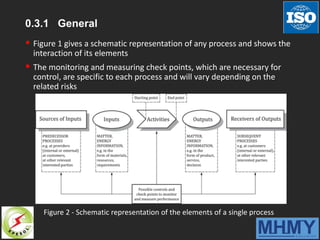
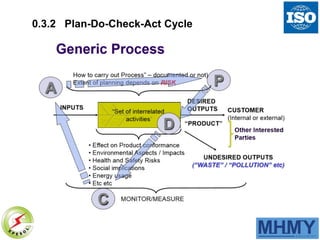
formalized system that documents processes, procedures,
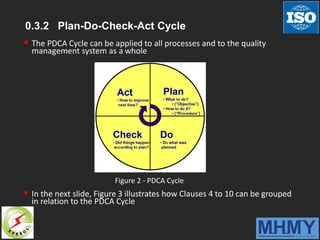
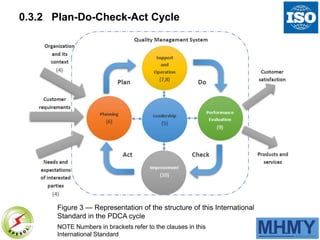
and responsibilities for achieving quality policies and
objectives
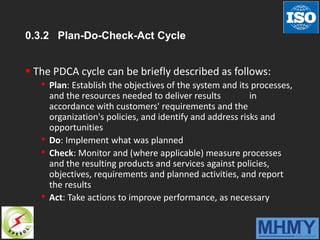
A QMS helps coordinate and direct an organization’s
activities to meet customer and regulatory requirements
and improve its effectiveness and efficiency on a continuous
basis
Implementing a quality management system affects every
aspect of an organization's performance
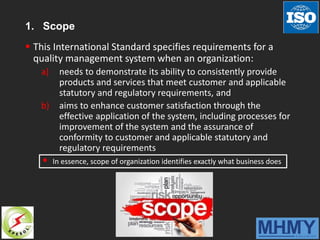
5.
Quality Management System
Benefits of a documented Quality Management System
include:
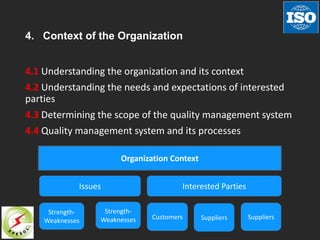
• Meeting the customer’s requirements, which helps to instill
confidence in the organization, in turn leading to more
customers, more sales, and more repeat business
• Meeting the organization's requirements, which ensures
compliance with regulations and provision of products and
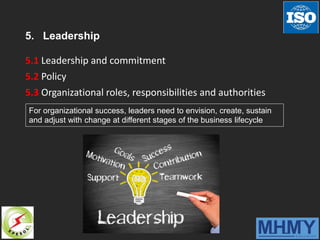
services in the most cost- and resource-efficient manner,
creating room for expansion, growth, and profit
6.
Quality Management System
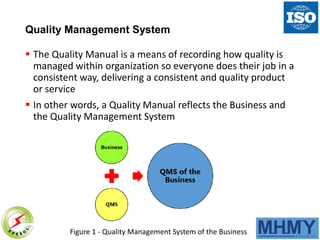
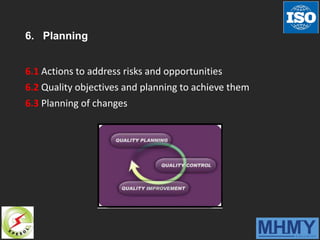
The Quality Manual is a means of recording how quality is
managed within organization so everyone does their job in a
consistent way, delivering a consistent and quality product
or service
In other words, a Quality Manual reflects the Business and
the Quality Management System
Figure 1 - Quality Management System of the Business
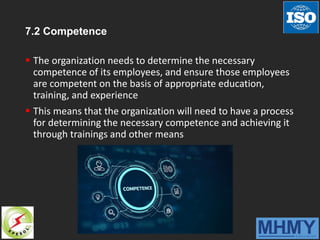
7.
ISO 9001:2015
Quality ManagementSystems - Requirements
The committee responsible for ISO 9001:2015 is Technical
Committee ISO/TC 176, Quality management and quality
assurance, Subcommittee SC 2, Quality systems
ISO 9001 was first published in 1987 underwent revisions in 1994,
2000, 2008 and latest revision was published in September 2015
This fifth edition cancels and replaces the fourth edition
(ISO 9001:2008), which has been technically revised, through the
adoption of a revised clause sequence and the adaptation of the
revised quality management principles and of new concepts
It also cancels and replaces the Technical Corrigendum
ISO 9001:2008/Cor.1:2009
It is the most popular standard in the ISO 9000 series, the only
standard in the series to which organizations can certify and
available at https://www.iso.org/standards
8.
ISO 9001:2015 –Introduction
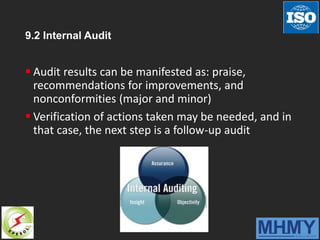
0.1 General
The adoption of a quality management system is a strategic
decision for an organization that can help to improve its
overall performance and provide a sound basis for
sustainable development initiatives
The potential benefits of implementing a quality
management system based on ISO 9001:2015 Standard are:
a) the ability to consistently provide products and services
that meet customer and applicable statutory and regulatory
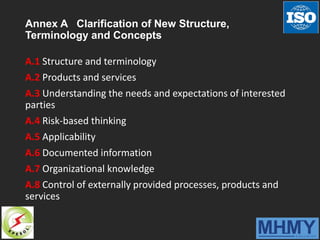
requirements
b) facilitating opportunities to enhance customer satisfaction
c) addressing risks and opportunities associated with its
context and objectives
d) the ability to demonstrate conformity to specified QMS
requirements
9.
0.1 General
ThisInternational Standard can be used by internal and
external parties
The quality management system requirements specified in
this International Standard are complementary to
requirements for products and services
This International Standard employs the process approach,
which incorporates the Plan-Do-Check-Act (PDCA) cycle and
risk-based thinking
The process approach enables an organization to plan its
processes and their interactions
10.
0.1 General
ThePDCA cycle enables an organization to ensure that its
processes are adequately resourced and managed, and that
opportunities for improvement are determined and acted
on
Risk-based thinking enables an organization to determine
the factors that could cause its processes and its quality
management system to deviate from the planned results, to
put in place preventive controls to minimize negative effects
and to make maximum use of opportunities as they arise
(refer Clause A.4 https://www.iso.org/standards)
11.
0.1 General
Consistentlymeeting requirements and addressing future
needs and expectations poses a challenge for organizations
in an increasingly dynamic and complex environment
To achieve this objective, the organization might find it
necessary to adopt various forms of improvement in
addition to correction and continual improvement, such as
breakthrough change, innovation and re-organization
12.
0.2 Quality ManagementPrinciples
ISO 9001:2015 Standard is based on the quality
management principles described in ISO 9000
The descriptions include a statement of each principle, a
rationale of why the principle is important for the
organization, some examples of benefits associated with the
principle and examples of typical actions to improve the
organization's performance when applying the principle
13.
0.2 Quality ManagementPrinciples
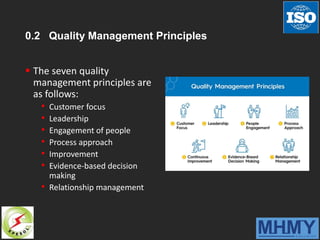
The seven quality
management principles are
as follows:
• Customer focus
• Leadership
• Engagement of people
• Process approach
• Improvement
• Evidence-based decision
making
• Relationship management
14.
0.2 Seven QualityManagement Principles –
Brief Explanation
Customer Focus: Organizations should understand and meet
the needs and expectations of their customers
Leadership: Leaders within the organization should create and
maintain a supportive environment for the achievement of
organizational goals
Engagement of People: People at all levels of the organization
should be involved in achieving organizational goals
Process Approach: Organizational activities should be
managed as interrelated processes
15.
0.2 Seven QualityManagement Principles –
Brief Explanation
Improvement: The organization should continually improve
its processes and overall performance
Evidence-based Decision Making: Decision making should be
based on analysis and evaluation of data and information
Relationship Management: The organization should manage
its relationships with suppliers and other stakeholders to
achieve its goals
16.
0.3 Process Approach
0.3.1General
This International Standard promotes the adoption of a
process approach when developing, implementing and
improving the effectiveness of a quality management
system, to enhance customer satisfaction by meeting
customer requirements.
Specific requirements considered essential to the adoption
of a process approach are included in Clause 4.4
https://www.iso.org/standards
17.
0.3.1 General
Theprocess approach is the key to an effective Quality
Management System
It basically means that every operation of the company
must be observed as a process, meaning organization
should identify all inputs, necessary resources, documents,
activities, and outputs from each operation
Once organization sets up system based on the processes, it
will be able to monitor and measure processes, their
effectiveness, and efficiency and improve them, that is the
reason why it is emphasized at the beginning of the
implementation, before going into any other details
regarding the standard requirements
18.
0.3.1 General
Insimple terms, the process approach represents the
concept of observing all operations in the organization as
processes
This includes breaking the organization down into its
processes, and determining their sequence, interaction,
inputs, and outputs; as well as identifying the processes in
the organization, which processes can start before other
processes are finished, resources and information needed
to start the process, and what results we expect from the
process
The best way to start implementing the process approach is
to create a process map that will include all processes in the
organization and their interconnections
19.
0.3.1 General
ThisInternational Standard promotes the adoption of a
process approach when developing, implementing and
improving the effectiveness of a quality management
system, to enhance customer satisfaction by meeting
customer requirements
Specific requirements considered essential to the adoption
of a process approach are included in Clause 4.4
Understanding and managing interrelated processes as a
system contributes to the organization's effectiveness and
efficiency in achieving its intended results
This approach enables the organization to control the
interrelationships and interdependencies among the
processes of the system, so that the overall performance of
the organization can be enhanced
20.
0.3.1 General
Theprocess approach involves the systematic definition and
management of processes, and their interactions, so as to
achieve the intended results in accordance with the quality
policy and strategic direction of the organization
Management of the processes and the system as a whole
can be achieved using the PDCA cycle with an overall focus
on risk-based thinking aimed at taking advantage of
opportunities and preventing undesirable results
The application of the process approach in a quality
management system enables:
a) understanding and consistency in meeting requirements
b) the consideration of processes in terms of added value
c) the achievement of effective process performance
d) improvement of processes based on evaluation of data and
information
21.
0.3.1 General
Figure1 gives a schematic representation of any process and shows the
interaction of its elements
The monitoring and measuring check points, which are necessary for
control, are specific to each process and will vary depending on the
related risks
Figure 2 - Schematic representation of the elements of a single process
22.
0.3.2 Plan-Do-Check-Act Cycle
The PDCA Cycle can be applied to all processes and to the quality
management system as a whole
In the next slide, Figure 3 illustrates how Clauses 4 to 10 can be grouped
in relation to the PDCA Cycle
Figure 2 - PDCA Cycle
23.
0.3.2 Plan-Do-Check-Act Cycle
Figure3 — Representation of the structure of this International
Standard in the PDCA cycle
NOTE Numbers in brackets refer to the clauses in this
International Standard
24.
0.3.2 Plan-Do-Check-Act Cycle
The PDCA cycle can be briefly described as follows:
• Plan: Establish the objectives of the system and its processes,
and the resources needed to deliver results in
accordance with customers' requirements and the
organization's policies, and identify and address risks and
opportunities
• Do: Implement what was planned
• Check: Monitor and (where applicable) measure processes
and the resulting products and services against policies,
objectives, requirements and planned activities, and report
the results
• Act: Take actions to improve performance, as necessary
0.3.3 Risk-based Thinking
Risk-based thinking (refer Clause A.4) is essential for
achieving an effective quality management system
The concept of risk-based thinking has been implicit in
previous editions of this International Standard including,
for example, carrying out preventive action to eliminate
potential nonconformities, analyzing any nonconformities
that do occur, and taking action to prevent recurrence that
is appropriate for the effects of the nonconformity
To conform to the requirements of this International
Standard, an organization needs to plan and implement
actions to address risks and opportunities
Addressing both risks and opportunities establishes a basis
for increasing the effectiveness of the quality management
system, achieving improved results and preventing negative
effects
27.
0.3.3 Risk-based Thinking
Opportunities can arise as a result of a situation favorable to
achieving an intended result, for example, a set of
circumstances that allow the organization to attract
customers, develop new products and services, reduce
waste or improve productivity
Actions to address opportunities can also include
consideration of associated risks
Risk is the effect of uncertainty and any such uncertainty
can have positive or negative effects
A positive deviation arising from a risk can provide an
opportunity, but not all positive effects of risk result in
opportunities
28.
0.4 Relationship withother Management System
Standards
This International Standard applies the framework developed by
ISO to improve alignment among its International Standards for
management systems (refer Clause A.1)
This International Standard enables an organization to use the
process approach, coupled with the PDCA cycle and risk-based
thinking, to align or integrate its quality management system with
the requirements of other management system standards
This International Standard relates to ISO 9000 and ISO 9004 as
follows:
• ISO 9000 Quality management systems — Fundamentals and
vocabulary provides essential background for the proper
understanding and implementation of this International Standard
• ISO 9004 Managing for the sustained success of an organization —
A quality management approach provides guidance for
organizations that choose to progress beyond the requirements of
this International Standard
29.
0.4 Relationship withother Management System
Standards
This International Standard does not include requirements
specific to other management systems, such as those for
environmental management, occupational health and safety
management, or financial management
Sector-specific quality management system standards based on
the requirements of this International Standard have been
developed for a number of sectors
Some of these standards specify additional quality management
system requirements, while others are limited to providing
guidance to the application of this International Standard within
the particular sector
A matrix showing the correlation between the clauses of this
edition of this International Standard and the previous edition
(ISO 9001:2008) can be found on the ISO/TC 176/SC 2 open
access web site at: www.iso.org/tc176/sc02/public
30.
1. Scope
ThisInternational Standard specifies requirements for a
quality management system when an organization:
a) needs to demonstrate its ability to consistently provide
products and services that meet customer and applicable
statutory and regulatory requirements, and
b) aims to enhance customer satisfaction through the
effective application of the system, including processes for
improvement of the system and the assurance of
conformity to customer and applicable statutory and
regulatory requirements
In essence, scope of organization identifies exactly what business does
31.
1. Scope
Allthe requirements of this International Standard are
generic and are intended to be applicable to any
organization, regardless of its type or size, or the products
and services it provides
NOTE 1 In this International Standard, the terms “product”
or “service” only apply to products and services intended
for, or required by, a customer
NOTE 2 Statutory and regulatory requirements can be
expressed as legal requirements
32.
2. Normative References
The following documents, in whole or in part, are
normatively referenced in this document and are
indispensable for its application. For dated references, only
the edition cited applies. For undated references, the latest
edition of the referenced document (including any
amendments) applies
ISO 9000:2015, Quality management systems —
Fundamentals and vocabulary
33.
3. Terms andDefinitions
For the purposes of this document, the terms and
definitions given in ISO 9000:2015 apply
34.
4. Context ofthe Organization
4.1 Understanding the organization and its context
4.2 Understanding the needs and expectations of interested
parties
4.3 Determining the scope of the quality management system
4.4 Quality management system and its processes
Organization Context
Issues Interested Parties
Strength-
Weaknesses
Strength-
Weaknesses Customers Suppliers Suppliers
35.
4.1 Understanding Organizationand its Context
This clause brings new requirements compared to the 2008
version of the standard, and requires the organization to
determine all internal and external issues that may be
relevant to the achievement of the objectives of the QMS
itself
This includes all elements that are, and may be capable of,
affecting these objectives and outcomes in the future
36.
4.2 Understanding Needsand Expectations of
Interested Parties
Due to the effect that interested parties may have on the
organization in terms of quality of products and services,
customer satisfaction, and statutory and regulatory
requirements, the standard requires the organization to
determine interested parties relevant to the QMS and their
needs and expectations
37.
4.3 Determining thescope of Quality Management
System
Determining the scope of the QMS is one of the main
milestones in the implementation
The scope must be examined and defined considering the
internal and external issues, interested parties and their
needs and expectations, as well as legal and regulatory
compliance obligations
Additional required considerations for the QMS scope are
products, services, and organizational size, nature and
complexity
The scope and justified exclusions must be kept as
documented information
38.
4.4 Quality ManagementSystem and its Processes
The organization needs to establish, implement, maintain,
and continually improve its QMS, including the processes
needed and their interactions, in accordance with the
requirements of the standard
This is where the process approach comes into action. The
organization will need to determine inputs and outputs of
the processes, sequence and interaction of the processes,
resources needed, and responsibilities, and ensure the
effectiveness of the processes
In addition, the organization will have to maintain necessary
documented information to support the operation of the
processes and keep records to evidence that the processes
were carried out as planned
39.
5. Leadership
5.1 Leadershipand commitment
5.2 Policy
5.3 Organizational roles, responsibilities and authorities
For organizational success, leaders need to envision, create, sustain
and adjust with change at different stages of the business lifecycle
40.
5.1 Leadership andcommitment
QMS implementation is strategic decision that demonstrates
commitment of organization to development and
application of the QMS and continual improvement of its
effectiveness
Customer focus
41.
5.2 Policy
Establishing andcommunicating the quality policy
The Quality Policy is a high-level document containing
statements about the general direction of the organization,
and its commitment to quality and customer satisfaction
It provides a framework for quality objectives
Meeting compliance and regulatory factors is a key element
The policy provide a commitment to the continual
improvement of the QMS and its results
The Quality Policy be maintained as documented
information, communicated within the organization, and be
available to all interested parties
42.
5.3 Organizational Roles,Responsibilities and
Authorities
Responsibilities and authorities must be precisely defined
and communicated to all hierarchical levels of the
organization
In specific situations (seasonal fluctuation of work force,
emergency situations, etc.), it is necessary to precisely
document and communicate authorities, and especially the
responsibilities of temporarily employed workers
43.
6. Planning
6.1 Actionsto address risks and opportunities
6.2 Quality objectives and planning to achieve them
6.3 Planning of changes
44.
6.1 Actions toaddress Risks and Opportunities
When planning the QMS, the organization will have to
consider context of the organization and the needs and
expectations of interested parties in order to determine
risks and opportunities that need to be addressed
The purpose of addressing risks and opportunities is to
ensure that the QMS will achieve the intended results,
enhance desirable effects, and achieve improvements
The actions have to be planned and implemented in the
QMS, and later evaluated for their effectiveness
45.
6.2 Quality Objectivesand Planning to achieve them
When the organization determines the need for changes to
the QMS, the changes should be carried out in a planned
manner
This includes considering their purpose and consequences,
the integrity of the QMS, availability of resources, and
allocation of responsibilities and authorities
46.
6.3 Planning changes
When the organization determines the need for changes to
the QMS, the changes should be carried out in a planned
manner
This includes considering their purpose and consequences,
the integrity of the QMS, availability of resources, and
allocation of responsibilities and authorities
There should be a central point of authority to bring any change in
the quality management system, for this planning of changes has
to be done to ensure the integrity of the system and restrict the
fluidity of the system to a minimum
47.
Documentary Evidence forthe Planning of Changes
There is no specific procedure or record mentioned in the
standard
However, usually the industrial practice includes a form
called “Change Requisition” (CR) or “Document Change
Request” (DCR)
This form includes information like document name,
proposed changes, number of procedures or records,
responsible persons, and approvals
7.1 Resources
Thestandard requires the organization to determine and
provide resources for the establishment, implementation,
maintenance, and continual improvement of the QMS,
taking into account the capabilities and constraints of
existing internal resources and the need to obtain additional
resources from external providers
Resources to be obtained include people, infrastructure,
environment for operation of the processes, monitoring and
measuring resources, and organizational knowledge
50.
7.2 Competence
Theorganization needs to determine the necessary
competence of its employees, and ensure those employees
are competent on the basis of appropriate education,
training, and experience
This means that the organization will need to have a process
for determining the necessary competence and achieving it
through trainings and other means
51.
7.3 Awareness
Awarenessis closely related to competence in the standard
Employees be made aware of the Quality Policy and its
contents, any current and future impacts that may affect
their tasks, what their personal performance means to the
QMS and its objectives, including the positives or improved
performance, and what the implications of poor
performance may be to the QMS
52.
7.4 Communication
Processesfor internal and external communication need to
be established within the QMS
The key elements that need to be decided and actioned are
what needs to be communicated, when it needs to be
communicated, how it should be done, who needs to
receive the communication, and who will communicate
It is important to note that any communication outputs be
consistent with related information and content generated
by the QMS for the sake of consistency
53.
7.5 Documented information
QMS documentation is comprised not only of the
documents and records required explicitly by the standard,
but also of the documents and records the organization
finds necessary to execute its activities and processes
The standard requires that documented information created
or updated in the scope of the QMS be properly identified
and described, also considering its content presentation,
and media used
All documented information go through proper review and
approval procedures to ensure it is fit for its intended
purpose
54.
7.5 Documented information
For proper control of documented information, the
organization consider the provision of processes regarding
the distribution, retention, access, usage, retrieval,
preservation and storage, control, and disposition of such
information
It is also be noted that controls be in placed to prevent the
unintentional use of obsolete information
55.
8. Operation
8.1 Operationalplanning and control
8.2 Requirements for products and services
8.3 Design and development of products and services
8.4 Control of externally provided processes, products and
services
8.5 Production and service provision
8.6 Release of products and services
8.7 Control of nonconforming outputs
56.
8.1 Operational planningand control
In order to meet the requirements for delivery of products
and services, the organization needs to plan, implement,
and control its processes
The first step is to determine the requirements for products
and services, meaning what features the product or service
will have
Then, the organization needs to define how processes will
be performed and what criteria the product or service
needs to meet to be accepted for release
Finally, the organization needs to determine the resources
needed for the processes and the records needed to
demonstrate that the processes were carried out as planned
57.
8.2 Requirements forProducts and Services
Requirements for products and services are closely related
to communication with customers
This communication include information related to the
products or services, handling inquiries, contracts or orders,
customer feedback, handling and controlling customer
property and, if needed, establishing specific requirements
for contingency actions
Before offering the product or service to the customer, the
organization needs to ensure that the requirements for the
products and services are defined, and that the organization
is able to deliver such products or services
58.
8.2 Requirements forProducts and Services
Requirements for products and services include any
applicable legislation and the requirements that the
organization considers necessary
After receiving the order, the organization review the
requirements related to the product prior to delivery and
keep records about the review
If the customer changes its requirements, these also must
be reviewed and recorded
In case of changes, the organization ensure that all
documented information is amended and all relevant
persons are aware of the changes
59.
8.3 Design andDevelopment of Products and
Services
This clause refers to design and development management,
from the initial idea to final acceptance of the product
ISO 9000 explains that the terms “design” and
“development” are often used as synonyms, and sometimes
define different phases of overall design and development
This means that design can’t be used apart from
development, and that they represent one single process
60.
8.4 Control ofExternally provided Processes,
Products and Services
This robust title of the clause refers to purchasing that
includes products and services acquired from suppliers and
outsourced processes
The organization needs to establish and document criteria
for suppliers selection, which includes how crucial the
purchased product or service is to the quality of product
and results of the supplier evaluation be kept
In order to ensure that externally provided processes,
products, and services do not have an adverse effect on the
conformance of the organization’s products and services,
the organization needs to establish controls including
verification and other activities
61.
8.4 Control ofExternally provided Processes,
Products and Services
As part of the controls, the organization needs to
communicate to external providers its requirements for:
• the processes, products, and services to be provided
• the approval of methods, processes, and equipment
• competence
• verification or validation activities that the organization
intends to perform
62.
8.5 Production andService Provision
The production and services provision process needs to be
performed under controlled conditions that will ensure that
the product or service delivered is compliant with initial
requirements.
This includes a sufficient level of documentation, like
procedures, work instructions and records, monitoring and
measurement equipment, appropriate infrastructure, etc.
The organization use suitable means to identify outputs
when it is necessary to ensure products and services
conformance
When the traceability is a requirement, the organization
needs to control the unique identification of outputs and
retain documented information necessary to enable
traceability
63.
8.6 Release ofProducts and Services
Release of the products and services should not be
performed until the organization ensures that the products
and services are conforming to the requirements
Demonstrating the conformance can be done by
documenting evidence of the conformance, which includes
criteria for the acceptance and information about the
person who authorized release of the product or service
64.
8.7 Control ofNonconforming Outputs
Nonconforming outputs must be prevented from
unintended use or delivery, so the organization must
identify and control nonconforming outputs that emerge
from any phase of production or service delivery. Depending
on the nature of the nonconformity, the organization can
take one or more of the following actions:
• correction
• segregation, containment, return, or suspension of provision
of products and services
• informing the customer
• obtaining authorization for acceptance under concession
65.
8.7 Control ofNonconforming Outputs
Conformity to the requirements must be verified when the
nonconforming output is corrected
The organization also needs to keep documented
information that describes the nonconformity, the action
taken, concessions obtained, and the authority deciding the
action with respect to the nonconformity
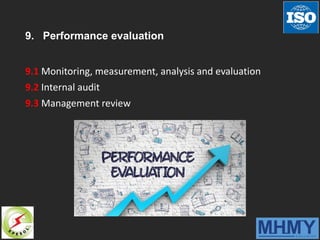
9.1 Monitoring, Measurement,Analysis and
Evaluation
This requirement is about a wider aspect of monitoring and
measuring
Information derived from monitoring, measurement, and
analysis represents inputs in the process of improvement
and management review
The organization needs to determine what needs to be
monitored and measured, how, and when, as well as when
the results will be analyzed
It is required to measure organization’s own performance as
a supplier in order to get information about users’
observations, and the extent to which you fulfilled their
requirements
68.
9.1 Monitoring, Measurement,Analysis and
Evaluation
Monitoring customer satisfaction levels must be a constant
activity in order to determine trends, and because opinions
about your performance can change
Information about customer satisfaction can be collected via
phone, interview or questionnaire, direct contact with the
user on the field, etc
Once the monitoring and measuring is performed and the
results are gathered, the organization needs to analyze the
results in order to evaluate conformity of products and
services, degree of customer satisfaction, performance of
the QMS, effectiveness of actions taken to address risks and
opportunities, performance of external providers, and need
for improvements to the QMS
69.
9.2 Internal Audit
The goal of an internal audit is not to determine
nonconformity; its goal is to check whether your QMS:
a) complies with the requirements of ISO 9001 and the
requirements of your organization
b) is effectively implemented and maintained
At the end of the audit, auditee will get audit results by
evaluating the data collected during the audit
70.
9.2 Internal Audit
Audit results can be manifested as: praise,
recommendations for improvements, and
nonconformities (major and minor)
Verification of actions taken may be needed, and in
that case, the next step is a follow-up audit
71.
9.3 Management Review
At least once a year, the top-level management review the
QMS in order to determine its:
• Appropriateness – does it serve its purpose and satisfy the
needs of the organization?
• Adequacy – does the QMS conform to standard
requirements?
• Applicability – are activities performed according to
procedures?
• Effectiveness – does it accomplish the planned results?
72.
9.3 Management Review
This review must evaluate possibilities for improvement and
needs for changing the QMS, Quality Policy, and objectives
Considering the inputs for the management review, such as
the results of the previous management reviews, changes in
the context, customer satisfaction survey results,
performance of the QMS and suppliers, etc., the top
management make decisions regarding opportunities for
improvement, need for changes in the QMS, and resources
needed for the upcoming period
10. Improvement
Thereis now a requirement for organizations to focus
clearly on customer satisfaction and customer needs, not
only that but to look for ways to improve:
a) products and services, now and for the future;
b) fixing and controlling business issues to reduce
things going wrong;
c) improving the QMS.
No requirement for a procedure on preventive action, this
term is removed
75.
10. Improvement
Clause10 of ISO 9001:2015 requires organizations to
determine and identify opportunities for improvement
The corrective action process is one of the key sections in
the standard designed to achieve improvement
There is a requirement for the improvement of products
and services with an eye to current and future market needs
This clause also includes requirements regarding the
correction of nonconformities
76.
10. Improvement
Organizationshave to react to the nonconformity and
engage in corrective action to correct the underlying causes
of existing problems, as well as engage in preventive action
to correct situations that could lead to potential problems
Organizations have to plan and manage the processes for
the continual improvement of the quality management
system
Organizations have to use the quality policy, objectives,
internal audit results, analysis of data, corrective and
preventive action and management review to facilitate
continual improvement
77.
10 Continual Improvement
There is now a clearer expectation for organizations to use
data from monitoring and measuring to review the business
performance and that of the QMS
Organizations should be clear to use this information, by
analyzing it and ensuring that the QMS is adequate for the
organization
78.
Annex A Clarificationof New Structure,
Terminology and Concepts
A.1 Structure and terminology
A.2 Products and services
A.3 Understanding the needs and expectations of interested
parties
A.4 Risk-based thinking
A.5 Applicability
A.6 Documented information
A.7 Organizational knowledge
A.8 Control of externally provided processes, products and
services
79.
Annex B OtherInternational Standards on Quality
Management and Quality Management Systems
Developed by ISO/TC 176
Annex B provides details of other International Standards on
quality management and quality management systems that
have been developed by ISO/TC 176
The International Standards described in this Annex provide
supporting information for organizations that apply this
International Standard, and to provide guidance for
organizations that choose to progress beyond its
requirements
Guidance or requirements contained in the documents
listed in Annex B do not add to, or modify, the requirements
of this International Standard
Table B.1 shows the relationship between these standards
and the relevant clauses of this International Standard
80.
Summary
ISO 9001:2015is a globally recognized standard for Quality
Management System that was developed by the ISO/TC 176
This standard provides organizations with guidance as to the
quality of their products and services, with the ultimate goal
of achieving customer satisfaction
ISO 9001:2015 specifies requirements for a quality
management system when an organization:
a) needs to demonstrate its ability to consistently provide
products and services that meet customer and applicable
statutory and regulatory requirements, and
b) aims to enhance customer satisfaction through the effective
application of the system, including processes for improvement
of the system and the assurance of conformity to customer and
applicable statutory and regulatory requirements
81.
Summary
All therequirements of ISO 9001:2015 are generic and are
intended to be applicable to any organization, regardless of
its type or size, or the products and services it provides
Delivering all of the clauses of the standard and truly
understanding them can benefit organizations, and drive
them on the road of continual improvement
Clause 0 mentions the benefits of implementing a QMS and
the quality management principles, and presents the
process approach, the Plan-Do-Check-Act cycle, and risk-
based thinking
People often overlook this clause, but they should not, as it
frames much of the information that comes next, especially
about how the various clauses relate to each other
82.
Summary
Clauses 1to 3 present introductory chapters that do not
hold any requirements
Clause 4 issues the requirements for organizations to
undertake an extensive overview of their operations and
give consideration to the major internal and external
aspects that influence it and its response as a definite
management system
Clause 5 requires that the top management provide
adequate resources and assign responsibilities and
authorities necessary to implement QMS effectively
Clause 6 requires an organization to take a risk-based
approach and plan for the uncertainties pro-actively
preventing undesired effects
83.
Summary
No businesscan succeed without some form of support.
Clause 7 is directly relating to the resources and support a
business requires to achieve their goals
Clause 8 addresses both in-house and outsourced
processes, while the overall process management includes
adequate criteria to control these processes, as well as ways
to manage planned and unintended change
Clause 9 is about measuring and evaluating and most of the
requirements address various ways of generating data but
there is also a section on analysis and one on management
reviews where decisions are made based on the derived
information
84.
Summary
Clause 10describes the requirements for continual
improvement in the quality management system by
identifying nonconformities and taking corrective actions to
recur the nonconformity by eliminating the root cause of
the non-conformance
Certification and compliance can bring reputational,
motivational, and financial benefits to organizations through
improved efficiency, quality of products and services, and
avoiding nonconformities and customer complaints, along
with improvements in supply chain
All of these elements are closely related to organization’s
ability to deliver satisfaction to customers, and fulfill the
expectations and wishes of all stakeholders


![REFERENCES
[1] https://www.iso.org/standard/62085.html
[2] https://www.iso.org/obp/ui/#iso:std:iso:9001:ed-5:v1:en
[3] https://inspectorio.com/blog/what-are-the-7-principles-of-quality-management
[4] https://psqca.isolutions.iso.org/obp/ui/#iso:std:iso:9001:ed-5:v1:en
[5] https://asq.org/quality-resources/iso-9001
[6] https://advisera.com/9001academy/what-is-iso-9001/
[7] https://www.iso-9001-checklist.co.uk/4.3-how-to-write-your-scope-for-ISO-9001-with-7-examples.htm
[8] https://www.tekrevol.com/blogs/five-leadership-skills-that-help-organizations/
[9] https://iso9001learning.com/clause-6-3-planning-of-changes-how-change-is-made-in-a-qms/
[10] https://www.nikunjbhoraniya.com/2018/10/requirements-of-iso-9001-2015.html
[11] https://www.9001simplified.com/know/clause-10-improvement.php
[12] https://ivypanda.com/essays/the-article-on-iso-
90012015/#:~:text=Conclusion,improvement%20in%20excellent%20service%20standards.
[13] https://www.qmsuk.com/iso-standards/iso-9001/what-is-iso-9001
[14] http://www.nsi.org.uk/wp-content/uploads/2012/11/Annex-A-Step-by-Step-Guide-for-ISO-9001-
2015-NG-FG-AG.pdf](https://image.slidesharecdn.com/iso9001trainingppt-250708041016-15709bb6/85/ISO-9001-training-ppt-all-clause-covered-86-320.jpg)


