MANAGEMENT TOOLS:
ISHIKAWA DIAGRAM, 6-3-5 & SIX THINKING HATS
Merve Nur Tas - Leonor Filipe - Claudia Gomez - Hassan Nasirzadeh
AnalysisandDesignofTransportSystems|ManagementTools
AnalysisandDesignofTransportSystems|
ManagementTools
2
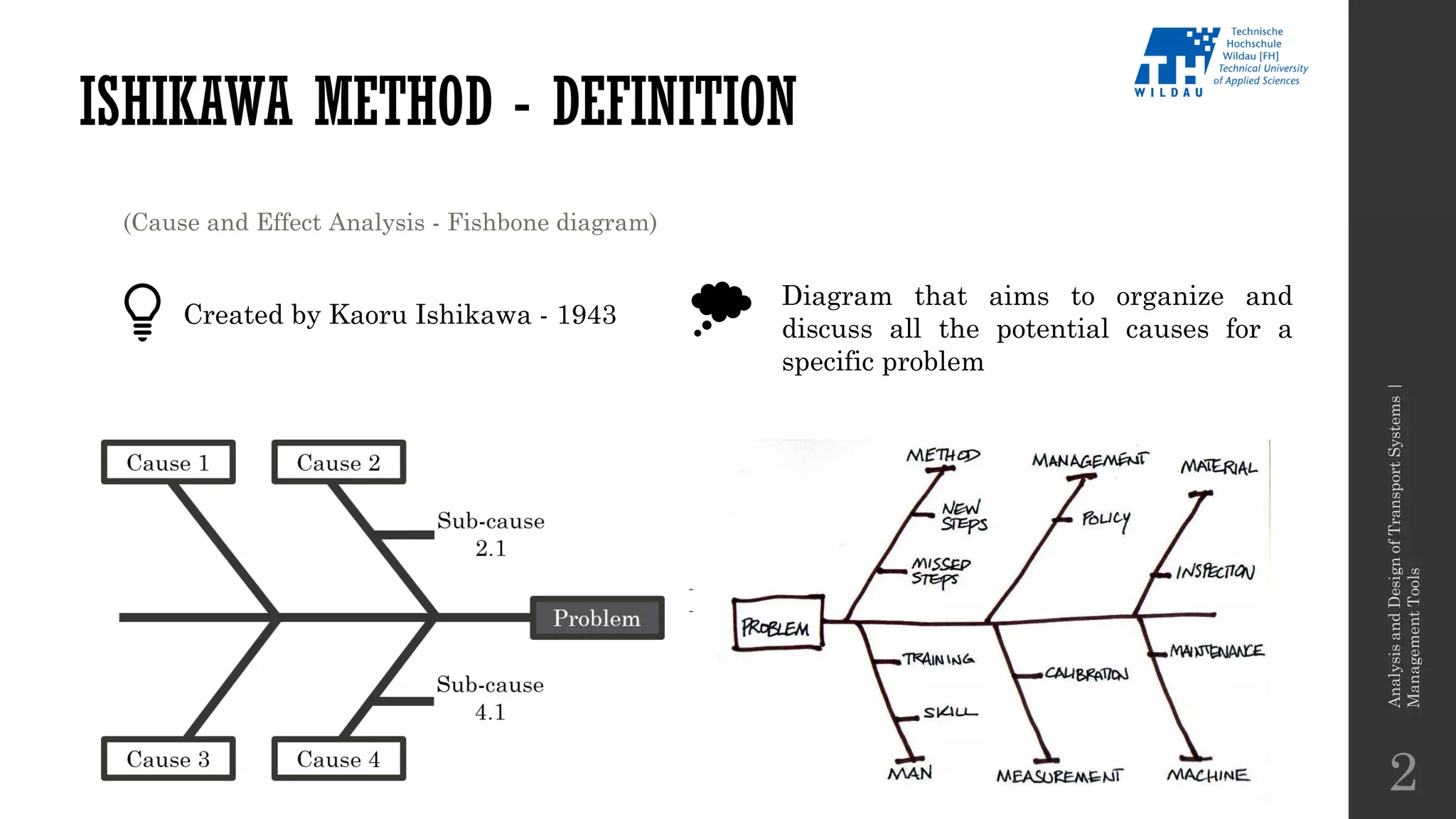
ISHIKAWA METHOD - DEFINITION
- Cause and Effect Analysis
- Fishbone Diagram
(Cause and Effect Analysis - Fishbone diagram)
Created by Kaoru Ishikawa - 1943
Diagram that aims to organize and
discuss all the potential causes for a
specific problem
AnalysisandDesignofTransportSystems|
ManagementTools
3
ISHIKAWA METHOD – ADVANTAGES &
DISADVANTAGES
ADVANTAGES DISADVANTAGES
- Easy to execute
- Helps to understand the main
causes of a problem
- Explores and shows, visually, all
the possible causes
- Can be used as a statistical tool for
quality control of products
- Does not show the evolution of the
problem
- Does not identify the gravity of the
problem
- For each situation, it is needed to
repeat the process and follow all
the diagram’s steps
AnalysisandDesignofTransportSystems|
ManagementTools
4
ISHIKAWA METHOD – EXAMPLE
Delay in
production
MATERIALS
MANPOWER MEASUREMENT
MACHINES METHODS
Highly optimistic
schedule
Miscommunication
Manpower shortage
Failure of machines
Lack of training
Low quality of
raw material
Wrong or non
existing standard
procedures
Raw materials’ and
parts unavailable
Insufficient capacity
Lack of
inventory
Low performance
Lack of maintenance
Inaccurate stock
planning
Unexpected
increased demand
AnalysisandDesignofTransportSystems|
ManagementTools
5
ISHIKAWA METHOD: Root Causes
SERVICE INDUSTRIES
Surroundings
Suppliers
Systems
Skills
MANUFACTURING
Machine
Materials
Method
Man
Measurement
PRODUCT MARKETING
Product/Service
Price
Promotion
Place
Process
People
Physical Evidence
Performance
4 Ss 5 Ms 8 Ps
Commonly used frameworks for Root Cause
Analysis - Not mandatory
AnalysisandDesignofTransportSystems|ManagementTools
6
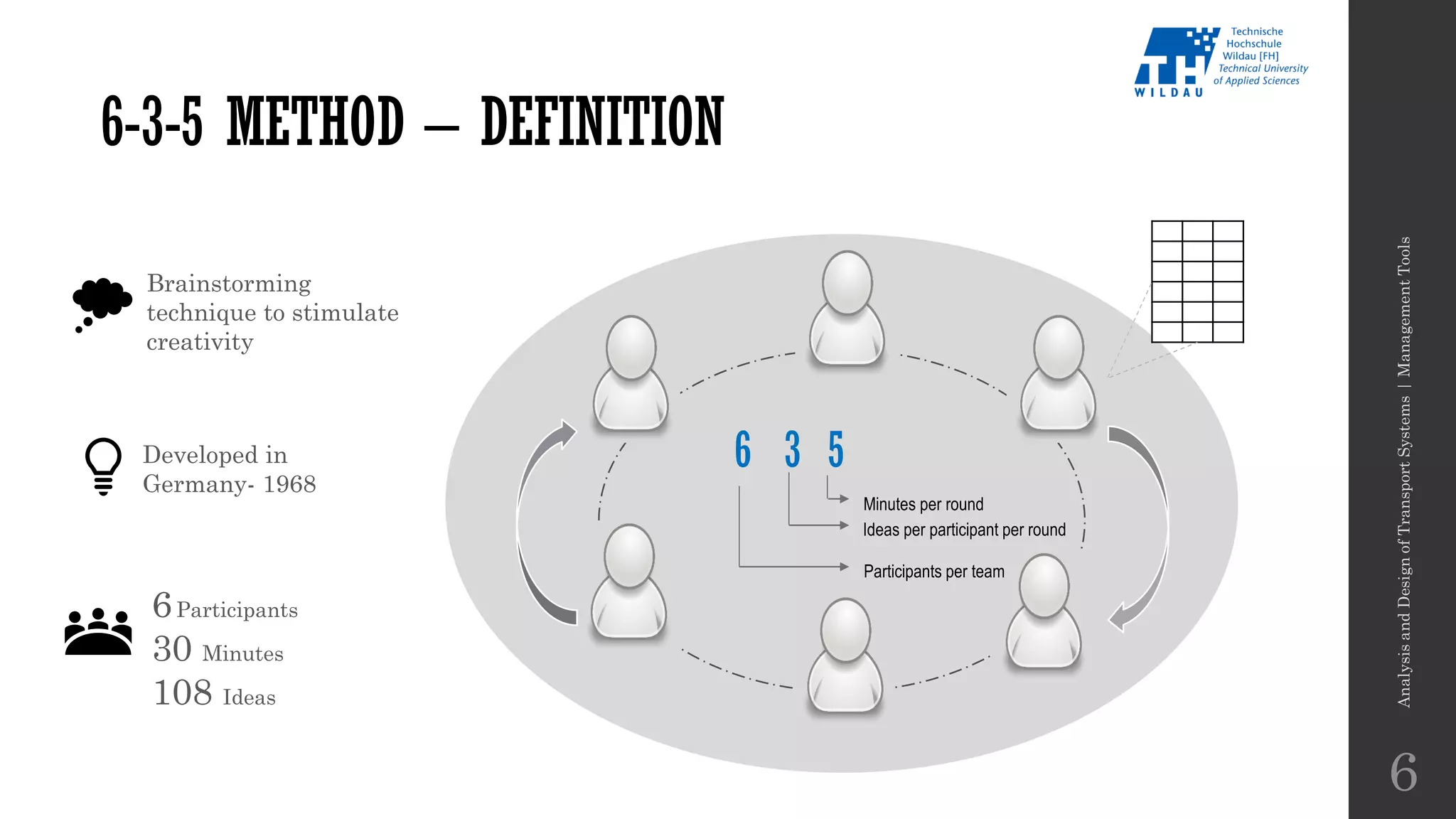
6 3 5
Participants per team
Ideas per participant per round
Minutes per round
Brainstorming
technique to stimulate
creativity
6-3-5 METHOD – DEFINITION
6Participants
30 Minutes
108 Ideas
Developed in
Germany- 1968
AnalysisandDesignofTransportSystems|
ManagementTools
7
6-3-5 METHOD – ADVANTAGES &
DISADVANTAGES
ADVANTAGES DISADVANTAGES
- Simple and easy to execute
- Does not require qualified moderator
- Exploits innovative potential
- Active participation from all
participants
- Useful ideas are further developed
- Author of a great idea can be
identified
- Issues of clarity and difficulty to
express ideas clearly
- Pressure of 5 min limits – less
quality
- May lead to less creative solutions –
no group discussion, clash of ideas
6-3-5 METHOD: LSC APPLICATIONS
AnalysisandDesignofTransportSystems|ManagementTools
8
SCENARIO
How to improve quality of products in a
manufacturing process?
Define
the
problem
Gather a
team
Production manager, quality manager,
quality control, procurement, product
development, machine operator
Perform a 6-3-5
Brainstorming
Machine
operator
Improve
quality of
raw material
New
maintenance
plan
Improve
training
workers
Product
development
Review
material vs
product
design
Replace a
problematic
machine
.
.
.
Procurement
Evaluate
other
suppliers
Calibrate
machine
.
.
.
Quality
Control
Increase
quality
control
.
.
.
.
.
.
Quality
manager
.
.
.
.
.
.
.
.
.
Production
manager
.
.
.
.
.
.
.
.
.
1st
Round
2nd
Round
3rd
Round
4th
Round
5th
Round
6th
Round
SIX THINKING HATS
AnalysisandDesignofTransportSystems|ManagementTools
9
Early in the 1980s, Dr. Edward De Bono introduced the concept of Six Thinking Hats.
Six Thinking Hats is a brainstorming technique which is used to incorporate parallel
thinking.
The Black Hat
– caution &
problems
The White Hat
– facts &
information
The Blue Hat
– managing
thinking
The Green Hat
– creativity &
solutions
The Red Hat
– feelings &
intuition
The Yellow Hat
– benefits &
advantages
SIX THINKING HATS - EXAMPLE
AnalysisandDesignofTransportSystems|ManagementTools
10
Wearing the Yellow Hat,
however, the directors know
that, if the economy holds
up and their projections are
correct, the company stands
to make a healthy profit.
The chairman of the
meeting wears the Blue
Hat to keep the
discussion moving and
ideas flowing.
With Green Hat
thinking, they consider
whether they should
redesign the building to
make it more appealing.
With the Black Hat, they
wonder whether the
economic forecast could
be wrong.
Thinking with a Red Hat,
some of the directors say
that the proposed building
looks ugly and gloomy.
Wearing the White Hat,
they analyze the data
that they have.
The directors of a property company are considering whether they should build a new office block.
AnalysisandDesignofTransportSystems|
ManagementTools
11
SIX THINKING HATS– ADVANTAGES &
DISADVANTAGES
ADVANTAGES DISADVANTAGES
− Maximize productive collaboration
and minimize counterproductive
interaction/behavior
− View problems from new and
unusual angles
− Consider issues, problems, decisions,
and opportunities systematically
− Use Parallel Thinking as a group
or team to generate more, better
ideas and solutions
− Go beyond the obvious to discover
effective alternate solutions
− View problems from new and
unusual angles
− The process of thinking is very time-
consuming
− Some team-members prefer to think
alone rather than in a group
− It can be hard to adapt different
thinking roles.
− Conflicts can still arise between
people of different perspective
REFERENCES
AnalysisandDesignofTransportSystems|ManagementTools
12
Ishikawa Method
https://www.isixsigma.com/tools-templates/cause-effect/cause-and-effect-aka-fishbone-diagram/
https://blog.softwareavaliacao.com.br/diagrama-de-ishikawa/
6- 3-5 Method
https://www.youtube.com/watch?v=TR1i1PPd8ZU
http://www.becreate.ch/en/methods/6-3-5-method.aspx
Six Thinking Hats
https://systemsplusgroup.blogspot.de/2014/01/six-thinking-hats-technique-of-business.html
http://www.managementcentre.co.uk/downloads/6TH.pdf
http://www.debonogroup.com/six_thinking_hats.php
https://www.mindtools.com/pages/article/newTED_07.htm

Ishikawa Diagram, 6-3-5, 6 Thinking Hats

  • 1.
    MANAGEMENT TOOLS: ISHIKAWA DIAGRAM,6-3-5 & SIX THINKING HATS Merve Nur Tas - Leonor Filipe - Claudia Gomez - Hassan Nasirzadeh AnalysisandDesignofTransportSystems|ManagementTools
  • 2.
    AnalysisandDesignofTransportSystems| ManagementTools 2 ISHIKAWA METHOD -DEFINITION - Cause and Effect Analysis - Fishbone Diagram (Cause and Effect Analysis - Fishbone diagram) Created by Kaoru Ishikawa - 1943 Diagram that aims to organize and discuss all the potential causes for a specific problem
  • 3.
    AnalysisandDesignofTransportSystems| ManagementTools 3 ISHIKAWA METHOD –ADVANTAGES & DISADVANTAGES ADVANTAGES DISADVANTAGES - Easy to execute - Helps to understand the main causes of a problem - Explores and shows, visually, all the possible causes - Can be used as a statistical tool for quality control of products - Does not show the evolution of the problem - Does not identify the gravity of the problem - For each situation, it is needed to repeat the process and follow all the diagram’s steps
  • 4.
    AnalysisandDesignofTransportSystems| ManagementTools 4 ISHIKAWA METHOD –EXAMPLE Delay in production MATERIALS MANPOWER MEASUREMENT MACHINES METHODS Highly optimistic schedule Miscommunication Manpower shortage Failure of machines Lack of training Low quality of raw material Wrong or non existing standard procedures Raw materials’ and parts unavailable Insufficient capacity Lack of inventory Low performance Lack of maintenance Inaccurate stock planning Unexpected increased demand
  • 5.
    AnalysisandDesignofTransportSystems| ManagementTools 5 ISHIKAWA METHOD: RootCauses SERVICE INDUSTRIES Surroundings Suppliers Systems Skills MANUFACTURING Machine Materials Method Man Measurement PRODUCT MARKETING Product/Service Price Promotion Place Process People Physical Evidence Performance 4 Ss 5 Ms 8 Ps Commonly used frameworks for Root Cause Analysis - Not mandatory
  • 6.
    AnalysisandDesignofTransportSystems|ManagementTools 6 6 3 5 Participantsper team Ideas per participant per round Minutes per round Brainstorming technique to stimulate creativity 6-3-5 METHOD – DEFINITION 6Participants 30 Minutes 108 Ideas Developed in Germany- 1968
  • 7.
    AnalysisandDesignofTransportSystems| ManagementTools 7 6-3-5 METHOD –ADVANTAGES & DISADVANTAGES ADVANTAGES DISADVANTAGES - Simple and easy to execute - Does not require qualified moderator - Exploits innovative potential - Active participation from all participants - Useful ideas are further developed - Author of a great idea can be identified - Issues of clarity and difficulty to express ideas clearly - Pressure of 5 min limits – less quality - May lead to less creative solutions – no group discussion, clash of ideas
  • 8.
    6-3-5 METHOD: LSCAPPLICATIONS AnalysisandDesignofTransportSystems|ManagementTools 8 SCENARIO How to improve quality of products in a manufacturing process? Define the problem Gather a team Production manager, quality manager, quality control, procurement, product development, machine operator Perform a 6-3-5 Brainstorming Machine operator Improve quality of raw material New maintenance plan Improve training workers Product development Review material vs product design Replace a problematic machine . . . Procurement Evaluate other suppliers Calibrate machine . . . Quality Control Increase quality control . . . . . . Quality manager . . . . . . . . . Production manager . . . . . . . . . 1st Round 2nd Round 3rd Round 4th Round 5th Round 6th Round
  • 9.
    SIX THINKING HATS AnalysisandDesignofTransportSystems|ManagementTools 9 Earlyin the 1980s, Dr. Edward De Bono introduced the concept of Six Thinking Hats. Six Thinking Hats is a brainstorming technique which is used to incorporate parallel thinking. The Black Hat – caution & problems The White Hat – facts & information The Blue Hat – managing thinking The Green Hat – creativity & solutions The Red Hat – feelings & intuition The Yellow Hat – benefits & advantages
  • 10.
    SIX THINKING HATS- EXAMPLE AnalysisandDesignofTransportSystems|ManagementTools 10 Wearing the Yellow Hat, however, the directors know that, if the economy holds up and their projections are correct, the company stands to make a healthy profit. The chairman of the meeting wears the Blue Hat to keep the discussion moving and ideas flowing. With Green Hat thinking, they consider whether they should redesign the building to make it more appealing. With the Black Hat, they wonder whether the economic forecast could be wrong. Thinking with a Red Hat, some of the directors say that the proposed building looks ugly and gloomy. Wearing the White Hat, they analyze the data that they have. The directors of a property company are considering whether they should build a new office block.
  • 11.
    AnalysisandDesignofTransportSystems| ManagementTools 11 SIX THINKING HATS–ADVANTAGES & DISADVANTAGES ADVANTAGES DISADVANTAGES − Maximize productive collaboration and minimize counterproductive interaction/behavior − View problems from new and unusual angles − Consider issues, problems, decisions, and opportunities systematically − Use Parallel Thinking as a group or team to generate more, better ideas and solutions − Go beyond the obvious to discover effective alternate solutions − View problems from new and unusual angles − The process of thinking is very time- consuming − Some team-members prefer to think alone rather than in a group − It can be hard to adapt different thinking roles. − Conflicts can still arise between people of different perspective
  • 12.
    REFERENCES AnalysisandDesignofTransportSystems|ManagementTools 12 Ishikawa Method https://www.isixsigma.com/tools-templates/cause-effect/cause-and-effect-aka-fishbone-diagram/ https://blog.softwareavaliacao.com.br/diagrama-de-ishikawa/ 6- 3-5Method https://www.youtube.com/watch?v=TR1i1PPd8ZU http://www.becreate.ch/en/methods/6-3-5-method.aspx Six Thinking Hats https://systemsplusgroup.blogspot.de/2014/01/six-thinking-hats-technique-of-business.html http://www.managementcentre.co.uk/downloads/6TH.pdf http://www.debonogroup.com/six_thinking_hats.php https://www.mindtools.com/pages/article/newTED_07.htm