KAIZEN
Road Map
to
World Class processes
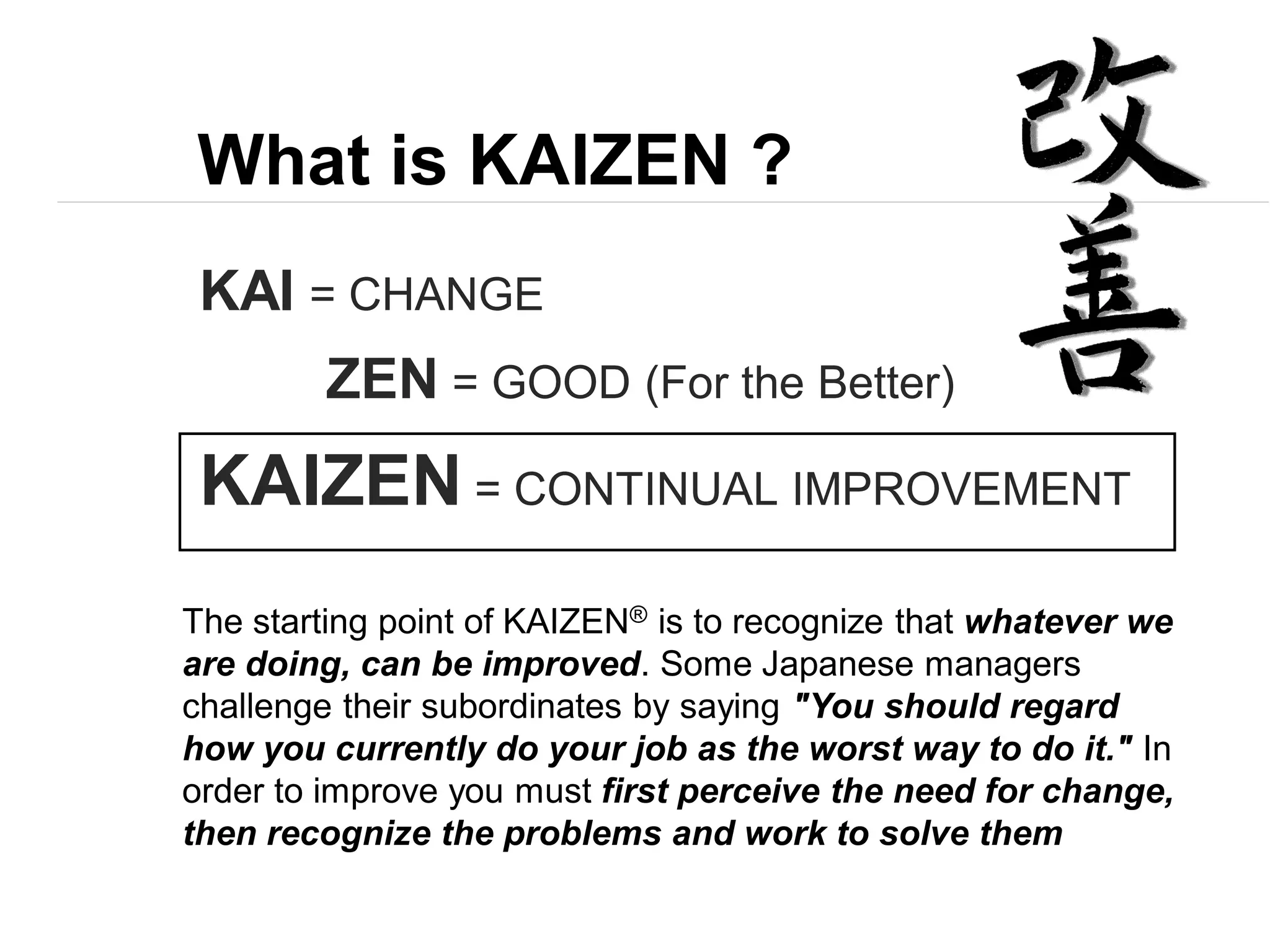
What is KAIZEN ?
KAI = CHANGE
ZEN = GOOD (For the Better)
KAIZEN = CONTINUAL IMPROVEMENT
The starting point of KAIZEN® is to recognize that whatever we
are doing, can be improved. Some Japanese managers
challenge their subordinates by saying "You should regard
how you currently do your job as the worst way to do it." In
order to improve you must first perceive the need for change,
then recognize the problems and work to solve them
Hierarchy of KAIZEN
[Policy Deployment / hoshin-kanri]
TQM (Total Quality management)
TPM (Total Productive maintenance)
JIT (Just-In-Time)
Improvement of QCD (Quality, Cost, Delivery)
QC Circles (small group activities)
Suggestions systems
Top management policy and Strategy
Management directed KAIZEN
Gemba KAIZEN (Shop Floor KAIZEN)
Top down
Bottom up
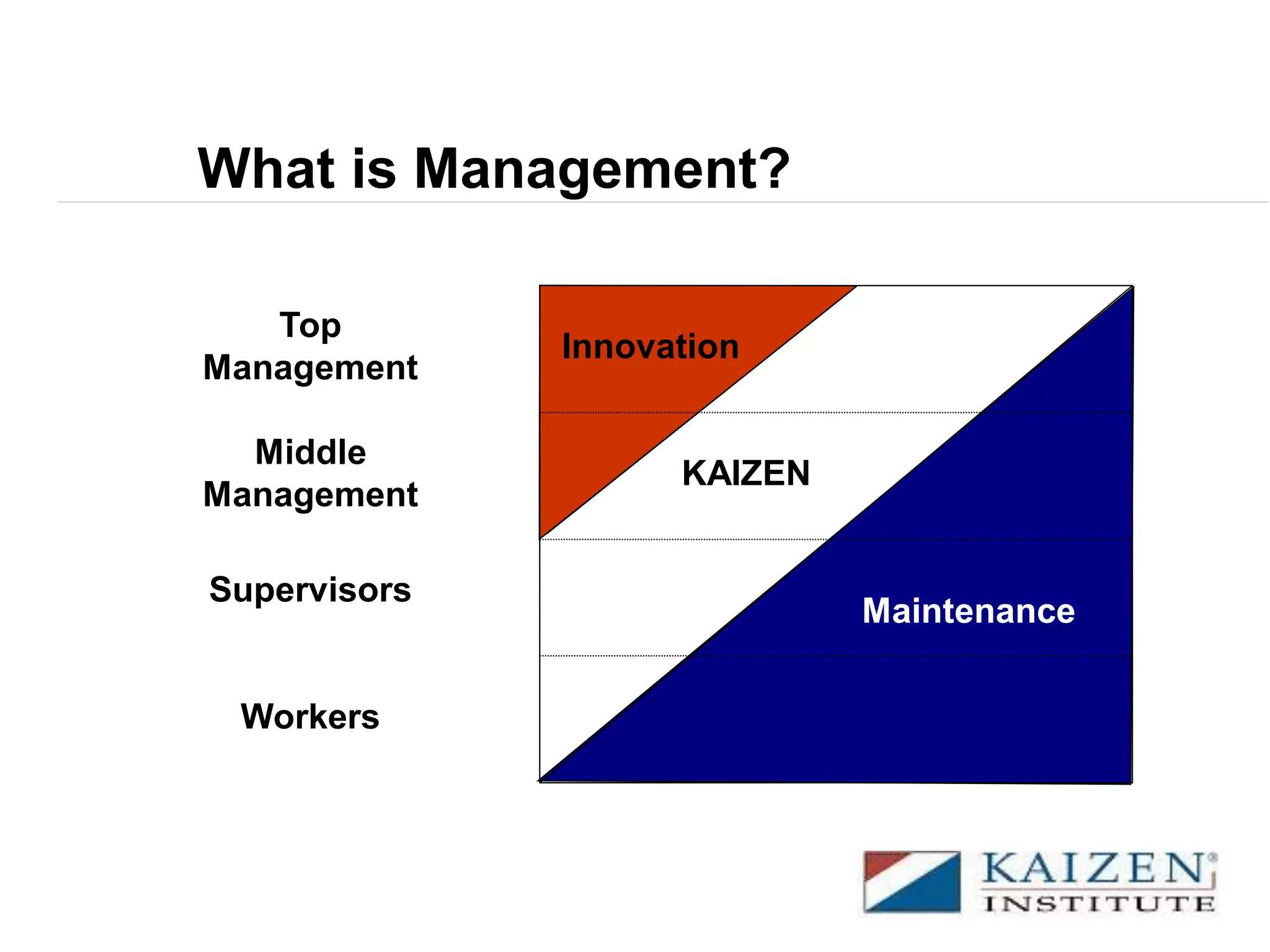
What is Management?
Innovation
KAIZEN
Maintenance
Top
Management
Middle
Management
Supervisors
Workers
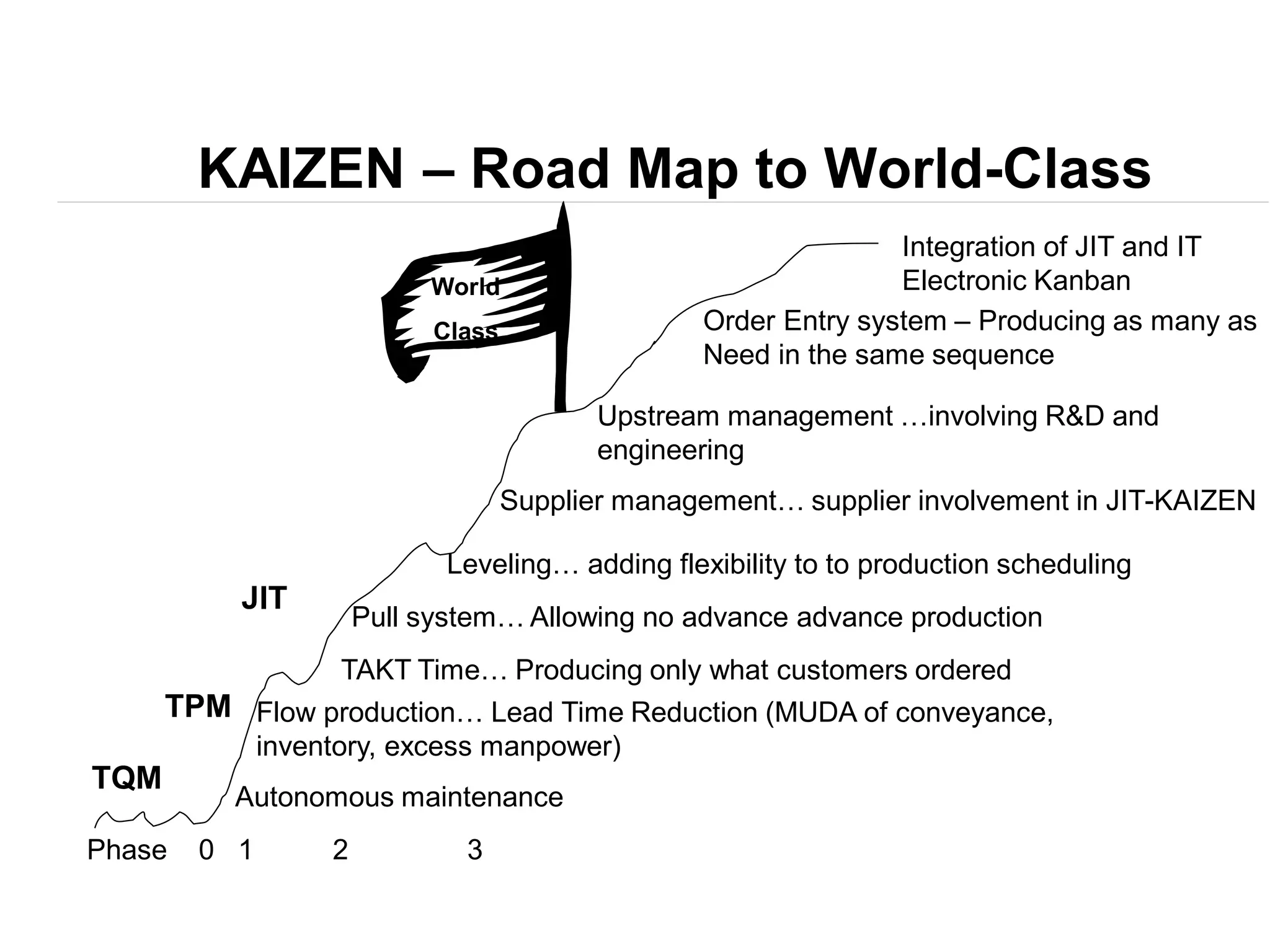
KAIZEN – Road Map to World-Class
TQM
TPM
JIT
World
Class Order Entry system – Producing as many as
Need in the same sequence
Integration of JIT and IT
Electronic Kanban
Upstream management …involving R&D and
engineering
Supplier management… supplier involvement in JIT-KAIZEN
Leveling… adding flexibility to to production scheduling
Pull system… Allowing no advance advance production
Flow production… Lead Time Reduction (MUDA of conveyance,
inventory, excess manpower)
Autonomous maintenance
TAKT Time… Producing only what customers ordered
Phase 0 1 2 3
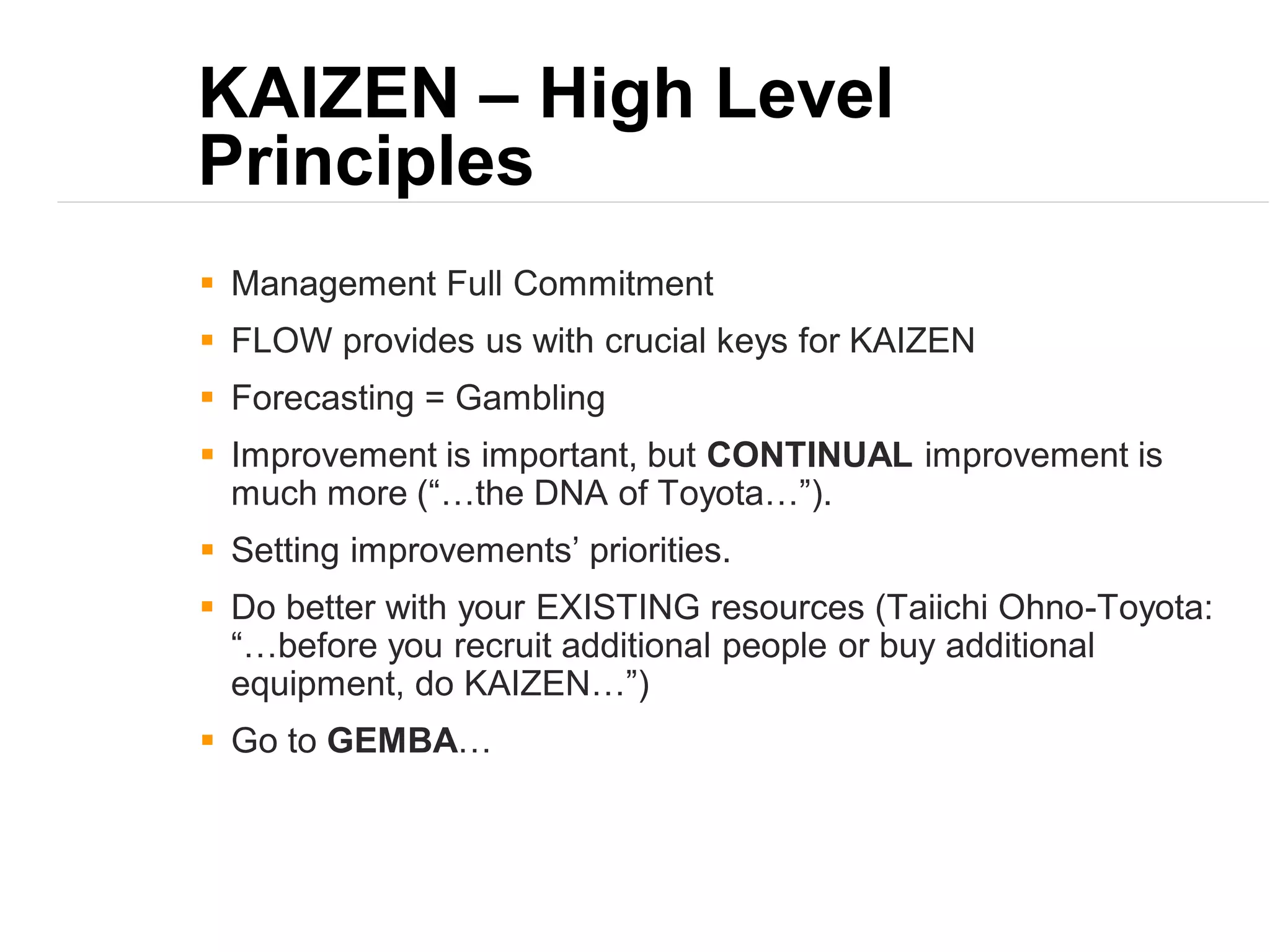
KAIZEN – High Level
Principles
 Management Full Commitment
 FLOW provides us with crucial keys for KAIZEN
 Forecasting = Gambling
 Improvement is important, but CONTINUAL improvement is
much more (“…the DNA of Toyota…”).
 Setting improvements’ priorities.
 Do better with your EXISTING resources (Taiichi Ohno-Toyota:
“…before you recruit additional people or buy additional
equipment, do KAIZEN…”)
 Go to GEMBA…
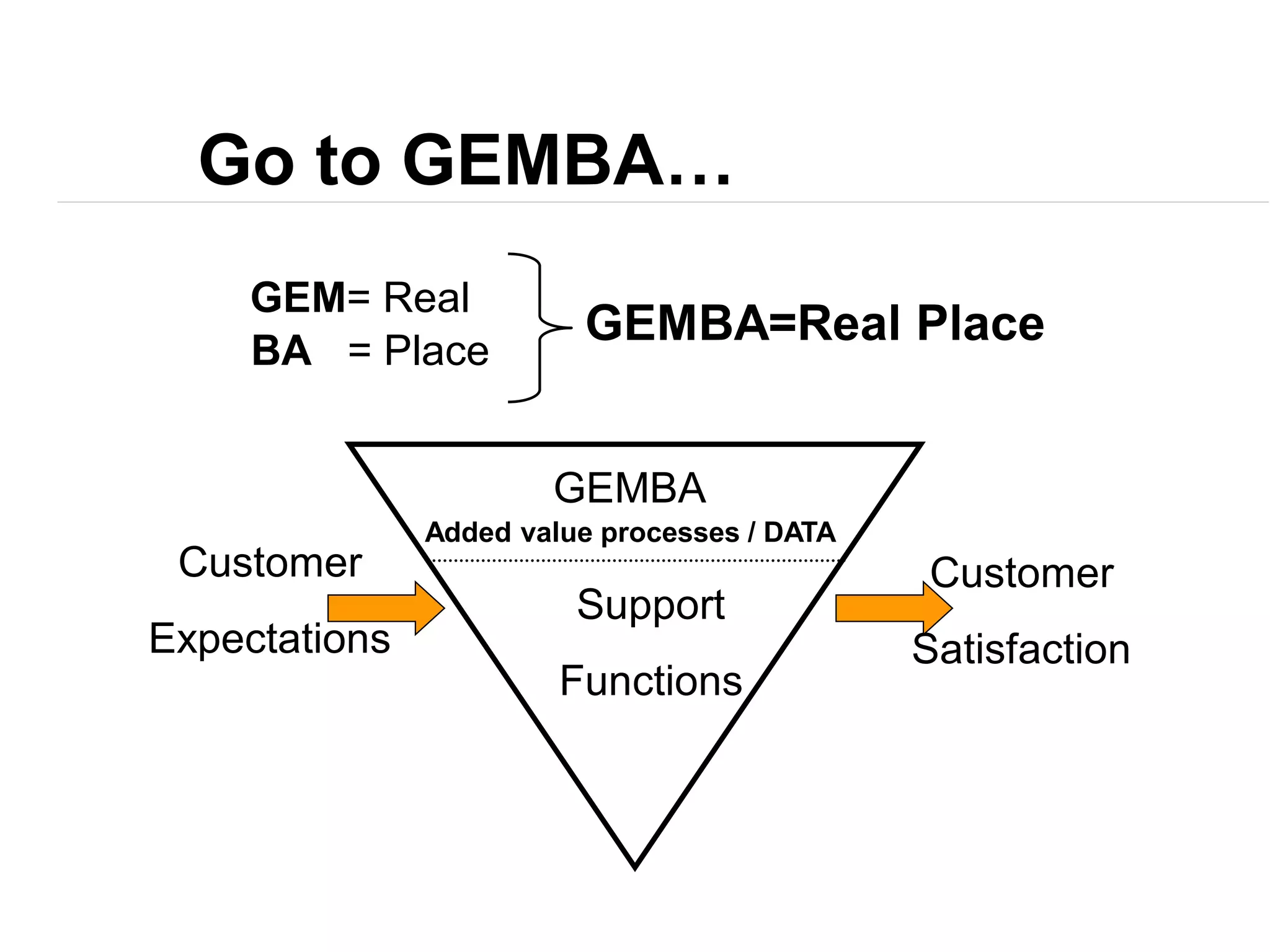
Go to GEMBA…
GEM= Real
BA = Place
GEMBA=Real Place
GEMBA
Support
Functions
Customer
Expectations
Customer
Satisfaction
Added value processes / DATA
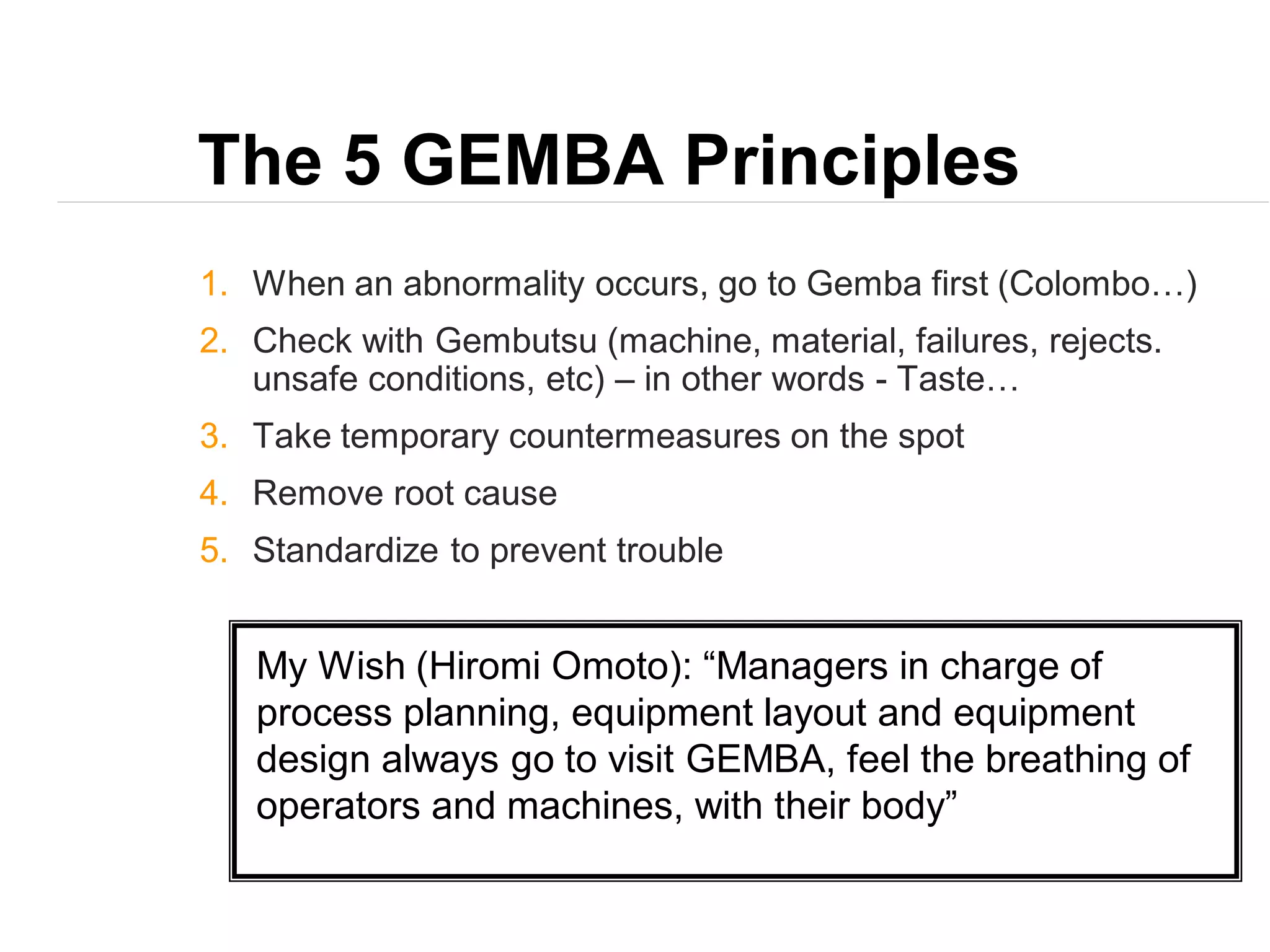
The 5 GEMBA Principles
1. When an abnormality occurs, go to Gemba first (Colombo…)
2. Check with Gembutsu (machine, material, failures, rejects.
unsafe conditions, etc) – in other words - Taste…
3. Take temporary countermeasures on the spot
4. Remove root cause
5. Standardize to prevent trouble
My Wish (Hiromi Omoto): “Managers in charge of
process planning, equipment layout and equipment
design always go to visit GEMBA, feel the breathing of
operators and machines, with their body”
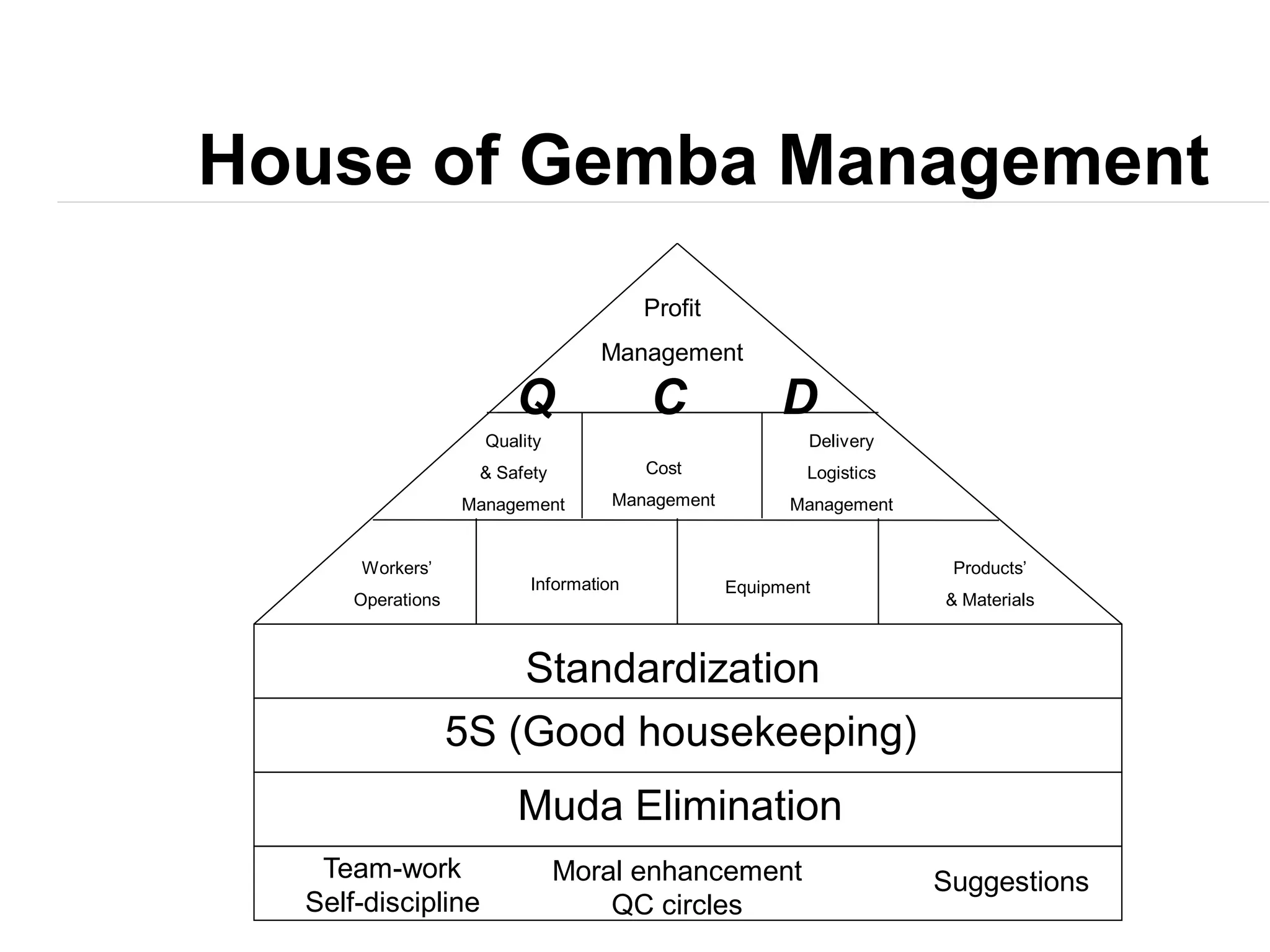
House of Gemba Management
Profit
Management
Q C D
Quality
& Safety
Management
Cost
Management
Delivery
Logistics
Management
Workers’
Operations
Information Equipment
Products’
& Materials
Standardization
5S (Good housekeeping)
Muda Elimination
Moral enhancement
QC circles
Team-work
Self-discipline
Suggestions
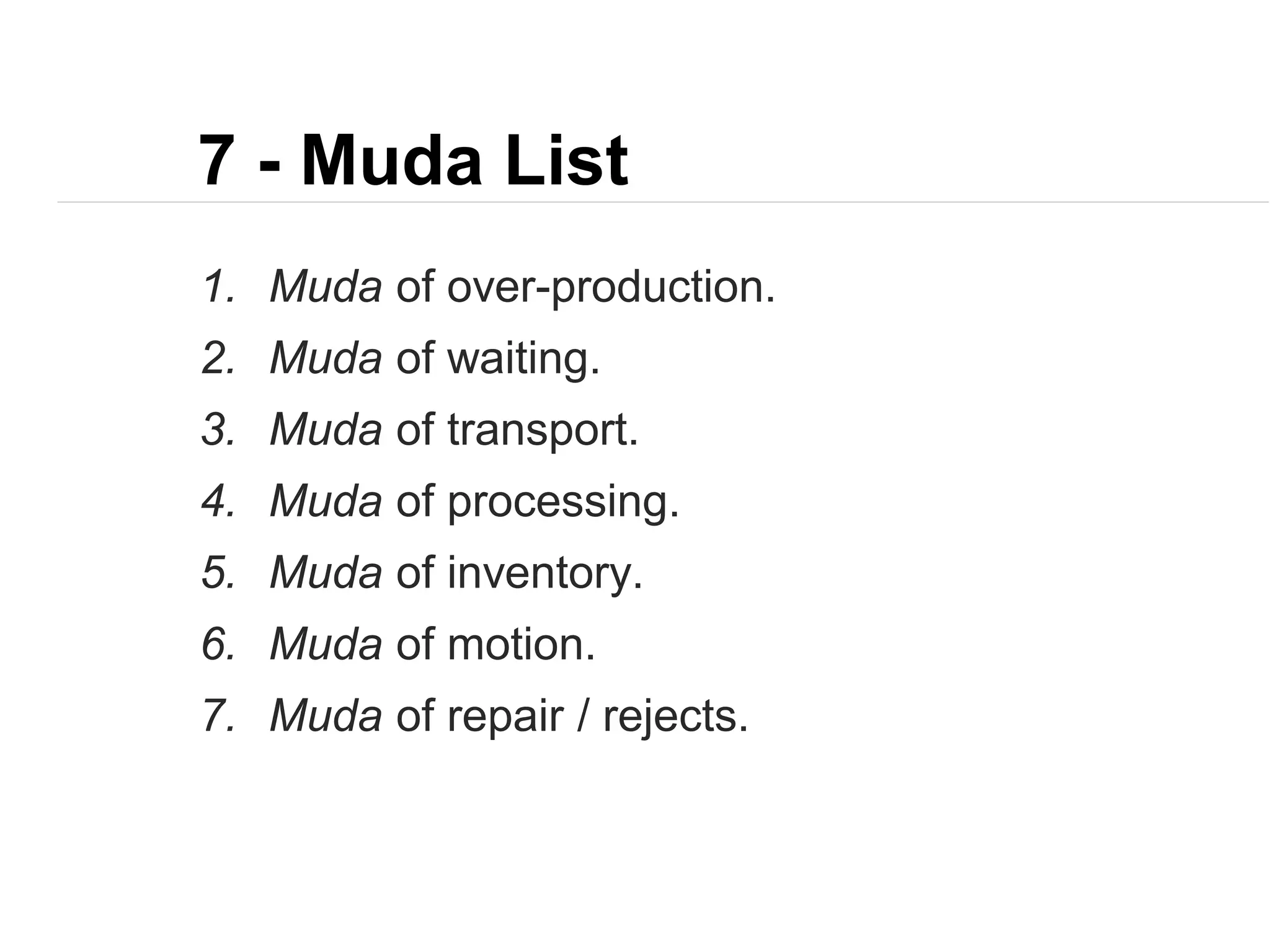
7 - Muda List
1. Muda of over-production.
2. Muda of waiting.
3. Muda of transport.
4. Muda of processing.
5. Muda of inventory.
6. Muda of motion.
7. Muda of repair / rejects.
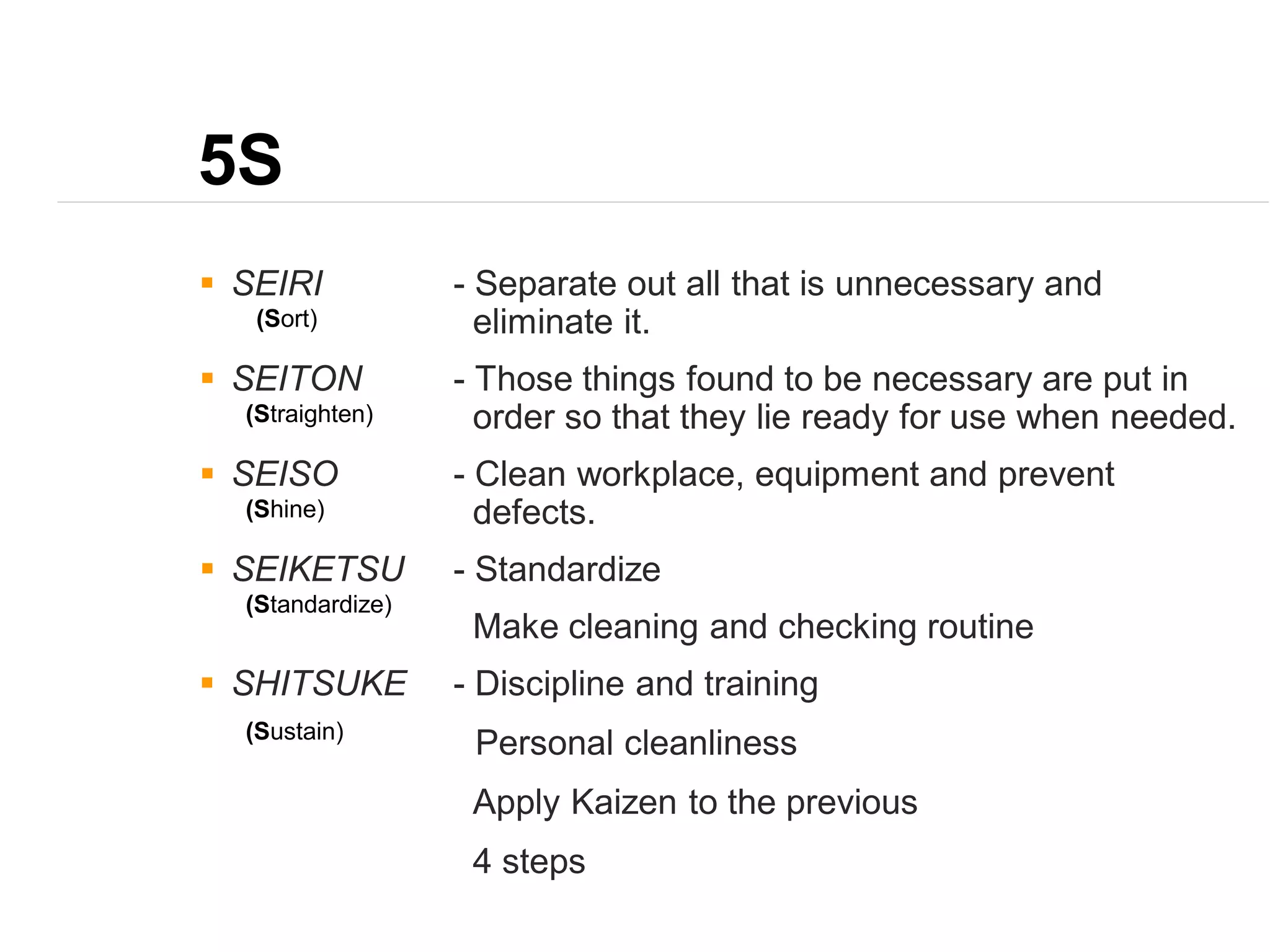
5S
 SEIRI - Separate out all that is unnecessary and
eliminate it.
 SEITON - Those things found to be necessary are put in
order so that they lie ready for use when needed.
 SEISO - Clean workplace, equipment and prevent
defects.
 SEIKETSU - Standardize
Make cleaning and checking routine
 SHITSUKE - Discipline and training
Personal cleanliness
Apply Kaizen to the previous
4 steps
(Sort)
(Straighten)
(Shine)
(Standardize)
(Sustain)
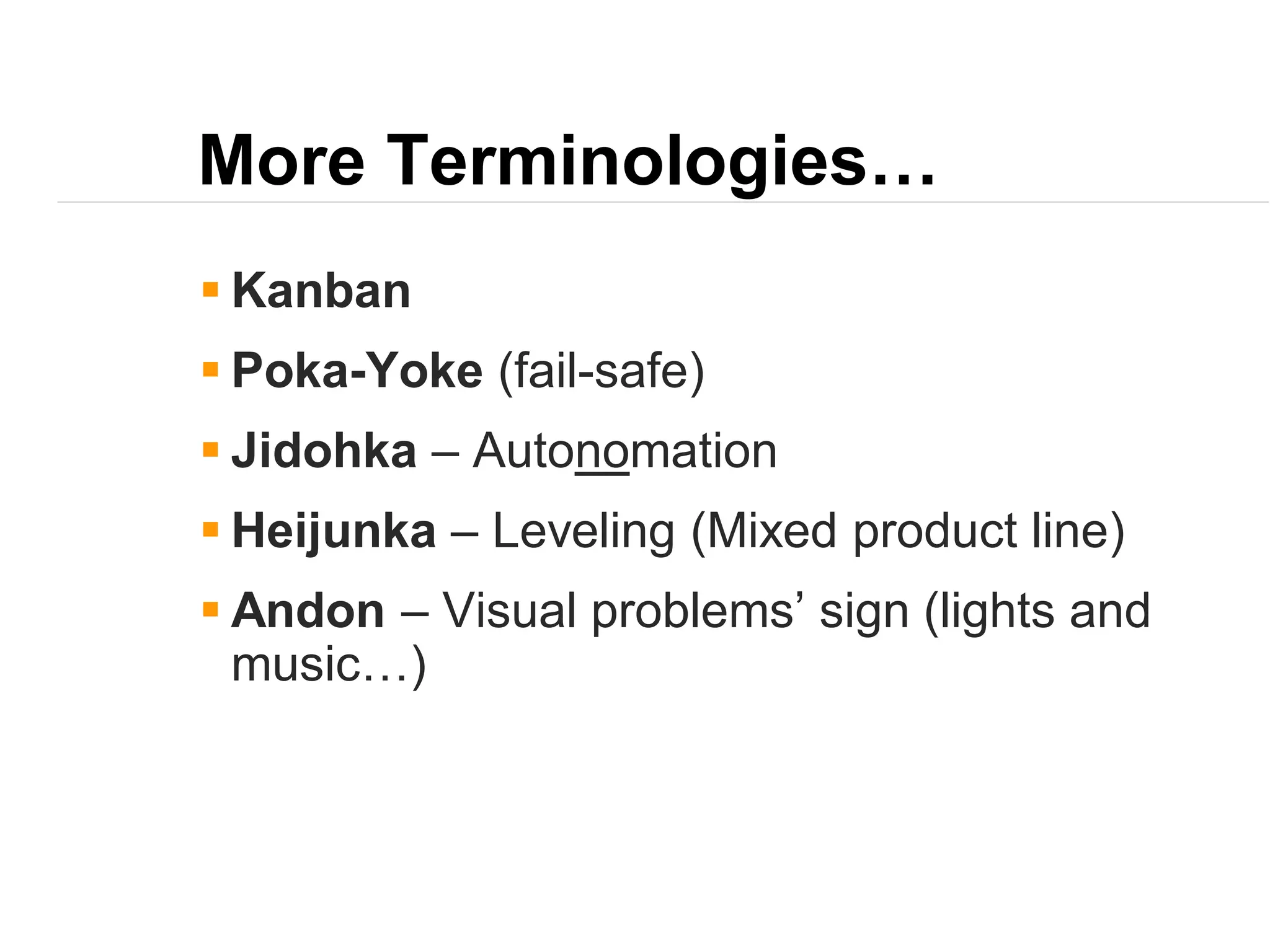
More Terminologies…
 Kanban
 Poka-Yoke (fail-safe)
 Jidohka – Autonomation
 Heijunka – Leveling (Mixed product line)
 Andon – Visual problems’ sign (lights and
music…)
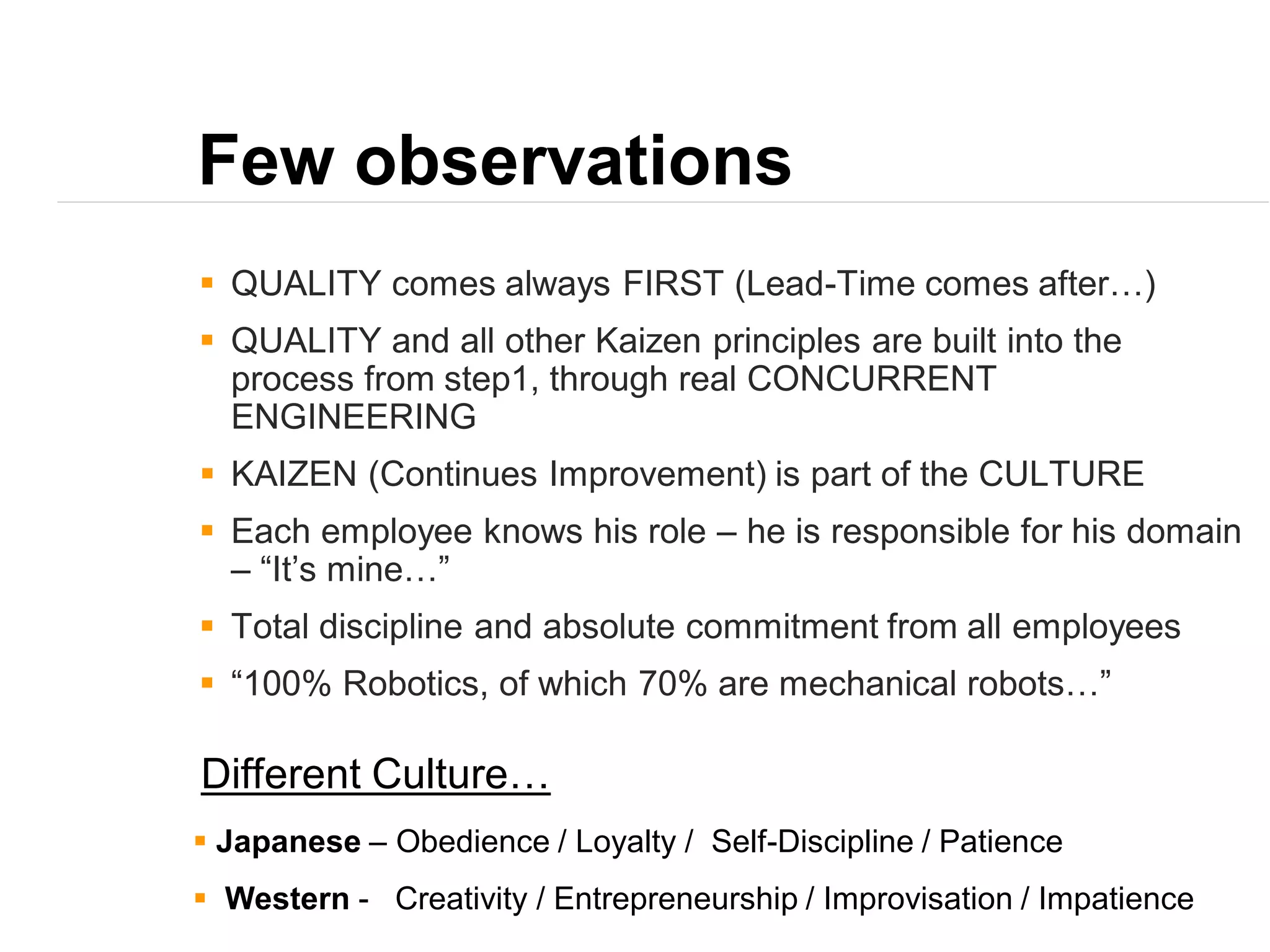
Few observations
 QUALITY comes always FIRST (Lead-Time comes after…)
 QUALITY and all other Kaizen principles are built into the
process from step1, through real CONCURRENT
ENGINEERING
 KAIZEN (Continues Improvement) is part of the CULTURE
 Each employee knows his role – he is responsible for his domain
– “It’s mine…”
 Total discipline and absolute commitment from all employees
 “100% Robotics, of which 70% are mechanical robots…”
 Japanese – Obedience / Loyalty / Self-Discipline / Patience
 Western - Creativity / Entrepreneurship / Improvisation / Impatience
Different Culture…
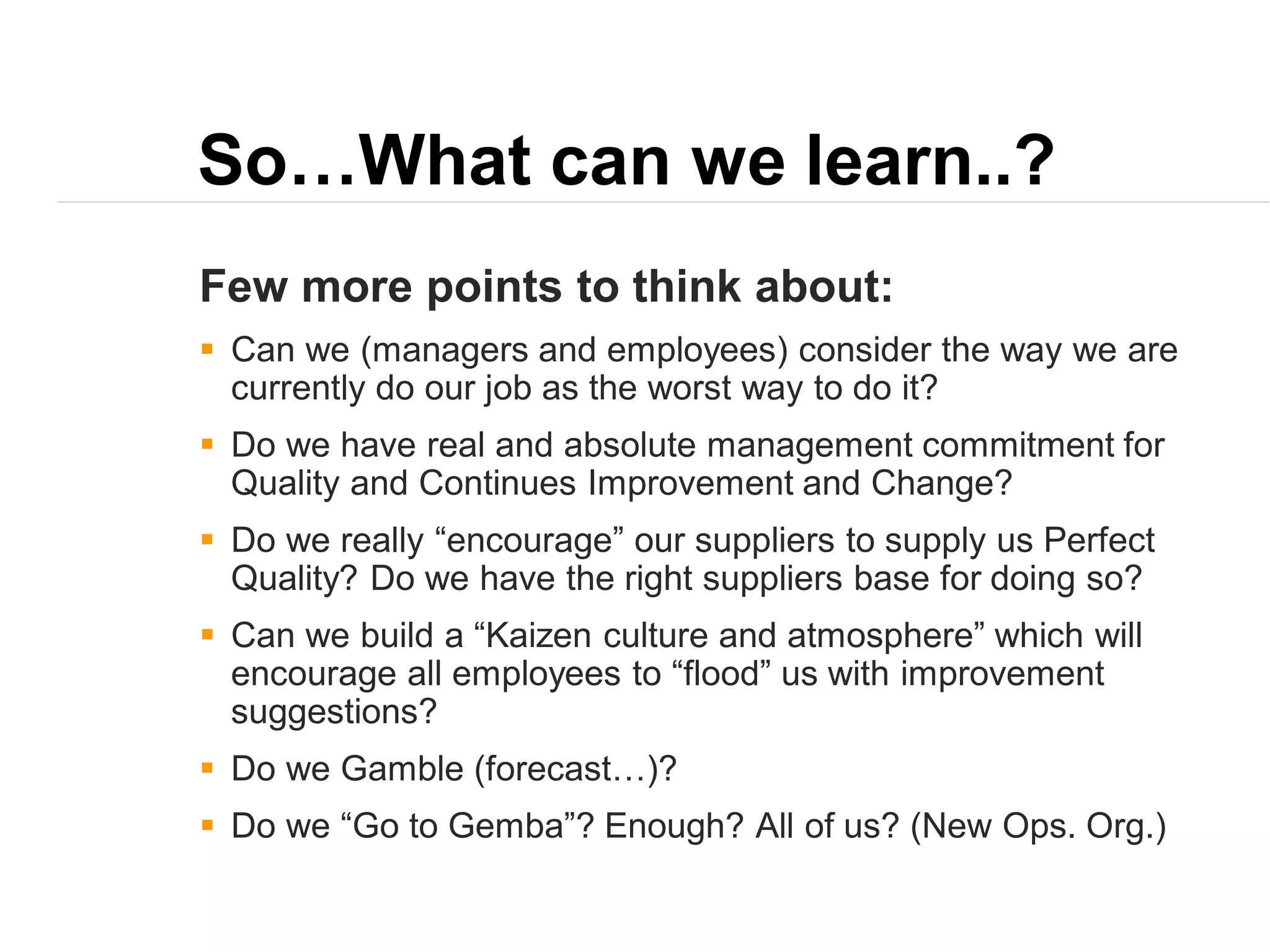
So…What can we learn..?
Few more points to think about:
 Can we (managers and employees) consider the way we are
currently do our job as the worst way to do it?
 Do we have real and absolute management commitment for
Quality and Continues Improvement and Change?
 Do we really “encourage” our suppliers to supply us Perfect
Quality? Do we have the right suppliers base for doing so?
 Can we build a “Kaizen culture and atmosphere” which will
encourage all employees to “flood” us with improvement
suggestions?
 Do we Gamble (forecast…)?
 Do we “Go to Gemba”? Enough? All of us? (New Ops. Org.)
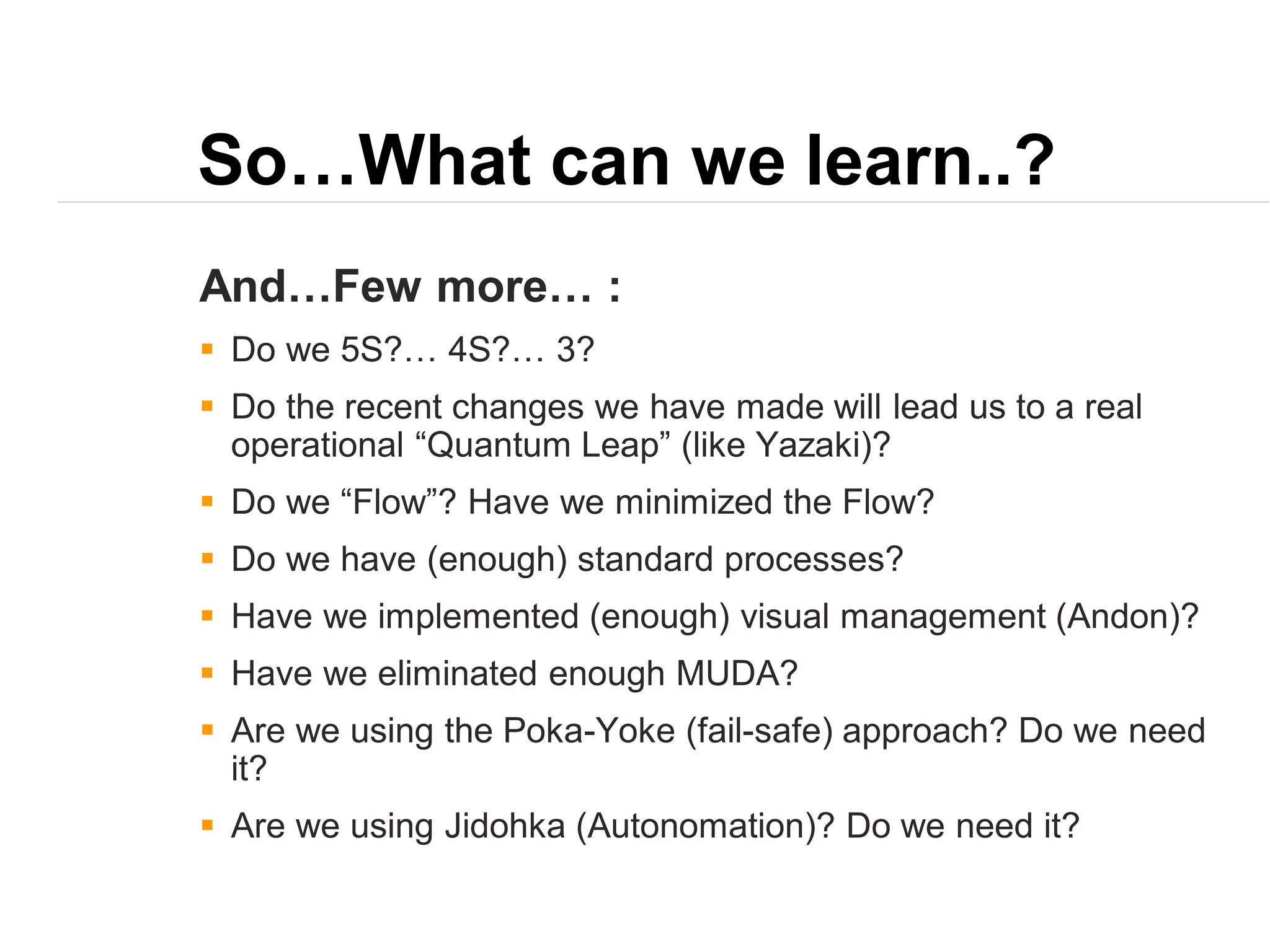
So…What can we learn..?
And…Few more… :
 Do we 5S?… 4S?… 3?
 Do the recent changes we have made will lead us to a real
operational “Quantum Leap” (like Yazaki)?
 Do we “Flow”? Have we minimized the Flow?
 Do we have (enough) standard processes?
 Have we implemented (enough) visual management (Andon)?
 Have we eliminated enough MUDA?
 Are we using the Poka-Yoke (fail-safe) approach? Do we need
it?
 Are we using Jidohka (Autonomation)? Do we need it?
Domo Arigato!!!
Thank You!!!

Kaizen – road map to world class processes

  • 1.
  • 2.
    What is KAIZEN? KAI = CHANGE ZEN = GOOD (For the Better) KAIZEN = CONTINUAL IMPROVEMENT The starting point of KAIZEN® is to recognize that whatever we are doing, can be improved. Some Japanese managers challenge their subordinates by saying "You should regard how you currently do your job as the worst way to do it." In order to improve you must first perceive the need for change, then recognize the problems and work to solve them
  • 3.
    Hierarchy of KAIZEN [PolicyDeployment / hoshin-kanri] TQM (Total Quality management) TPM (Total Productive maintenance) JIT (Just-In-Time) Improvement of QCD (Quality, Cost, Delivery) QC Circles (small group activities) Suggestions systems Top management policy and Strategy Management directed KAIZEN Gemba KAIZEN (Shop Floor KAIZEN) Top down Bottom up
  • 4.
  • 5.
    KAIZEN – RoadMap to World-Class TQM TPM JIT World Class Order Entry system – Producing as many as Need in the same sequence Integration of JIT and IT Electronic Kanban Upstream management …involving R&D and engineering Supplier management… supplier involvement in JIT-KAIZEN Leveling… adding flexibility to to production scheduling Pull system… Allowing no advance advance production Flow production… Lead Time Reduction (MUDA of conveyance, inventory, excess manpower) Autonomous maintenance TAKT Time… Producing only what customers ordered Phase 0 1 2 3
  • 6.
    KAIZEN – HighLevel Principles  Management Full Commitment  FLOW provides us with crucial keys for KAIZEN  Forecasting = Gambling  Improvement is important, but CONTINUAL improvement is much more (“…the DNA of Toyota…”).  Setting improvements’ priorities.  Do better with your EXISTING resources (Taiichi Ohno-Toyota: “…before you recruit additional people or buy additional equipment, do KAIZEN…”)  Go to GEMBA…
  • 7.
    Go to GEMBA… GEM=Real BA = Place GEMBA=Real Place GEMBA Support Functions Customer Expectations Customer Satisfaction Added value processes / DATA
  • 8.
    The 5 GEMBAPrinciples 1. When an abnormality occurs, go to Gemba first (Colombo…) 2. Check with Gembutsu (machine, material, failures, rejects. unsafe conditions, etc) – in other words - Taste… 3. Take temporary countermeasures on the spot 4. Remove root cause 5. Standardize to prevent trouble My Wish (Hiromi Omoto): “Managers in charge of process planning, equipment layout and equipment design always go to visit GEMBA, feel the breathing of operators and machines, with their body”
  • 9.
    House of GembaManagement Profit Management Q C D Quality & Safety Management Cost Management Delivery Logistics Management Workers’ Operations Information Equipment Products’ & Materials Standardization 5S (Good housekeeping) Muda Elimination Moral enhancement QC circles Team-work Self-discipline Suggestions
  • 10.
    7 - MudaList 1. Muda of over-production. 2. Muda of waiting. 3. Muda of transport. 4. Muda of processing. 5. Muda of inventory. 6. Muda of motion. 7. Muda of repair / rejects.
  • 11.
    5S  SEIRI -Separate out all that is unnecessary and eliminate it.  SEITON - Those things found to be necessary are put in order so that they lie ready for use when needed.  SEISO - Clean workplace, equipment and prevent defects.  SEIKETSU - Standardize Make cleaning and checking routine  SHITSUKE - Discipline and training Personal cleanliness Apply Kaizen to the previous 4 steps (Sort) (Straighten) (Shine) (Standardize) (Sustain)
  • 12.
    More Terminologies…  Kanban Poka-Yoke (fail-safe)  Jidohka – Autonomation  Heijunka – Leveling (Mixed product line)  Andon – Visual problems’ sign (lights and music…)
  • 13.
    Few observations  QUALITYcomes always FIRST (Lead-Time comes after…)  QUALITY and all other Kaizen principles are built into the process from step1, through real CONCURRENT ENGINEERING  KAIZEN (Continues Improvement) is part of the CULTURE  Each employee knows his role – he is responsible for his domain – “It’s mine…”  Total discipline and absolute commitment from all employees  “100% Robotics, of which 70% are mechanical robots…”  Japanese – Obedience / Loyalty / Self-Discipline / Patience  Western - Creativity / Entrepreneurship / Improvisation / Impatience Different Culture…
  • 14.
    So…What can welearn..? Few more points to think about:  Can we (managers and employees) consider the way we are currently do our job as the worst way to do it?  Do we have real and absolute management commitment for Quality and Continues Improvement and Change?  Do we really “encourage” our suppliers to supply us Perfect Quality? Do we have the right suppliers base for doing so?  Can we build a “Kaizen culture and atmosphere” which will encourage all employees to “flood” us with improvement suggestions?  Do we Gamble (forecast…)?  Do we “Go to Gemba”? Enough? All of us? (New Ops. Org.)
  • 15.
    So…What can welearn..? And…Few more… :  Do we 5S?… 4S?… 3?  Do the recent changes we have made will lead us to a real operational “Quantum Leap” (like Yazaki)?  Do we “Flow”? Have we minimized the Flow?  Do we have (enough) standard processes?  Have we implemented (enough) visual management (Andon)?  Have we eliminated enough MUDA?  Are we using the Poka-Yoke (fail-safe) approach? Do we need it?  Are we using Jidohka (Autonomation)? Do we need it?
  • 16.