INNOVATION TECHNIQUES
Finding solutions
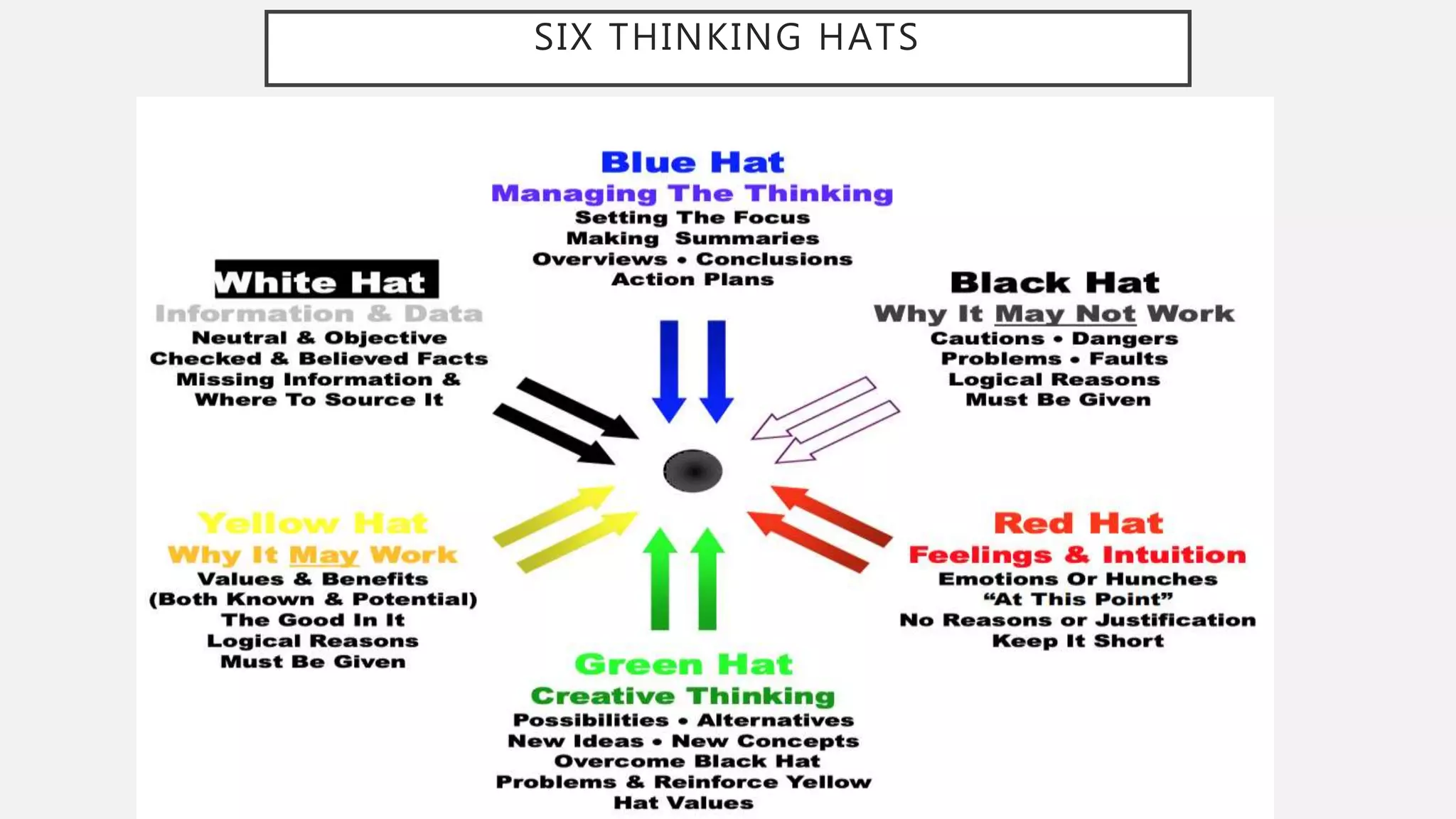
SIX THINKING HATS
Introduction
• Thinking like any other creative process can be chaotic, create conflicts and lead
to debates at times heated
• Everyone has a ‘point-of-view’, ‘bias’, opinion and different way of thinking
which has been conditioned by their experiences
• Invariably an effective decision should have scrutinized/evaluated the outcomes
from multiple views
• Considering multiple different point of views collectively and consciously as a
technique can therefore enable us make better decisions
• Six Thinking Hats is a thinking technique proposed by Edward De Bono that
helps teams and individuals be innovative and holistic thinkers and decision
makers
Introduction
• Six Thinking Hats Technique requires you to ‘imagine’ there are Six hats of
specific colours that you can put on or take off.
• Each is a different colour and represents a different direction/point-of-
view/mental model of thinking.
• Parallel Thinking - Everyone thinks in the same direction at any given point.
• Constructive alternative to arguments
• When we change hats - we change our thinking. Everyone changes direction at
the same time!
SIX THINKING HATS
• TRIZ sees problem solving as 4 Step Process
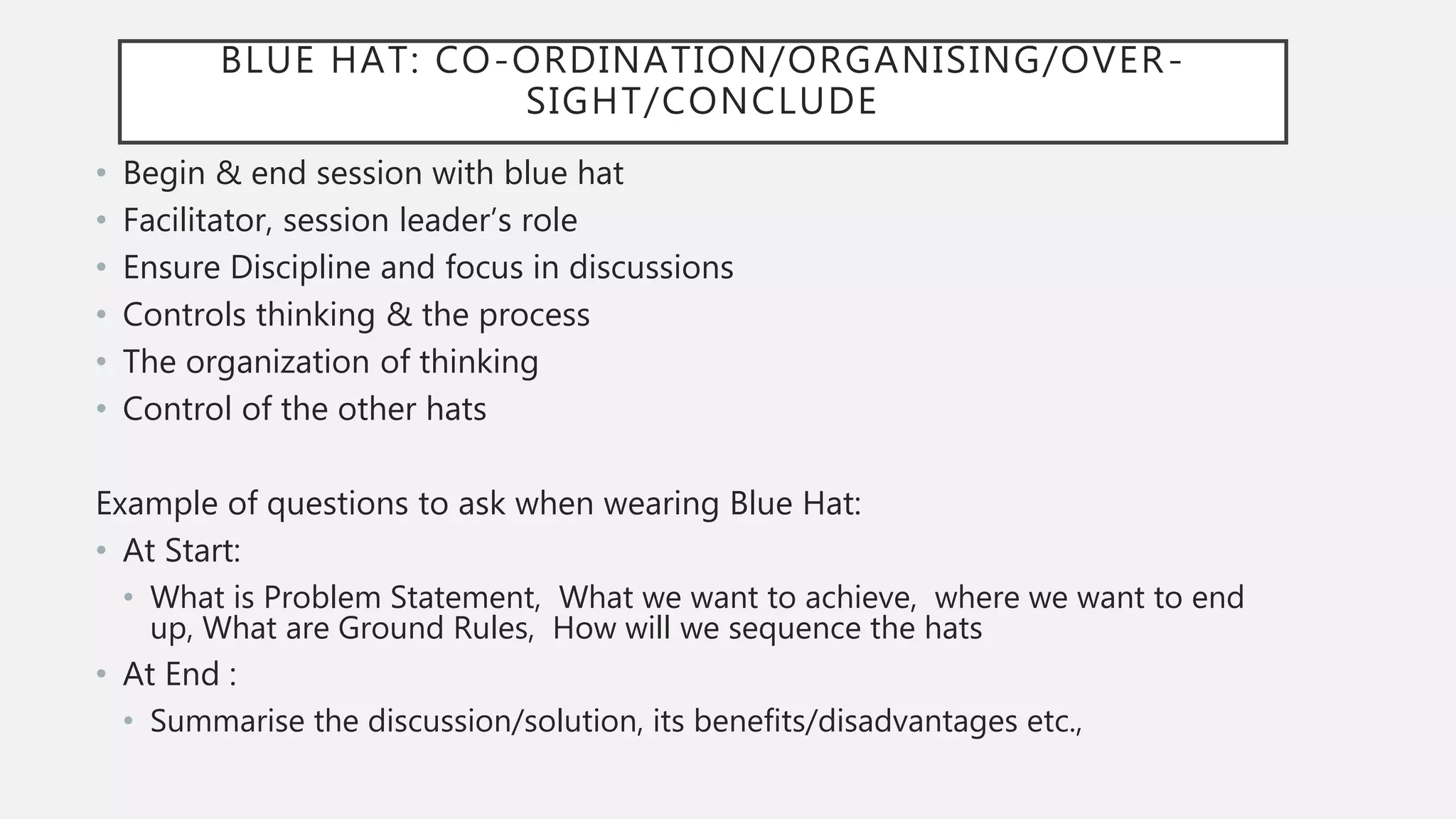
BLUE HAT: CO-ORDINATION/ORGANISING/OVER-
SIGHT/CONCLUDE
• Begin & end session with blue hat
• Facilitator, session leader’s role
• Ensure Discipline and focus in discussions
• Controls thinking & the process
• The organization of thinking
• Control of the other hats
Example of questions to ask when wearing Blue Hat:
• At Start:
• What is Problem Statement, What we want to achieve, where we want to end
up, What are Ground Rules, How will we sequence the hats
• At End :
• Summarise the discussion/solution, its benefits/disadvantages etc.,
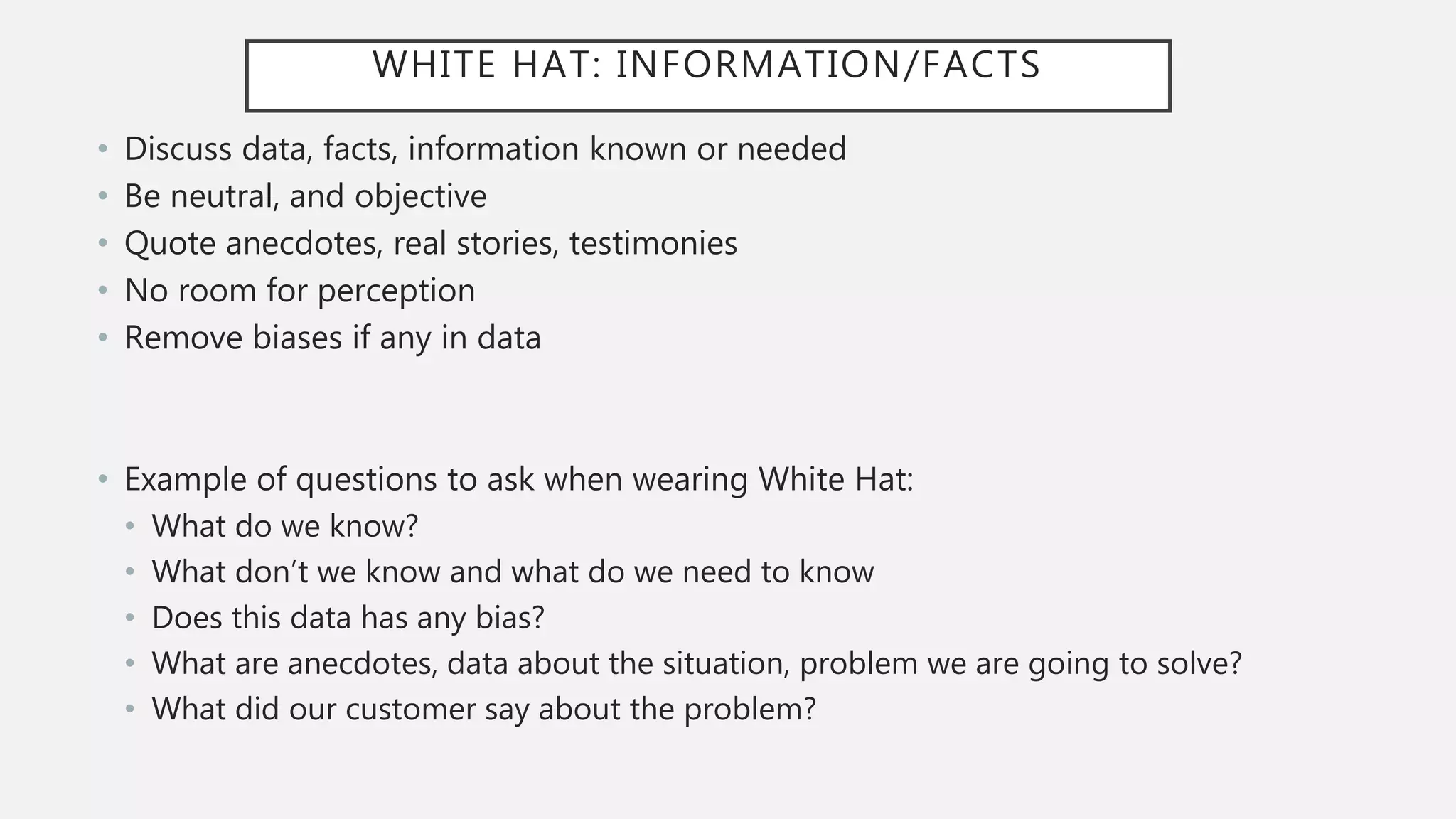
WHITE HAT: INFORMATION/FACTS
• Discuss data, facts, information known or needed
• Be neutral, and objective
• Quote anecdotes, real stories, testimonies
• No room for perception
• Remove biases if any in data
• Example of questions to ask when wearing White Hat:
• What do we know?
• What don’t we know and what do we need to know
• Does this data has any bias?
• What are anecdotes, data about the situation, problem we are going to solve?
• What did our customer say about the problem?
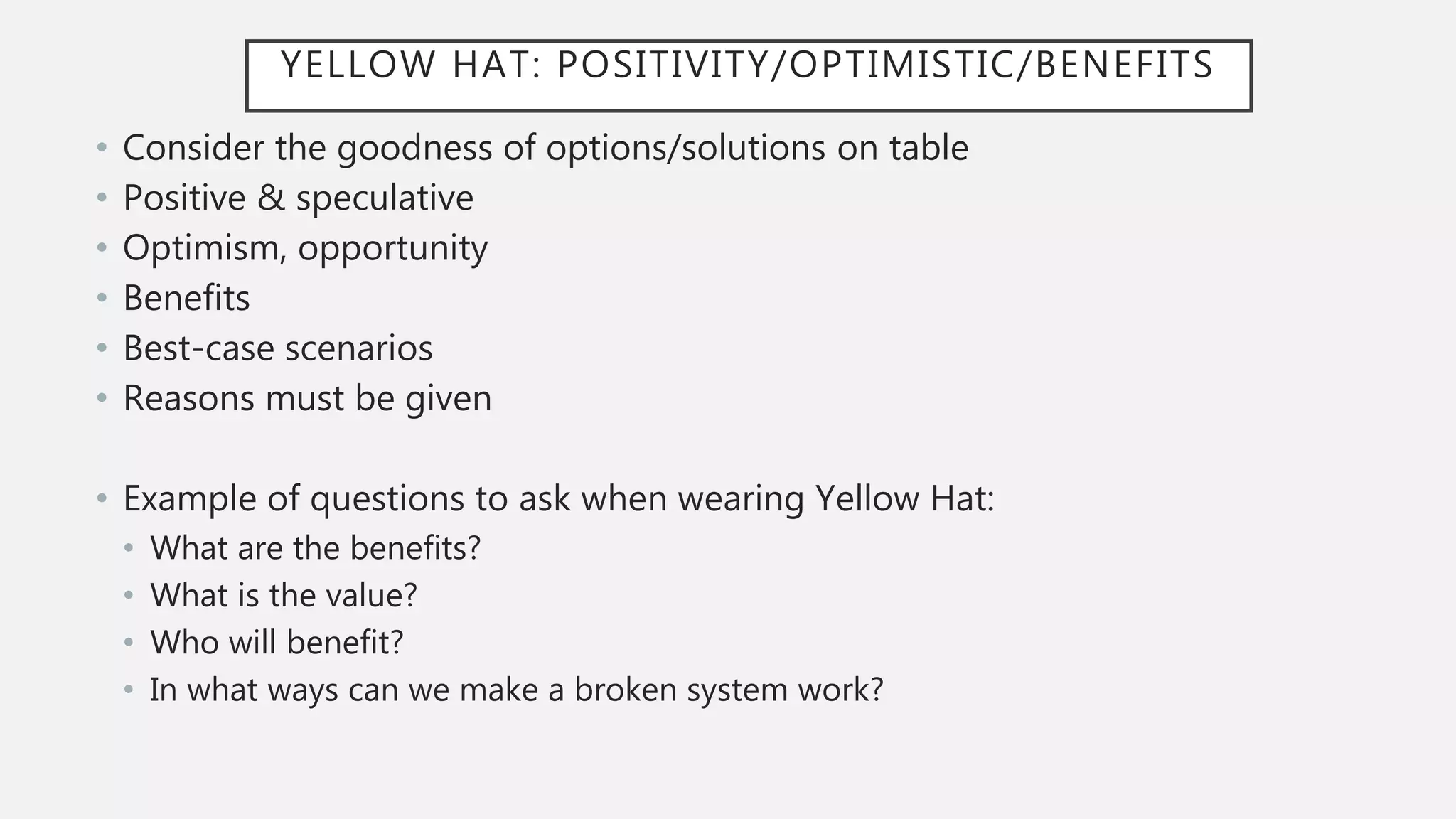
YELLOW HAT: POSITIVITY/OPTIMISTIC/BENEFITS
• Consider the goodness of options/solutions on table
• Positive & speculative
• Optimism, opportunity
• Benefits
• Best-case scenarios
• Reasons must be given
• Example of questions to ask when wearing Yellow Hat:
• What are the benefits?
• What is the value?
• Who will benefit?
• In what ways can we make a broken system work?
GREEN HAT: CREATIVITY/NEW
IDEAS/ALTERNATIVES
• New ideas, concepts, perceptions
• Deliberate creation of new ideas
• Discuss Alternatives and more alternatives, No criticism
• Discuss New approaches to problems
• Creative & lateral thinking
• Example of questions to ask when wearing Green Hat:
• What is Possible?
• What ideas do you have?
• Can we combine these ideas?
• Is there an alternative?
• What different can we do in this situation?
• Is there an analogous solution that can be applied here?
RED HAT: FEELINGS/EMOTIONS/HUNCH AND INTUTION
• Emotions & feelings
• Hunches, intuitions, impressions and perceptions
• Share freely and avoid criticism
• Doesn’t have to be logical or consistent
• No justifications, reasons or basis need to be given
• Example of questions to ask when wearing Red Hat:
• What I feel about this idea?
• Do you think this will be a great idea?
• How will this be perceived?
• Do you like/dislike this?
• What is your opinion?
BLACK HAT: NEGATIVITY/FAILURES/DANGERS/LOSSES
• Cautious and careful
• Play Devil’s Advocate: Logical negative – why it won’t work
• Critical judgment, pessimistic view
• Separates logical negative from emotional
• Focus on errors, evidence, conclusions
• Logical & truthful, but not necessarily fair
Example of questions to ask when wearing Black Hat:
• Why this solution won’t work?
• In what cases will this fail?
• What all negative impact this solution has?
• What are roadblocks to get this done?
HOW TO APPLY 6-TH TECHNIQUE
• Define clear agenda/goals for discussion, Set Ground Rules,
Think!!
• Use any hat, as often as needed
• Not necessary to use every hat
• Time under each hat: generally, short ~5 mins
• Requires discipline from each person – While using it, stay in
the idiom
• Can be used by individuals and groups
6-TH: SIX THINKING HATS
Thanks!!
Q&A

Innovative technique (6 thinking hats)

  • 1.
  • 2.
  • 3.
    Introduction • Thinking likeany other creative process can be chaotic, create conflicts and lead to debates at times heated • Everyone has a ‘point-of-view’, ‘bias’, opinion and different way of thinking which has been conditioned by their experiences • Invariably an effective decision should have scrutinized/evaluated the outcomes from multiple views • Considering multiple different point of views collectively and consciously as a technique can therefore enable us make better decisions • Six Thinking Hats is a thinking technique proposed by Edward De Bono that helps teams and individuals be innovative and holistic thinkers and decision makers
  • 4.
    Introduction • Six ThinkingHats Technique requires you to ‘imagine’ there are Six hats of specific colours that you can put on or take off. • Each is a different colour and represents a different direction/point-of- view/mental model of thinking. • Parallel Thinking - Everyone thinks in the same direction at any given point. • Constructive alternative to arguments • When we change hats - we change our thinking. Everyone changes direction at the same time!
  • 5.
    SIX THINKING HATS •TRIZ sees problem solving as 4 Step Process
  • 6.
    BLUE HAT: CO-ORDINATION/ORGANISING/OVER- SIGHT/CONCLUDE •Begin & end session with blue hat • Facilitator, session leader’s role • Ensure Discipline and focus in discussions • Controls thinking & the process • The organization of thinking • Control of the other hats Example of questions to ask when wearing Blue Hat: • At Start: • What is Problem Statement, What we want to achieve, where we want to end up, What are Ground Rules, How will we sequence the hats • At End : • Summarise the discussion/solution, its benefits/disadvantages etc.,
  • 7.
    WHITE HAT: INFORMATION/FACTS •Discuss data, facts, information known or needed • Be neutral, and objective • Quote anecdotes, real stories, testimonies • No room for perception • Remove biases if any in data • Example of questions to ask when wearing White Hat: • What do we know? • What don’t we know and what do we need to know • Does this data has any bias? • What are anecdotes, data about the situation, problem we are going to solve? • What did our customer say about the problem?
  • 8.
    YELLOW HAT: POSITIVITY/OPTIMISTIC/BENEFITS •Consider the goodness of options/solutions on table • Positive & speculative • Optimism, opportunity • Benefits • Best-case scenarios • Reasons must be given • Example of questions to ask when wearing Yellow Hat: • What are the benefits? • What is the value? • Who will benefit? • In what ways can we make a broken system work?
  • 9.
    GREEN HAT: CREATIVITY/NEW IDEAS/ALTERNATIVES •New ideas, concepts, perceptions • Deliberate creation of new ideas • Discuss Alternatives and more alternatives, No criticism • Discuss New approaches to problems • Creative & lateral thinking • Example of questions to ask when wearing Green Hat: • What is Possible? • What ideas do you have? • Can we combine these ideas? • Is there an alternative? • What different can we do in this situation? • Is there an analogous solution that can be applied here?
  • 10.
    RED HAT: FEELINGS/EMOTIONS/HUNCHAND INTUTION • Emotions & feelings • Hunches, intuitions, impressions and perceptions • Share freely and avoid criticism • Doesn’t have to be logical or consistent • No justifications, reasons or basis need to be given • Example of questions to ask when wearing Red Hat: • What I feel about this idea? • Do you think this will be a great idea? • How will this be perceived? • Do you like/dislike this? • What is your opinion?
  • 11.
    BLACK HAT: NEGATIVITY/FAILURES/DANGERS/LOSSES •Cautious and careful • Play Devil’s Advocate: Logical negative – why it won’t work • Critical judgment, pessimistic view • Separates logical negative from emotional • Focus on errors, evidence, conclusions • Logical & truthful, but not necessarily fair Example of questions to ask when wearing Black Hat: • Why this solution won’t work? • In what cases will this fail? • What all negative impact this solution has? • What are roadblocks to get this done?
  • 12.
    HOW TO APPLY6-TH TECHNIQUE • Define clear agenda/goals for discussion, Set Ground Rules, Think!! • Use any hat, as often as needed • Not necessary to use every hat • Time under each hat: generally, short ~5 mins • Requires discipline from each person – While using it, stay in the idiom • Can be used by individuals and groups
  • 13.
    6-TH: SIX THINKINGHATS Thanks!! Q&A