The document discusses various challenges and strategies related to the production ramp-up process, focusing on issues like product complexity, lack of scalability in planning, and human-machine collaboration. It highlights the importance of systematic learning, effective capital management, and communication with suppliers for successful ramp-ups. Multiple case studies from different manufacturing contexts provide insights into addressing these challenges through innovative approaches.
The introduction of Team 9 includes presenters Merve Nur Tas and Tommi Veromaa.
These slides discuss overcoming challenges in production ramp-up, addressing issues like scalability, fast-paced tech improvements, and product complexity.
Key strategies for successful ramp-up are outlined, including human-machine collaboration, effective planning, and managing production complexities.
A list of cited works related to technology planning and ramp-up optimization in production environments.
No specific content provided; slide likely serves as a visual closing or summary of the presentation.
The journal discussesovercoming the challenge of increasing variety of products and lower
product lifecycle times in ramp-up process. It shows an approach of integrating technology
planning into production ramp-up management.The main problem presented is that
production planning and product usage is out of scale.
Challenges:
Lack of scalability in production planning
Investment allocation only to specific projects (not the whole production environment)
Lack of sustainable planning because of not being able to evaluate cost-benefit-ratio
properly
Strategy:
Controlling and evaluating investment capital (understanding how does the capital
materialize and generate value)
Source:http://jmt.wip.pw.edu.pl/index.php/JMT/article/view/41_2_3/63
16-Nov-17 2
3.
This paper showsa sequential approach to ramp-up. Machines and production stations are the
main resources in a manufacturing system and production stations and machines can be in the
first instance, treated as independent ramp-up problems.
Challenges:
Very fast pace of technology improvement
Lack of systematic learning,
Human overconfidence when applying changes
Strategies:
Improvement of process understanding
Systematic experiments during ramp-up phase to accumulate knowledge
Sacrifice production output at the beginning to obtain better learning process
Source: http://ieeexplore.ieee.org/stamp/stamp.jsp?arnumber=6702489
16-Nov-17 3
4.
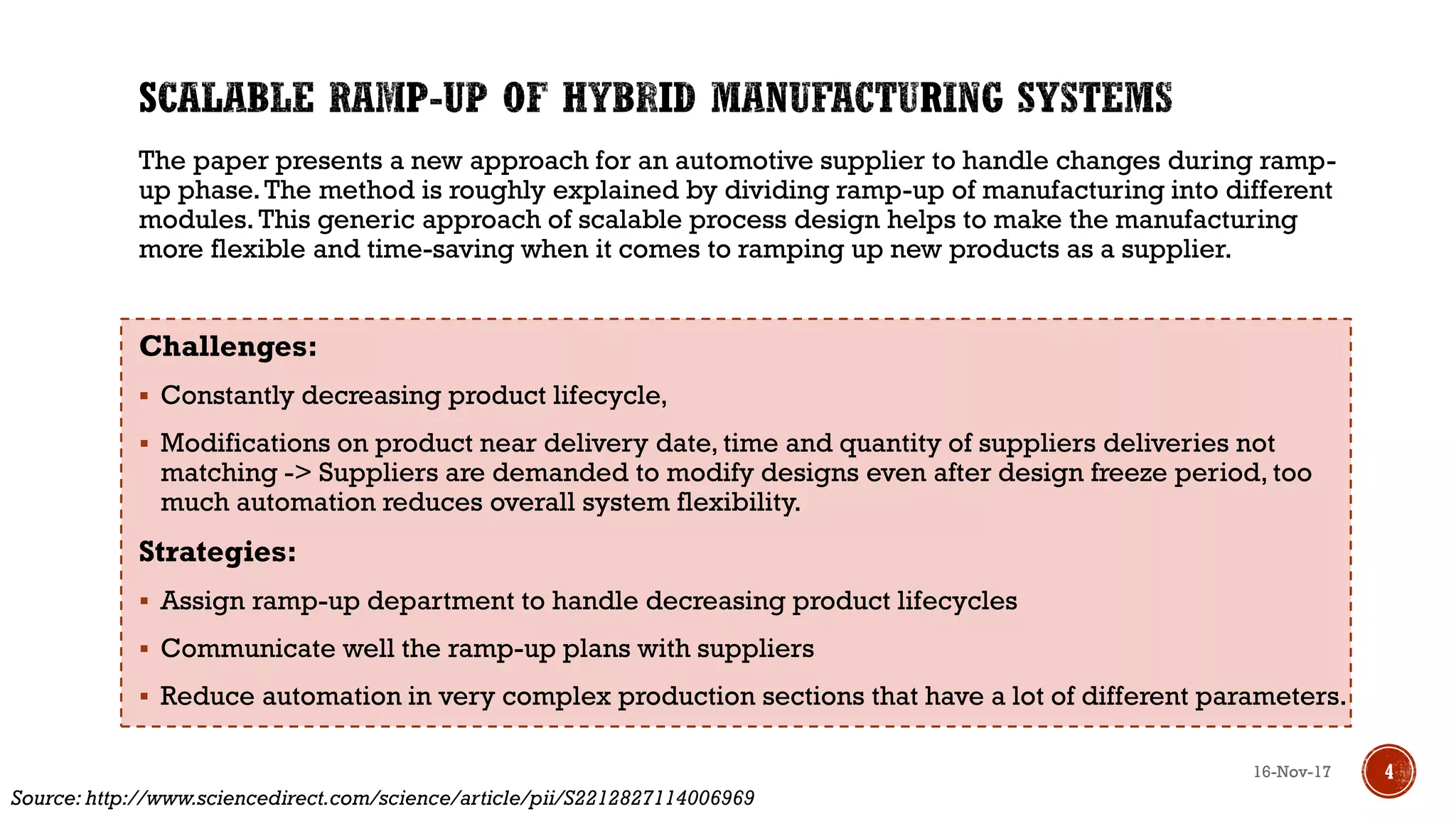
The paper presentsa new approach for an automotive supplier to handle changes during ramp-
up phase.The method is roughly explained by dividing ramp-up of manufacturing into different
modules.This generic approach of scalable process design helps to make the manufacturing
more flexible and time-saving when it comes to ramping up new products as a supplier.
Challenges:
Constantly decreasing product lifecycle,
Modifications on product near delivery date, time and quantity of suppliers deliveries not
matching -> Suppliers are demanded to modify designs even after design freeze period, too
much automation reduces overall system flexibility.
Strategies:
Assign ramp-up department to handle decreasing product lifecycles
Communicate well the ramp-up plans with suppliers
Reduce automation in very complex production sections that have a lot of different parameters.
Source: http://www.sciencedirect.com/science/article/pii/S2212827114006969
16-Nov-17 4
5.
This work investigatesa symbiotic human–machine environment, which combines a formal
framework for capturing structured ramp-up experiences from expert production engineers
with a reinforcement learning method to formulate effective ramp-up policies.
Challenges:
Inefficient communication
Staff turnover
Lack of transferable experience - results in multiple repetitions
Strategies:
Human–machine collaboration
Symbiotic human–machine learning
The development of formal models and pattern recognition algorithms for ramp-up
16-Nov-17 5
Source: http://ieeexplore.ieee.org/document/7983421/
6.
THE IMPACT OFPRODUCT COMPLEXITY ON RAMP-UP
PERFORMANCE
This study identifies the key product characteristics that affect ramp-up performance using
operational data from the cell phone industry.
Challenges:
Product novelty
Product design decisions: high levels of hardware complexity
Sales forecast change (SFC): Management adjusts sales plans and sales forecasts during the
ramp-up preparation phase
Strategies:
Managing effective capacity (1- lost capacity/planned allocated capacity) instead of final yield
Deliberate product design decisions
Source: https://www.researchgate.net/profile/Ton_De_Kok/publication/265235097_The_Impact_of_Product_Complexity_on_Ramp-
Up_Performance/links/54912a4f0cf2d1800d87c886.pd
16-Nov-17 6
7.
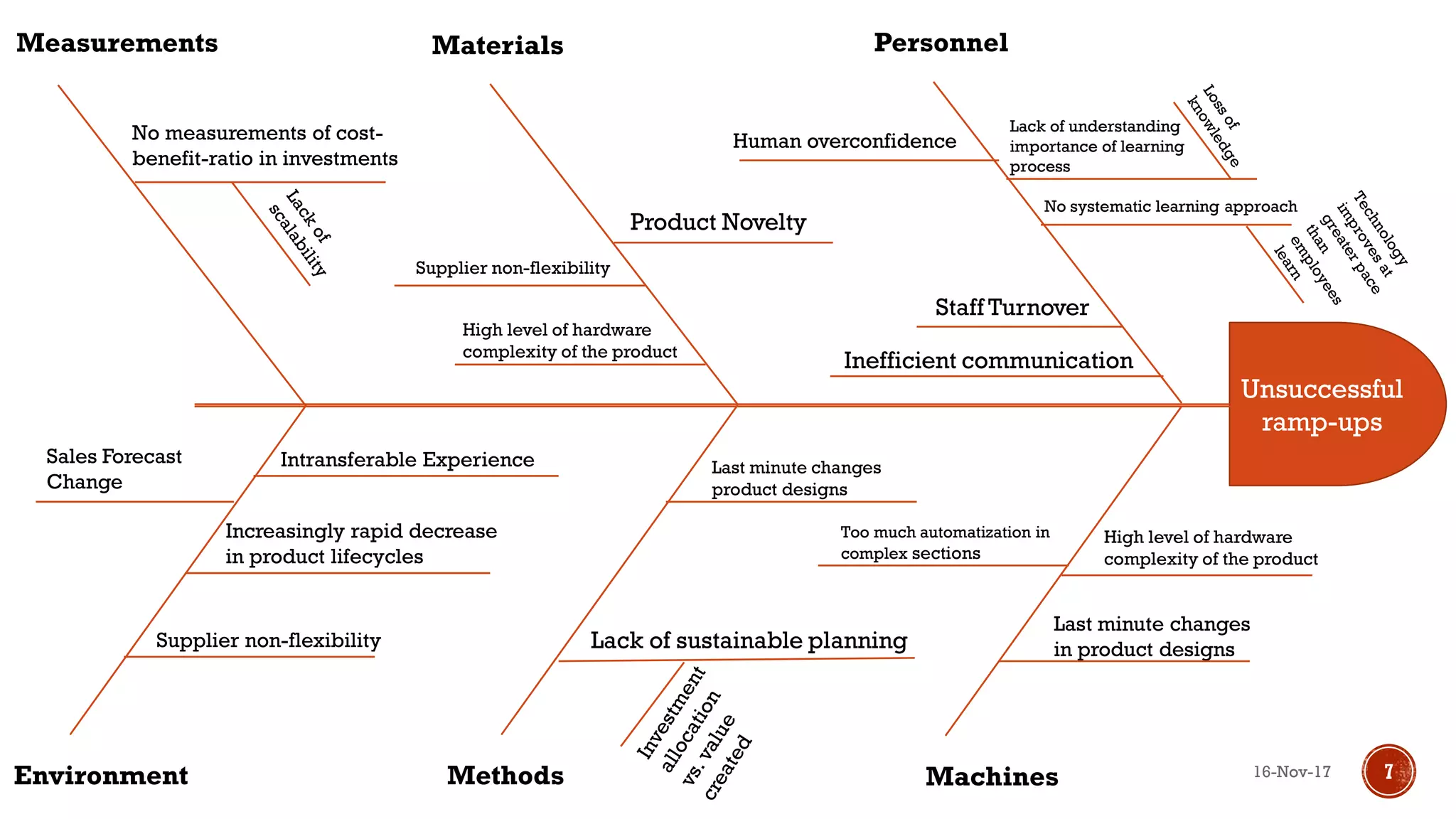
Unsuccessful
ramp-ups
Measurements Materials Personnel
EnvironmentMethods Machines
Lack of sustainable planning
No measurements of cost-
benefit-ratio in investments
Lack of understanding
importance of learning
process
No systematic learning approach
Human overconfidence
Increasingly rapid decrease
in product lifecycles
Last minute changes
product designs
Last minute changes
in product designsSupplier non-flexibility
Supplier non-flexibility
Too much automatization in
complex sections
Staff Turnover
Inefficient communication
16-Nov-17 7
Intransferable Experience
Product Novelty
High level of hardware
complexity of the product
Sales Forecast
Change
High level of hardware
complexity of the product
8.
16-Nov-17 8
Strategies/Ramp-up Categories
Product
/factory
Material
flow
Transport
system
Logistics
process
Supply
chain
Logistics
mana./
control
Controlling and evaluating investment capital (understanding
how does the capital materialize and generate value)
Improvement of process understanding
Systematic experiments during ramp-up phase to accumulate
knowledge
Sacrifice production output at the beginning to obtain better
learning process
Assign ramp-up department to handle decreasing product
lifecycles
Communicate well the ramp-up plans with suppliers
Reduce automation in very complex production sections that
have a lot of different parameters.
Human–machine collaboration
Symbiotic human–machine learning
The development of formal models and pattern recognition
algorithms for ramp-up
Managing effective capacity instead of final yield
Deliberate product design decisions
9.
Nau, B.,Burggraf, P., Klocke, F., & Kampker, A. (2017). Technology Planning and
Evaluation of Planning Processes During Product Ramp-Up. Journal of
Manufacturing Technologies, 41(2), 19-24.
Doltsinis, S., Ferreira, P., & Lohse, N. (2014). An MDP model-based reinforcement
learning approach for production station ramp-up optimization: Q-learning
analysis. IEEE Transactions on Systems, Man, and Cybernetics: Systems, 44(9), 1125-
1138.
Basse, I., Sauer, A., & Schmitt, R. (2014). Scalable ramp-up of hybrid manufacturing
systems. Procedia CIRP, 20, 1-6.
Doltsinis, S., Ferreira, P., & Lohse, N. (2017). A Symbiotic Human–Machine Learning
Approach for Production Ramp-up. IEEE Transactions on Human-Machine Systems.
Pufall, A., Fransoo, J. C., de Jong, A., & de Kok,T. (2012). The impact of product
complexity on ramp-up performance.Working paper, Beta publicatie, Eindhoven
University of Technology, Netherlands.
16-Nov-17 9