2nd	
  Interna)onal	
  Symposium	
  on	
  Freeway	
  and	
  Tollway	
  Opera)ons	
  
                 Honolulu,	
  Hawaii	
  –	
  June	
  21-­‐24,	
  2009	


Irregulari)es	
  in	
  the	
  output	
  of	
  transport	
  
 planning	
  models’	
  forecasts	
  for	
  capital	
  
    infrastructure	
  planning	
  decisions	
  

           C.	
  Antoniou1,	
  B.	
  Psarianos1,	
  and	
  W.	
  Brilon2	


     1	
  Na)onal	
  Technical	
  University	
  of	
  Athens,	
  Greece	
  
                  2	
  Ruhr-­‐University	
  Bochum,	
  Germany	
  
2nd	
  Interna)onal	
  Symposium	
  on	
  Freeway	
  and	
  Tollway	
  Opera)ons	
  
                         Honolulu,	
  Hawaii	
  –	
  June	
  21-­‐24,	
  2009	


                          Errors	
  in	
  	
  
    Transporta)on	
  Planning	
  Processes	
  Regarding	
  Large	
  
                 Infrastructure	
  Projects	


               C.	
  Antoniou1,	
  B.	
  Psarianos1,	
  and	
  W.	
  Brilon2	


         1	
  Na)onal	
  Technical	
  University	
  of	
  Athens,	
  Greece	
  
                      2	
  Ruhr-­‐University	
  Bochum,	
  Germany	


2       Transporation Planning and Large Infrastructure Projects
Outline	


    •  Mo)va)on	
  and	
  objec)ve	
  
    •  Background	
  and	
  evidence	
  from	
  the	
  literature	
  
    •  Applica)on	
  in	
  AUki	
  Odos	
  Motorway	
  (Athens,	
  
       Greece)	
  	
  
    •  Findings	
  and	
  conclusion	


3          Transporation Planning and Large Infrastructure Projects
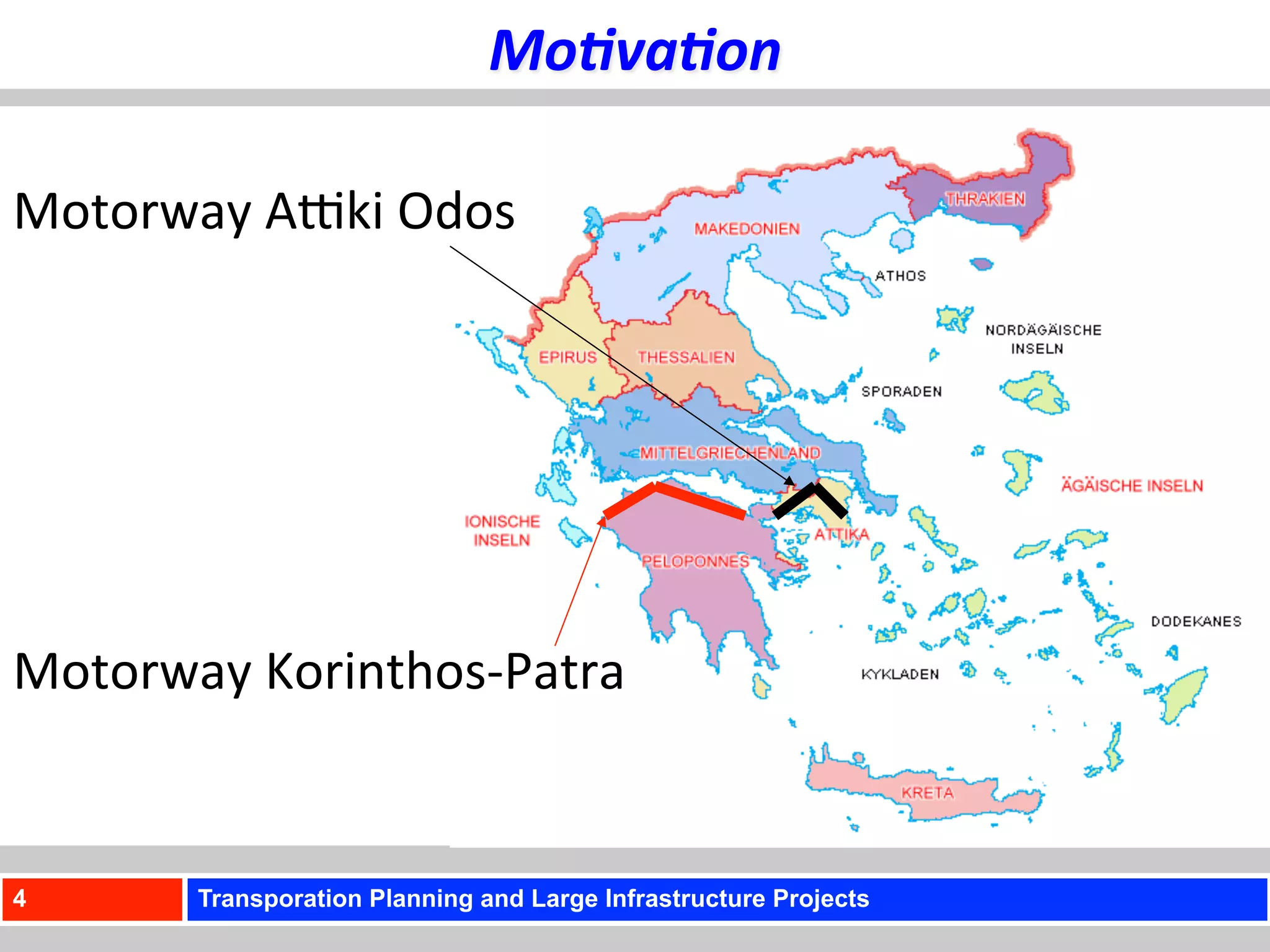
Mo+va+on	
  

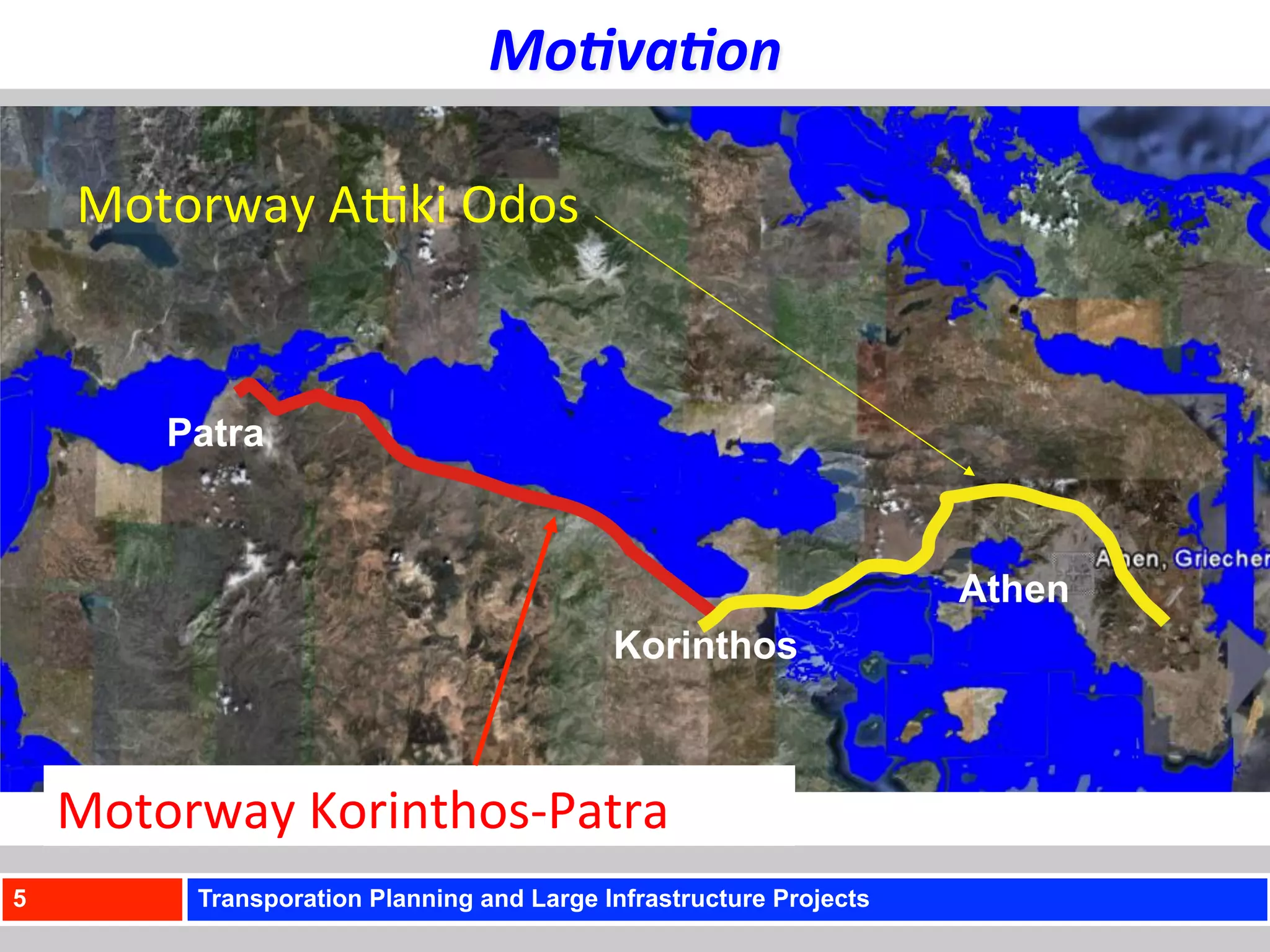
Motorway	
  AUki	
  Odos	


Motorway	
  Korinthos-­‐Patra	


4         Transporation Planning and Large Infrastructure Projects
Mo+va+on	
  

     Motorway	
  AUki	
  Odos	


    Motorway	
  Korinthos-­‐Patra	
  
5          Transporation Planning and Large Infrastructure Projects
Experiences	


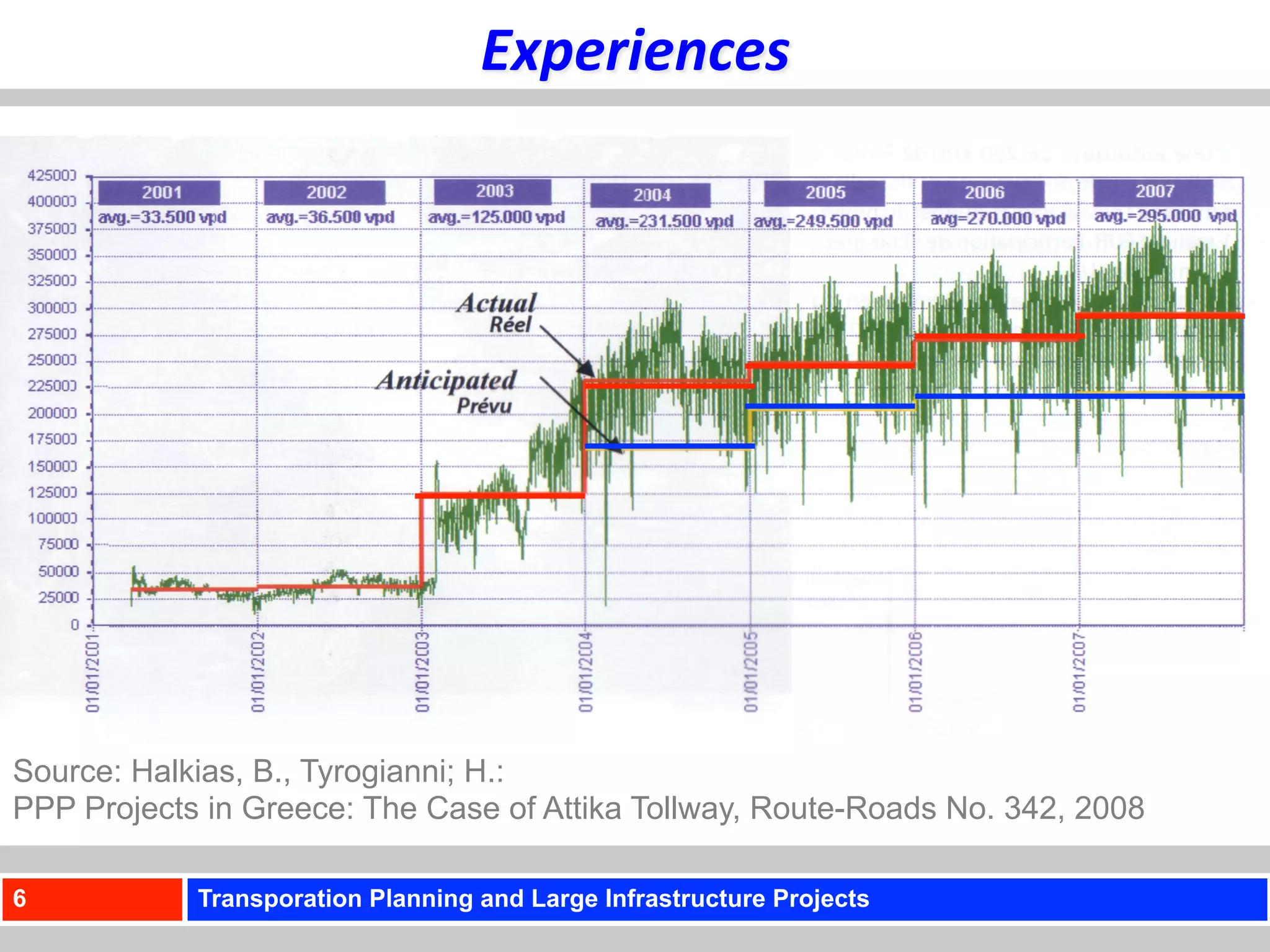
Source: Halkias, B., Tyrogianni; H.:
PPP Projects in Greece: The Case of Attika Tollway, Route-Roads No. 342, 2008

6           Transporation Planning and Large Infrastructure Projects
Ques+ons	
  
    •    Why have the traffic forecasts been so wrong?
    •    What can we learn from existing experience for
         future projects?


7           Transporation Planning and Large Infrastructure Projects
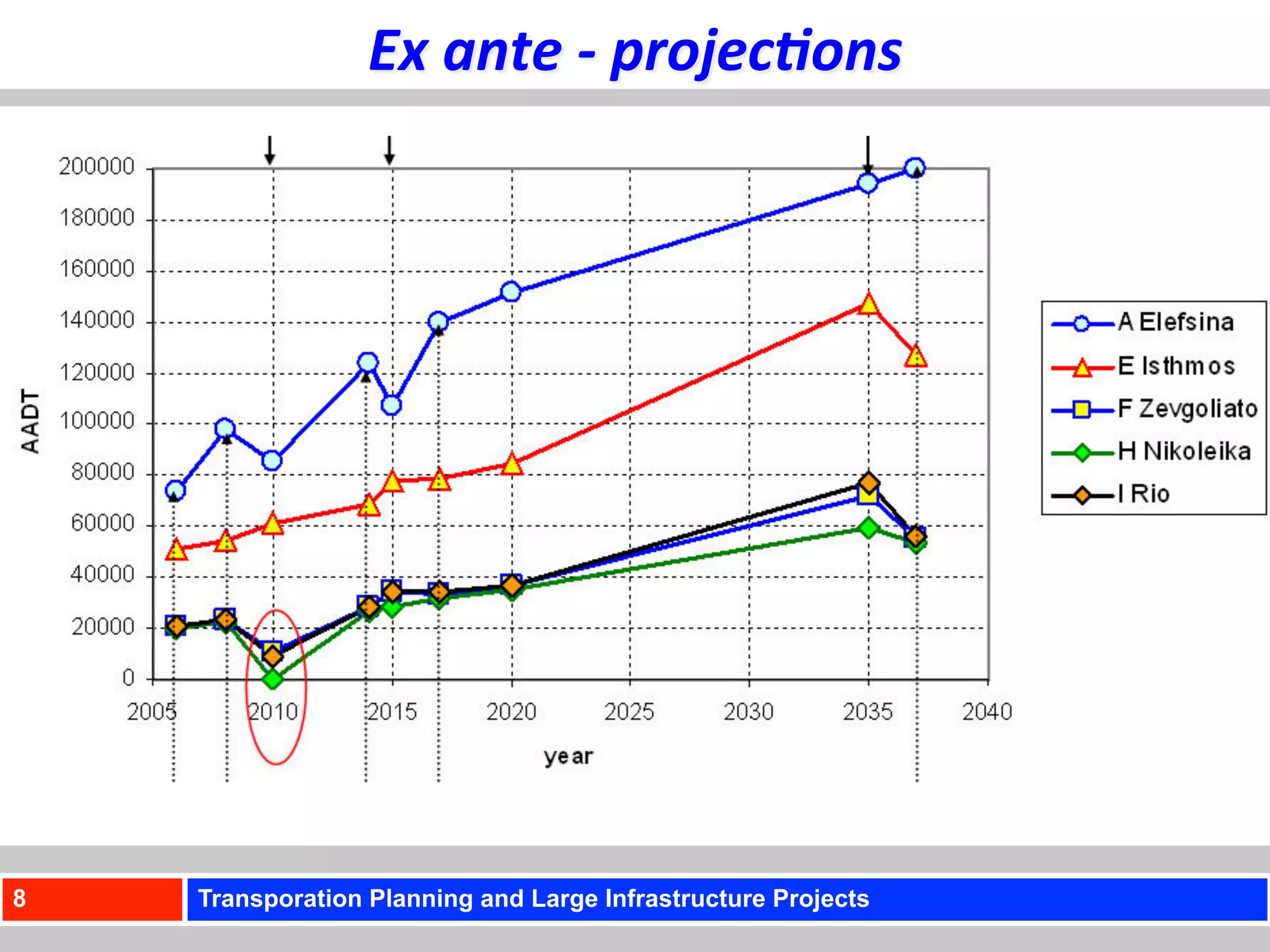
Ex	
  ante	
  -­‐	
  projec+ons	


8   Transporation Planning and Large Infrastructure Projects
Ex	
  post	
  -­‐	
  studies	
  
    •    Parthasarathi, Levinson (2009):
          •  62 % od forecasts were wrong
          •  Underestimating highway traffic
    •    Noland (2001):
          •  Wrong or missing effect of induced traffic
    •    Flybjerg e.a. (2006):
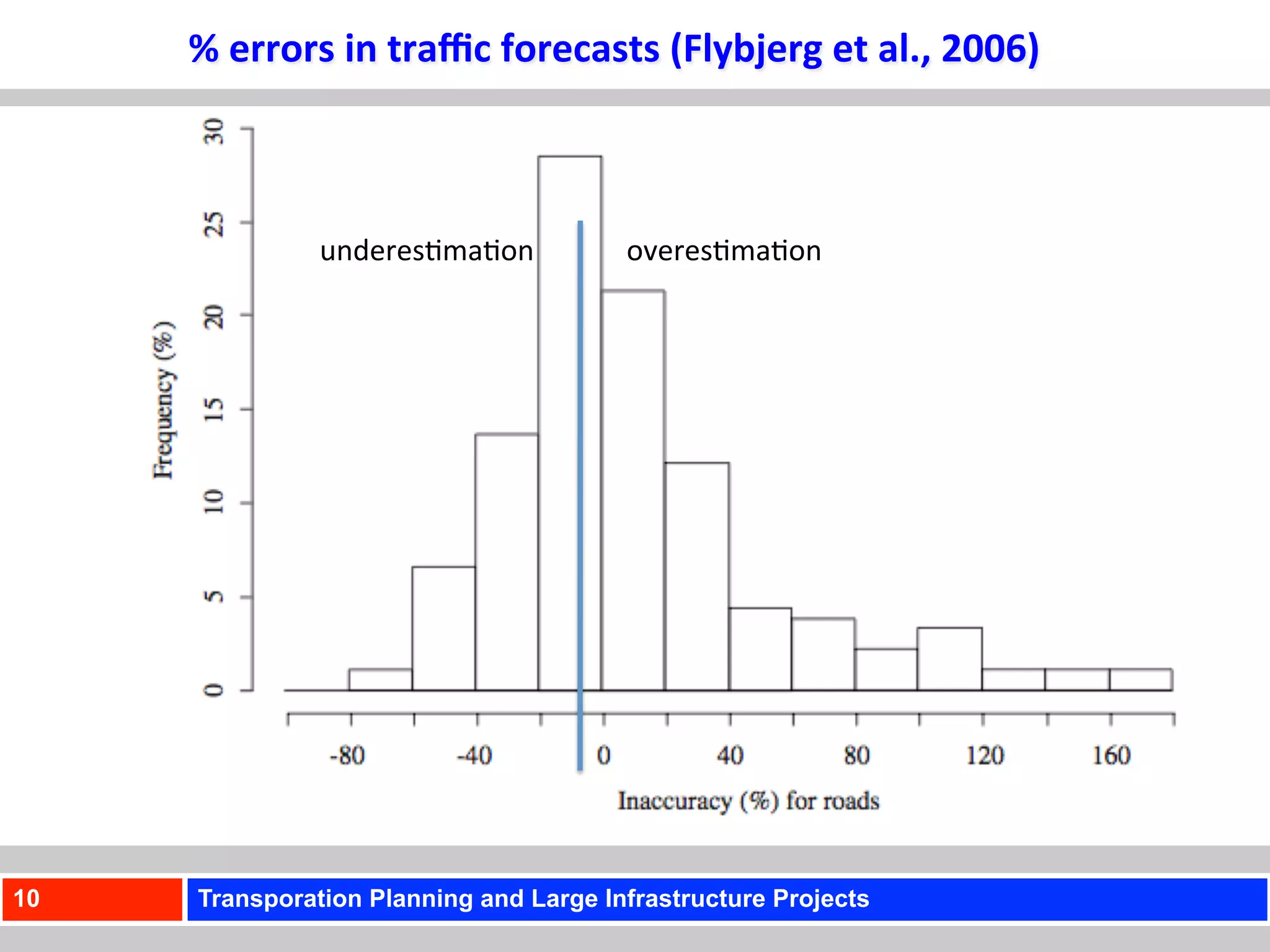
          •  Railway projects: 72 % overestimated
          •  Highway projects: 25 % of cases error > 40 %


9            Transporation Planning and Large Infrastructure Projects
%	
  errors	
  in	
  traffic	
  forecasts	
  (Flybjerg	
  et	
  al.,	
  2006)	


                 underes)ma)on	
              overes)ma)on	


10   Transporation Planning and Large Infrastructure Projects
Ex	
  post	
  -­‐	
  studies	
  
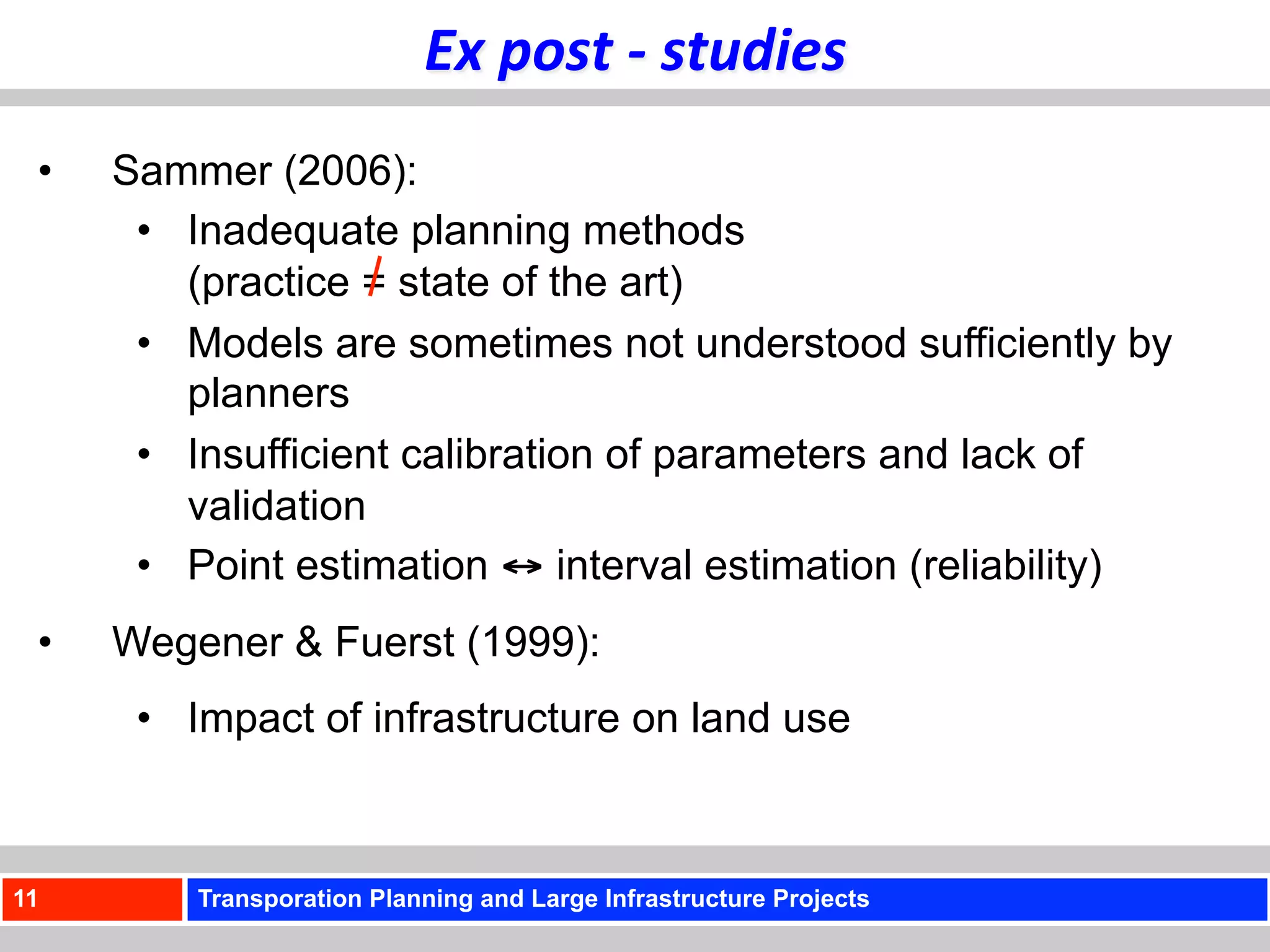
 •    Sammer (2006):
       •  Inadequate planning methods
          (practice = state of the art)
       •  Models are sometimes not understood sufficiently by
          planners
       •  Insufficient calibration of parameters and lack of
          validation
       •  Point estimation ↔ interval estimation (reliability)
 •    Wegener & Fuerst (1999):
       •  Impact of infrastructure on land use


11        Transporation Planning and Large Infrastructure Projects
Study	
  area:	
  A<ki	
  Odos	
  Motorway	
  
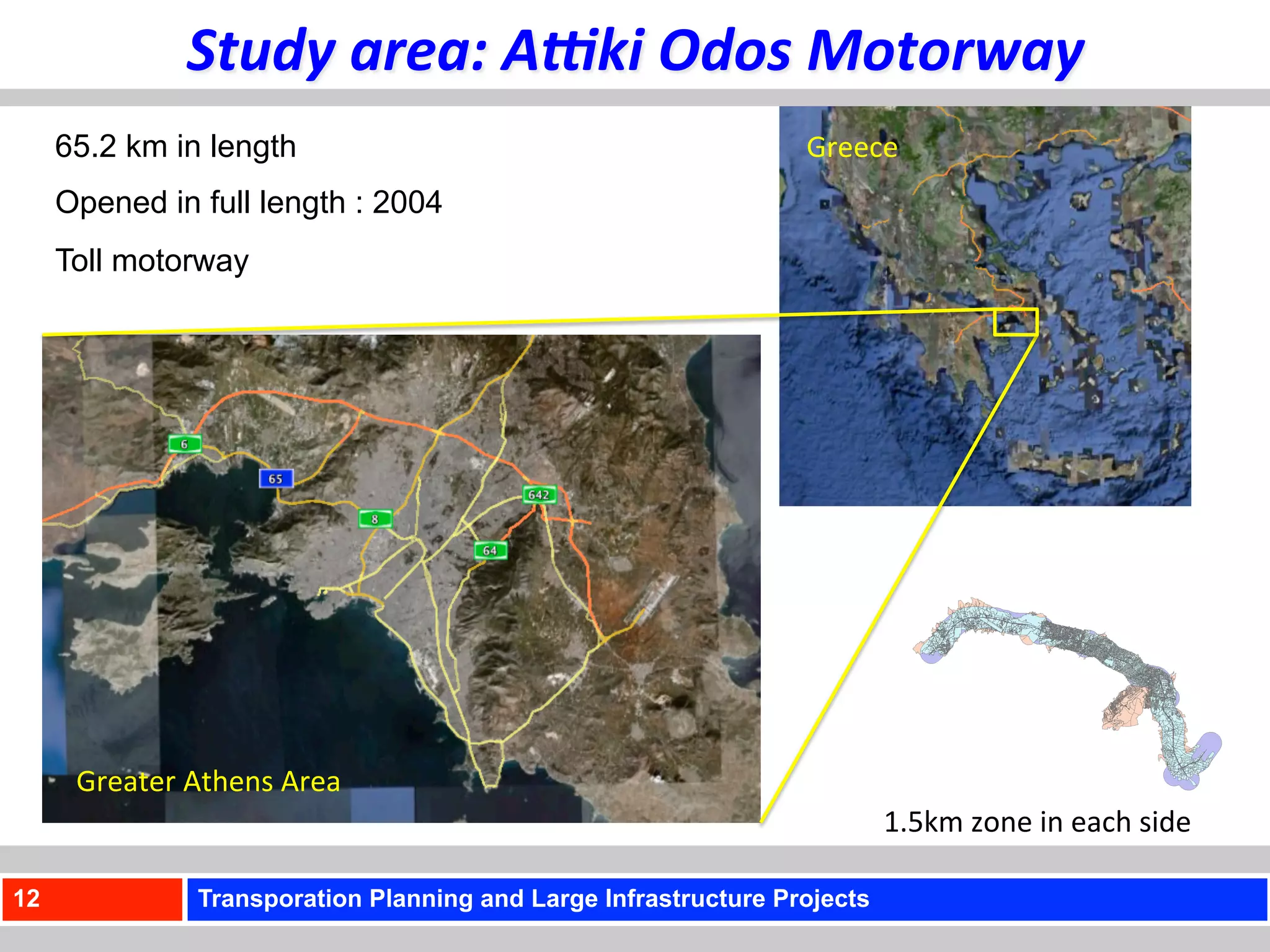
     65.2 km in length                                              Greece	
  
     Opened in full length : 2004
     Toll motorway


      Greater	
  Athens	
  Area	
  
                                                                             1.5km	
  zone	
  in	
  each	
  side	
  	
  
                                                                             of	
  the	
  motorway	
  axis	
  
12                Transporation Planning and Large Infrastructure Projects
Study	
  area:	
  A<ki	
  Odos	
  Motorway	
  
     Traffic studies in advance of the project:
     •  Rather rough analytical data background
     •  Conventional transport planning methodologies
     •  Studies were more directed
        on predicting the toll income
        than on really expected traffic
     •  Neglecting of induced traffic


13         Transporation Planning and Large Infrastructure Projects
Induced	
  Traffic	
  
     = Traffic which has not been there before the
       implementation of the new infrastructure
     1. kind:
        traffic generated by the existing land use;
        the same origins but more distant destinations

     2. kind
        traffic generated by new land use,
        which is induced by the new infrastructure


14         Transporation Planning and Large Infrastructure Projects
Induced	
  Traffic	
  
     = Traffic which has not been there before the
       implementation of the new infrastructure
     1. kind:
        well treated by adequate transportation traffic
        modeling

     2. kind
        open question


15         Transporation Planning and Large Infrastructure Projects
Case	
  study:	
  A<ki	
  Odos	
  
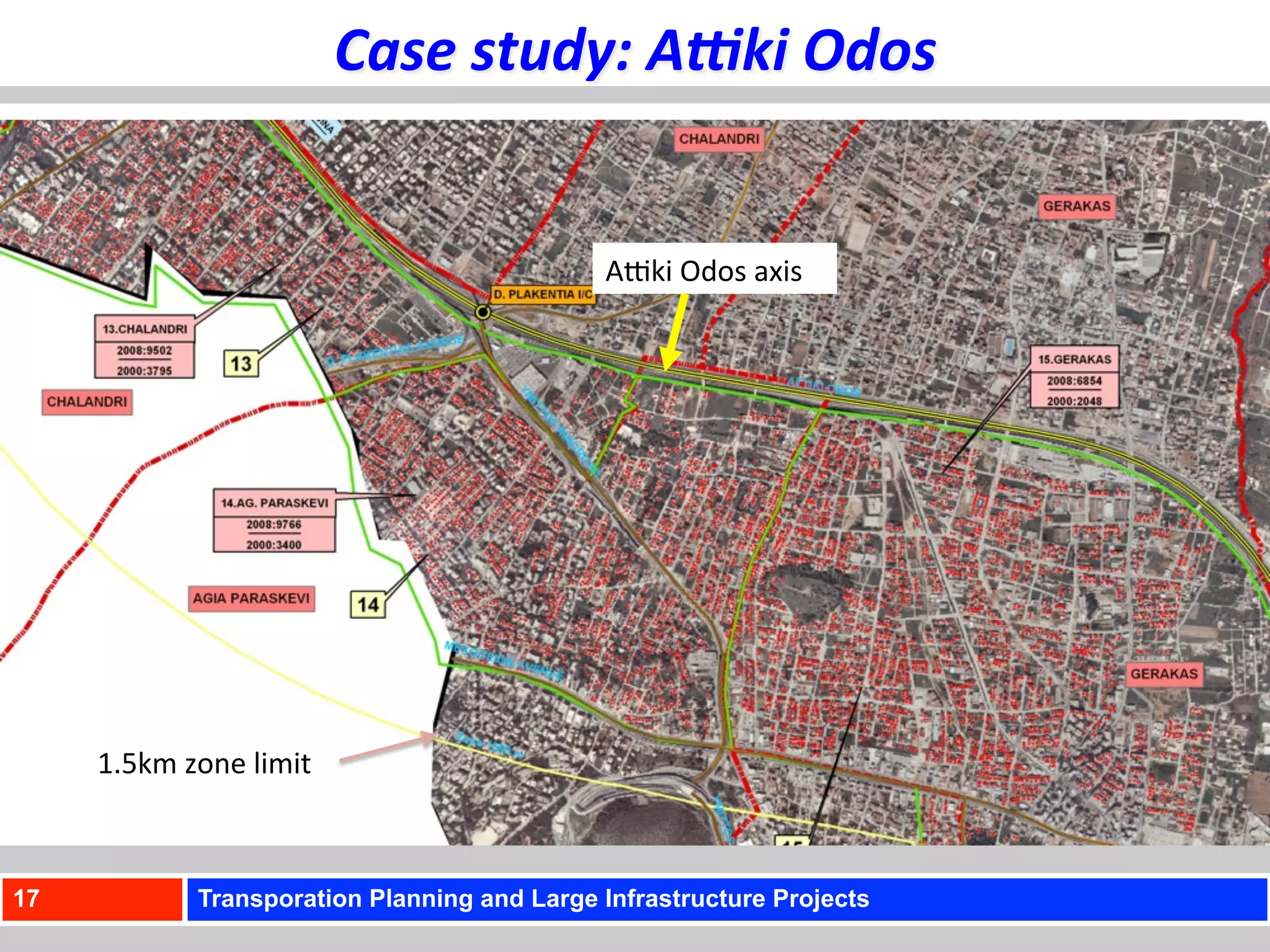
     Determination of modified land use
        before and after the opening of Attiki Odos Motorway
     •    Areal photographs
     •    Interviews


     Estimation of the number of households within a margin of 1,5
         km around the motorway


16           Transporation Planning and Large Infrastructure Projects
Case	
  study:	
  A<ki	
  Odos	


                                                 AUki	
  Odos	
  axis	


     1.5km	
  zone	
  limit	


17              Transporation Planning and Large Infrastructure Projects
Case	
  
 study	
  
results	
  
Major	
  Findings	
  

     •  Areas	
  that	
  were	
  already	
  well-­‐built-­‐up	
  prior	
  to	
  the	
  
        opera)on	
  of	
  AUki	
  Odos	
  motorway	
  show	
  more	
  
        moderate	
  growth	
  rates	
  	
  
        (s)ll	
  around	
  or	
  even	
  exceeding	
  20%	
  annually	
  	
  
        for	
  a	
  period	
  of	
  8	
  consecu)ve	
  years)	
  	
  
     •  Areas	
  that	
  were	
  less	
  developed	
  and	
  had	
  more	
  room	
  
        for	
  growth	
  show	
  annual	
  growth	
  rates	
  exceeding	
  
        50%.	


19            Transporation Planning and Large Infrastructure Projects
Case	
  study:	
  A<ki	
  Odos	
  

     •  For	
  2000,	
  the	
  number	
  of	
  households	
  in	
  the	
  influence	
  
        zone	
  in	
  2000	
  was	
  83.802	
  
     •  For	
  2008	
  the	
  number	
  of	
  households	
  in	
  the	
  influence	
  
        zone	
  (of	
  1.5km)	
  grew	
  up	
  to	


        141.038	
  households.	
  
     •  An	
  annual	
  increase	
  in	
  households	
  equal	
  to	
  8.5%	
  was	
  
        therefore	
  computed	
  for	
  the	
  en)re	
  influence	
  zone.	


20            Transporation Planning and Large Infrastructure Projects
Conclusion	
  
     •  Considera)on	
  of	
  induced	
  traffic	
  	
  
        -­‐1st	
  and	
  2nd	
  kind	


        is	
  an	
  indispensable	
  element	


  of	
  transporta)on	
  planning	


  for	
  large	
  infrastructure	
  projects	
  
     •  Tradi)onal	
  aggregated	
  modeling	
  frameworks	


  are	
  not	
  longer	
  a	
  useful	
  basis	


  for	
  traffic	
  predic)on	


  on	
  large	
  infrastructure	
  projects	
  	
  
              –  Ac)vity	
  based	
  modeling	
  
              –  Dealing	
  with	
  uncertainty	


21           Transporation Planning and Large Infrastructure Projects
Thank	
  you	
  for	
  your	
  aGen+on	
  !	


22   Transporation Planning and Large Infrastructure Projects
Mo)va)on	
  
•  Traffic	
  forecasts	
  are	
  oaen	
  underesImaIng	
  	
  
   traffic	
  demand	
  compared	
  to	
  the	
  actual	
  traffic	
  counts	


•  An	
  explana)on	
  for	
  the	
  underes)ma)on	
  can	
  be	
  
   abributed	
  to	
  the	
  non-­‐incorpora)on	
  of	
  induced	
  traffic	
  
   into	
  the	
  model	
  forecas)ng	
  	
  
•  The	
  gap	
  between	
  state-­‐of-­‐the-­‐art	
  theory	
  and	
  pracIce	
  
   appears	
  to	
  be	
  widening	
  
•  Problems	
  include:	
  
    –  “black-­‐box”	
  effect	
  
    –  lible	
  or	
  no	
  evidence	
  for	
  the	
  validity	
  of	
  the	
  input	
  data	
  used	
  
       or	
  how	
  the	
  model	
  was	
  calibrated	
  
    –  the	
  results	
  are	
  presented	
  as	
  point	
  esImates,	
  rather	
  than	
  
       interval	
  es)mates	
  based	
  on	
  a	
  probability	
  func)on,	
  with	
  
       confidence	
  limits	
  specified	
  
Objec)ve	
  
•  Provide	
  insight	
  into	
  the	
  problem	
  
•  Through	
  analysis	
  of	
  one	
  of	
  the	
  aspects	
  
    –  Lack	
  of	
  adequate	
  modeling	
  of	
  induced	
  demand	
  
•  By	
  an	
  applica)on	
  in	
  a	
  recently	
  developed	
  
   tollway	
  
    –  AUki	
  Odos	
  Tollway	
  (Athens,	
  Greece)	
  
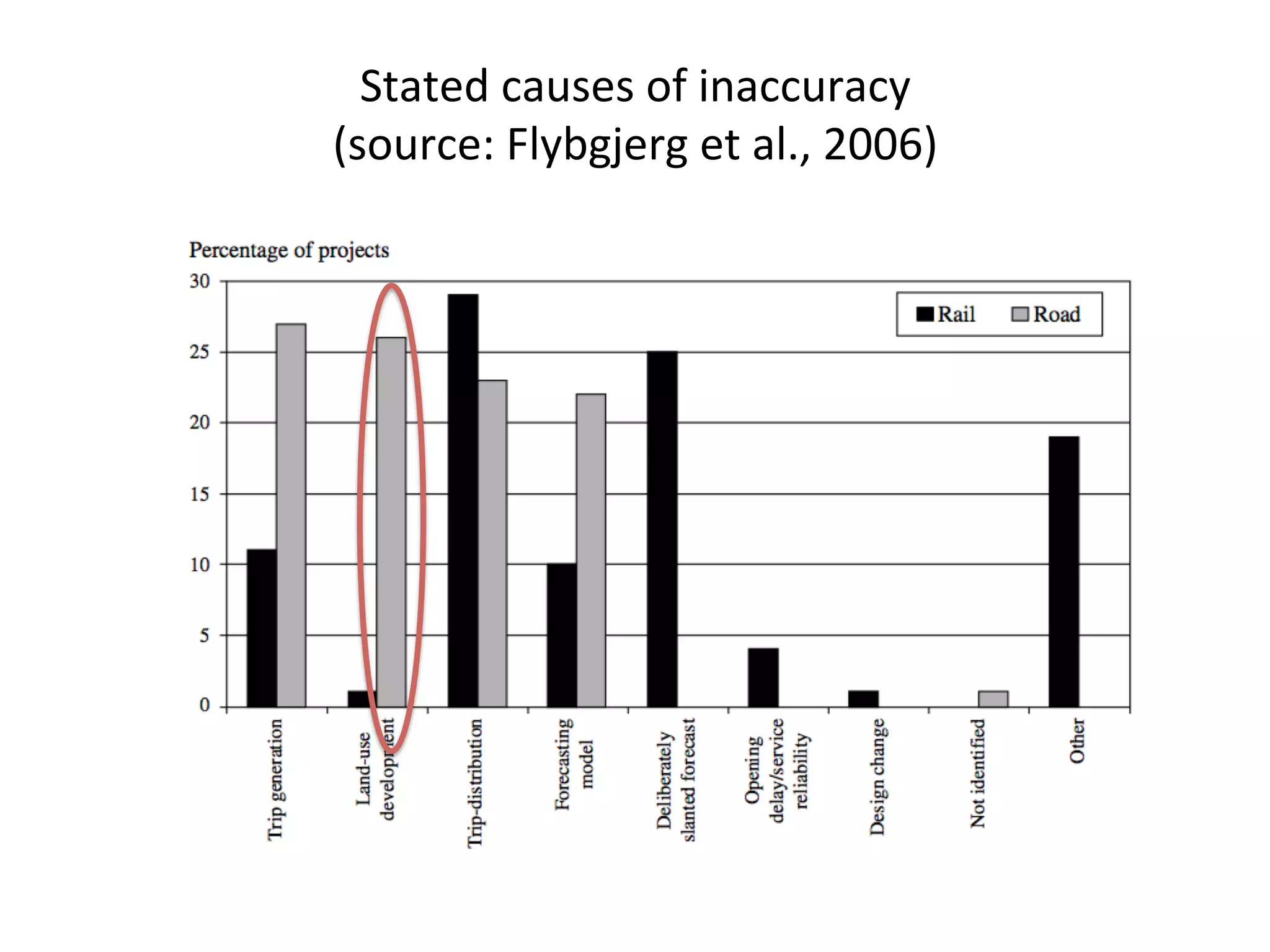
Stated	
  causes	
  of	
  inaccuracy	
  
(source:	
  Flybgjerg	
  et	
  al.,	
  2006)	
  	
  
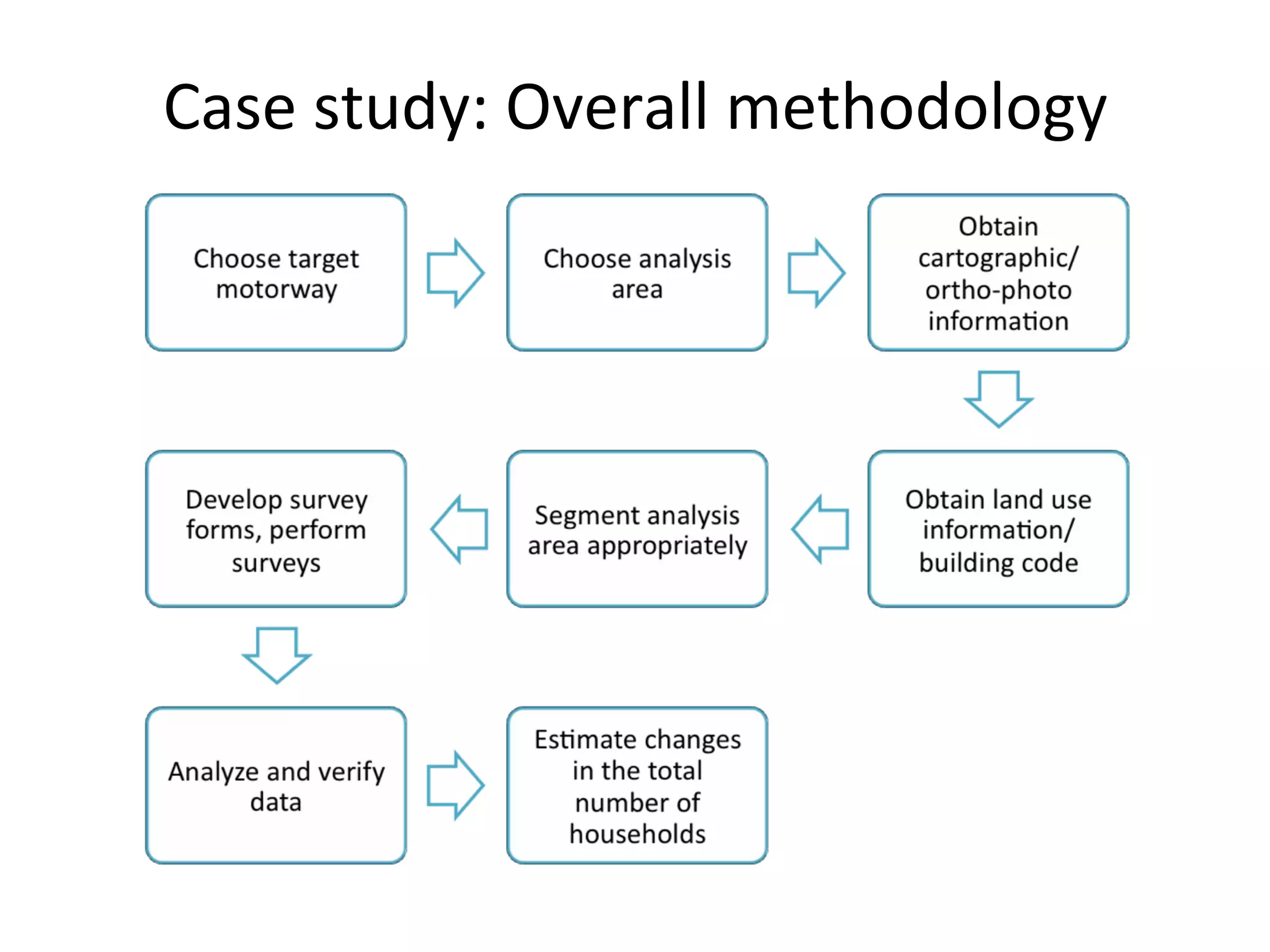
Case	
  study:	
  Overall	
  methodology	
  
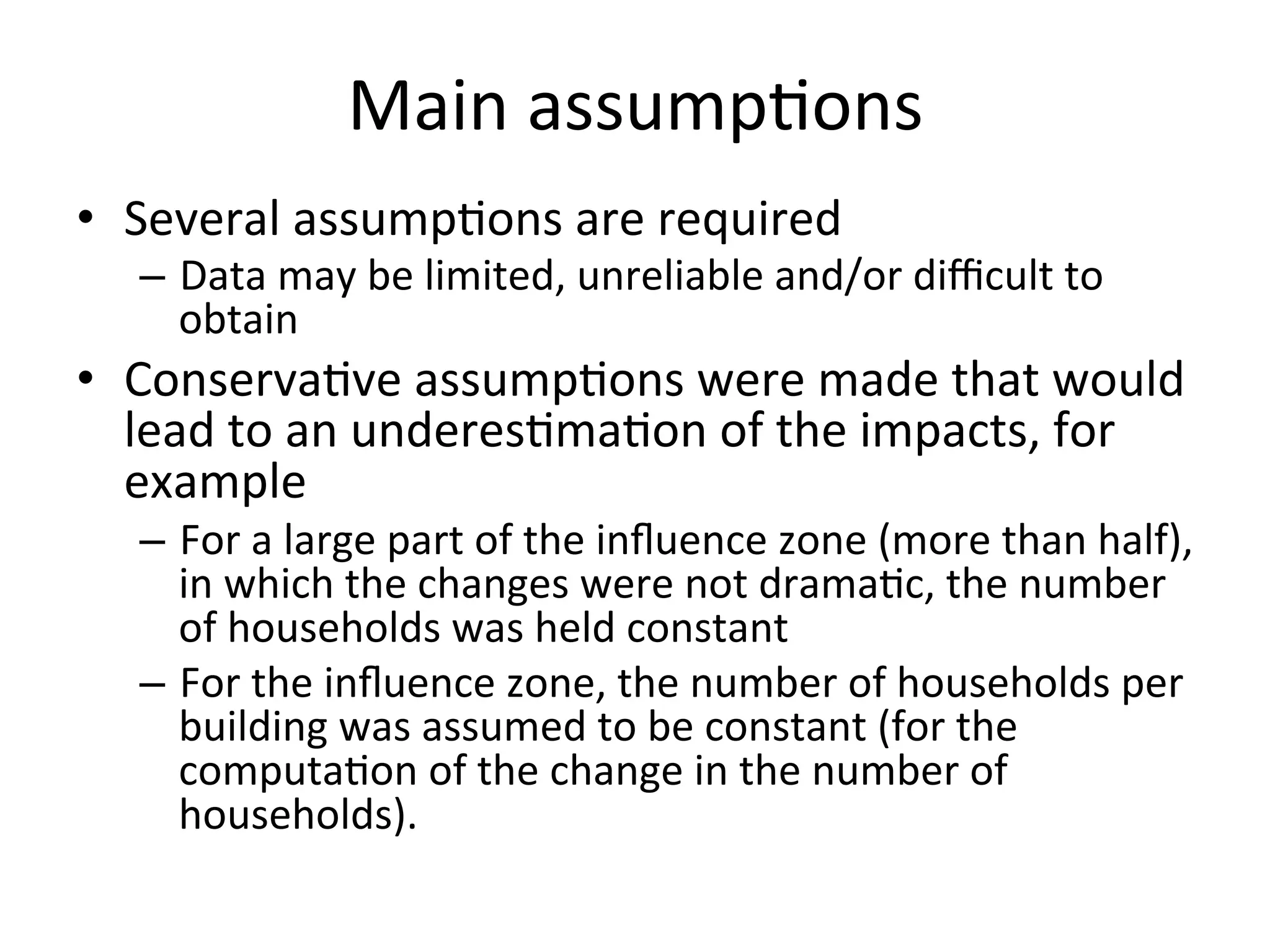
Main	
  assump)ons	
  
•  Several	
  assump)ons	
  are	
  required	
  
    –  Data	
  may	
  be	
  limited,	
  unreliable	
  and/or	
  difficult	
  to	
  
       obtain	
  
•  Conserva)ve	
  assump)ons	
  were	
  made	
  that	
  would	
  
   lead	
  to	
  an	
  underes)ma)on	
  of	
  the	
  impacts,	
  for	
  
   example	
  
    –  For	
  a	
  large	
  part	
  of	
  the	
  influence	
  zone	
  (more	
  than	
  half),	
  
       in	
  which	
  the	
  changes	
  were	
  not	
  drama)c,	
  the	
  number	
  
       of	
  households	
  was	
  held	
  constant	
  	
  
    –  For	
  the	
  influence	
  zone,	
  the	
  number	
  of	
  households	
  per	
  
       building	
  was	
  assumed	
  to	
  be	
  constant	
  (for	
  the	
  
       computa)on	
  of	
  the	
  change	
  in	
  the	
  number	
  of	
  
       households).	


Traffic Forecasting Irregularities

  • 1.
    2nd  Interna)onal  Symposium  on  Freeway  and  Tollway  Opera)ons   Honolulu,  Hawaii  –  June  21-­‐24,  2009     Irregulari)es  in  the  output  of  transport   planning  models’  forecasts  for  capital   infrastructure  planning  decisions   C.  Antoniou1,  B.  Psarianos1,  and  W.  Brilon2     1  Na)onal  Technical  University  of  Athens,  Greece   2  Ruhr-­‐University  Bochum,  Germany  
  • 2.
    2nd  Interna)onal  Symposium  on  Freeway  and  Tollway  Opera)ons   Honolulu,  Hawaii  –  June  21-­‐24,  2009       Errors  in     Transporta)on  Planning  Processes  Regarding  Large   Infrastructure  Projects     C.  Antoniou1,  B.  Psarianos1,  and  W.  Brilon2     1  Na)onal  Technical  University  of  Athens,  Greece   2  Ruhr-­‐University  Bochum,  Germany       2 Transporation Planning and Large Infrastructure Projects
  • 3.
    Outline   •  Mo)va)on  and  objec)ve   •  Background  and  evidence  from  the  literature   •  Applica)on  in  AUki  Odos  Motorway  (Athens,   Greece)     •  Findings  and  conclusion   3 Transporation Planning and Large Infrastructure Projects
  • 4.
    Mo+va+on   Motorway  AUki  Odos   Motorway  Korinthos-­‐Patra   4 Transporation Planning and Large Infrastructure Projects
  • 5.
    Mo+va+on   Motorway  AUki  Odos   Motorway  Korinthos-­‐Patra   5 Transporation Planning and Large Infrastructure Projects
  • 6.
    Experiences   Source: Halkias,B., Tyrogianni; H.: PPP Projects in Greece: The Case of Attika Tollway, Route-Roads No. 342, 2008 6 Transporation Planning and Large Infrastructure Projects
  • 7.
    Ques+ons   •  Why have the traffic forecasts been so wrong? •  What can we learn from existing experience for future projects? 7 Transporation Planning and Large Infrastructure Projects
  • 8.
    Ex  ante  -­‐  projec+ons   8 Transporation Planning and Large Infrastructure Projects
  • 9.
    Ex  post  -­‐  studies   •  Parthasarathi, Levinson (2009): •  62 % od forecasts were wrong •  Underestimating highway traffic •  Noland (2001): •  Wrong or missing effect of induced traffic •  Flybjerg e.a. (2006): •  Railway projects: 72 % overestimated •  Highway projects: 25 % of cases error > 40 % 9 Transporation Planning and Large Infrastructure Projects
  • 10.
    %  errors  in  traffic  forecasts  (Flybjerg  et  al.,  2006)     underes)ma)on   overes)ma)on   10 Transporation Planning and Large Infrastructure Projects
  • 11.
    Ex  post  -­‐  studies   •  Sammer (2006): •  Inadequate planning methods (practice = state of the art) •  Models are sometimes not understood sufficiently by planners •  Insufficient calibration of parameters and lack of validation •  Point estimation ↔ interval estimation (reliability) •  Wegener & Fuerst (1999): •  Impact of infrastructure on land use 11 Transporation Planning and Large Infrastructure Projects
  • 12.
    Study  area:  A<ki  Odos  Motorway   65.2 km in length Greece   Opened in full length : 2004 Toll motorway Greater  Athens  Area   1.5km  zone  in  each  side     of  the  motorway  axis   12 Transporation Planning and Large Infrastructure Projects
  • 13.
    Study  area:  A<ki  Odos  Motorway   Traffic studies in advance of the project: •  Rather rough analytical data background •  Conventional transport planning methodologies •  Studies were more directed on predicting the toll income than on really expected traffic •  Neglecting of induced traffic 13 Transporation Planning and Large Infrastructure Projects
  • 14.
    Induced  Traffic   = Traffic which has not been there before the implementation of the new infrastructure 1. kind: traffic generated by the existing land use; the same origins but more distant destinations 2. kind traffic generated by new land use, which is induced by the new infrastructure 14 Transporation Planning and Large Infrastructure Projects
  • 15.
    Induced  Traffic   = Traffic which has not been there before the implementation of the new infrastructure 1. kind: well treated by adequate transportation traffic modeling 2. kind open question 15 Transporation Planning and Large Infrastructure Projects
  • 16.
    Case  study:  A<ki  Odos   Determination of modified land use before and after the opening of Attiki Odos Motorway •  Areal photographs •  Interviews Estimation of the number of households within a margin of 1,5 km around the motorway 16 Transporation Planning and Large Infrastructure Projects
  • 17.
    Case  study:  A<ki  Odos   AUki  Odos  axis   1.5km  zone  limit   17 Transporation Planning and Large Infrastructure Projects
  • 18.
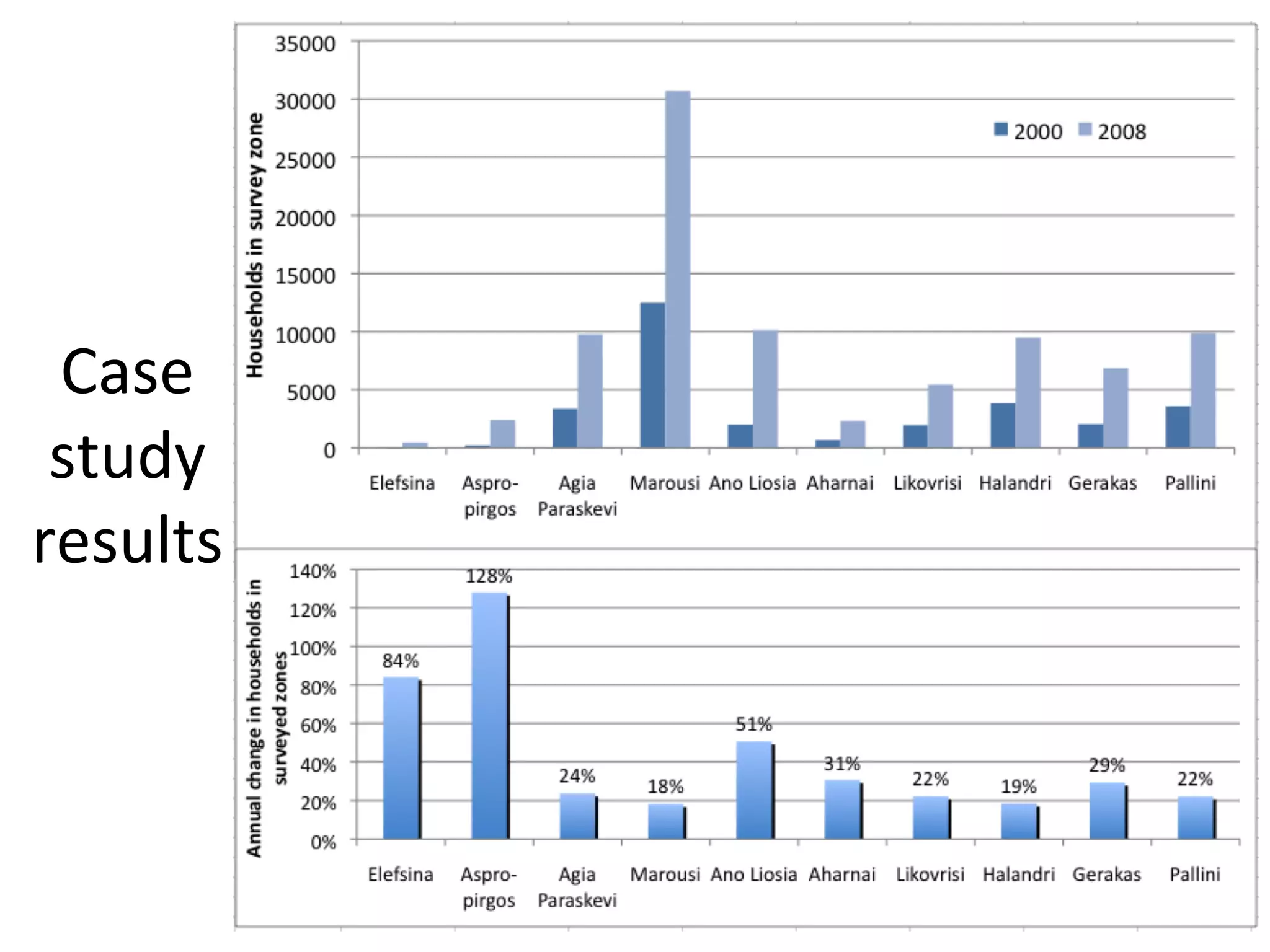
    Case   study   results  
  • 19.
    Major  Findings   •  Areas  that  were  already  well-­‐built-­‐up  prior  to  the   opera)on  of  AUki  Odos  motorway  show  more   moderate  growth  rates     (s)ll  around  or  even  exceeding  20%  annually     for  a  period  of  8  consecu)ve  years)     •  Areas  that  were  less  developed  and  had  more  room   for  growth  show  annual  growth  rates  exceeding   50%.     19 Transporation Planning and Large Infrastructure Projects
  • 20.
    Case  study:  A<ki  Odos   •  For  2000,  the  number  of  households  in  the  influence   zone  in  2000  was  83.802   •  For  2008  the  number  of  households  in  the  influence   zone  (of  1.5km)  grew  up  to       141.038  households.   •  An  annual  increase  in  households  equal  to  8.5%  was   therefore  computed  for  the  en)re  influence  zone.     20 Transporation Planning and Large Infrastructure Projects
  • 21.
    Conclusion   •  Considera)on  of  induced  traffic     -­‐1st  and  2nd  kind     is  an  indispensable  element        of  transporta)on  planning          for  large  infrastructure  projects   •  Tradi)onal  aggregated  modeling  frameworks        are  not  longer  a  useful  basis          for  traffic  predic)on            on  large  infrastructure  projects     –  Ac)vity  based  modeling   –  Dealing  with  uncertainty   21 Transporation Planning and Large Infrastructure Projects
  • 22.
    Thank  you  for  your  aGen+on  !   22 Transporation Planning and Large Infrastructure Projects
  • 25.
    Mo)va)on   •  Traffic  forecasts  are  oaen  underesImaIng     traffic  demand  compared  to  the  actual  traffic  counts       •  An  explana)on  for  the  underes)ma)on  can  be   abributed  to  the  non-­‐incorpora)on  of  induced  traffic   into  the  model  forecas)ng     •  The  gap  between  state-­‐of-­‐the-­‐art  theory  and  pracIce   appears  to  be  widening   •  Problems  include:   –  “black-­‐box”  effect   –  lible  or  no  evidence  for  the  validity  of  the  input  data  used   or  how  the  model  was  calibrated   –  the  results  are  presented  as  point  esImates,  rather  than   interval  es)mates  based  on  a  probability  func)on,  with   confidence  limits  specified  
  • 26.
    Objec)ve   •  Provide  insight  into  the  problem   •  Through  analysis  of  one  of  the  aspects   –  Lack  of  adequate  modeling  of  induced  demand   •  By  an  applica)on  in  a  recently  developed   tollway   –  AUki  Odos  Tollway  (Athens,  Greece)  
  • 27.
    Stated  causes  of  inaccuracy   (source:  Flybgjerg  et  al.,  2006)    
  • 28.
    Case  study:  Overall  methodology  
  • 29.
    Main  assump)ons   • Several  assump)ons  are  required   –  Data  may  be  limited,  unreliable  and/or  difficult  to   obtain   •  Conserva)ve  assump)ons  were  made  that  would   lead  to  an  underes)ma)on  of  the  impacts,  for   example   –  For  a  large  part  of  the  influence  zone  (more  than  half),   in  which  the  changes  were  not  drama)c,  the  number   of  households  was  held  constant     –  For  the  influence  zone,  the  number  of  households  per   building  was  assumed  to  be  constant  (for  the   computa)on  of  the  change  in  the  number  of   households).