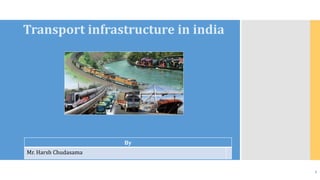
Transport infrastructure in india
By
Mr. Harsh Chudasama
1
CONTENTS
INTRODUCTION
TYPE OF TRANSPORT SYSTEM
RAILWAY TRANSPORT
ROAD & HIGHWAY TRANSPORT
AIRWAY TRANSPORT
WATERWAY TRANSPORT
CONCLUSION
2
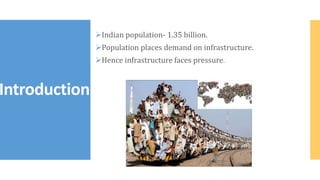
Indian population- 1.35 billion.
Population places demand on infrastructure.
Hence infrastructure faces pressure.
Introduction
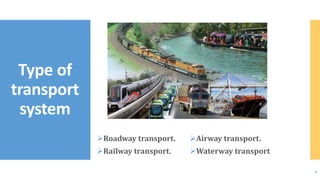
Roadway transport.
Railway transport.
Type of
transport
system
4
Airway transport.
Waterway transport
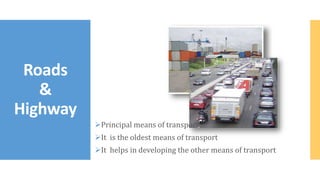
Principal means of transport
It is the oldest means of transport
It helps in developing the other means of transport
Roads
&
Highway
India has the second largest road network in the world.
National highways account for 1.7 % Of total network in
India.
Double-lane highways constitutes the largest share of
highways in India.
Proposal For Infrastructure - In order to boost the
transport infrastructure in the country the Union Budget
has provided for about Rs 1.70 Lakh Crore.
Roads
&
Highway
6
Less capital outlay (cost of constructing, operating and
maintaining roads)
Door to door service (warehouse to warehouse)
Service in rural areas
Flexible service (alternative ways, if any road is blocked)
Suitable for short distance
Lesser risk of damage in transit
Rapid speed
Personal services(people have their own vehicles)
Roads
&
Highway
Advantages
7
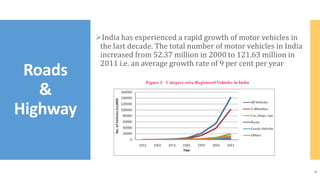
India has experienced a rapid growth of motor vehicles in
the last decade. The total number of motor vehicles in India
increased from 52.37 million in 2000 to 121.63 million in
2011 i.e. an average growth rate of 9 per cent per year
Roads
&
Highway
8
In the roads sector, the policy thrust is on increased
categorisation of national highways (from the current 1.3
lakh kms to 2.0 lakh kms), building expressways,
increased use of electronic tolling and advanced
technologies for traffic control.
The Delhi-Mumbai expressway is getting immediate
attention. This sector has experimented with different
forms of PPPs, including Build Operate Transfer (BOT),
Hybrid Annuity Model (HAM) and Toll Operate Transfer
(TOT), enabling more projects to be undertaking.
Roads
&
Highway
9
Delhi-Mumbai Expressway is to be completed by 2023
while the work on the 262-km-long Bengaluru-Chennai
Expressway will commence within six months.
The six-lane, access-controlled expressway begins at
Hoskote in Karnataka and ends at Outer Ring Road near
Chennai. The project, which is being implemented under
the public-private partnership, is likely to reduce travel
time between Chennai and Bangalore to four hours.
12 lots of highway bundles totaling ₹60,000 crores would
be monetized before 2024. The Govt can utilize these funds
to build newer roads.
Roads
&
Highway
10
Delay in land acquisition,
Delay in obtaining forest/ environment clearances,
Lack of infrastructure support and linkages, delay in tie-up
of project financing,
Delay in finalisation of detailed engineering, change in
scope,
Delay in tendering, ordering & equipment supply, law &
order problems,
Geological surprises, pre-commissioning teething troubles
and contractual issues.
Roads
&
Highway
Challenges
11
NHAI –National highway authority of india
BRO-border road organisation.
 Both have their headquarters in delhi
Example of highway
 North –South Corridor >>linking shrinagar –kanya kumara
 East – West Corridor >>linking silchar (Assam)–porbandar
Road &
highways
12
Indian Railways (IR) is the third largest transportation and
logistics network of the world operating 21,000 plus trains
per day.
Network spans more than 64,600 kms.
 It runs around 13,000 trains to carry over 23 million
passengers per day connecting about 8,000 stations spread
across the subcontinent.
Worlds largest passenger carrier.
Railway
13
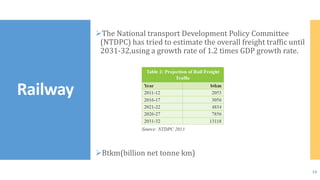
The National transport Development Policy Committee
(NTDPC) has tried to estimate the overall freight traffic until
2031-32,using a growth rate of 1.2 times GDP growth rate.
Btkm(billion net tonne km)
Railway
14
Bhairabi Sairang railway project: In the state of Mizoram, the capital,
Aizawl to get Indian Railways connectivity through the 51 km long
Bhairabi Sairang project, which is expected to be completed by March
2023.
Dimapur-Kohima railway project: In the state of Nagaland, the
capital, Kohima to get the rail network through 82 km long Dimapur-
Kohima project. This rail project is expected to be completed by the
month of March 2023.
Teteliya-Byrnihat railway project: The capital of Meghalaya, Shillong
will be connected to the Indian Railways network through the 22 km
long Teteliya-Byrnihat project. This railway project is likely to be
completed by March 2022.
Sivok-Rangpo railway project: The capital of Sikkim, Gangtok will get
Indian Railways connectivity through the 44 km long Sivok-Rangpo
railway project.
Railway
15
Development and renewal of railways: Construction of
new lines and re-development of four stations.
Construction of 148-km Bengaluru suburban transport
project at a cost of ₹18,600 crores will be started, which
would have fared on the metro model.
Track renewal and introduction of more Tejas type
trains to iconic tourist destinations.
Corporate Train: It will run by IRCTC between Indore and
Varanasi.
Operation of 150 passenger trains via public-private
partnership (PPP) mode.
Setting up a large solar power capacity alongside the rail
tracks.
Railway
16
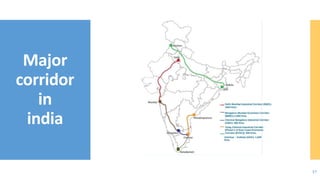
Major
corridor
in
india
17
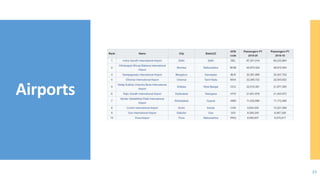
The mobility of men and material by air is called air
transport.
It is the fastest means of transport.
It is very useful for long distances and saves time.
Airports
18
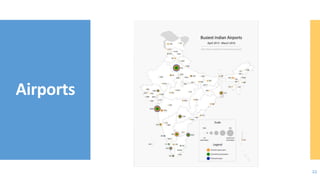
486 total airports, airstrips, flying schools and military
bases available in the country
123 airports with scheduled commercial flights including
some with dual civilian and army use
34 international airports
Airports
19
In the airports sector, there are two focus areas. The first is
on increasing capacity and services levels in the top 30
airports, primarily through the PPP route.
The second is on increasing the number of airports to
about 100 and ensuring that all tier II and many tier III
cities have own airports.
Regarding the increase in airports to serve lower ties cities,
the issue is one of viability. Attracting PPP’s may be difficult
in such airports, though with appropriate viability gap
funding/ subsidies, it is workable.
Airports
20
Airports
21
Airports
22
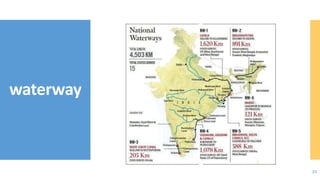
The government approved the proposal for enactment of
central legislation for declaring 101 additional inland
waterways as national waterway for navigation.
Inland water transport (IWT) is world over recognised as a
fuel efficient, cost effective and an environment friendly
mode of transport, especially for bulk goods, hazardous
goods and over dimensional cargo. The enormous socio-
economic and environmental advantages of IWT mode of
transportation over other modes such a
waterway
23
 Cost savings: HP moves 150 kg on road, 500 kg on rail and 4000 kg on
water. litre of fuel moves 24 t-km on road, 85 on rail and 105 on IWT..
Cost of developing waterways is much lower than rail & road. Reduces
transportation and transition losses.
Environment friendly:Least fuel consumption per tonne - km. CO2
emission is 50 percent that of trucks. Negligible land requirement. Safe
mode for hazardous and over dimensional cargo.
 Supplementary mode: Reduces pressure on road and rail. Reduces
congestion and accidents on road.
In view of the large network of inland waterways in India, there is vast
potential in IWT to act as an alternate
Advantages
of
Waterway
24
waterway
25
Conclusion
26
India’s growth story should no longer be impeded by a lack of
efficient transport infrastructure, and the fruits of growth
should reach everyone in the remotest part of the country
THANK YOU
27

Transport infrastructure in india

  • 1.
    Transport infrastructure inindia By Mr. Harsh Chudasama 1
  • 2.
    CONTENTS INTRODUCTION TYPE OF TRANSPORTSYSTEM RAILWAY TRANSPORT ROAD & HIGHWAY TRANSPORT AIRWAY TRANSPORT WATERWAY TRANSPORT CONCLUSION 2
  • 3.
    Indian population- 1.35billion. Population places demand on infrastructure. Hence infrastructure faces pressure. Introduction
  • 4.
    Roadway transport. Railway transport. Typeof transport system 4 Airway transport. Waterway transport
  • 5.
    Principal means oftransport It is the oldest means of transport It helps in developing the other means of transport Roads & Highway
  • 6.
    India has thesecond largest road network in the world. National highways account for 1.7 % Of total network in India. Double-lane highways constitutes the largest share of highways in India. Proposal For Infrastructure - In order to boost the transport infrastructure in the country the Union Budget has provided for about Rs 1.70 Lakh Crore. Roads & Highway 6
  • 7.
    Less capital outlay(cost of constructing, operating and maintaining roads) Door to door service (warehouse to warehouse) Service in rural areas Flexible service (alternative ways, if any road is blocked) Suitable for short distance Lesser risk of damage in transit Rapid speed Personal services(people have their own vehicles) Roads & Highway Advantages 7
  • 8.
    India has experienceda rapid growth of motor vehicles in the last decade. The total number of motor vehicles in India increased from 52.37 million in 2000 to 121.63 million in 2011 i.e. an average growth rate of 9 per cent per year Roads & Highway 8
  • 9.
    In the roadssector, the policy thrust is on increased categorisation of national highways (from the current 1.3 lakh kms to 2.0 lakh kms), building expressways, increased use of electronic tolling and advanced technologies for traffic control. The Delhi-Mumbai expressway is getting immediate attention. This sector has experimented with different forms of PPPs, including Build Operate Transfer (BOT), Hybrid Annuity Model (HAM) and Toll Operate Transfer (TOT), enabling more projects to be undertaking. Roads & Highway 9
  • 10.
    Delhi-Mumbai Expressway isto be completed by 2023 while the work on the 262-km-long Bengaluru-Chennai Expressway will commence within six months. The six-lane, access-controlled expressway begins at Hoskote in Karnataka and ends at Outer Ring Road near Chennai. The project, which is being implemented under the public-private partnership, is likely to reduce travel time between Chennai and Bangalore to four hours. 12 lots of highway bundles totaling ₹60,000 crores would be monetized before 2024. The Govt can utilize these funds to build newer roads. Roads & Highway 10
  • 11.
    Delay in landacquisition, Delay in obtaining forest/ environment clearances, Lack of infrastructure support and linkages, delay in tie-up of project financing, Delay in finalisation of detailed engineering, change in scope, Delay in tendering, ordering & equipment supply, law & order problems, Geological surprises, pre-commissioning teething troubles and contractual issues. Roads & Highway Challenges 11
  • 12.
    NHAI –National highwayauthority of india BRO-border road organisation.  Both have their headquarters in delhi Example of highway  North –South Corridor >>linking shrinagar –kanya kumara  East – West Corridor >>linking silchar (Assam)–porbandar Road & highways 12
  • 13.
    Indian Railways (IR)is the third largest transportation and logistics network of the world operating 21,000 plus trains per day. Network spans more than 64,600 kms.  It runs around 13,000 trains to carry over 23 million passengers per day connecting about 8,000 stations spread across the subcontinent. Worlds largest passenger carrier. Railway 13
  • 14.
    The National transportDevelopment Policy Committee (NTDPC) has tried to estimate the overall freight traffic until 2031-32,using a growth rate of 1.2 times GDP growth rate. Btkm(billion net tonne km) Railway 14
  • 15.
    Bhairabi Sairang railwayproject: In the state of Mizoram, the capital, Aizawl to get Indian Railways connectivity through the 51 km long Bhairabi Sairang project, which is expected to be completed by March 2023. Dimapur-Kohima railway project: In the state of Nagaland, the capital, Kohima to get the rail network through 82 km long Dimapur- Kohima project. This rail project is expected to be completed by the month of March 2023. Teteliya-Byrnihat railway project: The capital of Meghalaya, Shillong will be connected to the Indian Railways network through the 22 km long Teteliya-Byrnihat project. This railway project is likely to be completed by March 2022. Sivok-Rangpo railway project: The capital of Sikkim, Gangtok will get Indian Railways connectivity through the 44 km long Sivok-Rangpo railway project. Railway 15
  • 16.
    Development and renewalof railways: Construction of new lines and re-development of four stations. Construction of 148-km Bengaluru suburban transport project at a cost of ₹18,600 crores will be started, which would have fared on the metro model. Track renewal and introduction of more Tejas type trains to iconic tourist destinations. Corporate Train: It will run by IRCTC between Indore and Varanasi. Operation of 150 passenger trains via public-private partnership (PPP) mode. Setting up a large solar power capacity alongside the rail tracks. Railway 16
  • 17.
  • 18.
    The mobility ofmen and material by air is called air transport. It is the fastest means of transport. It is very useful for long distances and saves time. Airports 18
  • 19.
    486 total airports,airstrips, flying schools and military bases available in the country 123 airports with scheduled commercial flights including some with dual civilian and army use 34 international airports Airports 19
  • 20.
    In the airportssector, there are two focus areas. The first is on increasing capacity and services levels in the top 30 airports, primarily through the PPP route. The second is on increasing the number of airports to about 100 and ensuring that all tier II and many tier III cities have own airports. Regarding the increase in airports to serve lower ties cities, the issue is one of viability. Attracting PPP’s may be difficult in such airports, though with appropriate viability gap funding/ subsidies, it is workable. Airports 20
  • 21.
  • 22.
  • 23.
    The government approvedthe proposal for enactment of central legislation for declaring 101 additional inland waterways as national waterway for navigation. Inland water transport (IWT) is world over recognised as a fuel efficient, cost effective and an environment friendly mode of transport, especially for bulk goods, hazardous goods and over dimensional cargo. The enormous socio- economic and environmental advantages of IWT mode of transportation over other modes such a waterway 23
  • 24.
     Cost savings:HP moves 150 kg on road, 500 kg on rail and 4000 kg on water. litre of fuel moves 24 t-km on road, 85 on rail and 105 on IWT.. Cost of developing waterways is much lower than rail & road. Reduces transportation and transition losses. Environment friendly:Least fuel consumption per tonne - km. CO2 emission is 50 percent that of trucks. Negligible land requirement. Safe mode for hazardous and over dimensional cargo.  Supplementary mode: Reduces pressure on road and rail. Reduces congestion and accidents on road. In view of the large network of inland waterways in India, there is vast potential in IWT to act as an alternate Advantages of Waterway 24
  • 25.
  • 26.
    Conclusion 26 India’s growth storyshould no longer be impeded by a lack of efficient transport infrastructure, and the fruits of growth should reach everyone in the remotest part of the country
  • 27.