Bridging the Gap
Strategies for Transit and Active Transportation
Next Generation Transportation Certificate
Happy Projects
Stories of success are often similar.
Stories of failure are plentiful, diverse, and entertaining.
Course Outline
1. Introduction
2. Define Strategies and Skills
3. Positive and Negative Examples
Approximately 45 minutes
Course Presenter
Dan Ross, CPEng. (NZ), MUP
Senior Transportation Planner,
Opus International Consultants, Ltd.
North Vancouver, British Columbia, Canada
Formerly
- Transit Planner – Edmonton Transit System
- Senior Transportation Consultant – Opus, Auckland, NZ
- Traffic Planner/Borough Planner – New York City DOT
- Associate City Planner – New York City DCP
Why This Topic?
Similarities towards active
transportation and transit
Burden of proof is on you
- Gatekeepers
- Prejudices
- Responsive strategies
- Different delivery and outcomes
Why This Topic?
High Level plans have
similar intentions
• Higher PT/AT trips
• Reduced emissions
• Denser development
• Translate ‘down’ to
specific plans
New York, NY
Auckland, NZ
Vancouver, BC
Edmonton, AB
A Common Path
High Level Policy
Priority Statement
Program/Schedule of Projects
Feasibility?
Planners
Engineers
Investigation
Some Success
1st Ave Complete Street –
New York, NY
Dunsmuir St. bike lanes –
Vancouver, BC
Beach Rd cycle lanes –
Auckland, NZ
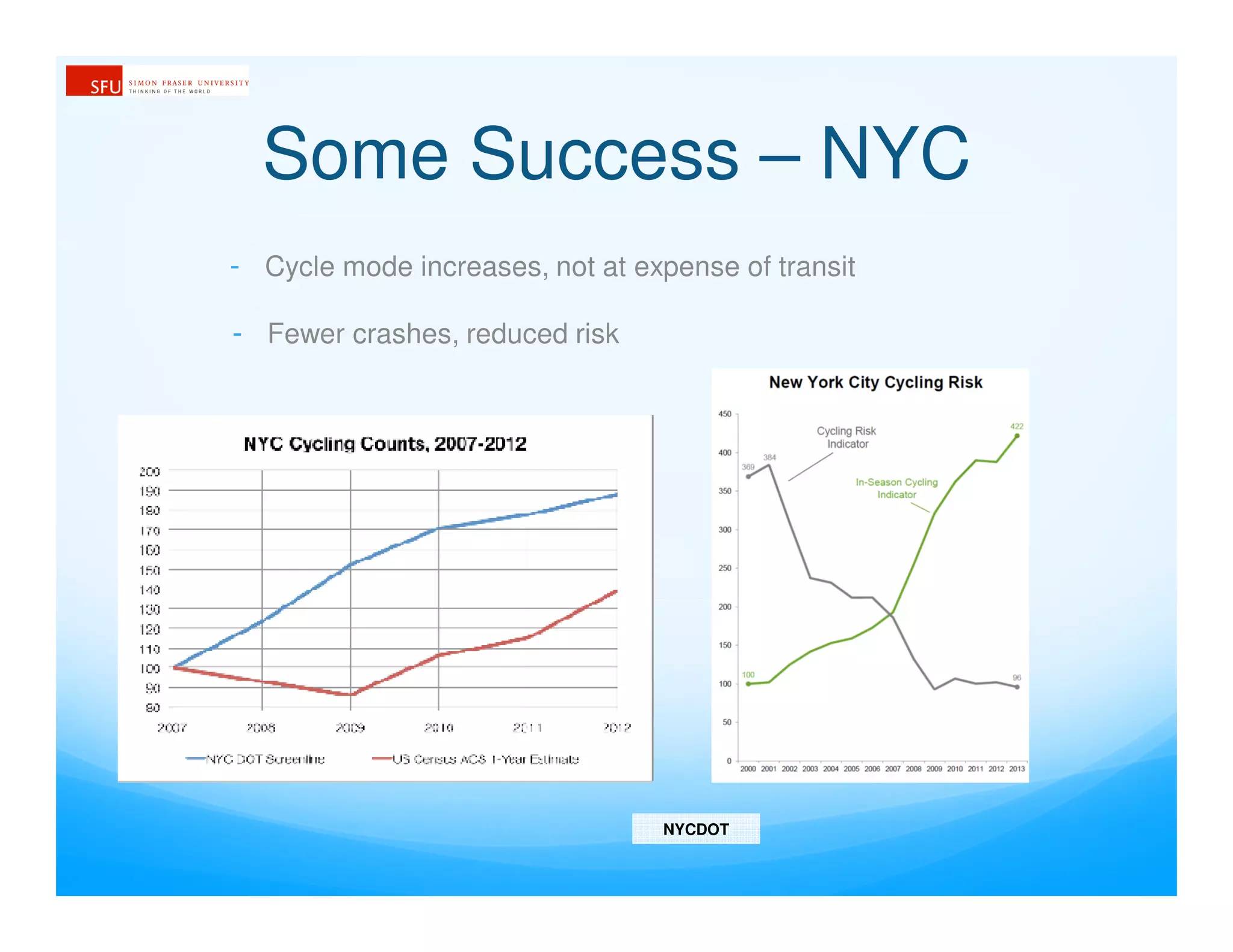
Some Success – NYC
NYCDOT
- Cycle mode increases, not at expense of transit
- Fewer crashes, reduced risk
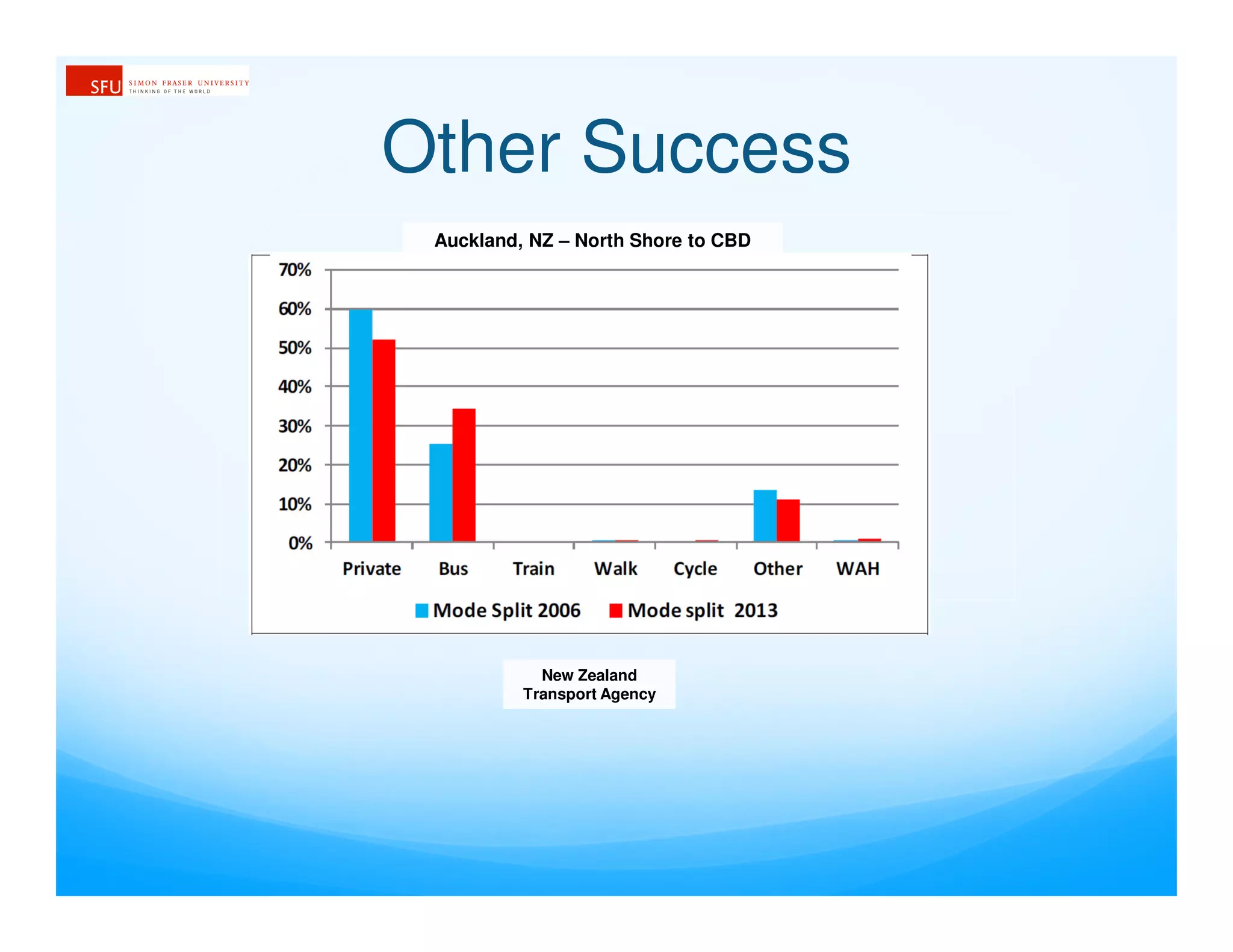
Other Success
Auckland, NZ – North Shore to CBD
New Zealand
Transport Agency
Other Success
Vancouver, BC
City of Vancouver
Metro Vancouver
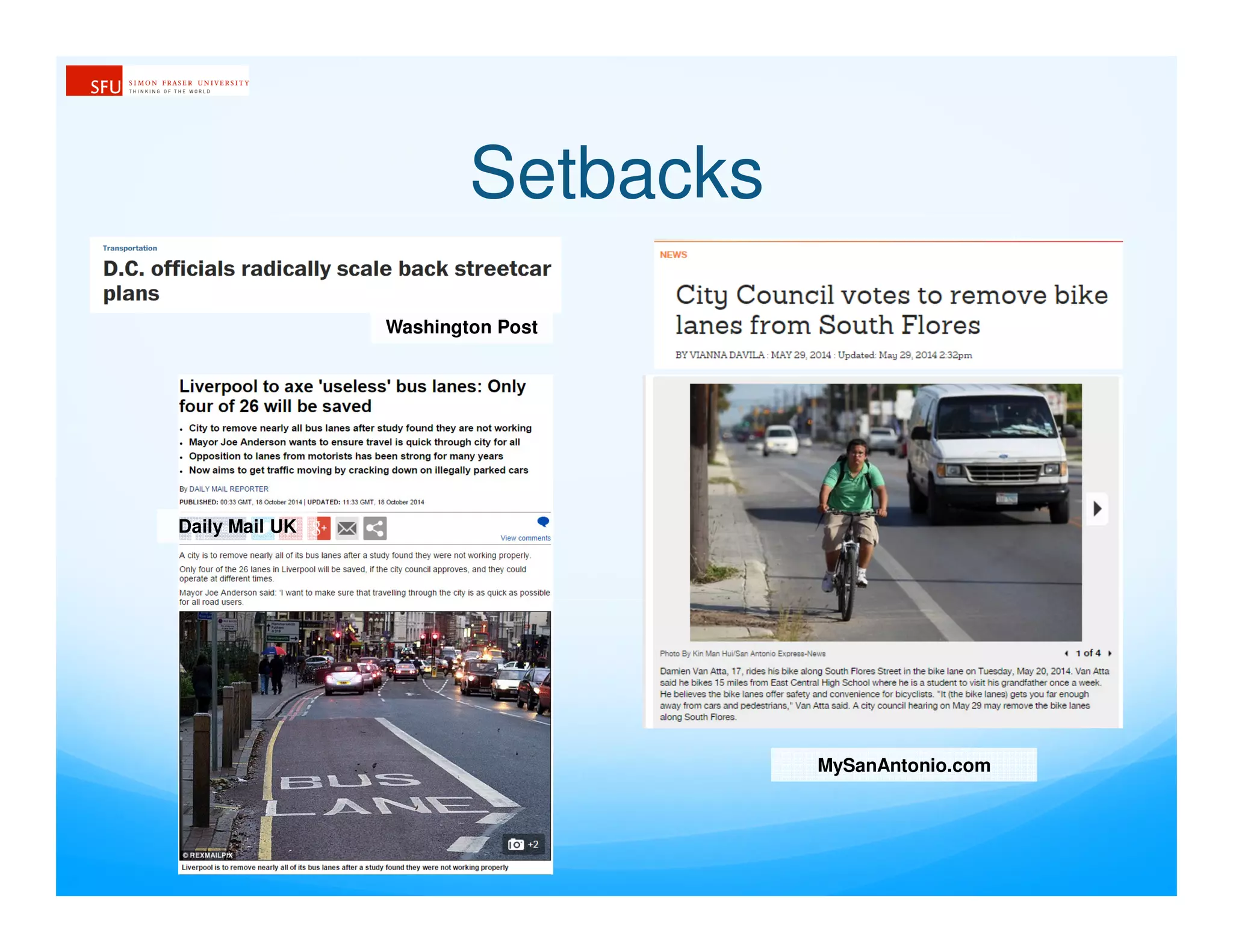
Setbacks
Daily Mail UK
MySanAntonio.com
Washington Post
Setbacks
Toronto Sun
Gothamist NYC
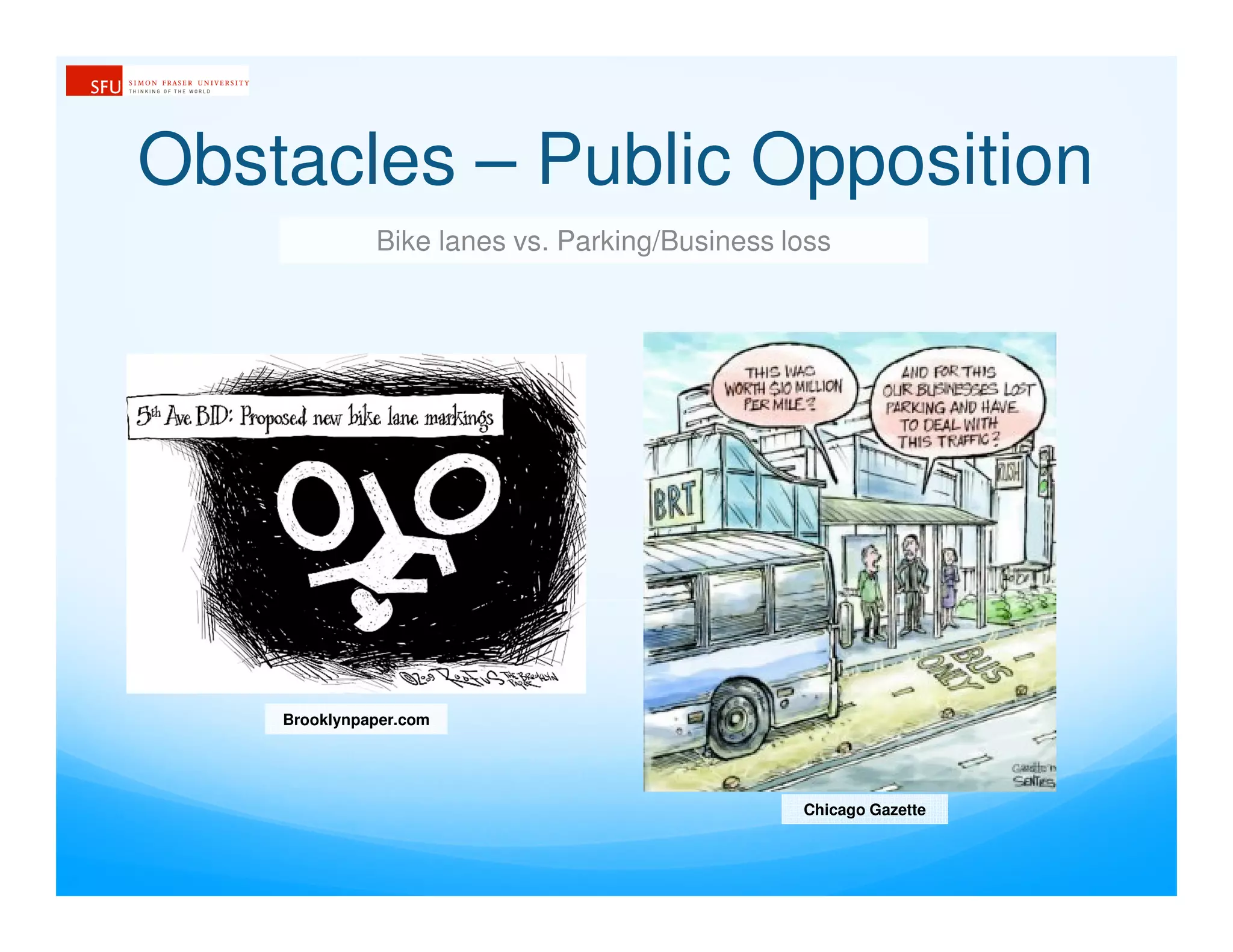
Obstacles – Public Opposition
Bike lanes vs. Parking/Business loss
Brooklynpaper.com
Chicago Gazette
Obstacles – Public Opposition
Malcolm MayesElitism/’Social Engineering’ Edmonton Sun
NY Daily News
The Onion
Old Perceptions Dying Hard
‘Boondoggle’ and Public Menace Double Standard
New Zealand Herald, 2007
Old Perceptions Dying Hard
Calgary Sun
NY Daily News
‘Boondoggle’ and Public Menace Double Standard
What Could Possibly Go Wrong?
High Level Policy
Priority Statement
Program/Schedule of Projects
Feasibility?
Planners
Engineers
Investigation
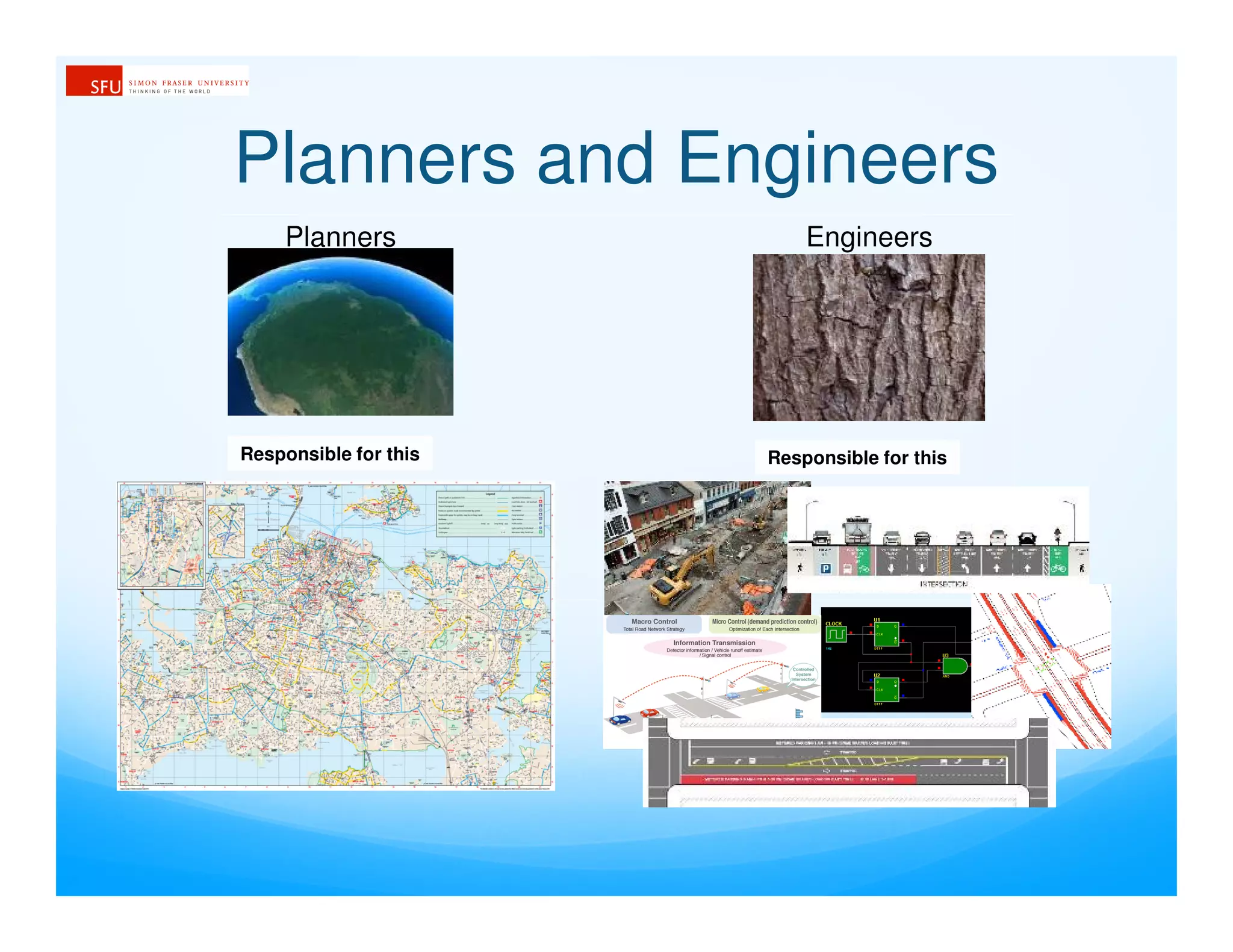
Planners and Engineers
Planners Engineers
Responsible for this Responsible for this
Traffic Engineers
Decision Making Factors
• Applied Precedence
• Common Sense
• Methodology
• Ethics
• Empathy - for motorists
Engineers are people, too
Considerations
• Design/Engineering Standards Guidelines
• Need for defensible decisions
• What’s worked before?
Guiding Methodology
1. Effects on Traffic – short and long term
2. Constructability – how much and where?
3. Whole life costs – operations and maintenance
Minimal Considerations
‘Business Case’
1. Traffic Impacts
2. Constructability
3. Operations and Maintenance
4. Other elements to consider
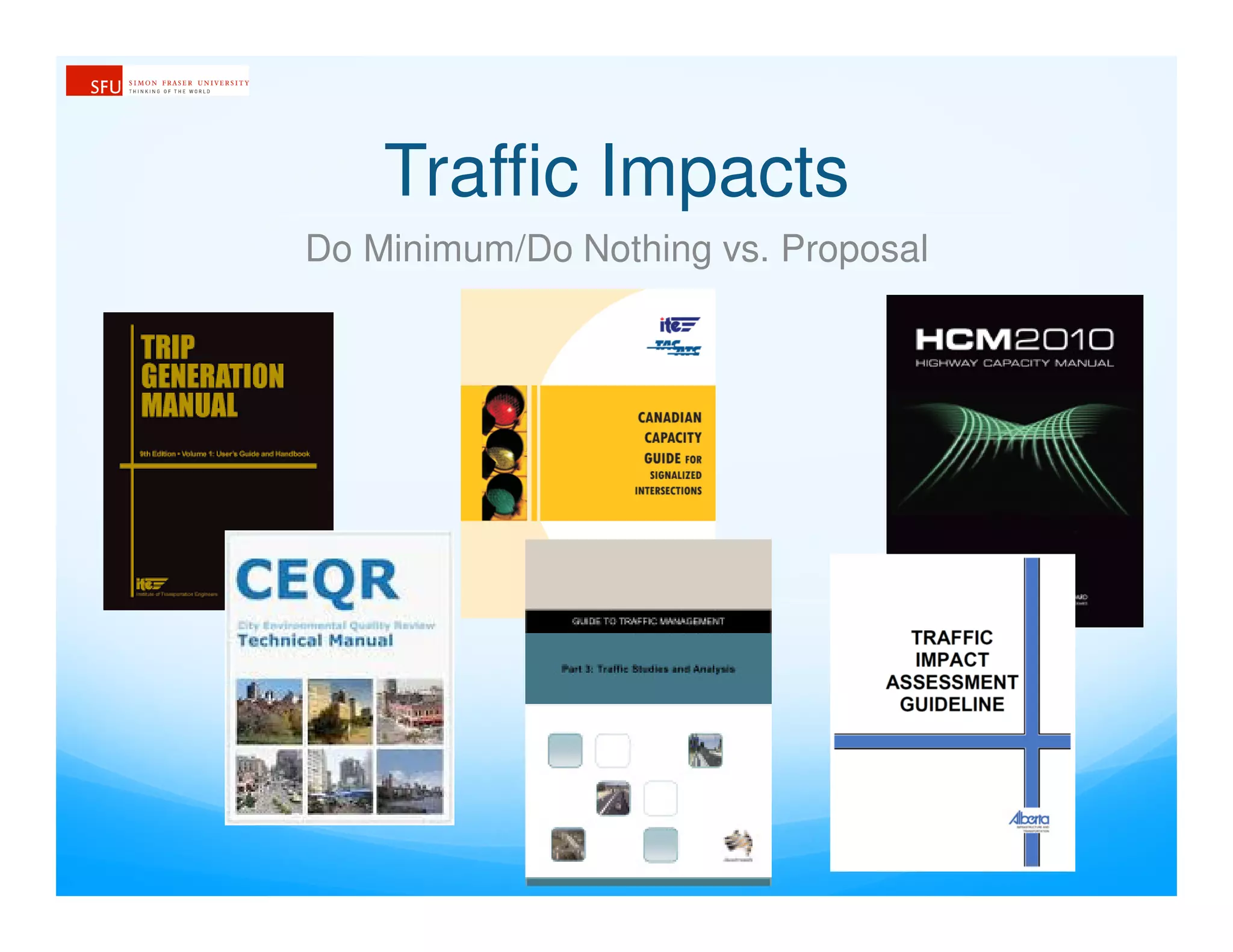
Traffic Impacts
Do Minimum/Do Nothing vs. Proposal
2. What will happen to affected/displaced traffic?
- modelling, route analyses, mode shift?
Traffic Impacts
Be Prepared to Discuss
1. What is an ‘acceptable’ impact?
- i.e., LOS, v/c ratio, peak impacts
3. How many people are affected? Not just cars
- Quantify comparative impacts
Example 1
Broadway Blvd – New York, NY
• Road diet for major
Manhattan street; 33rd
St – 59th St
• Not possible without
extensive network
modelling
• Led to Greenlight for
Midtown projects
• Continuously
monitored and updated
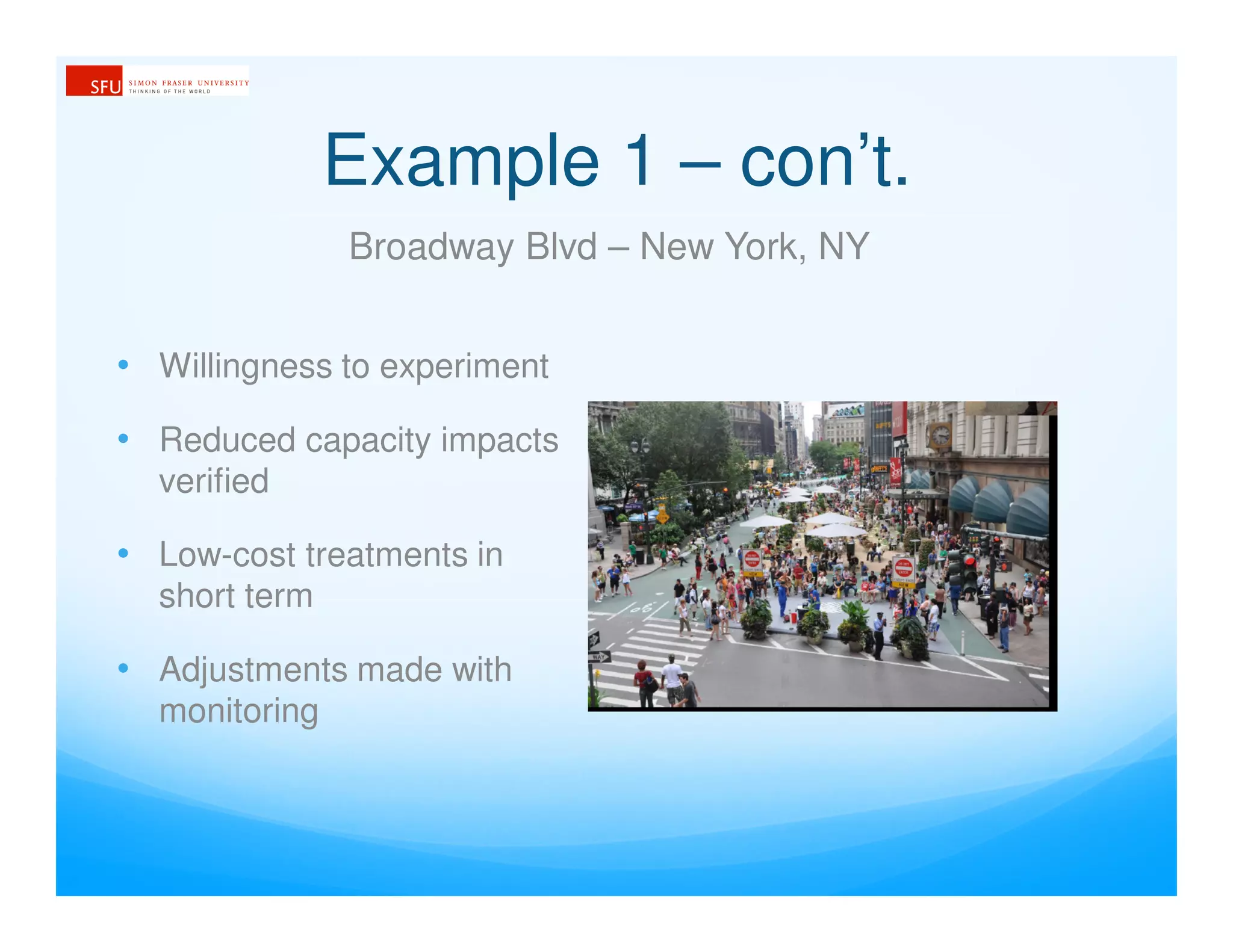
Example 1 – con’t.
Broadway Blvd – New York, NY
• Willingness to experiment
• Reduced capacity impacts
verified
• Low-cost treatments in
short term
• Adjustments made with
monitoring
Example 1 – con’t.
Broadway Blvd – New York, NY
Before After
B’way south of 59th St
Example 1 – con’t.
Broadway Blvd – New York, NY
Before After
Times Square
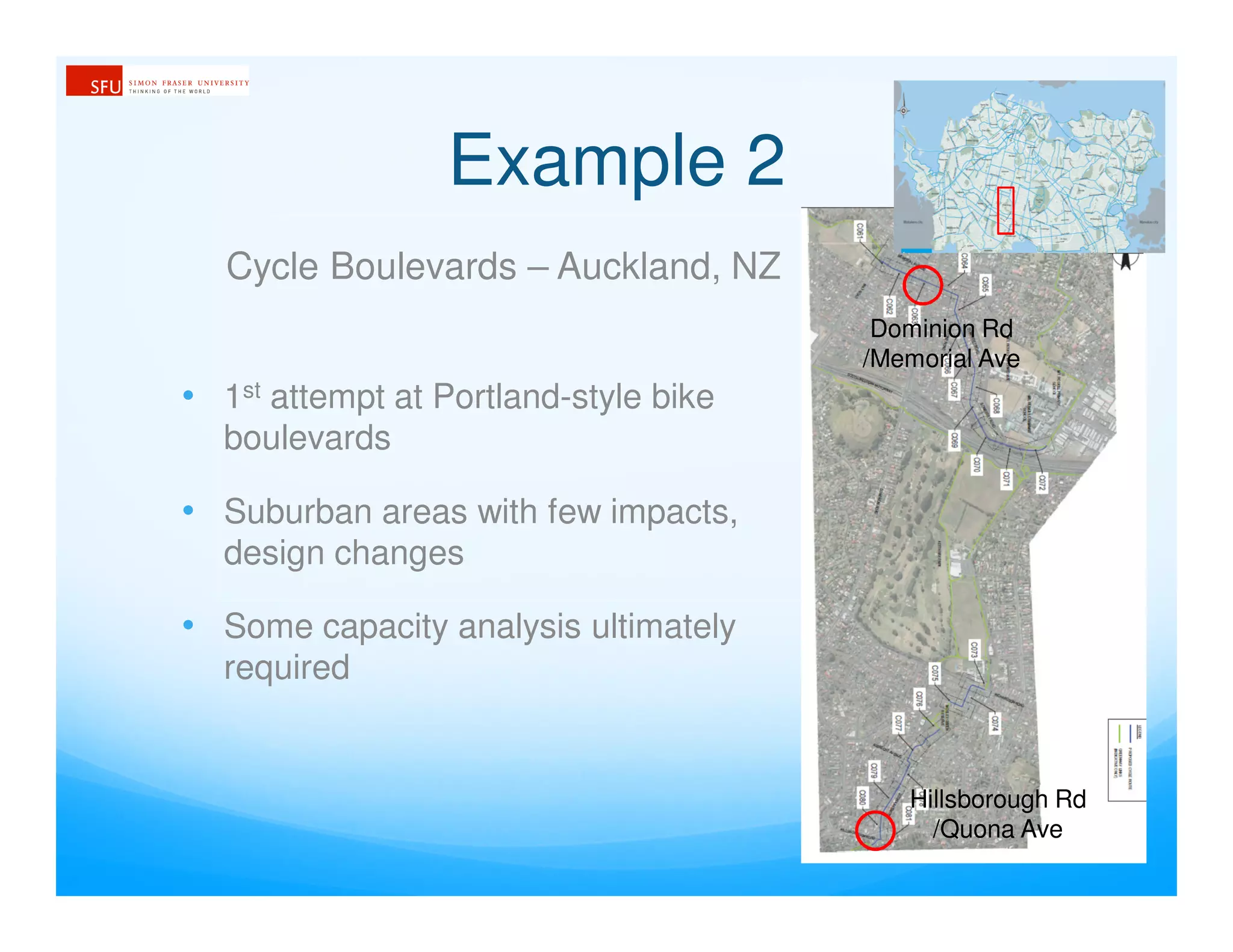
Example 2
Cycle Boulevards – Auckland, NZ
Hillsborough Rd
/Quona Ave
Dominion Rd
/Memorial Ave
• 1st attempt at Portland-style bike
boulevards
• Suburban areas with few impacts,
design changes
• Some capacity analysis ultimately
required
Example 2 – con’t.
Auckland Cycle Boulevards
• Originally rerouted 0.5km to south to new signalized intersection
• Crossing impacts forced into scope
• No adverse impacts – approved
Dominion Rd/Memorial Ave
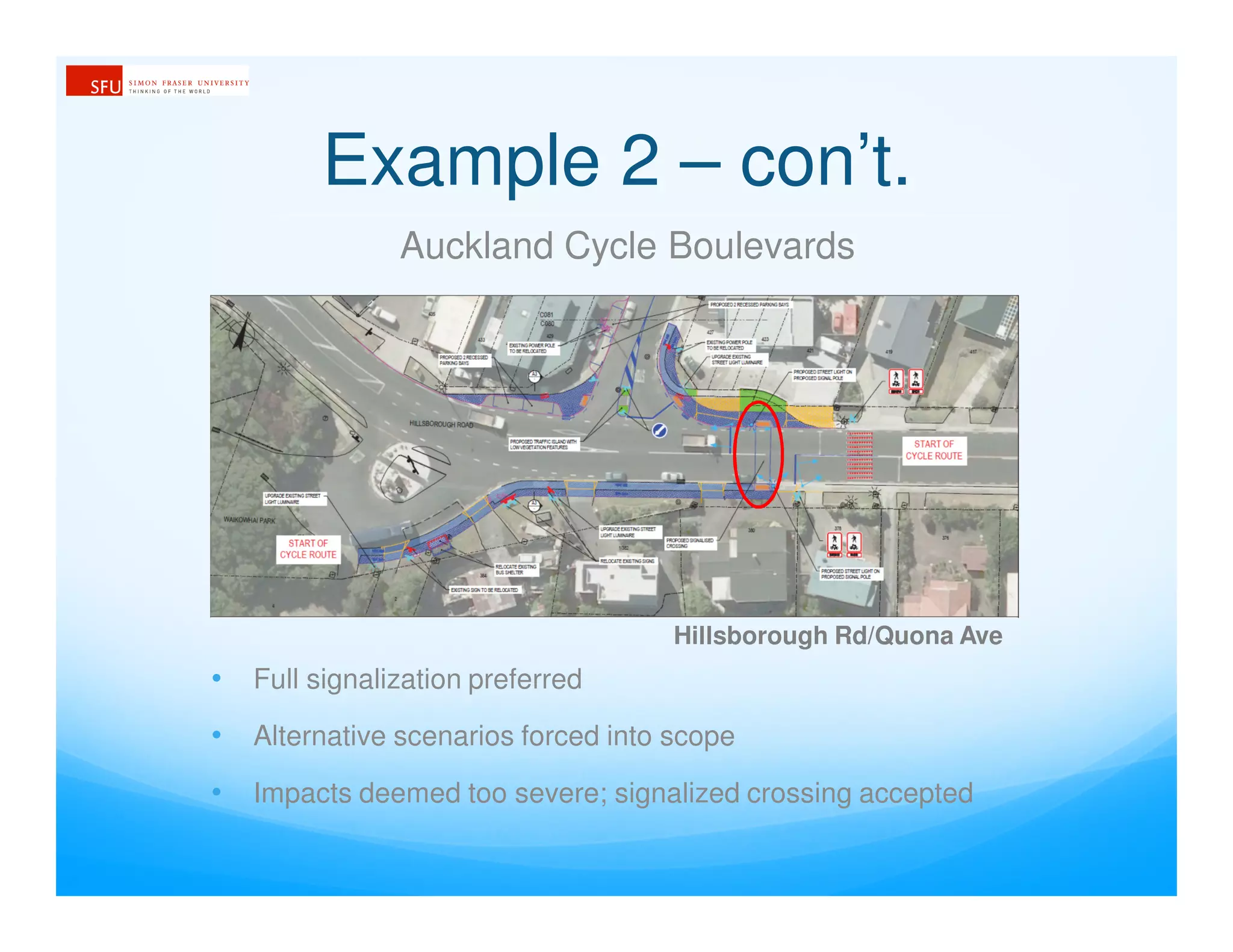
Example 2 – con’t.
Auckland Cycle Boulevards
Hillsborough Rd/Quona Ave
• Full signalization preferred
• Alternative scenarios forced into scope
• Impacts deemed too severe; signalized crossing accepted
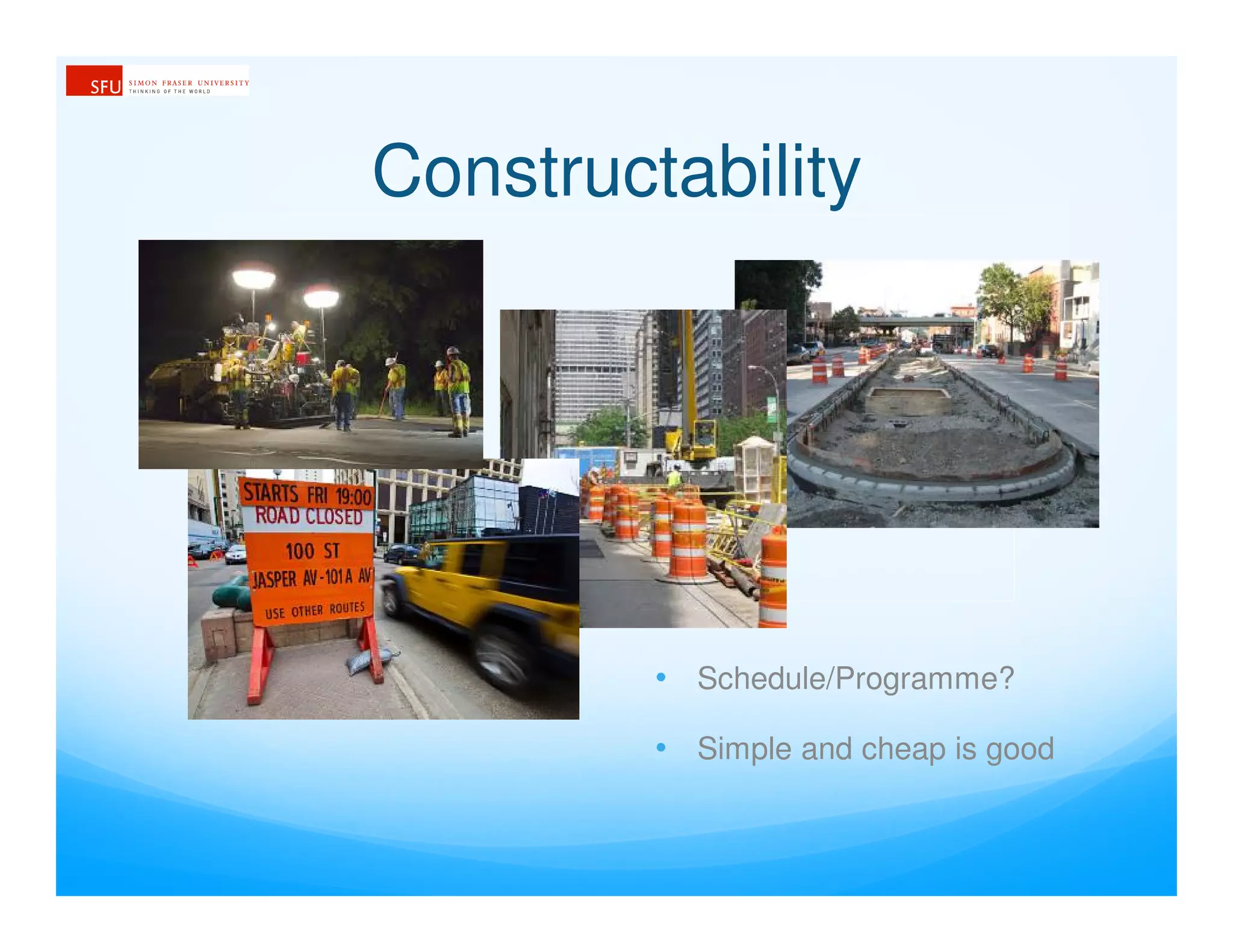
Constructability
• Schedule/Programme?
• Simple and cheap is good
Example 3
Ngahue Drive – Auckland, NZ
New Stonefields
Development
(former quarry)
Auckland Council GIS Viewer
cycling
facilities
cycling
facilities • 1.5km connecting
cycle way
• On strategic
network
• 3m-5m wide
boulevard/berm
next to golf course
• No room for on-
road facilities
Example 3 – con’t.
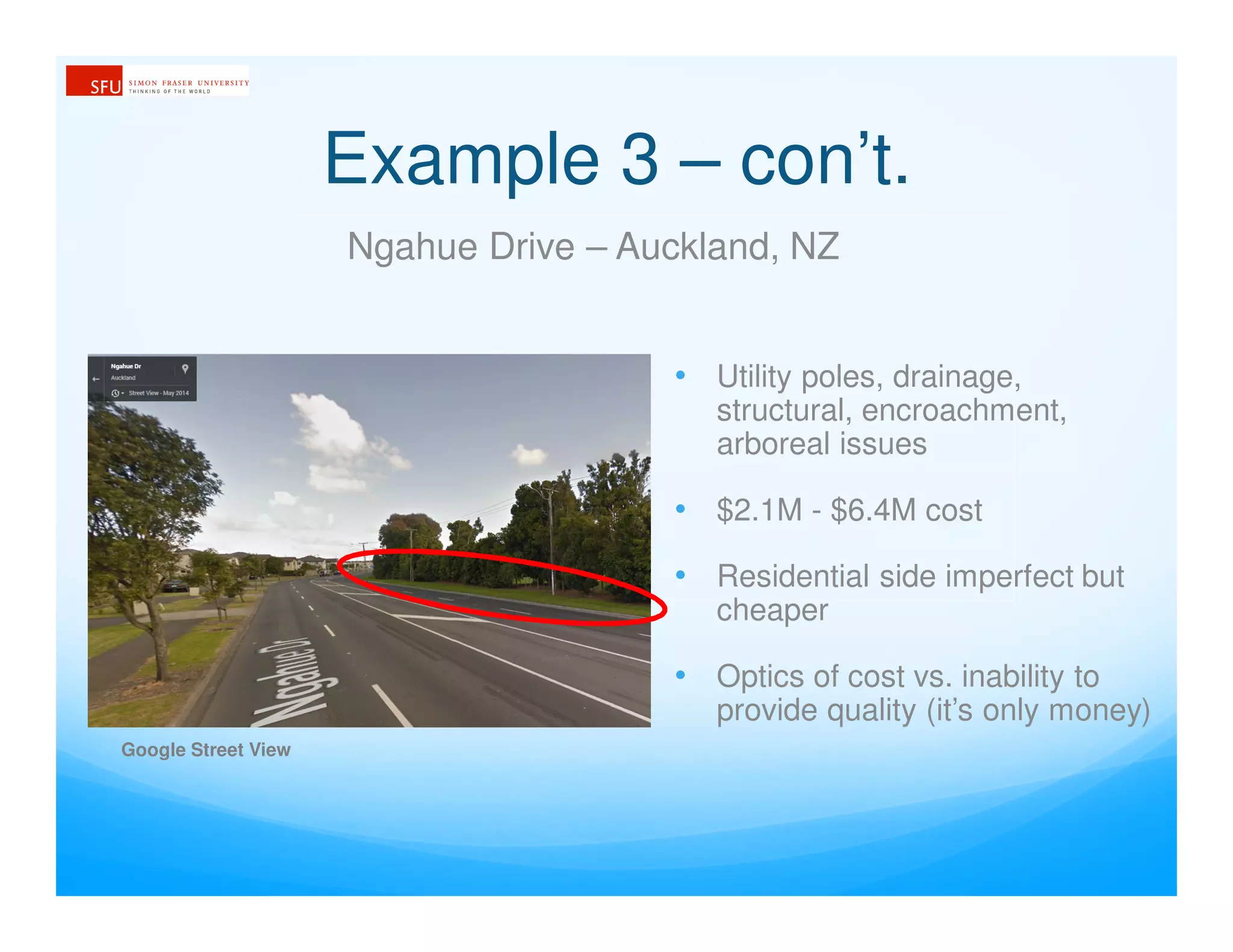
Ngahue Drive – Auckland, NZ
• Utility poles, drainage,
structural, encroachment,
arboreal issues
• $2.1M - $6.4M cost
• Residential side imperfect but
cheaper
• Optics of cost vs. inability to
provide quality (it’s only money)
Google Street View
Example 4
Materials
Auckland, NZ
Fort Street Shared Space
• High-quality redesign
• Full consultation
• NZ$23M for 800m
Jean Batten Place
Before
After
Example 4 – con’t.
Materials
New York, NY
NYCDOT Plaza Program
Pearl St Plaza, Brooklyn
• Concrete, asphalt only
• Local partnerships
• Minimal design, cost
• Potential for staging
Corona Plaza, Queens
Operations and Maintenance
Edmonton Complete Streets Pilot Projects
Design Elements
Example 5
• Sustainability initiative from
Transportation Master Plan
• NACTO-influenced
• Application constraints
- curb build-outs
- lane widths
www.edmonton.ca
Edmonton Complete Streets Pilot Projects
Design Elements
Example 5 – con’t.
Curb Extensions
City of Edmonton –
Complete Streets Guidelines, 2013
Edmonton Complete Streets Pilot Projects
Design Elements
Example 5 – con’t.
City of Edmonton –
Complete Streets Guidelines, 2013
Preferred Lane Widths
Edmonton Complete Streets Pilot Projects
Design Elements
Example 5 – con’t.
Bad for Bulb-outs
Curb Extensions
• No plow equipment for curb
extensions
• Delay until existing fleet is
upgraded
Edmonton Complete Streets Pilot Projects
Design Elements
Example 5 – con’t.
Preferred Lane Widths
Seasonal Road Diet
• ‘Windrow’s reduce curbside widths
• Alberta min. is 4.2m to compensate
• National Ass’n of City Transportation Officials (NACTO)
• Vehicle-Miles Traveled (VMT) over LOS – CEQA
• Multimodal LOS Analyses
• Improved GIS applications
• Data collection techniques
• Social Media outreach
• Tasteful Obstinacy – not new
New-ish Resources
New-ish Resources – con`t
`NYCDOT Current Projects`
http://www.nyc.gov/html/dot/html/about/current-projects.shtml
‘California Senate Bill (SB) 743’
http://leginfo.legislature.ca.gov/faces/billNavClient.xhtml?bill_i
d=201320140SB743
‘Updating Transportation Impacts Analysis in
the CEQA Guidelines’
Summary
• Burden of Proof is on you
• Know your implementation context
• Consider risks during planning
• Challenge engineers
• Build your Business Case
Building a Better Business Case
1. Traffic Impacts
2. Constructability
3. Operations &
Maintenance
• What will happen to traffic?
• Analysis in scope or RFP
• How will this thing be built?
• Timing of construction
• Materials
• Minimum access requirements?
• How will it function?
• Who will maintain?
Burden of proof is on you
THANK YOU
Dan.Ross@opusinternational.ca
Dan Ross - LinkedIn
ca.linkedin.com/pub/dan-ross

Dan Ross NextGen ppt FINAL

  • 1.
    Bridging the Gap Strategiesfor Transit and Active Transportation Next Generation Transportation Certificate
  • 2.
    Happy Projects Stories ofsuccess are often similar. Stories of failure are plentiful, diverse, and entertaining.
  • 3.
    Course Outline 1. Introduction 2.Define Strategies and Skills 3. Positive and Negative Examples Approximately 45 minutes
  • 4.
    Course Presenter Dan Ross,CPEng. (NZ), MUP Senior Transportation Planner, Opus International Consultants, Ltd. North Vancouver, British Columbia, Canada Formerly - Transit Planner – Edmonton Transit System - Senior Transportation Consultant – Opus, Auckland, NZ - Traffic Planner/Borough Planner – New York City DOT - Associate City Planner – New York City DCP
  • 5.
    Why This Topic? Similaritiestowards active transportation and transit Burden of proof is on you - Gatekeepers - Prejudices - Responsive strategies - Different delivery and outcomes
  • 6.
    Why This Topic? HighLevel plans have similar intentions • Higher PT/AT trips • Reduced emissions • Denser development • Translate ‘down’ to specific plans New York, NY Auckland, NZ Vancouver, BC Edmonton, AB
  • 7.
    A Common Path HighLevel Policy Priority Statement Program/Schedule of Projects Feasibility? Planners Engineers Investigation
  • 8.
    Some Success 1st AveComplete Street – New York, NY Dunsmuir St. bike lanes – Vancouver, BC Beach Rd cycle lanes – Auckland, NZ
  • 9.
    Some Success –NYC NYCDOT - Cycle mode increases, not at expense of transit - Fewer crashes, reduced risk
  • 10.
    Other Success Auckland, NZ– North Shore to CBD New Zealand Transport Agency
  • 11.
    Other Success Vancouver, BC Cityof Vancouver Metro Vancouver
  • 12.
  • 13.
  • 14.
    Obstacles – PublicOpposition Bike lanes vs. Parking/Business loss Brooklynpaper.com Chicago Gazette
  • 15.
    Obstacles – PublicOpposition Malcolm MayesElitism/’Social Engineering’ Edmonton Sun NY Daily News The Onion
  • 16.
    Old Perceptions DyingHard ‘Boondoggle’ and Public Menace Double Standard New Zealand Herald, 2007
  • 17.
    Old Perceptions DyingHard Calgary Sun NY Daily News ‘Boondoggle’ and Public Menace Double Standard
  • 18.
    What Could PossiblyGo Wrong? High Level Policy Priority Statement Program/Schedule of Projects Feasibility? Planners Engineers Investigation
  • 19.
    Planners and Engineers PlannersEngineers Responsible for this Responsible for this
  • 20.
    Traffic Engineers Decision MakingFactors • Applied Precedence • Common Sense • Methodology • Ethics • Empathy - for motorists
  • 21.
  • 22.
    Considerations • Design/Engineering StandardsGuidelines • Need for defensible decisions • What’s worked before? Guiding Methodology
  • 23.
    1. Effects onTraffic – short and long term 2. Constructability – how much and where? 3. Whole life costs – operations and maintenance Minimal Considerations
  • 24.
    ‘Business Case’ 1. TrafficImpacts 2. Constructability 3. Operations and Maintenance 4. Other elements to consider
  • 25.
    Traffic Impacts Do Minimum/DoNothing vs. Proposal
  • 26.
    2. What willhappen to affected/displaced traffic? - modelling, route analyses, mode shift? Traffic Impacts Be Prepared to Discuss 1. What is an ‘acceptable’ impact? - i.e., LOS, v/c ratio, peak impacts 3. How many people are affected? Not just cars - Quantify comparative impacts
  • 27.
    Example 1 Broadway Blvd– New York, NY • Road diet for major Manhattan street; 33rd St – 59th St • Not possible without extensive network modelling • Led to Greenlight for Midtown projects • Continuously monitored and updated
  • 28.
    Example 1 –con’t. Broadway Blvd – New York, NY • Willingness to experiment • Reduced capacity impacts verified • Low-cost treatments in short term • Adjustments made with monitoring
  • 29.
    Example 1 –con’t. Broadway Blvd – New York, NY Before After B’way south of 59th St
  • 30.
    Example 1 –con’t. Broadway Blvd – New York, NY Before After Times Square
  • 31.
    Example 2 Cycle Boulevards– Auckland, NZ Hillsborough Rd /Quona Ave Dominion Rd /Memorial Ave • 1st attempt at Portland-style bike boulevards • Suburban areas with few impacts, design changes • Some capacity analysis ultimately required
  • 32.
    Example 2 –con’t. Auckland Cycle Boulevards • Originally rerouted 0.5km to south to new signalized intersection • Crossing impacts forced into scope • No adverse impacts – approved Dominion Rd/Memorial Ave
  • 33.
    Example 2 –con’t. Auckland Cycle Boulevards Hillsborough Rd/Quona Ave • Full signalization preferred • Alternative scenarios forced into scope • Impacts deemed too severe; signalized crossing accepted
  • 34.
  • 35.
    Example 3 Ngahue Drive– Auckland, NZ New Stonefields Development (former quarry) Auckland Council GIS Viewer cycling facilities cycling facilities • 1.5km connecting cycle way • On strategic network • 3m-5m wide boulevard/berm next to golf course • No room for on- road facilities
  • 36.
    Example 3 –con’t. Ngahue Drive – Auckland, NZ • Utility poles, drainage, structural, encroachment, arboreal issues • $2.1M - $6.4M cost • Residential side imperfect but cheaper • Optics of cost vs. inability to provide quality (it’s only money) Google Street View
  • 37.
    Example 4 Materials Auckland, NZ FortStreet Shared Space • High-quality redesign • Full consultation • NZ$23M for 800m Jean Batten Place Before After
  • 38.
    Example 4 –con’t. Materials New York, NY NYCDOT Plaza Program Pearl St Plaza, Brooklyn • Concrete, asphalt only • Local partnerships • Minimal design, cost • Potential for staging Corona Plaza, Queens
  • 39.
  • 40.
    Edmonton Complete StreetsPilot Projects Design Elements Example 5 • Sustainability initiative from Transportation Master Plan • NACTO-influenced • Application constraints - curb build-outs - lane widths www.edmonton.ca
  • 41.
    Edmonton Complete StreetsPilot Projects Design Elements Example 5 – con’t. Curb Extensions City of Edmonton – Complete Streets Guidelines, 2013
  • 42.
    Edmonton Complete StreetsPilot Projects Design Elements Example 5 – con’t. City of Edmonton – Complete Streets Guidelines, 2013 Preferred Lane Widths
  • 43.
    Edmonton Complete StreetsPilot Projects Design Elements Example 5 – con’t. Bad for Bulb-outs Curb Extensions • No plow equipment for curb extensions • Delay until existing fleet is upgraded
  • 44.
    Edmonton Complete StreetsPilot Projects Design Elements Example 5 – con’t. Preferred Lane Widths Seasonal Road Diet • ‘Windrow’s reduce curbside widths • Alberta min. is 4.2m to compensate
  • 45.
    • National Ass’nof City Transportation Officials (NACTO) • Vehicle-Miles Traveled (VMT) over LOS – CEQA • Multimodal LOS Analyses • Improved GIS applications • Data collection techniques • Social Media outreach • Tasteful Obstinacy – not new New-ish Resources
  • 46.
    New-ish Resources –con`t `NYCDOT Current Projects` http://www.nyc.gov/html/dot/html/about/current-projects.shtml ‘California Senate Bill (SB) 743’ http://leginfo.legislature.ca.gov/faces/billNavClient.xhtml?bill_i d=201320140SB743 ‘Updating Transportation Impacts Analysis in the CEQA Guidelines’
  • 47.
    Summary • Burden ofProof is on you • Know your implementation context • Consider risks during planning • Challenge engineers • Build your Business Case
  • 48.
    Building a BetterBusiness Case 1. Traffic Impacts 2. Constructability 3. Operations & Maintenance • What will happen to traffic? • Analysis in scope or RFP • How will this thing be built? • Timing of construction • Materials • Minimum access requirements? • How will it function? • Who will maintain? Burden of proof is on you
  • 49.
    THANK YOU Dan.Ross@opusinternational.ca Dan Ross- LinkedIn ca.linkedin.com/pub/dan-ross