ISEOR / Academy of Management - June 2010© 2010 Baugh, Hallcom, & Harris1Changes that make a difference: Attaining a PhD while maintaining an active life.Research Team & AuthorsJoseph B. Baugh, PhD, PMPUniversity of Arizona SouthAnne Saber-Hallcom, PhDCapella UniversityMarilyn E. Harris, PhDCapella University
ISEOR / Academy of Management - June 2010© 2010 Baugh, Hallcom, & Harris2AgendaIntroductionThe Research QuestionsThe StudyAnalyzing the DataFindingsRecommendationsKey TakeawaysQuestions2
The Research QuestionsWhat are the forces and conditions that facilitate the doctoral journey?What are the forces and conditions that constrain or block the doctoral journey?How did these forces affect doctoral journeys across the study population?ISEOR / Academy of Management - June 2010© 2010 Baugh, Hallcom, & Harris3
The StudyApplied research using mixed methodology questionnaire delivered over the InternetDemographic data, primarily quantitativeOpen-ended questions explored lived experiences (Denzin, 2001) of study participantsPurposeful sampling best suited for studyTwo primary study populations drawn from six different PhD awarding institutionsRecent PhD graduatesDoctoral learners at various stages along the journeyUsed branching logic to examine experiences common to both groups and singular to each group.ISEOR / Academy of Management - June 2010© 2010 Baugh, Hallcom, & Harris4
Analyzing the DataBased on Lewin’s (1951) seminal work in field theory as modified by Cronshaw and McCulloch (2008) to map findings to three field conditionsFacilitatingConstraining BlockingUsed Atlas.ti® as the Qualitative Data Analysis Software [QDAS] package to facilitate:Organization, tracking, management, and analyses of the data for emerging themes and patterns (Baugh, Hallcom & Harris, 2009)ISEOR / Academy of Management - June 2010© 2010 Baugh, Hallcom, & Harris5
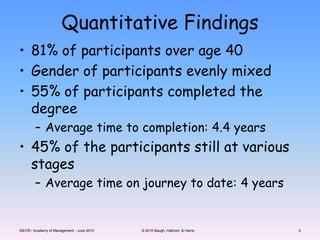
Quantitative Findings81% of participants over age 40Gender of participants evenly mixed55% of participants completed the degreeAverage time to completion: 4.4 years45% of the participants still at various stagesAverage time on journey to date: 4 yearsISEOR / Academy of Management - June 2010© 2010 Baugh, Hallcom, & Harris6
Qualitative FindingsISEOR / Academy of Management - June 2010© 2010 Baugh, Hallcom, & Harris7
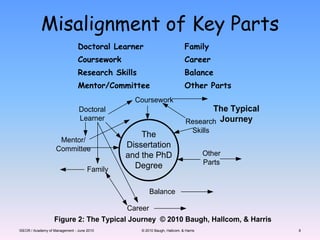
Misalignment of Key PartsISEOR / Academy of Management - June 2010© 2010 Baugh, Hallcom, & Harris8
ISEOR / Academy of Management - June 2010© 2010 Baugh, Hallcom, & Harris9Key TakeawaysHow can PhD students accomplish this seemingly conflicting goal?Get a running start by being prepared for the doctoral journeyDevelop time management skills 	Align the purposeful partsUnderstand individual reasoning for pursuing the degreeSeek support sources from peers, family, friends.Seek a compatible mentor and committeeMinimize distractions and focus on the goal
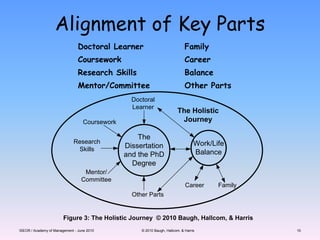
Alignment of Key PartsISEOR / Academy of Management - June 2010© 2010 Baugh, Hallcom, & Harris10
RecommendationsA transformative change is required, building on Gharajedaghi (2006) and Harris, Becker, Hallcom, and Ponschock (2008):Learn to Be DoctoralDevelop a better understanding of the purpose and intent of individual rationales  for attaining the PhDLearn to Learn in a Scholarly MannerUse coursework to learn active research practices and develop necessary research skillsLearn to Do Applied ResearchImprove data collection, analysis, and  reporting skills.Enforce visibility on the goal Focus on feasible milestones, make suitable progressSeek work/life balance along the entire journeyDegree  FamilyCareerISEOR / Academy of Management - June 2010© 2010 Baugh, Hallcom, & Harris11
ISEOR / Academy of Management - June 2010© 2010 Baugh, Hallcom, & Harris12Questions
ISEOR / Academy of Management - June 2010© 2010 Baugh, Hallcom, & Harris13ReferencesBaugh, J. B., Hallcom, A. S, & Harris, M. E. (2009). Computer assisted qualitative data analysis software: A practical perspective for applied research. Proceedings from the 2009 ISEOR - Academy of Management International Conference and Doctoral Consortium on Social Responsibility and Corporate Environmental Evaluation Indicators (Vol. 1, pp. 173-182). Lyon France, June 2009.Cronshaw, S. F., & McCulloch, A. N. A. (2008, Winter). Reinstating the Lewinian vision: From force field analysis to organizational field assessment. Organization Development Journal, 26(4), 89-103.Denzin, N. K. (2001). Interpretive interactionism (2nd ed.). Thousand Oaks, CA: Sage.Gharajedaghi, J. (2006). Systems thinking: Managing chaos and complexity: (2nd ed.). Burlington, MA: Elsevier.Harris, M. E., Becker, G. F., Hallcom, A. S., & Ponschock, R. L. (2008). Mastering a New Paradigm in Management Consulting (2nd ed.).  Petoskey, MI: Createspace.Lewin, K. (1951). Field theory in social sciences: Selected theoretical papers. D. Cartwright, Ed., New York, NY: Harper & Brothers.13

Iseor Ao M Earning Ph D June2010

  • 1.
    ISEOR / Academyof Management - June 2010© 2010 Baugh, Hallcom, & Harris1Changes that make a difference: Attaining a PhD while maintaining an active life.Research Team & AuthorsJoseph B. Baugh, PhD, PMPUniversity of Arizona SouthAnne Saber-Hallcom, PhDCapella UniversityMarilyn E. Harris, PhDCapella University
  • 2.
    ISEOR / Academyof Management - June 2010© 2010 Baugh, Hallcom, & Harris2AgendaIntroductionThe Research QuestionsThe StudyAnalyzing the DataFindingsRecommendationsKey TakeawaysQuestions2
  • 3.
    The Research QuestionsWhatare the forces and conditions that facilitate the doctoral journey?What are the forces and conditions that constrain or block the doctoral journey?How did these forces affect doctoral journeys across the study population?ISEOR / Academy of Management - June 2010© 2010 Baugh, Hallcom, & Harris3
  • 4.
    The StudyApplied researchusing mixed methodology questionnaire delivered over the InternetDemographic data, primarily quantitativeOpen-ended questions explored lived experiences (Denzin, 2001) of study participantsPurposeful sampling best suited for studyTwo primary study populations drawn from six different PhD awarding institutionsRecent PhD graduatesDoctoral learners at various stages along the journeyUsed branching logic to examine experiences common to both groups and singular to each group.ISEOR / Academy of Management - June 2010© 2010 Baugh, Hallcom, & Harris4
  • 5.
    Analyzing the DataBasedon Lewin’s (1951) seminal work in field theory as modified by Cronshaw and McCulloch (2008) to map findings to three field conditionsFacilitatingConstraining BlockingUsed Atlas.ti® as the Qualitative Data Analysis Software [QDAS] package to facilitate:Organization, tracking, management, and analyses of the data for emerging themes and patterns (Baugh, Hallcom & Harris, 2009)ISEOR / Academy of Management - June 2010© 2010 Baugh, Hallcom, & Harris5
  • 6.
    Quantitative Findings81% ofparticipants over age 40Gender of participants evenly mixed55% of participants completed the degreeAverage time to completion: 4.4 years45% of the participants still at various stagesAverage time on journey to date: 4 yearsISEOR / Academy of Management - June 2010© 2010 Baugh, Hallcom, & Harris6
  • 7.
    Qualitative FindingsISEOR /Academy of Management - June 2010© 2010 Baugh, Hallcom, & Harris7
  • 8.
    Misalignment of KeyPartsISEOR / Academy of Management - June 2010© 2010 Baugh, Hallcom, & Harris8
  • 9.
    ISEOR / Academyof Management - June 2010© 2010 Baugh, Hallcom, & Harris9Key TakeawaysHow can PhD students accomplish this seemingly conflicting goal?Get a running start by being prepared for the doctoral journeyDevelop time management skills Align the purposeful partsUnderstand individual reasoning for pursuing the degreeSeek support sources from peers, family, friends.Seek a compatible mentor and committeeMinimize distractions and focus on the goal
  • 10.
    Alignment of KeyPartsISEOR / Academy of Management - June 2010© 2010 Baugh, Hallcom, & Harris10
  • 11.
    RecommendationsA transformative changeis required, building on Gharajedaghi (2006) and Harris, Becker, Hallcom, and Ponschock (2008):Learn to Be DoctoralDevelop a better understanding of the purpose and intent of individual rationales for attaining the PhDLearn to Learn in a Scholarly MannerUse coursework to learn active research practices and develop necessary research skillsLearn to Do Applied ResearchImprove data collection, analysis, and reporting skills.Enforce visibility on the goal Focus on feasible milestones, make suitable progressSeek work/life balance along the entire journeyDegree FamilyCareerISEOR / Academy of Management - June 2010© 2010 Baugh, Hallcom, & Harris11
  • 12.
    ISEOR / Academyof Management - June 2010© 2010 Baugh, Hallcom, & Harris12Questions
  • 13.
    ISEOR / Academyof Management - June 2010© 2010 Baugh, Hallcom, & Harris13ReferencesBaugh, J. B., Hallcom, A. S, & Harris, M. E. (2009). Computer assisted qualitative data analysis software: A practical perspective for applied research. Proceedings from the 2009 ISEOR - Academy of Management International Conference and Doctoral Consortium on Social Responsibility and Corporate Environmental Evaluation Indicators (Vol. 1, pp. 173-182). Lyon France, June 2009.Cronshaw, S. F., & McCulloch, A. N. A. (2008, Winter). Reinstating the Lewinian vision: From force field analysis to organizational field assessment. Organization Development Journal, 26(4), 89-103.Denzin, N. K. (2001). Interpretive interactionism (2nd ed.). Thousand Oaks, CA: Sage.Gharajedaghi, J. (2006). Systems thinking: Managing chaos and complexity: (2nd ed.). Burlington, MA: Elsevier.Harris, M. E., Becker, G. F., Hallcom, A. S., & Ponschock, R. L. (2008). Mastering a New Paradigm in Management Consulting (2nd ed.). Petoskey, MI: Createspace.Lewin, K. (1951). Field theory in social sciences: Selected theoretical papers. D. Cartwright, Ed., New York, NY: Harper & Brothers.13