Conceptualizing Education Faculty Development for Hospital-Based Faculty Elisabeth E. Bennett, PhD Director, Education Research and Development, Baystate Health Assistant Professor, Tufts University School of Medicine [email_address]
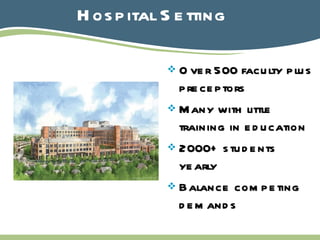
Hospital Setting Over 500 faculty plus preceptors Many with little training in education 2000+ students yearly Balance competing demands
Purpose & Perspective Purpose : To support advancement of knowledge and innovative approaches to the preparation of tomorrow’s healthcare professionals through the development of faculty expertise in clinical education and educational research Perspective : Jolly (2002) suggests medical education faculty development has been  overly focused on   teaching skills   for ‘old curricula.’  New thinking is needed to manage dramatic changes on the horizon
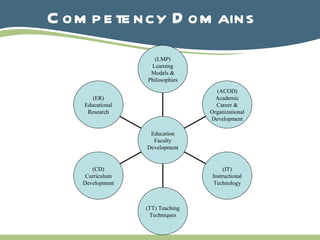
Competency Domains (ER) Educational Research (CD) Curriculum Development (TT) Teaching Techniques (IT) Instructional Technology (ACOD) Academic Career & Organizational Development (LMP) Learning Models & Philosophies Education Faculty Development
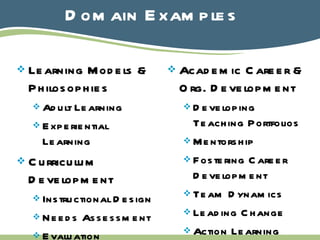
Domain Examples Learning Models & Philosophies Adult Learning Experiential Learning Curriculum Development Instructional Design Needs Assessment Evaluation  Academic Career & Org. Development Developing Teaching Portfolios Mentorship Fostering Career Development Team Dynamics Leading Change Action Learning
Faculty Development Survey (N=104) Constructs were initially validated across disciplines and professions Few respondents provided topical ideas Nearly all qualitative comments fell within the constructs. Two comments were not education related
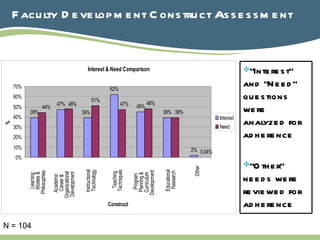
Faculty Development Construct Assessment N = 104 “ Interest” and “Need” questions were analyzed for adherence “ Other” needs were reviewed for adherence
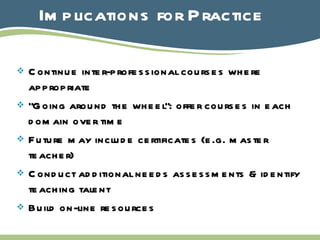
Implications for Practice Continue inter-professional courses where appropriate “ Going around the wheel”: offer courses in each domain over time Future may include certificates (e.g. master teacher) Conduct additional needs assessments & identify teaching talent Build on-line resources
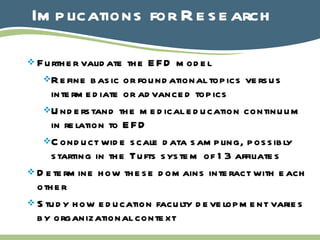
Implications for Research Further validate the EFD model Refine basic or foundational topics versus intermediate or advanced topics Understand the medical education continuum in relation to EFD Conduct wide scale data sampling, possibly starting in the Tufts system of 13 affiliates Determine how these domains interact with each other Study how education faculty development varies by organizational context
Reference Jolly, Brian. C. (2002). Faculty development for curricular implementation. In G. R. Norman, C P. M. van der Vleuten, & D. I Newble (Eds.),  International handbook of research in medical education . Dordercht, The Netherlands: Kluwer Academic Publishers.

Conceptualizing Education Faculty Development

  • 1.
    Conceptualizing Education FacultyDevelopment for Hospital-Based Faculty Elisabeth E. Bennett, PhD Director, Education Research and Development, Baystate Health Assistant Professor, Tufts University School of Medicine [email_address]
  • 2.
    Hospital Setting Over500 faculty plus preceptors Many with little training in education 2000+ students yearly Balance competing demands
  • 3.
    Purpose & PerspectivePurpose : To support advancement of knowledge and innovative approaches to the preparation of tomorrow’s healthcare professionals through the development of faculty expertise in clinical education and educational research Perspective : Jolly (2002) suggests medical education faculty development has been overly focused on teaching skills for ‘old curricula.’ New thinking is needed to manage dramatic changes on the horizon
  • 4.
    Competency Domains (ER)Educational Research (CD) Curriculum Development (TT) Teaching Techniques (IT) Instructional Technology (ACOD) Academic Career & Organizational Development (LMP) Learning Models & Philosophies Education Faculty Development
  • 5.
    Domain Examples LearningModels & Philosophies Adult Learning Experiential Learning Curriculum Development Instructional Design Needs Assessment Evaluation Academic Career & Org. Development Developing Teaching Portfolios Mentorship Fostering Career Development Team Dynamics Leading Change Action Learning
  • 6.
    Faculty Development Survey(N=104) Constructs were initially validated across disciplines and professions Few respondents provided topical ideas Nearly all qualitative comments fell within the constructs. Two comments were not education related
  • 7.
    Faculty Development ConstructAssessment N = 104 “ Interest” and “Need” questions were analyzed for adherence “ Other” needs were reviewed for adherence
  • 8.
    Implications for PracticeContinue inter-professional courses where appropriate “ Going around the wheel”: offer courses in each domain over time Future may include certificates (e.g. master teacher) Conduct additional needs assessments & identify teaching talent Build on-line resources
  • 9.
    Implications for ResearchFurther validate the EFD model Refine basic or foundational topics versus intermediate or advanced topics Understand the medical education continuum in relation to EFD Conduct wide scale data sampling, possibly starting in the Tufts system of 13 affiliates Determine how these domains interact with each other Study how education faculty development varies by organizational context
  • 10.
    Reference Jolly, Brian.C. (2002). Faculty development for curricular implementation. In G. R. Norman, C P. M. van der Vleuten, & D. I Newble (Eds.), International handbook of research in medical education . Dordercht, The Netherlands: Kluwer Academic Publishers.