Sharing, Reproducibility, Replication – AN NIH View
ACS National Meeting
March 24, 2015
Philip E. Bourne, PhD, FAMCI
Associate Director for Data Science, NIH
Department of Health and Human Services
With Thanks to Larry Tabak 1
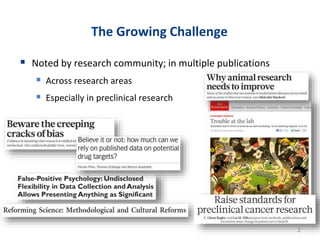
The Growing Challenge
 Noted by research community; in multiple publications
 Across research areas
 Especially in preclinical research
2
Challenges to Ensuring Rigor and Transparency
in Reporting Science: Additional Contributors
 Insufficient Reporting
 “P-Hacking”
 Lack of Consideration of Sex as a Biological Variable
3
Challenges to Ensuring Rigor and Transparency
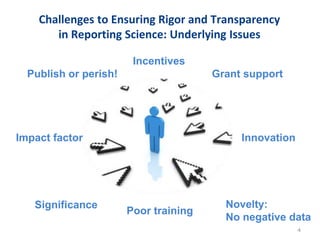
in Reporting Science: Underlying Issues
4
Publish or perish! Grant support
Impact factor Innovation
Significance Novelty:
No negative data
Poor training
Incentives
5
Principles for Addressing the
Underlying Issues
 Raise community awareness
 Enhance formal training
 Protect the quality of funded and published research
by adoption of more systematic review processes
 Increase stability for investigators
6
Addressing Underlying Issues:
Raise Community Awareness
 Workshop in June 2014 with Journal Editors to
identify common opportunity areas
 Workshop in July 2014 with PhRMA to identify areas
of common interest with industry
 Obtained input on barriers to reproducibility re:
research reagents
 Meetings with professional societies and institutions
7
Addressing Underlying Issues:
Raise Community Awareness
 Over 130 journals endorsed the principles, which were
broadly shared in November 2014 through editorials and
other notifications
8http://nih.gov/about/endorsing-jounals.htm
Addressing Underlying Issues:
Trans-NIH Pilots
9
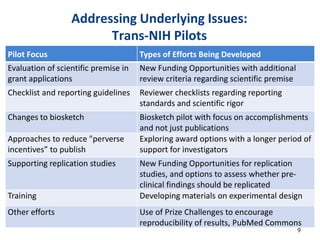
Pilot Focus Types of Efforts Being Developed
Evaluation of scientific premise in
grant applications
New Funding Opportunities with additional
review criteria regarding scientific premise
Checklist and reporting guidelines Reviewer checklists regarding reporting
standards and scientific rigor
Changes to biosketch Biosketch pilot with focus on accomplishments
and not just publications
Approaches to reduce "perverse
incentives” to publish
Exploring award options with a longer period of
support for investigators
Supporting replication studies New Funding Opportunities for replication
studies, and options to assess whether pre-
clinical findings should be replicated
Training Developing materials on experimental design
Other efforts Use of Prize Challenges to encourage
reproducibility of results, PubMed Commons
http://www.ncbi.nlm.nih.gov/pubmedcommons/
Addressing Underlying Issues:
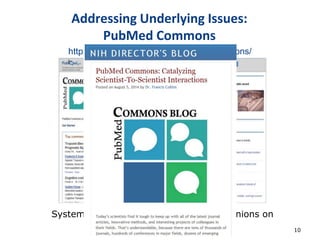
PubMed Commons
10
System allowing researchers to share opinions on
publications indexed by PubMed
Issues Specific to Data Science
11
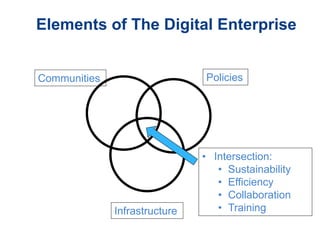
Elements of The Digital Enterprise
Communities Policies
Infrastructure
• Intersection:
• Sustainability
• Efficiency
• Collaboration
• Training
Policies: Now & Forthcoming
 Data Sharing
 Genomic data sharing announced
 Data sharing plans on all research awards
 Data sharing plan enforcement
 Machine readable plan
 Repository requirements to include grant
numbers
http://www.nih.gov/news/health/aug2014/od-27.htm
Policies - Forthcoming
 Data Citation
 Goal: legitimize data as a form of scholarship
 Process:
 Machine readable standard for data citation (done)
 Endorsement of data citation for inclusion in NIH bib
sketch, grants, reports, etc.
 Example formats for human readable data citations
 Slowly work into NLM/NCBI workflow
 dbGaP in the cloud (soon!)
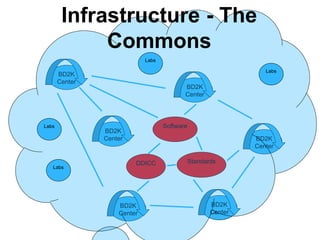
BD2K
Center
BD2K
Center
BD2K
Center
BD2K
Center
BD2K
Center
BD2K
Center
DDICC
Software
Standards
Infrastructure - The
Commons
Labs
Labs
Labs
Labs
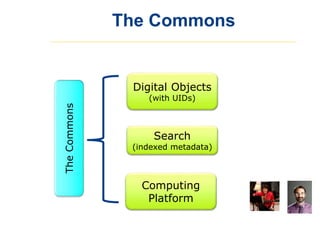
The Commons
Digital Objects
(with UIDs)
Search
(indexed metadata)
Computing
Platform
TheCommons
Vivien Bonazzi
George Komatsoulis
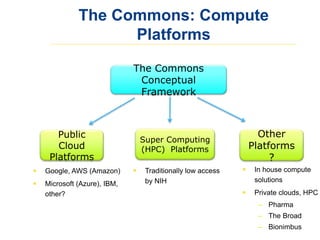
The Commons: Compute
Platforms
The Commons
Conceptual
Framework
Public
Cloud
Platforms
Super Computing
(HPC) Platforms
Other
Platforms
?
 Google, AWS (Amazon)
 Microsoft (Azure), IBM,
other?
 In house compute
solutions
 Private clouds, HPC
– Pharma
– The Broad
– Bionimbus
 Traditionally low access
by NIH
The Commons:
Business Model
[George Komatsoulis]
NIH…
Turning Discovery Into Health
philip.bourne@nih.gov

Sharing, Reproducibility, Replication – AN NIH View

  • 1.
    Sharing, Reproducibility, Replication– AN NIH View ACS National Meeting March 24, 2015 Philip E. Bourne, PhD, FAMCI Associate Director for Data Science, NIH Department of Health and Human Services With Thanks to Larry Tabak 1
  • 2.
    The Growing Challenge Noted by research community; in multiple publications  Across research areas  Especially in preclinical research 2
  • 3.
    Challenges to EnsuringRigor and Transparency in Reporting Science: Additional Contributors  Insufficient Reporting  “P-Hacking”  Lack of Consideration of Sex as a Biological Variable 3
  • 4.
    Challenges to EnsuringRigor and Transparency in Reporting Science: Underlying Issues 4 Publish or perish! Grant support Impact factor Innovation Significance Novelty: No negative data Poor training Incentives
  • 5.
  • 6.
    Principles for Addressingthe Underlying Issues  Raise community awareness  Enhance formal training  Protect the quality of funded and published research by adoption of more systematic review processes  Increase stability for investigators 6
  • 7.
    Addressing Underlying Issues: RaiseCommunity Awareness  Workshop in June 2014 with Journal Editors to identify common opportunity areas  Workshop in July 2014 with PhRMA to identify areas of common interest with industry  Obtained input on barriers to reproducibility re: research reagents  Meetings with professional societies and institutions 7
  • 8.
    Addressing Underlying Issues: RaiseCommunity Awareness  Over 130 journals endorsed the principles, which were broadly shared in November 2014 through editorials and other notifications 8http://nih.gov/about/endorsing-jounals.htm
  • 9.
    Addressing Underlying Issues: Trans-NIHPilots 9 Pilot Focus Types of Efforts Being Developed Evaluation of scientific premise in grant applications New Funding Opportunities with additional review criteria regarding scientific premise Checklist and reporting guidelines Reviewer checklists regarding reporting standards and scientific rigor Changes to biosketch Biosketch pilot with focus on accomplishments and not just publications Approaches to reduce "perverse incentives” to publish Exploring award options with a longer period of support for investigators Supporting replication studies New Funding Opportunities for replication studies, and options to assess whether pre- clinical findings should be replicated Training Developing materials on experimental design Other efforts Use of Prize Challenges to encourage reproducibility of results, PubMed Commons
  • 10.
    http://www.ncbi.nlm.nih.gov/pubmedcommons/ Addressing Underlying Issues: PubMedCommons 10 System allowing researchers to share opinions on publications indexed by PubMed
  • 11.
    Issues Specific toData Science 11
  • 12.
    Elements of TheDigital Enterprise Communities Policies Infrastructure • Intersection: • Sustainability • Efficiency • Collaboration • Training
  • 13.
    Policies: Now &Forthcoming  Data Sharing  Genomic data sharing announced  Data sharing plans on all research awards  Data sharing plan enforcement  Machine readable plan  Repository requirements to include grant numbers http://www.nih.gov/news/health/aug2014/od-27.htm
  • 14.
    Policies - Forthcoming Data Citation  Goal: legitimize data as a form of scholarship  Process:  Machine readable standard for data citation (done)  Endorsement of data citation for inclusion in NIH bib sketch, grants, reports, etc.  Example formats for human readable data citations  Slowly work into NLM/NCBI workflow  dbGaP in the cloud (soon!)
  • 15.
  • 16.
    The Commons Digital Objects (withUIDs) Search (indexed metadata) Computing Platform TheCommons Vivien Bonazzi George Komatsoulis
  • 17.
    The Commons: Compute Platforms TheCommons Conceptual Framework Public Cloud Platforms Super Computing (HPC) Platforms Other Platforms ?  Google, AWS (Amazon)  Microsoft (Azure), IBM, other?  In house compute solutions  Private clouds, HPC – Pharma – The Broad – Bionimbus  Traditionally low access by NIH
  • 18.
  • 19.
    NIH… Turning Discovery IntoHealth philip.bourne@nih.gov